


A double sum is a series having terms depending on two indices,
 | (1) |
A finite double series can be written as a product of series
 |  |  | (2) |
 |  |  | (3) |
 |  | 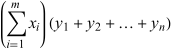 | (4) |
 |  | 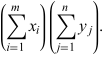 | (5) |
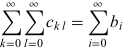
An infinite double series can be written in terms of a single series
 | (6) |
by reordering as follows,
 |  |  | (7) |
 |  |  | (8) |
 |  |  | (9) |
 |  |  | (10) |
Many examples exists of simple double series that cannot be computed analytically, such as the Erdős-Borwein constant
 |  |  | (11) |
 |  |  | (12) |
 |  | 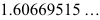 | (13) |
(OEIS A065442), where  is a q-polygamma function.
Another series is
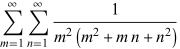 |  | 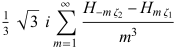 | (14) |
 |  |  | (15) |
(OEIS A091349), where  is a harmonic number and
  is a cube root of unity.
A double series that can be done analytically is given by
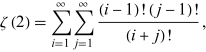 | (16) |
where  is the Riemann zeta function zeta(2) (B. Cloitre, pers. comm., Dec. 9, 2004).
The double series
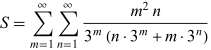 | (17) |
can be evaluated by interchanging  and
and  and averaging,
 |  | ![1/2[sum_(m=1)^(infty)sum_(n=1)^(infty)(m^2n)/(3^m(n·3^m+m·3^n))+sum_(m=1)^(infty)sum_(n=1)^(infty)(n^2m)/(3^n(n·3^m+m·3^n))]](https://mathworld.wolfram.com/images/equations/DoubleSeries/Inline48.svg) | (18) |
 |  | 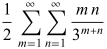 | (19) |
 |  |  | (20) |
 |  |  | (21) |
(Borwein et al. 2004, p. 54).
Identities involving double sums include the following:
 | (22) |
where
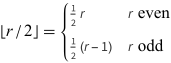 | (23) |
is the floor function, and
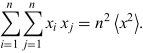 | (24) |
Consider the series
 | (25) |
over binary quadratic forms, where the prime indicates that summation occurs over all pairs of  and
and  but excludes the term
 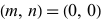 . If
. If  can be decomposed into a linear sum of products of Dirichlet L-series, it is said to be solvable. The related sums
 |  | 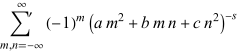 | (26) |
 |  | 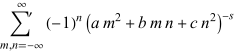 | (27) |
 |  | 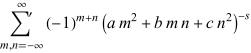 | (28) |
can also be defined, which gives rise to such impressive formulas as
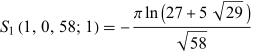 | (29) |
(Glasser and Zucker 1980). A complete table of the principal solutions of all solvable  is given in Glasser and Zucker (1980, pp. 126-131).
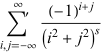
The lattice sum  can be separated into two pieces,
 |  |  | (30) |
 |  |  | (31) |
 |  | ![4[sum_(i,j=1)^(infty)((-1)^(i+j))/((i^2+j^2)^s)+sum_(i=1)^(infty)((-1)^i)/(i^(2s))]](https://mathworld.wolfram.com/images/equations/DoubleSeries/Inline81.svg) | (32) |
 |  | ![4[sum_(i,j=1)^(infty)((-1)^(i+j))/((i^2+j^2)^s)-eta(2s)],](https://mathworld.wolfram.com/images/equations/DoubleSeries/Inline84.svg) | (33) |
where  is the Dirichlet eta function. Using the analytic form of the lattice sum
 |  |  | (34) |
 |  | ![4[S_(1,2)(1,0,1;s)-eta(2s)],](https://mathworld.wolfram.com/images/equations/DoubleSeries/Inline91.svg) | (35) |
where  is the Dirichlet beta function gives the sum
 |  |  | (36) |
 |  |  | (37) |
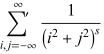
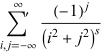
Borwein and Borwein (1987, p. 291) show that for ![R[s]>1](https://mathworld.wolfram.com/images/equations/DoubleSeries/Inline99.svg) ,
,
 |  |  | (38) |
 |  |  | (39) |
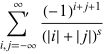
where  is the Riemann zeta function, and for appropriate
  ,
,
 |  |  | (40) |
 |  |  | (41) |
 |  |  | (42) |
 |  |  | (43) |
 |  |  | (44) |
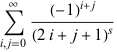 |  |  | (45) |
(Borwein and Borwein 1987, p. 305).
Another double series reduction is given by
![sum_(m,n=-infty)^infty(F(|2m+2n+1|))/(cosh[(2n+1)u]cosh(2nu))=2sum_(n=0)^infty((2n+1)F(2n+1))/(sinh[(2n+1)u]),](https://mathworld.wolfram.com/images/equations/DoubleSeries/NumberedEquation10.svg) | (46) |
where  denotes any function (Glasser 1974).

 -Series." J. Phys. A: Math. Gen. 9, 1207-1214, 1976a.Zucker, I. J. and Robertson, M. M. "A Systematic Approach to the Evaluation of
  ." J. Phys. A: Math. Gen. 9, 1215-1225, 1976b.