


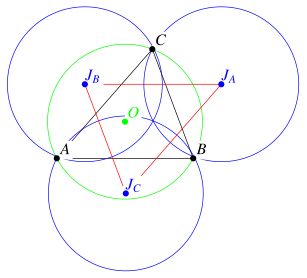
The Johnson triangle  , a term coined here for the first time, is the triangle formed by the centers of the Johnson circles.
It has trilinear vertex matrix
![[-abcS_A:c(S^2+S_AS_C):b(S^2+S_AS_B); c(S^2+S_BS_C):-abcS_B:a(S^2+S_AS_B); b(S^2+S_BS_C):a(S^2+S_AS_C):-abcS_C],](https://mathworld.wolfram.com/images/equations/JohnsonTriangle/NumberedEquation1.svg) |
where  ,
,  ,
,  , and
, and  is Conway triangle notation.
The Johnson triangle circumcircle is congruent to the Johnson circles and therefore also to the circumcircle of the reference triangle.
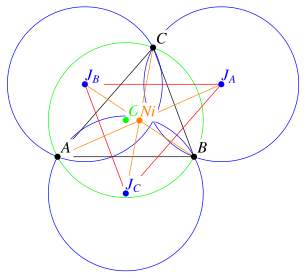
The Johnson triangle is congruent to the reference triangle, with which it is also in perspective with perspector at nine-point center. Because the Johnson triangle is congruent to the reference triangle, the points  ,
,  ,
,  , and
, and  form an orthocentric system. Furthermore, the Johnson triangle is homothetic to the reference triangle and has a homothetic center at the nine-point center of the reference triangle (midway between
  and
and  on their common Euler line).
The nine-point center is also the midpoint of the lines  ,
,  , and
, and  . In fact, more generally, the nine-point center lies at the center of a line between any defined point
  in the reference triangle and its congruent point
  in the Johnson triangle. (But note that this midpoint should not be confused with the Johnson midpoint).
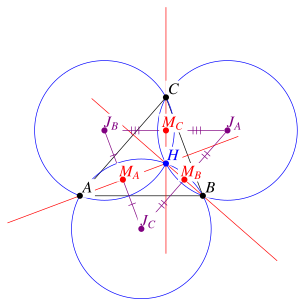
The radical lines through pairs of intersecting Johnson circles orthogonally bisect the sides of the Johnson triangle at its medians. Consequently, the medial triangle of the Johnson triangle is homothetic to the reference triangle and its homothetic center is the orthocenter of the reference triangle.
In addition to the vertices  ,
,  , and
, and  being the reflections of
  in the sidelines
  ,
,  , and
, and  of
of  ,
,  is also the Euler triangle of the anticomplementary triangle
  is
is  rotated by
  around
  , so
, so  and
and  share the same nine-point circle.
