


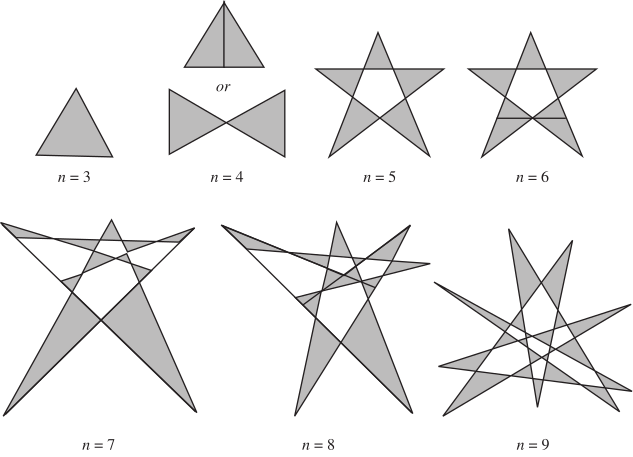
Japanese puzzle expert and mathematics teacher Kobon Fujimura asked for the largest number  of nonoverlapping triangles that can be constructed using
  lines (Fujimura 1978; Gardner 1983, p. 170). A Kobon triangle is therefore defined as one of the triangles constructed in such a way. While it appears to be very difficult to find an analytic expression for the general
  th term, upper bounds are known. The first few known terms for
  , 3, ... are 1, 2, 5, 7, 11, 15, 21, 25, 32, 38, 47, ... (OEIS A006066).
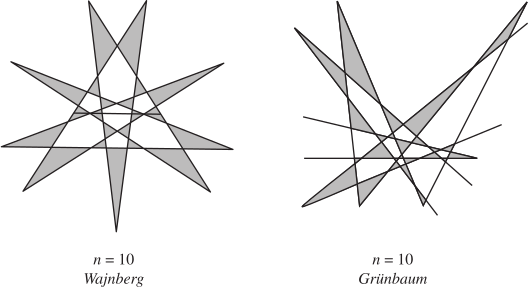
A. Wajnberg (pers. comm., Nov. 18, 2005) found a configuration for  containing 25 triangles (left figure). A different 10-line, 25-triangle construction was found by Grünbaum (2003, p. 400), and a third configuration is referenced by Honma. Two other distinct solutions were found in 1996 by Grabarchuk and Kabanovitch (Kabanovitch 1999, Pegg 2006).
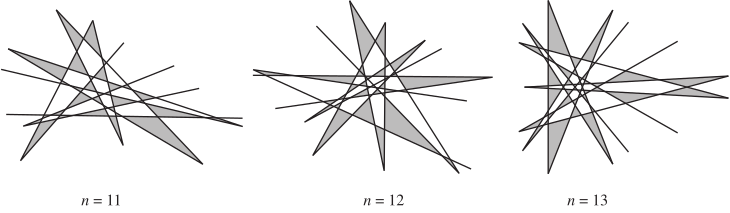
Honma illustrated an 11-line, 32-triangle configuration and another solution was found by Kabanovitch (1999; Pegg 2006). While 32-triangle solutions (one less than known upper bound as discussed below) had long been known, maximality was finally proved by Savchuk (2025).
Kabanovitch (1999) also found a 12-line, 38-triangle configuration, and a 13-line 47-triangle configuration (Pegg 2006).
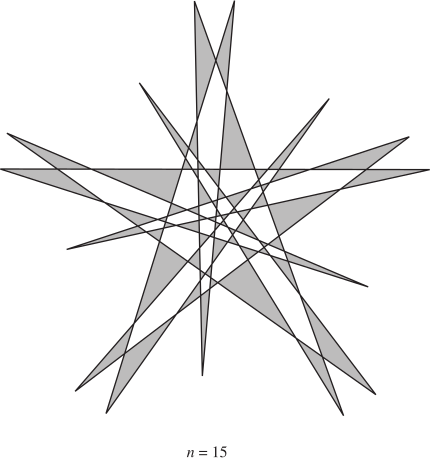
T. Suzuki (pers. comm., Oct. 2, 2005) found the above configuration for  .
.
A number of other configurations that are either maximal or the best known are summarized and linked to on the page for the sequence OEIS A006066 in the Online Encyclopedia of Integer Sequences. Savchuk (2025) enumerated all possible Kobon arrangements for  , 5, 9, 15, and 17 and also found new optimal Kobon arrangements for 23 and 27 lines.
The simplest bound was found by Saburo Tamura, who showed that for  ,
,
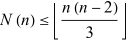 | (1) |
(Eppstein, Bartholdi et al. 2007, Clément and Bader 2007), where  is the floor function. Clément and Bader (2007) tightened the bound by one in the case of
  , obtaining
 |  |  | (2) |
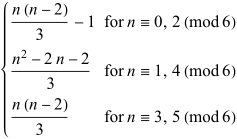 | 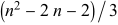 |  | (3) |
(where the above expression  was incorrectly written as
  in the paper). The bound in the case of even
  was tightened further by Bartholdi et al. (2007) to
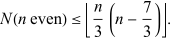 | (4) |
Finding an arrangement with  equal to any (or in practice, the smallest) of these bounds is therefore guaranteed to be an maximal configuration, meaning all the configurations illustrated above are, in fact, maximal.
These upper bounds discussed above are summarized in the following table.
 | OEIS | 3 | 4 | 5 | 6 | 7 | 8 | 9 | 10 | 11 | 12 | 13 | 14 | 15 | 16 | 17 | 18 | 19 | 20 |
| Tamura bound | A032765 | 1 | 2 | 5 | 8 | 11 | 16 | 21 | 26 | 33 | 40 | 47 | 56 | 65 | 74 | 85 | 96 | 107 | 120 |
| Clément and Bader bound | A000000 | 1 | 2 | 5 | 7 | 11 | 15 | 21 | 26 | 33 | 39 | 47 | 55 | 65 | 74 | 85 | 95 | 107 | 119 |
| Bartholdi et al. bound | A000000 | 2 | 7 | 15 | 25 | 38 | 54 | 72 | 94 | 117 |
In addition, exact values are known for some special forms of  as summarized in the following table (Bartholdi et al. 2007).
 |  |
 |  |
 |  |
 |  |
Known exact values of  for
for  are summarized in the following table.
 |  | comment | reference |
| 3 | 1 |  | |
| 4 | 2 | upper limit construction | |
| 5 | 5 |  | |
| 6 | 7 | upper limit construction | |
| 7 | 11 |  | |
| 8 | 15 | upper limit construction | |
| 9 | 21 |  | |
| 10 | 25 | upper limit construction | Kabanovitch (1999), Grabarchuk, Grünbaum (2003), Wajnberg (pers. comm., 2005) |
| 11 | 32 | proved maximal by SAT | Savchuk (2025) |
| 12 | 38 | upper limit construction | Kabanovitch (1999) |
| 13 | 47 |  | |
| 15 | 65 |  | Suzuki (pers. comm., 2005) |
| 16 | 72 | upper limit construction | Clément and Bader (2007) |
| 17 | 85 |  | Clément and Bader (2007) |
| 19 | 107 | upper limit construction | Wood |
| 21 | 133 | upper limit construction | Savchuk (2025) |
| 23 | 161 | upper limit construction | Savchuk (2025) |
| 25 | 191 |  | |
| 27 | 225 | upper limit construction | Savchuk (2025) |
| 29 | 261 |  | |
| 31 | 299 | upper limit construction | Wood |
| 33 | 341 |  | |
| 49 | 767 |  |

 and
and  with the Maximum Number of Triangles." 5 Jun 2007.