


Let  ,
,  be integers satisfying
 | (1) |
Then roots of
 | (2) |
are
 |  |  | (3) |
 |  |  | (4) |
so
 |  |  | (5) |
 |  |  | (6) |
 |  |  | (7) |
 |  |  | (8) |
Now define
 |  |  | (9) |
 |  |  | (10) |
for integer  , so the first few values are
 |  |  | (11) |
 |  |  | (12) |
 |  |  | (13) |
 |  |  | (14) |
 |  |  | (15) |
 |  |  | (16) |
 |  |  | (17) |
 |  |  | (18) |
 |  |  | (19) |
 |  |  | (20) |
 |  |  | (21) |
and
 |  |  | (22) |
 |  |  | (23) |
 |  |  | (24) |
 |  |  | (25) |
 |  |  | (26) |
 |  |  | (27) |
 |  |  | (28) |
 |  |  | (29) |
 |  |  | (30) |
 |  |  | (31) |
 |  |  | (32) |
Closed forms for these are given by
 |  |  | (33) |
 |  | 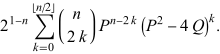 | (34) |
The sequences
 |  |  | (35) |
 |  |  | (36) |
are called Lucas sequences, where the definition is usually extended to include
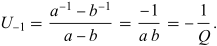 | (37) |
The following table summarizes special cases of  and
and  .
.
 |  |  |
 | Fibonacci numbers | Lucas numbers |
 | Pell numbers | Pell-Lucas numbers |
 | Jacobsthal numbers | Pell-Jacobsthal numbers |
The Lucas sequences satisfy the general recurrence relations
 |  |  | (38) |
 |  |  | (39) |
 |  |  | (40) |
 |  |  | (41) |
 |  |  | (42) |
 |  |  | (43) |
Taking  then gives
 |  |  | (44) |
 |  |  | (45) |
Other identities include
 |  |  | (46) |
 |  |  | (47) |
 |  |  | (48) |
 |  |  | (49) |
 |  | 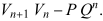 | (50) |
These formulas allow calculations for large  to be decomposed into a chain in which only four quantities must be kept track of at a time, and the number of steps needed is
  . The chain is particularly simple if
  has many 2s in its factorization.

 ,
,  ." Ch. 17 in