


The largest value of a set, function, etc. The maximum value of a set of elements  is denoted
  or
or  , and is equal to the last element of a sorted (i.e., ordered) version of
  . For example, given the set
  , the sorted version is
  , so the maximum is 5. The maximum and minimum are the simplest order statistics.
The maximum value of a variable  is commonly denoted
  (Strang 1988, pp. 286-287 and 301-303) or
  (Golub and Van Loan 1996, p. 74). In this work, the convention
  is used.
The maximum of a set of elements is implemented in the Wolfram Language as Max[list] and satisfies the identities
 |  |  | (1) |
 |  |  | (2) |
Definite integrals include
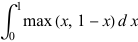 |  |  | (3) |
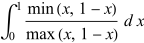 |  |  | (4) |
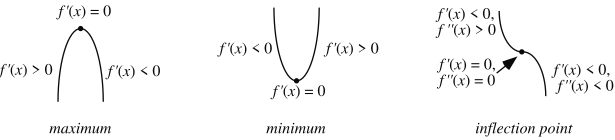
A continuous function may assume a maximum at a single point or may have maxima at a number of points. A global maximum of a function is the largest value in the entire range of the function, and a local maximum is the largest value in some local neighborhood.
For a function  which is continuous at a point
  , a necessary but not sufficient condition for
  to have a local maximum at
  is that
  be a critical point (i.e.,
  is either not differentiable at
  or
or  is a stationary point, in which case
  ).
).
The first derivative test can be applied to continuous functions to distinguish maxima from minima. For twice differentiable functions of one variable,  , or of two variables,
  , the second derivative test can sometimes also identify the nature of an extremum. For a function
  , the extremum test succeeds under more general conditions than the second derivative test.
