


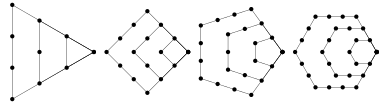
A polygonal number is a type of figurate number that is a generalization of triangular, square, etc., to an  -gon for
  an arbitrary positive integer. The above diagrams graphically illustrate the process by which the polygonal numbers are built up. Starting with the
  th triangular number
  , then
 | (1) |
Now note that
 | (2) |
gives the  th square number,
 | (3) |
gives the  th pentagonal number, and so on. The general polygonal number can be written in the form
 |  | ![1/2n[(n-1)r-2(n-2)]](https://mathworld.wolfram.com/images/equations/PolygonalNumber/Inline9.svg) | (4) |
 |  | ![1/2n[(r-2)n-(r-4)],](https://mathworld.wolfram.com/images/equations/PolygonalNumber/Inline12.svg) | (5) |
where  is the
  th
th  -gonal number (Savin 2000). For example, taking
  in (5) gives a triangular number,
  gives a square number, etc.
Polygonal numbers are implemented in the Wolfram Language as PolygonalNumber.
Call a number  -highly polygonal if it is
  -polygonal in
  or more ways out of
  , 4, ... up to some limit. Then the first few 2-highly polygonal numbers up to
  are 1, 6, 9, 10, 12, 15, 16, 21, 28, (OEIS A090428). Similarly, the first few 3-highly polygonal numbers up to
  are 1, 15, 36, 45, 325, 561, 1225, 1540, 3025, ... (OEIS A062712). There are no 4-highly polygonal numbers of this type less than
  except for 1.
The generating function for the  -gonal numbers is given by the beautiful formula
![G_n(x)=(x[(n-3)x+1])/((1-x)^3).](https://mathworld.wolfram.com/images/equations/PolygonalNumber/NumberedEquation4.svg) | (6) |
Fermat proposed that every number is expressible as at most 
 -gonal numbers (Fermat's polygonal number theorem). Fermat claimed to have a proof of this result, although this proof has never been found. Jacobi, Lagrange (in 1772), and Euler all proved the square case, and Gauss proved the triangular case in 1796. In 1813, Cauchy proved the proposition in its entirety.
An arbitrary number  can be checked to see if it is a
  -gonal number as follows. Note the identity
 | (7) |
so  must be a perfect square. Therefore, if it is not, the number cannot be
  -gonal. If it is a perfect square, then solving
 | (8) |
for the rank  gives
gives
 | (9) |
An  -gonal number is equal to the sum of the
  -gonal number of the same statistical rank and the triangular number of the previous statistical rank.
