


Let  be a simple graph on vertex set
  and and let
  be a subset
  . Call two vertices
  "
" -visible" if there exists a shortest path from
  to
to  such that none of the internal vertices on the path belong to the set
  . A set
  is then called a mutual-visibility set of
  if every pair of vertices in
  is
is  -visible (Tonny and Shikhi 2025).
The cardinality of the largest mutual-visibility set of  is called the mutual-visibility number of
  , denoted
  (not to be confused with the matching-generating polynomial
  ), and the number of such mutual-visibility sets of
  is denoted
  (Tonny and Shikhi 2025). Letting
  denote the number of mutual visibility sets of size
  , the visibility polynomial
  is then defined by
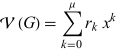 | (1) |
(Bujtása et al. 2024, Tonny and Shikhi 2025).
Since every set of at most two vertices in a connected graph on  vertices forms a mutual-visibility set, the visibility polynomial of a connected graph
  always begins
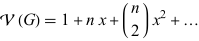 | (2) |
(Tonny and Shikhi 2025), where  is a binomial coefficient.
Special cases include
 |  |  | (3) |
 |  | 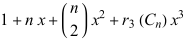 | (4) |
 |  |  | (5) |
 |  | ![{(1+x)^2 for n=1; (1+x)^(2n)-2[x(1+x)]^n+x^n(2+2nx+x^n) otherwise](https://mathworld.wolfram.com/images/equations/VisibilityPolynomial/Inline37.svg) | (6) |
 |  |  | (7) |
 |  | 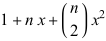 | (8) |
where
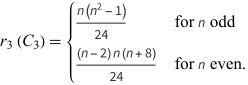 | (9) |
A formula for  with
with  involving three sums is given by Tonny and Shikhi (2025).
The visibility polynomial of a disconnected graph with  components
  , ...,
  is given by
 | (10) |
(Tonny and Shikhi 2025).
