


The  th
th  -statistic
  is the unique symmetric unbiased estimator of the cumulant
  of a given statistical distribution, i.e.,
  is defined so that
 | (1) |
where  denotes the expectation value of
  (Kenney and Keeping 1951, p. 189; Rose and Smith 2002, p. 256). In addition, the variance
 | (2) |
is a minimum compared to all other unbiased estimators (Halmos 1946; Rose and Smith 2002, p. 256). Most authors (e.g., Kenney and Keeping 1951, 1962) use the notation  for
for  -statistics, while Rose and Smith (2002) prefer
  .
.
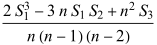
The  -statistics can be given in terms of the sums of the
  th powers of the data points as
 | (3) |
then
 |  |  | (4) |
 |  |  | (5) |
 |  |  | (6) |
 |  |  | (7) |
(Fisher 1928; Rose and Smith 2002, p. 256). These can be given by KStatistic[r] in the Mathematica application package mathStatica.
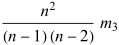
For a sample size  , the first few
  -statistics are given by
 |  |  | (8) |
 |  |  | (9) |
 |  |  | (10) |
 |  | ![(n^2[(n+1)m_4-3(n-1)m_2^2])/((n-1)(n-2)(n-3)),](https://mathworld.wolfram.com/images/equations/k-Statistic/Inline38.svg) | (11) |
where  is the sample mean,
  is the sample variance, and
  is the
  th sample central moment (Kenney and Keeping 1951, pp. 109-110, 163-165, and 189; Kenney and Keeping 1962).
The variances of the first few  -statistics are given by
 |  |  | (12) |
 |  |  | (13) |
 |  |  | (14) |
 |  |  | (15) |
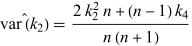
An unbiased estimator for  is given by
 | (16) |
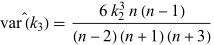
(Kenney and Keeping 1951, p. 189). In the special case of a normal parent population, an unbiased estimator for  is given by
 | (17) |
(Kenney and Keeping 1951, pp. 189-190).
For a finite population, let a sample size  be taken from a population size
  . Then unbiased estimators
  for the population mean
  ,
,  for the population variance
  ,
,  for the population skewness
  , and
, and  for the population kurtosis excess
  are
are
 |  |  | (18) |
 |  |  | (19) |
 |  | 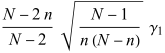 | (20) |
 |  |  | (21) |
(Church 1926, p. 357; Carver 1930; Irwin and Kendall 1944; Kenney and Keeping 1951, p. 143), where  is the sample skewness and
  is the sample kurtosis excess.

 -Statistics." §7.9 in
  and
and  in Terms of Power Sums and Sample Moments." Ann. Math. Stat. 25, 800-803, 1954.Ziaud-Din, M. "The Expression of
  -Statistic
  in Terms of Power Sums and Sample Moments." Ann. Math. Stat. 30, 825-828, 1959.Ziaud-Din, M. and Ahmad, M. "On the Expression of the
  -Statistic
  in Terms of Power Sums and Sample Moments." Bull. Internat. Stat. Inst. 38, 635-640, 1960.