


The  -binomial coefficient is a q-analog for the binomial coefficient, also called a Gaussian coefficient or a Gaussian polynomial. A
  -binomial coefficient is given by
![[n; m]_q=((q)_n)/((q)_m(q)_(n-m))=product_(i=0)^(m-1)(1-q^(n-i))/(1-q^(i+1)),](https://mathworld.wolfram.com/images/equations/q-BinomialCoefficient/NumberedEquation1.svg) | (1) |
where
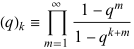 | (2) |
is a q-series (Koepf 1998, p. 26). For  ,
,
![[n; k]_q=([n]_q!)/([k]_q![n-k]_q!),](https://mathworld.wolfram.com/images/equations/q-BinomialCoefficient/NumberedEquation3.svg) | (3) |
where ![[n]_q!](https://mathworld.wolfram.com/images/equations/q-BinomialCoefficient/Inline4.svg) is a q-factorial (Koepf 1998, p. 30). The
is a q-factorial (Koepf 1998, p. 30). The  -binomial coefficient can also be defined in terms of the q-brackets
 ![[k]_q](https://mathworld.wolfram.com/images/equations/q-BinomialCoefficient/Inline6.svg) by
by
![[n; k]_q={product_(i=1)^(k)([n-i+1]_q)/([i]_q) for 0<=k<=n; 0 otherwise.](https://mathworld.wolfram.com/images/equations/q-BinomialCoefficient/NumberedEquation4.svg) | (4) |
The  -binomial is implemented in the Wolfram Language as QBinomial[n, m, q].
For  , the
, the  -binomial coefficients turn into the usual binomial coefficient.
The special case
![[n]_q=[n; 1]_q=(1-q^n)/(1-q)](https://mathworld.wolfram.com/images/equations/q-BinomialCoefficient/NumberedEquation5.svg) | (5) |
is sometimes known as the q-bracket.
The  -binomial coefficient satisfies the recurrence equation
![[n+1; k]_q=q^k[n; k]_q+[n; k-1]_q,](https://mathworld.wolfram.com/images/equations/q-BinomialCoefficient/NumberedEquation6.svg) | (6) |
for all  and
and  , so every
  -binomial coefficient is a polynomial in
  . The first few
  -binomial coefficients are
![[2; 1]_q](https://mathworld.wolfram.com/images/equations/q-BinomialCoefficient/Inline16.svg) |  | 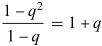 | (7) |
![[3; 1]_q](https://mathworld.wolfram.com/images/equations/q-BinomialCoefficient/Inline19.svg) |  | ![[3; 2]_q=(1-q^3)/(1-q)=1+q+q^2](https://mathworld.wolfram.com/images/equations/q-BinomialCoefficient/Inline21.svg) | (8) |
![[4; 1]_q](https://mathworld.wolfram.com/images/equations/q-BinomialCoefficient/Inline22.svg) |  | ![[4; 3]_q=(1-q^4)/(1-q)=1+q+q^2+q^3](https://mathworld.wolfram.com/images/equations/q-BinomialCoefficient/Inline24.svg) | (9) |
![[4; 2]_q](https://mathworld.wolfram.com/images/equations/q-BinomialCoefficient/Inline25.svg) |  |  | (10) |
From the definition, it follows that
![[n; 1]_q=[n; n-1]_q=sum_(i=0)^(n-1)q^i.](https://mathworld.wolfram.com/images/equations/q-BinomialCoefficient/NumberedEquation7.svg) | (11) |
Additional identities include
![([n+1; k+1]_q)/([n; k+1]_q)](https://mathworld.wolfram.com/images/equations/q-BinomialCoefficient/Inline28.svg) |  |  | (12) |
![([n+1; k+1]_q)/([n+1; k]_q)](https://mathworld.wolfram.com/images/equations/q-BinomialCoefficient/Inline31.svg) |  |  | (13) |
The  -binomial coefficient
 ![[n; m]_q](https://mathworld.wolfram.com/images/equations/q-BinomialCoefficient/Inline35.svg) can be constructed by building all
can be constructed by building all  -subsets of
  , summing the elements of each subset, and taking the sum
![[n; m]_q=sum_(i)q^(s_i-m(m+1)/2)](https://mathworld.wolfram.com/images/equations/q-BinomialCoefficient/NumberedEquation8.svg) | (14) |
over all subset-sums  (Kac and Cheung 2001, p. 19).
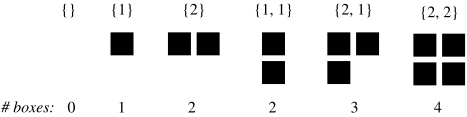
The  -binomial coefficient
 ![[m+n; m]_q](https://mathworld.wolfram.com/images/equations/q-BinomialCoefficient/Inline40.svg) can also be interpreted as a polynomial in
can also be interpreted as a polynomial in  whose coefficient
  counts the number of distinct partitions of
  elements which fit inside an
  rectangle. For example, the partitions of 1, 2, 3, and 4 are given in the following table.
 | partitions |
| 0 |  |
| 1 |  |
| 2 |  |
| 3 |  |
| 4 |  |
Of these,  ,
,  ,
,  ,
,  ,
,  , and
, and  fit inside a
  box. The counts of these having 0, 1, 2, 3, and 4 elements are 1, 1, 2, 1, and 1, so the (4, 2)-binomial coefficient is given by
![[4; 2]_q=1+q+2q^2+q^3+q^4,](https://mathworld.wolfram.com/images/equations/q-BinomialCoefficient/NumberedEquation9.svg) | (15) |
as above.
