Showing posts with label How-To. Show all posts

Sunday, February 19, 2012

Macarons Framboise - Ladurée's Recipe


Well I'm back folks!

Not really, but bear with me I'll be back in the groove of things as soon as I'm settled. I really have been busy, juggling some major changes around here. You see, among other things, I'm buying a new house and dealing with all the madness that goes along with that process. It's been a hectic couple of months but hopefully, if everything goes well, I'll be baking future macarons in a brand new oven soon.

No, who am I kidding. The next several weeks will be spent packing and moving an entire household. Maybe replacing a few door knobs too, since our builder decided to go with a design that I can only describe as suitable for your Grandma's cottage--on Mars. Anyway, breaking in my bright and sunny new kitchen with a little baking will happen, I just need to get settled in.

Wednesday, November 30, 2011

Dead Man's Peanut Butter Cupcakes

Devil's Food & Dead Man's Peanut Butter Mousse
Slathered in chocolate fudge.
Oh yea. 

We're revisiting my Dead Man's Peanut Butter Pie recipe today, with a few fun tweaks.

Today I found myself wrestling with a familiar peanut butter and chocolate craving.  In such situations I have the following options:

  1. Go to the store and buy all the available peanut butter cups. Of course, this isn't much of an option since getting out of the house with two small children and going anywhere requires nearly as much planning and preparation as a mission to Mars.
  2. Eat peanut butter from jar with a spoon, dipping it into that 20lb bag of chocolate chips I have. Also not a great option, since with this method of consumption, any semblance of portion control vanishes and I just bought skinny jeans.
  3. Bake something with peanut butter and chocolate for the blog, while wearing said skinny jeans and pretend that they will encourage restraint while tasting and testing.

I think we all know how this worked out.


Sunday, October 23, 2011

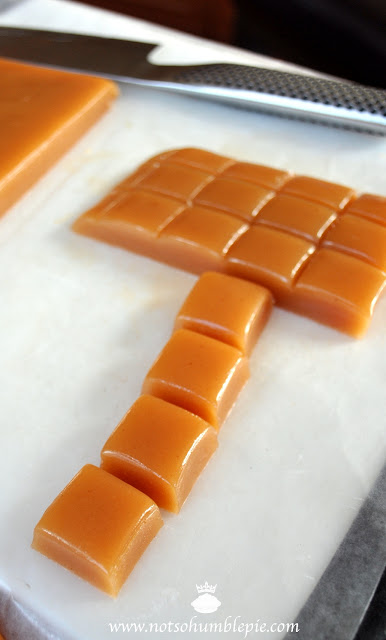
Spiced Apple Cider Caramels


Hope everyone had a good week.

For my part, I spent the week tinkering in the kitchen with batches of caramel and I have a wonderful new recipe to share with everyone. A caramel that tastes of freshly mulled apple cider. Oh yes, it's good.

Those of you going "Ppbbth, Caramels! I waited all week! Me want prizes!" I'll post the winner from last weeks giveaway of the big McCormick Halloween Goodie box too. Just zip down to the bottom of today's post.

For us candy makers, how about we get started on these apple cider caramels.

Now, just to be clear, "apple cider" around here is basically apple juice. I know it was wrong of us North Americans to adopt the term cider for a non-alcholic beverage, but we did it anyway. We just wanted to confuse everyone and I apologize. So just to be completely clear, we won't be using the fermented drink made from apples, no. Today we're working with a jug of fresh apple cider, which is essentially unfiltered apple juice. If you cannot get the fresh, cold pressed unfiltered stuff, go ahead and substitute the best quality/tasting apple juice you can find.

These caramels are a variation of my popular fleur de sel caramels, with a reduction of mulled apple cider. If you haven't tried them, you'll find that they're rich, smooth and far superior to those waxy squares you find in the supermarket.


Sunday, August 7, 2011

Neapolitan Marshmallows


A good Sunday to everyone!

I'm still busy making the most of my baking weekend but I have things prepared to share. Today, we're making  Neapolitan Marshmallows. They're tasty little bites, flavored just like neapolitan ice cream with layers of chocolate, vanilla and strawberry.

Now, you can probably tell just by looking at them that they're going to be a wee bit time consuming but hey, they're adorable! Pretty takes time and these are probably the cutest confection I've made in a while. I can already see them dressed up in little bags and chocolate colored ribbons, ready to be gifted.

Tuesday, July 12, 2011

Red Rose Raspberry Sorbet


Happy Tuesday, everyone!

It is one in the morning and I'm up with my newborn. So why not wrap up a little blogging between feeding and bouncing, right? Today we have yet another frozen dessert and a particularly pretty one at that.

I absolutely love the combination of raspberry and rose, so a sorbet featuring those flavors seemed like a natural summer time choice for the blog.

Gorgeous, isn't it? Such an vibrant red it almost makes me want to double check the settings on my camera. This dessert isn't just pretty to look at, it velvety smooth and packs bright fresh raspberry flavor and the sweet fragrance of rose.

Sunday, May 15, 2011

Lemon Meringue Pie


After a long month's baking, we're tackling one of my favorite pies today: Lemon Meringue.

I learned how to bake this pie from my mother, who baked it frequently for my father--an ardent fan of lemon meringue. So much so in fact, that he jokes about ranking prospective brides based on their ability to execute the pie well.

Unfortunately, my mother made something we Humbles call "Lemon Meringue Pool". Tasty but structurally… well, a disaster (sorry mom). When served, the filling would be slack and form a puddle on the plate. Hence the name. I'd post photos of lemon meringue pool, but to save mom face I'll post a quick doodle of a sad pie that appears to have wet himself.

You get the idea.

Friday, March 4, 2011

Cinnamon Rolls With Whipped Cream Cheese Frosting


Happy Friday everyone!

Sorry for my lengthy post-valentines day hiatus. The third trimester has made me a little slow in the kitchen and I've had my hands full with family. Like my mother, who was in town last week and thinks a day at the spa is a better use of my time than baking (hey, I'm not going to argue). Then we had Mr. Humble's laptop crashing and needing to be resurrected after the latest Windows 7 service pack, something that makes the Mac user in me smirk with smug hipster superiority.

Mr. Humble (and his laptop) were necessary for today's post, since we're using one of his bread recipes. A recipe I've been begging... scratch that, demanding he make in recent weeks. You see, I've had some pretty crazy pregnant woman cravings for all things creamy. Cheesecakes, eclairs, cream puffs, donuts, and cinnamon rolls topped with pillows of creamy goodness. Knowing that Mr. Humble's soft, tender enriched white dough makes a beautiful cinnamon roll, I lobbied hard.

Of course, once I actually got my wish for a pan of delicious freshly made cinnamon rolls, I spent more time eating them than photographing them. Thus all I have to accompany this post is a bunch of photos of minimally-staged cinnamon rolls that are in the process of being eaten.


Tuesday, January 25, 2011

Golden Raspberry-Rose Chocolates


It's getting close to that time of the year again, Valentine's day.

Since last year's post was a wee bit bitter, I'll provide some actual sweets for your sweetheart over these next few weeks. Starting with these raspberry and rose flavored chocolates (appropriate, right?), only bitter for their use of rich dark chocolate.

Raspberry and bittersweet chocolate is a common combination in the candy making universe. However, add a little rose oil (or rose water) and you have something very unique and delicious. The raspberry ganache centers in these chocolates finish with a wonderfully fruity-floral rose note without being perfumey.

As an added bit of fun, I'm going to teach you all how to turn your chocolates (or any chocolate) brilliant gold. (No pesky gold leaf required)

Monday, December 13, 2010

Caramel Wrapped Marshmallows


Few things woo me back into the kitchen like candy making. Not only is it fun and delicious, when making candy I always have this devious, subversive feeling come over me. As though I've thwarted some natural law by bringing the special, highly rationed substance CANDY into existence with my own humble hands.

Monday, September 13, 2010

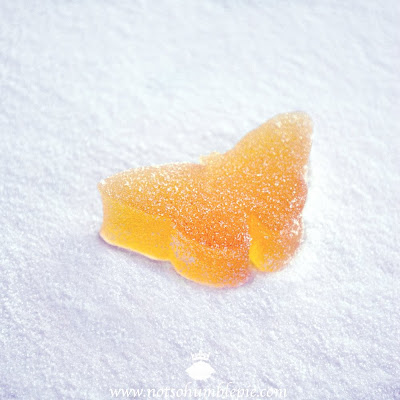
Fruit Gelées


Happy Monday, everyone!

We're making candy today, and unlike last week's marshmallows these are vegan/vegetarian friendly. Fruit gelées is something that I've long wanted to make for the blog but it involves one rather pesky ingredient: Pectin.

Since not all pectins are created equal, you often see recipes will call for a specific brand or type (like apple) when making gelées. Rarely does one find a recipe that calls for a generic powdered fruit pectin, the type one might find at a corner grocery store. And of course, using gelatin as the gelling agent was off the table, as it doesn't produce the ideal texture in these fruit candies.


What I needed was a reliable recipe that had a chance of working with ordinary powdered fruit pectin and finally, I've found one to share with everyone today.

Monday, September 6, 2010

Lemon Mascarpone Cream Cake


Happy Monday, everyone!

So we're following up last week's easy cookie theme with something a little more fussy. Something that would get my apron dirty.

Today's cake is divine. Frosted with whipping cream, stabilized with mascarpone cheese and flavored with lemon curd. It's light, creamy and not too sweet. The cake is moist and dense, yet fluffy with a delicate crumb. Layered with a little lemon curd and the mascarpone frosting, it's easily one of my favorites.

Thursday, August 19, 2010

Baked Fruit Leather


Happy Thursday, all.

Yesterday, I found myself very busy using up all the wonderful summer fruit I have hanging around. Fruit that was in desperate need of a purpose, and soon.

Usually, when faced with an excess of fresh fruit I do two things: make purée to freeze and save for future baking and candy making or I make fruit leather.

Fruit leather is so simple to make and a great way to take advantage of the summer markets that are flooded with inexpensive fresh fruit. Kids love the stuff too... who will be going back to school soon, right? They might need a reasonably healthy treat in their lunchbox. Something better than the usual fare I supply on this site.

While fruit leather is generally made in a dehydrator, you can make it at home in your oven too. All you need is plenty of time, a blender or food processor, an oven that can hold a temperature more or less around 150°F, and since most ovens don't have a mark on their dial for that, an oven thermometer too.


That's all you need to turn all this into this...

Tuesday, August 17, 2010

Macaron Troubleshooting & A New Recipe


Blogging about macarons today!

Yes I know, I blog a lot about macarons but even with all the information I've posted on the blog, I still get a ton of questions in my email box. An overwhelming number of emails, emails that I don't always have the time to answer punctually, so I felt a need to address the questions in one space on the blog.

I'm posting a troubleshooting guide to help folks with their macarons.

I'm also posting another french macaron recipe. One that I've been working on for almost two months. I've been crafting a recipe that produces a cookie that is a bit more reliable.

French macarons don't get any more perfect than this.

Monday, August 16, 2010

Freezer Jam


Happy Monday, all!

Today we're going to talk a bit about jam, because I spent a good part of my weekend making it with Mother Humble and I don't have anything else ready.

Mother Humble has this thing about jam, while other mothers might worry about their children's health, finances or career. My mother seems primarily concerned with how much jam we have.

It is so obsessive, that I seriously feel I could tell her some crazy story about my life being in total chaos and the first thing she would ask me would be, "...but sweetie, do you have enough jam?"

She asks about it during each of her visits. She never believes it when I say we're stocked, that we have tons of jam. Instead, she checks my supply and determines--regardless of how much is actually in there--that my supply is woefully inadequate. Inadequate, only if I want to serve scones to all of South Asia.

Maybe that's the life lesson she's gleaned from her half century of existence, you must stockpile jam.

A lot of jam.


War? Societal collapse? Armageddon? Llamas?

No problem. I have a lot jam. I'm going to make it.

You can make it too. Freezer jam requires no cooking or canning know-how and since it isn't heat treated the fruit flavor stays bright and fresh.

Wednesday, August 4, 2010

Thomas Keller's Cinnamon-Sugar Doughnuts


While out shopping this weekend I came across Thomas Keller's famed French Laundry cookbook and Ad Hoc At Home. While flipping through the books--to make sure they had adequate photos, which I need--I saw the doughnuts.

I was hooked.

With the French Laundry name attached, I assumed these little golden blobs of fried dough had to be good, so I grabbed the books.


Once home, I handed the recipe over to my dough machine (aka Mr. Humble) who got to work on the dough. Unfortunately for Mr. Humble, who had to work the next morning, the dough requires an overnight retardation in the refrigerator and it fell upon me to finish and eat the doughnuts the following morning.

I was not disappointed.

Pictures truly don't do the texture of these donuts justice.

Thomas Keller's doughnuts are absolutely wonderful. Probably the best homemade doughnuts I've ever had. They were gone in seconds. The busy and work bound Mr. Humble was very perturbed.

(Mother Humble ate them, it wasn't my fault none were left!)

Worse, I have another doughnut post lined up in the coming weeks. This is going to be a tough act to follow. Oh well, the perils of food blogging, right? On to the doughnuts...


Thomas Keller's Cinnamon-Sugar Doughnuts

from The French Laundry Cookbook
serves 6

Sponge
1/4 cup plus 1 tablespoon water, at room temperature
1/4 ounce compressed fresh yeast (wee little blocks of this yeast can usually be found in your grocer's cooler case)
1/2 cup all-purpose flour

Dough
1/4 ounce compressed fresh yeast
2 tablespoons whole milk, at room temperature
1 cup plus 2 tablespoons all-purpose flour, or more as needed
3 tablespoons sugar
1 teaspoon kosher salt
1/4 cup egg yolks (about 3 large yolks)
2 tablespoons (1 ounce) unsalted butter, melted and cooled
Canola oil for deep-frying

Cinnamon Sugar
1/2 cup sugar mixed with 1 1/4 teaspoons ground cinnamon

While this recipe calls for the use of a stand mixer, we did not use one. Mr. Humble and I rarely use our stand mixers to make yeast doughs, feeling it is best done by hand. So if you lack a mixer, don't let that stop you from making these doughnuts. I'll provide a video guide below for how best to approach a wet sticky dough such as this one.


In the bowl of your mixer, add the water and crumbled yeast. With a spoon, mix and mush the yeast into the water to dissolve. Add the flour to the bowl and using the dough hook, mix slowly until the sponge is thoroughly blended.

Transfer the sponge to a bowl and cover. Allow to proof at room temperature for 1 to 2 hours. Once it has doubled you can begin the dough.

To make the dough, add the crumbled yeast and milk to a small bowl, stirring to dissolve. Add 3/4 cup of the flour, the sugar, and salt to the bowl of your mixer. With the dough hook, mix on low speed, adding the milk and yeast mixture, followed by the egg yolks and butter. Mix for a minute to combine.

Add the proofed sponge and the remaining 1/4 cup plus 2 tablespoons flour. Continue to beat at low speed until combined. Turn up the speed slightly and knead the dough for 4 to 5 minutes, or until it has formed a ball and cleans the sides of the bowl. If the dough seems wet, it may be necessary to add 1 to 2 more tablespoons flour. Cover the bowl and let the dough proof overnight in the refrigerator.

As I mentioned above, Mr. Humble and I made this without the aid of a mixer. We hand mixed and folded the sticky dough to develop the gluten.

Richard Bertinet illustrating a french fold on a marvelously wet and sticky egg dough:


(If the embedded video isn't loading for you, try this link)

The dough will still be sticker than bertinet's after folding, so don't fret. Different dough, different hydration.

To shape the overnight-rested dough: Place the chilled dough on a lightly floured surface and roll it out 1/2" thick. Cut out the doughnuts using a 2-inch doughnut cutter (you may also use biscuit cutters, using a smaller cutter to remove the hole). Place the doughnuts and holes onto a baking sheet, lined with parchment paper and lightly dusted with flour. Drape the doughnuts with a sheet of plastic wrap that has been sprayed with nonstick spray.


At this point, the doughnuts can be frozen for several days, refrigerated, or allowed to rise at room temperature. If they're frozen, defrost them and then allow them to rise at room temperature for 1 to 1 1/2 hours. They can be refrigerated for several hours or overnight, to rise slowly. When you remove them from the refrigerator, uncover them and let them finish proofing in a warm place for 20 to 30 minutes. If they have not been refrigerated or frozen, they should rise at room temperature in about 15 minutes. Once proofed, they will have risen to approximately 3/4 inch.

To cook the doughnuts: In a deep heavy saucepan heat the canola oil for deep-frying to 325°F. Use a frying thermometer to check the temperature and be sure to bring the oil back to 325°F after frying each batch. Add the doughnuts and holes to the oil and cook for approximately 30 seconds on the first side. Flip the doughnuts and fry for 1 minute on the second side, then turn back to the first side to cook for an additional 30 seconds, or until a deep golden brown. Remove the doughnuts, drain them briefly on paper towels, and toss them in a bowl with the cinnamon sugar. Repeat with the remaining doughnuts.


Now, when I post recipes for well-hydrated doughs I sometimes get worried emails. So I've decided to post a "helpful" guide, in web comic form, for emphasis on how to approach this particular dough. (And because drawing with a laptop touch pad entertains me. )


Until tomorrow, folks!

Thursday, July 15, 2010

S'mores Candy Bars


Chocolate again today! In fact, we're making candy bars at the Humble household.

Over the last year I've noticed an increasing number of custom candy bars being offered online. Candy makers have finally put a choke hold on chocolate lovers by offering to craft their ultimate, personal chocolate bar. Who can resist that?

Chocolate, any way YOU want it. To think, for so many years I raged at the world for denying my cravings for chocolate with chili and gummy bears. Now the retail market is finally reaching out to me and my bizarre cravings.

Of course, making personalized chocolate bars is something that we've had the ability to do for ages. It doesn't require a lot of specialized equipment, just a little time, a lot of chocolate and a dash of know-how.

Really, the only tool you will need is a chocolate bar mold. I have a single large break-apart chocolate bar mold that I use for my candy-bar making. They're cheap--a couple dollars--and will give your candy a nice professional look.

**A warning though, owning a chocolate mold may turn you into Willy Wonka--only crazier. Yes, that IS possible--and you may start inventing candy bars that only a mother could love.**

Occasionally though, you'll hit on something that has a little appeal… like a s'mores candy bar.


S'mores Chocolate Bars
this should yield 2-3 bars, depending on your mold's dimensions
1/2 pound milk chocolate
1 jar marshmallow fluff
dozen graham crackers

Special tools:
chocolate bar mold
kitchen torch (optional)

The first thing you need to do when making candy bars is temper the chocolate. This is where the science comes in. When you buy a good quality bar of chocolate or a molded chocolate from a candy shop you'll notice it has a nice hard, glossy finish and will break with a clean snap. Tempering is the process that creates this finish. Without it, you'll have a whole host of problems: The chocolate may never set up at room temperature. It may become hard but will look dull and blotchy. You can have blooms of fats and sugar on the surface of the candy. Worst of all, the chocolate might not pop out of your mold.

That's bad.

To prevent this you need to coax the cocoa fats into a specific structure that stabilizes the chocolate. This is done by regulating the chocolate's temperature and rather than write endlessly on how to do this, I'm going to post a video and then go do some laundry. Blogger cop-out for sure, but hey... I don't have any clean towels.

Tempering Chocolate (In the Microwave) with Jacques Torres


Thank you Jacques!

So, once you have your bowl of tempered chocolate you're ready to start candy making. The easiest method of making custom candy bars is to fill the mold 3/4's full and then poke any dried fruits, nuts, confections, cookies, cereals etc into the wet chocolate and allow to set.

So if this method of making the candy bars seems a little overwhelming or bothersome, you can still jab mini marshmallows and graham cracker chunks into the chocolate to make a simplified version of this candy bar.

Now onto making this S'mores Candy bar:


Ladle in the tempered chocolate and fill the mold. Grab a chef knife or large spatula (the sort you use to frost cakes) Turn the mold over the bowl and tap the back of the mold with the back of your chef's knife to remove the excess chocolate. This will create a hollow chocolate shell to contain all the s'more goodness. Allow the remaining chocolate in the mold to set until firm and glossy.

Fun with fire!

Meanwhile, spoon your marshmallow cream onto a plate or bowl and grab your kitchen torch. Toast the surface of the cream and then stir. Repeat several times until the cream has the flavor of toasted marshmallow. (You should be able to get the same effect using your oven's broiler, just watch it carefully.)

Allow the marshmallow cream to cool completely before the next step.


Spread a layer of cream into your set chocolate mold. Press a single layer of graham crackers down onto the cream.

Pour a layer of tempered chocolate on top to seal the candy bar. Tap the bar on the counter to release any air bubbles and then scrape off the excess with the back of a chef's knife.


Allow the chocolate to set completely before un-molding. Breaking and eating.

Enjoy!

Monday, May 3, 2010

Lollipops & Sugar Science Ramblings

A typical cloudy Pacific Northwest day,
as seen through lollipops


I've been itching for a little candy making lately. However, whenever I post candy on the blog I spend a lot of time in the comments answering questions and discussing the science behind candy making.

I told myself that the next time I made candy for NSHP, I was going to take some time to talk about sugar and the science behind candy making. So I made some lollipops last Friday, probably the simplest and cutest candy someone can make at home and wrote a post on sugar, science and lollipops.

Yum!

Well sorta. The post got totally out of hand. Epic baking nerdery.

I had to rewrite the whole thing because I was just rambling on and on about chemistry, fructose grannies, sucrose dance parties and molecular peer pressure.

It was long and well, it was a bit weird.

Okay, a lot weird.

So I rewrote it over the weekend (why Friday's post never came to be), stripping it down to the two issues that usually come up in candy making:

"My candy crystallized! What should I do differently?"


To which I usually give the stock answers of washing down the sides of the pot, don't stir after a certain point, keep seed crystals away from your syrup and use some corn syrup.

Then I get this question:

"I don't have or can't use corn syrup, what do I do?"


There are options, but it takes explaining. It can be hard to sum up in a little comment, so that is basically what I am going to write about today:

Crystallization and what alternatives are out there for folks who cannot find, or do not wish to use corn syrup.


The Basics:

When you cook a sugar syrup, the water boils away and the sugar concentrates. As the sugar concentrates the temperature increases. This is why we use temperature (not cooking time) to determine if the syrup is ready to make a batch of taffy or a batch of toffee. The higher the temperature, the more concentrated the syrup, the firmer it will set when cool.

Unfortunately, the more concentrated the sugar the higher the risk of crystallization. Eventually it will get to a point where basically all you have to do is look at it funny and BAM (channeling Emeril today it seems) you've created a batch of woefully gritty candy. Of course this is a bit of an exaggeration, but when you're dealing with a highly saturated solution it really doesn't take much.

How does one prevent this? Well this is where things can get a bit long, there are both methods and ingredients that can assist in preventing crystallization. To keep things brief we're going to stick to interfering agents (ingredients).


The common means of preventing crystallization in candy making are glucose, fructose and fats.

Think of sucrose molecules as puzzle pieces. Pieces to the least puzzling puzzle ever, since they all align perfectly with each other. Now, glucose and fructose... well they're not part of the puzzle set and basically gets in the way of the sucrose pieces (hence the term interfering agents). The sucrose has a hard time aligning with other sucrose molecules if there is a glucose molecule between it and its sucrose buddy. In candies like caramels, butter (fat) plays a similar role.

My go-to interfering agent is glucose (corn syrup) when making candy. It is readily available in the U.S. and inexpensive (in bulk). If you're not able to buy corn syrup or don't wish to use it there are options for substitution. However it is important that your substitution be primarily composed of glucose or a mixture of glucose/fructose.

I've seen folks suggest substituting sucrose based syrups for corn syrup in candy making, however this will not fulfill corn syrup's roll in prevent crystallization. You're just adding more sucrose puzzle pieces to the mix and that will only make those crystallization crazed sugar molecules more happy.

So when choosing a substitution, read the labels and think about the chemistry.

This is a quick and dirty run down of sweeteners in various syrups. Probably inaccurate because the internet lies to me, but it will give you a rough idea of what you're dealing with.

Honey: 40% fructose, 30% glucose, 1% sucrose, 9% bee spit
Maple Syrup: primarily sucrose
Corn Syrup (not high fructose): primarily glucose
Agave Nectar: 50-90% fructose 8-20% glucose
Brown Rice Syrup: 45% maltose*, 3% glucose, 52% maltotriose* (*glucose gone wild)
Simple Syrup: primarily sucrose
Golden Syrup: roughly half fructose and glucose and half sucrose
Inverted Syrup: glucose and fructose


Not all of these sweeteners are equal when it comes to candy making. When looking for an agent to help prevent crystallization, obviously you will want to avoid sucrose as it isn't going to do much to prevent crystallization.

One will also need to be mindful of how hygroscopic (how much water it absorbs from the atmosphere) the sweetener is, depending on the candy you're making. A sweetener with a lot of fructose (which will wick moisture at even a low relative humidity) can make hard candies that can quickly become gummy and sticky. This is also why one needs to be mindful of the humidity when making candy as all sugars are hygroscopic to some degree. Unless somehow, you're working with a low hygroscopic sweetener like isomalt, you shouldn't make candy on humid days.

Of all of the syrups listed above, you can make the last of them (Invert Syrup) at home from plain ol' sugar. Meaning it it can be made by almost anyone anywhere.

So today, for this candy post I'm going to put aside my ameri-centric corn syrup and cook with the more universal inverted syrup.


Inverting Sugar:

The regular sugar (sucrose) is really just two simpler sugars linked (glucose and fructose). If you separate them, then you are creating fructose and glucose, the interfering agent needed to prevent crystallization.

There are a few ways to invert sugar:

-- Method 1: Invertase.
This is an enzyme that breaks down sucrose into an inverted sugar syrup (fructose and glucose). Those gooey chocolate covered cherries you like? Invertase. Soft creamy Junior mints, Cadbury eggs, Caramello bars? Those are invertase too. It is a little O-C(fructose) bond cleaving powerhouse and how most commercial invert sugar and gooey treats are made.

It can be difficult to find Invertase in the retail market, though specialty shops that cater to home candy makers will carry it. One can also find it online--along with practically everything else under the sun--at Amazon.


-- Method 2: Acid.
No, not 'ahhh my skin' kind of acid. The decidedly less cool types, like lemon juice, which don't produce any ahhhhh's or flailing, unless squirted into the eyes. Citric acid, ascorbic acid, potassium bitartrate (cream of tartar) are other acids that are used to accelerate the conversion of sucrose to invert sugar.

(Technically, one doesn't need any of these to create an invert sugar syrup. You can create a small amount of inverted sugar just through the process of simmering a simple sugar syrup. However it is generally done with assistance as it is far more efficient.)


I tested two batches of invert syrup, as I had never used it before in candy making and I wanted to be certain it worked. I made one batch with lemon and one with cream of tarter. They both worked well in the lollipop recipe (which happens to be a great test for these syrups as lollipops are highly prone to crystallization without an interfering agent).

Invert Sugar Syrup Recipe

2 cups (410g) sugar
1 cup (236ml) water
1/2 teaspoon lemon juice OR 1/4 teaspoon cream of tartar

Combine your ingredients in a heavy bottomed sauce pan and bring to a boil over medium heat, stirring until the sugar is dissolved. Once it boils, stop stirring and wash down the sides of the pot with a damp pastry brush to remove any crystals from the side of the pan. Allow the pot to boil undisturbed until it reaches 230°F and then remove from heat.

Allow the syrup to cool a bit and then pour into a heat safe container (mason jars or Italian caning jars work great). You can store it tightly covered in your refrigerator for up to 6 months.

Now you can make lollipops!

Lollipops are so simple. Really, you don't even need a recipe for them. They're one of the things that I just throw together in a pan just eyeballing the ingredients to make sure the ratios are roughly right. However, I probably can't get away with that kind of instruction on the blog so I'll post a recipe:


Not So Humble Lollipops
1 cup granulated sugar
1/2 cup water
1 cup invert syrup or corn syrup
food coloring and flavoring

Additional supplies: lollipop sticks and molds*, candy oils or flavoring extracts.

*You have the option of pouring the lollipops or using a lollipop mold. I have molds but I prefer the slightly irregular charm of poured lollipops. Molds do make the process easier, particularly if you don't have a perfectly level heat safe surface to pour onto. I used a very lightly oiled marble pastry slab or when needed, some space on my granite counter tops. Molds can be greased with a little nonstick spray too if you're worried about them sticking (though they usually pop out with a little flex).

(If you're using a mold, make sure it isn't a chocolate mold. Some chocolate molds look similar to hard candy molds (round, slot for a stick etc) but they cannot withstand 300°F molten sugar. If in doubt look at the color: Clear molds are usually for chocolate, opaque white molds are usually for hard candy. I'm sure there are exceptions to this rule of thumb but so far, it has worked for me.)

Combine the sugar, invert syrup (or cornsyrup), and water into a small heavy bottomed pot. Bring to a boil over medium heat stirring to dissolve the sugar. Once boiling stop stirring and wash down the sides of the pot with a damp pastry brush to remove any sugar. Clip on your candy thermometer and watch it simmer. At about 260°F add a few drops of gel food coloring to the mix, no need to stir it in, the bubbling action will take care of that. Continue to cook over medium until the temperature reads 300°F (hard crack stage) and remove from heat.

Add your flavoring now and stir it in (standing back as it may steam up a bit). For this recipe it will take roughly one dram of candy flavoring oil or a 1-2 teaspoons flavoring extract. What type of flavor will determine exactly how much (peppermint and cinnamon are generally much stronger than other flavorings).

Now pour the candy onto your prepared surface, working carefully as sugar burns are not fun. This isn't something that you should do with dogs, children, or marbles underfoot. You can either pour the lollipops onto the sticks or place the stick into the syrup after you've poured it. I prefer the latter as it creates a rounder lollipop, though it can be tricky to pour lollipops and insert the sticks (giving them a little twist to coat them) before the syrup hardens so consider recruiting an extra set of hands for this.


For the molds, insert your sticks into the slots and then pour in your candy. That's it.

Give your candy some time to cool (10-20 minutes) and then try to pop them off the surface or out of the mold (don't use the stick to pry them out). As soon as they're completely cool, individually wrap them in cellophane and tie them securely with a decorative twist tie or ribbon. This will prevent them from absorbing moisture.

They should keep a few days like this depending on the humidity.

Enjoy!

Related Posts with Thumbnails