


Terpene

A terpene[1] is a type of natural organic compound. They are hydrocarbons made of one or more isoprene repeating units.[2] Non-hydrocarbon derivatives, especially those with oxygen, and hydrocarbons where hydrogen and methyl groups are added to terpenes, are called terpenoids.[3]
Types
[change | change source]Terpenes are grouped by the number of isoprene units. The only hemiterpene is isoprene itself, but other types of terpene have many different isomers.
| Group | Isoprene units | Formula | Example | Example structure |
|---|---|---|---|---|
| Hemiterpene | 1 | C5H8 | Isoprene |  |
| Monoterpenes | 2 | C10H16 | Camphene |  |
| Limonene | File:(R)-Limonene skeletal horiz.svg | |||
| Sesquiterpenes | 3 | C15H24 | Zingiberene | 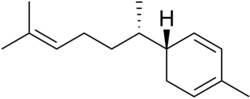 |
| Longfoliene |  | |||
| Diterpenes | 4 | C20H32 | Cembrene A |  |
| Taxadiene |  | |||
| Triterpenes | 6 | C30H48 | Squalene |  |
| Hopane |  | |||
| Tetraterpenes | 8 | C40H64 or C40Hx | Lycopene |  |
| β-Carotene |  | |||
| Polyterpenes | More than 8 | C5nH8n | cis-Polyisoprene (natural rubber) |  |
| trans-Polyisoprene (gutta-percha) |  |
The tetraterpenes often include more than just the exact formula C40H64, because many important molecules in biology have more or less hydrogen while keeping the overall tetraterpene structure.
Sources
[change | change source]- ↑ The term comes from Terpentin, the Greman word for turpentine
- ↑ IUPAC, Compendium of Chemical Terminology, 5th ed. (the "Gold Book") (2025). Online version: (2006–) "terpenes". doi:10.1351/goldbook.T06278
- ↑ IUPAC, Compendium of Chemical Terminology, 5th ed. (the "Gold Book") (2025). Online version: (2006–) "terpenoids". doi:10.1351/goldbook.T06279