Showing posts with label Embroidery. Show all posts

Friday, October 19, 2012

Katherine Dimond - Art With Needle and Thread


Katie's first Owl
Size - 5" x 6.5"
cotton floss on woven cotton

Artists often attract other artists to be their life partners.  So it is with my son Adrian and Katherine or Katie as we know her.  They were married in April of 2011, and we were not at all surprised to find her to be a talented artist. The surprise for me was how she has begun to use her talent.

For the last couple of years I've been interested in embroidery and during a visit, Katie and I decided to do some stitching and then share what we did.  There wasn't much discussion about what we might do so you can imagine my surprise when I first saw Katie's work. One word description covers it: amazing.  I immediately wanted to share it with more people so I asked Katie to write a narrative to introduce herself to you and to show her work.  

The stories of people's lives and the paths they have followed are always of interest to me.  All of life's experiences end up in their work if they are artists.  With that in mind I was happy that Katie has chosen to share how she came to be making what she is making and I believe you will relate.

One note:  Katie has an esty shop, PelicanZ, and I invite you to visit and tell your friends.


An early commission.
Size - 8" x 4"
cotton floss on woven linen


Katherine Dimond

Background

In 2001 I earned my Bachelor of Fine Arts from Pratt Institute in Brooklyn, NY.  My senior thesis involved sewn fabric sculptures.  I made towers out of used ladies' clothing and nightgowns from the Salvation Army.  I half-deconstructed the clothing and then sewed it all back together into these deformed monster-ladies. There was a vague feminist theory in there somewhere.

My first real job after college was at an upscale clothing boutique in SoHo and then I moved to a vintage poster restoration studio called M&W Graphics.  I had a friend who worked at a poster gallery and she suggested it might be the place for me.  When there was an opening she referred me and I got the job.  It involved repairing damage to vintage posters, mostly as a service for galleries, museums and private collectors.  My job was to fix fold lines, tears, stains and holes.  All of this is done by hand, primarily with watercolors and pencils.  I spent seven years there before moving to LA where I miraculously got a job doing similar work at Poster Mountain.  I've been there for two years and I love it.


Kestrel - Katherine Dimond
Size - 8" x 5.5"
cotton floss on woven cotton
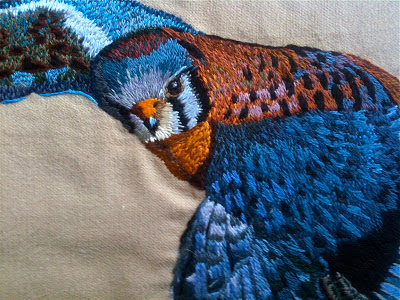
The restoration work is painstaking and takes a kind of patience I was not naturally endowed with.  I am also not a natural perfectionist but that is not true at work.  I can spend days working on one poster and often when I think I'm finished I still keep going.  Often when a flaw looks invisible from one angle, all you have to do is move your head and there it is again.  I usually make tiny microscopic dots.  Dot, dot, dot all day.  And when I'm done with the black dots for example, then I move onto another layer of dots but this time red or blue dots, because nothing is ever simple.


Detail - Kestrel
Notice the dots of thread.


Creative Urge

Restoration involves creativity, but only up to a certain point.  Nothing I created at work was my own.  I had the creative urge but was afraid to follow through.  Maybe everyone experiences a lot of trauma in their twenties, but within a two-year span my mother died, the 9/11 attacks happened in my town, and I was mugged with a gun to my head.  I went into a sort of freaked-out survival mode and didn't make anything for a good ten years after graduating college.  Suppressing that urge made me pretty angry and unhappy.  I think it's bad for anyone, bad for the soul, not doing what you're meant to do.


One of the things that got me out of my funk was my husband.  Watching the way he works.  He seems to protect his creativity with the fierceness of a mother hen guarding her eggs.  If there's something he wants to make, he immediately takes action without brooding or even really thinking.  He just starts working methodically and unceasingly until he's got it.


Thread Box

I've made some good friends here in LA.  One day I was in the car with a friend and we were talking about making things.  I said I had the urge to embroider and she immediately encouraged me to just do it.  So I did, thanks to her faith in me.  She and I would have little craft parties after work; we'd just hang out, watch Downton Abbey, and make little pointless things.  I was terrible at it but I loved doing it.  I wasn't trying to make anything special or beautiful; I was just trying to have fun.


Learning the Process

I had learned how to stitch from my mother when I was about ten.  I don't think she taught me at home but at school as part of a month-long Pioneer Days thing.  I guess they were trying to teach us about what people did with their free time before TV.  We learned a simple backstitch.  When I took it up again in adulthood I checked out a bunch of stitching books from the library and taught myself whatever I wanted to learn.


Early stage of a work.

I'm not very strict about it.  People -- non-stitchers mainly -- love to say you can tell the skill of an embroiderer by looking at the back of the work.  It's supposed to look nice and neat.  Mine usually looks like a rat's nest.  I try not to waste thread but I'm also not going to waste time on the back.


Back side of a work in progress.

It's a lot like restoration in a few ways.  It takes superhuman patience, it takes lots of little dots, and it causes migraines.

I love that the materials are so inexpensive.  One 8.7-yard skein of DMC floss costs 39 cents.  That's so much less than paint, you don't have to sit there making up a palette for an hour before starting, and there's very little cleanup.  You can take on the airplane, you can pick it up whenever there's enough light to work.  Also, the colors don't get muddy.  You have total control over where the colors go and they won't bleed together.

Subject Matter

My subject matter is pretty arbitrary.  I love all animals but it just seemed to me that birds, with all their little fibrous feathers, lend themselves nicely to embroidery.  Lately I've been experimenting with cats.  We'll see where that goes.  I put a lot of emotion into my work.  It's been building up for a long time.  I feel like I've just been take-take-taking from the world and now I want to give back something special.


Kite - Katherine Dimond
Size - 8" x 4"
cotton floss on woven cotton


Maybe I'm doing birds because many people don't like them.  They think birds are untrustworthy or something.  I can understand that.  I've been attacked before.  Where I grew up in Laguna Beach, there were these birds that would hang out in a hedge by the art museum, randomly dive-bombing passersby for their hair.  It's pretty funny to see, not so much when it happens to you.  I still love birds.  I think they're beautiful and there's something about flying that seems like a metaphor for the soul.  So I'm trying to manipulate others into liking them too.


detail - Kite - Katherine Dimond


Listening and Working

Terry:  I asked Katie if she ever listened to music or books while she worked since I know how intense this work can be.  Here is her response.

While I'm working I usually listen to my ipod, mainly audiobooks and podcasts.  I love long books, so Dickens is good.  I like short educational podcasts such as Discovery Channel's Stuff You Missed in History Class, Stuff to Blow your Mind, etc.  Also I watch a lot of black humor British TV shows like Peepshow and Spaced.  Embroidery is tiring, so I like to take plenty of short, frequent breaks.

It's weird but every time I look at my work, I can vividly remember what I was listening to or watching at the time.  For example, when I did my Eagle Owl, I was listening to Norwegian murder mysteries.  Same with the posters at work.  One of my projects, a Tarzan movie poster, needed days of work.  It   took took exactly the length of The Count of Monte Cristo, which is what I listened to while working.  So those two stories are forever linked for me.


Katie is one of her favorite stitching spots.


Thank you Katie for sharing your story and your work.  We love YOU!

Don't forget to drop in on Katie at PelicanZ.

***

Thank you for spending time at Studio 24-7!
I love hearing from you and Remember:
Commenting
Is
Free!!!

Friday, May 18, 2012

Extremely Intense Embroidery


Cayce Zavaglia

Carol - Hand Embroidery
Crewel Wool and Acrylic on Linen - 14 x38"

A friend gave me an article that was in one of her art magazines about Cayce Zavaglia and her amazing hand embroidery.  It is amazing!  Check it out here:  http://www.caycezavaglia.com/

Thank you for spending time at Studio 24-7.  I love hearing from you and Remember:

Commenting is FREE!!!

Monday, January 23, 2012

Hang with ArtQuilt Elements 2012


Postcard by Terry Jarrard-Dimond
Hang with ArtQuilt Elements 2012


ArtQuilt Elements began in 1999 as ArtQuilts at the Sedgwick. This show has grown to be one of the premier art quilt exhibitions in the country and is celebrating it's 10 exhibit this year.

As part of this celebration they are presenting 6" x 4" fabric art postcards in the Link Gallery during the opening weekend. The pieced pictured here is my contribution to this project. It is a small piece of monoprinted fabric with handstitching and is part of the exploration I am working on now in a larger work. Each piece will be priced at $50 each and all funds raised will help support the full color catalog for the AQE 2012 exhibition.


The show runs from March 30 - May 31, 2012. For more information check HERE.


Thank you for spending time at Studio 24-7. I love hearing from and Remember:

Commenting is FREE!!!

Monday, June 20, 2011

Anna Torma - embroidery

Since my collaboration with Kathy Loomis which used blind embroidery and my post on the Boy Code work of Wendy Osher, I have been investigating the work of artists who use embroidery as their primary technique. The work of Anna Torma has been high on my list and today I found a wonderful article on her work by Elvis Robertson.

Here is a link to the article: lovely textiles: Anna Torma - embroidery

I felt this article was so excellent that I would share it with you. The blog is titled Lovely Textiles and is maintained by Elvis Robertson whose work is also wonderful. During this investigation I also found an interesting interview with Elvis that you might enjoy. Our English sisters certainly have a way with embroidery.

Here is another link you will enjoy from Christine Mauersberger on Anna: http://cmauers.blogspot.com/2010/09/anna-torma.html

If you enjoy the articles on the blogs, please let the bloggers know by leaving a comment.


Thank you for spending time at Studio 24-7. I love hearing from you and Remember...

Commenting is FREE!!!


Monday, April 25, 2011

Blind Stitching OR Stitching Blind 2


Equinox - Night and Day
Kathy Loomis and Terry Jarrard-Dimond
2010
Fabric and Embroidary Floss


Two summers ago I attended a workshop at QBL and took a class titled Expressive Stitching with Dorothy Caldwell. It was an interesting experience and has inspired me to incorporate some handstitching into my work.


Day


The experimentation that I most connected with was an exercise where Dorothy had the class put on blindfolds and stitching following very specific directions. This might sound a little strange but from my perspective, the most expressive stitching that was done that week was while we were all blindfolded!!! It is not my intention to insult the members of my class with that statement. My sighted stitching was the most constrained of all. I like to think of myself as able to communicate and "express" feelings and ideas with my art materials but it wasn't happening until I worked blindfolded.


I did all of my stitching at my work table.


Fast forward to fall 2010. I became very interested in a SAQA competition titled Beyond Comfort which challenged artists to expand on the idea of textiles or textile techniques and "Blind Stitching" came to mind. Ultimately I decided not to follow that line of thinking but I did discuss the idea with my friend Kathy Loomis and we decided to do a collaboration where we would each spend time stitching blindfolded and then join the work into one piece.


I threaded the needles without the blindfold but I ended each length of floss with the blindfold in place.


Here is the process we followed:
  • We choose a diptych format. One side black and one white. We drew lots and Kathy got the black and I drew white.
  • We each individually decided on the color or colors of thread we would use and did not discuss it with one another.
  • We each would stitch 12 hours making the piece "worth" 24 hours of blind stitching or stitching blind.
  • We would not look at the work once we began until reaching the 12 hour mark.
  • We would each select what stitch or stitches to use in the work.


This is now the fabric looked before it was stretched. I had not tried to keep things flat.


I'm very happy we decided to divide the 24 hours because I found out very quickly that it was hard to not look. While there was pleasure in trying to "see" with my finger tips, I found it tempting to peek and had to work hard not to do so.


Detail of Day


The best thing was that I liked the feel of what was happening on the fabric from the very beginning. I could feel puckers, bumps, tails, knots, tracks. I could visualize what was happening on the surface although not how the thread colors were working.

I selected about 24 colors which were placed in a paper bag. Each time I sat down to stitch I randomly pulled one skein from the bag, threaded 8 needles and worked until I ran out of needles. I made it without looking until 6 hours in and then I couldn't stand it anymore. I looked. I couldn't believe now nice the work was. I then reframed from further looking until I finished.

I did have issues with tangled threads and sewing in the tails but somehow it all looks just fine now that it has been finished. Kathy did the finish work and she did a bang-up job. Thank you Kathy. Each side is mounted to a stretcher frame and will be hung side-by-side but not attached to one another.

Kathy chose to work with a cross stitch and I did mostly a running stitch although I did work some areas into patches of stitches.

So what's the meaning of this? For me it is an example of how powerful our senses are. Artists tend to be very visually oriented naturally but I believe we also use the sense of touch, smell and sound - even when we aren't aware of doing so. Think installation or performance. In a very real sense Kathy and I created a performance work by quietly sitting and stitching allowing our fingers to communicate with our brains to tell us what to do next.

You are invited to visit Kathy's blog to see her photographs and thoughts on the process: http://artwithaneedle.blogspot.com

I have some ideas of ways to carry this forward. I'll keep you posted.

Thank you for visiting Studio 24-7. I love hearing from you so Remember:

Commenting Is FREE!


Thursday, April 21, 2011

Wendy Osher - Boy Code Embroideries


Boy Code - 2003 - Wendy Osher
Embroidery Floss on cotton, silk ties and men's suits


I wrote recently about visiting the San Jose Museum of Quilts and Textiles and the exciting work of two artists who go by the name of A BEE ( Carrie Houseman and Darbury Novoselic). In addition to this show there was a small grouping of embroidary works by Wendy Osher.

Osher's work is from her series The Boycode Project. There were 11 embroideries based on the drawings which are of a type typical of adolescence boys. The works feature gruesome male figures, warriors and superheroes. Each work is formated as a Thangka which is a type of Tibetan portable altar(as described by the artist) and is constructed of men's suit and tie fabrics.

As the mother of a son who is an artist and who like many young boys drew all over everything, I found this an interesting and powerful concept. The boys' drawings were rendered perfectly down to the lines on notebook paper. I responded to the intimate size of the work which made it necessity to view the work up close and presented a unique view of familiar subject matter.

The exploration of materials with ideas is central to Osher's work. The following is quoted from her biographical information. "Wendy Osher's practice works deep in the seams of discrepancies in our relationships with the natural world, each other, the things we use, and community. The materials she chooses emerge from the dynamics of each exploration. In recent years, discarded materials, installation, stitching, and documentary video have surfaced regularly. Her meticulous, labor-intensive approach betrays a rootedness in process, while her sense of humor always lurks in the wings."

This show will be on view through May 1, 2011.

***

Thank you for spending time at Studio 24-7.

I love hearing from you and Remember:

Commenting is FREE!!

Monday, April 11, 2011

Christine Mauersberger: Stitched Maps - Real and Imagined


Cross Roads Map I - 2009
embroidery floss on vintage linen - 9" x 9"


Christine Mauersberger is an artist I met through participation in Artist As Quiltmaker and the web. We quickly realized we have many similiar life experiences and our friendship began.

Using fabric and stitch, Chris creates artworks she calls "maps". The work is quiet, comtemplative, delicate and enticing. The work invites questions.


Nelson - 2009
embroidery floss on vintage linen - 9" x 9"


Interview


Terry: What is the meaning of map making in your work?


Chris: Each mark I make by stitching, drawing or printing represents a mental navigation through a place, whether real or imagined, therefore the finished pieces are maps that only I can read.


Redland II Drawing - 2009
marker on paper - 14" x 10"

Redland II Map -2009
embroidery floss on vintage linen - 18" x 18"


Learning to read maps was instilled in me at childhood. Maps were important to my father and in turn, he wanted his children to know how to read them. When I learned to drive, my dad would open the city map and plot a course for navigation, noting landmarks for me. Maps were a way to communicate with my dad. If he knew that I understood my surroundings, I wouldn't become lost.


Move - 2009
work in progress


Terry: How have you come to this concept and the textile medium?


Chris: A little over two years ago, I decided that I didn't want to do anything that didn't make me happy.

I started to draw small marks in my sketchbook using a red marker. These drawings were pleasing and meditative. Soon these marks started to have a formal language for me. I realized that I could daydream about places and allow the marks to evoke the movement through those places.

Within a short time, a desire to stitch the drawings onto fabric became evident. Without a conscious notion of the outcome, I cut a swatch of cloth from a vintage linen tablecloth and began to stitch. I only knew that I wanted my stitches to achieve the same look and feel on fabric as my marks did on paper.

I enjoy thinking that my new marks gave the fabric a new purpose. That piece of cloth was the genesis of working with previously owned fabrics.


Cross Roads Drawing - 2009
marker on paper - 11" x 10"


Terry: What process do you use to record ideas for future work?


Chris: Keeping a sketchbook for writing, drawing, and pasting small bits of images for ideas is how I best flush out ideas.

Sketchbooks are handy. They don't need to be big. I carry a small book in my purse.

A camera is a huge part of my process for future work. I carry a nice small Nikon camera in my purse. Documenting where I go is part of my vernacular. I capture images of fairly dull content. Mostly the images contain some type of natural or man-made mark, repetition, or pattern. Observation of marks is a private pleasure that, to me, is life affirming. We exist. Life is dynamic. Fleeting bits of evidence are within my sight and I take note. My mother tells me I was born with my eyes wide open; I guess I haven't stopped looking.


Black Skirt - 2009
Black Skirt, cotton/silk thread, felted wool, eco-dyed silk
21" x 20"


Terry: Do you work in any medium other than fabric and thread?


Chris: Last fall, printmaking re-entered my radar. I studied printmaking in college and wanted to get back on the press. There is a brilliant printmaking co-operative studio in town called Zygote Press. They charge a nominal fee to use their presses and inks. Having access to these tools has been important for my continued growth.

Knitting has been in and out of my life since 2001. I've got a nice little history teaching knitting at a local shop in town. I like to connect with people. Knitting with others is a magical way to achieve a meaningful bond.

Eleven years ago I took an eight week quiltmaking course where we learned everything from rotary cutting to binding. It was teriffic and we each left with a completed quilt. Since then I've made several traditional quilts.

I admire contemporary quilt artists and wish I had the fearlessness of others to dive in and dye hundreds of yards of fabric. Three things hold me back: cost, caustic nature of chemical dyes, and studio space. I battle with using dyes versus found materials and natural dyes, but now I'm printmaking using chemicals, so I think I need to reassess my position.

I used to weave in high school and in my 20's and still have my Glimakra loom and 2 spinning wheels.


Black Shirt - 2010
Black Shirt, cotton/silk on found linen shirt - 19" x 21"


Terry: Many artists are born collectors of a variety of things. Do you collect anything?


Chris: Gulp! I'm in the process of editing everything I've collected. Editing is code for "throwing away" or donating.

I used to collect chairs. Before I got married and moved in with my husband, I lived in an apartment where I had nothing but chairs. Wood, wicker, paint-chipped, antique, new...it was fun and a bit odd. I had this fear of owning a sofa. I thought a sofa was a metaphor for settling down and I wasn't ready for that. Now I have less chairs and 2 sofas.


I've collected the usual things like sea shells, rocks, fabric yarn, and odds and ends from the thrift store. Vintage notions, knitting needles, embroidery hoops, table linens, tea towels and gently used clothing usually find their way home with me. I love the feel of old fabric in my hands and the memories they hold.


Christine's Studio


Christine Mauersberger
Artist Statement


My work investigates the marks made by all living things. Whether these marks are intentional or by chance, they are deeply interesting and cause me to wonder about their meanings and origins.

Observations made throughout my immediate environment are the conduit for the resulting artwork. I take notice of small disruptions in my surroundings and they inform my own mark making on paper and on fabric.

The marks I make by I stitching, drawing or printmaking represent a mental navigation through a place, whether real or imagined, therefore, the finished pieces are maps that only I can read.


***


Christine Mauersberger


A native of Ohio, Chris is a graduate of Cleveland State University and she lives and works in Cleveland with her husband, George. She is currently working in the studio to create a new body of work.


Links

Chris maintains a blog, Christine Mauersberger which features her thoughts on working in the studio as well as articles on artists who catch her eye. It is a treat to see the work she presents as she has a very clear asthetic. A personal website is planned for the future.

***

Thank you Christine!

Thank you Reader for spending time at
Studio 24-7!
I
LOVE
hearing from
YOU!

Remember:
COMMENTING IS FREE.