Showing posts with label bamako. Show all posts

October 15, 2015

Tempo

'Tempus fugit', often translated as 'time flies', actually means 'time escapes'. This is how I experience the passing of time; it rushes on and I am running after it trying to catch up.
In this post I would like to share with you a video, which I recorded in 2011 and which I have been meaning to post on this blog ever since. But time has been escaping me, and we are now in 2015.

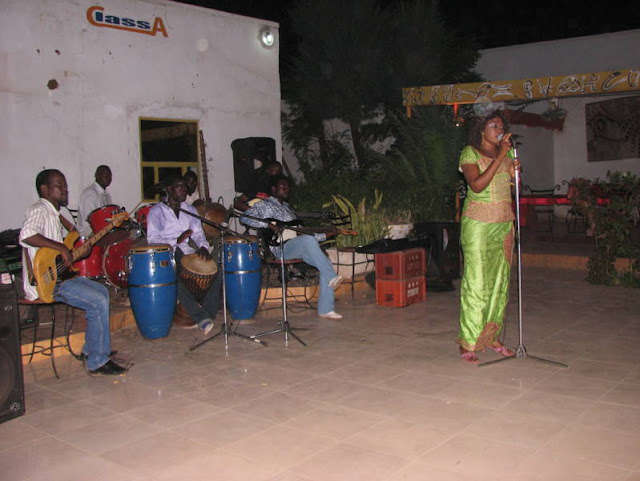
The recording was made in October 2011, in a bar called Le Tempo in central Bamako. And the name seems very fitting for the music which was performed by a group of clearly seasoned musicians. For walking into the bar was like walking into a time machine, and being transported to the early 1970s.
And perhaps even to a different place. For this music reminded me of legendary artists like Dexter Johnson, Laba Sosseh, Idy Diop, Papa and Mar Seck. Music with a strong Latin or Cuban flavour, hot and languid. Languid in a positive sense: with the ease that comes from an inherited understanding, and not from fanatic practice.

Unfortunately the sound is slighty distorted, but it should give you an idea of the almost unreal quality of this orchestra. The flute player would fit in easily with any top Cuban orchestra. Unfortunately I did not have time to go back and find out who he is, but this man is topnotch. The vocals in these two cleverly linked songs are superb. The harmonies in "Que Humanidad" (the first if the two) are in my opinion better than in Johnny Pacheco's original from the mid-1960s, particularly for the despondent tone. The second song, "Oriente", does not surpass the original, but this is not surprising as the original is by the immortal Cheo Marquetti* when he was singing with Chappottin y sus Estrellas, at a time when they were - rightly - at the top of their fame. But the Tempo band still manages to give the song its own feeling.


Out of character and emphasising that I am not going to be making a habit of this, I would like to add that if you like this 'genre' I can recommend the releases by Terangabeat, noteably those of Idrissa (Idy) Diop, Mar Seck and Dexter Johnson, despite the fact that I get the impression that in 'restoring' the original they may have in some cases overshot the mark.

Returning to the music of Mali: a lot has been written about the Latin influence into the music of the Malian orchestras. While I am inclined to believe that this influence is being overstated, it does not mean there was no influence. Apart from a few musicians who went to, visited or even studied in Cuba (such as Boncana Maiga, who can been seen nowadays presenting a rather unfortunate weekly magazine on modern African music on the French TV5), Mali also went through a Latin 'wave', - as did most countries in Africa, Europe and the Americas**. Often records from the GV-series on the HMV-label (from the 1950s) are cited as a major influence on West African music, but I have my doubts about this. This series contained mainly Cuban son music, and little of this music remains in the West African music of either the 1950s or 1960s. I suspect Mali went along with the worldwide craze in the 1960s.

I had heard from several musicians that there had been orchestras in the era of Modibo Keita which combined Latin with Malian, and even French music. But for decades this music seemed to have been lost in the mist of time (as is the case with far too much music in the African continent). But fortunately Florent Mazzoleni managed to dig up this cassette, which I would like to share with you here. The cassette contains no information apart from the title of the orchestra: Askia Jazz.

This orchestra was reputedly founded in 1960, in the wake of Mali's independence, by pupils of the Lycée Askia Modibo in Bamako. Several musicians claim to have started in this orchestra, but one member who has been confirmed by several sources is the legendary sax player Harouna Barry. I am not quite sure which instrument Harouna Barry played with Askia Jazz, but reports suggest it was not the saxophone, as he only took up playing this instruments years later. He only stayed with Askia Jazz for a few years before moving to Gao, where he worked as teacher. In the mid-1970s he joined Boncana Maiga in Les Maravillas. And ten years later, in the mid-1980s, he was the leader of the Ensemble Instrumental National du Mali before becoming the chef d'orchestre of National Badèma. He remained in this position until his retirement in 2001. Harouna Barry passed away in January 2008.

Other members included Mohamed Cheick Tabouré, who - according to this article - stated that the creation of Askia Jazz was made possible by using the money from the deposits which student had to pay when they joined the Lycée. This money was used to buy instruments in Abidjan. The example of the Lycée Askia Modibo was soon followed by other schools in Bamako.
Tabouré, by the way, is in the news in Mali with some regularity as a leading member and spokesperson of le Mouvement Populaire du 22 mars, which was created to support the plotters of the coup d'état of March 2012.

As per usual I am open to any suggestions with regard to the titles of the 16 songs of this cassette. I have added my suggestions, - but they are just that: suggestions.

Askia Jazz du Lycée Askia Modibo

Many thanks to Florent Mazzoleni for filling in this bit of musical history from Mali!

* but what is surprising is the fact that Marquetti, born in the Occidente of Cuba (Alquízar), should be so melancholic about the Oriente.
** even in the Netherlands we had a spell a Latin madness. I particularly remember this frisky chachacha from my youth.

April 26, 2014

Lemon or lime

A few days ago I stumbled upon the video by Karamoko Keita which you can find at the bottom of this post. Although I was looking for something else I couldn't help but watch the whole video. The thing is, this man has got certain 'je-ne-sais-quoi' which really appeals to me. I like his singing style, which is old-school Bambara (pentatonic) without being mouldy. The quality of the video is slightly below poor to hopeless, but just watching the movement, both of Karamoko himself and the chorus in the background, makes me irrationally happy.

I first heard his music during one of my first visits to Mali in the 1980s. To be honest, it was very difficult not to hear it because everybody was playing it, in the streets of Bamako and in every town and village I visited. The children were singing Karamoko's songs and their parents knew every single word of the lyrics.
They were playing this cassette, recorded for Malian radio, and here in the release of the Super Sound label of Monrovia, Liberia. You can see the first song, "Diama", in a video which I posted earlier.

This cassette just oozes old-style Malian music. And if you ask me it even oozes old-style Mali. I can't help but thinking of that friendly and hospitable people I encountered all over the country. People were curious without being nosey, warm without being pushy... They shared the little they had and demanded nothing in return. It was, in short, a country that was easy to fall in love with.
I know a lot has changed since those days, but I am sure these qualities are still there, perhaps hidden under a layer of cautiousness. A defence which may be the result of the invasion from neighbouring countries over the last decades, - or of the opening up to the modern world in general.

This is one of those cassettes with shifting favourites. All tracks are great, so it depends on moods, susceptability and environment which I prefer. When I first heard it it was "Lemourou". In hindsight I think this may have had to do with hearing this in the villages, where little girls were chanting it. I asked them what it meant and they contorted their faces. Later on someone told me it meant "citron" (lemon), but then I saw someone selling limes shouting "lemourou". My guess is it means both lemon and lime.

Super Sound SS-36

And, as mentioned above, here is another song from the same concert as the video I posted before. Karamoko with a somewhat larger ensemble and dancing, which adds an extra element of joy to his songs, if you ask me.

December 29, 2012

Finesse

Recently the owner of the (highly recommended) Malian Divas channel on YouTube asked me why I have never posted any music by the third (see below) of those magic Malian divas of the 1980s: Ami Koita.
I admit I did not have a good answer, apart from that I just haven't got round to her.

But perhaps there is another, subconscious reason for my omission. I have met Ami Koita, when she visited the Netherlands in 1991.
On the LolaRadio blog you can find recordings made during this trip by VPRO Radio (and a few days later she also performed in "Reiziger in de muziek" on VPRO TV).
Both Ami Koita and her daughter, who backed her mother in the chorus, were very friendly. But it was impossible to talk to Ami more than a minute as her husband (on the left, holding a camera with which he videoed his wife's every move) was constantly making his presence known. And not only by standing in the background, but also by answering questions for his wife and physically putting himself between his wife and whoever wanted to talk to her.
I later found out that this was the result of an extreme case of jealousy, and several rumours have gone 'round in Mali as to the (possible) grounds for this jealousy.
One way or another, this has perhaps played a role in my apprecation of Ms. Koita.

Getting back to her being the third: the other two of what was like the 'holy trinity' in Malian divaness in the 1980s were of course Kandia Kouyaté and Tata Bambo Kouyaté. And that reminds me that I should be digging up some more of those two in the near future.

Anyway, I would like to share with you this cassette recorded in the late 1970s. The quality of the cassette is dubious, to say the least. And I have tried to remove the extreme hiss*.
But I love the music. Ami Koita's rendition of the classic "Tara" is up there with the very best. And Nene Daou and Lassana Sacko have probably donated their life savings after being immortalised by Ami.

S4307 cassette
or S4307 (speed adjusted - see below)

And as a further illustration of Ami Koita's talent I would like to share with you this first part of a programme entitled "L'Artiste et Sa Musique" featuring Ami Koita "& son ensemble". And this ensemble consists of two great accompagnateurs: Moriba Koita and Bouba Sacko (see my earlier post). The show is presented by Zoumana Yoro Traoré, whom you may remember from the videos I posted by Kandia Kouyaté and Coumba Sidibé. I will post the remaining part of this programme at a later date. Ami is interpreting "Djeliya", a kind of metadata song, a song about griotism. Compared to Tata Bambo's song with the same title, which I have posted four years ago, you will have to agree that Ami's song is more delicate. Both her interpretation and appearance do justice to her reputation as the djeli with finesse.


P.S.: More to follow before the end of the year....

EDIT December 30, 2012: Ngoni has pointed out (see comments) that there may be a problem with the speed of this cassette. I have slowed down the recording to the speed he suggests, and it does sound better. So I have added a link to the slower version.

* And in case there is any demand for the 'raw' sound of the untampered original, send me an email.

July 04, 2012

Daughter

Off-topic: I am getting a bit annoyed with the - unfortunately numerous - pathetic attempts to 'slip in' commercial or otherwise completely irritating links into comments. I do not want to introduce a form of moderation, but I am also not going to accept any links not related to either the posts or the comments. So please try and control these urges....
And while I am on the subject of irritating mails: it is absolutely useless and a waste of time to ask me if I am interested in 'partnerships' or other commercial 'liaisons'. So do yourself (and me) a favour....

On-topic: You may remember my earlier post dedicate to the legendary Siramori Diabaté. In this post I would like to share with you some recordings made by her eldest daughter, Sanoudie (or Sanungwe or Sanougue) Kouyaté.

Perhaps you know her 1990 "Balendala Djibe" album (cassette/lp/CD) which was produced by Salif Keita and recorded in Paris. As far as I know she has not brought out another record since, although I think I saw the title song of the Paris recording on one of the many CD compilation of Malian divas.
I am not sure about her present role in Malian music, but I gather from a book entitled "Relaties smeden: de rol van een jelimuso (griotte) in Mali" (i.e. "Forging relationships: the role of a jelimuso [female griot] in Mali") written by Dutch antropologist Nienke Muurling (and released in 2003), in which the writer submerges into the jeli scene of Bamako & Paris, that Sanoudie was very much active in the lucrative sumu (soirées, weddings, baptisms and such) scene at the turn of the century.

Apparently (I read in this same book) she wasn't able to follow in the footsteps of her mother until in the second part of the 1980s, not because of lack of talent or of 'griot training' (the practical side of tradition), but because of her marriage to a Diawara. Her husband's family did not allow her to get mixed up in 'jeli doings'.... It wasn't until she divorced Diawara and married Madusilla Kouyaté that she was able to start a career as a djeli mousso (jelimuso).

Personally I am not a great fan of "Balendala Djibe". Like many of Salif Keita's albums it is too overproduced for my liking and - as a result - the music loses a lot of its power. Although Sanoudie manages - and with some ease - to overcome the treaclelike production, she has had to make some adjustments to do so. Especially the more subtle nuances of her voice are lost.

These subtleties are very audible in this cassette, which is not dated but which I assume was recorded in the late 1980s. On this cassette she is very much her mother's daughter, and not just by the choice of songs. For all the songs are from Siramori Diabaté's repertoire, which is the repertoire of the griots of Kangaba/Kela (I gladly refer you to Jan Jansen's great CD's on the PAN label, no. 2015, 2059 and 2104). The accompaniment is simple and inobtrusive, especially on side B, where it consists of just a guitar (her husband Madusilla?).

On side A there are brilliant renditions of Malinké classics like "Sadiona Magni" and "Yasoumouka" (which you perhaps know from the version by Les Ambassadeurs du Motel), but as great as these are, the killer tracks are, in my opinion, on the B-side. "Bani" (elsewhere interpreted under the title of "Baninde" - see this post and - of course - this one) is one of the best versions I have heard. And that classic of classics "Wara" is sung in a disturblingly casual but brilliant manner, - and hits me right between the eyes.

Syllart SYL 83107

There are several videos on YouTube by Sanoudie (don't look for Sanoudie, but try Sanungwe instead). My favourite of these is the one Ngoni posted on his great channel. It is roughly from the same period as the recordings on the cassette, and (also??) features her husband on guitar.

May 13, 2012

Bronkoni

Two of the tracks I am sharing with you in this post were on a cassette labelled "Super Biton National 81" which I bought some ten or eleven years ago in Bamako.
It was only last year that I found out I had been misled.

In meeting the musicians from Super Biton in Bamako, last October, I asked them to help me out with the titles of a couple of cassettes attributed to them which I had collected of the last thirty years. Much to my surprise they identified these two tracks, which up to then had been among my favourite "Biton" tracks, as being performed not by Super Biton from Segou, but by Orchestre Bronkoni* from Niono!

The name rang a bell. I had heard of this orchestra in 1988 during my visit to the last of the old style Biennales in Bamako. Two years later I even ventured down to Niono, partly to retrieve some music by this mysterious group, and partly because others had pointed the small town of Niono out as a "hotspot" for traditional Bambara and Sarakolé music. Disappointingly I only found a disproportionate amount of Sudanese music (largely due to the presence of a Sudanese medic, I was told), and some Dutch (agricultural) development aid workers.

In the meantime the name "Bronkoni de Niono" appears to be almost exclusively associated with one artist: Adama Yalomba, who seems to have been touring in Europe (and perhaps also other parts of the world). Apparently he has been a member of this orchestra at one - undefined (!) - point. As seems to be common on the web, all references are indiscriminately copied (and often even without bothering to change the wording).
I am told he is not the only musician with a history with Bronkoni. But I am sure Vieux Paré (video!) is not as well known in the west, so you won't find as many references linking him to the Niono orchestra.

Getting back to the music, even now I have a hard time not associating this music with the legendary Super Biton orchestra. These two songs are of such a high standard, and so brilliantly executed, that it seems hard to imagine them as originating from another source. The opening lines are 100% in the Biton style, with a superb horn section sliding in over the guitar intro. A spine-tingling opening usually only to be found with the music of Biton.
On the other hand it can be seen as an indication of the general - exceptionally high - level of the Malian orchestras, during their 'Golden Years' in the 1970s and 1980s.

Both songs feature elements which can also be found with other Malian orchestras, such as the female impersonation (in "Pary-Mary") and the 'underground' organ (in "Kômon Foli").
But I for one certainly would love to hear more from and by this great orchestra.

Two songs by Bronkoni de Niono

As a foretaste of things to come, I am adding a track which I recorded myself at the Biennale in 1988. The track is by the orchestra representing the district of Bamako: Bamansaba de Bamako. The photo on the right taken during this concert should give you an idea of the circumstances during this concert on September 11, 1988 at the Cinema Rex in the center of Bamako (which no longer exists).
In a future post I hope to write more about the competition of the "Orchestres Modernes" of the 1988 Biennale.

Bamasaba de Bamako - "Danaya Kouma"

* Toussaint Siané wrote "M'Brokoni", and Florent Mazzoleni "Boronkoni", but it's all the same orchestra...

March 26, 2012

A.T.T.

To tell you the truth, I have been totally and utterly flabbergasted by the 'coup d'état' which took place in Mali last week. Or perhaps I should use the word "dumbfounded", - if only for the inclusion of the word that immediately springs to mind: "dumb". For how stupid can you get if you think that overthrowing the government of a respected and liked president like Amadou Toumani Touré is going to solve anything, let alone the trouble Mali is having with rebel groups in the v-a-s-t northern regions of the country?
A.T.T., 1991

The effect is as predictable as it is sad. Mali's reputation as a democratic and stable country, which was carefully built up over the last twenty years, is shot. The reaction to the coup has been resolutely negative, both from African countries and from influential countries like the former colonial power France. Inside the country Malian citizens are in dread of the present (with disorderly troops roaming the streets of the capital), and in fear of the future, with the food situation already getting perilous (prices are doubling from one day to another).

What can possibly have inspired this captain Amadou Sanogo to execute this coup? Does he seriously think that a coup is going to make an end to the "incompetence" he accuses A.T.T.'s government of in handling the Tuareg crisis in the north?
Personally I am inclined to think that if ever Mali had a government capable of resolving this long-time dispute it would have the very government that has been overthrown. Please get me right: I don't mean to say that I know all the ins and outs of the political scene in Mali. I am in all respects an outsider, looking in from the outside, - but still looking in....

The fact that A.T.T. also led a coup d'état, exactly 21 years ago today (i.e. on March 26, 1991), can not be used as an excuse for this coup. Even the fact that the Tuareg rising played a (marginal) part in the 1991 coup can not be used as a justification. The coup in 1991 came after a long period of protests against an autocratic government that had done its utmost to resist any form of democracy, and that had long lost the support of the population. A.T.T. can not be compared to Moussa Traoré.

For further reading about Amadou Toumani Touré I advise you to read the paragraph on him in the Wikipedia.

For now, I would like to share with you a cassette from 1991 (the year in which A.T.T. overtrew Moussa Traoré), bought in Mopti (the town where A.T.T. was born), and recorded by one of my favourites "vendeurs de cassettes" in the local market: Amadou Fofana (more of his cassettes in future posts). The subject of the cassette is A.T.T. himself. And I have no doubt the song is in praise of the man.
About the artist(s) I know absolutely nothing, apart from the fact that they sing in Peul.

Ganari 1991

And to cool myself down, after getting very worked up, I am adding this short relaxing video from the days when peace still reigned in Bamako.....

March 08, 2012

R.T.M.

I have been rummaging through my archives again and dug up some cassettes by Malian female singers. Singers who are perhaps relatively unknown in the western world. And there is a good reason for this, as Kandia Kouyaté (see earlier post, post and post) once explained to me.

One reason is that the music of these singers is uniquely directed at the local market. They sing at ceremonies like weddings and baptisms, at soirées (or 'sumu') and such. The scale of these events is usually such that most participants or persons attending are known to the singer, or people assisting the singer.

And that brings me to another, no - to the number one reason. This is, of course, an economic one. By praising, or at least singing about, respected, respectable and/or self-respecting members of the community the singer can make a good living. And in some cases even an excellent living. Anything from money, handbags, jewelry, items of clothing (pagnes but also silk, embroidered dresses etcetera) to cars and villas can be bestowed on a talented artist. The extent of gratitude on the part of the receiver of the praise is largely dependent of his or her social prestige, or at least the perceived social prestige.

And that is a key ingredient of Malian society: prestige. I have been to events where Malians friends did not dare show up, as they were - rightly - afraid that they would be the subject of griot flattery. As they were (temporarily) financially incapable to live up to their social status, they preferred to stay away. On the other hand I have seen poor Malians give away their family fortune when they fell into the hands of a griot who managed to hit the right button....

So that is why for most female griots there is no reason to gather fame abroad. Ironically the location of this talk with Kandia Kouyaté was Amsterdam......
But that is the subject of a future post.

This post is about one of the more succesful griots: Naini Diabaté. When I first travelled through Mali in the 1980s, there were plenty of stories going around about this singer, who was born in Bamako in 1963. One of the more spectacular ones was that Naini, being blind in one eye, during a heated performance had miscalculated the extent of the stage and had fallen into the crowd. Others claim that she was the first female griot to perform on Malian television in 1983, at the newly constructed (and Libyan funded) broadcasting centre of the R.T.M.. I have my doubts about this claim, but it is reasonably certain that Naini Diabaté rose to fame as a result of her television performances.

Seeing this video from a performance in (probably) 1988 will give you an idea why.


Naini in turn repaid the R.T.M. by singing its praise. And, if you ask me, this praise is well deserved. For the Radiodiffusion Télévision du Mali, which was renamed "Office de Radiodiffusion Télévision du Mali (ORTM)" in 1992, has served Mali - and in particular Malian culture - well. Not just by the many televised performances by Malian artists, but also by the wide range of audio recordings made at their studios. Many of which - by the way - were subsequently released on record or cassette outside Mali.

This is not the case with the cassette Naini recorded for Beny Mariko's label in 1988. I really like this cassette. And not just for the memories which it evokes for me. Not just in the title song "R.T.M." (yes again), but particularly in songs like "An Sako Be Ke", with its variety in amplitude, and the deeply soulful "Sory", the overwhelming "Diamou Niagale" and the skillful "Diagneko" Naini Diabaté demonstrates her maturity and tremendous power as a singer.

You can find more great videos by Naini Diabaté on Ngoniba's great Youtube channel.

Beny Mariko BM-018, 1988 [new link June 3, 2014]

February 24, 2012

Survivor


I first met Zoumana Tereta when he took part in a rather prestigious project called "Fura, Opera Bambara", which toured through the Netherlands in March 1999. I remember it was a miserable day, - cold, wet (see photo on the right).
My interest in the tour was drawn not only by the fact I had been phoned by the producer Abdoulaye Diarra, but also because my friends Daouda 'Flani' Sangaré (see previous posts on this blog) and Zani Diabaté (see particularly this post) were participating. It actually was the first time I saw Flani dance without Alou Fané. Because he was not only singing, but also dancing.

Besides these stars from the Djata Band the Opera feature two great names from Malian comic theatre & television: Habib Dembelé, better known as "Guimba", and Michel Sangaré. Leading lady in the production was Guimba's wife, singer Fantani Touré. You can find the full line-up here (unfortunately only in Dutch, but I guess you can still sort out the names..).

We saw them perform in Amstelveen and a few days later in Utrecht, where we joined them afterwards for a chat and a drink. They were staying in a somewhat bleak motel outside of Utrecht. To liven things up Flani suggested they would play a bit of music. I have posted one track of this session in the tribute to Zani (#10). If I remember correctly Zoumana himself suggested he would do one of his own songs. I was surprised about how familiar his voice sounded to me when he started singing "Sira Mougoulé" ("the well made path"), accompanying himself on the soku, the bambara fiddle.

I have since wondered about this. I had never heard him sing before, but still it seemed to me as if I had. His voice is well-matched with the instrument of which he is the undisputed master. Zoumana, by the way, disputes the suggestion that the soku has its origin in Wassoulou (as I see is also claimed on wikipedia). According to him the roots of the instrument are in Segou, and in the bambara music of Segou.

When I heard Zoumana Tereta play and sing again, a few days later at my own house, it dawned on me that I was listening to a voice from the past, a survivor from another era. The era of artists like Bazoumana Sissoko, Koni Coumaré, Fanta Damba and Tara Bouaré. An era of artists that had not succumbed to the (at times narrow-minded) taste of western moneymen. An era in which traditional music began the transition from the live performance in front of real people to the still images recorded in the sterile surroundings of a studio.

Recordings from 1999 (1 song from March 15, and 2 songs from March 20)*

Zoumana has played with everybody. In the eighties and nineties he played with Sali Sidibé, he replaced Aliou Traoré in Oumou Sangaré's band and in Badèma National, he performed and recorded with Bassekou Kouyaté, with Toumani Diabaté, with that sympathetic Samba Touré (who appears to have his own YouTube channel - or channels?), in fact with everyone who is anybody in Malian music... He has released two albums himself, "Niger Blues" (2003) and "Soku Fola" (2008), which are perhaps not so easy to get hold of (and - again - please correct me if I'm wrong).

Last October I saw him again. During a performance by Ethiopian azmaris (subject of a later post!) at the Patio, the - excellent - restaurant of the Institut Français (or the Centre Culturel Français or CCF as most Malians continue to call it) on October 26, 2011 he intervened, joined in. While it was interesting to see the merging of pentatonic styles, I was more interested to see him perform solo, - 12 years later.
I managed to record one or two of the songs he performed. He seemed very self-assured, matured, compared to 1999. And more extrovert too. It was clear that he had grown in stature in the last decade.

Seeing him unfortunately also filled me with nostalgia for my two friends who since those sessions in 1999 had passed away...

In the video you may note Lucy Duran reacting to the praises of Zoumana. Sitting to the left of me and noticeable at the end is Momo, the algerian (via Denmark and other parts of the world) host of the Patio.


* You may be interested to know that the 'percussion instrument' you can hear in both sessions is actually a box of matches. The instrumentalist is comedian Michel Sangaré.

November 07, 2011

Colloque

I returned from the symposium - or 'colloque' - in Bamako last weekend, but still haven't been able to digest all the impressions and information from this highly compressed (only one week) but absolutely fascinating meeting. The highlights of this inspiring gathering were too many to deal with in one post, so I intend to dedicate several posts to these.

I am planning to post images of a brilliant concert by the legendary orchestra Super Biton, led by Mama Sissoko, who demonstrated he must be counted as one of the most outstanding guitarists in West-African music.

Then there will be a post dedicated to the fantastic research done by Vincent Kenis (who unfortunately was unable to attend the colloque), Césarine Sinatu Bolya and a young Congolese whose name I forgot to write down. They interviewed 'survivors' (musicians and mélomanes) from the golden era of Congolese music, i.e. the 1950s and early 1960s. This includes Paul Mwanga (photo right), who, contrary to what I wrote in my post about the song "Mokolo Nakokufa", is clearly not dead, - or at least was still very much alive at the time of the interview some five years ago.

More mysteries were resolved (and others added...). I was able to retrieve the titles of some unreleased Super Biton tracks, which I also hope to share with you in the near future. I found out more about the Malian lamellophone about which I reported a short while ago.

Other highlights of the colloque included a performance in the restaurant of the Institut Français by a group of azmaris from Ethiopia, which led to a remarkable encouter between a masengo and a sokou (photo right)... I intend to post a few videos of this encounter.

Then there were two very short but delightful performances by John Collins, the eminent expert on highlife music in general (and Ghanian music in particular). Unfortunately on Thursday John received news that his house in Accra had been hit by the floods which destroyed parts of the city. It seems likely (but I have had no confirmation of this) that his music archive has been damaged.... I will keep you informed.
We had some interesting discussions about the influence of the Kru sailors on the musics of west and central africa. No doubt this will lead to another post...

The presentations during the colloque gave plenty of food for thought. I was particularly interested in Lucy Duran's presentation about the phenomenon of the "sumu" (soirée), and the domination of female singers in the Malian music scene (in Mali, that is...). I will certainly come back to this, - and probably soon.
Others. like Ariel de Bigault and Uchenna Ikonne (of the Comb and Razor blog), surprised me with presentations packed with information on subjects about which I know little or nothing.

I could go on about the meeting with experts like Francis Falceto (of the brilliant Ethiopiques series), Wolfgang Bender (the author of - amongst others - the classic "Sweet Mother, Modern African Music", who in his presentation spoke about a subject which is very close to my heart: the archiving and preservation of African musics) and Gérald Arnaud (a francophone expert on yoruba music). I am sure I will dedicate posts to subjects about which they talked.

As I wrote, the programme was very compact. I would have loved to have talked more with South African lawyer, radio presenter and researcher Richard Haslop, who in his excellent presentation on South African music not only came up with some intriguing musical examples, but also appeared to have a fine nose (or ear) for good music in general.
The same goes for prolific writer (he will be finishing books about Malian and Burkinabe music very shortly, and has just published "Afro Pop, L'Âge D'Or Des Grands Orchestres Africains") and almost manic record (vinyl) collector Florent Mazzoleni, who I assume was mainly responsible, or at least instrumental, for my invitation to the colloque, and whom I certainly expect to meet more often (assuming he will be in Europe long enough).

And, of course, it was a great pleasure to meet 'my brother from the other end of the world': Graeme Counsel. We were fortunate enough to - again (after our visit to the first new-style Semaine Nationale in 2001) - share some memorable experiences in Bamako, one of which was the 'excursion' to a performance by one of the new style Apollo groups, Les Frères Dembélé, fronted by a very convincing female singer with a voice somewhere between Tata Bambo and Coumba Sidibé (photo left). This excursion too will be the subject of a post.

I am sure you have understood by now that it was a great meeting. I met many others, who I will mention in future posts. But special thanks must go to Lucien Roux (photo right), the 'directeur adjoint' of the Institut Français, who together with his very friendly staff not only organised the meeting but also proved to be a very pleasant and warm host.

More soon......


I had planned to post this video before leaving for Bamako, but just didn't have the time. It seemed a suitable way to get into the mood for a trip to Bamako. The video is by that almost archetypal Malian musician, 'Tasidoni' Karamoko Keita. This video from 1986 is not of the same exceptional image quality as the one I posted earlier, but is in my opinion musically more exiting. The title, "Randevou Ma Gne", seems to be a misspelling of "Rendezvous magnin" (magnin = bad).

October 02, 2011

Twin

For those in Bamako, Mali, from October 24 to 29 there is a chance to meet some of the experts on African music during a symposium organised by the Centre Culturel Français in Bamako. And I will be there too, not so much an expert as an experienced amateur (and/or 'dabbler').

For me it will be a chance to meet some people again. Graeme Counsel and I only meet in Bamako, and it will be just over ten years since we last met on the occasion of the first Semaine Nationale des Arts et de la Culture, which took place from September 11 to 21, 2001. But some sadness will also be inevitable, as many of my musical friends will be missing, - and missed. Daouda 'Flani' Sangaré, Zani Diabaté, Ali 'Farka' Touré: they have all passed away.

For those who are unable to attend, I will attempt to report on the event when I get back.


All this has little or nothing to do with the cassette I would like to share with you in this post. This cassette has presented a mystery to me since I got it in the early 1990s. I have no idea what ensemble, troupe or group is playing, and I can only guess what the titles are. The sleeve carries no information apart from the title "Gao Thonville". And I am pretty sure that by the last name they actually mean "Thionville", a town in the north-east of France near the German border.

Apparently Thionville is twinned with Gao. This 'jumelage' was started in 1986, was suspended in 1992 (as a result of the Tuareg rebellion) and resumed in 1999.

My guess is that this cassette is a result of the enthusiasm of the initial twinning. This enthusiasm is reflected in the musical content. Or perhaps "love" is a better word to describe the general feeling (sorry) of the music.

The songs appear to be entirely in the Sonrai (or Songhai or Songhoi) tradition, which is no wonder given the history of Gao as the capital of the Sonrai empire. Perhaps you even recognise track B3 as a version of "Tamala (Maïga)", the first song of the Songhai lp in the "Premiere Anthologie de la Musique Malienne" on Bärenreiter-Musicaphon. Compared to this, the version on this cassette is much smoother, less earthy, and this is largely a result of the strange instrument which plays a leading role on this cassette. You may be tempted at first to think it is a kind of balafon. A smaller type perhaps. But listening to the first notes on side B it becomes clear that it must be a kind of lamellophone or thumb piano. This instrument, plus the njarka (fiddle), and the proud singing of the girls' chorus make this cassette one that could claim a permanent place in your musical memory, - as it has done with me....

Gao Thonville (cassette)

January 15, 2011

Tribute

Preparing this post has been quite an emotional experience. And not only for the passionate music, but also for the memories of a trio of friends that have now gone. With the death of Zani Diabaté none of the men, who met at the Ballet National du Mali and who subsequently decided to 'do their own thing' on the side by starting the now legendary Super Djata Band, remains alive. Alou Fané, singer and dancer, master of the kamalen n'goni, proud member of a blacksmith family and a unique personality, was the first to go, over fifteen years ago now. A loss felt to this day. A few years ago saw the death of Daouda 'Flani' Sangaré, musical researcher, extraordinary singer, terrific dancer, sought-after romantic (very popular with the ladies), but also a man who had experienced the deepest depths of misery - after losing his parents at a young age and then (in the last decade) his second and finally his first wife -, and a warm and caring friend. And now Zani, the first and last with the Ballet, who besides a spectacular and unique guitarist was a dancer, multi-instrumentalist (with a background in djembe and other percussion instruments), bandleader and organiser, driving force, as well as being a (in my opinion: too) modest and very friendly guy.

I would like to use the music of Zani and his friends of the Djata Band as an illustration in this tribute. A few of these tracks I have posted before, but most you will find nowhere else. Those recordings were made in a private ambience, at concerts or even by Zani himself.

1. Noumouna Kouloumba
A track from the early 1980's and recorded at the Radio Mali studios in Bamako. This is in fact a medley of donso n'goni songs, made popular by the great Toumani Koné. It starts off with Zani frantically setting the pace in a tune known as "Dangoroba". Flani is singing the lead, with Sidi* Touré backing him. After 1'24 the band seamlessly moves into what is probably "Gon Magni" (see 5), followed after 2'40 by "Noumouna Kouloumba". Note how Zani uses the guitar to imitate the shooting of a rifle (e.g. at 1'45). After 4'22 wanders off with a solo that illustrates his fantastic rhythmic skills, as he meanders around the main rhythm but always gets back on the right spot. The medley ends with a version of "Baba", a track covered many times by other artists (in various forms).

2. Sinaya
A favourite among the Djata Band songs, with (I suspect) the same Sidi Touré singing alongside Alou Fané; I don't know who the third singer is (who starts after 3'10). I can picture the whole orchestra dancing on this very delicate rhythm, with the unique and unforgettably subtle moves of Alou (a bear of a guy, but what refinement in his dancing...). Very vaguely in the background in the instrumental bits you can hear a sax. I suspect they deliberately didn't open the volume of his microphone, - and that was in my opinion a wise decision by the technicians at Radio Mali. Zani's solo (from 1'43) accentuates the turning and twisting of the dancers. The use of some 'wa wa' effects (2'30) reflects Zani's admiration of Jimi Hendrix (he was near ecstatic when Aboubacar Siddikh gave him a pile of Hendrix cassettes in 1999). I love the part from 4'53 where Zani adds some coal to the fire; I wonder if he could resist doing acrobatics on the studio floor while playing this...

3. Yacouba
Recorded during a concert in the Melkweg, Amsterdam on March 20, 1987, by Joris Oldewelt. This same concert was recorded for release on lp (Milady Music 10023, also released on cd). I refer you to my earlier post for an explanation of this song (and a video). I love Zani's dynamics in this version, with some lovely restrained, almost tiptoeing guitar. Flani's singing is really superb in this song, full of genuine emotion when citing the names of the greats that have passed away...

4. Taasi Doni
A recording of a session at my place, almost exactly twelve years after the previous song, of a song made famous by Super Biton from Segou. Flani was a good friend of Biton singer Mamadou 'Percey' Doumbia. This song was never part of the Djata Band repertoire, so you can hear Zani switching to more suitable chords, displaying a great talent for improvisation. Zani and Flani were in Holland to perform in the 'Opera Bambara' with the title "Fura". I'll post more songs from this session at a later date.

5. Gon Magnin
Recorded by Zani himself during a concert in a village on the outskirts of Bamako. Another classic from the repertoire of Toumani Koné, brilliantly interpreted by Flani and Zani. After 2'30 launches into a solo in which he pulls out all the stops. This song has such pace, that lift-off is almost achieved....

6. Signana
From the same lp as #2 (and yes, I did post this one before) and clearly recorded during the same session, with the same suppressed sax. The two songs may seem very similar at first, but there are a lot of differences. For one, Flani is singing with Alou replying, together with Sidi Touré. This is a song from Flani's roots in the Ganadougou district near Sikasso. My impression is that this was originally a balafon song. Because the monotony of the rhythm the impact of Zani's solo from 2'55 is all the more intense. Again he shows his love for Hendrix's music, but he does so in an amazingly functional way, because it just increases the effect on the dancing and twirling, - which I know must have gone on when this was recorded. After 4'58 the sax player actually discovers that his microphone has not been switched on, and is allowed some 30 seconds of audible contribution. This is certainly one of my top favourite Djata songs.


7. Diabaté Zani
After the two video versions I posted (here and here) here is a third version of this song dedicated to Zani himself. This is from the same concert and recorded by the same person as #3. Attentive listeners may have noticed that this is in fact the same song as "Bomama" by Super Biton. In his solo, after 3'08, Zani does a series of acrobatics, rolling on the floor and sliding his guitar underneath his body. Alou's singing after the solo, however, is somewhat below par. This song does give a good impression of the reception the band got from Dutch audiences.

8. Koursigui Tan
From the same session as #4. The recording begins by me trying to explain which song I was refering to in a discussion that took place earlier. The original, of which I play a few seconds, was by Flani and Alou and their kamalen n'goni act. Zani needs a few moments to recall the song and Flani helps him by singing a few lines from the song. After a while Zani decides it is better to keep the guitar playing monotonous to imitate Alou's n'goni of the original. This certainly gives the song more pace, and goes on 'till the break at 4'25. The subsequent variations again show Zani's skills as an improviser.

9. Fadigna Kouma
This is a song from the very first recording of the band in the Netherlands, on December 18, 1985, at the Melkweg in Amsterdam. It was recorded by VPRO Radio, under the guidance of the late Dave van Dijk. The track starts off with the balafon of Bakari Diabaté, Zani's younger brother, who died some years later. Again perhaps not the best version, but a good illustration of how difficult it is for western engineers to get the sound right. They have a strong tendency to 'normalise' all the instruments and singers within a group, i.e. to record all at roughly the same volume. This tendency has had some dramatic results over the years, the most remarkable being the mixing out of Franco's guitar in the recordings of the 1986 concert in Utrecht (this was 'rectified' in the re-release of the lp). And while we're on the subject: besides being a fan of Jimi Hendrix Zani was - like so many African guitarists - perhaps an even bigger fan of le Grand Maître. Franco's influence is apparent not by Zani playing Franco-like chords, but rather by the boldness of his guitar playing, the choice for an own original sound and - on the level of the guitar playing itself - the awareness of the power of repetition.

10. Facia
Recorded at the Van der Valk Hotel in De Bilt (near Utrecht, the Netherlands) a few days before #4 and #8, this is a truely sparkling version of the Djata Band classic "Facia". Flani improvises with the lyrics to sing about their friend Alou Fané, who had passed away five years before. Zani is filling in both the rhythm and the solo. Such a delightful song!

As a comparison, here is the version of the same song performed by the complete Super Djata Band, in their optimal line-up, during a concert in Angoulême, France, in 1984. This was, by the way, the first performance by the band in Europe.


11. Mali ni woula
To round off this tribute another song recorded at the Radio Mali studios in Bamako in the early 1980s. With the title meaning "Good evening Mali", this is a version of a Na Hawa Doumbia song. It is sung (solo) by Flani, who was very friendly with Na Hawa and her husband N'gou Bagayoko, and visited them whenever he came to or passed through Bougouni (where Flani's eldest son lives). While Flani attempts to recreate the 'modest' atmosphere of Na Hawa's song, Zani offers a contrast with a spectacular and 'full-scope' solo from 2'47. Towards the end, from 5'30 onwards, Flani cites the names of the band members.

There will be more music by Zani, the Super Djata Band, by Alou and Flani, and by Alou and his group Fotemocoba and by Flani on this blog. These great artists and friends may be gone, but their music will live one......

The 11 songs can also be downloaded as one file here (new link March 7, 2014).

*if I remember his first name correctly...

PS: the photo on the top-right was taken by myself at his home in (I think) 1990.

September 11, 2010

911

Where was I when the planes hit the Twin Towers? I was sitting amongst the dignitaries, watching the opening of the first new style Semaine National des Arts et de la Culture (SNAC).


As Graeme Counsel, who was there with Daouda 'Flani' Sangaré and me, put it in his thesis: "The festival commenced with a grand opening ceremony held on Avenue de l’Independence in front of an assembled crowd of dignitaries. Under a hot sun each region and district paraded along the avenue giving the audience a sample of what was in store for the competition proper. Most performers wore traditional costumes and were accompanied by a variety of ensembles performing both modern and traditional instruments. Dancers spun around, acrobats threw each other in the air, which throbbed with the sounds of each of the performance troupes. The soirée for the opening night was to be held by the region of Sikasso, the highlights of which were their orchestra and dance troupe, the latter performing with gourds covered in cowrie shells which supplied a perfect rhythmic accompaniment."

I can add little but some photos, plus a recording made of the 'chant solo' of the Troupe de Sikasso and the dance troup who performed with the cowrie covered gourds.
And the music of this chant solo is here, and the music of the dance troup can be found here.


I will post some more recordings from the 2001 SNAC later.

August 03, 2010

More Djata

This is the sixth post dedicated to the music of the Super Djata Band ( 1, 2, 3, 4 & 5), and certainly not the last. Although I haven't checked, I think it is safe to say that this music is increasingly hard to find in Mali, - let alone outside of Mali. So besides sharing this music with you, conserving it for posterity is a motive for this post.

This lp is the second of two volumes which were released in the early 1980s by the Musique Mondiale label in Abidjan (Côte D'Ivoire), the first of which I posted in December 2009. There are only five tracks on this album and three of these are slow, - which for those of you who only know their European releases may come as something of a surprise. The two tracks on side A, "Yacouba" and "Konadou", have been repeated on a later album, which I posted in December 2008. Both these tracks are, however, considerably longer on this lp.

The B-side contains a cover of a song made famous by Coumba Sidibé, which can be found on the cassette I posted earlier. On that cassette the track is - probably erroneously - titled "Fakoye Noumouye" (which seems to refer to "Fakoly" and "Noumou", which in turn suggests that the song is about blacksmiths). On the Djata lp the more popular title of "Yamba" ("happiness") is used. I advise you to take the time to compare the two versions. Coumba's version was recorded and released a few years later than Flani's/Djata's versions and therefore may have a 'better' or cleaner sound. And Coumba is probably the singer with the more powerful voice. But I really like the pentatonic twists in Flani's version.

The second song, "Mali den", is sung by Mamadou 'Johnny' Diabaté, who with the Djata Band was responsible for the few Malinké songs in their repertoire.
"Bimoko Magnin", the last song on the album, is a rather bizarre duet of Alou Fané and Flani, with Flani singing in a falsetto voice.

Returning to the A-side, "Yacouba" is a song which was quite a success for the Djata Band in the early 1980s. It is an emotional tribute to Yacouba, a dancer of the Ballet National, who was killed by bandits in Dakar in 1973 at the age of 45. This Yacouba was the star of a dance called "Gomba", a sacred dance of the Bambara of Djitimou. Others who have passed away (Aboubacar Demba Camara, Sory Kandia Kouyaté and Biton's Sadio 'Aw' Traoré) were also commemorated in the song. Those who have seen the Djata Band during their 1980s concerts in Europe and Japan may remember the emotional moment when the whole band knelt down during this song. Flani in 1987 recalled a performance in Bamako when large parts of the audience started crying; he himself felt the tears rolling down his cheeks...

Here is a video, of a concert recorded by Malian television in the early 1980s, of the Djata Band playing this song. The quality of this video is unfortunately very poor, but the music and the performance should amply compensate for this...


Personally I have great difficulties watching this video, with memories of Flani and Alou, who have both joined Yacouba, blurring my vision....

There is one song remaining in this album: "Konadou". This is a song which strongly reminds me of Alou Fané. Listening to the version on this album you will probably be asking why, as Flani is the lead vocalist and Alou doesn't even sing in the chorus. But if you listen to the version of this song recorded live during a concert in the Melkweg in Amsterdam, on March 20, 1987, and more specifically to Alou's 'climactic intervention' after 5'20, you will probably understand why I associate this song with this great (and sadly missed) man.

Musique Mondiale MAD 004

"Konadou" live 1987

June 16, 2009

Wasso

I am taking a risk here, in assuming the title of the last track of this lp is misspelt (or misspelled) and the actual title should be "waso" with one "s", meaning "showing off" or "boasting". You will find many songs in Malian music telling you that showing off is not acceptable ("waso magni").

The Rail Band is not one of those bands that can be accused of showing off. On the contrary, they have been very modest in the long time of their existence. Forever linked to their 'alumni' Mory Kanté and Salif Keita (and the latter only was a member for two years!), the band has struggled through the decades, playing at the Buffet de la Gare in the centre of Bamako. And I can assure you that this was not always the 'hottest club in town'....

Lately, with the release of the Belle Epoque series (of which the second is my favourite, by the way) they have been rightly brought into the limelight. But there is still a lot of ground to be covered for a band that has been in existence for 40 years this year.

Consider this album my 'drop in the ocean'. Recorded for the Sacodis label in Abidjan in 1979, it is remarkable how close the orchestra has managed to remain to their live sound. Listening to these tracks I have no problem imagining myself sitting at a table at the Buffet de la Gare, a rapidly warming beer within reach plus the inevitable 'loose women'.... The cool but decisive guitar of Djelimady Tounkara, (the late) Tidiani Koné, who founded the band, dodging around him on sax and leading the horns, the mainly doubled vocals...
It is no wonder they lasted so long!

Sacodis LS-25

December 27, 2008

Pioneers of Malian music (5)

After these intense days of Christmas, you may feel the need for some exercise. And what better exercise is there than dancing on the Bambara rhythms of the Super Djata Band?

As I have mentioned in earlier posts, the origins of this band were with the Ballet National du Mali. And although the direction of the videos of the Angoulême festival I posted earlier leaves a lot to be desired, they should give you some idea of the brilliant dancing technique of Daouda 'Flani' Sangaré, Alou Fané and Zani Diabaté.

This is one of the most danceable albums by this great band. It features tracks just made for dancing, like "Maliniwoula", "Zani Diabaté", "Konadou" (tracks which the band played in all of their European tours), plus -my favourites- "Sinaya" and "Signana". I am not quite sure who the other singers -besides Alou Fané- are in the first of these two; if I remember correctly one of them is called Sidi Touré. He is probably also singing in the latter, besides Flani and Alou.
Zani's guitar is clearly leading the dancers, turning and swirling, directing the breaks...

The sax is somewhat lost in the mix, but I for one am not unhappy about that.

I only have the cassette version of the album which was released -as the lp I posted earlier- on the Disco Rama label in Côte D'Ivoire. It's possible the cassette doesn't contain the complete album. The track "Yacouba", the last track of side A, is only three and a half minutes long, about half the size as the same track on MAD 004 on the Musique Mondiale label*.

As a bonus, here is a short video of a concert at the back of the Carrefours des Jeunes. I am not sure where Flani was during this recording, but I suspect he was on tour with Alou. According to the video the track is called "Balla", but I have my doubts about this title.

* which I'll post later

December 20, 2008

More Tasidoni

Since my first post about 'Tasidoni' Karamoko Keita we have learned that our hero is no longer with us. The more reason to raise a statue for this artist, who can been seen as a man of the people, a Malian amongst Malians.

He has no airs, no pretentiousness. Listen to the intro of this cassette: Karamoko thanks God and subsequently introduces himself and the people present at this recording session. I just love this cassette. It's so authentically Malian, so characteristic of the Bamako of the 1980s.


SS 87 (new link April 12, 2015)

October 04, 2008

Local

It is sad to see African artists rising to fame solely because a western producer thinks he has found a 'star'. And it is even sadder to see that, just because these artists have 'made it' (or are perceived to have made it) in Europe, the States and/or Japan, they rise to stardom in their own country, - where nobody wanted to know them before.

By contrast, there are many artists whose songs have been deeply rooted into the memories of vast amount of Africans, but who will always be considered as being too 'local' for global distribution. One of these is 'Tasidoni' Karamoko Keita. BIG in Bamako in the eighties. Children were singing his tunes.

I don't know where he is today. But his music shouldn't be forgotten.
Here is a video from Malian television, and this time in full colour.
Isn't he great?