Showing posts with label franco. Show all posts

October 12, 2019

30 Years

It is hard to believe that thirty years have passed since Franco died. Regular visitors of this blog (if there are any) probably recall my earlier posts on the subject of his demise and the sad or even tragic circumstances of his last performance, just twenty days before in the Melkweg in Amsterdam.
Fortunately a lot has been done in the last few years to preserve and/or restore his legacy. And one can only hope that even more can be retrieved before it disappears in the inevitable mist of time.

In this post I would like to share one of the key albums of the Grand Maître's extensive legacy. This double album, "Tonton Franco et le T.P. O.K. Jazz - 6 juin 1956-6 juin 1980 - 24 Ans d'Age", released on the V.I.S.A. 1980 label (FRAN 004-005), contains eight songs, - and only one composed by Franco himself. The album was released in 1981, so in fact almost 25 years after the foundation of the O.K. Jazz.
It is only the fourth album on the V.I.S.A. label, the label which Franco had initiated after the collapse of Fonior/Decca in March 1980 and for which he had negotiated a distribution deal with Daniel Cuxac's Disco Stock in Abidjan in 1980 (an interview with Daniel Cuxac from 1983 can be found on the afrodisc.com website).

Unlike the first of the V.I.S.A. 1980 albums this album is not dominated by Franco himself, but more of an orchestra-wide effort, with compositions from Josky Kiambukuta, Ndombe Opetum, Gerry Dialungana, Lola Djangi (a.k.a. Chécain), Makosso (credited as "Mackos" on the label and "Makos" on the sleeve) and two compositions by Wuta Mayi. Of the two records the first one probably contains the most 'well-known' songs. Songs which were reproduced during concerts in the 1980s and became 'household names' with mélomanes all over Africa.
It looks like this record was intended as a 'theme' record, and perhaps even as a single lp. For the songs "Propriétaire" (owner), "Héritier" (heir), "Locataire" (tenant) and "Ayant Droit" (beneficiary or rightful owner) all refer to ownership and rights. It is doubtful that these songs were composed with this theme in mind though, as the composers later referred to them with other titles. "Héritier" was also referred to as "Machata", "Propriétaire" as "Sambwa Sambwa".

There are many highlights on this classic album. The first of my personal favourites is the start of Josky's "Propriétaire". I just love it when Ntesa Dalienst shines through in the chorus, adding extra swirls like a baroque painter.
Ntesa & Wuta Mayi
After 2'39 the rhythm changes into the trademark 'San Salvador' shuffle, used in more of Josky's compositions. Josky is - as always - in great form, with the typical decline at the end of his lines (which for some strange reason is why I love Josky's singing).
Josky is also great in the chorus in "Héritier", where he is joined by Lukoki Diatho, adding warmth and depth to the song which - as often with Ndombe's compositions - has plenty of drive, but tends to stay a bit two-dimensional.
"Ayant Droit", the first of the two compositions by Wuta Mayi, is in my opinion the star of "24 Ans d'Age". It has everything: great rhythm, great arrangement and - above all - great vocals. The melodious lead vocal by Wuta Mayi, the adornments by Ntesa, Josky providing the solid base: this is why the T.P. O.K. Jazz was top of the league. Ntesa told us in 1991 that Franco did not play on this and the other Wuta Mayi song; so the 'Franco guitar' in "Ayant Droit" is Thierry Mantuika.

Of course this is not the case on "Locataire". This is Tonton Franco himself playing. Once more Ntesa is prominently present, although more restrained than in the Josky and Wuta Mayi compositions. As per usual with the Franco compositions the sébène is intense, with Franco in charge.

"Kufwa Ntangu", composed by guitarist Gerry Dialunga, features Wuta Mayi and Josky alternating on lead vocal, backed by (a once more very prominent) Ntesa and (probably) Lola Djangi. "Probably" as Lola manages to stay well hidden behind Ntesa, but the combination of voices does remind me of his own composition, - which happens to be the next song on the album. "Kufwa Ntangu"" is one of those songs that grows on you after a while, and it is a pity that it is the shortest song on the album.

"Meka Okangama" has that special element which typifies a Lola Djangi composition: there is always something of a "mélodie mélancholique", as he himself described it. Even with the energetic voice of Ntesa besides him Chécain succeeds in radiating a certain sadness in this wonderful song, which is probably the most typical 'old school' O.K. Jazz song on the album. Besides Ntesa Josky is singing and Ndombe was clearly present during the recording (he can be heard animating at 8'30) but I doubt if he was singing.

Wuta Mayi's second composition, "Likambo Ya Moto", is in my opinion not as exciting as "Ayant Droit", but still has some interesting vocal combinations, with Ntesa, Lukoki Diatho and of course Wuta Mayi. Although Franco is not playing there is a lot of guitars battling it out in the sébène...

Djo Mpoyi, who joined the orchestra in 1978, only sings on one song: "Banza", composed by rhythm guitarist Makosso (full name Makonko Kindudi). Like "Héritier" this song does not feature Ntesa Dalienst, but this is amply compensated by Josky, who is backed by Wuta and Djo. Josky is once more in great form and really carries this song.

"24 Ans d'Age" is not so much a showcase of le Grand Maître Franco, but more of his Tout Puissant O.K. Jazz, and particularly of the vocal talents, which in the year before the release of this album had led to a huge hit with Ntesa's "Liyanzi Ekoti Ngai Na Motema". With the album Franco targeted a wide, mainly African, audience. The success of the V.I.S.A. 1980 albums made him realise that an even wider audience was possible, and in the following years he developed a plan to reach out to the world.

Wuta Mayi - Josky - Djo Mpoyi - Franco - Makosso - Papa Noel - Ndombe - Lola Djangi

Live versions of these songs can be seen on Aboubacar Siddikh's YouTube channel:
Propriétaire: Télé-Zaïre 1980
Héritier: Télé-Zaïre 1980
Ayant Droit: Télé-Zaïre 1980 and at 1-2-3
Locataire: Télé-Zaïre 1980 and in Abidjan 1980
Kufwa Ntangu: Télé-Zaïre 1980 and in Abidjan 1980
Meka Okangama: Télé-Zaïre 1980

And for those who can not enjoy music without seeing a picture, Aboubacar has also uploaded the songs of this album: Propriétaire - Héritier - Ayant Droit - Locataire - Kufwa Ntangu - Meka Okangama - Likambo Ya Moto - Banza.

FRAN 004/005 (mp3)
FRAN 004/005 (flac - available until December 31, 2019)


PS: coming up: more music from Mali....


March 31, 2019

Le Poète

Only a year ago we celebrated his 80th birthday with a selection of his work, today we mourn his death.
There are no words for the sadness, the loss, felt at the death of 'Le Poète' Simaro Lutumba Ndomanueno.
The only consolation I can offer is another selection from the extensive legacy of this great composer.

01. Kadima
02. Cedou
03. Presence Na Ngai Ebangisaka I & II
04. Naboyi Bombanda Ya Basi Misato
05. Vaccination
06. On Ne Vit Qu'une Seule Fois
07. Mbanzi Ya Kamundele
08. Desespoir 1 & 2
09. Minuit Eleki Lezi I & II
10. G.G. Yoka
11. Mbawu Nako Recuperer Yo
12. Regina Regina
13. Je Vis Avec Le P.D.G.
14. Monzo 1 & 2
15. Mbongo


In Memoriam Le Poète 19/03/1938 - 30/03/2019

December 30, 2015

La femme se plaint

Is there an element linking this and the previous post? The answer is yes. What both artists have in common is a unique and original singing style. And that's not all: they both draw their inspiration from tradition. Although I add that the source of this tradition may not be so clearly defined - and certainly not in ethnomusicological (what?) terms - in the case of the singer who is the subject of this post.

I am sure you have already recognised him from the photo on the sleeve; the subject of this post is Josky Kiambukuta. I am sure I am not the first blogger to post this album, but there is a valid reason why I still would like to share it with you again. This is a special album. First, because it was conceived as an album, and not as a random collection of previously released songs. Secondly, because Josky was the first singer who was allowed to make his own album with the T.P. O.K. Jazz.

Josky was recruited into the O.K. Jazz (by Simaro Lutumba*) after Sam Mangwana to add a different style to the orchestra. As an ex-singer with Docteur Nico's African Fiesta Sukisa and a member of the Orchestre Continental (as was Wuta Mayi) he was firmly rooted in the African Jazz school of Congolese music. As he explained in an interview in 1991 he had been a great fan of Rochereau since his early youth. Obviously his first vocal contributions were in the style of idol (great example), but he soon started making his mark in the O.K. Jazz, and was actively encouraged to develop his own style. Like all musicians within the O.K. Jazz he was also asked to contribute as a composer, which he did with fervour ("Kebana", "Monzo", "Seli-Ja").
In the interview he pinpoints the song "Fariya" as the start of his own style. A style which he traced back to the legendary ensemble San Salvador, who dominated the recordings on the Ngoma label in the first half of the 1950s. He further developed and refined his style in songs like "Ba Pensées", "Amour Violé", "Mobali Amesana Na Ngai", "Toto", "Bisengambi", "Tokabola Sentiment", "Propriétaire" and - of course - "Bimansha" and "Nostalgie". All these songs were hits.

In the 1991 interview Josky indicated that traditional music was another source of inspiration for these songs. He named "Amour Violé" and "Limbisa Ngai" as based on a traditional rhythm from Shaba (now once more named Katanga**). This personal development culminated in the lp "Franco présente Josky Kiambukuta du T.P. O.K. Jazz", an album which he treated with considerable respect and care. This resulted in a true Classic of Congolese music.

And this is a rare feat for an O.K. Jazz album to which Franco himself has not contributed (i.e. he is not playing in these recordings...). What I personally really like in these four songs is the variation which Josky has managed to introduce both in the rhythms and in his singing. He is without a doubt the star in these songs, but none of the songs is the same, and within the songs it is like he is constantly 'feeling his way', almost exploring the right notes. Solidly backing him in all songs are Aimé Kiwakana, Lokombe Ntal and Madilu System. This harmonic backing only acts to emphasise Josky's vocal excellence in all four songs. Just listen to the ease with which he weaves through "Massini" and "Mehida"!

Josky stated in the interview that most of his songs are sung from a perspective of a woman. "La femme se plaint" (the woman complains) as he described it. Keep this in the back of your mind and listen to this album again. It will add another dimension to what is already a masterpiece.

Edipop POP 025 (1983)

* who knew him from the age of 15.
** Josky himself is from Bas-Congo.

January 07, 2015

Je veux danser

Another new year. Of course I wish all of you a very good 2015, with only good things.

To get this year off to splendid start I would like to share with you this wonderful cassette with sixteen songs from the late 1950s/early 1960s Congo. You may remember those five cassettes of classic South African songs I posted some time ago (here, here and here). This cassette is from the same source, and - judging by the artwork - released by the same people.

This has been a truely eye-opening cassette for me. After hearing it for the first time, some thirty years ago, I knew I want more. That has proven to be quite a bit of a task...
Of the sixteen tracks on the cassette six were recorded for the Loningisa label. The other ten were originally released on the Esengo label. And while to me it was more than obvious that this was music of an exceptional quality, the likes of which will be hard to find on this entire planet, I was disappointed to find that the music of these Congolese labels is extremely hard to find.
And that is true to this day.
Especially the tracks from the extensive Esengo catalogue remain obscure and very hard to find. Luckily some have survived through Pathé re-releases (particularly songs by African Jazz and Rock-a-Mambo), and recently some have popped up on the two (recommended) releases on Planet Ilunga. But the bulk of the releases on this label remains hidden, and is perhaps even lost (aaarghh!!).

Of the ten Esengo tracks three are by De Wayon (or Dewayon) and his Conga Jazz, four are by the Negro Band (from Brazzaville), one is by orchestre Bantou (still without an "s" at the end), and two are by Rochereau with African Rock. African Rock is one of the many combinations of musicians from Rock-a-Mambo and African Jazz. To be honest I find the two Rochereau compositions the least interesting on this cassette, despite the contribution by Jean-Serge Essous. But that may be due to the level of competition.

The one who does stand out is De Wayon, with three absolute scorchers. I love the joy and playfulness of "Josephine", the cheeky staccato in "E Champrau" (and the little cries just kill me) and boyish singing and almost subversive interplay between the guitars in "Merengue Conga Jazz". Lovely naughty music!
Competing on equal terms is the Negro Band. "Bambanda Bayini Negro", composed by guitarist Baguin, with its almost absurd guitars, "Bolingo Rosalie" with the subtly off-key harmonies (by composer Demon Kasanaut and?) which oddly only add to its attraction and the apparent insanity of "Paresse Bobo", another staccato cha-cha-cha. Again contributions from other musicians at Esengo appeared to be more of a rule than an exception, although it is not always clear who is who in these recordings. The fourth Negro Band track ("Los Amor Mary-Clary"), for example, is credited in the Esengo catalogue to Nezy with the Negro Succes. While Vicky Longomba's Negro Succes were recording for Esengo at the time, it seems very unlikely that a singer who spent a large part, if not all his career, with the Negro Band would contribute a composition to another, rivalling orchestra.

Of the six Loningisa tracks four are by the O.K. Jazz, and the other two are credited on the cassette sleeve to the O.K. Jazz. The tracks which áre by the O.K. Jazz are by Vicky ("Nakolela Mama Azonga", a rumba also featured on Sonodisc CD 36502 and African 360.144), by Franco (the iconic bolero "Maladi Ya Bolingo") and by Daniel Lubelo, better known as De la Lune.
Especially the two tracks composed by De la Lune are ver special. The first, "Ozali Se Wa Ngai", is a wonderfully languid song which is just made for warm summer evening and romantic dancing. The second, "Ntsay Ya Bala Ba O.K.", a song which clearly borrows from traditional rhythms, was performed by the O.K. Jazz 'till well in the 1980s, as a warm-up song and to remind the public of the long line of classics the orchestra had and has produced.
The two remaining songs are incorrectly credited on the sleeve to "Tuka Floriant w. O.K. Jazz", and so far I have not been able to trace the origin of this mistake. I mean, who would invent a name like "Tuka Floriant"? It is however a name that has not been recognised by any of the (O.K. Jazz and other) musicians I have talked to. What's more, in the Loningisa catalogue the songs are credited to Tchade Mpiana. And to clinch it: the O.K. Jazz had left Loningisa in August 1961 and the two tracks were recorded in January 1962. Tchade was a singer with the Beguen Band, the band who rose to glory with the Ngoma label, but were contracted by Papadimitriou to fill the void left by the O.K. Jazz. My guess is the song "Bisengo Ya Bana Ya Loningisa" is either intended to claim the position of Loningisa's number one band, or to flatter the people at or owners of Loningisa. The Beguen Band have recorded quite a few songs at Loningisa, but these are all in the category "extremely-rare-and-very-hard-to-find". But please prove me wrong!
The two Beguen Band songs are in my humble opinion the whipped cream on the birthday cake, the brandy on the christmas pudding or (the bit of) chilly in the perfect curry dish. Modest in their conception, they shine and have remain firm classics in my household for multiple decades now.

"Je veux danser"... toute l'année!!

Music of Zaire 1 - Catalina (cassette)

October 12, 2014

Seduction

Today it is exactly 25 years ago that Franco passed away in Namur, Belgium. To commemorate this tragedy, and as a tribute to this giant of Congolese, African and global music, I would like to share with you some of the songs of his early career. Songs which earned him the appellation "Franco de mi amor".

These songs by the O.K. Jazz were recorded between August 28, 1957 and March 10, 1959; so at a time when Franco (born July 6, 1938) was 19 and 20 years old. All songs fall in that unfortunate category of 'inédits', i.e. songs which - as far as I know (and please correct me if I'm wrong!) - were never rereleased. They were originally recorded for the Loningisa label owned by the cousins Basile and Athanase Papadimitriou, and released both on the Loningisa label and on His Master's Voice. The full catalogue of the Loningisa label can be found here, and more detailled catalogues of the HMV releases of Loningisa recordings and of the O.K. Jazz songs on Loningisa can be found on Flemming Harrev's excellent Afrodisc.com.

As I have written before, it is a mystery to me why these songs have not been reissued, either on vinyl or in digital form. These recordings are in my opinion of the quality which should deserve them the protected status of the Unesco's World Heritage List or such.
I have to add that a number of songs of this era have been released, both on vinyl (African 360.1441 and 360.158, Discostock DS 7950) and on CD (Sonodisc 36502 and the first 10 songs on 36505, RetroAfric Retro 2XCD). But still a lot risk being forgotten in the dense mist of time.....

Let me stress that the quality of (the copies of) these records leaves a lot to be desired. Although this is not always a bad thing.
A good example of this is the song originally released as Lon 199: "Linga Ngai Tolinga Ye". Despite its obvious shortcomings I prefer this version to the remastered (?) version on Discostock DS 7950. The instruments, the vocals, they are much clearer in this version, far more defined. Vicky Longomba's heavenly velvet voice, backed by the subtly understated Edo Nganga, Franco adding touches, colour, filling in sentiment in the background, caressing Isaac Musekiwa's sax play (in one of his very first recordings with the O.K. Jazz!), Brazzos providing the stable base on rhythm guitar: what a sheer delight is this song! A boléro, but one that seduces the listener into movement, - if not dance.

The second song in this collection is the A-side of Lon 203: "Oboyi Ngai Likambo Te", composed by Celestin Kouka. The B-side, "Tika Na Bala Ye", can be found on Sonodisc 36505. A typical rumba, with Franco and Musekiwa side-by-side providing the base of the song, sung by Vicky and Kouka. I particularly like the decorations added by Musekiwa. Ordinary as these may sound now, they were completely new at the time. Musekiwa had come over from African Jazz just a few months before, so he and Franco were busy inventing a new style in these songs.

In the A-side of Lon 205, "Obebisi Chance Stephanie", the interplay between Franco and Musekiwa is very different. Instead of joining they are complimenting each other. Isaac plays the chorus2, with Franco doing the decorating. And in the refrains Isaac does the decorating, while Franco signals the breaks.
The B-side of Lon 205 is equally interesting. Both "Tokomi Na Bonne Année" and the A-side are composed by Vicky, but he does not sing the lead vocal on the B-side. Instead he modestly backs Edo. Franco is very active in the refrain and the first chorus is another combined effort with Isaac. But from halfway into the song Isaac takes over from Franco in the refrain, and he and Franco play an extended version of the chorus.

Lon 206 has two songs composed by Edo. The A-side, "Christine Yo Nde Boye", is particularly interesting as the bass player, De la Lune, plays an unusual role. Musekiwa only appears after two minutes, so Franco seems to chose De la Lune for some interaction. The B-side, "Bonne Année To Sepeli" starts off with Isaac colouring in the refrain, only to be joined by Franco for an extended chorus. Unfortunately the song is incomplete; it breaks off after 2'50.

The next two songs (Lon 217), both composed by Franco, are of a muffled sound quality, but it is still clear that there is quite a bit going on in the songs. "O.K. Jazz Bana Mike" has Franco really sweating, pushing the rhythm, with Dessoin on congas vaguely audible in the background. A lovely steamy song, of which I would love to have a better copy (hint..).
In the B-side "Ah! Mi Espana" too there is an important role for Dessoin. Vicky is dishing out the rubbish spanish with the usual unperturbed conviction and cool. It seems the country of Spain itself was not known to the members of the band, as they consistently pronounce it as "Espana" (instead of "España"). But who cares?

One of my favourite songs of this collection is Vicky's "Olongi Na Yo Mama" (Lon 221). Despite the poor quality of this copy it isn't hard to hear that Franco is dying a thousands deaths in the background. What pathos!
The killer in the chorus is Vicky's "Boyoki Mama" (1'13) followed by "Ah .. bolingo". This just is the icing on the cake for me. Vicky had a rare gift for adding these spoken comments at exactly the right moment, but this is one of the very best. In an inexplicable way it lifts the whole song to another level.
In the second refrain Franco is more subdued but certainly not more intense. In the following chorus he throws out all the emotion. What a gem!
The B-side, the rumba "Nayebi Bolingo", is (relatively) less exciting, with Musekiwa playing a very active part throughout the song.

The emotion is certainly present in "Ah! Pauvre De Moi" (Lon 227), composed by Edo, but is a different one than the extreme one of "Olongi Na Yo Mama". Here Franco is Franco de Mi Amor: more loving, almost seducing his audience. The vocal harmony between Edo and Vicky is simply heavenly. Another song which just cries out for a rerelease...
In this case the B-side, "Bokokana Se Pamba", is equally interesting, particularly because of the delightfully lightfooted rhythm, which all contribute to accentuate. Again De la Lune plays a crucial role on bass in keeping the song flowing.

The next two songs in this selection were composed by Brazzos. Along with Edo Nganga he is one of the few survivors3 of this golden era of the O.K. Jazz (and of Congolese music in general). "Cuando Yo Te Dico" (Lon 231) is in a lot of ways a typical Brazzos composition, with its pseudo-spanish lyrics and a rhythm which is a cross between a boléro and a cha-cha-cha. The interplay between Franco and Musekiwa in this song sounds very casual and easy. It is not clear what the role of Brazzos is in this song. Perhaps he is playing bass in this?
The B-side, "Boni Na Ngai?", is a rumba with a rather unusual rhythm. Dessoin's conga gives it an galopping pace, with Franco dancing on top. As on the A-side the quality of the 78rpm record is quite bad, but the music still shines through.

"Hey John, here's your heisty time for the calypso, fine" are the cryptic opening words of "Timing Hole", a composition by Rhodesian Isaac Musekiwa. Released as Lon 241 and recorded on December 3, 1958, the song is labelled as a calypso, but I personally don't hear the similarity with any other calypso, be it of African or of West Indian origin. The rhythm is pleasantly slow and stretched out, leaving plenty of space for Franco to fill in with his inimitable riffs. This song and its at times incomprehensible lyrics (in English) remind me of the songs Musekiwa composed with African Jazz ("Flowers of Luckyness" and "While She's Away"), and leave me with the same puzzled feeling. What are these songs about?
The A-side "Ondimi Sik'Oyo" is a straightforward rumba, with Isaac in a leading role.

Lon 244 features another composition by Vicky in a local version of spanish, - as the title "Eschucha Mia Demanda" already suggests. My guess is the song is intended to be about a man (Vicky) begging a woman (?) to listen to his plea and not let him suffer. And I guess a large part of the Leopoldville audience understood the gist of the song, if only on the basis of the few french words strategically thrown in. Harmonies again are superb, and Isaac is clearly in his element.
Unfortunately I don't have the B-side.

The next record, Lon 245, contained two more songs composed by Brazzos. The A-side is a rumba: "Naboyi Bilubu Ya Bandumba". A compact and powerful song with a strong contribution by Franco, including a very tight interplay with Isaac.
The B-side has a more relaxed, loose rhythm; a cha-cha-cha with boléro touches: "Naci Para Bailar". In this song the contribution of the composer seems more pronounced, assuming he plays rhythm guitar. The interplay of Musekiwa and Franco has reached a tightness where Franco is almost hidden behind Isaac's notes. The break or shift at 1'14 is a stroke of sheer genius of the composer. Wonderful song!

The next song is one of those very special compositions by Franco lui-même. The A-side of "Masumbuku" (see this post), "Yimbi" (Lon 246) is Franco's personal take on traditional music. These songs are usually very personal songs, sung by Franco himself. Franco is hyper and hyper-present from the start. In case there was still any doubt about Franco's vocal agility, this song is a great example of his talent in this field. He may not have the belcanto of Vicky, or of Kabasele, Kwamy or Rochereau, but he does have character and personality in his singing. And if that is not enough there is that hard-hitting guitar. The omission of this song in any collection of his work is almost criminal, if you ask me...

"Pantchika Es Mi Cancion" (Lon 249) offers a unique opportunity to distinguish its composer, Celestin Kouka. Unfortunately it is only for a few seconds, from 1'18 to 1'30 and from 2'41 to 2'55, - and then barely audible in this somewhat dull sounding copy. In the rest of the song he is hidden behind Vicky. Star of this track is Musekiwa. He is clearly getting the hang of things within the O.K. Jazz.
The B-side is much clearer sounding. "Na Tikali Ngai Moko", is a rumba in the style of "Naboyi Bilubu Ya Bandumba" and others. Notable is the subtle variation in the interplay between Franco and Musekiwa. Here Franco is clearly 'in the lead'.

The songs on Lon 251 were composed by a new talent: Jean Bokelo. I have no idea what Bokelo's contribution to "Elongi Nayo Ya Bomwana" involves. It seems unlikely he was playing guitar, with the likes of Franco and Brazzos around. The guitar certainly sounds like Franco, with the usual addition of bonus chords. Bokelo, who of course is better known as the leader of Conga Succès (and later Mbonda Africa), recorded two more compositions with Loningisa, "Likambo Soki Ya Koloka" and "Pobre Don Pierro" (Lon 299). He has also recorded for the Esengo label with his brother Dewayon's Conga Jazz, and I am not sure which came first.
The B-side, "Makanisi Makondisi Ngai", is a marvelous boléro, of the type patented by Franco. Again it is not clear what Bokelo's role is in this. Perhaps he is playing an extra guitar?

The final song in the compilation is "La Muyer" (Lon 253). Composed by Franco, it is a cha-cha-cha "espagnol" with a tight rhythm. The gimmick in this song is obviously the upward chord on the sax, executed with verve by Isaac.

This collection of 25 songs on the 25th anniversary of Franco's death proves that there is still a lot of work to do to preserve the legacy of this monument of African music. There are still countless songs to discover, and to uncover even...

The collection can also be downloaded here as one file.


1 Recommended
2 I.e. the instrumental bits between the sung refrains.
3 At least as far as I know.

April 20, 2014

Dots on the i's

This short post is really about just one song. And about a survivor.

For as far as I am aware he is one of the few survivors from the brilliant orchestra which rocketed Congolese music to an altitude where it subsequently influenced the whole of a continent. I was reminded of this the other day when I saw him on a photo (on the right - and Edo is the second from the right) uploaded by Dizzy Mandjeku. Born on October 27, 1933, Edo Nganga has left enough traces in the musical history of the two Congos to warrant a prominent place in the hall of fame of African music. Contrary to some reports, he was not present at the founding of the O.K. Jazz. But he did arrive only a few months later, when Rossignol (Philippe Landot) and others left for the new Esengo label.

Edo has contributed many memorable compositions to the 'grand oeuvre' of the O.K. Jazz (and I am tempted to post a selection of these). But he is perhaps best known for his songs based on traditionals. I am referring to tracks like "Semba Mbwa Semba Dibou", "Tsia Koi Bon Tchele"(both on African 360.156*), "Ba O.K. Batele Wo" (Sonodisc CD 36553) and "Bazonzele Mama Ana" (Sonodisc CD 36555). I am still not quite sure on which tradition these are based. I have been told that Edo was inspired by the folklore of the Kongo people, but that seems to refer to many rather distinct traditions.

I am assuming there must be more songs by Edo Nganga with the O.K. Jazz which have only been released on a 45 r.p.m. record (i.e. never been reissued).
And one of these is the gem on side B of this EP: "Veronica". A beautiful bolero, offering Franco the opportunity to do what he does best: decorate and dress a song. He is at it right from the start, putting the dots on the i's, the cream on the cake, the frills on the wedding dress... The effect is accentuated even more because of the rather 'normal' (well at least compared to the Vicky's and the Kwamy's of those days) vocal of Edo Nganga. What never ceases to amaze me is the timing with which Franco adds his decorations. Take the dramatic 'interlude' starting at 1'04 and ending 20 seconds later: just perfect!

As the two other songs on this EP: the second song on the B-side, "Ba O.K. Batele Wo", is probably from the same recordings session, while the song on the A-side, Franco's "Timothée Abangi Makambo" (which as appeared on several lp's and CD's), is from a totally different recording session.

Pathé 45 EG 958

* "Semba Mbwa Semba Dibou" was later reissued on Sonodisc CD 36521, but the brilliantly arranged "Tsia Koi Bon Tchele" has never made it to a digital release, as far as I know. Why?

September 22, 2013

September 22, 1989


Historic photos taken by Ton Verhees before and during the last concert of Franco et le T.P.O.K. Jazz at the Melkweg in Amsterdam, - just 20 days before his death in Namur, Belgium.

We had already seen the dramatically slimmed-down Franco at the same location, the Melkweg in Amsterdam, in January. But as he walked through the main entrance of the same theatre surrounded by his musicians just over 9 months later, he looked but a shadow of his former self. The musicians were clearly worried. Dizzy Mandjeku shook his head and told me "Ça ne va pas". They had tried to persuade him not come, to stay in Brussels, but he had been adamant. He had made a promise and he was going to keep it.
Encouraged by the pleasant and open interview during his last visit I had prepared a long list of questions. But seeing the man it was clear not only that Franco was too busy with his present condition and with what he had set himself to do, but also that I would not have the emotional nerve to bother an obviously very sick man with issues from the past.

The concert itself remains a painful memory for all those who were present. Some of those were perhaps not aware of the severity of the occasion. Many, including myself, still feel the intense sadness of seeing this tout-puissant musical giant so powerless, so fragile, struggling and frustrated.

Fortunately a Malian journalist and friend, Bouné Zouboye, did have the courage to talk to Franco, after the concert. The short interview fully captures the emotion of the moment, not only of Franco's own desperation, but also of the feelings of compassion and profound sympathy felt by the public on that historic evening, 24 years ago...

July 15, 2013

On sort O.K.

In this second commemorative post I am going back to the start of Franco's O.K. Jazz. The three EP's I would like to share were released in the early 1960s, but the songs on these were recorded between late November 1956 and August 1957.

All of these songs have been - at some time - released on CD, so you may wonder why I am posting them. The answer is actually quite simple: I think the sound on these EP's is better. And I don't mean that these EP's are flawless. On the contrary, I would described the state of the vinyl as mediocre*. There is a steady crackle on all these three Extended Play records. Nevertheless, the definition of the music, of the instruments and the singers, is - in my opinion - better than on the CD's.

Essous & Rossignol in 1957
This 'definition' is immediately noticeable in the first song of the EP with the title "O.K. Jazz No.2". This song, "La Fiesta" (here "La Fiesta-Tcha-Tcha-Tcha", probably copied from the labelling on the HMV shellac), features singer Vicky Longomba backed by Philippe Landot a.k.a. "Rossignol". Just on the voices there is clearly more definition: Rossignol's voice can be distinguished far better and is positioned behind Vicky's in the sound image. But an even greater difference can be heard in the sound of the maracas. This instrument no longer sounds muffled. Also that wonderful clarinet, played by Jean-Serge Essous (see this post), is more more '3-D' than on the CD, which even further enhances the part of this song after 1'24 which I see as one of the climaxes in the Essous' work with the O.K. Jazz.
Unfortunately there are very few of those. And this is not so much due to the lack of talent on the part of Essous, but entirely to the fact that on January 1, 1957 he (and Rossignol, plus drummer Saturnin 'Ben' Pandi and Paul Ebengo better known as Dewayon) left the O.K. Jazz and Editions Loningisa for the new created Esengo label. So this was exactly 5 weeks after recording "La Fiesta" and the A-side of this 78 (Loningisa 160), "On Entre O.K., On Sort K.O.", which by many - and in my opinion erroneously - is considered to be the first track by the O.K. Jazz. My guess is that this has to do with the HMV catalogue, in which "On Entre O.K., On Sort K.O."/"La Fiesta" is the first record (HMV 1001). The tracks recorded at the Loningisa studio were sold on to His Master's Voice. There are even a few tracks which were only released on HMV.
Going by the recording dates the first record by the O.K. Jazz (founded June 6, 1956) is Loningisa 154 "Makambo Mayiza Mazono" (recorded June 20, 1956), with the tell-tale B-side "La Rumba O.K." (recorded on June 21, 1956). Both these songs, composed by Franco, are on Crammed Disc CRAW 7, which also contains Loningisa 157: "Tika Kondima Na Zolo"/"Meya Te, Kaka Elamba". And, in case you are still convinced that Loningisa 160 was the first release by the O.K. Jazz: Loningisa 158, recorded in July 1956, features another Franco song entitled "Bana O.K. Jazz".

To me the best tracks of Essous with the O.K. Jazz must be the two on the A-side of the second EP, which carries the rather anonymous title of "Congo Rhythm". These two tracks, "Alliance Mode Succès" and "Tongo Se Elangisa" (both composed by Dewayon), were recorded just days before Essous and Rossignol departed, on December 24 and 27. The interplay between Franco and Essous in these songs is just brilliant, and makes me wish the cooperation between these two Greats would have continued for much longer. It is clear that this interplay was the basis for the - almost hallmark - interaction between Franco and Isaac Musekiwa, the sax player who in the early part of 1957 came over from Kabasellé's African Jazz to fill the gap Essous had left.
I assume the song "Alliance Mode Succès" is one of many paying tribute to a female association (and I suppose this must have been "La Mode"**). Rossignol encourages the members of the association to show their dancing skills, calling them one by one.
"Tongo Se Elangisa" is my favourite song of Vicky singing with Rossignol. Rossignol is singing lead, with a touch of the dramatic (it is a bolero); and Vicky shows great control in backing him in an understated manner.

More songs from 1956 can be found on the third of these EP's. Something appears to have gone terribly wrong with the title of this EP, as the trademark slogan "On entre O.K., on sort K.O." has been 'corrected' into "On Entre O.K., On Sort O.K.". It is unlikely that the correction was intentional, as even the opening track of this EP, the A-side of "La Fiesta" (see above), has been changed.
The two songs on the B-side of this EP were composed by Essous. As with the songs on the other EP's, both "Lina" and "Se Pamba" sound more open than the CD-versions, which also makes it easier to distinguish Franco's antics in the background.

After the departure of Essous, Rossignol and Pandi new members were recruited. Vocalists Edo Nganga and Célestin Kouka joined the young orchestra, and Nicolas Bosuma a.k.a "Dessoin" was attracted to replace Pandi. No doubt provoked by the serious competition from the new orchestras and temporary groupings on the Esengo label, the O.K. Jazz progressed at an incredible rate.
Also new with the O.K. Jazz was Antoine 'Brazzos' Armando. He had played with Vicky at Editions CEFA in the mid-1950s. There he worked with Belgian (jazz-)guitarist Bill Alexandre, who in 1955 introduced the electric guitar into Congolese music. Bill Alexandre named Brazzos, in an interview in 1992, as the best guitarist of the era. I am not sure what the precise grounds were for this qualification, or if this was in any way influenced by the fact that they cooperated at the CEFA label. Nor do I have any idea if Mr. Alexandre was aware of the full extent of the competition. Fact is, however, that Brazzos played a crucial role in the evolution of the O.K. Jazz, - if only for his compositions.
For, to be honest, Brazzos' role as an instrumentalist within the O.K. Jazz is still a bit of a mystery to me. As I mentioned, he joined the O.K. Jazz in 1957 as a rhythm guitarist, left the orchestra at the end of 1959 to join Kabasellé (and Vicky) as a bass player at the Table Ronde. And when he returned a few years later (again with Vicky), his place as an accompagnateur was taken by Lutumba Simarro and Franco was well on his way to establish himself as the undisputed star of the orchestra.

In the time between his arrival at the O.K. Jazz and his departure for African Jazz Brazzos composed 20 songs for the orchestra, and all of these are veritable gems. His first record was "Na Banzaki Angelu"/"Nde Okobanza" (Loningisa 181 / HMV 1027) and his second was "Tcha Tcha Tcha De Mi Amor"/"Yaka Nakoki Te" (Loningisa 189 / HMV 1045). These last two songs can be found on these EP's. "Tcha Tcha Tcha De Mi Amor" is the first in a line of killer cha-cha-cha's, which with the O.K. Jazz were usually not very far from a boléro. Franco is at it and restless like a caged animal, while the rest of the orchestra remains relatively sedate and seemingly undisturbed. In "Yaka Nakoki Te" Franco seems more controlled, but this control is deceptive.
I am sure I'll get back to Brazzos and his contribution to the early O.K. Jazz at a later date.

I leave you to evaluate the remaining four tracks from these three EP's by yourself. The two most 'recent' of these, "Nakolela Mama Azonga" and "Ah Bolingo Pasi", were composed by Vicky and were recorded on August 21, 1957 and released as Loningisa 198 (HMV 1054). Edo Nganga's "Taxi Avalon" was released on Loningisa 192 (HMV 1048). And I am sure you recognise "Aya La Mode" (Loningisa 194 / HMV 1050) from the compilations in which this compositon by Franco has been included, - unfortunately in most cases out of context and seriously compressed and/or otherwise mangled. In the version on the EP you can still hear Brazzos' understated rhythm guitar, which Franco uses as a line to set his exclamation marks.

Pathé 7 EMF 218 - 7 EMF 291 - 7 EMF 302 (or in one file)

*this the equivalent of what those online sellers of vinyl label "NM", - which I, naively, believed to mean "near mint", but should be interpreted as either "slightly worse than anything in your own collection" or "exposed to a pre-school playgroup"....
** and that reminds me: I am still waiting, with considerable anticipation, for the documentary which Vincent Kenis, Césarine Sinatu Bolya and others have made about the 1950s Congolese music scene, in which these associations play an important role.

July 12, 2013

75

I had intended to finish this post last Saturday, July 6, as it was the date on which Franco would have celebrated his 75th birthday. But both the warm weather here in the low countries, plus work and (especially) social obligations have prevented me from completing this task.
So almost a week late, I would like to commemorate this true giant of African music, a giant who despite his huge influence on African and - through this - world music in many respects remains completely unknown to the general public in large parts of the world, by sharing two selections from his work.

The first of these is the album "Chez Fabrice à Bruxelles" which was released on the Edipop label in 1983.

In my experience this is an album that not many people will mention when summing up their favourite works by Franco and his T.P. O.K. Jazz. This is a pity, but not for the most obvious reason.
The most obvious reason being that this is the album that contains the first (almost 19 minutes) track combining the vocals of Franco and Madilu System: "Non". This combination would prove hugely successful in the following years, with the albums "Très Impoli" (POP 028, 1984 - with "Tu Vois?", which is probably better known as "Mamou") and, of course, "Mario" (CHOC 004 and CHOC 005, both from 1985).

To be honest, I am not a great fan of the (also late) Madilu. While I understand the reasons for his popularity, my preferences are with other singers.
But, as Ntesa Dalienst put it in an interview in 1990 (parts of which have been posted by Aboubacar Siddikh on his YouTube channel), in the last years of his life Franco composed songs for the voice of Madilu. According to Ntesa, this choice must be seen in the light of Franco's continual endeavour to incorporate other popular Congolese styles into the music of the T.P. O.K. Jazz. From 1973 onwards he had (no doubt helped by the position he had obtained both within the music 'business' and in relation to the political powers of - then - Zaïre) attracted singers from the African Jazz school of Congolese music (Sam Mangwana, Josky Kiambukuta, Ntesa Dalienst and others). Ntesa names "Non" specifically as a song intended to integrate the style of Pepe Kallé.
While Ntesa stated that the love for this music style was Franco's main motive, I suspect that commercial motives must have played a role. And especially as Franco was trying, in 1983, to gain access to the American and European market and wanted to use the broadest possible scope of Congolese music to do so.

At the same time Franco did not want to lose any of his popularity with his Congolese/Zairean public. So he continued to address them on issues which can best be described as 'everyday issues'. "Non" is a mix between a love song and a song about a social topic. In short, the song is about a girl's refusal to marry a married man. Seen from a current, western perspective the lyrics are blatantly sexist, even verging on misogynistic. Whether this means that Franco can be described a misogynist is, however, not as obvious as it may seem. A lot of Franco's songs describe opinions held by (a larger or smaller part of) the Zairean public. In many cases they do not necessarily always represent Franco's personal view.

Getting back to the album, I find the A-side musically more interesting than the B-side. This side contains two tracks, "Frein à main" and "5 Ans ya Fabrice". I don't know the lyrical content of the first song, apart from what appears to emanate from the title (a "frein à main" is a handbrake, and I assume Franco is not referring to the handbrake in a car).
The second song is a sequel to a song from 1980, simply called "Fabrice". It is a continued ode to the tailor in Ixelles, Brussels frequented by Franco and some of his musicians and staff.
There is a third ode to the same craftsman, "Fabrice Akende Sango", which was released after Franco's death on Sonodisc CD 6981, and which also features Ntesa, but this time with Sam Mangwana, - and not with Josky (as in this version). Sadly the Franco's absence in the post-production of that last version is very noticeable....

I like the A-side not just for the solid chorus, but also for the complex arrangement. Perhaps not as classic as "A l'Ancienne Belgique" from 1984, but well en route to that peak in the 1980s repertoire of the T.P. O.K. Jazz.
Over the years I have found that a lot of listeners have problems distinguishing Franco's guitar in the melee (or - if you like - mêlée) of guitars. In "Frein à main" and "5 Ans ya Fabrice" his guitar is on the far right of the stereo image (e.g. 7'15 into "Frein" or 10'36 into "Fabrice").

Edipop POP 027

February 19, 2013

¿Qué Ry-Co?

In case you are wondering about the fall in the frequency of the posting on this blog, I have recently purchased a new second-hand VHS recorder, and have been messing about with the digitisation of video-cassettes. I hope and intend to share the fruits of these efforts (which are in an exploratory phase right now) at a later moment.

In the meantime here is a short interludum.

With this record by Ry-Co Jazz I get the same uneasy feeling I had when I first heard the CD on the RetroAfric label (Retro10CD, 1996). In fact even slightly more so than that CD. It's not that I don't like the CD; there are quite a few rather nice songs on it. And there is the added pleasure of Gary Stewart's informative liner notes (which is a thing that is missing from a lot, if not most, Congolese albums...). It is just that there is a certain akwardness about it, which I for a long time credited to the Parisian influence. I saw a comparison with the recordings of Kabasele with the African Team, and the feeling of missed opportunities I often get when listening to those records.

But now, many years later, I suspect bad timing may have something to do with my uneasiness. This single is a good example of this. Both sides feature a cover of a song originally recorded by the O.K. Jazz. The A-side is a cover of Dele Pedro's "Tu Bois Beaucoup" (which is also on the CD, by the way), which even within the repertoire of the O.K. Jazz is not a typical song. The appeal of the song is one of a gimmicky type. Musically it is not one of the highlights of Congolese music of the early 1960s. In the version of Ry-Co Jazz the gimmick is watered-down, and the result falls absolutely short of the mark.

The B-side is a cover of Franco's 1960 classic "Liwa Ya Wech". This song has been covered by artists in several countries. I have even heard a Guinean version (and I don't mean the version by Miriam Makeba). In a way this is surprising as this is a very personal song, about the death of a personal friend of Franco. If you ask me the personal touch and even intimacy of the original is completely flattened by this version, even it is sung by Essous, an ex-member of the O.K. Jazz. Although I am not averse to organs, the one on this single does not lift me off the floor and definitely sounds very dated, very late 1960s.
All in all I don't feel all that Ry-Co after listening to these two songs....

DEBS 45 DD 159

PS: Who is this "Mawa"?

December 31, 2012

Paradi

A short post to finish the year in style. And what better way to round off a year* than with two records by Franco and the O.K. Jazz.

I assure you music does not get a lot better than this. These four tracks, composed by Franco himself and recorded on February 18, 1960 for Editions Loningisa, are among my absolute favourites, - and not just of the early work by Franco.
The songs stand out for several reasons. First the line-up is unique, with the departure of Vicky Longomba (first to join Kabasélé at the Table Ronde and then to start his own orchestra: Négro Succès). To replace him Mulamba Joseph a.k.a. Mujos had joined the O.K. Jazz and he is the Vicky-like voice in these songs. Isaac Musekiwa too had defected in July the year before, after Franco had been imprisoned for a traffic offence; he had joined Orchestre Vedette Jazz but returned to the O.K. Jazz at the end of 1961. He proved difficult to replace, and I am not sure who is playing the sax in these songs. The O.K. Jazz did engage others such as trumpet player Dominique Kuntima, better known as Willy (who is perhaps best known for his time with African Jazz and African Fiesta), and clarinetist Edo Lutula a.k.a. Edo Clari, and in 1961 Albino Kalombo (who had gathered fame alongside the great Léon Bukasa at Ngoma).
On guitar Franco was joined by Bombolo Léon a.k.a. Bholen, who had been recruited by Vicky, as had been singer Hubert 'Djeskin' Dihunga. Both were later persuaded by Vicky to join him at Négro Succès.

But the most impressive new recruits to the O.K. Jazz were two singers. First a singer of considerable repute: Gérard Madiata (whom you may remember from his songs with Kongo Jazz). He is the star of that immortal cha cha cha "Cuando Paradi", - and this while only singing backing vocal!
The second is Jean Munsi, better known as Kwamy or - in those days - Coimy. As Gérard Madiata in "Cuando Paradi" he adds that very special something to the equally immortal boléro "Caro Simon Mabanzo", even though he is not the lead singer. His velvet voice is the secret ingredient to one of Franco's most exciting boleros.

But star of these four tracks is of course Franco himself. In "Mobembo Ya Franco Na Wele" he is tiptoeing, in "Cuando Paradi" he is cheekily doing pirouettes. In "Mobali Asundoli Ngai Na Mwana" he is in charge and leading the orchestra, dictating breaks and turns. But "Caro Simon Mabanzo" sees the master in his natural environment: the boléro. He adds an extra dimension to the song, adding tension, joking, coaxing, provoking, in short: being Franco.
It doesn't get better than this........

Loningisa 267
Loningisa 268

For a limited period these tracks can also be downloaded in FLAC-format: Lon 267+268

I wish you all a very happy and successful 2013!

* or for those in more eastern time zones: to start the new year!

October 12, 2012

23 Years

It is 23 years ago today that I, like many other mélomanes, was shocked to receive the news of Franco's death in Namur, Belgium. And in writing I am tempted to add "only". For in many ways it seems like no time at all has passed since the tragic day of October 12, 1989.

I am referring (once again) to the lack of progress in 'uncovering' Franco's legacy, in making available the treasures that so far have not been re-issued since their first (analog) release. Still the majority of the HMV/Loningisa catalogue remains hidden from the global audience, only a fraction of the Epanza Makita recordings have been reproduced, and less than half the wonderful tracks released on the Surboum OK and CEFA labels. And I could go on...

On this EP from 1964 alone there are - at least* - three songs that have so far escaped digitisation. Three songs which on their own would amply merit a release on CD. And not just for the fact that no less than two of the three are in the musical style which seems to fit Franco like a glove: the bolero.

The A-side contains two songs composed (and of course sung) by Vicky Longomba, while those on the B-side are composed by Franco lui-même. Needless to say that the two boleros are hot favourites on this record, with Franco at his dramatic best on guitar in Vicky's composition and addressing the Congolese/lingalaphone masses in the intriguing "Biloko Bihati Ntalona". This song is especially intriguing as it follows "On A Osé Le Dire", which can be translated (rather badly, I admit) as "They have dared to say it". Apparently the person who is being addressed in the song has been accused of using sorcery ("fétiches") against the singer, or rather the person represented by the singer. And the singer is gradually starting to believe that these rumours are true.

To add to the intrigue, I have the impression that "biloko" may refer to malignant dwarf-like creatures, which the Mongo people believe roam the dense forests and are considered to be the spirits of ancestors of the people living there, - according to this article in the wikipedia.

Perhaps someone who does understand lingala can help us out...?

Pathé EG 763

*I am not sure if "On A Osé Le Dire" has appeared on CD. I can't find it right now, but it is possible I have overlooked it...

August 27, 2012

Kill them

I can imagine that a lot of followers and fans of the music of Franco and his O.K. Jazz get confused about the chronology of this impressive oeuvre. Unfortunately the CD's that have been released in the decades since Franco's untimely death in 1989 have done little to take away this confusion.

I admit, it is not easy to retrieve this chronology. And this is especially difficult in the recordings of the second half of the 1960s. In this period Franco was releasing records through different labels. The main labels were Epanza Makita (which according to Gary Stewart means "the rain that disperses gatherings", which should be a reference to the effect the recordings would have on the competition) and Boma Bango (which simply means "kill them"). To complicate matters other orchestras, like Négro Succès (see for example this single) and Cercul Jazz, were also allowed to publish their songs via these labels.
And to add to the confusion, O.K. Jazz songs were also published through the Likembe, the Tcheza and the Ngoma label.

In a (perhaps futile) attempt to create a beginning of order, I would like to share with you the first four singles released on the Boma Bango label.

I hasten to add that almost all of these eight songs have been released on lp or CD (and in some cases more than once). And the quality of these releases is certainly better than that of these scratchy old singles from 1966*.

It is clear that the O.K. Jazz was in control of what tracks were to be released on what single. The first single on Boma Bango features two songs composed by Franco himself. Both songs (which have been perfectly reproduced on Sonodisc CD 36521) are in every aspect typical Franco songs. Side A, "Bondoki Na Boniama", a bolero dealing with witchcraft (bondoki) and bestiality or cruelty (boniama). And side B a rumba about a (to me, unknown) topical event in Congolese politics. Franco is emphatically present, vocally, jokingly, brilliantly laid back (side A) or aggressive and biting (side B) on guitar....

Boma Bango BB 1 (African 90.020) or BB 1

BB 2 is as typical of Vicky Longomba as BB 1 of Franco. This single featured on "L'Afrique Danse", the first lp on the African label**, with songs released in 1966. It was later somewhat confusingly added, almost as an afterthought, to Sonodisc CD 36588.
"Tonton" is a Vicky and an O.K. Jazz classic, and features, besides Vicky on lead, Michel Boyibanda on backing vocal. The B-side, "Quand le film est triste", is clearly a cover of a sentimental (lyrics!) French ballad. My guess is that Vicky had heard Sylvie Vartan's 1963 (or 1962?) version of this song. This in turn is credited by some to Georges Aber (France), John D. Loudermilk (US) and Lucien Morisse (France), or to Sylvie Vartan herself with lyrics by a Canadian singer called Michelle Richard, while others claim it is a copy of a 1961 song called "Sad movies make me cry" by Sue Thompson. In any case, it seems very unlikely that - as the label claims - Vicky is the composer...
But both Vicky and Franco make the most of it (and I certainly prefer it to Ms. Vartan's version).

Note, by the way, the trumpet in "Quand le film..". Does anyone have a clue as to the identity of this musician?

Boma Bango BB 2 (African 90.008) or BB 2

The third of these singles features two songs composed by Michel Boyibanda. Both of these were digitised for Sonodisc CD 36533, although the A-side "Ata Na Yebi" was renamed to "Valenta Yoka" and the B-side "OK Asuanaka Te Mpo Na Muasi" lost the "muasi" (= woman). The second, a cha cha cha, can certainly be characterised as a typical Boyibanda tune, if only because he had - at the time at least - a certain reputation for singing Cuban songs. But I am personally more inclined to favour the first, a very delicate rumba, with a fine balance of voices and a superb support by Franco, which lift the song to another level. Notable too is the lovely understated sax, probably by Verckys, but very much in the style of that master of saxes, Isaac Musekiwa.

Boma Bango BB 3 or BB 3

The fourth and final of these four singles contains two songs attributed to Verckys. Side A, "Oh Madame De La Maison", has a history for getting misplaced. It was included on the lp Authenticité Vol.3 (African 360.072), a collection of songs released in 1963 and 1964 on the CEFA label, and subsequently in digital form on Sonodisc CD 36586, a rather incomprehensible collection of songs from different labels and years. Besides this, the track is also interesting musically, and more particularly vocally. As far as I can distinguish Mujos is singing with Michel Boyibanda, but both are singing the lead part (so no lead and backing roles). This lack of harmony leads to a very tight song, which helps to accentuate Franco's neat guitar playing. Verckys hovers in the background for a long time, but when he finally does move to the foreground he does not challenge Franco (as he does for example in "Course Au Pouvoir" and other later tracks on the Boma Bango label).
When I mentioned that both sides of this single are attributed to Verckys, I was referring to the B-side, "El Cuini". As far as I known this is a composition by Cuban legend Richard Egües and was made famous by his Orquesta Aragón (still going strong!). As with the other song which the O.K. Jazz borrowed from Aragón, "Chaleco", I am amazed at the idea of copying a song which relies heavily on the presence of a violin section and the flute of Egües. It must have taken quite a bit of inventiveness to 'translate' this to guitars and saxes, and just for this the O.K. Jazz deserve a credit. I particularly like the use of multiple saxes in this version, and I suppose this was Verckys' contribution.
A slight different form of inventiveness seems to have been applied to the lyrics, - but that just adds to the attraction of these songs....

Boma Bango BB 4 (African 90.023) or BB 4

The combined four singles can also be downloaded here.
And more Boma Bango tracks are on this lp I posted earlier.

* Although there are good reasons for preserving these vinyl treasures. Compare, for example, the tragically compressed "Tonton" of CD 36588 to the open sounding version of the single....
** On this lp you can also find BB 5, "Finga Mama Munu"/ "Revolver" both by Mujos.


July 06, 2012

July 6, 1938

He would have been 74 today. And although he has been dead for over 20 years now, and even the circumstances surrounding his death (such as where he died, and his last concert in Amsterdam) are getting blurred* in the mist of time, he remains a legend, a source of inspiration both for musicians and for the many, many, many passionate lovers of his music and of the passion and assertiveness of his guitar playing.
And I count myself amongst those.

Of course I don't need an excuse to post another album by Franco and his orchestre O.K. Jazz.
And especially when it concerns this one. Volume 4 is from the In Memoriam series released by Polygram, Kenya in 1989, shortly after Franco's death. This album contains a truly varied selection of songs from the early 1970s/late 1960s. Four of the eight songs are composed by Franco himself, and one each by Kwamy, Youlou, Celi Bitshou and Vicky.

Franco is at it from the start, with some trademark shuffles in the opening track "Claude" and over 2 minutes of unadulterated 'mipanza' (or 'knitting'), as Franco would call his guitar style.
Franco's second composition "Tembe Na Tembe" may at first seem like more of the same, but after listening to it a few times you will notice the totally different approach: it is like Franco is on tiptoes, with almost casual notes from his guitar, - until he just flutters off after 1'51....

More ecstacy in the third track "Caisse D'Epargne". I suspect the song is about a savings bank, but the music can certainly not be labelled as 'frugal', let alone dull. This is one of the very few songs in this period featuring a drum kit. The O.K. Jazz used a drum kit in their live performances but found it hard to use in the studio. The reason is quite obvious, given that recordings were done in one take. The - skipping - result in this song is quite satisfactory, but only because Franco's contribution on guitar is minimal. Chécain's voice seems to act as a counterpoise for the jubilant horns.

After the jubilation of "Caisse D'Epargne" the contrast with the following "Lola" only adds to the dramatic impact of this superb bolero by one of my favourite bolero singers with the O.K. Jazz: Kwamy. I have asked several musicians of the O.K. Jazz about the guitarists in this song, and the general opinion appears to be that in fact two guitarists are playing the lead: Franco and Brazzos. In my opinion there is no doubt that Franco is the one responsible for that 'stab to the heart' at 3'41.....
Please note, by the way, that Kwamy's last whispers at the very end of the song are missing in the CD version (Sonodisc CD 36603).

Like "Lola" the tracks on side B can be found on CD's. In the case of Youlou Mabiala's "Celina" this is actually an improvement as the version on CD 36586 is in stereo and (subsequently) sounds more open. "Patience" was released on CD 36581 as "Mwasi Tata Abali Sika".
In the case of "Mokili Matata" the CD version is even harder to trace, as it is credited on the CD (the same as the previous track) to Franco. This is incorrect.

It is wise to take good note of all tracks composed by Celi Bitshou. His best known composition is of course "(Infidelité) Mado", but other tracks like "Mokolo Ya Pasi" and "Nazali Kitoko Mingi" (on that great CD 36514) show his incredible talent for arranging and for the dramatic. And the same goes for this "Mokili Matata". Franco's rhythmic interaction with the percussion and the rhythm guitar is - again - brilliant.

The last track is really an 'odd one out'. The song was recorded as the very first song of Vicky's Viclong label. As such it was the first step on the way to the separation between Franco and Vicky, with as you may remember from this earlier post a B-side entitled "J'ai trompé mon amour". An indication of things to come, one might say.

GMFLP 004

And as an extra celebrational bonus I am adding this incredible video, posted by Aboubacar Siddikh.


*and talking about blurred: the writer of this article appears to be the last in a word-of-mouth line with several deaf people in it....

June 05, 2012

Ndombe

Another of the big men of Congolese music has gone. Paul Ndombe, better known as Pépé Ndombe or Ndombe Opetum has died on May 24, 2012 in Kinshasa.

The first rumours of his death reached me on the very same day. As it was impossible to verify this tragic news, and as rumours have often been found to travel faster than the truth, it seemed wise to wait a little before posting it in this blog.
Unfortunately, the rumours were soon confirmed by several sources. Apparently Ndombe had been taken ill a few days earlier; it appears this illness was to be his last...

I have never had the fortune to interview Ndombe. So with regards to his biography I have to rely on other sources.
Born on February 21, 1944 in the Bandundu province, Paul Ndombe moved to the capital Leopoldville at the age of five, where his father had found work as a teacher. Having succesfully finished his schooling, Paul was sent to the town of Kikwit in the Kwilu province to start work as a civil servant. There, at the age of seventeen (and far from the watchful eyes of his parents?), he gave in to his passion for 'the arts' and joined a group called Select Jazz. A few years later, with some friends and with the help of a local sponsor, he started a band called Super Fiesta.

In 1965, as a result of the unrest in the Kwilu province, his job was 'relocated' to the capital. Although this meant leaving his band behind, it appears the urge for music did not diminish. According to some reports Paul Ndombe in 1967 attempted to join Vox Africa, after Sam Mangwana left the group. But Jeannot Bombenga turned him down.

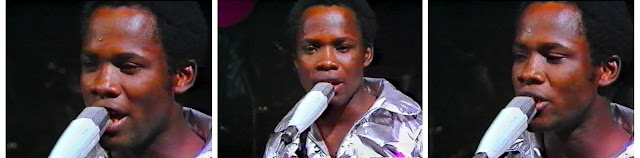
single by Ndombe Opetum & African Fiesta Nationale
A single by Ndombe with African Fiesta Nationale
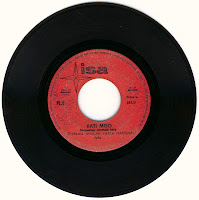
on the Isa label (link to this single)
A year later he was encouraged to audition for an even greater star of Congolese music: Rochereau. According Gary Stewart (in his "Rumba On The River") and others he again was to replace Sam Mangwana, who had left after the orchestra had been suspended for showing up late for a gala concert set up by President Mobutu. He managed to impress Rochereau with an immaculate rendering of the song "Baboka" (a.k.a. "Michelina"), according to this interview (which unfortunately is in lingala, but which I still recommend very strongly, - if only for the bits of singing by Ndombe!).

Ndombe, nicknamed "Pepe" by Rochereau, settled in great with African Fiesta National (or African Fiesta 'Le Peuple'). His voice combined perfectly with Rochereau's. In fact, both voices were similar to a point where fans even confused Ndombe's vocal with that of Rochereau.
As a composer too Ndombe soon started to make a name for himself, with hits like "Hortense", "Nakoli Kotika Yo Te! Papa" and - my favourite - "Longo". And in 1970 he accompanied Rochereau, who by then had adopted the title of "Le Seigneur", during his prestigious concerts at the Olympia in Paris. Concerts which - by the way - Rochereau has described in several interviews as a highlight in his career.

In the following year, things turned slightly sour for African Fiesta. Some musicians and dancers left after they had not been paid for nine months. Rochereau himself was even jailed after a dispute about money.
The exodus was completed in 1972, when Pierre 'Attel' Mbumba (who had joined African Fiesta shortly before Ndombe) and Empompo Loway 'Deyesse', together with Ndombe (who had been renamed Ndombe Opetum in the Mobutu's Authenticité campaign), were lured out of the orchestra to form Orchestre Afrizam.

Sam Mangwana joined for a short while, but after he had left Ndombe was the star of the show. He composed a great number of songs and sang in most, if not all.

My impression is that things did not go as smoothly as Ndombe would have like with Afrizam. Some point out that the ghost of Tabu Ley Rochereau's Afrisa/African Fiesta kept pursuing Afrizam and that this was only strengthened by the use of Afrisa's rhythms. Ndombe decided to team up with guitarist Dino Vangu and change the name of the orchestra into Makina Loka. Here he recorded - amongst others - this single "Zongisa Bolingo 1 & 2" (which was re-released on CD as "Mpongo").

Ndombe 1975My guess is that it did not take a lot of persuading to get Ndombe to join the Tout Puissant O.K. Jazz in 1975. He fitted perfectly into Franco's strategy to merge the styles of the two schools of Congolese music into one.
Again he served as a replacement for Sam Mangwana, although I assume that Franco saw the 'added value' which Ndombe could bring, and which he very soon demonstrated in songs like "Yo Seli-Ja" (video) and - especially - "Salima" (highly recommended video).

Besides being a great addition as a vocalist Ndombe also proved his relevance as a composer. Best known in this early stage of his career with the T.P. O.K. Jazz is his song "Voyage Na Bandundu". Although others see this song as a continuation of his repertoire with Tabu Ley, I don't agree. My impression is that Ndombe tried to emulate the success of Lutumba Simaro's classic "Ebale Ya Zaïre", which had been so brilliantly interpreted by his 'predecessor' Sam Mangwana.

In later years Ndombe produced many hits with the T.P. O.K. Jazz, the biggest of which were the 1982 "Mawe" and "Na Yebi Ndenge Bokolela Ngai" (video) from 1983 (also known as "Masha Masha" or "Mashata"). And perhaps I should add this song, originally from 1979:


Ndombe Opetum with his son (Delft, 1991-08-03)
Ndombe and son (Delft 1991)
In 1983 Ndombe left the T.P. O.K. Jazz*, for reasons which so far I have not been able to uncover. Perhaps they had to do with Franco's lengthy stay in Europe, and with Ndombe's ownership of a bar dancing, called "Lal Abiy Santamaria", which was his pride until it was burned down (in 1994?).
He teamed up with Sam Mangwana and Empompo Loway in a group ambitiously called "Tiers Monde Cooperation" ("third world cooperation"). The Tiers Monde 'project' delivered - as far as I am aware - three lp's, and four if you count the lp featuring "Fatimata" which is credited to Sam Mangwana (who is only on one of the Tiers Monde Cooperation lp's) and orchestre Tiers-Monde.

Ndombe returned to the O.K. Jazz flock in 1986, and joined Franco on the tour of Kenya that year, and during the concerts in Brussels in April 1987. But later the same year he had another row with Franco and left the band to rejoin Tabu Ley's Afrisa International.
Fortunately Franco and Ndombe put aside their differences and reconciled before Franco's death on October 12, 1989. Ndombe rejoined the T.P. O.K. Jazz and became one of the leading forces of the band after Franco's demise. In 1993, when the band was forced to abandon the name of T.P. O.K. Jazz as a result of dispute with Franco's family, Ndombe was one of the initiators of the new orchestra Bana O.K.. He played a crucial role in the continuation of Franco's legacy until his untimely death.

Ndombe leaves a wife and 9 children.
May he rest in peace.

Ndombe with African Fiesta National and Afrizam
Ndombe with T.P. O.K. Jazz

photo: Aboubacar Siddikh [copyright]
Madilu System, Ndombe Opetum, Lola Djangi Chécain, Aimé Kiwakana (Delft 1991)  

* according to some sources. Other sources claim that he never left the T.P. O.K. Jazz, but was allowed to 'moonlight' with Tiers Monde.