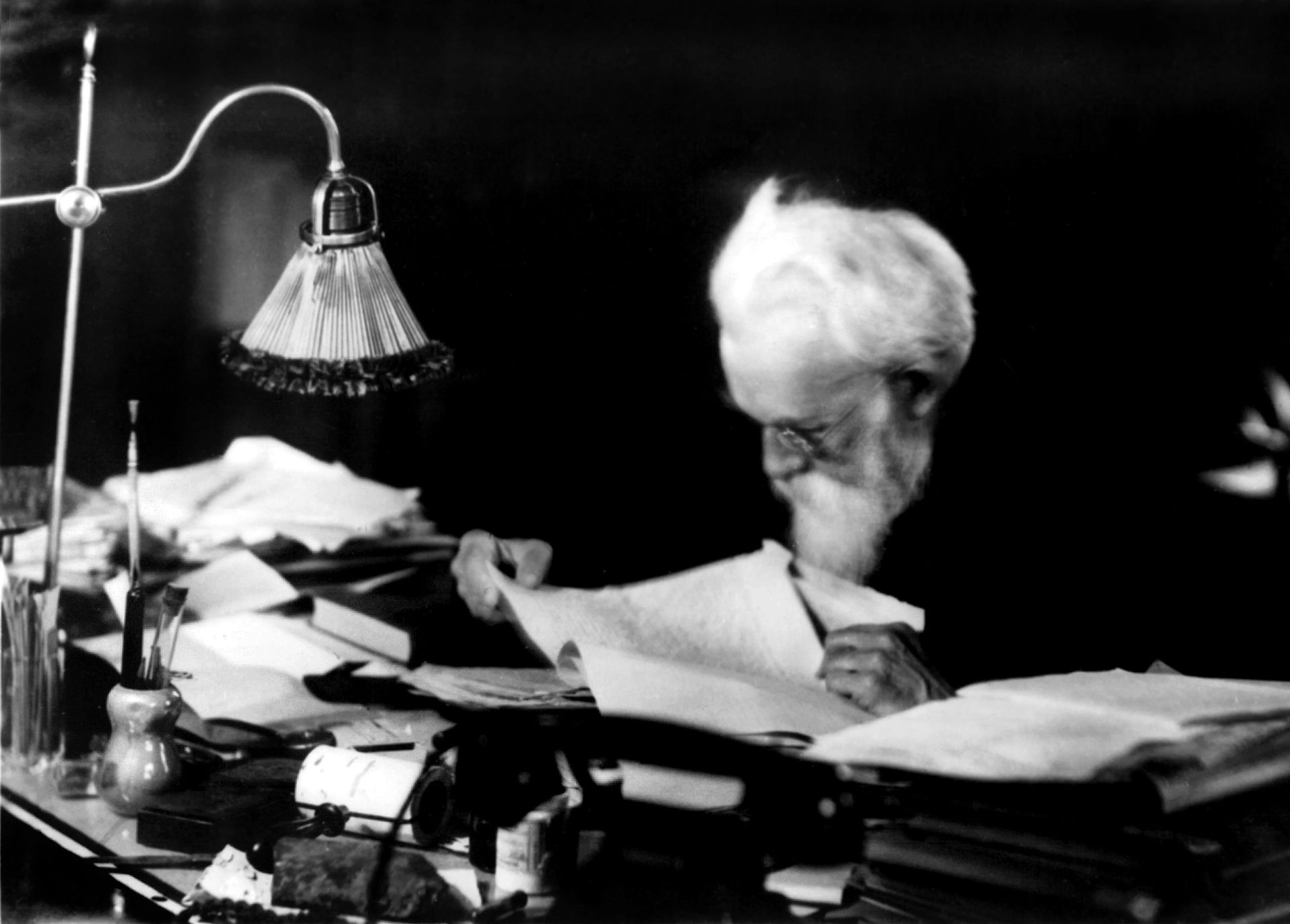
The 100th anniversary of the publication of ‘The Biosphere’, written by the first President of the Ukrainian Academy of Sciences, Volodymyr Vernadsky, is a time to appreciate the interconnected nature of life on our planet.
The extraordinary and beguiling diversity of life on planet Earth has, for a long time, challenged people to make sense of it all. Even Greek philosopher Aristotle, over two thousand years ago, made a gallant attempt to classify all animals based on their appearances.
JOIN US ON TELEGRAM
Follow our coverage of the war on the @Kyivpost_official.
Much later, Charles Darwin, using observations he made during his voyage on The Beagle and some clever reasoning, worked out how the menagerie of creatures which inhabit the planet had achieved its astonishing variety. In his book The Origin of Species, he offered us the first credible mechanism to explain how this planetary zoo had evolved.
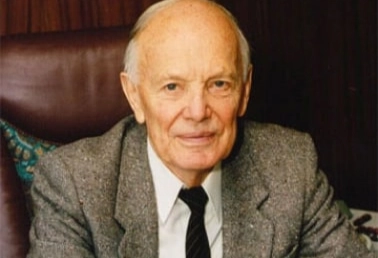
But it was Volodymyr Vernadsky (1863-1945) who wrote the book that described all this flora and fauna as a single interconnected entity, as a biosphere.
Vernadsky didn’t invent the term biosphere. Apparently that accolade goes to Austrian geologist Eduard Suess, whom Vernadsky met in 1911 (I have at times said that Vernadsky did invent the term, but perhaps that error merely reflects the lasting imprint that he made on the world).
Born to native Kyiv residents in St Petersburg, Vernadsky spent his childhood in Kharkiv, the son of a father who was politically active, and a mother of Ukrainian Cossack heritage. He was a man of his time and the geopolitical realities of the age in which his career unfolded.

Two-Thirds of Ukrainian Businesses Impacted by Fuel Price Surge
In 1918, Vernadsky became the first President of the Ukrainian Academy of Sciences (today the National Academy of Sciences of Ukraine) and a founder of Ukraine’s National Library. He was a member of the Russian liberal Constitutional Democratic Party, and, of course, he could not escape the political changes that occurred after the 1917 revolution; his scientific work occurred within the milieu of the emerging Soviet Union.
Vernadsky had a strong independent mind yet managed to avoid the repressions of the 1930s. He was later given the Stalin Prize. He was one of those wayward free-thinking personalities that autocratic regimes quietly fear, but just can’t seem to do without, especially when the rest of the world admires them, as was the case with Vernadsky.
It was for his scientific work that he is best remembered. What fascinated him most were not the minerals and rocks that he had spent much of his youth studying, or even the flora and fauna that he had observed on the many field expeditions he led, but rather the way in which these two domains came together to make a connected system of living things that covers the planet.
Despite the rudimentary knowledge about the limits of life, Vernadsky correctly pointed out that the thickness of the biosphere (at least the part that is actively replicating) was just a few kilometres. This is a not a vast phenomenon in its spatial extent; it is, as he put it, an “envelope” of life.
The biosphere isn’t merely a large blob of life independently going about its business. It changes the rocks in which it lives and circulates gases through the atmosphere at a prodigious scale. Each year, microorganisms alone take 150 million tonnes of nitrogen gas from the atmosphere and capture it in forms available to plants and animals, including you and me. Vernadsky understood this; he described life as a geological force that shapes our planet.
The biosphere is embedded in the bigger cosmos. Streaming in from space is radiation from the Sun. Picked up by plants and other photosynthetic creatures, the energy is transformed into new living forms. You can think of life as a gigantic energy capturing apparatus. Vernadsky succinctly, in his usual readable style, said that the biosphere: “may be regarded as a region of transformers that convert cosmic radiations into active energy in electrical, chemical, mechanical, thermal, and other forms…The action of solar radiation on earth processes provides a precise basis for viewing the biosphere as both terrestrial and a cosmic mechanism.” In other words, the biosphere was an enormous machine, taking in the energy from space and driving the formation of life and the cycles in which it is integrated.
Although we probably wouldn’t describe Vernadsky as an environmentalist in the modern sense, he did comprehend that humanity could destroy Earth and that we should attempt to look after the planet like a garden. A change to a part of the biosphere, perhaps caused by human actions, could influence another. In grasping the totality of life on the planet, we might simply say that Vernadsky eloquently synthesized the view of the biosphere that we have today.
Intriguingly, Vernadsky went further and suggested that the biosphere, in giving birth to intelligence, had spawned a new part of itself, the so-called noosphere, which he described as the “sphere of reason.” His idea might be said to be a prescient image of the interconnected global internet, a sort of information sphere into which the human part of the biosphere is linked, and, by being the medium through which societies collectively make decisions about their activities and industry, increasingly influences the state of the biosphere itself.
There are aspects of our knowledge about the biosphere that have advanced considerably since Vernadsky’s day, one of which is its origin. He assumed that life had existed forever, subscribing to a view that life cannot be made without life, a strange infinite regress that denied him the chance to consider what the earliest biosphere might have been like. However, his view was not uncommon at the time. When he wrote his book, we had little experimental knowledge of how life started.
With advances in chemistry and other fields, we now have better suggestions about how the first cells might have emerged from the earliest environments on Earth. Deep ocean vents that spew super-heated water, and the interior of searing asteroid and comet impact craters, are thought to be promising places where the first chemical reactions that led to life could have occurred; there is much theoretical and experimental evidence to support some of these ideas.
In his book, Vernadsky had nothing to say about whether biospheres could exist on other planets (although it is known that he did think about these matters). Today, missions to Mars to search for fossils in dried ancient lakes and rivers, and the observation of plumes of water erupting from icy moons in the far reaches of the outer solar system, offer tantalizing prospects in our search for extraterrestrial life. Giant telescopes allow us to search for planets orbiting distant stars that may be like Earth and could host life, creatures that we might indirectly detect by searching for the gases they emit into their planetary atmosphere. When Volodymyr wrote his book, all of this was in the future and although people during his time were speculating about life on Mars, there was little scientific evidence.
It would be fascinating to know, in the light of modern knowledge, what he would have thought about the possibility of other biospheres in the universe. What could we learn about our own biosphere, its inevitable emergence (or not), and whether our biosphere is typical for life in the Universe? Answers to these questions may be forthcoming in the next 100 years. Perhaps, in 2126, the 200th anniversary of Vernadsky’s book, we will either know that the biosphere is an apparently unique phenomenon or we will be discussing biospheres in the plural.
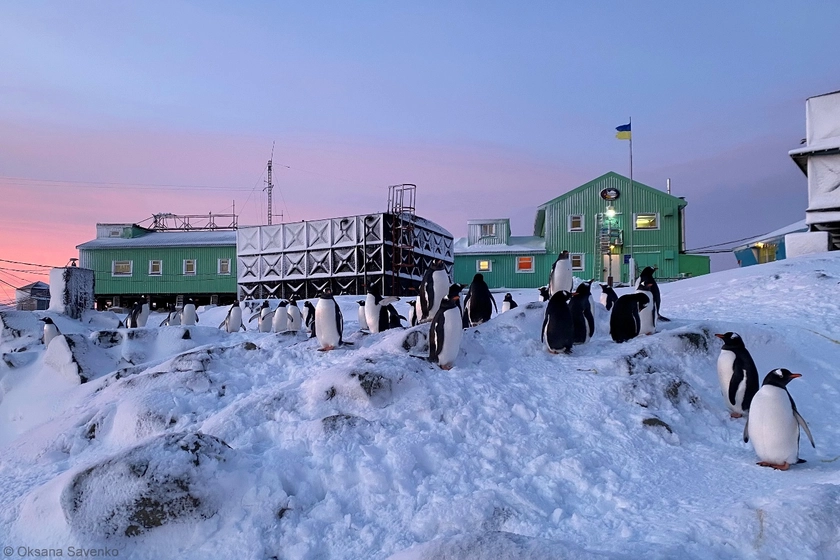
Vernadsky leaves us with a remarkable scientific legacy. His contributions ranged across mineralogy, geochemistry, and biology. Outside science, his efforts to help the formation of new scientific institutions were formidable. Today his face adorns the one-thousand-hryvnia bank note, evidence of his wider legacy. Ukraine’s Antarctic station is deservedly named after him.
The Biosphere remains one of Vernadsky’s most enduring and seminal scientific contributions, not only because of its scientific content, but because of his contribution to the public appreciation of the interlinked, interdependent network of life in which we all live.
Charles Cockell is Professor of Astrobiology at the University of Edinburgh.
You can also highlight the text and press Ctrl + Enter