Version 2.0.2 Copyright © 2017 ESP8266 Non-OS SDK API Reference
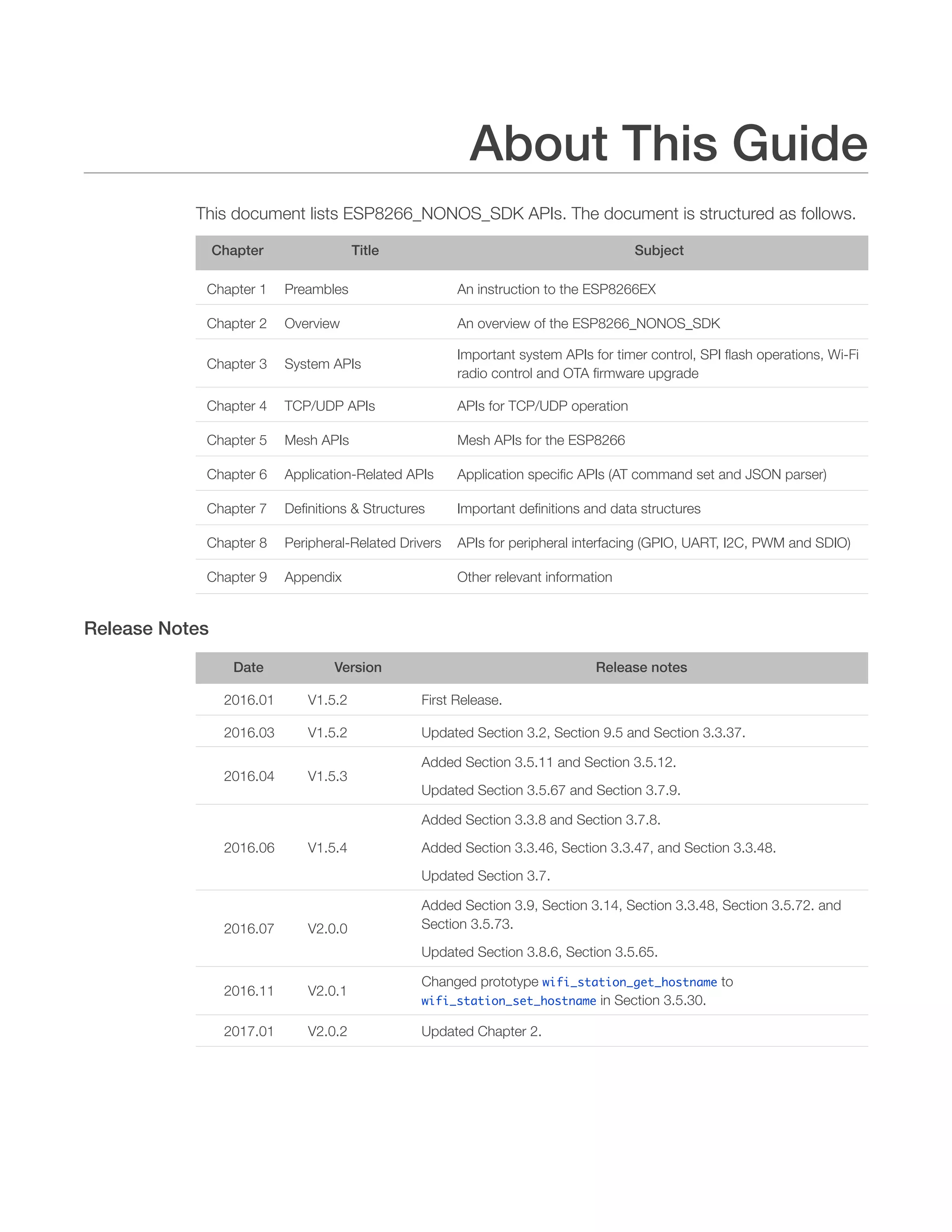
About This Guide This document lists ESP8266_NONOS_SDK APIs. The document is structured as follows. Release Notes Chapter Title Subject Chapter 1 Preambles An instruction to the ESP8266EX Chapter 2 Overview An overview of the ESP8266_NONOS_SDK Chapter 3 System APIs Important system APIs for timer control, SPI flash operations, Wi-Fi radio control and OTA firmware upgrade Chapter 4 TCP/UDP APIs APIs for TCP/UDP operation Chapter 5 Mesh APIs Mesh APIs for the ESP8266 Chapter 6 Application-Related APIs Application specific APIs (AT command set and JSON parser) Chapter 7 Definitions & Structures Important definitions and data structures Chapter 8 Peripheral-Related Drivers APIs for peripheral interfacing (GPIO, UART, I2C, PWM and SDIO) Chapter 9 Appendix Other relevant information Date Version Release notes 2016.01 V1.5.2 First Release. 2016.03 V1.5.2 Updated Section 3.2, Section 9.5 and Section 3.3.37. 2016.04 V1.5.3 Added Section 3.5.11 and Section 3.5.12. Updated Section 3.5.67 and Section 3.7.9. 2016.06 V1.5.4 Added Section 3.3.8 and Section 3.7.8. Added Section 3.3.46, Section 3.3.47, and Section 3.3.48. Updated Section 3.7. 2016.07 V2.0.0 Added Section 3.9, Section 3.14, Section 3.3.48, Section 3.5.72. and Section 3.5.73. Updated Section 3.8.6, Section 3.5.65. 2016.11 V2.0.1 Changed prototype wifi_station_get_hostname to wifi_station_set_hostname in Section 3.5.30. 2017.01 V2.0.2 Updated Chapter 2.
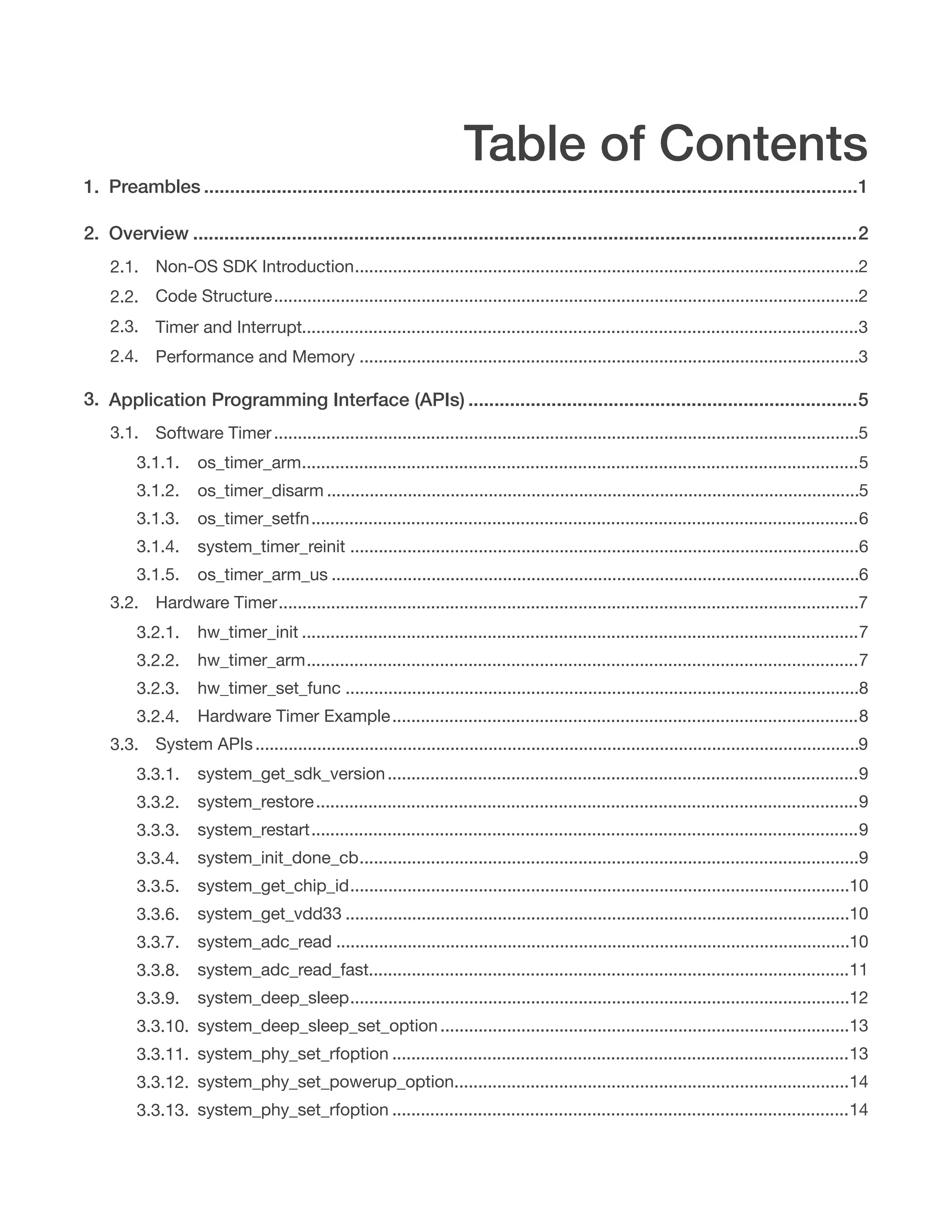
Table of Contents 1. Preambles 1.............................................................................................................................. 2. Overview 2................................................................................................................................ 2.1. Non-OS SDK Introduction 2 .......................................................................................................... 2.2. Code Structure 2 ........................................................................................................................... 2.3. Timer and Interrupt 3 ..................................................................................................................... 2.4. Performance and Memory 3 ......................................................................................................... 3. Application Programming Interface (APIs) 5........................................................................... 3.1. Software Timer 5 ........................................................................................................................... 3.1.1. os_timer_arm 5 ..................................................................................................................... 3.1.2. os_timer_disarm 5 ................................................................................................................ 3.1.3. os_timer_setfn 6 ................................................................................................................... 3.1.4. system_timer_reinit 6 ........................................................................................................... 3.1.5. os_timer_arm_us 6 ............................................................................................................... 3.2. Hardware Timer 7 .......................................................................................................................... 3.2.1. hw_timer_init 7 ..................................................................................................................... 3.2.2. hw_timer_arm 7 .................................................................................................................... 3.2.3. hw_timer_set_func 8 ............................................................................................................ 3.2.4. Hardware Timer Example 8 .................................................................................................. 3.3. System APIs 9 ............................................................................................................................... 3.3.1. system_get_sdk_version 9 ................................................................................................... 3.3.2. system_restore 9 .................................................................................................................. 3.3.3. system_restart 9 ................................................................................................................... 3.3.4. system_init_done_cb 9 ......................................................................................................... 3.3.5. system_get_chip_id 10 ......................................................................................................... 3.3.6. system_get_vdd33 10 .......................................................................................................... 3.3.7. system_adc_read 10 ............................................................................................................ 3.3.8. system_adc_read_fast 11 ..................................................................................................... 3.3.9. system_deep_sleep 12 ......................................................................................................... 3.3.10. system_deep_sleep_set_option 13 ...................................................................................... 3.3.11. system_phy_set_rfoption 13 ................................................................................................ 3.3.12. system_phy_set_powerup_option 14 ................................................................................... 3.3.13. system_phy_set_rfoption 14 ................................................................................................
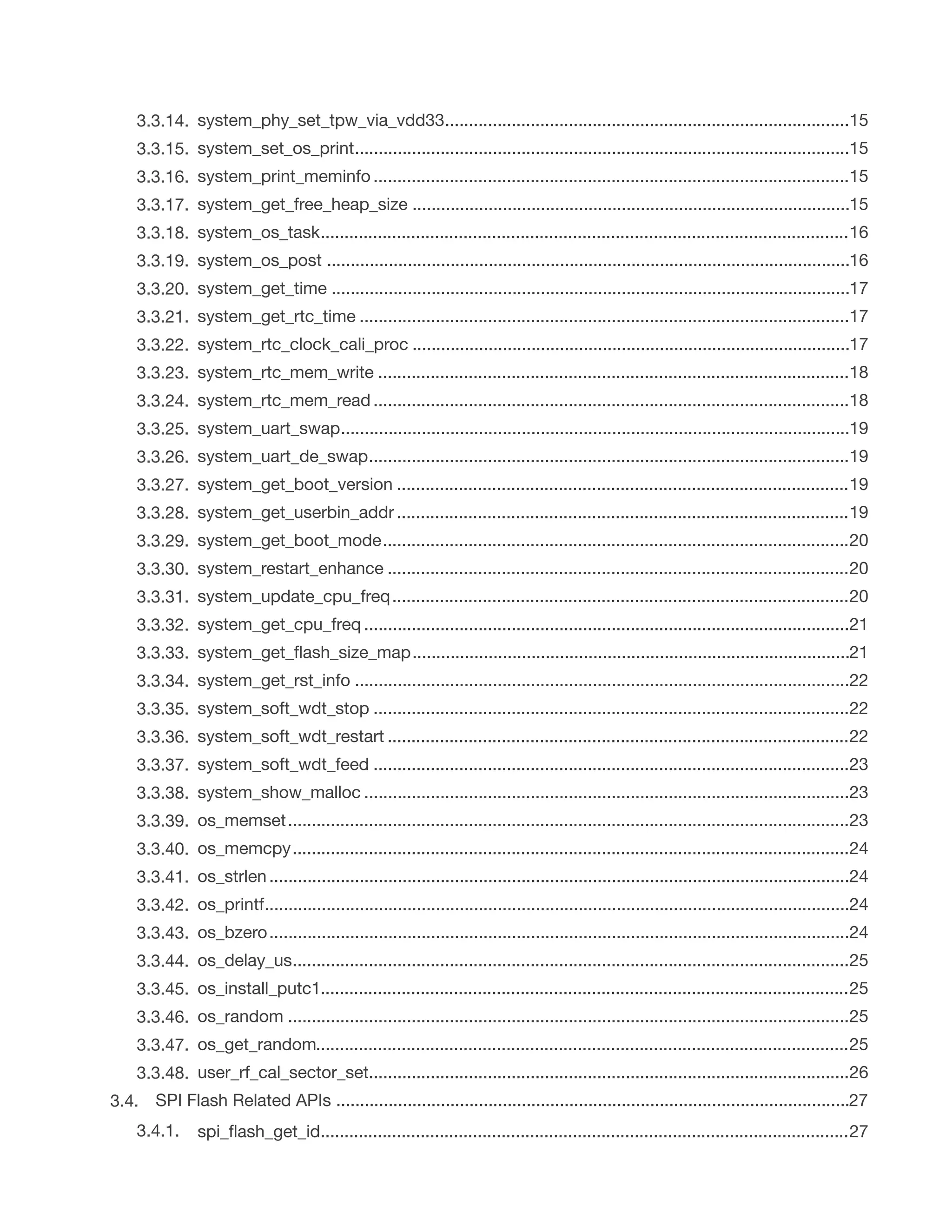
3.3.14. system_phy_set_tpw_via_vdd33 15 ..................................................................................... 3.3.15. system_set_os_print 15 ........................................................................................................ 3.3.16. system_print_meminfo 15 .................................................................................................... 3.3.17. system_get_free_heap_size 15 ............................................................................................ 3.3.18. system_os_task 16 ............................................................................................................... 3.3.19. system_os_post 16 .............................................................................................................. 3.3.20. system_get_time 17 ............................................................................................................. 3.3.21. system_get_rtc_time 17 ....................................................................................................... 3.3.22. system_rtc_clock_cali_proc 17 ............................................................................................ 3.3.23. system_rtc_mem_write 18 ................................................................................................... 3.3.24. system_rtc_mem_read 18 .................................................................................................... 3.3.25. system_uart_swap 19 ........................................................................................................... 3.3.26. system_uart_de_swap 19 ..................................................................................................... 3.3.27. system_get_boot_version 19 ............................................................................................... 3.3.28. system_get_userbin_addr 19 ............................................................................................... 3.3.29. system_get_boot_mode 20 .................................................................................................. 3.3.30. system_restart_enhance 20 ................................................................................................. 3.3.31. system_update_cpu_freq 20 ................................................................................................ 3.3.32. system_get_cpu_freq 21 ...................................................................................................... 3.3.33. system_get_flash_size_map 21 ............................................................................................ 3.3.34. system_get_rst_info 22 ........................................................................................................ 3.3.35. system_soft_wdt_stop 22 .................................................................................................... 3.3.36. system_soft_wdt_restart 22 ................................................................................................. 3.3.37. system_soft_wdt_feed 23 .................................................................................................... 3.3.38. system_show_malloc 23 ...................................................................................................... 3.3.39. os_memset 23 ...................................................................................................................... 3.3.40. os_memcpy 24 ..................................................................................................................... 3.3.41. os_strlen 24 .......................................................................................................................... 3.3.42. os_printf 24 ........................................................................................................................... 3.3.43. os_bzero 24 .......................................................................................................................... 3.3.44. os_delay_us 25 ..................................................................................................................... 3.3.45. os_install_putc1 25 ............................................................................................................... 3.3.46. os_random 25 ...................................................................................................................... 3.3.47. os_get_random 25 ................................................................................................................ 3.3.48. user_rf_cal_sector_set 26 ..................................................................................................... 3.4. SPI Flash Related APIs 27 ............................................................................................................ 3.4.1. spi_flash_get_id 27 ...............................................................................................................
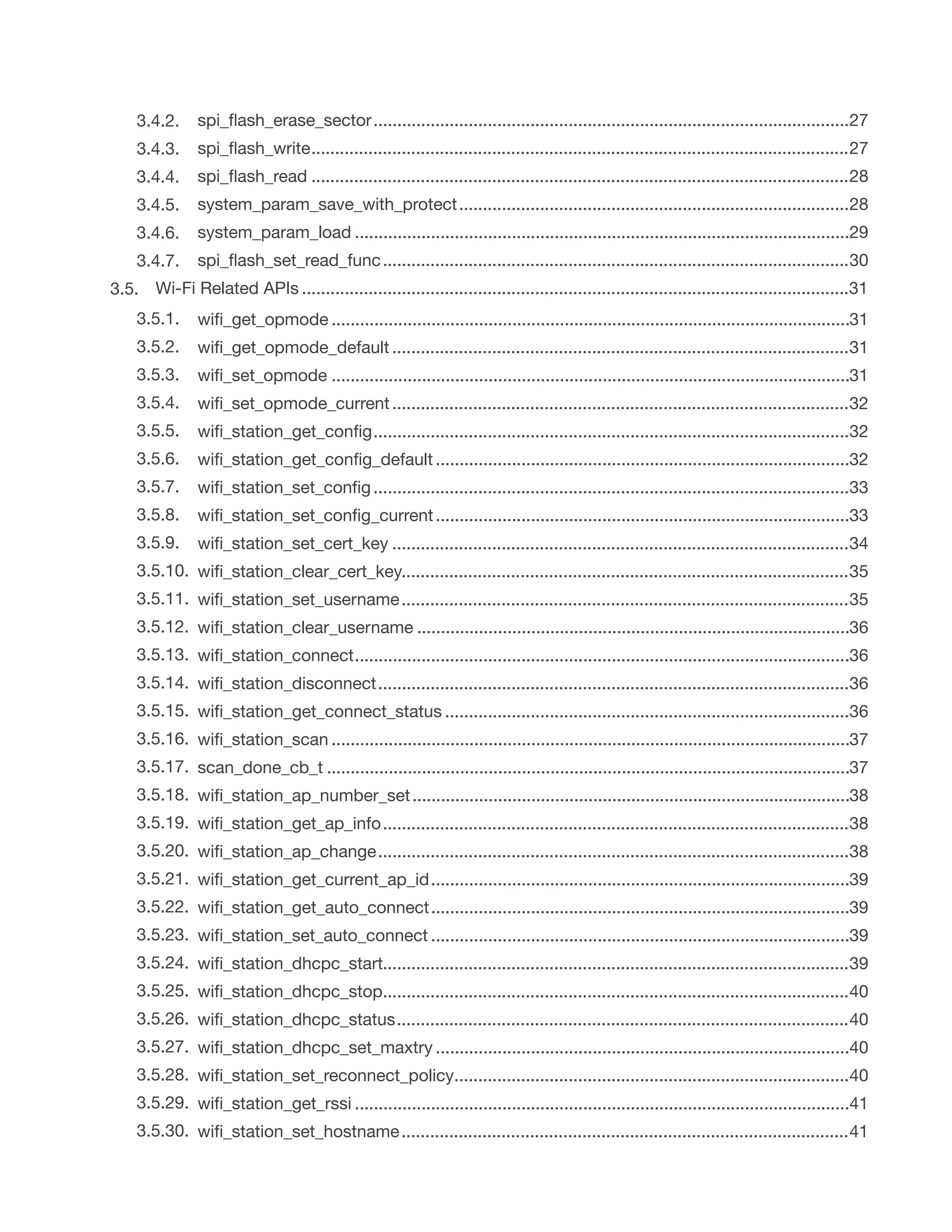
3.4.2. spi_flash_erase_sector 27 .................................................................................................... 3.4.3. spi_flash_write 27 ................................................................................................................. 3.4.4. spi_flash_read 28 ................................................................................................................. 3.4.5. system_param_save_with_protect 28 .................................................................................. 3.4.6. system_param_load 29 ........................................................................................................ 3.4.7. spi_flash_set_read_func 30 .................................................................................................. 3.5. Wi-Fi Related APIs 31 ................................................................................................................... 3.5.1. wifi_get_opmode 31 ............................................................................................................. 3.5.2. wifi_get_opmode_default 31 ................................................................................................ 3.5.3. wifi_set_opmode 31 ............................................................................................................. 3.5.4. wifi_set_opmode_current 32 ................................................................................................ 3.5.5. wifi_station_get_config 32 .................................................................................................... 3.5.6. wifi_station_get_config_default 32 ....................................................................................... 3.5.7. wifi_station_set_config 33 .................................................................................................... 3.5.8. wifi_station_set_config_current 33 ....................................................................................... 3.5.9. wifi_station_set_cert_key 34 ................................................................................................ 3.5.10. wifi_station_clear_cert_key 35 .............................................................................................. 3.5.11. wifi_station_set_username 35 .............................................................................................. 3.5.12. wifi_station_clear_username 36 ........................................................................................... 3.5.13. wifi_station_connect 36 ........................................................................................................ 3.5.14. wifi_station_disconnect 36 ................................................................................................... 3.5.15. wifi_station_get_connect_status 36 ..................................................................................... 3.5.16. wifi_station_scan 37 ............................................................................................................. 3.5.17. scan_done_cb_t 37 .............................................................................................................. 3.5.18. wifi_station_ap_number_set 38 ............................................................................................ 3.5.19. wifi_station_get_ap_info 38 .................................................................................................. 3.5.20. wifi_station_ap_change 38 ................................................................................................... 3.5.21. wifi_station_get_current_ap_id 39 ........................................................................................ 3.5.22. wifi_station_get_auto_connect 39 ........................................................................................ 3.5.23. wifi_station_set_auto_connect 39 ........................................................................................ 3.5.24. wifi_station_dhcpc_start 39 .................................................................................................. 3.5.25. wifi_station_dhcpc_stop 40 .................................................................................................. 3.5.26. wifi_station_dhcpc_status 40 ............................................................................................... 3.5.27. wifi_station_dhcpc_set_maxtry 40 ....................................................................................... 3.5.28. wifi_station_set_reconnect_policy 40 ................................................................................... 3.5.29. wifi_station_get_rssi 41 ........................................................................................................ 3.5.30. wifi_station_set_hostname 41 ..............................................................................................
3.5.31. wifi_station_get_hostname 41 .............................................................................................. 3.5.32. wifi_softap_get_config 41 ..................................................................................................... 3.5.33. wifi_softap_get_config_default 42 ........................................................................................ 3.5.34. wifi_softap_set_config 42 ..................................................................................................... 3.5.35. wifi_softap_set_config_current 42 ........................................................................................ 3.5.36. wifi_softap_get_station_num 42 ........................................................................................... 3.5.37. wifi_softap_get_station_info 43 ............................................................................................ 3.5.38. wifi_softap_free_station_info 43 ........................................................................................... 3.5.39. wifi_softap_dhcps_start 43 .................................................................................................. 3.5.40. wifi_softap_dhcps_stop 44 ................................................................................................... 3.5.41. wifi_softap_set_dhcps_lease 44 ........................................................................................... 3.5.42. wifi_softap_get_dhcps_lease 45 .......................................................................................... 3.5.43. wifi_softap_set_dhcps_lease_time 46 .................................................................................. 3.5.44. wifi_softap_get_dhcps_lease_time 46 .................................................................................. 3.5.45. wifi_softap_reset_dhcps_lease_time 46 ............................................................................... 3.5.46. wifi_softap_dhcps_status 46 ................................................................................................ 3.5.47. wifi_softap_set_dhcps_offer_option 47 ................................................................................ 3.5.48. wifi_set_phy_mode 47 .......................................................................................................... 3.5.49. wifi_get_phy_mode 47 ......................................................................................................... 3.5.50. wifi_get_ip_info 48 ................................................................................................................ 3.5.51. wifi_set_ip_info 48 ................................................................................................................ 3.5.52. wifi_set_macaddr 49 ............................................................................................................ 3.5.53. wifi_get_macaddr 50 ............................................................................................................ 3.5.54. wifi_set_sleep_type 50 ......................................................................................................... 3.5.55. wifi_get_sleep_type 50 ......................................................................................................... 3.5.56. wifi_status_led_install 50 ...................................................................................................... 3.5.57. wifi_status_led_uninstall 51 .................................................................................................. 3.5.58. wifi_set_broadcast_if 51 ....................................................................................................... 3.5.59. wifi_get_broadcast_if 51 ....................................................................................................... 3.5.60. wifi_set_event_handler_cb 52 .............................................................................................. 3.5.61. wifi_wps_enable 53 .............................................................................................................. 3.5.62. wifi_wps_disable 53 ............................................................................................................. 3.5.63. wifi_wps_start 53 .................................................................................................................. 3.5.64. wifi_set_wps_cb 54 .............................................................................................................. 3.5.65. wifi_register_send_pkt_freedom_cb 55 ................................................................................ 3.5.66. wifi_unregister_send_pkt_freedom_cb 55 ............................................................................ 3.5.67. wifi_send_pkt_freedom 56 ...................................................................................................
3.5.68. wifi_rfid_locp_recv_open 56 ................................................................................................. 3.5.69. wifi_rfid_locp_recv_close 56 ................................................................................................. 3.5.70. wifi_register_rfid_locp_recv_cb 57 ....................................................................................... 3.5.71. wifi_unregister_rfid_locp_recv_cb 57 ................................................................................... 3.5.72. wifi_enable_gpio_wakeup 57 ............................................................................................... 3.5.73. wifi_disable_gpio_wakeup 58 ............................................................................................... 3.6. Rate Control APIs 59 ..................................................................................................................... 3.6.1. wifi_set_user_fixed_rate 59 .................................................................................................. 3.6.2. wifi_get_user_fixed_rate 59 .................................................................................................. 3.6.3. wifi_set_user_sup_rate 60 .................................................................................................... 3.6.4. wifi_set_user_rate_limit 60 ................................................................................................... 3.6.5. wifi_set_user_limit_rate_mask 62 ......................................................................................... 3.6.6. wifi_get_user_limit_rate_mask 62 ......................................................................................... 3.7. Force Sleep APIs 63 ...................................................................................................................... 3.7.1. wifi_fpm_open 63 ................................................................................................................. 3.7.2. wifi_fpm_close 63 ................................................................................................................. 3.7.3. wifi_fpm_do_wakeup 63 ....................................................................................................... 3.7.4. wifi_fpm_set_wakeup_cb 64 ................................................................................................ 3.7.5. wifi_fpm_do_sleep 64 ........................................................................................................... 3.7.6. wifi_fpm_set_sleep_type 64 ................................................................................................. 3.7.7. wifi_fpm_get_sleep_type 65 ................................................................................................. 3.7.8. wifi_fpm_auto_sleep_set_in_null_mode 65 .......................................................................... 3.7.9. Example 65 ........................................................................................................................... 3.8. ESP-NOW APIs 68 ........................................................................................................................ 3.8.1. Roles of ESP-NOW 68 ......................................................................................................... 3.8.2. esp_now_init 68 .................................................................................................................... 3.8.3. esp_now_deinit 69 ............................................................................................................... 3.8.4. esp_now_register_recv_cb 69 .............................................................................................. 3.8.5. esp_now_unregister_recv_cb 69 .......................................................................................... 3.8.6. esp_now_register_send_cb 69 ............................................................................................. 3.8.7. esp_now_unregister_send_cb 70 ......................................................................................... 3.8.8. esp_now_send 71 ................................................................................................................ 3.8.9. esp_now_add_peer 71 ......................................................................................................... 3.8.10. esp_now_del_peer 71 .......................................................................................................... 3.8.11. esp_now_set_self_role 72 .................................................................................................... 3.8.12. esp_now_get_self_role 72 ....................................................................................................
3.8.13. esp_now_set_peer_role 72 ................................................................................................... 3.8.14. esp_now_get_peer_role 72 .................................................................................................. 3.8.15. esp_now_set_peer_key 72 ................................................................................................... 3.8.16. esp_now_get_peer_key 73 ................................................................................................... 3.8.17. esp_now_set_peer_channel 73 ............................................................................................ 3.8.18. esp_now_get_peer_channel 73 ............................................................................................ 3.8.19. esp_now_is_peer_exist 74 ................................................................................................... 3.8.20. esp_now_fetch_peer 74 ....................................................................................................... 3.8.21. esp_now_get_cnt_info 74 ..................................................................................................... 3.8.22. esp_now_set_kok 75 ............................................................................................................ 3.9. Simple Pair APIs 76 ....................................................................................................................... 3.9.1. Status of Simple Pair 76 ....................................................................................................... 3.9.2. register_simple_pair_status_cb 76 ....................................................................................... 3.9.3. unregister_simple_pair_status_cb 76 ................................................................................... 3.9.4. simple_pair_init 77 ................................................................................................................ 3.9.5. simple_pair_deinit 77 ............................................................................................................ 3.9.6. simple_pair_state_reset 77 ................................................................................................... 3.9.7. simple_pair_ap_enter_announce_mode 77 .......................................................................... 3.9.8. simple_pair_sta_enter_scan_mode 77 ................................................................................. 3.9.9. simple_pair_sta_start_negotiate 78 ...................................................................................... 3.9.10. simple_pair_ap_start_negotiate 78 ....................................................................................... 3.9.11. simple_pair_ap_refuse_negotiate 78 .................................................................................... 3.9.12. simple_pair_set_peer_ref 78 ................................................................................................. 3.9.13. simple_pair_get_peer_ref 79 ................................................................................................ 3.10. Upgrade (FOTA) APIs 80 ............................................................................................................... 3.10.1. system_upgrade_userbin_check 80 ..................................................................................... 3.10.2. system_upgrade_flag_set 80 ............................................................................................... 3.10.3. system_upgrade_flag_check 80 ........................................................................................... 3.10.4. system_upgrade_start 80 ..................................................................................................... 3.10.5. system_upgrade_reboot 81 .................................................................................................. 3.11. Sniffer Related APIs 82 ................................................................................................................. 3.11.1. wifi_promiscuous_enable 82 ................................................................................................ 3.11.2. wifi_promiscuous_set_mac 82 ............................................................................................. 3.11.3. wifi_set_promiscuous_rx_cb 82 ........................................................................................... 3.11.4. wifi_get_channel 83 .............................................................................................................. 3.11.5. wifi_set_channel 83 ..............................................................................................................
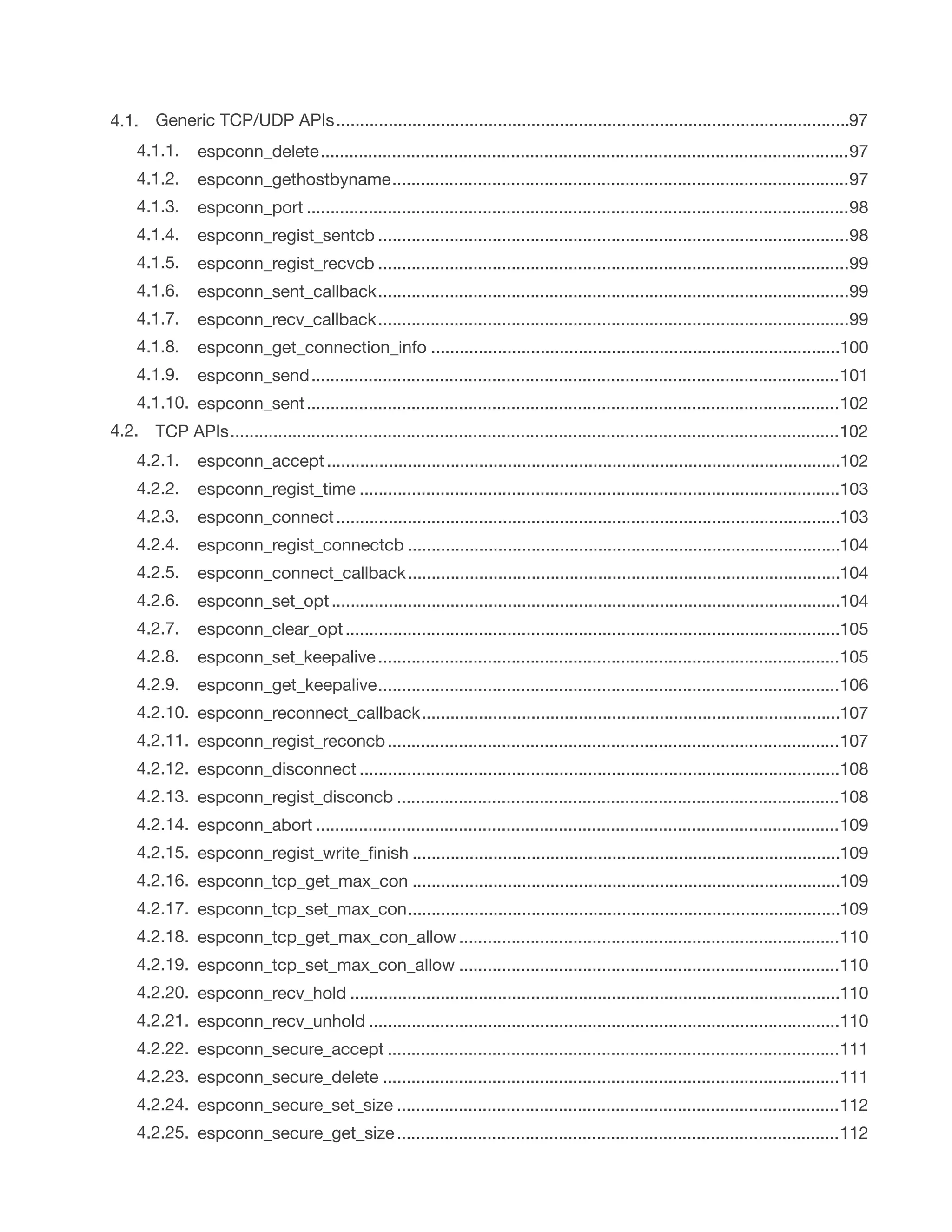
3.12. Smart Config APIs 84 .................................................................................................................... 3.12.1. smartconfig_start 84 ............................................................................................................ 3.12.2. smartconfig_stop 86 ............................................................................................................. 3.12.3. smartconfig_set_type 86 ...................................................................................................... 3.12.4. airkiss_version 86 ................................................................................................................. 3.12.5. airkiss_lan_recv 87 ............................................................................................................... 3.12.6. airkiss_lan_pack 87 .............................................................................................................. 3.13. SNTP APIs 88 ................................................................................................................................ 3.13.1. sntp_setserver 88 ................................................................................................................. 3.13.2. sntp_getserver 88 ................................................................................................................. 3.13.3. sntp_setservername 88 ........................................................................................................ 3.13.4. sntp_getservername 88 ........................................................................................................ 3.13.5. sntp_init 89 ........................................................................................................................... 3.13.6. sntp_stop 89 ......................................................................................................................... 3.13.7. sntp_get_current_timestamp 89 ........................................................................................... 3.13.8. sntp_get_real_time 89 .......................................................................................................... 3.13.9. sntp_set_timezone 89 .......................................................................................................... 3.13.10.sntp_get_timezone 90 .......................................................................................................... 3.13.11.SNTP Example 90 ................................................................................................................ 3.14. WPA2_Enterprise APIs 92 ............................................................................................................. 3.14.1. wifi_station_set_wpa2_enterprise_auth 92 ........................................................................... 3.14.2. wifi_station_set_enterprise_cert_key 92 ............................................................................... 3.14.3. wifi_station_clear_enterprise_cert_key 93 ............................................................................ 3.14.4. wifi_station_set_enterprise_ca_cert 93 ................................................................................ 3.14.5. wifi_station_clear_enterprise_ca_cert 93 ............................................................................. 3.14.6. wifi_station_set_enterprise_username 94 ............................................................................ 3.14.7. wifi_station_clear_enterprise_username 94 ......................................................................... 3.14.8. wifi_station_set_enterprise_password 94 ............................................................................ 3.14.9. wifi_station_clear_enterprise_password 94 .......................................................................... 3.14.10.wifi_station_set_enterprise_new_password 95 .................................................................... 3.14.11.wifi_station_clear_enterprise_new_password 95 ................................................................. 3.14.12.wifi_station_set_enterprise_disable_time_check 95 ............................................................ 3.14.13.wifi_station_get_enterprise_disable_time_check 95 ............................................................ 3.14.14.wpa2_enterprise_set_user_get_time 96 ............................................................................... 3.14.15.WPA2_Enterprise Work Flow 96 ........................................................................................... 4. TCP/UDP APIs 97.....................................................................................................................
4.1. Generic TCP/UDP APIs 97 ............................................................................................................ 4.1.1. espconn_delete 97 ............................................................................................................... 4.1.2. espconn_gethostbyname 97 ................................................................................................ 4.1.3. espconn_port 98 .................................................................................................................. 4.1.4. espconn_regist_sentcb 98 ................................................................................................... 4.1.5. espconn_regist_recvcb 99 ................................................................................................... 4.1.6. espconn_sent_callback 99 ................................................................................................... 4.1.7. espconn_recv_callback 99 ................................................................................................... 4.1.8. espconn_get_connection_info 100 ...................................................................................... 4.1.9. espconn_send 101 ............................................................................................................... 4.1.10. espconn_sent 102 ................................................................................................................ 4.2. TCP APIs 102 ................................................................................................................................ 4.2.1. espconn_accept 102 ............................................................................................................ 4.2.2. espconn_regist_time 103 ..................................................................................................... 4.2.3. espconn_connect 103 .......................................................................................................... 4.2.4. espconn_regist_connectcb 104 ........................................................................................... 4.2.5. espconn_connect_callback 104 ........................................................................................... 4.2.6. espconn_set_opt 104 ........................................................................................................... 4.2.7. espconn_clear_opt 105 ........................................................................................................ 4.2.8. espconn_set_keepalive 105 ................................................................................................. 4.2.9. espconn_get_keepalive 106 ................................................................................................. 4.2.10. espconn_reconnect_callback 107 ........................................................................................ 4.2.11. espconn_regist_reconcb 107 ............................................................................................... 4.2.12. espconn_disconnect 108 ..................................................................................................... 4.2.13. espconn_regist_disconcb 108 ............................................................................................. 4.2.14. espconn_abort 109 .............................................................................................................. 4.2.15. espconn_regist_write_finish 109 .......................................................................................... 4.2.16. espconn_tcp_get_max_con 109 .......................................................................................... 4.2.17. espconn_tcp_set_max_con 109 ........................................................................................... 4.2.18. espconn_tcp_get_max_con_allow 110 ................................................................................ 4.2.19. espconn_tcp_set_max_con_allow 110 ................................................................................ 4.2.20. espconn_recv_hold 110 ....................................................................................................... 4.2.21. espconn_recv_unhold 110 ................................................................................................... 4.2.22. espconn_secure_accept 111 ............................................................................................... 4.2.23. espconn_secure_delete 111 ................................................................................................ 4.2.24. espconn_secure_set_size 112 ............................................................................................. 4.2.25. espconn_secure_get_size 112 .............................................................................................
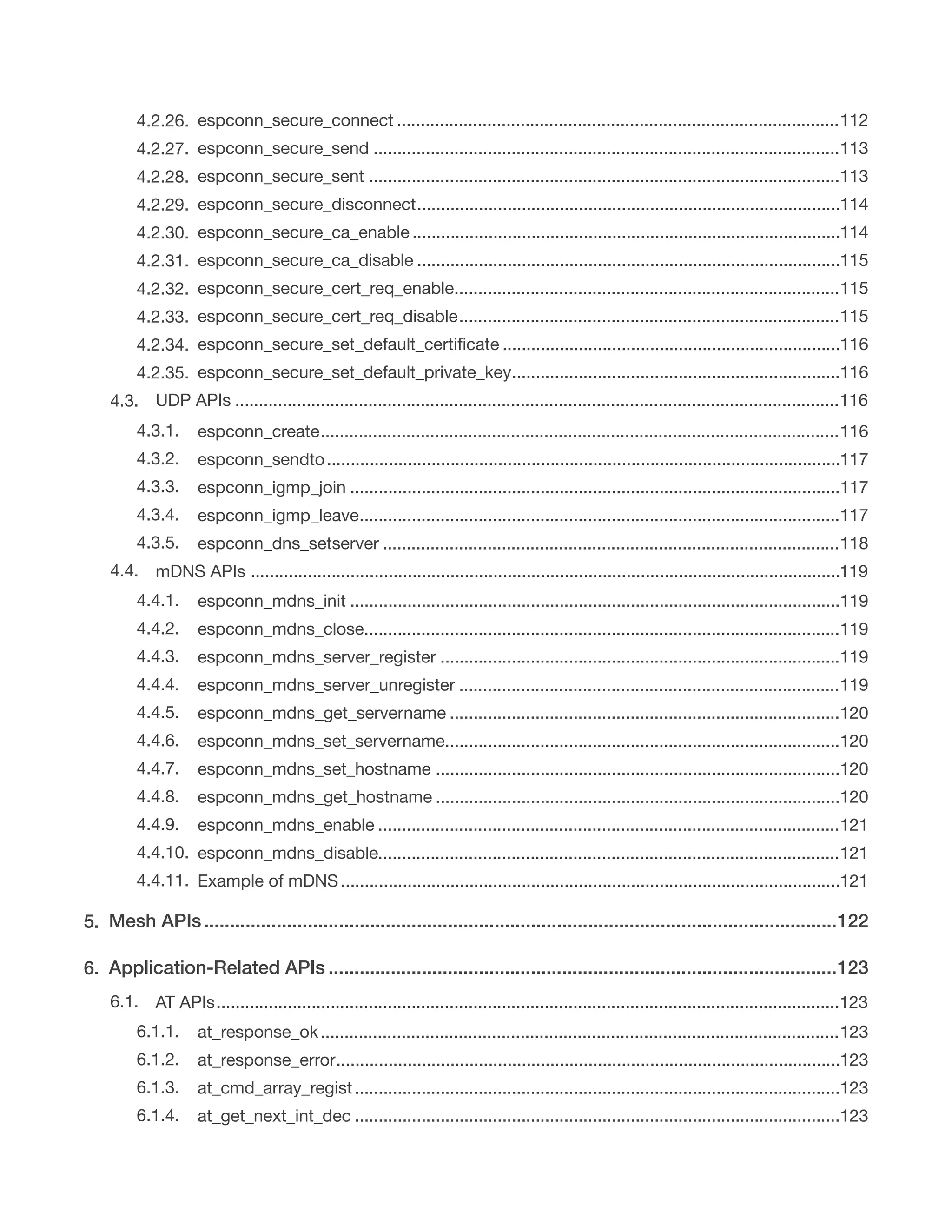
4.2.26. espconn_secure_connect 112 ............................................................................................. 4.2.27. espconn_secure_send 113 .................................................................................................. 4.2.28. espconn_secure_sent 113 ................................................................................................... 4.2.29. espconn_secure_disconnect 114 ......................................................................................... 4.2.30. espconn_secure_ca_enable 114 .......................................................................................... 4.2.31. espconn_secure_ca_disable 115 ......................................................................................... 4.2.32. espconn_secure_cert_req_enable 115 ................................................................................. 4.2.33. espconn_secure_cert_req_disable 115 ................................................................................ 4.2.34. espconn_secure_set_default_certificate 116 ....................................................................... 4.2.35. espconn_secure_set_default_private_key 116 ..................................................................... 4.3. UDP APIs 116 ............................................................................................................................... 4.3.1. espconn_create 116 ............................................................................................................. 4.3.2. espconn_sendto 117 ............................................................................................................ 4.3.3. espconn_igmp_join 117 ....................................................................................................... 4.3.4. espconn_igmp_leave 117 ..................................................................................................... 4.3.5. espconn_dns_setserver 118 ................................................................................................ 4.4. mDNS APIs 119 ............................................................................................................................ 4.4.1. espconn_mdns_init 119 ....................................................................................................... 4.4.2. espconn_mdns_close 119 .................................................................................................... 4.4.3. espconn_mdns_server_register 119 .................................................................................... 4.4.4. espconn_mdns_server_unregister 119 ................................................................................ 4.4.5. espconn_mdns_get_servername 120 .................................................................................. 4.4.6. espconn_mdns_set_servername 120 ................................................................................... 4.4.7. espconn_mdns_set_hostname 120 ..................................................................................... 4.4.8. espconn_mdns_get_hostname 120 ..................................................................................... 4.4.9. espconn_mdns_enable 121 ................................................................................................. 4.4.10. espconn_mdns_disable 121 ................................................................................................. 4.4.11. Example of mDNS 121 ......................................................................................................... 5. Mesh APIs 122.......................................................................................................................... 6. Application-Related APIs 123.................................................................................................. 6.1. AT APIs 123 ................................................................................................................................... 6.1.1. at_response_ok 123 ............................................................................................................. 6.1.2. at_response_error 123 .......................................................................................................... 6.1.3. at_cmd_array_regist 123 ...................................................................................................... 6.1.4. at_get_next_int_dec 123 ......................................................................................................
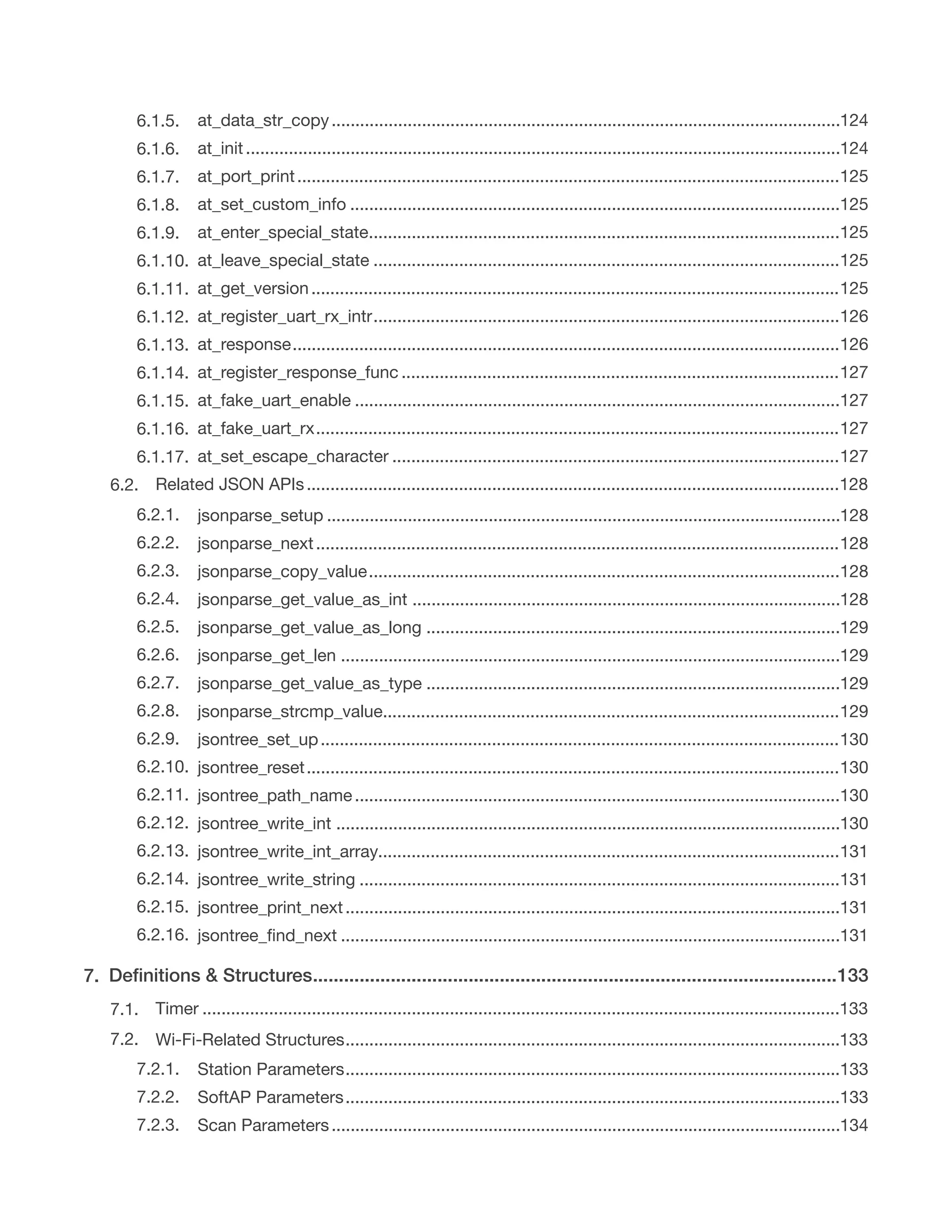
6.1.5. at_data_str_copy 124 ........................................................................................................... 6.1.6. at_init 124 ............................................................................................................................. 6.1.7. at_port_print 125 .................................................................................................................. 6.1.8. at_set_custom_info 125 ....................................................................................................... 6.1.9. at_enter_special_state 125 ................................................................................................... 6.1.10. at_leave_special_state 125 .................................................................................................. 6.1.11. at_get_version 125 ............................................................................................................... 6.1.12. at_register_uart_rx_intr 126 .................................................................................................. 6.1.13. at_response 126 ................................................................................................................... 6.1.14. at_register_response_func 127 ............................................................................................ 6.1.15. at_fake_uart_enable 127 ...................................................................................................... 6.1.16. at_fake_uart_rx 127 .............................................................................................................. 6.1.17. at_set_escape_character 127 .............................................................................................. 6.2. Related JSON APIs 128 ................................................................................................................ 6.2.1. jsonparse_setup 128 ............................................................................................................ 6.2.2. jsonparse_next 128 .............................................................................................................. 6.2.3. jsonparse_copy_value 128 ................................................................................................... 6.2.4. jsonparse_get_value_as_int 128 .......................................................................................... 6.2.5. jsonparse_get_value_as_long 129 ....................................................................................... 6.2.6. jsonparse_get_len 129 ......................................................................................................... 6.2.7. jsonparse_get_value_as_type 129 ....................................................................................... 6.2.8. jsonparse_strcmp_value 129 ................................................................................................ 6.2.9. jsontree_set_up 130 ............................................................................................................. 6.2.10. jsontree_reset 130 ................................................................................................................ 6.2.11. jsontree_path_name 130 ...................................................................................................... 6.2.12. jsontree_write_int 130 .......................................................................................................... 6.2.13. jsontree_write_int_array 131 ................................................................................................. 6.2.14. jsontree_write_string 131 ..................................................................................................... 6.2.15. jsontree_print_next 131 ........................................................................................................ 6.2.16. jsontree_find_next 131 ......................................................................................................... 7. Definitions & Structures 133..................................................................................................... 7.1. Timer 133 ...................................................................................................................................... 7.2. Wi-Fi-Related Structures 133 ........................................................................................................ 7.2.1. Station Parameters 133 ........................................................................................................ 7.2.2. SoftAP Parameters 133 ........................................................................................................ 7.2.3. Scan Parameters 134 ...........................................................................................................
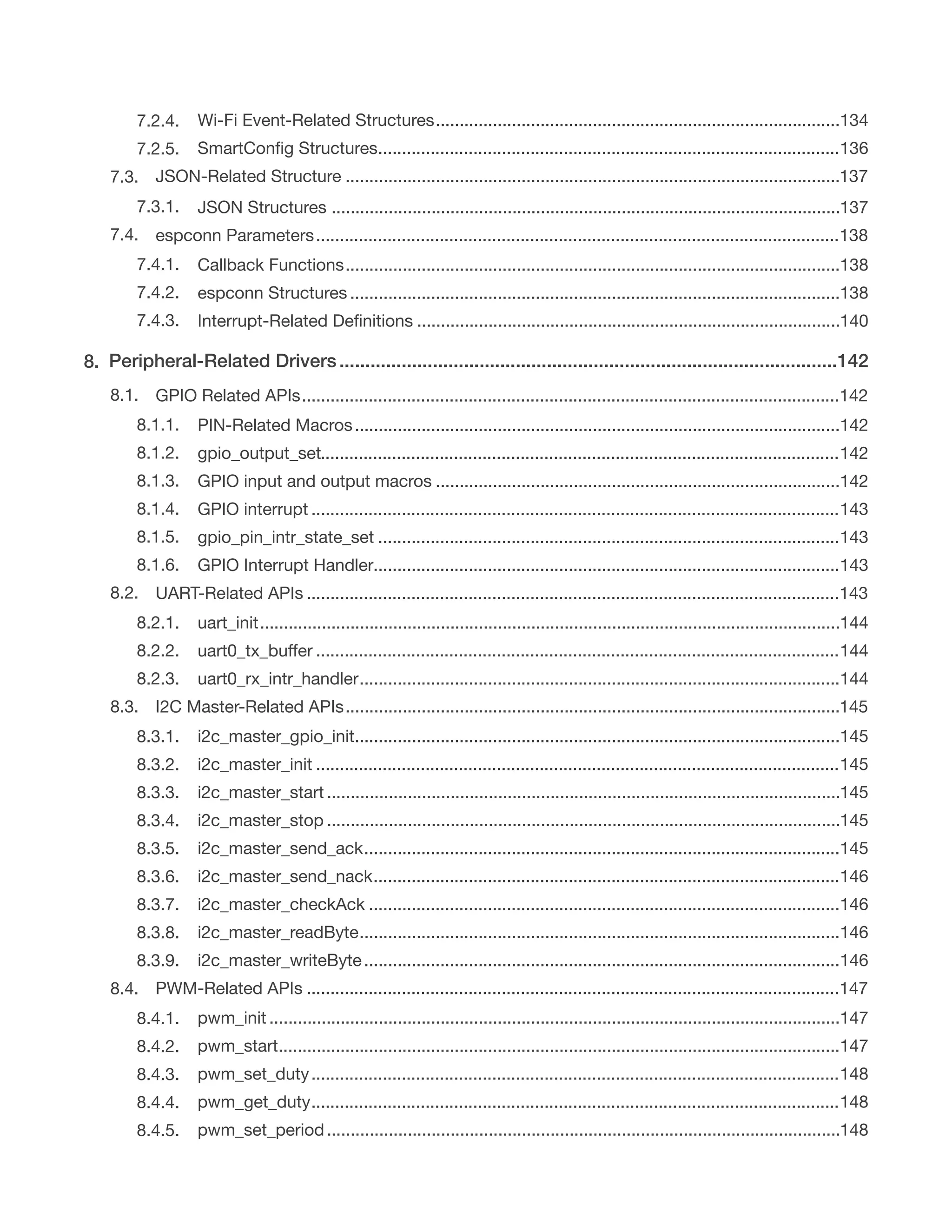
7.2.4. Wi-Fi Event-Related Structures 134 ..................................................................................... 7.2.5. SmartConfig Structures 136 ................................................................................................. 7.3. JSON-Related Structure 137 ........................................................................................................ 7.3.1. JSON Structures 137 ........................................................................................................... 7.4. espconn Parameters 138 .............................................................................................................. 7.4.1. Callback Functions 138 ........................................................................................................ 7.4.2. espconn Structures 138 ....................................................................................................... 7.4.3. Interrupt-Related Definitions 140 ......................................................................................... 8. Peripheral-Related Drivers 142................................................................................................ 8.1. GPIO Related APIs 142 ................................................................................................................. 8.1.1. PIN-Related Macros 142 ...................................................................................................... 8.1.2. gpio_output_set 142 ............................................................................................................. 8.1.3. GPIO input and output macros 142 ..................................................................................... 8.1.4. GPIO interrupt 143 ............................................................................................................... 8.1.5. gpio_pin_intr_state_set 143 ................................................................................................. 8.1.6. GPIO Interrupt Handler 143 .................................................................................................. 8.2. UART-Related APIs 143 ................................................................................................................ 8.2.1. uart_init 144 .......................................................................................................................... 8.2.2. uart0_tx_buffer 144 .............................................................................................................. 8.2.3. uart0_rx_intr_handler 144 ..................................................................................................... 8.3. I2C Master-Related APIs 145 ........................................................................................................ 8.3.1. i2c_master_gpio_init 145 ...................................................................................................... 8.3.2. i2c_master_init 145 .............................................................................................................. 8.3.3. i2c_master_start 145 ............................................................................................................ 8.3.4. i2c_master_stop 145 ............................................................................................................ 8.3.5. i2c_master_send_ack 145 .................................................................................................... 8.3.6. i2c_master_send_nack 146 .................................................................................................. 8.3.7. i2c_master_checkAck 146 ................................................................................................... 8.3.8. i2c_master_readByte 146 ..................................................................................................... 8.3.9. i2c_master_writeByte 146 .................................................................................................... 8.4. PWM-Related APIs 147 ................................................................................................................ 8.4.1. pwm_init 147 ........................................................................................................................ 8.4.2. pwm_start 147 ...................................................................................................................... 8.4.3. pwm_set_duty 148 ............................................................................................................... 8.4.4. pwm_get_duty 148 ............................................................................................................... 8.4.5. pwm_set_period 148 ............................................................................................................
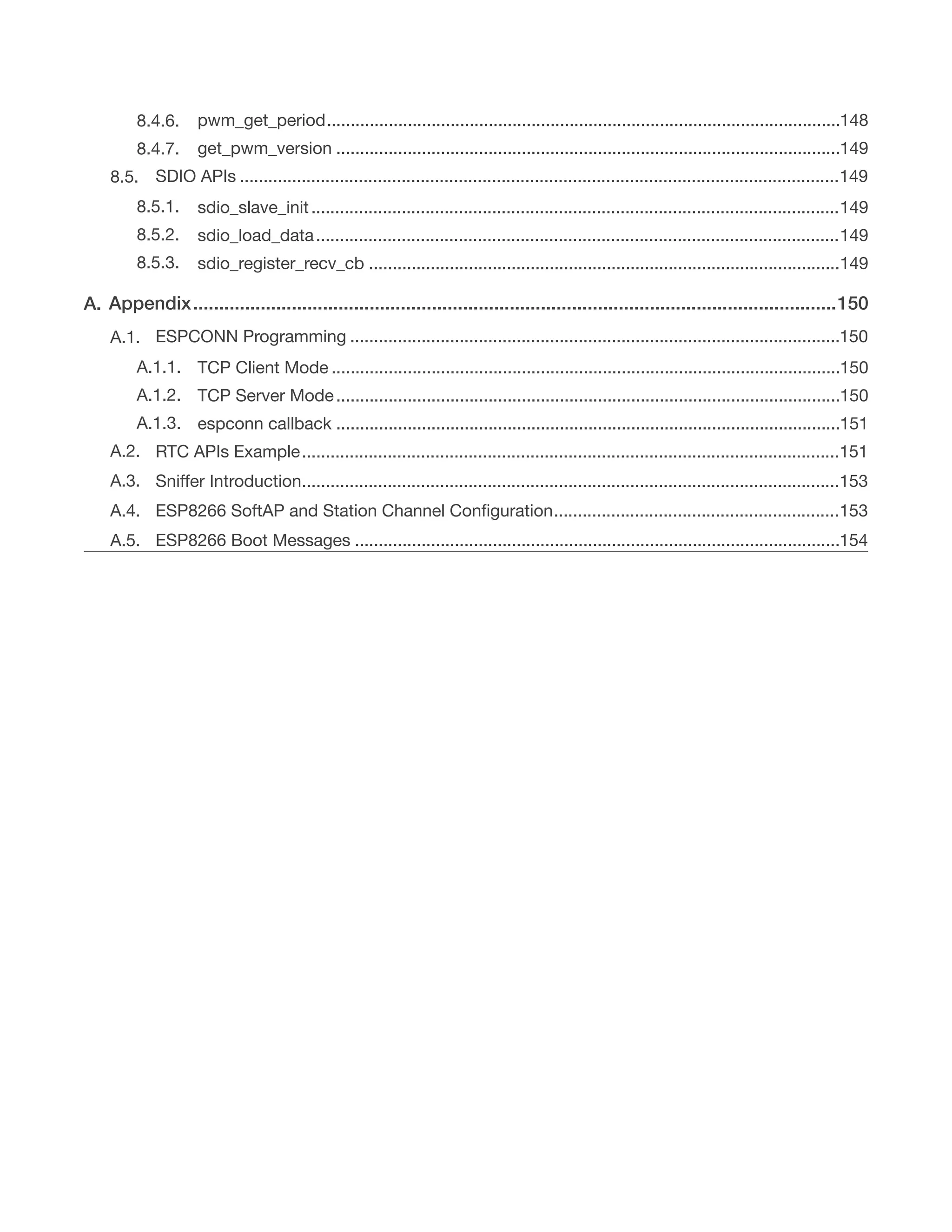
8.4.6. pwm_get_period 148 ............................................................................................................ 8.4.7. get_pwm_version 149 .......................................................................................................... 8.5. SDIO APIs 149 .............................................................................................................................. 8.5.1. sdio_slave_init 149 ............................................................................................................... 8.5.2. sdio_load_data 149 .............................................................................................................. 8.5.3. sdio_register_recv_cb 149 ................................................................................................... A. Appendix 150............................................................................................................................ A.1. ESPCONN Programming 150 ....................................................................................................... A.1.1. TCP Client Mode 150 ........................................................................................................... A.1.2. TCP Server Mode 150 .......................................................................................................... A.1.3. espconn callback 151 .......................................................................................................... A.2. RTC APIs Example 151 ................................................................................................................. A.3. Sniffer Introduction 153 ................................................................................................................. A.4. ESP8266 SoftAP and Station Channel Configuration 153 ............................................................ A.5. ESP8266 Boot Messages 154......................................................................................................
! 1. Preambles 1. Preambles ESP8266 Wi-Fi SoC offers a complete and self-contained Wi-Fi networking solution; it can be used to host applications or to offload Wi-Fi networking functions from another application processor. When the ESP8266 hosts application, it boots up directly from an external flash. It has an integrated cache to improve the performance of system’s running applications. Alternately, serving as a Wi-Fi adapter, wireless internet access can be added into any microcontroller-based design with simple connectivity through UART interface or the CPU AHB bridge interface. ESP8266EX is amongst the most integrated Wi-Fi chips in the industry; it integrates the antenna switches, RF balun, power amplifier, low noise receive amplifier, filters, and power management modules. Thus, it requires minimal external circuitry, and the entire solution, including front-end module, is designed to occupy minimal PCB area. ESP8266EX also integrates an enhanced version of Tensilica’s L106 Diamond series 32-bit processor, with on-chip SRAM, on top of its Wi-Fi functionalities. It is integrated with external sensors and other application specific devices through its GPIOs. Codes for such applications are provided as examples in the SDK. Sophisticated system-level features include fast sleep/wake switching for energy-efficient VoIP, adaptive radio biasing for low-power operations, advanced signal processing, spur cancellation and radio co-existence features for common cellular, Bluetooth, DDR, LVDS, LCD interference mitigation. The SDK based on ESP8266 IoT platform offers the users an easy, fast and efficient way to develop IoT devices. This programming guide provides overview of the SDK as well as detailed description of the APIs. It is written to help embedded software developers program on ESP8266 IoT platform.
 Espressif ! /1551 2017.01
! 2. Overview 2. Overview 2.1. Non-OS SDK Introduction The SDK provides a set of interfaces for data reception and transmission functions over the Wi-Fi and TCP/IP layers so programmers can focus on application development at a higher level. Users can easily make use of the corresponding interfaces to receive and transmit data. All networking functions on the ESP8266 IoT platform are realized in the library, and are available to users. Users can initialize the interface in user_main.c. void	user_init	(void) is the default method provided. Users can add functions like firmware initialization, network parameters setting, and timer initialization in it. void	user_rf_pre_init	(void) is to be added in user_main.c since ESP8266_NONOS_SDK_ V1.1.0 and is provided for RF initialization. User can call system_phy_set_rfoption to set RF option in user_rf_pre_init, or call system_deep_sleep_set_option before Deep-sleep. If RF is disabled, ESP8266 Station and SoftAP will both be disabled, so the related APIs must not be called, and Wi-Fi function can not be used either. APIs for JSON packets are included in the SDK. Users can define the format of data packets themselves. 2.2. Code Structure • All application code must be in either a task or a timer. • When using Non-OS SDK which is single-threaded, the CPU should not take long to execute tasks. If a task occupies the CPU for too long, and the watchdog cannot be fed, and it will cause a watchdog reset. All tasks and timers should complete in less than 2 ms and must complete in less than 500 ms or the watchdog timer will reset the MCU. • There are 3 user task levels: 0, 1, 2. - All Level 2 tasks queued run before any queued level 1 tasks and so on. - Level 2 tasks are reserved for HAL functions. • Tasks and timers do not preempt each other. A new task or timer cannot start until the running task/timer has ended. • It is recommended that users use RTOS SDK. The OS will schedule different tasks. • esp_init_data.bin has to be downloaded into flash at least once. Espressif ! /1552 2017.01
! 2. Overview 2.3. Timer and Interrupt • We suggest using a timer to check periodically, if users need to call function os_delay_us or while, or for in timer callback, please do not occupy CPU more than 15 ms. • Reoccurring timers should not be scheduled more often than every 5 ms. • Timers which are due are higher priority than tasks. • If interrupt is disabled, CPU can only be occupied in μs range and the time should not be more than 10 μs; if interrupt is not disabled, it is suggested that CPU should not be occupied more than 500 ms. - No ISR can run for more than 10 μs. - It is suggested that interrupt should not be disabled; if it has to be disabled, the disabled time should be kept to a bare minimum. - When the MCU can’t serve radio interrupts fast enough, lmac.c ### / mac ### errors occur. • For printing logs inside interrupt handlers, please use API os_printf_plus. Printing excess logging data from inside an interrupt handler may occupy the CPU for too long, thus causing errors. 2.4. Performance and Memory • All register reads/writes are surprisingly slow so they should be kept to a minimum. Please use cache for fast reads/writes. • Application code should have the ICACHE_FLASH_ATTR decorator unless it is executed very often. • All interrupt handlers must not have the	ICACHE_FLASH_ATTR decorator and any code which executes very often should not have the decorator. • The ESP8266 is not especially fast and fetching code is relatively slow; however, it has a relatively large amount of RAM, so when making computation/code-size/RAM use trade-offs, it generally takes the path that uses more RAM. • Heep (malloc and free) is available but should be used sparingly and cautiously. • Read and write of RAM has to be aligned by 4 bytes, so please do not cast pointers directly. For example, please use os_memcpy instead of float	temp	= *((float*)data). • Code size: - Since the ESP8266 uses external SPI flash, there is effectively unlimited code memory. - However, loading code from SPI flash is relatively slow and there is a limited code cache in local chip RAM. Hence inner loops and code which executes often should be kept relatively small to reduce cache thrashing. Espressif ! /1553 2017.01
! 2. Overview 📖 Note: Part of Section 2.2 ~ 2.4 is excerpted from “Guidelines for writing code for the ESP8266” by Daniel Casner. (Link: http://www.danielcasner.org/guidelines-for-writing-code-for-the-esp8266/) Espressif ! /1554 2017.01
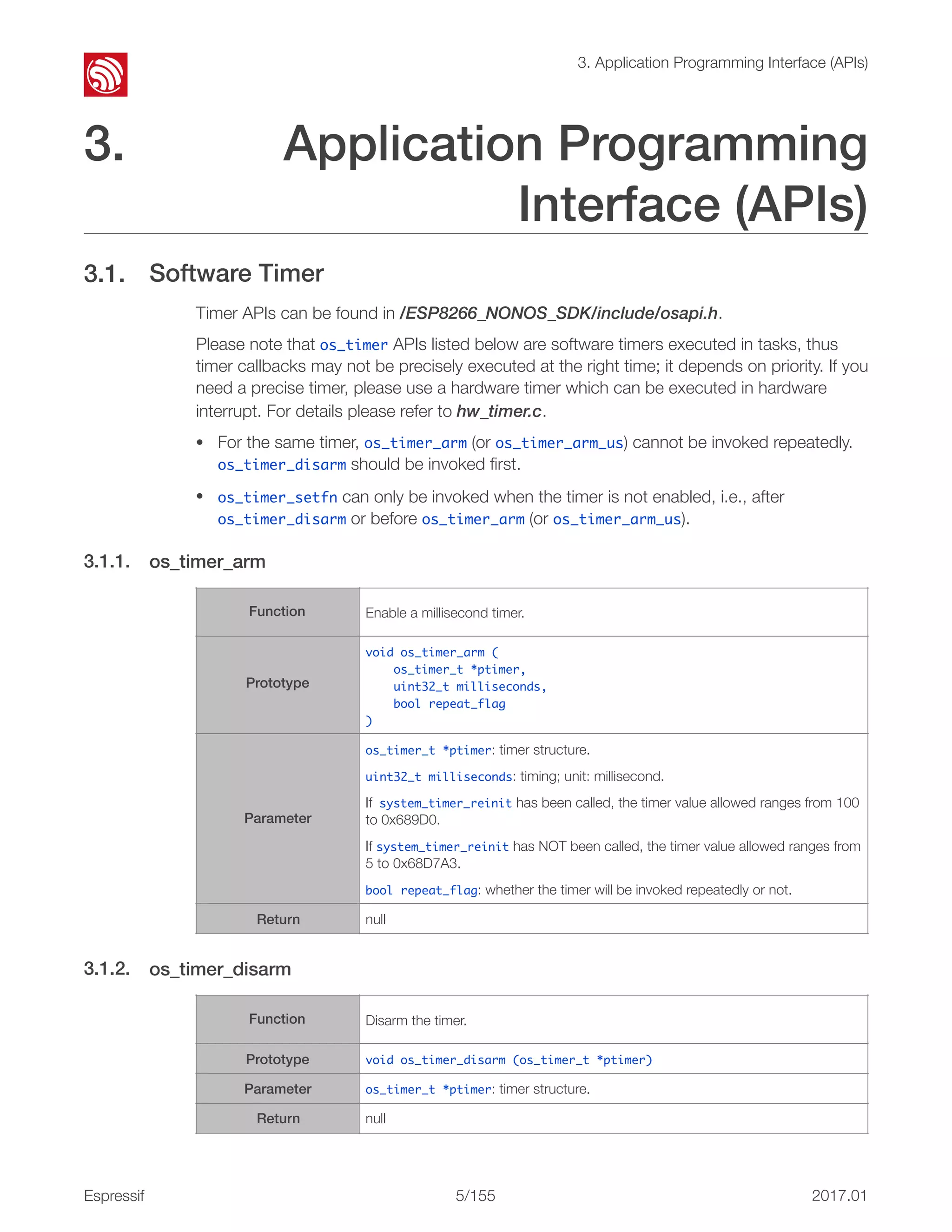
! 3. Application Programming Interface (APIs) 3. Application Programming Interface (APIs) 3.1. Software Timer Timer APIs can be found in /ESP8266_NONOS_SDK/include/osapi.h. Please note that os_timer APIs listed below are software timers executed in tasks, thus timer callbacks may not be precisely executed at the right time; it depends on priority. If you need a precise timer, please use a hardware timer which can be executed in hardware interrupt. For details please refer to hw_timer.c. • For the same timer, os_timer_arm (or os_timer_arm_us) cannot be invoked repeatedly. os_timer_disarm should be invoked first. • os_timer_setfn can only be invoked when the timer is not enabled, i.e., after os_timer_disarm or before os_timer_arm (or os_timer_arm_us). 3.1.1. os_timer_arm 3.1.2. os_timer_disarm Function Enable a millisecond timer. Prototype void	os_timer_arm	(
	os_timer_t	*ptimer,	
	uint32_t	milliseconds,	
	bool	repeat_flag
 ) Parameter os_timer_t	*ptimer: timer structure. uint32_t	milliseconds: timing; unit: millisecond. If	system_timer_reinit has been called, the timer value allowed ranges from 100 to 0x689D0. If system_timer_reinit has NOT been called, the timer value allowed ranges from 5 to 0x68D7A3. bool	repeat_flag: whether the timer will be invoked repeatedly or not. Return null Function Disarm the timer. Prototype void	os_timer_disarm	(os_timer_t	*ptimer) Parameter os_timer_t	*ptimer: timer structure. Return null Espressif ! /1555 2017.01
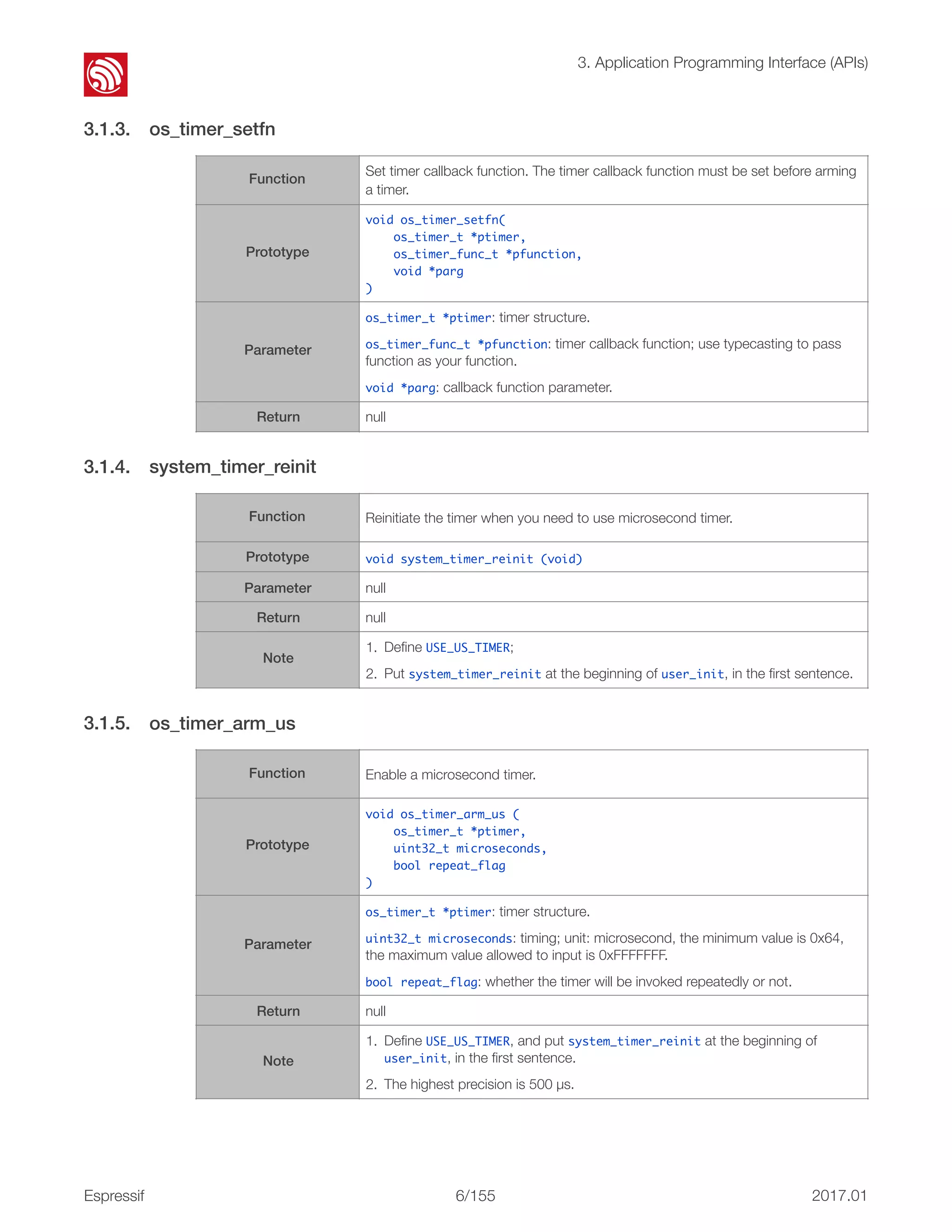
! 3. Application Programming Interface (APIs) 3.1.3. os_timer_setfn 3.1.4. system_timer_reinit 3.1.5. os_timer_arm_us Function Set timer callback function. The timer callback function must be set before arming a timer. Prototype void	os_timer_setfn(
	os_timer_t	*ptimer,	
	os_timer_func_t	*pfunction,	
	void	*parg
 ) Parameter os_timer_t	*ptimer: timer structure. os_timer_func_t	*pfunction: timer callback function; use typecasting to pass function as your function. void	*parg: callback function parameter. Return null Function Reinitiate the timer when you need to use microsecond timer. Prototype void	system_timer_reinit	(void) Parameter null Return null Note 1. Define USE_US_TIMER; 2. Put system_timer_reinit at the beginning of user_init, in the first sentence. Function Enable a microsecond timer. Prototype void	os_timer_arm_us	(
	os_timer_t	*ptimer,	
	uint32_t	microseconds,	
	bool	repeat_flag
 ) Parameter os_timer_t	*ptimer: timer structure. uint32_t	microseconds: timing; unit: microsecond, the minimum value is 0x64, the maximum value allowed to input is 0xFFFFFFF. bool	repeat_flag: whether the timer will be invoked repeatedly or not. Return null Note 1. Define USE_US_TIMER, and put system_timer_reinit at the beginning of user_init, in the first sentence. 2. The highest precision is 500 μs. Espressif ! /1556 2017.01
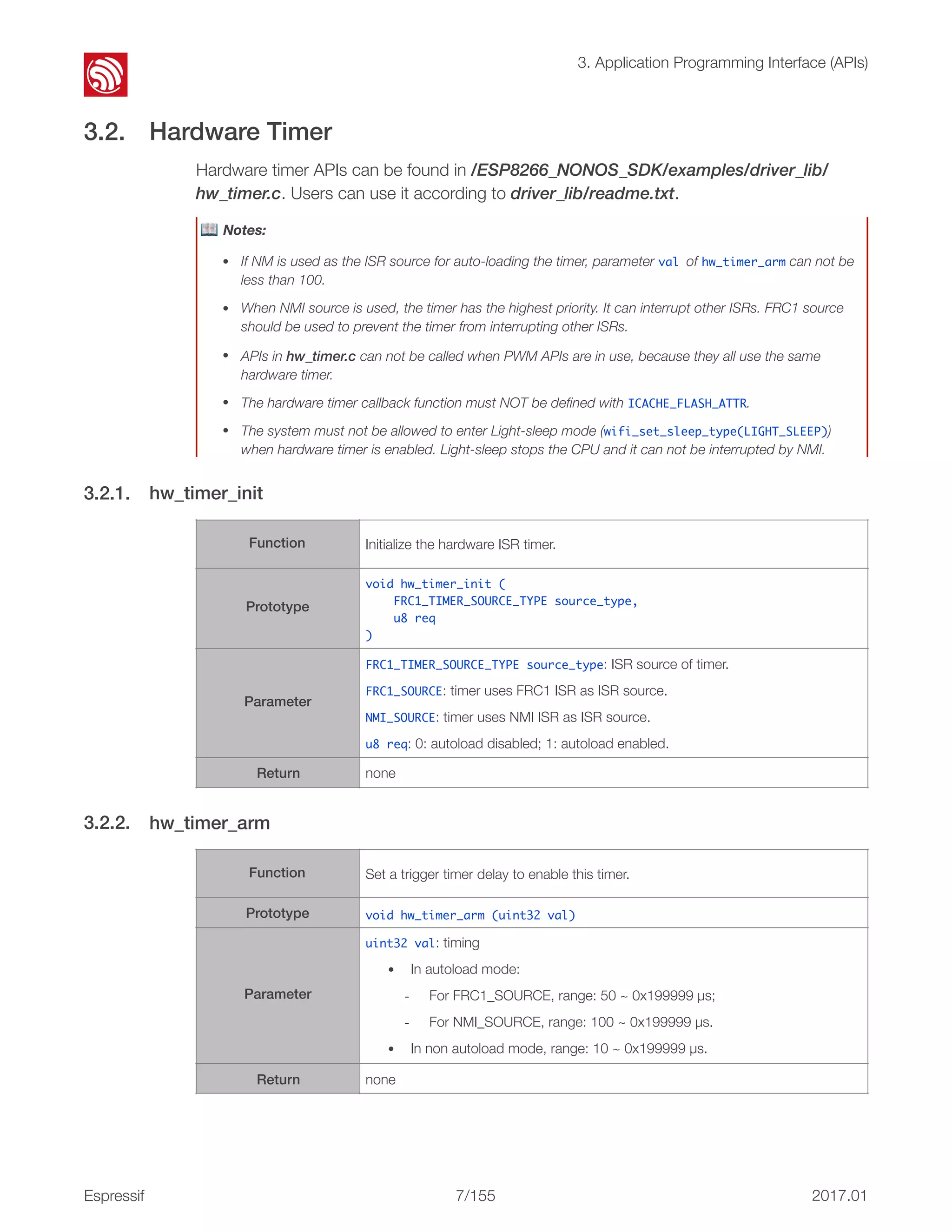
! 3. Application Programming Interface (APIs) 3.2. Hardware Timer Hardware timer APIs can be found in /ESP8266_NONOS_SDK/examples/driver_lib/ hw_timer.c. Users can use it according to driver_lib/readme.txt. 3.2.1. hw_timer_init 3.2.2. hw_timer_arm 📖 Notes: • If NM is used as the ISR source for auto-loading the timer, parameter val	of hw_timer_arm can not be less than 100. • When NMI source is used, the timer has the highest priority. It can interrupt other ISRs. FRC1 source should be used to prevent the timer from interrupting other ISRs. • APIs in hw_timer.c can not be called when PWM APIs are in use, because they all use the same hardware timer. • The hardware timer callback function must NOT be defined with ICACHE_FLASH_ATTR. • The system must not be allowed to enter Light-sleep mode (wifi_set_sleep_type(LIGHT_SLEEP)) when hardware timer is enabled. Light-sleep stops the CPU and it can not be interrupted by NMI. Function Initialize the hardware ISR timer. Prototype void	hw_timer_init	(
	FRC1_TIMER_SOURCE_TYPE	source_type,	
	u8	req
 ) Parameter FRC1_TIMER_SOURCE_TYPE	source_type: ISR source of timer. FRC1_SOURCE: timer uses FRC1 ISR as ISR source. NMI_SOURCE: timer uses NMI ISR as ISR source. u8	req: 0: autoload disabled; 1: autoload enabled. Return none Function Set a trigger timer delay to enable this timer. Prototype void	hw_timer_arm	(uint32	val) Parameter uint32	val: timing • In autoload mode: - For FRC1_SOURCE, range: 50 ~ 0x199999 μs; - For NMI_SOURCE, range: 100 ~ 0x199999 μs. • In non autoload mode, range: 10 ~ 0x199999 μs. Return none Espressif ! /1557 2017.01
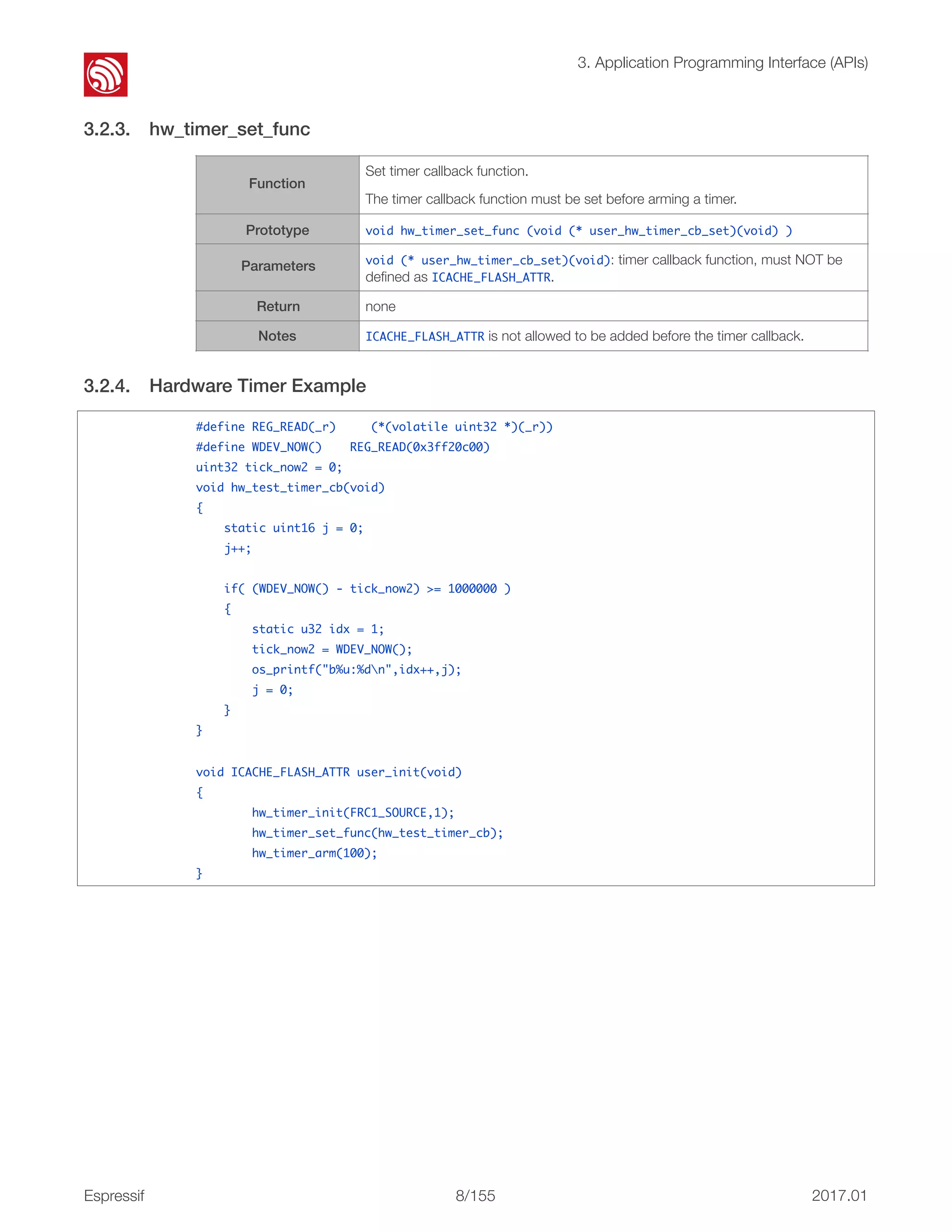
! 3. Application Programming Interface (APIs) 3.2.3. hw_timer_set_func 3.2.4. Hardware Timer Example #define	REG_READ(_r)	(*(volatile	uint32	*)(_r)) #define	WDEV_NOW()	REG_READ(0x3ff20c00) uint32	tick_now2	=	0; void	hw_test_timer_cb(void) {	static	uint16	j	=	0;	j++;	if(	(WDEV_NOW()	-	tick_now2)	>=	1000000	)	{	static	u32	idx	=	1;	tick_now2	=	WDEV_NOW();	os_printf("b%u:%dn",idx++,j);	j	=	0;	} } void	ICACHE_FLASH_ATTR	user_init(void) {	hw_timer_init(FRC1_SOURCE,1);	hw_timer_set_func(hw_test_timer_cb);	hw_timer_arm(100); } Function Set timer callback function. The timer callback function must be set before arming a timer. Prototype void	hw_timer_set_func	(void	(*	user_hw_timer_cb_set)(void)	) Parameters void	(*	user_hw_timer_cb_set)(void): timer callback function, must NOT be defined as ICACHE_FLASH_ATTR. Return none Notes ICACHE_FLASH_ATTR is not allowed to be added before the timer callback. Espressif ! /1558 2017.01
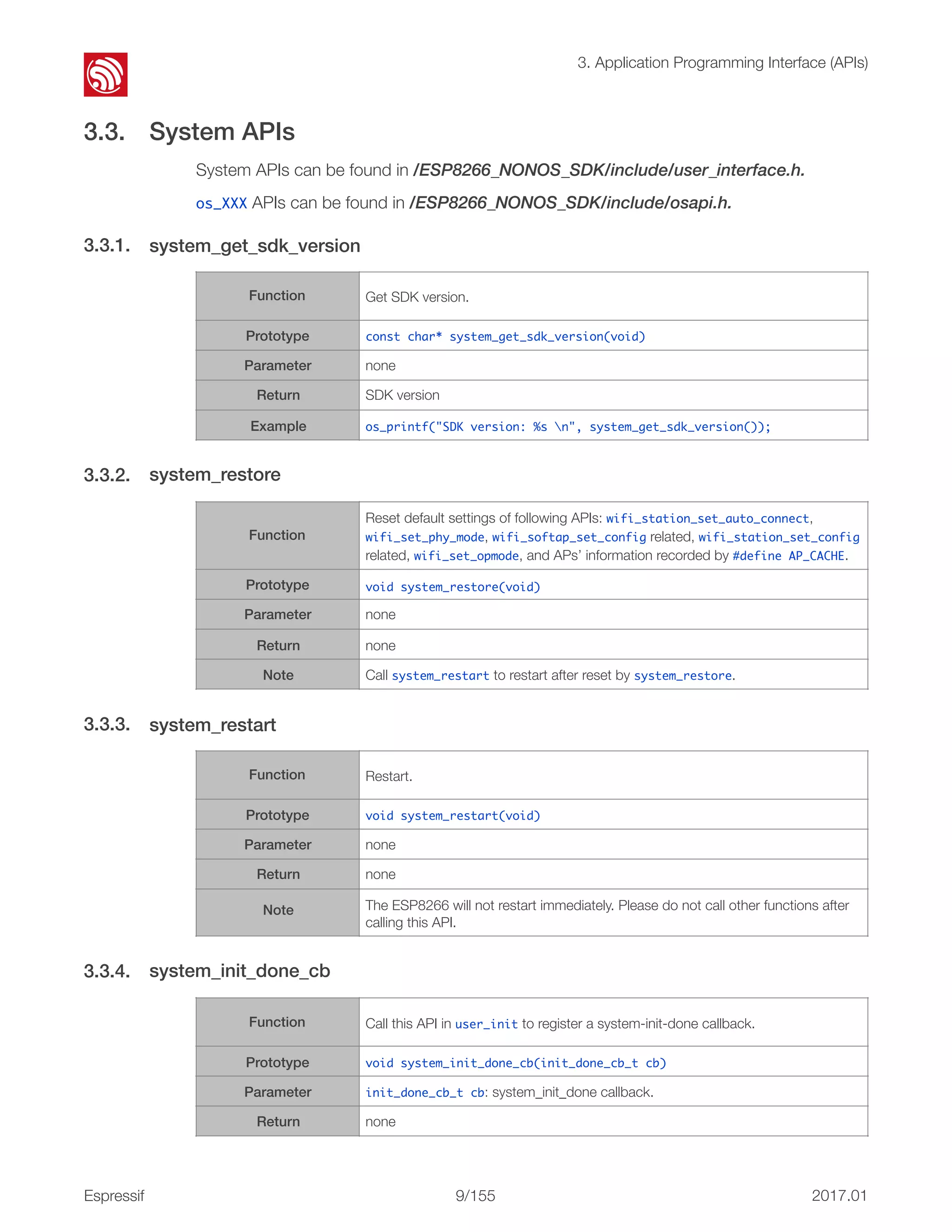
! 3. Application Programming Interface (APIs) 3.3. System APIs System APIs can be found in /ESP8266_NONOS_SDK/include/user_interface.h. os_XXX APIs can be found in /ESP8266_NONOS_SDK/include/osapi.h. 3.3.1. system_get_sdk_version 3.3.2. system_restore 3.3.3. system_restart 3.3.4. system_init_done_cb Function Get SDK version. Prototype const	char*	system_get_sdk_version(void) Parameter none Return SDK version Example os_printf("SDK	version:	%s	n",	system_get_sdk_version()); Function Reset default settings of following APIs: wifi_station_set_auto_connect, wifi_set_phy_mode, wifi_softap_set_config related, wifi_station_set_config related, wifi_set_opmode, and APs’ information recorded by #define	AP_CACHE. Prototype void	system_restore(void) Parameter none Return none Note Call system_restart to restart after reset by system_restore. Function Restart. Prototype void	system_restart(void) Parameter none Return none Note The ESP8266 will not restart immediately. Please do not call other functions after calling this API. Function Call this API in user_init to register a system-init-done callback. Prototype void	system_init_done_cb(init_done_cb_t	cb) Parameter init_done_cb_t	cb: system_init_done callback. Return none Espressif ! /1559 2017.01
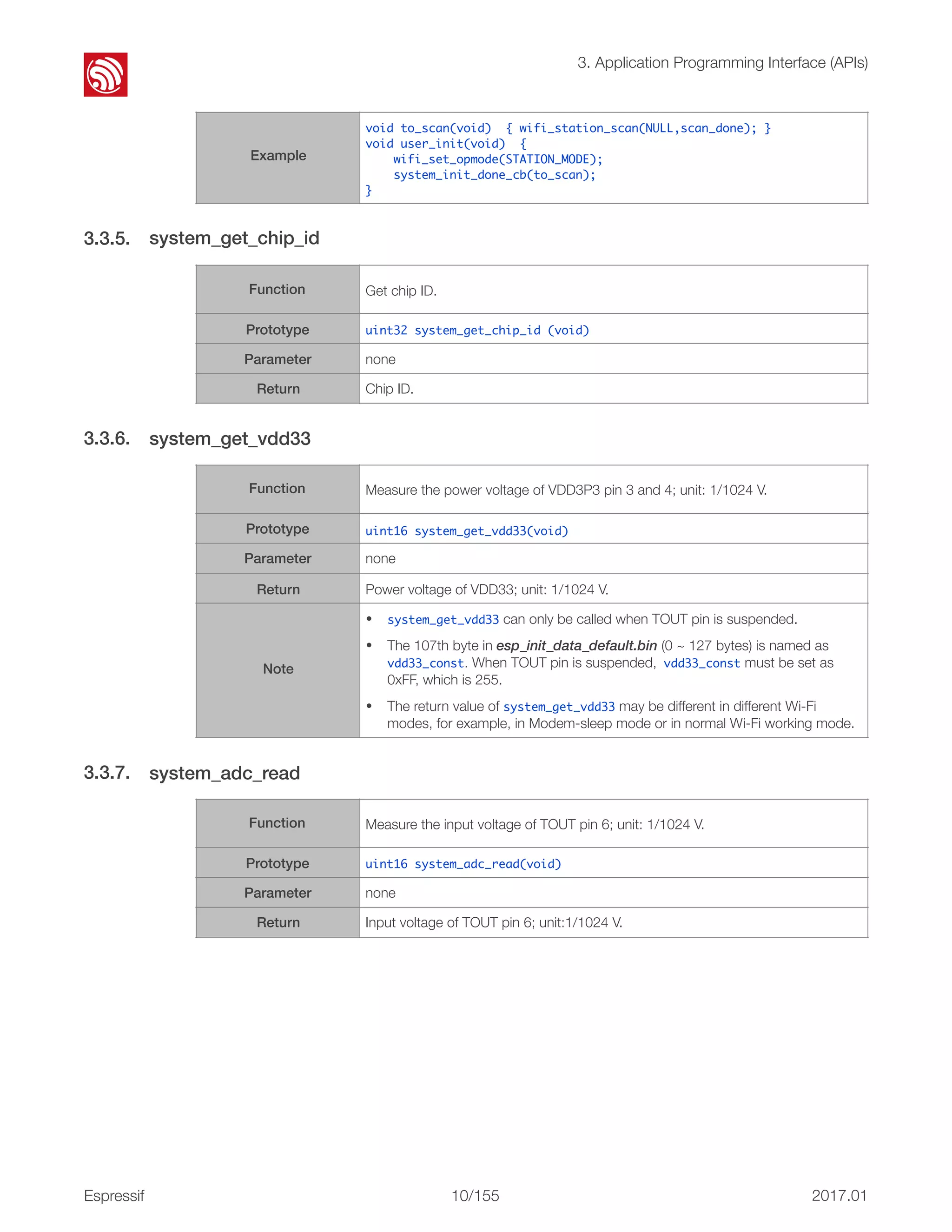
! 3. Application Programming Interface (APIs) 3.3.5. system_get_chip_id 3.3.6. system_get_vdd33 3.3.7. system_adc_read Example void	to_scan(void)	{	wifi_station_scan(NULL,scan_done);	}	
 void	user_init(void)	{	
	wifi_set_opmode(STATION_MODE);	
	system_init_done_cb(to_scan);	
 } Function Get chip ID. Prototype uint32	system_get_chip_id	(void) Parameter none Return Chip ID. Function Measure the power voltage of VDD3P3 pin 3 and 4; unit: 1/1024 V. Prototype uint16	system_get_vdd33(void) Parameter none Return Power voltage of VDD33; unit: 1/1024 V. Note • system_get_vdd33 can only be called when TOUT pin is suspended. • The 107th byte in esp_init_data_default.bin (0 ~ 127 bytes) is named as vdd33_const. When TOUT pin is suspended,	vdd33_const must be set as 0xFF, which is 255. • The return value of system_get_vdd33 may be different in different Wi-Fi modes, for example, in Modem-sleep mode or in normal Wi-Fi working mode. Function Measure the input voltage of TOUT pin 6; unit: 1/1024 V. Prototype uint16	system_adc_read(void) Parameter none Return Input voltage of TOUT pin 6; unit:1/1024 V. Espressif ! /15510 2017.01
! 3. Application Programming Interface (APIs) 3.3.8. system_adc_read_fast Note • system_adc_read is only available when TOUT pin is wired to external circuitry. Input Voltage Range restricted to 0 ~ 1.0V. • The 107th byte in esp_init_data_default.bin (0 ~ 127 bytes) is named as vdd33_const, and when TOUT pin is wired to external circuitry, the vdd33_const must be set as real power voltage of VDD3P3 pin 3 and 4, and has to be less than 0xFF. • The range of operating voltage of ESP8266 is 1.8V ~ 3.6V, the unit of vdd33_const is 0.1V, so effective value range of vdd33_const is [18, 36]. If vdd33_const	is an ineffective value in the range of (0, 18) or (36, 255), ESP8266 RF calibration will be 3.3V by default. • The return value of system_adc_read may be different in different Wi-Fi modes, for example, in Modem-sleep mode or in normal Wi-Fi working mode. • If high precision is needed, please use system_adc_read_fast instead. Function Fast and high-precision sampling of ADC. Prototype void	system_adc_read_fast	(uint16	*adc_addr,	uint16	adc_num,	uint8 adc_clk_div) Parameter uint16	*adc_addr: point to the address of ADC continuously fast sampling output. uint16	adc_num: sampling number of ADC continuously fast sampling; range [1, 65535]. uint8	adc_clk_div: ADC working clock = 80M/adc_clk_div; range [8, 32], the recommended value is 8. Return none Espressif ! /15511 2017.01
! 3. Application Programming Interface (APIs) 3.3.9. system_deep_sleep Example extern	void	system_adc_read_fast(uint16	*adc_addr,	uint16	adc_num, uint8	adc_clk_div); os_timer_t	timer; void	ICACHE_FLASH_ATTR	ADC_TEST(void	*p)
 { wifi_set_opmode(NULL_MODE); ets_intr_lock(	); //close	interrupt uint16	adc_addr[10]; uint16	adc_num	=	10; uint8	adc_clk_div	=	8; uint32	i; system_adc_read_fast(adc_addr,	adc_num,	adc_clk_div); for(i=0;	i<adc_num;	i++) os_printf("i=%d,	adc_v=%dn",	i,	adc_addr[i]); ets_intr_unlock(); //open	interrupt os_timer_disarm(&timer); os_timer_setfn(&timer,	ADC_TEST,	NULL); os_timer_arm(&timer,1000,1); } Note • system_adc_read_fast is only available when TOUT pin is wired to external circuitry. Input voltage range is restricted to 0 ~ 1.0V. • The 107th byte in esp_init_data_default.bin (0 ~ 127 bytes) is named as vdd33_const, and when TOUT pin is wired to external circuitry, the vdd33_const must be set as real power voltage of VDD3P3 pin 3 and 4, and has to be less than 0xFF. • The range of operating voltage of ESP8266 is 1.8V ~ 3.6V, the unit of vdd33_const is 0.1V, so effective value range of vdd33_const is [18, 36]. If vdd33_const is an ineffective value in the range of (0, 18) or (36, 255), ESP8266 RF calibration will use 3.3V by default. • To use	system_adc_read_fast, Wi-Fi has to be disabled. And if ADC continuously sampling is needed, all interrupts have to be disabled, so PWM or NMI hardware timer can not be used when system_adc_read_fast is calling. Function Configures chip for Deep-sleep mode. When the device is in Deep-sleep, it automatically wakes up periodically; the period is configurable. Upon waking up, the device boots up from user_init. Prototype void	system_deep_sleep(uint32	time_in_us) Parameter uint32	time_in_us: the duration of time (μs) when the device is in Deep-sleep. Return null Espressif ! /15512 2017.01
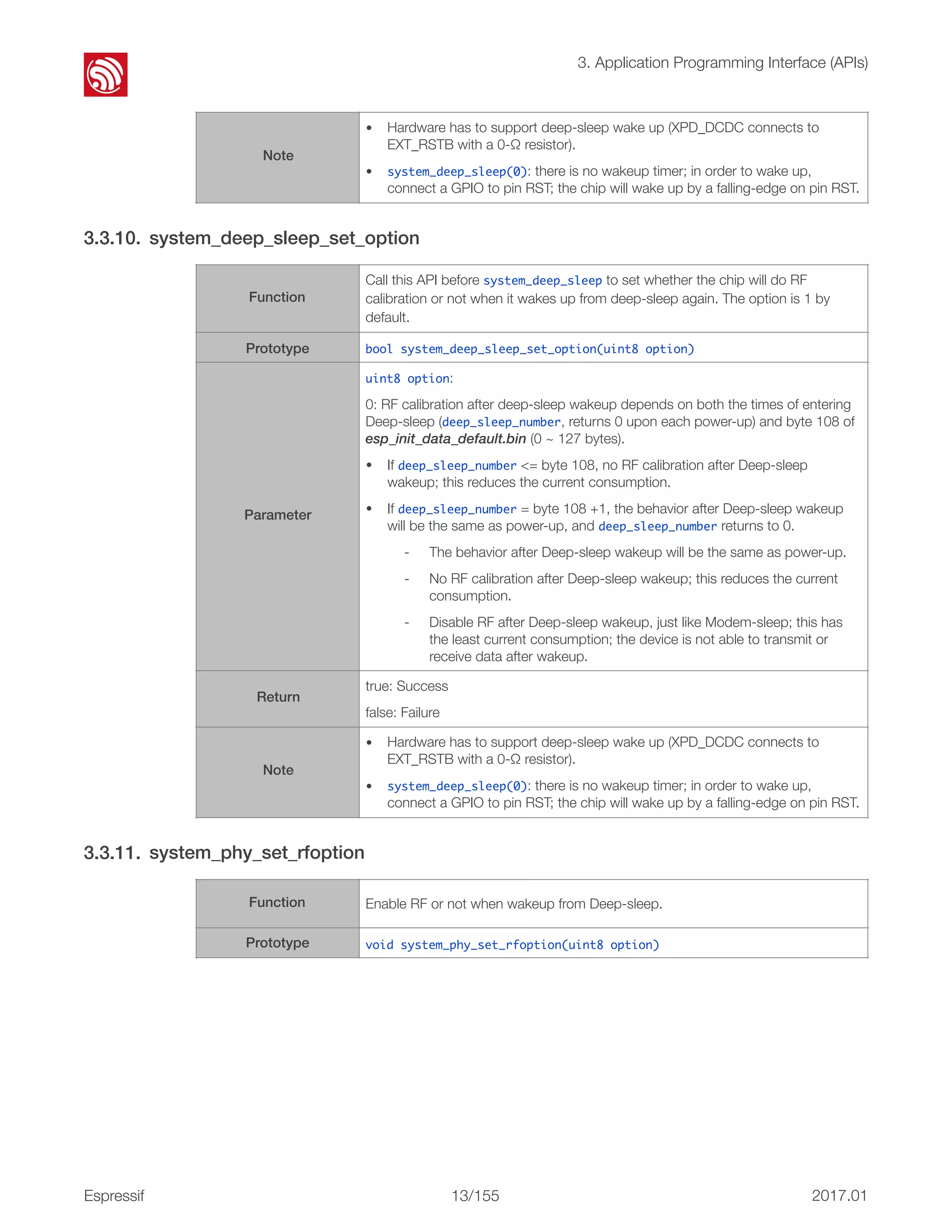
! 3. Application Programming Interface (APIs) 3.3.10. system_deep_sleep_set_option 3.3.11. system_phy_set_rfoption Note • Hardware has to support deep-sleep wake up (XPD_DCDC connects to EXT_RSTB with a 0-Ω resistor). • system_deep_sleep(0): there is no wakeup timer; in order to wake up, connect a GPIO to pin RST; the chip will wake up by a falling-edge on pin RST. Function Call this API before system_deep_sleep to set whether the chip will do RF calibration or not when it wakes up from deep-sleep again. The option is 1 by default. Prototype bool	system_deep_sleep_set_option(uint8	option) Parameter uint8	option: 0: RF calibration after deep-sleep wakeup depends on both the times of entering Deep-sleep (deep_sleep_number, returns 0 upon each power-up) and byte 108 of esp_init_data_default.bin (0 ~ 127 bytes). • If deep_sleep_number <= byte 108, no RF calibration after Deep-sleep wakeup; this reduces the current consumption. • If deep_sleep_number = byte 108 +1, the behavior after Deep-sleep wakeup will be the same as power-up, and deep_sleep_number returns to 0. - The behavior after Deep-sleep wakeup will be the same as power-up. - No RF calibration after Deep-sleep wakeup; this reduces the current consumption. - Disable RF after Deep-sleep wakeup, just like Modem-sleep; this has the least current consumption; the device is not able to transmit or receive data after wakeup. Return true: Success false: Failure Note • Hardware has to support deep-sleep wake up (XPD_DCDC connects to EXT_RSTB with a 0-Ω resistor). • system_deep_sleep(0): there is no wakeup timer; in order to wake up, connect a GPIO to pin RST; the chip will wake up by a falling-edge on pin RST. Function Enable RF or not when wakeup from Deep-sleep. Prototype void	system_phy_set_rfoption(uint8	option) Espressif ! /15513 2017.01
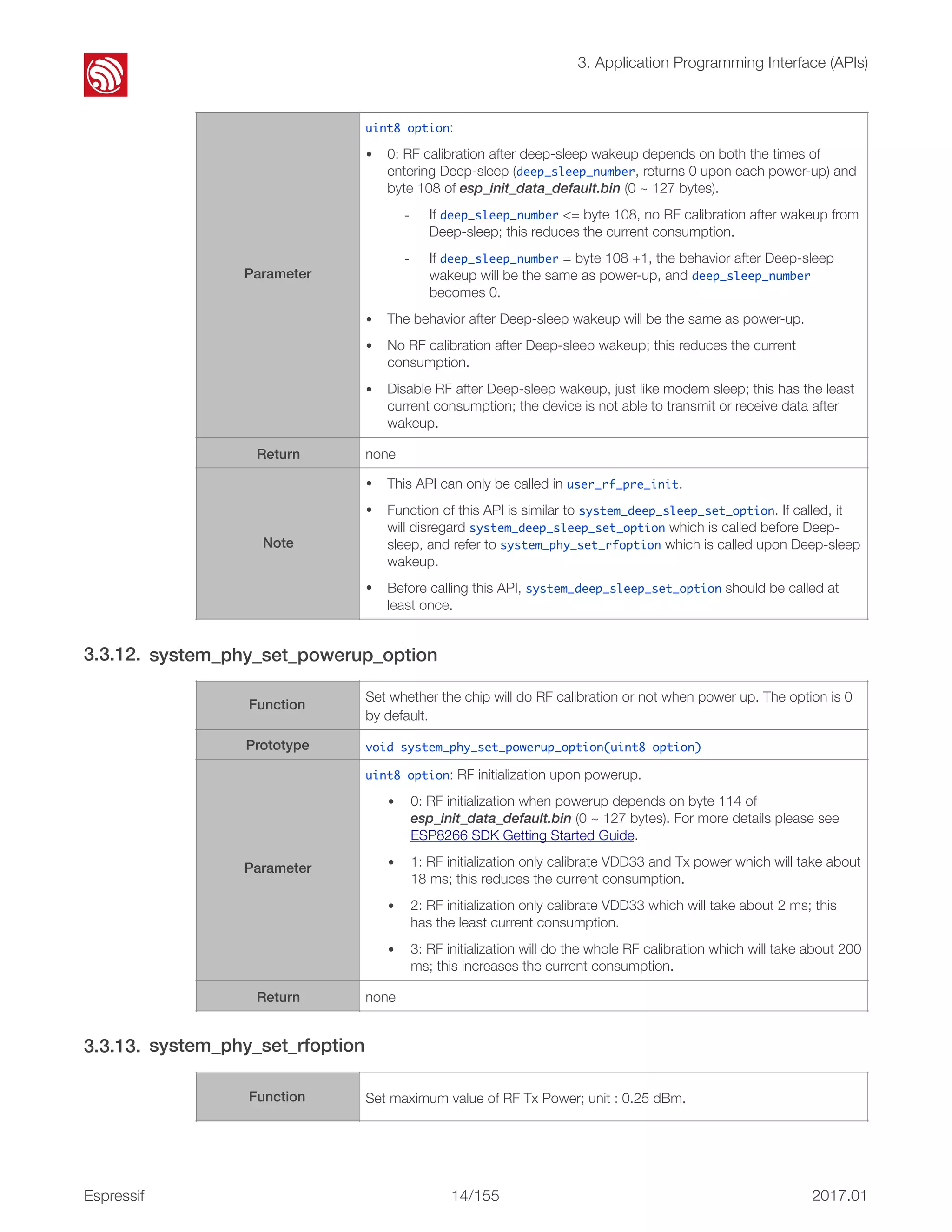
! 3. Application Programming Interface (APIs) 3.3.12. system_phy_set_powerup_option 3.3.13. system_phy_set_rfoption Parameter uint8	option: • 0: RF calibration after deep-sleep wakeup depends on both the times of entering Deep-sleep (deep_sleep_number, returns 0 upon each power-up) and byte 108 of esp_init_data_default.bin (0 ~ 127 bytes). - If deep_sleep_number <= byte 108, no RF calibration after wakeup from Deep-sleep; this reduces the current consumption. - If deep_sleep_number = byte 108 +1, the behavior after Deep-sleep wakeup will be the same as power-up, and deep_sleep_number becomes 0. • The behavior after Deep-sleep wakeup will be the same as power-up. • No RF calibration after Deep-sleep wakeup; this reduces the current consumption. • Disable RF after Deep-sleep wakeup, just like modem sleep; this has the least current consumption; the device is not able to transmit or receive data after wakeup. Return none Note • This API can only be called in user_rf_pre_init. • Function of this API is similar to system_deep_sleep_set_option. If called, it will disregard system_deep_sleep_set_option which is called before Deep- sleep, and refer to system_phy_set_rfoption which is called upon Deep-sleep wakeup. • Before calling this API, system_deep_sleep_set_option should be called at least once. Function Set whether the chip will do RF calibration or not when power up. The option is 0 by default. Prototype void	system_phy_set_powerup_option(uint8	option) Parameter uint8	option: RF initialization upon powerup. • 0: RF initialization when powerup depends on byte 114 of esp_init_data_default.bin (0 ~ 127 bytes). For more details please see ESP8266 SDK Getting Started Guide. • 1: RF initialization only calibrate VDD33 and Tx power which will take about 18 ms; this reduces the current consumption. • 2: RF initialization only calibrate VDD33 which will take about 2 ms; this has the least current consumption. • 3: RF initialization will do the whole RF calibration which will take about 200 ms; this increases the current consumption. Return none Function Set maximum value of RF Tx Power; unit : 0.25 dBm. Espressif ! /15514 2017.01
! 3. Application Programming Interface (APIs) 3.3.14. system_phy_set_tpw_via_vdd33 3.3.15. system_set_os_print 3.3.16. system_print_meminfo 3.3.17. system_get_free_heap_size Prototype void	system_phy_set_max_tpw(uint8	max_tpw) Parameter uint8	max_tpw: maximum value of RF Tx Power, unit: 0.25 dBm, range [0, 82]. It can be set by referring to the 34th byte (target_power_qdb_0) of esp_init_data_default.bin (0 ~ 127 bytes). Return none Function Adjust RF Tx Power according to VDD33; unit : 1/1024 V. Prototype void	system_phy_set_tpw_via_vdd33(uint16	vdd33) Parameter uint16	vdd33: VDD33, unit : 1/1024V, range [1900, 3300] Return none Note When TOUT pin is suspended, VDD33 can be got by system_get_vdd33; When TOUT pin is wired to external circuitry, system_get_vdd33 can not be used. Function Turn log printing on or off. Prototype void	system_set_os_print	(uint8	onoff) Parameter uint8	onoff Return none Note onoff = 0: print function off onoff = 1: print function on Default Print function on. Function Print memory information, including data/rodata/bss/heap. Prototype void	system_print_meminfo	(void) Parameter none Return none Function Get free heap size. Prototype uint32	system_get_free_heap_size(void) Espressif ! /15515 2017.01
! 3. Application Programming Interface (APIs) 3.3.18. system_os_task 3.3.19. system_os_post Parameter none Return uint32: available heap size Function Set up tasks. Prototype bool	system_os_task(
	os_task_t	task,	
	uint8	prio,	
	os_event_t	*queue,	
	uint8	qlen
 ) Parameters os_task_t	task: task function. uint8	prio: task priority. Three priorities are supported: 0/1/2; 0 is the lowest priority. This means only 3 tasks are allowed to be set up. os_event_t	*queue: message queue pointer. uint8	qlen: message queue depth. Return true:Success false:Failure Example #define	SIG_RX	0
 #define	TEST_QUEUE_LEN	4
 os_event_t	*testQueue;
 void	test_task	(os_event_t	*e)	{
	switch	(e->sig)	{
	case	SIG_RX:
	os_printf(sig_rx	%c/n,	(char)e->par);
	break;
	default:
	break;
	}
 }
 void	task_init(void)	{
	testQueue=(os_event_t *)os_malloc(sizeof(os_event_t)*TEST_QUEUE_LEN);
 system_os_task(test_task,USER_TASK_PRIO_0,testQueue,TEST_QUEUE_LEN);
 } Function Send messages to task. Prototype bool	system_os_post	(
	uint8	prio,	
	os_signal_t	sig,	
	os_param_t	par
 ) Espressif ! /15516 2017.01
! 3. Application Programming Interface (APIs) 3.3.20. system_get_time 3.3.21. system_get_rtc_time 3.3.22. system_rtc_clock_cali_proc Parameter uint8	prio: task priority, corresponding to that you set up. os_signal_t	sig: message type. os_param_t	par: message parameters. Return true:Success false:Failure Example void	task_post(void)	{
	system_os_post(USER_TASK_PRIO_0,	SIG_RX,	‘a’);
 } Print sig_rx	a Function Get system time (μs). Prototype uint32	system_get_time(void) Parameter none Return System time in microsecond. Function Get RTC time, as denoted by the number of RTC clock periods. Prototype uint32	system_get_rtc_time(void) Parameter none Return RTC time. Example If system_get_rtc_time returns 10 (which means 10 RTC cycles), and system_rtc_clock_cali_proc returns 5.75 (which means 5.75 μs per RTC cycle), the real time is 10 x 5.75 = 57.5 μs. Note System time will return to zero because of system_restart, but RTC still goes on. If an external hardware reset the chip via EXT_RST or CHIP_EN (such as timed wakeup from Deep-sleep), the RTC timer will be reset. • Reset by pin EXT_RST: RTC memory won’t change; RTC timer starts to zero. • Watchdog reset: RTC memory won’t change; RTC timer won’t change. • system_restart: RTC memory won’t change; RTC timer won’t change. • Power-on: RTC memory contains a random value; RTC timer starts from zero. • Reset by pin CHIP_EN: RTC memory contains a random value; RTC timer starts from zero. Function Get RTC clock period. Espressif ! /15517 2017.01
! 3. Application Programming Interface (APIs) 3.3.23. system_rtc_mem_write 3.3.24. system_rtc_mem_read Prototype uint32	system_get_rtc_time(void) Parameter none Return RTC clock period (in us); bit11 ~ bit0 are decimal. Example os_printf("clk	cal	:	%d	rn",system_rtc_clock_cali_proc()>>12); Note • RTC clock period has decimal part. • RTC clock period tends to drift with changes in temperature, so RTC timer is not very precise. • See RTC demo in Appendix.A. Function Writes data to the RTC memory. During Deep-sleep mode, the RTC is still operational and can store user data in the defined user-data area. |<------system data (256 bytes)------->|<-----------------user data (512 bytes)--------------->| Prototype bool	system_rtc_mem_write	(
	uint32	des_addr,	
	void	*	src_addr,	
	uint32	save_size
 ) Parameter uint32	des_addr: destination address (block number) in RTC memory, des_addr >=64 void	*	src_addr: data pointer uint32	save_size: data length ( byte) Return true: Success false: Failure Example os_printf("clk	cal	:	%d	rn",system_rtc_clock_cali_proc()>>12); Note Data read/write accesses to the RTC memory must be word-aligned (4-byte boundary aligned). Parameter des_addr means block number (4 bytes per block). For example, to save data at the beginning of user data area, des_addr will be 256/4 = 64, and save_size will be data length. Function Read user data from RTC memory. Only user data area should be accessed by the user. |<------system data (256 bytes)------->|<-----------------user data (512 bytes)--------------->| Prototype bool	system_rtc_mem_read	(
	uint32	src_addr,	
	void	*	des_addr,	
	uint32	save_size
 ) Espressif ! /15518 2017.01
! 3. Application Programming Interface (APIs) 3.3.25. system_uart_swap 3.3.26. system_uart_de_swap 3.3.27. system_get_boot_version 3.3.28. system_get_userbin_addr Parameter uint32	src_addr: source address (block number) in RTC memory, src_addr >= 64 void	*	des_addr: data pointer uint32	save_size: data length; unit: byte Return true: Success false: Failure Note Data read/write accesses to the RTC memory must be word aligned (4 bytes boundary aligned). Parameter	src_addr means block number(4 bytes per block). For example, to read data from the beginning of user data area, src_addr will be 256/4=64, save_size will be data length. Function UART0 swap. Use MTCK as UART0 Rx, MTDO as UART0 Tx, so ROM log will not output from this new UART0. MTDO (U0RTS) and MTCK (U0CTS) also need to be used as UART0 in hardware. Prototype void	system_uart_swap	(void) Parameter none Return none Function Disable UART0 swap. Use original UART0, not MTCK and MTDO. Prototype void	system_uart_de_swap	(void) Parameter none Return none Function Get version info of boot. Prototype uint8	system_get_boot_version	(void) Parameter none Return Version info of boot. Note If boot version >= 3, it is possible to enable enhanced boot mode (for details of which please see system_restart_enhance). Function Get address of the current running user bin (user1.bin or user2.bin). Prototype uint32	system_get_userbin_addr	(void) Espressif ! /15519 2017.01
! 3. Application Programming Interface (APIs) 3.3.29. system_get_boot_mode 3.3.30. system_restart_enhance 3.3.31. system_update_cpu_freq Parameter none Return Start address info of the current running user binary. Function Get boot mode. Prototype uint8	system_get_boot_mode	(void) Parameter none Return #define	SYS_BOOT_ENHANCE_MODE	0
 #define	SYS_BOOT_NORMAL_MODE	1 Note • Enhance boot mode: can load and run FW at any address. • Normal boot mode: can only load and run normal user1.bin (or user2.bin). Function Restarts system, and enters enhance boot mode. Prototype bool	system_restart_enhance(
	uint8	bin_type,	
	uint32	bin_addr
 ) Parameter uint8	bin_type: type of bin #define	SYS_BOOT_NORMAL_BIN	0	//	user1.bin	or	user2.bin #define	SYS_BOOT_TEST_BIN	1	//	can	only	be	Espressif	test	bin uint32	bin_addr: start address of bin file Return true: Success false: Failure Note SYS_BOOT_TEST_BIN is for factory test during production; you can apply for the test bin from Espressif Systems. Function Set CPU frequency. Default is 80 MHz. Prototype bool	system_update_cpu_freq(uint8	freq) Parameter uint8	freq: CPU frequency #define	SYS_CPU_80MHz	80 #define	SYS_CPU_160MHz	160 Return true: Success false: Failure Espressif ! /15520 2017.01
! 3. Application Programming Interface (APIs) 3.3.32. system_get_cpu_freq 3.3.33. system_get_flash_size_map Note System bus frequency is 80 MHz, and it is not affected by CPU frequency. The frequency of UART, SPI, or other peripheral devices, are divided from system bus frequency, so they will not be affected by CPU frequency either. Function Get CPU frequency. Prototype uint8	system_get_cpu_freq(void) Parameter none Return CPU frequency; unit : MHz. Function Get current flash size and flash map. Flash map depends on selection when compiling; for more details please see ESP8266 SDK Getting Started Guide. Structure enum	flash_size_map	{ FLASH_SIZE_4M_MAP_256_256	=	0, FLASH_SIZE_2M, FLASH_SIZE_8M_MAP_512_512, FLASH_SIZE_16M_MAP_512_512, FLASH_SIZE_32M_MAP_512_512, FLASH_SIZE_16M_MAP_1024_1024, FLASH_SIZE_32M_MAP_1024_1024 }; Prototype enum	flash_size_map	system_get_flash_size_map(void) Parameter none Return flash map Espressif ! /15521 2017.01
! 3. System APIs 3.3.34. system_get_rst_info 3.3.35. system_soft_wdt_stop 3.3.36. system_soft_wdt_restart Function Get information about current startup. Structure enum	rst_reason	{ REANSON_DEFAULT_RST =	0, //	normal	startup	by	power	on REANSON_WDT_RST =	1, //	hardware	watch	dog	reset //	exception	reset,	GPIO	status	won’t	change REANSON_EXCEPTION_RST =	2, //	software	watch	dog	reset,	GPIO	status	won’t	change REANSON_SOFT_WDT_RST =	3, //	software	restart	,system_restart	,	GPIO	status	won’t change REANSON_SOFT_RESTART =	4, REANSON_DEEP_SLEEP_AWAKE=	5,	//	wake	up	from	deep-sleep REANSON_EXT_SYS_RST =	6, //	external	system	reset }; struct	rst_info	{ uint32	reason;	//	enum	rst_reason uint32	exccause; uint32	epc1;	//	the	address	that	error occurred uint32	epc2; uint32	epc3; uint32	excvaddr; uint32	depc; }; Prototype struct	rst_info*	system_get_rst_info(void) Parameter none Return Information about startup. Function Stop software watchdog. Prototype void	system_soft_wdt_stop(void) Parameter none Return none Note The software watchdog must not be stopped for too long (over 6 seconds), otherwise it will trigger hardware watchdog reset. Function Restart software watchdog. Espressif ! /15522 2017.01
! 3. System APIs 3.3.37. system_soft_wdt_feed 3.3.38. system_show_malloc 3.3.39. os_memset Prototype void	system_soft_wdt_restart(void) Parameter none Return none Note This API can only be called if software watchdog is stopped (system_soft_wdt_stop). Function Feed software watchdog. Prototype void	system_soft_wdt_feed(void) Parameter none Return none Note This API can only be called if software watchdog is enabled. Function For debugging memory leak issue and printing the memory usage. Prototype void	system_show_malloc(void) Parameter none Return none Note • To use this API, users need to enable #define MEMLEAK_DEBUG in user_config.h, then refer to the note which is at the beginning of ESP8266_NONOS_SDKincludedmem.h. • The memory usage which cause memory leak issue may be in the logs, not ensure, just for reference. • This API is only for debugging. After calling this API, the program may go wrong, so please do not call it in normal usage. Function Set value of memory. Prototype os_memset(void	*s,	int	ch,	size_t	n) Parameter void	*s: pointer of memory int	ch: set value size_t	n: size Return none Example uint8	buffer[32]; os_memset(buffer,	0,	sizeof(buffer)); Espressif ! /15523 2017.01
! 3. System APIs 3.3.40. os_memcpy 3.3.41. os_strlen 3.3.42. os_printf 3.3.43. os_bzero Function Standard function for copying memory content. Prototype os_memcpy(void	*des,	void	*src,	size_t	n) Parameter void	*des: pointer of destination void	*src: pointer of source size_t	n: memory size Return none Note uint8	buffer[4]	=	{0}; os_memcpy(buffer,	"abcd",	4); Function Get string length. Prototype os_strlen(char	*s) Parameter char	*s: string Return string length Example char	*ssid	=	"ESP8266"; os_memcpy(softAP_config.ssid,	ssid,	os_strlen(ssid)); Function Print format. Prototype os_printf(const	char	*s) Parameter const	char	*s: string Return none Example os_printf("SDK	version:	%s	n",	system_get_sdk_version()); Note • Default to be output from UART 0. uart_init	in	IOT_Demo can set baud rate of UART, and os_install_putc1((void	*)uart1_write_char) in it will set os_printf to be output from UART 1. • Continuously printing more than 125 bytes or repeated calls to this API may cause loss of print data. Function Set the first n bytes of string p to be 0, include ’0’. Prototype void	os_bzero(void	*p,	size_t	n) Espressif ! /15524 2017.01
! 3. System APIs 3.3.44. os_delay_us 3.3.45. os_install_putc1 3.3.46. os_random 3.3.47. os_get_random Parameter void	*p: pointer of memory need to be set 0 size_t	n: length Return none Function Time delay, max : 65535 μs. Prototype void	os_delay_us(uint16	μs) Parameter uint16	μs: time, unit: μs Return none Function Register print output function. Prototype void	os_install_putc1(void(*p)(char	c)) Parameter void(*p)(char	c): pointer of print function. Return none Example os_install_putc1((void	*)uart1_write_char) in uart_init will set os_printf to be output from UART 1; otherwise, os_printf default output from UART 0. Function Get a random number. Prototype unsigned	long	os_random(void) Parameter none Return The random number. Function Get a random number of specified bits. Prototype int	os_get_random(unsigned	char	*buf,	size_t	len) Parameter unsigned	char	*buf: pointer of the random number it gets size_t	len: specified bits of the random number Return 0: Success otherwise: Failure Espressif ! /15525 2017.01
! 3. System APIs 3.3.48. user_rf_cal_sector_set Example int	ret	=	os_get_random((unsigned	char	*)temp,	7);
 os_printf("ret	%d,	value	0x%08x%08xnr",	ret,	temp[1],	temp[0]); Function Set the target flash sector to store RF_CAL parameters. Prototype uint32	user_rf_cal_sector_set(void) Parameter none Return The target flash sector to store RF_CAL parameters. Notes • The user_rf_cal_sector_set has to be added in application, but need NOT to be called. It will be called inside the SDK. • The system parameter area (4 flash sectors) has already been used, so the RF_CAL parameters will be stored in the target sector set by user_rf_cal_sector_set. Since we do not know which sector is available in user data area, users need to set an available sector in the user_rf_cal_sector_set for the SDK to store RF_CAL parameter. • If the user_rf_cal_sector_set is not added in the application, the compilation will fail in link stage. • Download blank.bin to initialize the sector stored RF_CAL parameter, and download esp_init_data.bin into flash, when the system needs to be initialized, or RF needs to be calibrated again. Example Set the 5th sector from the end of the flash to store the RF_CAL parameter. uint32	user_rf_cal_sector_set(void) {	enum	flash_size_map	size_map	=	system_get_flash_size_map();	uint32	rf_cal_sec	=	0;	switch	(size_map)	{	case	FLASH_SIZE_4M_MAP_256_256:	rf_cal_sec	=	128	-	5;	break;	case	FLASH_SIZE_8M_MAP_512_512:	rf_cal_sec	=	256	-	5;	break;	case	FLASH_SIZE_16M_MAP_512_512:	case	FLASH_SIZE_16M_MAP_1024_1024:	rf_cal_sec	=	512	-	5;	break;	case	FLASH_SIZE_32M_MAP_512_512:	case	FLASH_SIZE_32M_MAP_1024_1024:	rf_cal_sec	=	512	-	5;	break;	default:	rf_cal_sec	=	0;	break;	}	return	rf_cal_sec; } Espressif ! /15526 2017.01
! 3. System APIs 3.4. SPI Flash Related APIs SPI flash APIs can be found in: /ESP8266_NONOS_SDK/include/spi_flash.h. system_param_xxx APIs can be found in: /ESP8266_NONOS_SDK/include/ user_interface.h. More details about flash read/write operation please see document ESP8266 Flash RW Operation. 3.4.1. spi_flash_get_id 3.4.2. spi_flash_erase_sector 3.4.3. spi_flash_write Function Get ID info of SPI flash. Prototype uint32	spi_flash_get_id	(void) Parameter none Return SPI flash ID Function Erase sector in flash. Prototype SpiFlashOpResult	spi_flash_erase_sector	(uint16	sec) Parameter uint16	sec: Sector number, the count starts at sector 0, 4 KB per sector. Return typedef	enum{
	SPI_FLASH_RESULT_OK,
	SPI_FLASH_RESULT_ERR,
	SPI_FLASH_RESULT_TIMEOUT
 }	SpiFlashOpResult; Function Write data to flash. Flash read/write has to be aligned to the 4-byte boundary. Prototype SpiFlashOpResult	spi_flash_write	(
	uint32	des_addr,	
	uint32	*src_addr,	
	uint32	size
 ) Parameter uint32	des_addr: destination address in flash. uint32	*src_addr: source address of the data. uint32	size: length of data, uint: byte, has to be aligned to the 4-byte boundary. Return typedef	enum{
	SPI_FLASH_RESULT_OK,
	SPI_FLASH_RESULT_ERR,
	SPI_FLASH_RESULT_TIMEOUT
 }	SpiFlashOpResult; Espressif ! /15527 2017.01
! 3. System APIs 3.4.4. spi_flash_read 3.4.5. system_param_save_with_protect Function Read data to flash. Flash read/write has to be aligned to the 4-byte boundary. Prototype SpiFlashOpResult	spi_flash_read(
	uint32	src_addr,	
	uint32	*	des_addr,	
	uint32	size
 ) Parameter uint32	src_addr: source address in flash. uint32	*des_addr: destination address to keep data. uint32	size: length of data; unit: byte, has to be aligned to the 4-bytes boundary. Return typedef	enum	{
	SPI_FLASH_RESULT_OK,
	SPI_FLASH_RESULT_ERR,
	SPI_FLASH_RESULT_TIMEOUT
 }	SpiFlashOpResult; Example uint32	value; uint8	*addr	=	(uint8	*)&value; spi_flash_read(0x3E	*	SPI_FLASH_SEC_SIZE,	(uint32	*)addr,	4); os_printf("0x3E	sec:%02x%02x%02x%02xrn",	addr[0],	addr[1],	addr[2], addr[3]); Function Write data into flash with protection. Flash read/write has to be aligned to the 4- byte boundary. Protection of flash read/write : 3 sectors (4 KB per sector) are used to save 4 KB data with protection; sector 0 and sector 1 are data sectors and back up each other; data is saved alternately; sector 2 is flag sector that points out which sector is keeping the latest data—sector 0 or sector 1. Prototype bool	system_param_save_with_protect	(
	uint16	start_sec,	
	void	*param,	
	uint16	len
 ) Parameter uint16	start_sec: start sector (sector 0) of the 3 sectors which used for flash read/write protection. For example, in IOT_Demo we could use the 3 sectors (3*4 KB) starts from flash 0x3D000 for flash read/write protection, so the parameter	start_sec should be 0x3D. void	*param: pointer of data need to save. uint16	len: data length, should less than a sector which is 4*1024. Return true: Success false: Failure Espressif ! /15528 2017.01
! 3. System APIs 3.4.6. system_param_load Example uint32	value; uint8	*addr	=	(uint8	*)&value; spi_flash_read(0x3E	*	SPI_FLASH_SEC_SIZE,	(uint32	*)addr,	4); os_printf("0x3E	sec:%02x%02x%02x%02xrn",	addr[0],	addr[1],	addr[2], addr[3]); Note For more details about protection of flash read/write, please see ESP8266 Flash RW Operation. Function Read protected data from flash. Flash read/write has to be aligned to the 4-byte boundary. Protection of flash read/write : 3 sectors (4 KB per sector) are used to save 4 KB data with protection; sector 0 and sector 1 are data sectors and back up each other; data is saved alternately; sector 2 is flag sector that points out which sector is keeping the latest data—sector 0 or sector 1. Prototype bool	system_param_load	( uint16	start_sec, uint16	offset, void	*param, uint16	len
 ) Parameter uint16	start_sec: start sector (sector 0) of the 3 sectors which used for flash read/write protection. It cannot be sectors 1 or 2. For example, in IOT_Demo we could use the 3 sectors (3*4 KB) starts from flash 0x3D000 for flash read/write protection, so the parameter	start_sec should be 0x3D. uint16	offset: offset of data saved in sector. void	*param: pointer of data need to save. uint16	len: data length, should less than a sector which is 4*1024. Return true: Success false: Failure Example uint32	value; uint8	*addr	=	(uint8	*)&value; spi_flash_read(0x3E	*	SPI_FLASH_SEC_SIZE,	(uint32	*)addr,	4); os_printf("0x3E	sec:%02x%02x%02x%02xrn",	addr[0],	addr[1],	addr[2], addr[3]); Note For more details about protection of flash read/write, please see ESP8266 Flash RW Operation. Espressif ! /15529 2017.01
! 3. System APIs 3.4.7. spi_flash_set_read_func Function Register user-defined SPI flash read API. Prototype void	spi_flash_set_read_func	(user_spi_flash_read	read) Parameter user_spi_flash_read: user-defined SPI flash read API. Return none Parameter Definition typedef	SpiFlashOpResult	(*user_spi_flash_read)(	SpiFlashChip	*spi,
	uint32	src_addr,	
	uint32	*	des_addr,	
	uint32	size
 ) Note This API can be only used in SPI overlap mode, for details please see ESP8266_NONOS_SDKdriver_libdriverspi_overlap.c. Espressif ! /15530 2017.01
! 3. System APIs 3.5. Wi-Fi Related APIs Wi-Fi APIs can be found in /ESP8266_NONOS_SDK/include/user_interface.h. wifi_station_xxx APIs and other APIs which set/get configurations of the ESP8266 Station can only be called if the ESP8266 Station is enabled. wifi_softap_xxx APIs and other APIs which set/get configurations of the ESP8266 SoftAP can only be called if the ESP8266 SoftAP is enabled. Flash system parameter area is the last 16 KB of flash. 3.5.1. wifi_get_opmode 3.5.2. wifi_get_opmode_default 3.5.3. wifi_set_opmode Function Get the current operating mode of Wi-Fi. Prototype uint8	wifi_get_opmode	(void) Parameter none Return Wi-Fi working modes: • 0x01: Station mode • 0x02: SoftAP mode • 0x03: Station + SoftAP Note This API can be only used in SPI overlap mode, for details please see ESP8266_NONOS_SDKdriver_libdriverspi_overlap.c. Function Get the Wi-Fi operating mode that saved in flash. Prototype uint8	wifi_get_opmode_default	(void) Parameter none Return Wi-Fi working modes: • 0x01: Station mode • 0x02: SoftAP mode • 0x03: Station + SoftAP Note This API can be only used in SPI overlap mode, for details please see ESP8266_NONOS_SDKdriver_libdriverspi_overlap.c. Function Set Wi-Fi working mode to Station mode, SoftAP or Station + SoftAP, and save it in flash. The default mode is SoftAP mode. Prototype bool	wifi_set_opmode	(uint8	opmode) Espressif ! /15531 2017.01
! 3. System APIs 3.5.4. wifi_set_opmode_current 3.5.5. wifi_station_get_config 3.5.6. wifi_station_get_config_default Parameter uint8	opmode: Wi-Fi working modes: • 0x01: Station mode • 0x02: SoftAP mode • 0x03: Station + SoftAP Return true: Success false: Failure Note Versions before ESP8266_NONOS_SDK_V0.9.2, need to call system_restart() after this API; after ESP8266_NONOS_SDK_V0.9.2, need not to restart. This configuration will be saved in flash system parameter area if changed. Function Set Wi-Fi working mode to Station mode, SoftAP or Station + SoftAP, and do not update flash. Prototype bool	wifi_set_opmode_current	(uint8	opmode) Parameter uint8	opmode: Wi-Fi working modes: • 0x01: Station mode • 0x02: SoftAP mode • 0x03: Station + SoftAP Return true: Success false: Failure Function Get Wi-Fi Station’s current configuration. Prototype bool	wifi_station_get_config	(struct	station_config	*config) Parameter struct	station_config	*config: Wi-Fi Station configuration pointer Return true: Success false: Failure Function Get Wi-Fi Station’s configuration from flash memory. Prototype bool	wifi_station_get_config_default	(struct	station_config	*config) Parameter struct	station_config	*config: Wi-Fi Station configuration pointer Return true: Success false: Failure Espressif ! /15532 2017.01
! 3. System APIs 3.5.7. wifi_station_set_config 3.5.8. wifi_station_set_config_current Function Set Wi-Fi Station configuration, and save it to flash. Prototype bool	wifi_station_set_config	(struct	station_config	*config) Parameter struct	station_config	*config: Wi-Fi Station configuration pointer Return true: Success false: Failure Example void	ICACHE_FLASH_ATTR user_set_station_config(void) { char	ssid[32]	=	SSID; char	password[64]	=	PASSWORD; struct	station_config	stationConf; stationConf.bssid_set	=	0;	//need	not	check	MAC	address of	AP os_memcpy(&stationConf.ssid,	ssid,	32); os_memcpy(&stationConf.password,	password,	64); wifi_station_set_config(&stationConf); } void	user_init(void) { wifi_set_opmode(STATIONAP_MODE);	//Set	softAP	+	station	mode user_set_station_config(); } Note • This API can be called only if ESP8266 Station is enabled. • If	wifi_station_set_config is called in user_init , there is no need to call wifi_station_connect after that, ESP8266 will connect to router automatically; otherwise, wifi_station_connect is needed to connect. • In general, station_config.bssid_set need to be 0, otherwise it will check BSSID which is the MAC address of AP. • This configuration will be saved in flash system parameter area if changed. Function Set Wi-Fi Station configuration; setting in flash is not updated. Prototype bool	wifi_station_set_config	(struct	station_config	*config) Parameter struct	station_config	*config: Wi-Fi Station configuration pointer Return true: Success false: Failure Espressif ! /15533 2017.01
! 3. System APIs 3.5.9. wifi_station_set_cert_key Example void	ICACHE_FLASH_ATTR user_set_station_config(void) { char	ssid[32]	=	SSID; char	password[64]	=	PASSWORD; struct	station_config	stationConf; stationConf.bssid_set	=	0;	//need	not	check	MAC	address of	AP os_memcpy(&stationConf.ssid,	ssid,	32); os_memcpy(&stationConf.password,	password,	64); wifi_station_set_config(&stationConf); } void	user_init(void) { wifi_set_opmode(STATIONAP_MODE);//Set	softAP	+	station	mode user_set_station_config(); } Note • This API can be called only if ESP8266 Station is enabled. • If	wifi_station_set_config is called in user_init , there is no need to call wifi_station_connect after that, ESP8266 will connect to router automatically; otherwise, wifi_station_connect is needed to connect. • In general, station_config.bssid_set need to be 0, otherwise it will check BSSID which is the MAC address of AP. Function This API is deprecated; please use wifi_station_set_enterprise_cert_key instead. Set certificate and private key for connecting to WPA2-ENTERPRISE AP. Prototype bool	wifi_station_set_cert_key	(
 uint8	*client_cert,	int	client_cert_len,	
 uint8	*private_key,	int	private_key_len,
 uint8	*private_key_passwd,	int	private_key_passwd_len,) Parameter uint8	*client_cert: certificate; HEX array. int	client_cert_len: length of certificate. uint8	*private_key: private key; HEX array; can NOT be longer than 2048 bits. int	private_key_len: length of private key; less than 2048 bits. uint8	*private_key_passwd: password for private key; to be supported; can only be NULL now. int	private_key_passwd_len: length of password; to be supported; can only be 0 now. Return 0: Success otherwise: Failure Espressif ! /15534 2017.01
! 3. System APIs 3.5.10. wifi_station_clear_cert_key 3.5.11. wifi_station_set_username Example For example, the private key is - - - - - BEGIN PRIVATE KEY - - - - - … … … … Then the array should be uint8 key[]={0x2d, 0x2d, 0x2d, 0x2d, 0x2d, 0x42, 0x45, 0x47, … … 0x00 }; It is the ASCII of the characters, and the array needs to terminate with 0x00. Note • Connecting to WPA2-ENTERPRISE AP needs more than 26 KB of memory, please ensure enough space (system_get_free_heap_size). • So far, WPA2-ENTERPRISE can only support unencrypted certificate and private key, and only in PEM format. - Header of certificate: - - - - - BEGIN CERTIFICATE - - - - - - Header of private key: - - - - - BEGIN RSA PRIVATE KEY - - - - - or - - - - - BEGIN PRIVATE KEY - - - - - • Please call this API to set certificate and private key before connecting to WPA2- ENTERPRISE AP and the application needs to hold the certificate and private key. Call wifi_station_clear_cert_key to release resources and clear status after connected to the target AP, and then the application can release the certificate and private key. • If the private key is encrypted, please use OpenSSL PKey command to change it to unencrypted file to use, or use OpenSSl RSA related commands to change it (or change the start TAG). Function This API is deprecated, please use wifi_station_clear_enterprise_cert_key instead. Release certificate and private key resources and clear related status after connected to the WPA2-ENTERPRISE AP. Prototype void	wifi_station_clear_cert_key	(void) Parameter none Return none Function This API is deprecated, please use wifi_station_clear_enterprise_cert_key instead. Set ESP8266 Station’s user name for connecting to WPA2-ENTERPRISE AP. Prototype int	wifi_station_set_username	(uint8	*username,	int	len) Parameter uint8	*username: the user name. int	len: length of user name. Return 0 : Success otherwise: Failure Espressif ! /15535 2017.01
! 3. System APIs 3.5.12. wifi_station_clear_username 3.5.13. wifi_station_connect 3.5.14. wifi_station_disconnect 3.5.15. wifi_station_get_connect_status Function This API is deprecated, please use wifi_station_clear_enterprise_username instead. Release the user name resources and clear related status after connected to the WPA2-ENTERPRISE AP. Prototype void	wifi_station_clear_username	(void) Parameter none Return none Function Connect Wi-Fi Station to AP. Prototype void	wifi_station_clear_username	(void) Parameter none Return true: Success false: Failure Note • If the ESP8266 is already connected to a router, wifi_station_disconnect must be called first, before calling wifi_station_connect. • Do not call this API in this API need to be called after system initializes and the ESP8266 Station mode is enabled. Function Disconnects Wi-Fi Station from AP. Prototype void	wifi_station_clear_username	(void) Parameter none Return true: Success false: Failure Note Do not call this API in user_init. This API need to be called after system initializes and the ESP8266 Station mode is enabled. Function Get Wi-Fi connection status of ESP8266 Station to AP. Prototype uint8	wifi_station_get_connect_status	(void) Parameter none Espressif ! /15536 2017.01
! 3. System APIs 3.5.16. wifi_station_scan 3.5.17. scan_done_cb_t Return enum{
	STATION_IDLE	=	0,
	STATION_CONNECTING,
	STATION_WRONG_PASSWORD,
	STATION_NO_AP_FOUND,
	STATION_CONNECT_FAIL,
	STATION_GOT_IP
 }; Note In a special case, if you call wifi_station_set_reconnect_policy to disable reconnection, and do not call wifi_set_event_handler_cb to register Wi-Fi event handler, wifi_station_get_connect_status will become invalid and can not get the right status. Function Scan all available APs. Prototype bool	wifi_station_scan	(struct	scan_config	*config,	scan_done_cb_t cb); Structure struct	scan_config	{
	uint8	*ssid;	//	AP’s	ssid
	uint8	*bssid;	//	AP’s	bssid
	uint8	channel;	//scan	a	specific	channel
	uint8	show_hidden;	//scan	APs	of	which	ssid	is	hidden.
 }; Parameter • struct	scan_config	*config: AP config for scan. - If config==null, scan all APs. - If config.ssid==null && config.bssid==null && config.channel!=null, ESP8266 Station interface will scan the APs in a specific channel. - If config.ssid!=null	&&	config.bssid==null	&& config.channel==null, ESP8266 Station will scan the APs with a specific SSID in all channels. • scan_done_cb_t	cb: callback function after scanning. Return true: Success false: Failure Note Do not call this API in user_init. This API need to be called after system initializes and the ESP8266 Station mode is enabled. Function Callback function for wifi_station_scan. Prototype void	scan_done_cb_t	(void	*arg,	STATUS	status) Parameter void	*arg: information of APs that were found, refer to struct bss_info. STATUS	status: get status. Return none Espressif ! /15537 2017.01
! 3. System APIs 3.5.18. wifi_station_ap_number_set 3.5.19. wifi_station_get_ap_info 3.5.20. wifi_station_ap_change Example wifi_station_scan(&config,	scan_done);
 static	void	ICACHE_FLASH_ATTR	scan_done(void	*arg,	STATUS	status)	{
	if	(status	==	OK)	{
	struct	bss_info	*bss_link	=	(struct	bss_info	*)arg;
	...
	}
 } Function Sets the number of APs that will be cached for ESP8266 Station mode. Whenever ESP8266 Station connects to an AP, it caches a record of this AP’s SSID and password. The cached ID index starts from 0. Prototype bool	wifi_station_ap_number_set	(uint8	ap_number) Parameter uint8	ap_number: the number of APs that can be recorded (MAX: 5) Return true: Success false: Failure Example wifi_station_scan(&config,	scan_done);
 static	void	ICACHE_FLASH_ATTR	scan_done(void	*arg,	STATUS	status)	{
	if	(status	==	OK)	{
	struct	bss_info	*bss_link	=	(struct	bss_info	*)arg;
	...
	}
 } Note This configuration will be saved in flash system parameter area if changed. Function Get information of APs recorded by ESP8266 Station. Prototype uint8	wifi_station_get_ap_info(struct	station_config	config[]) Parameter struct	station_config	config[]: information of APs; array size has to be 5. Return The number of APs recorded. Example struct	station_config	config[5];
 int	i	=	wifi_station_get_ap_info(config); Function Switch ESP8266 Station connection to AP as specified. Prototype bool	wifi_station_ap_change	(uint8	new_ap_id) Parameter uint8	new_ap_id: AP’s record ID; start counting from 0. Return true: Success false: Failure Espressif ! /15538 2017.01
! 3. System APIs 3.5.21. wifi_station_get_current_ap_id 3.5.22. wifi_station_get_auto_connect 3.5.23. wifi_station_set_auto_connect 3.5.24. wifi_station_dhcpc_start Function Get the current cached ID of AP. ESP8266 records the ID of each AP it connects with. The ID number starts from 1. Prototype uint8	wifi_station_get_current_ap_id	(); Parameter null Return The ID of the AP to which ESP8266 is currently connected, in the cached AP list. Function Check if ESP8266 Station will connect to AP (whose ID is cached) automatically or not when it is powered on. Prototype uint8	wifi_station_get_auto_connect(void) Parameter none Return 0: wil not connect to AP automatically; otherwise: will connect to AP automatically. Function Set the ESP8266 Station to connect to the AP (whose ID is cached) automatically or not when powered on. Auto-connection is enabled by default. Prototype bool	wifi_station_set_auto_connect(uint8	set) Parameter uint8	set: Automatically connect or not: • 0: will not connect automatically • 1: to connect automatically Return true: Success false: Failure Note Setting the ESP8266 Station to connect to the AP (whose ID is cached) automatically or not when powered on. Auto-connection is enabled by default. Function Enable ESP8266 Station DHCP client. Prototype bool	wifi_station_dhcpc_start(void) Parameter none Return true: Success false: Failure Espressif ! /15539 2017.01
! 3. System APIs 3.5.25. wifi_station_dhcpc_stop 3.5.26. wifi_station_dhcpc_status 3.5.27. wifi_station_dhcpc_set_maxtry 3.5.28. wifi_station_set_reconnect_policy Note • DHCP is enabled by default. • This configuration interacts with static IP API (wifi_set_ip_info): - If DHCP is enabled, static IP will be disabled; - If static IP is enabled, DHCP will be disabled; • These settings depend on the last configuration. Function Disable ESP8266 Station DHCP client. Prototype bool	wifi_station_dhcpc_stop(void) Parameter none Return true: Success false: Failure Note DHCP is enabled by default. Function Get ESP8266 Station DHCP client status. Prototype enum	dhcp_status	wifi_station_dhcpc_status(void) Parameter none Return enum	dhcp_status	{
	DHCP_STOPPED,
	DHCP_STARTED
 }; Function Set the maximum number that ESP8266 Station DHCP client will try to reconnect to the AP. Prototype bool	wifi_station_dhcpc_set_maxtry(uint8	num) Parameter uint8	num: the maximum number count. Return true: Success false: Failure Function Set whether the ESP8266 will attempt to reconnect to an AP if disconnected. Prototype bool	wifi_station_dhcpc_set_maxtry(uint8	num) Espressif ! /15540 2017.01
! 3. System APIs 3.5.29. wifi_station_get_rssi 3.5.30. wifi_station_set_hostname 3.5.31. wifi_station_get_hostname 3.5.32. wifi_softap_get_config Parameter bool	set: true, enable reconnection; false, disable reconnection. Return true: Success false: Failure Note • It is recommended that the API be called from user_init. • This API can only be called when the ESP8266 Station is enabled. Function Get RSSI of the AP to which the ESP8266 is connected. Prototype sint8	wifi_station_get_rssi(void) Parameter none Return 31: Failure, invalid value. other : Success, value of RSSI, in general, RSSI value < 10 Function Set ESP8266 Station DHCP hostname. Prototype bool	wifi_station_set_hostname(char*	hostname) Parameter char*	hostname: hostname, max length: 32 characters. Return true: Success false: Failure Function Get ESP8266 Station DHCP hostname. Prototype char*	wifi_station_get_hostname(void) Parameter none Return hostname Function Get the current configuration of Wi-Fi SoftAP. Prototype bool	wifi_softap_get_config(struct	softap_config	*config) Parameter struct	softap_config	*config: ESP8266 SoftAP configuration information. Return true: Success false: Failure Espressif ! /15541 2017.01
! 3. System APIs 3.5.33. wifi_softap_get_config_default 3.5.34. wifi_softap_set_config 3.5.35. wifi_softap_set_config_current 3.5.36. wifi_softap_get_station_num Function Get Wi-Fi SoftAP configuration saved in flash. Prototype bool	wifi_softap_get_config_default(struct	softap_config	*config) Parameter struct	softap_config	*config: ESP8266 SoftAP configuration information. Return true: Success false: Failure Function Set Wi-Fi SoftAP configuration and save it in flash. Prototype bool	wifi_softap_set_config	(struct	softap_config	*config) Parameter struct	softap_config	*config: Wi-Fi SoftAP configuration pointer Return true: Success false: Failure Note • This API can be called only if the ESP8266 SoftAP is enabled. • This configuration will be saved in flash system parameter area if changed. • In SoftAP + Station mode, the ESP8266 SoftAP will adjust its channel configuration to be the as same as that of the ESP8266 Station. More details please see Appendix.A. Function Set Wi-Fi SoftAP configuration; settings are not updated in flash memory. Prototype bool	wifi_softap_set_config_current	(struct	softap_config	*config) Parameter struct	softap_config	*config: Wi-Fi SoftAP configuration pointer Return true: Success false: Failure Note • This API can be called only if the ESP8266 SoftAP is enabled. • In SoftAP + Station mode, the ESP8266 SoftAP will adjust its channel configuration to be the as same as that of the ESP8266 Station. For more details please see Appendix A. Function Count the number of Stations connected to the ESP8266 SoftAP. Prototype uint8	wifi_softap_get_station_num(void) Espressif ! /15542 2017.01
! 3. System APIs 3.5.37. wifi_softap_get_station_info 3.5.38. wifi_softap_free_station_info 3.5.39. wifi_softap_dhcps_start Parameter none Return Number of Stations connected to ESP8266 SoftAP. Function Get information on connected Station devices under SoftAP mode, including MAC and IP. Prototype struct	station_info	*	wifi_softap_get_station_info(void) Parameter none Return struct	station_info*: station information structure. Note This API depends on DHCP, so it cannot get static IP, etc. in case DHCP is not used. Function Frees the struct station_info by calling the wifi_softap_get_station_info function. Prototype void	wifi_softap_free_station_info(void) Parameter none Return none Example Example 1 (getting MAC and IP information): struct	station_info	*	station	=	wifi_softap_get_station_info();
 struct	station_info	*	next_station;
 while(station)	{
	os_printf(bssid	:	MACSTR,	ip	:	IPSTR/n,	
	MAC2STR(station->bssid),	IP2STR(&station->ip));
	next_station	=	STAILQ_NEXT(station,	next);
	os_free(station);	//	Free	it	directly
	station	=	next_station;
 } Example 2 (getting MAC and IP information): struct	station_info	*	station	=	wifi_softap_get_station_info();
 while(station){
	os_printf(bssid	:	MACSTR,	ip	:	IPSTR/n,	
	MAC2STR(station->bssid),	IP2STR(&station->ip));
	station	=	STAILQ_NEXT(station,	next);
 }
 wifi_softap_free_station_info();	//	Free	it	by	calling	functions Function Enable ESP8266 SoftAP DHCP server. Prototype bool	wifi_softap_dhcps_start(void) Parameter none Espressif ! /15543 2017.01
! 3. System APIs 3.5.40. wifi_softap_dhcps_stop 3.5.41. wifi_softap_set_dhcps_lease Return true: Success false: Failure Note • DHCP is enabled by default. • This configuration interacts with static IP API (wifi_set_ip_info): - If DHCP is enabled, static IP will be disabled; - If static IP is enabled, DHCP will be disabled; - These settings depend on the last configuration. Function Disable ESP8266 SoftAP DHCP server. Prototype bool	wifi_softap_dhcps_stop(void) Parameter none Return true: Success false: Failure Note DHCP is enabled by default. Function Set the IP range that can be allocated by the ESP8266 SoftAP DHCP server. Prototype bool	wifi_softap_set_dhcps_lease(struct	dhcps_lease	*please) Parameter struct	dhcps_lease	{
	struct	ip_addr	start_ip;
	struct	ip_addr	end_ip;
 }; Return true: Success false: Failure Espressif ! /15544 2017.01
! 3. System APIs 3.5.42. wifi_softap_get_dhcps_lease Example void	dhcps_lease_test(void) { struct	dhcps_lease	dhcp_lease; const	char*	start_ip	=	"192.168.5.100"; const	char*	end_ip	=	"192.168.5.105"; dhcp_lease.start_ip.addr	=	ipaddr_addr(start_ip); dhcp_lease.end_ip.addr	=	ipaddr_addr(end_ip); wifi_softap_set_dhcps_lease(&dhcp_lease); } or void	dhcps_lease_test(void) { struct	dhcps_lease	dhcp_lease; IP4_ADDR(&dhcp_lease.start_ip,	192,	168,	5,	100); IP4_ADDR(&dhcp_lease.end_ip,	192,	168,	5,	105); wifi_softap_set_dhcps_lease(&dhcp_lease); } void	user_init(void) { struct	ip_info	info; wifi_set_opmode(STATIONAP_MODE);	//Set	softAP	+	station	mode wifi_softap_dhcps_stop(); 
 IP4_ADDR(&info.ip,	192,	168,	5,	1);
 IP4_ADDR(&info.gw,	192,	168,	5,	1);
 IP4_ADDR(&info.netmask,	255,	255,	255,	0);
 wifi_set_ip_info(SOFTAP_IF,	&info); dhcps_lease_test(); wifi_softap_dhcps_start(); } Note • IP range has to be in the same sub-net with the ESP8266 SoftAP IP address. • This API can only be called when DHCP server is disabled (wifi_softap_dhcps_stop). • This configuration only takes effect on next wifi_	SoftAP_dhcps_start; if then wifi_softap_dhcps_stop is called, users need to call this API to set IP range again if needed, and then call wifi_softap_dhcps_start for the configuration to take effect. Function Query the IP range that can be allocated by the ESP8266 SoftAP DHCP server. Prototype bool	wifi_softap_get_dhcps_lease(struct	dhcps_lease	*please) Return true: Success false: Failure Note This API can only be called when ESP8266 SoftAP DHCP server is enabled. Espressif ! /15545 2017.01
! 3. System APIs 3.5.43. wifi_softap_set_dhcps_lease_time 3.5.44. wifi_softap_get_dhcps_lease_time 3.5.45. wifi_softap_reset_dhcps_lease_time 3.5.46. wifi_softap_dhcps_status Function Set ESP8266 SoftAP DHCP server lease time, 120 minutes by default. Prototype bool	wifi_softap_set_dhcps_lease_time(uint32	minute) Parameter uint32	minute: lease time, uint: minute, range: [1, 2880]. Return true: Success false: Failure Note This API can only be called when ESP8266 SoftAP DHCP server is enabled. Function Get ESP8266 SoftAP DHCP server lease time. Prototype uint32	wifi_softap_get_dhcps_lease_time(void) Return Lease time; uint: minute. Note This API can only be called when ESP8266 SoftAP DHCP server is enabled. Function Reset ESP8266 SoftAP DHCP server lease time to its default value, which is 120 minutes. Prototype bool	wifi_softap_reset_dhcps_lease_time(void) Return true: Success false: Failure Note This API can only be called when ESP8266 SoftAP DHCP server is enabled. Function Get ESP8266 SoftAP DHCP server status. Prototype enum	dhcp_status	wifi_softap_dhcps_status(void) Parameter none Return enum	dhcp_status	{
	DHCP_STOPPED,
	DHCP_STARTED
 }; Note This API can only be called when ESP8266 SoftAP DHCP server is enabled. Espressif ! /15546 2017.01
! 3. System APIs 3.5.47. wifi_softap_set_dhcps_offer_option 3.5.48. wifi_set_phy_mode 3.5.49. wifi_get_phy_mode Function Set ESP8266 SoftAP DHCP server option. Structure enum	dhcps_offer_option{ OFFER_START	=	0x00, OFFER_ROUTER	=	0x01, OFFER_END }; Prototype bool	wifi_softap_set_dhcps_offer_option(uint8	level,	void*	optarg) Parameter uint8	level: OFFER_ROUTER set router option void*	optarg: enabled by default • bit0, 0 disables router information from ESP8266 SoftAP DHCP server; • bit0, 1 enables router information from ESP8266 SoftAP DHCP server. Return true: Success false: Failure Example uint8	mode	=	0; wifi_softap_set_dhcps_offer_option(OFFER_ROUTER,	&mode); Function Set ESP8266 physical mode (802.11b/g/n). Prototype bool	wifi_set_phy_mode(enum	phy_mode	mode) Parameter enum	phy_mode	mode	:	physical	mode
 enum	phy_mode	{
	PHY_MODE_11B	=	1,
	PHY_MODE_11G	=	2,
	PHY_MODE_11N	=	3
 }; Return true: Success false: Failure Note • ESP8266 SoftAP only support 802.11b/g. • Users can set to be 802.11g mode for consumption. Function Get ESP8266 physical mode (802.11b/g/n). Prototype enum	phy_mode	wifi_get_phy_mode(void) Parameter none Espressif ! /15547 2017.01
! 3. System APIs 3.5.50. wifi_get_ip_info 3.5.51. wifi_set_ip_info Return enum	phy_mode{
	PHY_MODE_11B	=	1,
	PHY_MODE_11G	=	2,
	PHY_MODE_11N	=	3
 }; Function Get IP info of Wi-Fi Station or SoftAP interface. Prototype bool	wifi_get_ip_info(
	uint8	if_index,	
	struct	ip_info	*info
 ) Parameter uint8	if_index: the interface to get IP info: 0x00 for STATION_IF; 0x01 for SOFTAP_IF. struct	ip_info	*info: pointer to get IP info of a certain interface. Return true: Success false: Failure Note This API is available after initialization, do not call it in user_init. Function Set the IP address of ESP8266 Station or SoftAP. Prototype bool	wifi_set_ip_info(
	uint8	if_index,	
	struct	ip_info	*info
 ) Parameter uint8	if_index: set Station IP or SoftAP IP. #define	STATION_IF	0x00
	#define	SOFTAP_IF	0x01 struct	ip_info	*info: IP information. Return true: Success false: Failure Espressif ! /15548 2017.01
! 3. System APIs 3.5.52. wifi_set_macaddr Example wifi_set_opmode(STATIONAP_MODE);	//Set	softAP	+	station	mode struct	ip_info	info; wifi_station_dhcpc_stop(); wifi_softap_dhcps_stop(); 
 IP4_ADDR(&info.ip,	192,	168,	3,	200);
 IP4_ADDR(&info.gw,	192,	168,	3,	1);
 IP4_ADDR(&info.netmask,	255,	255,	255,	0);
 wifi_set_ip_info(STATION_IF,	&info); 
 IP4_ADDR(&info.ip,	10,	10,	10,	1);
 IP4_ADDR(&info.gw,	10,	10,	10,	1);
 IP4_ADDR(&info.netmask,	255,	255,	255,	0);
 wifi_set_ip_info(SOFTAP_IF,	&info); wifi_softap_dhcps_start(); Note To set static IP, please disable DHCP first (wifi_station_dhcpc_stop	or wifi_softap_dhcps_stop): • If static IP is enabled, DHCP will be disabled; • If DHCP is enabled, static IP will be disabled. Function Set MAC address. Prototype bool	wifi_set_macaddr(
	uint8	if_index,	
	uint8	*macaddr
 ) Parameter uint8	if_index: set station MAC or SoftAP MAC.	#define	STATION_IF	0x00
	#define	SOFTAP_IF	0x01 uint8	*macaddr: MAC address. Return true: Success false: Failure Example wifi_set_opmode(STATIONAP_MODE); char	sofap_mac[6]	=	{0x16,	0x34,	0x56,	0x78,	0x90,	0xab};
 char	sta_mac[6]	=	{0x12,	0x34,	0x56,	0x78,	0x90,	0xab};
 wifi_set_macaddr(SOFTAP_IF,	sofap_mac);
 wifi_set_macaddr(STATION_IF,	sta_mac); Note • This API can only be called in user_init. • ESP8266 SoftAP and station have different MAC addresses, please do not set them to be the same. • The bit 0 of the first byte of ESP8266 MAC address can not be 1. For example, MAC address can be “1a:XX:XX:XX:XX:XX”, but can not be “15:XX:XX:XX:XX:XX”. Espressif ! /15549 2017.01
! 3. System APIs 3.5.53. wifi_get_macaddr 3.5.54. wifi_set_sleep_type 3.5.55. wifi_get_sleep_type 3.5.56. wifi_status_led_install Function Get MAC address. Prototype bool	wifi_get_macaddr(
	uint8	if_index,	
	uint8	*macaddr
 ) Parameter uint8	if_index: get station MAC or SoftAP MAC.	#define	STATION_IF	0x00
	#define	SOFTAP_IF	0x01 uint8	*macaddr: MAC address. Return true: Success false: Failure Function Sets sleep type for power saving. Set NONE_SLEEP_T to disable power saving. Prototype bool	wifi_set_sleep_type(enum	sleep_type	type) Parameter enum	sleep_type	type: sleep type. Return true: Success false: Failure Note Default mode: Modem-sleep. Function Get sleep type. Prototype enum	sleep_type	wifi_get_sleep_type(void) Parameter none Return enum	sleep_type	{
	NONE_SLEEP_T	=	0;
	LIGHT_SLEEP_T,
	MODEM_SLEEP_T
 }; Function Install Wi-Fi status LED. Espressif ! /15550 2017.01
! 3. System APIs 3.5.57. wifi_status_led_uninstall 3.5.58. wifi_set_broadcast_if 3.5.59. wifi_get_broadcast_if Prototype void	wifi_status_led_install	(
	uint8	gpio_id,	
	uint32	gpio_name,	
	uint8	gpio_func
 ) Parameter uint8	gpio_id: GPIO number. uint8	gpio_name: GPIO mux name. uint8	gpio_func: GPIO function. Return none Example Use	GPIO0	as	WiFi	status	LED
 #define	HUMITURE_WIFI_LED_IO_MUX	PERIPHS_IO_MUX_GPIO0_U
 #define	HUMITURE_WIFI_LED_IO_NUM	0
 #define	HUMITURE_WIFI_LED_IO_FUNC	FUNC_GPIO0
 wifi_status_led_install(HUMITURE_WIFI_LED_IO_NUM,	
	HUMITURE_WIFI_LED_IO_MUX,	HUMITURE_WIFI_LED_IO_FUNC); Function Uninstall Wi-Fi status LED. Prototype void	wifi_status_led_uninstall	() Parameter none Return none Function Set ESP8266 to send UDP broadcast from Station interface or SoftAP interface, or both Station and SoftAP interfaces. The default interface is SoftAP. Prototype bool	wifi_set_broadcast_if	(uint8	interface) Parameter uint8	interface: • 1: Station • 2: SoftAP • 3: Station + SoftAP Return true: Success false: Failure Note If broadcast is set to be in station interface only, the SoftAP DHCP server will be disabled. Function Get interface which ESP8266 sends UDP broadcast from. This is usually used when you have Station + SoftAP mode to avoid ambiguity. Prototype uint8	wifi_get_broadcast_if	(void) Espressif ! /15551 2017.01
! 3. System APIs 3.5.60. wifi_set_event_handler_cb Parameter none Return 1: Station 2: SoftAP 3: Both Station and SoftAP Function Register Wi-Fi event handler. Prototype void	wifi_set_event_handler_cb(wifi_event_handler_cb_t	cb) Parameter wifi_event_handler_cb_t	cb: callback Return none Example void	wifi_handle_event_cb(System_Event_t	*evt) { os_printf("event	%xn",	evt->event); switch	(evt->event)	{ case	EVENT_STAMODE_CONNECTED: os_printf("connect	to	ssid	%s,	channel	%dn", evt->event_info.connected.ssid, evt->event_info.connected.channel); break; case	EVENT_STAMODE_DISCONNECTED: os_printf("disconnect	from	ssid	%s,	reason	%dn", evt->event_info.disconnected.ssid, evt->event_info.disconnected.reason); break; case	EVENT_STAMODE_AUTHMODE_CHANGE:	os_printf("mode:	%d	->	%dn", evt->event_info.auth_change.old_mode, evt->event_info.auth_change.new_mode);	break; case	EVENT_STAMODE_GOT_IP: os_printf("ip:"	IPSTR	",mask:"	IPSTR	",gw:"	IPSTR,	IP2STR(&evt->event_info.got_ip.ip),	IP2STR(&evt->event_info.got_ip.mask),	IP2STR(&evt->event_info.got_ip.gw)); os_printf("n"); break; case	EVENT_SOFTAPMODE_STACONNECTED:	os_printf("station:	"	MACSTR	"join,	AID	=	%dn", MAC2STR(evt->event_info.sta_connected.mac), evt->event_info.sta_connected.aid);	break;	case	EVENT_SOFTAPMODE_STADISCONNECTED:	os_printf("station:	"	MACSTR	"leave,	AID	=	%dn", MAC2STR(evt->event_info.sta_disconnected.mac), evt->event_info.sta_disconnected.aid);	break; default: break; } } void	user_init(void) {	//	TODO:	add	your	own	code	here....	wifi_set_event_hander_cb(wifi_handle_event_cb); } break; } } void	user_init(void) {	//	TODO:	add	your	own	code	here....	wifi_set_event_hander_cb(wifi_handle_event_cb); } Espressif ! /15552 2017.01
! 3. System APIs 3.5.61. wifi_wps_enable 3.5.62. wifi_wps_disable 3.5.63. wifi_wps_start Function Enable Wi-Fi WPS function. Structure typedef	enum	wps_type	{ WPS_TYPE_DISABLE=0, WPS_TYPE_PBC, WPS_TYPE_PIN, WPS_TYPE_DISPLAY, WPS_TYPE_MAX, }WPS_TYPE_t; Prototype bool	wifi_wps_enable(WPS_TYPE_t	wps_type) Parameter WPS_TYPE_t	wps_type: WPS type; so far only WPS_TYPE_PBC is supported. Return true: Success false: Failure Note WPS can only be used when ESP8266 Station is enabled. Function Disable Wi-Fi WPS function and release resources allocated to it. Prototype bool	wifi_wps_disable(void) Parameter none Return true: Success false: Failure Function WPS starts. Prototype bool	wifi_wps_start(void) Parameter none Return true: WPS starts. But it does not mean Wi-Fi protection setup is successfully completed. false: Failure Espressif ! /15553 2017.01
! 3. System APIs 3.5.64. wifi_set_wps_cb Function Set WPS callback; parameter of the callback is the status of WPS. Callback and Parameter Struture typedef	void	(*wps_st_cb_t)(int	status); enum	wps_cb_status	{ WPS_CB_ST_SUCCESS	=	0, WPS_CB_ST_FAILED, WPS_CB_ST_TIMEOUT, WPS_CB_ST_WEP,	//	WPS	failed	because	that	WEP	is	not supported WPS_CB_ST_SCAN_ERR,	//	can	not	find	the	target	WPS	AP Prototype bool	wifi_set_wps_cb(wps_st_cb_t	cb) Parameter wps_st_cb_t	cb: callback Return true: Success false: Failure Note • If parameter status == WPS_CB_ST_SUCCESS in WPS callback, it means WPS got AP’s information, user can call wifi_wps_disable to disable WPS and release resource, then call wifi_station_connect to connect to target AP. • Otherwise, it means that WPS failed, user can create a timer to retry WPS by wifi_wps_start	after a while, or call wifi_wps_disable to disable WPS and release resource. Espressif ! /15554 2017.01
! 3. System APIs 3.5.65. wifi_register_send_pkt_freedom_cb 3.5.66. wifi_unregister_send_pkt_freedom_cb Function Register a callback for sending user-defined 802.11 packets. Callback Definition typedef	void	(*freedom_outside_cb_t)(uint8	status); parameter status: 0 — packet sending succeeds; otherwise — failed. The send callback can determine the status of a transmitted packet, however, note that: • For unicast packet: - If the status is OK in the freedom_outside_cb_t, but the target device failed to receive the packet, the reasons may be as follows: 1. It may have been corrupted by other unexpected devices. 2. Incorrect key for communication. 3. the application is lost or missed the packet. Solution: handshake mechanism should be used in application to get a high success rate with packet transmission. - If the status is FAIL in the freedom_outside_cb_t, and the target device does receive the packet, the possible reason could be that the sender fails to receive the ACK because of busy channel. Solution: the sender application should re-transmit the packet, and the receiver should detect the retransmitted packet. • For multicast packet (include broadcast packet): - If the status is OK in the freedom_outside_cb_t, it indicates that the packet is sent successfully. - If the status is FAIL in the freedom_outside_cb_t, it indicates that sending failed. Prototype int	wifi_register_send_pkt_freedom_cb(freedom_outside_cb_t	cb) Parameter freedom_outside_cb_t	cb: callback Return 0: Success -1: Failure Note Only after the previous packet was sent, entered the freedom_outside_cb_t, the next packet is allowed to be sent. Function Unregister the callback for sending packets freedom. Prototype void	wifi_unregister_send_pkt_freedom_cb(void) Parameter none Return none Espressif ! /15555 2017.01
! 3. System APIs 3.5.67. wifi_send_pkt_freedom 3.5.68. wifi_rfid_locp_recv_open 3.5.69. wifi_rfid_locp_recv_close Function Send user-defined 802.11 packets. Prototype int	wifi_send_pkt_freedom(uint8	*buf,	int	len,bool	sys_seq) Parameter uint8	*buf: pointer of packet int	len: packet length bool	sys_seq: follow the system’s 802.11 packets sequence number or not; if it is true, the sequence number will be increased 1 every time a packet is sent. Return 0: Success -1: Failure Note • Packet has to be the whole 802.11 packet, excluding the FCS. The length of the packet has to be longer than the minimum length of the header of 802.11 packet, which is 24 bytes, and less than 1400 bytes. • Duration area is invalid for user, it will be filled in SDK. • The rate of sending packet is same as the management packet which is the same as the system rate of sending packets. • Can send: unencrypted data packet, unencrypted beacon/probe req/probe resp. • Can NOT send: all encrypted packets (the encrypt bit in the packet has to be 0, otherwise it is not supported), control packet, other management packet except unencrypted beacon/probe req/probe resp. • Only after the previous packet was sent, and the sent callback is entered, the next packet is allowed to send. Otherwise, wifi_send_pkt_freedom will return “fail”. Function Enable RFID LOCP (Location Control Protocol) to receive WDS packets. Prototype int	wifi_rfid_locp_recv_open(void) Parameter none Return 0: Success otherwise: Failure Function Disable RFID LOCP (Location Control Protocol). Prototype void	wifi_rfid_locp_recv_close(void) Parameter none Return none Espressif ! /15556 2017.01
! 3. System APIs 3.5.70. wifi_register_rfid_locp_recv_cb 3.5.71. wifi_unregister_rfid_locp_recv_cb 3.5.72. wifi_enable_gpio_wakeup Function Register a callback on receiving WDS packets, only if the first MAC address of the WDS packet is a multicast address. Callback Definition typedef	void	(*rfid_locp_cb_t)(uint8	*frm,	int	len,	int	rssi); Parameter uint8	*frm: point to the head of 802.11 packet. int	len: packet length. int	rssi: signal strength. Prototype int	wifi_register_rfid_locp_recv_cb(rfid_locp_cb_t	cb) Return 0: Success otherwise: Failure Function Unregister the callback of receiving WDS packets. Prototype void	wifi_unregister_rfid_locp_recv_cb(void) Parameter none Return none Function Set a GPIO to wake the ESP8266 up from light-sleep mode. Prototype void	wifi_enable_gpio_wakeup(uint32	i,	GPIO_INT_TYPE	intr_status) Parameter uint32	i: GPIO number, range: [0, 15]. GPIO_INT_TYPE	intr_status: status of GPIO interrupt to trigger the wakeup process. Return none Example ESP8266 will be wakened from Light-sleep, when the GPIO12 is in low-level. GPIO_DIS_OUTPUT(12); PIN_FUNC_SELECT(PERIPHS_IO_MUX_MTDI_U,	FUNC_GPIO12); wifi_enable_gpio_wakeup(12,	GPIO_PIN_INTR_LOLEVEL); Note If the ESP8266 enters light-sleep automatically (wifi_set_sleep_type(LIGHT_SLEEP_T);), after being waken up by GPIO, when the chip attempts to sleep again, it will check the status of the GPIO: • If the GPIO is still in the wakeup status, the EP8266 will enter modem- sleep mode instead; • If the GPIO is NOT in the wakeup status, the ESP8266 will enter light-sleep mode. Espressif ! /15557 2017.01
! 3. System APIs 3.5.73. wifi_disable_gpio_wakeup Function Disable the function that the GPIO can wake the ESP8266 up from light-sleep mode. Prototype void	wifi_disable_gpio_wakeup(void) Parameter none Return none Espressif ! /15558 2017.01
! 3. System APIs 3.6. Rate Control APIs Wi-Fi rate control APIs can be found in /ESP8266_NONOS_SDK/include/ user_interface.h. 3.6.1. wifi_set_user_fixed_rate 3.6.2. wifi_get_user_fixed_rate Function Set the fixed rate and mask of sending data from ESP8266. Structure and Definition enum	FIXED_RATE	{ PHY_RATE_48	=	0x8,
 PHY_RATE_24	=	0x9,
 PHY_RATE_12	=	0xA,
 PHY_RATE_6	=	0xB,
 PHY_RATE_54	=	0xC,
 PHY_RATE_36	=	0xD,
 PHY_RATE_18	=	0xE,
 PHY_RATE_9	=	0xF,
 } #define	FIXED_RATE_MASK_NONE (0x00)
 #define	FIXED_RATE_MASK_STA (0x01)
 #define	FIXED_RATE_MASK_AP (0x02)
 #define	FIXED_RATE_MASK_ALL (0x03) Prototype int	wifi_set_user_fixed_rate(uint8	enable_mask,	uint8	rate) Parameter uint8	enable_mask: • 0x00: disable the fixed rate • 0x01: use the fixed rate on ESP8266 Station • 0x02: use the fixed rate on ESP8266 SoftAP • 0x03: use the fixed rate on ESP8266 Station and SoftAP uint8	rate: value of the fixed rate Return 0: Success otherwise: Failure Note • Only if the corresponding bit in enable_mask is 1, ESP8266 Station or SoftAP will send data in the fixed rate. • If the enable_mask is 0, both ESP8266 Station and SoftAP will not send data in the fixed rate. • ESP8266 Station and SoftAP share the same rate, they can not be set to different data rates. Function Get the fixed rate and mask of ESP8266. Prototype int	wifi_get_user_fixed_rate(uint8	*enable_mask,	uint8	*rate) Espressif ! /15559 2017.01
! 3. System APIs 3.6.3. wifi_set_user_sup_rate 3.6.4. wifi_set_user_rate_limit Parameter uint8	*enable_mask: pointer of the enable_mask. uint8	*rate: pointer of the fixed rate. Return 0: Success otherwise: Failure Function Set the rate range in the IE of support rate in ESP8266’s beacon, probe req/resp and other packets. Tell other devices about the rate range supported by ESP8266 to limit the rate of sending packets from other devices. Parameter enum	support_rate	{
	RATE_11B5M	=	0,
	RATE_11B11M	=	1,
	RATE_11B1M	=	2,
	RATE_11B2M	=	3,
	RATE_11G6M	=	4,
	RATE_11G12M	=	5,
	RATE_11G24M	=	6,
	RATE_11G48M	=	7,
	RATE_11G54M	=	8,
	RATE_11G9M	=	9,
	RATE_11G18M	=	10,	
	RATE_11G36M	=	11,	
 }; Prototype int	wifi_set_user_sup_rate(uint8	min,	uint8	max) Parameter uint8	min: the minimum value of the support rate, according to enum support_rate. uint8	max: the maximum value of the support rate, according to enum support_rate. Return 0: Success otherwise: Failure Example wifi_set_user_sup_rate(RATE_11G6M,	RATE_11G24M); Note This API can only support 802.11g now, but it will support 802.11b in next version. Function Limit the initial rate of sending data from ESP8266. The rate of retransmission is not limited by this API. Espressif ! /15560 2017.01
! 3. System APIs Parameter Definition	enum	RATE_11B_ID	{	
	RATE_11B_B11M =	0,	
	RATE_11B_B5M =	1,	
	RATE_11B_B2M =	2,	
	RATE_11B_B1M =	3,	
	}	enum	RATE_11G_ID	{	
	RATE_11G_G54M =	0,	
	RATE_11G_G48M =	1,	
	RATE_11G_G36M =	2,	
	RATE_11G_G24M =	3,	
	RATE_11G_G18M =	4,	
	RATE_11G_G12M =	5,	
	RATE_11G_G9M =	6,	
	RATE_11G_G6M =	7	
	RATE_11G_B5M =	8,	
	RATE_11G_B2M =	9,	
	RATE_11G_B1M =	10	
	}	enum	RATE_11N_ID	{	
	RATE_11N_MCS7S	=	0,	
	RATE_11N_MCS7 =	1,	
	RATE_11N_MCS6 =	2,	
	RATE_11N_MCS5 =	3,	
	RATE_11N_MCS4 =	4,	
	RATE_11N_MCS3 =	5,	
	RATE_11N_MCS2 =	6,	
	RATE_11N_MCS1 =	7,	
	RATE_11N_MCS0 =	8,	
	RATE_11N_B5M =	9,	
	RATE_11N_B2M =	10,	
	RATE_11N_B1M =	11	
	} Prototype bool	wifi_set_user_rate_limit(uint8	mode,	uint8	ifidx,	uint8	max, uint8	min) Parameter uint8	mode: Wi-Fi mode #define	RC_LIMIT_11B 0 #define	RC_LIMIT_11G 1 #define	RC_LIMIT_11N 2 uint8	ifidx: interface of ESP8266 • 0x00: ESP8266 Station • 0x01: ESP8266 SoftAP uint8	max: the maximum value of the rate, according to the enum rate corresponding to the first parameter mode. uint8	min: the minimum value of the rate, according to the enum rate corresponding to the first parameter mode. Return true: Success false: Failure Example //	Set	the	rate	limitation	of	ESP8266	Station	in	11G	mode,	6M	~	18M. wifi_set_user_rate_limit(RC_LIMIT_11G,	0,	RATE_11G_G18M, RATE_11G_G6M); Espressif ! /15561 2017.01
! 3. System APIs 3.6.5. wifi_set_user_limit_rate_mask 3.6.6. wifi_get_user_limit_rate_mask Function Set the interfaces of ESP8266 whose rate of sending packets is limited by wifi_set_user_rate_limit. Definition #define	LIMIT_RATE_MASK_NONE (0x00)
 #define	LIMIT_RATE_MASK_STA (0x01)
 #define	LIMIT_RATE_MASK_AP (0x02)
 #define	LIMIT_RATE_MASK_ALL (0x03) Prototype uint8	wifi_get_user_limit_rate_mask(void) Parameter uint8	enable_mask: 0x00 - disable the limitation on both ESP8266 Station and SoftAP;
 0x01 - enable the limitation on ESP8266 Station;
 0x02 - enable the limitation on ESP8266 SoftAP;
 0x03 - enable the limitation on both ESP8266 Station and SoftAP. Return true: Success false: Failure Function Get the interfaces of ESP8266 whose rate of sending data is limited by wifi_set_user_rate_limit. Prototype uint8	wifi_get_user_limit_rate_mask(void) Parameter none Return 0x00: both ESP8266 Station and SoftAP are not limited. 0x01: ESP8266 Station is limited. 0x02: ESP8266 SoftAP is limited. 0x03: both ESP8266 Station and SoftAP are limited. Espressif ! /15562 2017.01
! 3. System APIs 3.7. Force Sleep APIs Force Sleep APIs can be found in: /ESP8266_NONOS_SDK/include/user_interface.h. wifi_set_opmode has to be set to NULL_MODE before entering forced sleep mode. Then users need to wake ESP8266 up from sleep, or wait till the sleep time out and enter the wakeup callback (register by wifi_fpm_set_wakeup_cb). Disable the force sleep function by wifi_fpm_close before setting Wi-Fi mode back to normal mode. Timer will prevent the chip from entering Light-sleep mode, please disable all timers in application before entering Light-sleep. For more details please see 3.7.9 Example. 3.7.1. wifi_fpm_open 3.7.2. wifi_fpm_close 3.7.3. wifi_fpm_do_wakeup Function Enable force sleep function. Prototype void	wifi_fpm_open	(void) Parameter none Return none Default Force sleep function is disabled. Function Disable force sleep function. Prototype void	wifi_fpm_close	(void) Parameter none Return none Function Wake ESP8266 up from MODEM_SLEEP_T force sleep. Prototype void	wifi_fpm_do_wakeup	(void) Parameter none Return none Note This API can only be called when MODEM_SLEEP_T force sleep function is enabled, after calling wifi_fpm_open. This API can not be called after calling wifi_fpm_close. Espressif ! /15563 2017.01
! 3. System APIs 3.7.4. wifi_fpm_set_wakeup_cb 3.7.5. wifi_fpm_do_sleep 3.7.6. wifi_fpm_set_sleep_type Function Set a wake-up callback function to be called on wake-up from force sleep because of timeout. Prototype void	wifi_fpm_set_wakeup_cb(void	(*fpm_wakeup_cb_func)(void)) Parameter void	(*fpm_wakeup_cb_func)(void)	:	callback	on	wake-up Return none Note This API can only be called when force sleep function is enabled, after calling wifi_fpm_open. This API can not be called after calling wifi_fpm_close. fpm_wakeup_cb_func will be called after system wakes up only if the force sleep time out (wifi_fpm_do_sleep and the parameter is not 0xFFFFFFF). fpm_wakeup_cb_func will not be called if wake-up is caused by wifi_fpm_do_wakeup from MODEM_SLEEP_T type force sleep. Function Force ESP8266 to enter sleep mode, and it will wake up automatically on time out. Prototype int8	wifi_fpm_do_sleep	(uint32	sleep_time_in_us) Parameter uint32	sleep_time_in_us: sleep time, ESP8266 will wake up automatically on time out. Unit: us. Range: 10000 ~ 268435455(0xFFFFFFF) • If sleep_time_in_us is 0xFFFFFFF, the ESP8266 will sleep till be woke up as below: • If wifi_fpm_set_sleep_type is set to be LIGHT_SLEEP_T, ESP8266 can wake up by GPIO. • If wifi_fpm_set_sleep_type is set to be MODEM_SLEEP_T, ESP8266 can wake up by wifi_fpm_do_wakeup. Return 0, setting successful; -1, failed to sleep, sleep status error; -2, failed to sleep, force sleep function is not enabled. Note This API can only be called when force sleep function is enabled, after calling wifi_fpm_open. This API can not be called after calling wifi_fpm_close. fpm_wakeup_cb_func will be called after system wakes up only if the force sleep time out (wifi_fpm_do_sleep and the parameter is not 0xFFFFFFF). fpm_wakeup_cb_func will not be called if wake-up is caused by wifi_fpm_do_wakeup from MODEM_SLEEP_T type force sleep. Function Set sleep type for force sleep function. Prototype void	wifi_fpm_set_sleep_type	(enum	sleep_type	type) Espressif ! /15564 2017.01
! 3. System APIs 3.7.7. wifi_fpm_get_sleep_type 3.7.8. wifi_fpm_auto_sleep_set_in_null_mode 3.7.9. Example For example, forced sleep interface can be called, the RF circuit can be closed mandatorily so as to lower the power. Example one: Modem-sleep mode (disabling RF) #define	FPM_SLEEP_MAX_TIME 0xFFFFFFF Parameter enum	sleep_type{
 NONE_SLEEP_T = 0,
 LIGHT_SLEEP_T,	
 MODEM_SLEEP_T,
 }; Return none Note This API can only be called before wifi_fpm_open. Function Get sleep type of force sleep function. Prototype enum	sleep_type	wifi_fpm_get_sleep_type	(void) Parameter none Return enum	sleep_type{
 NONE_SLEEP_T = 0,
 LIGHT_SLEEP_T,	
 MODEM_SLEEP_T,
 }; Function Set whether enter modem sleep mode automatically or not after disabled Wi-Fi mode (wifi_set_opmode(NULL_MODE)). Prototype void	wifi_fpm_auto_sleep_set_in_null_mode	(uint8	req) Parameter uint8	req: • 0: disable auto-sleep function; • 1: enable auto modem sleep when Wi-Fi mode is	NULL_MODE. Return none 📖 Note: When forced sleep interface is called, the chip will not enter sleep mode instantly, it will enter sleep mode when the system is executing idle task. Please refer to the below sample code. Espressif ! /15565 2017.01
! 3. System APIs void	fpm_wakup_cb_func1(void)
 {
	wifi_fpm_close();	//	disable	force	sleep	function
	wifi_set_opmode(STATION_MODE);	//	set	station	mode
	wifi_station_connect();	//	connect	to	AP
 }
 void	user_func(...)
 {	
	wifi_station_disconnect();
	wifi_set_opmode(NULL_MODE);	//	set	WiFi	mode	to	null	mode.
	wifi_fpm_set_sleep_type(MODEM_SLEEP_T);	//	modem	sleep
	wifi_fpm_open();	//	enable	force	sleep #ifdef	SLEEP_MAX
	/*	For	modem	sleep,	FPM_SLEEP_MAX_TIME	can	only	be	wakened	by	calling wifi_fpm_do_wakeup.	*/
	wifi_fpm_do_sleep(FPM_SLEEP_MAX_TIME);	
 #else
	//	wakeup	automatically	when	timeout.
	wifi_fpm_set_wakeup_cb(fpm_wakup_cb_func1);	//	Set	wakeup	callback	
	wifi_fpm_do_sleep(50*1000);	
 #endif	
 }	#ifdef	SLEEP_MAX
 void	func1(void)
 {
	wifi_fpm_do_wakeup();
	wifi_fpm_close();	//	disable	force	sleep	function
	wifi_set_opmode(STATION_MODE);	//	set	station	mode
	wifi_station_connect();	//	connect	to	AP
 }
 #endif Example two: Light-sleep mode (disabling RF and CPU) #define	FPM_SLEEP_MAX_TIME 0xFFFFFFF void	fpm_wakup_cb_func1(void)
 {
	wifi_fpm_close(); //	disable	force	sleep	function
	wifi_set_opmode(STATION_MODE);	//	set	station	mode
	wifi_station_connect(); //	connect	to	AP
 } #ifndef	SLEEP_MAX
 //	Wakeup	till	time	out.
 void	user_func(...)
 {	
	wifi_station_disconnect();
	wifi_set_opmode(NULL_MODE); //	set	WiFi	mode	to	null	mode.
	wifi_fpm_set_sleep_type(LIGHT_SLEEP_T); //	light	sleep
	wifi_fpm_open(); //	enable	force	sleep
	wifi_fpm_set_wakeup_cb(fpm_wakup_cb_func1);	//	Set	wakeup	callback	
	wifi_fpm_do_sleep(50*1000);	
 } #else //	Or	wake	up	by	GPIO
 void	user_func(...)
 {	
	wifi_station_disconnect();
	wifi_set_opmode(NULL_MODE); //	set	WiFi	mode	to	null	mode.
	wifi_fpm_set_sleep_type(LIGHT_SLEEP_T); //	light	sleep
	wifi_fpm_open(); //	enable	force	sleep
 Espressif ! /15566 2017.01
! 3. System APIs	PIN_FUNC_SELECT(PERIPHS_IO_MUX_MTDI_U,	FUNC_GPIO12);	wifi_enable_gpio_wakeup(12,	GPIO_PIN_INTR_LOLEVEL);
 
	wifi_fpm_set_wakeup_cb(fpm_wakup_cb_func1);	//	Set	wakeup	callback	
	wifi_fpm_do_sleep(FPM_SLEEP_MAX_TIME);	
	...
 }
 #endif Espressif ! /15567 2017.01
! 3. System APIs 3.8. ESP-NOW APIs ESP-NOW APIs can be found in: /ESP8266_NONOS_SDK/include/espnow.h. More details about ESP-NOW are in ESP-NOW User Guide. Please note the following points carefully: • ESP-NOW do not support broadcast and multicast. • It is suggested that slave and combo roles corresponding to SoftAP or SoftAP + Station mode, controller role corresponding to station mode. • When ESP8266 is in SoftAP + Station mode, it will communicate through station interface if it is in slave or combo role, and communicate through SoftAP interface if it is in controller role. • ESP-NOW can not wake ESP8266 up from sleep, so if the target ESP8266 Station is in sleep, ESP-NOW communication will fail. • In station mode, ESP8266 supports 10 encrypt ESP-NOW peers at most, with the unencrypted peers, it can be 20 peers in total at most. • In the SoftAP mode or SoftAP + Station mode, the ESP8266 supports 6 encrypt ESP- NOW peers at most, with the unencrypted peers, it can be 20 peers in total at most. 3.8.1. Roles of ESP-NOW enum	esp_now_role	{ ESP_NOW_ROLE_IDLE	=	0, ESP_NOW_ROLE_CONTROLLER, ESP_NOW_ROLE_SLAVE, ESP_NOW_ROLE_COMBO, //	both	slave	and	controller ESP_NOW_ROLE_MAX, }; 3.8.2. esp_now_init Function ESP-NOW initialization. Prototype init	esp_now_init(void) Parameter none Return 0: Success otherwise: Failure Espressif ! /15568 2017.01
! 3. System APIs 3.8.3. esp_now_deinit 3.8.4. esp_now_register_recv_cb 3.8.5. esp_now_unregister_recv_cb 3.8.6. esp_now_register_send_cb Function Deinitialize ESP-NOW. Prototype int	esp_now_deinit(void) Parameter none Return 0: Success otherwise: Failure Function Register ESP-NOW receive callback. When received an ESP-NOW packet, enter receive callback: typedef	void	(*esp_now_recv_cb_t)(u8	*mac_addr,	u8	*data,	u8 len) Parameters of ESP-NOW receive callback: u8	*mac_addr: MAC address of the sender u8	*data: data received u8	len: data length Prototype int	esp_now_register_recv_cb(esp_now_recv_cb_t	cb) Parameter esp_now_recv_cb_t	cb: receive callback. Return 0: Success otherwise: Failure Function Unregister ESP-NOW receive callback. Prototype int	esp_now_unregister_recv_cb(void) Parameter none Return 0: Success otherwise: Failure Function Register ESP-NOW send callback. Prototype u8	esp_now_register_send_cb(esp_now_send_cb_t	cb) Parameter esp_now_send_cb_t	cb: callback. Espressif ! /15569 2017.01
! 3. System APIs 3.8.7. esp_now_unregister_send_cb Return 0: Success otherwise: Failure Note ESP-NOW send callback: void	esp_now_send_cb_t(u8	*mac_addr,	u8	status) Parameter: u8	*mac_addr: MAC address of target device u8	status: status of ESP-NOW sending packet mt_tx_status	{ MT_TX_STATUS_OK	=	0, MT_TX_STATUS_FAILED, } The status will be updated to MT_TX_STATUS_OK, if ESP-NOW send the packet successfully. Users must explicitly make sure that the key for communication is correct. The send callback can determine the status of a transmitted packet, however, please note the following points: • For unicast packet: - If the status is OK in the esp_now_send_cb_t, but the target device failed to receive the packet, the reasons may be as follows: 1. It may have been corrupted by other unexpected devices; 2. Incorrect key for communication; 3. The application was lost or missed the packet. Solution: handshake mechanism should be used in application to get a high success rate with packet transmission. - If the status is FAIL in the esp_now_send_cb_t, but the target device does receive the packet, the reason may be that the sender fails to receive the ACK because of busy channel. Solution: the sender application should re-transmit the packet, and the receiver should detect the retransmitted packet. • For multicast packet (include broadcast packet): - If the status is OK in the esp_now_send_cb_t, it indicates that the packet is sent successfully. - If the status is FAIL in the esp_now_send_cb_t, it indicates that sending failed. Function Unregister ESP-NOW send callback. Prototype int	esp_now_unregister_send_cb(void) Espressif ! /15570 2017.01
! 3. System APIs 3.8.8. esp_now_send 3.8.9. esp_now_add_peer 3.8.10. esp_now_del_peer Parameter none Return 0: Success otherwise: Failure Function Send ESP-NOW packets. Prototype int	esp_now_send(u8	*da,	u8	*data,	int	len) Parameter u8	*da: Destination MAC address. If it’s NULL, the packet is sent to all MAC addresses recorded by ESP-NOW; otherwise, the packet is sent to the target MAC address only. u8	*data: data to be sent. int	len: data length. Return 0: Success otherwise: Failure Function Add an ESP-NOW peer, store MAC address of target device into ESP-NOW MAC list. Prototype int	esp_now_add_peer(u8	*mac_addr,	u8	role,	u8	channel,	u8	*key,	u8 key_len) Parameter u8	*mac_addr: MAC address of device. u8	role: role type of device; see esp_now_role for details. u8	channel: channel of device. u8	*key: 16 bytes key which is needed for ESP-NOW communication. u8	key_len: length of key, has to be 16 bytes now. Return 0: Success otherwise: Failure Function Delete an ESP-NOW peer, delete MAC address of the device from ESP-NOW MAC list. Prototype int	esp_now_del_peer(u8	*mac_addr) Parameter u8	*mac_addr: MAC address of device. Return 0: Success otherwise: Failure Espressif ! /15571 2017.01
! 3. System APIs 3.8.11. esp_now_set_self_role 3.8.12. esp_now_get_self_role 3.8.13. esp_now_set_peer_role 3.8.14. esp_now_get_peer_role 3.8.15. esp_now_set_peer_key Function Set the ESP-NOW role of the device. Prototype int	esp_now_set_self_role(u8	role) Parameter u8	role: role type; see esp_now_role for details. Return 0: Success otherwise: Failure Function Get the ESP-NOW role of the device. Prototype u8	esp_now_get_self_role(void) Parameter none Return Role type. Function Set the ESP-NOW role for a target device. If it is set more than one times, the new role setting will override the old role. Prototype int	esp_now_set_peer_role(u8	*mac_addr,u8	role) Parameter u8	*mac_addr: MAC address of the target device. u8	role: role type; see esp_now_role for details. Return 0: Success otherwise: Failure Function Get the ESP-NOW role of a target device. Prototype int	esp_now_get_peer_role(u8	*mac_addr) Parameter u8	*mac_addr: MAC address of target device. Return esp_now_role: the role type otherwise: Failure Function Set ESP-NOW key for a target device. If it is set multiple times, the latest setting will be valid. Espressif ! /15572 2017.01
! 3. System APIs 3.8.16. esp_now_get_peer_key 3.8.17. esp_now_set_peer_channel 3.8.18. esp_now_get_peer_channel Prototype int	esp_now_set_peer_key(u8	*mac_addr,u8	*key,u8	key_len) Parameter u8	*mac_addr: MAC address of target device. u8	*key: 16 bytes key which is needed for ESP-NOW communication; if it is NULL, set the current key to be none. u8	key_len: key length; 16 bytes. Return 0: Success otherwise: Failure Function Get ESP-NOW key of a target device. Prototype int	esp_now_set_peer_key(u8	*mac_addr,u8	*key,u8	*key_len) Parameter u8	*mac_addr: MAC address of target device. u8	*key: pointer to the key, buffer size has to be 16 bytes at least. u8	*key_len: key length. Return 0: Success > 0: Found target device but cannot get key < 0: Failure Function Record channel information of an ESP-NOW device. To communicate with a device, • call esp_now_get_peer_channel to get its channel first; • then call wifi_set_channel to be on the same channel and continue further communication. Prototype int	esp_now_set_peer_channel(u8	*mac_addr,u8	channel) Parameter u8	*mac_addr: MAC address of target device. u8	channel: channel, usually to be 1 ~ 13, some area may use channel 14. Return 0: Success otherwise: Failure Function Get channel information of a ESP-NOW device. ESP-NOW communication needs to be at the same channel. Prototype int	esp_now_get_peer_channel(u8	*mac_addr) Parameter u8	*mac_addr: MAC address of the target device. Espressif ! /15573 2017.01
! 3. System APIs 3.8.19. esp_now_is_peer_exist 3.8.20. esp_now_fetch_peer 3.8.21. esp_now_get_cnt_info Return 1 ~ 13 (14 for some areas): Success otherwise: Failure Function Check if target device exists or not. Prototype int	esp_now_is_peer_exist(u8	*mac_addr) Parameter u8	*mac_addr: MAC address of the target device. Return 0: Device does not exist. < 0: Error, check for device failed. > 0: Device exists. Function Get MAC address of ESP-NOW device which is pointed now, and move the pointer to next one in ESP-NOW MAC list or move the pointer to the first one in ESP-NOW MAC list. Prototype u8	*esp_now_fetch_peer(bool	restart) Parameter bool	restart: • true: move pointer to the first one in ESP-NOW MAC list; • false: move pointer to the next one in ESP-NOW MAC list. Return • NULL, no ESP-NOW devices exist; • Otherwise, MAC address of ESP-NOW device which is pointed now. Note This API can not re-entry. Parameter has to be true when you call it the first time. Function Get the total number of ESP-NOW devices which are associated, and the number count of encrypted devices. Prototype int	esp_now_get_cnt_info(u8	*all_cnt,	u8	*encryp_cnt) Parameter u8	*all_cnt: total number of ESP-NOW devices which are associated. u8	*encryp_cnt: number count of encrypted devices. Return 0: Success otherwise: Failure Espressif ! /15574 2017.01
! 3. System APIs 3.8.22. esp_now_set_kok Function Set the encryption key for the communication key. All ESP-NOW devices share the same encrypt key. If users do not set the encrypt key, ESP-NOW communication key will be encrypted by a default key. If this API needs to be called, please call it before	esp_now_add_peer	and esp_now_set_peer_key. Prototype int	esp_now_set_kok(u8	*key,	u8	len) Parameter u8	*key: pointer of encryption key; u8	len: key length; 16 bytes. Return 0: Success otherwise: Failure Espressif ! /15575 2017.01
! 3. System APIs 3.9. Simple Pair APIs Simple Pair APIs can be found in: /ESP8266_NONOS_SDK/include/simple_pair.h. 3.9.1. Status of Simple Pair typedef	enum	{ SP_ST_STA_FINISH	=	0, //	station	finished	negotiation SP_ST_AP_FINISH	=	0, //	AP	finished	negotiation SP_ST_AP_RECV_NEG, //	AP	received	a	request	of	negotiation	from	station SP_ST_STA_AP_REFUSE_NEG, //	station	received	the	refusal	to	negotiate from	AP /*	definitions	below	are	error	codes	*/ SP_ST_WAIT_TIMEOUT, //	Error:	time	out SP_ST_SEND_ERROR, //	Error:	error	occur	when	sending	data SP_ST_KEY_INSTALL_ERR, //	Error:	error	occur	during	key	installation SP_ST_KEY_OVERLAP_ERR, //	Error:	one	MAC	address	uses	multiple	keys SP_ST_OP_ERROR, //	Error:	operational	error SP_ST_UNKNOWN_ERROR, //	Error:	unknown	error SP_ST_MAX, }	SP_ST_t; 3.9.2. register_simple_pair_status_cb 3.9.3. unregister_simple_pair_status_cb Function Register a callback of status for status of simple pair. Prototype init	register_simple_pair_status_cb(simple_pair_status_cb_t	cb) Callback Definition typedef	void	(*simple_pair_status_cb_t)(u8	*sa,	u8	status); Parameters: • u8	*sa: the MAC address of the remote device; • u8	status: status of simple pair, refer to SP_ST_t. Parameter simple_pair_status_cb_t	cb: callback. Return 0: Success otherwise: Failure Function Unregister the callback of status of simple pair. Prototype void	unregister_simple_pair_status_cb(void) Parameter none Espressif ! /15576 2017.01
! 3. System APIs 3.9.4. simple_pair_init 3.9.5. simple_pair_deinit 3.9.6. simple_pair_state_reset 3.9.7. simple_pair_ap_enter_announce_mode 3.9.8. simple_pair_sta_enter_scan_mode Return none Function Simple pair initialization. Prototype int	simple_pair_init(void) Parameter none Return 0: Success otherwise: Failure Function Deinitialize simple pair. Prototype int	simple_pair_deinit(void) Parameter none Return none Function Reset the state of simple pair. When simple pair needs to be restarted again, this API can be called to reset the state. Prototype int	simple_pair_state_reset(void) Parameter none Return 0: Success otherwise: Failure Function The AP peer of simple pair enters announce mode. Prototype int	simple_pair_ap_enter_announce_mode(void) Parameter none Return 0: Success otherwise: Failure Function The station peer of simple pair enters scan mode. Espressif ! /15577 2017.01
! 3. System APIs 3.9.9. simple_pair_sta_start_negotiate 3.9.10. simple_pair_ap_start_negotiate 3.9.11. simple_pair_ap_refuse_negotiate 3.9.12. simple_pair_set_peer_ref Prototype int	simple_pair_ap_enter_announce_mode(void) Parameter none Return 0: Success otherwise: Failure Function The station peer of simple pair starts to negotiate. Prototype int	simple_pair_sta_start_negotiate(void) Parameter none Return 0: Success otherwise: Failure Function The AP peer of simple pair agrees to negotiate. Prototype int	simple_pair_ap_start_negotiate(void) Parameter none Return 0: Success otherwise: Failure Function The AP peer of simple pair refuses to negotiate. Prototype int	simple_pair_ap_refuse_negotiate(void) Parameter none Return 0: Success otherwise: Failure Function Set configuration of the peer which needs to negotiate. Note that this only sets the configuration of the peer, and does not install keys or perform any other relevant operations. If the device runs as the station peer, this API needs to be called before simple_pair_sta_start_negotiate. If the device runs as the AP peer, this API needs to be called before simple_pair_ap_start_negotiate or simple_pair_ap_refuse_negotiate. Espressif ! /15578 2017.01
! 3. System APIs 3.9.13. simple_pair_get_peer_ref Prototype int	simple_pair_set_peer_ref(u8	*peer_mac,	u8	*tmp_key,	u8	*ex_key) Parameter u8	*peer_mac: MAC address of the target peer of negotiation, length: 6 bytes, can NOT be null. u8	*tmp_key: a temporary key to encrypt the negotiation, length: 16 bytes, can NOT be null. u8	*ex_key: a key for exchange, length: 16 bytes. If it is null, the 0x0000...0000 will be used as the ex_key by default. Return 0: Success otherwise: Failure Function Get the configuration of the negotiation. If passing a null pointer, the corresponding parameter will not be got. Prototype int	simple_pair_get_peer_ref(u8	*peer_mac,	u8	*tmp_key,	u8	*ex_key) Parameter u8	*peer_mac: MAC address of the target peer of negotiation, length: 6 bytes. u8	*tmp_key: the temporary key to encrypt the negotiation, length: 16 bytes. u8	*ex_key: a key for exchange, length: 16 bytes. If it is null, the 0x0000...0000 will be used as the ex_key by default. Return 0: Success otherwise: Failure Espressif ! /15579 2017.01
! 3. System APIs 3.10. Upgrade (FOTA) APIs FOTA APIs can be found in: /ESP8266_NONOS_SDK/include/user_interface.h & upgrade.h. 3.10.1. system_upgrade_userbin_check 3.10.2. system_upgrade_flag_set 3.10.3. system_upgrade_flag_check 3.10.4. system_upgrade_start Function Check user bin. Prototype uint8	system_upgrade_userbin_check() Parameter none Return 0x00: UPGRADE_FW_BIN1, i.e. user1.bin. 0x01: UPGRADE_FW_BIN2, i.e. user2.bin. Function Set upgrade status flag. Prototype void	system_upgrade_flag_set(uint8	flag) Parameter uint8	flag:
 #define	UPGRADE_FLAG_IDLE	0x00
 #define	UPGRADE_FLAG_START	0x01
 #define	UPGRADE_FLAG_FINISH	0x02 Return none Note If you using system_upgrade_start to upgrade, this API need not be called. If you using spi_flash_write to upgrade firmware yourself, this flag need to be set to UPGRADE_FLAG_FINISH, then call system_upgrade_reboot to reboot to run new firmware. Function Get upgrade status flag. Prototype uint8	system_upgrade_flag_check() Parameter none Return #define	UPGRADE_FLAG_IDLE	0x00
 #define	UPGRADE_FLAG_START	0x01
 #define	UPGRADE_FLAG_FINISH	0x02 Function Configure parameters and start upgrading. Espressif ! /15580 2017.01
! 3. System APIs 3.10.5. system_upgrade_reboot Prototype bool	system_upgrade_start	(struct	upgrade_server_info	*server) Parameter struct	upgrade_server_info	*server: server related parameters. Return true: start upgrade. false: upgrade cannot be started. Function Reboot system and use new version. Prototype void	system_upgrade_reboot	(void) Parameter none Return none Espressif ! /15581 2017.01
! 3. System APIs 3.11. Sniffer Related APIs Sniffer APIs can be found in: /ESP8266_NONOS_SDK/include/user_interface.h. 3.11.1. wifi_promiscuous_enable 3.11.2. wifi_promiscuous_set_mac 3.11.3. wifi_set_promiscuous_rx_cb Function Enable promiscuous mode for sniffer. Prototype void	wifi_promiscuous_enable(uint8	promiscuous) Parameter uint8	promiscuous: • 0: disable promiscuous; • 1: enable promiscuous Return none Note • Promiscuous mode can only be enabled in Station mode. • During promiscuous mode (sniffer), ESP8266 Station and SoftAP are disabled. • Before enable promiscuous mode, please call wifi_station_disconnect first. • Don’t call any other APIs during sniffer, please call wifi_promiscuous_enable(0) first. Function Set MAC address filter for sniffer. Prototype void	wifi_promiscuous_set_mac(const	uint8_t	*address) Parameter const	uint8_t	*address: MAC address Return none Note This filter only be available in the current sniffer phase, if you disable sniffer and then enable sniffer, you need to set filter again if you need it. Example char	ap_mac[6]	=	{0x16,	0x34,	0x56,	0x78,	0x90,	0xab}; wifi_promiscuous_set_mac(ap_mac); Function Registers an Rx callback function in promiscuous mode, which will be called when data packet is received. Prototype void	wifi_set_promiscuous_rx_cb(wifi_promiscuous_cb_t	cb) Parameter wifi_promiscuous_cb_t	cb: callback Return none Espressif ! /15582 2017.01
! 3. System APIs 3.11.4. wifi_get_channel 3.11.5. wifi_set_channel Function Get Wi-Fi channel. Prototype uint8	wifi_get_channel(void) Parameter none Return Channel number. Function Set Wi-Fi channel, for sniffer mode. Prototype bool	wifi_set_channel	(uint8	channel) Parameter uint8	channel: channel number Return true: Success false: Failure Espressif ! /15583 2017.01
! 3. System APIs 3.12. Smart Config APIs SmartConfig APIs can be found in /ESP8266_NONOS_SDK/include/smartconfig.h. AirKiss APIs can be found in /ESP8266_NONOS_SDK/include/airkiss.h. Please make sure the target AP is enabled before enabling SmartConfig. 3.12.1. smartconfig_start Function Start smart configuration mode. Connect ESP8266 Station to AP, by sniffing for special packets from the air, containing SSID and password of desired AP. You need to broadcast the SSID and password (e.g. from mobile device or computer) with the SSID and password encoded. Structure typedef	enum	{ SC_STATUS_WAIT	=	0,	//	Please	don’t	start	connection	in this	phase SC_STATUS_FIND_CHANNEL,	//	Start	connection	by	APP	in	this phase SC_STATUS_GETTING_SSID_PSWD, SC_STATUS_LINK, SC_STATUS_LINK_OVER,	//	Got	IP,	connect	to	AP successfully }	sc_status; typedef	enum	{ SC_TYPE_ESPTOUCH	=	0, SC_TYPE_AIRKISS, }	sc_type; Prototype bool	smartconfig_start(
	sc_callback_t	cb,	
	uint8	log
 ) Parameter sc_callback_t	cb: smart config callback; executed when smart-config status changed. Parameter status of this callback shows the status of smart-config: • If status	==	SC_STATUS_GETTING_SSID_PSWD, parameter void	*pdata is a pointer of sc_type, means smart-config type: AirKiss or ESP-TOUCH. • If status	==	SC_STATUS_LINK, parameter void	*pdata is a pointer of struct station_config; • If status	==	SC_STATUS_LINK_OVER, parameter void	*pdata is a pointer of mobile phone’s IP address, 4 bytes. This is only available in ESPTOUCH, otherwise, it is NULL. • otherwise, parameter void	*pdata is NULL. uint8	log: 1: UART outputs logs; otherwise: UART only outputs the result. It is suggested that this log is only used for debugging. Users should not set it to 1 while SmartConfig is working. Espressif ! /15584 2017.01
! 3. System APIs Return true: Success false: Failure Example void	ICACHE_FLASH_ATTR smartconfig_done(sc_status	status,	void	*pdata) {	switch(status)	{	case	SC_STATUS_WAIT:	os_printf("SC_STATUS_WAITn");	break;	case	SC_STATUS_FIND_CHANNEL:	os_printf("SC_STATUS_FIND_CHANNELn");	break;	case	SC_STATUS_GETTING_SSID_PSWD:	os_printf("SC_STATUS_GETTING_SSID_PSWDn");	sc_type	*type	=	pdata;	if	(*type	==	SC_TYPE_ESPTOUCH)	{	os_printf("SC_TYPE:SC_TYPE_ESPTOUCHn");	}	else	{	os_printf("SC_TYPE:SC_TYPE_AIRKISSn");	}	break;	case	SC_STATUS_LINK:	os_printf("SC_STATUS_LINKn");	struct	station_config	*sta_conf	=	pdata;	wifi_station_set_config(sta_conf);	wifi_station_disconnect();	wifi_station_connect();	break;	case	SC_STATUS_LINK_OVER:	os_printf("SC_STATUS_LINK_OVERn");	if	(pdata	!=	NULL)	{	uint8	phone_ip[4]	=	{0};	memcpy(phone_ip,	(uint8*)pdata,	4);	os_printf("Phone	ip:	%d.%d.%d.%d n",phone_ip[0],phone_ip[1],phone_ip[2],phone_ip[3]);	}	smartconfig_stop();	break;	} } smartconfig_start(smartconfig_done); Note • This API can only be called in station mode. • During smart-config, ESP8266 Station and SoftAP are disabled. • Can not call smartconfig_start twice before it finish, please call smartconfig_stop first. • Don’t call any other APIs during smart-config, please call smartconfig_stop first. Espressif ! /15585 2017.01
! 3. System APIs 3.12.2. smartconfig_stop 3.12.3. smartconfig_set_type 3.12.4. airkiss_version Function Stop smart config, free the buffer taken by smartconfig_start. Prototype bool	smartconfig_stop(void) Parameter none Return true: Success false: Failure Note Irrespective of whether connection to AP succeeded or not, this API should be called to free memory taken by smartconfig_start. Function Set the protocol type of SmartConfig. Prototype bool	smartconfig_set_type(sc_type	type) Parameter typedef	enum	{	
	SC_TYPE_ESPTOUCH	=	0,	
	SC_TYPE_AIRKISS,	
	SC_TYPE_ESPTOUCH_AIRKISS,	
 }	sc_type; Return true: Success false: Failure Note This API can only be called before calling smartconfig_start. Function Get version information of the AirKiss lib. Prototype const	char*	airkiss_version(void) Parameter none Return Version information of the AirKiss lib. Note The length of the version information is unknown. Espressif ! /15586 2017.01
! 3. System APIs 3.12.5. airkiss_lan_recv 3.12.6. airkiss_lan_pack Function For the function that AirKiss can detect the ESP8266 devices in LAN, more details of this function refer to http://iot.weixin.qq.com. Workflow: Create a UDP transmission. When UDP data is received in espconn_recv_callback, call API airkiss_lan_recv and input the UDP data; if airkiss_lan_recv returns AIRKISS_LAN_SSDP_REQ, airkiss_lan_pack can be called to make a response packet. This API is to parse the UDP packet sent by WeChat. Prototype int	airkiss_lan_recv(
 const	void*	body,
 unsigned	short	length,
 const	airkiss_config_t*	config) Parameter const	void*	body: the received UDP packet; unsigned	short	length: the length of UDP packet; airkiss_config_t*	config: AirKiss structure. Return Refer to	airkiss_lan_ret_t, >= 0: Success, < 0: Failure Function User packet assembly for the function that AirKiss can detect the ESP8266 devices in LAN. Prototype int	airkiss_lan_pack(
 airkiss_lan_cmdid_t	ak_lan_cmdid,
 void*	appid,
 void*	deviceid,
 void*	_datain,
 unsigned	short	inlength,
 void*	_dataout,
 unsigned	short*	outlength,
 const	airkiss_config_t*	config) Parameter airkiss_lan_cmdid_t	ak_lan_cmdid: packet type. void*	appid: WeChat public number, got from WeChat. void*	deviceid: device ID, got from WeChat. void*	_datain: user data waiting for packet assembly. unsigned	short	inlength: length of the user data. void*	_dataout: the packet got by _datain packet assembly. unsigned	short*	outlength: length of the packet. const	airkiss_config_t*	config: AirKiss structure. Return Refer to airkiss_lan_ret_t >= 0: Success, < 0: Failure Espressif ! /15587 2017.01
! 3. System APIs 3.13. SNTP APIs SNTP APIs can be found in: /ESP8266_NONOS_SDK/include/sntp.h. 3.13.1. sntp_setserver 3.13.2. sntp_getserver 3.13.3. sntp_setservername 3.13.4. sntp_getservername Function Set SNTP server by IP address; it supports 3 SNTP servers at most. Prototype void	sntp_setserver(unsigned	char	idx,	ip_addr_t	*addr) Parameter unsigned	char	idx: SNTP server index; 3 SNTP server is supported at most (0 ~ 2); index 0 is the main server, and index 1 and 2 are backups. ip_addr_t	*addr: IP address; users need to ensure that it is an SNTP server. Return none Function Get IP address of SNTP server as set by sntp_setserver. Prototype ip_addr_t	sntp_getserver(unsigned	char	idx) Parameter unsigned	char	idx: SNTP server index; supports 3 SNTP servers at most (0 ~ 2). Return IP address Function Set SNTP server by domain name; support 3 SNTP server at most. Prototype void	sntp_setservername(unsigned	char	idx,	char	*server) Parameter unsigned	char	idx: SNTP server index, supports 3 SNTP servers at most (0 ~ 2); index 0 is the main server, and index 1 and 2 are as backup. char	*server: domain name; users need to ensure that it is an SNTP server. Return none Function Get domain name of SNTP server which set by sntp_setservername. Prototype char	*	sntp_getservername(unsigned	char	idx) Parameter unsigned	char	idx: SNTP server index; supports 3 SNTP servers at most (0 ~ 2). Return Domain name Espressif ! /15588 2017.01
! 3. System APIs 3.13.5. sntp_init 3.13.6. sntp_stop 3.13.7. sntp_get_current_timestamp 3.13.8. sntp_get_real_time 3.13.9. sntp_set_timezone Function Initialize SNTP. Prototype void	sntp_init(void) Parameter none Return none Function Stop SNTP. Prototype void	sntp_stop(void) Parameter none Return none Function Get current timestamp from basic time (1970.01.01 00:00:00 GMT + 8); uint: second. Prototype uint32	sntp_get_current_timestamp() Parameter none Return Time stamp Function Get real time(GMT + 8) Prototype char*	sntp_get_real_time(long	t) Parameter long	t: time stamp Return Real time Function Set time zone. Prototype bool	sntp_set_timezone	(sint8	timezone) Parameter sint8	timezone: time zone; range:-11 ~ 13. Return true: Success false: Failure Espressif ! /15589 2017.01
! 3. System APIs 3.13.10.sntp_get_timezone 3.13.11.SNTP Example Step 1. Enable SNTP. ip_addr_t	*addr	=	(ip_addr_t	*)os_zalloc(sizeof(ip_addr_t)); sntp_setservername(0,	"us.pool.ntp.org");	//	set	server	0	by	domain	name sntp_setservername(1,	"ntp.sjtu.edu.cn");	//	set	server	1	by	domain	name ipaddr_aton("210.72.145.44",	addr); sntp_setserver(2,	addr);	//	set	server	2	by	IP	address sntp_init(); os_free(addr); Step 2. Set a timer to check SNTP timestamp. LOCAL	os_timer_t	sntp_timer; os_timer_disarm(&sntp_timer); os_timer_setfn(&sntp_timer,	(os_timer_func_t	*)user_check_sntp_stamp,	NULL); os_timer_arm(&sntp_timer,	100,	0); Step 3. Timer Callback void	ICACHE_FLASH_ATTR	user_check_sntp_stamp(void	*arg){ uint32	current_stamp; current_stamp	=	sntp_get_current_timestamp(); if(current_stamp	==	0){ Example sntp_stop(); if(	true	==	sntp_set_timezone(-5)	)	{ sntp_init(); } Note Before calling	sntp_set_timezone, please call sntp_stop first. Function Get time zone. Prototype sint8	sntp_get_timezone	(void) Parameter none Return Time zone; range: -11 ~ 13. Espressif ! /15590 2017.01
! 3. System APIs os_timer_arm(&sntp_timer,	100,	0); }	else{ os_timer_disarm(&sntp_timer); os_printf("sntp:	%d,	%s	n",current_stamp, sntp_get_real_time(current_stamp)); } } Espressif ! /15591 2017.01
! 3. System APIs 3.14. WPA2_Enterprise APIs ESP8266 Station can connect to WPA2_Enterprise APs. WPA2_Enterprise APIs can be found in /ESP8266_NONOS_SDK/include/ wpa2_enterprise.h. 3.14.1. wifi_station_set_wpa2_enterprise_auth 3.14.2. wifi_station_set_enterprise_cert_key Function Set authentication of WPA2_Enterprise. To connect to WPA2_Enterprise AP, wifi_station_set_wpa2_enterprise_auth(1);	should be called first. For connecting to a regular AP at a later stage, wifi_station_set_wpa2_enterprise_auth(0); should be called to clear the WPA2_Enterprise status. Prototype int	wifi_station_set_wpa2_enterprise_auth(int	enable) Parameter int	enable: • 0, disable authentication of WPA2_Enterprise, clear the status; • otherwise, enable authentication of WPA2_Enterprise. Return 0: Success otherwise: Failure Function Set user certificate and private key for connecting to WPA2_Enterprise AP. It is used for EAP- TLS authentication. Prototype int	wifi_station_set_enterprise_cert_key	(
 u8	*client_cert,	int	client_cert_len,	
 u8	*private_key,	int	private_key_len,
 u8	*private_key_passwd,	int	private_key_passwd_len,) Parameter u8	*client_cert: user certificate, HEX array int	client_cert_len: length of certificate u8	*private_key: private key, HEX array, can NOT be longer than 2048 bits int	private_key_len: length of private key, less than 2048 u8	*private_key_passwd: password for private key, to be supported, can only be NULL now. int	private_key_passwd_len: length of password, to be supported, can only be 0 now. Return 0: Success otherwise: Failure Example For example, the private key is - - - - - BEGIN PRIVATE KEY - - - - - … … … …, then array should be uint8 key[]={0x2d, 0x2d, 0x2d, 0x2d, 0x2d, 0x42, 0x45, 0x47, … … 0x00 }; It is the ASCII code for the characters, and the array needs to terminate with 0x00. Espressif ! /15592 2017.01
! 3. System APIs 3.14.3. wifi_station_clear_enterprise_cert_key 3.14.4. wifi_station_set_enterprise_ca_cert 3.14.5. wifi_station_clear_enterprise_ca_cert • Connecting to WPA2-ENTERPRISE AP needs more than 26 KB memory, please ensure enough space (system_get_free_heap_size). • So far, WPA2-ENTERPRISE can only support unencrypted certificate and private key, and only in PEM format. - Header of certificate: - - - - - BEGIN CERTIFICATE - - - - - - Header of private key: - - - - - BEGIN RSA PRIVATE KEY - - - - - or - - - - - BEGIN PRIVATE KEY - - - - - • Please call this API to set certificate and private key before connecting to WPA2_ Enterprise AP and the application needs to hold the certificate and private key. Call wifi_station_clear_enterprise_cert_key to release resources and clear status after being connected to the target AP, and then the application can release the certificate and private key. • If the private key is encrypted, please use openssl pkey command to change it to unencrypted file to use, or use openssl rsa related commands to change it (or change the start TAG). Function Release user certificate and private key resources and clear related status after being connected to the WPA2_Enterprise AP. Prototype void	wifi_station_clear_enterprise_cert_key	(void) Parameter none Return none Function Set root certificate for connecting to WPA2_Enterprise AP. It is an option in EAP- TTLS/PEAP authentication. Prototype int	wifi_station_set_enterprise_ca_cert(u8	*ca_cert,	int	ca_cert_len) Parameter u8	*ca_cert: root certificate, HEX array int	ca_cert_len: length of root certificate Return 0 : Success otherwise : Failure Function Release root certificate resources and clear related status after being connected to the WPA2_Enterprise AP. Prototype void	wifi_station_clear_enterprise_ca_cert	(void) Parameter none Return none Espressif ! /15593 2017.01
! 3. System APIs 3.14.6. wifi_station_set_enterprise_username 3.14.7. wifi_station_clear_enterprise_username 3.14.8. wifi_station_set_enterprise_password 3.14.9. wifi_station_clear_enterprise_password Function Set ESP8266 Station’s user name for connecting to WPA2_Enterprise AP. Prototype int	wifi_station_set_enterprise_username	(u8	*username,	int	len) Parameter u8	*username: the user name int	len: length of user name Return 0: Success otherwise: Failure Note • For EAP-TTLS and EAP-PEAP authentication, the user name has to be set. It is used in phase 2 of the authentication, only the user name that the server supported can pass the authentication. • For EAP-TTLS and EAP-PEAP authentication, the user name is only an option. Without setting user name, the authentication can still be done anonymously. Function Release the user name resources and clear related status after being connected to the WPA2_Enterprise AP. Prototype void	wifi_station_clear_enterprise_username	(void) Parameter none Return none Function Set the password for connecting to WPA2_Enterprise AP. It is used for EAP- TTLS / EAP-PEAP authentication. Prototype int	wifi_station_set_enterprise_password	(u8	*password,	int	len) Parameter u8	*password: the user password int	len: length of the password Return 0: Success otherwise: Failure Function Clear the password resources and clear related status data after being connected to the WPA2_Enterprise AP. Prototype void	wifi_station_clear_enterprise_password	(void) Parameter none Return none Espressif ! /15594 2017.01
! 3. System APIs 3.14.10.wifi_station_set_enterprise_new_password 3.14.11.wifi_station_clear_enterprise_new_password 3.14.12.wifi_station_set_enterprise_disable_time_check 3.14.13.wifi_station_get_enterprise_disable_time_check Function Set the new password for connecting to WPA2_Enterprise AP. It is used for MSCHAPV2. Prototype int	wifi_station_set_enterprise_new_password	(u8	*new_password,	int len) Parameter u8	*new_password: the new password int	len: length of the password Return 0: Success otherwise: Failure Function Release the new password resources and clear related status after being connected to the WPA2_Enterprise AP. Prototype void	wifi_station_clear_enterprise_new_password	(void) Parameter none Return none Function Determines whether expiration time is checked in authentication. The expiration time will not be checked by default. Prototype void	wifi_station_set_enterprise_disable_time_check	(bool	disable) Parameter bool	disable: • true, will NOT check the expiration time; • false, check the expiration time, wpa2_enterprise_set_user_get_time has to be called. Return none Function Check whether the expiration time will be observed in authentication. Prototype bool	wifi_station_get_enterprise_disable_time_check	(void) Parameter none Return True: will NOT check the expiration time False: check the expiration time Espressif ! /15595 2017.01
! 3. System APIs 3.14.14.wpa2_enterprise_set_user_get_time 3.14.15.WPA2_Enterprise Work Flow Here is the work flow that prepares ESP266 station to connect to WPA2_Enterprise AP. • Call wifi_station_set_config to set the configuration of target AP. • Call wifi_station_set_wpa2_enterprise_auth(1); to enable WPA2_Enterprise authentication. - For EAP-TLS authentication, call wifi_station_set_enterprise_cert_key to set certificate and private key. wifi_station_set_enterprise_username is an optional choice, it can be called to set user name. - For EAP-TTLS or EAP-PEAP authentication, call wifi_station_set_enterprise_username and wifi_station_set_enterprise_password to set user name and password. wifi_station_set_enterprise_ca_cert is an optional choice, it can be called to set root certificate. • Call wifi_station_connect to connect to target AP. • After being connected to an AP, or failing to connect to AP and on stopped retries, please call the corresponding wifi_station_clear_enterprise_XXX APIs to release the resources.
 Function Set time callback to get current time from user. wifi_station_set_enterprise_disable_time_check(false);	should be called as the example below. Prototype void	wpa2_enterprise_set_user_get_time(get_time_func_t	cb) Parameter get_time_func_t	cb: callback Return none Example static	int	sys_get_current_time(struct	os_time	*t)	{
 t->sec	=	CURRENT_TIME;	//	User	set	current	time.
	return	0;
 } //Set	Callback
 wpa2_enterprise_set_user_get_time(sys_get_current_time); //Enable	Time	check
 wifi_station_set_enterprise_disable_time_check(false); Espressif ! /15596 2017.01
! 4. TCP/UDP APIs 4. TCP/UDP APIs Found in ESP8266_NONOS_SDK/include/espconn.h. The network APIs can be grouped into the following types: • General APIs: APIs can be used for both TCP and UDP . • TCP APIs: APIs that are only used for TCP. • UDP APIs: APIs that are only used for UDP. • mDNS APIs: APIs that related to mDNS. 4.1. Generic TCP/UDP APIs 4.1.1. espconn_delete 4.1.2. espconn_gethostbyname Function Delete a transmission. Prototype sint8	espconn_delete(struct	espconn	*espconn) Parameter struct	espconn	*espconn: corresponding connected control block structure Return 0: Success Otherwise: error, return error code • ESPCONN_ARG: illegal argument, cannot find network transmission according to structure espconn. • ESPCONN_INPROGRESS: the connection is still in progress; please call espconn_disconnect to disconnect before deleting it. Note Corresponding API: TCP: espconn_accept; UDP: espconn_create. Function DNS Prototype err_t	espconn_gethostbyname(
	struct	espconn	*pespconn,	
	const	char	*hostname,	
	ip_addr_t	*addr,	
	dns_found_callback	found
 ) Espressif ! /!97 155 2017.01
! 4. TCP/UDP APIs 4.1.3. espconn_port 4.1.4. espconn_regist_sentcb Parameter struct	espconn	*espconn: corresponding connected control block structure const	char	*hostname: domain name string pointer ip_addr_t	*addr: IP address dns_found_callback	found: callback Return err_t: • ESPCONN_OK: Success. • ESPCONN_INPROGRESS: Error code : already connected. • ESPCONN_ARG: Error code: illegal argument; cannot find network transmission according to structure espconn. Note Corresponding creation API: TCP: espconn_accept; UDP: espconn_create. Example ip_addr_t	esp_server_ip;
 LOCAL	void	ICACHE_FLASH_ATTR
 user_esp_platform_dns_found(const	char	*name,	ip_addr_t	*ipaddr,	void *arg)	{
	struct	espconn	*pespconn	=	(struct	espconn	*)arg; if	(ipaddr	!=	NULL)
	os_printf(user_esp_platform_dns_found	%d.%d.%d.%d/n,
	*((uint8	*)&ipaddr->addr),	*((uint8	*)&ipaddr->addr	+	1),
	*((uint8	*)&ipaddr->addr	+	2),	*((uint8	*)&ipaddr->addr	+	3));
 }
 void	dns_test(void)	{
	espconn_gethostbyname(pespconn,"iot.espressif.cn",	&esp_server_ip,
	user_esp_platform_dns_found);
 } Function Get an available port. Prototype uint32	espconn_port(void) Parameter none Return uint32: ID of the port you get Function Register data sent function which will be called back when data are successfully sent. Prototype sint8	espconn_regist_sentcb(
	struct	espconn	*espconn,	
	espconn_sent_callback	sent_cb
 ) Espressif ! /!98 155 2017.01
! 4. TCP/UDP APIs 4.1.5. espconn_regist_recvcb 4.1.6. espconn_sent_callback 4.1.7. espconn_recv_callback Parameter struct	espconn	*espconn: corresponding connected control block structure espconn_sent_callback	sent_cb: registered callback function Return 0: Success Otherwise: Error code ESPCONN_ARG: illegal argument; cannot find network transmission according to structure espconn. Function Register data receive function which will be called back when data is received. Prototype sint8	espconn_regist_recvcb(
	struct	espconn	*espconn,	
	espconn_recv_callback	recv_cb
 ) Parameter struct	espconn	*espconn: corresponding connected control block structure; espconn_connect_callback	connect_cb: registered callback function. Return 0: Success Otherwise: Error code ESPCONN_ARG: illegal argument; cannot find network transmission according to structure espconn. Function Callback after the data are sent. Prototype void	espconn_sent_callback	(void	*arg) Parameter void	*arg: pointer corresponding structure espconn. This pointer may be different in different callbacks, please don’t use this pointer directly to distinguish one from another in multiple connections, use remote_ip and remote_port in espconn instead. Return null Function Callback after data are received. Prototype void	espconn_recv_callback	(
	void	*arg,	
	char	*pdata,	
	unsigned	short	len
 ) Espressif ! /!99 155 2017.01
! 4. TCP/UDP APIs 4.1.8. espconn_get_connection_info Parameter void	*arg: pointer corresponding structure espconn. This pointer may be different in different callbacks, please don’t use this pointer directly to distinguish one from another in multiple connections, use remote_ip and remote_port in espconn instead. char	*pdata: received data entry parameters. unsigned	short	len: received data length. Return none Function Get the information about a TCP connection or UDP transmission. Usually used in the espconn_recv_callback. Prototype sint8	espconn_get_connection_info(
	struct	espconn	*espconn,	
	remot_info	**pcon_info,	
	uint8	typeflags
 ) Parameter • struct	espconn	*espconn: corresponding connected control block structure; • remot_info	**pcon_info: connect to client info; • uint8	typeflags: - 0, regular server; - 1, ssl server. Return 0: Success Espressif ! /!100 155 2017.01
! 4. TCP/UDP APIs 4.1.9. espconn_send Example	void	user_udp_recv_cb(void	*arg,	char	*pusrdata,	unsigned	short length)	{	struct	espconn	*pesp_conn	=	arg;	remot_info	*premot	=	NULL;	if	(espconn_get_connection_info(pesp_conn,&premot,0)	== ESPCONN_OK){	pesp_conn->proto.tcp->remote_port	=	premot->remote_port;	pesp_conn->proto.tcp->remote_ip[0]	=	premot- >remote_ip[0];	pesp_conn->proto.tcp->remote_ip[1]	=	premot- >remote_ip[1];	pesp_conn->proto.tcp->remote_ip[2]	=	premot- >remote_ip[2];	pesp_conn->proto.tcp->remote_ip[3]	=	premot- >remote_ip[3];	espconn_sent(pesp_conn,	pusrdata,	os_strlen(pusrdata));	}	} Function Send data through network. Prototype sint8	espconn_send(
	struct	espconn	*espconn,	
	uint8	*psent,	
	uint16	length
 ) Parameter struct	espconn	*espconn: corresponding connected control block structure; uint8	*psent: pointer of sent data; uint16	length: data length. Return 0: Success Otherwise: Error code • ESPCONN_MEM: Out of memory; • ESPCONN_ARG: illegal argument; cannot find network transmission according to structure espconn; • ESPCONN_MAXNUM: buffer (or 8 packets at most) of sending data is full; • ESPCONN_IF: fail to send UDP data. Note • Please call espconn_send after espconn_sent_callback of the pre-packet. • If it is a UDP transmission, please set espconn->proto.udp->remote_ip and remote_port before every calling of espconn_send. Espressif ! /!101 155 2017.01
! 4. TCP/UDP APIs 4.1.10. espconn_sent [@deprecated] This API is deprecated, please use espconn_send instead. 4.2. TCP APIs TCP APIs act only on TCP connections and do not affect nor apply to UDP connections. 4.2.1. espconn_accept Function Send data through network. Prototype sint8	espconn_send(
	struct	espconn	*espconn,	
	uint8	*psent,	
	uint16	length
 ) Parameter struct	espconn	*espconn: corresponding connected control block structure; uint8	*psent: pointer of sent data; uint16	length: data length. Return 0: Success Otherwise: Error code • ESPCONN_MEM: Out of memory; • ESPCONN_ARG: illegal argument; cannot find network transmission according to structure espconn; • ESPCONN_MAXNUM: buffer (or 8 packets at most) of sending data is full; • ESPCONN_IF: fail to send UDP data. Note • Please call espconn_send after espconn_sent_callback of the pre-packet. • If it is a UDP transmission, please set espconn->proto.udp->remote_ip and remote_port before every calling of espconn_send. Function Creates a TCP server (i.e. accepts connections). Prototype sint8	espconn_accept(struct	espconn	*espconn) Parameter struct	espconn	*espconn: corresponding connected control block structure. Return 0: Success Otherwise: Error code • ESPCONN_MEM: Out of memory; • ESPCONN_ISCONN: Already connected; • ESPCONN_ARG: illegal argument; cannot find TCP connection according to structure espconn. Espressif ! /!102 155 2017.01
! 4. TCP/UDP APIs 4.2.2. espconn_regist_time 4.2.3. espconn_connect Function Register timeout interval of ESP8266 TCP server. Prototype sint8	espconn_regist_time(
	struct	espconn	*espconn,	
	uint32	interval,	
	uint8	type_flag
 ) Parameter struct	espconn	*espconn: corresponding connected control block structure; uint32	interval: timeout interval; unit: second; maximum: 7200 seconds; uint8	type_flag: 0, set all connections; 1, set a single connection. Return 0: Success. ESPCONN_ARG: illegal argument, cannot find TCP connection according to structure espconn. Note • Call this API after espconn_accept, before listening to a TCP connection. This API can not be used for SSL connection. • This timeout interval is not precise. Please use it only as a reference. • If timeout is set to 0, timeout will be disabled and ESP8266 TCP server will not disconnect if a TCP client has stopped communication. This usage of timeout=0, is deprecated. Function Connect to a TCP server (ESP8266 acting as TCP client). Prototype sint8	espconn_connect(struct	espconn	*espconn) Parameter struct	espconn	*espconn: corresponding connected control block structure. Return 0: Success Otherwise: Error code • ESPCONN_RTE: Routing Problem • ESPCONN_MEM: Out of memory • ESPCONN_ISCONN: Already connected • ESPCONN_ARG: illegal argument; cannot find TCP connection according to structure espconn. Note If espconn_connect fails, returns otherwise value. There is no connection, so it won’t enter any espconn callback. It is recommended to use espconn_port to get an available local port. Espressif ! /!103 155 2017.01
! 4. TCP/UDP APIs 4.2.4. espconn_regist_connectcb 4.2.5. espconn_connect_callback 4.2.6. espconn_set_opt Function Register a connected callback which will be called on successful TCP connection. Prototype sint8	espconn_regist_connectcb(
	struct	espconn	*espconn,	
	espconn_connect_callback	connect_cb
 ) Parameter struct	espconn	*espconn: corresponding connected control block structure; espconn_connect_callback	connect_cb: registered callback function. Return 0: Success Otherwise: error code ESPCONN_ARG: illegal argument; cannot find TCP connection according to structure espconn. Function Callback for successful connection (ESP8266 as TCP server or ESP8266 as TCP client). Callback can be registered by espconn_regist_connectcb. Prototype void	espconn_connect_callback	(void	*arg) Parameter void	*arg: pointer to corresponding structure espconn. This pointer may be different in different callbacks. Please don’t use this pointer directly to distinguish one from another in multiple connections; use remote_ip and remote_port in espconn instead. Return none Function Set configuration options for TCP connection. Prototype sint8	espconn_set_opt(	struct	espconn	*espconn,	uint8	opt) Structure enum	espconn_option{ ESPCONN_START	=	0x00,
 ESPCONN_REUSEADDR	=	0x01,
 ESPCONN_NODELAY	=	0x02,
 ESPCONN_COPY	=	0x04,
 ESPCONN_KEEPALIVE	=	0x08,
 ESPCONN_END
 } Espressif ! /!104 155 2017.01
! 4. TCP/UDP APIs 4.2.7. espconn_clear_opt 4.2.8. espconn_set_keepalive Parameter • struct	espconn	*espconn: corresponding connected control structure. • uint8	opt: options for TCP connection; please refer to espconn_option. - bit	0: 1: free memory after TCP disconnection. Need not wait for 2 minutes. - bit	1: 1: disable nagle algorithm during TCP data transmission, thus quickening the data transmission. - bit	2: 1: enable espconn_regist_write_finish. Enter write finish callback once the data has been sent using espconn_send (data was written to 2920 bytes write-buffer for sending or has already been sent). - bit	3: 1: enable TCP keep alive. Return 0: Success Otherwise: error code ESPCONN_ARG: illegal argument; cannot find TCP connection according to structure espconn. Function Clear option of TCP connection. Prototype sint8	espconn_clear_opt(
	struct	espconn	*espconn,	
	uint8	opt
 ) Structure enum	espconn_option{ ESPCONN_START	=	0x00, ESPCONN_REUSEADDR	=	0x01, ESPCONN_NODELAY	=	0x02, ESPCONN_COPY	=	0x04, ESPCONN_KEEPALIVE	=	0x08, ESPCONN_END } Parameter struct	espconn	*espconn: corresponding connected control block structure uint8	opt: option of TCP connection, refer to espconn_option. Return 0: Success Otherwise: error code ESPCONN_ARG: illegal argument; cannot find TCP connection according to structure espconn. Function Set configuration of TCP keep alive. Prototype sint8	espconn_set_keepalive(struct	espconn	*espconn,	uint8	level, void*	optarg) Espressif ! /!105 155 2017.01
! 4. TCP/UDP APIs 4.2.9. espconn_get_keepalive Structure enum	espconn_level{ ESPCONN_KEEPIDLE, ESPCONN_KEEPINTVL, ESPCONN_KEEPCNT } Parameter • struct	espconn	*espconn: corresponding connected control block structure • uint8	level: Default to do TCP keep-alive detection every ESPCONN_KEEPIDLE, if there in no response, retry ESPCONN_KEEPCNT times every ESPCONN_KEEPINTVL. If there is still no response, it is considered as a broken TCP connection and program calls espconn_reconnect_callback. Please note that keep alive interval is not precise, only for reference, it depends on priority. Description: - ESPCONN_KEEPIDLE: TCP keep-alive interval; unit:second. - ESPCONN_KEEPINTVL: packet interval during TCP keep-alive; unit: second. - ESPCONN_KEEPCNT: maximum packet count of TCP keep-alive. • void*	optarg: value of parameter. Return 0: Success Otherwise: error code ESPCONN_ARG: illegal argument; cannot find TCP connection according to structure espconn. Note In general, this API need not be called. If needed, please call it in espconn_connect_callback and call espconn_set_opt to enable keep alive first. Function Get value of TCP keep-alive parameter. Prototype sint8	espconn_set_keepalive(struct	espconn	*espconn,	uint8	level, void*	optarg) Structure enum	espconn_level{ ESPCONN_KEEPIDLE, ESPCONN_KEEPINTVL, ESPCONN_KEEPCNT } Espressif ! /!106 155 2017.01
! 4. TCP/UDP APIs 4.2.10. espconn_reconnect_callback 4.2.11. espconn_regist_reconcb Parameter • struct	espconn	*espconn: corresponding connected control block structure. • uint8	level: - ESPCONN_KEEPIDLE: TCP keep-alive interval; unit:second. - ESPCONN_KEEPINTVL: packet interval during TCP keep-alive; unit: second. - ESPCONN_KEEPCNT: maximum packet count of TCP keep-alive. • void*	optarg: value of parameter. Return 0: Success Otherwise: error code ESPCONN_ARG: illegal argument; cannot find TCP connection according to structure espconn. Function This callback is entered when an error occurs, TCP connection broken. This callback is registered by espconn_regist_reconcb. Prototype void	espconn_reconnect_callback	(void	*arg,	sint8	err) Structure enum	espconn_level{ ESPCONN_KEEPIDLE, ESPCONN_KEEPINTVL, ESPCONN_KEEPCNT } Parameter • void	*arg: pointer corresponding structure espconn. This pointer may be different in different callbacks, please do not use this pointer directly to distinguish one from another in multiple connections, use remote_ip and remote_port in	espconn instead. • sint8	err: error code - ESCONN_TIMEOUT: Timeout. - ESPCONN_ABRT: TCP connection aborted. - ESPCONN_RST: TCP connection reset. - ESPCONN_CLSD: TCP connection closed. - ESPCONN_CONN: TCP connection fails. - ESPCONN_HANDSHAKE: TCP SSL handshake fails. - ESPCONN_PROTO_MSG: SSL application is invalid. Return none Function Register reconnection callback. Espressif ! /!107 155 2017.01
! 4. TCP/UDP APIs 4.2.12. espconn_disconnect 4.2.13. espconn_regist_disconcb Prototype sint8	espconn_regist_reconcb(
	struct	espconn	*espconn,	
	espconn_reconnect_callback	recon_cb
 ) Structure enum	espconn_level{ ESPCONN_KEEPIDLE, ESPCONN_KEEPINTVL, ESPCONN_KEEPCNT } Parameter • struct	espconn	*espconn: corresponding connected control block structure; • espconn_reconnect_callback	recon_cb: registered callback function. Return 0: Success. Otherwise: Error code ESPCONN_ARG: illegal argument, cannot find TCP connection according to structure espconn. Note espconn_reconnect_callback is more like a network-broken error handler; it handles errors that occurs in any phase of the connection. For instance, if espconn_send fails, the network is assumed to have broken and espconn_reconnect_callback. Function Disconnect a TCP connection. Prototype sint8	espconn_disconnect(struct	espconn	*espconn) Parameter struct	espconn	*espconn: corresponding connected control structure. Return 0: Success Otherwise: Error code ESPCONN_ARG: illegal argument, cannot find TCP connection according to structure espconn. Note Do not call this API in any espconn callback. If needed, please use system_os_task and system_os_post to trigger espconn_disconnect. Function Disconnect a TCP connection. Register disconnection function which will be called back under successful TCP disconnection. Prototype sint8	espconn_regist_disconcb(
	struct	espconn	*espconn,	
	espconn_connect_callback	discon_cb
 ) Parameter • struct	espconn	*espconn: corresponding connected control block structure. • espconn_connect_callback	connect_cb: registered callback function. Espressif ! /!108 155 2017.01
! 4. TCP/UDP APIs 4.2.14. espconn_abort 4.2.15. espconn_regist_write_finish 4.2.16. espconn_tcp_get_max_con 4.2.17. espconn_tcp_set_max_con Return 0: Success Otherwise: Error code ESPCONN_ARG: illegal argument, cannot find TCP connection according to structure espconn. Function Forcefully abort a TCP connection. Prototype sint8	espconn_abort(struct	espconn	*espconn) Parameter struct	espconn	*espconn: corresponding network connection. Return 0: Success Otherwise: Error code ESPCONN_ARG: illegal argument; cannot find TCP connection according to structure espconn. Note Do not call this API in any espconn callback. If needed, please use system_os_task and system_os_post to trigger espconn_abort. Function Get the number of maximum TCP connections allowed. Prototype uint8	espconn_tcp_get_max_con(void) Parameter none Return Maximum number of TCP connections allowed. Function Get the number of maximum TCP connections allowed. Prototype uint8	espconn_tcp_get_max_con(void) Parameter none Return Maximum number of TCP connections allowed. Function Set the maximum number of TCP connections allowed. Prototype sint8	espconn_tcp_set_max_con(uint8	num) Parameter uint8	num: Maximum number of TCP connections allowed. Return 0: Success Otherwise: Error code ESPCONN_ARG: illegal argument; cannot find TCP connection according to structure espconn. Espressif ! /!109 155 2017.01
! 4. TCP/UDP APIs 4.2.18. espconn_tcp_get_max_con_allow 4.2.19. espconn_tcp_set_max_con_allow 4.2.20. espconn_recv_hold 4.2.21. espconn_recv_unhold Function Get the maximum number of TCP clients allowed to connect to ESP8266 TCP server. Prototype sint8	espconn_tcp_get_max_con_allow(struct	espconn	*espconn) Parameter struct	espconn	*espconn: corresponding network connection. Return > 0: Maximum number of TCP clients allowed. < 0: Error code ESPCONN_ARG: illegal argument, cannot find TCP connection according to structure espconn. Function Get the maximum number of TCP clients allowed to connect to ESP8266 TCP server. Prototype sint8	espconn_tcp_set_max_con_allow(struct	espconn	*espconn,	uint8 num) Parameter • struct	espconn	*espconn: corresponding network connection. • uint8	num: Maximum number of TCP clients allowed. Return 0: Success Otherwise: Error code ESPCONN_ARG: illegal argument; cannot find TCP connection according to structure espconn. Function Puts in a request to block the TCP receive function. Prototype sint8	espconn_recv_hold(struct	espconn	*espconn) Parameter struct	espconn	*espconn: corresponding network connection. Return 0: Success Otherwise: Error code ESPCONN_ARG: illegal argument; cannot find TCP connection according to structure espconn. Function Unblock TCP receiving data (i.e. undo espconn_recv_hold). Prototype sint8	espconn_recv_unhold(struct	espconn	*espconn) Parameter struct	espconn	*espconn: corresponding network connection. Return 0: Success Otherwise: Error code ESPCONN_ARG: illegal argument; cannot find TCP connection according to structure espconn. Espressif ! /!110 155 2017.01
! 4. TCP/UDP APIs 4.2.22. espconn_secure_accept 4.2.23. espconn_secure_delete Note This API takes effect immediately. Function Creates an SSL TCP server. Prototype sint8	espconn_secure_accept(struct	espconn	*espconn) Parameter struct	espconn	*espconn: corresponding network connection. Return 0: Success Otherwise: Error code • ESPCONN_MEM: Out of memory. • ESPCONN_ISCONN: Already connected. • ESPCONN_ARG: illegal argument; cannot find TCP connection according to structure espconn. Note • This API can be called only once. Only one SSL server is allowed to be created, and only one SSL client can be connected. • If the SSL encrypted packet size is larger than ESP8266’s SSL buffer size (default 2 KB, set by espconn_secure_set_size), SSL connection will fail. ESP8266 will enter espconn_reconnect_callback. • SSL-related APIs named as espconn_secure_XXX are different from normal TCP APIs and must not be used interchangeably. In SSL connection, only espconn_secure_XXX APIs, espconn_regist_XXXcb APIs and espconn_port can be used. • Users should call API espconn_secure_set_default_certificate and espconn_secure_set_default_private_key to set SSL certificate and secure key first. Function Delete the SSL connection when ESP8266 runs as SSL server. Prototype sint8	espconn_secure_delete(struct	espconn	*espconn) Parameter struct	espconn	*espconn: corresponding SSL connection. Return 0: Success; Otherwise: Error, return error code. • ESPCONN_ARG: illegal argument, cannot find network transmission according to structure espconn. • ESPCONN_INPROGRESS: the SSL connection is still in progress, please call espconn_secure_disconnect to disconnect before deleting it. Espressif ! /!111 155 2017.01
! 4. TCP/UDP APIs 4.2.24. espconn_secure_set_size 4.2.25. espconn_secure_get_size 4.2.26. espconn_secure_connect Function Set buffer size of encrypted data (SSL). Prototype bool	espconn_secure_set_size	(uint8	level,	uint16	size) Parameter • uint8	level: set buffer for ESP8266 SSL server/client: - 0x01: SSL client; - 0x02: SSL server; - 0x03: both SSL client and SSL server • uint16	size: buffer size; range: 1 ~ 8192; unit: byte, default to be 2048. Return true: Success false: Failure Note The default buffer size is 2 KB. Please call this API before espconn_secure_accept (ESP8266 as TCP SSL server) or espconn_secure_connect (ESP8266 as TCP SSL client) to change buffer size. Function Get buffer size of encrypted data (SSL). Prototype sint16	espconn_secure_get_size	(uint8	level) Parameter uint8	level: buffer for ESP8266 SSL server/client: • 0x01: SSL client; • 0x02: SSL server; • 0x03: both SSL client and SSL server Return buffer size Function Securely connect (SSL) to a TCP server (ESP8266 acts as TCP client). Prototype sint8	espconn_secure_connect	(struct	espconn	*espconn) Parameter struct	espconn	*espconn: corresponding network connection Return 0: Success Otherwise: Error code • ESPCONN_MEM: Out of memory. • ESPCONN_ISCONN: Already connected. • ESPCONN_ARG: illegal argument; cannot find TCP connection according to structure espconn. Espressif ! /!112 155 2017.01
! 4. TCP/UDP APIs 4.2.27. espconn_secure_send 4.2.28. espconn_secure_sent [@deprecated] This API is deprecated; please use espconn_secure_send instead. • If espconn_connect	fails, a otherwise value will be returned. TCP connection fails and and therefore the ESP8266 will not enter any espconn callback. • Only one connection is allowed when the ESP8266 acts as a SSL client. This API can be called only once. Users can call espconn_secure_disconnect to disconnect first before calling this API to create another SSL connection. • If the SSL encrypted packet size is larger than the ESP8266 SSL buffer size (2 KB by default, set by espconn_secure_set_size), the SSL connection will fail. The ESP8266 will enter espconn_reconnect_callback • SSL-related APIs named as espconn_secure_XXX are different from normal TCP APIs and must not be used interchangeably. In SSL connection, only espconn_secure_XXX APIs, espconn_regist_XXXcb APIs and espconn_port can be used. Function Send encrypted data (SSL). Prototype sint8	espconn_secure_send	(
	struct	espconn	*espconn,	
	uint8	*psent,	
	uint16	length
 ) Parameter struct	espconn	*espconn: corresponding network connection. uint8	*psent: sent data pointer. uint16	length: sent data length. Return 0: Success Otherwise: Error code ESPCONN_ARG: illegal argument; cannot find TCP connection according to structure espconn. Note • Please call espconn_secure_send	after espconn_sent_callback of the pre- packet. • The unencrypted data can be 1024 bytes at most per packet; the encrypted data can be 1460 bytes at most per packet. Function Send encrypted data (SSL). Prototype sint8	espconn_secure_send	(
	struct	espconn	*espconn,	
	uint8	*psent,	
	uint16	length
 ) Espressif ! /!113 155 2017.01
! 4. TCP/UDP APIs 4.2.29. espconn_secure_disconnect 4.2.30. espconn_secure_ca_enable Parameter struct	espconn	*espconn: corresponding network connection uint8	*psent: sent data pointer uint16	length: sent data length Return 0: Success Otherwise: Error code ESPCONN_ARG: illegal argument; cannot find TCP connection according to structure espconn. Note • Please call espconn_secure_send	after espconn_sent_callback of the pre- packet. • The unencrypted data can be 1024 bytes at most per packet; the encrypted data can be 1460 bytes at most per packet. Function Secure TCP disconnection(SSL). Prototype sint8	espconn_secure_disconnect(struct	espconn	*espconn) Parameter struct	espconn	*espconn: corresponding network connection Return 0: Success Otherwise: Error code ESPCONN_ARG: illegal argument; cannot find TCP connection according to structure espconn. Note Do not call this API in any espconn callback. If needed, please use system_os_task and system_os_post to trigger espconn_secure_disconnect. Function Enable SSL CA (certificate authenticate) function. Prototype bool	espconn_secure_ca_enable	(uint8	level,	uint32	flash_sector) Parameter • uint8	level: set configuration for ESP8266 SSL server/client: - 0x01: SSL client; - 0x02: SSL server; - 0x03: both SSL client and SSL server. • uint32	flash_sector: flash sector in which CA (esp_ca_cert.bin) is downloaded. For example, if the flash_sector is 0x3B, then esp_ca_cert.bin must be downloaded to flash at 0x3B000. Return true: Success false: Failure Espressif ! /!114 155 2017.01
! 4. TCP/UDP APIs 4.2.31. espconn_secure_ca_disable 4.2.32. espconn_secure_cert_req_enable 4.2.33. espconn_secure_cert_req_disable Note • CA function is disabled by default. For more information please see ESP8266 SDK SSL User_Manual. • This API must be called before espconn_secure_accept	(when the ESP8266 acts as TCP SSL server) or espconn_secure_connect (when the ESP8266 acts as TCP SSL client). Function Disable SSL CA (certificate authenticate) function. Prototype bool	espconn_secure_ca_disable	(uint8	level) Parameter uint8	level: set configuration for ESP8266 SSL server/client: • 0x01: SSL client; • 0x02: SSL server; • 0x03: both SSL client and SSL server. Return true: Success false: Failure Note CA function is disabled by default. For more information please see ESP8266 SDK SSL User_Manual. Function Enable certification verification function when the ESP8266 runs as SSL client. Prototype bool	espconn_secure_cert_req_enable	(uint8	level,	uint32	flash_sector) Parameter uint8	level: can only be set as 0x01 when ESP8266 runs as SSL client; uint32	flash_sector: set the address where secure key (esp_cert_private_key.bin) will be written in the flash. For example, parameters 0x3A should be written into address 0x3A000 in the flash. Please note that the secure key written into flash must not overlap with code binaries or system parameter binaries in the flash memory. Return true: Success false: Failure Note • Certification verification function is disabled by defaults. If the SSL server does not require certification verification, this API need not be called. • This API must be called before espconn_secure_connect is called. Function Disable certification verification function when ESP8266 runs as SSL client. Espressif ! /!115 155 2017.01
! 4. TCP/UDP APIs 4.2.34. espconn_secure_set_default_certificate 4.2.35. espconn_secure_set_default_private_key 4.3. UDP APIs 4.3.1. espconn_create Prototype bool	espconn_secure_ca_disable	(uint8	level) Parameter uint8	level: can only be set as 0x01 when ESP8266 runs as SSL client. Return true: Success false: Failure Note Certification verification function is disabled by defaults. Function Set the certificate when ESP8266 runs as SSL server. Prototype bool	espconn_secure_set_default_certificate	(const	uint8_t* certificate,	uint16_t	length) Parameter const	uint8_t*	certificate: pointer to the certificate; uint16_t	length: length of the certificate. Return true: Success false: Failure Note • Demos can be found in ESP8266_NONOS_SDK/examples/IoT_Demo; • This API has to be called before espconn_secure_accept. Function Set the secure key when ESP8266 runs as SSL server. Prototype bool	espconn_secure_set_default_private_key	(const	uint8_t*	key, uint16_t	length) Parameter const	uint8_t*	certificate: pointer to the certificate; uint16_t	length: length of the certificate. Return true: Success false: Failure Note • Demos can be found in ESP8266_NONOS_SDK/examples/IoT_Demo; • This API has to be called before espconn_secure_accept. Function Create UDP transmission. Prototype sin8	espconn_create(struct	espconn	*espconn) Parameter struct	espconn	*espconn: corresponding network transmission. Espressif ! /!116 155 2017.01
! 4. TCP/UDP APIs 4.3.2. espconn_sendto 4.3.3. espconn_igmp_join 4.3.4. espconn_igmp_leave Return 0: Success Otherwise: Error code • ESPCONN_ISCONN: Already connected. • ESPCONN_MEM: Out of memory. • ESPCONN_ARG: illegal argument, cannot find UDP transmission according to structure espconn. Note Parameter remote_ip and remote_port need to be set. Do not set them to be 0. Function Send UDP data. Prototype sin16	espconn_sendto(struct	espconn	*espconn,	uint8	*psent,	uint16 length) Parameter struct	espconn	*espconn: corresponding network transmission uint8	*psent: pointer of data uint16	length: data length Return 0: Success Otherwise: Error code • ESPCONN_ISCONN: Already connected. • ESPCONN_MEM: Out of memory. • ESPCONN_ARG: illegal argument, cannot find UDP transmission according to structure espconn. Function Join a multicast group. Prototype sint8	espconn_igmp_join(ip_addr_t	*host_ip,	ip_addr_t	*multicast_ip) Parameter ip_addr_t	*host_ip: IP of host ip_addr_t	*multicast_ip: IP of multicast group Return 0: Success Otherwise: Error code ESPCONN_MEM: Out of memory. Note This API can only be called after the ESP8266 Station connects to a router. Function Quit a multicast group. Prototype sint8	espconn_igmp_leave(ip_addr_t	*host_ip,	ip_addr_t	*multicast_ip) Espressif ! /!117 155 2017.01
! 4. TCP/UDP APIs 4.3.5. espconn_dns_setserver Parameter ip_addr_t	*host_ip: IP of host ip_addr_t	*multicast_ip: IP of multicast group Return 0: Success Otherwise: Error code ESPCONN_MEM: Out of memory. Function Set default DNS server. Two DNS servers are allowed to be set. Prototype void	espconn_dns_setserver(char	numdns,	ip_addr_t	*dnsserver) Parameter char	numdns: DNS server ID, 0 or 1 ip_addr_t	*dnsserver: DNS server IP Return none Note Only when ESP8266 DHCP client is disabled (wifi_station_dhcpc_stop) can this API be used. Espressif ! /!118 155 2017.01
! 4. TCP/UDP APIs 4.4. mDNS APIs 4.4.1. espconn_mdns_init 4.4.2. espconn_mdns_close 4.4.3. espconn_mdns_server_register 4.4.4. espconn_mdns_server_unregister Function mDNS initialization Structure struct	mdns_info{
 char	*host_name;
 char	*server_name;
 uint16	server_port;
 unsigned	long	ipAddr;
 char	*txt_data[10];
 }; Prototype void	espconn_mdns_init(struct	mdns_info	*info) Parameter struct	mdns_info	*info: mDNS information Return none Example • In SoftAP + Station mode, call wifi_set_broadcast_if (STATIONAP_MODE); first to enable broadcast for both SoftAP and Station interface. • Using Station interface, please obtain IP address of the ESP8266 Station first before calling the API to initialize mDNS; • txt_data has to be set as “key = value”. Function Close mDNS, corresponding creation API: espconn_mdns_init. Prototype void	espconn_mdns_close(void) Parameter none Return none Function Register mDNS server. Prototype void	espconn_mdns_server_register(void) Parameter none Return none Function Unregister mDNS server. Prototype void	espconn_mdns_server_unregister(void) Espressif ! /!119 155 2017.01
! 4. TCP/UDP APIs 4.4.5. espconn_mdns_get_servername 4.4.6. espconn_mdns_set_servername 4.4.7. espconn_mdns_set_hostname 4.4.8. espconn_mdns_get_hostname Parameter none Return none Function Get mDNS server name. Prototype char*	espconn_mdns_get_servername(void) Parameter none Return server name Function Set mDNS server name. Prototype void	espconn_mdns_set_servername(const	char	*name) Parameter const	char	*name: server name. Return none Function Set mDNS host name. Prototype void	espconn_mdns_set_hostname(char	*name) Parameter char	*name: host name. Return none Function Get mDNS host name. Prototype char*	espconn_mdns_get_hostname(void) Parameter none Return host name. Espressif ! /!120 155 2017.01
! 4. TCP/UDP APIs 4.4.9. espconn_mdns_enable 4.4.10. espconn_mdns_disable 4.4.11. Example of mDNS Please do not use special characters (for example, “.” character), or use a protocol name (for example, “http”), when defining host_name and server_name for mDNS. struct	mdns_info	info; void	user_mdns_config() { struct	ip_info	ipconfig; wifi_get_ip_info(STATION_IF,	&ipconfig); info->host_name	=	"espressif";
 info->ipAddr	=	ipconfig.ip.addr;	//ESP8266	Station	IP
 info->server_name	=	"iot";
 info->server_port	=	8080;
 info->txt_data[0]	=	"version	=	now";
 info->txt_data[1]	=	"user1	=	data1";
 info->txt_data[2]	=	"user2	=	data2";
 espconn_mdns_init(&info); }
 Function Enable mDNS. Prototype void	espconn_mdns_enable(void) Parameter none Return none Function Disable mDNS, corresponding creation API: espconn_mdns_enable. Prototype void	espconn_mdns_disable(void) Parameter none Return none Espressif ! /!121 155 2017.01
! 5. Mesh APIs 5. Mesh APIs For more information on Mesh, please see document ESP8266 Mesh User Guide.
 Espressif ! /!122 155 2017.01
! 6. Application-Related APIs 6. Application-Related APIs 6.1. AT APIs AT APIs can be found in /ESP8266_NONOS_SDK/include/at_custom.h. For AT APIs examples, refer to ESP8266_NONOS_SDK/examples/at. 6.1.1. at_response_ok 6.1.2. at_response_error 6.1.3. at_cmd_array_regist 6.1.4. at_get_next_int_dec Function Output OK to AT Port (UART0). Prototype void	at_response_ok(void) Parameter none Return none Function Output OK to AT Port (UART0). Prototype void	at_response_ok(void) Parameter none Return none Function Register user-defined AT commands. It can be called only once to register all user- defined AT commands. Prototype void	at_cmd_array_regist	(
	at_function	*	custom_at_cmd_arrar,	
	uint32	cmd_num
 ) Parameter at_function	*	custom_at_cmd_arrar: Array of user-defined AT commands; uint32	cmd_num: Number counts of user-defined AT commands. Return none Example For examples please refer to ESP8266_NONOS_SDK/examples/at/user/ user_main.c. Function Parse int from AT command. Espressif ! /!123 155 2017.01
! 6. Application-Related APIs 6.1.5. at_data_str_copy 6.1.6. at_init Prototype bool	at_get_next_int_dec	(char	**p_src,int*	result,int*	err) Parameter • char	**p_src: *p_src	is the AT command that need to be parsed; • int*	result: int number parsed from the AT command; • int*	err: - 1: no number is found; - 3: only “-” is found. Return true: parser succeeds (Notes: if no number is found, it will return True, but returns error code 1); false: parser is unable to parse string; some probable causes are: int number is more than 10 bytes; string contains termination characters r; string contains only -. Example For examples please refer to ESP8266_NONOS_SDK/examples/at/user/ user_main.c. Function Parse string from AT command. Prototype int32	at_data_str_copy	(char	*	p_dest,	char	**	p_src,int32	max_len) Parameter char	*	p_dest: string parsed from the AT command. char	**	p_src: *p_src is the AT command that needs to be parsed. int32	max_len: max string length allowed. Return length of string: • >=0: Success, and returns the length of the string; • <0 : Failure, and returns -1. Example For examples please refer to ESP8266_NONOS_SDK/examples/at/user/ user_main.c. Function Initialize AT. Prototype void	at_init	(void) Parameter none Return none Example For examples please refer to ESP8266_NONOS_SDK/examples/at/user/ user_main.c. Espressif ! /!124 155 2017.01
! 6. Application-Related APIs 6.1.7. at_port_print 6.1.8. at_set_custom_info 6.1.9. at_enter_special_state 6.1.10. at_leave_special_state 6.1.11. at_get_version Function Output string to AT port (UART0). Prototype void	at_port_print(const	char	*str) Parameter const	char	*str: string that need to output. Return none Example For examples please refer to ESP8266_NONOS_SDK/examples/at/user/ user_main.c. Function User-defined version info of AT which can be got by AT+GMR. Prototype void	at_set_custom_info	(char	*info) Parameter char	*info: version info. Return none Example For examples please refer to ESP8266_NONOS_SDK/examples/at/user/ user_main.c. Function Enter processing state. In processing state, AT core will return busy for any further AT commands. Prototype void	at_enter_special_state	(void) Parameter none Return none Function Exit from AT processing state. Prototype void	at_leave_special_state	(void) Parameter none Return none Function Get Espressif AT lib version. Prototype uint32	at_get_version	(void) Espressif ! /!125 155 2017.01
! 6. Application-Related APIs 6.1.12. at_register_uart_rx_intr 6.1.13. at_response Parameter none Return Espressif AT lib version. Function Set UART0 to be used by user or AT commands. Prototype void	at_register_uart_rx_intr(at_custom_uart_rx_intr	rx_func) Parameter at_custom_uart_rx_intr: register a UART0 Rx interrupt handler so that UART0 can be used by the customer; but if it is NULL, UART0 is assigned to AT commands. Return none Example void	user_uart_rx_intr(uint8*	data,	int32	len) { //	UART0	rx	for	user os_printf("len=%d	rn",len); os_printf(data); //	change	UART0	for	AT at_register_uart_rx_intr(NULL); } void	user_init(void){	at_register_uart_rx_intr(user_uart_rx_intr);	} Note • This API can be called multiple times. • When running AT, UART0 is used by AT commands by default. Function Set AT response. Prototype void	at_response	(const	char	*str) Parameter const	char	*str: string Return none Note • at_response outputs from UART0 Tx by default, which is same as at_port_print. • On calling	at_register_response_func, the string of at_response will be the parameter of response_func. Espressif ! /!126 155 2017.01
! 6. Application-Related APIs 6.1.14. at_register_response_func 6.1.15. at_fake_uart_enable 6.1.16. at_fake_uart_rx 6.1.17. at_set_escape_character Function Register callback of at_response	for user-defined responses. After calling at_register_response_func, the string of at_response will be the parameter of response_func. Users can define this behavior. Prototype void	at_register_response_func	(at_custom_response_func_type response_func) Parameter at_custom_response_func_type: callback of at_response. Return none Function Enable UART simulation, which can be used to develop AT commands through SDIO or network. Prototype bool	at_fake_uart_enable(bool	enable,	at_fake_uart_tx_func_type	func) Parameter bool	enable: enable UART simulation. at_fake_uart_tx_func_type	func: callback for UART Tx simulation. Return true: Success false: Failure Function UART Rx; can be used to develop AT commands through SDIO or network. Prototype uint32	at_fake_uart_rx(uint8*	data,	uint32	length) Parameter uint8*	data: data for UART(simulation) Rx; uint32	length: length of data. Return If successful, the return value will be equal to length, otherwise, the API fails to perform its function. Function Set an escape character for AT commands. The default escape character is . Prototype bool	at_set_escape_character(uint8	ch) Parameter uint8	ch: escape character, can be character !, or #, or $, or @, or &, or . Return true: Success false: Failure Espressif ! /!127 155 2017.01
! 6. Application-Related APIs 6.2. Related JSON APIs Found in ESP8266_NONOS_SDK/include/json/jsonparse.h & jsontree.h. 6.2.1. jsonparse_setup 6.2.2. jsonparse_next 6.2.3. jsonparse_copy_value 6.2.4. jsonparse_get_value_as_int Function Initialize JSON parser. Prototype void	jsonparse_setup(
	struct	jsonparse_state	*state,	
	const	char	*json,	
	int	len
 ) Parameter struct	jsonparse_state	*state: JSON parsing pointer. const	char	*json: JSON parsing character string. int	len: character string length. Return none Function Returns next object of JSONparse. Prototype int	jsonparse_next(struct	jsonparse_state	*state) Parameter struct	jsonparse_state	*state: JSON parsing pointer. Return int: parsing result. Function Copies current parsing character string to a certain buffer. Prototype int	jsonparse_copy_value(
	struct	jsonparse_state	*state,	
	char	*str,	
	int	size
 ) Parameter struct	jsonparse_state	*state: JSON parsing pointer. char	*str: buffer pointer. int	size: buffer size. Return int: copy result. Function Parse JSON to get integer. Espressif ! /!128 155 2017.01
! 6. Application-Related APIs 6.2.5. jsonparse_get_value_as_long 6.2.6. jsonparse_get_len 6.2.7. jsonparse_get_value_as_type 6.2.8. jsonparse_strcmp_value Prototype int	jsonparse_get_value_as_int(struct	jsonparse_state	*state) Parameter struct	jsonparse_state	*state: JSON parsing pointer. Return int: parsing result. Function Parse JSON to get long integer. Prototype long	jsonparse_get_value_as_long(struct	jsonparse_state	*state) Parameter struct	jsonparse_state	*state: JSON parsing pointer. Return long: parsing result. Function Get parsed JSON length. Prototype long	jsonparse_get_value_as_long(struct	jsonparse_state	*state) Parameter struct	jsonparse_state	*state: JSON parsing pointer. Return long: parsing JSON result. Function Parse JSON data type. Prototype int	jsonparse_get_value_as_type(struct	jsonparse_state	*state) Parameter struct	jsonparse_state	*state: JSON parsing pointer. Return int: parsed JSON data type. Function Compare parsed JSON and certain character string. Prototype int	jsonparse_strcmp_value(struct	jsonparse_state	*state,	const	char *str) Parameter struct	jsonparse_state	*state: JSON parsing pointer; const	char	*str: character buffer. Return int: comparison result. Espressif ! /!129 155 2017.01
! 6. Application-Related APIs 6.2.9. jsontree_set_up 6.2.10. jsontree_reset 6.2.11. jsontree_path_name 6.2.12. jsontree_write_int Function Create JSON data tree. Prototype void	jsontree_setup(
	struct	jsontree_context	*js_ctx,	
	struct	jsontree_value	*root,	
	int	(*	putchar)(int)
 ) Parameter struct	jsontree_context	*js_ctx: JSON data tree pointer; struct	jsontree_value	*root: root element pointer; int	(*	putchar)(int): input function. Return none Function Resets JSON tree. Prototype void	jsontree_reset(struct	jsontree_context	*js_ctx) Parameter struct	jsontree_context	*js_ctx: JSON data tree pointer; Return none Function Get JSON tree parameters. Prototype const	char	*jsontree_path_name(
	const	struct	jsontree_cotext	*js_ctx,	
	int	depth
 ) Parameter struct	jsontree_context	*js_ctx: JSON data tree pointer; int	depth: JSON tree depth Return char*: parameter pointer Function Write integer to JSON tree. Prototype void	jsontree_write_int(
	const	struct	jsontree_context	*js_ctx,	
	int	value
 ) Espressif ! /!130 155 2017.01
! 6. Application-Related APIs 6.2.13. jsontree_write_int_array 6.2.14. jsontree_write_string 6.2.15. jsontree_print_next 6.2.16. jsontree_find_next Parameter struct	jsontree_context	*js_ctx: JSON data tree pointer; int	value: integer value Return none Function Write integer array to JSON tree. Prototype void	jsontree_write_int_array(
	const	struct	jsontree_context	*js_ctx,	
	const	int	*text,	
	uint32	length
 ) Parameter struct	jsontree_context	*js_ctx: JSON data tree pointer; int	*text: array entry address; uint32	length: array length. Return none Function Writes string to JSON tree. Prototype void	jsontree_write_string(
	const	struct	jsontree_context	*js_ctx,	
	const	char	*text
 ) Parameter struct	jsontree_context	*js_ctx: JSON data tree pointer; const	char*	text: character string pointer. Return none Function JSON tree depth. Prototype int	jsontree_print_next(struct	jsontree_context	*js_ctx) Parameter struct	jsontree_context	*js_ctx: JSON data tree pointer. Return JSON tree depth. Function Find JSON tree element. Espressif ! /!131 155 2017.01
! 6. Application-Related APIs Prototype struct	jsontree_value	*jsontree_find_next(
	struct	jsontree_context	*js_ctx,	
	int	type
 ) Parameter struct	jsontree_context	*js_ctx: JSON data tree pointer; int: type. Return struct	jsontree_value	*: JSON tree element pointer. Espressif ! /!132 155 2017.01
! 7. Definitions & Structures 7. Definitions & Structures 7.1. Timer typedef	void	ETSTimerFunc(void	*timer_arg); typedef	struct	_ETSTIMER_	{	struct	_ETSTIMER_	*timer_next;	uint32_t	timer_expire;	uint32_t	timer_period;	ETSTimerFunc	*timer_func;	void	*timer_arg; }	ETSTimer; 7.2. Wi-Fi-Related Structures 7.2.1. Station Parameters struct	station_config	{
	uint8	ssid[32];
	uint8	password[64];
	uint8	bssid_set;
	uint8	bssid[6];
 }; 7.2.2. SoftAP Parameters typedef	enum	_auth_mode	{	AUTH_OPEN	=	0,	AUTH_WEP,	AUTH_WPA_PSK,	AUTH_WPA2_PSK,	AUTH_WPA_WPA2_PSK }	AUTH_MODE; struct	softap_config	{	uint8	ssid[32];	uint8	password[64];	uint8	ssid_len;	uint8	channel;	//	support	1	~	13 ⚠ Notice: BSSID is the MAC address of AP, which will be used when several APs have the same SSID. If station_config.bssid_set==1 , station_config.bssid has to be set; otherwise, the connection will fail. In general, station_config.bssid_set need to be 0. Espressif ! /!133 155 2017.01
! 7. Definitions & Structures	uint8	authmode;	//	Don’t	support	AUTH_WEP	in	SoftAP	mode	uint8	ssid_hidden;	//	default	0	uint8	max_connection;	//	default	4,	max	4	uint16	beacon_interval;	//	100	~	60000	ms,	default	100 }; 7.2.3. Scan Parameters struct	scan_config	{	uint8	*ssid;	uint8	*bssid;	uint8	channel;	uint8	show_hidden;	//	Scan	APs	which	are	hiding	their	SSID	or	not. }; struct	bss_info	{	STAILQ_ENTRY(bss_info)	next;	uint8	bssid[6];	uint8	ssid[32];	uint8	ssid_len;	uint8	channel;	sint8	rssi;	AUTH_MODE	authmode;	uint8	is_hidden; //	SSID	of	current	AP	is	hidden	or	not.	sint16	freq_offset; //	AP’s	frequency	offset	sint16	freqcal_val;	uint8	*esp_mesh_ie;	uint8	simple_pair; }; typedef	void	(*	scan_done_cb_t)(void	*arg,	STATUS	status); 7.2.4. Wi-Fi Event-Related Structures enum	{	EVENT_STAMODE_CONNECTED	=	0,	EVENT_STAMODE_DISCONNECTED,	EVENT_STAMODE_AUTHMODE_CHANGE,	EVENT_STAMODE_GOT_IP,	EVENT_STAMODE_DHCP_TIMEOUT,	EVENT_SOFTAPMODE_STACONNECTED,	EVENT_SOFTAPMODE_STADISCONNECTED,	EVENT_SOFTAPMODE_PROBEREQRECVED,	EVENT_MAX }; ⚠ Notice: If softap_config.ssid_len==0, SSID is checked till a termination character is found; otherwise, set the length of SSID according to softap_config.ssid_len. Espressif ! /!134 155 2017.01
! 7. Definitions & Structures enum	{ REASON_UNSPECIFIED	=	1, REASON_AUTH_EXPIRE	=	2, REASON_AUTH_LEAVE	=	3, REASON_ASSOC_EXPIRE	=	4, REASON_ASSOC_TOOMANY	=	5, REASON_NOT_AUTHED	=	6, REASON_NOT_ASSOCED	=	7, REASON_ASSOC_LEAVE	=	8, REASON_ASSOC_NOT_AUTHED	=	9, REASON_DISASSOC_PWRCAP_BAD	=	10,	/*	11h	*/ REASON_DISASSOC_SUPCHAN_BAD	=	11,	/*	11h	*/ REASON_IE_INVALID	=	13,	/*	11i	*/ REASON_MIC_FAILURE	=	14,	/*	11i	*/ REASON_4WAY_HANDSHAKE_TIMEOUT	=	15,	/*	11i	*/ REASON_GROUP_KEY_UPDATE_TIMEOUT	=	16,	/*	11i	*/ REASON_IE_IN_4WAY_DIFFERS	=	17,	/*	11i	*/ REASON_GROUP_CIPHER_INVALID	=	18,	/*	11i	*/ REASON_PAIRWISE_CIPHER_INVALID	=	19,	/*	11i	*/ REASON_AKMP_INVALID	=	20,	/*	11i	*/ REASON_UNSUPP_RSN_IE_VERSION	=	21,	/*	11i	*/ REASON_INVALID_RSN_IE_CAP	=	22,	/*	11i	*/ REASON_802_1X_AUTH_FAILED	=	23,	/*	11i	*/ REASON_CIPHER_SUITE_REJECTED	=	24,	/*	11i	*/ REASON_BEACON_TIMEOUT	=	200, REASON_NO_AP_FOUND	=	201, REASON_AUTH_FAIL	=	202, REASON_ASSOC_FAIL	=	203, REASON_HANDSHAKE_TIMEOUT	=	204, }; typedef	struct	{ uint8	ssid[32]; uint8	ssid_len; uint8	bssid[6]; uint8	channel; }	Event_StaMode_Connected_t; typedef	struct	{ uint8	ssid[32]; uint8	ssid_len; uint8	bssid[6]; uint8	reason; }	Event_StaMode_Disconnected_t; typedef	struct	{ uint8	old_mode; uint8	new_mode; }	Event_StaMode_AuthMode_Change_t; Espressif ! /!135 155 2017.01
! 7. Definitions & Structures typedef	struct	{ struct	ip_addr	ip; struct	ip_addr	mask; struct	ip_addr	gw; }	Event_StaMode_Got_IP_t; typedef	struct	{ uint8	mac[6]; uint8	aid; }	Event_SoftAPMode_StaConnected_t; typedef	struct	{ uint8	mac[6]; uint8	aid; }	Event_SoftAPMode_StaDisconnected_t; typedef	struct	{ int	rssi; uint8	mac[6]; }	Event_SoftAPMode_ProbeReqRecved_t; typedef	union	{ Event_StaMode_Connected_t connected; Event_StaMode_Disconnected_t disconnected; Event_StaMode_AuthMode_Change_t auth_change; Event_StaMode_Got_IP_t got_ip; Event_SoftAPMode_StaConnected_t sta_connected; Event_SoftAPMode_StaDisconnected_t sta_disconnected; Event_SoftAPMode_ProbeReqRecved_t	ap_probereqrecved; }	Event_Info_u; typedef	struct	_esp_event	{	uint32	event;	Event_Info_u	event_info; }	System_Event_t; 7.2.5. SmartConfig Structures typedef	enum	{	SC_STATUS_WAIT	=	0,	//	Please	don’t	start	connection	in	this	phase	SC_STATUS_FIND_CHANNEL,	//	Start	connection	by	APP	in	this	phase	SC_STATUS_GETTING_SSID_PSWD,	SC_STATUS_LINK,	SC_STATUS_LINK_OVER,	//	Got	IP,	connect	to	AP	successfully }	sc_status; typedef	enum	{	SC_TYPE_ESPTOUCH	=	0,	SC_TYPE_AIRKISS,	SC_TYPE_ESPTOUCH_AIRKISS, Espressif ! /!136 155 2017.01
! 7. Definitions & Structures }	sc_type; 7.3. JSON-Related Structure 7.3.1. JSON Structures struct	jsontree_value	{	uint8_t	type; }; struct	jsontree_pair	{	const	char	*name;	struct	jsontree_value	*value; }; struct	jsontree_context	{	struct	jsontree_value	*values[JSONTREE_MAX_DEPTH];	uint16_t	index[JSONTREE_MAX_DEPTH];	int	(*	putchar)(int);	uint8_t	depth;	uint8_t	path;	int	callback_state; }; struct	jsontree_callback	{	uint8_t	type;	int	(*	output)(struct	jsontree_context	*js_ctx);	int	(*	set)(struct	jsontree_context	*js_ctx,	
	struct	jsonparse_state	*parser); }; struct	jsontree_object	{	uint8_t	type;	uint8_t	count;	struct	jsontree_pair	*pairs; }; struct	jsontree_array	{	uint8_t	type;	uint8_t	count;	struct	jsontree_value	**values; }; struct	jsonparse_state	{	const	char	*json;	int	pos;	int	len;	int	depth;	int	vstart;	int	vlen; Espressif ! /!137 155 2017.01
! 7. Definitions & Structures	char	vtype;	char	error;	char	stack[JSONPARSE_MAX_DEPTH]; }; JSON	Macro	Definitions #define	JSONTREE_OBJECT(name,	...)	/ static	struct	jsontree_pair	jsontree_pair_##name[]	=	{__VA_ARGS__};	/ static	struct	jsontree_object	name	=	{	/	JSON_TYPE_OBJECT,	/ sizeof(jsontree_pair_##name)/sizeof(struct	jsontree_pair),	/	jsontree_pair_##name	} #define	JSONTREE_PAIR_ARRAY(value)	(struct	jsontree_value	*)(value) #define	JSONTREE_ARRAY(name,	...)	/ static	struct	jsontree_value*	jsontree_value_##name[]	=	{__VA_ARGS__};	/ static	struct	jsontree_array	name	=	{	/	JSON_TYPE_ARRAY,	/	sizeof(jsontree_value_##name)/sizeof(struct	jsontree_value*),	/	jsontree_value_##name	} 7.4. espconn Parameters 7.4.1. Callback Functions /**	callback	prototype	to	inform	about	events	for	a	espconn	*/ typedef	void	(*	espconn_recv_callback)(void	*arg,	char	*pdata,	unsigned	short	len); typedef	void	(*	espconn_callback)(void	*arg,	char	*pdata,	unsigned	short	len); typedef	void	(*	espconn_connect_callback)(void	*arg); 7.4.2. espconn Structures typedef	void*	espconn_handle; typedef	struct	_esp_tcp	{	int	remote_port;	int	local_port;	uint8	local_ip[4];	uint8	remote_ip[4]; espconn_connect_callback	connect_callback; espconn_reconnect_callback	reconnect_callback; espconn_connect_callback	disconnect_callback; espconn_connect_callback	write_finish_fn; }	esp_tcp; typedef	struct	_esp_udp	{	int	remote_port;	int	local_port;	uint8	local_ip[4];	uint8	remote_ip[4]; Espressif ! /!138 155 2017.01
! 7. Definitions & Structures }	esp_udp; /**	Protocol	family	and	type	of	the	espconn	*/ enum	espconn_type	{	ESPCONN_INVALID	=	0,	/*	ESPCONN_TCP	Group	*/	ESPCONN_TCP	=	0x10,	/*	ESPCONN_UDP	Group	*/	ESPCONN_UDP	=	0x20, }; /**	Current	state	of	the	espconn.	Non-TCP	espconn	are	always	in	state	ESPCONN_NONE!	*/ enum	espconn_state	{	ESPCONN_NONE,	ESPCONN_WAIT,	ESPCONN_LISTEN,	ESPCONN_CONNECT,	ESPCONN_WRITE,	ESPCONN_READ,	ESPCONN_CLOSE }; enum	espconn_option{ ESPCONN_START	=	0x00, ESPCONN_REUSEADDR	=	0x01, ESPCONN_NODELAY	=	0x02, ESPCONN_COPY	=	0x04, ESPCONN_KEEPALIVE	=	0x08, ESPCONN_END } enum	espconn_level{ ESPCONN_KEEPIDLE, ESPCONN_KEEPINTVL, ESPCONN_KEEPCNT } /**	A	espconn	descriptor	*/ struct	espconn	{	/**	type	of	the	espconn	(TCP,	UDP)	*/	enum	espconn_type	type;	/**	current	state	of	the	espconn	*/	enum	espconn_state	state;	union	{	esp_tcp	*tcp;	esp_udp	*udp;	}	proto;	/**	A	callback	function	that	is	informed	about	events	for	this	espconn	*/	espconn_recv_callback	recv_callback;	espconn_sent_callback	sent_callback;	uint8	link_cnt; Espressif ! /!139 155 2017.01
! 7. Definitions & Structures	void	*reverse;	//	reversed	for	customer	use }; 7.4.3. Interrupt-Related Definitions /*	interrupt	related	*/ #define	ETS_SPI_INUM 2 #define	ETS_GPIO_INUM 4 #define	ETS_UART_INUM 5 #define	ETS_UART1_INUM 5 #define	ETS_FRC_TIMER1_INUM 9 /*	disable	all	interrupts	*/ #define	ETS_INTR_LOCK() ets_intr_lock() /*	enable	all	interrupts	*/ #define	ETS_INTR_UNLOCK() ets_intr_unlock() /*	register	interrupt	handler	of	frc	timer1	*/ #define	ETS_FRC_TIMER1_INTR_ATTACH(func,	arg) ets_isr_attach(ETS_FRC_TIMER1_INUM,	(func),	(void	*)(arg)) /*	register	interrupt	handler	of	GPIO	*/ #define	ETS_GPIO_INTR_ATTACH(func,	arg) ets_isr_attach(ETS_GPIO_INUM,	(func),	(void	*)(arg)) /*	register	interrupt	handler	of	UART	*/ #define	ETS_UART_INTR_ATTACH(func,	arg) ets_isr_attach(ETS_UART_INUM,	(func),	(void	*)(arg)) /*	register	interrupt	handler	of	SPI	*/ #define	ETS_SPI_INTR_ATTACH(func,	arg) ets_isr_attach(ETS_SPI_INUM,	(func),	(void	*)(arg)) /*	enable	a	interrupt	*/ #define	ETS_INTR_ENABLE(inum) ets_isr_unmask((1<<inum)) /*	disable	a	interrupt	*/ #define	ETS_INTR_DISABLE(inum)	ets_isr_mask((1<<inum)) /*	enable	SPI	interrupt	*/ #define	ETS_SPI_INTR_ENABLE() ETS_INTR_ENABLE(ETS_SPI_INUM) /*	enable	UART	interrupt	*/ #define	ETS_UART_INTR_ENABLE() ETS_INTR_ENABLE(ETS_UART_INUM) /*	disable	UART	interrupt	*/ #define	ETS_UART_INTR_DISABLE()	ETS_INTR_DISABLE(ETS_UART_INUM) /*	enable	frc1	timer	interrupt	*/ #define	ETS_FRC1_INTR_ENABLE() ETS_INTR_ENABLE(ETS_FRC_TIMER1_INUM) /*	disable	frc1	timer	interrupt	*/ #define	ETS_FRC1_INTR_DISABLE()	ETS_INTR_DISABLE(ETS_FRC_TIMER1_INUM) /*	enable	GPIO	interrupt	*/ Espressif ! /!140 155 2017.01
! 7. Definitions & Structures #define	ETS_GPIO_INTR_ENABLE() ETS_INTR_ENABLE(ETS_GPIO_INUM) /*	disable	GPIO	interrupt	*/ #define	ETS_GPIO_INTR_DISABLE()	ETS_INTR_DISABLE(ETS_GPIO_INUM)
 Espressif ! /!141 155 2017.01
! 8. Peripheral-Related Drivers 8. Peripheral-Related Drivers For peripheral drivers please see /ESP8266_NONOS_SDK/driver_lib. 8.1. GPIO Related APIs GPIO APIs can be found in /ESP8266_NONOS_SDK/include/eagle_soc.h & gpio.h. Please refer to /ESP8266_NONOS_SDK/examples/IoT_Demo/user/user_plug.c. 8.1.1. PIN-Related Macros The following macros are used to control the GPIO pins’ status. 8.1.2. gpio_output_set 8.1.3. GPIO input and output macros PIN_PULLUP_DIS(PIN_NAME) Disable pin pull-up. Example: //	Use	MTDI	pin	as	GPIO12. PIN_FUNC_SELECT(PERIPHS_IO_MUX_MTDI_U, FUNC_GPIO12); PIN_PULLUP_EN(PIN_NAME) Enable pin pull up. PIN_FUNC_SELECT(PIN_NAME,	FUNC) Select pin function. Function Set GPIO property. Prototype void	gpio_output_set(
	uint32	set_mask,	
	uint32	clear_mask,	
	uint32	enable_mask,	
	uint32	disable_mask
 ) Parameter uint32	set_mask: set high output; 1: high output; 0: no status change; uint32	clear_mask: set low output; 1: low output; 0: no status change; uint32	enable_mask: enable output bit; uint32	disable_mask: enable input bit. Return none Example gpio_output_set(BIT12,	0,	BIT12,	0): Set GPIO12 as high-level output. gpio_output_set(0,	BIT12,	BIT12,	0): Set GPIO12 as low-level output. gpio_output_set(BIT12,	BIT13,	BIT12|BIT13,	0): Set GPIO12 as high-level output, and GPIO13 as low-level output. gpio_output_set(0,	0,	0,	BIT12): Set GPIO12 as input. GPIO_OUTPUT_SET(gpio_no,	bit_value) Set gpio_no as output bit_value, the same as the output example in 8.1.2. Espressif ! /!142 155 2017.01
! 8. Peripheral-Related Drivers 8.1.4. GPIO interrupt 8.1.5. gpio_pin_intr_state_set 8.1.6. GPIO Interrupt Handler Follow the steps below to clear interrupt status in GPIO interrupt processing function: uint32	gpio_status; gpio_status	=	GPIO_REG_READ(GPIO_STATUS_ADDRESS); //clear	interrupt	status GPIO_REG_WRITE(GPIO_STATUS_W1TC_ADDRESS,	gpio_status); 8.2. UART-Related APIs By default, UART0 is a debug output interface. In the case of a dual UART, UART0 works as data receive and transmit interface, while UART1 acts as the debug output interface. Please make sure all hardware is correctly connected. GPIO_DIS_OUTPUT(gpio_no) Set gpio_no as input, the same as the input example in 8.1.2. GPIO_INPUT_GET(gpio_no) Get the level status of	gpio_no. ETS_GPIO_INTR_ATTACH(func,	arg) Register GPIO interrupt control function. ETS_GPIO_INTR_DISABLE() Disable GPIO interrupt. ETS_GPIO_INTR_ENABLE() Enable GPIO interrupt. Function Set GPIO interrupt state. Prototype void	gpio_pin_intr_state_set(
	uint32	i,	
	GPIO_INT_TYPE	intr_state
 ) Parameter uint32	i	:	GPIO	pin	ID,	if	you	want	to	set	GPIO14,	pls	use GPIO_ID_PIN(14);
 GPIO_INT_TYPE	intr_state	:	interrupt	type	as	the	following:	
 typedef	enum	{
	GPIO_PIN_INTR_DISABLE	=	0,
	GPIO_PIN_INTR_POSEDGE	=	1,
	GPIO_PIN_INTR_NEGEDGE	=	2,
	GPIO_PIN_INTR_ANYEDGE	=	3,
	GPIO_PIN_INTR_LOLEVEL	=	4,
	GPIO_PIN_INTR_HILEVEL	=	5
 }	GPIO_INT_TYPE; Return none Espressif ! /!143 155 2017.01
! 8. Peripheral-Related Drivers For detailed information on UART, please see ESP8266 Technical Reference. 8.2.1. uart_init 8.2.2. uart0_tx_buffer 8.2.3. uart0_rx_intr_handler Function Initialize baud rates of the two UARTs. Prototype void	uart_init(
	UartBautRate	uart0_br,	
	UartBautRate	uart1_br
 ) Parameter UartBautRate	uart0_br: UART0 baud rate; UartBautRate	uart1_br: UART1 baud rate. Baud rates typedef	enum	{
	BIT_RATE_9600	=	9600,
	BIT_RATE_19200	=	19200,
	BIT_RATE_38400	=	38400,
	BIT_RATE_57600	=	57600,
	BIT_RATE_74880	=	74880,
	BIT_RATE_115200	=	115200,
	BIT_RATE_230400	=	230400,
	BIT_RATE_460800	=	460800,
	BIT_RATE_921600	=	921600
 }	UartBautRate; Return none Function Send user-defined data through UART0. Prototype void	uart0_tx_buffer(uint8	*buf,	uint16	len) Parameter uint8	*buf: data to be sent; uint16	len: the length of data to be sent. Return none Function UART0 interrupt processing function. Users can process the received data in this function. Prototype void	uart0_rx_intr_handler(void	*para) Parameter void	*para: the pointer pointing to RcvMsgBuff structure. Return none Espressif ! /!144 155 2017.01
! 8. Peripheral-Related Drivers 8.3. I2C Master-Related APIs 8.3.1. i2c_master_gpio_init 8.3.2. i2c_master_init 8.3.3. i2c_master_start 8.3.4. i2c_master_stop 8.3.5. i2c_master_send_ack Function Set GPIO in I2C master mode. Prototype void	i2c_master_gpio_init	(void) Parameter none Return none Function Initialize I2C. Prototype void	i2c_master_init(void) Parameter none Return none Function Configure I2C to start sending data. Prototype void	i2c_master_start(void) Parameter none Return none Function Configure I2C to stop sending data. Prototype void	i2c_master_stop(void) Parameter none Return none Function Sends I2C ACK. Prototype void	i2c_master_send_ack	(void) Parameter none Return none Espressif ! /!145 155 2017.01
! 8. Peripheral-Related Drivers 8.3.6. i2c_master_send_nack 8.3.7. i2c_master_checkAck 8.3.8. i2c_master_readByte 8.3.9. i2c_master_writeByte Function Sends I2C NACK. Prototype void	i2c_master_send_nack	(void) Parameter none Return none Function Checks the ACK from the slave. Prototype bool	i2c_master_checkAck	(void) Parameter none Return true: ACK received from I2C slave false: NACK received from I2C slave Function Read one byte from I2C slave. Prototype uint8	i2c_master_readByte	(void) Parameter none Return uint8: the value that was read Function Write one byte to the slave. Prototype void	i2c_master_writeByte	(uint8	wrdata) Parameter uint8	wrdata: data to write Return none Espressif ! /!146 155 2017.01
! 8. Peripheral-Related Drivers 8.4. PWM-Related APIs The document will introduce PWM-related APIs from pwm.h. For more information on PWM-related APIs please see ESP8266 Technical Reference. PWM APIs can not be called when APIs in hw_timer.c are in use, because they use the same hardware timer. Do not set the system to be Light-sleep mode (wifi_set_sleep_type(LIGT_SLEEP);), because CPU is halted and will not be interrupted by NMI during Light-sleep. To enter Deep- sleep mode, PWM needs to be stopped first. 8.4.1. pwm_init 8.4.2. pwm_start Function Initialize PWM function, including GPIO selection, period and duty cycle. Prototype void	pwm_init(
 uint32	period,	
 uint8	*duty,	
 uint32	pwm_channel_num,	
 uint32	(*pin_info_list)[3]) Parameter uint32	period: PWM period uint8	*duty: duty cycle of each output uint32	pwm_channel_num: PWM channel number uint32	(*pin_info_list)[3]: GPIO parameter of PWM channel.It is a pointer of n * 3 array which defines GPIO register, IO reuse of corresponding PIN and GPIO number. Return none Example uint32	io_info[][3]	=	
 {{PWM_0_OUT_IO_MUX,PWM_0_OUT_IO_FUNC,PWM_0_OUT_IO_NUM},
 {PWM_1_OUT_IO_MUX,PWM_1_OUT_IO_FUNC,PWM_1_OUT_IO_NUM},
 {PWM_2_OUT_IO_MUX,PWM_2_OUT_IO_FUNC,PWM_2_OUT_IO_NUM}}; pwm_init(light_param.pwm_period,	light_param.pwm_duty,	3,	io_info); Note This API can be called only once. Function Starts PWM. This function needs to be called after PWM configuration is changed. Prototype void	pwm_start	(void) Parameter none Return none Espressif ! /!147 155 2017.01
! 8. Peripheral-Related Drivers 8.4.3. pwm_set_duty 8.4.4. pwm_get_duty 8.4.5. pwm_set_period 8.4.6. pwm_get_period Function Sets duty cycle of a PWM output. Set the time that high-level signal will last. The range of duty depends on PWM period. Its maximum value of which can be Period * 1000 /45. For example, for 1-KHz PWM, the duty range is 0 ~ 22222. Prototype void	pwm_set_duty(uint32	duty,	uint8	channel) Parameter uint32	duty: the time that high-level single will last, duty cycle will be (duty*45)/ (period*1000); uint8	channel: PWM channel, which depends on how many PWM channels is used. In IOT_Demo it depends on #define	PWM_CHANNEL. Return none Function Get duty cycle of PWM output; duty cycle will be (duty*45)/ (period*1000). Prototype uint8	pwm_get_duty(uint8	channel) Parameter uint8	channel: PWM channel, which depends on how many PWM channels is used. In IOT_Demo it depends on #define	PWM_CHANNEL. Return uint8: duty cycle of PWM output. Function Set PWM period, unit: μs. For example, for 1-KHz PWM, the period is 1000 μs. Prototype void	pwm_set_period(uint32	period) Parameter uint32	period: PWM period, unit: μs. Return none Note After updating the configuration, pwm_start	must be called for the changes to take effect. Function Get PWM period. Prototype uint32	pwm_get_period(void) Parameter none Return PWM period; unit: μs. Espressif ! /!148 155 2017.01
! 8. Peripheral-Related Drivers 8.4.7. get_pwm_version 8.5. SDIO APIs ESP8266 can only work as SDIO slave. 8.5.1. sdio_slave_init 8.5.2. sdio_load_data 8.5.3. sdio_register_recv_cb Function Get version information of PWM. Prototype uint32	get_pwm_version(void) Parameter none Return PWM version Function SDIO slave initialization. Prototype void	sdio_slave_init(void) Parameter none Return none Function Load data into SDIO buffer, and inform SDIO host to read it. Prototype int32	sdio_load_data(const	uint8*	data,	uint32	len) Parameter const	uint8*	data: data that will be transmitted; uint32	len: the length of data. Return The length of data that be loaded successfully. If the data length is too long to fit in SDIO buffer, this API will return 0, which means it failed to load data. Function Register a callback which will be called when ESP8266 receives data from the host through SDIO. Callback function typedef	void(*sdio_recv_data_callback)(uint8*	data,	uint32	len) The sdio_recv_data_callback can not be stored in cache, so please do not define ICACHE_FLASH_ATTR before it. Callback Definition bool	sdio_register_recv_cb(sdio_recv_data_callback	cb) Parameter sdio_recv_data_callback	cb: callback Return true: Success false: Failure Espressif ! /!149 155 2017.01
! Appendix A A. Appendix A.1. ESPCONN Programming For Espressif sample codes, please see 
 https://github.com/espressif/esp8266-nonos-sample-code https://github.com/espressif/esp8266-rtos-sample-code A.1.1. TCP Client Mode Steps: 1. Initialize espconn parameters according to protocols. 2. Register connect callback function and reconnect callback function. • Call espconn_regist_connectcb and espconn_regist_reconcb. 3. Call espconn_connect function and set up connection with TCP Server. 4. Registered connected callback functions will be called after successful connection, which will register corresponding callback function. We recommend registering a disconnect callback function. • Call espconn_regist_recvcb, espconn_regist_sentcb and espconn_regist_disconcb in connected callback. 5. When using callback function of received data or callback function of sent data to close connection, it is recommended to set a time delay to make sure that the all firmware functions are completed. A.1.2. TCP Server Mode Steps: 1. Initialize espconn parameters according to protocols. 2. Register connect callback function and reconnect callback function. ⚠ Notice: • ESP8266, working in Station mode, will start client connections when given an IP address of the AP (the router) it connects to. • ESP8266, working in SoftAP mode, will start client connections when the devices connected to the ESP8266 are given IP addresses. ⚠ Notice: • If the ESP8266 is in Station mode, it will start server listening when given an IP address. • If the ESP8266 is in SoftAP mode, it will start server listening directly. Espressif ! /!150 155 2017.01
! Appendix A • Call espconn_regist_connectcb and espconn_regist_reconcb. 3. Call espconn_accept to listen to the connection with host.. 4. Registered connect function will be called after a successful connection, which will register a corresponding callback function. • Call espconn_regist_recvcb, espconn_regist_sentcb and espconn_regist_disconcb in connected callback. A.1.3. espconn callback A.2. RTC APIs Example Demo code below shows how to get RTC time and to read and write to RTC memory. #include	"ets_sys.h" #include	"osapi.h" #include	"user_interface.h" os_timer_t	rtc_test_t; #define	RTC_MAGIC	0x55aaaa55 typedef	struct	{ uint64	time_acc; uint32	magic	; Register Function Callback Description espconn_regist_connectcb espconn_connect_callback TCP connected successfully. espconn_regist_reconcb espconn_reconnect_callback TCP connected successfully. espconn_regist_sentcb espconn_sent_callback TCP or UDP data is successfully sent. espconn_regist_recvcb espconn_recv_callback Received TCP or UDP data. espconn_regist_write_finish espconn_write_finish_callback Write data into TCP-send-buffer. espconn_regist_disconcb espconn_disconnect_callback TCP disconnected successfully. ⚠ Notice: • Parameter arg of callback is the pointer corresponding structure espconn. This pointer may be different in different callbacks, please do not use this pointer directly to distinguish one from another in multiple connections. Use	remote_ip and remote_port in espconn instead. • If espconn_connect (or espconn_secure_connect) fails and returns a otherwise value, that means there is no connection, so it won’t enter any espconn callback. • Don’t call espconn_disconnect (or espconn_secure_disconnect) to break the TCP connection in any espconn callback. • If it is needed, please use system_os_task and system_os_post to trigger the disconnection (espconn_disconnect or espconn_secure_disconnect). Espressif ! /!151 155 2017.01
! Appendix A uint32	time_base; }RTC_TIMER_DEMO; void	rtc_count() {	RTC_TIMER_DEMO	rtc_time;	static	uint8	cnt	=	0;	system_rtc_mem_read(64,	&rtc_time,	sizeof(rtc_time));	if(rtc_time.magic!=RTC_MAGIC){ os_printf("rtc	time	init...rn"); rtc_time.magic	=	RTC_MAGIC; rtc_time.time_acc=	0; rtc_time.time_base	=	system_get_rtc_time(); os_printf("time	base	:	%d	rn",rtc_time.time_base);	}	os_printf("==================rn");	os_printf("RTC	time	test	:	rn");	uint32	rtc_t1,rtc_t2;	uint32	st1,st2;	uint32	cal1,	cal2;	rtc_t1	=	system_get_rtc_time();	st1	=	system_get_time();	cal1	=	system_rtc_clock_cali_proc();	os_delay_us(300);	st2	=	system_get_time();	rtc_t2	=	system_get_rtc_time();	cal2	=	system_rtc_clock_cali_proc();	os_printf("	rtc_t2-t1	:	%d	rn",rtc_t2-rtc_t1);	os_printf("	st2-t2	:	%d	rn",st2-st1);	os_printf("cal	1	:	%d.%d	rn",	((cal1*1000)>>12)/1000,	((cal1*1000)>>12)%1000	);	os_printf("cal	2	:	%d.%d	rn",((cal2*1000)>>12)/1000,((cal2*1000)>>12)%1000	);	os_printf("==================rnrn");	rtc_time.time_acc	+=	(	((uint64)(rtc_t2	-	rtc_time.time_base))	*	(	(uint64) ((cal2*1000)>>12))	)	;	os_printf("rtc	time	acc	:	%lld	rn",rtc_time.time_acc);	os_printf("power	on	time	:	%lld	usrn",	rtc_time.time_acc/1000);	os_printf("power	on	time	:	%lld.%02lld	Srn",	(rtc_time.time_acc/10000000)/100, (rtc_time.time_acc/10000000)%100);	rtc_time.time_base	=	rtc_t2;	system_rtc_mem_write(64,	&rtc_time,	sizeof(rtc_time));	os_printf("------------------------rn");	if(5==	(cnt++)){ os_printf("system	restartrn"); system_restart(); Espressif ! /!152 155 2017.01
! Appendix A	}else{ os_printf("continue	...rn");	} } void	user_init(void) {	rtc_count();	os_printf("SDK	version:%sn",	system_get_sdk_version());	os_timer_disarm(&rtc_test_t);	os_timer_setfn(&rtc_test_t,rtc_count,NULL);	os_timer_arm(&rtc_test_t,10000,1); } A.3. Sniffer Introduction For more details on sniffer, please refer to ESP8266 Technical Reference. A.4. ESP8266 SoftAP and Station Channel Configuration Even though ESP8266 supports the SoftAP + Station mode, it is limited to only one hardware channel. In the SoftAP + Station mode, the ESP8266 SoftAP will adjust its channel configuration to be the same as the ESP8266 Station. This limitation may cause some inconveniences in the SoftAP + Station mode that users need to pay special attention to, for example: Case 1: (1) When users connect the ESP8266 Station to a router (for example, channel 6), (2) and sets the ESP8266 SoftAP through	wifi_softap_set_config, (3) if the value set is effective, the API will return true. However, the channel will be automatically adjusted to channel 6 in order to be in line with the ESP8266 Station interface. This is because there is only one hardware channel in this mode. Case 2: (1) If users set the channel of the ESP8266 SoftAP through wifi_softap_set_config (for example, channel 5), (2) other Stations will connect to the ESP8266 SoftAP. (3) When the users connects the ESP8266 Station to a router (for example, channel 6), (4) the ESP8266 SoftAP will adjust its channel to be the same as that of the ESP8266 Station (which is channel 6 in this case). (5) As a result of the change of channel, the Station Wi-Fi connected to the ESP8266 SoftAP in Step Two will be disconnected. Case 3: Espressif ! /!153 155 2017.01
! Appendix A (1) Other stations are connected to the ESP8266 SoftAP. (2) If the ESP8266’s Station interface has been scanning or trying to connect to a target router, the ESP8266 SoftAP’s connection may terminate. (3) This is because the ESP8266 Station will try to find its target router in different channels, which means it will keep changing channels, and as a result, the ESP8266 channel is changing, too. Therefore, the ESP8266 SoftAP’s connection may terminate. (4) In cases like this, users can set a timer to call wifi_station_disconnect to stop the ESP8266 Station from continuously trying to connect to a router. Or use wifi_station_set_reconnect_policy or wifi_station_set_auto_connect to disable the ESP8266 Station from reconnecting to the router. A.5. ESP8266 Boot Messages ESP8266 outputs boot messages through UART0 with a baud rate of 74880. Messages Description rst cause 1: power on 2: external reset 4: hardware watchdog reset boot mode (the first parameter) 1: ESP8266 is in UART-down mode (and downloads firmware into flash). 3: ESP8266 is in Flash-boot mode (and boots up from flash). chksum If chksum == csum, it means that flash is correctly read during booting. Espressif ! /!154 155 2017.01
Disclaimer and Copyright Notice Information in this document, including URL references, is subject to change without notice. THIS DOCUMENT IS PROVIDED AS IS WITH NO WARRANTIES WHATSOEVER, INCLUDING ANY WARRANTY OF MERCHANTABILITY, NON-INFRINGEMENT, FITNESS FOR ANY PARTICULAR PURPOSE, OR ANY WARRANTY OTHERWISE ARISING OUT OF ANY PROPOSAL, SPECIFICATION OR SAMPLE. All liability, including liability for infringement of any proprietary rights, relating to the use of information in this document, is disclaimed. No licenses express or implied, by estoppel or otherwise, to any intellectual property rights are granted herein. The Wi-Fi Alliance Member logo is a trademark of the Wi-Fi Alliance. The Bluetooth logo is a registered trademark of Bluetooth SIG. All trade names, trademarks and registered trademarks mentioned in this document are property of their respective owners, and are hereby acknowledged. Copyright © 2017 Espressif Inc. All rights reserved. Espressif IOT Team www.espressif.com

2c esp8266 non-os_sdk_api_reference_en

  • 1.
    
 Version 2.0.2 Copyright ©2017 ESP8266 Non-OS SDK API Reference
  • 2.
    About This Guide Thisdocument lists ESP8266_NONOS_SDK APIs. The document is structured as follows. Release Notes Chapter Title Subject Chapter 1 Preambles An instruction to the ESP8266EX Chapter 2 Overview An overview of the ESP8266_NONOS_SDK Chapter 3 System APIs Important system APIs for timer control, SPI flash operations, Wi-Fi radio control and OTA firmware upgrade Chapter 4 TCP/UDP APIs APIs for TCP/UDP operation Chapter 5 Mesh APIs Mesh APIs for the ESP8266 Chapter 6 Application-Related APIs Application specific APIs (AT command set and JSON parser) Chapter 7 Definitions & Structures Important definitions and data structures Chapter 8 Peripheral-Related Drivers APIs for peripheral interfacing (GPIO, UART, I2C, PWM and SDIO) Chapter 9 Appendix Other relevant information Date Version Release notes 2016.01 V1.5.2 First Release. 2016.03 V1.5.2 Updated Section 3.2, Section 9.5 and Section 3.3.37. 2016.04 V1.5.3 Added Section 3.5.11 and Section 3.5.12. Updated Section 3.5.67 and Section 3.7.9. 2016.06 V1.5.4 Added Section 3.3.8 and Section 3.7.8. Added Section 3.3.46, Section 3.3.47, and Section 3.3.48. Updated Section 3.7. 2016.07 V2.0.0 Added Section 3.9, Section 3.14, Section 3.3.48, Section 3.5.72. and Section 3.5.73. Updated Section 3.8.6, Section 3.5.65. 2016.11 V2.0.1 Changed prototype wifi_station_get_hostname to wifi_station_set_hostname in Section 3.5.30. 2017.01 V2.0.2 Updated Chapter 2.
  • 3.
    Table of Contents 1.Preambles 1.............................................................................................................................. 2. Overview 2................................................................................................................................ 2.1. Non-OS SDK Introduction 2 .......................................................................................................... 2.2. Code Structure 2 ........................................................................................................................... 2.3. Timer and Interrupt 3 ..................................................................................................................... 2.4. Performance and Memory 3 ......................................................................................................... 3. Application Programming Interface (APIs) 5........................................................................... 3.1. Software Timer 5 ........................................................................................................................... 3.1.1. os_timer_arm 5 ..................................................................................................................... 3.1.2. os_timer_disarm 5 ................................................................................................................ 3.1.3. os_timer_setfn 6 ................................................................................................................... 3.1.4. system_timer_reinit 6 ........................................................................................................... 3.1.5. os_timer_arm_us 6 ............................................................................................................... 3.2. Hardware Timer 7 .......................................................................................................................... 3.2.1. hw_timer_init 7 ..................................................................................................................... 3.2.2. hw_timer_arm 7 .................................................................................................................... 3.2.3. hw_timer_set_func 8 ............................................................................................................ 3.2.4. Hardware Timer Example 8 .................................................................................................. 3.3. System APIs 9 ............................................................................................................................... 3.3.1. system_get_sdk_version 9 ................................................................................................... 3.3.2. system_restore 9 .................................................................................................................. 3.3.3. system_restart 9 ................................................................................................................... 3.3.4. system_init_done_cb 9 ......................................................................................................... 3.3.5. system_get_chip_id 10 ......................................................................................................... 3.3.6. system_get_vdd33 10 .......................................................................................................... 3.3.7. system_adc_read 10 ............................................................................................................ 3.3.8. system_adc_read_fast 11 ..................................................................................................... 3.3.9. system_deep_sleep 12 ......................................................................................................... 3.3.10. system_deep_sleep_set_option 13 ...................................................................................... 3.3.11. system_phy_set_rfoption 13 ................................................................................................ 3.3.12. system_phy_set_powerup_option 14 ................................................................................... 3.3.13. system_phy_set_rfoption 14 ................................................................................................
  • 4.
    3.3.14. system_phy_set_tpw_via_vdd33 15 ..................................................................................... 3.3.15.system_set_os_print 15 ........................................................................................................ 3.3.16. system_print_meminfo 15 .................................................................................................... 3.3.17. system_get_free_heap_size 15 ............................................................................................ 3.3.18. system_os_task 16 ............................................................................................................... 3.3.19. system_os_post 16 .............................................................................................................. 3.3.20. system_get_time 17 ............................................................................................................. 3.3.21. system_get_rtc_time 17 ....................................................................................................... 3.3.22. system_rtc_clock_cali_proc 17 ............................................................................................ 3.3.23. system_rtc_mem_write 18 ................................................................................................... 3.3.24. system_rtc_mem_read 18 .................................................................................................... 3.3.25. system_uart_swap 19 ........................................................................................................... 3.3.26. system_uart_de_swap 19 ..................................................................................................... 3.3.27. system_get_boot_version 19 ............................................................................................... 3.3.28. system_get_userbin_addr 19 ............................................................................................... 3.3.29. system_get_boot_mode 20 .................................................................................................. 3.3.30. system_restart_enhance 20 ................................................................................................. 3.3.31. system_update_cpu_freq 20 ................................................................................................ 3.3.32. system_get_cpu_freq 21 ...................................................................................................... 3.3.33. system_get_flash_size_map 21 ............................................................................................ 3.3.34. system_get_rst_info 22 ........................................................................................................ 3.3.35. system_soft_wdt_stop 22 .................................................................................................... 3.3.36. system_soft_wdt_restart 22 ................................................................................................. 3.3.37. system_soft_wdt_feed 23 .................................................................................................... 3.3.38. system_show_malloc 23 ...................................................................................................... 3.3.39. os_memset 23 ...................................................................................................................... 3.3.40. os_memcpy 24 ..................................................................................................................... 3.3.41. os_strlen 24 .......................................................................................................................... 3.3.42. os_printf 24 ........................................................................................................................... 3.3.43. os_bzero 24 .......................................................................................................................... 3.3.44. os_delay_us 25 ..................................................................................................................... 3.3.45. os_install_putc1 25 ............................................................................................................... 3.3.46. os_random 25 ...................................................................................................................... 3.3.47. os_get_random 25 ................................................................................................................ 3.3.48. user_rf_cal_sector_set 26 ..................................................................................................... 3.4. SPI Flash Related APIs 27 ............................................................................................................ 3.4.1. spi_flash_get_id 27 ...............................................................................................................
  • 5.
    3.4.2. spi_flash_erase_sector 27 .................................................................................................... 3.4.3.spi_flash_write 27 ................................................................................................................. 3.4.4. spi_flash_read 28 ................................................................................................................. 3.4.5. system_param_save_with_protect 28 .................................................................................. 3.4.6. system_param_load 29 ........................................................................................................ 3.4.7. spi_flash_set_read_func 30 .................................................................................................. 3.5. Wi-Fi Related APIs 31 ................................................................................................................... 3.5.1. wifi_get_opmode 31 ............................................................................................................. 3.5.2. wifi_get_opmode_default 31 ................................................................................................ 3.5.3. wifi_set_opmode 31 ............................................................................................................. 3.5.4. wifi_set_opmode_current 32 ................................................................................................ 3.5.5. wifi_station_get_config 32 .................................................................................................... 3.5.6. wifi_station_get_config_default 32 ....................................................................................... 3.5.7. wifi_station_set_config 33 .................................................................................................... 3.5.8. wifi_station_set_config_current 33 ....................................................................................... 3.5.9. wifi_station_set_cert_key 34 ................................................................................................ 3.5.10. wifi_station_clear_cert_key 35 .............................................................................................. 3.5.11. wifi_station_set_username 35 .............................................................................................. 3.5.12. wifi_station_clear_username 36 ........................................................................................... 3.5.13. wifi_station_connect 36 ........................................................................................................ 3.5.14. wifi_station_disconnect 36 ................................................................................................... 3.5.15. wifi_station_get_connect_status 36 ..................................................................................... 3.5.16. wifi_station_scan 37 ............................................................................................................. 3.5.17. scan_done_cb_t 37 .............................................................................................................. 3.5.18. wifi_station_ap_number_set 38 ............................................................................................ 3.5.19. wifi_station_get_ap_info 38 .................................................................................................. 3.5.20. wifi_station_ap_change 38 ................................................................................................... 3.5.21. wifi_station_get_current_ap_id 39 ........................................................................................ 3.5.22. wifi_station_get_auto_connect 39 ........................................................................................ 3.5.23. wifi_station_set_auto_connect 39 ........................................................................................ 3.5.24. wifi_station_dhcpc_start 39 .................................................................................................. 3.5.25. wifi_station_dhcpc_stop 40 .................................................................................................. 3.5.26. wifi_station_dhcpc_status 40 ............................................................................................... 3.5.27. wifi_station_dhcpc_set_maxtry 40 ....................................................................................... 3.5.28. wifi_station_set_reconnect_policy 40 ................................................................................... 3.5.29. wifi_station_get_rssi 41 ........................................................................................................ 3.5.30. wifi_station_set_hostname 41 ..............................................................................................
  • 6.
    3.5.31. wifi_station_get_hostname 41 .............................................................................................. 3.5.32.wifi_softap_get_config 41 ..................................................................................................... 3.5.33. wifi_softap_get_config_default 42 ........................................................................................ 3.5.34. wifi_softap_set_config 42 ..................................................................................................... 3.5.35. wifi_softap_set_config_current 42 ........................................................................................ 3.5.36. wifi_softap_get_station_num 42 ........................................................................................... 3.5.37. wifi_softap_get_station_info 43 ............................................................................................ 3.5.38. wifi_softap_free_station_info 43 ........................................................................................... 3.5.39. wifi_softap_dhcps_start 43 .................................................................................................. 3.5.40. wifi_softap_dhcps_stop 44 ................................................................................................... 3.5.41. wifi_softap_set_dhcps_lease 44 ........................................................................................... 3.5.42. wifi_softap_get_dhcps_lease 45 .......................................................................................... 3.5.43. wifi_softap_set_dhcps_lease_time 46 .................................................................................. 3.5.44. wifi_softap_get_dhcps_lease_time 46 .................................................................................. 3.5.45. wifi_softap_reset_dhcps_lease_time 46 ............................................................................... 3.5.46. wifi_softap_dhcps_status 46 ................................................................................................ 3.5.47. wifi_softap_set_dhcps_offer_option 47 ................................................................................ 3.5.48. wifi_set_phy_mode 47 .......................................................................................................... 3.5.49. wifi_get_phy_mode 47 ......................................................................................................... 3.5.50. wifi_get_ip_info 48 ................................................................................................................ 3.5.51. wifi_set_ip_info 48 ................................................................................................................ 3.5.52. wifi_set_macaddr 49 ............................................................................................................ 3.5.53. wifi_get_macaddr 50 ............................................................................................................ 3.5.54. wifi_set_sleep_type 50 ......................................................................................................... 3.5.55. wifi_get_sleep_type 50 ......................................................................................................... 3.5.56. wifi_status_led_install 50 ...................................................................................................... 3.5.57. wifi_status_led_uninstall 51 .................................................................................................. 3.5.58. wifi_set_broadcast_if 51 ....................................................................................................... 3.5.59. wifi_get_broadcast_if 51 ....................................................................................................... 3.5.60. wifi_set_event_handler_cb 52 .............................................................................................. 3.5.61. wifi_wps_enable 53 .............................................................................................................. 3.5.62. wifi_wps_disable 53 ............................................................................................................. 3.5.63. wifi_wps_start 53 .................................................................................................................. 3.5.64. wifi_set_wps_cb 54 .............................................................................................................. 3.5.65. wifi_register_send_pkt_freedom_cb 55 ................................................................................ 3.5.66. wifi_unregister_send_pkt_freedom_cb 55 ............................................................................ 3.5.67. wifi_send_pkt_freedom 56 ...................................................................................................
  • 7.
    3.5.68. wifi_rfid_locp_recv_open 56 ................................................................................................. 3.5.69.wifi_rfid_locp_recv_close 56 ................................................................................................. 3.5.70. wifi_register_rfid_locp_recv_cb 57 ....................................................................................... 3.5.71. wifi_unregister_rfid_locp_recv_cb 57 ................................................................................... 3.5.72. wifi_enable_gpio_wakeup 57 ............................................................................................... 3.5.73. wifi_disable_gpio_wakeup 58 ............................................................................................... 3.6. Rate Control APIs 59 ..................................................................................................................... 3.6.1. wifi_set_user_fixed_rate 59 .................................................................................................. 3.6.2. wifi_get_user_fixed_rate 59 .................................................................................................. 3.6.3. wifi_set_user_sup_rate 60 .................................................................................................... 3.6.4. wifi_set_user_rate_limit 60 ................................................................................................... 3.6.5. wifi_set_user_limit_rate_mask 62 ......................................................................................... 3.6.6. wifi_get_user_limit_rate_mask 62 ......................................................................................... 3.7. Force Sleep APIs 63 ...................................................................................................................... 3.7.1. wifi_fpm_open 63 ................................................................................................................. 3.7.2. wifi_fpm_close 63 ................................................................................................................. 3.7.3. wifi_fpm_do_wakeup 63 ....................................................................................................... 3.7.4. wifi_fpm_set_wakeup_cb 64 ................................................................................................ 3.7.5. wifi_fpm_do_sleep 64 ........................................................................................................... 3.7.6. wifi_fpm_set_sleep_type 64 ................................................................................................. 3.7.7. wifi_fpm_get_sleep_type 65 ................................................................................................. 3.7.8. wifi_fpm_auto_sleep_set_in_null_mode 65 .......................................................................... 3.7.9. Example 65 ........................................................................................................................... 3.8. ESP-NOW APIs 68 ........................................................................................................................ 3.8.1. Roles of ESP-NOW 68 ......................................................................................................... 3.8.2. esp_now_init 68 .................................................................................................................... 3.8.3. esp_now_deinit 69 ............................................................................................................... 3.8.4. esp_now_register_recv_cb 69 .............................................................................................. 3.8.5. esp_now_unregister_recv_cb 69 .......................................................................................... 3.8.6. esp_now_register_send_cb 69 ............................................................................................. 3.8.7. esp_now_unregister_send_cb 70 ......................................................................................... 3.8.8. esp_now_send 71 ................................................................................................................ 3.8.9. esp_now_add_peer 71 ......................................................................................................... 3.8.10. esp_now_del_peer 71 .......................................................................................................... 3.8.11. esp_now_set_self_role 72 .................................................................................................... 3.8.12. esp_now_get_self_role 72 ....................................................................................................
  • 8.
    3.8.13. esp_now_set_peer_role 72 ................................................................................................... 3.8.14.esp_now_get_peer_role 72 .................................................................................................. 3.8.15. esp_now_set_peer_key 72 ................................................................................................... 3.8.16. esp_now_get_peer_key 73 ................................................................................................... 3.8.17. esp_now_set_peer_channel 73 ............................................................................................ 3.8.18. esp_now_get_peer_channel 73 ............................................................................................ 3.8.19. esp_now_is_peer_exist 74 ................................................................................................... 3.8.20. esp_now_fetch_peer 74 ....................................................................................................... 3.8.21. esp_now_get_cnt_info 74 ..................................................................................................... 3.8.22. esp_now_set_kok 75 ............................................................................................................ 3.9. Simple Pair APIs 76 ....................................................................................................................... 3.9.1. Status of Simple Pair 76 ....................................................................................................... 3.9.2. register_simple_pair_status_cb 76 ....................................................................................... 3.9.3. unregister_simple_pair_status_cb 76 ................................................................................... 3.9.4. simple_pair_init 77 ................................................................................................................ 3.9.5. simple_pair_deinit 77 ............................................................................................................ 3.9.6. simple_pair_state_reset 77 ................................................................................................... 3.9.7. simple_pair_ap_enter_announce_mode 77 .......................................................................... 3.9.8. simple_pair_sta_enter_scan_mode 77 ................................................................................. 3.9.9. simple_pair_sta_start_negotiate 78 ...................................................................................... 3.9.10. simple_pair_ap_start_negotiate 78 ....................................................................................... 3.9.11. simple_pair_ap_refuse_negotiate 78 .................................................................................... 3.9.12. simple_pair_set_peer_ref 78 ................................................................................................. 3.9.13. simple_pair_get_peer_ref 79 ................................................................................................ 3.10. Upgrade (FOTA) APIs 80 ............................................................................................................... 3.10.1. system_upgrade_userbin_check 80 ..................................................................................... 3.10.2. system_upgrade_flag_set 80 ............................................................................................... 3.10.3. system_upgrade_flag_check 80 ........................................................................................... 3.10.4. system_upgrade_start 80 ..................................................................................................... 3.10.5. system_upgrade_reboot 81 .................................................................................................. 3.11. Sniffer Related APIs 82 ................................................................................................................. 3.11.1. wifi_promiscuous_enable 82 ................................................................................................ 3.11.2. wifi_promiscuous_set_mac 82 ............................................................................................. 3.11.3. wifi_set_promiscuous_rx_cb 82 ........................................................................................... 3.11.4. wifi_get_channel 83 .............................................................................................................. 3.11.5. wifi_set_channel 83 ..............................................................................................................
  • 9.
    3.12. Smart ConfigAPIs 84 .................................................................................................................... 3.12.1. smartconfig_start 84 ............................................................................................................ 3.12.2. smartconfig_stop 86 ............................................................................................................. 3.12.3. smartconfig_set_type 86 ...................................................................................................... 3.12.4. airkiss_version 86 ................................................................................................................. 3.12.5. airkiss_lan_recv 87 ............................................................................................................... 3.12.6. airkiss_lan_pack 87 .............................................................................................................. 3.13. SNTP APIs 88 ................................................................................................................................ 3.13.1. sntp_setserver 88 ................................................................................................................. 3.13.2. sntp_getserver 88 ................................................................................................................. 3.13.3. sntp_setservername 88 ........................................................................................................ 3.13.4. sntp_getservername 88 ........................................................................................................ 3.13.5. sntp_init 89 ........................................................................................................................... 3.13.6. sntp_stop 89 ......................................................................................................................... 3.13.7. sntp_get_current_timestamp 89 ........................................................................................... 3.13.8. sntp_get_real_time 89 .......................................................................................................... 3.13.9. sntp_set_timezone 89 .......................................................................................................... 3.13.10.sntp_get_timezone 90 .......................................................................................................... 3.13.11.SNTP Example 90 ................................................................................................................ 3.14. WPA2_Enterprise APIs 92 ............................................................................................................. 3.14.1. wifi_station_set_wpa2_enterprise_auth 92 ........................................................................... 3.14.2. wifi_station_set_enterprise_cert_key 92 ............................................................................... 3.14.3. wifi_station_clear_enterprise_cert_key 93 ............................................................................ 3.14.4. wifi_station_set_enterprise_ca_cert 93 ................................................................................ 3.14.5. wifi_station_clear_enterprise_ca_cert 93 ............................................................................. 3.14.6. wifi_station_set_enterprise_username 94 ............................................................................ 3.14.7. wifi_station_clear_enterprise_username 94 ......................................................................... 3.14.8. wifi_station_set_enterprise_password 94 ............................................................................ 3.14.9. wifi_station_clear_enterprise_password 94 .......................................................................... 3.14.10.wifi_station_set_enterprise_new_password 95 .................................................................... 3.14.11.wifi_station_clear_enterprise_new_password 95 ................................................................. 3.14.12.wifi_station_set_enterprise_disable_time_check 95 ............................................................ 3.14.13.wifi_station_get_enterprise_disable_time_check 95 ............................................................ 3.14.14.wpa2_enterprise_set_user_get_time 96 ............................................................................... 3.14.15.WPA2_Enterprise Work Flow 96 ........................................................................................... 4. TCP/UDP APIs 97.....................................................................................................................
  • 10.
    4.1. Generic TCP/UDPAPIs 97 ............................................................................................................ 4.1.1. espconn_delete 97 ............................................................................................................... 4.1.2. espconn_gethostbyname 97 ................................................................................................ 4.1.3. espconn_port 98 .................................................................................................................. 4.1.4. espconn_regist_sentcb 98 ................................................................................................... 4.1.5. espconn_regist_recvcb 99 ................................................................................................... 4.1.6. espconn_sent_callback 99 ................................................................................................... 4.1.7. espconn_recv_callback 99 ................................................................................................... 4.1.8. espconn_get_connection_info 100 ...................................................................................... 4.1.9. espconn_send 101 ............................................................................................................... 4.1.10. espconn_sent 102 ................................................................................................................ 4.2. TCP APIs 102 ................................................................................................................................ 4.2.1. espconn_accept 102 ............................................................................................................ 4.2.2. espconn_regist_time 103 ..................................................................................................... 4.2.3. espconn_connect 103 .......................................................................................................... 4.2.4. espconn_regist_connectcb 104 ........................................................................................... 4.2.5. espconn_connect_callback 104 ........................................................................................... 4.2.6. espconn_set_opt 104 ........................................................................................................... 4.2.7. espconn_clear_opt 105 ........................................................................................................ 4.2.8. espconn_set_keepalive 105 ................................................................................................. 4.2.9. espconn_get_keepalive 106 ................................................................................................. 4.2.10. espconn_reconnect_callback 107 ........................................................................................ 4.2.11. espconn_regist_reconcb 107 ............................................................................................... 4.2.12. espconn_disconnect 108 ..................................................................................................... 4.2.13. espconn_regist_disconcb 108 ............................................................................................. 4.2.14. espconn_abort 109 .............................................................................................................. 4.2.15. espconn_regist_write_finish 109 .......................................................................................... 4.2.16. espconn_tcp_get_max_con 109 .......................................................................................... 4.2.17. espconn_tcp_set_max_con 109 ........................................................................................... 4.2.18. espconn_tcp_get_max_con_allow 110 ................................................................................ 4.2.19. espconn_tcp_set_max_con_allow 110 ................................................................................ 4.2.20. espconn_recv_hold 110 ....................................................................................................... 4.2.21. espconn_recv_unhold 110 ................................................................................................... 4.2.22. espconn_secure_accept 111 ............................................................................................... 4.2.23. espconn_secure_delete 111 ................................................................................................ 4.2.24. espconn_secure_set_size 112 ............................................................................................. 4.2.25. espconn_secure_get_size 112 .............................................................................................
  • 11.
    4.2.26. espconn_secure_connect 112 ............................................................................................. 4.2.27.espconn_secure_send 113 .................................................................................................. 4.2.28. espconn_secure_sent 113 ................................................................................................... 4.2.29. espconn_secure_disconnect 114 ......................................................................................... 4.2.30. espconn_secure_ca_enable 114 .......................................................................................... 4.2.31. espconn_secure_ca_disable 115 ......................................................................................... 4.2.32. espconn_secure_cert_req_enable 115 ................................................................................. 4.2.33. espconn_secure_cert_req_disable 115 ................................................................................ 4.2.34. espconn_secure_set_default_certificate 116 ....................................................................... 4.2.35. espconn_secure_set_default_private_key 116 ..................................................................... 4.3. UDP APIs 116 ............................................................................................................................... 4.3.1. espconn_create 116 ............................................................................................................. 4.3.2. espconn_sendto 117 ............................................................................................................ 4.3.3. espconn_igmp_join 117 ....................................................................................................... 4.3.4. espconn_igmp_leave 117 ..................................................................................................... 4.3.5. espconn_dns_setserver 118 ................................................................................................ 4.4. mDNS APIs 119 ............................................................................................................................ 4.4.1. espconn_mdns_init 119 ....................................................................................................... 4.4.2. espconn_mdns_close 119 .................................................................................................... 4.4.3. espconn_mdns_server_register 119 .................................................................................... 4.4.4. espconn_mdns_server_unregister 119 ................................................................................ 4.4.5. espconn_mdns_get_servername 120 .................................................................................. 4.4.6. espconn_mdns_set_servername 120 ................................................................................... 4.4.7. espconn_mdns_set_hostname 120 ..................................................................................... 4.4.8. espconn_mdns_get_hostname 120 ..................................................................................... 4.4.9. espconn_mdns_enable 121 ................................................................................................. 4.4.10. espconn_mdns_disable 121 ................................................................................................. 4.4.11. Example of mDNS 121 ......................................................................................................... 5. Mesh APIs 122.......................................................................................................................... 6. Application-Related APIs 123.................................................................................................. 6.1. AT APIs 123 ................................................................................................................................... 6.1.1. at_response_ok 123 ............................................................................................................. 6.1.2. at_response_error 123 .......................................................................................................... 6.1.3. at_cmd_array_regist 123 ...................................................................................................... 6.1.4. at_get_next_int_dec 123 ......................................................................................................
  • 12.
    6.1.5. at_data_str_copy 124 ........................................................................................................... 6.1.6.at_init 124 ............................................................................................................................. 6.1.7. at_port_print 125 .................................................................................................................. 6.1.8. at_set_custom_info 125 ....................................................................................................... 6.1.9. at_enter_special_state 125 ................................................................................................... 6.1.10. at_leave_special_state 125 .................................................................................................. 6.1.11. at_get_version 125 ............................................................................................................... 6.1.12. at_register_uart_rx_intr 126 .................................................................................................. 6.1.13. at_response 126 ................................................................................................................... 6.1.14. at_register_response_func 127 ............................................................................................ 6.1.15. at_fake_uart_enable 127 ...................................................................................................... 6.1.16. at_fake_uart_rx 127 .............................................................................................................. 6.1.17. at_set_escape_character 127 .............................................................................................. 6.2. Related JSON APIs 128 ................................................................................................................ 6.2.1. jsonparse_setup 128 ............................................................................................................ 6.2.2. jsonparse_next 128 .............................................................................................................. 6.2.3. jsonparse_copy_value 128 ................................................................................................... 6.2.4. jsonparse_get_value_as_int 128 .......................................................................................... 6.2.5. jsonparse_get_value_as_long 129 ....................................................................................... 6.2.6. jsonparse_get_len 129 ......................................................................................................... 6.2.7. jsonparse_get_value_as_type 129 ....................................................................................... 6.2.8. jsonparse_strcmp_value 129 ................................................................................................ 6.2.9. jsontree_set_up 130 ............................................................................................................. 6.2.10. jsontree_reset 130 ................................................................................................................ 6.2.11. jsontree_path_name 130 ...................................................................................................... 6.2.12. jsontree_write_int 130 .......................................................................................................... 6.2.13. jsontree_write_int_array 131 ................................................................................................. 6.2.14. jsontree_write_string 131 ..................................................................................................... 6.2.15. jsontree_print_next 131 ........................................................................................................ 6.2.16. jsontree_find_next 131 ......................................................................................................... 7. Definitions & Structures 133..................................................................................................... 7.1. Timer 133 ...................................................................................................................................... 7.2. Wi-Fi-Related Structures 133 ........................................................................................................ 7.2.1. Station Parameters 133 ........................................................................................................ 7.2.2. SoftAP Parameters 133 ........................................................................................................ 7.2.3. Scan Parameters 134 ...........................................................................................................
  • 13.
    7.2.4. Wi-Fi Event-RelatedStructures 134 ..................................................................................... 7.2.5. SmartConfig Structures 136 ................................................................................................. 7.3. JSON-Related Structure 137 ........................................................................................................ 7.3.1. JSON Structures 137 ........................................................................................................... 7.4. espconn Parameters 138 .............................................................................................................. 7.4.1. Callback Functions 138 ........................................................................................................ 7.4.2. espconn Structures 138 ....................................................................................................... 7.4.3. Interrupt-Related Definitions 140 ......................................................................................... 8. Peripheral-Related Drivers 142................................................................................................ 8.1. GPIO Related APIs 142 ................................................................................................................. 8.1.1. PIN-Related Macros 142 ...................................................................................................... 8.1.2. gpio_output_set 142 ............................................................................................................. 8.1.3. GPIO input and output macros 142 ..................................................................................... 8.1.4. GPIO interrupt 143 ............................................................................................................... 8.1.5. gpio_pin_intr_state_set 143 ................................................................................................. 8.1.6. GPIO Interrupt Handler 143 .................................................................................................. 8.2. UART-Related APIs 143 ................................................................................................................ 8.2.1. uart_init 144 .......................................................................................................................... 8.2.2. uart0_tx_buffer 144 .............................................................................................................. 8.2.3. uart0_rx_intr_handler 144 ..................................................................................................... 8.3. I2C Master-Related APIs 145 ........................................................................................................ 8.3.1. i2c_master_gpio_init 145 ...................................................................................................... 8.3.2. i2c_master_init 145 .............................................................................................................. 8.3.3. i2c_master_start 145 ............................................................................................................ 8.3.4. i2c_master_stop 145 ............................................................................................................ 8.3.5. i2c_master_send_ack 145 .................................................................................................... 8.3.6. i2c_master_send_nack 146 .................................................................................................. 8.3.7. i2c_master_checkAck 146 ................................................................................................... 8.3.8. i2c_master_readByte 146 ..................................................................................................... 8.3.9. i2c_master_writeByte 146 .................................................................................................... 8.4. PWM-Related APIs 147 ................................................................................................................ 8.4.1. pwm_init 147 ........................................................................................................................ 8.4.2. pwm_start 147 ...................................................................................................................... 8.4.3. pwm_set_duty 148 ............................................................................................................... 8.4.4. pwm_get_duty 148 ............................................................................................................... 8.4.5. pwm_set_period 148 ............................................................................................................
  • 14.
    8.4.6. pwm_get_period 148 ............................................................................................................ 8.4.7.get_pwm_version 149 .......................................................................................................... 8.5. SDIO APIs 149 .............................................................................................................................. 8.5.1. sdio_slave_init 149 ............................................................................................................... 8.5.2. sdio_load_data 149 .............................................................................................................. 8.5.3. sdio_register_recv_cb 149 ................................................................................................... A. Appendix 150............................................................................................................................ A.1. ESPCONN Programming 150 ....................................................................................................... A.1.1. TCP Client Mode 150 ........................................................................................................... A.1.2. TCP Server Mode 150 .......................................................................................................... A.1.3. espconn callback 151 .......................................................................................................... A.2. RTC APIs Example 151 ................................................................................................................. A.3. Sniffer Introduction 153 ................................................................................................................. A.4. ESP8266 SoftAP and Station Channel Configuration 153 ............................................................ A.5. ESP8266 Boot Messages 154......................................................................................................
  • 15.
    ! 1. Preambles 1. Preambles ESP8266Wi-Fi SoC offers a complete and self-contained Wi-Fi networking solution; it can be used to host applications or to offload Wi-Fi networking functions from another application processor. When the ESP8266 hosts application, it boots up directly from an external flash. It has an integrated cache to improve the performance of system’s running applications. Alternately, serving as a Wi-Fi adapter, wireless internet access can be added into any microcontroller-based design with simple connectivity through UART interface or the CPU AHB bridge interface. ESP8266EX is amongst the most integrated Wi-Fi chips in the industry; it integrates the antenna switches, RF balun, power amplifier, low noise receive amplifier, filters, and power management modules. Thus, it requires minimal external circuitry, and the entire solution, including front-end module, is designed to occupy minimal PCB area. ESP8266EX also integrates an enhanced version of Tensilica’s L106 Diamond series 32-bit processor, with on-chip SRAM, on top of its Wi-Fi functionalities. It is integrated with external sensors and other application specific devices through its GPIOs. Codes for such applications are provided as examples in the SDK. Sophisticated system-level features include fast sleep/wake switching for energy-efficient VoIP, adaptive radio biasing for low-power operations, advanced signal processing, spur cancellation and radio co-existence features for common cellular, Bluetooth, DDR, LVDS, LCD interference mitigation. The SDK based on ESP8266 IoT platform offers the users an easy, fast and efficient way to develop IoT devices. This programming guide provides overview of the SDK as well as detailed description of the APIs. It is written to help embedded software developers program on ESP8266 IoT platform.
 Espressif ! /1551 2017.01
  • 16.
    ! 2. Overview 2. Overview 2.1.Non-OS SDK Introduction The SDK provides a set of interfaces for data reception and transmission functions over the Wi-Fi and TCP/IP layers so programmers can focus on application development at a higher level. Users can easily make use of the corresponding interfaces to receive and transmit data. All networking functions on the ESP8266 IoT platform are realized in the library, and are available to users. Users can initialize the interface in user_main.c. void user_init (void) is the default method provided. Users can add functions like firmware initialization, network parameters setting, and timer initialization in it. void user_rf_pre_init (void) is to be added in user_main.c since ESP8266_NONOS_SDK_ V1.1.0 and is provided for RF initialization. User can call system_phy_set_rfoption to set RF option in user_rf_pre_init, or call system_deep_sleep_set_option before Deep-sleep. If RF is disabled, ESP8266 Station and SoftAP will both be disabled, so the related APIs must not be called, and Wi-Fi function can not be used either. APIs for JSON packets are included in the SDK. Users can define the format of data packets themselves. 2.2. Code Structure • All application code must be in either a task or a timer. • When using Non-OS SDK which is single-threaded, the CPU should not take long to execute tasks. If a task occupies the CPU for too long, and the watchdog cannot be fed, and it will cause a watchdog reset. All tasks and timers should complete in less than 2 ms and must complete in less than 500 ms or the watchdog timer will reset the MCU. • There are 3 user task levels: 0, 1, 2. - All Level 2 tasks queued run before any queued level 1 tasks and so on. - Level 2 tasks are reserved for HAL functions. • Tasks and timers do not preempt each other. A new task or timer cannot start until the running task/timer has ended. • It is recommended that users use RTOS SDK. The OS will schedule different tasks. • esp_init_data.bin has to be downloaded into flash at least once. Espressif ! /1552 2017.01
  • 17.
    ! 2. Overview 2.3. Timerand Interrupt • We suggest using a timer to check periodically, if users need to call function os_delay_us or while, or for in timer callback, please do not occupy CPU more than 15 ms. • Reoccurring timers should not be scheduled more often than every 5 ms. • Timers which are due are higher priority than tasks. • If interrupt is disabled, CPU can only be occupied in μs range and the time should not be more than 10 μs; if interrupt is not disabled, it is suggested that CPU should not be occupied more than 500 ms. - No ISR can run for more than 10 μs. - It is suggested that interrupt should not be disabled; if it has to be disabled, the disabled time should be kept to a bare minimum. - When the MCU can’t serve radio interrupts fast enough, lmac.c ### / mac ### errors occur. • For printing logs inside interrupt handlers, please use API os_printf_plus. Printing excess logging data from inside an interrupt handler may occupy the CPU for too long, thus causing errors. 2.4. Performance and Memory • All register reads/writes are surprisingly slow so they should be kept to a minimum. Please use cache for fast reads/writes. • Application code should have the ICACHE_FLASH_ATTR decorator unless it is executed very often. • All interrupt handlers must not have the ICACHE_FLASH_ATTR decorator and any code which executes very often should not have the decorator. • The ESP8266 is not especially fast and fetching code is relatively slow; however, it has a relatively large amount of RAM, so when making computation/code-size/RAM use trade-offs, it generally takes the path that uses more RAM. • Heep (malloc and free) is available but should be used sparingly and cautiously. • Read and write of RAM has to be aligned by 4 bytes, so please do not cast pointers directly. For example, please use os_memcpy instead of float temp = *((float*)data). • Code size: - Since the ESP8266 uses external SPI flash, there is effectively unlimited code memory. - However, loading code from SPI flash is relatively slow and there is a limited code cache in local chip RAM. Hence inner loops and code which executes often should be kept relatively small to reduce cache thrashing. Espressif ! /1553 2017.01
  • 18.
    ! 2. Overview 📖 Note: Partof Section 2.2 ~ 2.4 is excerpted from “Guidelines for writing code for the ESP8266” by Daniel Casner. (Link: http://www.danielcasner.org/guidelines-for-writing-code-for-the-esp8266/) Espressif ! /1554 2017.01
  • 19.
    ! 3. Application ProgrammingInterface (APIs) 3. Application Programming Interface (APIs) 3.1. Software Timer Timer APIs can be found in /ESP8266_NONOS_SDK/include/osapi.h. Please note that os_timer APIs listed below are software timers executed in tasks, thus timer callbacks may not be precisely executed at the right time; it depends on priority. If you need a precise timer, please use a hardware timer which can be executed in hardware interrupt. For details please refer to hw_timer.c. • For the same timer, os_timer_arm (or os_timer_arm_us) cannot be invoked repeatedly. os_timer_disarm should be invoked first. • os_timer_setfn can only be invoked when the timer is not enabled, i.e., after os_timer_disarm or before os_timer_arm (or os_timer_arm_us). 3.1.1. os_timer_arm 3.1.2. os_timer_disarm Function Enable a millisecond timer. Prototype void os_timer_arm (
 os_timer_t *ptimer, 
 uint32_t milliseconds, 
 bool repeat_flag
 ) Parameter os_timer_t *ptimer: timer structure. uint32_t milliseconds: timing; unit: millisecond. If system_timer_reinit has been called, the timer value allowed ranges from 100 to 0x689D0. If system_timer_reinit has NOT been called, the timer value allowed ranges from 5 to 0x68D7A3. bool repeat_flag: whether the timer will be invoked repeatedly or not. Return null Function Disarm the timer. Prototype void os_timer_disarm (os_timer_t *ptimer) Parameter os_timer_t *ptimer: timer structure. Return null Espressif ! /1555 2017.01
  • 20.
    ! 3. Application ProgrammingInterface (APIs) 3.1.3. os_timer_setfn 3.1.4. system_timer_reinit 3.1.5. os_timer_arm_us Function Set timer callback function. The timer callback function must be set before arming a timer. Prototype void os_timer_setfn(
 os_timer_t *ptimer, 
 os_timer_func_t *pfunction, 
 void *parg
 ) Parameter os_timer_t *ptimer: timer structure. os_timer_func_t *pfunction: timer callback function; use typecasting to pass function as your function. void *parg: callback function parameter. Return null Function Reinitiate the timer when you need to use microsecond timer. Prototype void system_timer_reinit (void) Parameter null Return null Note 1. Define USE_US_TIMER; 2. Put system_timer_reinit at the beginning of user_init, in the first sentence. Function Enable a microsecond timer. Prototype void os_timer_arm_us (
 os_timer_t *ptimer, 
 uint32_t microseconds, 
 bool repeat_flag
 ) Parameter os_timer_t *ptimer: timer structure. uint32_t microseconds: timing; unit: microsecond, the minimum value is 0x64, the maximum value allowed to input is 0xFFFFFFF. bool repeat_flag: whether the timer will be invoked repeatedly or not. Return null Note 1. Define USE_US_TIMER, and put system_timer_reinit at the beginning of user_init, in the first sentence. 2. The highest precision is 500 μs. Espressif ! /1556 2017.01
  • 21.
    ! 3. Application ProgrammingInterface (APIs) 3.2. Hardware Timer Hardware timer APIs can be found in /ESP8266_NONOS_SDK/examples/driver_lib/ hw_timer.c. Users can use it according to driver_lib/readme.txt. 3.2.1. hw_timer_init 3.2.2. hw_timer_arm 📖 Notes: • If NM is used as the ISR source for auto-loading the timer, parameter val of hw_timer_arm can not be less than 100. • When NMI source is used, the timer has the highest priority. It can interrupt other ISRs. FRC1 source should be used to prevent the timer from interrupting other ISRs. • APIs in hw_timer.c can not be called when PWM APIs are in use, because they all use the same hardware timer. • The hardware timer callback function must NOT be defined with ICACHE_FLASH_ATTR. • The system must not be allowed to enter Light-sleep mode (wifi_set_sleep_type(LIGHT_SLEEP)) when hardware timer is enabled. Light-sleep stops the CPU and it can not be interrupted by NMI. Function Initialize the hardware ISR timer. Prototype void hw_timer_init (
 FRC1_TIMER_SOURCE_TYPE source_type, 
 u8 req
 ) Parameter FRC1_TIMER_SOURCE_TYPE source_type: ISR source of timer. FRC1_SOURCE: timer uses FRC1 ISR as ISR source. NMI_SOURCE: timer uses NMI ISR as ISR source. u8 req: 0: autoload disabled; 1: autoload enabled. Return none Function Set a trigger timer delay to enable this timer. Prototype void hw_timer_arm (uint32 val) Parameter uint32 val: timing • In autoload mode: - For FRC1_SOURCE, range: 50 ~ 0x199999 μs; - For NMI_SOURCE, range: 100 ~ 0x199999 μs. • In non autoload mode, range: 10 ~ 0x199999 μs. Return none Espressif ! /1557 2017.01
  • 22.
    ! 3. Application ProgrammingInterface (APIs) 3.2.3. hw_timer_set_func 3.2.4. Hardware Timer Example #define REG_READ(_r) (*(volatile uint32 *)(_r)) #define WDEV_NOW() REG_READ(0x3ff20c00) uint32 tick_now2 = 0; void hw_test_timer_cb(void) { static uint16 j = 0; j++; if( (WDEV_NOW() - tick_now2) >= 1000000 ) { static u32 idx = 1; tick_now2 = WDEV_NOW(); os_printf("b%u:%dn",idx++,j); j = 0; } } void ICACHE_FLASH_ATTR user_init(void) { hw_timer_init(FRC1_SOURCE,1); hw_timer_set_func(hw_test_timer_cb); hw_timer_arm(100); } Function Set timer callback function. The timer callback function must be set before arming a timer. Prototype void hw_timer_set_func (void (* user_hw_timer_cb_set)(void) ) Parameters void (* user_hw_timer_cb_set)(void): timer callback function, must NOT be defined as ICACHE_FLASH_ATTR. Return none Notes ICACHE_FLASH_ATTR is not allowed to be added before the timer callback. Espressif ! /1558 2017.01
  • 23.
    ! 3. Application ProgrammingInterface (APIs) 3.3. System APIs System APIs can be found in /ESP8266_NONOS_SDK/include/user_interface.h. os_XXX APIs can be found in /ESP8266_NONOS_SDK/include/osapi.h. 3.3.1. system_get_sdk_version 3.3.2. system_restore 3.3.3. system_restart 3.3.4. system_init_done_cb Function Get SDK version. Prototype const char* system_get_sdk_version(void) Parameter none Return SDK version Example os_printf("SDK version: %s n", system_get_sdk_version()); Function Reset default settings of following APIs: wifi_station_set_auto_connect, wifi_set_phy_mode, wifi_softap_set_config related, wifi_station_set_config related, wifi_set_opmode, and APs’ information recorded by #define AP_CACHE. Prototype void system_restore(void) Parameter none Return none Note Call system_restart to restart after reset by system_restore. Function Restart. Prototype void system_restart(void) Parameter none Return none Note The ESP8266 will not restart immediately. Please do not call other functions after calling this API. Function Call this API in user_init to register a system-init-done callback. Prototype void system_init_done_cb(init_done_cb_t cb) Parameter init_done_cb_t cb: system_init_done callback. Return none Espressif ! /1559 2017.01
  • 24.
    ! 3. Application ProgrammingInterface (APIs) 3.3.5. system_get_chip_id 3.3.6. system_get_vdd33 3.3.7. system_adc_read Example void to_scan(void) { wifi_station_scan(NULL,scan_done); } 
 void user_init(void) { 
 wifi_set_opmode(STATION_MODE); 
 system_init_done_cb(to_scan); 
 } Function Get chip ID. Prototype uint32 system_get_chip_id (void) Parameter none Return Chip ID. Function Measure the power voltage of VDD3P3 pin 3 and 4; unit: 1/1024 V. Prototype uint16 system_get_vdd33(void) Parameter none Return Power voltage of VDD33; unit: 1/1024 V. Note • system_get_vdd33 can only be called when TOUT pin is suspended. • The 107th byte in esp_init_data_default.bin (0 ~ 127 bytes) is named as vdd33_const. When TOUT pin is suspended, vdd33_const must be set as 0xFF, which is 255. • The return value of system_get_vdd33 may be different in different Wi-Fi modes, for example, in Modem-sleep mode or in normal Wi-Fi working mode. Function Measure the input voltage of TOUT pin 6; unit: 1/1024 V. Prototype uint16 system_adc_read(void) Parameter none Return Input voltage of TOUT pin 6; unit:1/1024 V. Espressif ! /15510 2017.01
  • 25.
    ! 3. Application ProgrammingInterface (APIs) 3.3.8. system_adc_read_fast Note • system_adc_read is only available when TOUT pin is wired to external circuitry. Input Voltage Range restricted to 0 ~ 1.0V. • The 107th byte in esp_init_data_default.bin (0 ~ 127 bytes) is named as vdd33_const, and when TOUT pin is wired to external circuitry, the vdd33_const must be set as real power voltage of VDD3P3 pin 3 and 4, and has to be less than 0xFF. • The range of operating voltage of ESP8266 is 1.8V ~ 3.6V, the unit of vdd33_const is 0.1V, so effective value range of vdd33_const is [18, 36]. If vdd33_const is an ineffective value in the range of (0, 18) or (36, 255), ESP8266 RF calibration will be 3.3V by default. • The return value of system_adc_read may be different in different Wi-Fi modes, for example, in Modem-sleep mode or in normal Wi-Fi working mode. • If high precision is needed, please use system_adc_read_fast instead. Function Fast and high-precision sampling of ADC. Prototype void system_adc_read_fast (uint16 *adc_addr, uint16 adc_num, uint8 adc_clk_div) Parameter uint16 *adc_addr: point to the address of ADC continuously fast sampling output. uint16 adc_num: sampling number of ADC continuously fast sampling; range [1, 65535]. uint8 adc_clk_div: ADC working clock = 80M/adc_clk_div; range [8, 32], the recommended value is 8. Return none Espressif ! /15511 2017.01
  • 26.
    ! 3. Application ProgrammingInterface (APIs) 3.3.9. system_deep_sleep Example extern void system_adc_read_fast(uint16 *adc_addr, uint16 adc_num, uint8 adc_clk_div); os_timer_t timer; void ICACHE_FLASH_ATTR ADC_TEST(void *p)
 { wifi_set_opmode(NULL_MODE); ets_intr_lock( ); //close interrupt uint16 adc_addr[10]; uint16 adc_num = 10; uint8 adc_clk_div = 8; uint32 i; system_adc_read_fast(adc_addr, adc_num, adc_clk_div); for(i=0; i<adc_num; i++) os_printf("i=%d, adc_v=%dn", i, adc_addr[i]); ets_intr_unlock(); //open interrupt os_timer_disarm(&timer); os_timer_setfn(&timer, ADC_TEST, NULL); os_timer_arm(&timer,1000,1); } Note • system_adc_read_fast is only available when TOUT pin is wired to external circuitry. Input voltage range is restricted to 0 ~ 1.0V. • The 107th byte in esp_init_data_default.bin (0 ~ 127 bytes) is named as vdd33_const, and when TOUT pin is wired to external circuitry, the vdd33_const must be set as real power voltage of VDD3P3 pin 3 and 4, and has to be less than 0xFF. • The range of operating voltage of ESP8266 is 1.8V ~ 3.6V, the unit of vdd33_const is 0.1V, so effective value range of vdd33_const is [18, 36]. If vdd33_const is an ineffective value in the range of (0, 18) or (36, 255), ESP8266 RF calibration will use 3.3V by default. • To use system_adc_read_fast, Wi-Fi has to be disabled. And if ADC continuously sampling is needed, all interrupts have to be disabled, so PWM or NMI hardware timer can not be used when system_adc_read_fast is calling. Function Configures chip for Deep-sleep mode. When the device is in Deep-sleep, it automatically wakes up periodically; the period is configurable. Upon waking up, the device boots up from user_init. Prototype void system_deep_sleep(uint32 time_in_us) Parameter uint32 time_in_us: the duration of time (μs) when the device is in Deep-sleep. Return null Espressif ! /15512 2017.01
  • 27.
    ! 3. Application ProgrammingInterface (APIs) 3.3.10. system_deep_sleep_set_option 3.3.11. system_phy_set_rfoption Note • Hardware has to support deep-sleep wake up (XPD_DCDC connects to EXT_RSTB with a 0-Ω resistor). • system_deep_sleep(0): there is no wakeup timer; in order to wake up, connect a GPIO to pin RST; the chip will wake up by a falling-edge on pin RST. Function Call this API before system_deep_sleep to set whether the chip will do RF calibration or not when it wakes up from deep-sleep again. The option is 1 by default. Prototype bool system_deep_sleep_set_option(uint8 option) Parameter uint8 option: 0: RF calibration after deep-sleep wakeup depends on both the times of entering Deep-sleep (deep_sleep_number, returns 0 upon each power-up) and byte 108 of esp_init_data_default.bin (0 ~ 127 bytes). • If deep_sleep_number <= byte 108, no RF calibration after Deep-sleep wakeup; this reduces the current consumption. • If deep_sleep_number = byte 108 +1, the behavior after Deep-sleep wakeup will be the same as power-up, and deep_sleep_number returns to 0. - The behavior after Deep-sleep wakeup will be the same as power-up. - No RF calibration after Deep-sleep wakeup; this reduces the current consumption. - Disable RF after Deep-sleep wakeup, just like Modem-sleep; this has the least current consumption; the device is not able to transmit or receive data after wakeup. Return true: Success false: Failure Note • Hardware has to support deep-sleep wake up (XPD_DCDC connects to EXT_RSTB with a 0-Ω resistor). • system_deep_sleep(0): there is no wakeup timer; in order to wake up, connect a GPIO to pin RST; the chip will wake up by a falling-edge on pin RST. Function Enable RF or not when wakeup from Deep-sleep. Prototype void system_phy_set_rfoption(uint8 option) Espressif ! /15513 2017.01
  • 28.
    ! 3. Application ProgrammingInterface (APIs) 3.3.12. system_phy_set_powerup_option 3.3.13. system_phy_set_rfoption Parameter uint8 option: • 0: RF calibration after deep-sleep wakeup depends on both the times of entering Deep-sleep (deep_sleep_number, returns 0 upon each power-up) and byte 108 of esp_init_data_default.bin (0 ~ 127 bytes). - If deep_sleep_number <= byte 108, no RF calibration after wakeup from Deep-sleep; this reduces the current consumption. - If deep_sleep_number = byte 108 +1, the behavior after Deep-sleep wakeup will be the same as power-up, and deep_sleep_number becomes 0. • The behavior after Deep-sleep wakeup will be the same as power-up. • No RF calibration after Deep-sleep wakeup; this reduces the current consumption. • Disable RF after Deep-sleep wakeup, just like modem sleep; this has the least current consumption; the device is not able to transmit or receive data after wakeup. Return none Note • This API can only be called in user_rf_pre_init. • Function of this API is similar to system_deep_sleep_set_option. If called, it will disregard system_deep_sleep_set_option which is called before Deep- sleep, and refer to system_phy_set_rfoption which is called upon Deep-sleep wakeup. • Before calling this API, system_deep_sleep_set_option should be called at least once. Function Set whether the chip will do RF calibration or not when power up. The option is 0 by default. Prototype void system_phy_set_powerup_option(uint8 option) Parameter uint8 option: RF initialization upon powerup. • 0: RF initialization when powerup depends on byte 114 of esp_init_data_default.bin (0 ~ 127 bytes). For more details please see ESP8266 SDK Getting Started Guide. • 1: RF initialization only calibrate VDD33 and Tx power which will take about 18 ms; this reduces the current consumption. • 2: RF initialization only calibrate VDD33 which will take about 2 ms; this has the least current consumption. • 3: RF initialization will do the whole RF calibration which will take about 200 ms; this increases the current consumption. Return none Function Set maximum value of RF Tx Power; unit : 0.25 dBm. Espressif ! /15514 2017.01
  • 29.
    ! 3. Application ProgrammingInterface (APIs) 3.3.14. system_phy_set_tpw_via_vdd33 3.3.15. system_set_os_print 3.3.16. system_print_meminfo 3.3.17. system_get_free_heap_size Prototype void system_phy_set_max_tpw(uint8 max_tpw) Parameter uint8 max_tpw: maximum value of RF Tx Power, unit: 0.25 dBm, range [0, 82]. It can be set by referring to the 34th byte (target_power_qdb_0) of esp_init_data_default.bin (0 ~ 127 bytes). Return none Function Adjust RF Tx Power according to VDD33; unit : 1/1024 V. Prototype void system_phy_set_tpw_via_vdd33(uint16 vdd33) Parameter uint16 vdd33: VDD33, unit : 1/1024V, range [1900, 3300] Return none Note When TOUT pin is suspended, VDD33 can be got by system_get_vdd33; When TOUT pin is wired to external circuitry, system_get_vdd33 can not be used. Function Turn log printing on or off. Prototype void system_set_os_print (uint8 onoff) Parameter uint8 onoff Return none Note onoff = 0: print function off onoff = 1: print function on Default Print function on. Function Print memory information, including data/rodata/bss/heap. Prototype void system_print_meminfo (void) Parameter none Return none Function Get free heap size. Prototype uint32 system_get_free_heap_size(void) Espressif ! /15515 2017.01
  • 30.
    ! 3. Application ProgrammingInterface (APIs) 3.3.18. system_os_task 3.3.19. system_os_post Parameter none Return uint32: available heap size Function Set up tasks. Prototype bool system_os_task(
 os_task_t task, 
 uint8 prio, 
 os_event_t *queue, 
 uint8 qlen
 ) Parameters os_task_t task: task function. uint8 prio: task priority. Three priorities are supported: 0/1/2; 0 is the lowest priority. This means only 3 tasks are allowed to be set up. os_event_t *queue: message queue pointer. uint8 qlen: message queue depth. Return true:Success false:Failure Example #define SIG_RX 0
 #define TEST_QUEUE_LEN 4
 os_event_t *testQueue;
 void test_task (os_event_t *e) {
 switch (e->sig) {
 case SIG_RX:
 os_printf(sig_rx %c/n, (char)e->par);
 break;
 default:
 break;
 }
 }
 void task_init(void) {
 testQueue=(os_event_t *)os_malloc(sizeof(os_event_t)*TEST_QUEUE_LEN);
 system_os_task(test_task,USER_TASK_PRIO_0,testQueue,TEST_QUEUE_LEN);
 } Function Send messages to task. Prototype bool system_os_post (
 uint8 prio, 
 os_signal_t sig, 
 os_param_t par
 ) Espressif ! /15516 2017.01
  • 31.
    ! 3. Application ProgrammingInterface (APIs) 3.3.20. system_get_time 3.3.21. system_get_rtc_time 3.3.22. system_rtc_clock_cali_proc Parameter uint8 prio: task priority, corresponding to that you set up. os_signal_t sig: message type. os_param_t par: message parameters. Return true:Success false:Failure Example void task_post(void) {
 system_os_post(USER_TASK_PRIO_0, SIG_RX, ‘a’);
 } Print sig_rx a Function Get system time (μs). Prototype uint32 system_get_time(void) Parameter none Return System time in microsecond. Function Get RTC time, as denoted by the number of RTC clock periods. Prototype uint32 system_get_rtc_time(void) Parameter none Return RTC time. Example If system_get_rtc_time returns 10 (which means 10 RTC cycles), and system_rtc_clock_cali_proc returns 5.75 (which means 5.75 μs per RTC cycle), the real time is 10 x 5.75 = 57.5 μs. Note System time will return to zero because of system_restart, but RTC still goes on. If an external hardware reset the chip via EXT_RST or CHIP_EN (such as timed wakeup from Deep-sleep), the RTC timer will be reset. • Reset by pin EXT_RST: RTC memory won’t change; RTC timer starts to zero. • Watchdog reset: RTC memory won’t change; RTC timer won’t change. • system_restart: RTC memory won’t change; RTC timer won’t change. • Power-on: RTC memory contains a random value; RTC timer starts from zero. • Reset by pin CHIP_EN: RTC memory contains a random value; RTC timer starts from zero. Function Get RTC clock period. Espressif ! /15517 2017.01
  • 32.
    ! 3. Application ProgrammingInterface (APIs) 3.3.23. system_rtc_mem_write 3.3.24. system_rtc_mem_read Prototype uint32 system_get_rtc_time(void) Parameter none Return RTC clock period (in us); bit11 ~ bit0 are decimal. Example os_printf("clk cal : %d rn",system_rtc_clock_cali_proc()>>12); Note • RTC clock period has decimal part. • RTC clock period tends to drift with changes in temperature, so RTC timer is not very precise. • See RTC demo in Appendix.A. Function Writes data to the RTC memory. During Deep-sleep mode, the RTC is still operational and can store user data in the defined user-data area. |<------system data (256 bytes)------->|<-----------------user data (512 bytes)--------------->| Prototype bool system_rtc_mem_write (
 uint32 des_addr, 
 void * src_addr, 
 uint32 save_size
 ) Parameter uint32 des_addr: destination address (block number) in RTC memory, des_addr >=64 void * src_addr: data pointer uint32 save_size: data length ( byte) Return true: Success false: Failure Example os_printf("clk cal : %d rn",system_rtc_clock_cali_proc()>>12); Note Data read/write accesses to the RTC memory must be word-aligned (4-byte boundary aligned). Parameter des_addr means block number (4 bytes per block). For example, to save data at the beginning of user data area, des_addr will be 256/4 = 64, and save_size will be data length. Function Read user data from RTC memory. Only user data area should be accessed by the user. |<------system data (256 bytes)------->|<-----------------user data (512 bytes)--------------->| Prototype bool system_rtc_mem_read (
 uint32 src_addr, 
 void * des_addr, 
 uint32 save_size
 ) Espressif ! /15518 2017.01
  • 33.
    ! 3. Application ProgrammingInterface (APIs) 3.3.25. system_uart_swap 3.3.26. system_uart_de_swap 3.3.27. system_get_boot_version 3.3.28. system_get_userbin_addr Parameter uint32 src_addr: source address (block number) in RTC memory, src_addr >= 64 void * des_addr: data pointer uint32 save_size: data length; unit: byte Return true: Success false: Failure Note Data read/write accesses to the RTC memory must be word aligned (4 bytes boundary aligned). Parameter src_addr means block number(4 bytes per block). For example, to read data from the beginning of user data area, src_addr will be 256/4=64, save_size will be data length. Function UART0 swap. Use MTCK as UART0 Rx, MTDO as UART0 Tx, so ROM log will not output from this new UART0. MTDO (U0RTS) and MTCK (U0CTS) also need to be used as UART0 in hardware. Prototype void system_uart_swap (void) Parameter none Return none Function Disable UART0 swap. Use original UART0, not MTCK and MTDO. Prototype void system_uart_de_swap (void) Parameter none Return none Function Get version info of boot. Prototype uint8 system_get_boot_version (void) Parameter none Return Version info of boot. Note If boot version >= 3, it is possible to enable enhanced boot mode (for details of which please see system_restart_enhance). Function Get address of the current running user bin (user1.bin or user2.bin). Prototype uint32 system_get_userbin_addr (void) Espressif ! /15519 2017.01
  • 34.
    ! 3. Application ProgrammingInterface (APIs) 3.3.29. system_get_boot_mode 3.3.30. system_restart_enhance 3.3.31. system_update_cpu_freq Parameter none Return Start address info of the current running user binary. Function Get boot mode. Prototype uint8 system_get_boot_mode (void) Parameter none Return #define SYS_BOOT_ENHANCE_MODE 0
 #define SYS_BOOT_NORMAL_MODE 1 Note • Enhance boot mode: can load and run FW at any address. • Normal boot mode: can only load and run normal user1.bin (or user2.bin). Function Restarts system, and enters enhance boot mode. Prototype bool system_restart_enhance(
 uint8 bin_type, 
 uint32 bin_addr
 ) Parameter uint8 bin_type: type of bin #define SYS_BOOT_NORMAL_BIN 0 // user1.bin or user2.bin #define SYS_BOOT_TEST_BIN 1 // can only be Espressif test bin uint32 bin_addr: start address of bin file Return true: Success false: Failure Note SYS_BOOT_TEST_BIN is for factory test during production; you can apply for the test bin from Espressif Systems. Function Set CPU frequency. Default is 80 MHz. Prototype bool system_update_cpu_freq(uint8 freq) Parameter uint8 freq: CPU frequency #define SYS_CPU_80MHz 80 #define SYS_CPU_160MHz 160 Return true: Success false: Failure Espressif ! /15520 2017.01
  • 35.
    ! 3. Application ProgrammingInterface (APIs) 3.3.32. system_get_cpu_freq 3.3.33. system_get_flash_size_map Note System bus frequency is 80 MHz, and it is not affected by CPU frequency. The frequency of UART, SPI, or other peripheral devices, are divided from system bus frequency, so they will not be affected by CPU frequency either. Function Get CPU frequency. Prototype uint8 system_get_cpu_freq(void) Parameter none Return CPU frequency; unit : MHz. Function Get current flash size and flash map. Flash map depends on selection when compiling; for more details please see ESP8266 SDK Getting Started Guide. Structure enum flash_size_map { FLASH_SIZE_4M_MAP_256_256 = 0, FLASH_SIZE_2M, FLASH_SIZE_8M_MAP_512_512, FLASH_SIZE_16M_MAP_512_512, FLASH_SIZE_32M_MAP_512_512, FLASH_SIZE_16M_MAP_1024_1024, FLASH_SIZE_32M_MAP_1024_1024 }; Prototype enum flash_size_map system_get_flash_size_map(void) Parameter none Return flash map Espressif ! /15521 2017.01
  • 36.
    ! 3. System APIs 3.3.34.system_get_rst_info 3.3.35. system_soft_wdt_stop 3.3.36. system_soft_wdt_restart Function Get information about current startup. Structure enum rst_reason { REANSON_DEFAULT_RST = 0, // normal startup by power on REANSON_WDT_RST = 1, // hardware watch dog reset // exception reset, GPIO status won’t change REANSON_EXCEPTION_RST = 2, // software watch dog reset, GPIO status won’t change REANSON_SOFT_WDT_RST = 3, // software restart ,system_restart , GPIO status won’t change REANSON_SOFT_RESTART = 4, REANSON_DEEP_SLEEP_AWAKE= 5, // wake up from deep-sleep REANSON_EXT_SYS_RST = 6, // external system reset }; struct rst_info { uint32 reason; // enum rst_reason uint32 exccause; uint32 epc1; // the address that error occurred uint32 epc2; uint32 epc3; uint32 excvaddr; uint32 depc; }; Prototype struct rst_info* system_get_rst_info(void) Parameter none Return Information about startup. Function Stop software watchdog. Prototype void system_soft_wdt_stop(void) Parameter none Return none Note The software watchdog must not be stopped for too long (over 6 seconds), otherwise it will trigger hardware watchdog reset. Function Restart software watchdog. Espressif ! /15522 2017.01
  • 37.
    ! 3. System APIs 3.3.37.system_soft_wdt_feed 3.3.38. system_show_malloc 3.3.39. os_memset Prototype void system_soft_wdt_restart(void) Parameter none Return none Note This API can only be called if software watchdog is stopped (system_soft_wdt_stop). Function Feed software watchdog. Prototype void system_soft_wdt_feed(void) Parameter none Return none Note This API can only be called if software watchdog is enabled. Function For debugging memory leak issue and printing the memory usage. Prototype void system_show_malloc(void) Parameter none Return none Note • To use this API, users need to enable #define MEMLEAK_DEBUG in user_config.h, then refer to the note which is at the beginning of ESP8266_NONOS_SDKincludedmem.h. • The memory usage which cause memory leak issue may be in the logs, not ensure, just for reference. • This API is only for debugging. After calling this API, the program may go wrong, so please do not call it in normal usage. Function Set value of memory. Prototype os_memset(void *s, int ch, size_t n) Parameter void *s: pointer of memory int ch: set value size_t n: size Return none Example uint8 buffer[32]; os_memset(buffer, 0, sizeof(buffer)); Espressif ! /15523 2017.01
  • 38.
    ! 3. System APIs 3.3.40.os_memcpy 3.3.41. os_strlen 3.3.42. os_printf 3.3.43. os_bzero Function Standard function for copying memory content. Prototype os_memcpy(void *des, void *src, size_t n) Parameter void *des: pointer of destination void *src: pointer of source size_t n: memory size Return none Note uint8 buffer[4] = {0}; os_memcpy(buffer, "abcd", 4); Function Get string length. Prototype os_strlen(char *s) Parameter char *s: string Return string length Example char *ssid = "ESP8266"; os_memcpy(softAP_config.ssid, ssid, os_strlen(ssid)); Function Print format. Prototype os_printf(const char *s) Parameter const char *s: string Return none Example os_printf("SDK version: %s n", system_get_sdk_version()); Note • Default to be output from UART 0. uart_init in IOT_Demo can set baud rate of UART, and os_install_putc1((void *)uart1_write_char) in it will set os_printf to be output from UART 1. • Continuously printing more than 125 bytes or repeated calls to this API may cause loss of print data. Function Set the first n bytes of string p to be 0, include ’0’. Prototype void os_bzero(void *p, size_t n) Espressif ! /15524 2017.01
  • 39.
    ! 3. System APIs 3.3.44.os_delay_us 3.3.45. os_install_putc1 3.3.46. os_random 3.3.47. os_get_random Parameter void *p: pointer of memory need to be set 0 size_t n: length Return none Function Time delay, max : 65535 μs. Prototype void os_delay_us(uint16 μs) Parameter uint16 μs: time, unit: μs Return none Function Register print output function. Prototype void os_install_putc1(void(*p)(char c)) Parameter void(*p)(char c): pointer of print function. Return none Example os_install_putc1((void *)uart1_write_char) in uart_init will set os_printf to be output from UART 1; otherwise, os_printf default output from UART 0. Function Get a random number. Prototype unsigned long os_random(void) Parameter none Return The random number. Function Get a random number of specified bits. Prototype int os_get_random(unsigned char *buf, size_t len) Parameter unsigned char *buf: pointer of the random number it gets size_t len: specified bits of the random number Return 0: Success otherwise: Failure Espressif ! /15525 2017.01
  • 40.
    ! 3. System APIs 3.3.48.user_rf_cal_sector_set Example int ret = os_get_random((unsigned char *)temp, 7);
 os_printf("ret %d, value 0x%08x%08xnr", ret, temp[1], temp[0]); Function Set the target flash sector to store RF_CAL parameters. Prototype uint32 user_rf_cal_sector_set(void) Parameter none Return The target flash sector to store RF_CAL parameters. Notes • The user_rf_cal_sector_set has to be added in application, but need NOT to be called. It will be called inside the SDK. • The system parameter area (4 flash sectors) has already been used, so the RF_CAL parameters will be stored in the target sector set by user_rf_cal_sector_set. Since we do not know which sector is available in user data area, users need to set an available sector in the user_rf_cal_sector_set for the SDK to store RF_CAL parameter. • If the user_rf_cal_sector_set is not added in the application, the compilation will fail in link stage. • Download blank.bin to initialize the sector stored RF_CAL parameter, and download esp_init_data.bin into flash, when the system needs to be initialized, or RF needs to be calibrated again. Example Set the 5th sector from the end of the flash to store the RF_CAL parameter. uint32 user_rf_cal_sector_set(void) { enum flash_size_map size_map = system_get_flash_size_map(); uint32 rf_cal_sec = 0; switch (size_map) { case FLASH_SIZE_4M_MAP_256_256: rf_cal_sec = 128 - 5; break; case FLASH_SIZE_8M_MAP_512_512: rf_cal_sec = 256 - 5; break; case FLASH_SIZE_16M_MAP_512_512: case FLASH_SIZE_16M_MAP_1024_1024: rf_cal_sec = 512 - 5; break; case FLASH_SIZE_32M_MAP_512_512: case FLASH_SIZE_32M_MAP_1024_1024: rf_cal_sec = 512 - 5; break; default: rf_cal_sec = 0; break; } return rf_cal_sec; } Espressif ! /15526 2017.01
  • 41.
    ! 3. System APIs 3.4.SPI Flash Related APIs SPI flash APIs can be found in: /ESP8266_NONOS_SDK/include/spi_flash.h. system_param_xxx APIs can be found in: /ESP8266_NONOS_SDK/include/ user_interface.h. More details about flash read/write operation please see document ESP8266 Flash RW Operation. 3.4.1. spi_flash_get_id 3.4.2. spi_flash_erase_sector 3.4.3. spi_flash_write Function Get ID info of SPI flash. Prototype uint32 spi_flash_get_id (void) Parameter none Return SPI flash ID Function Erase sector in flash. Prototype SpiFlashOpResult spi_flash_erase_sector (uint16 sec) Parameter uint16 sec: Sector number, the count starts at sector 0, 4 KB per sector. Return typedef enum{
 SPI_FLASH_RESULT_OK,
 SPI_FLASH_RESULT_ERR,
 SPI_FLASH_RESULT_TIMEOUT
 } SpiFlashOpResult; Function Write data to flash. Flash read/write has to be aligned to the 4-byte boundary. Prototype SpiFlashOpResult spi_flash_write (
 uint32 des_addr, 
 uint32 *src_addr, 
 uint32 size
 ) Parameter uint32 des_addr: destination address in flash. uint32 *src_addr: source address of the data. uint32 size: length of data, uint: byte, has to be aligned to the 4-byte boundary. Return typedef enum{
 SPI_FLASH_RESULT_OK,
 SPI_FLASH_RESULT_ERR,
 SPI_FLASH_RESULT_TIMEOUT
 } SpiFlashOpResult; Espressif ! /15527 2017.01
  • 42.
    ! 3. System APIs 3.4.4.spi_flash_read 3.4.5. system_param_save_with_protect Function Read data to flash. Flash read/write has to be aligned to the 4-byte boundary. Prototype SpiFlashOpResult spi_flash_read(
 uint32 src_addr, 
 uint32 * des_addr, 
 uint32 size
 ) Parameter uint32 src_addr: source address in flash. uint32 *des_addr: destination address to keep data. uint32 size: length of data; unit: byte, has to be aligned to the 4-bytes boundary. Return typedef enum {
 SPI_FLASH_RESULT_OK,
 SPI_FLASH_RESULT_ERR,
 SPI_FLASH_RESULT_TIMEOUT
 } SpiFlashOpResult; Example uint32 value; uint8 *addr = (uint8 *)&value; spi_flash_read(0x3E * SPI_FLASH_SEC_SIZE, (uint32 *)addr, 4); os_printf("0x3E sec:%02x%02x%02x%02xrn", addr[0], addr[1], addr[2], addr[3]); Function Write data into flash with protection. Flash read/write has to be aligned to the 4- byte boundary. Protection of flash read/write : 3 sectors (4 KB per sector) are used to save 4 KB data with protection; sector 0 and sector 1 are data sectors and back up each other; data is saved alternately; sector 2 is flag sector that points out which sector is keeping the latest data—sector 0 or sector 1. Prototype bool system_param_save_with_protect (
 uint16 start_sec, 
 void *param, 
 uint16 len
 ) Parameter uint16 start_sec: start sector (sector 0) of the 3 sectors which used for flash read/write protection. For example, in IOT_Demo we could use the 3 sectors (3*4 KB) starts from flash 0x3D000 for flash read/write protection, so the parameter start_sec should be 0x3D. void *param: pointer of data need to save. uint16 len: data length, should less than a sector which is 4*1024. Return true: Success false: Failure Espressif ! /15528 2017.01
  • 43.
    ! 3. System APIs 3.4.6.system_param_load Example uint32 value; uint8 *addr = (uint8 *)&value; spi_flash_read(0x3E * SPI_FLASH_SEC_SIZE, (uint32 *)addr, 4); os_printf("0x3E sec:%02x%02x%02x%02xrn", addr[0], addr[1], addr[2], addr[3]); Note For more details about protection of flash read/write, please see ESP8266 Flash RW Operation. Function Read protected data from flash. Flash read/write has to be aligned to the 4-byte boundary. Protection of flash read/write : 3 sectors (4 KB per sector) are used to save 4 KB data with protection; sector 0 and sector 1 are data sectors and back up each other; data is saved alternately; sector 2 is flag sector that points out which sector is keeping the latest data—sector 0 or sector 1. Prototype bool system_param_load ( uint16 start_sec, uint16 offset, void *param, uint16 len
 ) Parameter uint16 start_sec: start sector (sector 0) of the 3 sectors which used for flash read/write protection. It cannot be sectors 1 or 2. For example, in IOT_Demo we could use the 3 sectors (3*4 KB) starts from flash 0x3D000 for flash read/write protection, so the parameter start_sec should be 0x3D. uint16 offset: offset of data saved in sector. void *param: pointer of data need to save. uint16 len: data length, should less than a sector which is 4*1024. Return true: Success false: Failure Example uint32 value; uint8 *addr = (uint8 *)&value; spi_flash_read(0x3E * SPI_FLASH_SEC_SIZE, (uint32 *)addr, 4); os_printf("0x3E sec:%02x%02x%02x%02xrn", addr[0], addr[1], addr[2], addr[3]); Note For more details about protection of flash read/write, please see ESP8266 Flash RW Operation. Espressif ! /15529 2017.01
  • 44.
    ! 3. System APIs 3.4.7.spi_flash_set_read_func Function Register user-defined SPI flash read API. Prototype void spi_flash_set_read_func (user_spi_flash_read read) Parameter user_spi_flash_read: user-defined SPI flash read API. Return none Parameter Definition typedef SpiFlashOpResult (*user_spi_flash_read)( SpiFlashChip *spi,
 uint32 src_addr, 
 uint32 * des_addr, 
 uint32 size
 ) Note This API can be only used in SPI overlap mode, for details please see ESP8266_NONOS_SDKdriver_libdriverspi_overlap.c. Espressif ! /15530 2017.01
  • 45.
    ! 3. System APIs 3.5.Wi-Fi Related APIs Wi-Fi APIs can be found in /ESP8266_NONOS_SDK/include/user_interface.h. wifi_station_xxx APIs and other APIs which set/get configurations of the ESP8266 Station can only be called if the ESP8266 Station is enabled. wifi_softap_xxx APIs and other APIs which set/get configurations of the ESP8266 SoftAP can only be called if the ESP8266 SoftAP is enabled. Flash system parameter area is the last 16 KB of flash. 3.5.1. wifi_get_opmode 3.5.2. wifi_get_opmode_default 3.5.3. wifi_set_opmode Function Get the current operating mode of Wi-Fi. Prototype uint8 wifi_get_opmode (void) Parameter none Return Wi-Fi working modes: • 0x01: Station mode • 0x02: SoftAP mode • 0x03: Station + SoftAP Note This API can be only used in SPI overlap mode, for details please see ESP8266_NONOS_SDKdriver_libdriverspi_overlap.c. Function Get the Wi-Fi operating mode that saved in flash. Prototype uint8 wifi_get_opmode_default (void) Parameter none Return Wi-Fi working modes: • 0x01: Station mode • 0x02: SoftAP mode • 0x03: Station + SoftAP Note This API can be only used in SPI overlap mode, for details please see ESP8266_NONOS_SDKdriver_libdriverspi_overlap.c. Function Set Wi-Fi working mode to Station mode, SoftAP or Station + SoftAP, and save it in flash. The default mode is SoftAP mode. Prototype bool wifi_set_opmode (uint8 opmode) Espressif ! /15531 2017.01
  • 46.
    ! 3. System APIs 3.5.4.wifi_set_opmode_current 3.5.5. wifi_station_get_config 3.5.6. wifi_station_get_config_default Parameter uint8 opmode: Wi-Fi working modes: • 0x01: Station mode • 0x02: SoftAP mode • 0x03: Station + SoftAP Return true: Success false: Failure Note Versions before ESP8266_NONOS_SDK_V0.9.2, need to call system_restart() after this API; after ESP8266_NONOS_SDK_V0.9.2, need not to restart. This configuration will be saved in flash system parameter area if changed. Function Set Wi-Fi working mode to Station mode, SoftAP or Station + SoftAP, and do not update flash. Prototype bool wifi_set_opmode_current (uint8 opmode) Parameter uint8 opmode: Wi-Fi working modes: • 0x01: Station mode • 0x02: SoftAP mode • 0x03: Station + SoftAP Return true: Success false: Failure Function Get Wi-Fi Station’s current configuration. Prototype bool wifi_station_get_config (struct station_config *config) Parameter struct station_config *config: Wi-Fi Station configuration pointer Return true: Success false: Failure Function Get Wi-Fi Station’s configuration from flash memory. Prototype bool wifi_station_get_config_default (struct station_config *config) Parameter struct station_config *config: Wi-Fi Station configuration pointer Return true: Success false: Failure Espressif ! /15532 2017.01
  • 47.
    ! 3. System APIs 3.5.7.wifi_station_set_config 3.5.8. wifi_station_set_config_current Function Set Wi-Fi Station configuration, and save it to flash. Prototype bool wifi_station_set_config (struct station_config *config) Parameter struct station_config *config: Wi-Fi Station configuration pointer Return true: Success false: Failure Example void ICACHE_FLASH_ATTR user_set_station_config(void) { char ssid[32] = SSID; char password[64] = PASSWORD; struct station_config stationConf; stationConf.bssid_set = 0; //need not check MAC address of AP os_memcpy(&stationConf.ssid, ssid, 32); os_memcpy(&stationConf.password, password, 64); wifi_station_set_config(&stationConf); } void user_init(void) { wifi_set_opmode(STATIONAP_MODE); //Set softAP + station mode user_set_station_config(); } Note • This API can be called only if ESP8266 Station is enabled. • If wifi_station_set_config is called in user_init , there is no need to call wifi_station_connect after that, ESP8266 will connect to router automatically; otherwise, wifi_station_connect is needed to connect. • In general, station_config.bssid_set need to be 0, otherwise it will check BSSID which is the MAC address of AP. • This configuration will be saved in flash system parameter area if changed. Function Set Wi-Fi Station configuration; setting in flash is not updated. Prototype bool wifi_station_set_config (struct station_config *config) Parameter struct station_config *config: Wi-Fi Station configuration pointer Return true: Success false: Failure Espressif ! /15533 2017.01
  • 48.
    ! 3. System APIs 3.5.9.wifi_station_set_cert_key Example void ICACHE_FLASH_ATTR user_set_station_config(void) { char ssid[32] = SSID; char password[64] = PASSWORD; struct station_config stationConf; stationConf.bssid_set = 0; //need not check MAC address of AP os_memcpy(&stationConf.ssid, ssid, 32); os_memcpy(&stationConf.password, password, 64); wifi_station_set_config(&stationConf); } void user_init(void) { wifi_set_opmode(STATIONAP_MODE);//Set softAP + station mode user_set_station_config(); } Note • This API can be called only if ESP8266 Station is enabled. • If wifi_station_set_config is called in user_init , there is no need to call wifi_station_connect after that, ESP8266 will connect to router automatically; otherwise, wifi_station_connect is needed to connect. • In general, station_config.bssid_set need to be 0, otherwise it will check BSSID which is the MAC address of AP. Function This API is deprecated; please use wifi_station_set_enterprise_cert_key instead. Set certificate and private key for connecting to WPA2-ENTERPRISE AP. Prototype bool wifi_station_set_cert_key (
 uint8 *client_cert, int client_cert_len, 
 uint8 *private_key, int private_key_len,
 uint8 *private_key_passwd, int private_key_passwd_len,) Parameter uint8 *client_cert: certificate; HEX array. int client_cert_len: length of certificate. uint8 *private_key: private key; HEX array; can NOT be longer than 2048 bits. int private_key_len: length of private key; less than 2048 bits. uint8 *private_key_passwd: password for private key; to be supported; can only be NULL now. int private_key_passwd_len: length of password; to be supported; can only be 0 now. Return 0: Success otherwise: Failure Espressif ! /15534 2017.01
  • 49.
    ! 3. System APIs 3.5.10.wifi_station_clear_cert_key 3.5.11. wifi_station_set_username Example For example, the private key is - - - - - BEGIN PRIVATE KEY - - - - - … … … … Then the array should be uint8 key[]={0x2d, 0x2d, 0x2d, 0x2d, 0x2d, 0x42, 0x45, 0x47, … … 0x00 }; It is the ASCII of the characters, and the array needs to terminate with 0x00. Note • Connecting to WPA2-ENTERPRISE AP needs more than 26 KB of memory, please ensure enough space (system_get_free_heap_size). • So far, WPA2-ENTERPRISE can only support unencrypted certificate and private key, and only in PEM format. - Header of certificate: - - - - - BEGIN CERTIFICATE - - - - - - Header of private key: - - - - - BEGIN RSA PRIVATE KEY - - - - - or - - - - - BEGIN PRIVATE KEY - - - - - • Please call this API to set certificate and private key before connecting to WPA2- ENTERPRISE AP and the application needs to hold the certificate and private key. Call wifi_station_clear_cert_key to release resources and clear status after connected to the target AP, and then the application can release the certificate and private key. • If the private key is encrypted, please use OpenSSL PKey command to change it to unencrypted file to use, or use OpenSSl RSA related commands to change it (or change the start TAG). Function This API is deprecated, please use wifi_station_clear_enterprise_cert_key instead. Release certificate and private key resources and clear related status after connected to the WPA2-ENTERPRISE AP. Prototype void wifi_station_clear_cert_key (void) Parameter none Return none Function This API is deprecated, please use wifi_station_clear_enterprise_cert_key instead. Set ESP8266 Station’s user name for connecting to WPA2-ENTERPRISE AP. Prototype int wifi_station_set_username (uint8 *username, int len) Parameter uint8 *username: the user name. int len: length of user name. Return 0 : Success otherwise: Failure Espressif ! /15535 2017.01
  • 50.
    ! 3. System APIs 3.5.12.wifi_station_clear_username 3.5.13. wifi_station_connect 3.5.14. wifi_station_disconnect 3.5.15. wifi_station_get_connect_status Function This API is deprecated, please use wifi_station_clear_enterprise_username instead. Release the user name resources and clear related status after connected to the WPA2-ENTERPRISE AP. Prototype void wifi_station_clear_username (void) Parameter none Return none Function Connect Wi-Fi Station to AP. Prototype void wifi_station_clear_username (void) Parameter none Return true: Success false: Failure Note • If the ESP8266 is already connected to a router, wifi_station_disconnect must be called first, before calling wifi_station_connect. • Do not call this API in this API need to be called after system initializes and the ESP8266 Station mode is enabled. Function Disconnects Wi-Fi Station from AP. Prototype void wifi_station_clear_username (void) Parameter none Return true: Success false: Failure Note Do not call this API in user_init. This API need to be called after system initializes and the ESP8266 Station mode is enabled. Function Get Wi-Fi connection status of ESP8266 Station to AP. Prototype uint8 wifi_station_get_connect_status (void) Parameter none Espressif ! /15536 2017.01
  • 51.
    ! 3. System APIs 3.5.16.wifi_station_scan 3.5.17. scan_done_cb_t Return enum{
 STATION_IDLE = 0,
 STATION_CONNECTING,
 STATION_WRONG_PASSWORD,
 STATION_NO_AP_FOUND,
 STATION_CONNECT_FAIL,
 STATION_GOT_IP
 }; Note In a special case, if you call wifi_station_set_reconnect_policy to disable reconnection, and do not call wifi_set_event_handler_cb to register Wi-Fi event handler, wifi_station_get_connect_status will become invalid and can not get the right status. Function Scan all available APs. Prototype bool wifi_station_scan (struct scan_config *config, scan_done_cb_t cb); Structure struct scan_config {
 uint8 *ssid; // AP’s ssid
 uint8 *bssid; // AP’s bssid
 uint8 channel; //scan a specific channel
 uint8 show_hidden; //scan APs of which ssid is hidden.
 }; Parameter • struct scan_config *config: AP config for scan. - If config==null, scan all APs. - If config.ssid==null && config.bssid==null && config.channel!=null, ESP8266 Station interface will scan the APs in a specific channel. - If config.ssid!=null && config.bssid==null && config.channel==null, ESP8266 Station will scan the APs with a specific SSID in all channels. • scan_done_cb_t cb: callback function after scanning. Return true: Success false: Failure Note Do not call this API in user_init. This API need to be called after system initializes and the ESP8266 Station mode is enabled. Function Callback function for wifi_station_scan. Prototype void scan_done_cb_t (void *arg, STATUS status) Parameter void *arg: information of APs that were found, refer to struct bss_info. STATUS status: get status. Return none Espressif ! /15537 2017.01
  • 52.
    ! 3. System APIs 3.5.18.wifi_station_ap_number_set 3.5.19. wifi_station_get_ap_info 3.5.20. wifi_station_ap_change Example wifi_station_scan(&config, scan_done);
 static void ICACHE_FLASH_ATTR scan_done(void *arg, STATUS status) {
 if (status == OK) {
 struct bss_info *bss_link = (struct bss_info *)arg;
 ...
 }
 } Function Sets the number of APs that will be cached for ESP8266 Station mode. Whenever ESP8266 Station connects to an AP, it caches a record of this AP’s SSID and password. The cached ID index starts from 0. Prototype bool wifi_station_ap_number_set (uint8 ap_number) Parameter uint8 ap_number: the number of APs that can be recorded (MAX: 5) Return true: Success false: Failure Example wifi_station_scan(&config, scan_done);
 static void ICACHE_FLASH_ATTR scan_done(void *arg, STATUS status) {
 if (status == OK) {
 struct bss_info *bss_link = (struct bss_info *)arg;
 ...
 }
 } Note This configuration will be saved in flash system parameter area if changed. Function Get information of APs recorded by ESP8266 Station. Prototype uint8 wifi_station_get_ap_info(struct station_config config[]) Parameter struct station_config config[]: information of APs; array size has to be 5. Return The number of APs recorded. Example struct station_config config[5];
 int i = wifi_station_get_ap_info(config); Function Switch ESP8266 Station connection to AP as specified. Prototype bool wifi_station_ap_change (uint8 new_ap_id) Parameter uint8 new_ap_id: AP’s record ID; start counting from 0. Return true: Success false: Failure Espressif ! /15538 2017.01
  • 53.
    ! 3. System APIs 3.5.21.wifi_station_get_current_ap_id 3.5.22. wifi_station_get_auto_connect 3.5.23. wifi_station_set_auto_connect 3.5.24. wifi_station_dhcpc_start Function Get the current cached ID of AP. ESP8266 records the ID of each AP it connects with. The ID number starts from 1. Prototype uint8 wifi_station_get_current_ap_id (); Parameter null Return The ID of the AP to which ESP8266 is currently connected, in the cached AP list. Function Check if ESP8266 Station will connect to AP (whose ID is cached) automatically or not when it is powered on. Prototype uint8 wifi_station_get_auto_connect(void) Parameter none Return 0: wil not connect to AP automatically; otherwise: will connect to AP automatically. Function Set the ESP8266 Station to connect to the AP (whose ID is cached) automatically or not when powered on. Auto-connection is enabled by default. Prototype bool wifi_station_set_auto_connect(uint8 set) Parameter uint8 set: Automatically connect or not: • 0: will not connect automatically • 1: to connect automatically Return true: Success false: Failure Note Setting the ESP8266 Station to connect to the AP (whose ID is cached) automatically or not when powered on. Auto-connection is enabled by default. Function Enable ESP8266 Station DHCP client. Prototype bool wifi_station_dhcpc_start(void) Parameter none Return true: Success false: Failure Espressif ! /15539 2017.01
  • 54.
    ! 3. System APIs 3.5.25.wifi_station_dhcpc_stop 3.5.26. wifi_station_dhcpc_status 3.5.27. wifi_station_dhcpc_set_maxtry 3.5.28. wifi_station_set_reconnect_policy Note • DHCP is enabled by default. • This configuration interacts with static IP API (wifi_set_ip_info): - If DHCP is enabled, static IP will be disabled; - If static IP is enabled, DHCP will be disabled; • These settings depend on the last configuration. Function Disable ESP8266 Station DHCP client. Prototype bool wifi_station_dhcpc_stop(void) Parameter none Return true: Success false: Failure Note DHCP is enabled by default. Function Get ESP8266 Station DHCP client status. Prototype enum dhcp_status wifi_station_dhcpc_status(void) Parameter none Return enum dhcp_status {
 DHCP_STOPPED,
 DHCP_STARTED
 }; Function Set the maximum number that ESP8266 Station DHCP client will try to reconnect to the AP. Prototype bool wifi_station_dhcpc_set_maxtry(uint8 num) Parameter uint8 num: the maximum number count. Return true: Success false: Failure Function Set whether the ESP8266 will attempt to reconnect to an AP if disconnected. Prototype bool wifi_station_dhcpc_set_maxtry(uint8 num) Espressif ! /15540 2017.01
  • 55.
    ! 3. System APIs 3.5.29.wifi_station_get_rssi 3.5.30. wifi_station_set_hostname 3.5.31. wifi_station_get_hostname 3.5.32. wifi_softap_get_config Parameter bool set: true, enable reconnection; false, disable reconnection. Return true: Success false: Failure Note • It is recommended that the API be called from user_init. • This API can only be called when the ESP8266 Station is enabled. Function Get RSSI of the AP to which the ESP8266 is connected. Prototype sint8 wifi_station_get_rssi(void) Parameter none Return 31: Failure, invalid value. other : Success, value of RSSI, in general, RSSI value < 10 Function Set ESP8266 Station DHCP hostname. Prototype bool wifi_station_set_hostname(char* hostname) Parameter char* hostname: hostname, max length: 32 characters. Return true: Success false: Failure Function Get ESP8266 Station DHCP hostname. Prototype char* wifi_station_get_hostname(void) Parameter none Return hostname Function Get the current configuration of Wi-Fi SoftAP. Prototype bool wifi_softap_get_config(struct softap_config *config) Parameter struct softap_config *config: ESP8266 SoftAP configuration information. Return true: Success false: Failure Espressif ! /15541 2017.01
  • 56.
    ! 3. System APIs 3.5.33.wifi_softap_get_config_default 3.5.34. wifi_softap_set_config 3.5.35. wifi_softap_set_config_current 3.5.36. wifi_softap_get_station_num Function Get Wi-Fi SoftAP configuration saved in flash. Prototype bool wifi_softap_get_config_default(struct softap_config *config) Parameter struct softap_config *config: ESP8266 SoftAP configuration information. Return true: Success false: Failure Function Set Wi-Fi SoftAP configuration and save it in flash. Prototype bool wifi_softap_set_config (struct softap_config *config) Parameter struct softap_config *config: Wi-Fi SoftAP configuration pointer Return true: Success false: Failure Note • This API can be called only if the ESP8266 SoftAP is enabled. • This configuration will be saved in flash system parameter area if changed. • In SoftAP + Station mode, the ESP8266 SoftAP will adjust its channel configuration to be the as same as that of the ESP8266 Station. More details please see Appendix.A. Function Set Wi-Fi SoftAP configuration; settings are not updated in flash memory. Prototype bool wifi_softap_set_config_current (struct softap_config *config) Parameter struct softap_config *config: Wi-Fi SoftAP configuration pointer Return true: Success false: Failure Note • This API can be called only if the ESP8266 SoftAP is enabled. • In SoftAP + Station mode, the ESP8266 SoftAP will adjust its channel configuration to be the as same as that of the ESP8266 Station. For more details please see Appendix A. Function Count the number of Stations connected to the ESP8266 SoftAP. Prototype uint8 wifi_softap_get_station_num(void) Espressif ! /15542 2017.01
  • 57.
    ! 3. System APIs 3.5.37.wifi_softap_get_station_info 3.5.38. wifi_softap_free_station_info 3.5.39. wifi_softap_dhcps_start Parameter none Return Number of Stations connected to ESP8266 SoftAP. Function Get information on connected Station devices under SoftAP mode, including MAC and IP. Prototype struct station_info * wifi_softap_get_station_info(void) Parameter none Return struct station_info*: station information structure. Note This API depends on DHCP, so it cannot get static IP, etc. in case DHCP is not used. Function Frees the struct station_info by calling the wifi_softap_get_station_info function. Prototype void wifi_softap_free_station_info(void) Parameter none Return none Example Example 1 (getting MAC and IP information): struct station_info * station = wifi_softap_get_station_info();
 struct station_info * next_station;
 while(station) {
 os_printf(bssid : MACSTR, ip : IPSTR/n, 
 MAC2STR(station->bssid), IP2STR(&station->ip));
 next_station = STAILQ_NEXT(station, next);
 os_free(station); // Free it directly
 station = next_station;
 } Example 2 (getting MAC and IP information): struct station_info * station = wifi_softap_get_station_info();
 while(station){
 os_printf(bssid : MACSTR, ip : IPSTR/n, 
 MAC2STR(station->bssid), IP2STR(&station->ip));
 station = STAILQ_NEXT(station, next);
 }
 wifi_softap_free_station_info(); // Free it by calling functions Function Enable ESP8266 SoftAP DHCP server. Prototype bool wifi_softap_dhcps_start(void) Parameter none Espressif ! /15543 2017.01
  • 58.
    ! 3. System APIs 3.5.40.wifi_softap_dhcps_stop 3.5.41. wifi_softap_set_dhcps_lease Return true: Success false: Failure Note • DHCP is enabled by default. • This configuration interacts with static IP API (wifi_set_ip_info): - If DHCP is enabled, static IP will be disabled; - If static IP is enabled, DHCP will be disabled; - These settings depend on the last configuration. Function Disable ESP8266 SoftAP DHCP server. Prototype bool wifi_softap_dhcps_stop(void) Parameter none Return true: Success false: Failure Note DHCP is enabled by default. Function Set the IP range that can be allocated by the ESP8266 SoftAP DHCP server. Prototype bool wifi_softap_set_dhcps_lease(struct dhcps_lease *please) Parameter struct dhcps_lease {
 struct ip_addr start_ip;
 struct ip_addr end_ip;
 }; Return true: Success false: Failure Espressif ! /15544 2017.01
  • 59.
    ! 3. System APIs 3.5.42.wifi_softap_get_dhcps_lease Example void dhcps_lease_test(void) { struct dhcps_lease dhcp_lease; const char* start_ip = "192.168.5.100"; const char* end_ip = "192.168.5.105"; dhcp_lease.start_ip.addr = ipaddr_addr(start_ip); dhcp_lease.end_ip.addr = ipaddr_addr(end_ip); wifi_softap_set_dhcps_lease(&dhcp_lease); } or void dhcps_lease_test(void) { struct dhcps_lease dhcp_lease; IP4_ADDR(&dhcp_lease.start_ip, 192, 168, 5, 100); IP4_ADDR(&dhcp_lease.end_ip, 192, 168, 5, 105); wifi_softap_set_dhcps_lease(&dhcp_lease); } void user_init(void) { struct ip_info info; wifi_set_opmode(STATIONAP_MODE); //Set softAP + station mode wifi_softap_dhcps_stop(); 
 IP4_ADDR(&info.ip, 192, 168, 5, 1);
 IP4_ADDR(&info.gw, 192, 168, 5, 1);
 IP4_ADDR(&info.netmask, 255, 255, 255, 0);
 wifi_set_ip_info(SOFTAP_IF, &info); dhcps_lease_test(); wifi_softap_dhcps_start(); } Note • IP range has to be in the same sub-net with the ESP8266 SoftAP IP address. • This API can only be called when DHCP server is disabled (wifi_softap_dhcps_stop). • This configuration only takes effect on next wifi_ SoftAP_dhcps_start; if then wifi_softap_dhcps_stop is called, users need to call this API to set IP range again if needed, and then call wifi_softap_dhcps_start for the configuration to take effect. Function Query the IP range that can be allocated by the ESP8266 SoftAP DHCP server. Prototype bool wifi_softap_get_dhcps_lease(struct dhcps_lease *please) Return true: Success false: Failure Note This API can only be called when ESP8266 SoftAP DHCP server is enabled. Espressif ! /15545 2017.01
  • 60.
    ! 3. System APIs 3.5.43.wifi_softap_set_dhcps_lease_time 3.5.44. wifi_softap_get_dhcps_lease_time 3.5.45. wifi_softap_reset_dhcps_lease_time 3.5.46. wifi_softap_dhcps_status Function Set ESP8266 SoftAP DHCP server lease time, 120 minutes by default. Prototype bool wifi_softap_set_dhcps_lease_time(uint32 minute) Parameter uint32 minute: lease time, uint: minute, range: [1, 2880]. Return true: Success false: Failure Note This API can only be called when ESP8266 SoftAP DHCP server is enabled. Function Get ESP8266 SoftAP DHCP server lease time. Prototype uint32 wifi_softap_get_dhcps_lease_time(void) Return Lease time; uint: minute. Note This API can only be called when ESP8266 SoftAP DHCP server is enabled. Function Reset ESP8266 SoftAP DHCP server lease time to its default value, which is 120 minutes. Prototype bool wifi_softap_reset_dhcps_lease_time(void) Return true: Success false: Failure Note This API can only be called when ESP8266 SoftAP DHCP server is enabled. Function Get ESP8266 SoftAP DHCP server status. Prototype enum dhcp_status wifi_softap_dhcps_status(void) Parameter none Return enum dhcp_status {
 DHCP_STOPPED,
 DHCP_STARTED
 }; Note This API can only be called when ESP8266 SoftAP DHCP server is enabled. Espressif ! /15546 2017.01
  • 61.
    ! 3. System APIs 3.5.47.wifi_softap_set_dhcps_offer_option 3.5.48. wifi_set_phy_mode 3.5.49. wifi_get_phy_mode Function Set ESP8266 SoftAP DHCP server option. Structure enum dhcps_offer_option{ OFFER_START = 0x00, OFFER_ROUTER = 0x01, OFFER_END }; Prototype bool wifi_softap_set_dhcps_offer_option(uint8 level, void* optarg) Parameter uint8 level: OFFER_ROUTER set router option void* optarg: enabled by default • bit0, 0 disables router information from ESP8266 SoftAP DHCP server; • bit0, 1 enables router information from ESP8266 SoftAP DHCP server. Return true: Success false: Failure Example uint8 mode = 0; wifi_softap_set_dhcps_offer_option(OFFER_ROUTER, &mode); Function Set ESP8266 physical mode (802.11b/g/n). Prototype bool wifi_set_phy_mode(enum phy_mode mode) Parameter enum phy_mode mode : physical mode
 enum phy_mode {
 PHY_MODE_11B = 1,
 PHY_MODE_11G = 2,
 PHY_MODE_11N = 3
 }; Return true: Success false: Failure Note • ESP8266 SoftAP only support 802.11b/g. • Users can set to be 802.11g mode for consumption. Function Get ESP8266 physical mode (802.11b/g/n). Prototype enum phy_mode wifi_get_phy_mode(void) Parameter none Espressif ! /15547 2017.01
  • 62.
    ! 3. System APIs 3.5.50.wifi_get_ip_info 3.5.51. wifi_set_ip_info Return enum phy_mode{
 PHY_MODE_11B = 1,
 PHY_MODE_11G = 2,
 PHY_MODE_11N = 3
 }; Function Get IP info of Wi-Fi Station or SoftAP interface. Prototype bool wifi_get_ip_info(
 uint8 if_index, 
 struct ip_info *info
 ) Parameter uint8 if_index: the interface to get IP info: 0x00 for STATION_IF; 0x01 for SOFTAP_IF. struct ip_info *info: pointer to get IP info of a certain interface. Return true: Success false: Failure Note This API is available after initialization, do not call it in user_init. Function Set the IP address of ESP8266 Station or SoftAP. Prototype bool wifi_set_ip_info(
 uint8 if_index, 
 struct ip_info *info
 ) Parameter uint8 if_index: set Station IP or SoftAP IP. #define STATION_IF 0x00
 #define SOFTAP_IF 0x01 struct ip_info *info: IP information. Return true: Success false: Failure Espressif ! /15548 2017.01
  • 63.
    ! 3. System APIs 3.5.52.wifi_set_macaddr Example wifi_set_opmode(STATIONAP_MODE); //Set softAP + station mode struct ip_info info; wifi_station_dhcpc_stop(); wifi_softap_dhcps_stop(); 
 IP4_ADDR(&info.ip, 192, 168, 3, 200);
 IP4_ADDR(&info.gw, 192, 168, 3, 1);
 IP4_ADDR(&info.netmask, 255, 255, 255, 0);
 wifi_set_ip_info(STATION_IF, &info); 
 IP4_ADDR(&info.ip, 10, 10, 10, 1);
 IP4_ADDR(&info.gw, 10, 10, 10, 1);
 IP4_ADDR(&info.netmask, 255, 255, 255, 0);
 wifi_set_ip_info(SOFTAP_IF, &info); wifi_softap_dhcps_start(); Note To set static IP, please disable DHCP first (wifi_station_dhcpc_stop or wifi_softap_dhcps_stop): • If static IP is enabled, DHCP will be disabled; • If DHCP is enabled, static IP will be disabled. Function Set MAC address. Prototype bool wifi_set_macaddr(
 uint8 if_index, 
 uint8 *macaddr
 ) Parameter uint8 if_index: set station MAC or SoftAP MAC. #define STATION_IF 0x00
 #define SOFTAP_IF 0x01 uint8 *macaddr: MAC address. Return true: Success false: Failure Example wifi_set_opmode(STATIONAP_MODE); char sofap_mac[6] = {0x16, 0x34, 0x56, 0x78, 0x90, 0xab};
 char sta_mac[6] = {0x12, 0x34, 0x56, 0x78, 0x90, 0xab};
 wifi_set_macaddr(SOFTAP_IF, sofap_mac);
 wifi_set_macaddr(STATION_IF, sta_mac); Note • This API can only be called in user_init. • ESP8266 SoftAP and station have different MAC addresses, please do not set them to be the same. • The bit 0 of the first byte of ESP8266 MAC address can not be 1. For example, MAC address can be “1a:XX:XX:XX:XX:XX”, but can not be “15:XX:XX:XX:XX:XX”. Espressif ! /15549 2017.01
  • 64.
    ! 3. System APIs 3.5.53.wifi_get_macaddr 3.5.54. wifi_set_sleep_type 3.5.55. wifi_get_sleep_type 3.5.56. wifi_status_led_install Function Get MAC address. Prototype bool wifi_get_macaddr(
 uint8 if_index, 
 uint8 *macaddr
 ) Parameter uint8 if_index: get station MAC or SoftAP MAC. #define STATION_IF 0x00
 #define SOFTAP_IF 0x01 uint8 *macaddr: MAC address. Return true: Success false: Failure Function Sets sleep type for power saving. Set NONE_SLEEP_T to disable power saving. Prototype bool wifi_set_sleep_type(enum sleep_type type) Parameter enum sleep_type type: sleep type. Return true: Success false: Failure Note Default mode: Modem-sleep. Function Get sleep type. Prototype enum sleep_type wifi_get_sleep_type(void) Parameter none Return enum sleep_type {
 NONE_SLEEP_T = 0;
 LIGHT_SLEEP_T,
 MODEM_SLEEP_T
 }; Function Install Wi-Fi status LED. Espressif ! /15550 2017.01
  • 65.
    ! 3. System APIs 3.5.57.wifi_status_led_uninstall 3.5.58. wifi_set_broadcast_if 3.5.59. wifi_get_broadcast_if Prototype void wifi_status_led_install (
 uint8 gpio_id, 
 uint32 gpio_name, 
 uint8 gpio_func
 ) Parameter uint8 gpio_id: GPIO number. uint8 gpio_name: GPIO mux name. uint8 gpio_func: GPIO function. Return none Example Use GPIO0 as WiFi status LED
 #define HUMITURE_WIFI_LED_IO_MUX PERIPHS_IO_MUX_GPIO0_U
 #define HUMITURE_WIFI_LED_IO_NUM 0
 #define HUMITURE_WIFI_LED_IO_FUNC FUNC_GPIO0
 wifi_status_led_install(HUMITURE_WIFI_LED_IO_NUM, 
 HUMITURE_WIFI_LED_IO_MUX, HUMITURE_WIFI_LED_IO_FUNC); Function Uninstall Wi-Fi status LED. Prototype void wifi_status_led_uninstall () Parameter none Return none Function Set ESP8266 to send UDP broadcast from Station interface or SoftAP interface, or both Station and SoftAP interfaces. The default interface is SoftAP. Prototype bool wifi_set_broadcast_if (uint8 interface) Parameter uint8 interface: • 1: Station • 2: SoftAP • 3: Station + SoftAP Return true: Success false: Failure Note If broadcast is set to be in station interface only, the SoftAP DHCP server will be disabled. Function Get interface which ESP8266 sends UDP broadcast from. This is usually used when you have Station + SoftAP mode to avoid ambiguity. Prototype uint8 wifi_get_broadcast_if (void) Espressif ! /15551 2017.01
  • 66.
    ! 3. System APIs 3.5.60.wifi_set_event_handler_cb Parameter none Return 1: Station 2: SoftAP 3: Both Station and SoftAP Function Register Wi-Fi event handler. Prototype void wifi_set_event_handler_cb(wifi_event_handler_cb_t cb) Parameter wifi_event_handler_cb_t cb: callback Return none Example void wifi_handle_event_cb(System_Event_t *evt) { os_printf("event %xn", evt->event); switch (evt->event) { case EVENT_STAMODE_CONNECTED: os_printf("connect to ssid %s, channel %dn", evt->event_info.connected.ssid, evt->event_info.connected.channel); break; case EVENT_STAMODE_DISCONNECTED: os_printf("disconnect from ssid %s, reason %dn", evt->event_info.disconnected.ssid, evt->event_info.disconnected.reason); break; case EVENT_STAMODE_AUTHMODE_CHANGE: os_printf("mode: %d -> %dn", evt->event_info.auth_change.old_mode, evt->event_info.auth_change.new_mode); break; case EVENT_STAMODE_GOT_IP: os_printf("ip:" IPSTR ",mask:" IPSTR ",gw:" IPSTR, IP2STR(&evt->event_info.got_ip.ip), IP2STR(&evt->event_info.got_ip.mask), IP2STR(&evt->event_info.got_ip.gw)); os_printf("n"); break; case EVENT_SOFTAPMODE_STACONNECTED: os_printf("station: " MACSTR "join, AID = %dn", MAC2STR(evt->event_info.sta_connected.mac), evt->event_info.sta_connected.aid); break; case EVENT_SOFTAPMODE_STADISCONNECTED: os_printf("station: " MACSTR "leave, AID = %dn", MAC2STR(evt->event_info.sta_disconnected.mac), evt->event_info.sta_disconnected.aid); break; default: break; } } void user_init(void) { // TODO: add your own code here.... wifi_set_event_hander_cb(wifi_handle_event_cb); } break; } } void user_init(void) { // TODO: add your own code here.... wifi_set_event_hander_cb(wifi_handle_event_cb); } Espressif ! /15552 2017.01
  • 67.
    ! 3. System APIs 3.5.61.wifi_wps_enable 3.5.62. wifi_wps_disable 3.5.63. wifi_wps_start Function Enable Wi-Fi WPS function. Structure typedef enum wps_type { WPS_TYPE_DISABLE=0, WPS_TYPE_PBC, WPS_TYPE_PIN, WPS_TYPE_DISPLAY, WPS_TYPE_MAX, }WPS_TYPE_t; Prototype bool wifi_wps_enable(WPS_TYPE_t wps_type) Parameter WPS_TYPE_t wps_type: WPS type; so far only WPS_TYPE_PBC is supported. Return true: Success false: Failure Note WPS can only be used when ESP8266 Station is enabled. Function Disable Wi-Fi WPS function and release resources allocated to it. Prototype bool wifi_wps_disable(void) Parameter none Return true: Success false: Failure Function WPS starts. Prototype bool wifi_wps_start(void) Parameter none Return true: WPS starts. But it does not mean Wi-Fi protection setup is successfully completed. false: Failure Espressif ! /15553 2017.01
  • 68.
    ! 3. System APIs 3.5.64.wifi_set_wps_cb Function Set WPS callback; parameter of the callback is the status of WPS. Callback and Parameter Struture typedef void (*wps_st_cb_t)(int status); enum wps_cb_status { WPS_CB_ST_SUCCESS = 0, WPS_CB_ST_FAILED, WPS_CB_ST_TIMEOUT, WPS_CB_ST_WEP, // WPS failed because that WEP is not supported WPS_CB_ST_SCAN_ERR, // can not find the target WPS AP Prototype bool wifi_set_wps_cb(wps_st_cb_t cb) Parameter wps_st_cb_t cb: callback Return true: Success false: Failure Note • If parameter status == WPS_CB_ST_SUCCESS in WPS callback, it means WPS got AP’s information, user can call wifi_wps_disable to disable WPS and release resource, then call wifi_station_connect to connect to target AP. • Otherwise, it means that WPS failed, user can create a timer to retry WPS by wifi_wps_start after a while, or call wifi_wps_disable to disable WPS and release resource. Espressif ! /15554 2017.01
  • 69.
    ! 3. System APIs 3.5.65.wifi_register_send_pkt_freedom_cb 3.5.66. wifi_unregister_send_pkt_freedom_cb Function Register a callback for sending user-defined 802.11 packets. Callback Definition typedef void (*freedom_outside_cb_t)(uint8 status); parameter status: 0 — packet sending succeeds; otherwise — failed. The send callback can determine the status of a transmitted packet, however, note that: • For unicast packet: - If the status is OK in the freedom_outside_cb_t, but the target device failed to receive the packet, the reasons may be as follows: 1. It may have been corrupted by other unexpected devices. 2. Incorrect key for communication. 3. the application is lost or missed the packet. Solution: handshake mechanism should be used in application to get a high success rate with packet transmission. - If the status is FAIL in the freedom_outside_cb_t, and the target device does receive the packet, the possible reason could be that the sender fails to receive the ACK because of busy channel. Solution: the sender application should re-transmit the packet, and the receiver should detect the retransmitted packet. • For multicast packet (include broadcast packet): - If the status is OK in the freedom_outside_cb_t, it indicates that the packet is sent successfully. - If the status is FAIL in the freedom_outside_cb_t, it indicates that sending failed. Prototype int wifi_register_send_pkt_freedom_cb(freedom_outside_cb_t cb) Parameter freedom_outside_cb_t cb: callback Return 0: Success -1: Failure Note Only after the previous packet was sent, entered the freedom_outside_cb_t, the next packet is allowed to be sent. Function Unregister the callback for sending packets freedom. Prototype void wifi_unregister_send_pkt_freedom_cb(void) Parameter none Return none Espressif ! /15555 2017.01
  • 70.
    ! 3. System APIs 3.5.67.wifi_send_pkt_freedom 3.5.68. wifi_rfid_locp_recv_open 3.5.69. wifi_rfid_locp_recv_close Function Send user-defined 802.11 packets. Prototype int wifi_send_pkt_freedom(uint8 *buf, int len,bool sys_seq) Parameter uint8 *buf: pointer of packet int len: packet length bool sys_seq: follow the system’s 802.11 packets sequence number or not; if it is true, the sequence number will be increased 1 every time a packet is sent. Return 0: Success -1: Failure Note • Packet has to be the whole 802.11 packet, excluding the FCS. The length of the packet has to be longer than the minimum length of the header of 802.11 packet, which is 24 bytes, and less than 1400 bytes. • Duration area is invalid for user, it will be filled in SDK. • The rate of sending packet is same as the management packet which is the same as the system rate of sending packets. • Can send: unencrypted data packet, unencrypted beacon/probe req/probe resp. • Can NOT send: all encrypted packets (the encrypt bit in the packet has to be 0, otherwise it is not supported), control packet, other management packet except unencrypted beacon/probe req/probe resp. • Only after the previous packet was sent, and the sent callback is entered, the next packet is allowed to send. Otherwise, wifi_send_pkt_freedom will return “fail”. Function Enable RFID LOCP (Location Control Protocol) to receive WDS packets. Prototype int wifi_rfid_locp_recv_open(void) Parameter none Return 0: Success otherwise: Failure Function Disable RFID LOCP (Location Control Protocol). Prototype void wifi_rfid_locp_recv_close(void) Parameter none Return none Espressif ! /15556 2017.01
  • 71.
    ! 3. System APIs 3.5.70.wifi_register_rfid_locp_recv_cb 3.5.71. wifi_unregister_rfid_locp_recv_cb 3.5.72. wifi_enable_gpio_wakeup Function Register a callback on receiving WDS packets, only if the first MAC address of the WDS packet is a multicast address. Callback Definition typedef void (*rfid_locp_cb_t)(uint8 *frm, int len, int rssi); Parameter uint8 *frm: point to the head of 802.11 packet. int len: packet length. int rssi: signal strength. Prototype int wifi_register_rfid_locp_recv_cb(rfid_locp_cb_t cb) Return 0: Success otherwise: Failure Function Unregister the callback of receiving WDS packets. Prototype void wifi_unregister_rfid_locp_recv_cb(void) Parameter none Return none Function Set a GPIO to wake the ESP8266 up from light-sleep mode. Prototype void wifi_enable_gpio_wakeup(uint32 i, GPIO_INT_TYPE intr_status) Parameter uint32 i: GPIO number, range: [0, 15]. GPIO_INT_TYPE intr_status: status of GPIO interrupt to trigger the wakeup process. Return none Example ESP8266 will be wakened from Light-sleep, when the GPIO12 is in low-level. GPIO_DIS_OUTPUT(12); PIN_FUNC_SELECT(PERIPHS_IO_MUX_MTDI_U, FUNC_GPIO12); wifi_enable_gpio_wakeup(12, GPIO_PIN_INTR_LOLEVEL); Note If the ESP8266 enters light-sleep automatically (wifi_set_sleep_type(LIGHT_SLEEP_T);), after being waken up by GPIO, when the chip attempts to sleep again, it will check the status of the GPIO: • If the GPIO is still in the wakeup status, the EP8266 will enter modem- sleep mode instead; • If the GPIO is NOT in the wakeup status, the ESP8266 will enter light-sleep mode. Espressif ! /15557 2017.01
  • 72.
    ! 3. System APIs 3.5.73.wifi_disable_gpio_wakeup Function Disable the function that the GPIO can wake the ESP8266 up from light-sleep mode. Prototype void wifi_disable_gpio_wakeup(void) Parameter none Return none Espressif ! /15558 2017.01
  • 73.
    ! 3. System APIs 3.6.Rate Control APIs Wi-Fi rate control APIs can be found in /ESP8266_NONOS_SDK/include/ user_interface.h. 3.6.1. wifi_set_user_fixed_rate 3.6.2. wifi_get_user_fixed_rate Function Set the fixed rate and mask of sending data from ESP8266. Structure and Definition enum FIXED_RATE { PHY_RATE_48 = 0x8,
 PHY_RATE_24 = 0x9,
 PHY_RATE_12 = 0xA,
 PHY_RATE_6 = 0xB,
 PHY_RATE_54 = 0xC,
 PHY_RATE_36 = 0xD,
 PHY_RATE_18 = 0xE,
 PHY_RATE_9 = 0xF,
 } #define FIXED_RATE_MASK_NONE (0x00)
 #define FIXED_RATE_MASK_STA (0x01)
 #define FIXED_RATE_MASK_AP (0x02)
 #define FIXED_RATE_MASK_ALL (0x03) Prototype int wifi_set_user_fixed_rate(uint8 enable_mask, uint8 rate) Parameter uint8 enable_mask: • 0x00: disable the fixed rate • 0x01: use the fixed rate on ESP8266 Station • 0x02: use the fixed rate on ESP8266 SoftAP • 0x03: use the fixed rate on ESP8266 Station and SoftAP uint8 rate: value of the fixed rate Return 0: Success otherwise: Failure Note • Only if the corresponding bit in enable_mask is 1, ESP8266 Station or SoftAP will send data in the fixed rate. • If the enable_mask is 0, both ESP8266 Station and SoftAP will not send data in the fixed rate. • ESP8266 Station and SoftAP share the same rate, they can not be set to different data rates. Function Get the fixed rate and mask of ESP8266. Prototype int wifi_get_user_fixed_rate(uint8 *enable_mask, uint8 *rate) Espressif ! /15559 2017.01
  • 74.
    ! 3. System APIs 3.6.3.wifi_set_user_sup_rate 3.6.4. wifi_set_user_rate_limit Parameter uint8 *enable_mask: pointer of the enable_mask. uint8 *rate: pointer of the fixed rate. Return 0: Success otherwise: Failure Function Set the rate range in the IE of support rate in ESP8266’s beacon, probe req/resp and other packets. Tell other devices about the rate range supported by ESP8266 to limit the rate of sending packets from other devices. Parameter enum support_rate {
 RATE_11B5M = 0,
 RATE_11B11M = 1,
 RATE_11B1M = 2,
 RATE_11B2M = 3,
 RATE_11G6M = 4,
 RATE_11G12M = 5,
 RATE_11G24M = 6,
 RATE_11G48M = 7,
 RATE_11G54M = 8,
 RATE_11G9M = 9,
 RATE_11G18M = 10, 
 RATE_11G36M = 11, 
 }; Prototype int wifi_set_user_sup_rate(uint8 min, uint8 max) Parameter uint8 min: the minimum value of the support rate, according to enum support_rate. uint8 max: the maximum value of the support rate, according to enum support_rate. Return 0: Success otherwise: Failure Example wifi_set_user_sup_rate(RATE_11G6M, RATE_11G24M); Note This API can only support 802.11g now, but it will support 802.11b in next version. Function Limit the initial rate of sending data from ESP8266. The rate of retransmission is not limited by this API. Espressif ! /15560 2017.01
  • 75.
    ! 3. System APIs ParameterDefinition enum RATE_11B_ID { 
 RATE_11B_B11M = 0, 
 RATE_11B_B5M = 1, 
 RATE_11B_B2M = 2, 
 RATE_11B_B1M = 3, 
 } enum RATE_11G_ID { 
 RATE_11G_G54M = 0, 
 RATE_11G_G48M = 1, 
 RATE_11G_G36M = 2, 
 RATE_11G_G24M = 3, 
 RATE_11G_G18M = 4, 
 RATE_11G_G12M = 5, 
 RATE_11G_G9M = 6, 
 RATE_11G_G6M = 7 
 RATE_11G_B5M = 8, 
 RATE_11G_B2M = 9, 
 RATE_11G_B1M = 10 
 } enum RATE_11N_ID { 
 RATE_11N_MCS7S = 0, 
 RATE_11N_MCS7 = 1, 
 RATE_11N_MCS6 = 2, 
 RATE_11N_MCS5 = 3, 
 RATE_11N_MCS4 = 4, 
 RATE_11N_MCS3 = 5, 
 RATE_11N_MCS2 = 6, 
 RATE_11N_MCS1 = 7, 
 RATE_11N_MCS0 = 8, 
 RATE_11N_B5M = 9, 
 RATE_11N_B2M = 10, 
 RATE_11N_B1M = 11 
 } Prototype bool wifi_set_user_rate_limit(uint8 mode, uint8 ifidx, uint8 max, uint8 min) Parameter uint8 mode: Wi-Fi mode #define RC_LIMIT_11B 0 #define RC_LIMIT_11G 1 #define RC_LIMIT_11N 2 uint8 ifidx: interface of ESP8266 • 0x00: ESP8266 Station • 0x01: ESP8266 SoftAP uint8 max: the maximum value of the rate, according to the enum rate corresponding to the first parameter mode. uint8 min: the minimum value of the rate, according to the enum rate corresponding to the first parameter mode. Return true: Success false: Failure Example // Set the rate limitation of ESP8266 Station in 11G mode, 6M ~ 18M. wifi_set_user_rate_limit(RC_LIMIT_11G, 0, RATE_11G_G18M, RATE_11G_G6M); Espressif ! /15561 2017.01
  • 76.
    ! 3. System APIs 3.6.5.wifi_set_user_limit_rate_mask 3.6.6. wifi_get_user_limit_rate_mask Function Set the interfaces of ESP8266 whose rate of sending packets is limited by wifi_set_user_rate_limit. Definition #define LIMIT_RATE_MASK_NONE (0x00)
 #define LIMIT_RATE_MASK_STA (0x01)
 #define LIMIT_RATE_MASK_AP (0x02)
 #define LIMIT_RATE_MASK_ALL (0x03) Prototype uint8 wifi_get_user_limit_rate_mask(void) Parameter uint8 enable_mask: 0x00 - disable the limitation on both ESP8266 Station and SoftAP;
 0x01 - enable the limitation on ESP8266 Station;
 0x02 - enable the limitation on ESP8266 SoftAP;
 0x03 - enable the limitation on both ESP8266 Station and SoftAP. Return true: Success false: Failure Function Get the interfaces of ESP8266 whose rate of sending data is limited by wifi_set_user_rate_limit. Prototype uint8 wifi_get_user_limit_rate_mask(void) Parameter none Return 0x00: both ESP8266 Station and SoftAP are not limited. 0x01: ESP8266 Station is limited. 0x02: ESP8266 SoftAP is limited. 0x03: both ESP8266 Station and SoftAP are limited. Espressif ! /15562 2017.01
  • 77.
    ! 3. System APIs 3.7.Force Sleep APIs Force Sleep APIs can be found in: /ESP8266_NONOS_SDK/include/user_interface.h. wifi_set_opmode has to be set to NULL_MODE before entering forced sleep mode. Then users need to wake ESP8266 up from sleep, or wait till the sleep time out and enter the wakeup callback (register by wifi_fpm_set_wakeup_cb). Disable the force sleep function by wifi_fpm_close before setting Wi-Fi mode back to normal mode. Timer will prevent the chip from entering Light-sleep mode, please disable all timers in application before entering Light-sleep. For more details please see 3.7.9 Example. 3.7.1. wifi_fpm_open 3.7.2. wifi_fpm_close 3.7.3. wifi_fpm_do_wakeup Function Enable force sleep function. Prototype void wifi_fpm_open (void) Parameter none Return none Default Force sleep function is disabled. Function Disable force sleep function. Prototype void wifi_fpm_close (void) Parameter none Return none Function Wake ESP8266 up from MODEM_SLEEP_T force sleep. Prototype void wifi_fpm_do_wakeup (void) Parameter none Return none Note This API can only be called when MODEM_SLEEP_T force sleep function is enabled, after calling wifi_fpm_open. This API can not be called after calling wifi_fpm_close. Espressif ! /15563 2017.01
  • 78.
    ! 3. System APIs 3.7.4.wifi_fpm_set_wakeup_cb 3.7.5. wifi_fpm_do_sleep 3.7.6. wifi_fpm_set_sleep_type Function Set a wake-up callback function to be called on wake-up from force sleep because of timeout. Prototype void wifi_fpm_set_wakeup_cb(void (*fpm_wakeup_cb_func)(void)) Parameter void (*fpm_wakeup_cb_func)(void) : callback on wake-up Return none Note This API can only be called when force sleep function is enabled, after calling wifi_fpm_open. This API can not be called after calling wifi_fpm_close. fpm_wakeup_cb_func will be called after system wakes up only if the force sleep time out (wifi_fpm_do_sleep and the parameter is not 0xFFFFFFF). fpm_wakeup_cb_func will not be called if wake-up is caused by wifi_fpm_do_wakeup from MODEM_SLEEP_T type force sleep. Function Force ESP8266 to enter sleep mode, and it will wake up automatically on time out. Prototype int8 wifi_fpm_do_sleep (uint32 sleep_time_in_us) Parameter uint32 sleep_time_in_us: sleep time, ESP8266 will wake up automatically on time out. Unit: us. Range: 10000 ~ 268435455(0xFFFFFFF) • If sleep_time_in_us is 0xFFFFFFF, the ESP8266 will sleep till be woke up as below: • If wifi_fpm_set_sleep_type is set to be LIGHT_SLEEP_T, ESP8266 can wake up by GPIO. • If wifi_fpm_set_sleep_type is set to be MODEM_SLEEP_T, ESP8266 can wake up by wifi_fpm_do_wakeup. Return 0, setting successful; -1, failed to sleep, sleep status error; -2, failed to sleep, force sleep function is not enabled. Note This API can only be called when force sleep function is enabled, after calling wifi_fpm_open. This API can not be called after calling wifi_fpm_close. fpm_wakeup_cb_func will be called after system wakes up only if the force sleep time out (wifi_fpm_do_sleep and the parameter is not 0xFFFFFFF). fpm_wakeup_cb_func will not be called if wake-up is caused by wifi_fpm_do_wakeup from MODEM_SLEEP_T type force sleep. Function Set sleep type for force sleep function. Prototype void wifi_fpm_set_sleep_type (enum sleep_type type) Espressif ! /15564 2017.01
  • 79.
    ! 3. System APIs 3.7.7.wifi_fpm_get_sleep_type 3.7.8. wifi_fpm_auto_sleep_set_in_null_mode 3.7.9. Example For example, forced sleep interface can be called, the RF circuit can be closed mandatorily so as to lower the power. Example one: Modem-sleep mode (disabling RF) #define FPM_SLEEP_MAX_TIME 0xFFFFFFF Parameter enum sleep_type{
 NONE_SLEEP_T = 0,
 LIGHT_SLEEP_T, 
 MODEM_SLEEP_T,
 }; Return none Note This API can only be called before wifi_fpm_open. Function Get sleep type of force sleep function. Prototype enum sleep_type wifi_fpm_get_sleep_type (void) Parameter none Return enum sleep_type{
 NONE_SLEEP_T = 0,
 LIGHT_SLEEP_T, 
 MODEM_SLEEP_T,
 }; Function Set whether enter modem sleep mode automatically or not after disabled Wi-Fi mode (wifi_set_opmode(NULL_MODE)). Prototype void wifi_fpm_auto_sleep_set_in_null_mode (uint8 req) Parameter uint8 req: • 0: disable auto-sleep function; • 1: enable auto modem sleep when Wi-Fi mode is NULL_MODE. Return none 📖 Note: When forced sleep interface is called, the chip will not enter sleep mode instantly, it will enter sleep mode when the system is executing idle task. Please refer to the below sample code. Espressif ! /15565 2017.01
  • 80.
    ! 3. System APIs void fpm_wakup_cb_func1(void)
 {
 wifi_fpm_close(); // disable force sleep function
 wifi_set_opmode(STATION_MODE); // set station mode
 wifi_station_connect(); // connect to AP
 }
 void user_func(...)
 { 
 wifi_station_disconnect();
 wifi_set_opmode(NULL_MODE); // set WiFi mode to null mode.
 wifi_fpm_set_sleep_type(MODEM_SLEEP_T); // modem sleep
 wifi_fpm_open(); // enable force sleep #ifdef SLEEP_MAX
 /* For modem sleep, FPM_SLEEP_MAX_TIME can only be wakened by calling wifi_fpm_do_wakeup. */
 wifi_fpm_do_sleep(FPM_SLEEP_MAX_TIME); 
 #else
 // wakeup automatically when timeout.
 wifi_fpm_set_wakeup_cb(fpm_wakup_cb_func1); // Set wakeup callback 
 wifi_fpm_do_sleep(50*1000); 
 #endif 
 } #ifdef SLEEP_MAX
 void func1(void)
 {
 wifi_fpm_do_wakeup();
 wifi_fpm_close(); // disable force sleep function
 wifi_set_opmode(STATION_MODE); // set station mode
 wifi_station_connect(); // connect to AP
 }
 #endif Example two: Light-sleep mode (disabling RF and CPU) #define FPM_SLEEP_MAX_TIME 0xFFFFFFF void fpm_wakup_cb_func1(void)
 {
 wifi_fpm_close(); // disable force sleep function
 wifi_set_opmode(STATION_MODE); // set station mode
 wifi_station_connect(); // connect to AP
 } #ifndef SLEEP_MAX
 // Wakeup till time out.
 void user_func(...)
 { 
 wifi_station_disconnect();
 wifi_set_opmode(NULL_MODE); // set WiFi mode to null mode.
 wifi_fpm_set_sleep_type(LIGHT_SLEEP_T); // light sleep
 wifi_fpm_open(); // enable force sleep
 wifi_fpm_set_wakeup_cb(fpm_wakup_cb_func1); // Set wakeup callback 
 wifi_fpm_do_sleep(50*1000); 
 } #else // Or wake up by GPIO
 void user_func(...)
 { 
 wifi_station_disconnect();
 wifi_set_opmode(NULL_MODE); // set WiFi mode to null mode.
 wifi_fpm_set_sleep_type(LIGHT_SLEEP_T); // light sleep
 wifi_fpm_open(); // enable force sleep
 Espressif ! /15566 2017.01
  • 81.
  • 82.
    ! 3. System APIs 3.8.ESP-NOW APIs ESP-NOW APIs can be found in: /ESP8266_NONOS_SDK/include/espnow.h. More details about ESP-NOW are in ESP-NOW User Guide. Please note the following points carefully: • ESP-NOW do not support broadcast and multicast. • It is suggested that slave and combo roles corresponding to SoftAP or SoftAP + Station mode, controller role corresponding to station mode. • When ESP8266 is in SoftAP + Station mode, it will communicate through station interface if it is in slave or combo role, and communicate through SoftAP interface if it is in controller role. • ESP-NOW can not wake ESP8266 up from sleep, so if the target ESP8266 Station is in sleep, ESP-NOW communication will fail. • In station mode, ESP8266 supports 10 encrypt ESP-NOW peers at most, with the unencrypted peers, it can be 20 peers in total at most. • In the SoftAP mode or SoftAP + Station mode, the ESP8266 supports 6 encrypt ESP- NOW peers at most, with the unencrypted peers, it can be 20 peers in total at most. 3.8.1. Roles of ESP-NOW enum esp_now_role { ESP_NOW_ROLE_IDLE = 0, ESP_NOW_ROLE_CONTROLLER, ESP_NOW_ROLE_SLAVE, ESP_NOW_ROLE_COMBO, // both slave and controller ESP_NOW_ROLE_MAX, }; 3.8.2. esp_now_init Function ESP-NOW initialization. Prototype init esp_now_init(void) Parameter none Return 0: Success otherwise: Failure Espressif ! /15568 2017.01
  • 83.
    ! 3. System APIs 3.8.3.esp_now_deinit 3.8.4. esp_now_register_recv_cb 3.8.5. esp_now_unregister_recv_cb 3.8.6. esp_now_register_send_cb Function Deinitialize ESP-NOW. Prototype int esp_now_deinit(void) Parameter none Return 0: Success otherwise: Failure Function Register ESP-NOW receive callback. When received an ESP-NOW packet, enter receive callback: typedef void (*esp_now_recv_cb_t)(u8 *mac_addr, u8 *data, u8 len) Parameters of ESP-NOW receive callback: u8 *mac_addr: MAC address of the sender u8 *data: data received u8 len: data length Prototype int esp_now_register_recv_cb(esp_now_recv_cb_t cb) Parameter esp_now_recv_cb_t cb: receive callback. Return 0: Success otherwise: Failure Function Unregister ESP-NOW receive callback. Prototype int esp_now_unregister_recv_cb(void) Parameter none Return 0: Success otherwise: Failure Function Register ESP-NOW send callback. Prototype u8 esp_now_register_send_cb(esp_now_send_cb_t cb) Parameter esp_now_send_cb_t cb: callback. Espressif ! /15569 2017.01
  • 84.
    ! 3. System APIs 3.8.7.esp_now_unregister_send_cb Return 0: Success otherwise: Failure Note ESP-NOW send callback: void esp_now_send_cb_t(u8 *mac_addr, u8 status) Parameter: u8 *mac_addr: MAC address of target device u8 status: status of ESP-NOW sending packet mt_tx_status { MT_TX_STATUS_OK = 0, MT_TX_STATUS_FAILED, } The status will be updated to MT_TX_STATUS_OK, if ESP-NOW send the packet successfully. Users must explicitly make sure that the key for communication is correct. The send callback can determine the status of a transmitted packet, however, please note the following points: • For unicast packet: - If the status is OK in the esp_now_send_cb_t, but the target device failed to receive the packet, the reasons may be as follows: 1. It may have been corrupted by other unexpected devices; 2. Incorrect key for communication; 3. The application was lost or missed the packet. Solution: handshake mechanism should be used in application to get a high success rate with packet transmission. - If the status is FAIL in the esp_now_send_cb_t, but the target device does receive the packet, the reason may be that the sender fails to receive the ACK because of busy channel. Solution: the sender application should re-transmit the packet, and the receiver should detect the retransmitted packet. • For multicast packet (include broadcast packet): - If the status is OK in the esp_now_send_cb_t, it indicates that the packet is sent successfully. - If the status is FAIL in the esp_now_send_cb_t, it indicates that sending failed. Function Unregister ESP-NOW send callback. Prototype int esp_now_unregister_send_cb(void) Espressif ! /15570 2017.01
  • 85.
    ! 3. System APIs 3.8.8.esp_now_send 3.8.9. esp_now_add_peer 3.8.10. esp_now_del_peer Parameter none Return 0: Success otherwise: Failure Function Send ESP-NOW packets. Prototype int esp_now_send(u8 *da, u8 *data, int len) Parameter u8 *da: Destination MAC address. If it’s NULL, the packet is sent to all MAC addresses recorded by ESP-NOW; otherwise, the packet is sent to the target MAC address only. u8 *data: data to be sent. int len: data length. Return 0: Success otherwise: Failure Function Add an ESP-NOW peer, store MAC address of target device into ESP-NOW MAC list. Prototype int esp_now_add_peer(u8 *mac_addr, u8 role, u8 channel, u8 *key, u8 key_len) Parameter u8 *mac_addr: MAC address of device. u8 role: role type of device; see esp_now_role for details. u8 channel: channel of device. u8 *key: 16 bytes key which is needed for ESP-NOW communication. u8 key_len: length of key, has to be 16 bytes now. Return 0: Success otherwise: Failure Function Delete an ESP-NOW peer, delete MAC address of the device from ESP-NOW MAC list. Prototype int esp_now_del_peer(u8 *mac_addr) Parameter u8 *mac_addr: MAC address of device. Return 0: Success otherwise: Failure Espressif ! /15571 2017.01
  • 86.
    ! 3. System APIs 3.8.11.esp_now_set_self_role 3.8.12. esp_now_get_self_role 3.8.13. esp_now_set_peer_role 3.8.14. esp_now_get_peer_role 3.8.15. esp_now_set_peer_key Function Set the ESP-NOW role of the device. Prototype int esp_now_set_self_role(u8 role) Parameter u8 role: role type; see esp_now_role for details. Return 0: Success otherwise: Failure Function Get the ESP-NOW role of the device. Prototype u8 esp_now_get_self_role(void) Parameter none Return Role type. Function Set the ESP-NOW role for a target device. If it is set more than one times, the new role setting will override the old role. Prototype int esp_now_set_peer_role(u8 *mac_addr,u8 role) Parameter u8 *mac_addr: MAC address of the target device. u8 role: role type; see esp_now_role for details. Return 0: Success otherwise: Failure Function Get the ESP-NOW role of a target device. Prototype int esp_now_get_peer_role(u8 *mac_addr) Parameter u8 *mac_addr: MAC address of target device. Return esp_now_role: the role type otherwise: Failure Function Set ESP-NOW key for a target device. If it is set multiple times, the latest setting will be valid. Espressif ! /15572 2017.01
  • 87.
    ! 3. System APIs 3.8.16.esp_now_get_peer_key 3.8.17. esp_now_set_peer_channel 3.8.18. esp_now_get_peer_channel Prototype int esp_now_set_peer_key(u8 *mac_addr,u8 *key,u8 key_len) Parameter u8 *mac_addr: MAC address of target device. u8 *key: 16 bytes key which is needed for ESP-NOW communication; if it is NULL, set the current key to be none. u8 key_len: key length; 16 bytes. Return 0: Success otherwise: Failure Function Get ESP-NOW key of a target device. Prototype int esp_now_set_peer_key(u8 *mac_addr,u8 *key,u8 *key_len) Parameter u8 *mac_addr: MAC address of target device. u8 *key: pointer to the key, buffer size has to be 16 bytes at least. u8 *key_len: key length. Return 0: Success > 0: Found target device but cannot get key < 0: Failure Function Record channel information of an ESP-NOW device. To communicate with a device, • call esp_now_get_peer_channel to get its channel first; • then call wifi_set_channel to be on the same channel and continue further communication. Prototype int esp_now_set_peer_channel(u8 *mac_addr,u8 channel) Parameter u8 *mac_addr: MAC address of target device. u8 channel: channel, usually to be 1 ~ 13, some area may use channel 14. Return 0: Success otherwise: Failure Function Get channel information of a ESP-NOW device. ESP-NOW communication needs to be at the same channel. Prototype int esp_now_get_peer_channel(u8 *mac_addr) Parameter u8 *mac_addr: MAC address of the target device. Espressif ! /15573 2017.01
  • 88.
    ! 3. System APIs 3.8.19.esp_now_is_peer_exist 3.8.20. esp_now_fetch_peer 3.8.21. esp_now_get_cnt_info Return 1 ~ 13 (14 for some areas): Success otherwise: Failure Function Check if target device exists or not. Prototype int esp_now_is_peer_exist(u8 *mac_addr) Parameter u8 *mac_addr: MAC address of the target device. Return 0: Device does not exist. < 0: Error, check for device failed. > 0: Device exists. Function Get MAC address of ESP-NOW device which is pointed now, and move the pointer to next one in ESP-NOW MAC list or move the pointer to the first one in ESP-NOW MAC list. Prototype u8 *esp_now_fetch_peer(bool restart) Parameter bool restart: • true: move pointer to the first one in ESP-NOW MAC list; • false: move pointer to the next one in ESP-NOW MAC list. Return • NULL, no ESP-NOW devices exist; • Otherwise, MAC address of ESP-NOW device which is pointed now. Note This API can not re-entry. Parameter has to be true when you call it the first time. Function Get the total number of ESP-NOW devices which are associated, and the number count of encrypted devices. Prototype int esp_now_get_cnt_info(u8 *all_cnt, u8 *encryp_cnt) Parameter u8 *all_cnt: total number of ESP-NOW devices which are associated. u8 *encryp_cnt: number count of encrypted devices. Return 0: Success otherwise: Failure Espressif ! /15574 2017.01
  • 89.
    ! 3. System APIs 3.8.22.esp_now_set_kok Function Set the encryption key for the communication key. All ESP-NOW devices share the same encrypt key. If users do not set the encrypt key, ESP-NOW communication key will be encrypted by a default key. If this API needs to be called, please call it before esp_now_add_peer and esp_now_set_peer_key. Prototype int esp_now_set_kok(u8 *key, u8 len) Parameter u8 *key: pointer of encryption key; u8 len: key length; 16 bytes. Return 0: Success otherwise: Failure Espressif ! /15575 2017.01
  • 90.
    ! 3. System APIs 3.9.Simple Pair APIs Simple Pair APIs can be found in: /ESP8266_NONOS_SDK/include/simple_pair.h. 3.9.1. Status of Simple Pair typedef enum { SP_ST_STA_FINISH = 0, // station finished negotiation SP_ST_AP_FINISH = 0, // AP finished negotiation SP_ST_AP_RECV_NEG, // AP received a request of negotiation from station SP_ST_STA_AP_REFUSE_NEG, // station received the refusal to negotiate from AP /* definitions below are error codes */ SP_ST_WAIT_TIMEOUT, // Error: time out SP_ST_SEND_ERROR, // Error: error occur when sending data SP_ST_KEY_INSTALL_ERR, // Error: error occur during key installation SP_ST_KEY_OVERLAP_ERR, // Error: one MAC address uses multiple keys SP_ST_OP_ERROR, // Error: operational error SP_ST_UNKNOWN_ERROR, // Error: unknown error SP_ST_MAX, } SP_ST_t; 3.9.2. register_simple_pair_status_cb 3.9.3. unregister_simple_pair_status_cb Function Register a callback of status for status of simple pair. Prototype init register_simple_pair_status_cb(simple_pair_status_cb_t cb) Callback Definition typedef void (*simple_pair_status_cb_t)(u8 *sa, u8 status); Parameters: • u8 *sa: the MAC address of the remote device; • u8 status: status of simple pair, refer to SP_ST_t. Parameter simple_pair_status_cb_t cb: callback. Return 0: Success otherwise: Failure Function Unregister the callback of status of simple pair. Prototype void unregister_simple_pair_status_cb(void) Parameter none Espressif ! /15576 2017.01
  • 91.
    ! 3. System APIs 3.9.4.simple_pair_init 3.9.5. simple_pair_deinit 3.9.6. simple_pair_state_reset 3.9.7. simple_pair_ap_enter_announce_mode 3.9.8. simple_pair_sta_enter_scan_mode Return none Function Simple pair initialization. Prototype int simple_pair_init(void) Parameter none Return 0: Success otherwise: Failure Function Deinitialize simple pair. Prototype int simple_pair_deinit(void) Parameter none Return none Function Reset the state of simple pair. When simple pair needs to be restarted again, this API can be called to reset the state. Prototype int simple_pair_state_reset(void) Parameter none Return 0: Success otherwise: Failure Function The AP peer of simple pair enters announce mode. Prototype int simple_pair_ap_enter_announce_mode(void) Parameter none Return 0: Success otherwise: Failure Function The station peer of simple pair enters scan mode. Espressif ! /15577 2017.01
  • 92.
    ! 3. System APIs 3.9.9.simple_pair_sta_start_negotiate 3.9.10. simple_pair_ap_start_negotiate 3.9.11. simple_pair_ap_refuse_negotiate 3.9.12. simple_pair_set_peer_ref Prototype int simple_pair_ap_enter_announce_mode(void) Parameter none Return 0: Success otherwise: Failure Function The station peer of simple pair starts to negotiate. Prototype int simple_pair_sta_start_negotiate(void) Parameter none Return 0: Success otherwise: Failure Function The AP peer of simple pair agrees to negotiate. Prototype int simple_pair_ap_start_negotiate(void) Parameter none Return 0: Success otherwise: Failure Function The AP peer of simple pair refuses to negotiate. Prototype int simple_pair_ap_refuse_negotiate(void) Parameter none Return 0: Success otherwise: Failure Function Set configuration of the peer which needs to negotiate. Note that this only sets the configuration of the peer, and does not install keys or perform any other relevant operations. If the device runs as the station peer, this API needs to be called before simple_pair_sta_start_negotiate. If the device runs as the AP peer, this API needs to be called before simple_pair_ap_start_negotiate or simple_pair_ap_refuse_negotiate. Espressif ! /15578 2017.01
  • 93.
    ! 3. System APIs 3.9.13.simple_pair_get_peer_ref Prototype int simple_pair_set_peer_ref(u8 *peer_mac, u8 *tmp_key, u8 *ex_key) Parameter u8 *peer_mac: MAC address of the target peer of negotiation, length: 6 bytes, can NOT be null. u8 *tmp_key: a temporary key to encrypt the negotiation, length: 16 bytes, can NOT be null. u8 *ex_key: a key for exchange, length: 16 bytes. If it is null, the 0x0000...0000 will be used as the ex_key by default. Return 0: Success otherwise: Failure Function Get the configuration of the negotiation. If passing a null pointer, the corresponding parameter will not be got. Prototype int simple_pair_get_peer_ref(u8 *peer_mac, u8 *tmp_key, u8 *ex_key) Parameter u8 *peer_mac: MAC address of the target peer of negotiation, length: 6 bytes. u8 *tmp_key: the temporary key to encrypt the negotiation, length: 16 bytes. u8 *ex_key: a key for exchange, length: 16 bytes. If it is null, the 0x0000...0000 will be used as the ex_key by default. Return 0: Success otherwise: Failure Espressif ! /15579 2017.01
  • 94.
    ! 3. System APIs 3.10.Upgrade (FOTA) APIs FOTA APIs can be found in: /ESP8266_NONOS_SDK/include/user_interface.h & upgrade.h. 3.10.1. system_upgrade_userbin_check 3.10.2. system_upgrade_flag_set 3.10.3. system_upgrade_flag_check 3.10.4. system_upgrade_start Function Check user bin. Prototype uint8 system_upgrade_userbin_check() Parameter none Return 0x00: UPGRADE_FW_BIN1, i.e. user1.bin. 0x01: UPGRADE_FW_BIN2, i.e. user2.bin. Function Set upgrade status flag. Prototype void system_upgrade_flag_set(uint8 flag) Parameter uint8 flag:
 #define UPGRADE_FLAG_IDLE 0x00
 #define UPGRADE_FLAG_START 0x01
 #define UPGRADE_FLAG_FINISH 0x02 Return none Note If you using system_upgrade_start to upgrade, this API need not be called. If you using spi_flash_write to upgrade firmware yourself, this flag need to be set to UPGRADE_FLAG_FINISH, then call system_upgrade_reboot to reboot to run new firmware. Function Get upgrade status flag. Prototype uint8 system_upgrade_flag_check() Parameter none Return #define UPGRADE_FLAG_IDLE 0x00
 #define UPGRADE_FLAG_START 0x01
 #define UPGRADE_FLAG_FINISH 0x02 Function Configure parameters and start upgrading. Espressif ! /15580 2017.01
  • 95.
    ! 3. System APIs 3.10.5.system_upgrade_reboot Prototype bool system_upgrade_start (struct upgrade_server_info *server) Parameter struct upgrade_server_info *server: server related parameters. Return true: start upgrade. false: upgrade cannot be started. Function Reboot system and use new version. Prototype void system_upgrade_reboot (void) Parameter none Return none Espressif ! /15581 2017.01
  • 96.
    ! 3. System APIs 3.11.Sniffer Related APIs Sniffer APIs can be found in: /ESP8266_NONOS_SDK/include/user_interface.h. 3.11.1. wifi_promiscuous_enable 3.11.2. wifi_promiscuous_set_mac 3.11.3. wifi_set_promiscuous_rx_cb Function Enable promiscuous mode for sniffer. Prototype void wifi_promiscuous_enable(uint8 promiscuous) Parameter uint8 promiscuous: • 0: disable promiscuous; • 1: enable promiscuous Return none Note • Promiscuous mode can only be enabled in Station mode. • During promiscuous mode (sniffer), ESP8266 Station and SoftAP are disabled. • Before enable promiscuous mode, please call wifi_station_disconnect first. • Don’t call any other APIs during sniffer, please call wifi_promiscuous_enable(0) first. Function Set MAC address filter for sniffer. Prototype void wifi_promiscuous_set_mac(const uint8_t *address) Parameter const uint8_t *address: MAC address Return none Note This filter only be available in the current sniffer phase, if you disable sniffer and then enable sniffer, you need to set filter again if you need it. Example char ap_mac[6] = {0x16, 0x34, 0x56, 0x78, 0x90, 0xab}; wifi_promiscuous_set_mac(ap_mac); Function Registers an Rx callback function in promiscuous mode, which will be called when data packet is received. Prototype void wifi_set_promiscuous_rx_cb(wifi_promiscuous_cb_t cb) Parameter wifi_promiscuous_cb_t cb: callback Return none Espressif ! /15582 2017.01
  • 97.
    ! 3. System APIs 3.11.4.wifi_get_channel 3.11.5. wifi_set_channel Function Get Wi-Fi channel. Prototype uint8 wifi_get_channel(void) Parameter none Return Channel number. Function Set Wi-Fi channel, for sniffer mode. Prototype bool wifi_set_channel (uint8 channel) Parameter uint8 channel: channel number Return true: Success false: Failure Espressif ! /15583 2017.01
  • 98.
    ! 3. System APIs 3.12.Smart Config APIs SmartConfig APIs can be found in /ESP8266_NONOS_SDK/include/smartconfig.h. AirKiss APIs can be found in /ESP8266_NONOS_SDK/include/airkiss.h. Please make sure the target AP is enabled before enabling SmartConfig. 3.12.1. smartconfig_start Function Start smart configuration mode. Connect ESP8266 Station to AP, by sniffing for special packets from the air, containing SSID and password of desired AP. You need to broadcast the SSID and password (e.g. from mobile device or computer) with the SSID and password encoded. Structure typedef enum { SC_STATUS_WAIT = 0, // Please don’t start connection in this phase SC_STATUS_FIND_CHANNEL, // Start connection by APP in this phase SC_STATUS_GETTING_SSID_PSWD, SC_STATUS_LINK, SC_STATUS_LINK_OVER, // Got IP, connect to AP successfully } sc_status; typedef enum { SC_TYPE_ESPTOUCH = 0, SC_TYPE_AIRKISS, } sc_type; Prototype bool smartconfig_start(
 sc_callback_t cb, 
 uint8 log
 ) Parameter sc_callback_t cb: smart config callback; executed when smart-config status changed. Parameter status of this callback shows the status of smart-config: • If status == SC_STATUS_GETTING_SSID_PSWD, parameter void *pdata is a pointer of sc_type, means smart-config type: AirKiss or ESP-TOUCH. • If status == SC_STATUS_LINK, parameter void *pdata is a pointer of struct station_config; • If status == SC_STATUS_LINK_OVER, parameter void *pdata is a pointer of mobile phone’s IP address, 4 bytes. This is only available in ESPTOUCH, otherwise, it is NULL. • otherwise, parameter void *pdata is NULL. uint8 log: 1: UART outputs logs; otherwise: UART only outputs the result. It is suggested that this log is only used for debugging. Users should not set it to 1 while SmartConfig is working. Espressif ! /15584 2017.01
  • 99.
    ! 3. System APIs Return true:Success false: Failure Example void ICACHE_FLASH_ATTR smartconfig_done(sc_status status, void *pdata) { switch(status) { case SC_STATUS_WAIT: os_printf("SC_STATUS_WAITn"); break; case SC_STATUS_FIND_CHANNEL: os_printf("SC_STATUS_FIND_CHANNELn"); break; case SC_STATUS_GETTING_SSID_PSWD: os_printf("SC_STATUS_GETTING_SSID_PSWDn"); sc_type *type = pdata; if (*type == SC_TYPE_ESPTOUCH) { os_printf("SC_TYPE:SC_TYPE_ESPTOUCHn"); } else { os_printf("SC_TYPE:SC_TYPE_AIRKISSn"); } break; case SC_STATUS_LINK: os_printf("SC_STATUS_LINKn"); struct station_config *sta_conf = pdata; wifi_station_set_config(sta_conf); wifi_station_disconnect(); wifi_station_connect(); break; case SC_STATUS_LINK_OVER: os_printf("SC_STATUS_LINK_OVERn"); if (pdata != NULL) { uint8 phone_ip[4] = {0}; memcpy(phone_ip, (uint8*)pdata, 4); os_printf("Phone ip: %d.%d.%d.%d n",phone_ip[0],phone_ip[1],phone_ip[2],phone_ip[3]); } smartconfig_stop(); break; } } smartconfig_start(smartconfig_done); Note • This API can only be called in station mode. • During smart-config, ESP8266 Station and SoftAP are disabled. • Can not call smartconfig_start twice before it finish, please call smartconfig_stop first. • Don’t call any other APIs during smart-config, please call smartconfig_stop first. Espressif ! /15585 2017.01
  • 100.
    ! 3. System APIs 3.12.2.smartconfig_stop 3.12.3. smartconfig_set_type 3.12.4. airkiss_version Function Stop smart config, free the buffer taken by smartconfig_start. Prototype bool smartconfig_stop(void) Parameter none Return true: Success false: Failure Note Irrespective of whether connection to AP succeeded or not, this API should be called to free memory taken by smartconfig_start. Function Set the protocol type of SmartConfig. Prototype bool smartconfig_set_type(sc_type type) Parameter typedef enum { 
 SC_TYPE_ESPTOUCH = 0, 
 SC_TYPE_AIRKISS, 
 SC_TYPE_ESPTOUCH_AIRKISS, 
 } sc_type; Return true: Success false: Failure Note This API can only be called before calling smartconfig_start. Function Get version information of the AirKiss lib. Prototype const char* airkiss_version(void) Parameter none Return Version information of the AirKiss lib. Note The length of the version information is unknown. Espressif ! /15586 2017.01
  • 101.
    ! 3. System APIs 3.12.5.airkiss_lan_recv 3.12.6. airkiss_lan_pack Function For the function that AirKiss can detect the ESP8266 devices in LAN, more details of this function refer to http://iot.weixin.qq.com. Workflow: Create a UDP transmission. When UDP data is received in espconn_recv_callback, call API airkiss_lan_recv and input the UDP data; if airkiss_lan_recv returns AIRKISS_LAN_SSDP_REQ, airkiss_lan_pack can be called to make a response packet. This API is to parse the UDP packet sent by WeChat. Prototype int airkiss_lan_recv(
 const void* body,
 unsigned short length,
 const airkiss_config_t* config) Parameter const void* body: the received UDP packet; unsigned short length: the length of UDP packet; airkiss_config_t* config: AirKiss structure. Return Refer to airkiss_lan_ret_t, >= 0: Success, < 0: Failure Function User packet assembly for the function that AirKiss can detect the ESP8266 devices in LAN. Prototype int airkiss_lan_pack(
 airkiss_lan_cmdid_t ak_lan_cmdid,
 void* appid,
 void* deviceid,
 void* _datain,
 unsigned short inlength,
 void* _dataout,
 unsigned short* outlength,
 const airkiss_config_t* config) Parameter airkiss_lan_cmdid_t ak_lan_cmdid: packet type. void* appid: WeChat public number, got from WeChat. void* deviceid: device ID, got from WeChat. void* _datain: user data waiting for packet assembly. unsigned short inlength: length of the user data. void* _dataout: the packet got by _datain packet assembly. unsigned short* outlength: length of the packet. const airkiss_config_t* config: AirKiss structure. Return Refer to airkiss_lan_ret_t >= 0: Success, < 0: Failure Espressif ! /15587 2017.01
  • 102.
    ! 3. System APIs 3.13.SNTP APIs SNTP APIs can be found in: /ESP8266_NONOS_SDK/include/sntp.h. 3.13.1. sntp_setserver 3.13.2. sntp_getserver 3.13.3. sntp_setservername 3.13.4. sntp_getservername Function Set SNTP server by IP address; it supports 3 SNTP servers at most. Prototype void sntp_setserver(unsigned char idx, ip_addr_t *addr) Parameter unsigned char idx: SNTP server index; 3 SNTP server is supported at most (0 ~ 2); index 0 is the main server, and index 1 and 2 are backups. ip_addr_t *addr: IP address; users need to ensure that it is an SNTP server. Return none Function Get IP address of SNTP server as set by sntp_setserver. Prototype ip_addr_t sntp_getserver(unsigned char idx) Parameter unsigned char idx: SNTP server index; supports 3 SNTP servers at most (0 ~ 2). Return IP address Function Set SNTP server by domain name; support 3 SNTP server at most. Prototype void sntp_setservername(unsigned char idx, char *server) Parameter unsigned char idx: SNTP server index, supports 3 SNTP servers at most (0 ~ 2); index 0 is the main server, and index 1 and 2 are as backup. char *server: domain name; users need to ensure that it is an SNTP server. Return none Function Get domain name of SNTP server which set by sntp_setservername. Prototype char * sntp_getservername(unsigned char idx) Parameter unsigned char idx: SNTP server index; supports 3 SNTP servers at most (0 ~ 2). Return Domain name Espressif ! /15588 2017.01
  • 103.
    ! 3. System APIs 3.13.5.sntp_init 3.13.6. sntp_stop 3.13.7. sntp_get_current_timestamp 3.13.8. sntp_get_real_time 3.13.9. sntp_set_timezone Function Initialize SNTP. Prototype void sntp_init(void) Parameter none Return none Function Stop SNTP. Prototype void sntp_stop(void) Parameter none Return none Function Get current timestamp from basic time (1970.01.01 00:00:00 GMT + 8); uint: second. Prototype uint32 sntp_get_current_timestamp() Parameter none Return Time stamp Function Get real time(GMT + 8) Prototype char* sntp_get_real_time(long t) Parameter long t: time stamp Return Real time Function Set time zone. Prototype bool sntp_set_timezone (sint8 timezone) Parameter sint8 timezone: time zone; range:-11 ~ 13. Return true: Success false: Failure Espressif ! /15589 2017.01
  • 104.
    ! 3. System APIs 3.13.10.sntp_get_timezone 3.13.11.SNTPExample Step 1. Enable SNTP. ip_addr_t *addr = (ip_addr_t *)os_zalloc(sizeof(ip_addr_t)); sntp_setservername(0, "us.pool.ntp.org"); // set server 0 by domain name sntp_setservername(1, "ntp.sjtu.edu.cn"); // set server 1 by domain name ipaddr_aton("210.72.145.44", addr); sntp_setserver(2, addr); // set server 2 by IP address sntp_init(); os_free(addr); Step 2. Set a timer to check SNTP timestamp. LOCAL os_timer_t sntp_timer; os_timer_disarm(&sntp_timer); os_timer_setfn(&sntp_timer, (os_timer_func_t *)user_check_sntp_stamp, NULL); os_timer_arm(&sntp_timer, 100, 0); Step 3. Timer Callback void ICACHE_FLASH_ATTR user_check_sntp_stamp(void *arg){ uint32 current_stamp; current_stamp = sntp_get_current_timestamp(); if(current_stamp == 0){ Example sntp_stop(); if( true == sntp_set_timezone(-5) ) { sntp_init(); } Note Before calling sntp_set_timezone, please call sntp_stop first. Function Get time zone. Prototype sint8 sntp_get_timezone (void) Parameter none Return Time zone; range: -11 ~ 13. Espressif ! /15590 2017.01
  • 105.
    ! 3. System APIs os_timer_arm(&sntp_timer, 100, 0); } else{ os_timer_disarm(&sntp_timer); os_printf("sntp: %d, %s n",current_stamp, sntp_get_real_time(current_stamp)); } } Espressif ! /15591 2017.01
  • 106.
    ! 3. System APIs 3.14.WPA2_Enterprise APIs ESP8266 Station can connect to WPA2_Enterprise APs. WPA2_Enterprise APIs can be found in /ESP8266_NONOS_SDK/include/ wpa2_enterprise.h. 3.14.1. wifi_station_set_wpa2_enterprise_auth 3.14.2. wifi_station_set_enterprise_cert_key Function Set authentication of WPA2_Enterprise. To connect to WPA2_Enterprise AP, wifi_station_set_wpa2_enterprise_auth(1); should be called first. For connecting to a regular AP at a later stage, wifi_station_set_wpa2_enterprise_auth(0); should be called to clear the WPA2_Enterprise status. Prototype int wifi_station_set_wpa2_enterprise_auth(int enable) Parameter int enable: • 0, disable authentication of WPA2_Enterprise, clear the status; • otherwise, enable authentication of WPA2_Enterprise. Return 0: Success otherwise: Failure Function Set user certificate and private key for connecting to WPA2_Enterprise AP. It is used for EAP- TLS authentication. Prototype int wifi_station_set_enterprise_cert_key (
 u8 *client_cert, int client_cert_len, 
 u8 *private_key, int private_key_len,
 u8 *private_key_passwd, int private_key_passwd_len,) Parameter u8 *client_cert: user certificate, HEX array int client_cert_len: length of certificate u8 *private_key: private key, HEX array, can NOT be longer than 2048 bits int private_key_len: length of private key, less than 2048 u8 *private_key_passwd: password for private key, to be supported, can only be NULL now. int private_key_passwd_len: length of password, to be supported, can only be 0 now. Return 0: Success otherwise: Failure Example For example, the private key is - - - - - BEGIN PRIVATE KEY - - - - - … … … …, then array should be uint8 key[]={0x2d, 0x2d, 0x2d, 0x2d, 0x2d, 0x42, 0x45, 0x47, … … 0x00 }; It is the ASCII code for the characters, and the array needs to terminate with 0x00. Espressif ! /15592 2017.01
  • 107.
    ! 3. System APIs 3.14.3.wifi_station_clear_enterprise_cert_key 3.14.4. wifi_station_set_enterprise_ca_cert 3.14.5. wifi_station_clear_enterprise_ca_cert • Connecting to WPA2-ENTERPRISE AP needs more than 26 KB memory, please ensure enough space (system_get_free_heap_size). • So far, WPA2-ENTERPRISE can only support unencrypted certificate and private key, and only in PEM format. - Header of certificate: - - - - - BEGIN CERTIFICATE - - - - - - Header of private key: - - - - - BEGIN RSA PRIVATE KEY - - - - - or - - - - - BEGIN PRIVATE KEY - - - - - • Please call this API to set certificate and private key before connecting to WPA2_ Enterprise AP and the application needs to hold the certificate and private key. Call wifi_station_clear_enterprise_cert_key to release resources and clear status after being connected to the target AP, and then the application can release the certificate and private key. • If the private key is encrypted, please use openssl pkey command to change it to unencrypted file to use, or use openssl rsa related commands to change it (or change the start TAG). Function Release user certificate and private key resources and clear related status after being connected to the WPA2_Enterprise AP. Prototype void wifi_station_clear_enterprise_cert_key (void) Parameter none Return none Function Set root certificate for connecting to WPA2_Enterprise AP. It is an option in EAP- TTLS/PEAP authentication. Prototype int wifi_station_set_enterprise_ca_cert(u8 *ca_cert, int ca_cert_len) Parameter u8 *ca_cert: root certificate, HEX array int ca_cert_len: length of root certificate Return 0 : Success otherwise : Failure Function Release root certificate resources and clear related status after being connected to the WPA2_Enterprise AP. Prototype void wifi_station_clear_enterprise_ca_cert (void) Parameter none Return none Espressif ! /15593 2017.01
  • 108.
    ! 3. System APIs 3.14.6.wifi_station_set_enterprise_username 3.14.7. wifi_station_clear_enterprise_username 3.14.8. wifi_station_set_enterprise_password 3.14.9. wifi_station_clear_enterprise_password Function Set ESP8266 Station’s user name for connecting to WPA2_Enterprise AP. Prototype int wifi_station_set_enterprise_username (u8 *username, int len) Parameter u8 *username: the user name int len: length of user name Return 0: Success otherwise: Failure Note • For EAP-TTLS and EAP-PEAP authentication, the user name has to be set. It is used in phase 2 of the authentication, only the user name that the server supported can pass the authentication. • For EAP-TTLS and EAP-PEAP authentication, the user name is only an option. Without setting user name, the authentication can still be done anonymously. Function Release the user name resources and clear related status after being connected to the WPA2_Enterprise AP. Prototype void wifi_station_clear_enterprise_username (void) Parameter none Return none Function Set the password for connecting to WPA2_Enterprise AP. It is used for EAP- TTLS / EAP-PEAP authentication. Prototype int wifi_station_set_enterprise_password (u8 *password, int len) Parameter u8 *password: the user password int len: length of the password Return 0: Success otherwise: Failure Function Clear the password resources and clear related status data after being connected to the WPA2_Enterprise AP. Prototype void wifi_station_clear_enterprise_password (void) Parameter none Return none Espressif ! /15594 2017.01
  • 109.
    ! 3. System APIs 3.14.10.wifi_station_set_enterprise_new_password 3.14.11.wifi_station_clear_enterprise_new_password 3.14.12.wifi_station_set_enterprise_disable_time_check 3.14.13.wifi_station_get_enterprise_disable_time_check Function Setthe new password for connecting to WPA2_Enterprise AP. It is used for MSCHAPV2. Prototype int wifi_station_set_enterprise_new_password (u8 *new_password, int len) Parameter u8 *new_password: the new password int len: length of the password Return 0: Success otherwise: Failure Function Release the new password resources and clear related status after being connected to the WPA2_Enterprise AP. Prototype void wifi_station_clear_enterprise_new_password (void) Parameter none Return none Function Determines whether expiration time is checked in authentication. The expiration time will not be checked by default. Prototype void wifi_station_set_enterprise_disable_time_check (bool disable) Parameter bool disable: • true, will NOT check the expiration time; • false, check the expiration time, wpa2_enterprise_set_user_get_time has to be called. Return none Function Check whether the expiration time will be observed in authentication. Prototype bool wifi_station_get_enterprise_disable_time_check (void) Parameter none Return True: will NOT check the expiration time False: check the expiration time Espressif ! /15595 2017.01
  • 110.
    ! 3. System APIs 3.14.14.wpa2_enterprise_set_user_get_time 3.14.15.WPA2_EnterpriseWork Flow Here is the work flow that prepares ESP266 station to connect to WPA2_Enterprise AP. • Call wifi_station_set_config to set the configuration of target AP. • Call wifi_station_set_wpa2_enterprise_auth(1); to enable WPA2_Enterprise authentication. - For EAP-TLS authentication, call wifi_station_set_enterprise_cert_key to set certificate and private key. wifi_station_set_enterprise_username is an optional choice, it can be called to set user name. - For EAP-TTLS or EAP-PEAP authentication, call wifi_station_set_enterprise_username and wifi_station_set_enterprise_password to set user name and password. wifi_station_set_enterprise_ca_cert is an optional choice, it can be called to set root certificate. • Call wifi_station_connect to connect to target AP. • After being connected to an AP, or failing to connect to AP and on stopped retries, please call the corresponding wifi_station_clear_enterprise_XXX APIs to release the resources.
 Function Set time callback to get current time from user. wifi_station_set_enterprise_disable_time_check(false); should be called as the example below. Prototype void wpa2_enterprise_set_user_get_time(get_time_func_t cb) Parameter get_time_func_t cb: callback Return none Example static int sys_get_current_time(struct os_time *t) {
 t->sec = CURRENT_TIME; // User set current time.
 return 0;
 } //Set Callback
 wpa2_enterprise_set_user_get_time(sys_get_current_time); //Enable Time check
 wifi_station_set_enterprise_disable_time_check(false); Espressif ! /15596 2017.01
  • 111.
    ! 4. TCP/UDP APIs 4.TCP/UDP APIs Found in ESP8266_NONOS_SDK/include/espconn.h. The network APIs can be grouped into the following types: • General APIs: APIs can be used for both TCP and UDP . • TCP APIs: APIs that are only used for TCP. • UDP APIs: APIs that are only used for UDP. • mDNS APIs: APIs that related to mDNS. 4.1. Generic TCP/UDP APIs 4.1.1. espconn_delete 4.1.2. espconn_gethostbyname Function Delete a transmission. Prototype sint8 espconn_delete(struct espconn *espconn) Parameter struct espconn *espconn: corresponding connected control block structure Return 0: Success Otherwise: error, return error code • ESPCONN_ARG: illegal argument, cannot find network transmission according to structure espconn. • ESPCONN_INPROGRESS: the connection is still in progress; please call espconn_disconnect to disconnect before deleting it. Note Corresponding API: TCP: espconn_accept; UDP: espconn_create. Function DNS Prototype err_t espconn_gethostbyname(
 struct espconn *pespconn, 
 const char *hostname, 
 ip_addr_t *addr, 
 dns_found_callback found
 ) Espressif ! /!97 155 2017.01
  • 112.
    ! 4. TCP/UDP APIs 4.1.3.espconn_port 4.1.4. espconn_regist_sentcb Parameter struct espconn *espconn: corresponding connected control block structure const char *hostname: domain name string pointer ip_addr_t *addr: IP address dns_found_callback found: callback Return err_t: • ESPCONN_OK: Success. • ESPCONN_INPROGRESS: Error code : already connected. • ESPCONN_ARG: Error code: illegal argument; cannot find network transmission according to structure espconn. Note Corresponding creation API: TCP: espconn_accept; UDP: espconn_create. Example ip_addr_t esp_server_ip;
 LOCAL void ICACHE_FLASH_ATTR
 user_esp_platform_dns_found(const char *name, ip_addr_t *ipaddr, void *arg) {
 struct espconn *pespconn = (struct espconn *)arg; if (ipaddr != NULL)
 os_printf(user_esp_platform_dns_found %d.%d.%d.%d/n,
 *((uint8 *)&ipaddr->addr), *((uint8 *)&ipaddr->addr + 1),
 *((uint8 *)&ipaddr->addr + 2), *((uint8 *)&ipaddr->addr + 3));
 }
 void dns_test(void) {
 espconn_gethostbyname(pespconn,"iot.espressif.cn", &esp_server_ip,
 user_esp_platform_dns_found);
 } Function Get an available port. Prototype uint32 espconn_port(void) Parameter none Return uint32: ID of the port you get Function Register data sent function which will be called back when data are successfully sent. Prototype sint8 espconn_regist_sentcb(
 struct espconn *espconn, 
 espconn_sent_callback sent_cb
 ) Espressif ! /!98 155 2017.01
  • 113.
    ! 4. TCP/UDP APIs 4.1.5.espconn_regist_recvcb 4.1.6. espconn_sent_callback 4.1.7. espconn_recv_callback Parameter struct espconn *espconn: corresponding connected control block structure espconn_sent_callback sent_cb: registered callback function Return 0: Success Otherwise: Error code ESPCONN_ARG: illegal argument; cannot find network transmission according to structure espconn. Function Register data receive function which will be called back when data is received. Prototype sint8 espconn_regist_recvcb(
 struct espconn *espconn, 
 espconn_recv_callback recv_cb
 ) Parameter struct espconn *espconn: corresponding connected control block structure; espconn_connect_callback connect_cb: registered callback function. Return 0: Success Otherwise: Error code ESPCONN_ARG: illegal argument; cannot find network transmission according to structure espconn. Function Callback after the data are sent. Prototype void espconn_sent_callback (void *arg) Parameter void *arg: pointer corresponding structure espconn. This pointer may be different in different callbacks, please don’t use this pointer directly to distinguish one from another in multiple connections, use remote_ip and remote_port in espconn instead. Return null Function Callback after data are received. Prototype void espconn_recv_callback (
 void *arg, 
 char *pdata, 
 unsigned short len
 ) Espressif ! /!99 155 2017.01
  • 114.
    ! 4. TCP/UDP APIs 4.1.8.espconn_get_connection_info Parameter void *arg: pointer corresponding structure espconn. This pointer may be different in different callbacks, please don’t use this pointer directly to distinguish one from another in multiple connections, use remote_ip and remote_port in espconn instead. char *pdata: received data entry parameters. unsigned short len: received data length. Return none Function Get the information about a TCP connection or UDP transmission. Usually used in the espconn_recv_callback. Prototype sint8 espconn_get_connection_info(
 struct espconn *espconn, 
 remot_info **pcon_info, 
 uint8 typeflags
 ) Parameter • struct espconn *espconn: corresponding connected control block structure; • remot_info **pcon_info: connect to client info; • uint8 typeflags: - 0, regular server; - 1, ssl server. Return 0: Success Espressif ! /!100 155 2017.01
  • 115.
    ! 4. TCP/UDP APIs 4.1.9.espconn_send Example void user_udp_recv_cb(void *arg, char *pusrdata, unsigned short length) { struct espconn *pesp_conn = arg; remot_info *premot = NULL; if (espconn_get_connection_info(pesp_conn,&premot,0) == ESPCONN_OK){ pesp_conn->proto.tcp->remote_port = premot->remote_port; pesp_conn->proto.tcp->remote_ip[0] = premot- >remote_ip[0]; pesp_conn->proto.tcp->remote_ip[1] = premot- >remote_ip[1]; pesp_conn->proto.tcp->remote_ip[2] = premot- >remote_ip[2]; pesp_conn->proto.tcp->remote_ip[3] = premot- >remote_ip[3]; espconn_sent(pesp_conn, pusrdata, os_strlen(pusrdata)); } } Function Send data through network. Prototype sint8 espconn_send(
 struct espconn *espconn, 
 uint8 *psent, 
 uint16 length
 ) Parameter struct espconn *espconn: corresponding connected control block structure; uint8 *psent: pointer of sent data; uint16 length: data length. Return 0: Success Otherwise: Error code • ESPCONN_MEM: Out of memory; • ESPCONN_ARG: illegal argument; cannot find network transmission according to structure espconn; • ESPCONN_MAXNUM: buffer (or 8 packets at most) of sending data is full; • ESPCONN_IF: fail to send UDP data. Note • Please call espconn_send after espconn_sent_callback of the pre-packet. • If it is a UDP transmission, please set espconn->proto.udp->remote_ip and remote_port before every calling of espconn_send. Espressif ! /!101 155 2017.01
  • 116.
    ! 4. TCP/UDP APIs 4.1.10.espconn_sent [@deprecated] This API is deprecated, please use espconn_send instead. 4.2. TCP APIs TCP APIs act only on TCP connections and do not affect nor apply to UDP connections. 4.2.1. espconn_accept Function Send data through network. Prototype sint8 espconn_send(
 struct espconn *espconn, 
 uint8 *psent, 
 uint16 length
 ) Parameter struct espconn *espconn: corresponding connected control block structure; uint8 *psent: pointer of sent data; uint16 length: data length. Return 0: Success Otherwise: Error code • ESPCONN_MEM: Out of memory; • ESPCONN_ARG: illegal argument; cannot find network transmission according to structure espconn; • ESPCONN_MAXNUM: buffer (or 8 packets at most) of sending data is full; • ESPCONN_IF: fail to send UDP data. Note • Please call espconn_send after espconn_sent_callback of the pre-packet. • If it is a UDP transmission, please set espconn->proto.udp->remote_ip and remote_port before every calling of espconn_send. Function Creates a TCP server (i.e. accepts connections). Prototype sint8 espconn_accept(struct espconn *espconn) Parameter struct espconn *espconn: corresponding connected control block structure. Return 0: Success Otherwise: Error code • ESPCONN_MEM: Out of memory; • ESPCONN_ISCONN: Already connected; • ESPCONN_ARG: illegal argument; cannot find TCP connection according to structure espconn. Espressif ! /!102 155 2017.01
  • 117.
    ! 4. TCP/UDP APIs 4.2.2.espconn_regist_time 4.2.3. espconn_connect Function Register timeout interval of ESP8266 TCP server. Prototype sint8 espconn_regist_time(
 struct espconn *espconn, 
 uint32 interval, 
 uint8 type_flag
 ) Parameter struct espconn *espconn: corresponding connected control block structure; uint32 interval: timeout interval; unit: second; maximum: 7200 seconds; uint8 type_flag: 0, set all connections; 1, set a single connection. Return 0: Success. ESPCONN_ARG: illegal argument, cannot find TCP connection according to structure espconn. Note • Call this API after espconn_accept, before listening to a TCP connection. This API can not be used for SSL connection. • This timeout interval is not precise. Please use it only as a reference. • If timeout is set to 0, timeout will be disabled and ESP8266 TCP server will not disconnect if a TCP client has stopped communication. This usage of timeout=0, is deprecated. Function Connect to a TCP server (ESP8266 acting as TCP client). Prototype sint8 espconn_connect(struct espconn *espconn) Parameter struct espconn *espconn: corresponding connected control block structure. Return 0: Success Otherwise: Error code • ESPCONN_RTE: Routing Problem • ESPCONN_MEM: Out of memory • ESPCONN_ISCONN: Already connected • ESPCONN_ARG: illegal argument; cannot find TCP connection according to structure espconn. Note If espconn_connect fails, returns otherwise value. There is no connection, so it won’t enter any espconn callback. It is recommended to use espconn_port to get an available local port. Espressif ! /!103 155 2017.01
  • 118.
    ! 4. TCP/UDP APIs 4.2.4.espconn_regist_connectcb 4.2.5. espconn_connect_callback 4.2.6. espconn_set_opt Function Register a connected callback which will be called on successful TCP connection. Prototype sint8 espconn_regist_connectcb(
 struct espconn *espconn, 
 espconn_connect_callback connect_cb
 ) Parameter struct espconn *espconn: corresponding connected control block structure; espconn_connect_callback connect_cb: registered callback function. Return 0: Success Otherwise: error code ESPCONN_ARG: illegal argument; cannot find TCP connection according to structure espconn. Function Callback for successful connection (ESP8266 as TCP server or ESP8266 as TCP client). Callback can be registered by espconn_regist_connectcb. Prototype void espconn_connect_callback (void *arg) Parameter void *arg: pointer to corresponding structure espconn. This pointer may be different in different callbacks. Please don’t use this pointer directly to distinguish one from another in multiple connections; use remote_ip and remote_port in espconn instead. Return none Function Set configuration options for TCP connection. Prototype sint8 espconn_set_opt( struct espconn *espconn, uint8 opt) Structure enum espconn_option{ ESPCONN_START = 0x00,
 ESPCONN_REUSEADDR = 0x01,
 ESPCONN_NODELAY = 0x02,
 ESPCONN_COPY = 0x04,
 ESPCONN_KEEPALIVE = 0x08,
 ESPCONN_END
 } Espressif ! /!104 155 2017.01
  • 119.
    ! 4. TCP/UDP APIs 4.2.7.espconn_clear_opt 4.2.8. espconn_set_keepalive Parameter • struct espconn *espconn: corresponding connected control structure. • uint8 opt: options for TCP connection; please refer to espconn_option. - bit 0: 1: free memory after TCP disconnection. Need not wait for 2 minutes. - bit 1: 1: disable nagle algorithm during TCP data transmission, thus quickening the data transmission. - bit 2: 1: enable espconn_regist_write_finish. Enter write finish callback once the data has been sent using espconn_send (data was written to 2920 bytes write-buffer for sending or has already been sent). - bit 3: 1: enable TCP keep alive. Return 0: Success Otherwise: error code ESPCONN_ARG: illegal argument; cannot find TCP connection according to structure espconn. Function Clear option of TCP connection. Prototype sint8 espconn_clear_opt(
 struct espconn *espconn, 
 uint8 opt
 ) Structure enum espconn_option{ ESPCONN_START = 0x00, ESPCONN_REUSEADDR = 0x01, ESPCONN_NODELAY = 0x02, ESPCONN_COPY = 0x04, ESPCONN_KEEPALIVE = 0x08, ESPCONN_END } Parameter struct espconn *espconn: corresponding connected control block structure uint8 opt: option of TCP connection, refer to espconn_option. Return 0: Success Otherwise: error code ESPCONN_ARG: illegal argument; cannot find TCP connection according to structure espconn. Function Set configuration of TCP keep alive. Prototype sint8 espconn_set_keepalive(struct espconn *espconn, uint8 level, void* optarg) Espressif ! /!105 155 2017.01
  • 120.
    ! 4. TCP/UDP APIs 4.2.9.espconn_get_keepalive Structure enum espconn_level{ ESPCONN_KEEPIDLE, ESPCONN_KEEPINTVL, ESPCONN_KEEPCNT } Parameter • struct espconn *espconn: corresponding connected control block structure • uint8 level: Default to do TCP keep-alive detection every ESPCONN_KEEPIDLE, if there in no response, retry ESPCONN_KEEPCNT times every ESPCONN_KEEPINTVL. If there is still no response, it is considered as a broken TCP connection and program calls espconn_reconnect_callback. Please note that keep alive interval is not precise, only for reference, it depends on priority. Description: - ESPCONN_KEEPIDLE: TCP keep-alive interval; unit:second. - ESPCONN_KEEPINTVL: packet interval during TCP keep-alive; unit: second. - ESPCONN_KEEPCNT: maximum packet count of TCP keep-alive. • void* optarg: value of parameter. Return 0: Success Otherwise: error code ESPCONN_ARG: illegal argument; cannot find TCP connection according to structure espconn. Note In general, this API need not be called. If needed, please call it in espconn_connect_callback and call espconn_set_opt to enable keep alive first. Function Get value of TCP keep-alive parameter. Prototype sint8 espconn_set_keepalive(struct espconn *espconn, uint8 level, void* optarg) Structure enum espconn_level{ ESPCONN_KEEPIDLE, ESPCONN_KEEPINTVL, ESPCONN_KEEPCNT } Espressif ! /!106 155 2017.01
  • 121.
    ! 4. TCP/UDP APIs 4.2.10.espconn_reconnect_callback 4.2.11. espconn_regist_reconcb Parameter • struct espconn *espconn: corresponding connected control block structure. • uint8 level: - ESPCONN_KEEPIDLE: TCP keep-alive interval; unit:second. - ESPCONN_KEEPINTVL: packet interval during TCP keep-alive; unit: second. - ESPCONN_KEEPCNT: maximum packet count of TCP keep-alive. • void* optarg: value of parameter. Return 0: Success Otherwise: error code ESPCONN_ARG: illegal argument; cannot find TCP connection according to structure espconn. Function This callback is entered when an error occurs, TCP connection broken. This callback is registered by espconn_regist_reconcb. Prototype void espconn_reconnect_callback (void *arg, sint8 err) Structure enum espconn_level{ ESPCONN_KEEPIDLE, ESPCONN_KEEPINTVL, ESPCONN_KEEPCNT } Parameter • void *arg: pointer corresponding structure espconn. This pointer may be different in different callbacks, please do not use this pointer directly to distinguish one from another in multiple connections, use remote_ip and remote_port in espconn instead. • sint8 err: error code - ESCONN_TIMEOUT: Timeout. - ESPCONN_ABRT: TCP connection aborted. - ESPCONN_RST: TCP connection reset. - ESPCONN_CLSD: TCP connection closed. - ESPCONN_CONN: TCP connection fails. - ESPCONN_HANDSHAKE: TCP SSL handshake fails. - ESPCONN_PROTO_MSG: SSL application is invalid. Return none Function Register reconnection callback. Espressif ! /!107 155 2017.01
  • 122.
    ! 4. TCP/UDP APIs 4.2.12.espconn_disconnect 4.2.13. espconn_regist_disconcb Prototype sint8 espconn_regist_reconcb(
 struct espconn *espconn, 
 espconn_reconnect_callback recon_cb
 ) Structure enum espconn_level{ ESPCONN_KEEPIDLE, ESPCONN_KEEPINTVL, ESPCONN_KEEPCNT } Parameter • struct espconn *espconn: corresponding connected control block structure; • espconn_reconnect_callback recon_cb: registered callback function. Return 0: Success. Otherwise: Error code ESPCONN_ARG: illegal argument, cannot find TCP connection according to structure espconn. Note espconn_reconnect_callback is more like a network-broken error handler; it handles errors that occurs in any phase of the connection. For instance, if espconn_send fails, the network is assumed to have broken and espconn_reconnect_callback. Function Disconnect a TCP connection. Prototype sint8 espconn_disconnect(struct espconn *espconn) Parameter struct espconn *espconn: corresponding connected control structure. Return 0: Success Otherwise: Error code ESPCONN_ARG: illegal argument, cannot find TCP connection according to structure espconn. Note Do not call this API in any espconn callback. If needed, please use system_os_task and system_os_post to trigger espconn_disconnect. Function Disconnect a TCP connection. Register disconnection function which will be called back under successful TCP disconnection. Prototype sint8 espconn_regist_disconcb(
 struct espconn *espconn, 
 espconn_connect_callback discon_cb
 ) Parameter • struct espconn *espconn: corresponding connected control block structure. • espconn_connect_callback connect_cb: registered callback function. Espressif ! /!108 155 2017.01
  • 123.
    ! 4. TCP/UDP APIs 4.2.14.espconn_abort 4.2.15. espconn_regist_write_finish 4.2.16. espconn_tcp_get_max_con 4.2.17. espconn_tcp_set_max_con Return 0: Success Otherwise: Error code ESPCONN_ARG: illegal argument, cannot find TCP connection according to structure espconn. Function Forcefully abort a TCP connection. Prototype sint8 espconn_abort(struct espconn *espconn) Parameter struct espconn *espconn: corresponding network connection. Return 0: Success Otherwise: Error code ESPCONN_ARG: illegal argument; cannot find TCP connection according to structure espconn. Note Do not call this API in any espconn callback. If needed, please use system_os_task and system_os_post to trigger espconn_abort. Function Get the number of maximum TCP connections allowed. Prototype uint8 espconn_tcp_get_max_con(void) Parameter none Return Maximum number of TCP connections allowed. Function Get the number of maximum TCP connections allowed. Prototype uint8 espconn_tcp_get_max_con(void) Parameter none Return Maximum number of TCP connections allowed. Function Set the maximum number of TCP connections allowed. Prototype sint8 espconn_tcp_set_max_con(uint8 num) Parameter uint8 num: Maximum number of TCP connections allowed. Return 0: Success Otherwise: Error code ESPCONN_ARG: illegal argument; cannot find TCP connection according to structure espconn. Espressif ! /!109 155 2017.01
  • 124.
    ! 4. TCP/UDP APIs 4.2.18.espconn_tcp_get_max_con_allow 4.2.19. espconn_tcp_set_max_con_allow 4.2.20. espconn_recv_hold 4.2.21. espconn_recv_unhold Function Get the maximum number of TCP clients allowed to connect to ESP8266 TCP server. Prototype sint8 espconn_tcp_get_max_con_allow(struct espconn *espconn) Parameter struct espconn *espconn: corresponding network connection. Return > 0: Maximum number of TCP clients allowed. < 0: Error code ESPCONN_ARG: illegal argument, cannot find TCP connection according to structure espconn. Function Get the maximum number of TCP clients allowed to connect to ESP8266 TCP server. Prototype sint8 espconn_tcp_set_max_con_allow(struct espconn *espconn, uint8 num) Parameter • struct espconn *espconn: corresponding network connection. • uint8 num: Maximum number of TCP clients allowed. Return 0: Success Otherwise: Error code ESPCONN_ARG: illegal argument; cannot find TCP connection according to structure espconn. Function Puts in a request to block the TCP receive function. Prototype sint8 espconn_recv_hold(struct espconn *espconn) Parameter struct espconn *espconn: corresponding network connection. Return 0: Success Otherwise: Error code ESPCONN_ARG: illegal argument; cannot find TCP connection according to structure espconn. Function Unblock TCP receiving data (i.e. undo espconn_recv_hold). Prototype sint8 espconn_recv_unhold(struct espconn *espconn) Parameter struct espconn *espconn: corresponding network connection. Return 0: Success Otherwise: Error code ESPCONN_ARG: illegal argument; cannot find TCP connection according to structure espconn. Espressif ! /!110 155 2017.01
  • 125.
    ! 4. TCP/UDP APIs 4.2.22.espconn_secure_accept 4.2.23. espconn_secure_delete Note This API takes effect immediately. Function Creates an SSL TCP server. Prototype sint8 espconn_secure_accept(struct espconn *espconn) Parameter struct espconn *espconn: corresponding network connection. Return 0: Success Otherwise: Error code • ESPCONN_MEM: Out of memory. • ESPCONN_ISCONN: Already connected. • ESPCONN_ARG: illegal argument; cannot find TCP connection according to structure espconn. Note • This API can be called only once. Only one SSL server is allowed to be created, and only one SSL client can be connected. • If the SSL encrypted packet size is larger than ESP8266’s SSL buffer size (default 2 KB, set by espconn_secure_set_size), SSL connection will fail. ESP8266 will enter espconn_reconnect_callback. • SSL-related APIs named as espconn_secure_XXX are different from normal TCP APIs and must not be used interchangeably. In SSL connection, only espconn_secure_XXX APIs, espconn_regist_XXXcb APIs and espconn_port can be used. • Users should call API espconn_secure_set_default_certificate and espconn_secure_set_default_private_key to set SSL certificate and secure key first. Function Delete the SSL connection when ESP8266 runs as SSL server. Prototype sint8 espconn_secure_delete(struct espconn *espconn) Parameter struct espconn *espconn: corresponding SSL connection. Return 0: Success; Otherwise: Error, return error code. • ESPCONN_ARG: illegal argument, cannot find network transmission according to structure espconn. • ESPCONN_INPROGRESS: the SSL connection is still in progress, please call espconn_secure_disconnect to disconnect before deleting it. Espressif ! /!111 155 2017.01
  • 126.
    ! 4. TCP/UDP APIs 4.2.24.espconn_secure_set_size 4.2.25. espconn_secure_get_size 4.2.26. espconn_secure_connect Function Set buffer size of encrypted data (SSL). Prototype bool espconn_secure_set_size (uint8 level, uint16 size) Parameter • uint8 level: set buffer for ESP8266 SSL server/client: - 0x01: SSL client; - 0x02: SSL server; - 0x03: both SSL client and SSL server • uint16 size: buffer size; range: 1 ~ 8192; unit: byte, default to be 2048. Return true: Success false: Failure Note The default buffer size is 2 KB. Please call this API before espconn_secure_accept (ESP8266 as TCP SSL server) or espconn_secure_connect (ESP8266 as TCP SSL client) to change buffer size. Function Get buffer size of encrypted data (SSL). Prototype sint16 espconn_secure_get_size (uint8 level) Parameter uint8 level: buffer for ESP8266 SSL server/client: • 0x01: SSL client; • 0x02: SSL server; • 0x03: both SSL client and SSL server Return buffer size Function Securely connect (SSL) to a TCP server (ESP8266 acts as TCP client). Prototype sint8 espconn_secure_connect (struct espconn *espconn) Parameter struct espconn *espconn: corresponding network connection Return 0: Success Otherwise: Error code • ESPCONN_MEM: Out of memory. • ESPCONN_ISCONN: Already connected. • ESPCONN_ARG: illegal argument; cannot find TCP connection according to structure espconn. Espressif ! /!112 155 2017.01
  • 127.
    ! 4. TCP/UDP APIs 4.2.27.espconn_secure_send 4.2.28. espconn_secure_sent [@deprecated] This API is deprecated; please use espconn_secure_send instead. • If espconn_connect fails, a otherwise value will be returned. TCP connection fails and and therefore the ESP8266 will not enter any espconn callback. • Only one connection is allowed when the ESP8266 acts as a SSL client. This API can be called only once. Users can call espconn_secure_disconnect to disconnect first before calling this API to create another SSL connection. • If the SSL encrypted packet size is larger than the ESP8266 SSL buffer size (2 KB by default, set by espconn_secure_set_size), the SSL connection will fail. The ESP8266 will enter espconn_reconnect_callback • SSL-related APIs named as espconn_secure_XXX are different from normal TCP APIs and must not be used interchangeably. In SSL connection, only espconn_secure_XXX APIs, espconn_regist_XXXcb APIs and espconn_port can be used. Function Send encrypted data (SSL). Prototype sint8 espconn_secure_send (
 struct espconn *espconn, 
 uint8 *psent, 
 uint16 length
 ) Parameter struct espconn *espconn: corresponding network connection. uint8 *psent: sent data pointer. uint16 length: sent data length. Return 0: Success Otherwise: Error code ESPCONN_ARG: illegal argument; cannot find TCP connection according to structure espconn. Note • Please call espconn_secure_send after espconn_sent_callback of the pre- packet. • The unencrypted data can be 1024 bytes at most per packet; the encrypted data can be 1460 bytes at most per packet. Function Send encrypted data (SSL). Prototype sint8 espconn_secure_send (
 struct espconn *espconn, 
 uint8 *psent, 
 uint16 length
 ) Espressif ! /!113 155 2017.01
  • 128.
    ! 4. TCP/UDP APIs 4.2.29.espconn_secure_disconnect 4.2.30. espconn_secure_ca_enable Parameter struct espconn *espconn: corresponding network connection uint8 *psent: sent data pointer uint16 length: sent data length Return 0: Success Otherwise: Error code ESPCONN_ARG: illegal argument; cannot find TCP connection according to structure espconn. Note • Please call espconn_secure_send after espconn_sent_callback of the pre- packet. • The unencrypted data can be 1024 bytes at most per packet; the encrypted data can be 1460 bytes at most per packet. Function Secure TCP disconnection(SSL). Prototype sint8 espconn_secure_disconnect(struct espconn *espconn) Parameter struct espconn *espconn: corresponding network connection Return 0: Success Otherwise: Error code ESPCONN_ARG: illegal argument; cannot find TCP connection according to structure espconn. Note Do not call this API in any espconn callback. If needed, please use system_os_task and system_os_post to trigger espconn_secure_disconnect. Function Enable SSL CA (certificate authenticate) function. Prototype bool espconn_secure_ca_enable (uint8 level, uint32 flash_sector) Parameter • uint8 level: set configuration for ESP8266 SSL server/client: - 0x01: SSL client; - 0x02: SSL server; - 0x03: both SSL client and SSL server. • uint32 flash_sector: flash sector in which CA (esp_ca_cert.bin) is downloaded. For example, if the flash_sector is 0x3B, then esp_ca_cert.bin must be downloaded to flash at 0x3B000. Return true: Success false: Failure Espressif ! /!114 155 2017.01
  • 129.
    ! 4. TCP/UDP APIs 4.2.31.espconn_secure_ca_disable 4.2.32. espconn_secure_cert_req_enable 4.2.33. espconn_secure_cert_req_disable Note • CA function is disabled by default. For more information please see ESP8266 SDK SSL User_Manual. • This API must be called before espconn_secure_accept (when the ESP8266 acts as TCP SSL server) or espconn_secure_connect (when the ESP8266 acts as TCP SSL client). Function Disable SSL CA (certificate authenticate) function. Prototype bool espconn_secure_ca_disable (uint8 level) Parameter uint8 level: set configuration for ESP8266 SSL server/client: • 0x01: SSL client; • 0x02: SSL server; • 0x03: both SSL client and SSL server. Return true: Success false: Failure Note CA function is disabled by default. For more information please see ESP8266 SDK SSL User_Manual. Function Enable certification verification function when the ESP8266 runs as SSL client. Prototype bool espconn_secure_cert_req_enable (uint8 level, uint32 flash_sector) Parameter uint8 level: can only be set as 0x01 when ESP8266 runs as SSL client; uint32 flash_sector: set the address where secure key (esp_cert_private_key.bin) will be written in the flash. For example, parameters 0x3A should be written into address 0x3A000 in the flash. Please note that the secure key written into flash must not overlap with code binaries or system parameter binaries in the flash memory. Return true: Success false: Failure Note • Certification verification function is disabled by defaults. If the SSL server does not require certification verification, this API need not be called. • This API must be called before espconn_secure_connect is called. Function Disable certification verification function when ESP8266 runs as SSL client. Espressif ! /!115 155 2017.01
  • 130.
    ! 4. TCP/UDP APIs 4.2.34.espconn_secure_set_default_certificate 4.2.35. espconn_secure_set_default_private_key 4.3. UDP APIs 4.3.1. espconn_create Prototype bool espconn_secure_ca_disable (uint8 level) Parameter uint8 level: can only be set as 0x01 when ESP8266 runs as SSL client. Return true: Success false: Failure Note Certification verification function is disabled by defaults. Function Set the certificate when ESP8266 runs as SSL server. Prototype bool espconn_secure_set_default_certificate (const uint8_t* certificate, uint16_t length) Parameter const uint8_t* certificate: pointer to the certificate; uint16_t length: length of the certificate. Return true: Success false: Failure Note • Demos can be found in ESP8266_NONOS_SDK/examples/IoT_Demo; • This API has to be called before espconn_secure_accept. Function Set the secure key when ESP8266 runs as SSL server. Prototype bool espconn_secure_set_default_private_key (const uint8_t* key, uint16_t length) Parameter const uint8_t* certificate: pointer to the certificate; uint16_t length: length of the certificate. Return true: Success false: Failure Note • Demos can be found in ESP8266_NONOS_SDK/examples/IoT_Demo; • This API has to be called before espconn_secure_accept. Function Create UDP transmission. Prototype sin8 espconn_create(struct espconn *espconn) Parameter struct espconn *espconn: corresponding network transmission. Espressif ! /!116 155 2017.01
  • 131.
    ! 4. TCP/UDP APIs 4.3.2.espconn_sendto 4.3.3. espconn_igmp_join 4.3.4. espconn_igmp_leave Return 0: Success Otherwise: Error code • ESPCONN_ISCONN: Already connected. • ESPCONN_MEM: Out of memory. • ESPCONN_ARG: illegal argument, cannot find UDP transmission according to structure espconn. Note Parameter remote_ip and remote_port need to be set. Do not set them to be 0. Function Send UDP data. Prototype sin16 espconn_sendto(struct espconn *espconn, uint8 *psent, uint16 length) Parameter struct espconn *espconn: corresponding network transmission uint8 *psent: pointer of data uint16 length: data length Return 0: Success Otherwise: Error code • ESPCONN_ISCONN: Already connected. • ESPCONN_MEM: Out of memory. • ESPCONN_ARG: illegal argument, cannot find UDP transmission according to structure espconn. Function Join a multicast group. Prototype sint8 espconn_igmp_join(ip_addr_t *host_ip, ip_addr_t *multicast_ip) Parameter ip_addr_t *host_ip: IP of host ip_addr_t *multicast_ip: IP of multicast group Return 0: Success Otherwise: Error code ESPCONN_MEM: Out of memory. Note This API can only be called after the ESP8266 Station connects to a router. Function Quit a multicast group. Prototype sint8 espconn_igmp_leave(ip_addr_t *host_ip, ip_addr_t *multicast_ip) Espressif ! /!117 155 2017.01
  • 132.
    ! 4. TCP/UDP APIs 4.3.5.espconn_dns_setserver Parameter ip_addr_t *host_ip: IP of host ip_addr_t *multicast_ip: IP of multicast group Return 0: Success Otherwise: Error code ESPCONN_MEM: Out of memory. Function Set default DNS server. Two DNS servers are allowed to be set. Prototype void espconn_dns_setserver(char numdns, ip_addr_t *dnsserver) Parameter char numdns: DNS server ID, 0 or 1 ip_addr_t *dnsserver: DNS server IP Return none Note Only when ESP8266 DHCP client is disabled (wifi_station_dhcpc_stop) can this API be used. Espressif ! /!118 155 2017.01
  • 133.
    ! 4. TCP/UDP APIs 4.4.mDNS APIs 4.4.1. espconn_mdns_init 4.4.2. espconn_mdns_close 4.4.3. espconn_mdns_server_register 4.4.4. espconn_mdns_server_unregister Function mDNS initialization Structure struct mdns_info{
 char *host_name;
 char *server_name;
 uint16 server_port;
 unsigned long ipAddr;
 char *txt_data[10];
 }; Prototype void espconn_mdns_init(struct mdns_info *info) Parameter struct mdns_info *info: mDNS information Return none Example • In SoftAP + Station mode, call wifi_set_broadcast_if (STATIONAP_MODE); first to enable broadcast for both SoftAP and Station interface. • Using Station interface, please obtain IP address of the ESP8266 Station first before calling the API to initialize mDNS; • txt_data has to be set as “key = value”. Function Close mDNS, corresponding creation API: espconn_mdns_init. Prototype void espconn_mdns_close(void) Parameter none Return none Function Register mDNS server. Prototype void espconn_mdns_server_register(void) Parameter none Return none Function Unregister mDNS server. Prototype void espconn_mdns_server_unregister(void) Espressif ! /!119 155 2017.01
  • 134.
    ! 4. TCP/UDP APIs 4.4.5.espconn_mdns_get_servername 4.4.6. espconn_mdns_set_servername 4.4.7. espconn_mdns_set_hostname 4.4.8. espconn_mdns_get_hostname Parameter none Return none Function Get mDNS server name. Prototype char* espconn_mdns_get_servername(void) Parameter none Return server name Function Set mDNS server name. Prototype void espconn_mdns_set_servername(const char *name) Parameter const char *name: server name. Return none Function Set mDNS host name. Prototype void espconn_mdns_set_hostname(char *name) Parameter char *name: host name. Return none Function Get mDNS host name. Prototype char* espconn_mdns_get_hostname(void) Parameter none Return host name. Espressif ! /!120 155 2017.01
  • 135.
    ! 4. TCP/UDP APIs 4.4.9.espconn_mdns_enable 4.4.10. espconn_mdns_disable 4.4.11. Example of mDNS Please do not use special characters (for example, “.” character), or use a protocol name (for example, “http”), when defining host_name and server_name for mDNS. struct mdns_info info; void user_mdns_config() { struct ip_info ipconfig; wifi_get_ip_info(STATION_IF, &ipconfig); info->host_name = "espressif";
 info->ipAddr = ipconfig.ip.addr; //ESP8266 Station IP
 info->server_name = "iot";
 info->server_port = 8080;
 info->txt_data[0] = "version = now";
 info->txt_data[1] = "user1 = data1";
 info->txt_data[2] = "user2 = data2";
 espconn_mdns_init(&info); }
 Function Enable mDNS. Prototype void espconn_mdns_enable(void) Parameter none Return none Function Disable mDNS, corresponding creation API: espconn_mdns_enable. Prototype void espconn_mdns_disable(void) Parameter none Return none Espressif ! /!121 155 2017.01
  • 136.
    ! 5. Mesh APIs 5.Mesh APIs For more information on Mesh, please see document ESP8266 Mesh User Guide.
 Espressif ! /!122 155 2017.01
  • 137.
    ! 6. Application-Related APIs 6.Application-Related APIs 6.1. AT APIs AT APIs can be found in /ESP8266_NONOS_SDK/include/at_custom.h. For AT APIs examples, refer to ESP8266_NONOS_SDK/examples/at. 6.1.1. at_response_ok 6.1.2. at_response_error 6.1.3. at_cmd_array_regist 6.1.4. at_get_next_int_dec Function Output OK to AT Port (UART0). Prototype void at_response_ok(void) Parameter none Return none Function Output OK to AT Port (UART0). Prototype void at_response_ok(void) Parameter none Return none Function Register user-defined AT commands. It can be called only once to register all user- defined AT commands. Prototype void at_cmd_array_regist (
 at_function * custom_at_cmd_arrar, 
 uint32 cmd_num
 ) Parameter at_function * custom_at_cmd_arrar: Array of user-defined AT commands; uint32 cmd_num: Number counts of user-defined AT commands. Return none Example For examples please refer to ESP8266_NONOS_SDK/examples/at/user/ user_main.c. Function Parse int from AT command. Espressif ! /!123 155 2017.01
  • 138.
    ! 6. Application-Related APIs 6.1.5.at_data_str_copy 6.1.6. at_init Prototype bool at_get_next_int_dec (char **p_src,int* result,int* err) Parameter • char **p_src: *p_src is the AT command that need to be parsed; • int* result: int number parsed from the AT command; • int* err: - 1: no number is found; - 3: only “-” is found. Return true: parser succeeds (Notes: if no number is found, it will return True, but returns error code 1); false: parser is unable to parse string; some probable causes are: int number is more than 10 bytes; string contains termination characters r; string contains only -. Example For examples please refer to ESP8266_NONOS_SDK/examples/at/user/ user_main.c. Function Parse string from AT command. Prototype int32 at_data_str_copy (char * p_dest, char ** p_src,int32 max_len) Parameter char * p_dest: string parsed from the AT command. char ** p_src: *p_src is the AT command that needs to be parsed. int32 max_len: max string length allowed. Return length of string: • >=0: Success, and returns the length of the string; • <0 : Failure, and returns -1. Example For examples please refer to ESP8266_NONOS_SDK/examples/at/user/ user_main.c. Function Initialize AT. Prototype void at_init (void) Parameter none Return none Example For examples please refer to ESP8266_NONOS_SDK/examples/at/user/ user_main.c. Espressif ! /!124 155 2017.01
  • 139.
    ! 6. Application-Related APIs 6.1.7.at_port_print 6.1.8. at_set_custom_info 6.1.9. at_enter_special_state 6.1.10. at_leave_special_state 6.1.11. at_get_version Function Output string to AT port (UART0). Prototype void at_port_print(const char *str) Parameter const char *str: string that need to output. Return none Example For examples please refer to ESP8266_NONOS_SDK/examples/at/user/ user_main.c. Function User-defined version info of AT which can be got by AT+GMR. Prototype void at_set_custom_info (char *info) Parameter char *info: version info. Return none Example For examples please refer to ESP8266_NONOS_SDK/examples/at/user/ user_main.c. Function Enter processing state. In processing state, AT core will return busy for any further AT commands. Prototype void at_enter_special_state (void) Parameter none Return none Function Exit from AT processing state. Prototype void at_leave_special_state (void) Parameter none Return none Function Get Espressif AT lib version. Prototype uint32 at_get_version (void) Espressif ! /!125 155 2017.01
  • 140.
    ! 6. Application-Related APIs 6.1.12.at_register_uart_rx_intr 6.1.13. at_response Parameter none Return Espressif AT lib version. Function Set UART0 to be used by user or AT commands. Prototype void at_register_uart_rx_intr(at_custom_uart_rx_intr rx_func) Parameter at_custom_uart_rx_intr: register a UART0 Rx interrupt handler so that UART0 can be used by the customer; but if it is NULL, UART0 is assigned to AT commands. Return none Example void user_uart_rx_intr(uint8* data, int32 len) { // UART0 rx for user os_printf("len=%d rn",len); os_printf(data); // change UART0 for AT at_register_uart_rx_intr(NULL); } void user_init(void){ at_register_uart_rx_intr(user_uart_rx_intr); } Note • This API can be called multiple times. • When running AT, UART0 is used by AT commands by default. Function Set AT response. Prototype void at_response (const char *str) Parameter const char *str: string Return none Note • at_response outputs from UART0 Tx by default, which is same as at_port_print. • On calling at_register_response_func, the string of at_response will be the parameter of response_func. Espressif ! /!126 155 2017.01
  • 141.
    ! 6. Application-Related APIs 6.1.14.at_register_response_func 6.1.15. at_fake_uart_enable 6.1.16. at_fake_uart_rx 6.1.17. at_set_escape_character Function Register callback of at_response for user-defined responses. After calling at_register_response_func, the string of at_response will be the parameter of response_func. Users can define this behavior. Prototype void at_register_response_func (at_custom_response_func_type response_func) Parameter at_custom_response_func_type: callback of at_response. Return none Function Enable UART simulation, which can be used to develop AT commands through SDIO or network. Prototype bool at_fake_uart_enable(bool enable, at_fake_uart_tx_func_type func) Parameter bool enable: enable UART simulation. at_fake_uart_tx_func_type func: callback for UART Tx simulation. Return true: Success false: Failure Function UART Rx; can be used to develop AT commands through SDIO or network. Prototype uint32 at_fake_uart_rx(uint8* data, uint32 length) Parameter uint8* data: data for UART(simulation) Rx; uint32 length: length of data. Return If successful, the return value will be equal to length, otherwise, the API fails to perform its function. Function Set an escape character for AT commands. The default escape character is . Prototype bool at_set_escape_character(uint8 ch) Parameter uint8 ch: escape character, can be character !, or #, or $, or @, or &, or . Return true: Success false: Failure Espressif ! /!127 155 2017.01
  • 142.
    ! 6. Application-Related APIs 6.2.Related JSON APIs Found in ESP8266_NONOS_SDK/include/json/jsonparse.h & jsontree.h. 6.2.1. jsonparse_setup 6.2.2. jsonparse_next 6.2.3. jsonparse_copy_value 6.2.4. jsonparse_get_value_as_int Function Initialize JSON parser. Prototype void jsonparse_setup(
 struct jsonparse_state *state, 
 const char *json, 
 int len
 ) Parameter struct jsonparse_state *state: JSON parsing pointer. const char *json: JSON parsing character string. int len: character string length. Return none Function Returns next object of JSONparse. Prototype int jsonparse_next(struct jsonparse_state *state) Parameter struct jsonparse_state *state: JSON parsing pointer. Return int: parsing result. Function Copies current parsing character string to a certain buffer. Prototype int jsonparse_copy_value(
 struct jsonparse_state *state, 
 char *str, 
 int size
 ) Parameter struct jsonparse_state *state: JSON parsing pointer. char *str: buffer pointer. int size: buffer size. Return int: copy result. Function Parse JSON to get integer. Espressif ! /!128 155 2017.01
  • 143.
    ! 6. Application-Related APIs 6.2.5.jsonparse_get_value_as_long 6.2.6. jsonparse_get_len 6.2.7. jsonparse_get_value_as_type 6.2.8. jsonparse_strcmp_value Prototype int jsonparse_get_value_as_int(struct jsonparse_state *state) Parameter struct jsonparse_state *state: JSON parsing pointer. Return int: parsing result. Function Parse JSON to get long integer. Prototype long jsonparse_get_value_as_long(struct jsonparse_state *state) Parameter struct jsonparse_state *state: JSON parsing pointer. Return long: parsing result. Function Get parsed JSON length. Prototype long jsonparse_get_value_as_long(struct jsonparse_state *state) Parameter struct jsonparse_state *state: JSON parsing pointer. Return long: parsing JSON result. Function Parse JSON data type. Prototype int jsonparse_get_value_as_type(struct jsonparse_state *state) Parameter struct jsonparse_state *state: JSON parsing pointer. Return int: parsed JSON data type. Function Compare parsed JSON and certain character string. Prototype int jsonparse_strcmp_value(struct jsonparse_state *state, const char *str) Parameter struct jsonparse_state *state: JSON parsing pointer; const char *str: character buffer. Return int: comparison result. Espressif ! /!129 155 2017.01
  • 144.
    ! 6. Application-Related APIs 6.2.9.jsontree_set_up 6.2.10. jsontree_reset 6.2.11. jsontree_path_name 6.2.12. jsontree_write_int Function Create JSON data tree. Prototype void jsontree_setup(
 struct jsontree_context *js_ctx, 
 struct jsontree_value *root, 
 int (* putchar)(int)
 ) Parameter struct jsontree_context *js_ctx: JSON data tree pointer; struct jsontree_value *root: root element pointer; int (* putchar)(int): input function. Return none Function Resets JSON tree. Prototype void jsontree_reset(struct jsontree_context *js_ctx) Parameter struct jsontree_context *js_ctx: JSON data tree pointer; Return none Function Get JSON tree parameters. Prototype const char *jsontree_path_name(
 const struct jsontree_cotext *js_ctx, 
 int depth
 ) Parameter struct jsontree_context *js_ctx: JSON data tree pointer; int depth: JSON tree depth Return char*: parameter pointer Function Write integer to JSON tree. Prototype void jsontree_write_int(
 const struct jsontree_context *js_ctx, 
 int value
 ) Espressif ! /!130 155 2017.01
  • 145.
    ! 6. Application-Related APIs 6.2.13.jsontree_write_int_array 6.2.14. jsontree_write_string 6.2.15. jsontree_print_next 6.2.16. jsontree_find_next Parameter struct jsontree_context *js_ctx: JSON data tree pointer; int value: integer value Return none Function Write integer array to JSON tree. Prototype void jsontree_write_int_array(
 const struct jsontree_context *js_ctx, 
 const int *text, 
 uint32 length
 ) Parameter struct jsontree_context *js_ctx: JSON data tree pointer; int *text: array entry address; uint32 length: array length. Return none Function Writes string to JSON tree. Prototype void jsontree_write_string(
 const struct jsontree_context *js_ctx, 
 const char *text
 ) Parameter struct jsontree_context *js_ctx: JSON data tree pointer; const char* text: character string pointer. Return none Function JSON tree depth. Prototype int jsontree_print_next(struct jsontree_context *js_ctx) Parameter struct jsontree_context *js_ctx: JSON data tree pointer. Return JSON tree depth. Function Find JSON tree element. Espressif ! /!131 155 2017.01
  • 146.
    ! 6. Application-Related APIs Prototype struct jsontree_value *jsontree_find_next(
 struct jsontree_context *js_ctx, 
 int type
 ) Parameter struct jsontree_context *js_ctx:JSON data tree pointer; int: type. Return struct jsontree_value *: JSON tree element pointer. Espressif ! /!132 155 2017.01
  • 147.
    ! 7. Definitions &Structures 7. Definitions & Structures 7.1. Timer typedef void ETSTimerFunc(void *timer_arg); typedef struct _ETSTIMER_ { struct _ETSTIMER_ *timer_next; uint32_t timer_expire; uint32_t timer_period; ETSTimerFunc *timer_func; void *timer_arg; } ETSTimer; 7.2. Wi-Fi-Related Structures 7.2.1. Station Parameters struct station_config {
 uint8 ssid[32];
 uint8 password[64];
 uint8 bssid_set;
 uint8 bssid[6];
 }; 7.2.2. SoftAP Parameters typedef enum _auth_mode { AUTH_OPEN = 0, AUTH_WEP, AUTH_WPA_PSK, AUTH_WPA2_PSK, AUTH_WPA_WPA2_PSK } AUTH_MODE; struct softap_config { uint8 ssid[32]; uint8 password[64]; uint8 ssid_len; uint8 channel; // support 1 ~ 13 ⚠ Notice: BSSID is the MAC address of AP, which will be used when several APs have the same SSID. If station_config.bssid_set==1 , station_config.bssid has to be set; otherwise, the connection will fail. In general, station_config.bssid_set need to be 0. Espressif ! /!133 155 2017.01
  • 148.
    ! 7. Definitions &Structures uint8 authmode; // Don’t support AUTH_WEP in SoftAP mode uint8 ssid_hidden; // default 0 uint8 max_connection; // default 4, max 4 uint16 beacon_interval; // 100 ~ 60000 ms, default 100 }; 7.2.3. Scan Parameters struct scan_config { uint8 *ssid; uint8 *bssid; uint8 channel; uint8 show_hidden; // Scan APs which are hiding their SSID or not. }; struct bss_info { STAILQ_ENTRY(bss_info) next; uint8 bssid[6]; uint8 ssid[32]; uint8 ssid_len; uint8 channel; sint8 rssi; AUTH_MODE authmode; uint8 is_hidden; // SSID of current AP is hidden or not. sint16 freq_offset; // AP’s frequency offset sint16 freqcal_val; uint8 *esp_mesh_ie; uint8 simple_pair; }; typedef void (* scan_done_cb_t)(void *arg, STATUS status); 7.2.4. Wi-Fi Event-Related Structures enum { EVENT_STAMODE_CONNECTED = 0, EVENT_STAMODE_DISCONNECTED, EVENT_STAMODE_AUTHMODE_CHANGE, EVENT_STAMODE_GOT_IP, EVENT_STAMODE_DHCP_TIMEOUT, EVENT_SOFTAPMODE_STACONNECTED, EVENT_SOFTAPMODE_STADISCONNECTED, EVENT_SOFTAPMODE_PROBEREQRECVED, EVENT_MAX }; ⚠ Notice: If softap_config.ssid_len==0, SSID is checked till a termination character is found; otherwise, set the length of SSID according to softap_config.ssid_len. Espressif ! /!134 155 2017.01
  • 149.
    ! 7. Definitions &Structures enum { REASON_UNSPECIFIED = 1, REASON_AUTH_EXPIRE = 2, REASON_AUTH_LEAVE = 3, REASON_ASSOC_EXPIRE = 4, REASON_ASSOC_TOOMANY = 5, REASON_NOT_AUTHED = 6, REASON_NOT_ASSOCED = 7, REASON_ASSOC_LEAVE = 8, REASON_ASSOC_NOT_AUTHED = 9, REASON_DISASSOC_PWRCAP_BAD = 10, /* 11h */ REASON_DISASSOC_SUPCHAN_BAD = 11, /* 11h */ REASON_IE_INVALID = 13, /* 11i */ REASON_MIC_FAILURE = 14, /* 11i */ REASON_4WAY_HANDSHAKE_TIMEOUT = 15, /* 11i */ REASON_GROUP_KEY_UPDATE_TIMEOUT = 16, /* 11i */ REASON_IE_IN_4WAY_DIFFERS = 17, /* 11i */ REASON_GROUP_CIPHER_INVALID = 18, /* 11i */ REASON_PAIRWISE_CIPHER_INVALID = 19, /* 11i */ REASON_AKMP_INVALID = 20, /* 11i */ REASON_UNSUPP_RSN_IE_VERSION = 21, /* 11i */ REASON_INVALID_RSN_IE_CAP = 22, /* 11i */ REASON_802_1X_AUTH_FAILED = 23, /* 11i */ REASON_CIPHER_SUITE_REJECTED = 24, /* 11i */ REASON_BEACON_TIMEOUT = 200, REASON_NO_AP_FOUND = 201, REASON_AUTH_FAIL = 202, REASON_ASSOC_FAIL = 203, REASON_HANDSHAKE_TIMEOUT = 204, }; typedef struct { uint8 ssid[32]; uint8 ssid_len; uint8 bssid[6]; uint8 channel; } Event_StaMode_Connected_t; typedef struct { uint8 ssid[32]; uint8 ssid_len; uint8 bssid[6]; uint8 reason; } Event_StaMode_Disconnected_t; typedef struct { uint8 old_mode; uint8 new_mode; } Event_StaMode_AuthMode_Change_t; Espressif ! /!135 155 2017.01
  • 150.
    ! 7. Definitions &Structures typedef struct { struct ip_addr ip; struct ip_addr mask; struct ip_addr gw; } Event_StaMode_Got_IP_t; typedef struct { uint8 mac[6]; uint8 aid; } Event_SoftAPMode_StaConnected_t; typedef struct { uint8 mac[6]; uint8 aid; } Event_SoftAPMode_StaDisconnected_t; typedef struct { int rssi; uint8 mac[6]; } Event_SoftAPMode_ProbeReqRecved_t; typedef union { Event_StaMode_Connected_t connected; Event_StaMode_Disconnected_t disconnected; Event_StaMode_AuthMode_Change_t auth_change; Event_StaMode_Got_IP_t got_ip; Event_SoftAPMode_StaConnected_t sta_connected; Event_SoftAPMode_StaDisconnected_t sta_disconnected; Event_SoftAPMode_ProbeReqRecved_t ap_probereqrecved; } Event_Info_u; typedef struct _esp_event { uint32 event; Event_Info_u event_info; } System_Event_t; 7.2.5. SmartConfig Structures typedef enum { SC_STATUS_WAIT = 0, // Please don’t start connection in this phase SC_STATUS_FIND_CHANNEL, // Start connection by APP in this phase SC_STATUS_GETTING_SSID_PSWD, SC_STATUS_LINK, SC_STATUS_LINK_OVER, // Got IP, connect to AP successfully } sc_status; typedef enum { SC_TYPE_ESPTOUCH = 0, SC_TYPE_AIRKISS, SC_TYPE_ESPTOUCH_AIRKISS, Espressif ! /!136 155 2017.01
  • 151.
    ! 7. Definitions &Structures } sc_type; 7.3. JSON-Related Structure 7.3.1. JSON Structures struct jsontree_value { uint8_t type; }; struct jsontree_pair { const char *name; struct jsontree_value *value; }; struct jsontree_context { struct jsontree_value *values[JSONTREE_MAX_DEPTH]; uint16_t index[JSONTREE_MAX_DEPTH]; int (* putchar)(int); uint8_t depth; uint8_t path; int callback_state; }; struct jsontree_callback { uint8_t type; int (* output)(struct jsontree_context *js_ctx); int (* set)(struct jsontree_context *js_ctx, 
 struct jsonparse_state *parser); }; struct jsontree_object { uint8_t type; uint8_t count; struct jsontree_pair *pairs; }; struct jsontree_array { uint8_t type; uint8_t count; struct jsontree_value **values; }; struct jsonparse_state { const char *json; int pos; int len; int depth; int vstart; int vlen; Espressif ! /!137 155 2017.01
  • 152.
    ! 7. Definitions &Structures char vtype; char error; char stack[JSONPARSE_MAX_DEPTH]; }; JSON Macro Definitions #define JSONTREE_OBJECT(name, ...) / static struct jsontree_pair jsontree_pair_##name[] = {__VA_ARGS__}; / static struct jsontree_object name = { / JSON_TYPE_OBJECT, / sizeof(jsontree_pair_##name)/sizeof(struct jsontree_pair), / jsontree_pair_##name } #define JSONTREE_PAIR_ARRAY(value) (struct jsontree_value *)(value) #define JSONTREE_ARRAY(name, ...) / static struct jsontree_value* jsontree_value_##name[] = {__VA_ARGS__}; / static struct jsontree_array name = { / JSON_TYPE_ARRAY, / sizeof(jsontree_value_##name)/sizeof(struct jsontree_value*), / jsontree_value_##name } 7.4. espconn Parameters 7.4.1. Callback Functions /** callback prototype to inform about events for a espconn */ typedef void (* espconn_recv_callback)(void *arg, char *pdata, unsigned short len); typedef void (* espconn_callback)(void *arg, char *pdata, unsigned short len); typedef void (* espconn_connect_callback)(void *arg); 7.4.2. espconn Structures typedef void* espconn_handle; typedef struct _esp_tcp { int remote_port; int local_port; uint8 local_ip[4]; uint8 remote_ip[4]; espconn_connect_callback connect_callback; espconn_reconnect_callback reconnect_callback; espconn_connect_callback disconnect_callback; espconn_connect_callback write_finish_fn; } esp_tcp; typedef struct _esp_udp { int remote_port; int local_port; uint8 local_ip[4]; uint8 remote_ip[4]; Espressif ! /!138 155 2017.01
  • 153.
    ! 7. Definitions &Structures } esp_udp; /** Protocol family and type of the espconn */ enum espconn_type { ESPCONN_INVALID = 0, /* ESPCONN_TCP Group */ ESPCONN_TCP = 0x10, /* ESPCONN_UDP Group */ ESPCONN_UDP = 0x20, }; /** Current state of the espconn. Non-TCP espconn are always in state ESPCONN_NONE! */ enum espconn_state { ESPCONN_NONE, ESPCONN_WAIT, ESPCONN_LISTEN, ESPCONN_CONNECT, ESPCONN_WRITE, ESPCONN_READ, ESPCONN_CLOSE }; enum espconn_option{ ESPCONN_START = 0x00, ESPCONN_REUSEADDR = 0x01, ESPCONN_NODELAY = 0x02, ESPCONN_COPY = 0x04, ESPCONN_KEEPALIVE = 0x08, ESPCONN_END } enum espconn_level{ ESPCONN_KEEPIDLE, ESPCONN_KEEPINTVL, ESPCONN_KEEPCNT } /** A espconn descriptor */ struct espconn { /** type of the espconn (TCP, UDP) */ enum espconn_type type; /** current state of the espconn */ enum espconn_state state; union { esp_tcp *tcp; esp_udp *udp; } proto; /** A callback function that is informed about events for this espconn */ espconn_recv_callback recv_callback; espconn_sent_callback sent_callback; uint8 link_cnt; Espressif ! /!139 155 2017.01
  • 154.
    ! 7. Definitions &Structures void *reverse; // reversed for customer use }; 7.4.3. Interrupt-Related Definitions /* interrupt related */ #define ETS_SPI_INUM 2 #define ETS_GPIO_INUM 4 #define ETS_UART_INUM 5 #define ETS_UART1_INUM 5 #define ETS_FRC_TIMER1_INUM 9 /* disable all interrupts */ #define ETS_INTR_LOCK() ets_intr_lock() /* enable all interrupts */ #define ETS_INTR_UNLOCK() ets_intr_unlock() /* register interrupt handler of frc timer1 */ #define ETS_FRC_TIMER1_INTR_ATTACH(func, arg) ets_isr_attach(ETS_FRC_TIMER1_INUM, (func), (void *)(arg)) /* register interrupt handler of GPIO */ #define ETS_GPIO_INTR_ATTACH(func, arg) ets_isr_attach(ETS_GPIO_INUM, (func), (void *)(arg)) /* register interrupt handler of UART */ #define ETS_UART_INTR_ATTACH(func, arg) ets_isr_attach(ETS_UART_INUM, (func), (void *)(arg)) /* register interrupt handler of SPI */ #define ETS_SPI_INTR_ATTACH(func, arg) ets_isr_attach(ETS_SPI_INUM, (func), (void *)(arg)) /* enable a interrupt */ #define ETS_INTR_ENABLE(inum) ets_isr_unmask((1<<inum)) /* disable a interrupt */ #define ETS_INTR_DISABLE(inum) ets_isr_mask((1<<inum)) /* enable SPI interrupt */ #define ETS_SPI_INTR_ENABLE() ETS_INTR_ENABLE(ETS_SPI_INUM) /* enable UART interrupt */ #define ETS_UART_INTR_ENABLE() ETS_INTR_ENABLE(ETS_UART_INUM) /* disable UART interrupt */ #define ETS_UART_INTR_DISABLE() ETS_INTR_DISABLE(ETS_UART_INUM) /* enable frc1 timer interrupt */ #define ETS_FRC1_INTR_ENABLE() ETS_INTR_ENABLE(ETS_FRC_TIMER1_INUM) /* disable frc1 timer interrupt */ #define ETS_FRC1_INTR_DISABLE() ETS_INTR_DISABLE(ETS_FRC_TIMER1_INUM) /* enable GPIO interrupt */ Espressif ! /!140 155 2017.01
  • 155.
    ! 7. Definitions &Structures #define ETS_GPIO_INTR_ENABLE() ETS_INTR_ENABLE(ETS_GPIO_INUM) /* disable GPIO interrupt */ #define ETS_GPIO_INTR_DISABLE() ETS_INTR_DISABLE(ETS_GPIO_INUM)
 Espressif ! /!141 155 2017.01
  • 156.
    ! 8. Peripheral-Related Drivers 8.Peripheral-Related Drivers For peripheral drivers please see /ESP8266_NONOS_SDK/driver_lib. 8.1. GPIO Related APIs GPIO APIs can be found in /ESP8266_NONOS_SDK/include/eagle_soc.h & gpio.h. Please refer to /ESP8266_NONOS_SDK/examples/IoT_Demo/user/user_plug.c. 8.1.1. PIN-Related Macros The following macros are used to control the GPIO pins’ status. 8.1.2. gpio_output_set 8.1.3. GPIO input and output macros PIN_PULLUP_DIS(PIN_NAME) Disable pin pull-up. Example: // Use MTDI pin as GPIO12. PIN_FUNC_SELECT(PERIPHS_IO_MUX_MTDI_U, FUNC_GPIO12); PIN_PULLUP_EN(PIN_NAME) Enable pin pull up. PIN_FUNC_SELECT(PIN_NAME, FUNC) Select pin function. Function Set GPIO property. Prototype void gpio_output_set(
 uint32 set_mask, 
 uint32 clear_mask, 
 uint32 enable_mask, 
 uint32 disable_mask
 ) Parameter uint32 set_mask: set high output; 1: high output; 0: no status change; uint32 clear_mask: set low output; 1: low output; 0: no status change; uint32 enable_mask: enable output bit; uint32 disable_mask: enable input bit. Return none Example gpio_output_set(BIT12, 0, BIT12, 0): Set GPIO12 as high-level output. gpio_output_set(0, BIT12, BIT12, 0): Set GPIO12 as low-level output. gpio_output_set(BIT12, BIT13, BIT12|BIT13, 0): Set GPIO12 as high-level output, and GPIO13 as low-level output. gpio_output_set(0, 0, 0, BIT12): Set GPIO12 as input. GPIO_OUTPUT_SET(gpio_no, bit_value) Set gpio_no as output bit_value, the same as the output example in 8.1.2. Espressif ! /!142 155 2017.01
  • 157.
    ! 8. Peripheral-Related Drivers 8.1.4.GPIO interrupt 8.1.5. gpio_pin_intr_state_set 8.1.6. GPIO Interrupt Handler Follow the steps below to clear interrupt status in GPIO interrupt processing function: uint32 gpio_status; gpio_status = GPIO_REG_READ(GPIO_STATUS_ADDRESS); //clear interrupt status GPIO_REG_WRITE(GPIO_STATUS_W1TC_ADDRESS, gpio_status); 8.2. UART-Related APIs By default, UART0 is a debug output interface. In the case of a dual UART, UART0 works as data receive and transmit interface, while UART1 acts as the debug output interface. Please make sure all hardware is correctly connected. GPIO_DIS_OUTPUT(gpio_no) Set gpio_no as input, the same as the input example in 8.1.2. GPIO_INPUT_GET(gpio_no) Get the level status of gpio_no. ETS_GPIO_INTR_ATTACH(func, arg) Register GPIO interrupt control function. ETS_GPIO_INTR_DISABLE() Disable GPIO interrupt. ETS_GPIO_INTR_ENABLE() Enable GPIO interrupt. Function Set GPIO interrupt state. Prototype void gpio_pin_intr_state_set(
 uint32 i, 
 GPIO_INT_TYPE intr_state
 ) Parameter uint32 i : GPIO pin ID, if you want to set GPIO14, pls use GPIO_ID_PIN(14);
 GPIO_INT_TYPE intr_state : interrupt type as the following: 
 typedef enum {
 GPIO_PIN_INTR_DISABLE = 0,
 GPIO_PIN_INTR_POSEDGE = 1,
 GPIO_PIN_INTR_NEGEDGE = 2,
 GPIO_PIN_INTR_ANYEDGE = 3,
 GPIO_PIN_INTR_LOLEVEL = 4,
 GPIO_PIN_INTR_HILEVEL = 5
 } GPIO_INT_TYPE; Return none Espressif ! /!143 155 2017.01
  • 158.
    ! 8. Peripheral-Related Drivers Fordetailed information on UART, please see ESP8266 Technical Reference. 8.2.1. uart_init 8.2.2. uart0_tx_buffer 8.2.3. uart0_rx_intr_handler Function Initialize baud rates of the two UARTs. Prototype void uart_init(
 UartBautRate uart0_br, 
 UartBautRate uart1_br
 ) Parameter UartBautRate uart0_br: UART0 baud rate; UartBautRate uart1_br: UART1 baud rate. Baud rates typedef enum {
 BIT_RATE_9600 = 9600,
 BIT_RATE_19200 = 19200,
 BIT_RATE_38400 = 38400,
 BIT_RATE_57600 = 57600,
 BIT_RATE_74880 = 74880,
 BIT_RATE_115200 = 115200,
 BIT_RATE_230400 = 230400,
 BIT_RATE_460800 = 460800,
 BIT_RATE_921600 = 921600
 } UartBautRate; Return none Function Send user-defined data through UART0. Prototype void uart0_tx_buffer(uint8 *buf, uint16 len) Parameter uint8 *buf: data to be sent; uint16 len: the length of data to be sent. Return none Function UART0 interrupt processing function. Users can process the received data in this function. Prototype void uart0_rx_intr_handler(void *para) Parameter void *para: the pointer pointing to RcvMsgBuff structure. Return none Espressif ! /!144 155 2017.01
  • 159.
    ! 8. Peripheral-Related Drivers 8.3.I2C Master-Related APIs 8.3.1. i2c_master_gpio_init 8.3.2. i2c_master_init 8.3.3. i2c_master_start 8.3.4. i2c_master_stop 8.3.5. i2c_master_send_ack Function Set GPIO in I2C master mode. Prototype void i2c_master_gpio_init (void) Parameter none Return none Function Initialize I2C. Prototype void i2c_master_init(void) Parameter none Return none Function Configure I2C to start sending data. Prototype void i2c_master_start(void) Parameter none Return none Function Configure I2C to stop sending data. Prototype void i2c_master_stop(void) Parameter none Return none Function Sends I2C ACK. Prototype void i2c_master_send_ack (void) Parameter none Return none Espressif ! /!145 155 2017.01
  • 160.
    ! 8. Peripheral-Related Drivers 8.3.6.i2c_master_send_nack 8.3.7. i2c_master_checkAck 8.3.8. i2c_master_readByte 8.3.9. i2c_master_writeByte Function Sends I2C NACK. Prototype void i2c_master_send_nack (void) Parameter none Return none Function Checks the ACK from the slave. Prototype bool i2c_master_checkAck (void) Parameter none Return true: ACK received from I2C slave false: NACK received from I2C slave Function Read one byte from I2C slave. Prototype uint8 i2c_master_readByte (void) Parameter none Return uint8: the value that was read Function Write one byte to the slave. Prototype void i2c_master_writeByte (uint8 wrdata) Parameter uint8 wrdata: data to write Return none Espressif ! /!146 155 2017.01
  • 161.
    ! 8. Peripheral-Related Drivers 8.4.PWM-Related APIs The document will introduce PWM-related APIs from pwm.h. For more information on PWM-related APIs please see ESP8266 Technical Reference. PWM APIs can not be called when APIs in hw_timer.c are in use, because they use the same hardware timer. Do not set the system to be Light-sleep mode (wifi_set_sleep_type(LIGT_SLEEP);), because CPU is halted and will not be interrupted by NMI during Light-sleep. To enter Deep- sleep mode, PWM needs to be stopped first. 8.4.1. pwm_init 8.4.2. pwm_start Function Initialize PWM function, including GPIO selection, period and duty cycle. Prototype void pwm_init(
 uint32 period, 
 uint8 *duty, 
 uint32 pwm_channel_num, 
 uint32 (*pin_info_list)[3]) Parameter uint32 period: PWM period uint8 *duty: duty cycle of each output uint32 pwm_channel_num: PWM channel number uint32 (*pin_info_list)[3]: GPIO parameter of PWM channel.It is a pointer of n * 3 array which defines GPIO register, IO reuse of corresponding PIN and GPIO number. Return none Example uint32 io_info[][3] = 
 {{PWM_0_OUT_IO_MUX,PWM_0_OUT_IO_FUNC,PWM_0_OUT_IO_NUM},
 {PWM_1_OUT_IO_MUX,PWM_1_OUT_IO_FUNC,PWM_1_OUT_IO_NUM},
 {PWM_2_OUT_IO_MUX,PWM_2_OUT_IO_FUNC,PWM_2_OUT_IO_NUM}}; pwm_init(light_param.pwm_period, light_param.pwm_duty, 3, io_info); Note This API can be called only once. Function Starts PWM. This function needs to be called after PWM configuration is changed. Prototype void pwm_start (void) Parameter none Return none Espressif ! /!147 155 2017.01
  • 162.
    ! 8. Peripheral-Related Drivers 8.4.3.pwm_set_duty 8.4.4. pwm_get_duty 8.4.5. pwm_set_period 8.4.6. pwm_get_period Function Sets duty cycle of a PWM output. Set the time that high-level signal will last. The range of duty depends on PWM period. Its maximum value of which can be Period * 1000 /45. For example, for 1-KHz PWM, the duty range is 0 ~ 22222. Prototype void pwm_set_duty(uint32 duty, uint8 channel) Parameter uint32 duty: the time that high-level single will last, duty cycle will be (duty*45)/ (period*1000); uint8 channel: PWM channel, which depends on how many PWM channels is used. In IOT_Demo it depends on #define PWM_CHANNEL. Return none Function Get duty cycle of PWM output; duty cycle will be (duty*45)/ (period*1000). Prototype uint8 pwm_get_duty(uint8 channel) Parameter uint8 channel: PWM channel, which depends on how many PWM channels is used. In IOT_Demo it depends on #define PWM_CHANNEL. Return uint8: duty cycle of PWM output. Function Set PWM period, unit: μs. For example, for 1-KHz PWM, the period is 1000 μs. Prototype void pwm_set_period(uint32 period) Parameter uint32 period: PWM period, unit: μs. Return none Note After updating the configuration, pwm_start must be called for the changes to take effect. Function Get PWM period. Prototype uint32 pwm_get_period(void) Parameter none Return PWM period; unit: μs. Espressif ! /!148 155 2017.01
  • 163.
    ! 8. Peripheral-Related Drivers 8.4.7.get_pwm_version 8.5. SDIO APIs ESP8266 can only work as SDIO slave. 8.5.1. sdio_slave_init 8.5.2. sdio_load_data 8.5.3. sdio_register_recv_cb Function Get version information of PWM. Prototype uint32 get_pwm_version(void) Parameter none Return PWM version Function SDIO slave initialization. Prototype void sdio_slave_init(void) Parameter none Return none Function Load data into SDIO buffer, and inform SDIO host to read it. Prototype int32 sdio_load_data(const uint8* data, uint32 len) Parameter const uint8* data: data that will be transmitted; uint32 len: the length of data. Return The length of data that be loaded successfully. If the data length is too long to fit in SDIO buffer, this API will return 0, which means it failed to load data. Function Register a callback which will be called when ESP8266 receives data from the host through SDIO. Callback function typedef void(*sdio_recv_data_callback)(uint8* data, uint32 len) The sdio_recv_data_callback can not be stored in cache, so please do not define ICACHE_FLASH_ATTR before it. Callback Definition bool sdio_register_recv_cb(sdio_recv_data_callback cb) Parameter sdio_recv_data_callback cb: callback Return true: Success false: Failure Espressif ! /!149 155 2017.01
  • 164.
    ! Appendix A A. Appendix A.1.ESPCONN Programming For Espressif sample codes, please see 
 https://github.com/espressif/esp8266-nonos-sample-code https://github.com/espressif/esp8266-rtos-sample-code A.1.1. TCP Client Mode Steps: 1. Initialize espconn parameters according to protocols. 2. Register connect callback function and reconnect callback function. • Call espconn_regist_connectcb and espconn_regist_reconcb. 3. Call espconn_connect function and set up connection with TCP Server. 4. Registered connected callback functions will be called after successful connection, which will register corresponding callback function. We recommend registering a disconnect callback function. • Call espconn_regist_recvcb, espconn_regist_sentcb and espconn_regist_disconcb in connected callback. 5. When using callback function of received data or callback function of sent data to close connection, it is recommended to set a time delay to make sure that the all firmware functions are completed. A.1.2. TCP Server Mode Steps: 1. Initialize espconn parameters according to protocols. 2. Register connect callback function and reconnect callback function. ⚠ Notice: • ESP8266, working in Station mode, will start client connections when given an IP address of the AP (the router) it connects to. • ESP8266, working in SoftAP mode, will start client connections when the devices connected to the ESP8266 are given IP addresses. ⚠ Notice: • If the ESP8266 is in Station mode, it will start server listening when given an IP address. • If the ESP8266 is in SoftAP mode, it will start server listening directly. Espressif ! /!150 155 2017.01
  • 165.
    ! Appendix A • Callespconn_regist_connectcb and espconn_regist_reconcb. 3. Call espconn_accept to listen to the connection with host.. 4. Registered connect function will be called after a successful connection, which will register a corresponding callback function. • Call espconn_regist_recvcb, espconn_regist_sentcb and espconn_regist_disconcb in connected callback. A.1.3. espconn callback A.2. RTC APIs Example Demo code below shows how to get RTC time and to read and write to RTC memory. #include "ets_sys.h" #include "osapi.h" #include "user_interface.h" os_timer_t rtc_test_t; #define RTC_MAGIC 0x55aaaa55 typedef struct { uint64 time_acc; uint32 magic ; Register Function Callback Description espconn_regist_connectcb espconn_connect_callback TCP connected successfully. espconn_regist_reconcb espconn_reconnect_callback TCP connected successfully. espconn_regist_sentcb espconn_sent_callback TCP or UDP data is successfully sent. espconn_regist_recvcb espconn_recv_callback Received TCP or UDP data. espconn_regist_write_finish espconn_write_finish_callback Write data into TCP-send-buffer. espconn_regist_disconcb espconn_disconnect_callback TCP disconnected successfully. ⚠ Notice: • Parameter arg of callback is the pointer corresponding structure espconn. This pointer may be different in different callbacks, please do not use this pointer directly to distinguish one from another in multiple connections. Use remote_ip and remote_port in espconn instead. • If espconn_connect (or espconn_secure_connect) fails and returns a otherwise value, that means there is no connection, so it won’t enter any espconn callback. • Don’t call espconn_disconnect (or espconn_secure_disconnect) to break the TCP connection in any espconn callback. • If it is needed, please use system_os_task and system_os_post to trigger the disconnection (espconn_disconnect or espconn_secure_disconnect). Espressif ! /!151 155 2017.01
  • 166.
    ! Appendix A uint32 time_base; }RTC_TIMER_DEMO; void rtc_count() { RTC_TIMER_DEMO rtc_time; static uint8 cnt = 0; system_rtc_mem_read(64, &rtc_time, sizeof(rtc_time)); if(rtc_time.magic!=RTC_MAGIC){ os_printf("rtc time init...rn"); rtc_time.magic = RTC_MAGIC; rtc_time.time_acc= 0; rtc_time.time_base = system_get_rtc_time(); os_printf("time base : %d rn",rtc_time.time_base); } os_printf("==================rn"); os_printf("RTC time test : rn"); uint32 rtc_t1,rtc_t2; uint32 st1,st2; uint32 cal1, cal2; rtc_t1 = system_get_rtc_time(); st1 = system_get_time(); cal1 = system_rtc_clock_cali_proc(); os_delay_us(300); st2 = system_get_time(); rtc_t2 = system_get_rtc_time(); cal2 = system_rtc_clock_cali_proc(); os_printf(" rtc_t2-t1 : %d rn",rtc_t2-rtc_t1); os_printf(" st2-t2 : %d rn",st2-st1); os_printf("cal 1 : %d.%d rn", ((cal1*1000)>>12)/1000, ((cal1*1000)>>12)%1000 ); os_printf("cal 2 : %d.%d rn",((cal2*1000)>>12)/1000,((cal2*1000)>>12)%1000 ); os_printf("==================rnrn"); rtc_time.time_acc += ( ((uint64)(rtc_t2 - rtc_time.time_base)) * ( (uint64) ((cal2*1000)>>12)) ) ; os_printf("rtc time acc : %lld rn",rtc_time.time_acc); os_printf("power on time : %lld usrn", rtc_time.time_acc/1000); os_printf("power on time : %lld.%02lld Srn", (rtc_time.time_acc/10000000)/100, (rtc_time.time_acc/10000000)%100); rtc_time.time_base = rtc_t2; system_rtc_mem_write(64, &rtc_time, sizeof(rtc_time)); os_printf("------------------------rn"); if(5== (cnt++)){ os_printf("system restartrn"); system_restart(); Espressif ! /!152 155 2017.01
  • 167.
    ! Appendix A }else{ os_printf("continue ...rn"); } } void user_init(void) { rtc_count(); os_printf("SDK version:%sn", system_get_sdk_version()); os_timer_disarm(&rtc_test_t); os_timer_setfn(&rtc_test_t,rtc_count,NULL); os_timer_arm(&rtc_test_t,10000,1); } A.3.Sniffer Introduction For more details on sniffer, please refer to ESP8266 Technical Reference. A.4. ESP8266 SoftAP and Station Channel Configuration Even though ESP8266 supports the SoftAP + Station mode, it is limited to only one hardware channel. In the SoftAP + Station mode, the ESP8266 SoftAP will adjust its channel configuration to be the same as the ESP8266 Station. This limitation may cause some inconveniences in the SoftAP + Station mode that users need to pay special attention to, for example: Case 1: (1) When users connect the ESP8266 Station to a router (for example, channel 6), (2) and sets the ESP8266 SoftAP through wifi_softap_set_config, (3) if the value set is effective, the API will return true. However, the channel will be automatically adjusted to channel 6 in order to be in line with the ESP8266 Station interface. This is because there is only one hardware channel in this mode. Case 2: (1) If users set the channel of the ESP8266 SoftAP through wifi_softap_set_config (for example, channel 5), (2) other Stations will connect to the ESP8266 SoftAP. (3) When the users connects the ESP8266 Station to a router (for example, channel 6), (4) the ESP8266 SoftAP will adjust its channel to be the same as that of the ESP8266 Station (which is channel 6 in this case). (5) As a result of the change of channel, the Station Wi-Fi connected to the ESP8266 SoftAP in Step Two will be disconnected. Case 3: Espressif ! /!153 155 2017.01
  • 168.
    ! Appendix A (1) Otherstations are connected to the ESP8266 SoftAP. (2) If the ESP8266’s Station interface has been scanning or trying to connect to a target router, the ESP8266 SoftAP’s connection may terminate. (3) This is because the ESP8266 Station will try to find its target router in different channels, which means it will keep changing channels, and as a result, the ESP8266 channel is changing, too. Therefore, the ESP8266 SoftAP’s connection may terminate. (4) In cases like this, users can set a timer to call wifi_station_disconnect to stop the ESP8266 Station from continuously trying to connect to a router. Or use wifi_station_set_reconnect_policy or wifi_station_set_auto_connect to disable the ESP8266 Station from reconnecting to the router. A.5. ESP8266 Boot Messages ESP8266 outputs boot messages through UART0 with a baud rate of 74880. Messages Description rst cause 1: power on 2: external reset 4: hardware watchdog reset boot mode (the first parameter) 1: ESP8266 is in UART-down mode (and downloads firmware into flash). 3: ESP8266 is in Flash-boot mode (and boots up from flash). chksum If chksum == csum, it means that flash is correctly read during booting. Espressif ! /!154 155 2017.01
  • 169.
    Disclaimer and CopyrightNotice Information in this document, including URL references, is subject to change without notice. THIS DOCUMENT IS PROVIDED AS IS WITH NO WARRANTIES WHATSOEVER, INCLUDING ANY WARRANTY OF MERCHANTABILITY, NON-INFRINGEMENT, FITNESS FOR ANY PARTICULAR PURPOSE, OR ANY WARRANTY OTHERWISE ARISING OUT OF ANY PROPOSAL, SPECIFICATION OR SAMPLE. All liability, including liability for infringement of any proprietary rights, relating to the use of information in this document, is disclaimed. No licenses express or implied, by estoppel or otherwise, to any intellectual property rights are granted herein. The Wi-Fi Alliance Member logo is a trademark of the Wi-Fi Alliance. The Bluetooth logo is a registered trademark of Bluetooth SIG. All trade names, trademarks and registered trademarks mentioned in this document are property of their respective owners, and are hereby acknowledged. Copyright © 2017 Espressif Inc. All rights reserved. Espressif IOT Team www.espressif.com