The document provides a comprehensive overview of big data, its implications for various sectors, and the challenges associated with processing and analyzing it, including the need for advanced statistical methods and computing resources. It outlines the role of data science, highlighting the blend of statistical, machine learning, and domain knowledge required to derive insights from big data. A growing demand for analytics talent and the projected economic impact of data science on revenue are also discussed, emphasizing the emergence of data science hubs outside traditional tech centers.
Oxford EnglishDictionary: ◦ “An all-encompassing term for any collection of data sets so large and complex that it becomes difficult to process using on-hand data management tools or traditional data processing applications” Defined by volume, variety, velocity 2008 computer scientist predictions: ◦ Big Data will “transform the activities of companies, scientific researchers, medical practitioners, and our nation’s defense and intelligence operations” According to the New York Times: ◦ Big data science “typically means applying the tools of artificial application of intelligence, like machine learning, to vast new troves of data beyond that captured in standard databases”
4.
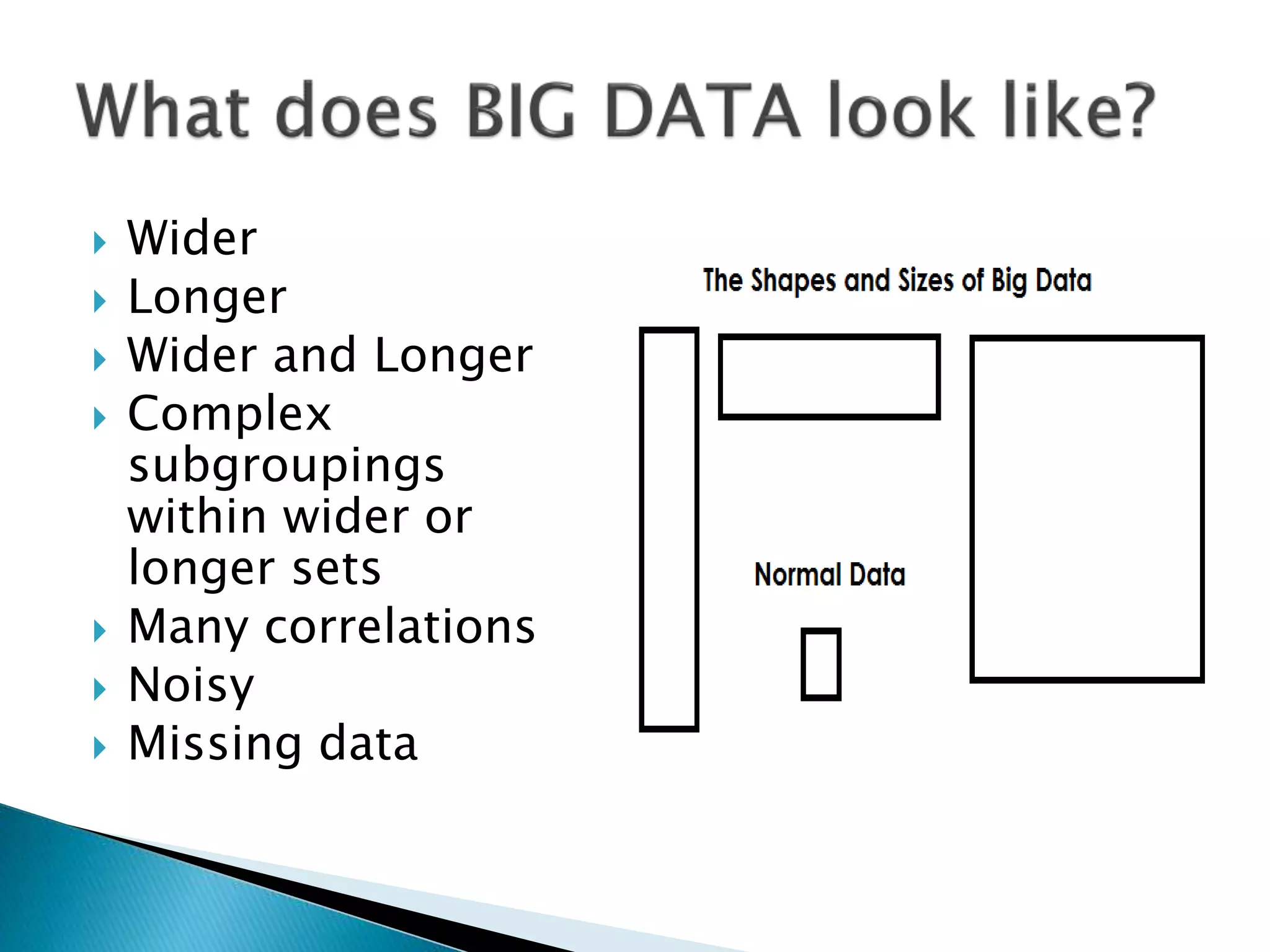
Wider Longer Wider and Longer Complex subgroupings within wider or longer sets Many correlations Noisy Missing data
5.
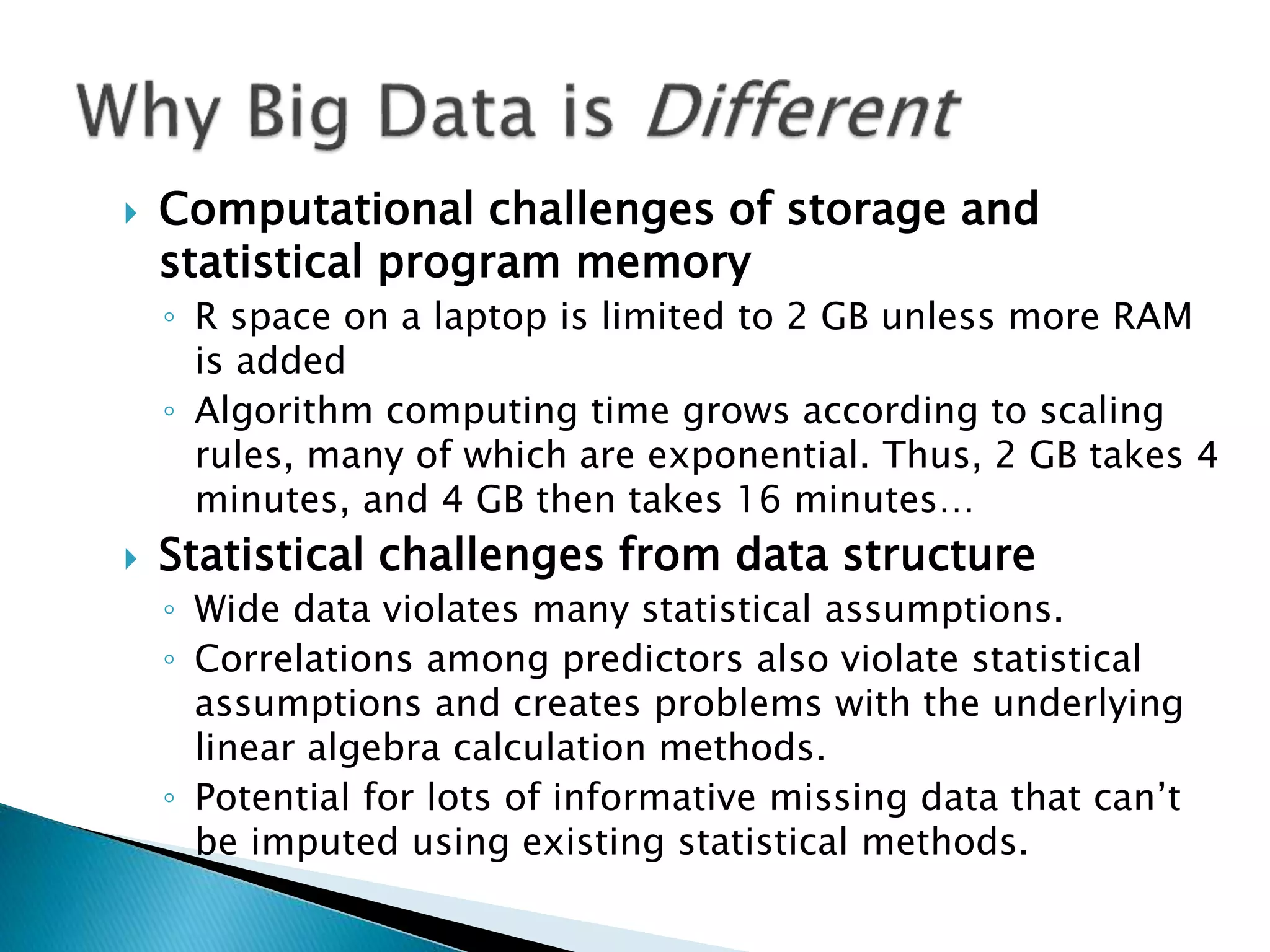
Computational challengesof storage and statistical program memory ◦ R space on a laptop is limited to 2 GB unless more RAM is added ◦ Algorithm computing time grows according to scaling rules, many of which are exponential. Thus, 2 GB takes 4 minutes, and 4 GB then takes 16 minutes… Statistical challenges from data structure ◦ Wide data violates many statistical assumptions. ◦ Correlations among predictors also violate statistical assumptions and creates problems with the underlying linear algebra calculation methods. ◦ Potential for lots of informative missing data that can’t be imputed using existing statistical methods.
6.
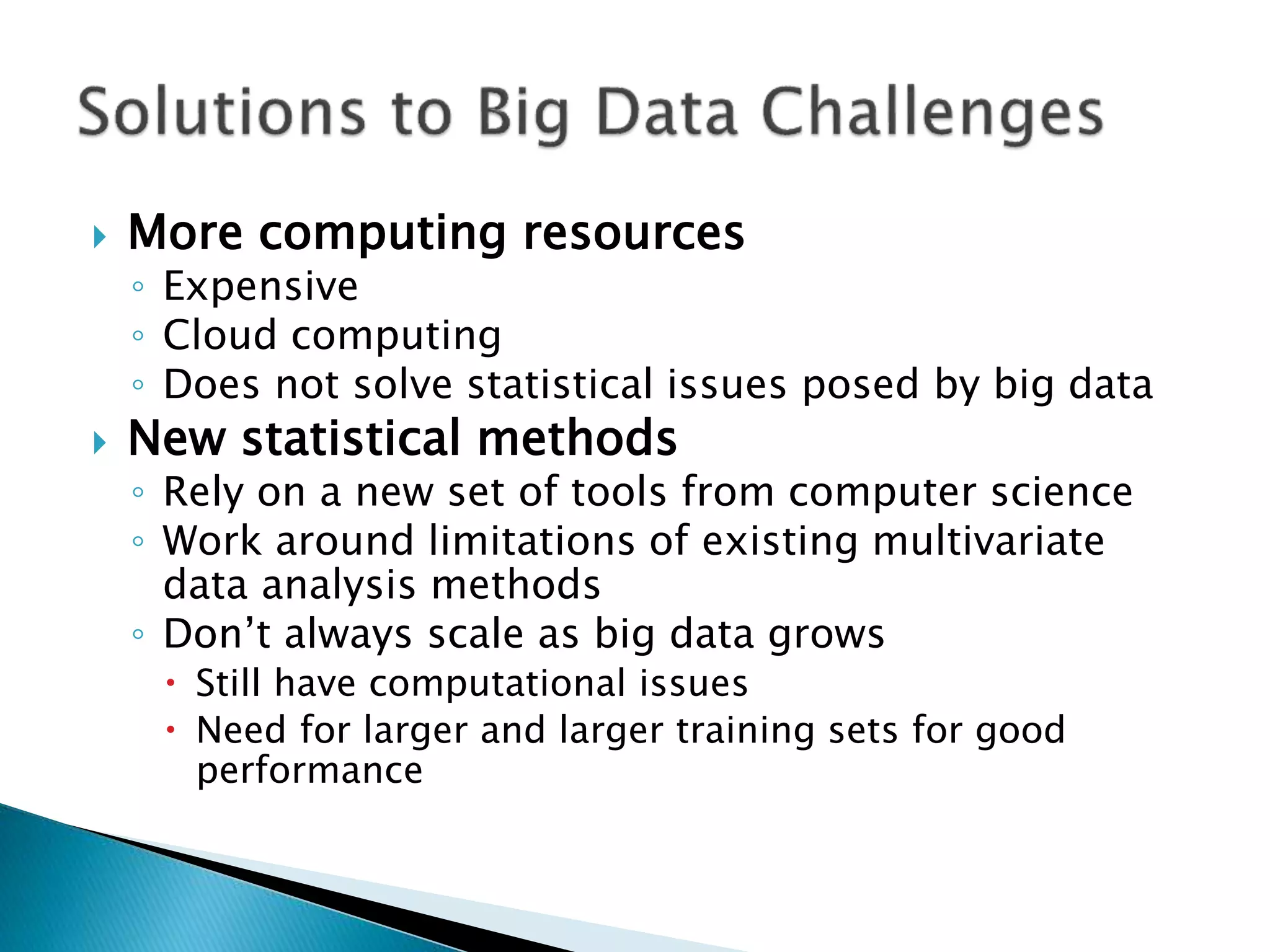
More computingresources ◦ Expensive ◦ Cloud computing ◦ Does not solve statistical issues posed by big data New statistical methods ◦ Rely on a new set of tools from computer science ◦ Work around limitations of existing multivariate data analysis methods ◦ Don’t always scale as big data grows Still have computational issues Need for larger and larger training sets for good performance
7.
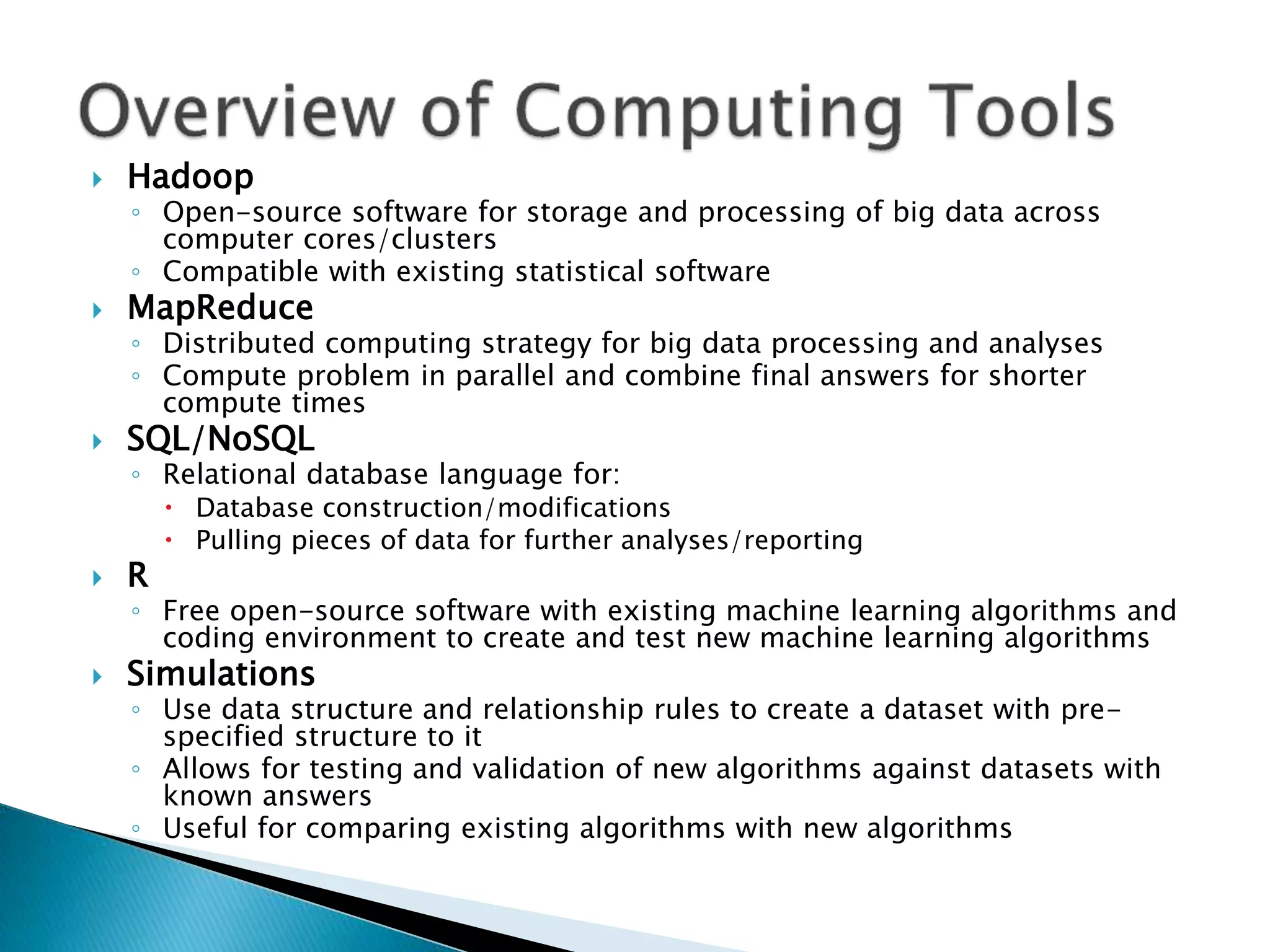
Hadoop ◦ Open-sourcesoftware for storage and processing of big data across computer cores/clusters ◦ Compatible with existing statistical software MapReduce ◦ Distributed computing strategy for big data processing and analyses ◦ Compute problem in parallel and combine final answers for shorter compute times SQL/NoSQL ◦ Relational database language for: Database construction/modifications Pulling pieces of data for further analyses/reporting R ◦ Free open-source software with existing machine learning algorithms and coding environment to create and test new machine learning algorithms Simulations ◦ Use data structure and relationship rules to create a dataset with pre- specified structure to it ◦ Allows for testing and validation of new algorithms against datasets with known answers ◦ Useful for comparing existing algorithms with new algorithms
8.
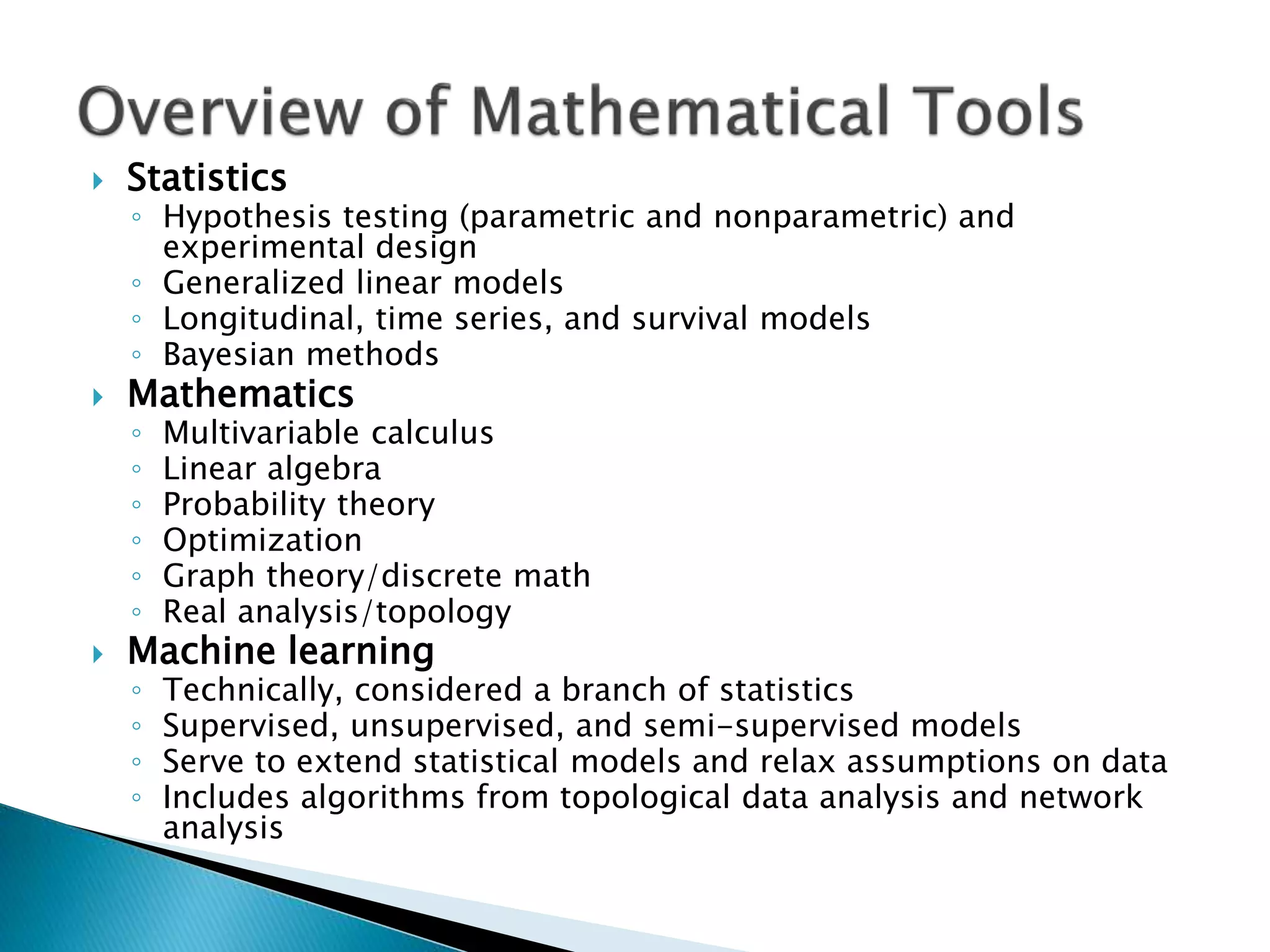
Statistics ◦ Hypothesistesting (parametric and nonparametric) and experimental design ◦ Generalized linear models ◦ Longitudinal, time series, and survival models ◦ Bayesian methods Mathematics ◦ Multivariable calculus ◦ Linear algebra ◦ Probability theory ◦ Optimization ◦ Graph theory/discrete math ◦ Real analysis/topology Machine learning ◦ Technically, considered a branch of statistics ◦ Supervised, unsupervised, and semi-supervised models ◦ Serve to extend statistical models and relax assumptions on data ◦ Includes algorithms from topological data analysis and network analysis
10.
A professionalwho blends several different areas of expertise to draw insights from disparate data sources (particularly big data) such that inference can be made about specific problems/decisions within the field of application Data science is a blend of statistical, machine learning, computer science, mathematical, and domain knowledge to leverage data for decision-making in that domain (business, medical, social media…).
11.
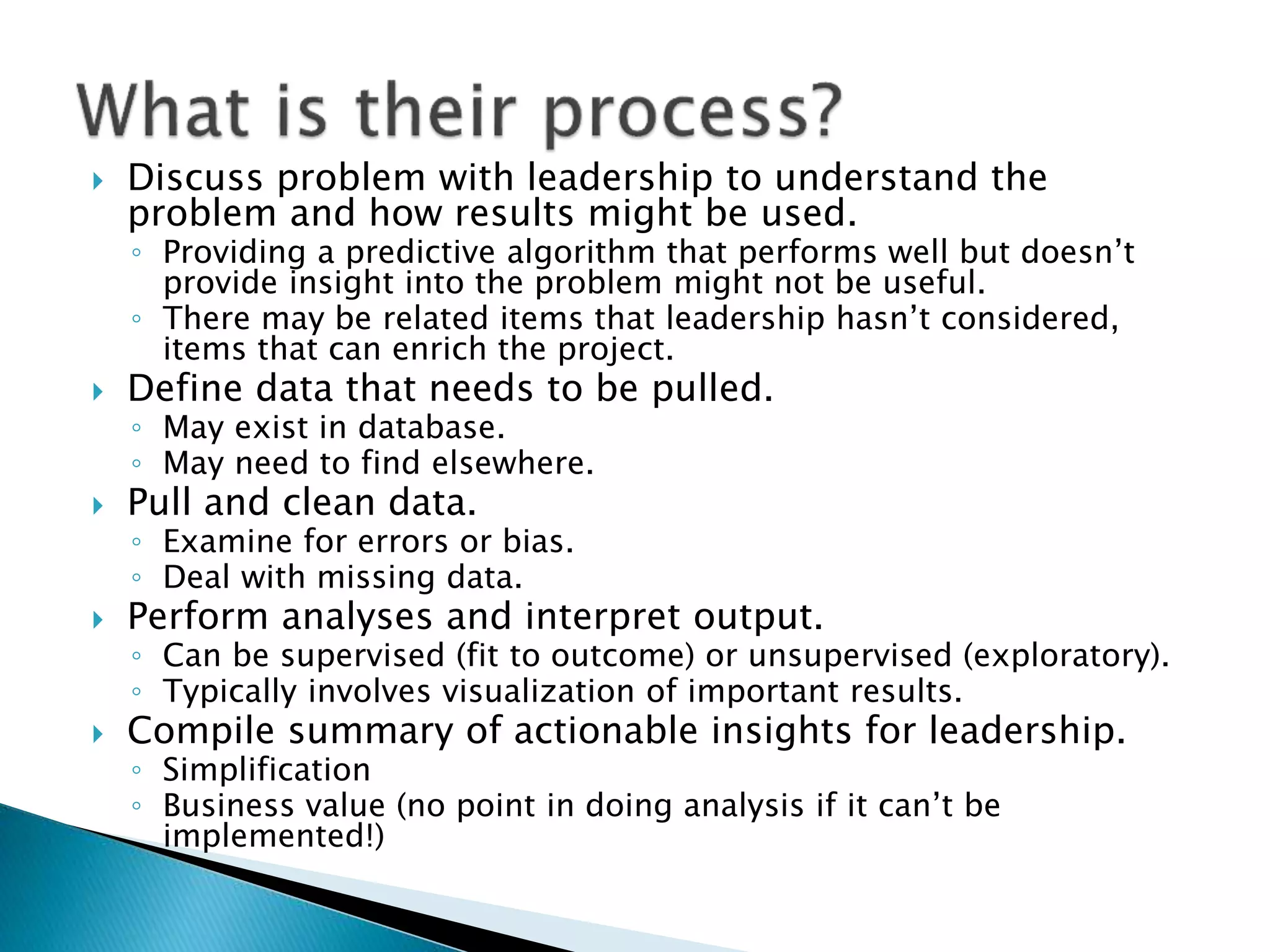
Discuss problemwith leadership to understand the problem and how results might be used. ◦ Providing a predictive algorithm that performs well but doesn’t provide insight into the problem might not be useful. ◦ There may be related items that leadership hasn’t considered, items that can enrich the project. Define data that needs to be pulled. ◦ May exist in database. ◦ May need to find elsewhere. Pull and clean data. ◦ Examine for errors or bias. ◦ Deal with missing data. Perform analyses and interpret output. ◦ Can be supervised (fit to outcome) or unsupervised (exploratory). ◦ Typically involves visualization of important results. Compile summary of actionable insights for leadership. ◦ Simplification ◦ Business value (no point in doing analysis if it can’t be implemented!)
12.
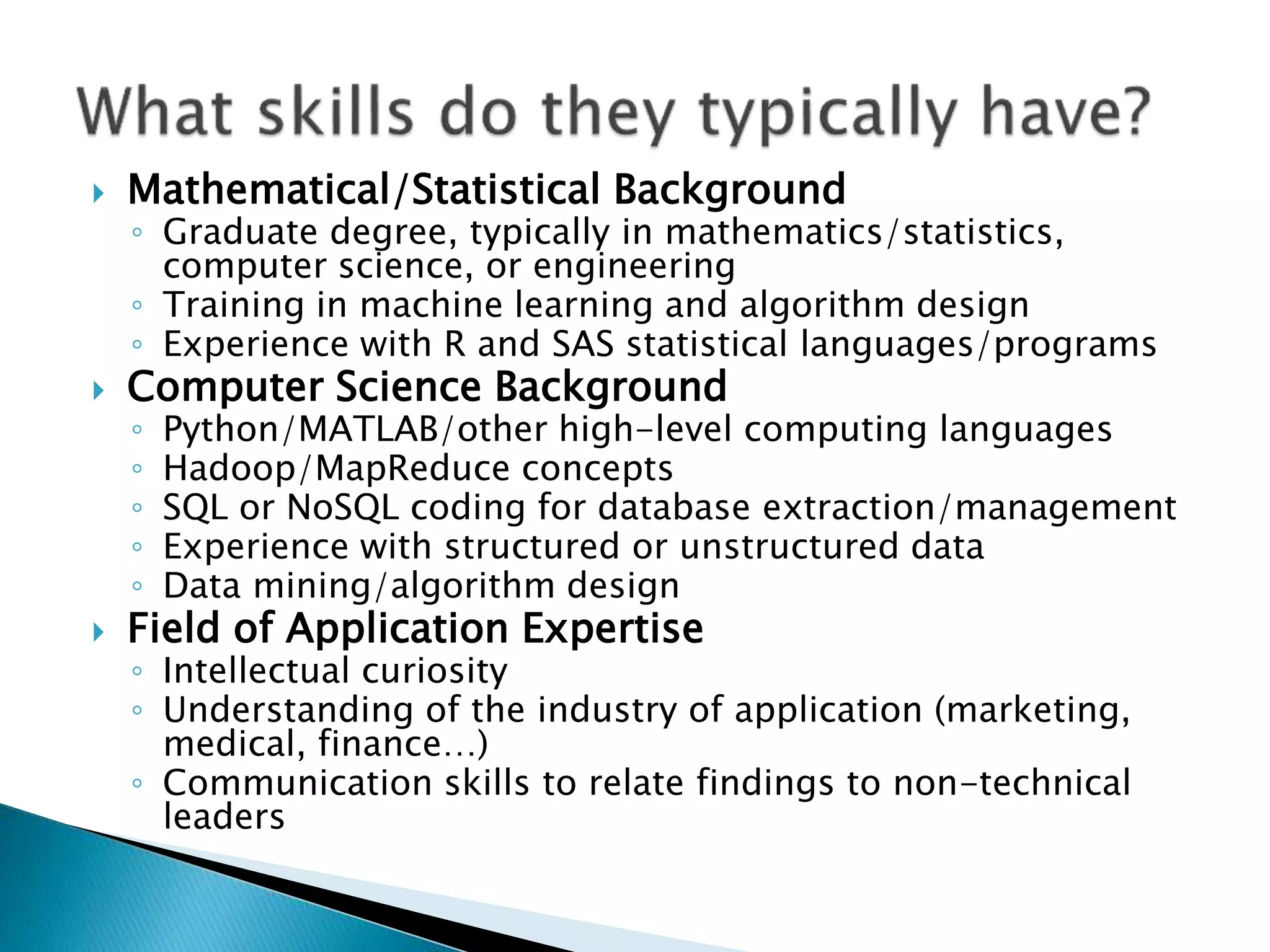
Mathematical/Statistical Background ◦Graduate degree, typically in mathematics/statistics, computer science, or engineering ◦ Training in machine learning and algorithm design ◦ Experience with R and SAS statistical languages/programs Computer Science Background ◦ Python/MATLAB/other high-level computing languages ◦ Hadoop/MapReduce concepts ◦ SQL or NoSQL coding for database extraction/management ◦ Experience with structured or unstructured data ◦ Data mining/algorithm design Field of Application Expertise ◦ Intellectual curiosity ◦ Understanding of the industry of application (marketing, medical, finance…) ◦ Communication skills to relate findings to non-technical leaders
13.
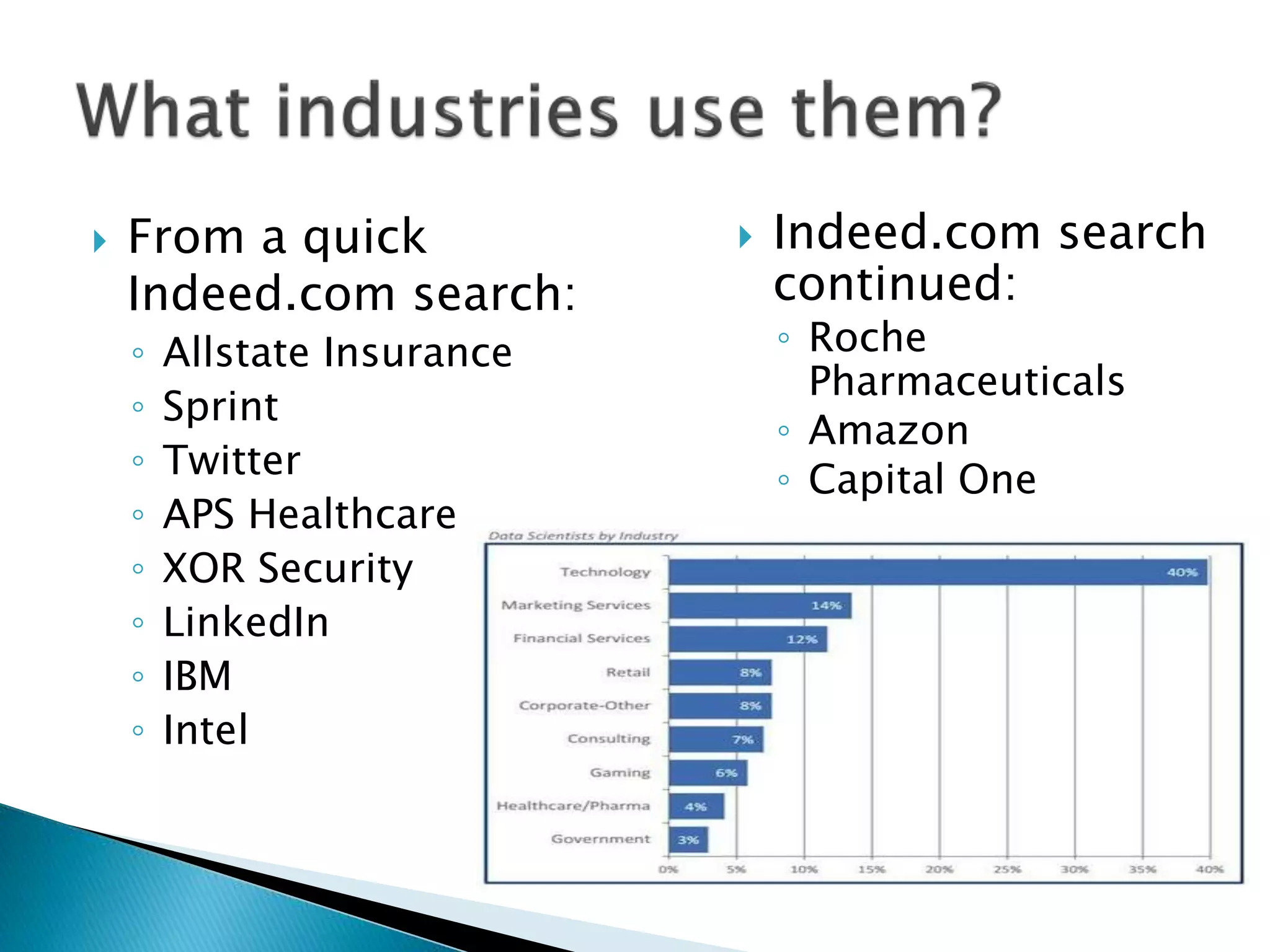
From aquick Indeed.com search: ◦ Allstate Insurance ◦ Sprint ◦ Twitter ◦ APS Healthcare ◦ XOR Security ◦ LinkedIn ◦ IBM ◦ Intel Indeed.com search continued: ◦ Roche Pharmaceuticals ◦ Amazon ◦ Capital One
14.
According toNewVantage and others: ◦ 2016 revenue gained from data science is estimated at $130.1 billion. ◦ This is expected to grow to $203 billion by 2020. Individual company results vary according to: ◦ Team talent and expertise ◦ Data collected (and quality of data) ◦ Competitor strengths in data science. Current and projected shortages of those with analytics talent will impact the market. ◦ Hubs of data science are emerging outside California— Boston, New York, Austin, Chicago, Jacksonville, Tampa, Charlotte, Atlanta… ◦ Across industries—healthcare, tech, finance, energy…
Editor's Notes
#4 http://www.forbes.com/sites/gilpress/2014/09/03/12-big-data-definitions-whats-yours/ Bryant, R., Katz, R. H., & Lazowska, E. D. (2008). Big-data computing: creating revolutionary breakthroughs in commerce, science and society. Lohr, S. (2012). How big data became so big. New York Times, 11. Cuzzocrea, A., Song, I. Y., & Davis, K. C. (2011, October). Analytics over large-scale multidimensional data: the big data revolution!. In Proceedings of the ACM 14th international workshop on Data Warehousing and OLAP (pp. 101-104). ACM. Mayer-Schönberger, V., & Cukier, K. (2013). Big data: A revolution that will transform how we live, work, and think. Houghton Mifflin Harcourt. Brown, B., Chui, M., & Manyika, J. (2011). Are you ready for the era of ‘big data’. McKinsey Quarterly, 4, 24-35.
#6 Heidema, A. G., Boer, J. M., Nagelkerke, N., Mariman, E. C., & Feskens, E. J. (2006). The challenge for genetic epidemiologists: how to analyze large numbers of SNPs in relation to complex diseases. BMC genetics, 7(1), 23. Draper, N. R., Smith, H., & Pownell, E. (1966). Applied regression analysis (Vol. 3). New York: Wiley. Gopalkrishnan, V., Steier, D., Lewis, H., & Guszcza, J. (2012, August). Big data, big business: bridging the gap. In Proceedings of the 1st International Workshop on Big Data, Streams and Heterogeneous Source Mining: Algorithms, Systems, Programming Models and Applications (pp. 7-11). ACM.
#7 Bekkerman, R., Bilenko, M., & Langford, J. (Eds.). (2011). Scaling up machine learning: Parallel and distributed approaches. Cambridge University Press. Christopher K. Riesbeck. From conceptual analyzer to Direct Memory Access Parsing: an overview., chapter 8. Ellis Horwood Limited, 1986. M. W. Berry. Large-scale sparse singular value computations. The International Journal of Supercomputer Applications, 6(1):13–49, Spring, 1992. Caporaso, J. G., Baumgartner Jr, W. A., Kim, H., Lu, Z., Johnson, H. L., Medvedeva, O., ... & Hunter, L. (2006). Concept Recognition, Information Retrieval, and Machine Learning in Genomics Question-Answering. In TREC. Madden, S. (2012). From databases to big data. IEEE Internet Computing, 16(3), 4-6. Agrawal, D., Das, S., & El Abbadi, A. (2011, March). Big data and cloud computing: current state and future opportunities. In Proceedings of the 14th International Conference on Extending Database Technology (pp. 530-533). ACM.