More Related Content
introduction to database systems Chapter01.ppt chapter 01 introduction to Database.ppt Introduction to Database management system and characteristics Ch01 database-conceptsppt4207 1 introduction databases and database users Introduction: Databases and Database Users Similar to Ch01-Introduction Databases and Database Users.ppt
Basic to Advance DBMS BOOK for School and Graduate Student Chapter01 database system in computer.ppt Foundation of database systems -Database Systems.ppt L01- Databases & Database Users ppt for DBMS DBMS Introduction: Database Users and Databases Chapter 1 data base system erd engineer .pdf Introduction to Database and database users.pptx FDS (Sixth Edition) | C1 | Databases and Database Users Database Systems - Introduction to Database Systems Module 1_Overview of Database Management System Recently uploaded
Buy Verified PayPal Account A Complete Guide to Online Finance.pdf How to Open an Etsy Shop stores bulk.pdf Marketing Localization for the Korean Market: Case Study by Alconost Thermal Energy International Presentation - 2025 AGM Buy LinkedIn Connections _ Grow Your Network Fast.pdf How Do I Buy Verified Wise Accounts for Personal Use.docx Joseph Heiman New Jersey - Passionate About Finance Brief Two Image and Anchoring Text Apply Localization success stories by Alconost 2025 Poultry Farm Investment Proposal in Minjar Woreda, Southern Shewa Zone, Amhar... Lion One Corporate Presentation November 2025 Revised How And Where To Buy LinkedIn Accounts_ New 2025 ... (1).pdf Lion One Corporate Presentation November 2025 Top 5 Places to Buy Aged LinkedIn Accounts and Should ....pdf Shark Tank Project Presentation Sample 1.pptx Digital Marketing Healthcare Case Study Knock Sugar The Code On Social Security and their application How To Safely Buy Instagram Accounts In 2025.pdf Blood Group ABO, Rh and others System best and easy lecture for Nursing, Medi... How can I buy a verified Binance account_.pdf Ch01-Introduction Databases and Database Users.ppt
- 1.
- 2.
Copyright © 2007Ramez Elmasri and Shamkant B. Navathe Chapter 1 Introduction: Databases and Database Users - 3.
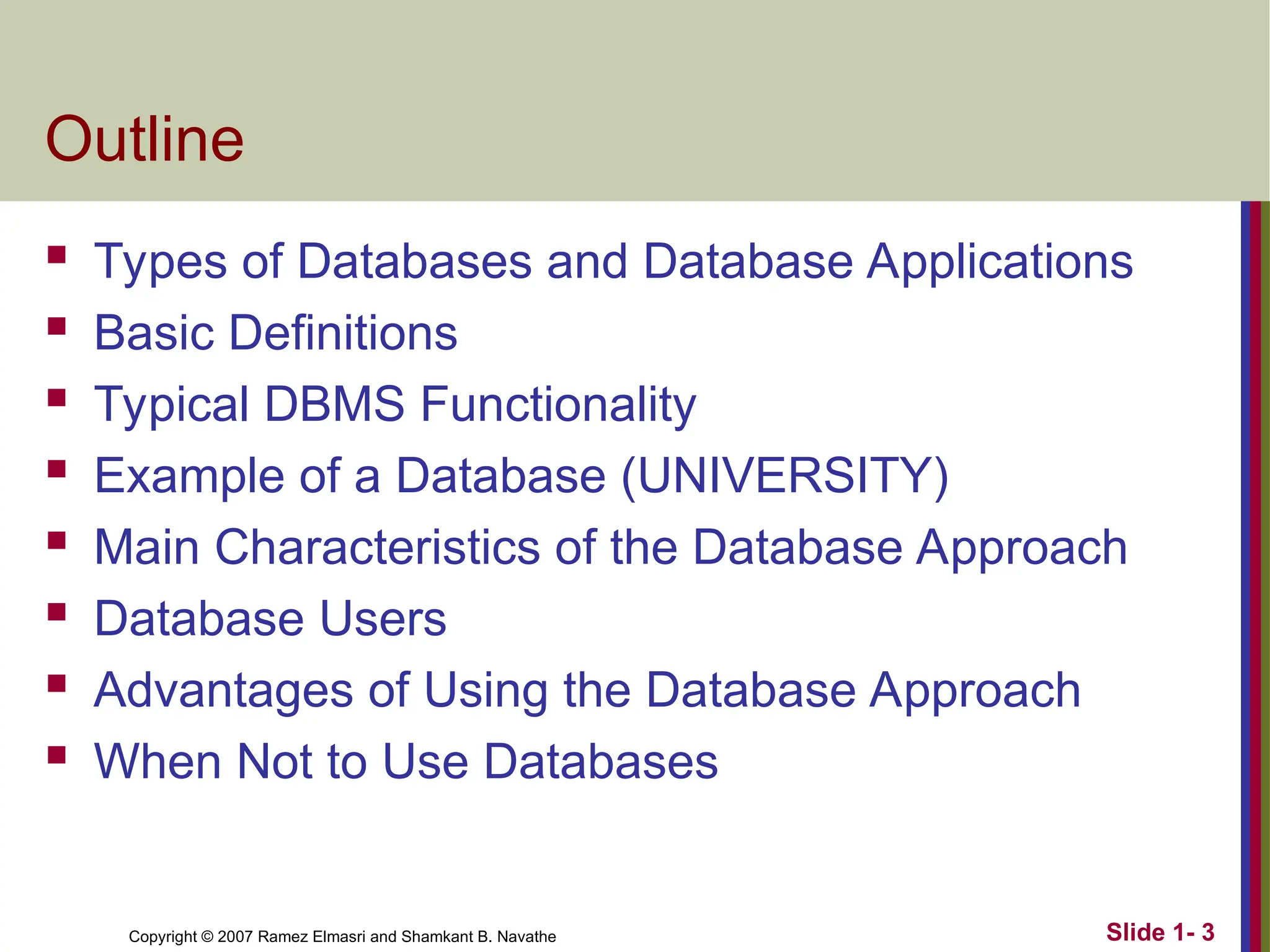
Slide 1- 3 Copyright© 2007 Ramez Elmasri and Shamkant B. Navathe Outline Types of Databases and Database Applications Basic Definitions Typical DBMS Functionality Example of a Database (UNIVERSITY) Main Characteristics of the Database Approach Database Users Advantages of Using the Database Approach When Not to Use Databases - 4.
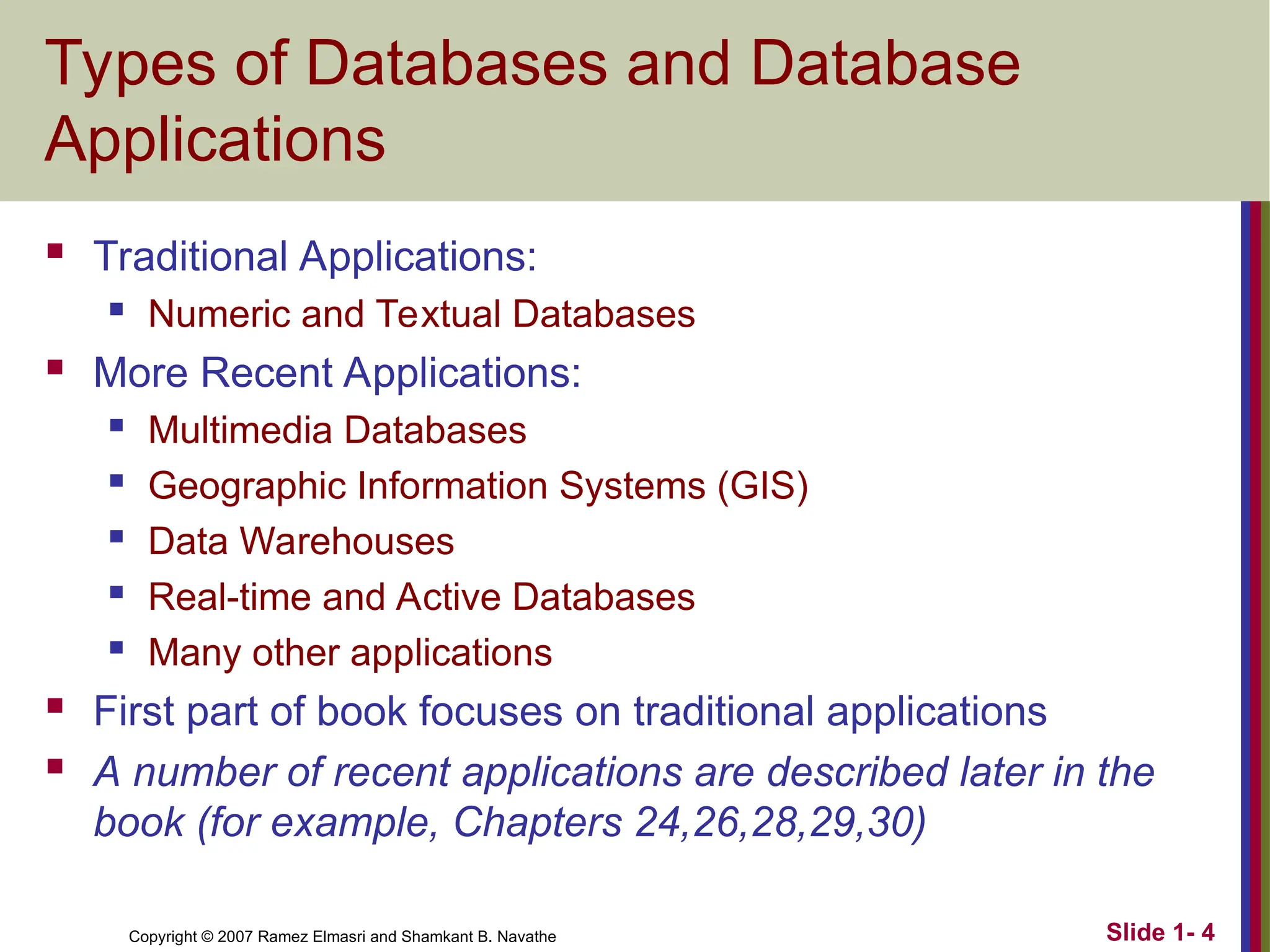
Slide 1- 4 Copyright© 2007 Ramez Elmasri and Shamkant B. Navathe Types of Databases and Database Applications Traditional Applications: Numeric and Textual Databases More Recent Applications: Multimedia Databases Geographic Information Systems (GIS) Data Warehouses Real-time and Active Databases Many other applications First part of book focuses on traditional applications A number of recent applications are described later in the book (for example, Chapters 24,26,28,29,30) - 5.
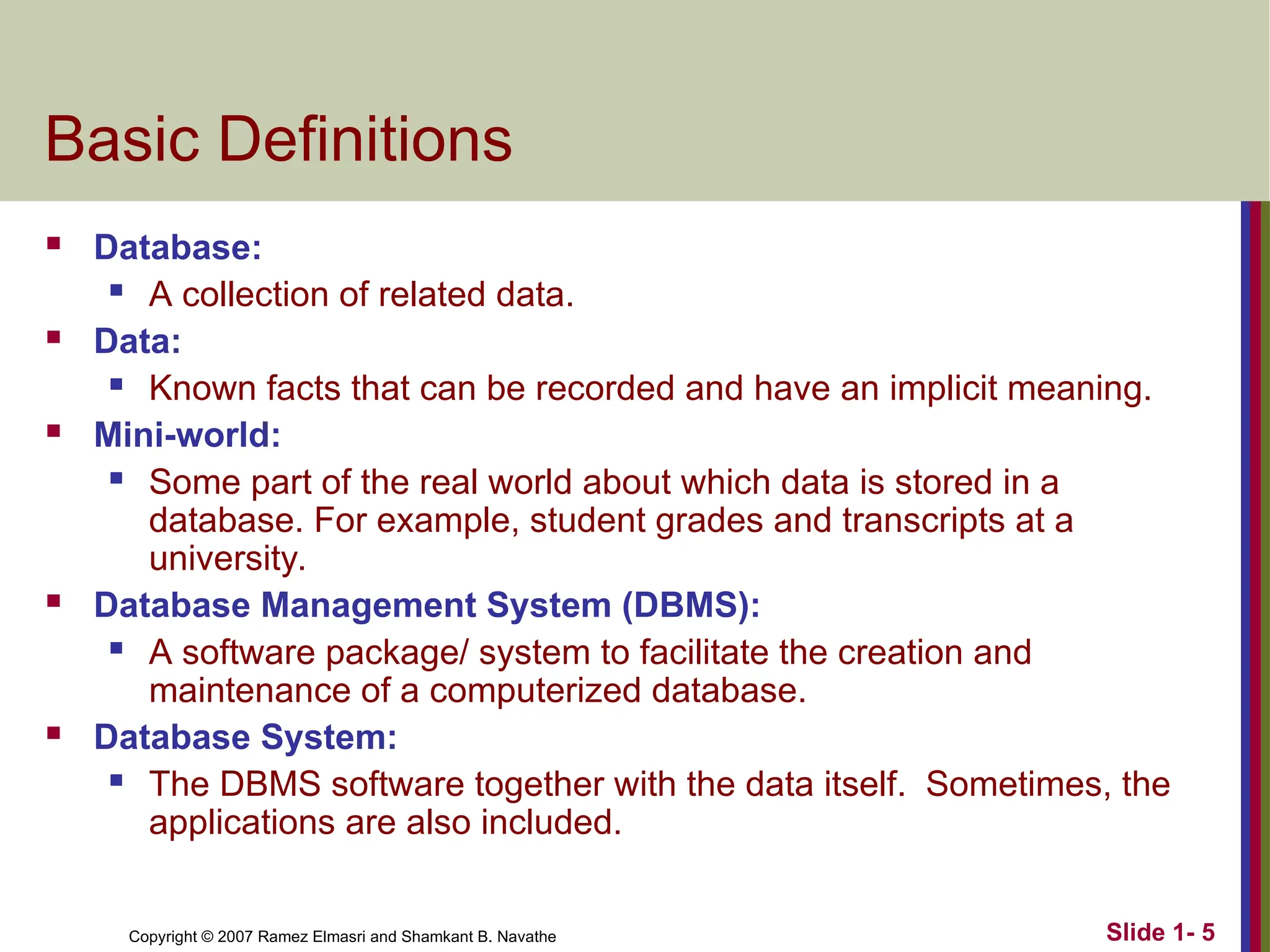
Slide 1- 5 Copyright© 2007 Ramez Elmasri and Shamkant B. Navathe Basic Definitions Database: A collection of related data. Data: Known facts that can be recorded and have an implicit meaning. Mini-world: Some part of the real world about which data is stored in a database. For example, student grades and transcripts at a university. Database Management System (DBMS): A software package/ system to facilitate the creation and maintenance of a computerized database. Database System: The DBMS software together with the data itself. Sometimes, the applications are also included. - 6.
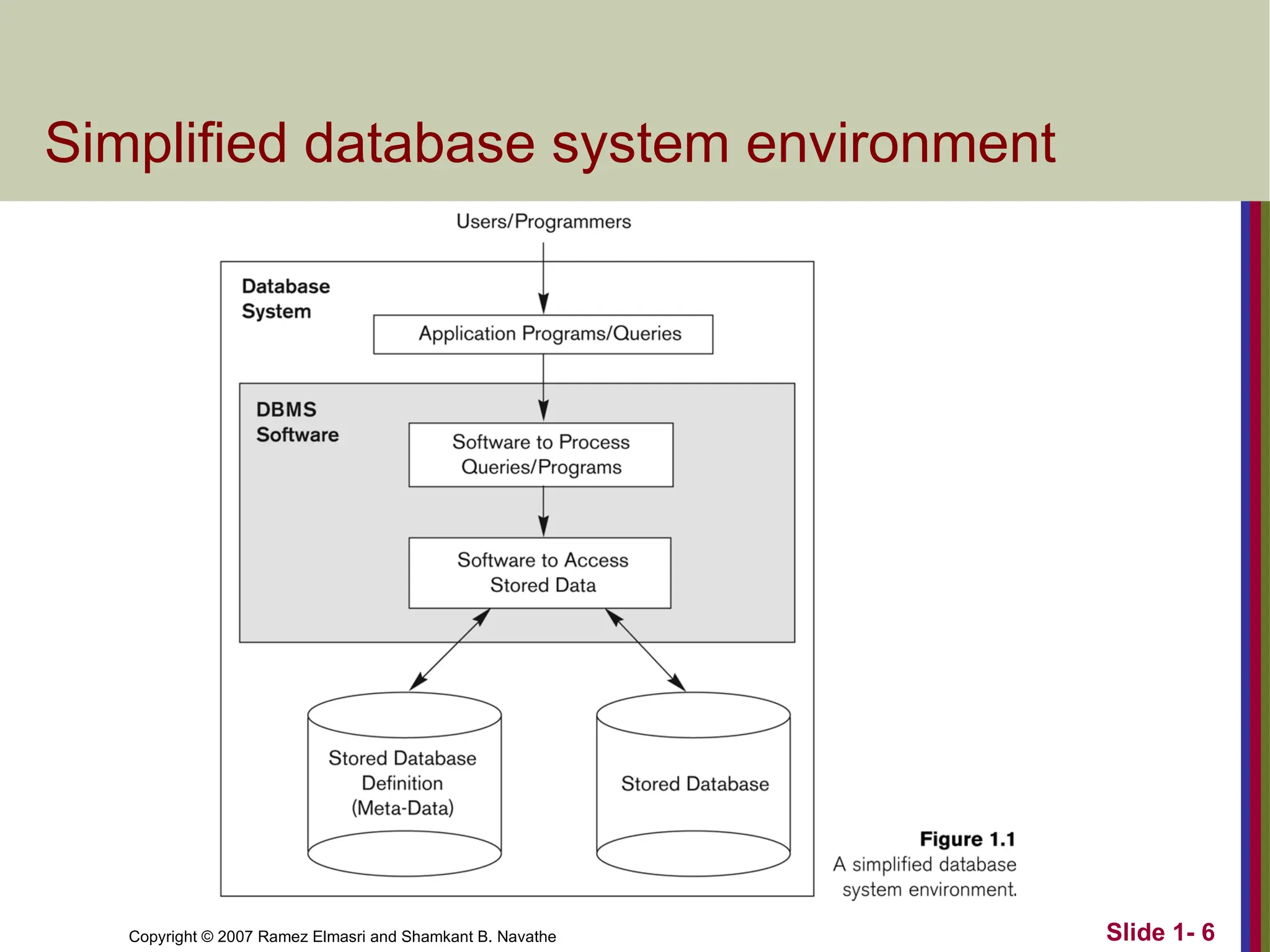
Slide 1- 6 Copyright© 2007 Ramez Elmasri and Shamkant B. Navathe Simplified database system environment - 7.
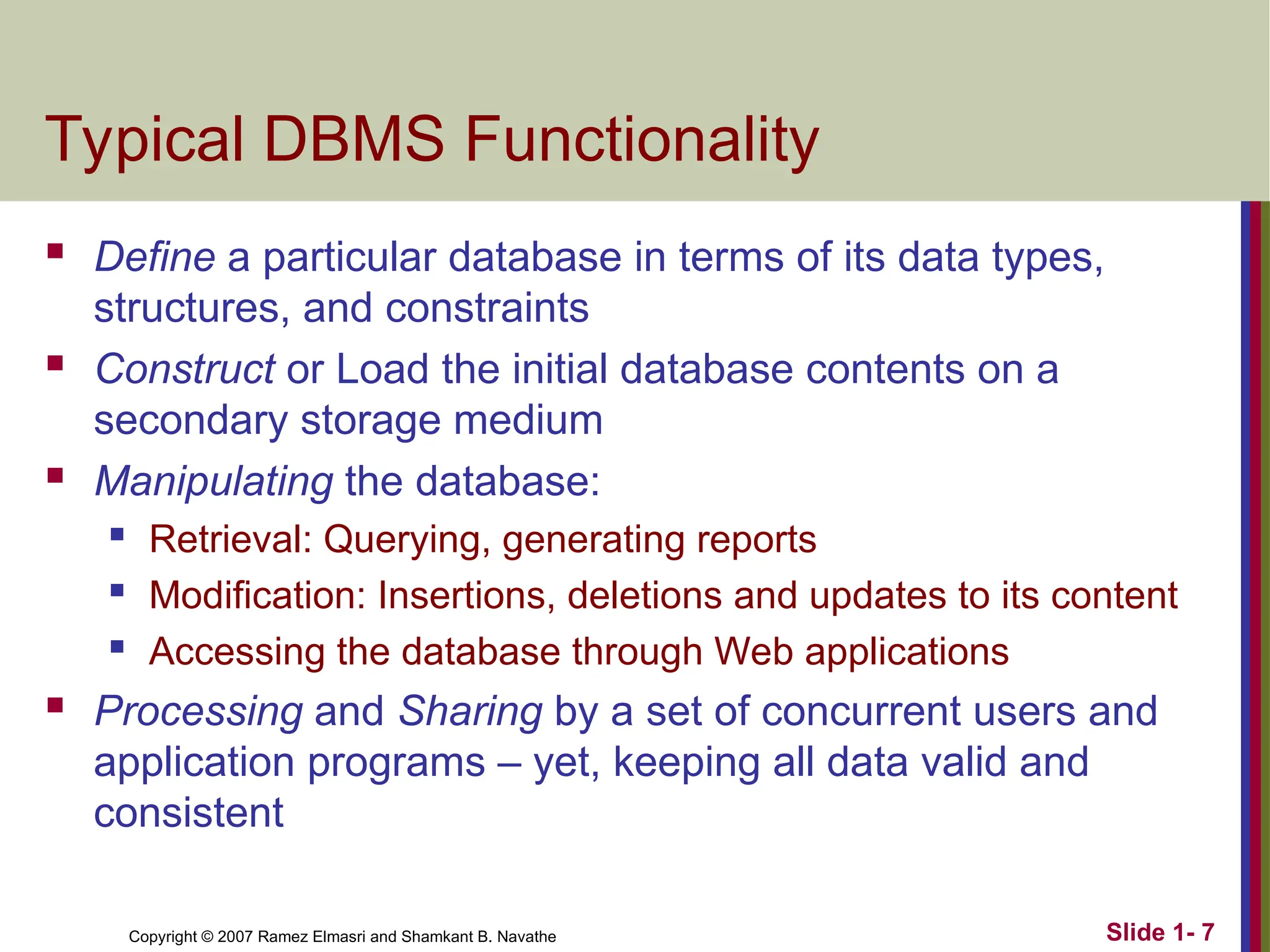
Slide 1- 7 Copyright© 2007 Ramez Elmasri and Shamkant B. Navathe Typical DBMS Functionality Define a particular database in terms of its data types, structures, and constraints Construct or Load the initial database contents on a secondary storage medium Manipulating the database: Retrieval: Querying, generating reports Modification: Insertions, deletions and updates to its content Accessing the database through Web applications Processing and Sharing by a set of concurrent users and application programs – yet, keeping all data valid and consistent - 8.
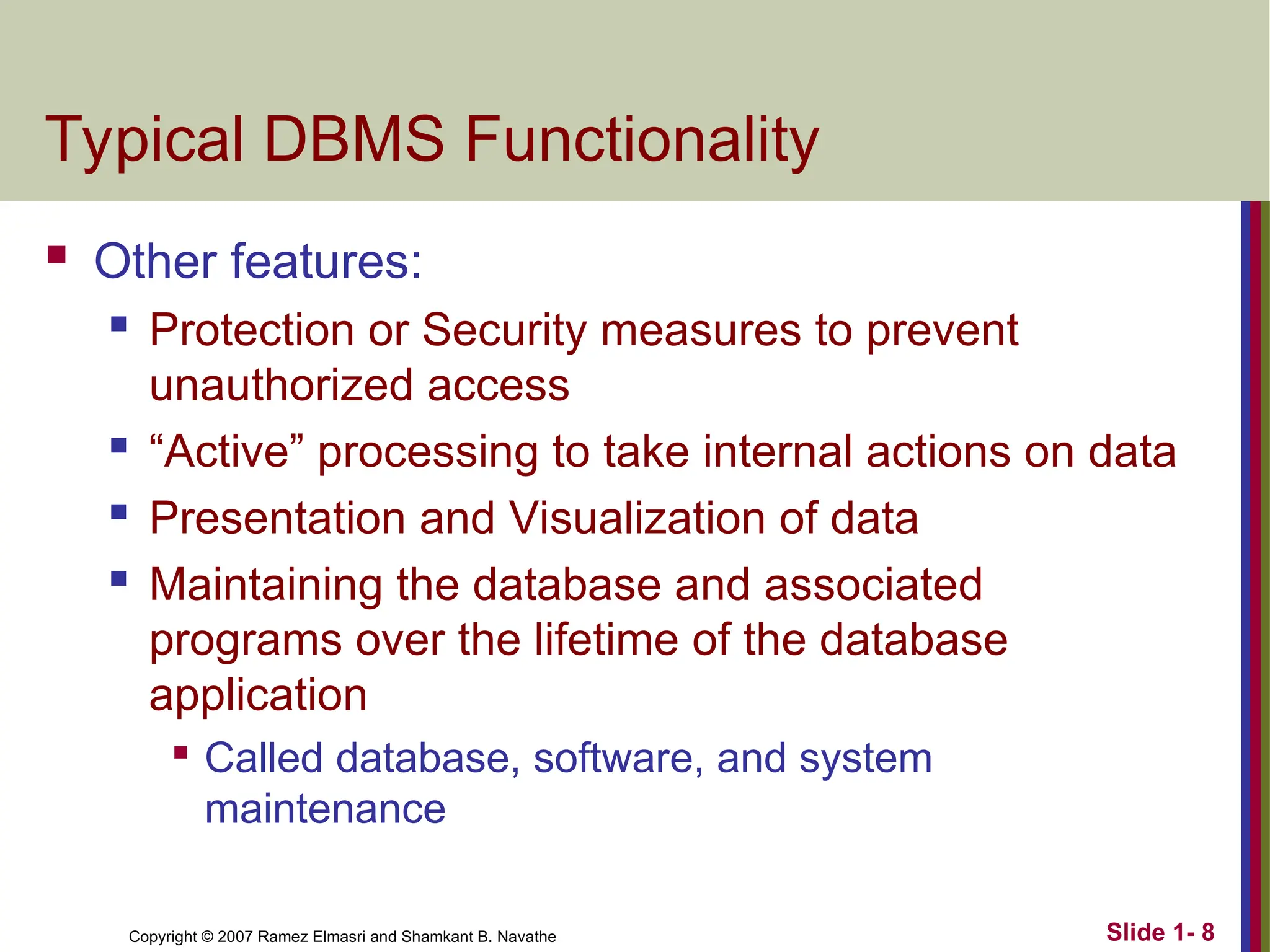
Slide 1- 8 Copyright© 2007 Ramez Elmasri and Shamkant B. Navathe Typical DBMS Functionality Other features: Protection or Security measures to prevent unauthorized access “Active” processing to take internal actions on data Presentation and Visualization of data Maintaining the database and associated programs over the lifetime of the database application Called database, software, and system maintenance - 9.
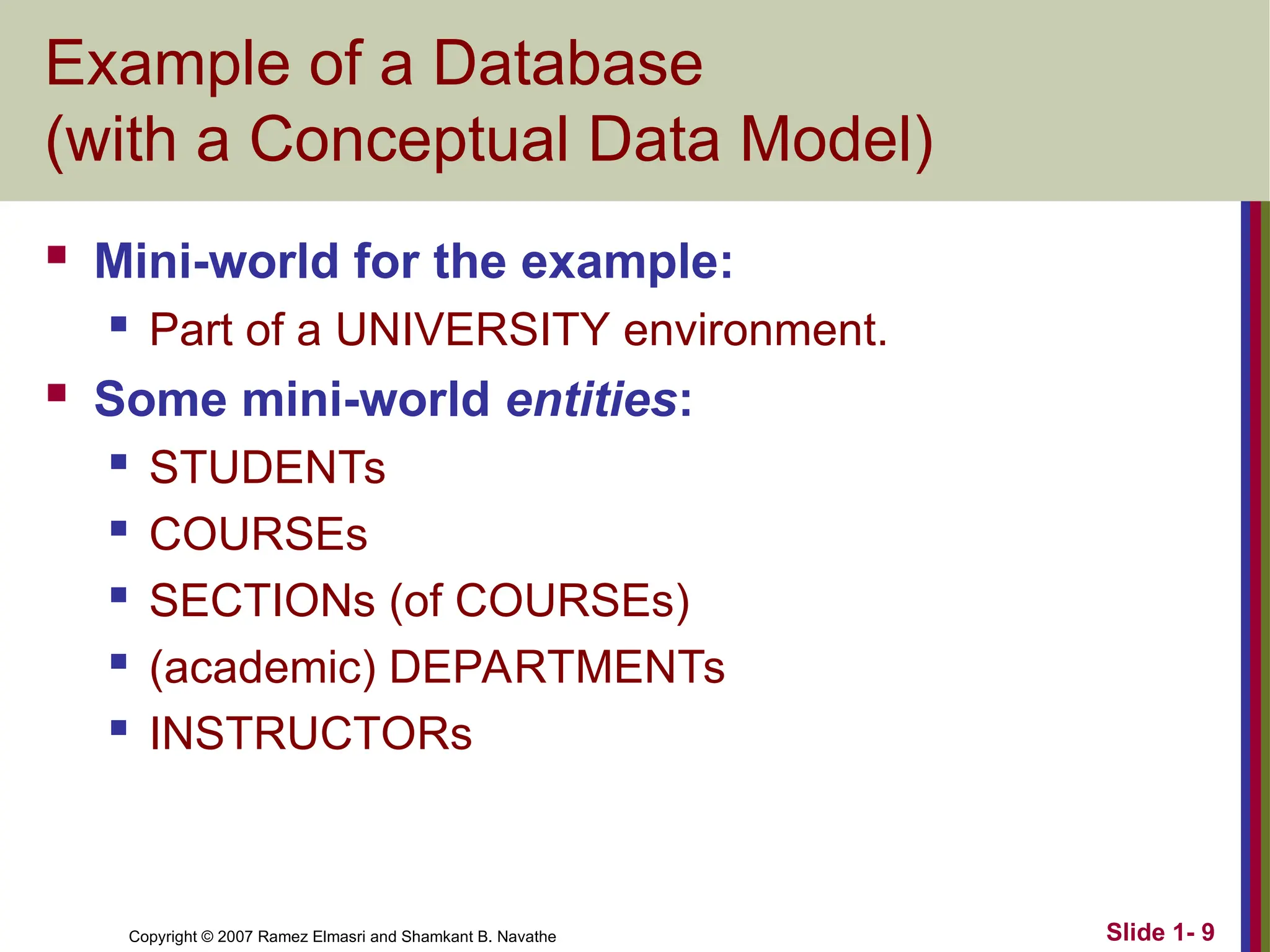
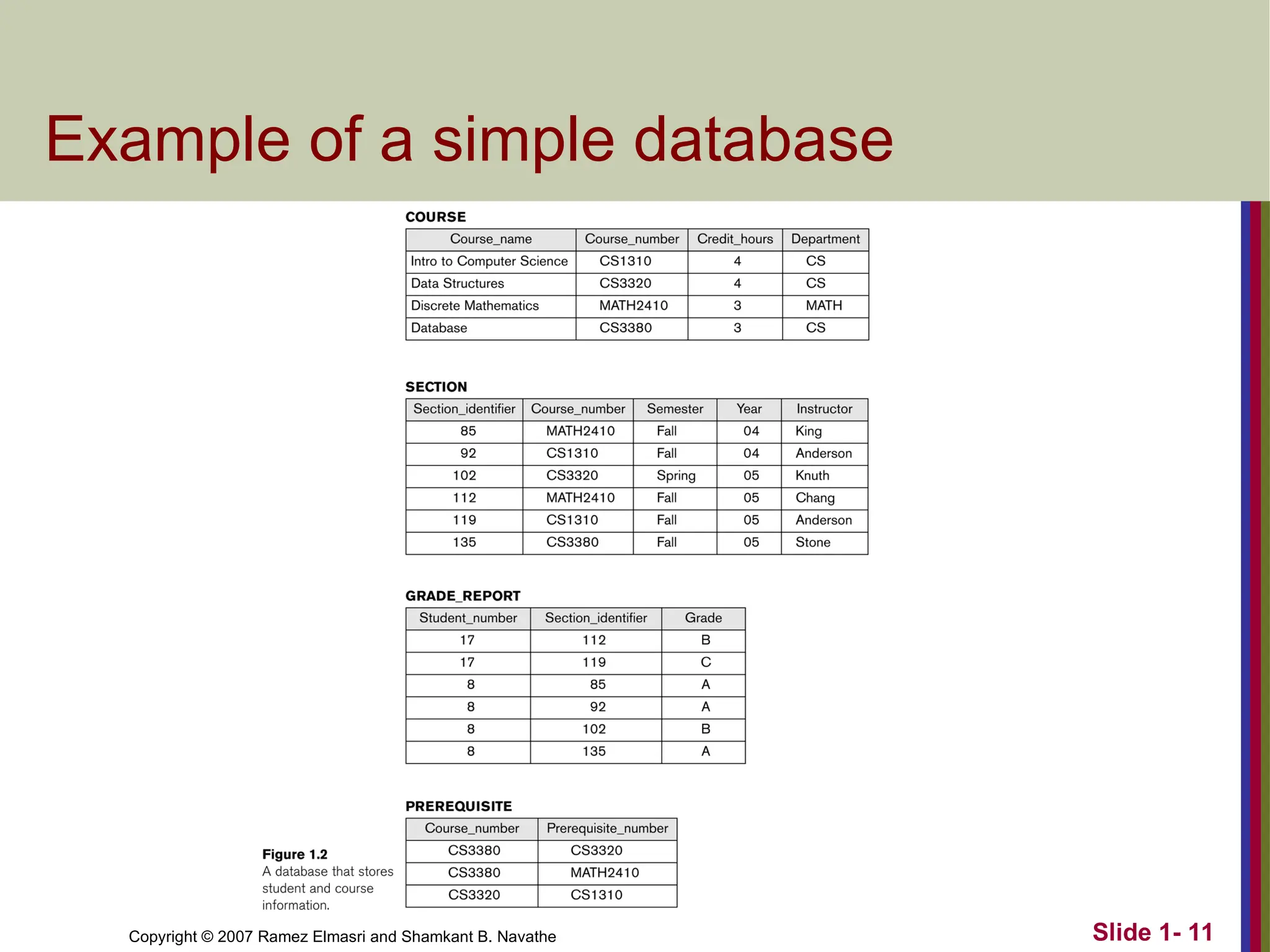
Slide 1- 9 Copyright© 2007 Ramez Elmasri and Shamkant B. Navathe Example of a Database (with a Conceptual Data Model) Mini-world for the example: Part of a UNIVERSITY environment. Some mini-world entities: STUDENTs COURSEs SECTIONs (of COURSEs) (academic) DEPARTMENTs INSTRUCTORs - 10.
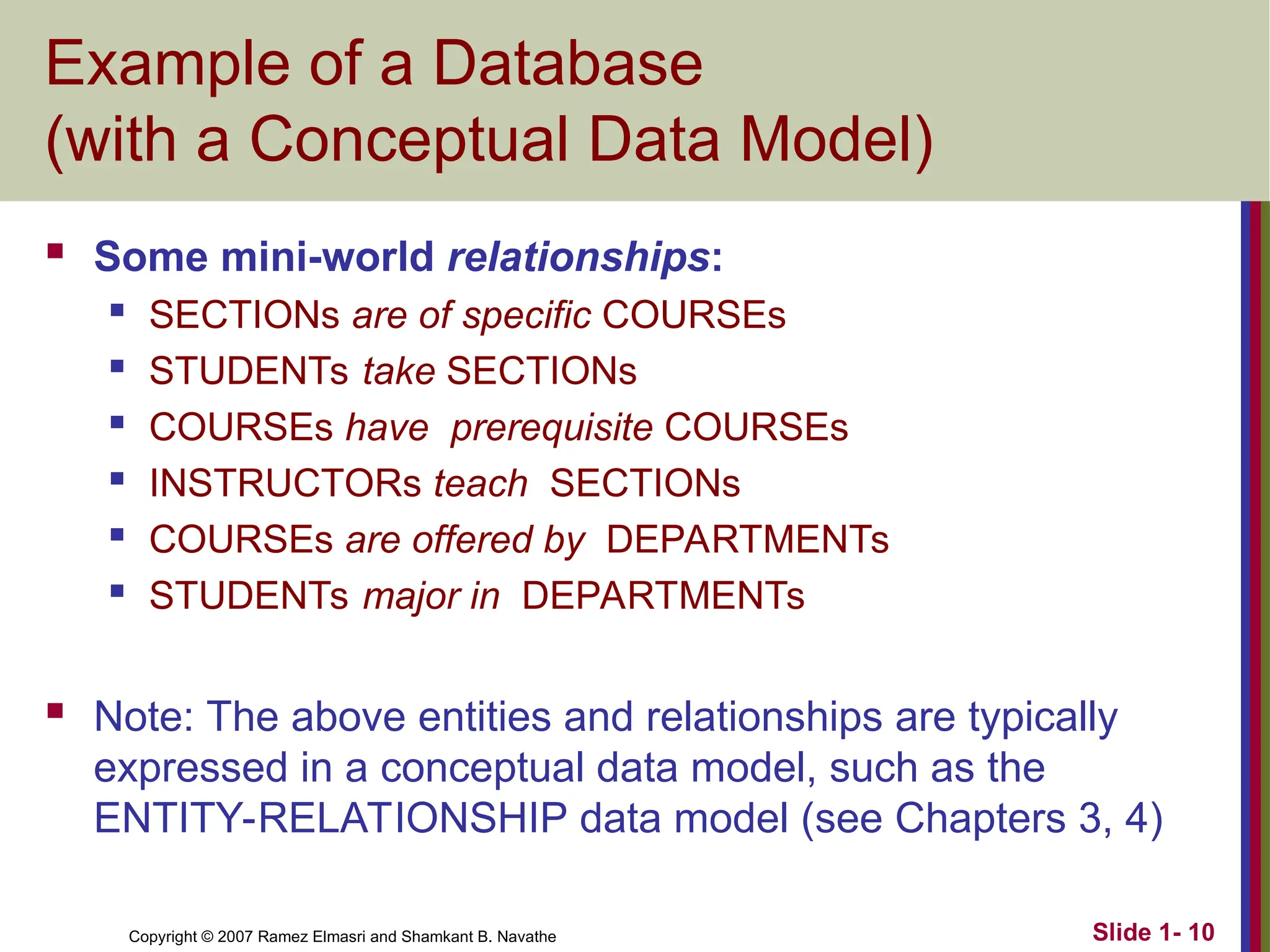
Slide 1- 10 Copyright© 2007 Ramez Elmasri and Shamkant B. Navathe Example of a Database (with a Conceptual Data Model) Some mini-world relationships: SECTIONs are of specific COURSEs STUDENTs take SECTIONs COURSEs have prerequisite COURSEs INSTRUCTORs teach SECTIONs COURSEs are offered by DEPARTMENTs STUDENTs major in DEPARTMENTs Note: The above entities and relationships are typically expressed in a conceptual data model, such as the ENTITY-RELATIONSHIP data model (see Chapters 3, 4) - 11.
- 12.
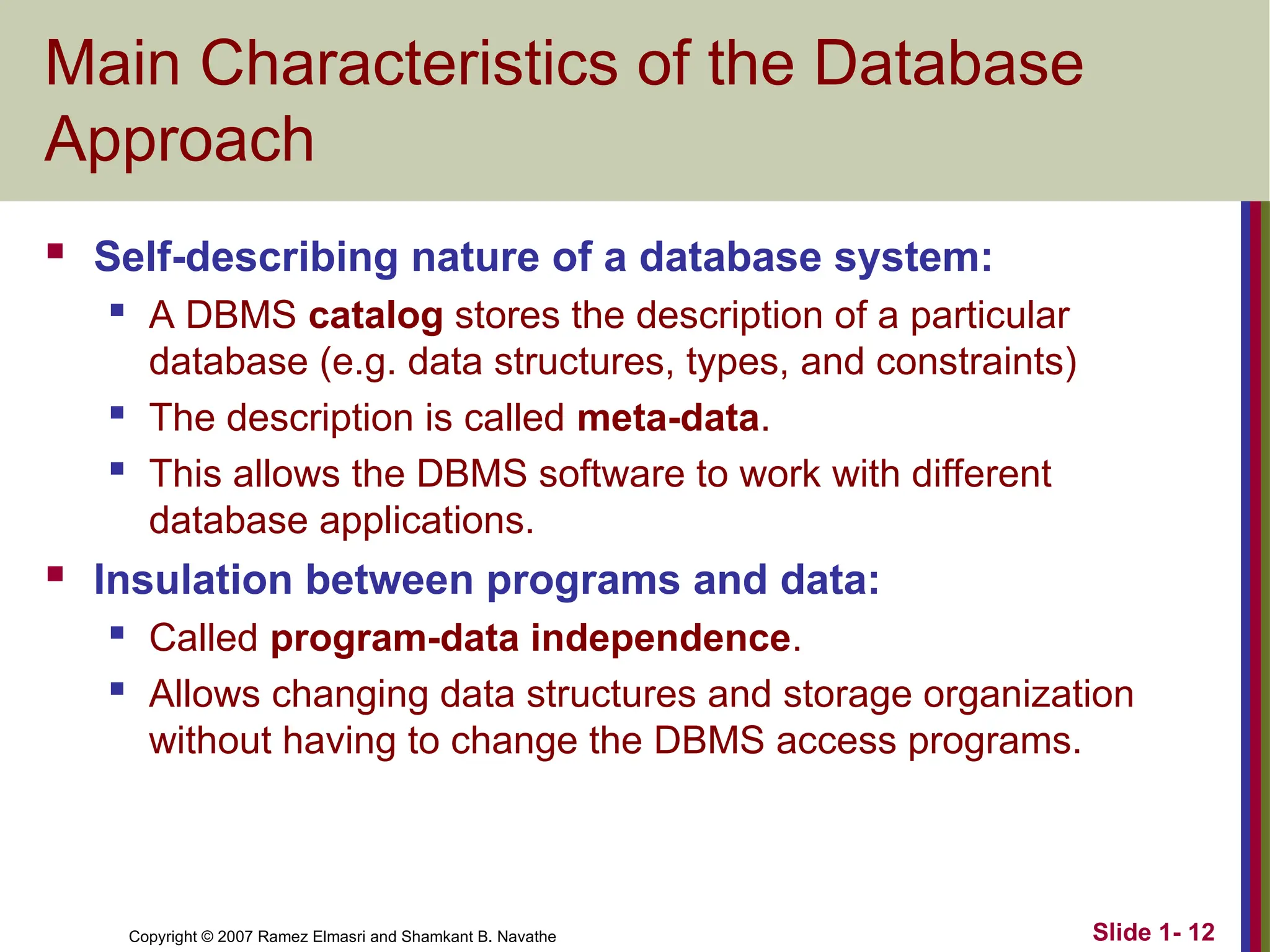
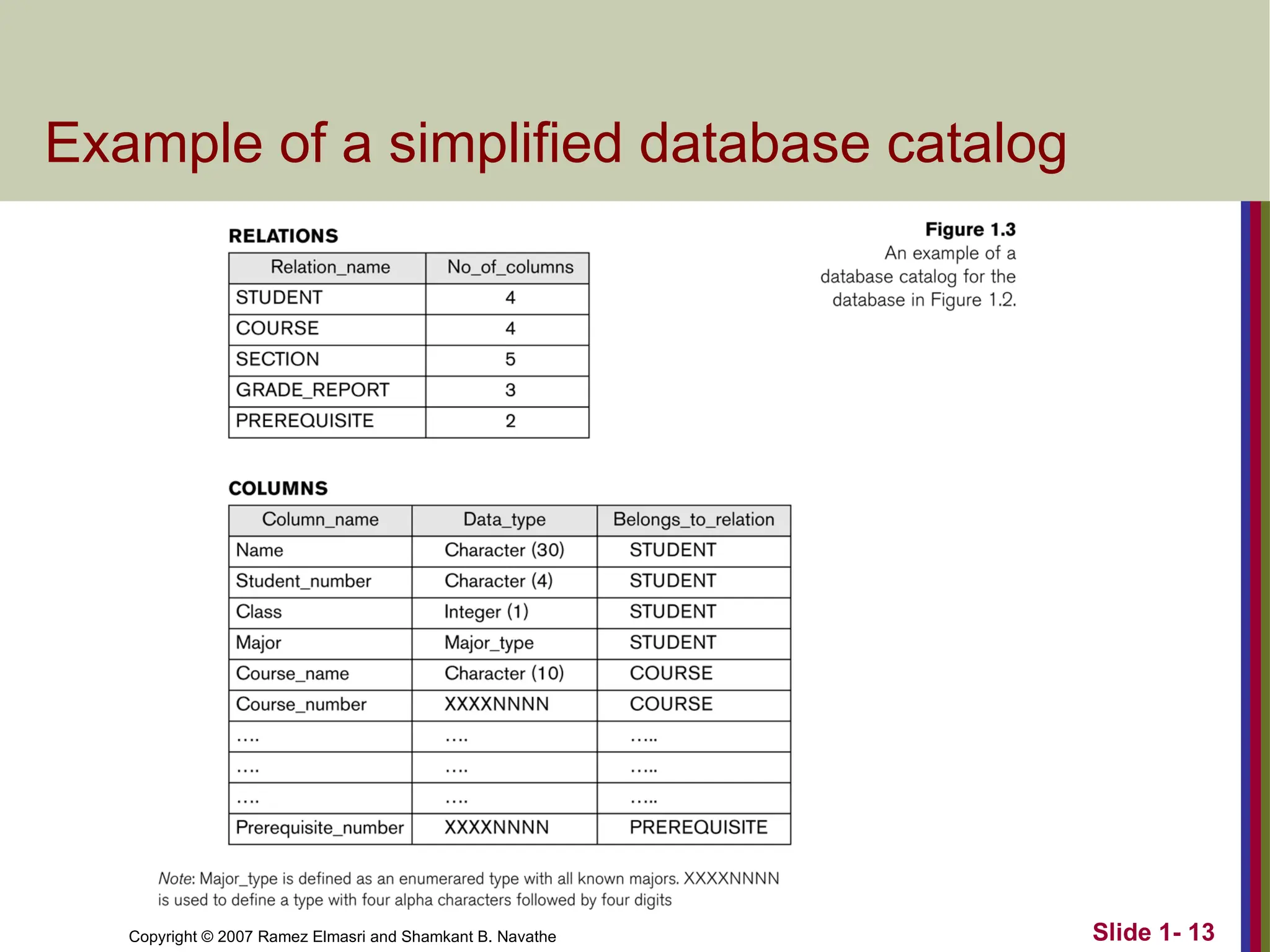
Slide 1- 12 Copyright© 2007 Ramez Elmasri and Shamkant B. Navathe Main Characteristics of the Database Approach Self-describing nature of a database system: A DBMS catalog stores the description of a particular database (e.g. data structures, types, and constraints) The description is called meta-data. This allows the DBMS software to work with different database applications. Insulation between programs and data: Called program-data independence. Allows changing data structures and storage organization without having to change the DBMS access programs. - 13.
Slide 1- 13 Copyright© 2007 Ramez Elmasri and Shamkant B. Navathe Example of a simplified database catalog - 14.
Slide 1- 14 Copyright© 2007 Ramez Elmasri and Shamkant B. Navathe Main Characteristics of the Database Approach (continued) Data Abstraction: A data model is used to hide storage details and present the users with a conceptual view of the database. Programs refer to the data model constructs rather than data storage details Support of multiple views of the data: Each user may see a different view of the database, which describes only the data of interest to that user. - 15.
Slide 1- 15 Copyright© 2007 Ramez Elmasri and Shamkant B. Navathe Main Characteristics of the Database Approach (continued) Sharing of data and multi-user transaction processing: Allowing a set of concurrent users to retrieve from and to update the database. Concurrency control within the DBMS guarantees that each transaction is correctly executed or aborted Recovery subsystem ensures each completed transaction has its effect permanently recorded in the database OLTP (Online Transaction Processing) is a major part of database applications. This allows hundreds of concurrent transactions to execute per second. - 16.
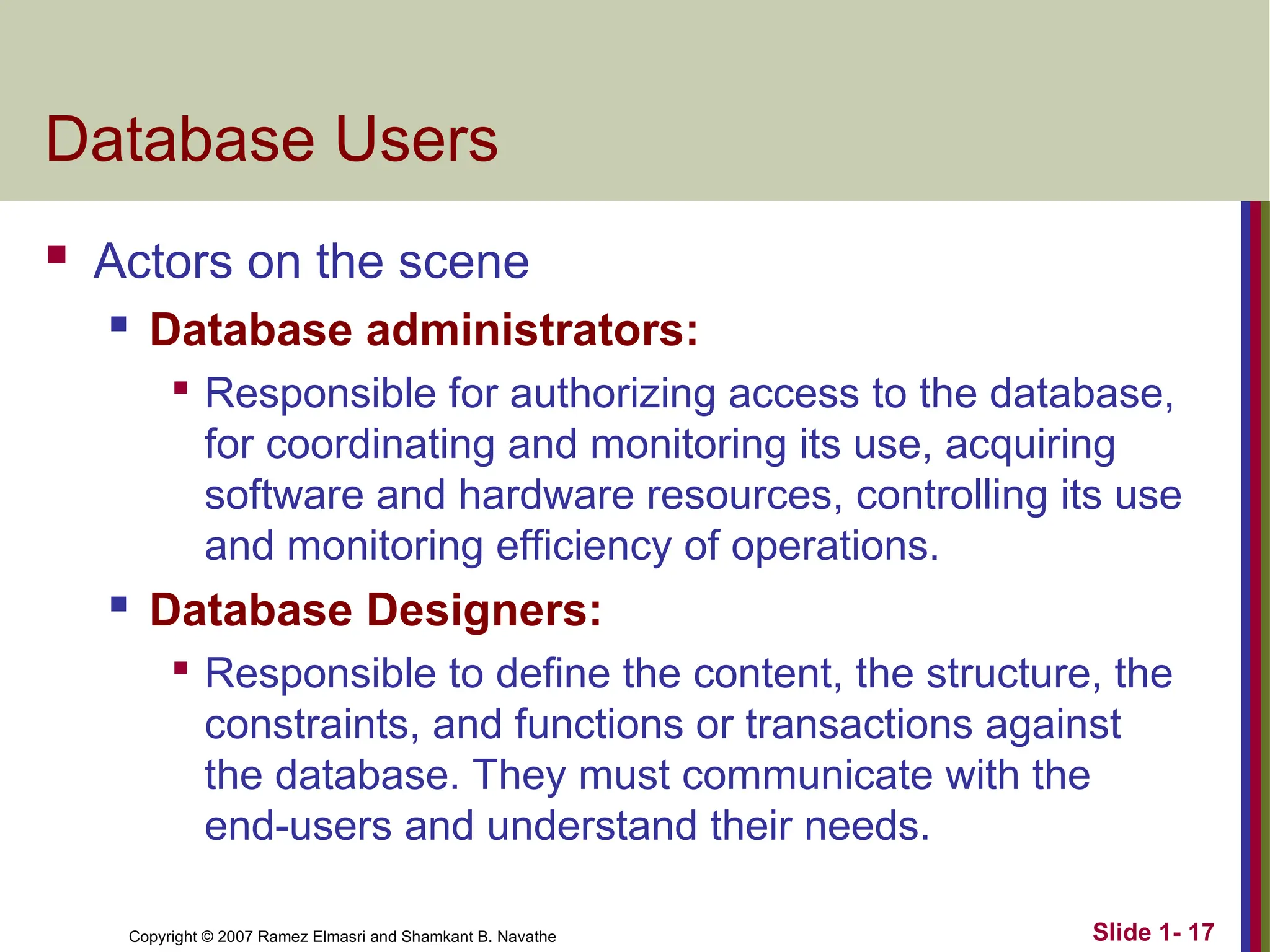
Slide 1- 16 Copyright© 2007 Ramez Elmasri and Shamkant B. Navathe Database Users Users may be divided into Those who actually use and control the database content, and those who design, develop and maintain database applications (called “Actors on the Scene”), and Those who design and develop the DBMS software and related tools, and the computer systems operators (called “Workers Behind the Scene”). - 17.
Slide 1- 17 Copyright© 2007 Ramez Elmasri and Shamkant B. Navathe Database Users Actors on the scene Database administrators: Responsible for authorizing access to the database, for coordinating and monitoring its use, acquiring software and hardware resources, controlling its use and monitoring efficiency of operations. Database Designers: Responsible to define the content, the structure, the constraints, and functions or transactions against the database. They must communicate with the end-users and understand their needs. - 18.
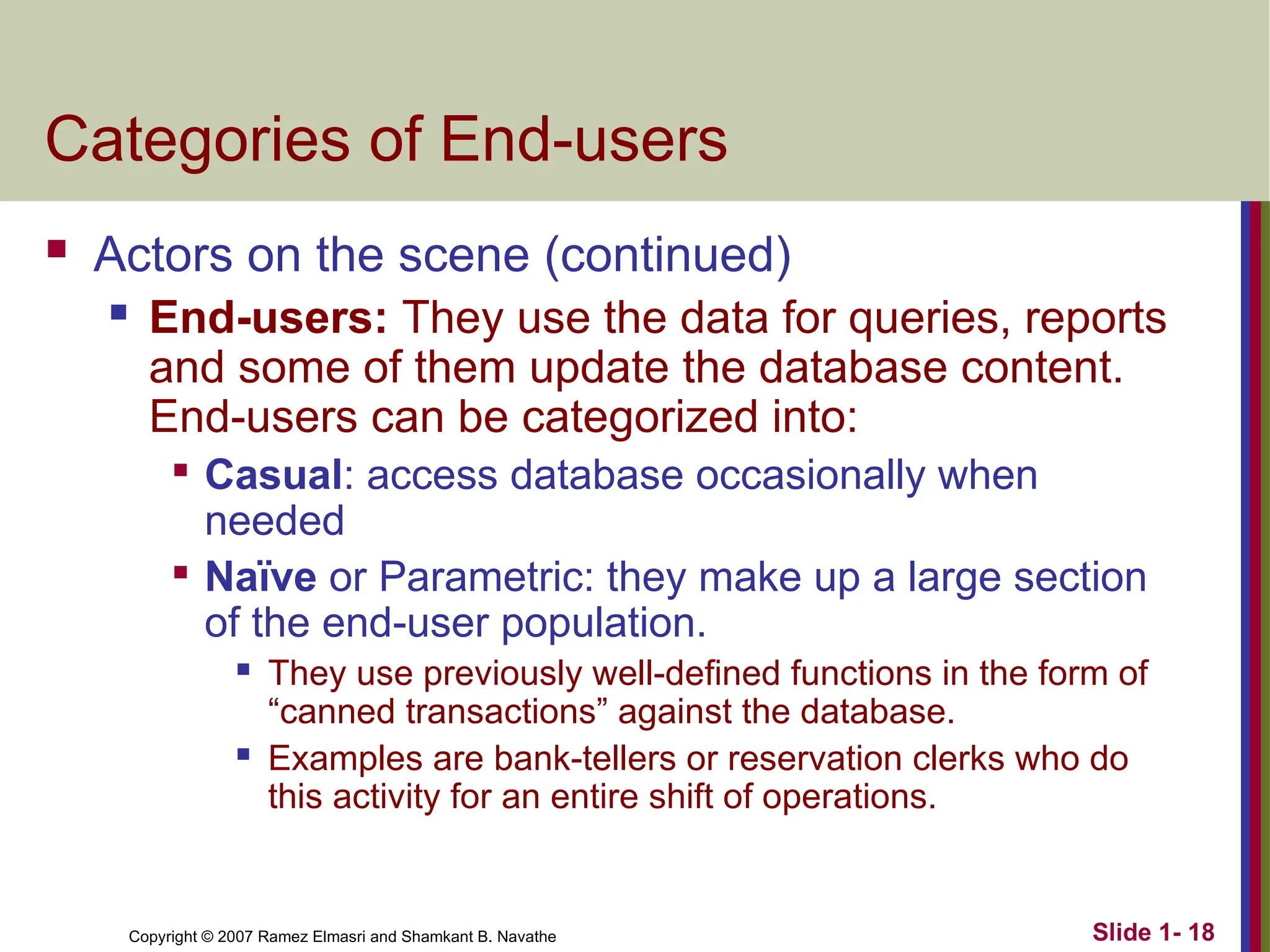
Slide 1- 18 Copyright© 2007 Ramez Elmasri and Shamkant B. Navathe Categories of End-users Actors on the scene (continued) End-users: They use the data for queries, reports and some of them update the database content. End-users can be categorized into: Casual: access database occasionally when needed Naïve or Parametric: they make up a large section of the end-user population. They use previously well-defined functions in the form of “canned transactions” against the database. Examples are bank-tellers or reservation clerks who do this activity for an entire shift of operations. - 19.
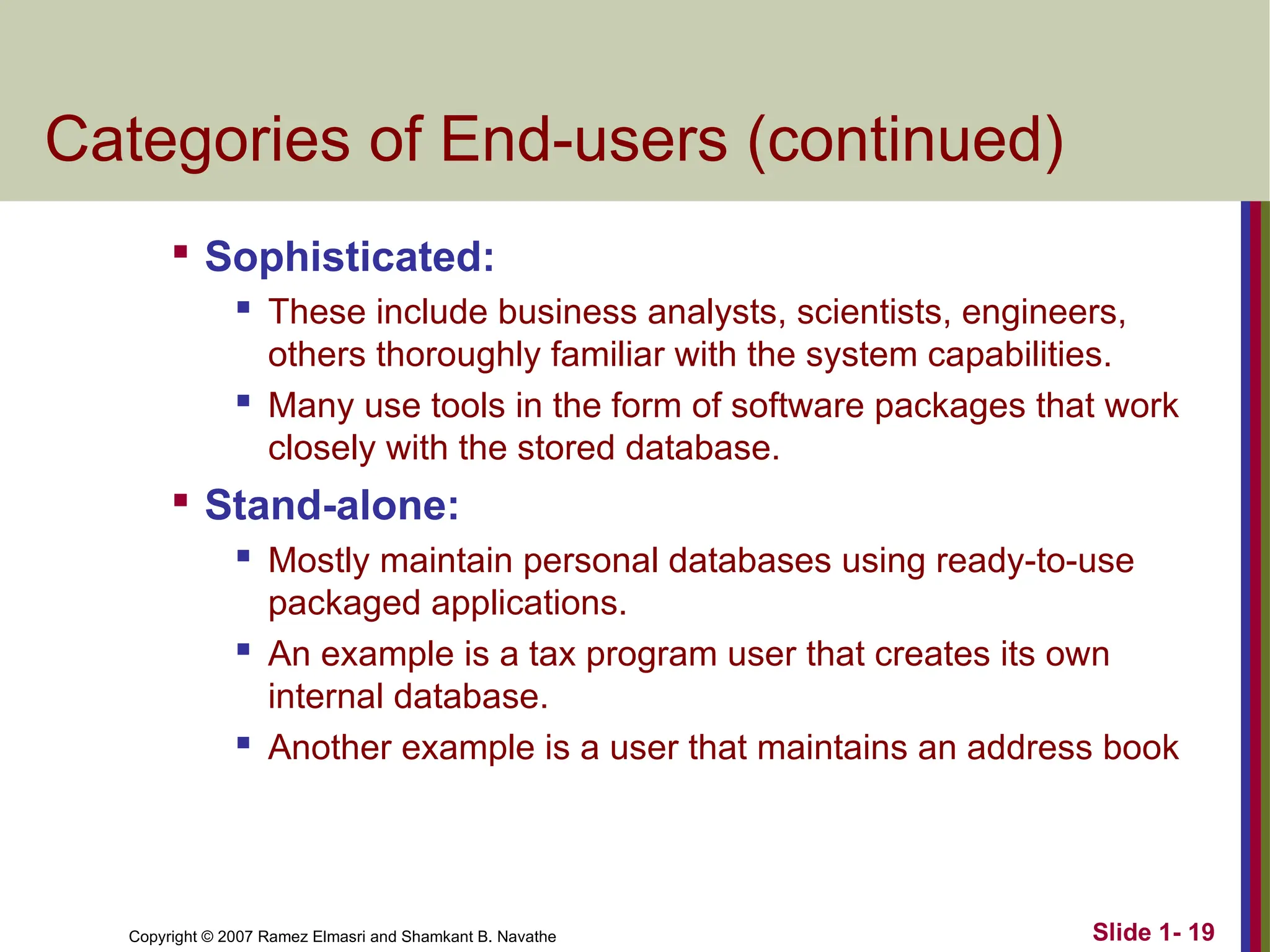
Slide 1- 19 Copyright© 2007 Ramez Elmasri and Shamkant B. Navathe Categories of End-users (continued) Sophisticated: These include business analysts, scientists, engineers, others thoroughly familiar with the system capabilities. Many use tools in the form of software packages that work closely with the stored database. Stand-alone: Mostly maintain personal databases using ready-to-use packaged applications. An example is a tax program user that creates its own internal database. Another example is a user that maintains an address book - 20.
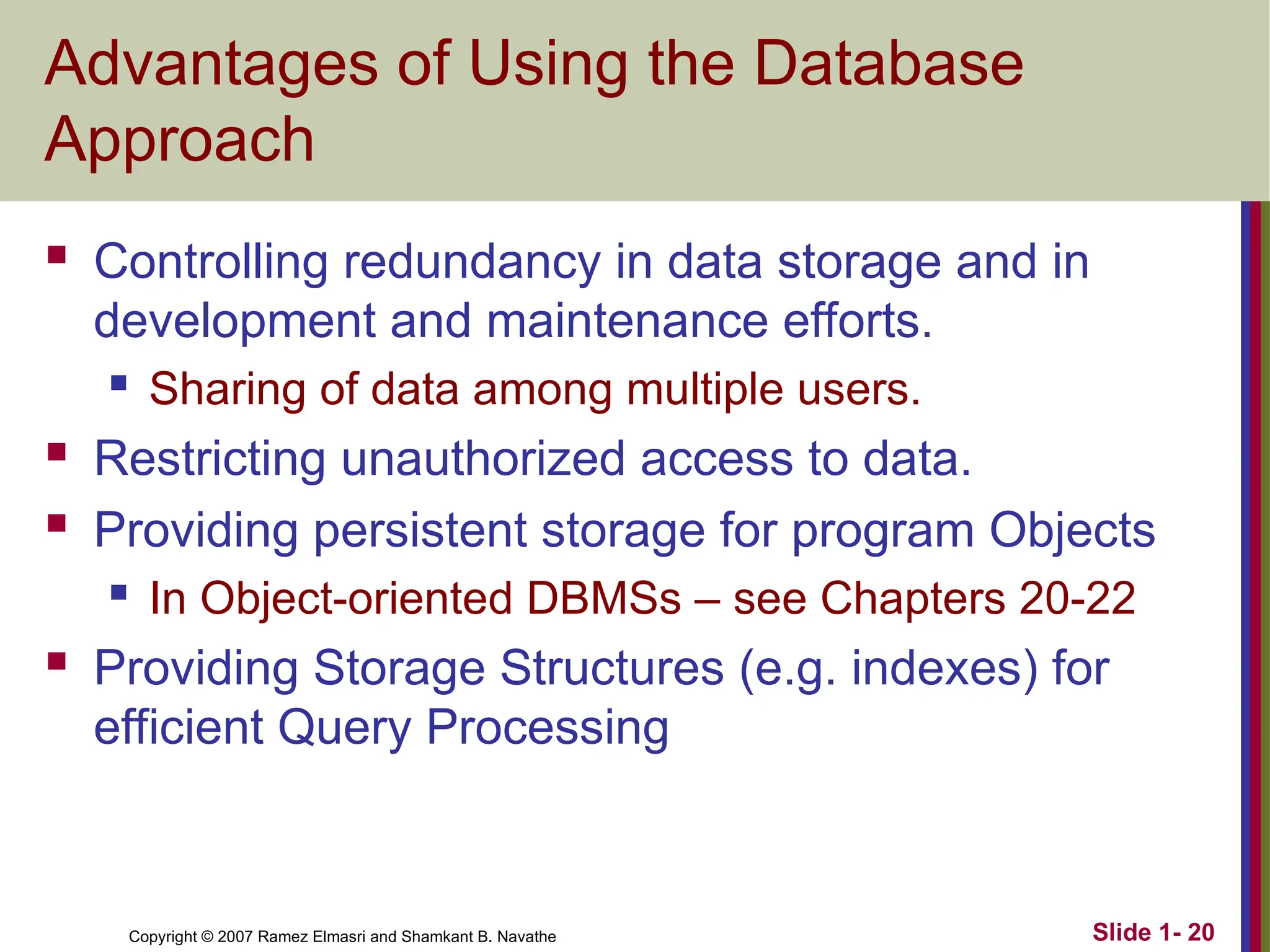
Slide 1- 20 Copyright© 2007 Ramez Elmasri and Shamkant B. Navathe Advantages of Using the Database Approach Controlling redundancy in data storage and in development and maintenance efforts. Sharing of data among multiple users. Restricting unauthorized access to data. Providing persistent storage for program Objects In Object-oriented DBMSs – see Chapters 20-22 Providing Storage Structures (e.g. indexes) for efficient Query Processing - 21.
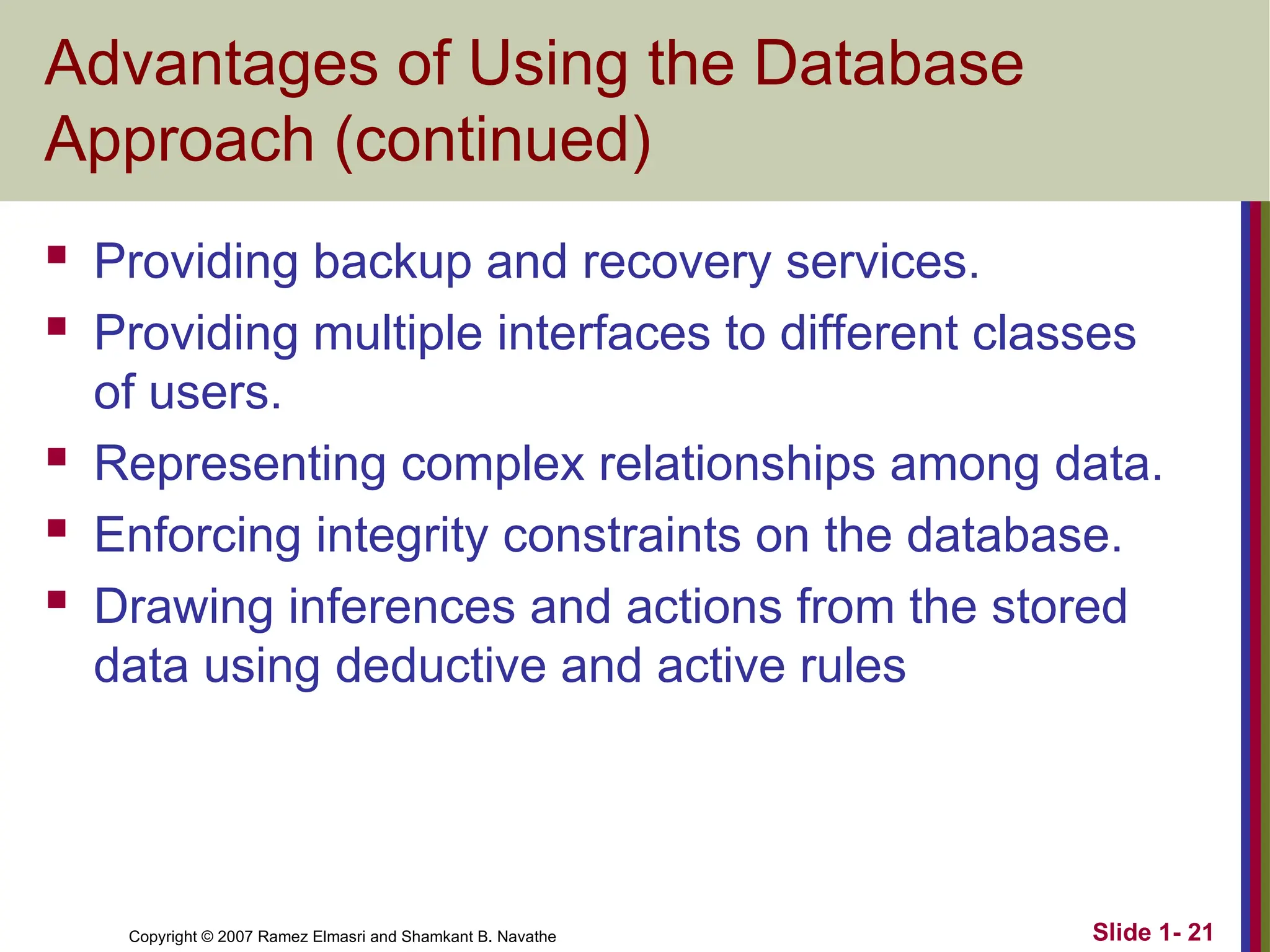
Slide 1- 21 Copyright© 2007 Ramez Elmasri and Shamkant B. Navathe Advantages of Using the Database Approach (continued) Providing backup and recovery services. Providing multiple interfaces to different classes of users. Representing complex relationships among data. Enforcing integrity constraints on the database. Drawing inferences and actions from the stored data using deductive and active rules - 22.
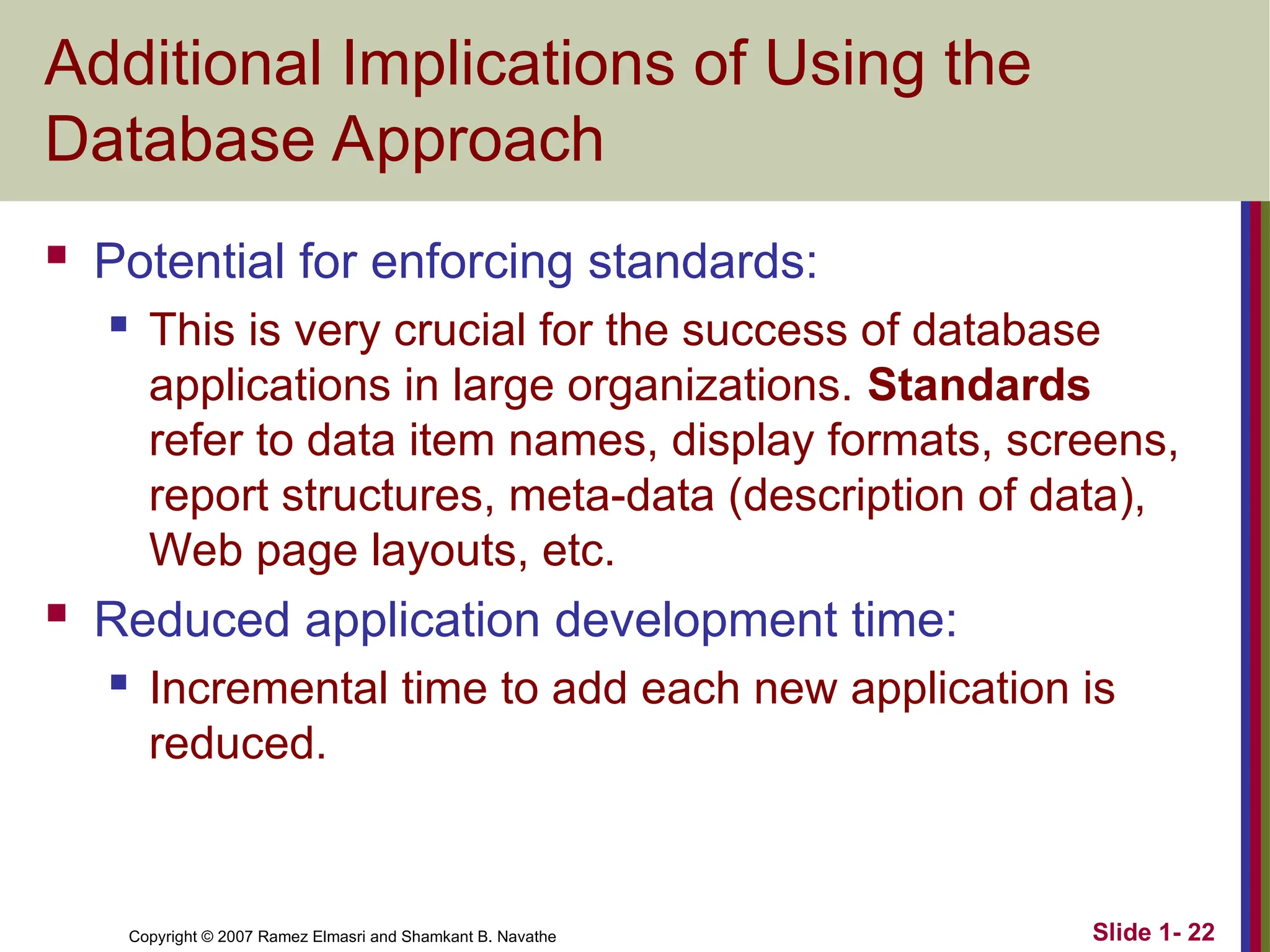
Slide 1- 22 Copyright© 2007 Ramez Elmasri and Shamkant B. Navathe Additional Implications of Using the Database Approach Potential for enforcing standards: This is very crucial for the success of database applications in large organizations. Standards refer to data item names, display formats, screens, report structures, meta-data (description of data), Web page layouts, etc. Reduced application development time: Incremental time to add each new application is reduced. - 23.
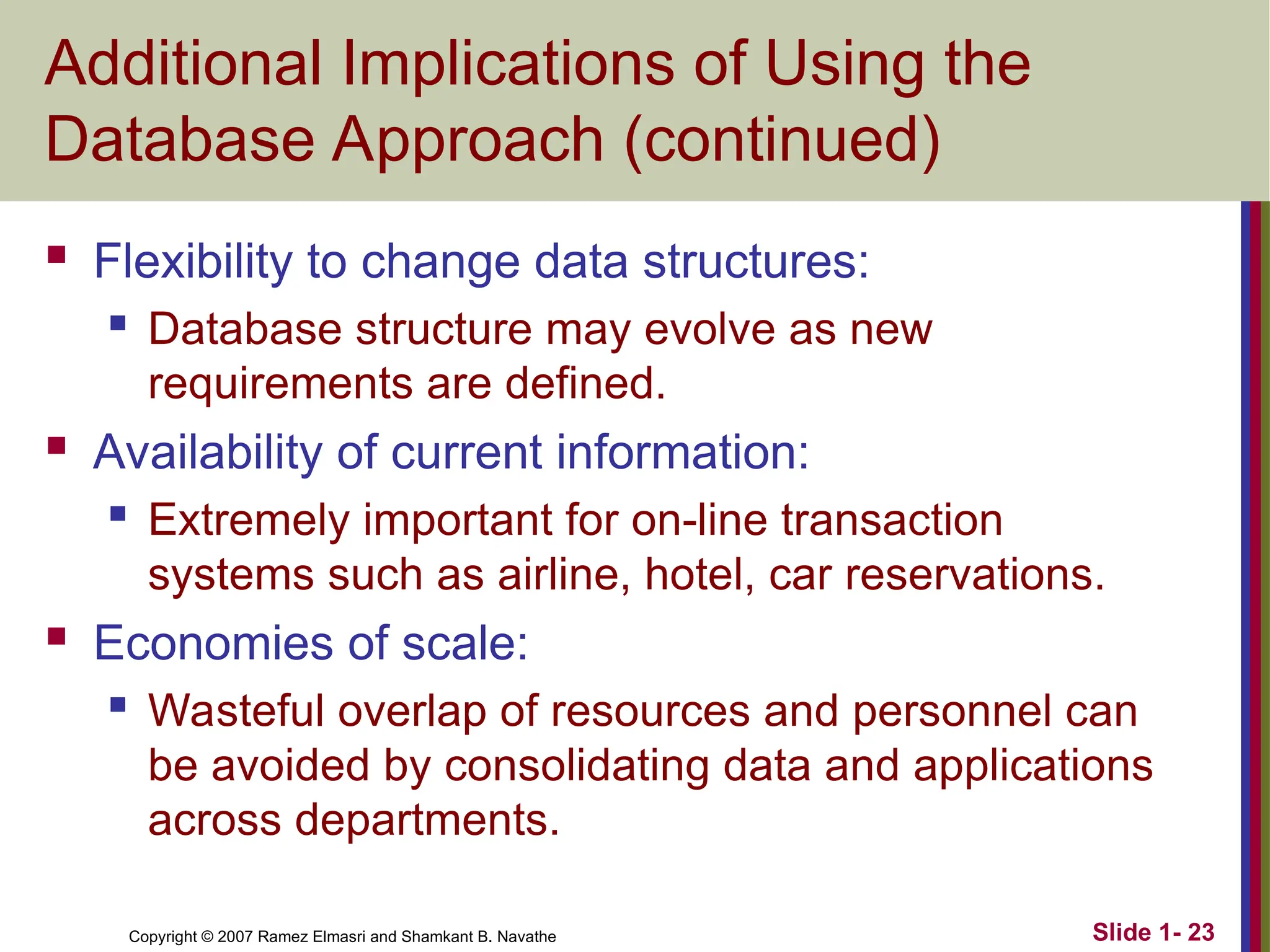
Slide 1- 23 Copyright© 2007 Ramez Elmasri and Shamkant B. Navathe Additional Implications of Using the Database Approach (continued) Flexibility to change data structures: Database structure may evolve as new requirements are defined. Availability of current information: Extremely important for on-line transaction systems such as airline, hotel, car reservations. Economies of scale: Wasteful overlap of resources and personnel can be avoided by consolidating data and applications across departments. - 24.
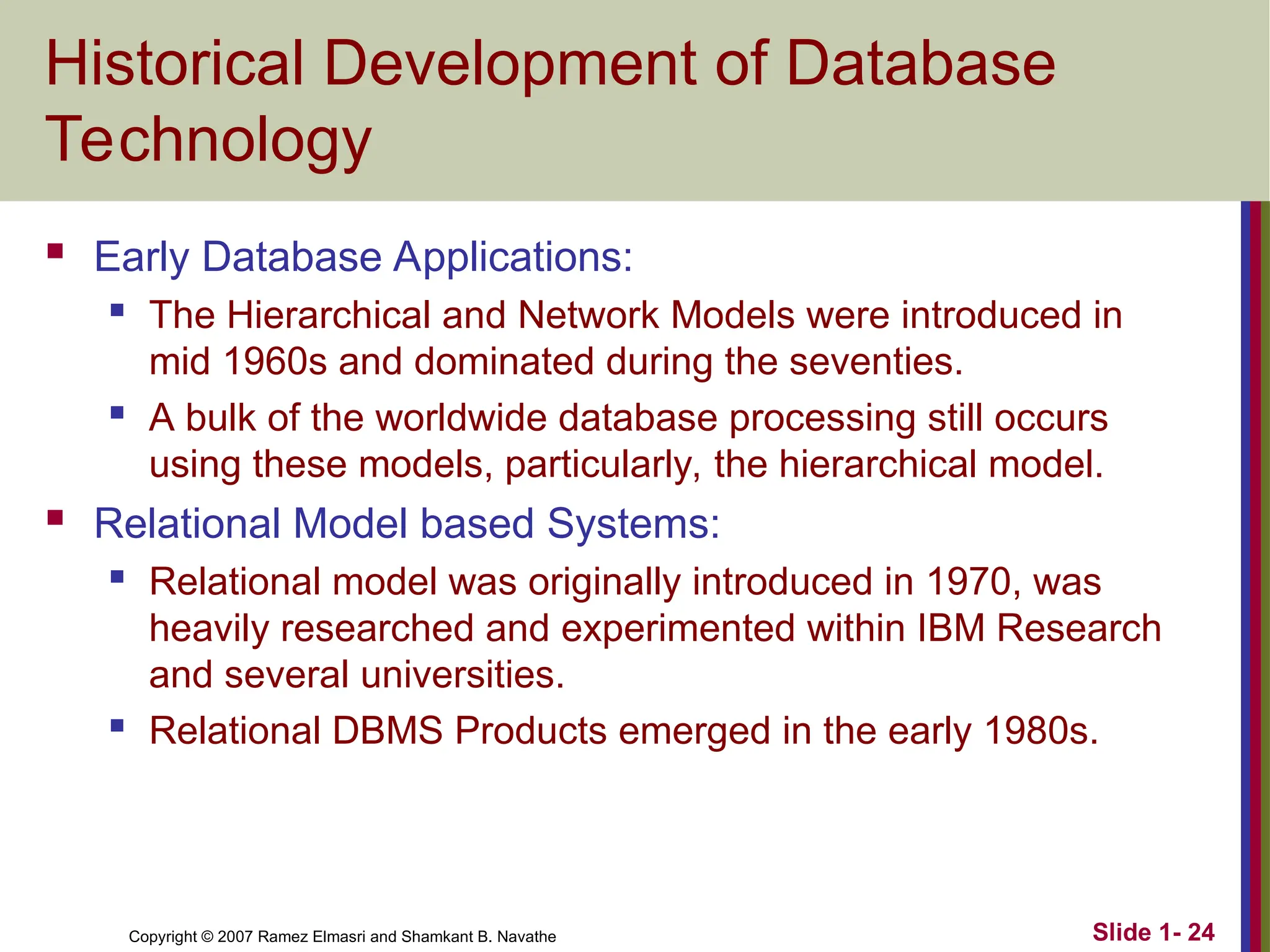
Slide 1- 24 Copyright© 2007 Ramez Elmasri and Shamkant B. Navathe Historical Development of Database Technology Early Database Applications: The Hierarchical and Network Models were introduced in mid 1960s and dominated during the seventies. A bulk of the worldwide database processing still occurs using these models, particularly, the hierarchical model. Relational Model based Systems: Relational model was originally introduced in 1970, was heavily researched and experimented within IBM Research and several universities. Relational DBMS Products emerged in the early 1980s. - 25.
Slide 1- 25 Copyright© 2007 Ramez Elmasri and Shamkant B. Navathe Historical Development of Database Technology (continued) Object-oriented and emerging applications: Object-Oriented Database Management Systems (OODBMSs) were introduced in late 1980s and early 1990s to cater to the need of complex data processing in CAD and other applications. Their use has not taken off much. Many relational DBMSs have incorporated object database concepts, leading to a new category called object-relational DBMSs (ORDBMSs) Extended relational systems add further capabilities (e.g. for multimedia data, XML, and other data types) - 26.
Slide 1- 26 Copyright© 2007 Ramez Elmasri and Shamkant B. Navathe Historical Development of Database Technology (continued) Data on the Web and E-commerce Applications: Web contains data in HTML (Hypertext markup language) with links among pages. This has given rise to a new set of applications and E-commerce is using new standards like XML (eXtended Markup Language). (see Ch. 27). Script programming languages such as PHP and JavaScript allow generation of dynamic Web pages that are partially generated from a database (see Ch. 26). Also allow database updates through Web pages - 27.
Slide 1- 27 Copyright© 2007 Ramez Elmasri and Shamkant B. Navathe Extending Database Capabilities New functionality is being added to DBMSs in the following areas: Scientific Applications XML (eXtensible Markup Language) Image Storage and Management Audio and Video Data Management Data Warehousing and Data Mining Spatial Data Management Time Series and Historical Data Management The above gives rise to new research and development in incorporating new data types, complex data structures, new operations and storage and indexing schemes in database systems. - 28.
Slide 1- 28 Copyright© 2007 Ramez Elmasri and Shamkant B. Navathe When not to use a DBMS Main inhibitors (costs) of using a DBMS: High initial investment and possible need for additional hardware. Overhead for providing generality, security, concurrency control, recovery, and integrity functions. When a DBMS may be unnecessary: If the database and applications are simple, well defined, and not expected to change. If there are stringent real-time requirements that may not be met because of DBMS overhead. If access to data by multiple users is not required. - 29.
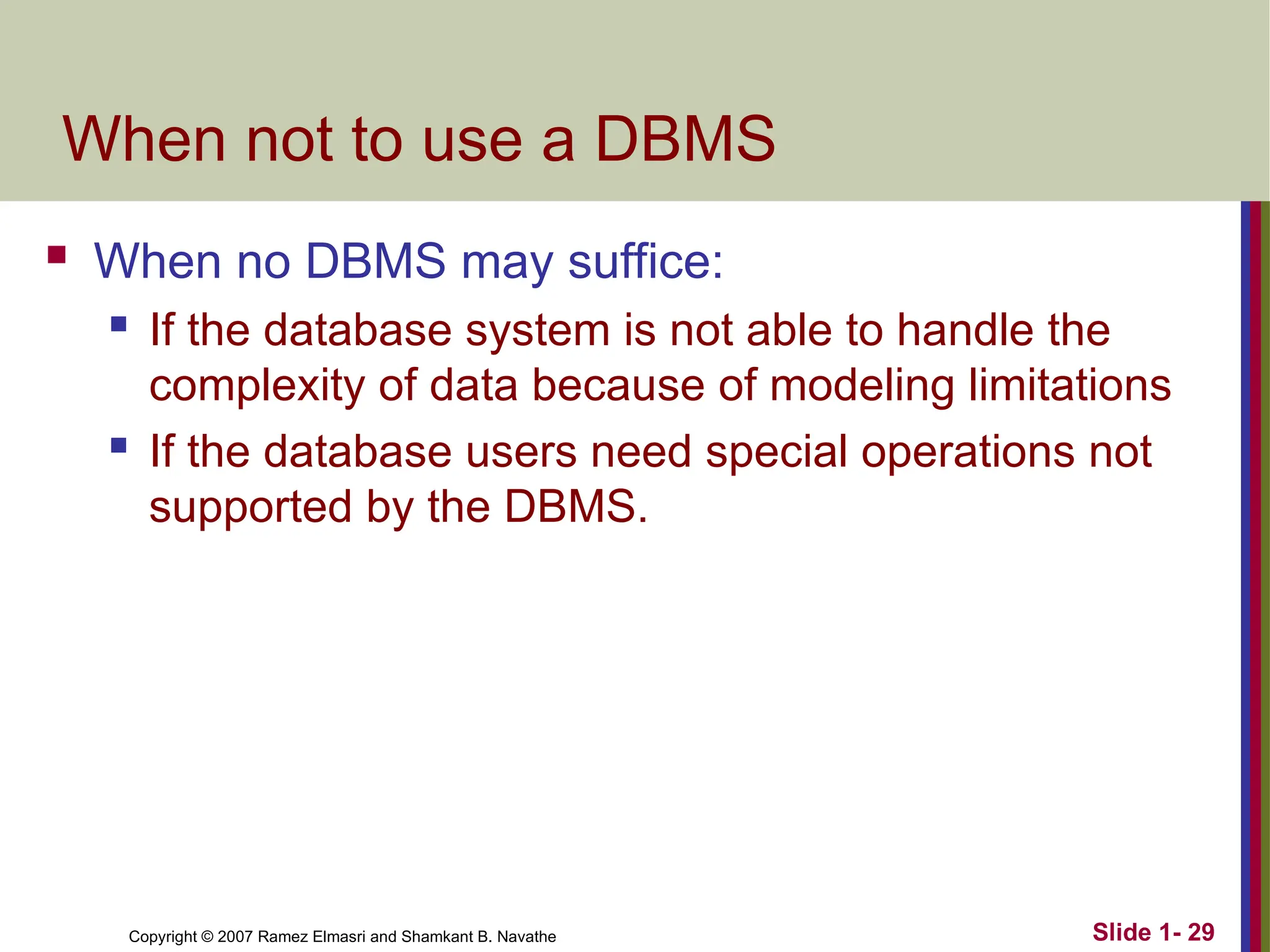
Slide 1- 29 Copyright© 2007 Ramez Elmasri and Shamkant B. Navathe When not to use a DBMS When no DBMS may suffice: If the database system is not able to handle the complexity of data because of modeling limitations If the database users need special operations not supported by the DBMS. - 30.
Slide 1- 30 Copyright© 2007 Ramez Elmasri and Shamkant B. Navathe Summary Types of Databases and Database Applications Basic Definitions Typical DBMS Functionality Example of a Database (UNIVERSITY) Main Characteristics of the Database Approach Database Users Advantages of Using the Database Approach When Not to Use Databases