Creating an Adaptive Setting A Workshop by David Keener ____________________________________________ Capclave 2015 | Gaithersburg, MD | October 9 – 11 Workshop: Saturday, 10:00 AM, October 10th
Agenda • Introduction • Settings: High-Level - With Exercises • Break (10:55 AM - 11:00 AM) • Settings: Low-Level - With Exercises • Wrap-Up 2Copyright © 2015 David Keener
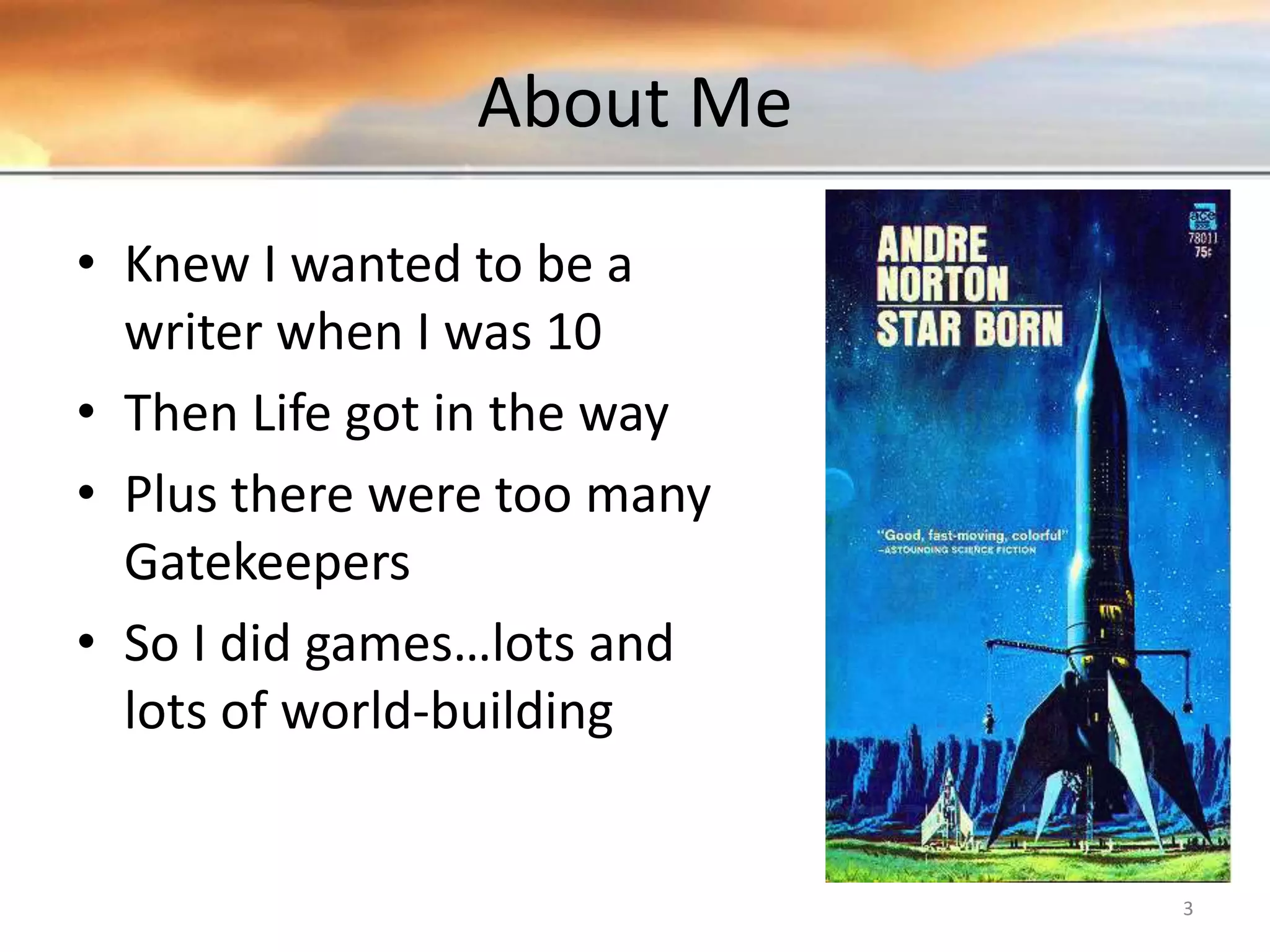
About Me • Knew I wanted to be a writer when I was 10 • Then Life got in the way • Plus there were too many Gatekeepers • So I did games…lots and lots of world-building 3
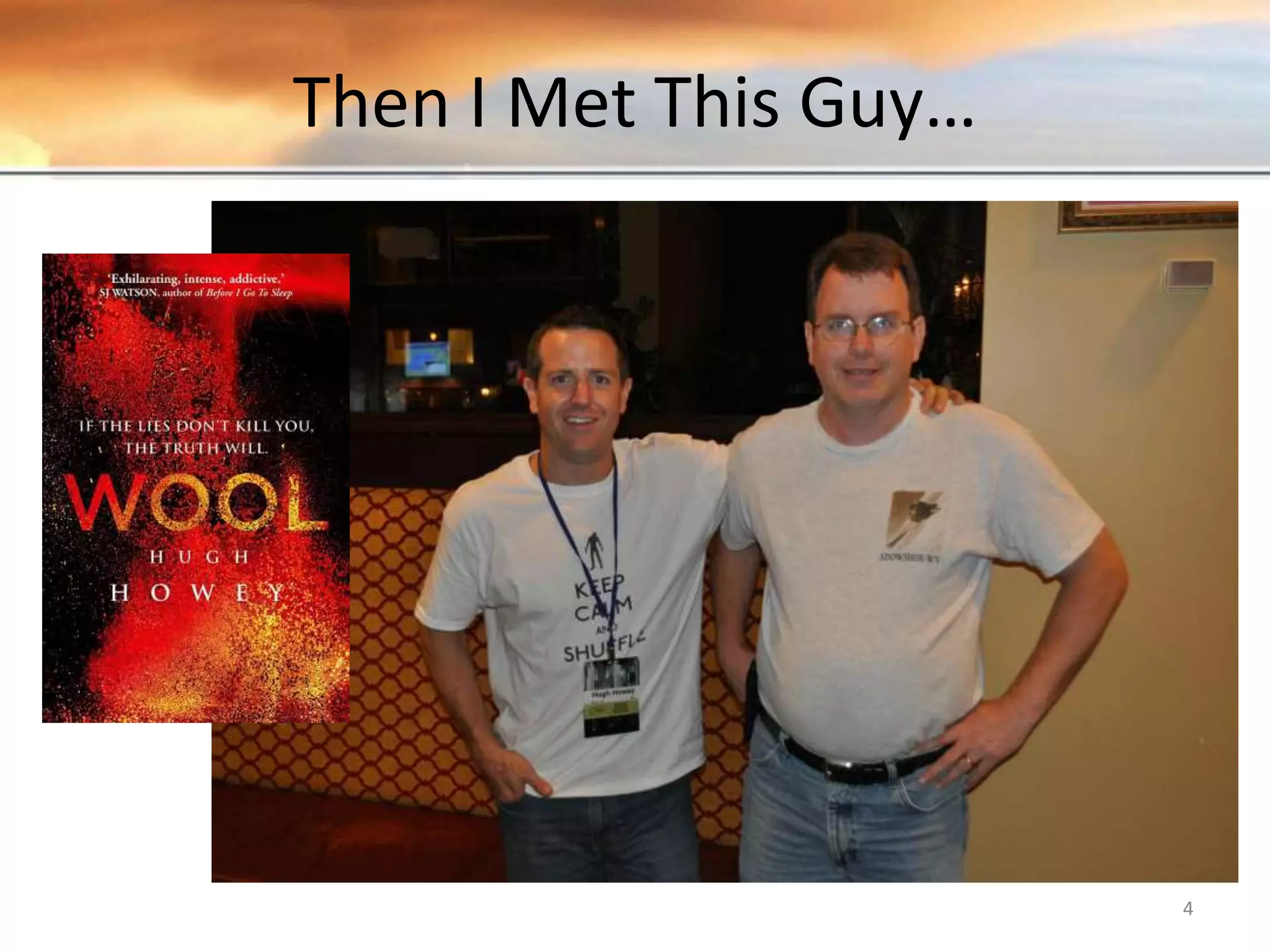
Then I Met This Guy… 4
What Not To Do • Design a Setting that serves only one purpose - “The Terminator” syndrome • Add a major SF/Fantasy element without considering the impact on society - We have the Transporter…now what? • Create a Setting that’s too neat and orderly - Reality is messy • Ignore basic infrastructure details - How do that many monsters live in a cave? 5
What Makes a Good Setting? • Sufficiently complex to seem plausible • Well-defined prerequisites • Logical, consistent flow from those prereqs • Setting promotes the possibility of CONFLICT • For a series, the Setting should provide multiple avenues for CONFLICT to occur • It feels real 6
The Reactive Net The Goals are: • To create a coherent, consistent and connected background • That can support multiple story lines over time • Leveraging the same Setting, Characters and a diverse cast of Supporting Characters. 7
The Reactive Net (2) It provides a set of steps for crafting your Setting with… • Enough potential conflict to support a series • Enough implied complexity to feel realistic • Enough connectivity to “suggest” useful story interactions • Enough flexibility to adapt to inciting events and character actions 8
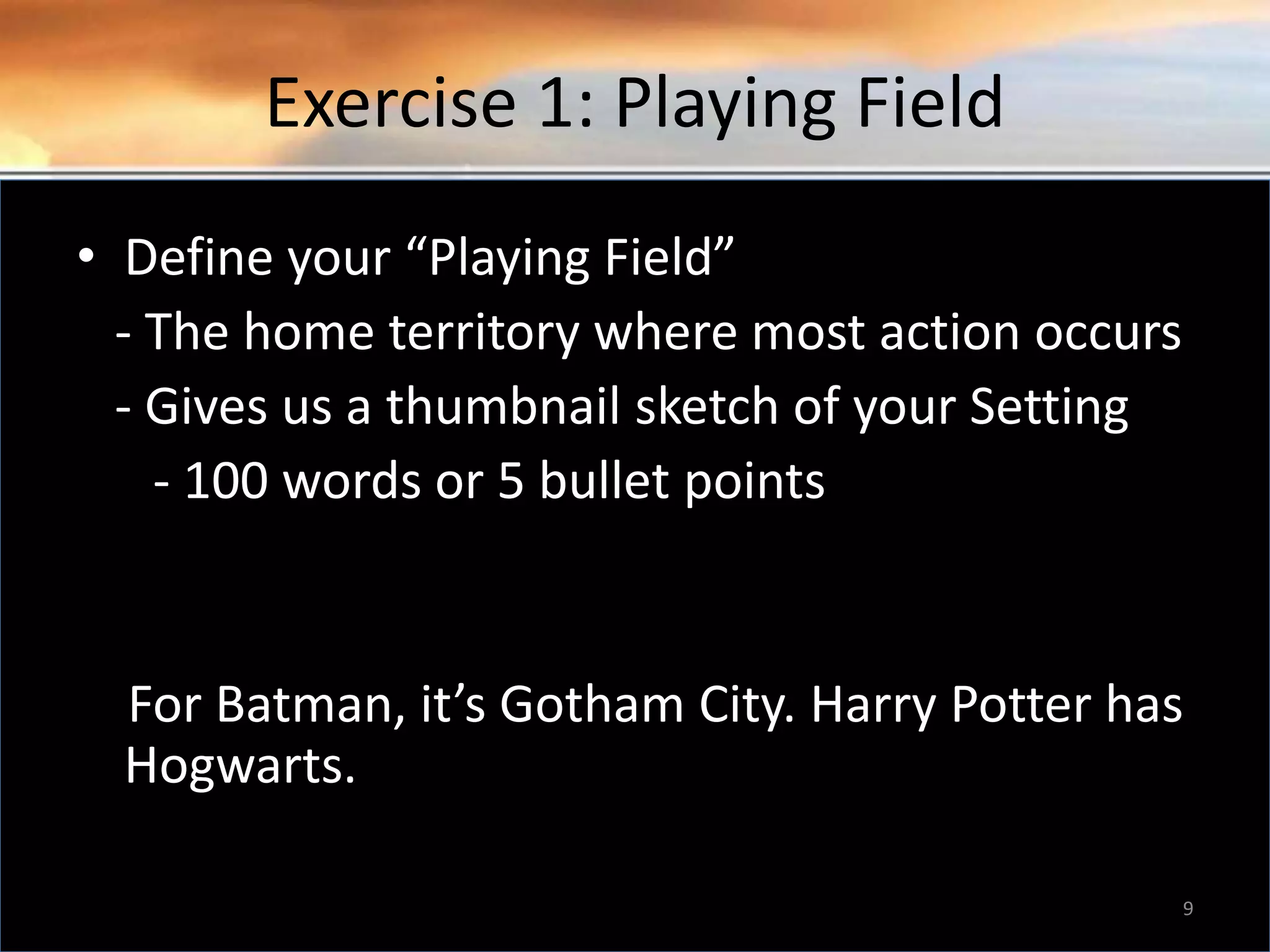
Exercise 1: Playing Field • Define your “Playing Field” - The home territory where most action occurs - Gives us a thumbnail sketch of your Setting - 100 words or 5 bullet points For Batman, it’s Gotham City. Harry Potter has Hogwarts. 9
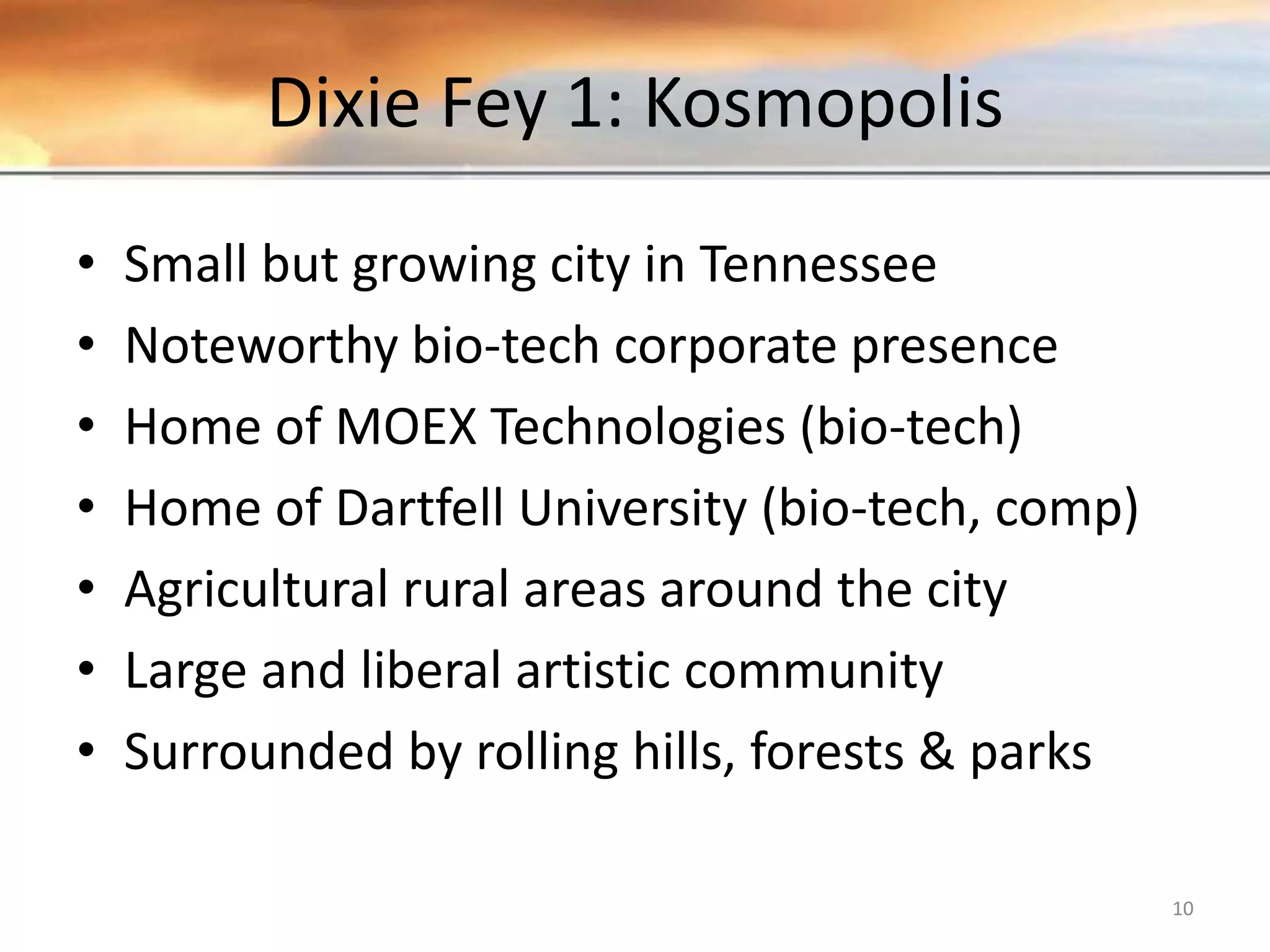
Dixie Fey 1: Kosmopolis • Small but growing city in Tennessee • Noteworthy bio-tech corporate presence • Home of MOEX Technologies (bio-tech) • Home of Dartfell University (bio-tech, comp) • Agricultural rural areas around the city • Large and liberal artistic community • Surrounded by rolling hills, forests & parks 10
Exercise 2: Special Rules Tell us about any special rules that are in play… • Does Magic work? • FTL? • Aliens? • Elvis? • Is there a Hell-Mouth nearby? • Zombies? 11
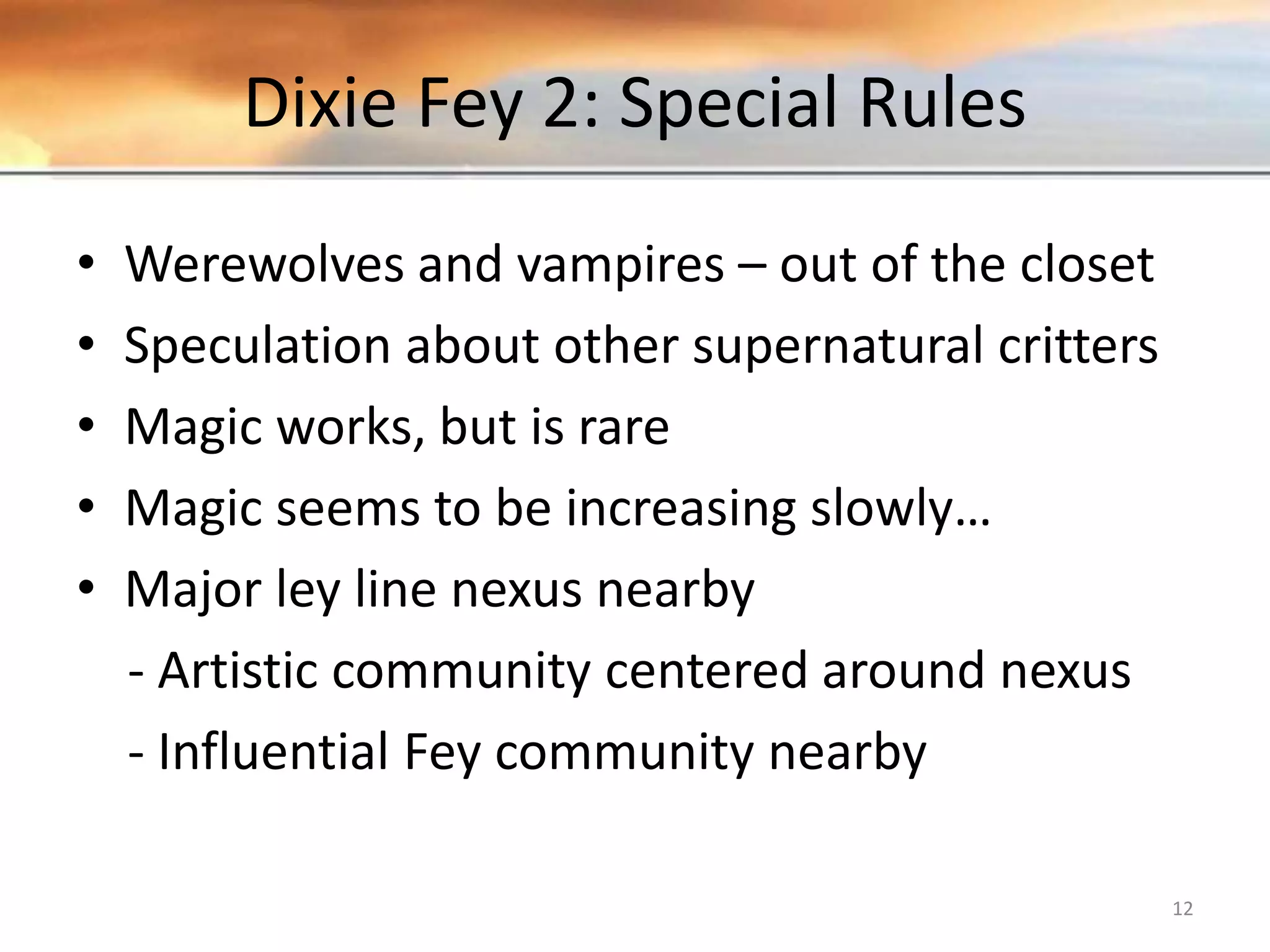
Dixie Fey 2: Special Rules • Werewolves and vampires – out of the closet • Speculation about other supernatural critters • Magic works, but is rare • Magic seems to be increasing slowly… • Major ley line nexus nearby - Artistic community centered around nexus - Influential Fey community nearby 12
Exercise 3: Factions To provide the potential for multiple angles of conflict, you need factions, i.e. – groups or orgs with differing goals • Define three groups within your Setting - Give us a 1 - 2 line description of their goals 13
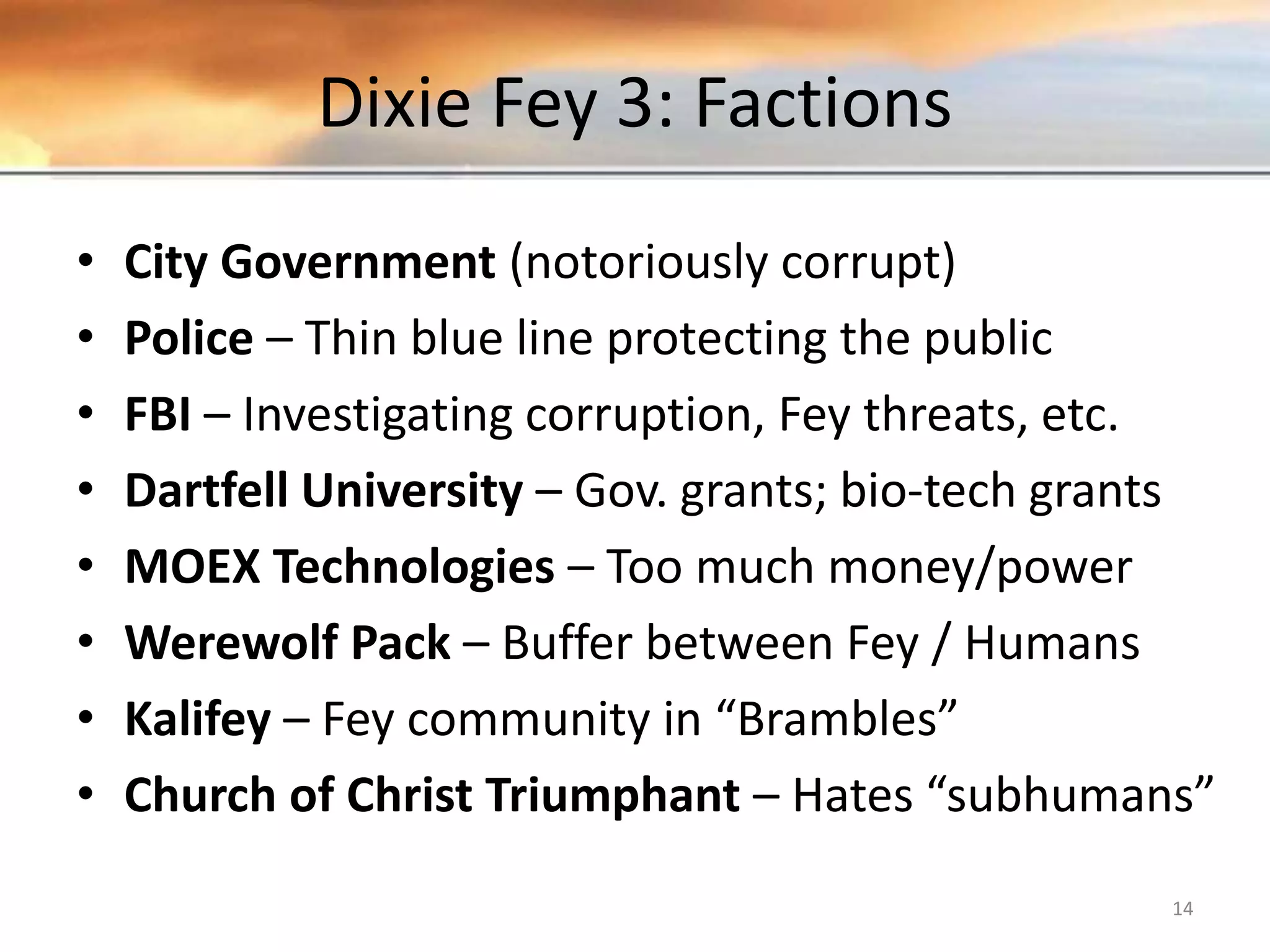
Dixie Fey 3: Factions • City Government (notoriously corrupt) • Police – Thin blue line protecting the public • FBI – Investigating corruption, Fey threats, etc. • Dartfell University – Gov. grants; bio-tech grants • MOEX Technologies – Too much money/power • Werewolf Pack – Buffer between Fey / Humans • Kalifey – Fey community in “Brambles” • Church of Christ Triumphant – Hates “subhumans” 14
Reality Isn’t Predictable • Everybody pulls in different directions • Nobody ever gets everything they want • Reality is what happens when all these things get worked out in the Stew Pot of History You want your Setting to imply enough complexity to feel real 15
Break
Exercise 4: Detailed Faction Define one faction in more detail. Provide a sentence or two for each category below: • Attitudes • Goals • Strengths • Weaknesses 17
Dixie Fey 4: Church of C.T. • Attitudes: Everything supernatural is part of a nefarious plot by Satan. All supernatural creatures and those who dabble in the black arts (magic) should die violently. Supernatural creatures, including mages, are not really people. • Goals: To expunge the supernatural from the world. • Strengths: They’re relentless, smart and wealthy. They’re also good at public relations. • Weaknesses: They are relentless. Sometimes they don’t recognize when to cut their losses. They’re fanatical. Compromise isn’t a word in their vocabulary. 18
Exercise 5: Operations How do the factions perform their day-to-day operations? Where do they get the money they need to run? How do they recruit new members? Who’s doin’ deals with who? • Detail at least three operational interactions… - Can focus on one faction…or…more 19
Dixie Fey 5: Operations • Werewolf Pack has a group house owned by the pack leader where they all meet. They live separately and tithe 10% of their income. • CCT runs a syndicated “Anti-Monster” radio show and accepts donations to campaign against the supernatural realm. • MOEX Technologies pioneered the blood substitute, AAA-Plus™, that vampires use so they’re not dependent on human blood. 20
Exercise 6: Key Roles Define some key roles within the Setting, i.e. – roles that are likely to appear in your stories. • At least four roles • Can be in different factions • Or even not associated directly with a faction - Ex. – the local fence for stolen goods 21
Dixie Fey 6: Key Roles • The “fixer” from the Werewolf Pack • The ambitious reporter looking for a story • The guy selling a new recreational drug that affects supernatural creatures • The local fence for stolen goods • The vet at the local zoo • The FBI agent investigating Fey threats 22
Just In Time Design • Your Setting design is done in broad strokes • You design your factions and roles • You don’t have to figure out every detail now • You fill in more details as you go - Keeping a series bible can be useful • Don’t get hung up on world-building… 23
Theory Time • You’ve designed your Setting • You’ve added connectivity • You’ve added operational details Now let’s put this Reactive Net thing to the test… 24
Dixie Fey, Book 1 Someone was savagely mauled by an animal • The Werewolf Pack’s fixer is worried about a rogue lycanthrope • The Police want to know what’s going on • Your Hero wants to prevent anybody else from getting hurt • Your Hero talks to the Vet at the local zoo, who was originally brought in by the police to look at the body • Your Hero encounters the fixer from the Werewolf Pack • The CCT uses the incident as part of an anti-monster campaign • Your local Reporter smells a story, too • Finally, the Kalifey are annoyed because the body was left near the Brambles — was it a warning or a threat aimed at them? 25
Dixie Fey, Book 2 A half-blood Fey dies of an overdose of a new street drug that affects supernatural creatures • The Kalifey want to know where the drug came from • The Kalifey ask your Hero to help them • The Police want to find whoever’s distributing bad drugs • The Werewolf Pack is involved again because the drug affects werewolves, too. • Dartfell University is involved because the drug was a byproduct of one of their experiments, and its been hijacked by an insider for illicit purposes • The CCT thinks this is a great way to kill monsters 26
Events and Reactions • The essence of the Reactive Net is that when an event occurs, people and organizations react, generating various types of conflict. • Not only do they react, but they do so in logical, consistent ways. • Reactions also occur when your Hero takes action as well. • Leverage these reactions for your stories… 27
Questions http://www.davidkeener.org dkeener@davidkeener.org
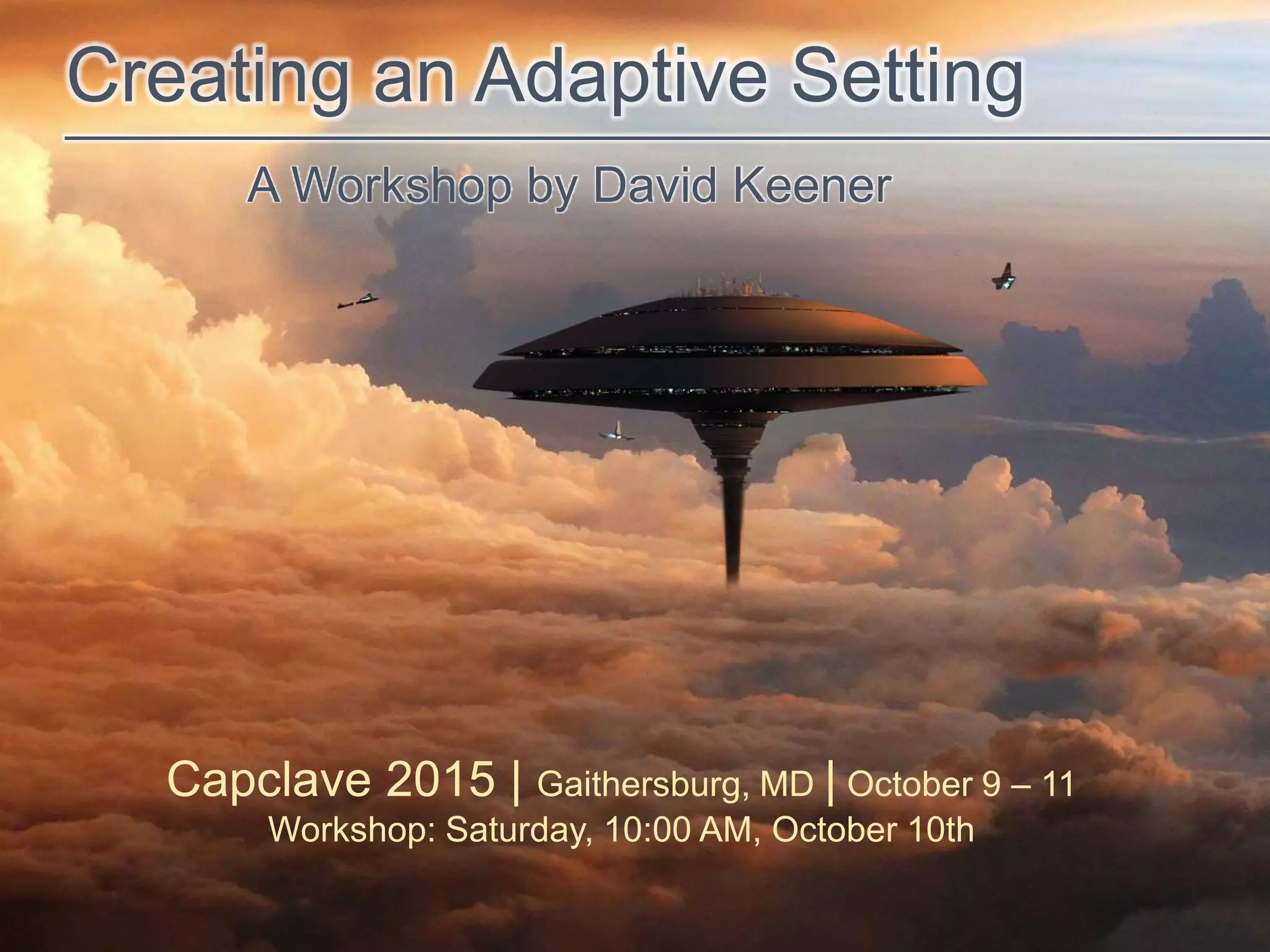
Credits 29 Cloud City, from the film, The Empire Strikes Back. It’s a gas mining colony floating in the atmosphere of the gas giant, Bespin. Fan art by Daein Ballard, used under a Creative Commons license.. Cover art for Andre Norton’s Star Born, one of the key books that made me realize at an early age that I wanted to be a writer. Art by Dean Ellis. Believed to be in the public domain. One of the numerous covers for Hugh Howey’s breakout indie-published bestseller, Wool. Hugh Howey and I at dinner at an Irish pub during the 2012 Worldcon in Chicago. He’d just changed my life by educating me about indie publishing. A brilliant picture of me taken by Edmond Joe in May 2015 at the District 29 Toastmasters Spring Conference. I was running A/V for the conference. This is near the end of the day, all is well, and I’m watching the show. Pretty much the same feeling I have when a successful workshop is over.

Creating an Adaptive Setting

  • 1.
    Creating an AdaptiveSetting A Workshop by David Keener ____________________________________________ Capclave 2015 | Gaithersburg, MD | October 9 – 11 Workshop: Saturday, 10:00 AM, October 10th
  • 2.
    Agenda • Introduction • Settings:High-Level - With Exercises • Break (10:55 AM - 11:00 AM) • Settings: Low-Level - With Exercises • Wrap-Up 2Copyright © 2015 David Keener
  • 3.
    About Me • KnewI wanted to be a writer when I was 10 • Then Life got in the way • Plus there were too many Gatekeepers • So I did games…lots and lots of world-building 3
  • 4.
    Then I MetThis Guy… 4
  • 5.
    What Not ToDo • Design a Setting that serves only one purpose - “The Terminator” syndrome • Add a major SF/Fantasy element without considering the impact on society - We have the Transporter…now what? • Create a Setting that’s too neat and orderly - Reality is messy • Ignore basic infrastructure details - How do that many monsters live in a cave? 5
  • 6.
    What Makes aGood Setting? • Sufficiently complex to seem plausible • Well-defined prerequisites • Logical, consistent flow from those prereqs • Setting promotes the possibility of CONFLICT • For a series, the Setting should provide multiple avenues for CONFLICT to occur • It feels real 6
  • 7.
    The Reactive Net TheGoals are: • To create a coherent, consistent and connected background • That can support multiple story lines over time • Leveraging the same Setting, Characters and a diverse cast of Supporting Characters. 7
  • 8.
    The Reactive Net(2) It provides a set of steps for crafting your Setting with… • Enough potential conflict to support a series • Enough implied complexity to feel realistic • Enough connectivity to “suggest” useful story interactions • Enough flexibility to adapt to inciting events and character actions 8
  • 9.
    Exercise 1: PlayingField • Define your “Playing Field” - The home territory where most action occurs - Gives us a thumbnail sketch of your Setting - 100 words or 5 bullet points For Batman, it’s Gotham City. Harry Potter has Hogwarts. 9
  • 10.
    Dixie Fey 1:Kosmopolis • Small but growing city in Tennessee • Noteworthy bio-tech corporate presence • Home of MOEX Technologies (bio-tech) • Home of Dartfell University (bio-tech, comp) • Agricultural rural areas around the city • Large and liberal artistic community • Surrounded by rolling hills, forests & parks 10
  • 11.
    Exercise 2: SpecialRules Tell us about any special rules that are in play… • Does Magic work? • FTL? • Aliens? • Elvis? • Is there a Hell-Mouth nearby? • Zombies? 11
  • 12.
    Dixie Fey 2:Special Rules • Werewolves and vampires – out of the closet • Speculation about other supernatural critters • Magic works, but is rare • Magic seems to be increasing slowly… • Major ley line nexus nearby - Artistic community centered around nexus - Influential Fey community nearby 12
  • 13.
    Exercise 3: Factions Toprovide the potential for multiple angles of conflict, you need factions, i.e. – groups or orgs with differing goals • Define three groups within your Setting - Give us a 1 - 2 line description of their goals 13
  • 14.
    Dixie Fey 3:Factions • City Government (notoriously corrupt) • Police – Thin blue line protecting the public • FBI – Investigating corruption, Fey threats, etc. • Dartfell University – Gov. grants; bio-tech grants • MOEX Technologies – Too much money/power • Werewolf Pack – Buffer between Fey / Humans • Kalifey – Fey community in “Brambles” • Church of Christ Triumphant – Hates “subhumans” 14
  • 15.
    Reality Isn’t Predictable •Everybody pulls in different directions • Nobody ever gets everything they want • Reality is what happens when all these things get worked out in the Stew Pot of History You want your Setting to imply enough complexity to feel real 15
  • 16.
  • 17.
    Exercise 4: DetailedFaction Define one faction in more detail. Provide a sentence or two for each category below: • Attitudes • Goals • Strengths • Weaknesses 17
  • 18.
    Dixie Fey 4:Church of C.T. • Attitudes: Everything supernatural is part of a nefarious plot by Satan. All supernatural creatures and those who dabble in the black arts (magic) should die violently. Supernatural creatures, including mages, are not really people. • Goals: To expunge the supernatural from the world. • Strengths: They’re relentless, smart and wealthy. They’re also good at public relations. • Weaknesses: They are relentless. Sometimes they don’t recognize when to cut their losses. They’re fanatical. Compromise isn’t a word in their vocabulary. 18
  • 19.
    Exercise 5: Operations Howdo the factions perform their day-to-day operations? Where do they get the money they need to run? How do they recruit new members? Who’s doin’ deals with who? • Detail at least three operational interactions… - Can focus on one faction…or…more 19
  • 20.
    Dixie Fey 5:Operations • Werewolf Pack has a group house owned by the pack leader where they all meet. They live separately and tithe 10% of their income. • CCT runs a syndicated “Anti-Monster” radio show and accepts donations to campaign against the supernatural realm. • MOEX Technologies pioneered the blood substitute, AAA-Plus™, that vampires use so they’re not dependent on human blood. 20
  • 21.
    Exercise 6: KeyRoles Define some key roles within the Setting, i.e. – roles that are likely to appear in your stories. • At least four roles • Can be in different factions • Or even not associated directly with a faction - Ex. – the local fence for stolen goods 21
  • 22.
    Dixie Fey 6:Key Roles • The “fixer” from the Werewolf Pack • The ambitious reporter looking for a story • The guy selling a new recreational drug that affects supernatural creatures • The local fence for stolen goods • The vet at the local zoo • The FBI agent investigating Fey threats 22
  • 23.
    Just In TimeDesign • Your Setting design is done in broad strokes • You design your factions and roles • You don’t have to figure out every detail now • You fill in more details as you go - Keeping a series bible can be useful • Don’t get hung up on world-building… 23
  • 24.
    Theory Time • You’vedesigned your Setting • You’ve added connectivity • You’ve added operational details Now let’s put this Reactive Net thing to the test… 24
  • 25.
    Dixie Fey, Book1 Someone was savagely mauled by an animal • The Werewolf Pack’s fixer is worried about a rogue lycanthrope • The Police want to know what’s going on • Your Hero wants to prevent anybody else from getting hurt • Your Hero talks to the Vet at the local zoo, who was originally brought in by the police to look at the body • Your Hero encounters the fixer from the Werewolf Pack • The CCT uses the incident as part of an anti-monster campaign • Your local Reporter smells a story, too • Finally, the Kalifey are annoyed because the body was left near the Brambles — was it a warning or a threat aimed at them? 25
  • 26.
    Dixie Fey, Book2 A half-blood Fey dies of an overdose of a new street drug that affects supernatural creatures • The Kalifey want to know where the drug came from • The Kalifey ask your Hero to help them • The Police want to find whoever’s distributing bad drugs • The Werewolf Pack is involved again because the drug affects werewolves, too. • Dartfell University is involved because the drug was a byproduct of one of their experiments, and its been hijacked by an insider for illicit purposes • The CCT thinks this is a great way to kill monsters 26
  • 27.
    Events and Reactions •The essence of the Reactive Net is that when an event occurs, people and organizations react, generating various types of conflict. • Not only do they react, but they do so in logical, consistent ways. • Reactions also occur when your Hero takes action as well. • Leverage these reactions for your stories… 27
  • 28.
  • 29.
    Credits 29 Cloud City, fromthe film, The Empire Strikes Back. It’s a gas mining colony floating in the atmosphere of the gas giant, Bespin. Fan art by Daein Ballard, used under a Creative Commons license.. Cover art for Andre Norton’s Star Born, one of the key books that made me realize at an early age that I wanted to be a writer. Art by Dean Ellis. Believed to be in the public domain. One of the numerous covers for Hugh Howey’s breakout indie-published bestseller, Wool. Hugh Howey and I at dinner at an Irish pub during the 2012 Worldcon in Chicago. He’d just changed my life by educating me about indie publishing. A brilliant picture of me taken by Edmond Joe in May 2015 at the District 29 Toastmasters Spring Conference. I was running A/V for the conference. This is near the end of the day, all is well, and I’m watching the show. Pretty much the same feeling I have when a successful workshop is over.

Editor's Notes

  • #4 I’m not talking about the kind of fun but simplistic gaming sessions where the heroes descend into a “dungeon” and kill lots of monsters. I’m talking about “interactive novels” with complicated story lines, unexpected plot twists, hundreds of supporting characters (non-player characters for you gamer types), lots of competing factions, etc. Some of my “campaigns” continued for twenty or thirty twelve-hour games with the same loose group of characters.
  • #5 He convinced that there was something real about this Self-Publishing thing. That it was possible to work around the Gatekeepers. I started getting serious about my writing. I joined two writing groups in my local area. I soon discovered that all that gaming I’d done, all that hardcore world-building was more useful than I expected. And it informed the comments that I gave to my fellow writers, as well. After I kept giving out the same advice a few times…I realized I had a useful workshop. Organized it and ran it locally…and now I’m here.
  • #6 Talk about my first D&D background. Every monster from the Monster Manual was placed somewhere on the Map.
  • #8 So I came up with something based on my gaming experience that I call the Reactive Net. Which all sounds sort of grandiose, but hopefully by the end of the workshop, I will have changed how you think about series.
  • #9 In this workshop, we’re going to explore how to use the Reactive Net to define a Setting by going through some exercises. I’ll also be following along with an extended example that illustrates the design of an urban fantasy series called “Dixie Fey.”
  • #10 Batman had Gotham City. Superman had Metropolis. Harry Potter had Hogwarts. Harry Dresden has Chicago.
  • #11 Very conventional. Nothing special here. Yet.
  • #12 To put it another way, if there’s a Hell-Mouth (as in the Buffy the Vampire Slayer TV series) anywhere nearby, here’s where you mention that vital fact.
  • #14 They can be sub-groups within a larger organization.
  • #16 You want your setting to be complex enough to feel real. Your don’t have to provide every detail, though. Your mission is to imply all of that complexity without having to actually figure out things to that degree.
  • #20 Use the Martial-Arts/Magic example here.
  • #25 Someone in Kosmopolis was savagely mauled by a wild animal…
  • #27 Do these reactions make sense, or what? Connectivity. Something you can run as a modest little simulation in your own mind.
  • #30 Batman had Gotham City. Superman had Metropolis. Harry Potter had Hogwarts. Harry Dresden has Chicago.