DATA STRUCTURES AND ALGORITHMS Lecture Notes 3 Prepared by İnanç TAHRALI
2 ROAD MAP  Abstract Data Types (ADT)  The List ADT  Implementation of Lists  Array implementation of lists  Linked list implementation of lists  Cursor implementation of lists
3 Abstract Data Types (ADT)  Definition : Is a set of operation Mathematical abstraction No implementation detail  Example : Lists, sets, graphs, stacks are examples of ADT along with their operations
4 Why ADT ?  Modularity  divide program into small functions  easy to debug and maintain  easy to modify  group work  Reuse  do some operations only once  Easy to change of implementation  transparent to the program
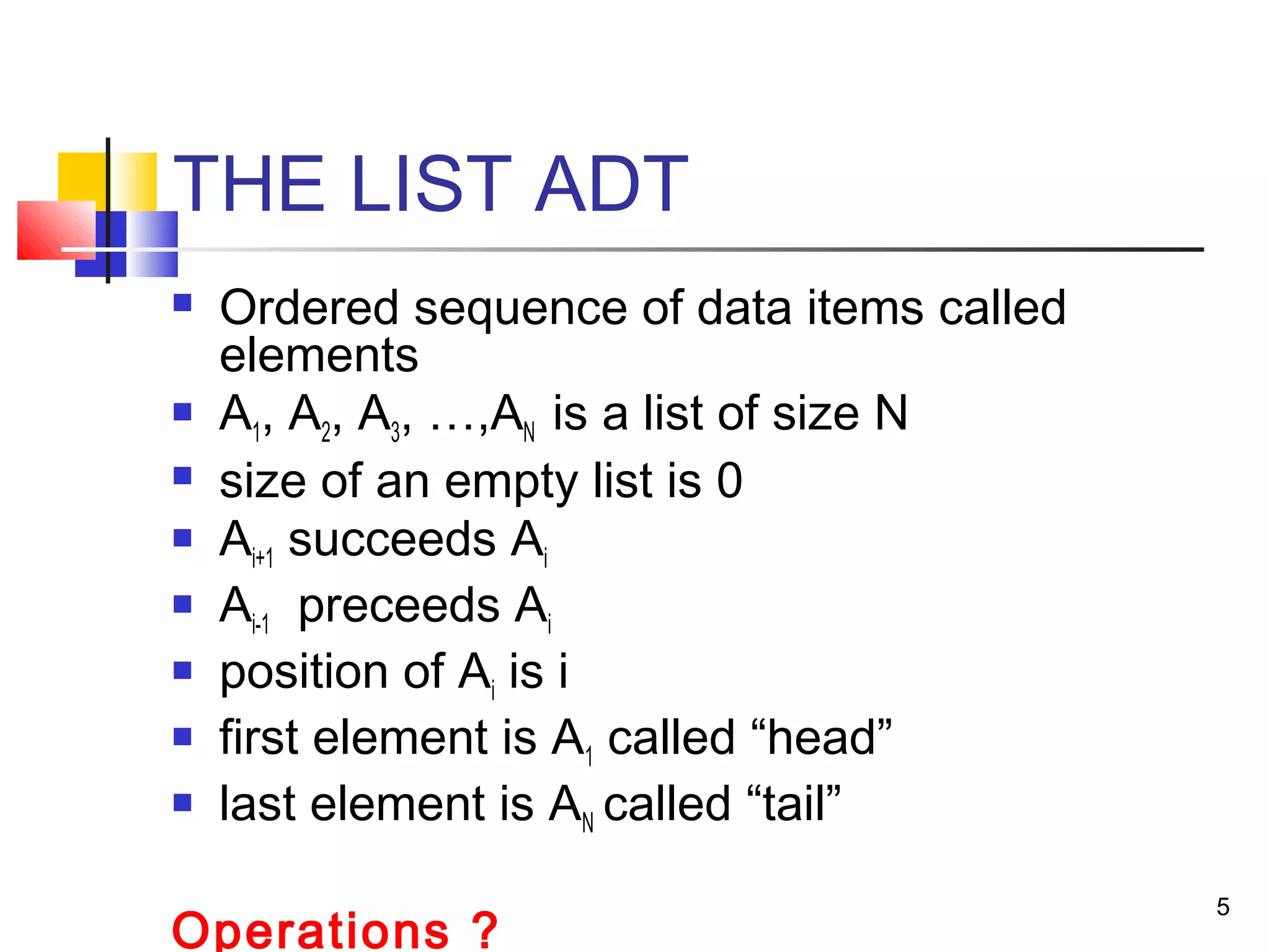
5 THE LIST ADT  Ordered sequence of data items called elements  A1, A2, A3, …,AN is a list of size N  size of an empty list is 0  Ai+1 succeeds Ai  Ai-1 preceeds Ai  position of Ai is i  first element is A1 called “head”  last element is AN called “tail” Operations ?
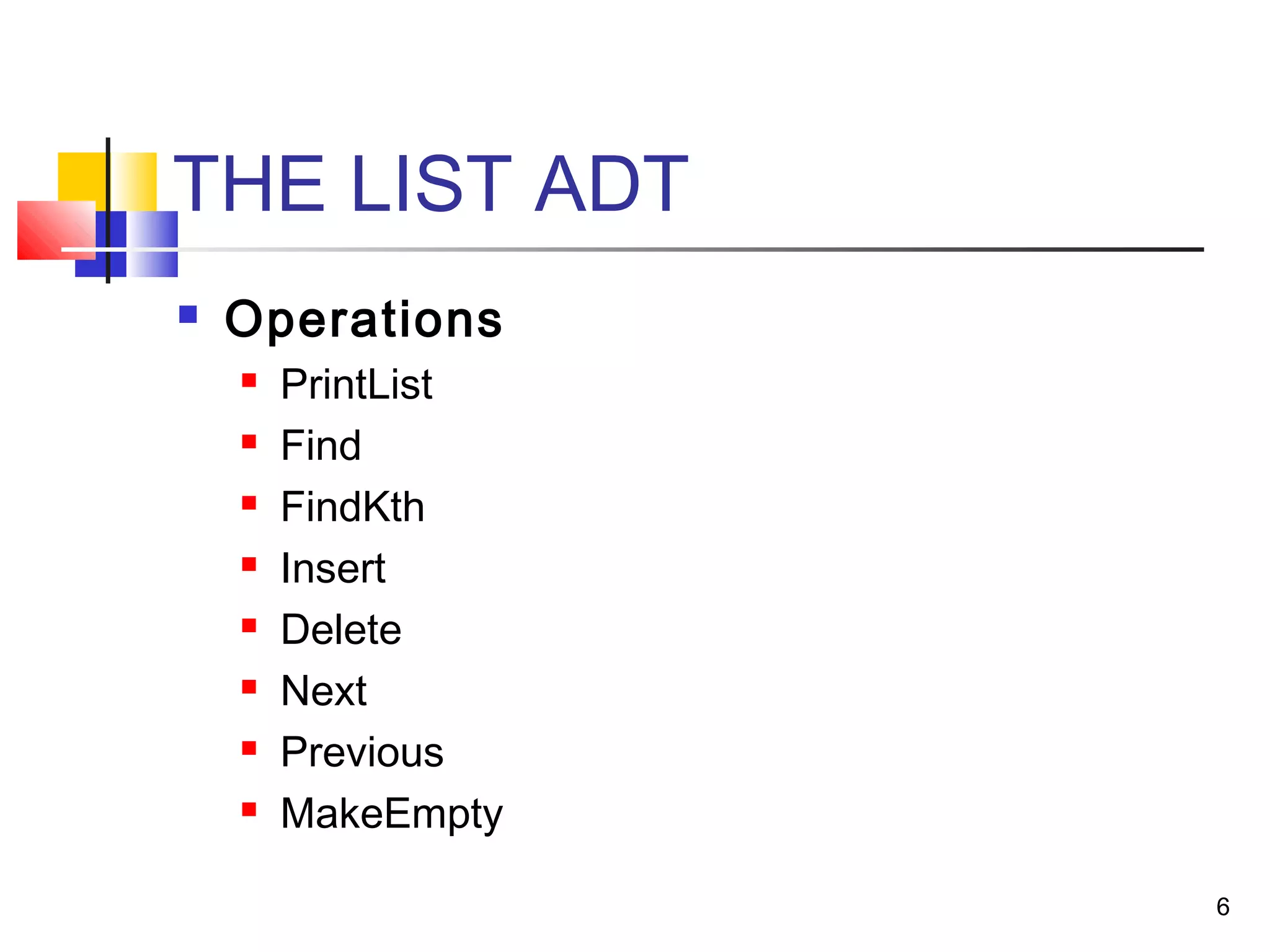
6 THE LIST ADT  Operations  PrintList  Find  FindKth  Insert  Delete  Next  Previous  MakeEmpty
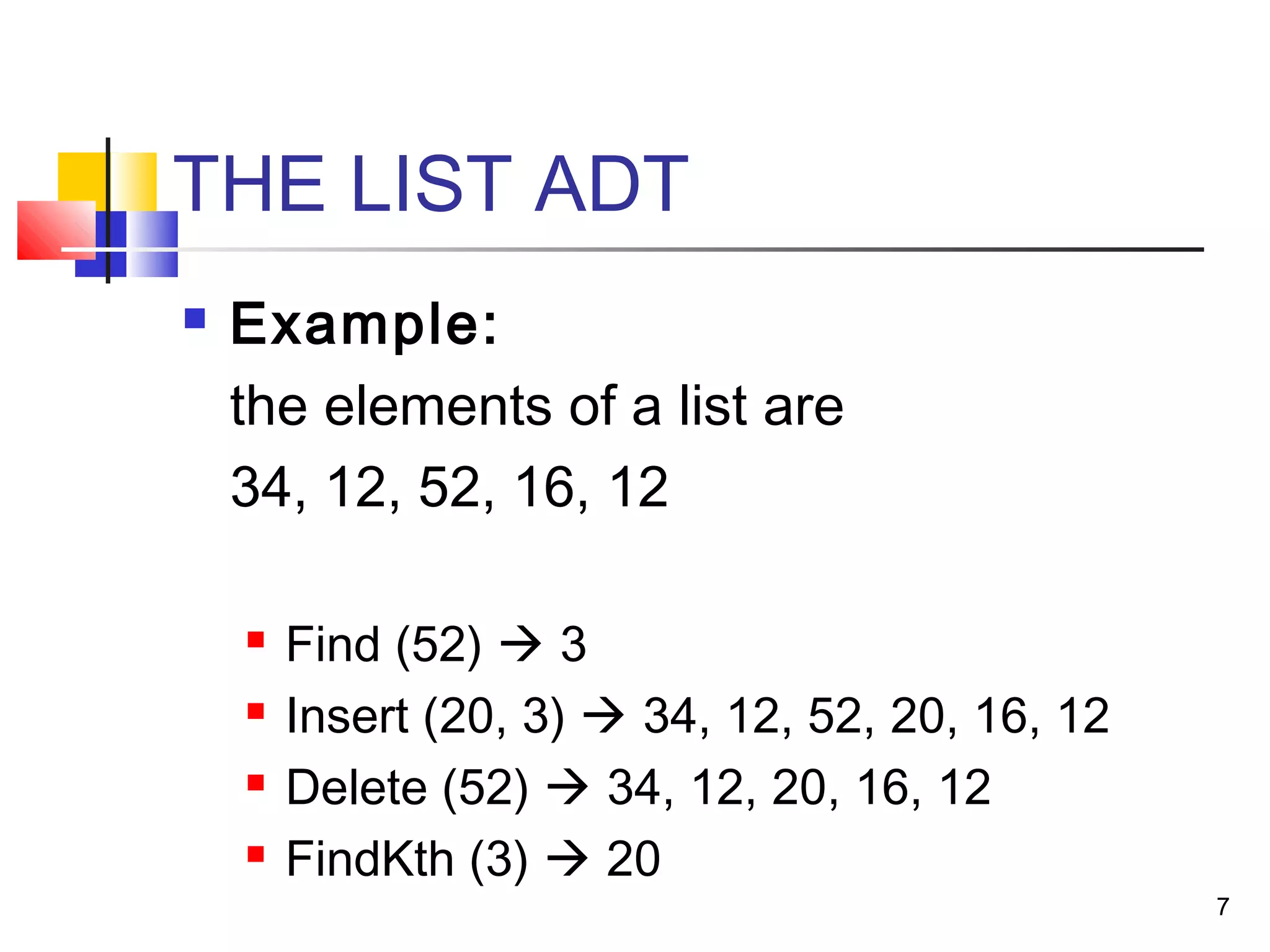
7 THE LIST ADT  Example: the elements of a list are 34, 12, 52, 16, 12  Find (52)  3  Insert (20, 3)  34, 12, 52, 20, 16, 12  Delete (52)  34, 12, 20, 16, 12  FindKth (3)  20
8 Implementation of Lists  Many Implementations  Array  Linked List  Cursor (linked list using arrays)
9 ROAD MAP  Abstract Data Types (ADT)  The List ADT  Implementation of Lists  Array implementation of lists  Linked list implementation of lists  Cursor implementation of lists
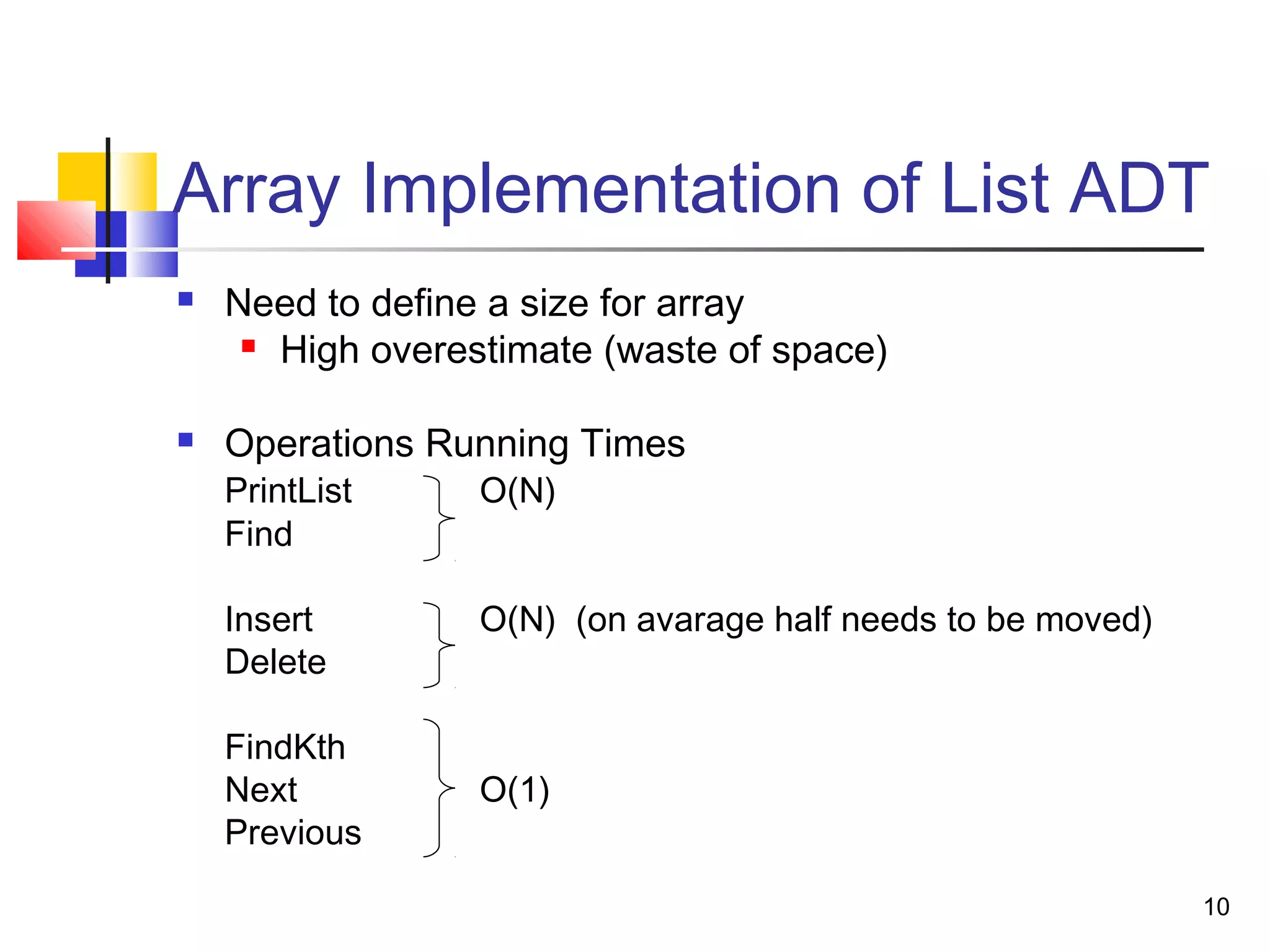
10 Array Implementation of List ADT  Need to define a size for array  High overestimate (waste of space)  Operations Running Times PrintList O(N) Find Insert O(N) (on avarage half needs to be moved) Delete FindKth Next O(1) Previous
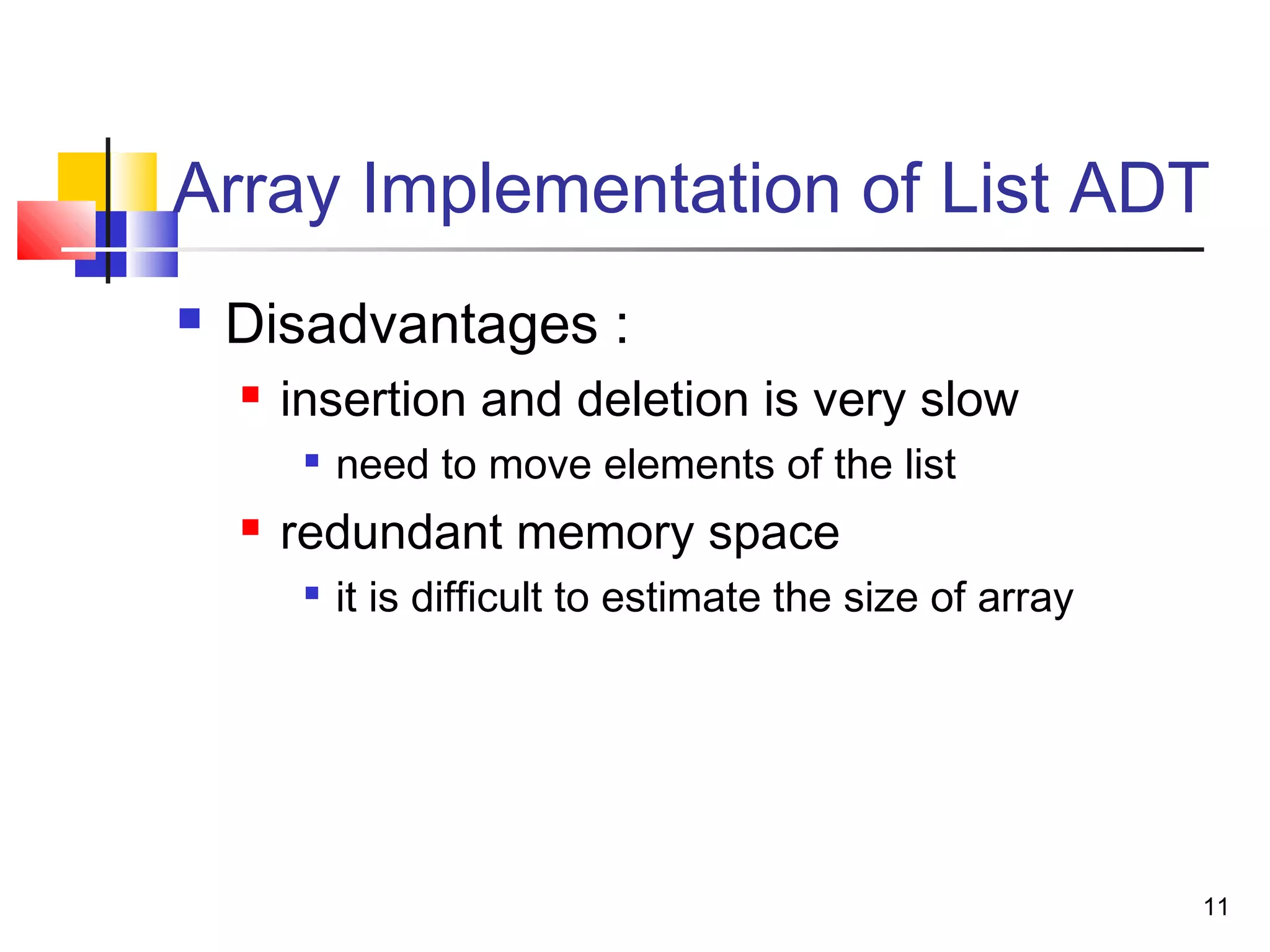
11 Array Implementation of List ADT  Disadvantages :  insertion and deletion is very slow  need to move elements of the list  redundant memory space  it is difficult to estimate the size of array
12 ROAD MAP  Abstract Data Types (ADT)  The List ADT  Implementation of Lists  Array implementation of lists  Linked list implementation of lists  Cursor implementation of lists
13 Linked List Implementation of Lists  Series of nodes  not adjacent in memory  contain the element and a pointer to a node containing its succesor  Avoids the linear cost of insertion and deletion !
14 Linked List Implementation of Lists  Insertion into a linked list
15 Linked List Implementation of Lists  Deletion from a linked list
16 Linked List Implementation of Lists  Need to know where the first node is  the rest of the nodes can be accessed  No need to move the list for insertion and deletion operations  No memory waste
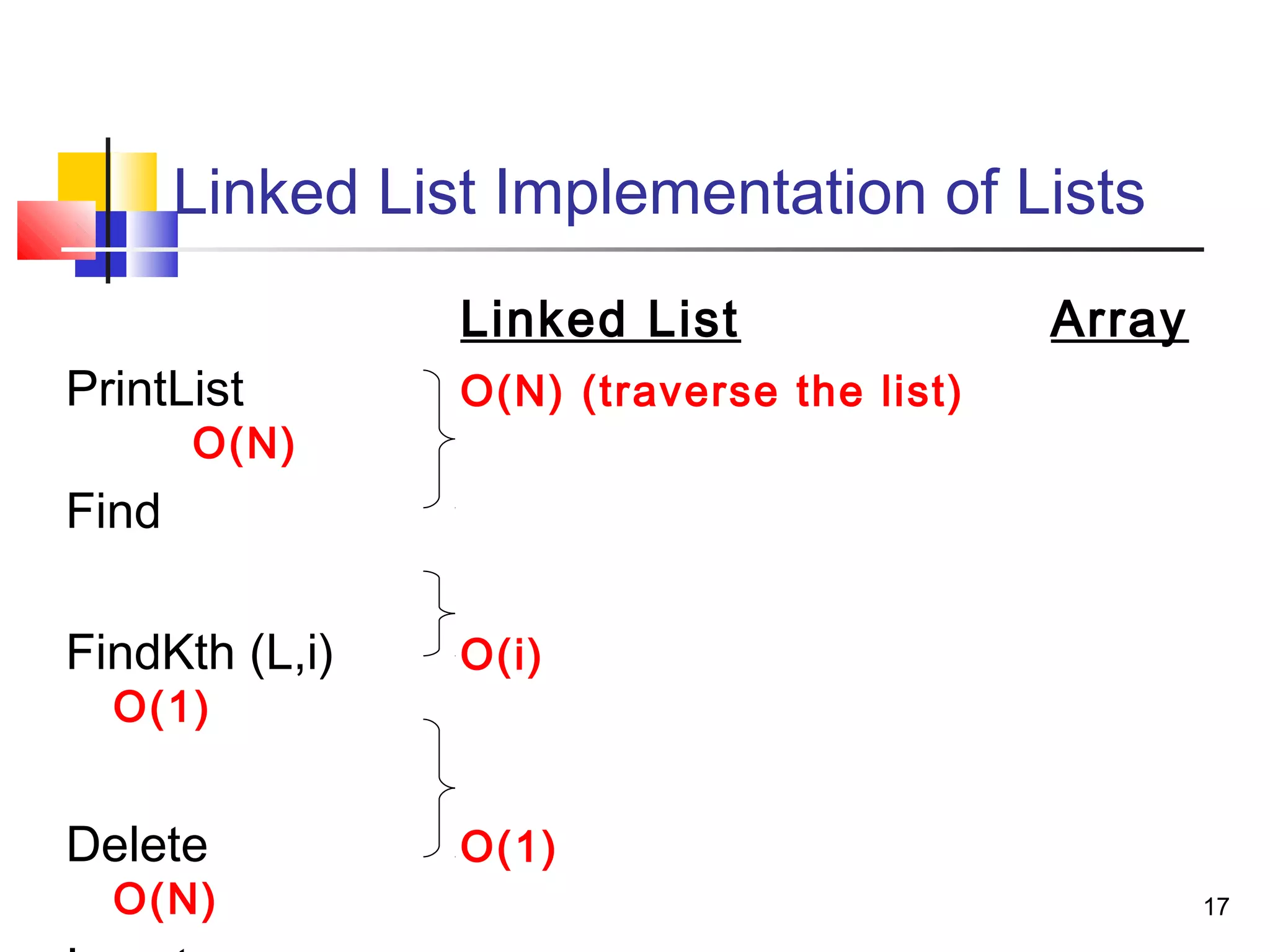
17 Linked List Implementation of Lists Linked List Array PrintList O(N) (traverse the list) O(N) Find FindKth (L,i) O(i) O(1) Delete O(1) O(N)
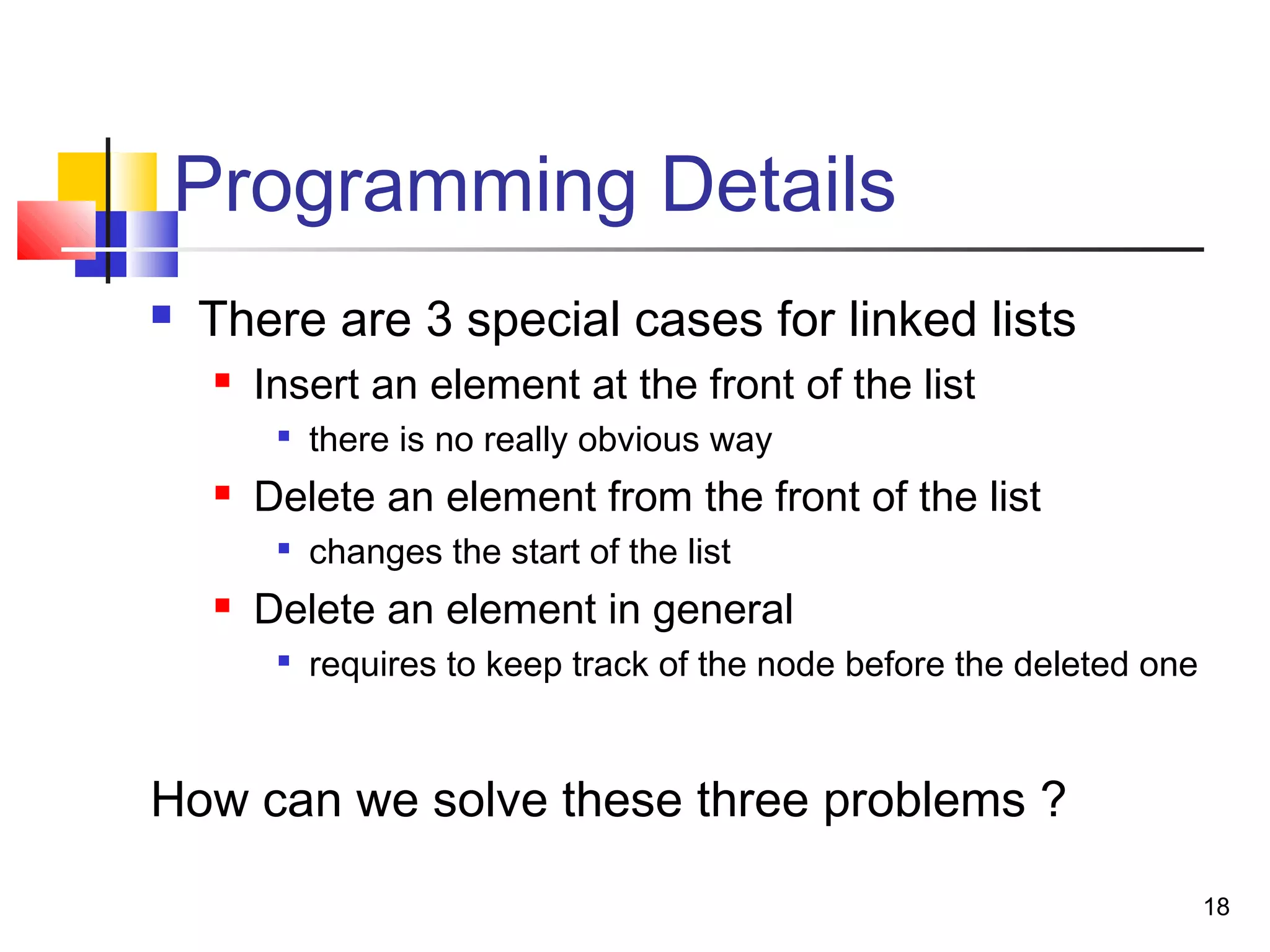
18 Programming Details  There are 3 special cases for linked lists  Insert an element at the front of the list  there is no really obvious way  Delete an element from the front of the list  changes the start of the list  Delete an element in general  requires to keep track of the node before the deleted one How can we solve these three problems ?
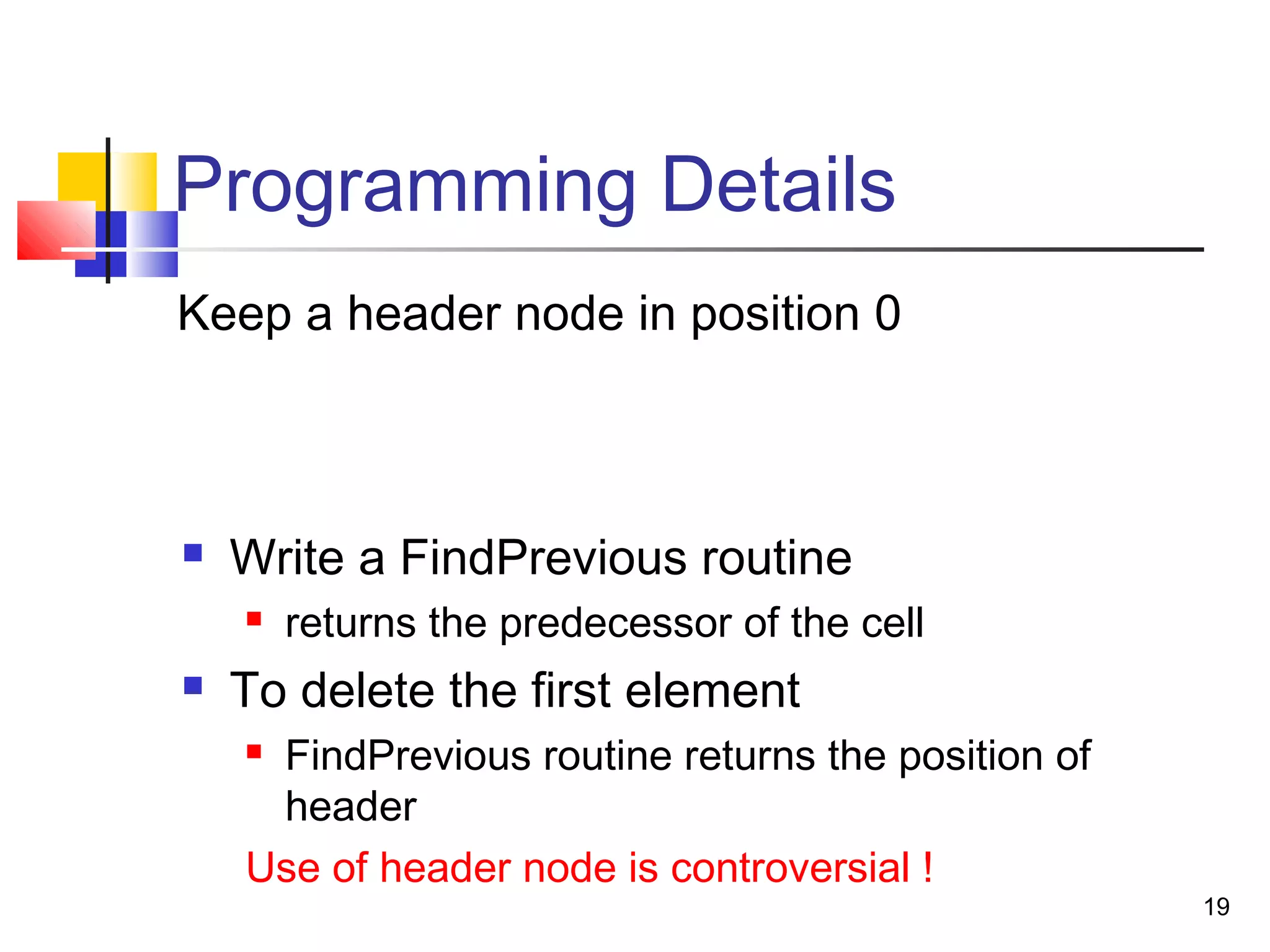
19 Programming Details Keep a header node in position 0  Write a FindPrevious routine  returns the predecessor of the cell  To delete the first element  FindPrevious routine returns the position of header Use of header node is controversial !
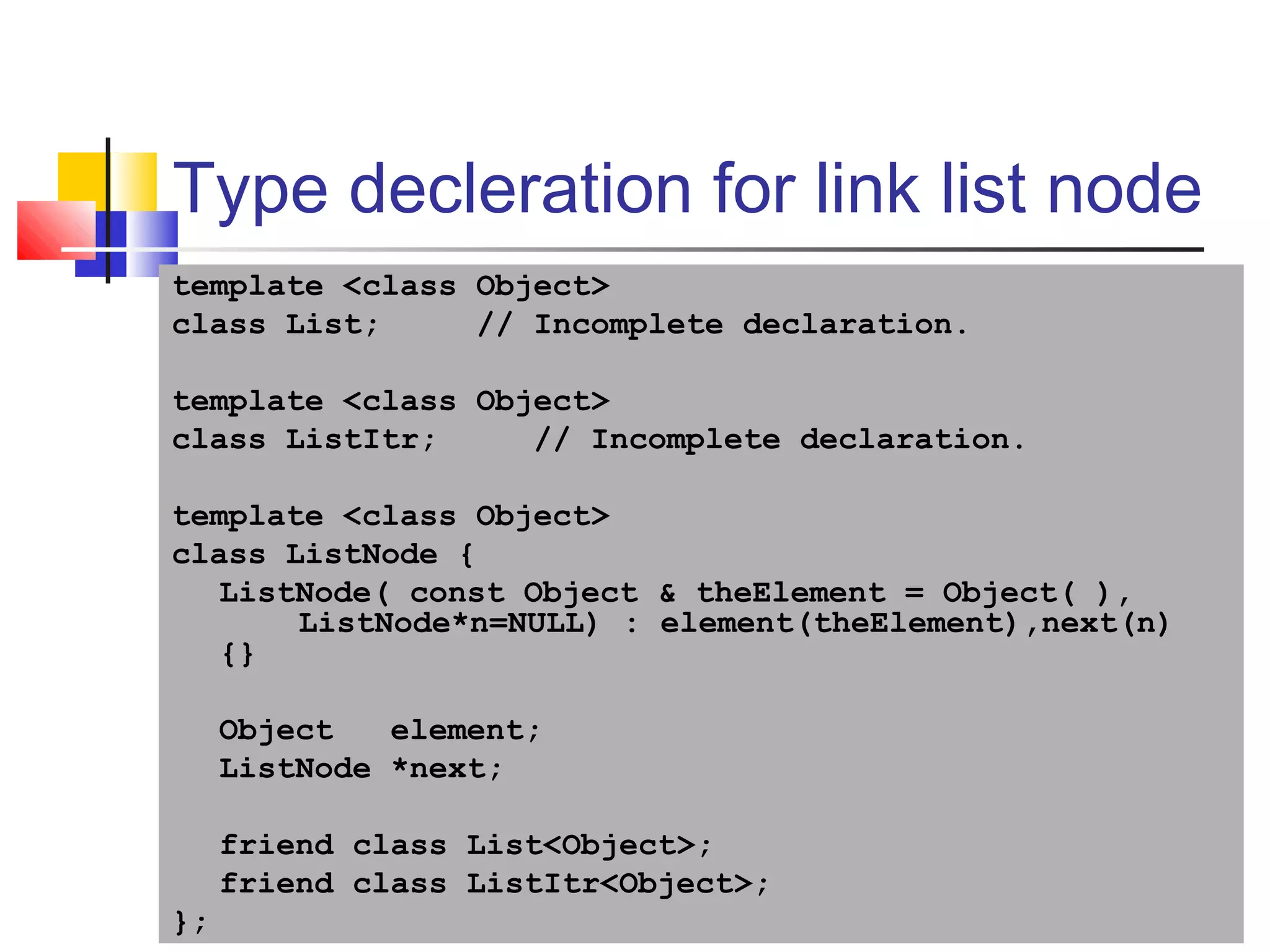
20 Type decleration for link list node template <class Object> class List; // Incomplete declaration. template <class Object> class ListItr; // Incomplete declaration. template <class Object> class ListNode { ListNode( const Object & theElement = Object( ), ListNode*n=NULL) : element(theElement),next(n) {} Object element; ListNode *next; friend class List<Object>; friend class ListItr<Object>; };
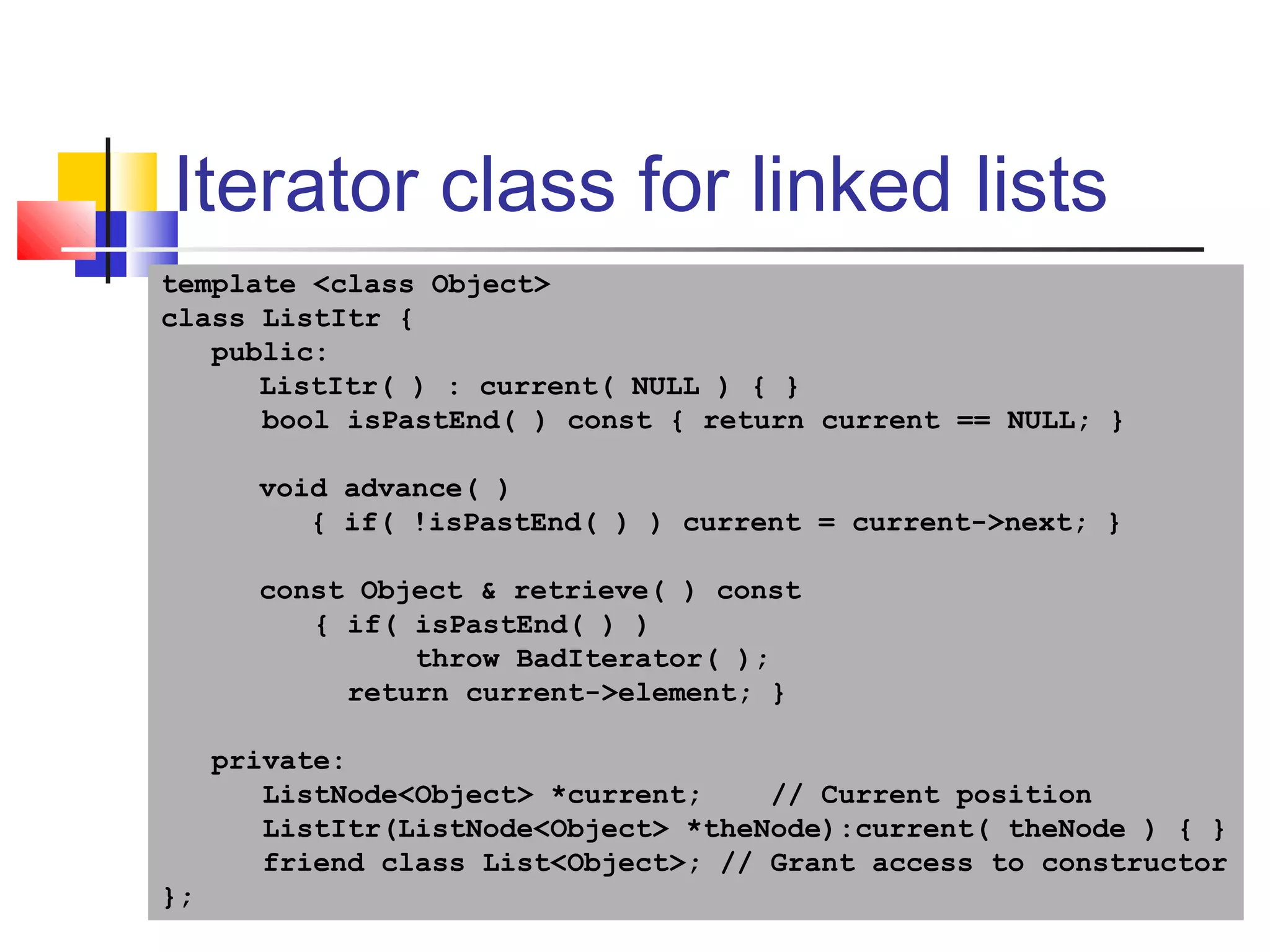
21 Iterator class for linked lists template <class Object> class ListItr { public: ListItr( ) : current( NULL ) { } bool isPastEnd( ) const { return current == NULL; } void advance( ) { if( !isPastEnd( ) ) current = current->next; } const Object & retrieve( ) const { if( isPastEnd( ) ) throw BadIterator( ); return current->element; } private: ListNode<Object> *current; // Current position ListItr(ListNode<Object> *theNode):current( theNode ) { } friend class List<Object>; // Grant access to constructor };
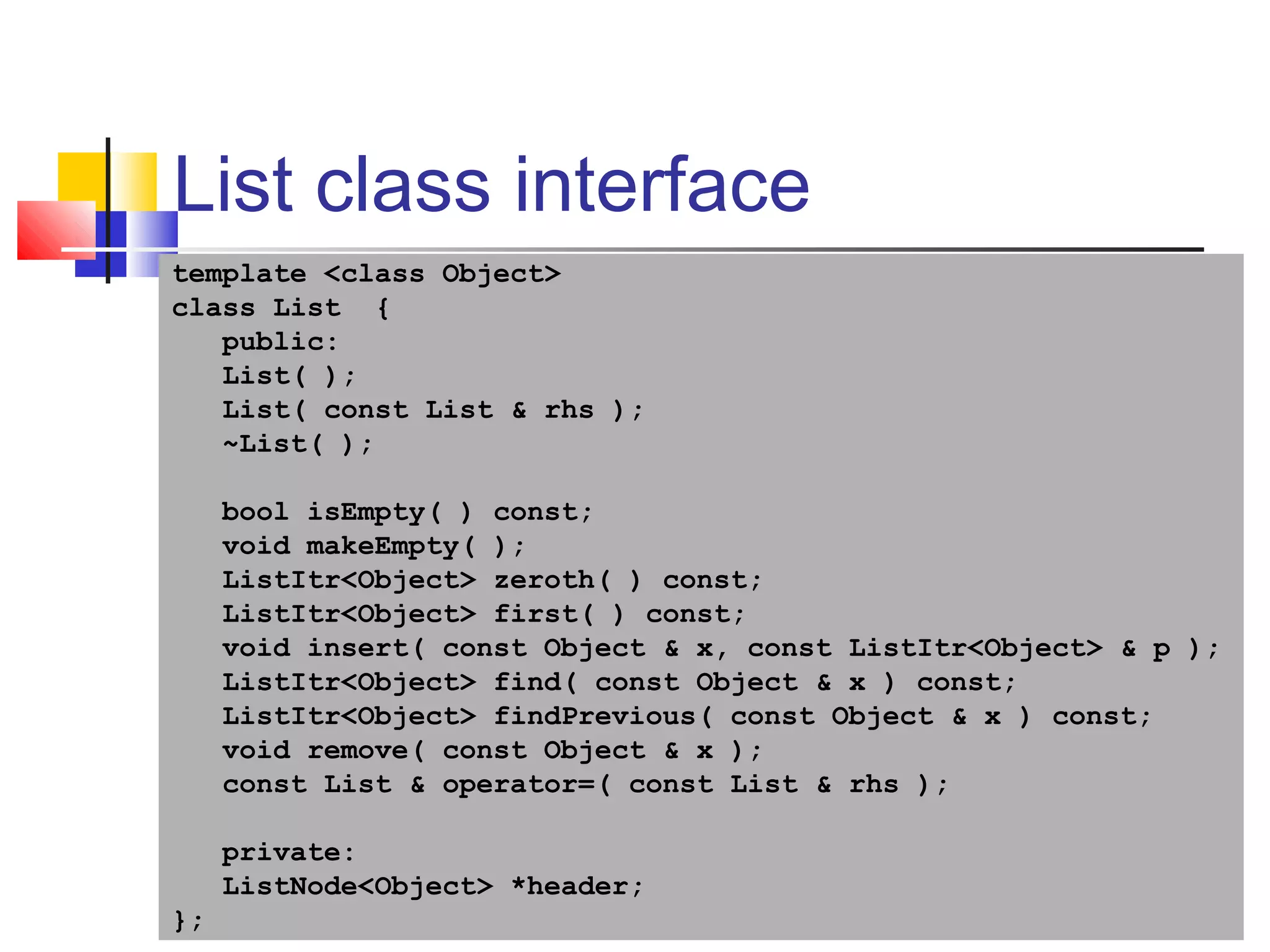
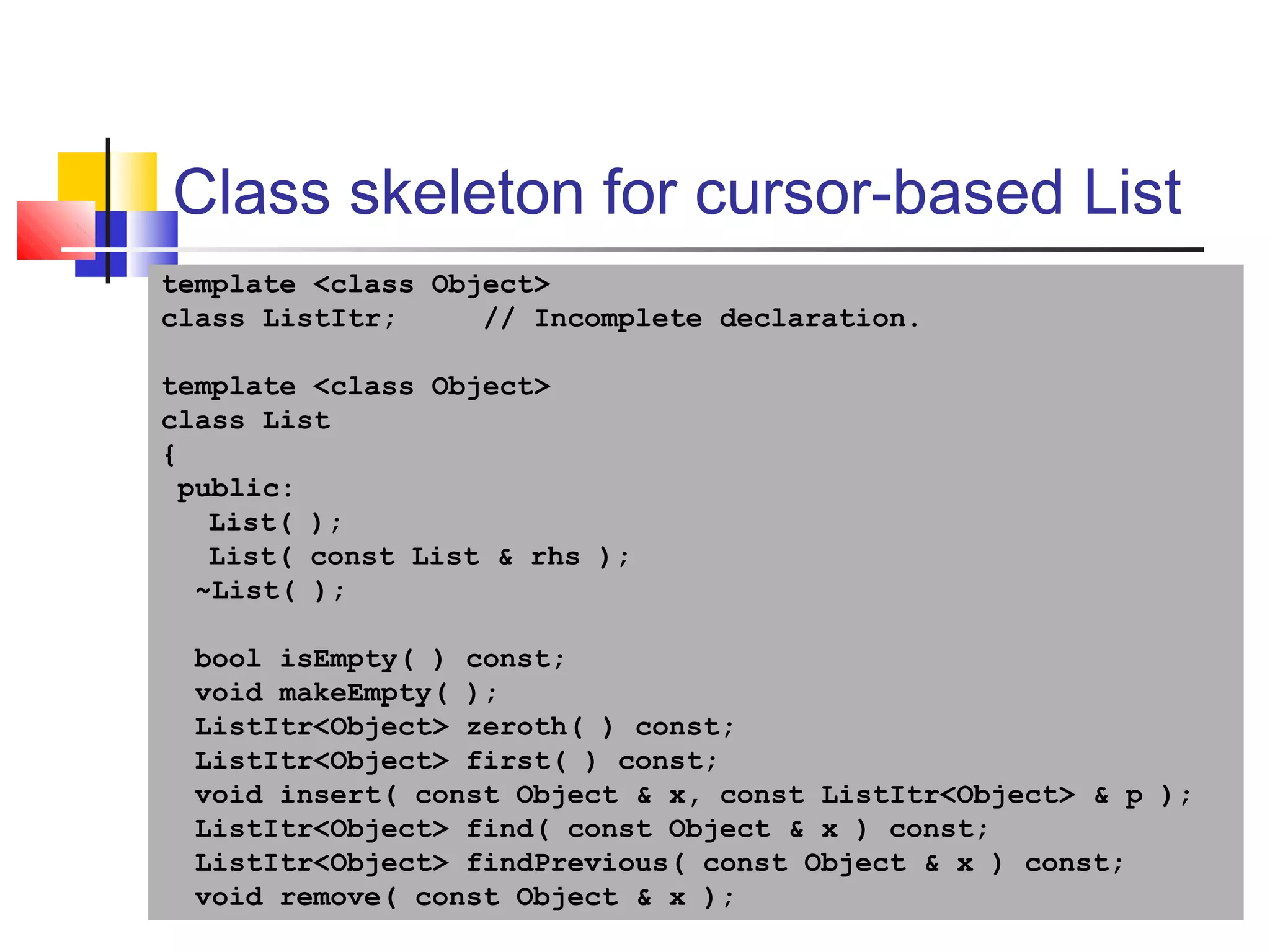
22 List class interface template <class Object> class List { public: List( ); List( const List & rhs ); ~List( ); bool isEmpty( ) const; void makeEmpty( ); ListItr<Object> zeroth( ) const; ListItr<Object> first( ) const; void insert( const Object & x, const ListItr<Object> & p ); ListItr<Object> find( const Object & x ) const; ListItr<Object> findPrevious( const Object & x ) const; void remove( const Object & x ); const List & operator=( const List & rhs ); private: ListNode<Object> *header; };
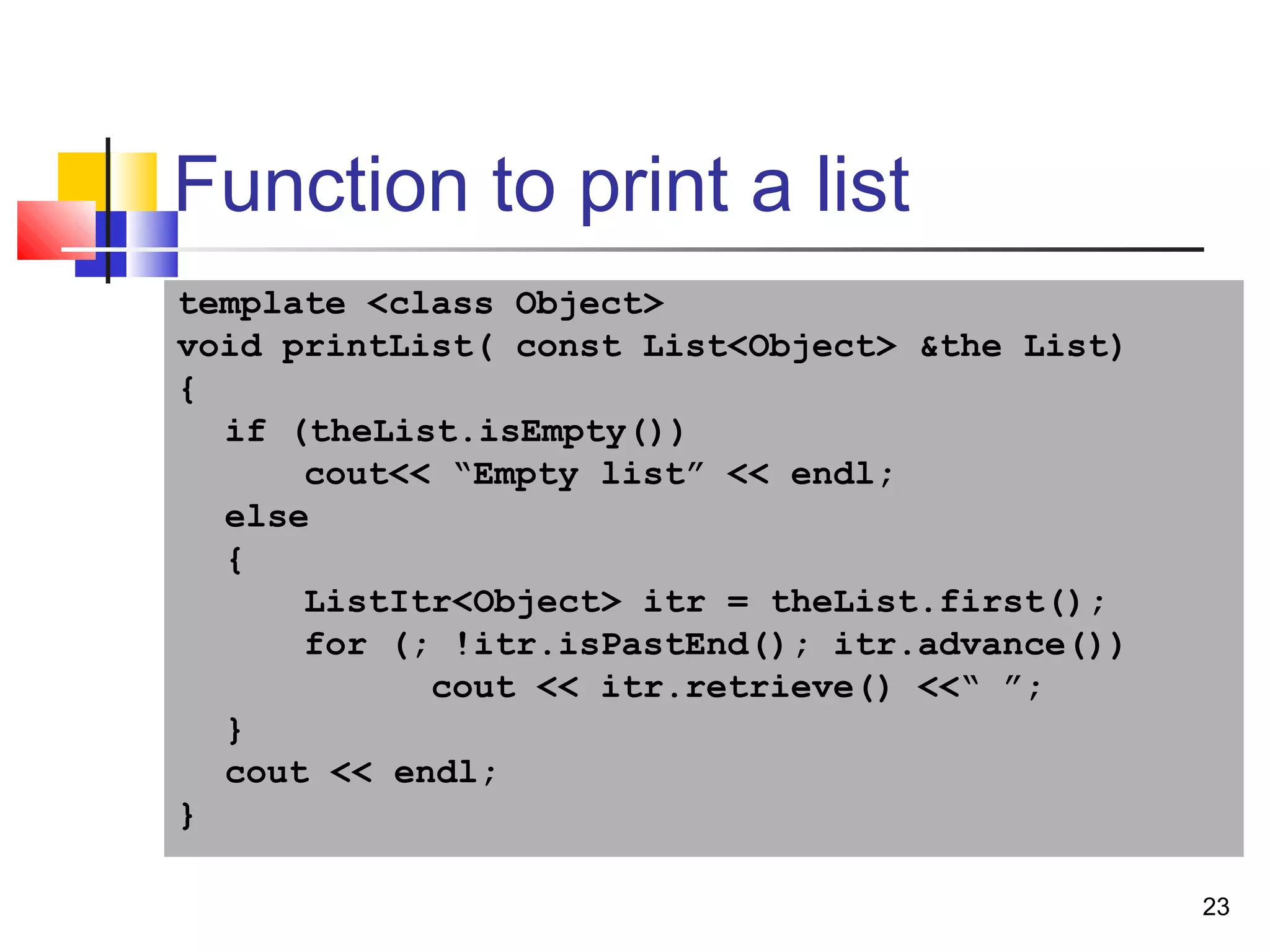
23 Function to print a list template <class Object> void printList( const List<Object> &the List) { if (theList.isEmpty()) cout<< “Empty list” << endl; else { ListItr<Object> itr = theList.first(); for (; !itr.isPastEnd(); itr.advance()) cout << itr.retrieve() <<“ ”; } cout << endl; }
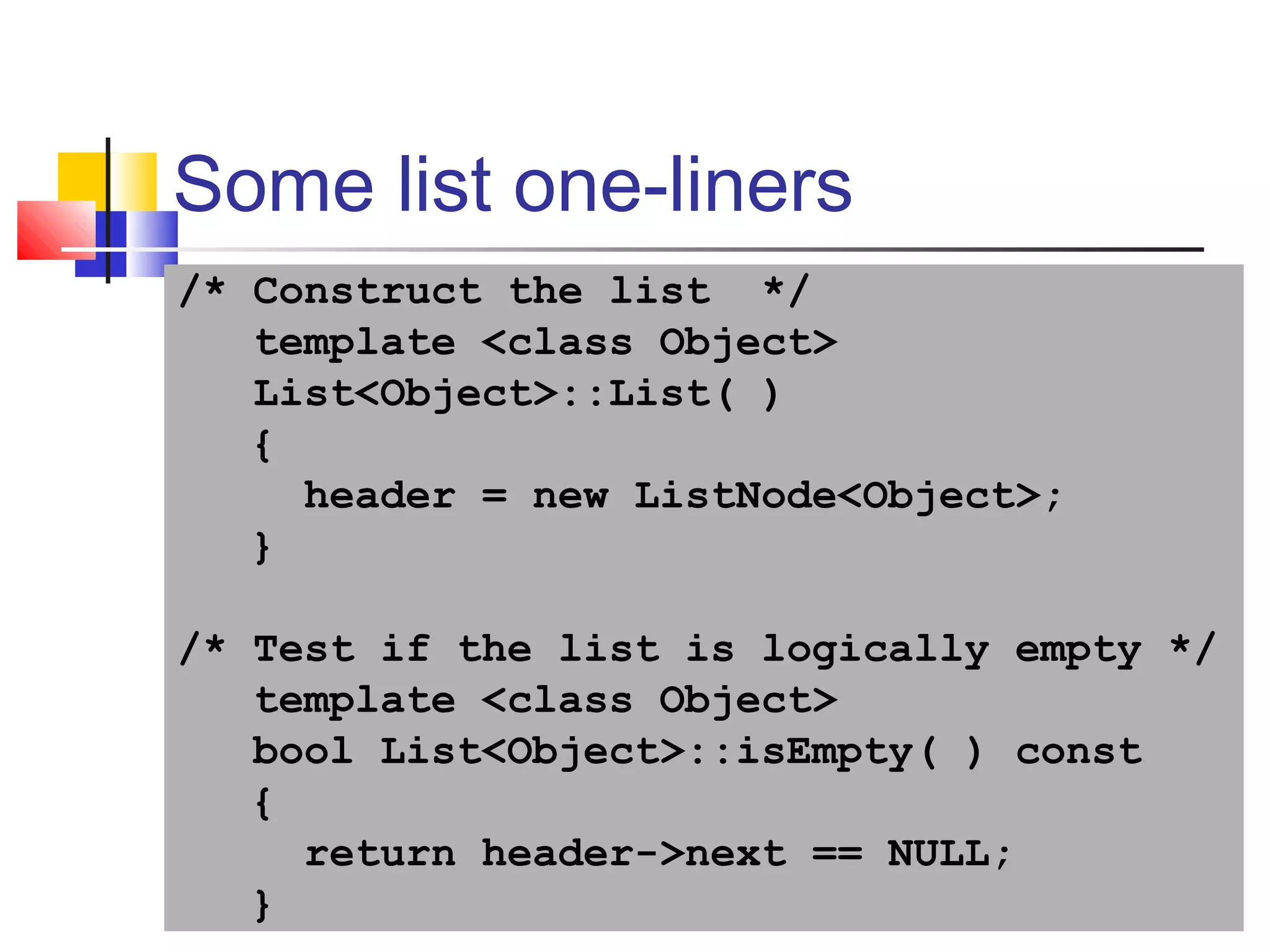
24 Some list one-liners /* Construct the list */ template <class Object> List<Object>::List( ) { header = new ListNode<Object>; } /* Test if the list is logically empty */ template <class Object> bool List<Object>::isEmpty( ) const { return header->next == NULL; }
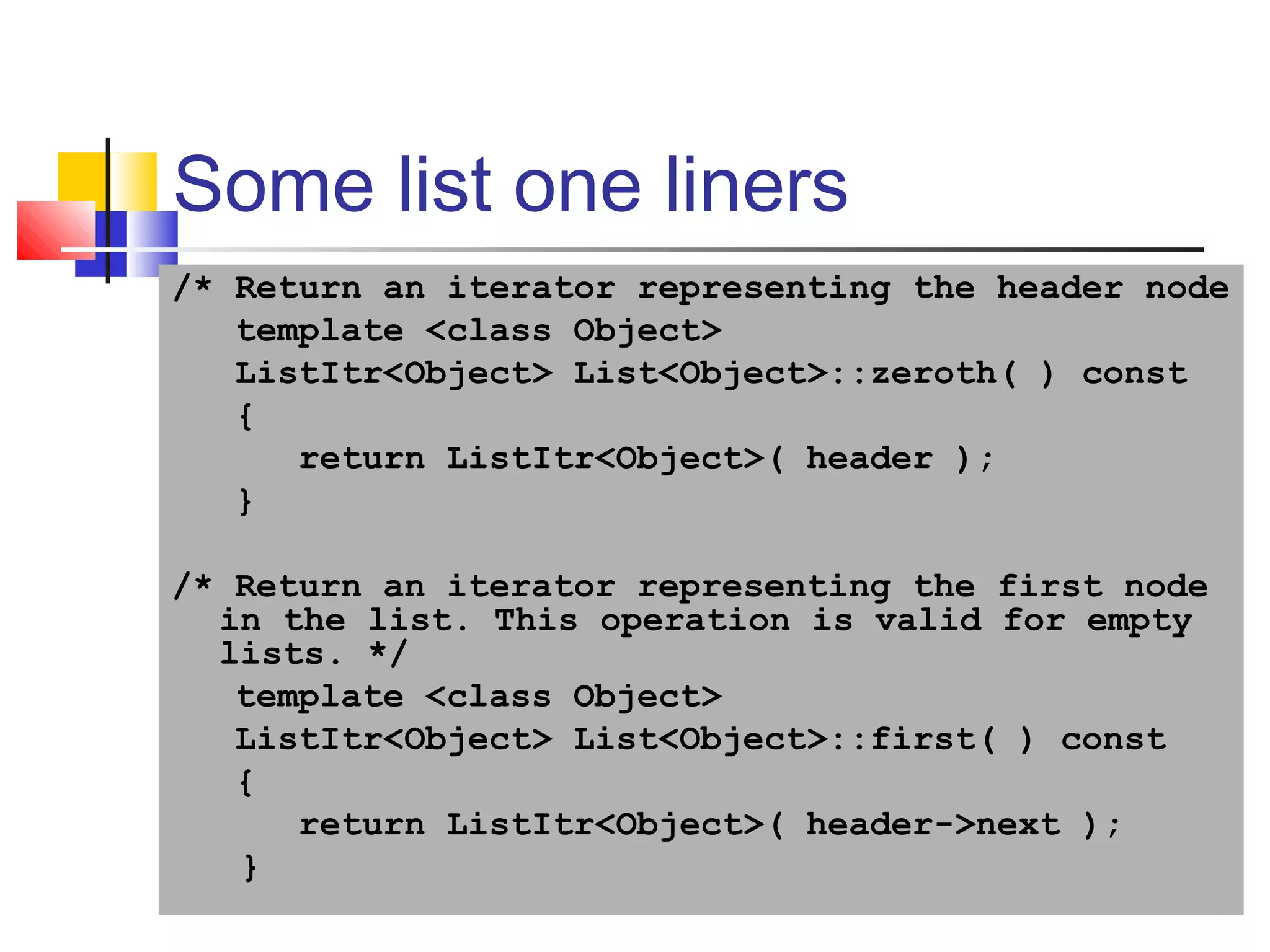
25 Some list one liners /* Return an iterator representing the header node template <class Object> ListItr<Object> List<Object>::zeroth( ) const { return ListItr<Object>( header ); } /* Return an iterator representing the first node in the list. This operation is valid for empty lists. */ template <class Object> ListItr<Object> List<Object>::first( ) const { return ListItr<Object>( header->next ); }
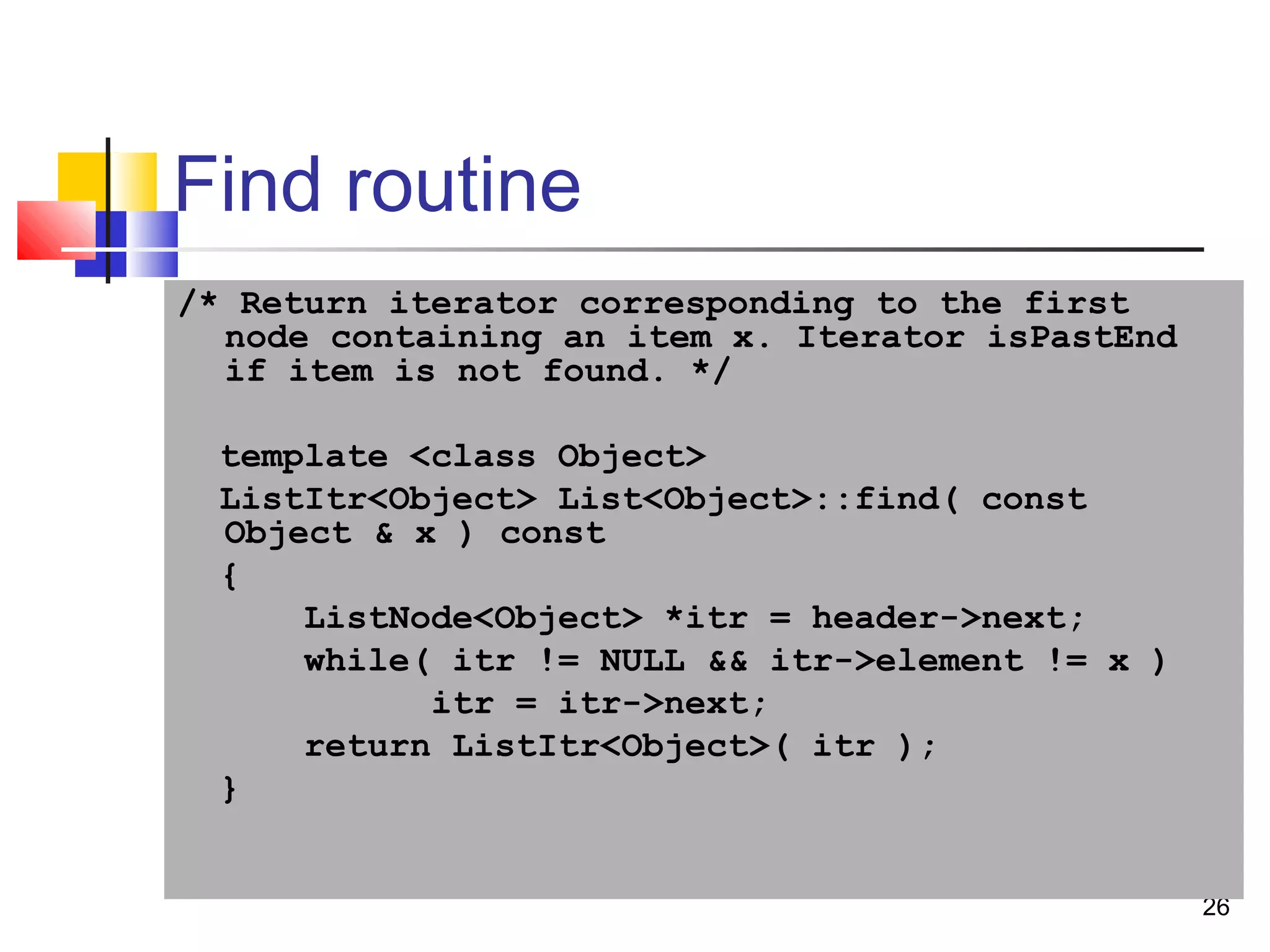
26 Find routine /* Return iterator corresponding to the first node containing an item x. Iterator isPastEnd if item is not found. */ template <class Object> ListItr<Object> List<Object>::find( const Object & x ) const { ListNode<Object> *itr = header->next; while( itr != NULL && itr->element != x ) itr = itr->next; return ListItr<Object>( itr ); }
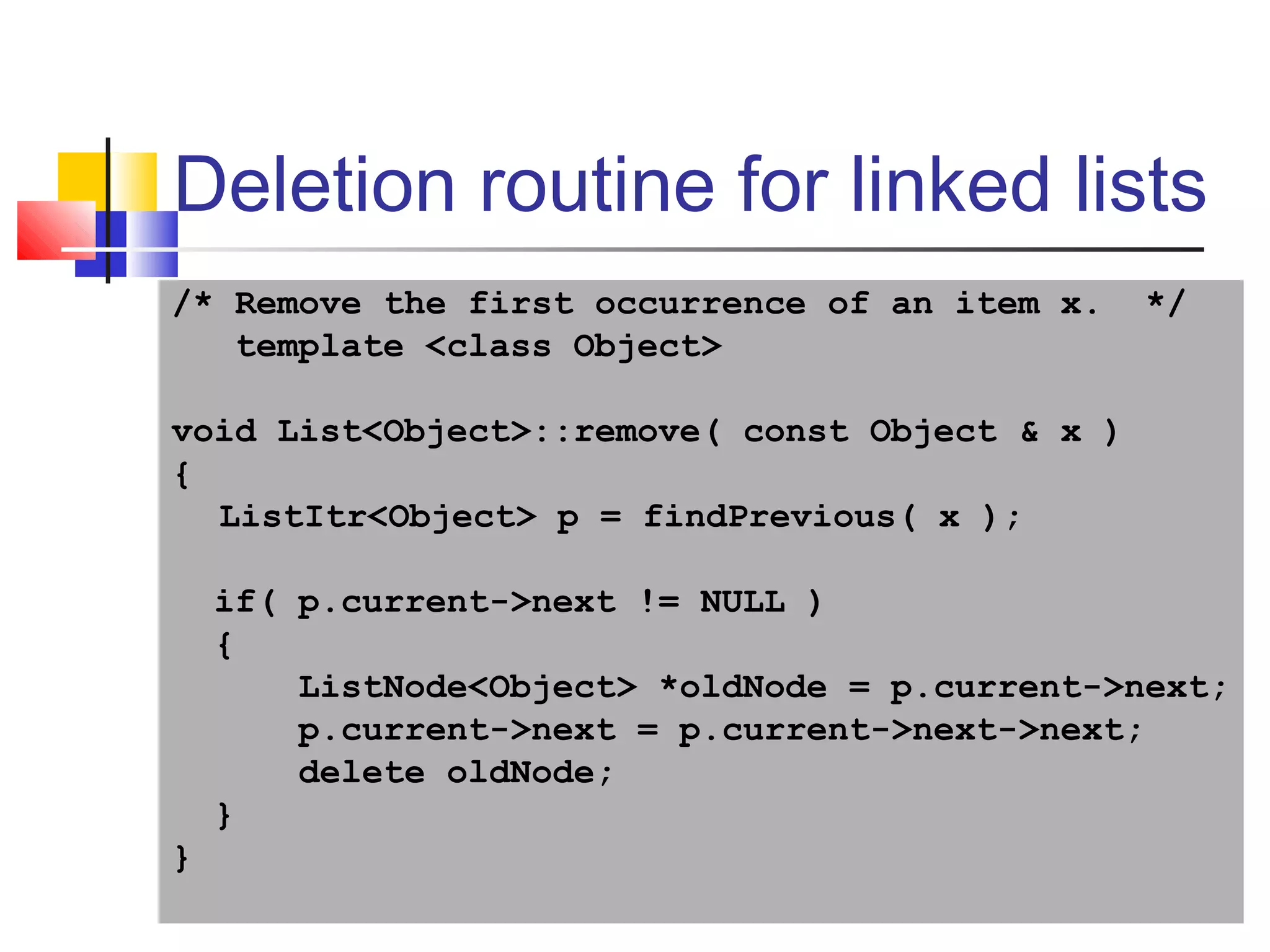
27 Deletion routine for linked lists /* Remove the first occurrence of an item x. */ template <class Object> void List<Object>::remove( const Object & x ) { ListItr<Object> p = findPrevious( x ); if( p.current->next != NULL ) { ListNode<Object> *oldNode = p.current->next; p.current->next = p.current->next->next; delete oldNode; } }
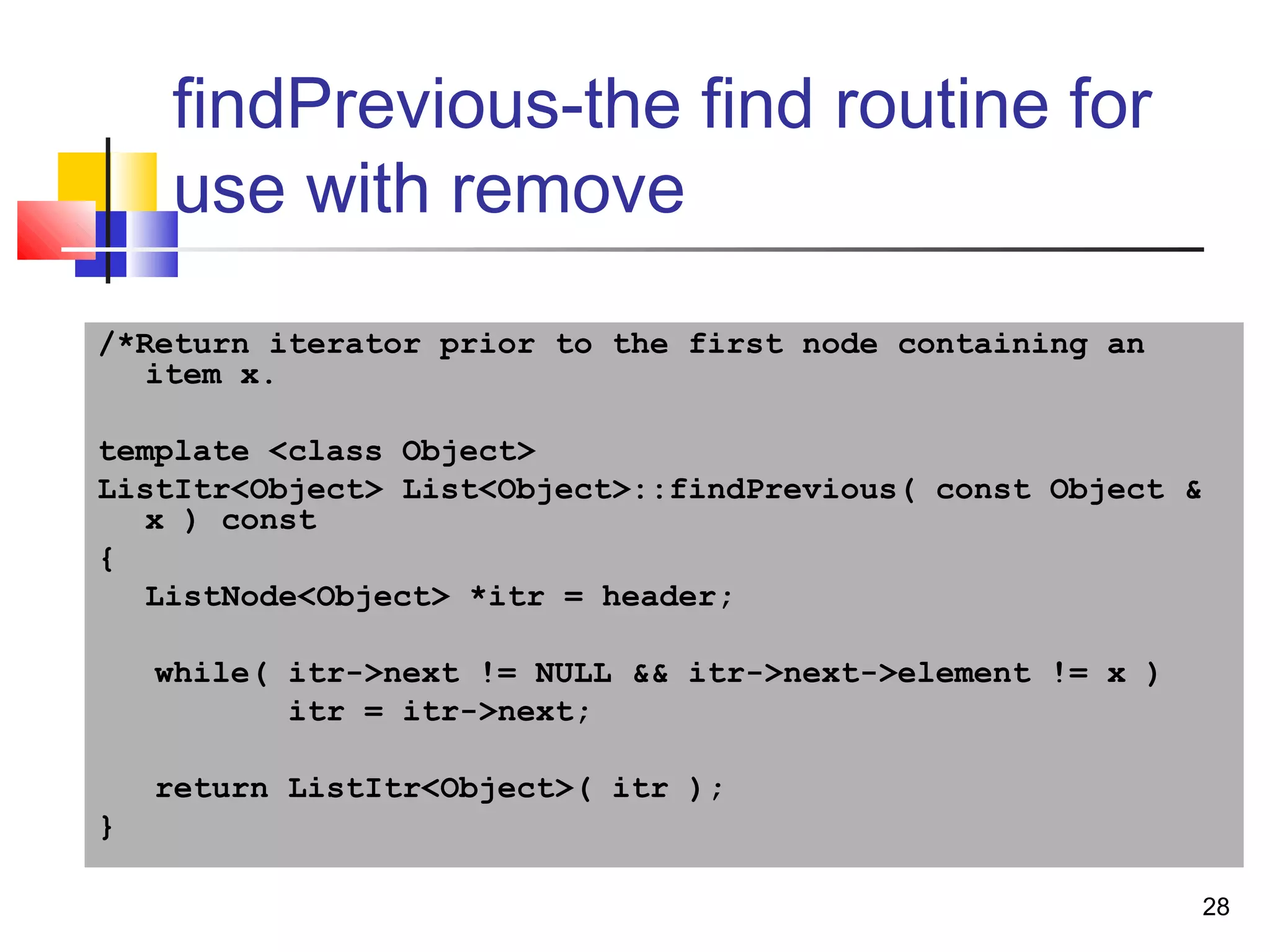
28 findPrevious-the find routine for use with remove /*Return iterator prior to the first node containing an item x. template <class Object> ListItr<Object> List<Object>::findPrevious( const Object & x ) const { ListNode<Object> *itr = header; while( itr->next != NULL && itr->next->element != x ) itr = itr->next; return ListItr<Object>( itr ); }
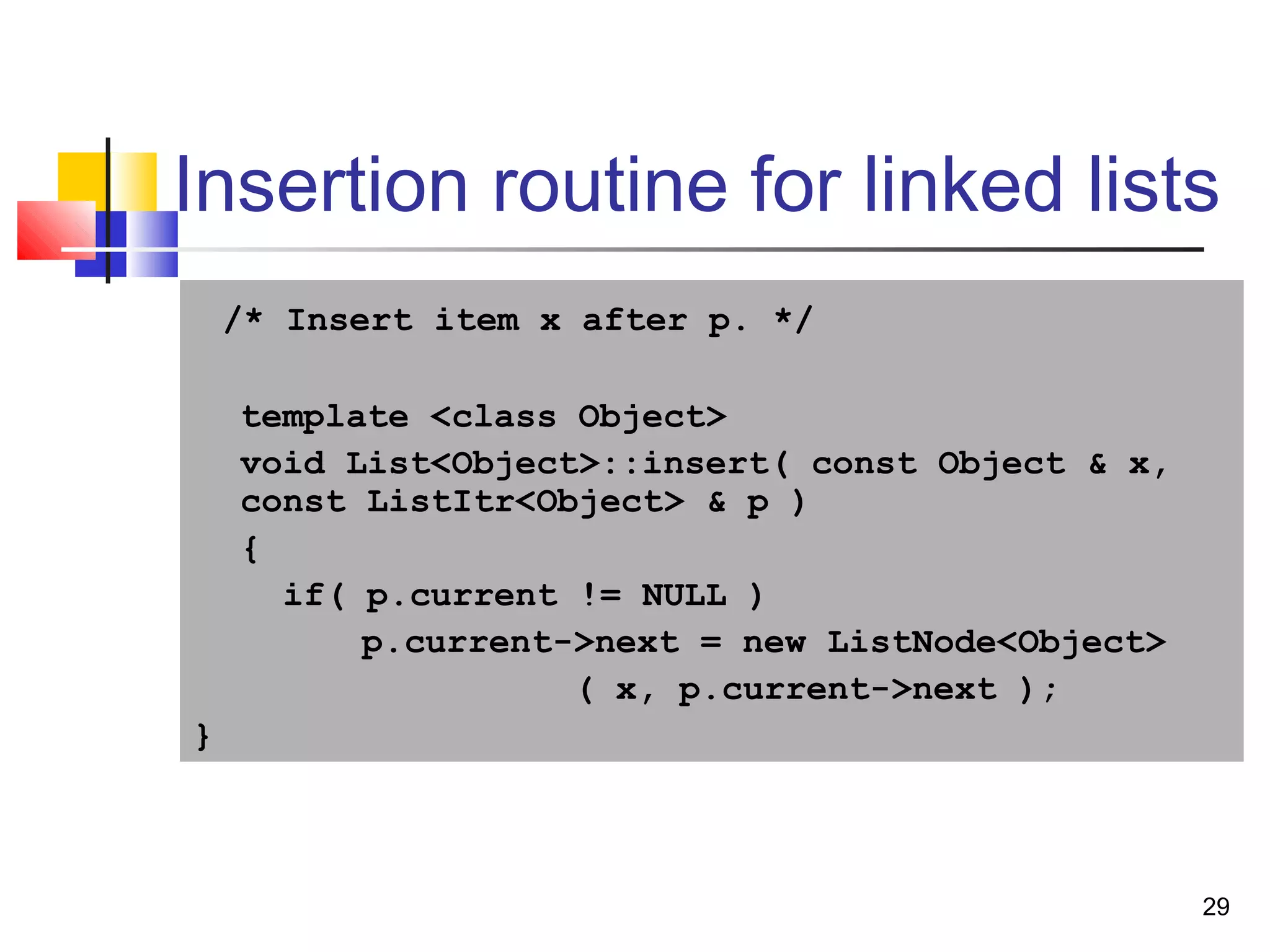
29 Insertion routine for linked lists /* Insert item x after p. */ template <class Object> void List<Object>::insert( const Object & x, const ListItr<Object> & p ) { if( p.current != NULL ) p.current->next = new ListNode<Object> ( x, p.current->next ); }
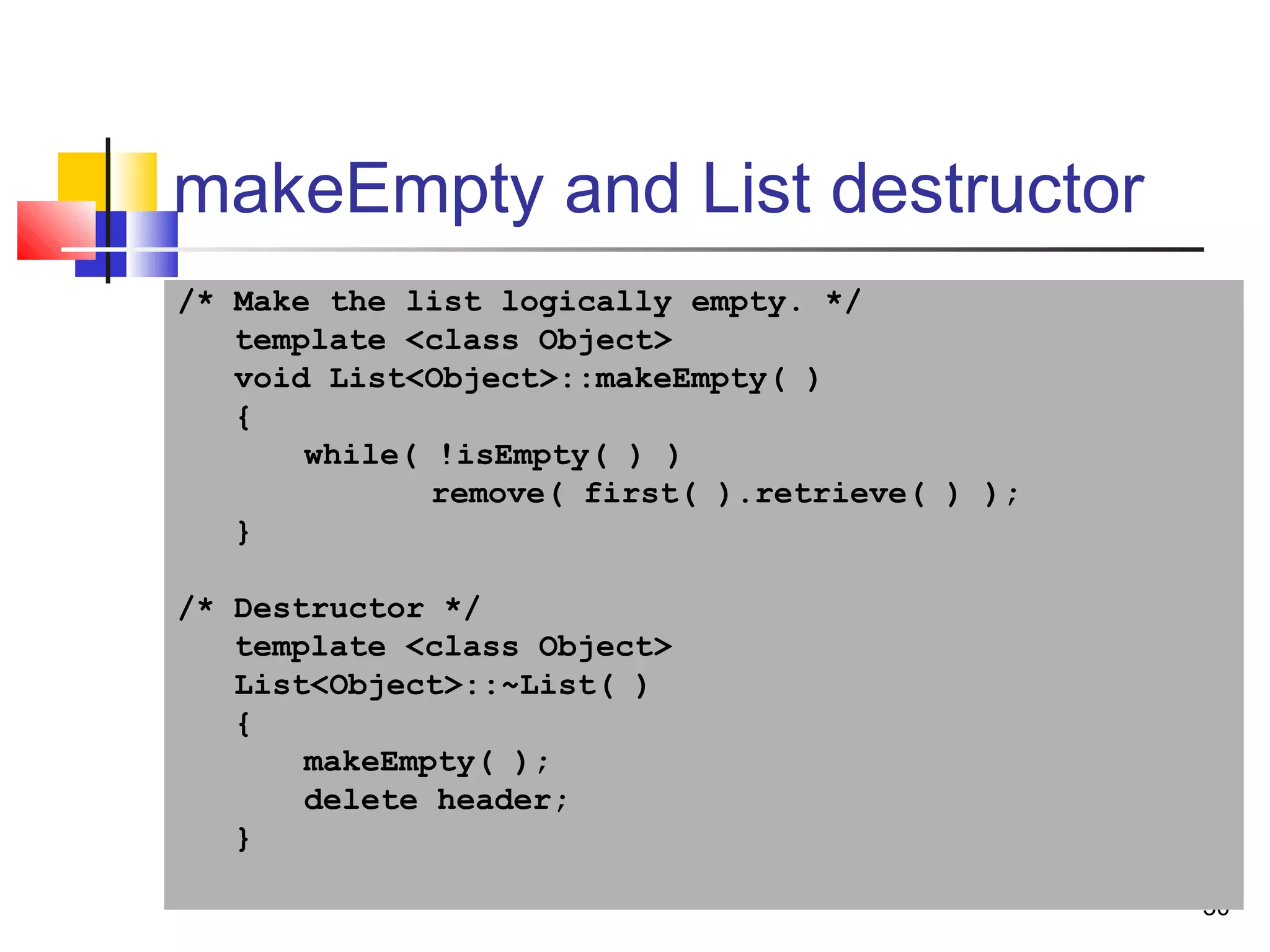
30 makeEmpty and List destructor /* Make the list logically empty. */ template <class Object> void List<Object>::makeEmpty( ) { while( !isEmpty( ) ) remove( first( ).retrieve( ) ); } /* Destructor */ template <class Object> List<Object>::~List( ) { makeEmpty( ); delete header; }
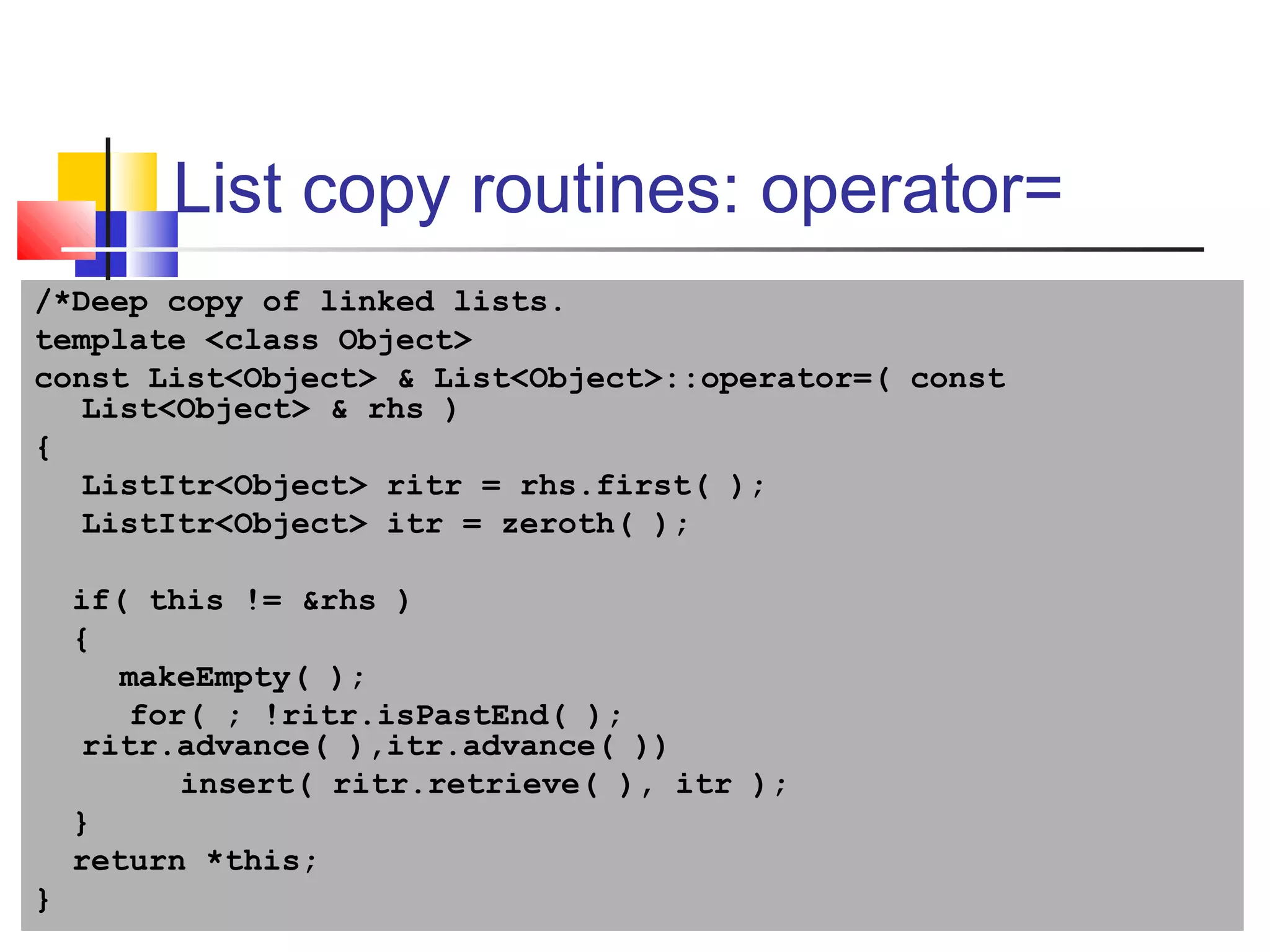
31 List copy routines: operator= /*Deep copy of linked lists. template <class Object> const List<Object> & List<Object>::operator=( const List<Object> & rhs ) { ListItr<Object> ritr = rhs.first( ); ListItr<Object> itr = zeroth( ); if( this != &rhs ) { makeEmpty( ); for( ; !ritr.isPastEnd( ); ritr.advance( ),itr.advance( )) insert( ritr.retrieve( ), itr ); } return *this; }
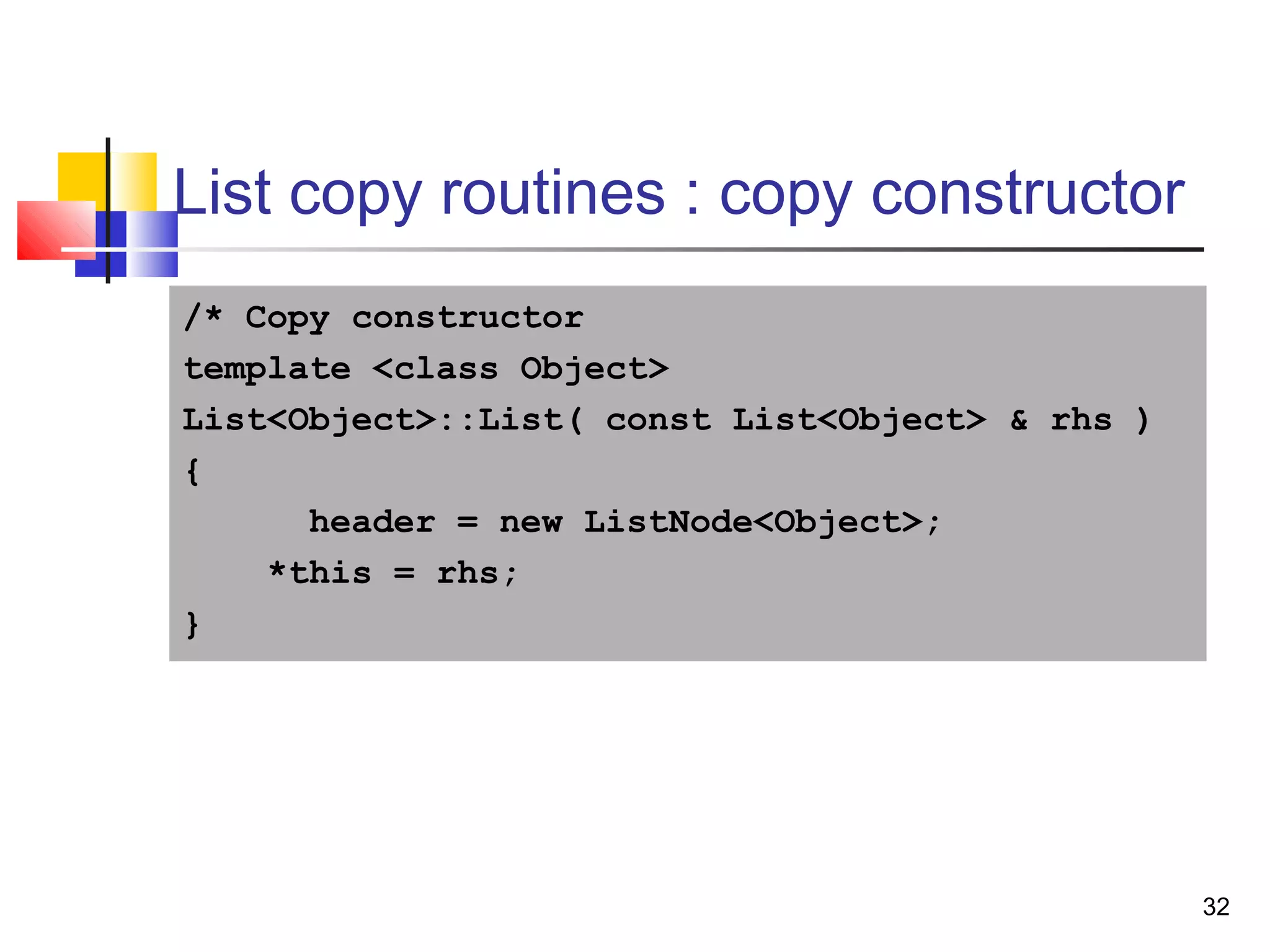
32 List copy routines : copy constructor /* Copy constructor template <class Object> List<Object>::List( const List<Object> & rhs ) { header = new ListNode<Object>; *this = rhs; }
33 Doubly Linked List  Traversing list backwards  not easy with regular lists  Insertion and deletion more pointer fixing  Deletion is easier  Previous node is easy to find
34 Circulary Linked List  Last node points the first
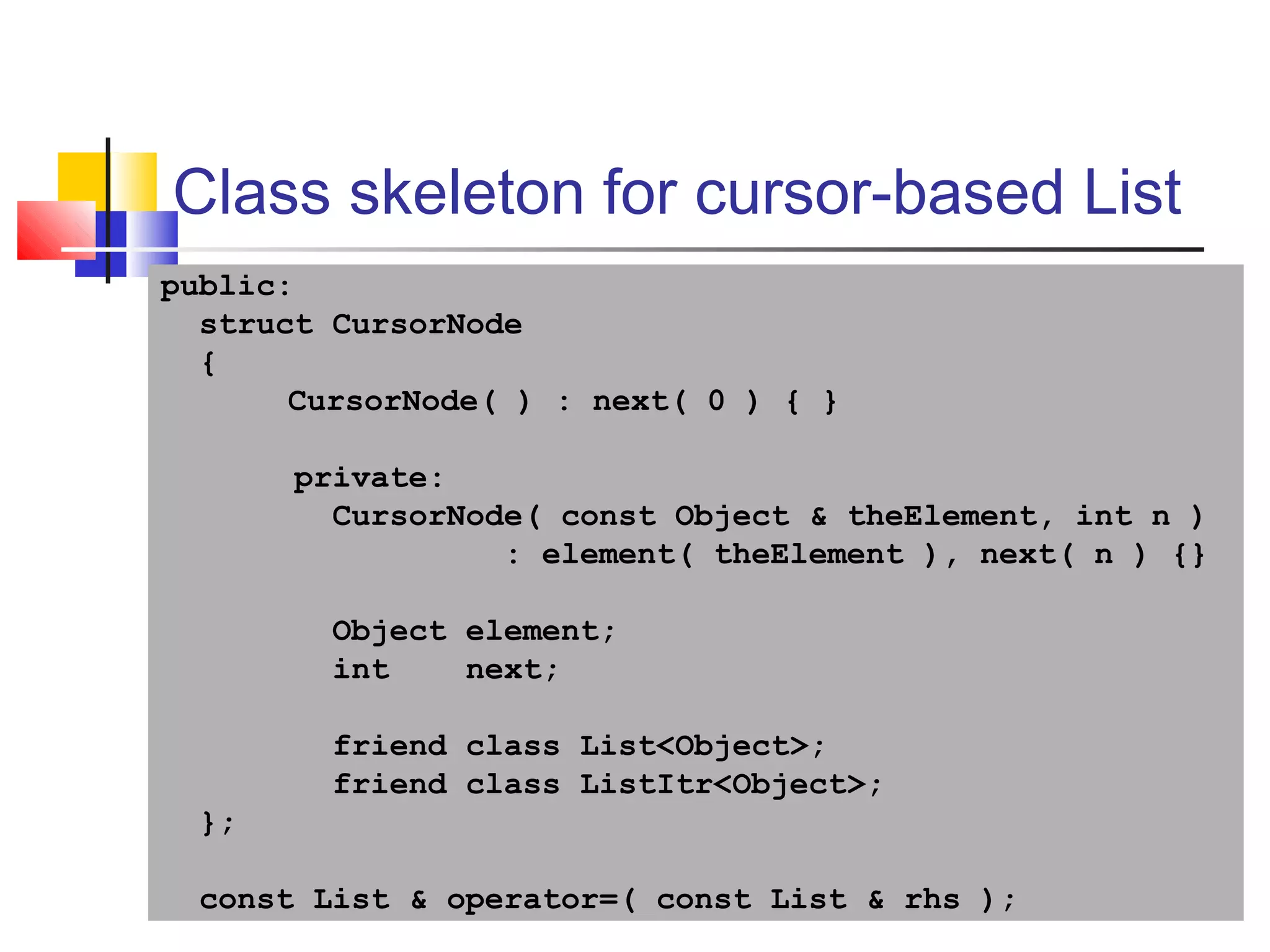
35 ROAD MAP  Abstract Data Types (ADT)  The List ADT  Implementation of Lists  Array implementation of lists  Linked list implementation of lists  Cursor implementation of lists
36 Cursor Implementation of Linked List Problems with linked list implementation:  Same language do not support pointers !  Then how can you use linked lists ?  new and free operations are slow  Actually not constant time
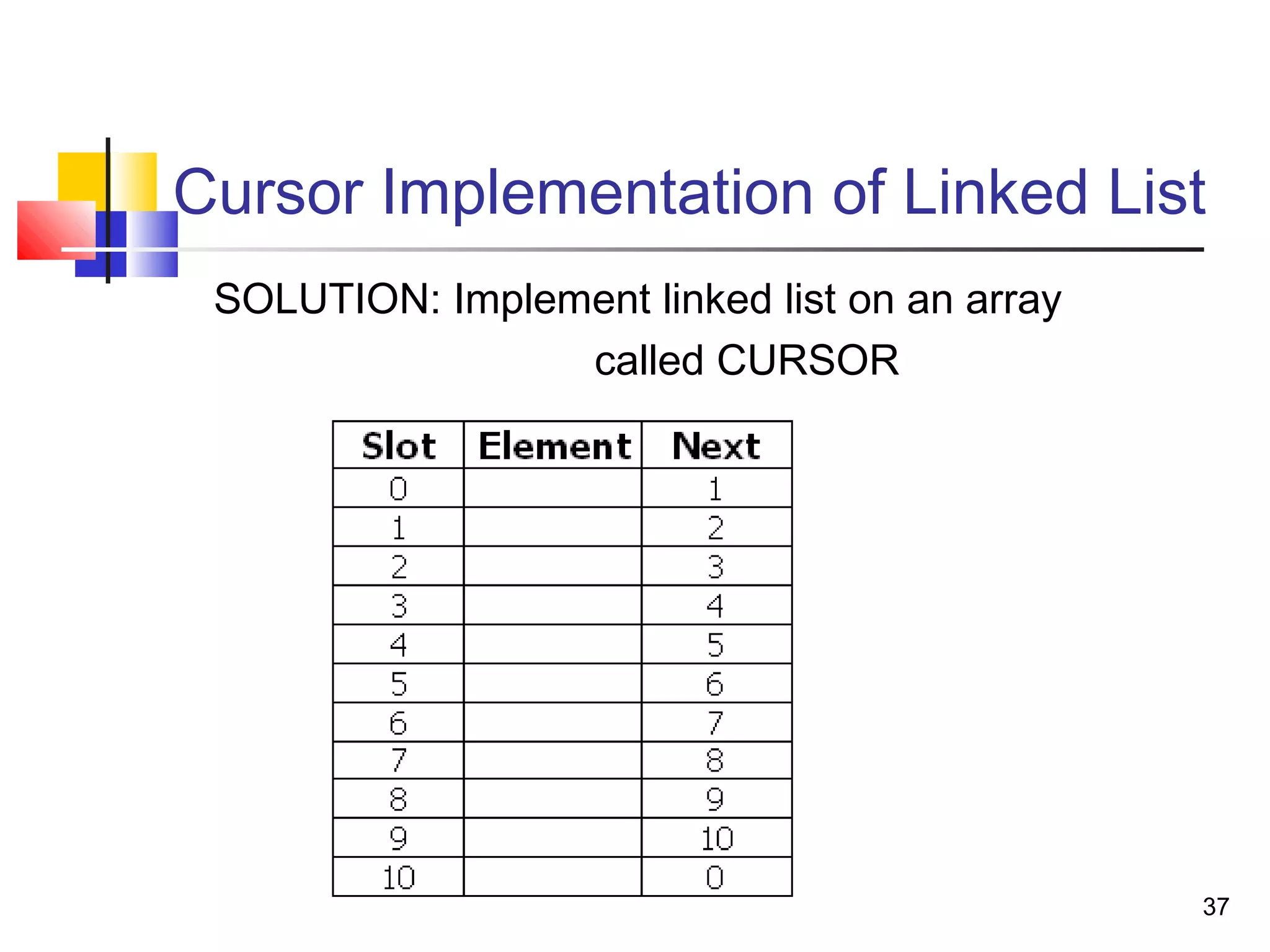
37 Cursor Implementation of Linked List SOLUTION: Implement linked list on an array called CURSOR
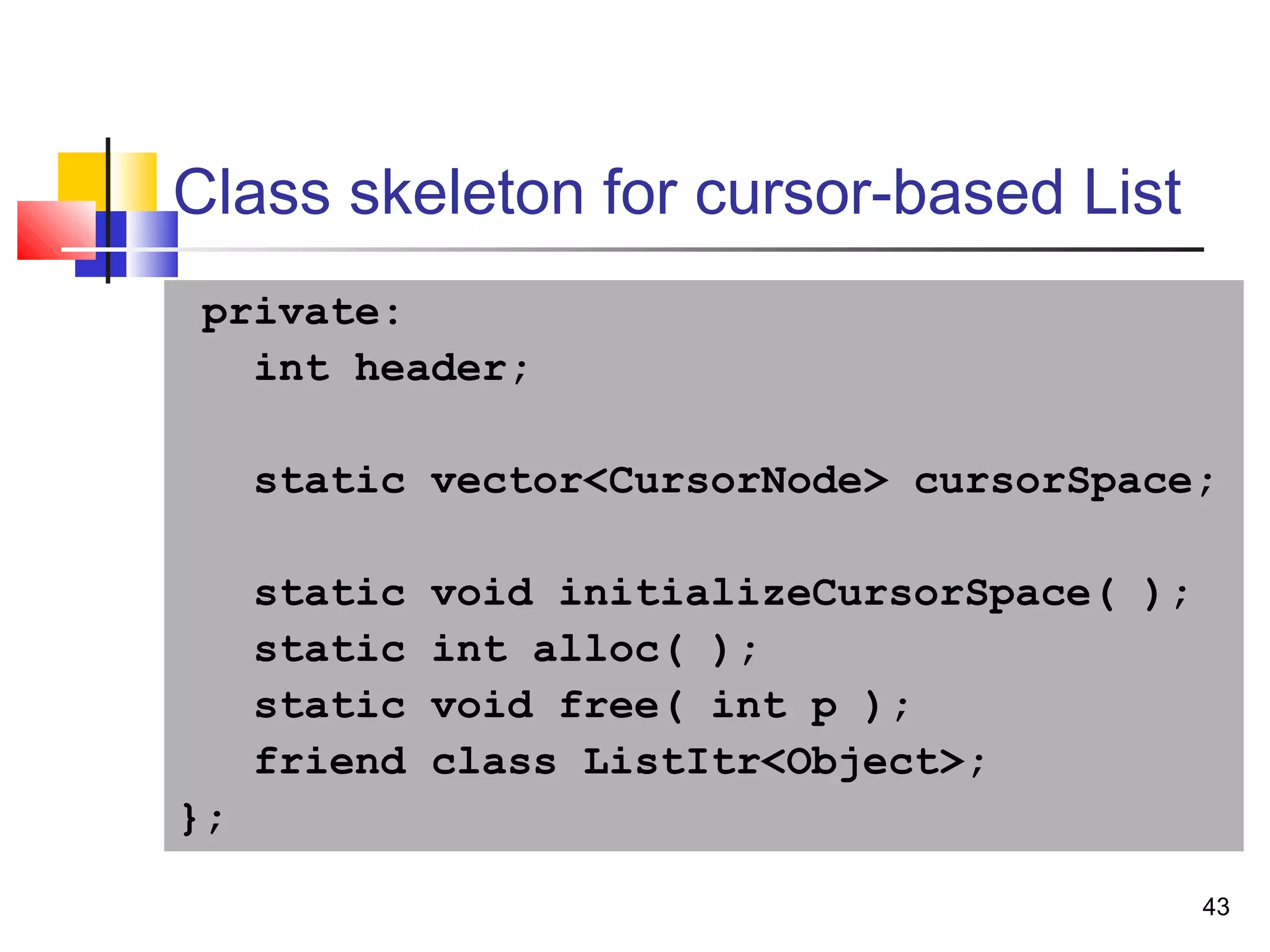
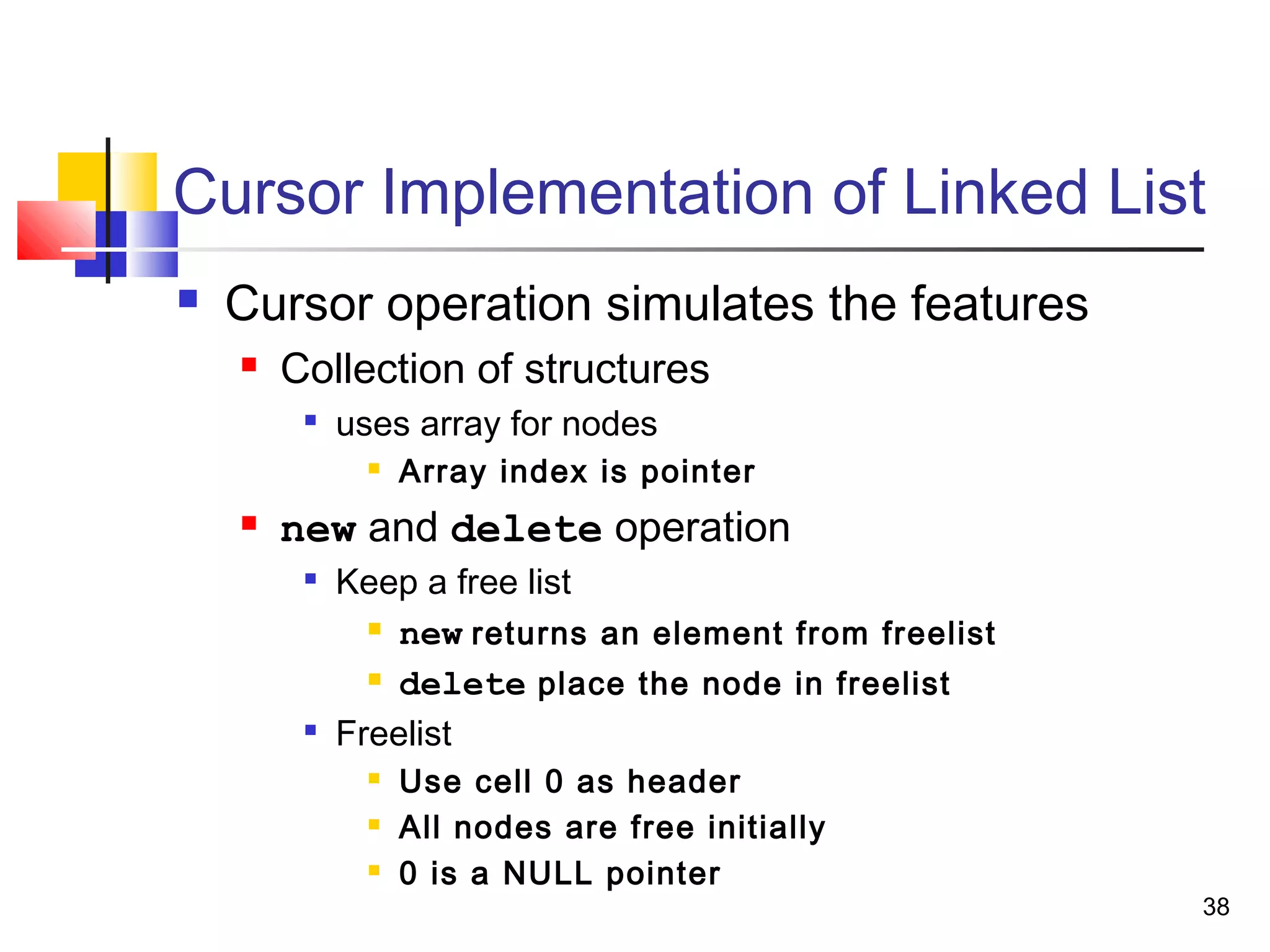
38 Cursor Implementation of Linked List  Cursor operation simulates the features  Collection of structures  uses array for nodes  Array index is pointer  new and delete operation  Keep a free list  new returns an element from freelist  delete place the node in freelist  Freelist  Use cell 0 as header  All nodes are free initially  0 is a NULL pointer
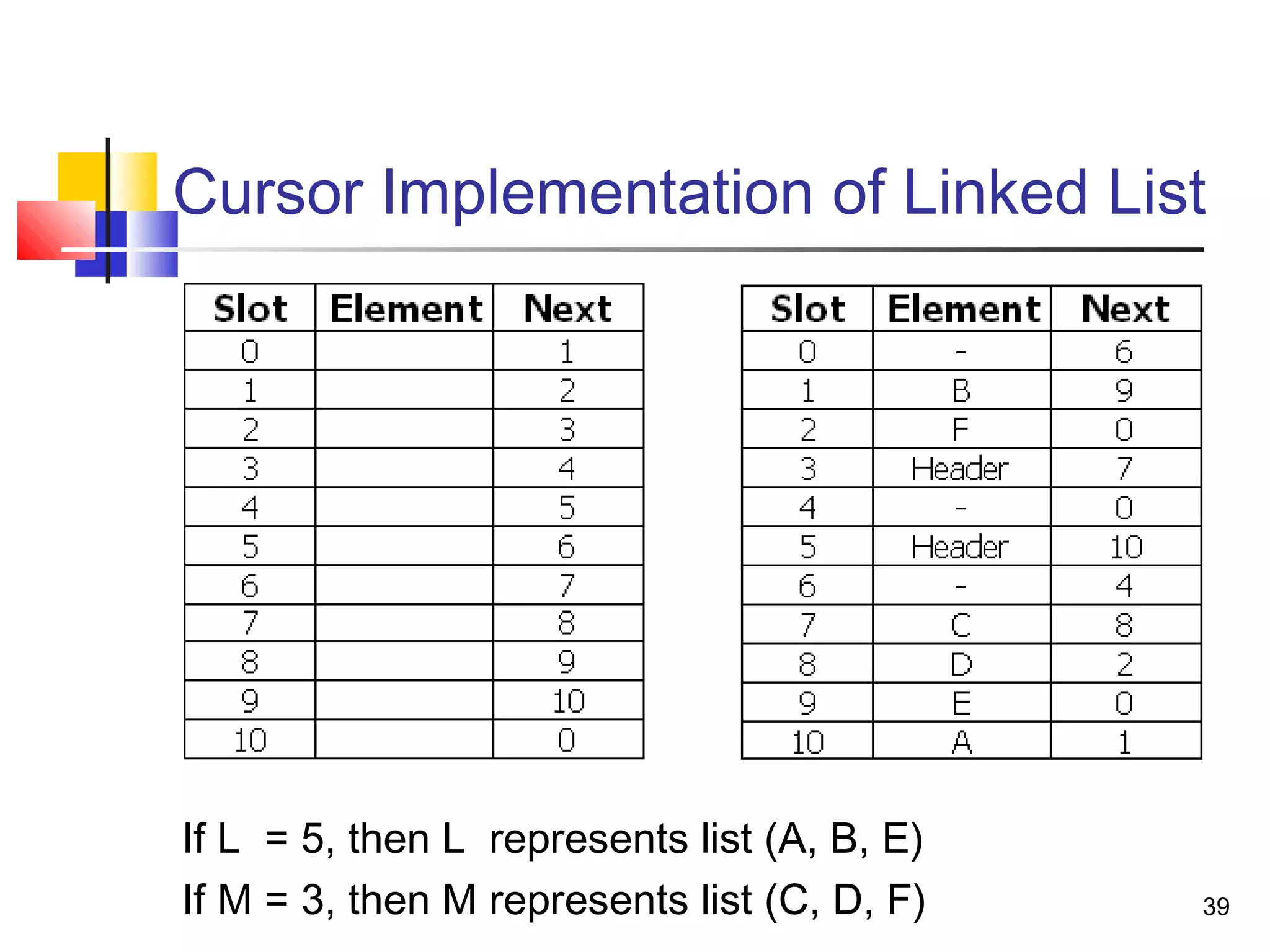
39 Cursor Implementation of Linked List If L = 5, then L represents list (A, B, E) If M = 3, then M represents list (C, D, F)
40 Iterator for cursor implementation of linked lists template <class Object> class ListItr { public: ListItr( ) : current( 0 ) { } bool isPastEnd( ) const {return current == 0; } void advance( ){ if( !isPastEnd( ) ) current = List<Object>::cursorSpace[ current ].next; } const Object & retrieve( ) const { if( isPastEnd( ) ) throw BadIterator( ); return List<Object>::cursorSpace[ current ].element; } private: int current; // Current position friend class List<Object>; ListItr( int theNode ) : current( theNode ) { } };
41 Class skeleton for cursor-based List template <class Object> class ListItr; // Incomplete declaration. template <class Object> class List { public: List( ); List( const List & rhs ); ~List( ); bool isEmpty( ) const; void makeEmpty( ); ListItr<Object> zeroth( ) const; ListItr<Object> first( ) const; void insert( const Object & x, const ListItr<Object> & p ); ListItr<Object> find( const Object & x ) const; ListItr<Object> findPrevious( const Object & x ) const; void remove( const Object & x );
42 Class skeleton for cursor-based List public: struct CursorNode { CursorNode( ) : next( 0 ) { } private: CursorNode( const Object & theElement, int n ) : element( theElement ), next( n ) {} Object element; int next; friend class List<Object>; friend class ListItr<Object>; }; const List & operator=( const List & rhs );
43 Class skeleton for cursor-based List private: int header; static vector<CursorNode> cursorSpace; static void initializeCursorSpace( ); static int alloc( ); static void free( int p ); friend class ListItr<Object>; };
44 cursorSpace initialization /* Routine to initialize the cursorSpace. */ template <class Object> void List<Object>::initializeCursorSpace( ) { static int cursorSpaceIsInitialized = false; if( !cursorSpaceIsInitialized ) { cursorSpace.resize( 100 ); for( int i = 0; i < cursorSpace.size( ); i++ ) cursorSpace[ i ].next = i + 1; cursorSpace[ cursorSpace.size( ) - 1 ].next = 0; cursorSpaceIsInitialized = true; } }
45 Routines : alloc and free /* Allocate a CursorNode template <class Object> int List<Object>::alloc( ) { int p = cursorSpace[ 0 ].next; cursorSpace[ 0 ].next = cursorSpace[ p ].next; return p; } /* Free a CursorNode template <class Object> void List<Object>::free( int p ) { cursorSpace[ p ].next = cursorSpace[ 0 ].next; cursorSpace[ 0 ].next = p; }
46 Short routines for cursor-based lists /* Construct the list template <class Object> List<Object>::List( ) { initializeCursorSpace( ); header = alloc( ); cursorSpace[ header ].next = 0; } /* Destroy the list template <class Object> List<Object>::~List( ) { makeEmpty( ); free( header ); }
47 Short routines for cursor-based lists /* Test if the list is logically empty. return true if empty template <class Object> bool List<Object>::isEmpty( ) const { return cursorSpace[ header ].next == 0; } /* Return an iterator representing the first node in the list. This operation is valid for empty lists. template <class Object> ListItr<Object> List<Object>::first( ) const { return ListItr<Object>( cursorSpace[ header ].next ); }
48 find routine - cursor implementation /*Return iterator corresponding to the first node containing an item x. Iterator isPastEnd if item is not found. template <class Object> ListItr<Object> List<Object>::find( const Object & x ) const { int itr = cursorSpace[ header ].next; while( itr != 0 && cursorSpace[ itr ].element != x ) itr = cursorSpace[ itr ].next; return ListItr<Object>( itr ); }
49 insertion routine-cursor implementation /* Insert item x after p. template <class Object> void List<Object>::insert(const Object & x,const ListItr<Object> & p) { if( p.current != 0 ) { int pos = p.current; int tmp = alloc( ); cursorSpace[ tmp ] = CursorNode( x, cursorSpace[ pos ].next ); cursorSpace[ pos ].next = tmp; } }
50 deletion routine - cursor implementation /* Remove the first occurrence of an item x. template <class Object> void List<Object>::remove( const Object & x ) { ListItr<Object> p = findPrevious( x ); int pos = p.current; if( cursorSpace[ pos ].next != 0 ) { int tmp = cursorSpace[ pos ].next; cursorSpace[ pos ].next = cursorSpace[ tmp ].next; free ( tmp ); } }

Data structures & algorithms lecture 3

  • 1.
    DATA STRUCTURES AND ALGORITHMS Lecture Notes3 Prepared by İnanç TAHRALI
  • 2.
    2 ROAD MAP  AbstractData Types (ADT)  The List ADT  Implementation of Lists  Array implementation of lists  Linked list implementation of lists  Cursor implementation of lists
  • 3.
    3 Abstract Data Types(ADT)  Definition : Is a set of operation Mathematical abstraction No implementation detail  Example : Lists, sets, graphs, stacks are examples of ADT along with their operations
  • 4.
    4 Why ADT ? Modularity  divide program into small functions  easy to debug and maintain  easy to modify  group work  Reuse  do some operations only once  Easy to change of implementation  transparent to the program
  • 5.
    5 THE LIST ADT Ordered sequence of data items called elements  A1, A2, A3, …,AN is a list of size N  size of an empty list is 0  Ai+1 succeeds Ai  Ai-1 preceeds Ai  position of Ai is i  first element is A1 called “head”  last element is AN called “tail” Operations ?
  • 6.
    6 THE LIST ADT Operations  PrintList  Find  FindKth  Insert  Delete  Next  Previous  MakeEmpty
  • 7.
    7 THE LIST ADT Example: the elements of a list are 34, 12, 52, 16, 12  Find (52)  3  Insert (20, 3)  34, 12, 52, 20, 16, 12  Delete (52)  34, 12, 20, 16, 12  FindKth (3)  20
  • 8.
    8 Implementation of Lists Many Implementations  Array  Linked List  Cursor (linked list using arrays)
  • 9.
    9 ROAD MAP  AbstractData Types (ADT)  The List ADT  Implementation of Lists  Array implementation of lists  Linked list implementation of lists  Cursor implementation of lists
  • 10.
    10 Array Implementation ofList ADT  Need to define a size for array  High overestimate (waste of space)  Operations Running Times PrintList O(N) Find Insert O(N) (on avarage half needs to be moved) Delete FindKth Next O(1) Previous
  • 11.
    11 Array Implementation ofList ADT  Disadvantages :  insertion and deletion is very slow  need to move elements of the list  redundant memory space  it is difficult to estimate the size of array
  • 12.
    12 ROAD MAP  AbstractData Types (ADT)  The List ADT  Implementation of Lists  Array implementation of lists  Linked list implementation of lists  Cursor implementation of lists
  • 13.
    13 Linked List Implementationof Lists  Series of nodes  not adjacent in memory  contain the element and a pointer to a node containing its succesor  Avoids the linear cost of insertion and deletion !
  • 14.
    14 Linked List Implementationof Lists  Insertion into a linked list
  • 15.
    15 Linked List Implementationof Lists  Deletion from a linked list
  • 16.
    16 Linked List Implementationof Lists  Need to know where the first node is  the rest of the nodes can be accessed  No need to move the list for insertion and deletion operations  No memory waste
  • 17.
    17 Linked List Implementationof Lists Linked List Array PrintList O(N) (traverse the list) O(N) Find FindKth (L,i) O(i) O(1) Delete O(1) O(N)
  • 18.
    18 Programming Details  Thereare 3 special cases for linked lists  Insert an element at the front of the list  there is no really obvious way  Delete an element from the front of the list  changes the start of the list  Delete an element in general  requires to keep track of the node before the deleted one How can we solve these three problems ?
  • 19.
    19 Programming Details Keep aheader node in position 0  Write a FindPrevious routine  returns the predecessor of the cell  To delete the first element  FindPrevious routine returns the position of header Use of header node is controversial !
  • 20.
    20 Type decleration forlink list node template <class Object> class List; // Incomplete declaration. template <class Object> class ListItr; // Incomplete declaration. template <class Object> class ListNode { ListNode( const Object & theElement = Object( ), ListNode*n=NULL) : element(theElement),next(n) {} Object element; ListNode *next; friend class List<Object>; friend class ListItr<Object>; };
  • 21.
    21 Iterator class forlinked lists template <class Object> class ListItr { public: ListItr( ) : current( NULL ) { } bool isPastEnd( ) const { return current == NULL; } void advance( ) { if( !isPastEnd( ) ) current = current->next; } const Object & retrieve( ) const { if( isPastEnd( ) ) throw BadIterator( ); return current->element; } private: ListNode<Object> *current; // Current position ListItr(ListNode<Object> *theNode):current( theNode ) { } friend class List<Object>; // Grant access to constructor };
  • 22.
    22 List class interface template<class Object> class List { public: List( ); List( const List & rhs ); ~List( ); bool isEmpty( ) const; void makeEmpty( ); ListItr<Object> zeroth( ) const; ListItr<Object> first( ) const; void insert( const Object & x, const ListItr<Object> & p ); ListItr<Object> find( const Object & x ) const; ListItr<Object> findPrevious( const Object & x ) const; void remove( const Object & x ); const List & operator=( const List & rhs ); private: ListNode<Object> *header; };
  • 23.
    23 Function to printa list template <class Object> void printList( const List<Object> &the List) { if (theList.isEmpty()) cout<< “Empty list” << endl; else { ListItr<Object> itr = theList.first(); for (; !itr.isPastEnd(); itr.advance()) cout << itr.retrieve() <<“ ”; } cout << endl; }
  • 24.
    24 Some list one-liners /*Construct the list */ template <class Object> List<Object>::List( ) { header = new ListNode<Object>; } /* Test if the list is logically empty */ template <class Object> bool List<Object>::isEmpty( ) const { return header->next == NULL; }
  • 25.
    25 Some list oneliners /* Return an iterator representing the header node template <class Object> ListItr<Object> List<Object>::zeroth( ) const { return ListItr<Object>( header ); } /* Return an iterator representing the first node in the list. This operation is valid for empty lists. */ template <class Object> ListItr<Object> List<Object>::first( ) const { return ListItr<Object>( header->next ); }
  • 26.
    26 Find routine /* Returniterator corresponding to the first node containing an item x. Iterator isPastEnd if item is not found. */ template <class Object> ListItr<Object> List<Object>::find( const Object & x ) const { ListNode<Object> *itr = header->next; while( itr != NULL && itr->element != x ) itr = itr->next; return ListItr<Object>( itr ); }
  • 27.
    27 Deletion routine forlinked lists /* Remove the first occurrence of an item x. */ template <class Object> void List<Object>::remove( const Object & x ) { ListItr<Object> p = findPrevious( x ); if( p.current->next != NULL ) { ListNode<Object> *oldNode = p.current->next; p.current->next = p.current->next->next; delete oldNode; } }
  • 28.
    28 findPrevious-the find routinefor use with remove /*Return iterator prior to the first node containing an item x. template <class Object> ListItr<Object> List<Object>::findPrevious( const Object & x ) const { ListNode<Object> *itr = header; while( itr->next != NULL && itr->next->element != x ) itr = itr->next; return ListItr<Object>( itr ); }
  • 29.
    29 Insertion routine forlinked lists /* Insert item x after p. */ template <class Object> void List<Object>::insert( const Object & x, const ListItr<Object> & p ) { if( p.current != NULL ) p.current->next = new ListNode<Object> ( x, p.current->next ); }
  • 30.
    30 makeEmpty and Listdestructor /* Make the list logically empty. */ template <class Object> void List<Object>::makeEmpty( ) { while( !isEmpty( ) ) remove( first( ).retrieve( ) ); } /* Destructor */ template <class Object> List<Object>::~List( ) { makeEmpty( ); delete header; }
  • 31.
    31 List copy routines:operator= /*Deep copy of linked lists. template <class Object> const List<Object> & List<Object>::operator=( const List<Object> & rhs ) { ListItr<Object> ritr = rhs.first( ); ListItr<Object> itr = zeroth( ); if( this != &rhs ) { makeEmpty( ); for( ; !ritr.isPastEnd( ); ritr.advance( ),itr.advance( )) insert( ritr.retrieve( ), itr ); } return *this; }
  • 32.
    32 List copy routines: copy constructor /* Copy constructor template <class Object> List<Object>::List( const List<Object> & rhs ) { header = new ListNode<Object>; *this = rhs; }
  • 33.
    33 Doubly Linked List Traversing list backwards  not easy with regular lists  Insertion and deletion more pointer fixing  Deletion is easier  Previous node is easy to find
  • 34.
    34 Circulary Linked List Last node points the first
  • 35.
    35 ROAD MAP  AbstractData Types (ADT)  The List ADT  Implementation of Lists  Array implementation of lists  Linked list implementation of lists  Cursor implementation of lists
  • 36.
    36 Cursor Implementation ofLinked List Problems with linked list implementation:  Same language do not support pointers !  Then how can you use linked lists ?  new and free operations are slow  Actually not constant time
  • 37.
    37 Cursor Implementation ofLinked List SOLUTION: Implement linked list on an array called CURSOR
  • 38.
    38 Cursor Implementation ofLinked List  Cursor operation simulates the features  Collection of structures  uses array for nodes  Array index is pointer  new and delete operation  Keep a free list  new returns an element from freelist  delete place the node in freelist  Freelist  Use cell 0 as header  All nodes are free initially  0 is a NULL pointer
  • 39.
    39 Cursor Implementation ofLinked List If L = 5, then L represents list (A, B, E) If M = 3, then M represents list (C, D, F)
  • 40.
    40 Iterator for cursorimplementation of linked lists template <class Object> class ListItr { public: ListItr( ) : current( 0 ) { } bool isPastEnd( ) const {return current == 0; } void advance( ){ if( !isPastEnd( ) ) current = List<Object>::cursorSpace[ current ].next; } const Object & retrieve( ) const { if( isPastEnd( ) ) throw BadIterator( ); return List<Object>::cursorSpace[ current ].element; } private: int current; // Current position friend class List<Object>; ListItr( int theNode ) : current( theNode ) { } };
  • 41.
    41 Class skeleton forcursor-based List template <class Object> class ListItr; // Incomplete declaration. template <class Object> class List { public: List( ); List( const List & rhs ); ~List( ); bool isEmpty( ) const; void makeEmpty( ); ListItr<Object> zeroth( ) const; ListItr<Object> first( ) const; void insert( const Object & x, const ListItr<Object> & p ); ListItr<Object> find( const Object & x ) const; ListItr<Object> findPrevious( const Object & x ) const; void remove( const Object & x );
  • 42.
    42 Class skeleton forcursor-based List public: struct CursorNode { CursorNode( ) : next( 0 ) { } private: CursorNode( const Object & theElement, int n ) : element( theElement ), next( n ) {} Object element; int next; friend class List<Object>; friend class ListItr<Object>; }; const List & operator=( const List & rhs );
  • 43.
    43 Class skeleton forcursor-based List private: int header; static vector<CursorNode> cursorSpace; static void initializeCursorSpace( ); static int alloc( ); static void free( int p ); friend class ListItr<Object>; };
  • 44.
    44 cursorSpace initialization /* Routineto initialize the cursorSpace. */ template <class Object> void List<Object>::initializeCursorSpace( ) { static int cursorSpaceIsInitialized = false; if( !cursorSpaceIsInitialized ) { cursorSpace.resize( 100 ); for( int i = 0; i < cursorSpace.size( ); i++ ) cursorSpace[ i ].next = i + 1; cursorSpace[ cursorSpace.size( ) - 1 ].next = 0; cursorSpaceIsInitialized = true; } }
  • 45.
    45 Routines : allocand free /* Allocate a CursorNode template <class Object> int List<Object>::alloc( ) { int p = cursorSpace[ 0 ].next; cursorSpace[ 0 ].next = cursorSpace[ p ].next; return p; } /* Free a CursorNode template <class Object> void List<Object>::free( int p ) { cursorSpace[ p ].next = cursorSpace[ 0 ].next; cursorSpace[ 0 ].next = p; }
  • 46.
    46 Short routines forcursor-based lists /* Construct the list template <class Object> List<Object>::List( ) { initializeCursorSpace( ); header = alloc( ); cursorSpace[ header ].next = 0; } /* Destroy the list template <class Object> List<Object>::~List( ) { makeEmpty( ); free( header ); }
  • 47.
    47 Short routines forcursor-based lists /* Test if the list is logically empty. return true if empty template <class Object> bool List<Object>::isEmpty( ) const { return cursorSpace[ header ].next == 0; } /* Return an iterator representing the first node in the list. This operation is valid for empty lists. template <class Object> ListItr<Object> List<Object>::first( ) const { return ListItr<Object>( cursorSpace[ header ].next ); }
  • 48.
    48 find routine -cursor implementation /*Return iterator corresponding to the first node containing an item x. Iterator isPastEnd if item is not found. template <class Object> ListItr<Object> List<Object>::find( const Object & x ) const { int itr = cursorSpace[ header ].next; while( itr != 0 && cursorSpace[ itr ].element != x ) itr = cursorSpace[ itr ].next; return ListItr<Object>( itr ); }
  • 49.
    49 insertion routine-cursor implementation /*Insert item x after p. template <class Object> void List<Object>::insert(const Object & x,const ListItr<Object> & p) { if( p.current != 0 ) { int pos = p.current; int tmp = alloc( ); cursorSpace[ tmp ] = CursorNode( x, cursorSpace[ pos ].next ); cursorSpace[ pos ].next = tmp; } }
  • 50.
    50 deletion routine -cursor implementation /* Remove the first occurrence of an item x. template <class Object> void List<Object>::remove( const Object & x ) { ListItr<Object> p = findPrevious( x ); int pos = p.current; if( cursorSpace[ pos ].next != 0 ) { int tmp = cursorSpace[ pos ].next; cursorSpace[ pos ].next = cursorSpace[ tmp ].next; free ( tmp ); } }