International Research Journal of Engineering and Technology (IRJET) e-ISSN: 2395-0056 Volume: 09 Issue: 08 | Aug 2022 www.irjet.net p-ISSN: 2395-0072 © 2022, IRJET | Impact Factor value: 7.529 | ISO 9001:2008 Certified Journal | Page 9 Deep Learning in Text Recognition and Text Detection : A Review Brindha Muthusamy1, Kousalya K2 1Dept. of Computer Science and Engineering, Kongu Engineering College, Erode 3Professor, Dept. of Computer Science and Engineering, Kongu Engineering College, Erode ---------------------------------------------------------------------***--------------------------------------------------------------------- Abstract - Detecting text in natural situations is a difficult task that is more difficult than extracting the text from those natural images in which the background and foreground are clearly separated and every character isisolatedfromtheimages. Textin the landscapes which is nature may occur in a range of states like a text in dark with the backgroundlightandviceversa, withabroad diversity of fonts, even for letters of the same word, sections of words can be overlapped by environment objects, makingdetection of these parts impossible. Deep learning which is a subset of Machine learning employs a neural network, a technique that replicates how the brain analyses data. An Optical Character Recognition engine has two parts: i)Text recognition and ii)Text detection. The process of locating the sections of text in a document is known as text detection. Since the different documents (invoices, newspapers, etc.) have varied structures, this work has historically proved difficult. A text recognition system, on the other hand, takes a portion of a document containing text (a word or a line of text) and outputs the associated text. Both text detection and text recognition have shown considerable promise with deep learning algorithms. Keywords: Deep learning, Convolutional Neural Network, text detection, text classification, Optical Character Recognition, optimization I. INTRODUCTION Deep learning algorithms learn about the image by passing through each neural network layer. For applications like machine translation and image searches, OCR mechanism is being used to recognise text within photographs. The method for recognising the text/characters from a photo, sends the features extracted text from an image/photo to the classifier which is trained to distinguish individual characters that is similar to object recognition. Recognition oftext,ontheotherhand,looksat the text as a group of meaningful characters rather than single characters. A text string can be recognized by clustering the similar characters, which means that every character in the text must separate for recognition [21]. Alternatively, in the instance of classification, train the network on a labelled datasets in order to categorize the samples in the datasets. Convolutional Neural Network (CNN) was applied to extractthefeaturesforcharacter recognitionperformance.Abrief review on text detection and text recognition are shown in Table 2. The CNN model is trained in three steps : (i) Train the CNN model from the scratch, (ii) Using a transfer learning method for exploiting the features from a pretrained model on larger datasets and, (iii) Transfer learning and fine-tuning the weights of an CNN architecture. CNN architecture consists mostly of four layers. (i) Convolutional layer [Conv]; (ii) Pooling layer; (iii) Fully connected layer; and (iv) Rectified Linear units [4]. Artificial Neural Network (ANN) is being trained to extractinformationthroughthedeep-learning-basedtechnologies from an image. VGG, ResNet, MobileNet, GoogleNet, Xception, and DenseNet are examples of CNN architecture where several convolution layers are utilized to extract the features from the images [21]. Handwritten texts are difficult while reading text from photographs or recognising that has attained a lot of attention. Most systems have two important components, (i) Text detection; and (ii) Text recognition. Text detection is a technique where the text instances from the images can be predicted and localized. The text recognition is done by autoencoder which is the process of decoding the textintothemachine-readable format.
International Research Journal of Engineering and Technology (IRJET) e-ISSN: 2395-0056 Volume: 09 Issue: 08 | Aug 2022 www.irjet.net p-ISSN: 2395-0072 © 2022, IRJET | Impact Factor value: 7.529 | ISO 9001:2008 Certified Journal | Page 10 Figure 1 CNN architecture for text classification II. TEXT DETECTION AND RECOGNITION USING DEEP LEARNING 2.1 Text detection The local features can be extracted from CNN through the training of character pictures and sub-regionsbasedonthe characteristics of an individual’s handwriting. To train CNN, randomly selected instances of an image in the training sets are used, and the local features extracted from the image from these instances are aggregated in order to generate the global features. The process of randomly sampling instances is repeated for every training epoch. This results in the increase of training the patterns for training the CNN for text independent writer identification [1]. Deep learning can constantly learn by examining data and finding patterns and classifying images. For picture categorization, language transaction and character recognition, deep learning is applied. Deep Neural Networksarenetworks with multiple layers that can perform complex operations onimages,sound,andtext,suchasrepresentationandabstraction. It can be used for any type of recognition problem. The basic goal is only for computers to learn withouthumaninterventionand modify their activities accordingly. 2.2 Text recognition The recognition can be done by many techniques. It involves Convolutional Neural Network(CNN), Semi Incremental Method, Incremental Method, Line and Word Segmentation method etc. One of the most effective and prominent ways of handwriting recognition is Convolutional Neural Network (CNN). The most prevalent application of CNN is in image analysis. Artificial neurons are used in CNN [11]. CNN canrecogniseimagesandvideos,classifyimages,analysemedical images,perform computer vision, and process natural language. CNN or ConvNets architecture has made significant contributions to the analysis of images. CNN is defined as , 1)A convolution tool that separates and identifies the distinct characteristics of the image for analysis in a process called Feature Extraction, which is part of the CNN architecture. 2) A fully connected layer makes use of the outputoftheconvolutionprocess in order to forecast the image's class using the information acquired in earlier stages. CNN extracts the features from handwritten text images of numerous characters by the end-to-end method based on deep learning and combines these extractedfeaturestorecognizethewriter’sspecific data duringloweringofcharacter’sclass- specific features. To create n-tuple images, a single writer’shandwrittensquaredimagesaresampledrandomly.Second,every image from n-tuple is sent into a local feature extractor (CNN). CNN can extract text-independent writer specificpropertiesby employing new techniques to structure the training samples as n tuple pictures. Finally,a global featureaggregator aggregates the retrieved local features in various ways, such as using the average or maximum. Finally, the combined characteristics are sent into a softmax classifier (fully connected with an Nfc unit which is equal to the number of writers) for predicting [1].
International Research Journal of Engineering and Technology (IRJET) e-ISSN: 2395-0056 Volume: 09 Issue: 08 | Aug 2022 www.irjet.net p-ISSN: 2395-0072 © 2022, IRJET | Impact Factor value: 7.529 | ISO 9001:2008 Certified Journal | Page 11 III. PRELIMINARY STEPS FOR TEXT DETECTION AND RECOGNITION 3.1 Datasets The datasets are collected from various ImageNet dataset like, MNIST, NIST, IAM dataset, IFN/ENIT, and so on. The different dataset on different languages like, English, Arabic, Bangla handwritten character datasets are taken into consideration. The detailed view of these datasets are shown in table 2. 3.2 Image Pre-processing Pre-processing is a technology which transforms the raw data to useful and efficient data/information. This process consists of different operations which are used to perform on input images and in this process, the images are reshaped. The rearrangement of the form of the data is done without changing the contents of the data. Different kinds of arrangements are done in this process according to the parameters which are needed to carry on till further process [1].Imagepre-processingis nothing but to remove irrelevant data and delete the duplicate data fromthedatabases.Thetextintheimagecanbeindifferent styles, fonts and so on. In data pre-processing, the data are processed in different ways, they are:  Data cleaning : Remove noise and data inconsistency from raw data. That is, the datasetwhichdoesnot belongto the dataset comes, this data cleaning process removes these datasets. It is done by filtering the dataset and handling the missing data. It ensures the quality of data. In other words, itonlyremovestheunwanteddata butmaintainstheoriginality of the data.  Data integration : Data integration collects data from various multiple resources and combines it to form coherent data and also supports the consolidated perspective of the information. That is, it merges data from varioussourcesintoa coherent datastore (data warehouse). These data are stored and maintained for future use. It may be in the form of documents where the relevant data are stored in the different documents.  Data reduction : Data reduction is the process of reducing the data size by instances, aggregation, eliminating irrelevant data/features or by clustering. Data reduction can increase the storage capacity and the cost is reduced. It does not lose any data, instead it maintains the originality of the data. Data reduction process is done with the help of data compression. Data compression is a technique to compressthedata ina reducedformofdata whichcanreducethestorage space.  Data transformation : Data transformation is used to convert one form of format to another format. It is also known as data munging or data wrangling. Otherwise called Normalization. The data points in the scatter plot should be linear.If the points are in the form of a curve, it is difficult to calculate the accuracywhichaffects theperformanceofthemodel. This curve can be converted into a linear line by scaling the model in the range of 0 and 1. Activation functions are used when the model shows non-linearity in their respective model. 3.3 Normalization Normalization is the process of organizing data in the database. This process involves table creation and establishing relationships between these tables. It protects the data as well as makes the database moreflexible byeliminatingredundancy and inconsistent dependency. Redundant data takes more space and is complicated to maintain. The inconsistent dependent data can make it difficult to access the data since the path to find the data is either missing or broken. Hence, Normalization is more important since it can reduce these irrelevant data and data inconsistency and it can handle the missing data as well to make the database more flexible. Normalization includes three stages of normalization steps where each stage generates the table. Each table stores the relevant data which does not include duplicate data or miss any data. The three steps involved in the normalization process are as follows, 3.3.1 First Normal form The First Normal Form (1NF) sets the fundamental rulesfordatabasenormalizationwhichrelatestothesingletablein the relational database model. The steps involved in the First Normal Form are :  Every column in the table are unique  Separate tables are created for every relevant set of data  Each table must be identified with a unique column or the concatenated columns are called with the primary key
International Research Journal of Engineering and Technology (IRJET) e-ISSN: 2395-0056 Volume: 09 Issue: 08 | Aug 2022 www.irjet.net p-ISSN: 2395-0072 © 2022, IRJET | Impact Factor value: 7.529 | ISO 9001:2008 Certified Journal | Page 12  Neither row or column of the table are duplicated  No row or column that intersects in the table contain a NULL value  No row or column that intersects in the table can have multi-valued fields 3.3.2 Second Normal Form The Second Normal Form (2NF) follows the First Normal Form . The basic requirements of Second Normal Form for organizing the data include:  No redundancy of data. All the data is stored in only one place.  Data dependencies in Second Normal Form are logical. That is, all the related data items are stored together which is useful for easy access. 3.3.3 Third Normal Form The Third Normal Form (3NF)isthecombinationof both FirstNormal FormandSecondNormal Form(1NF+2NF).The main benefits of this Third normal form are:  Reduces duplication of the data and achieves data integrity in a database.  Useful to design a normal relational database  3NF are independent of anomalies of deletion, updation, and insertion  It ensures losslessness and prevention of the functional dependencies 3.4 Feature extraction Text extraction or Feature extraction from an image is a method of extracting text from a photograph using machine learning techniques. Text extraction is also known as text localization. It is used for text detection and localizationwhich helps for text recognition. Text localization is the process which isusedtodevelopa computersystem(AI)toautomaticallyrecognize and read the text from the images. In deep learning models, the feature extraction process is done automatically since the models are pre-trained. It is done by text classification. 3.4.1 Text Classification Text classification is also known as text tagging or text categorization. Texts are always unstructured in handwritten words or characters. Hence, these texts are categorized into an organized group. This process is difficult since it takes more time and is a little expensive. By using Natural Language Processing (NLP) which can be used as a text classifier, the texts can be categorized and can be converted into structural textual data which is easy to understand, cost effective and is more scalable. Natural Language Processing can automatically analyse and understandthetypeofcharacteranditwill assigna set of pre-defined tags (Pre-trained image datasets) and can be categorized based on its characteristics. 3.5 Text detection In the testing stage, text detection is accomplishedbysegmentingphotos.Aseriesoftext/sub-imagesofindividual text is divided from a full image. Edge detection and the space between the different characters are used to segment the image. Following segmentation, the sub-divided portions are labelled and processed one at a time. This labellingisusedto determine the total number of characters in an image. After that, each sub picture is scaled (70x50) and normalized in relation to itself. This aids in the extraction of image quality attributes [9]. Text detection is a method in which the model is given an image and the text region is detected by building a bounding box around it. Text recognition is carried out by further processing the discovered textual sections in order to recognise the text. 3.5.1 Training the dataset Deep learning model is built while feeding data to a deep neural network (DNN) to "train" in order to do a specific AI task (such as image classification or speech to text conversion). The hidden layer in the neural network is used for backpropagation which helps to improve the performance of the training model. Hence, during the training process, known data is fed into the DNN, and this DNN generates a prediction on what the data represents.
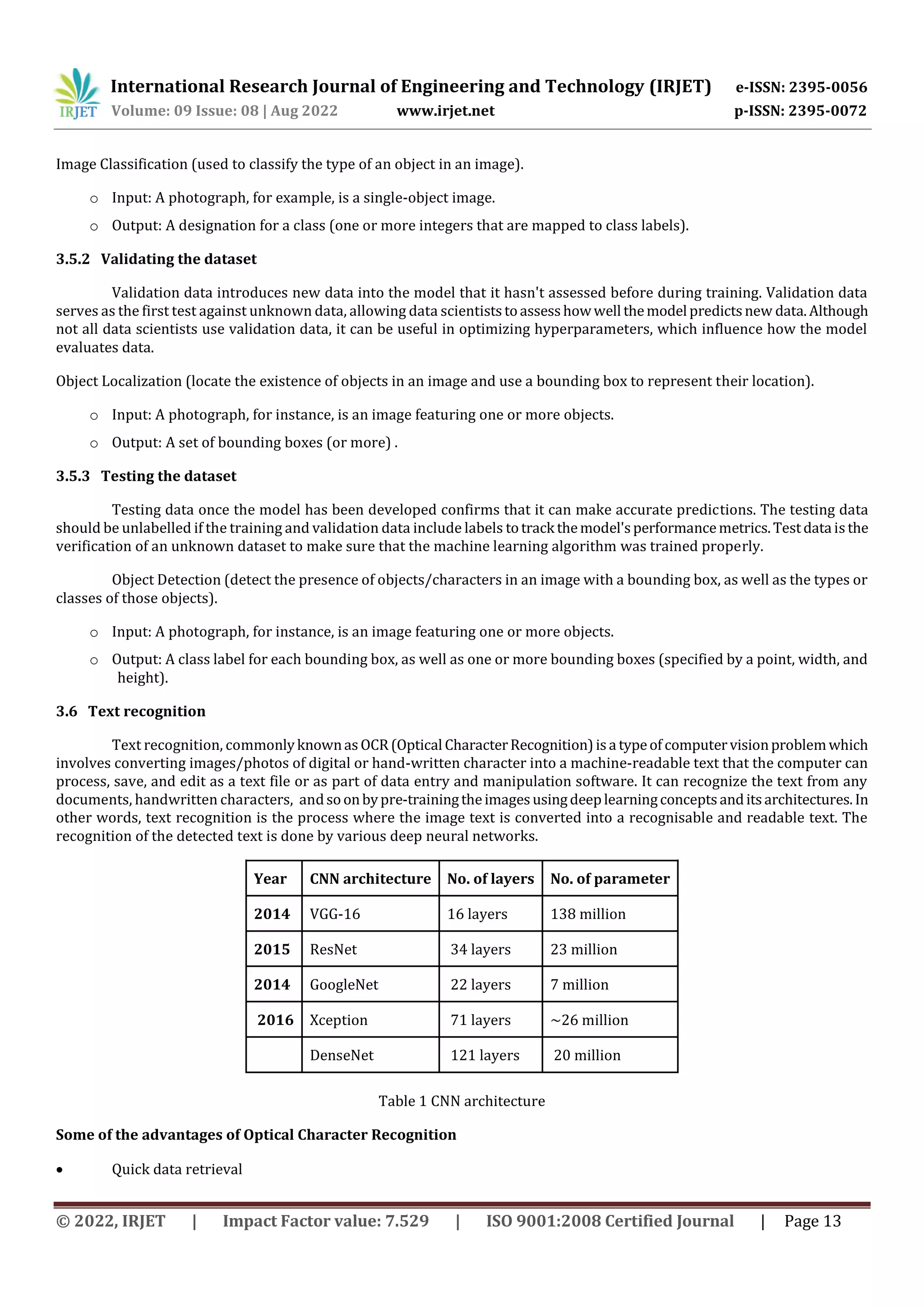
International Research Journal of Engineering and Technology (IRJET) e-ISSN: 2395-0056 Volume: 09 Issue: 08 | Aug 2022 www.irjet.net p-ISSN: 2395-0072 © 2022, IRJET | Impact Factor value: 7.529 | ISO 9001:2008 Certified Journal | Page 13 Image Classification (used to classify the type of an object in an image). o Input: A photograph, for example, is a single-object image. o Output: A designation for a class (one or more integers that are mapped to class labels). 3.5.2 Validating the dataset Validation data introduces new data into the model that it hasn't assessed before during training. Validation data serves as the first test against unknown data, allowing data scientiststoassesshowwell themodel predictsnew data.Although not all data scientists use validation data, it can be useful in optimizing hyperparameters, which influence how the model evaluates data. Object Localization (locate the existence of objects in an image and use a bounding box to represent their location). o Input: A photograph, for instance, is an image featuring one or more objects. o Output: A set of bounding boxes (or more) . 3.5.3 Testing the dataset Testing data once the model has been developed confirms that it can make accurate predictions. The testing data should be unlabelled if the training and validation data include labels totrack themodel'sperformancemetrics.Testdata isthe verification of an unknown dataset to make sure that the machine learning algorithm was trained properly. Object Detection (detect the presence of objects/characters in an image with a bounding box, as well as the types or classes of those objects). o Input: A photograph, for instance, is an image featuring one or more objects. o Output: A class label for each bounding box, as well as one or more bounding boxes (specified by a point, width, and height). 3.6 Text recognition Text recognition, commonlyknownasOCR (Optical CharacterRecognition)isa typeof computervisionproblemwhich involves converting images/photos of digital or hand-written character into a machine-readable text that the computer can process, save, and edit as a text file or as part of data entry and manipulation software. It can recognize the text from any documents, handwritten characters, andsoonbypre-trainingtheimagesusingdeeplearningconceptsanditsarchitectures.In other words, text recognition is the process where the image text is converted into a recognisable and readable text. The recognition of the detected text is done by various deep neural networks. Year CNN architecture No. of layers No. of parameter 2014 VGG-16 16 layers 138 million 2015 ResNet 34 layers 23 million 2014 GoogleNet 22 layers 7 million 2016 Xception 71 layers ~26 million DenseNet 121 layers 20 million Table 1 CNN architecture Some of the advantages of Optical Character Recognition  Quick data retrieval
International Research Journal of Engineering and Technology (IRJET) e-ISSN: 2395-0056 Volume: 09 Issue: 08 | Aug 2022 www.irjet.net p-ISSN: 2395-0072 © 2022, IRJET | Impact Factor value: 7.529 | ISO 9001:2008 Certified Journal | Page 14  Easy to extract relevant data  Low cost for usage like copying, editing and so on  High accuracy to detect and recognize  Increase the storage capacity IV. DEEP NEURAL NETWORKS FOR TEXT DETECTION AND RECOGNITION Deep learning is a domain of study that aims to copy the functioning of human brains in order to process data and make decisions. Deep learning is also knownasDeepNeural Network (DNN)orDeepNeural Learning.Thedeeplearningmodel for Optical Character Recognition uses two types of neural network architecture. They are i)Convolutional Neural Network (CNN); ii)Artificial Neural Network (ANN). 4.1 Convolutional Neural Network (CNN) Convolutional Neural Network (CNN) is a neural network which has three layers. They are: (i) Input layer, (ii)Hidden layer ;and (iii) Output layer. Optical Character Recognition (OCR) considers the optical image of a character as an input and provides the corresponding recognisable character as an output. ThetrainedCNN isusedtoextractthefeaturesoftheimage.CNN classifiers along with other classifiers can be combined and give the best result for classification.Thatis,theaccuracyandefficiencyofthe classification can be improved. The hidden layer uses the input to perform feed-forward and backpropagation in order to improve the accuracy and reduce the error rate. Convolutional Neural Network and Error Correcting Output Code (CNN +ECOC) where CNN for feature extraction and ECOC for classification are combined to obtain Optical Character Recognition. This method gives high accuracy for handwritten characters. It is trained and validated with NIST dataset [46]. 4.2 Artificial Neural Network (ANN) Artificial Neural Network can be used to recognise the image with a single character and further include many characters for classification. The classification process can be done in two phases: i) Feature preprocessing - read each character and convert it into binary image and scan by all four sides (left, tp, right, bottom) and ii) a) Training the neural network and b) Testing the neural network with the datasets. Here, the training sets are used to learn how to remove noise from the data [50]. 4.3 Recurrent Neural Network (RNN) Recurrent Neural Network is based on the sequential form of data. Recurrent neural network is most suitable for the text classification which can recognize the whole sentence or sequential set of words. When the words or characters are in sequence, this recurrent neural network can predict the next word of the sequence. Hence handwritten characters can be predicted more accurately while using recurrent neural networks. To achieve the prediction accuracy,RNN doesnotrequire a dataset in the form of labelled data (need not be supervised learning). Recurrent neural networks are capable of working the temporal information. The disadvantage of RNN is that it will raise the vanishing gradient problem. The trainingof datasetsis more complex and hence more difficult. It is also difficult to process the long sequential characters. LEARNING RATE IN DEEP LEARNING ALGORITHM The learning rate refers to the number of times the images are trained. In deep learning neural networks, the Stochastic Gradient Descent is used. The learning rate refers to the parameters or hyperparameter which controls how many times the dataset is trained in order to reduce error rate and improve accuracy which improves the performanceof themodel. While training this dataset, backpropagation technique is used where the weights are updated each time in order to getbetter performance of the neural network model. This learning rate affects the performance of the model when it reaches the local minima. Hence, it is important to adjust the learning rate from high to low to slow down once the model reaches the optimal solution during training.
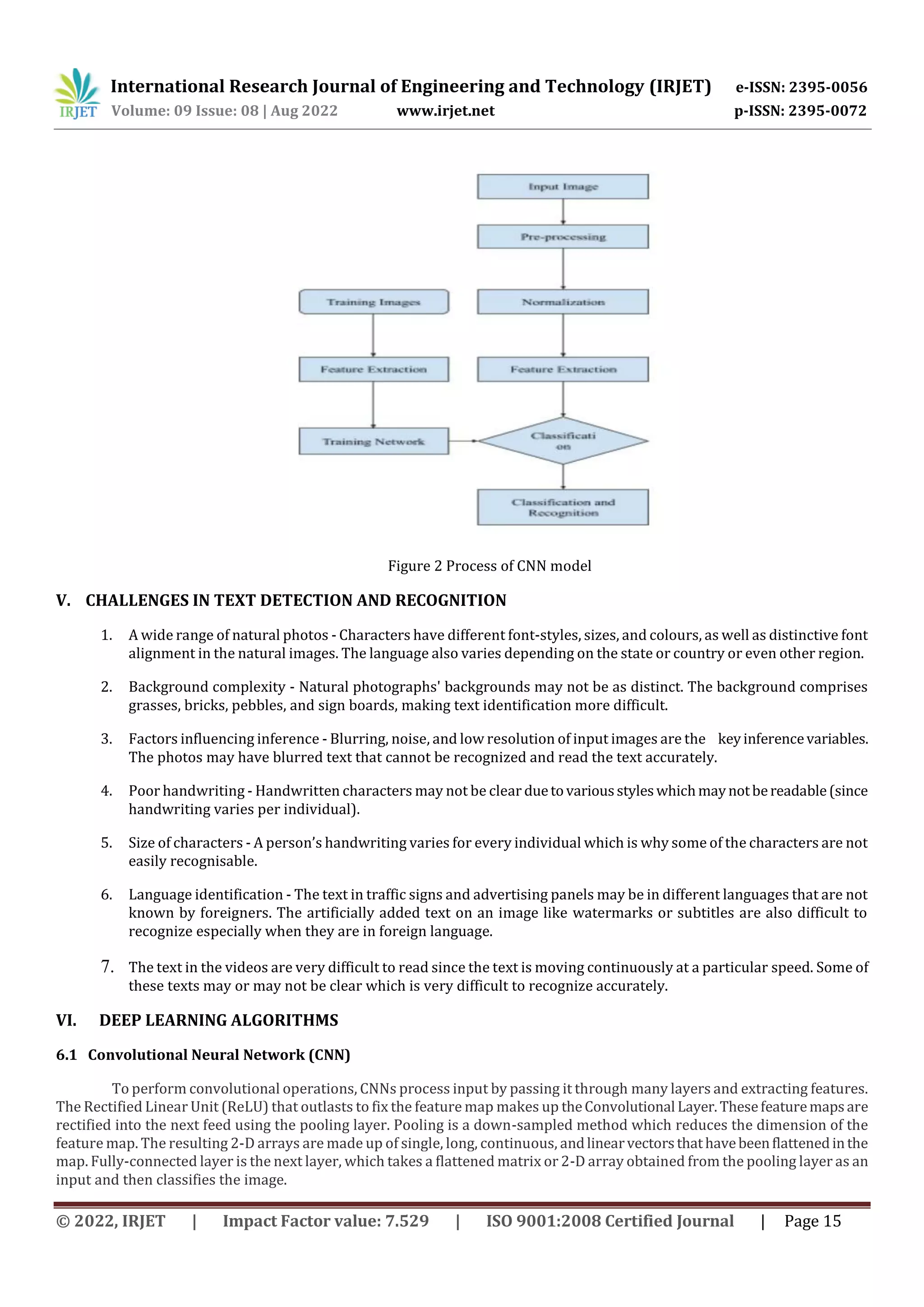
International Research Journal of Engineering and Technology (IRJET) e-ISSN: 2395-0056 Volume: 09 Issue: 08 | Aug 2022 www.irjet.net p-ISSN: 2395-0072 © 2022, IRJET | Impact Factor value: 7.529 | ISO 9001:2008 Certified Journal | Page 15 Figure 2 Process of CNN model V. CHALLENGES IN TEXT DETECTION AND RECOGNITION 1. A wide range of natural photos - Characters have different font-styles, sizes, and colours, as well as distinctive font alignment in the natural images. The language also varies depending on the state or country or even other region. 2. Background complexity - Natural photographs' backgrounds may not be as distinct. The background comprises grasses, bricks, pebbles, and sign boards, making text identification more difficult. 3. Factors influencing inference - Blurring, noise, and low resolution of input images are the keyinferencevariables. The photos may have blurred text that cannot be recognized and read the text accurately. 4. Poor handwriting - Handwritten characters may not be clear duetovariousstyleswhichmaynotbereadable(since handwriting varies per individual). 5. Size of characters - A person’s handwriting varies for every individual which is why some of the characters are not easily recognisable. 6. Language identification - The text in traffic signs and advertising panels may be in different languages that are not known by foreigners. The artificially added text on an image like watermarks or subtitles are also difficult to recognize especially when they are in foreign language. 7. The text in the videos are very difficult to read since the text is moving continuously at a particular speed. Some of these texts may or may not be clear which is very difficult to recognize accurately. VI. DEEP LEARNING ALGORITHMS 6.1 Convolutional Neural Network (CNN) To perform convolutional operations, CNNs process input by passing it through many layers and extracting features. The Rectified Linear Unit (ReLU) that outlasts to fix the feature map makes up theConvolutional Layer.Thesefeaturemapsare rectified into the next feed using the pooling layer. Pooling is a down-sampled method which reduces the dimension of the feature map. The resulting 2-D arrays are made up of single, long, continuous, andlinearvectorsthathavebeenflattenedinthe map. Fully-connected layer is the next layer, which takes a flattened matrix or 2-D array obtained from the pooling layer as an input and then classifies the image.
International Research Journal of Engineering and Technology (IRJET) e-ISSN: 2395-0056 Volume: 09 Issue: 08 | Aug 2022 www.irjet.net p-ISSN: 2395-0072 © 2022, IRJET | Impact Factor value: 7.529 | ISO 9001:2008 Certified Journal | Page 16 6.2 Long-Short Term Memory Networks(LSTMs) LSTMs are proven which outperforms the conventional recurrent neural networks and it suffers from the fading gradient problem, when modelling long-term dependencies. The CTC layer, whichcomesaftertheLSTMlayers[figure3],gives the feature sequences with the ground truth transcription during the training and decoding the LSTM layer’s outputs during evaluation to create the predicted transcription. From the start to finish, the system is taught through feeding the text lines, pictures and ground truth transcription (in UTF-8) [5]. Figure 3 CNN-BiLSTM architecture 6.3 Recurrent Neural Networks (RNNs) Recurrent Neural Networks is mainly used for feed-forward techniques. RNN can work both parallelly and sequentially. During computation. A number of sequence learning challenges have been successfully solved using Recurrent Neural Networks (RNN) and RNN variations (Bi-directional LSTMs and MDLSTM). According to several studies, LSTM outperforms HMMs on such tasks. 6.4 Generative Adversarial Networks (GANs) GANs are the form of neural network architecture which enables the deep learning models to learn and capture the training data distribution, which provides the generation of new data instancesbased onthesedistributions.GANsareusedfor unsupervised machine learning to train the two models parallely. It gives the training data whichissimilartotheoriginal data. A discriminator and a generator are often included in GANs [51]. 6.5 Multi-Layer Perceptron (MLPs) The MLPs is a supervised learning convolutional artificial neural network that reduces error by continuously computing and updating all the weights in the network. In the first phase, which is a feed-forwarding phase, thetraineddata is delivered to the output layer, after that the output and the desired targets (errors) are back-propagated to update the network’s weight in the next phase. The Adam optimiser was employed to improve the performanceofMultiLayer Perceptron [22]. Adam optimizer : Adam optimizer is an extension of stochastic gradient descent that usesdeeplearningapplications for computer vision and Natural Language Processing (NLP). Adam optimizer is used to remove vanishing gradient problems. The computation time is faster and it requires only a few parameters for tuning.
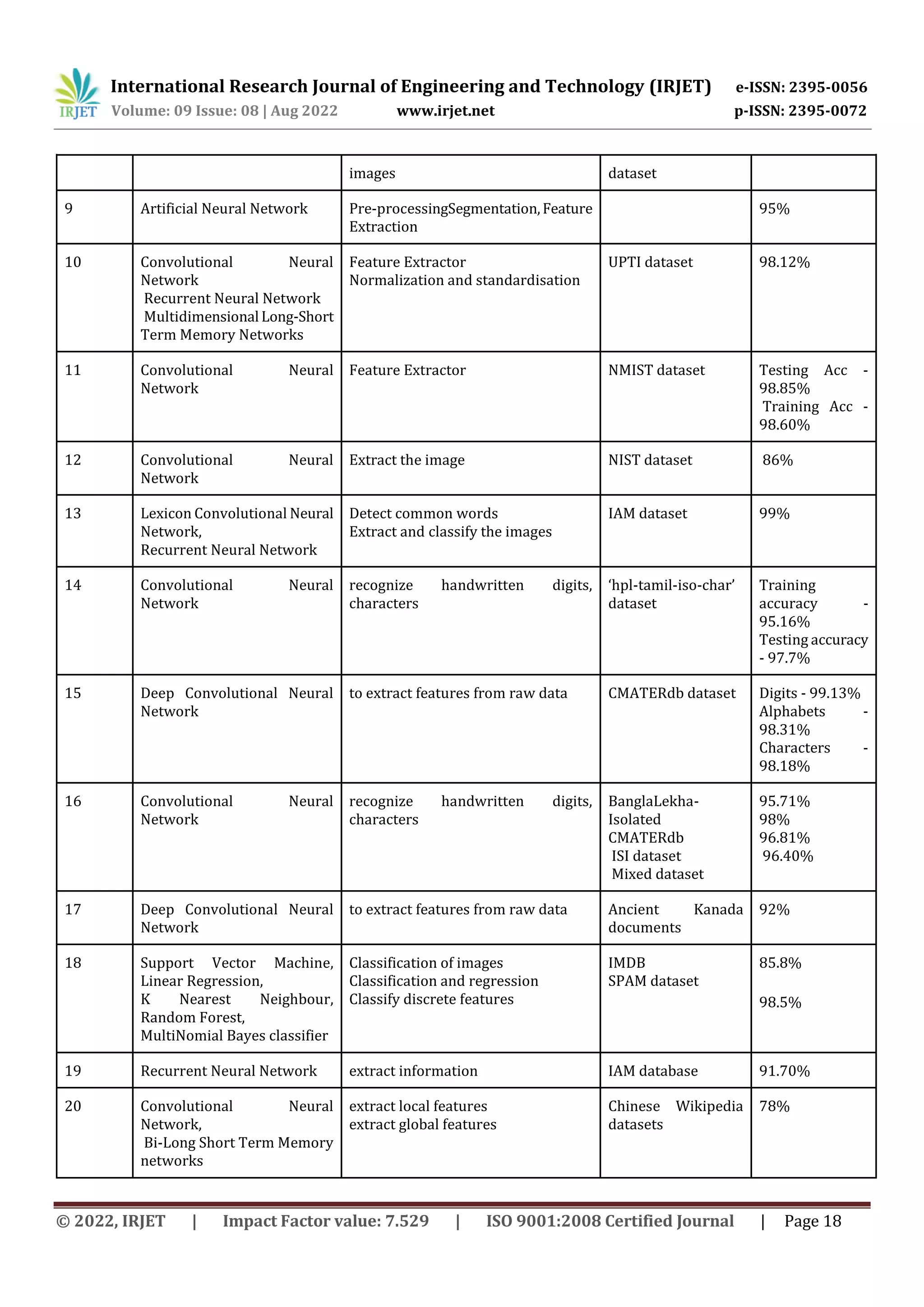
International Research Journal of Engineering and Technology (IRJET) e-ISSN: 2395-0056 Volume: 09 Issue: 08 | Aug 2022 www.irjet.net p-ISSN: 2395-0072 © 2022, IRJET | Impact Factor value: 7.529 | ISO 9001:2008 Certified Journal | Page 17 6.6 Deep Belief Networks (DBNs) A Deep Belief Network (DBN) is a type of deep neural network (DNN) or a generative graphical model. The DBN is constructed with multiple layers of “hidden units” which are latent variables with the connections across the levels and not in between the units in each layer. DBN can be learned to probabilisticallyrecreatetheinputswithoutsupervisionwhentheseare trained on the set of example datasets. Next, the DBN’s layers act as a feature for detection. Additionally, a DBN can be trained under supervision to categorize the text or object after completing the learning stage. To develop a Novel Q-ADBN for handwritten digit/character recognition, ADAE and Q-learning algorithms are introduced in Deep Belief Network [4]. 6.7 Restricted Boltzmann Machines (RBMs) The Adaptive Deep Auto-encoder(ADAE)hasbeenmadeupofnumeroussuccessivelystackedRBMs,wheretheoutput of one RBM acts as the input of the next. Each RBN is treated as an encoder. The encoder uses unique code torecognisethetext .ADAE’s hierarchical feature extraction technique is comparable to that of a human’s brain [4]. 6.8 Autoencoders Autoencoders are the combination of Encoders and Decoders. It is mainly used to learn the compressed representations of the datasets. The Autoencoders should be trained in order to learn the fixed dimensional latent space representation of the given image, making them ideal for the feature extraction [6]. The output of the autoencoder network is the reconstruction of the input data which is more efficient. Related Works Referen ce Proposed Algorithm Purpose Dataset Accuracy 1 Convolutional Neural Network extract feature from raw images JEITA-HP database Firemaker and IAM database 99.97% 91.81% 2 Codebook model, Clustering,Bayesianclassifier, Moore’s algorithm Feature generation and Feature selection, Classifiers using feature vectors IAM dataset AUT-FH dataset 93.7% 96.9% 3 Convolutional Neural Network + XGradientBoost CNN - feature extraction XGBoost - Recognition and classification HECR (CNN+XGBoost) 99.84% 4 Q-ADBN ADAE extract features from original images using ADAE MNIST dataset 99.18% 5 Convolutional Neural Network, Long Short Term Memory network feature extraction Increase the memory of RNN IFN/ENIT dataset 83% 6 Convolutional Neural Network autoencoder + Support Vector Machine Feature extractor Classify the images 4600 MODI characters 99.3% 7 Convolutional Neural Network, Algebraic fusion of multiple classifier Feature extractor Multi-level fusion classifier MNIST dataset 98% 8 Artificial Neural Network Classify and Recognize the text from USTB-Vid TEXT 85%
International Research Journal of Engineering and Technology (IRJET) e-ISSN: 2395-0056 Volume: 09 Issue: 08 | Aug 2022 www.irjet.net p-ISSN: 2395-0072 © 2022, IRJET | Impact Factor value: 7.529 | ISO 9001:2008 Certified Journal | Page 18 images dataset 9 Artificial Neural Network Pre-processingSegmentation,Feature Extraction 95% 10 Convolutional Neural Network Recurrent Neural Network Multidimensional Long-Short Term Memory Networks Feature Extractor Normalization and standardisation UPTI dataset 98.12% 11 Convolutional Neural Network Feature Extractor NMIST dataset Testing Acc - 98.85% Training Acc - 98.60% 12 Convolutional Neural Network Extract the image NIST dataset 86% 13 Lexicon Convolutional Neural Network, Recurrent Neural Network Detect common words Extract and classify the images IAM dataset 99% 14 Convolutional Neural Network recognize handwritten digits, characters ‘hpl-tamil-iso-char’ dataset Training accuracy - 95.16% Testing accuracy - 97.7% 15 Deep Convolutional Neural Network to extract features from raw data CMATERdb dataset Digits - 99.13% Alphabets - 98.31% Characters - 98.18% 16 Convolutional Neural Network recognize handwritten digits, characters BanglaLekha- Isolated CMATERdb ISI dataset Mixed dataset 95.71% 98% 96.81% 96.40% 17 Deep Convolutional Neural Network to extract features from raw data Ancient Kanada documents 92% 18 Support Vector Machine, Linear Regression, K Nearest Neighbour, Random Forest, MultiNomial Bayes classifier Classification of images Classification and regression Classify discrete features IMDB SPAM dataset 85.8% 98.5% 19 Recurrent Neural Network extract information IAM database 91.70% 20 Convolutional Neural Network, Bi-Long Short Term Memory networks extract local features extract global features Chinese Wikipedia datasets 78%
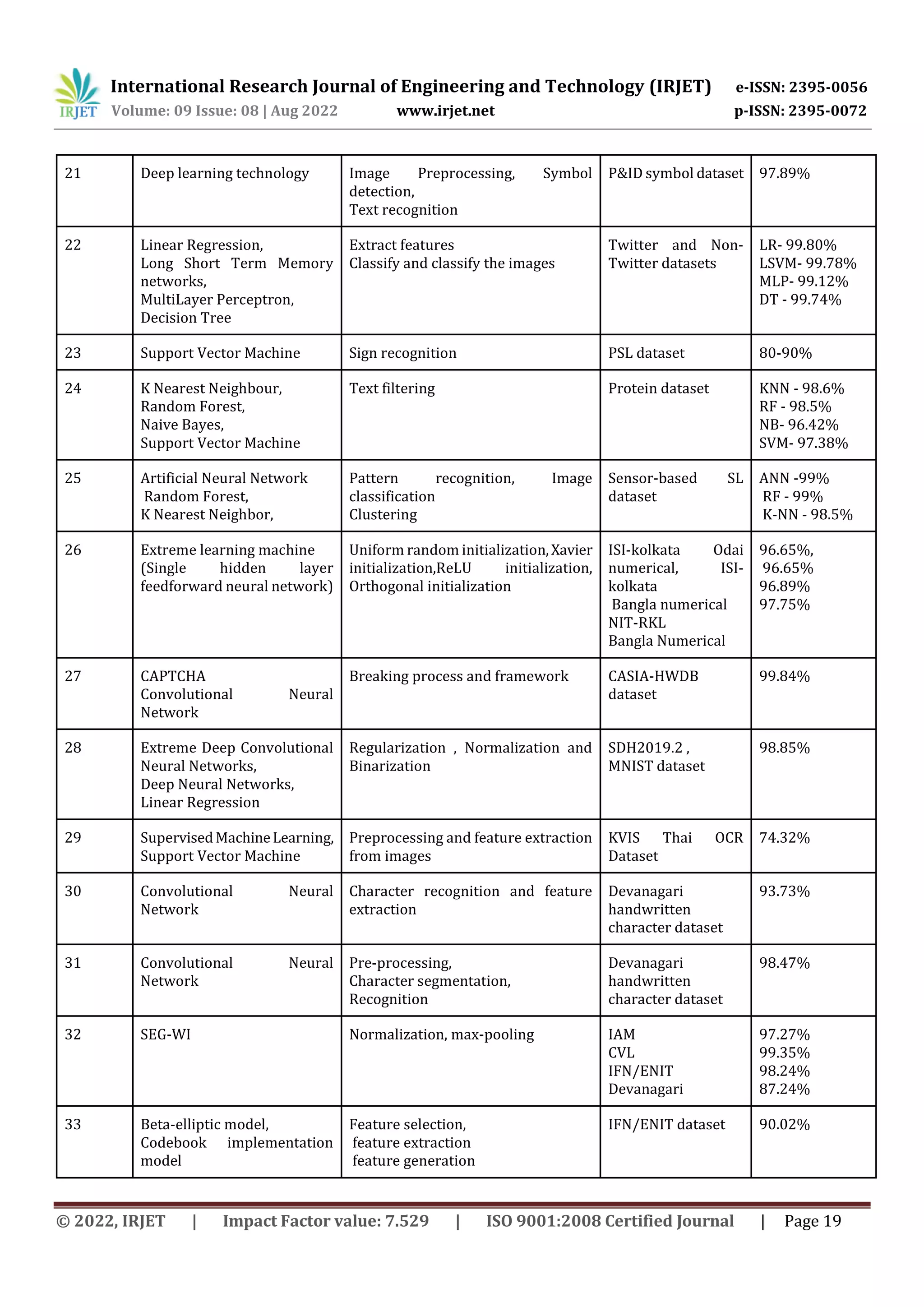
International Research Journal of Engineering and Technology (IRJET) e-ISSN: 2395-0056 Volume: 09 Issue: 08 | Aug 2022 www.irjet.net p-ISSN: 2395-0072 © 2022, IRJET | Impact Factor value: 7.529 | ISO 9001:2008 Certified Journal | Page 19 21 Deep learning technology Image Preprocessing, Symbol detection, Text recognition P&ID symbol dataset 97.89% 22 Linear Regression, Long Short Term Memory networks, MultiLayer Perceptron, Decision Tree Extract features Classify and classify the images Twitter and Non- Twitter datasets LR- 99.80% LSVM- 99.78% MLP- 99.12% DT - 99.74% 23 Support Vector Machine Sign recognition PSL dataset 80-90% 24 K Nearest Neighbour, Random Forest, Naive Bayes, Support Vector Machine Text filtering Protein dataset KNN - 98.6% RF - 98.5% NB- 96.42% SVM- 97.38% 25 Artificial Neural Network Random Forest, K Nearest Neighbor, Pattern recognition, Image classification Clustering Sensor-based SL dataset ANN -99% RF - 99% K-NN - 98.5% 26 Extreme learning machine (Single hidden layer feedforward neural network) Uniform random initialization,Xavier initialization,ReLU initialization, Orthogonal initialization ISI-kolkata Odai numerical, ISI- kolkata Bangla numerical NIT-RKL Bangla Numerical 96.65%, 96.65% 96.89% 97.75% 27 CAPTCHA Convolutional Neural Network Breaking process and framework CASIA-HWDB dataset 99.84% 28 Extreme Deep Convolutional Neural Networks, Deep Neural Networks, Linear Regression Regularization , Normalization and Binarization SDH2019.2 , MNIST dataset 98.85% 29 SupervisedMachineLearning, Support Vector Machine Preprocessing and feature extraction from images KVIS Thai OCR Dataset 74.32% 30 Convolutional Neural Network Character recognition and feature extraction Devanagari handwritten character dataset 93.73% 31 Convolutional Neural Network Pre-processing, Character segmentation, Recognition Devanagari handwritten character dataset 98.47% 32 SEG-WI Normalization, max-pooling IAM CVL IFN/ENIT Devanagari 97.27% 99.35% 98.24% 87.24% 33 Beta-elliptic model, Codebook implementation model Feature selection, feature extraction feature generation IFN/ENIT dataset 90.02%
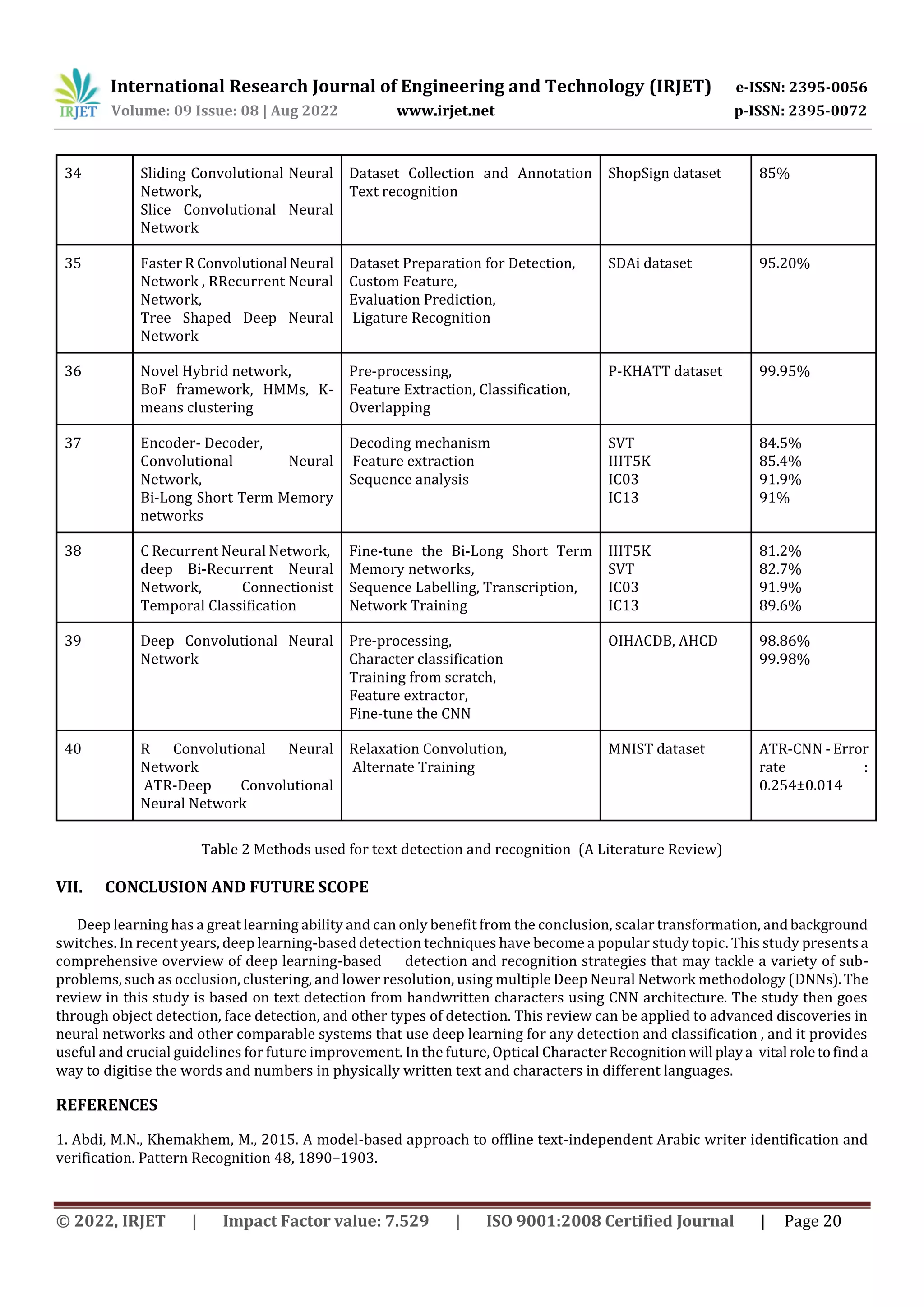
International Research Journal of Engineering and Technology (IRJET) e-ISSN: 2395-0056 Volume: 09 Issue: 08 | Aug 2022 www.irjet.net p-ISSN: 2395-0072 © 2022, IRJET | Impact Factor value: 7.529 | ISO 9001:2008 Certified Journal | Page 20 34 Sliding Convolutional Neural Network, Slice Convolutional Neural Network Dataset Collection and Annotation Text recognition ShopSign dataset 85% 35 Faster R Convolutional Neural Network , RRecurrent Neural Network, Tree Shaped Deep Neural Network Dataset Preparation for Detection, Custom Feature, Evaluation Prediction, Ligature Recognition SDAi dataset 95.20% 36 Novel Hybrid network, BoF framework, HMMs, K- means clustering Pre-processing, Feature Extraction, Classification, Overlapping P-KHATT dataset 99.95% 37 Encoder- Decoder, Convolutional Neural Network, Bi-Long Short Term Memory networks Decoding mechanism Feature extraction Sequence analysis SVT IIIT5K IC03 IC13 84.5% 85.4% 91.9% 91% 38 C Recurrent Neural Network, deep Bi-Recurrent Neural Network, Connectionist Temporal Classification Fine-tune the Bi-Long Short Term Memory networks, Sequence Labelling, Transcription, Network Training IIIT5K SVT IC03 IC13 81.2% 82.7% 91.9% 89.6% 39 Deep Convolutional Neural Network Pre-processing, Character classification Training from scratch, Feature extractor, Fine-tune the CNN OIHACDB, AHCD 98.86% 99.98% 40 R Convolutional Neural Network ATR-Deep Convolutional Neural Network Relaxation Convolution, Alternate Training MNIST dataset ATR-CNN - Error rate : 0.254±0.014 Table 2 Methods used for text detection and recognition (A Literature Review) VII. CONCLUSION AND FUTURE SCOPE Deep learning has a great learning ability and can only benefit from the conclusion, scalar transformation, andbackground switches. In recent years, deep learning-based detection techniques have become a popular study topic. This study presentsa comprehensive overview of deep learning-based detection and recognition strategies that may tackle a variety of sub- problems, such as occlusion, clustering, and lower resolution, using multiple Deep Neural Network methodology (DNNs).The review in this study is based on text detection from handwritten characters using CNN architecture. The study then goes through object detection, face detection, and other types of detection. This review can be applied to advanced discoveries in neural networks and other comparable systems that use deep learning for any detection and classification , and it provides useful and crucial guidelines for future improvement. In the future, Optical CharacterRecognition will playa vital roletofinda way to digitise the words and numbers in physically written text and characters in different languages. REFERENCES 1. Abdi, M.N., Khemakhem, M., 2015. A model-based approach to offline text-independent Arabic writer identification and verification. Pattern Recognition 48, 1890–1903.
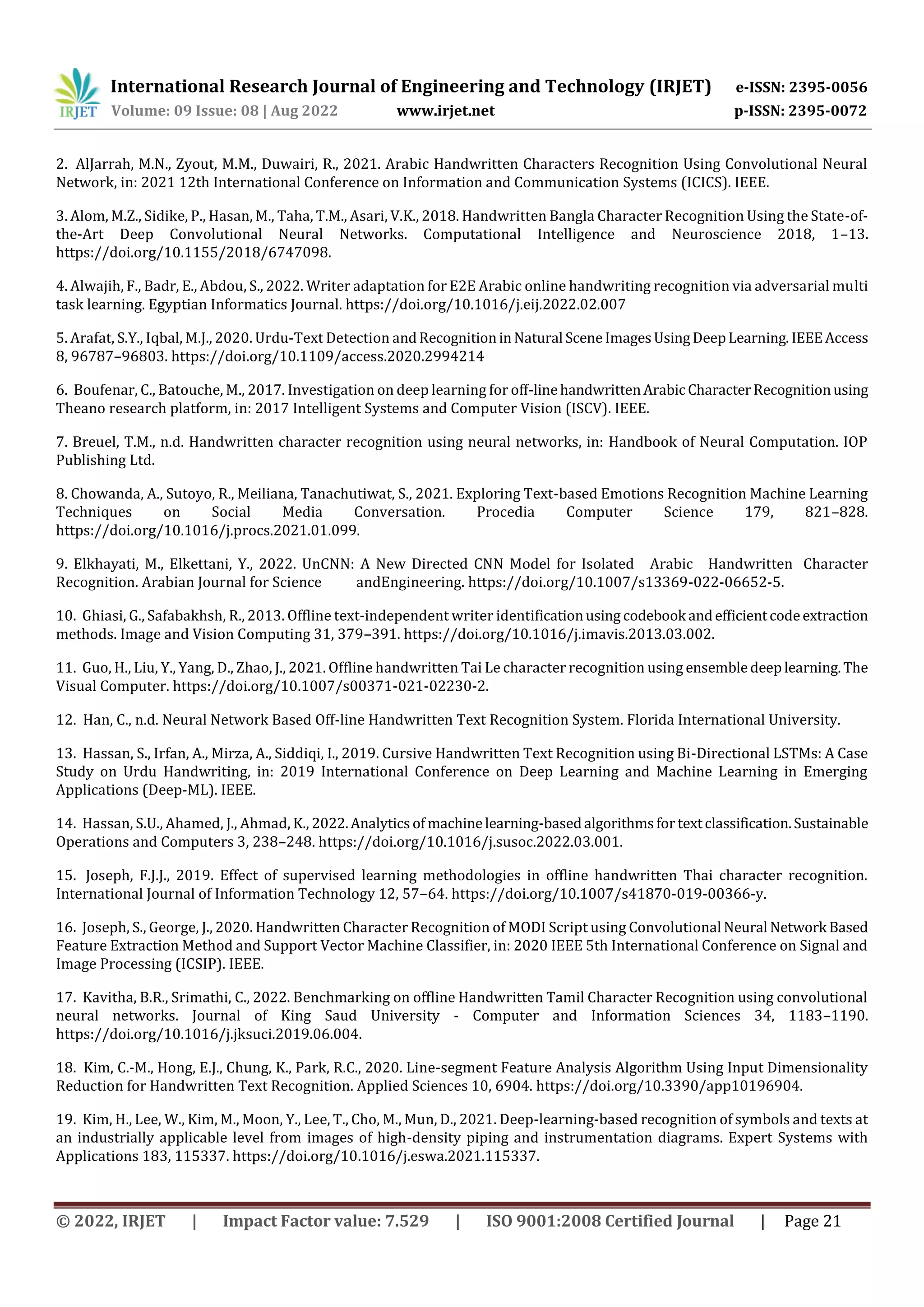
International Research Journal of Engineering and Technology (IRJET) e-ISSN: 2395-0056 Volume: 09 Issue: 08 | Aug 2022 www.irjet.net p-ISSN: 2395-0072 © 2022, IRJET | Impact Factor value: 7.529 | ISO 9001:2008 Certified Journal | Page 21 2. AlJarrah, M.N., Zyout, M.M., Duwairi, R., 2021. Arabic Handwritten Characters Recognition Using Convolutional Neural Network, in: 2021 12th International Conference on Information and Communication Systems (ICICS). IEEE. 3. Alom, M.Z., Sidike, P., Hasan, M., Taha, T.M., Asari, V.K., 2018. Handwritten Bangla Character Recognition Using the State-of- the-Art Deep Convolutional Neural Networks. Computational Intelligence and Neuroscience 2018, 1–13. https://doi.org/10.1155/2018/6747098. 4. Alwajih, F., Badr, E., Abdou, S., 2022. Writer adaptation for E2E Arabic online handwriting recognition via adversarial multi task learning. Egyptian Informatics Journal. https://doi.org/10.1016/j.eij.2022.02.007 5. Arafat, S.Y., Iqbal, M.J., 2020. Urdu-Text Detection andRecognitioninNatural SceneImagesUsingDeepLearning. IEEEAccess 8, 96787–96803. https://doi.org/10.1109/access.2020.2994214 6. Boufenar, C., Batouche, M., 2017. Investigation on deep learning for off-linehandwrittenArabicCharacterRecognitionusing Theano research platform, in: 2017 Intelligent Systems and Computer Vision (ISCV). IEEE. 7. Breuel, T.M., n.d. Handwritten character recognition using neural networks, in: Handbook of Neural Computation. IOP Publishing Ltd. 8. Chowanda, A., Sutoyo, R., Meiliana, Tanachutiwat, S., 2021. Exploring Text-based Emotions Recognition Machine Learning Techniques on Social Media Conversation. Procedia Computer Science 179, 821–828. https://doi.org/10.1016/j.procs.2021.01.099. 9. Elkhayati, M., Elkettani, Y., 2022. UnCNN: A New Directed CNN Model for Isolated Arabic Handwritten Character Recognition. Arabian Journal for Science andEngineering. https://doi.org/10.1007/s13369-022-06652-5. 10. Ghiasi, G., Safabakhsh, R., 2013. Offline text-independent writer identificationusing codebook andefficientcodeextraction methods. Image and Vision Computing 31, 379–391. https://doi.org/10.1016/j.imavis.2013.03.002. 11. Guo, H., Liu, Y., Yang, D., Zhao, J., 2021. Offline handwritten Tai Le character recognition using ensembledeeplearning.The Visual Computer. https://doi.org/10.1007/s00371-021-02230-2. 12. Han, C., n.d. Neural Network Based Off-line Handwritten Text Recognition System. Florida International University. 13. Hassan, S., Irfan, A., Mirza, A., Siddiqi, I., 2019. Cursive Handwritten Text Recognition using Bi-Directional LSTMs: A Case Study on Urdu Handwriting, in: 2019 International Conference on Deep Learning and Machine Learning in Emerging Applications (Deep-ML). IEEE. 14. Hassan, S.U., Ahamed, J., Ahmad, K., 2022.Analyticsof machinelearning-basedalgorithmsfortextclassification.Sustainable Operations and Computers 3, 238–248. https://doi.org/10.1016/j.susoc.2022.03.001. 15. Joseph, F.J.J., 2019. Effect of supervised learning methodologies in offline handwritten Thai character recognition. International Journal of Information Technology 12, 57–64. https://doi.org/10.1007/s41870-019-00366-y. 16. Joseph, S., George, J., 2020. Handwritten Character Recognition of MODI Script using Convolutional Neural Network Based Feature Extraction Method and Support Vector Machine Classifier, in: 2020 IEEE 5th International Conference on Signal and Image Processing (ICSIP). IEEE. 17. Kavitha, B.R., Srimathi, C., 2022. Benchmarking on offline Handwritten Tamil Character Recognition using convolutional neural networks. Journal of King Saud University - Computer and Information Sciences 34, 1183–1190. https://doi.org/10.1016/j.jksuci.2019.06.004. 18. Kim, C.-M., Hong, E.J., Chung, K., Park, R.C., 2020. Line-segment Feature Analysis Algorithm Using Input Dimensionality Reduction for Handwritten Text Recognition. Applied Sciences 10, 6904. https://doi.org/10.3390/app10196904. 19. Kim, H., Lee, W., Kim, M., Moon, Y., Lee, T., Cho, M., Mun, D., 2021. Deep-learning-based recognition of symbols and texts at an industrially applicable level from images of high-density piping and instrumentation diagrams. Expert Systems with Applications 183, 115337. https://doi.org/10.1016/j.eswa.2021.115337.
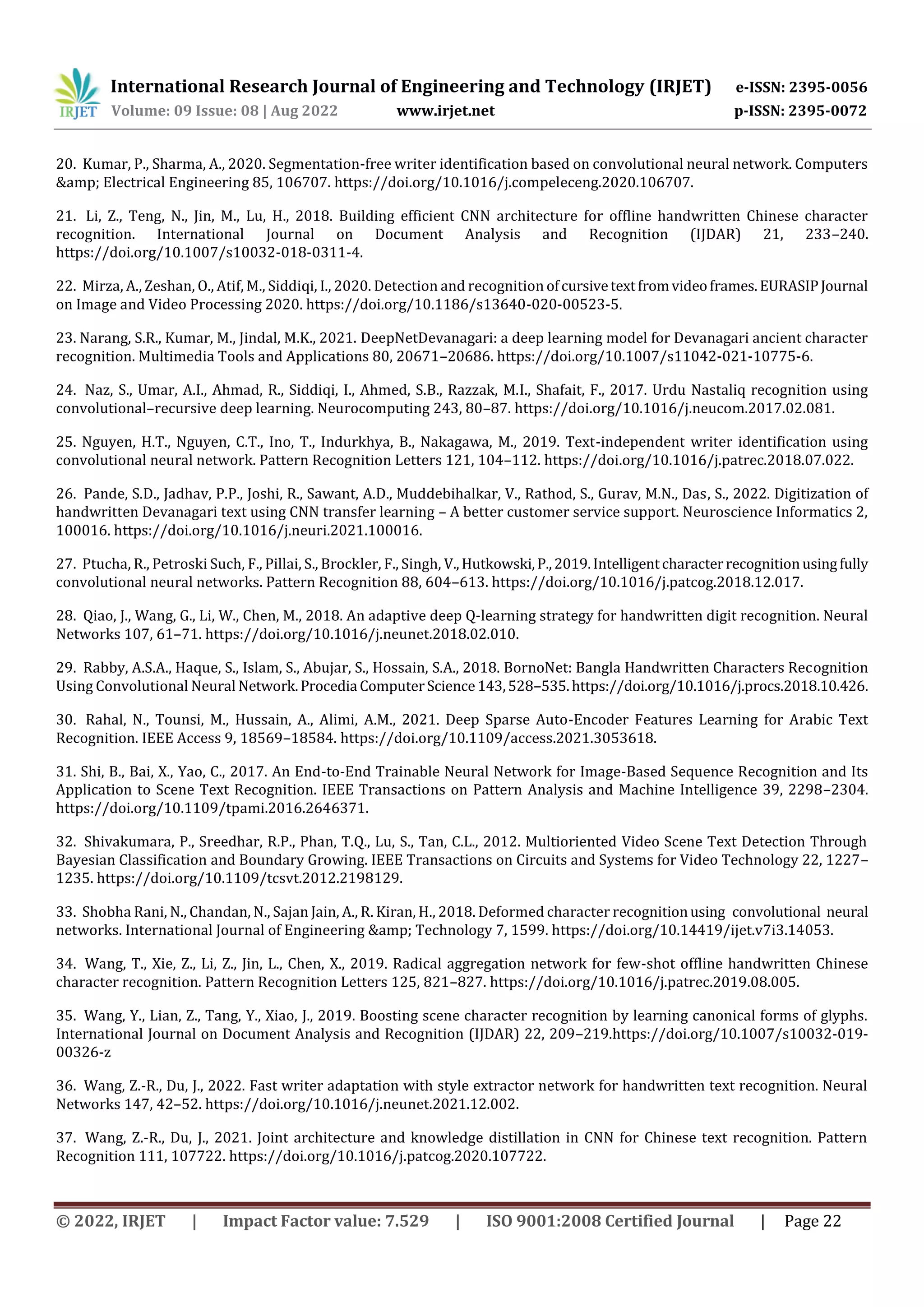
International Research Journal of Engineering and Technology (IRJET) e-ISSN: 2395-0056 Volume: 09 Issue: 08 | Aug 2022 www.irjet.net p-ISSN: 2395-0072 © 2022, IRJET | Impact Factor value: 7.529 | ISO 9001:2008 Certified Journal | Page 22 20. Kumar, P., Sharma, A., 2020. Segmentation-free writer identification based on convolutional neural network. Computers & Electrical Engineering 85, 106707. https://doi.org/10.1016/j.compeleceng.2020.106707. 21. Li, Z., Teng, N., Jin, M., Lu, H., 2018. Building efficient CNN architecture for offline handwritten Chinese character recognition. International Journal on Document Analysis and Recognition (IJDAR) 21, 233–240. https://doi.org/10.1007/s10032-018-0311-4. 22. Mirza, A., Zeshan, O., Atif, M., Siddiqi, I., 2020. Detection and recognition ofcursivetextfromvideoframes.EURASIPJournal on Image and Video Processing 2020. https://doi.org/10.1186/s13640-020-00523-5. 23. Narang, S.R., Kumar, M., Jindal, M.K., 2021. DeepNetDevanagari: a deep learning model for Devanagari ancient character recognition. Multimedia Tools and Applications 80, 20671–20686. https://doi.org/10.1007/s11042-021-10775-6. 24. Naz, S., Umar, A.I., Ahmad, R., Siddiqi, I., Ahmed, S.B., Razzak, M.I., Shafait, F., 2017. Urdu Nastaliq recognition using convolutional–recursive deep learning. Neurocomputing 243, 80–87. https://doi.org/10.1016/j.neucom.2017.02.081. 25. Nguyen, H.T., Nguyen, C.T., Ino, T., Indurkhya, B., Nakagawa, M., 2019. Text-independent writer identification using convolutional neural network. Pattern Recognition Letters 121, 104–112. https://doi.org/10.1016/j.patrec.2018.07.022. 26. Pande, S.D., Jadhav, P.P., Joshi, R., Sawant, A.D., Muddebihalkar, V., Rathod, S., Gurav, M.N., Das, S., 2022. Digitization of handwritten Devanagari text using CNN transfer learning – A better customer service support. Neuroscience Informatics 2, 100016. https://doi.org/10.1016/j.neuri.2021.100016. 27. Ptucha, R., Petroski Such, F., Pillai, S., Brockler, F., Singh, V.,Hutkowski,P.,2019.Intelligentcharacterrecognitionusingfully convolutional neural networks. Pattern Recognition 88, 604–613. https://doi.org/10.1016/j.patcog.2018.12.017. 28. Qiao, J., Wang, G., Li, W., Chen, M., 2018. An adaptive deep Q-learning strategy for handwritten digit recognition. Neural Networks 107, 61–71. https://doi.org/10.1016/j.neunet.2018.02.010. 29. Rabby, A.S.A., Haque, S., Islam, S., Abujar, S., Hossain, S.A., 2018. BornoNet: Bangla Handwritten Characters Recognition Using Convolutional Neural Network.Procedia ComputerScience143,528–535.https://doi.org/10.1016/j.procs.2018.10.426. 30. Rahal, N., Tounsi, M., Hussain, A., Alimi, A.M., 2021. Deep Sparse Auto-Encoder Features Learning for Arabic Text Recognition. IEEE Access 9, 18569–18584. https://doi.org/10.1109/access.2021.3053618. 31. Shi, B., Bai, X., Yao, C., 2017. An End-to-End Trainable Neural Network for Image-Based Sequence Recognition and Its Application to Scene Text Recognition. IEEE Transactions on Pattern Analysis and Machine Intelligence 39, 2298–2304. https://doi.org/10.1109/tpami.2016.2646371. 32. Shivakumara, P., Sreedhar, R.P., Phan, T.Q., Lu, S., Tan, C.L., 2012. Multioriented Video Scene Text Detection Through Bayesian Classification and Boundary Growing. IEEE Transactions on Circuits and Systems for Video Technology 22, 1227– 1235. https://doi.org/10.1109/tcsvt.2012.2198129. 33. Shobha Rani, N., Chandan, N., Sajan Jain, A., R. Kiran, H., 2018. Deformed character recognitionusing convolutional neural networks. International Journal of Engineering & Technology 7, 1599. https://doi.org/10.14419/ijet.v7i3.14053. 34. Wang, T., Xie, Z., Li, Z., Jin, L., Chen, X., 2019. Radical aggregation network for few-shot offline handwritten Chinese character recognition. Pattern Recognition Letters 125, 821–827. https://doi.org/10.1016/j.patrec.2019.08.005. 35. Wang, Y., Lian, Z., Tang, Y., Xiao, J., 2019. Boosting scene character recognition by learning canonical forms of glyphs. International Journal on Document Analysis and Recognition (IJDAR) 22, 209–219.https://doi.org/10.1007/s10032-019- 00326-z 36. Wang, Z.-R., Du, J., 2022. Fast writer adaptation with style extractor network for handwritten text recognition. Neural Networks 147, 42–52. https://doi.org/10.1016/j.neunet.2021.12.002. 37. Wang, Z.-R., Du, J., 2021. Joint architecture and knowledge distillation in CNN for Chinese text recognition. Pattern Recognition 111, 107722. https://doi.org/10.1016/j.patcog.2020.107722.
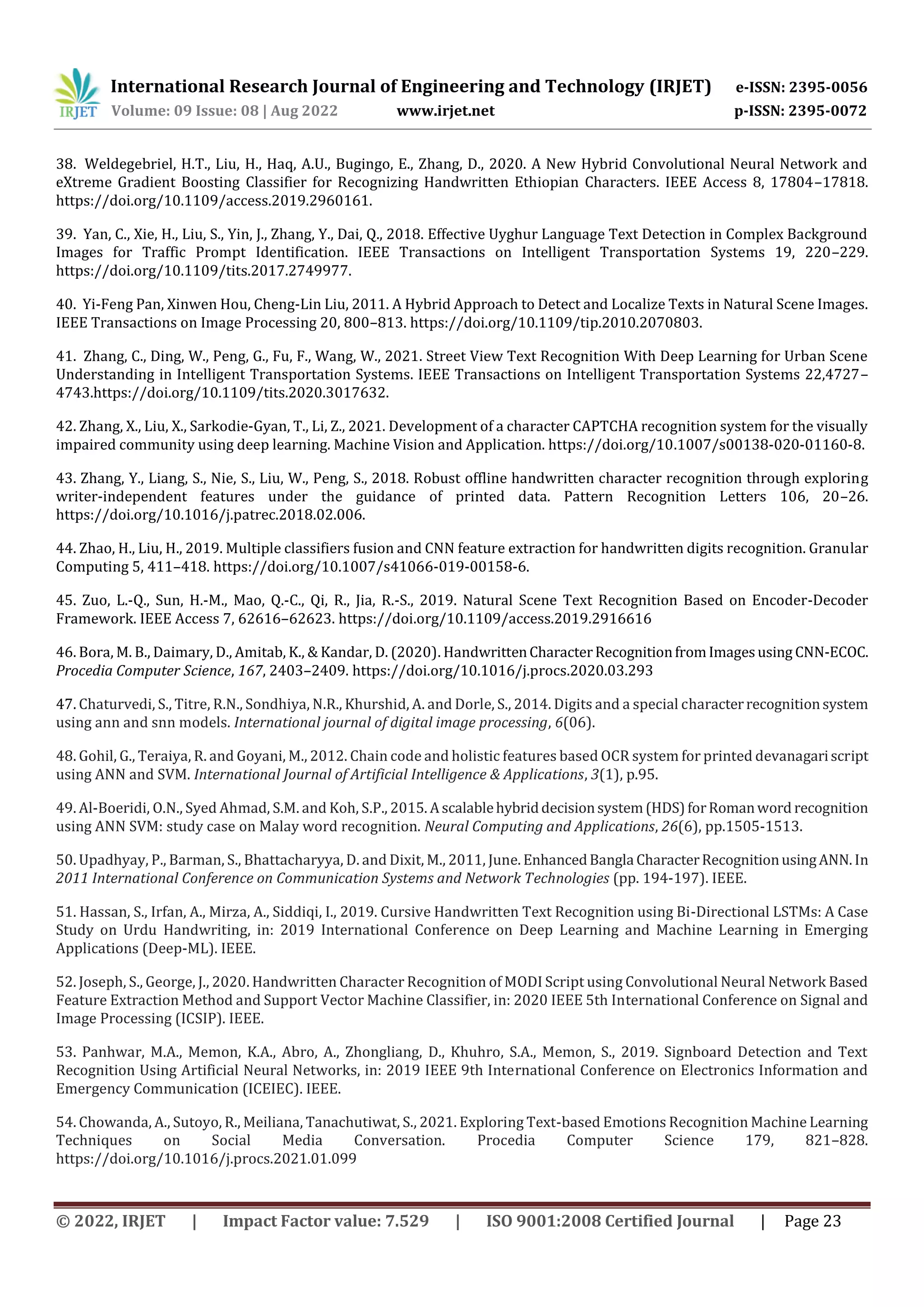
International Research Journal of Engineering and Technology (IRJET) e-ISSN: 2395-0056 Volume: 09 Issue: 08 | Aug 2022 www.irjet.net p-ISSN: 2395-0072 © 2022, IRJET | Impact Factor value: 7.529 | ISO 9001:2008 Certified Journal | Page 23 38. Weldegebriel, H.T., Liu, H., Haq, A.U., Bugingo, E., Zhang, D., 2020. A New Hybrid Convolutional Neural Network and eXtreme Gradient Boosting Classifier for Recognizing Handwritten Ethiopian Characters. IEEE Access 8, 17804–17818. https://doi.org/10.1109/access.2019.2960161. 39. Yan, C., Xie, H., Liu, S., Yin, J., Zhang, Y., Dai, Q., 2018. Effective Uyghur Language Text Detection in Complex Background Images for Traffic Prompt Identification. IEEE Transactions on Intelligent Transportation Systems 19, 220–229. https://doi.org/10.1109/tits.2017.2749977. 40. Yi-Feng Pan, Xinwen Hou, Cheng-Lin Liu, 2011. A Hybrid Approach to Detect and Localize Texts in Natural Scene Images. IEEE Transactions on Image Processing 20, 800–813. https://doi.org/10.1109/tip.2010.2070803. 41. Zhang, C., Ding, W., Peng, G., Fu, F., Wang, W., 2021. Street View Text Recognition With Deep Learning for Urban Scene Understanding in Intelligent Transportation Systems. IEEE Transactions on Intelligent Transportation Systems 22,4727– 4743.https://doi.org/10.1109/tits.2020.3017632. 42. Zhang, X., Liu, X., Sarkodie-Gyan, T., Li, Z., 2021. Development of a character CAPTCHA recognition system for the visually impaired community using deep learning. Machine Vision and Application. https://doi.org/10.1007/s00138-020-01160-8. 43. Zhang, Y., Liang, S., Nie, S., Liu, W., Peng, S., 2018. Robust offline handwritten character recognition through exploring writer-independent features under the guidance of printed data. Pattern Recognition Letters 106, 20–26. https://doi.org/10.1016/j.patrec.2018.02.006. 44. Zhao, H., Liu, H., 2019. Multiple classifiers fusion and CNN feature extraction for handwritten digits recognition. Granular Computing 5, 411–418. https://doi.org/10.1007/s41066-019-00158-6. 45. Zuo, L.-Q., Sun, H.-M., Mao, Q.-C., Qi, R., Jia, R.-S., 2019. Natural Scene Text Recognition Based on Encoder-Decoder Framework. IEEE Access 7, 62616–62623. https://doi.org/10.1109/access.2019.2916616 46. Bora, M. B., Daimary, D., Amitab, K., & Kandar, D. (2020). HandwrittenCharacterRecognitionfromImagesusing CNN-ECOC. Procedia Computer Science, 167, 2403–2409. https://doi.org/10.1016/j.procs.2020.03.293 47. Chaturvedi, S., Titre, R.N., Sondhiya, N.R., Khurshid, A. and Dorle, S., 2014. Digits and a special characterrecognitionsystem using ann and snn models. International journal of digital image processing, 6(06). 48. Gohil, G., Teraiya, R. and Goyani, M., 2012. Chain code and holistic features based OCR system for printed devanagariscript using ANN and SVM. International Journal of Artificial Intelligence & Applications, 3(1), p.95. 49. Al-Boeridi, O.N., Syed Ahmad, S.M. and Koh, S.P., 2015. Ascalablehybriddecisionsystem(HDS)forRomanword recognition using ANN SVM: study case on Malay word recognition. Neural Computing and Applications, 26(6), pp.1505-1513. 50. Upadhyay, P., Barman, S., Bhattacharyya, D. and Dixit, M., 2011, June. EnhancedBangla CharacterRecognitionusingANN.In 2011 International Conference on Communication Systems and Network Technologies (pp. 194-197). IEEE. 51. Hassan, S., Irfan, A., Mirza, A., Siddiqi, I., 2019. Cursive Handwritten Text Recognition using Bi-Directional LSTMs: A Case Study on Urdu Handwriting, in: 2019 International Conference on Deep Learning and Machine Learning in Emerging Applications (Deep-ML). IEEE. 52. Joseph, S., George, J., 2020. Handwritten Character Recognition of MODI Script using Convolutional Neural Network Based Feature Extraction Method and Support Vector Machine Classifier, in: 2020 IEEE 5th International Conference on Signal and Image Processing (ICSIP). IEEE. 53. Panhwar, M.A., Memon, K.A., Abro, A., Zhongliang, D., Khuhro, S.A., Memon, S., 2019. Signboard Detection and Text Recognition Using Artificial Neural Networks, in: 2019 IEEE 9th International Conference on Electronics Information and Emergency Communication (ICEIEC). IEEE. 54. Chowanda, A., Sutoyo, R., Meiliana, Tanachutiwat, S., 2021. Exploring Text-based Emotions Recognition Machine Learning Techniques on Social Media Conversation. Procedia Computer Science 179, 821–828. https://doi.org/10.1016/j.procs.2021.01.099
International Research Journal of Engineering and Technology (IRJET) e-ISSN: 2395-0056 Volume: 09 Issue: 08 | Aug 2022 www.irjet.net p-ISSN: 2395-0072 © 2022, IRJET | Impact Factor value: 7.529 | ISO 9001:2008 Certified Journal | Page 24 55. Chiong, R., Budhi, G.S., Dhakal, S., Chiong, F., 2021. A textual-basedfeatureapproachfordepressiondetectionusingmachine learning classifiers and social media texts. Computers in Biology and Medicine 135, 104499. https://doi.org/10.1016/j.compbiomed.2021.104499. 56. Wu, C., Fan, W., He, Y., Sun, J., Naoi, S., 2014. Handwritten Character Recognition by Alternately Trained Relaxation Convolutional Neural Network, in: 2014 14th International Conference on Frontiers in Handwriting Recognition. IEEE. 57. Zhang, Y.-K., Zhang, H., Liu, Y.-G., Yang, Q., Liu, C.-L., 2019. Oracle Character Recognition by Nearest Neighbor Classification with Deep Metric Learning, in: 2019 International Conference on Document Analysis and Recognition (ICDAR). IEEE. 58. Mirza, A., Zeshan, O., Atif, M., Siddiqi, I., 2020. Detection and recognition of cursive text fromvideoframes.EURASIP Journal on Image and Video Processing 2020. https://doi.org/10.1186/s13640-020-00523-5 59. Shivakumara, P., Phan, T.Q., Lu, S., Tan, C.L., 2013. Gradient Vector Flow and Grouping-Based Method for Arbitrarily Oriented Scene Text Detection in Video Images. IEEE Transactions on Circuits and Systems for Video Technology 23, 1729– 1739. https://doi.org/10.1109/tcsvt.2013.2255396 60. Cilia, N.D., De Stefano, C., Fontanella, F., Scotto di Freca, A., 2019. A ranking-based feature selection approach for handwritten character recognition. Pattern Recognition Letters 121, 77–86. https://doi.org/10.1016/j.patrec.2018.04.007 61. Abdulrazzaq, M.B., Saeed, J.N., 2019. A Comparison of ThreeClassificationAlgorithmsforHandwrittenDigitRecognition, in: 2019 International Conference on Advanced Science and Engineering (ICOASE). IEEE.

Deep Learning in Text Recognition and Text Detection : A Review

  • 1.
    International Research Journalof Engineering and Technology (IRJET) e-ISSN: 2395-0056 Volume: 09 Issue: 08 | Aug 2022 www.irjet.net p-ISSN: 2395-0072 © 2022, IRJET | Impact Factor value: 7.529 | ISO 9001:2008 Certified Journal | Page 9 Deep Learning in Text Recognition and Text Detection : A Review Brindha Muthusamy1, Kousalya K2 1Dept. of Computer Science and Engineering, Kongu Engineering College, Erode 3Professor, Dept. of Computer Science and Engineering, Kongu Engineering College, Erode ---------------------------------------------------------------------***--------------------------------------------------------------------- Abstract - Detecting text in natural situations is a difficult task that is more difficult than extracting the text from those natural images in which the background and foreground are clearly separated and every character isisolatedfromtheimages. Textin the landscapes which is nature may occur in a range of states like a text in dark with the backgroundlightandviceversa, withabroad diversity of fonts, even for letters of the same word, sections of words can be overlapped by environment objects, makingdetection of these parts impossible. Deep learning which is a subset of Machine learning employs a neural network, a technique that replicates how the brain analyses data. An Optical Character Recognition engine has two parts: i)Text recognition and ii)Text detection. The process of locating the sections of text in a document is known as text detection. Since the different documents (invoices, newspapers, etc.) have varied structures, this work has historically proved difficult. A text recognition system, on the other hand, takes a portion of a document containing text (a word or a line of text) and outputs the associated text. Both text detection and text recognition have shown considerable promise with deep learning algorithms. Keywords: Deep learning, Convolutional Neural Network, text detection, text classification, Optical Character Recognition, optimization I. INTRODUCTION Deep learning algorithms learn about the image by passing through each neural network layer. For applications like machine translation and image searches, OCR mechanism is being used to recognise text within photographs. The method for recognising the text/characters from a photo, sends the features extracted text from an image/photo to the classifier which is trained to distinguish individual characters that is similar to object recognition. Recognition oftext,ontheotherhand,looksat the text as a group of meaningful characters rather than single characters. A text string can be recognized by clustering the similar characters, which means that every character in the text must separate for recognition [21]. Alternatively, in the instance of classification, train the network on a labelled datasets in order to categorize the samples in the datasets. Convolutional Neural Network (CNN) was applied to extractthefeaturesforcharacter recognitionperformance.Abrief review on text detection and text recognition are shown in Table 2. The CNN model is trained in three steps : (i) Train the CNN model from the scratch, (ii) Using a transfer learning method for exploiting the features from a pretrained model on larger datasets and, (iii) Transfer learning and fine-tuning the weights of an CNN architecture. CNN architecture consists mostly of four layers. (i) Convolutional layer [Conv]; (ii) Pooling layer; (iii) Fully connected layer; and (iv) Rectified Linear units [4]. Artificial Neural Network (ANN) is being trained to extractinformationthroughthedeep-learning-basedtechnologies from an image. VGG, ResNet, MobileNet, GoogleNet, Xception, and DenseNet are examples of CNN architecture where several convolution layers are utilized to extract the features from the images [21]. Handwritten texts are difficult while reading text from photographs or recognising that has attained a lot of attention. Most systems have two important components, (i) Text detection; and (ii) Text recognition. Text detection is a technique where the text instances from the images can be predicted and localized. The text recognition is done by autoencoder which is the process of decoding the textintothemachine-readable format.
  • 2.
    International Research Journalof Engineering and Technology (IRJET) e-ISSN: 2395-0056 Volume: 09 Issue: 08 | Aug 2022 www.irjet.net p-ISSN: 2395-0072 © 2022, IRJET | Impact Factor value: 7.529 | ISO 9001:2008 Certified Journal | Page 10 Figure 1 CNN architecture for text classification II. TEXT DETECTION AND RECOGNITION USING DEEP LEARNING 2.1 Text detection The local features can be extracted from CNN through the training of character pictures and sub-regionsbasedonthe characteristics of an individual’s handwriting. To train CNN, randomly selected instances of an image in the training sets are used, and the local features extracted from the image from these instances are aggregated in order to generate the global features. The process of randomly sampling instances is repeated for every training epoch. This results in the increase of training the patterns for training the CNN for text independent writer identification [1]. Deep learning can constantly learn by examining data and finding patterns and classifying images. For picture categorization, language transaction and character recognition, deep learning is applied. Deep Neural Networksarenetworks with multiple layers that can perform complex operations onimages,sound,andtext,suchasrepresentationandabstraction. It can be used for any type of recognition problem. The basic goal is only for computers to learn withouthumaninterventionand modify their activities accordingly. 2.2 Text recognition The recognition can be done by many techniques. It involves Convolutional Neural Network(CNN), Semi Incremental Method, Incremental Method, Line and Word Segmentation method etc. One of the most effective and prominent ways of handwriting recognition is Convolutional Neural Network (CNN). The most prevalent application of CNN is in image analysis. Artificial neurons are used in CNN [11]. CNN canrecogniseimagesandvideos,classifyimages,analysemedical images,perform computer vision, and process natural language. CNN or ConvNets architecture has made significant contributions to the analysis of images. CNN is defined as , 1)A convolution tool that separates and identifies the distinct characteristics of the image for analysis in a process called Feature Extraction, which is part of the CNN architecture. 2) A fully connected layer makes use of the outputoftheconvolutionprocess in order to forecast the image's class using the information acquired in earlier stages. CNN extracts the features from handwritten text images of numerous characters by the end-to-end method based on deep learning and combines these extractedfeaturestorecognizethewriter’sspecific data duringloweringofcharacter’sclass- specific features. To create n-tuple images, a single writer’shandwrittensquaredimagesaresampledrandomly.Second,every image from n-tuple is sent into a local feature extractor (CNN). CNN can extract text-independent writer specificpropertiesby employing new techniques to structure the training samples as n tuple pictures. Finally,a global featureaggregator aggregates the retrieved local features in various ways, such as using the average or maximum. Finally, the combined characteristics are sent into a softmax classifier (fully connected with an Nfc unit which is equal to the number of writers) for predicting [1].
  • 3.
    International Research Journalof Engineering and Technology (IRJET) e-ISSN: 2395-0056 Volume: 09 Issue: 08 | Aug 2022 www.irjet.net p-ISSN: 2395-0072 © 2022, IRJET | Impact Factor value: 7.529 | ISO 9001:2008 Certified Journal | Page 11 III. PRELIMINARY STEPS FOR TEXT DETECTION AND RECOGNITION 3.1 Datasets The datasets are collected from various ImageNet dataset like, MNIST, NIST, IAM dataset, IFN/ENIT, and so on. The different dataset on different languages like, English, Arabic, Bangla handwritten character datasets are taken into consideration. The detailed view of these datasets are shown in table 2. 3.2 Image Pre-processing Pre-processing is a technology which transforms the raw data to useful and efficient data/information. This process consists of different operations which are used to perform on input images and in this process, the images are reshaped. The rearrangement of the form of the data is done without changing the contents of the data. Different kinds of arrangements are done in this process according to the parameters which are needed to carry on till further process [1].Imagepre-processingis nothing but to remove irrelevant data and delete the duplicate data fromthedatabases.Thetextintheimagecanbeindifferent styles, fonts and so on. In data pre-processing, the data are processed in different ways, they are:  Data cleaning : Remove noise and data inconsistency from raw data. That is, the datasetwhichdoesnot belongto the dataset comes, this data cleaning process removes these datasets. It is done by filtering the dataset and handling the missing data. It ensures the quality of data. In other words, itonlyremovestheunwanteddata butmaintainstheoriginality of the data.  Data integration : Data integration collects data from various multiple resources and combines it to form coherent data and also supports the consolidated perspective of the information. That is, it merges data from varioussourcesintoa coherent datastore (data warehouse). These data are stored and maintained for future use. It may be in the form of documents where the relevant data are stored in the different documents.  Data reduction : Data reduction is the process of reducing the data size by instances, aggregation, eliminating irrelevant data/features or by clustering. Data reduction can increase the storage capacity and the cost is reduced. It does not lose any data, instead it maintains the originality of the data. Data reduction process is done with the help of data compression. Data compression is a technique to compressthedata ina reducedformofdata whichcanreducethestorage space.  Data transformation : Data transformation is used to convert one form of format to another format. It is also known as data munging or data wrangling. Otherwise called Normalization. The data points in the scatter plot should be linear.If the points are in the form of a curve, it is difficult to calculate the accuracywhichaffects theperformanceofthemodel. This curve can be converted into a linear line by scaling the model in the range of 0 and 1. Activation functions are used when the model shows non-linearity in their respective model. 3.3 Normalization Normalization is the process of organizing data in the database. This process involves table creation and establishing relationships between these tables. It protects the data as well as makes the database moreflexible byeliminatingredundancy and inconsistent dependency. Redundant data takes more space and is complicated to maintain. The inconsistent dependent data can make it difficult to access the data since the path to find the data is either missing or broken. Hence, Normalization is more important since it can reduce these irrelevant data and data inconsistency and it can handle the missing data as well to make the database more flexible. Normalization includes three stages of normalization steps where each stage generates the table. Each table stores the relevant data which does not include duplicate data or miss any data. The three steps involved in the normalization process are as follows, 3.3.1 First Normal form The First Normal Form (1NF) sets the fundamental rulesfordatabasenormalizationwhichrelatestothesingletablein the relational database model. The steps involved in the First Normal Form are :  Every column in the table are unique  Separate tables are created for every relevant set of data  Each table must be identified with a unique column or the concatenated columns are called with the primary key
  • 4.
    International Research Journalof Engineering and Technology (IRJET) e-ISSN: 2395-0056 Volume: 09 Issue: 08 | Aug 2022 www.irjet.net p-ISSN: 2395-0072 © 2022, IRJET | Impact Factor value: 7.529 | ISO 9001:2008 Certified Journal | Page 12  Neither row or column of the table are duplicated  No row or column that intersects in the table contain a NULL value  No row or column that intersects in the table can have multi-valued fields 3.3.2 Second Normal Form The Second Normal Form (2NF) follows the First Normal Form . The basic requirements of Second Normal Form for organizing the data include:  No redundancy of data. All the data is stored in only one place.  Data dependencies in Second Normal Form are logical. That is, all the related data items are stored together which is useful for easy access. 3.3.3 Third Normal Form The Third Normal Form (3NF)isthecombinationof both FirstNormal FormandSecondNormal Form(1NF+2NF).The main benefits of this Third normal form are:  Reduces duplication of the data and achieves data integrity in a database.  Useful to design a normal relational database  3NF are independent of anomalies of deletion, updation, and insertion  It ensures losslessness and prevention of the functional dependencies 3.4 Feature extraction Text extraction or Feature extraction from an image is a method of extracting text from a photograph using machine learning techniques. Text extraction is also known as text localization. It is used for text detection and localizationwhich helps for text recognition. Text localization is the process which isusedtodevelopa computersystem(AI)toautomaticallyrecognize and read the text from the images. In deep learning models, the feature extraction process is done automatically since the models are pre-trained. It is done by text classification. 3.4.1 Text Classification Text classification is also known as text tagging or text categorization. Texts are always unstructured in handwritten words or characters. Hence, these texts are categorized into an organized group. This process is difficult since it takes more time and is a little expensive. By using Natural Language Processing (NLP) which can be used as a text classifier, the texts can be categorized and can be converted into structural textual data which is easy to understand, cost effective and is more scalable. Natural Language Processing can automatically analyse and understandthetypeofcharacteranditwill assigna set of pre-defined tags (Pre-trained image datasets) and can be categorized based on its characteristics. 3.5 Text detection In the testing stage, text detection is accomplishedbysegmentingphotos.Aseriesoftext/sub-imagesofindividual text is divided from a full image. Edge detection and the space between the different characters are used to segment the image. Following segmentation, the sub-divided portions are labelled and processed one at a time. This labellingisusedto determine the total number of characters in an image. After that, each sub picture is scaled (70x50) and normalized in relation to itself. This aids in the extraction of image quality attributes [9]. Text detection is a method in which the model is given an image and the text region is detected by building a bounding box around it. Text recognition is carried out by further processing the discovered textual sections in order to recognise the text. 3.5.1 Training the dataset Deep learning model is built while feeding data to a deep neural network (DNN) to "train" in order to do a specific AI task (such as image classification or speech to text conversion). The hidden layer in the neural network is used for backpropagation which helps to improve the performance of the training model. Hence, during the training process, known data is fed into the DNN, and this DNN generates a prediction on what the data represents.
  • 5.
    International Research Journalof Engineering and Technology (IRJET) e-ISSN: 2395-0056 Volume: 09 Issue: 08 | Aug 2022 www.irjet.net p-ISSN: 2395-0072 © 2022, IRJET | Impact Factor value: 7.529 | ISO 9001:2008 Certified Journal | Page 13 Image Classification (used to classify the type of an object in an image). o Input: A photograph, for example, is a single-object image. o Output: A designation for a class (one or more integers that are mapped to class labels). 3.5.2 Validating the dataset Validation data introduces new data into the model that it hasn't assessed before during training. Validation data serves as the first test against unknown data, allowing data scientiststoassesshowwell themodel predictsnew data.Although not all data scientists use validation data, it can be useful in optimizing hyperparameters, which influence how the model evaluates data. Object Localization (locate the existence of objects in an image and use a bounding box to represent their location). o Input: A photograph, for instance, is an image featuring one or more objects. o Output: A set of bounding boxes (or more) . 3.5.3 Testing the dataset Testing data once the model has been developed confirms that it can make accurate predictions. The testing data should be unlabelled if the training and validation data include labels totrack themodel'sperformancemetrics.Testdata isthe verification of an unknown dataset to make sure that the machine learning algorithm was trained properly. Object Detection (detect the presence of objects/characters in an image with a bounding box, as well as the types or classes of those objects). o Input: A photograph, for instance, is an image featuring one or more objects. o Output: A class label for each bounding box, as well as one or more bounding boxes (specified by a point, width, and height). 3.6 Text recognition Text recognition, commonlyknownasOCR (Optical CharacterRecognition)isa typeof computervisionproblemwhich involves converting images/photos of digital or hand-written character into a machine-readable text that the computer can process, save, and edit as a text file or as part of data entry and manipulation software. It can recognize the text from any documents, handwritten characters, andsoonbypre-trainingtheimagesusingdeeplearningconceptsanditsarchitectures.In other words, text recognition is the process where the image text is converted into a recognisable and readable text. The recognition of the detected text is done by various deep neural networks. Year CNN architecture No. of layers No. of parameter 2014 VGG-16 16 layers 138 million 2015 ResNet 34 layers 23 million 2014 GoogleNet 22 layers 7 million 2016 Xception 71 layers ~26 million DenseNet 121 layers 20 million Table 1 CNN architecture Some of the advantages of Optical Character Recognition  Quick data retrieval
  • 6.
    International Research Journalof Engineering and Technology (IRJET) e-ISSN: 2395-0056 Volume: 09 Issue: 08 | Aug 2022 www.irjet.net p-ISSN: 2395-0072 © 2022, IRJET | Impact Factor value: 7.529 | ISO 9001:2008 Certified Journal | Page 14  Easy to extract relevant data  Low cost for usage like copying, editing and so on  High accuracy to detect and recognize  Increase the storage capacity IV. DEEP NEURAL NETWORKS FOR TEXT DETECTION AND RECOGNITION Deep learning is a domain of study that aims to copy the functioning of human brains in order to process data and make decisions. Deep learning is also knownasDeepNeural Network (DNN)orDeepNeural Learning.Thedeeplearningmodel for Optical Character Recognition uses two types of neural network architecture. They are i)Convolutional Neural Network (CNN); ii)Artificial Neural Network (ANN). 4.1 Convolutional Neural Network (CNN) Convolutional Neural Network (CNN) is a neural network which has three layers. They are: (i) Input layer, (ii)Hidden layer ;and (iii) Output layer. Optical Character Recognition (OCR) considers the optical image of a character as an input and provides the corresponding recognisable character as an output. ThetrainedCNN isusedtoextractthefeaturesoftheimage.CNN classifiers along with other classifiers can be combined and give the best result for classification.Thatis,theaccuracyandefficiencyofthe classification can be improved. The hidden layer uses the input to perform feed-forward and backpropagation in order to improve the accuracy and reduce the error rate. Convolutional Neural Network and Error Correcting Output Code (CNN +ECOC) where CNN for feature extraction and ECOC for classification are combined to obtain Optical Character Recognition. This method gives high accuracy for handwritten characters. It is trained and validated with NIST dataset [46]. 4.2 Artificial Neural Network (ANN) Artificial Neural Network can be used to recognise the image with a single character and further include many characters for classification. The classification process can be done in two phases: i) Feature preprocessing - read each character and convert it into binary image and scan by all four sides (left, tp, right, bottom) and ii) a) Training the neural network and b) Testing the neural network with the datasets. Here, the training sets are used to learn how to remove noise from the data [50]. 4.3 Recurrent Neural Network (RNN) Recurrent Neural Network is based on the sequential form of data. Recurrent neural network is most suitable for the text classification which can recognize the whole sentence or sequential set of words. When the words or characters are in sequence, this recurrent neural network can predict the next word of the sequence. Hence handwritten characters can be predicted more accurately while using recurrent neural networks. To achieve the prediction accuracy,RNN doesnotrequire a dataset in the form of labelled data (need not be supervised learning). Recurrent neural networks are capable of working the temporal information. The disadvantage of RNN is that it will raise the vanishing gradient problem. The trainingof datasetsis more complex and hence more difficult. It is also difficult to process the long sequential characters. LEARNING RATE IN DEEP LEARNING ALGORITHM The learning rate refers to the number of times the images are trained. In deep learning neural networks, the Stochastic Gradient Descent is used. The learning rate refers to the parameters or hyperparameter which controls how many times the dataset is trained in order to reduce error rate and improve accuracy which improves the performanceof themodel. While training this dataset, backpropagation technique is used where the weights are updated each time in order to getbetter performance of the neural network model. This learning rate affects the performance of the model when it reaches the local minima. Hence, it is important to adjust the learning rate from high to low to slow down once the model reaches the optimal solution during training.
  • 7.
    International Research Journalof Engineering and Technology (IRJET) e-ISSN: 2395-0056 Volume: 09 Issue: 08 | Aug 2022 www.irjet.net p-ISSN: 2395-0072 © 2022, IRJET | Impact Factor value: 7.529 | ISO 9001:2008 Certified Journal | Page 15 Figure 2 Process of CNN model V. CHALLENGES IN TEXT DETECTION AND RECOGNITION 1. A wide range of natural photos - Characters have different font-styles, sizes, and colours, as well as distinctive font alignment in the natural images. The language also varies depending on the state or country or even other region. 2. Background complexity - Natural photographs' backgrounds may not be as distinct. The background comprises grasses, bricks, pebbles, and sign boards, making text identification more difficult. 3. Factors influencing inference - Blurring, noise, and low resolution of input images are the keyinferencevariables. The photos may have blurred text that cannot be recognized and read the text accurately. 4. Poor handwriting - Handwritten characters may not be clear duetovariousstyleswhichmaynotbereadable(since handwriting varies per individual). 5. Size of characters - A person’s handwriting varies for every individual which is why some of the characters are not easily recognisable. 6. Language identification - The text in traffic signs and advertising panels may be in different languages that are not known by foreigners. The artificially added text on an image like watermarks or subtitles are also difficult to recognize especially when they are in foreign language. 7. The text in the videos are very difficult to read since the text is moving continuously at a particular speed. Some of these texts may or may not be clear which is very difficult to recognize accurately. VI. DEEP LEARNING ALGORITHMS 6.1 Convolutional Neural Network (CNN) To perform convolutional operations, CNNs process input by passing it through many layers and extracting features. The Rectified Linear Unit (ReLU) that outlasts to fix the feature map makes up theConvolutional Layer.Thesefeaturemapsare rectified into the next feed using the pooling layer. Pooling is a down-sampled method which reduces the dimension of the feature map. The resulting 2-D arrays are made up of single, long, continuous, andlinearvectorsthathavebeenflattenedinthe map. Fully-connected layer is the next layer, which takes a flattened matrix or 2-D array obtained from the pooling layer as an input and then classifies the image.
  • 8.
    International Research Journalof Engineering and Technology (IRJET) e-ISSN: 2395-0056 Volume: 09 Issue: 08 | Aug 2022 www.irjet.net p-ISSN: 2395-0072 © 2022, IRJET | Impact Factor value: 7.529 | ISO 9001:2008 Certified Journal | Page 16 6.2 Long-Short Term Memory Networks(LSTMs) LSTMs are proven which outperforms the conventional recurrent neural networks and it suffers from the fading gradient problem, when modelling long-term dependencies. The CTC layer, whichcomesaftertheLSTMlayers[figure3],gives the feature sequences with the ground truth transcription during the training and decoding the LSTM layer’s outputs during evaluation to create the predicted transcription. From the start to finish, the system is taught through feeding the text lines, pictures and ground truth transcription (in UTF-8) [5]. Figure 3 CNN-BiLSTM architecture 6.3 Recurrent Neural Networks (RNNs) Recurrent Neural Networks is mainly used for feed-forward techniques. RNN can work both parallelly and sequentially. During computation. A number of sequence learning challenges have been successfully solved using Recurrent Neural Networks (RNN) and RNN variations (Bi-directional LSTMs and MDLSTM). According to several studies, LSTM outperforms HMMs on such tasks. 6.4 Generative Adversarial Networks (GANs) GANs are the form of neural network architecture which enables the deep learning models to learn and capture the training data distribution, which provides the generation of new data instancesbased onthesedistributions.GANsareusedfor unsupervised machine learning to train the two models parallely. It gives the training data whichissimilartotheoriginal data. A discriminator and a generator are often included in GANs [51]. 6.5 Multi-Layer Perceptron (MLPs) The MLPs is a supervised learning convolutional artificial neural network that reduces error by continuously computing and updating all the weights in the network. In the first phase, which is a feed-forwarding phase, thetraineddata is delivered to the output layer, after that the output and the desired targets (errors) are back-propagated to update the network’s weight in the next phase. The Adam optimiser was employed to improve the performanceofMultiLayer Perceptron [22]. Adam optimizer : Adam optimizer is an extension of stochastic gradient descent that usesdeeplearningapplications for computer vision and Natural Language Processing (NLP). Adam optimizer is used to remove vanishing gradient problems. The computation time is faster and it requires only a few parameters for tuning.
  • 9.
    International Research Journalof Engineering and Technology (IRJET) e-ISSN: 2395-0056 Volume: 09 Issue: 08 | Aug 2022 www.irjet.net p-ISSN: 2395-0072 © 2022, IRJET | Impact Factor value: 7.529 | ISO 9001:2008 Certified Journal | Page 17 6.6 Deep Belief Networks (DBNs) A Deep Belief Network (DBN) is a type of deep neural network (DNN) or a generative graphical model. The DBN is constructed with multiple layers of “hidden units” which are latent variables with the connections across the levels and not in between the units in each layer. DBN can be learned to probabilisticallyrecreatetheinputswithoutsupervisionwhentheseare trained on the set of example datasets. Next, the DBN’s layers act as a feature for detection. Additionally, a DBN can be trained under supervision to categorize the text or object after completing the learning stage. To develop a Novel Q-ADBN for handwritten digit/character recognition, ADAE and Q-learning algorithms are introduced in Deep Belief Network [4]. 6.7 Restricted Boltzmann Machines (RBMs) The Adaptive Deep Auto-encoder(ADAE)hasbeenmadeupofnumeroussuccessivelystackedRBMs,wheretheoutput of one RBM acts as the input of the next. Each RBN is treated as an encoder. The encoder uses unique code torecognisethetext .ADAE’s hierarchical feature extraction technique is comparable to that of a human’s brain [4]. 6.8 Autoencoders Autoencoders are the combination of Encoders and Decoders. It is mainly used to learn the compressed representations of the datasets. The Autoencoders should be trained in order to learn the fixed dimensional latent space representation of the given image, making them ideal for the feature extraction [6]. The output of the autoencoder network is the reconstruction of the input data which is more efficient. Related Works Referen ce Proposed Algorithm Purpose Dataset Accuracy 1 Convolutional Neural Network extract feature from raw images JEITA-HP database Firemaker and IAM database 99.97% 91.81% 2 Codebook model, Clustering,Bayesianclassifier, Moore’s algorithm Feature generation and Feature selection, Classifiers using feature vectors IAM dataset AUT-FH dataset 93.7% 96.9% 3 Convolutional Neural Network + XGradientBoost CNN - feature extraction XGBoost - Recognition and classification HECR (CNN+XGBoost) 99.84% 4 Q-ADBN ADAE extract features from original images using ADAE MNIST dataset 99.18% 5 Convolutional Neural Network, Long Short Term Memory network feature extraction Increase the memory of RNN IFN/ENIT dataset 83% 6 Convolutional Neural Network autoencoder + Support Vector Machine Feature extractor Classify the images 4600 MODI characters 99.3% 7 Convolutional Neural Network, Algebraic fusion of multiple classifier Feature extractor Multi-level fusion classifier MNIST dataset 98% 8 Artificial Neural Network Classify and Recognize the text from USTB-Vid TEXT 85%
  • 10.
    International Research Journalof Engineering and Technology (IRJET) e-ISSN: 2395-0056 Volume: 09 Issue: 08 | Aug 2022 www.irjet.net p-ISSN: 2395-0072 © 2022, IRJET | Impact Factor value: 7.529 | ISO 9001:2008 Certified Journal | Page 18 images dataset 9 Artificial Neural Network Pre-processingSegmentation,Feature Extraction 95% 10 Convolutional Neural Network Recurrent Neural Network Multidimensional Long-Short Term Memory Networks Feature Extractor Normalization and standardisation UPTI dataset 98.12% 11 Convolutional Neural Network Feature Extractor NMIST dataset Testing Acc - 98.85% Training Acc - 98.60% 12 Convolutional Neural Network Extract the image NIST dataset 86% 13 Lexicon Convolutional Neural Network, Recurrent Neural Network Detect common words Extract and classify the images IAM dataset 99% 14 Convolutional Neural Network recognize handwritten digits, characters ‘hpl-tamil-iso-char’ dataset Training accuracy - 95.16% Testing accuracy - 97.7% 15 Deep Convolutional Neural Network to extract features from raw data CMATERdb dataset Digits - 99.13% Alphabets - 98.31% Characters - 98.18% 16 Convolutional Neural Network recognize handwritten digits, characters BanglaLekha- Isolated CMATERdb ISI dataset Mixed dataset 95.71% 98% 96.81% 96.40% 17 Deep Convolutional Neural Network to extract features from raw data Ancient Kanada documents 92% 18 Support Vector Machine, Linear Regression, K Nearest Neighbour, Random Forest, MultiNomial Bayes classifier Classification of images Classification and regression Classify discrete features IMDB SPAM dataset 85.8% 98.5% 19 Recurrent Neural Network extract information IAM database 91.70% 20 Convolutional Neural Network, Bi-Long Short Term Memory networks extract local features extract global features Chinese Wikipedia datasets 78%
  • 11.
    International Research Journalof Engineering and Technology (IRJET) e-ISSN: 2395-0056 Volume: 09 Issue: 08 | Aug 2022 www.irjet.net p-ISSN: 2395-0072 © 2022, IRJET | Impact Factor value: 7.529 | ISO 9001:2008 Certified Journal | Page 19 21 Deep learning technology Image Preprocessing, Symbol detection, Text recognition P&ID symbol dataset 97.89% 22 Linear Regression, Long Short Term Memory networks, MultiLayer Perceptron, Decision Tree Extract features Classify and classify the images Twitter and Non- Twitter datasets LR- 99.80% LSVM- 99.78% MLP- 99.12% DT - 99.74% 23 Support Vector Machine Sign recognition PSL dataset 80-90% 24 K Nearest Neighbour, Random Forest, Naive Bayes, Support Vector Machine Text filtering Protein dataset KNN - 98.6% RF - 98.5% NB- 96.42% SVM- 97.38% 25 Artificial Neural Network Random Forest, K Nearest Neighbor, Pattern recognition, Image classification Clustering Sensor-based SL dataset ANN -99% RF - 99% K-NN - 98.5% 26 Extreme learning machine (Single hidden layer feedforward neural network) Uniform random initialization,Xavier initialization,ReLU initialization, Orthogonal initialization ISI-kolkata Odai numerical, ISI- kolkata Bangla numerical NIT-RKL Bangla Numerical 96.65%, 96.65% 96.89% 97.75% 27 CAPTCHA Convolutional Neural Network Breaking process and framework CASIA-HWDB dataset 99.84% 28 Extreme Deep Convolutional Neural Networks, Deep Neural Networks, Linear Regression Regularization , Normalization and Binarization SDH2019.2 , MNIST dataset 98.85% 29 SupervisedMachineLearning, Support Vector Machine Preprocessing and feature extraction from images KVIS Thai OCR Dataset 74.32% 30 Convolutional Neural Network Character recognition and feature extraction Devanagari handwritten character dataset 93.73% 31 Convolutional Neural Network Pre-processing, Character segmentation, Recognition Devanagari handwritten character dataset 98.47% 32 SEG-WI Normalization, max-pooling IAM CVL IFN/ENIT Devanagari 97.27% 99.35% 98.24% 87.24% 33 Beta-elliptic model, Codebook implementation model Feature selection, feature extraction feature generation IFN/ENIT dataset 90.02%
  • 12.
    International Research Journalof Engineering and Technology (IRJET) e-ISSN: 2395-0056 Volume: 09 Issue: 08 | Aug 2022 www.irjet.net p-ISSN: 2395-0072 © 2022, IRJET | Impact Factor value: 7.529 | ISO 9001:2008 Certified Journal | Page 20 34 Sliding Convolutional Neural Network, Slice Convolutional Neural Network Dataset Collection and Annotation Text recognition ShopSign dataset 85% 35 Faster R Convolutional Neural Network , RRecurrent Neural Network, Tree Shaped Deep Neural Network Dataset Preparation for Detection, Custom Feature, Evaluation Prediction, Ligature Recognition SDAi dataset 95.20% 36 Novel Hybrid network, BoF framework, HMMs, K- means clustering Pre-processing, Feature Extraction, Classification, Overlapping P-KHATT dataset 99.95% 37 Encoder- Decoder, Convolutional Neural Network, Bi-Long Short Term Memory networks Decoding mechanism Feature extraction Sequence analysis SVT IIIT5K IC03 IC13 84.5% 85.4% 91.9% 91% 38 C Recurrent Neural Network, deep Bi-Recurrent Neural Network, Connectionist Temporal Classification Fine-tune the Bi-Long Short Term Memory networks, Sequence Labelling, Transcription, Network Training IIIT5K SVT IC03 IC13 81.2% 82.7% 91.9% 89.6% 39 Deep Convolutional Neural Network Pre-processing, Character classification Training from scratch, Feature extractor, Fine-tune the CNN OIHACDB, AHCD 98.86% 99.98% 40 R Convolutional Neural Network ATR-Deep Convolutional Neural Network Relaxation Convolution, Alternate Training MNIST dataset ATR-CNN - Error rate : 0.254±0.014 Table 2 Methods used for text detection and recognition (A Literature Review) VII. CONCLUSION AND FUTURE SCOPE Deep learning has a great learning ability and can only benefit from the conclusion, scalar transformation, andbackground switches. In recent years, deep learning-based detection techniques have become a popular study topic. This study presentsa comprehensive overview of deep learning-based detection and recognition strategies that may tackle a variety of sub- problems, such as occlusion, clustering, and lower resolution, using multiple Deep Neural Network methodology (DNNs).The review in this study is based on text detection from handwritten characters using CNN architecture. The study then goes through object detection, face detection, and other types of detection. This review can be applied to advanced discoveries in neural networks and other comparable systems that use deep learning for any detection and classification , and it provides useful and crucial guidelines for future improvement. In the future, Optical CharacterRecognition will playa vital roletofinda way to digitise the words and numbers in physically written text and characters in different languages. REFERENCES 1. Abdi, M.N., Khemakhem, M., 2015. A model-based approach to offline text-independent Arabic writer identification and verification. Pattern Recognition 48, 1890–1903.
  • 13.
    International Research Journalof Engineering and Technology (IRJET) e-ISSN: 2395-0056 Volume: 09 Issue: 08 | Aug 2022 www.irjet.net p-ISSN: 2395-0072 © 2022, IRJET | Impact Factor value: 7.529 | ISO 9001:2008 Certified Journal | Page 21 2. AlJarrah, M.N., Zyout, M.M., Duwairi, R., 2021. Arabic Handwritten Characters Recognition Using Convolutional Neural Network, in: 2021 12th International Conference on Information and Communication Systems (ICICS). IEEE. 3. Alom, M.Z., Sidike, P., Hasan, M., Taha, T.M., Asari, V.K., 2018. Handwritten Bangla Character Recognition Using the State-of- the-Art Deep Convolutional Neural Networks. Computational Intelligence and Neuroscience 2018, 1–13. https://doi.org/10.1155/2018/6747098. 4. Alwajih, F., Badr, E., Abdou, S., 2022. Writer adaptation for E2E Arabic online handwriting recognition via adversarial multi task learning. Egyptian Informatics Journal. https://doi.org/10.1016/j.eij.2022.02.007 5. Arafat, S.Y., Iqbal, M.J., 2020. Urdu-Text Detection andRecognitioninNatural SceneImagesUsingDeepLearning. IEEEAccess 8, 96787–96803. https://doi.org/10.1109/access.2020.2994214 6. Boufenar, C., Batouche, M., 2017. Investigation on deep learning for off-linehandwrittenArabicCharacterRecognitionusing Theano research platform, in: 2017 Intelligent Systems and Computer Vision (ISCV). IEEE. 7. Breuel, T.M., n.d. Handwritten character recognition using neural networks, in: Handbook of Neural Computation. IOP Publishing Ltd. 8. Chowanda, A., Sutoyo, R., Meiliana, Tanachutiwat, S., 2021. Exploring Text-based Emotions Recognition Machine Learning Techniques on Social Media Conversation. Procedia Computer Science 179, 821–828. https://doi.org/10.1016/j.procs.2021.01.099. 9. Elkhayati, M., Elkettani, Y., 2022. UnCNN: A New Directed CNN Model for Isolated Arabic Handwritten Character Recognition. Arabian Journal for Science andEngineering. https://doi.org/10.1007/s13369-022-06652-5. 10. Ghiasi, G., Safabakhsh, R., 2013. Offline text-independent writer identificationusing codebook andefficientcodeextraction methods. Image and Vision Computing 31, 379–391. https://doi.org/10.1016/j.imavis.2013.03.002. 11. Guo, H., Liu, Y., Yang, D., Zhao, J., 2021. Offline handwritten Tai Le character recognition using ensembledeeplearning.The Visual Computer. https://doi.org/10.1007/s00371-021-02230-2. 12. Han, C., n.d. Neural Network Based Off-line Handwritten Text Recognition System. Florida International University. 13. Hassan, S., Irfan, A., Mirza, A., Siddiqi, I., 2019. Cursive Handwritten Text Recognition using Bi-Directional LSTMs: A Case Study on Urdu Handwriting, in: 2019 International Conference on Deep Learning and Machine Learning in Emerging Applications (Deep-ML). IEEE. 14. Hassan, S.U., Ahamed, J., Ahmad, K., 2022.Analyticsof machinelearning-basedalgorithmsfortextclassification.Sustainable Operations and Computers 3, 238–248. https://doi.org/10.1016/j.susoc.2022.03.001. 15. Joseph, F.J.J., 2019. Effect of supervised learning methodologies in offline handwritten Thai character recognition. International Journal of Information Technology 12, 57–64. https://doi.org/10.1007/s41870-019-00366-y. 16. Joseph, S., George, J., 2020. Handwritten Character Recognition of MODI Script using Convolutional Neural Network Based Feature Extraction Method and Support Vector Machine Classifier, in: 2020 IEEE 5th International Conference on Signal and Image Processing (ICSIP). IEEE. 17. Kavitha, B.R., Srimathi, C., 2022. Benchmarking on offline Handwritten Tamil Character Recognition using convolutional neural networks. Journal of King Saud University - Computer and Information Sciences 34, 1183–1190. https://doi.org/10.1016/j.jksuci.2019.06.004. 18. Kim, C.-M., Hong, E.J., Chung, K., Park, R.C., 2020. Line-segment Feature Analysis Algorithm Using Input Dimensionality Reduction for Handwritten Text Recognition. Applied Sciences 10, 6904. https://doi.org/10.3390/app10196904. 19. Kim, H., Lee, W., Kim, M., Moon, Y., Lee, T., Cho, M., Mun, D., 2021. Deep-learning-based recognition of symbols and texts at an industrially applicable level from images of high-density piping and instrumentation diagrams. Expert Systems with Applications 183, 115337. https://doi.org/10.1016/j.eswa.2021.115337.
  • 14.
    International Research Journalof Engineering and Technology (IRJET) e-ISSN: 2395-0056 Volume: 09 Issue: 08 | Aug 2022 www.irjet.net p-ISSN: 2395-0072 © 2022, IRJET | Impact Factor value: 7.529 | ISO 9001:2008 Certified Journal | Page 22 20. Kumar, P., Sharma, A., 2020. Segmentation-free writer identification based on convolutional neural network. Computers & Electrical Engineering 85, 106707. https://doi.org/10.1016/j.compeleceng.2020.106707. 21. Li, Z., Teng, N., Jin, M., Lu, H., 2018. Building efficient CNN architecture for offline handwritten Chinese character recognition. International Journal on Document Analysis and Recognition (IJDAR) 21, 233–240. https://doi.org/10.1007/s10032-018-0311-4. 22. Mirza, A., Zeshan, O., Atif, M., Siddiqi, I., 2020. Detection and recognition ofcursivetextfromvideoframes.EURASIPJournal on Image and Video Processing 2020. https://doi.org/10.1186/s13640-020-00523-5. 23. Narang, S.R., Kumar, M., Jindal, M.K., 2021. DeepNetDevanagari: a deep learning model for Devanagari ancient character recognition. Multimedia Tools and Applications 80, 20671–20686. https://doi.org/10.1007/s11042-021-10775-6. 24. Naz, S., Umar, A.I., Ahmad, R., Siddiqi, I., Ahmed, S.B., Razzak, M.I., Shafait, F., 2017. Urdu Nastaliq recognition using convolutional–recursive deep learning. Neurocomputing 243, 80–87. https://doi.org/10.1016/j.neucom.2017.02.081. 25. Nguyen, H.T., Nguyen, C.T., Ino, T., Indurkhya, B., Nakagawa, M., 2019. Text-independent writer identification using convolutional neural network. Pattern Recognition Letters 121, 104–112. https://doi.org/10.1016/j.patrec.2018.07.022. 26. Pande, S.D., Jadhav, P.P., Joshi, R., Sawant, A.D., Muddebihalkar, V., Rathod, S., Gurav, M.N., Das, S., 2022. Digitization of handwritten Devanagari text using CNN transfer learning – A better customer service support. Neuroscience Informatics 2, 100016. https://doi.org/10.1016/j.neuri.2021.100016. 27. Ptucha, R., Petroski Such, F., Pillai, S., Brockler, F., Singh, V.,Hutkowski,P.,2019.Intelligentcharacterrecognitionusingfully convolutional neural networks. Pattern Recognition 88, 604–613. https://doi.org/10.1016/j.patcog.2018.12.017. 28. Qiao, J., Wang, G., Li, W., Chen, M., 2018. An adaptive deep Q-learning strategy for handwritten digit recognition. Neural Networks 107, 61–71. https://doi.org/10.1016/j.neunet.2018.02.010. 29. Rabby, A.S.A., Haque, S., Islam, S., Abujar, S., Hossain, S.A., 2018. BornoNet: Bangla Handwritten Characters Recognition Using Convolutional Neural Network.Procedia ComputerScience143,528–535.https://doi.org/10.1016/j.procs.2018.10.426. 30. Rahal, N., Tounsi, M., Hussain, A., Alimi, A.M., 2021. Deep Sparse Auto-Encoder Features Learning for Arabic Text Recognition. IEEE Access 9, 18569–18584. https://doi.org/10.1109/access.2021.3053618. 31. Shi, B., Bai, X., Yao, C., 2017. An End-to-End Trainable Neural Network for Image-Based Sequence Recognition and Its Application to Scene Text Recognition. IEEE Transactions on Pattern Analysis and Machine Intelligence 39, 2298–2304. https://doi.org/10.1109/tpami.2016.2646371. 32. Shivakumara, P., Sreedhar, R.P., Phan, T.Q., Lu, S., Tan, C.L., 2012. Multioriented Video Scene Text Detection Through Bayesian Classification and Boundary Growing. IEEE Transactions on Circuits and Systems for Video Technology 22, 1227– 1235. https://doi.org/10.1109/tcsvt.2012.2198129. 33. Shobha Rani, N., Chandan, N., Sajan Jain, A., R. Kiran, H., 2018. Deformed character recognitionusing convolutional neural networks. International Journal of Engineering & Technology 7, 1599. https://doi.org/10.14419/ijet.v7i3.14053. 34. Wang, T., Xie, Z., Li, Z., Jin, L., Chen, X., 2019. Radical aggregation network for few-shot offline handwritten Chinese character recognition. Pattern Recognition Letters 125, 821–827. https://doi.org/10.1016/j.patrec.2019.08.005. 35. Wang, Y., Lian, Z., Tang, Y., Xiao, J., 2019. Boosting scene character recognition by learning canonical forms of glyphs. International Journal on Document Analysis and Recognition (IJDAR) 22, 209–219.https://doi.org/10.1007/s10032-019- 00326-z 36. Wang, Z.-R., Du, J., 2022. Fast writer adaptation with style extractor network for handwritten text recognition. Neural Networks 147, 42–52. https://doi.org/10.1016/j.neunet.2021.12.002. 37. Wang, Z.-R., Du, J., 2021. Joint architecture and knowledge distillation in CNN for Chinese text recognition. Pattern Recognition 111, 107722. https://doi.org/10.1016/j.patcog.2020.107722.
  • 15.
    International Research Journalof Engineering and Technology (IRJET) e-ISSN: 2395-0056 Volume: 09 Issue: 08 | Aug 2022 www.irjet.net p-ISSN: 2395-0072 © 2022, IRJET | Impact Factor value: 7.529 | ISO 9001:2008 Certified Journal | Page 23 38. Weldegebriel, H.T., Liu, H., Haq, A.U., Bugingo, E., Zhang, D., 2020. A New Hybrid Convolutional Neural Network and eXtreme Gradient Boosting Classifier for Recognizing Handwritten Ethiopian Characters. IEEE Access 8, 17804–17818. https://doi.org/10.1109/access.2019.2960161. 39. Yan, C., Xie, H., Liu, S., Yin, J., Zhang, Y., Dai, Q., 2018. Effective Uyghur Language Text Detection in Complex Background Images for Traffic Prompt Identification. IEEE Transactions on Intelligent Transportation Systems 19, 220–229. https://doi.org/10.1109/tits.2017.2749977. 40. Yi-Feng Pan, Xinwen Hou, Cheng-Lin Liu, 2011. A Hybrid Approach to Detect and Localize Texts in Natural Scene Images. IEEE Transactions on Image Processing 20, 800–813. https://doi.org/10.1109/tip.2010.2070803. 41. Zhang, C., Ding, W., Peng, G., Fu, F., Wang, W., 2021. Street View Text Recognition With Deep Learning for Urban Scene Understanding in Intelligent Transportation Systems. IEEE Transactions on Intelligent Transportation Systems 22,4727– 4743.https://doi.org/10.1109/tits.2020.3017632. 42. Zhang, X., Liu, X., Sarkodie-Gyan, T., Li, Z., 2021. Development of a character CAPTCHA recognition system for the visually impaired community using deep learning. Machine Vision and Application. https://doi.org/10.1007/s00138-020-01160-8. 43. Zhang, Y., Liang, S., Nie, S., Liu, W., Peng, S., 2018. Robust offline handwritten character recognition through exploring writer-independent features under the guidance of printed data. Pattern Recognition Letters 106, 20–26. https://doi.org/10.1016/j.patrec.2018.02.006. 44. Zhao, H., Liu, H., 2019. Multiple classifiers fusion and CNN feature extraction for handwritten digits recognition. Granular Computing 5, 411–418. https://doi.org/10.1007/s41066-019-00158-6. 45. Zuo, L.-Q., Sun, H.-M., Mao, Q.-C., Qi, R., Jia, R.-S., 2019. Natural Scene Text Recognition Based on Encoder-Decoder Framework. IEEE Access 7, 62616–62623. https://doi.org/10.1109/access.2019.2916616 46. Bora, M. B., Daimary, D., Amitab, K., & Kandar, D. (2020). HandwrittenCharacterRecognitionfromImagesusing CNN-ECOC. Procedia Computer Science, 167, 2403–2409. https://doi.org/10.1016/j.procs.2020.03.293 47. Chaturvedi, S., Titre, R.N., Sondhiya, N.R., Khurshid, A. and Dorle, S., 2014. Digits and a special characterrecognitionsystem using ann and snn models. International journal of digital image processing, 6(06). 48. Gohil, G., Teraiya, R. and Goyani, M., 2012. Chain code and holistic features based OCR system for printed devanagariscript using ANN and SVM. International Journal of Artificial Intelligence & Applications, 3(1), p.95. 49. Al-Boeridi, O.N., Syed Ahmad, S.M. and Koh, S.P., 2015. Ascalablehybriddecisionsystem(HDS)forRomanword recognition using ANN SVM: study case on Malay word recognition. Neural Computing and Applications, 26(6), pp.1505-1513. 50. Upadhyay, P., Barman, S., Bhattacharyya, D. and Dixit, M., 2011, June. EnhancedBangla CharacterRecognitionusingANN.In 2011 International Conference on Communication Systems and Network Technologies (pp. 194-197). IEEE. 51. Hassan, S., Irfan, A., Mirza, A., Siddiqi, I., 2019. Cursive Handwritten Text Recognition using Bi-Directional LSTMs: A Case Study on Urdu Handwriting, in: 2019 International Conference on Deep Learning and Machine Learning in Emerging Applications (Deep-ML). IEEE. 52. Joseph, S., George, J., 2020. Handwritten Character Recognition of MODI Script using Convolutional Neural Network Based Feature Extraction Method and Support Vector Machine Classifier, in: 2020 IEEE 5th International Conference on Signal and Image Processing (ICSIP). IEEE. 53. Panhwar, M.A., Memon, K.A., Abro, A., Zhongliang, D., Khuhro, S.A., Memon, S., 2019. Signboard Detection and Text Recognition Using Artificial Neural Networks, in: 2019 IEEE 9th International Conference on Electronics Information and Emergency Communication (ICEIEC). IEEE. 54. Chowanda, A., Sutoyo, R., Meiliana, Tanachutiwat, S., 2021. Exploring Text-based Emotions Recognition Machine Learning Techniques on Social Media Conversation. Procedia Computer Science 179, 821–828. https://doi.org/10.1016/j.procs.2021.01.099
  • 16.
    International Research Journalof Engineering and Technology (IRJET) e-ISSN: 2395-0056 Volume: 09 Issue: 08 | Aug 2022 www.irjet.net p-ISSN: 2395-0072 © 2022, IRJET | Impact Factor value: 7.529 | ISO 9001:2008 Certified Journal | Page 24 55. Chiong, R., Budhi, G.S., Dhakal, S., Chiong, F., 2021. A textual-basedfeatureapproachfordepressiondetectionusingmachine learning classifiers and social media texts. Computers in Biology and Medicine 135, 104499. https://doi.org/10.1016/j.compbiomed.2021.104499. 56. Wu, C., Fan, W., He, Y., Sun, J., Naoi, S., 2014. Handwritten Character Recognition by Alternately Trained Relaxation Convolutional Neural Network, in: 2014 14th International Conference on Frontiers in Handwriting Recognition. IEEE. 57. Zhang, Y.-K., Zhang, H., Liu, Y.-G., Yang, Q., Liu, C.-L., 2019. Oracle Character Recognition by Nearest Neighbor Classification with Deep Metric Learning, in: 2019 International Conference on Document Analysis and Recognition (ICDAR). IEEE. 58. Mirza, A., Zeshan, O., Atif, M., Siddiqi, I., 2020. Detection and recognition of cursive text fromvideoframes.EURASIP Journal on Image and Video Processing 2020. https://doi.org/10.1186/s13640-020-00523-5 59. Shivakumara, P., Phan, T.Q., Lu, S., Tan, C.L., 2013. Gradient Vector Flow and Grouping-Based Method for Arbitrarily Oriented Scene Text Detection in Video Images. IEEE Transactions on Circuits and Systems for Video Technology 23, 1729– 1739. https://doi.org/10.1109/tcsvt.2013.2255396 60. Cilia, N.D., De Stefano, C., Fontanella, F., Scotto di Freca, A., 2019. A ranking-based feature selection approach for handwritten character recognition. Pattern Recognition Letters 121, 77–86. https://doi.org/10.1016/j.patrec.2018.04.007 61. Abdulrazzaq, M.B., Saeed, J.N., 2019. A Comparison of ThreeClassificationAlgorithmsforHandwrittenDigitRecognition, in: 2019 International Conference on Advanced Science and Engineering (ICOASE). IEEE.