DYNAMIC MEMORY ALLOCATION IN C PRESENTED BY M.LAVANYA M.Sc(CS&IT) NSCAS
SYNOPSIS • Memory allocation • Static Memory Allocation • Memory Allocation Process • Memory Allocation Functions • Allocation A Block Of Memory : Malloc • Allocation A Block Of Memory : Calloc • Altering The Size Of A Block : Realloc • Releasing The Used Space: Free
MEMORY ALLOCATION • The blocks of information in a memory system is called memory allocation. • To allocate memory it is necessary to keep in information of available memory in the system. If memory management system finds sufficient free memory, it allocates only as much memory as needed, keeping the rest available to satisfy future request. • In memory allocation has two types. They are static and dynamic memory allocation.
STATIC MEMORY ALLOCATION • In static memory allocation, size of the memory may be required for the that must be define before loading and executing the program. DYNAMIC MEMORY ALLOCATION • In the dynamic memory allocation, the memory is allocated to a variable or program at the run time. • The only way to access this dynamically allocated memory is through pointer.
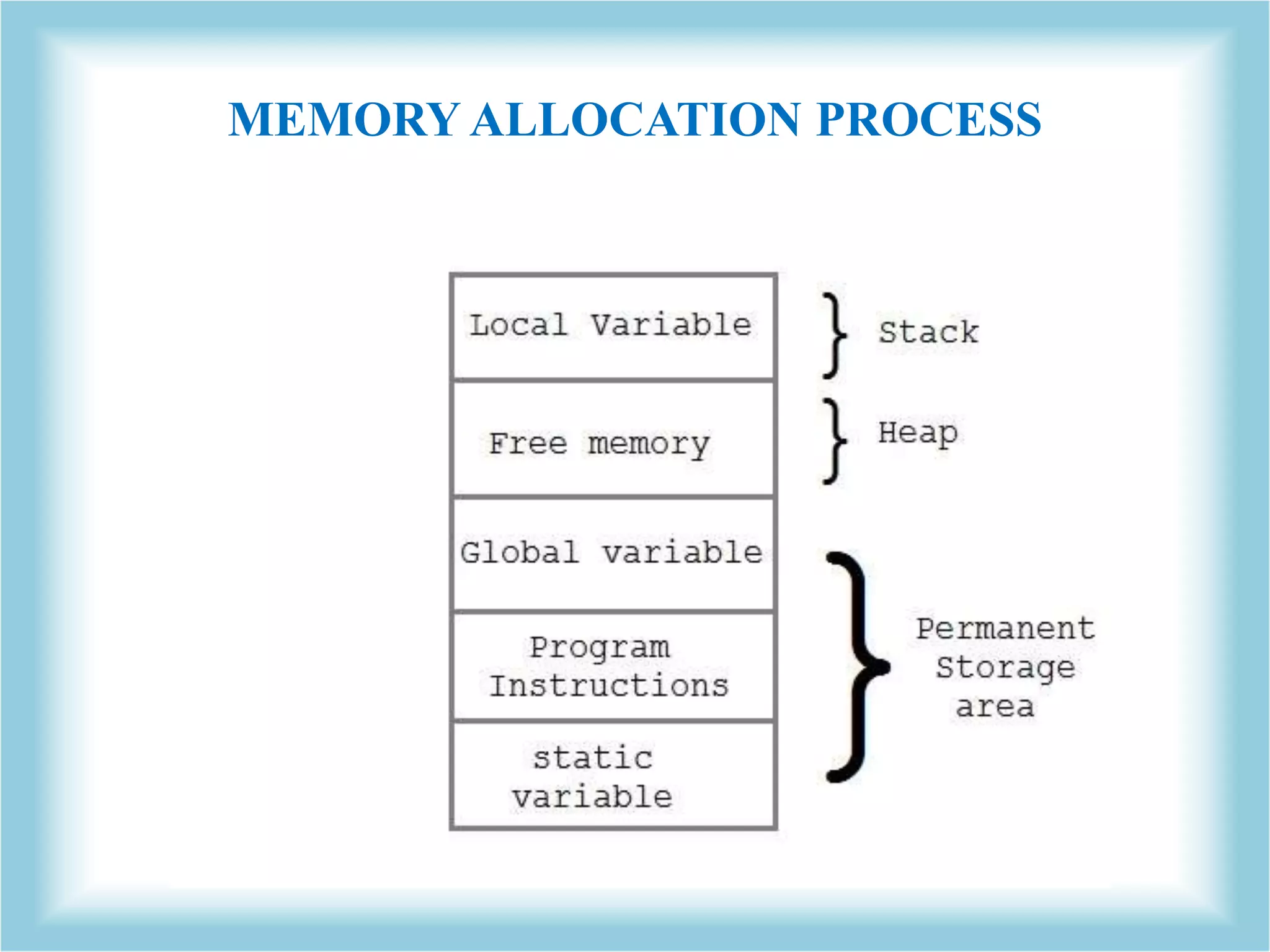
MEMORY ALLOCATION PROCESS
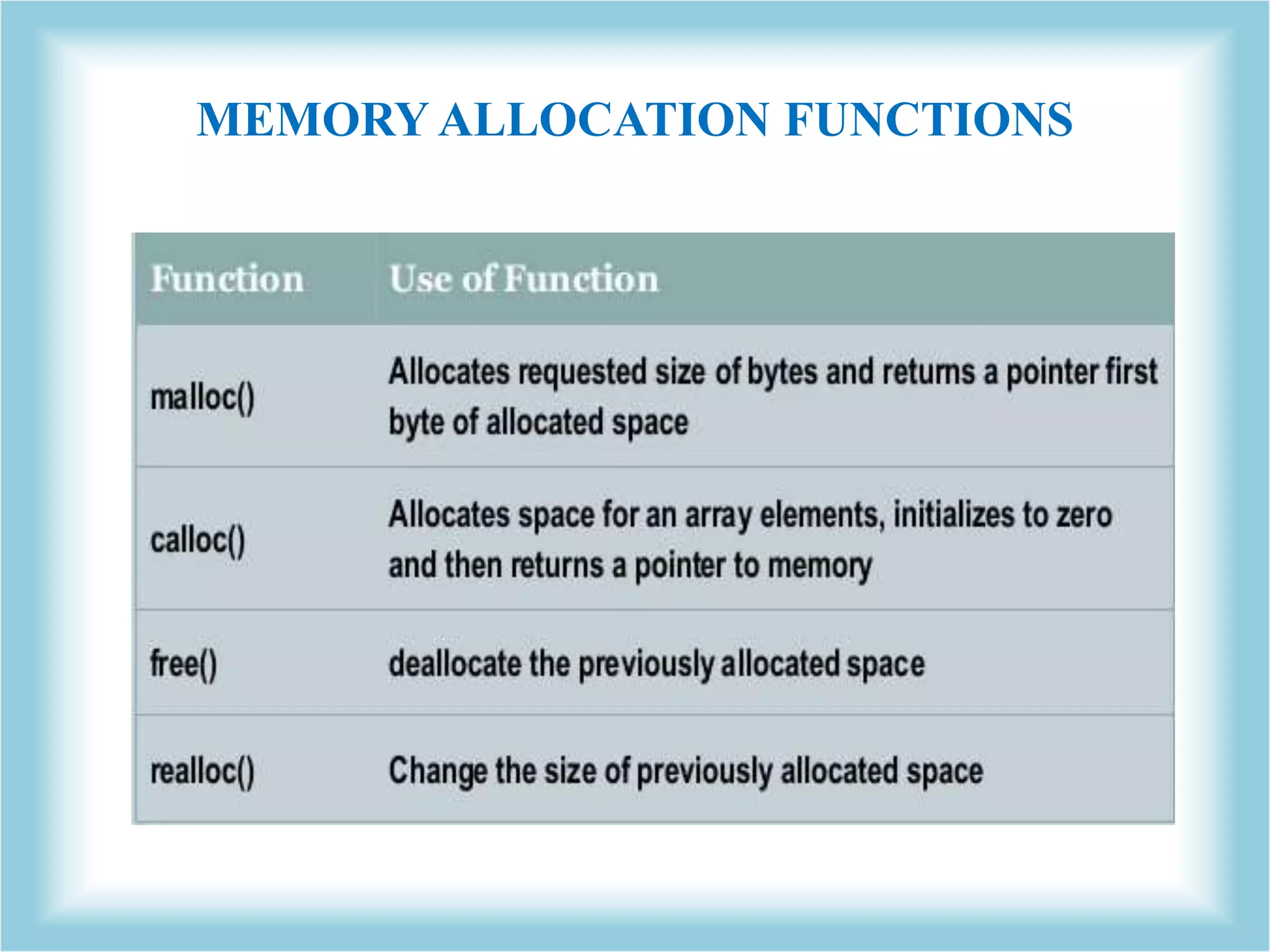
MEMORY ALLOCATION FUNCTIONS
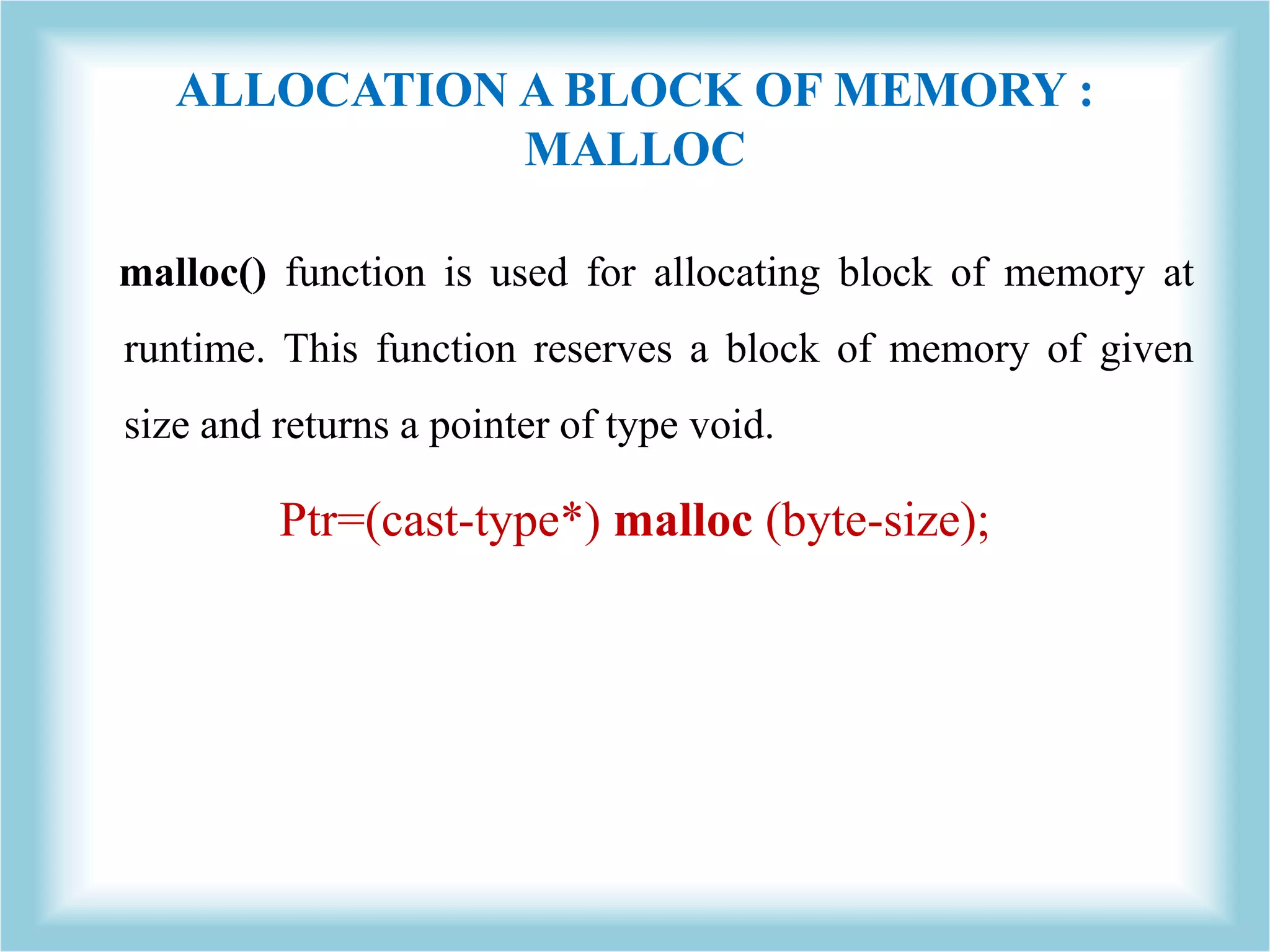
ALLOCATION A BLOCK OF MEMORY : MALLOC malloc() function is used for allocating block of memory at runtime. This function reserves a block of memory of given size and returns a pointer of type void. Ptr=(cast-type*) malloc (byte-size);
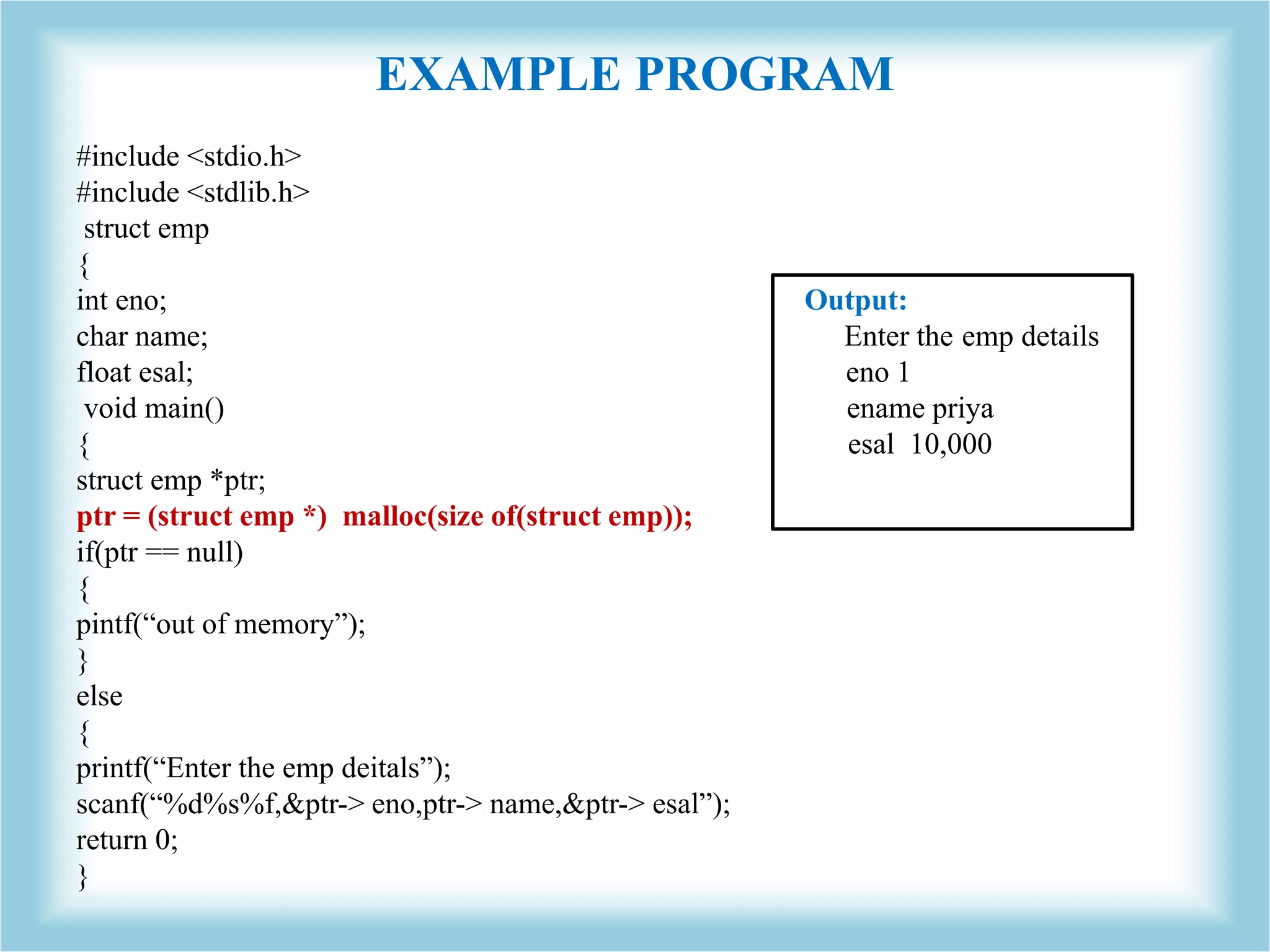
EXAMPLE PROGRAM #include <stdio.h> #include <stdlib.h> struct emp { int eno; Output: char name; Enter the emp details float esal; eno 1 void main() ename priya { esal 10,000 struct emp *ptr; ptr = (struct emp *) malloc(size of(struct emp)); if(ptr == null) { pintf(“out of memory”); } else { printf(“Enter the emp deitals”); scanf(“%d%s%f,&ptr-> eno,ptr-> name,&ptr-> esal”); return 0; }
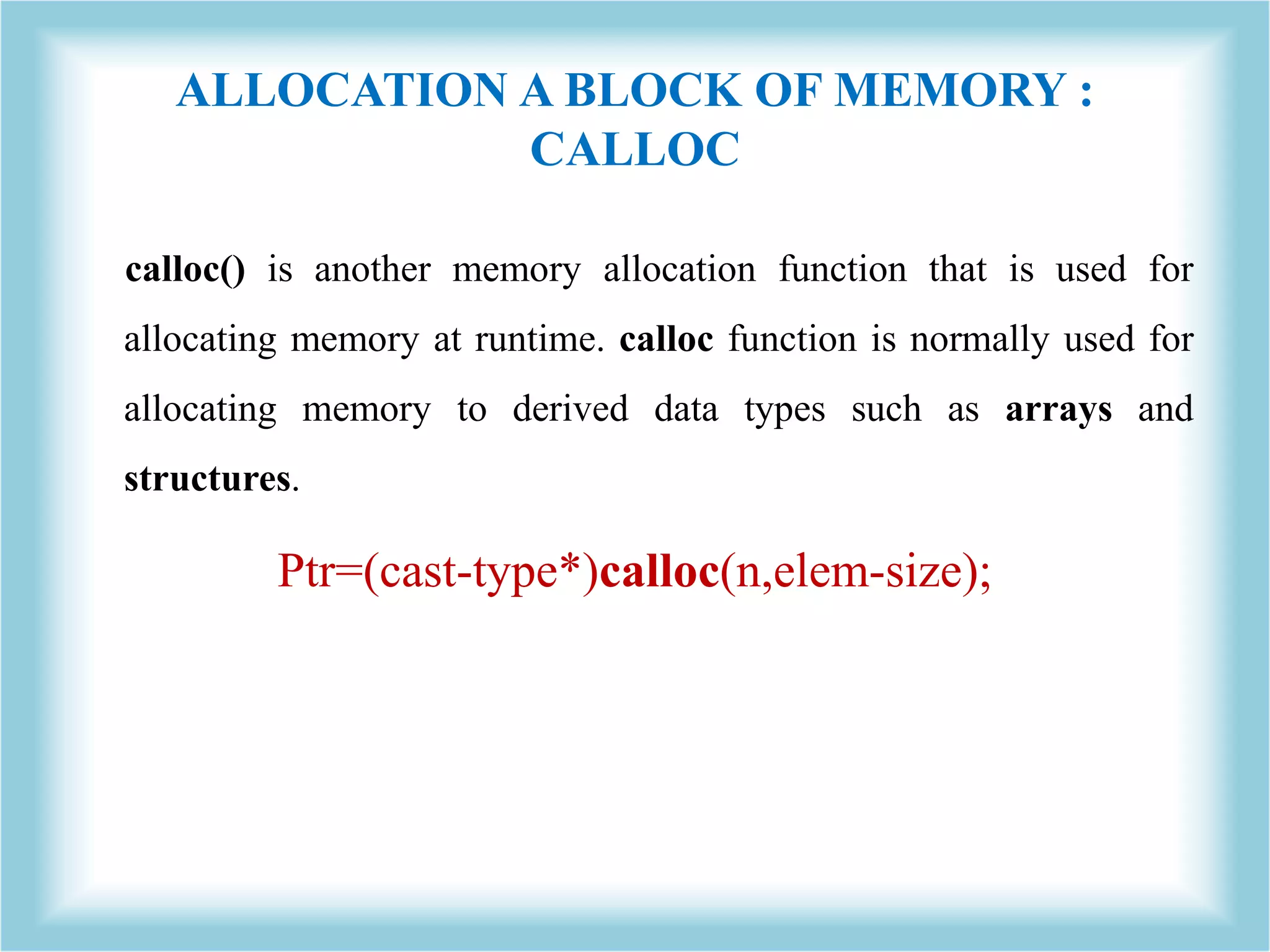
ALLOCATION A BLOCK OF MEMORY : CALLOC calloc() is another memory allocation function that is used for allocating memory at runtime. calloc function is normally used for allocating memory to derived data types such as arrays and structures. Ptr=(cast-type*)calloc(n,elem-size);
EXAMPLE PROGRAM #include <stdio.h> #include <stdlib.h> int main() { output: int i, n; int *a; Number of elements to be entered :3 printf("Number of elements to be entered:"); Enter 3 numbers: scanf("%d",&n); 22 a = (int*)calloc(n, sizeof(int)); 55 printf("Enter %d numbers:n",n); 14 for( i=0 ; i < n ; i++ ) The numbers entered are :22 55 14 { scanf("%d",&a[i]); } printf("The numbers entered are: "); for( i=0 ; i < n ; i++ ) { printf("%d ",a[i]); } free( a ); return(0); }
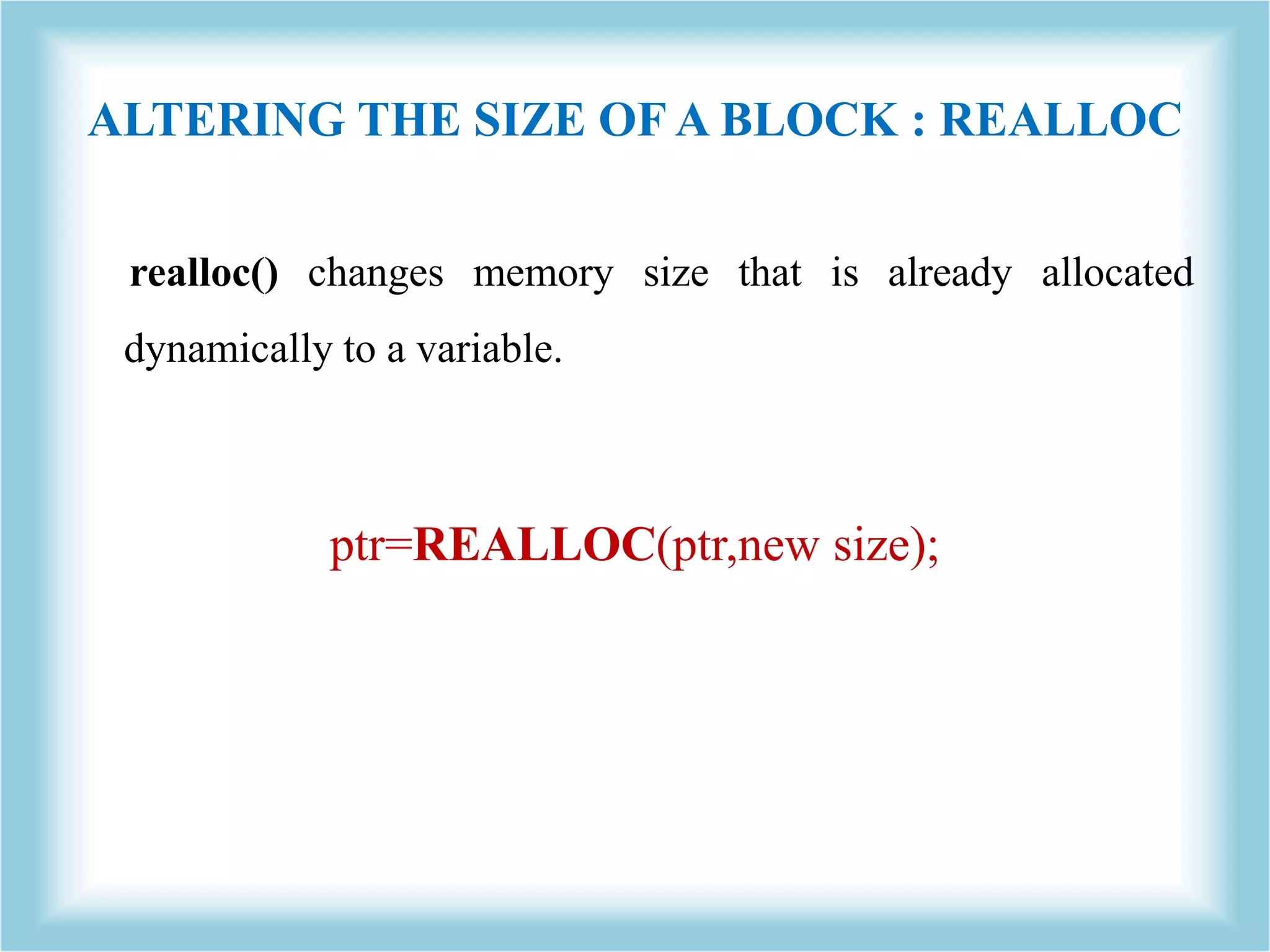
ALTERING THE SIZE OF A BLOCK : REALLOC realloc() changes memory size that is already allocated dynamically to a variable. ptr=REALLOC(ptr,new size);
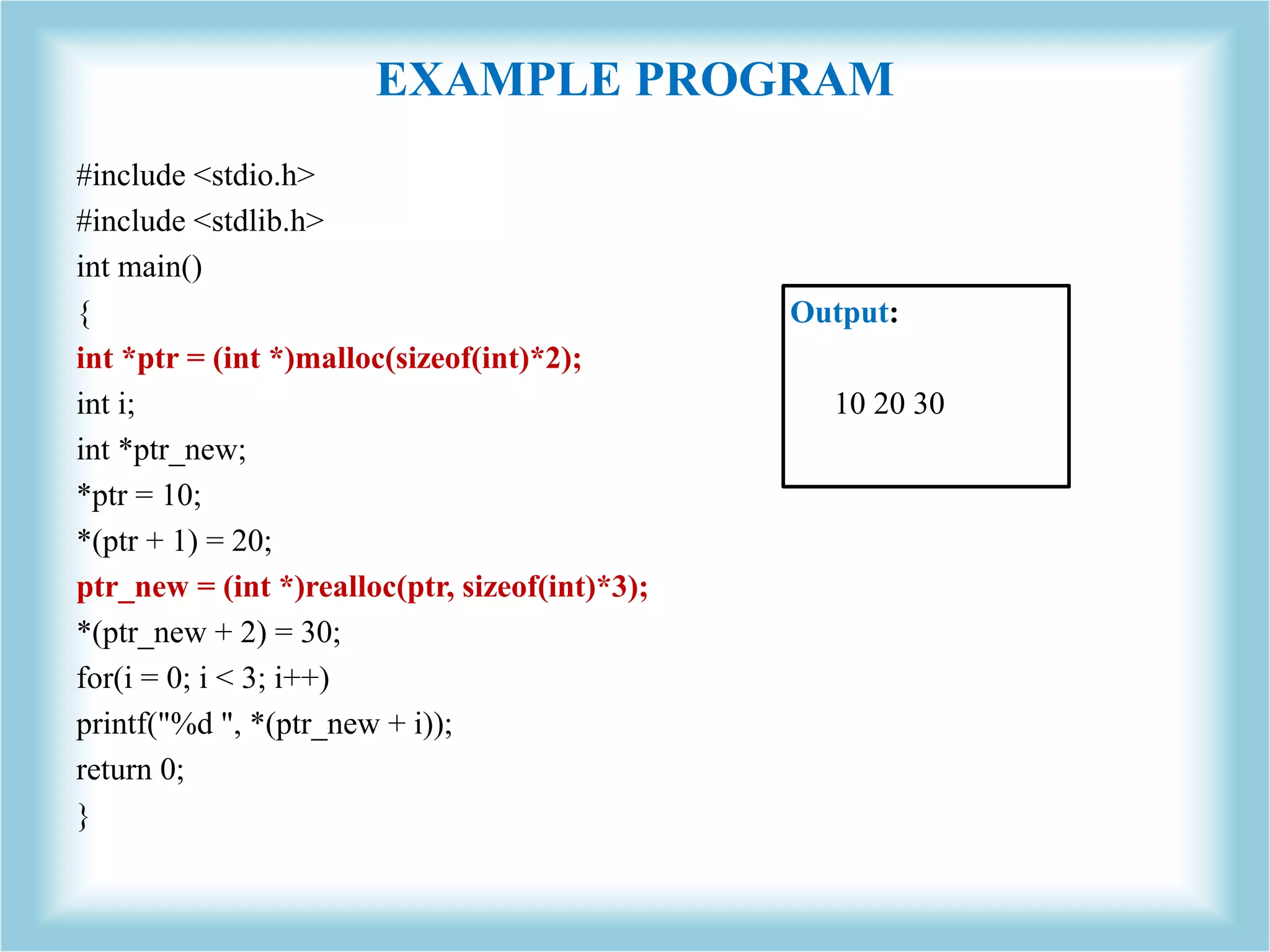
EXAMPLE PROGRAM #include <stdio.h> #include <stdlib.h> int main() { Output: int *ptr = (int *)malloc(sizeof(int)*2); int i; 10 20 30 int *ptr_new; *ptr = 10; *(ptr + 1) = 20; ptr_new = (int *)realloc(ptr, sizeof(int)*3); *(ptr_new + 2) = 30; for(i = 0; i < 3; i++) printf("%d ", *(ptr_new + i)); return 0; }
RELEASING THE USED SPACE: FREE Free() function should be called on a pointer that was used either with ”calloc()” or “malloc()”,otherwise the function will destroy the memory management making a system to crash. free (ptr) EXAMPLE: func() { int *ptr, *p; ptr = new int[100]; p = new int; delete[] ptr; delete p; }
Dynamic memory allocation in c

Dynamic memory allocation in c

  • 1.
    DYNAMIC MEMORY ALLOCATION INC PRESENTED BY M.LAVANYA M.Sc(CS&IT) NSCAS
  • 2.
    SYNOPSIS • Memory allocation •Static Memory Allocation • Memory Allocation Process • Memory Allocation Functions • Allocation A Block Of Memory : Malloc • Allocation A Block Of Memory : Calloc • Altering The Size Of A Block : Realloc • Releasing The Used Space: Free
  • 3.
    MEMORY ALLOCATION • Theblocks of information in a memory system is called memory allocation. • To allocate memory it is necessary to keep in information of available memory in the system. If memory management system finds sufficient free memory, it allocates only as much memory as needed, keeping the rest available to satisfy future request. • In memory allocation has two types. They are static and dynamic memory allocation.
  • 4.
    STATIC MEMORY ALLOCATION •In static memory allocation, size of the memory may be required for the that must be define before loading and executing the program. DYNAMIC MEMORY ALLOCATION • In the dynamic memory allocation, the memory is allocated to a variable or program at the run time. • The only way to access this dynamically allocated memory is through pointer.
  • 5.
  • 6.
  • 7.
    ALLOCATION A BLOCKOF MEMORY : MALLOC malloc() function is used for allocating block of memory at runtime. This function reserves a block of memory of given size and returns a pointer of type void. Ptr=(cast-type*) malloc (byte-size);
  • 8.
    EXAMPLE PROGRAM #include <stdio.h> #include<stdlib.h> struct emp { int eno; Output: char name; Enter the emp details float esal; eno 1 void main() ename priya { esal 10,000 struct emp *ptr; ptr = (struct emp *) malloc(size of(struct emp)); if(ptr == null) { pintf(“out of memory”); } else { printf(“Enter the emp deitals”); scanf(“%d%s%f,&ptr-> eno,ptr-> name,&ptr-> esal”); return 0; }
  • 9.
    ALLOCATION A BLOCKOF MEMORY : CALLOC calloc() is another memory allocation function that is used for allocating memory at runtime. calloc function is normally used for allocating memory to derived data types such as arrays and structures. Ptr=(cast-type*)calloc(n,elem-size);
  • 10.
    EXAMPLE PROGRAM #include <stdio.h> #include<stdlib.h> int main() { output: int i, n; int *a; Number of elements to be entered :3 printf("Number of elements to be entered:"); Enter 3 numbers: scanf("%d",&n); 22 a = (int*)calloc(n, sizeof(int)); 55 printf("Enter %d numbers:n",n); 14 for( i=0 ; i < n ; i++ ) The numbers entered are :22 55 14 { scanf("%d",&a[i]); } printf("The numbers entered are: "); for( i=0 ; i < n ; i++ ) { printf("%d ",a[i]); } free( a ); return(0); }
  • 11.
    ALTERING THE SIZEOF A BLOCK : REALLOC realloc() changes memory size that is already allocated dynamically to a variable. ptr=REALLOC(ptr,new size);
  • 12.
    EXAMPLE PROGRAM #include <stdio.h> #include<stdlib.h> int main() { Output: int *ptr = (int *)malloc(sizeof(int)*2); int i; 10 20 30 int *ptr_new; *ptr = 10; *(ptr + 1) = 20; ptr_new = (int *)realloc(ptr, sizeof(int)*3); *(ptr_new + 2) = 30; for(i = 0; i < 3; i++) printf("%d ", *(ptr_new + i)); return 0; }
  • 13.
    RELEASING THE USEDSPACE: FREE Free() function should be called on a pointer that was used either with ”calloc()” or “malloc()”,otherwise the function will destroy the memory management making a system to crash. free (ptr) EXAMPLE: func() { int *ptr, *p; ptr = new int[100]; p = new int; delete[] ptr; delete p; }