International Research Journal of Engineering and Technology (IRJET) e-ISSN: 2395-0056 Volume: 10 Issue: 07 | July 2023 www.irjet.net p-ISSN: 2395-0072 © 2023, IRJET | Impact Factor value: 8.226 | ISO 9001:2008 Certified Journal | Page 241 Face Recognition Based on Image Processing in an Advanced Robotic System Amandeep Kaur1, Swati Sharma1, Sumit Asthana1 , Sushil Kumar Pal 1, Anshuman Singh 1, Vishal Kumar 1, Vivek Kumar1 1Department of Instrumentation, Bhaskaracharya College of Applied Sciences, University of Delhi ---------------------------------------------------------------------***--------------------------------------------------------------------- Abstract - In the present work, face recognition system has been developed using image processing technique. Thesystem developed works in two stages. In the first stage, face recognition algorithm is used to unlock the system by a valid user face. Once the system is unlocked, then the motion of robot is controlled using different navigation images. Face recognization is implemented using SVM (support vector machine), HOG (histogram of oriented gradients)and kNN(k- nearest neighbors) algorithm inMATLAB. Thewholeprocessis based on the concept called Machine Learning in artificial intelligence. Here we are dealing with supervised machine learning technique where the machine is trained insupervised manner. Key Words: Face recognition, SVM, HOG, KNN, Machine learning 1. INTRODUCTION The field of digital image processing has grown rapidly after 1960, after the development of hi-speed computer. It has found importance in mainly two areas: (i) Improvement of pictorial information for better human interpretation and the second being the processing of a scene data for an autonomous machine perception. The first feature i.e.image enhancement and restoration are used to process degraded or blurred images. As per medical imaging is concerned, most of the images may be used in the detectionoftumorsor for screening the patients. Whereas second feature i.e. machine perception can be employedinautomatic character recognition, industrial machine vision for product assembly and inspection. The continuing decline in the ratio of computer price to performance and the expansion of networking and communication bandwidth via the world wide web and the Internet have created unprecedented opportunities for continued growth of digital image processing [1]. Digital image processing basically includes the following three steps: Importing the image with optical scanner, analyzing and manipulating the image and Output is the last stage in which result can be altered image or report that is based on image analysis. It can be used to perform various tasks such as: (i) Visualization of the objects that are not visible, (ii) Image sharpening and restoration to create a better image, (iii) Image retrieval to seek image of interest, (iv) Measurement of pattern in an image and (v) Image Recognition – Distinguish the objects in an image [2]. In the present work, we will be implementing the(v)part i.e. Face recognition. As we know that face plays a major role in our social intercourse in conveyingidentityandexpressions. The human ability to recognize faces is remarkable. We can recognize thousandsoffaces learnedthroughoutourlifetime and identify familiar faces at a glance even after years of separation. But developing a computational model of face recognition is quite difficult, because faces are complex, multidimensional, and subject to change over time and integration of face recognition in robotics is more difficult [3-4]. Face recognition has its applications in various fields. Machines and technology are increasing rapidly, butwelack a system which can distinguish between different users and respond to that uniquely. Today most of the systems are blind because they cannot differentiate between valid and invalid users. Keeping security breaching in mind, face recognition based system must be developed in order to improve security level. Facerecognition isa partofadvanced image processing which can be achieved using image processing algorithm as shown in Figure 1[5]. Fig 1- Image Processing Flow chart
International Research Journal of Engineering and Technology (IRJET) e-ISSN: 2395-0056 Volume: 10 Issue: 07 | July 2023 www.irjet.net p-ISSN: 2395-0072 © 2023, IRJET | Impact Factor value: 8.226 | ISO 9001:2008 Certified Journal | Page 242 In the past few years, various researchers have done work on face recognition algorithm. Most of them have workedon Principal component analysis (PCA) algorithm in MATLAB. This approach reduces the dimension of the data/image by means of data compression which might cause loss in the information. It also reduces the dimensions of the data. Also PCA uses 1D array to store the information of the test data, which leads to insufficiency of space for data storage. Apart from this, some other workers have used Back Propagation Neural Network (BPNN) algorithm for classification of training data and run time captured test data/image, which is a very complex process of neural network of artificial intelligence [7]. Both these methods are complex and produces unsatisfactory results. In the present work,facerecognizationisimplementedusing SVM (support vector machine), HOG (histogram of oriented gradients) and kNN (k-nearest neighbors) algorithm in MATLAB. Further, we have usedthismodel incontrolling the motion of the robot. 2. Working Model Working model of a face recognition based system can be majorly described in two stages. Both the stages uses image processing. In the first stage, Face recognition algorithm is used to unlock the system by a valid user face. Valid face images will be pre-stored in the system. Once the system is unlocked, then the motion of robot is controlled using different navigation images. The whole process is based on the conceptcalled MachineLearning in artificial intelligence. Here we are dealing with supervised machine learning technique where the machine is trained in supervised manner. We have used various algorithm of MATLAB to acheieve this. We will now discuss them one by one. HOG is a function used in MATLAB, which finds the gradients of each pixel of an image captured during run time.Gradients obtained are used to build a histogram of gradients and then they are stored in a 2D array, which is then assigned with a group name and it can be further used for classification of an image. While using HOG, there are no problem of data compression and dimensions reductions, so there is no chance of loss of information. In addition to this, HOG descriptor has advantages over other descriptors, as it is invariant to geometric and photometric transformations.[8] Image captured is displayed on a window using command ‘imshow(imr)’ and HOGfeatureofrealtimecapturedimageis then extracted usingcommand‘extractHOGFeatures’.Finally using command ‘[feat] = hog_feature_vector(imr)’ the extracted HOG feature is represented in the form of a vector, i.e. vectorisation is done. Here, pause is required for the captured images to appear on window clearly. Fig 2- HOG function working Before proceeding further, let’s understand the working of HOG function. As shown in Figure2, [9] the imagecapturedis divided into cells and then orientation of gradients is being found foreach cell. After gradient orientation has beenfound successfully, it’s been concatenated to form a histogram and finally histogram is shown in vector form. Support Vector Machine (SVM)- While dealing with complex data sets such as faces, kNN cannot be used. KNN is a classifier which deals with data sets that are easy to handle and operate whereas SVM classifier deals with data sets that are closely related to eachotherinthematterofresemblance. As we know, human faces are similar to each other to a high extent, so face recognition needs to have a classifier which can be able to differentiate between such similar data sets. It uses the concept of hyperplane for classification. It creates a line or a hyper-plane between two sets of data which are related to each other at alarge extent and thusseparatethem out precisely. We are using SVM here in a way to classify the real time image captured with the images of human faces already present in the system. SVM takes two data sets at random and separate them out using a hyperplane. Hyperplane can be treated here as a boundary between data sets. Now these two data sets are matched with the real time captured image data set using a classifierandthusitgivesthe optimum result. SVM is used here to match the feature of an image with the training data set so that system can authenticate a user and unlock it, if it finds an authentic face. In machine learning, SVMs are supervised learning models with associated learning algorithms that analyze data used for classification. [10] SVM function is used as a classifier for face recognition operation. Our main task here is to find the optimal matches of the human face images captured during run time. The command ‘SVM_Mdl = fitcecoc(fea,group)’ is used to find the match of the feature group and then command ‘c = predict(SVM_Mdl,test_feature)’ is used for prediction of test feature group which is closely related to the run time captured images features.
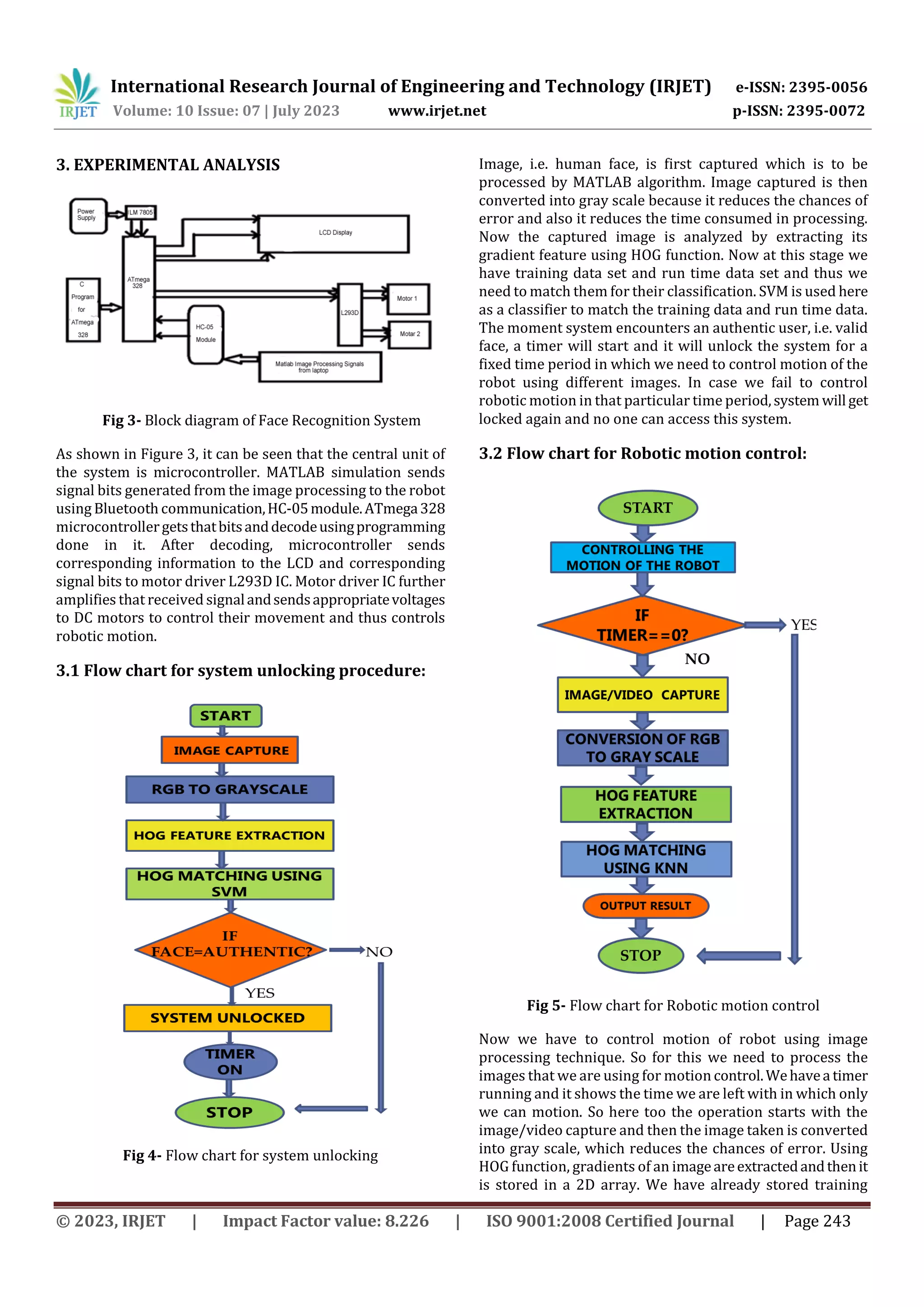
International Research Journal of Engineering and Technology (IRJET) e-ISSN: 2395-0056 Volume: 10 Issue: 07 | July 2023 www.irjet.net p-ISSN: 2395-0072 © 2023, IRJET | Impact Factor value: 8.226 | ISO 9001:2008 Certified Journal | Page 243 3. EXPERIMENTAL ANALYSIS Fig 3- Block diagram of Face Recognition System As shown in Figure 3, it can be seen that the central unit of the system is microcontroller. MATLAB simulation sends signal bits generated from the image processing to the robot using Bluetooth communication,HC-05module.ATmega328 microcontrollergetsthatbitsanddecodeusingprogramming done in it. After decoding, microcontroller sends corresponding information to the LCD and corresponding signal bits to motor driver L293D IC. Motor driver IC further amplifies that received signalandsendsappropriatevoltages to DC motors to control their movement and thus controls robotic motion. 3.1 Flow chart for system unlocking procedure: Fig 4- Flow chart for system unlocking Image, i.e. human face, is first captured which is to be processed by MATLAB algorithm. Image captured is then converted into gray scale because it reduces the chances of error and also it reduces the time consumed in processing. Now the captured image is analyzed by extracting its gradient feature using HOG function. Now at this stage we have training data set and run time data set and thus we need to match them for their classification. SVM is used here as a classifier to match the training data and run time data. The moment system encounters an authentic user, i.e. valid face, a timer will start and it will unlock the system for a fixed time period in which we need to control motion of the robot using different images. In case we fail to control robotic motion in that particular time period,system will get locked again and no one can access this system. 3.2 Flow chart for Robotic motion control: Fig 5- Flow chart for Robotic motion control Now we have to control motion of robot using image processing technique. So for this we need to process the images that we are using for motion control.Wehavea timer running and it shows the time we are left with in which only we can motion. So here too the operation starts with the image/video capture and then the image taken is converted into gray scale, which reduces the chances of error. Using HOG function, gradients of an imageareextractedandthenit is stored in a 2D array. We have already stored training
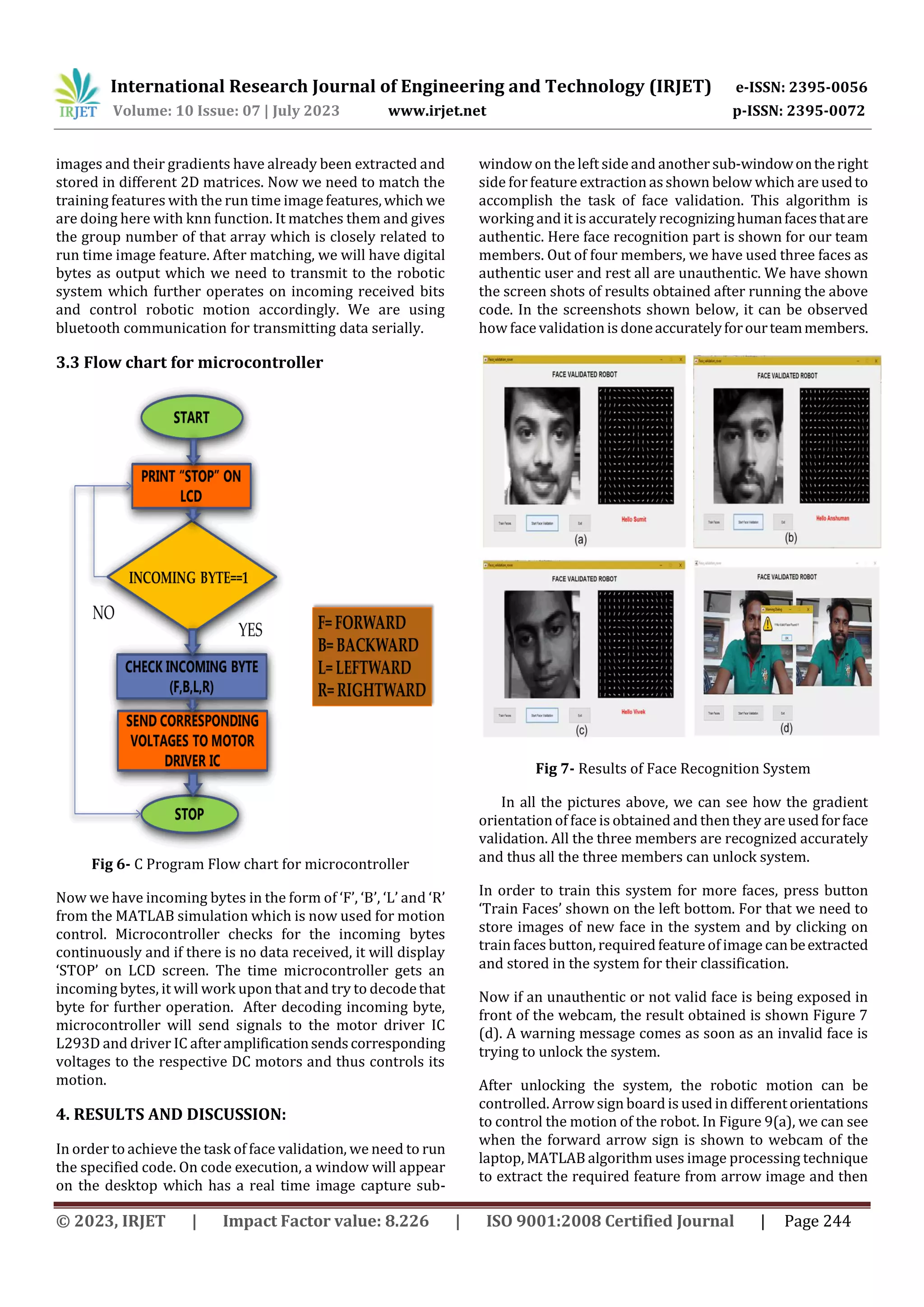
International Research Journal of Engineering and Technology (IRJET) e-ISSN: 2395-0056 Volume: 10 Issue: 07 | July 2023 www.irjet.net p-ISSN: 2395-0072 © 2023, IRJET | Impact Factor value: 8.226 | ISO 9001:2008 Certified Journal | Page 244 images and their gradients have already been extracted and stored in different 2D matrices. Now we need to match the training features with the run time imagefeatures,which we are doing here with knn function. It matches them and gives the group number of that array which is closely related to run time image feature. After matching, we will have digital bytes as output which we need to transmit to the robotic system which further operates on incoming received bits and control robotic motion accordingly. We are using bluetooth communication for transmitting data serially. 3.3 Flow chart for microcontroller Fig 6- C Program Flow chart for microcontroller Now we have incoming bytes in the form of ‘F’, ‘B’, ‘L’ and ‘R’ from the MATLAB simulation which is now used for motion control. Microcontroller checks for the incoming bytes continuously and if there is no data received, it will display ‘STOP’ on LCD screen. The time microcontroller gets an incoming bytes, it will work upon that and try to decodethat byte for further operation. After decoding incoming byte, microcontroller will send signals to the motor driver IC L293D and driver IC afteramplificationsendscorresponding voltages to the respective DC motors and thus controls its motion. 4. RESULTS AND DISCUSSION: In order to achieve the task of face validation, we need to run the specified code. On code execution, a window will appear on the desktop which has a real time image capture sub- window on the left sideand another sub-windowontheright side forfeature extraction asshown below which are usedto accomplish the task of face validation. This algorithm is working and it is accurately recognizinghumanfacesthatare authentic. Here face recognition part is shown for our team members. Out of four members, we have used three faces as authentic user and rest all are unauthentic. We have shown the screen shots of results obtained after running the above code. In the screenshots shown below, it can be observed how face validation is doneaccuratelyforourteammembers. Fig 7- Results of Face Recognition System In all the pictures above, we can see how the gradient orientation of face is obtained and then they are usedforface validation. All the three members are recognized accurately and thus all the three members can unlock system. In order to train this system for more faces, press button ‘Train Faces’ shown on the left bottom. For that we need to store images of new face in the system and by clicking on train faces button, required featureof image canbeextracted and stored in the system for their classification. Now if an unauthentic or not valid face is being exposed in front of the webcam, the result obtained is shown Figure 7 (d). A warning message comes as soon as an invalid face is trying to unlock the system. After unlocking the system, the robotic motion can be controlled. Arrow sign board is used in differentorientations to control the motion of the robot. In Figure 9(a), we can see when the forward arrow sign is shown to webcam of the laptop, MATLAB algorithm uses image processing technique to extract the required feature from arrow image and then
International Research Journal of Engineering and Technology (IRJET) e-ISSN: 2395-0056 Volume: 10 Issue: 07 | July 2023 www.irjet.net p-ISSN: 2395-0072 © 2023, IRJET | Impact Factor value: 8.226 | ISO 9001:2008 Certified Journal | Page 245 they are used to move the robot in forward direction. We can see in the window on the right sideof the figurebelow,arrow image is being processed and converted into gray scale and then its feature is extracted. The similar results are obtained for ‘BACKWARD’, ‘LEFTWARD’, ‘RIGHTWARD’ directions. Fig 8- Controlling Robotic Motion with the help of arrow image 3. CONCLUSIONS The face recognition system for advanceduseinroboticshas been successfully developed which performs the desired functions satisfactorily. As projected, the system efficiently unlocks for the defined user and enables him to access the robot. The robot in turn, also performs the desired movements adequately as instructed by the user. Multiple users can be defined for giving the access by incorporating their details in the program. Users can be added, deleted or changed as per our application by modifyingtheprogram. In future, we propose to introduce a high end security system called IRIS scanner and identifier. It can be implemented in our robotic system to first scan and identify an authentic user’s iris and then use this information for high level robotics operation. REFERENCES [1] Digital image processing 3rd edition, Rafael C. Gonzalez [2] Yan Sun,1Zhenyun Ren,1and Wenxi Zheng, Research on Face Recognition Algorithm Based on Image Processing, Computational Intelligence and Neuroscience Volume 2022 [3] M.A. Turk and A.P. Pentland. “Facerecognitionusing Eigenfaces”. In Proc.ofComputerVisionand Pattern Recognition, pages 586-591.IEEE, June 1991b. [4] Facial Recognition Using Image Processing Dr. Madhusudhan, Chinmaya Dayananda Kamath, Darshan Naik M , Chinmaya Bhatt K, Shreyas, International Journal of Advanced Research in Science, Communication and Technology(IJARSCT) Volume 2, Issue 2, March 2022 . [5] A MATLAB based Face Recognition System using Image Processing and Neural NetworksJawadNagi, Syed Khaleel Ahmed FarrukhNagi4thInternational Colloquium on Signal Processing and its Applications, March 7-9, 2008, Kuala Lumpur, Malaysia. [6] Roza Dastres and Mohsen Soori , Advanced Image processing systems, Internationational journal of imaging and Robotics, vol 21, 2021. [7] Signal & Image Processing:AnInternational Journal (SIPIJ) Vol.2, No.3, September 2011 Anissa Bouzalmat, Naouar Belghini, Arsalane Zarghili, and Jamal Kharroubi, Face Detection and Recognition Using Back Propagation Neural Network and Fourier Gabor Filter [8] Navneet Dalal and Bill Triggs, Histograms of Oriented Gradients for Human Detection, Published in: Computer Vision and Pattern Recognition, 2005. CVPR 2005. IEEE Computer Society Conference on, Date of Conference: 20-25 June 2005,Date Added to IEEE Xplore: 25 July 2005, ISBN Information: Print ISSN: 1063-6919, INSPEC Accession Number: 8588935, DOI: 10.1109/CVPR.2005.177 [9] Hyukmin Eum 1, Changyong Yoon 2, Heejin Lee 3 and Mignon Park 1,* Continuous Human Action Recognition Using Depth-MHI-HOG and a Spotter Model, Sensors 2015, 15(3), 5197-5227; doi:10.3390/s150305197 [10] JINHO KIM¹ ,BYUNG-SOO KIM², SILVIO SAVARESE, Comparing Image Classification Methods: K-Nearest-Neighbor and Support-Vector- Machines, Applied Mathematics in Electrical and Computer Engineering, 2012, ISBN: 978-1-61804- 064-0 133-138

Face Recognition Based on Image Processing in an Advanced Robotic System

  • 1.
    International Research Journalof Engineering and Technology (IRJET) e-ISSN: 2395-0056 Volume: 10 Issue: 07 | July 2023 www.irjet.net p-ISSN: 2395-0072 © 2023, IRJET | Impact Factor value: 8.226 | ISO 9001:2008 Certified Journal | Page 241 Face Recognition Based on Image Processing in an Advanced Robotic System Amandeep Kaur1, Swati Sharma1, Sumit Asthana1 , Sushil Kumar Pal 1, Anshuman Singh 1, Vishal Kumar 1, Vivek Kumar1 1Department of Instrumentation, Bhaskaracharya College of Applied Sciences, University of Delhi ---------------------------------------------------------------------***--------------------------------------------------------------------- Abstract - In the present work, face recognition system has been developed using image processing technique. Thesystem developed works in two stages. In the first stage, face recognition algorithm is used to unlock the system by a valid user face. Once the system is unlocked, then the motion of robot is controlled using different navigation images. Face recognization is implemented using SVM (support vector machine), HOG (histogram of oriented gradients)and kNN(k- nearest neighbors) algorithm inMATLAB. Thewholeprocessis based on the concept called Machine Learning in artificial intelligence. Here we are dealing with supervised machine learning technique where the machine is trained insupervised manner. Key Words: Face recognition, SVM, HOG, KNN, Machine learning 1. INTRODUCTION The field of digital image processing has grown rapidly after 1960, after the development of hi-speed computer. It has found importance in mainly two areas: (i) Improvement of pictorial information for better human interpretation and the second being the processing of a scene data for an autonomous machine perception. The first feature i.e.image enhancement and restoration are used to process degraded or blurred images. As per medical imaging is concerned, most of the images may be used in the detectionoftumorsor for screening the patients. Whereas second feature i.e. machine perception can be employedinautomatic character recognition, industrial machine vision for product assembly and inspection. The continuing decline in the ratio of computer price to performance and the expansion of networking and communication bandwidth via the world wide web and the Internet have created unprecedented opportunities for continued growth of digital image processing [1]. Digital image processing basically includes the following three steps: Importing the image with optical scanner, analyzing and manipulating the image and Output is the last stage in which result can be altered image or report that is based on image analysis. It can be used to perform various tasks such as: (i) Visualization of the objects that are not visible, (ii) Image sharpening and restoration to create a better image, (iii) Image retrieval to seek image of interest, (iv) Measurement of pattern in an image and (v) Image Recognition – Distinguish the objects in an image [2]. In the present work, we will be implementing the(v)part i.e. Face recognition. As we know that face plays a major role in our social intercourse in conveyingidentityandexpressions. The human ability to recognize faces is remarkable. We can recognize thousandsoffaces learnedthroughoutourlifetime and identify familiar faces at a glance even after years of separation. But developing a computational model of face recognition is quite difficult, because faces are complex, multidimensional, and subject to change over time and integration of face recognition in robotics is more difficult [3-4]. Face recognition has its applications in various fields. Machines and technology are increasing rapidly, butwelack a system which can distinguish between different users and respond to that uniquely. Today most of the systems are blind because they cannot differentiate between valid and invalid users. Keeping security breaching in mind, face recognition based system must be developed in order to improve security level. Facerecognition isa partofadvanced image processing which can be achieved using image processing algorithm as shown in Figure 1[5]. Fig 1- Image Processing Flow chart
  • 2.
    International Research Journalof Engineering and Technology (IRJET) e-ISSN: 2395-0056 Volume: 10 Issue: 07 | July 2023 www.irjet.net p-ISSN: 2395-0072 © 2023, IRJET | Impact Factor value: 8.226 | ISO 9001:2008 Certified Journal | Page 242 In the past few years, various researchers have done work on face recognition algorithm. Most of them have workedon Principal component analysis (PCA) algorithm in MATLAB. This approach reduces the dimension of the data/image by means of data compression which might cause loss in the information. It also reduces the dimensions of the data. Also PCA uses 1D array to store the information of the test data, which leads to insufficiency of space for data storage. Apart from this, some other workers have used Back Propagation Neural Network (BPNN) algorithm for classification of training data and run time captured test data/image, which is a very complex process of neural network of artificial intelligence [7]. Both these methods are complex and produces unsatisfactory results. In the present work,facerecognizationisimplementedusing SVM (support vector machine), HOG (histogram of oriented gradients) and kNN (k-nearest neighbors) algorithm in MATLAB. Further, we have usedthismodel incontrolling the motion of the robot. 2. Working Model Working model of a face recognition based system can be majorly described in two stages. Both the stages uses image processing. In the first stage, Face recognition algorithm is used to unlock the system by a valid user face. Valid face images will be pre-stored in the system. Once the system is unlocked, then the motion of robot is controlled using different navigation images. The whole process is based on the conceptcalled MachineLearning in artificial intelligence. Here we are dealing with supervised machine learning technique where the machine is trained in supervised manner. We have used various algorithm of MATLAB to acheieve this. We will now discuss them one by one. HOG is a function used in MATLAB, which finds the gradients of each pixel of an image captured during run time.Gradients obtained are used to build a histogram of gradients and then they are stored in a 2D array, which is then assigned with a group name and it can be further used for classification of an image. While using HOG, there are no problem of data compression and dimensions reductions, so there is no chance of loss of information. In addition to this, HOG descriptor has advantages over other descriptors, as it is invariant to geometric and photometric transformations.[8] Image captured is displayed on a window using command ‘imshow(imr)’ and HOGfeatureofrealtimecapturedimageis then extracted usingcommand‘extractHOGFeatures’.Finally using command ‘[feat] = hog_feature_vector(imr)’ the extracted HOG feature is represented in the form of a vector, i.e. vectorisation is done. Here, pause is required for the captured images to appear on window clearly. Fig 2- HOG function working Before proceeding further, let’s understand the working of HOG function. As shown in Figure2, [9] the imagecapturedis divided into cells and then orientation of gradients is being found foreach cell. After gradient orientation has beenfound successfully, it’s been concatenated to form a histogram and finally histogram is shown in vector form. Support Vector Machine (SVM)- While dealing with complex data sets such as faces, kNN cannot be used. KNN is a classifier which deals with data sets that are easy to handle and operate whereas SVM classifier deals with data sets that are closely related to eachotherinthematterofresemblance. As we know, human faces are similar to each other to a high extent, so face recognition needs to have a classifier which can be able to differentiate between such similar data sets. It uses the concept of hyperplane for classification. It creates a line or a hyper-plane between two sets of data which are related to each other at alarge extent and thusseparatethem out precisely. We are using SVM here in a way to classify the real time image captured with the images of human faces already present in the system. SVM takes two data sets at random and separate them out using a hyperplane. Hyperplane can be treated here as a boundary between data sets. Now these two data sets are matched with the real time captured image data set using a classifierandthusitgivesthe optimum result. SVM is used here to match the feature of an image with the training data set so that system can authenticate a user and unlock it, if it finds an authentic face. In machine learning, SVMs are supervised learning models with associated learning algorithms that analyze data used for classification. [10] SVM function is used as a classifier for face recognition operation. Our main task here is to find the optimal matches of the human face images captured during run time. The command ‘SVM_Mdl = fitcecoc(fea,group)’ is used to find the match of the feature group and then command ‘c = predict(SVM_Mdl,test_feature)’ is used for prediction of test feature group which is closely related to the run time captured images features.
  • 3.
    International Research Journalof Engineering and Technology (IRJET) e-ISSN: 2395-0056 Volume: 10 Issue: 07 | July 2023 www.irjet.net p-ISSN: 2395-0072 © 2023, IRJET | Impact Factor value: 8.226 | ISO 9001:2008 Certified Journal | Page 243 3. EXPERIMENTAL ANALYSIS Fig 3- Block diagram of Face Recognition System As shown in Figure 3, it can be seen that the central unit of the system is microcontroller. MATLAB simulation sends signal bits generated from the image processing to the robot using Bluetooth communication,HC-05module.ATmega328 microcontrollergetsthatbitsanddecodeusingprogramming done in it. After decoding, microcontroller sends corresponding information to the LCD and corresponding signal bits to motor driver L293D IC. Motor driver IC further amplifies that received signalandsendsappropriatevoltages to DC motors to control their movement and thus controls robotic motion. 3.1 Flow chart for system unlocking procedure: Fig 4- Flow chart for system unlocking Image, i.e. human face, is first captured which is to be processed by MATLAB algorithm. Image captured is then converted into gray scale because it reduces the chances of error and also it reduces the time consumed in processing. Now the captured image is analyzed by extracting its gradient feature using HOG function. Now at this stage we have training data set and run time data set and thus we need to match them for their classification. SVM is used here as a classifier to match the training data and run time data. The moment system encounters an authentic user, i.e. valid face, a timer will start and it will unlock the system for a fixed time period in which we need to control motion of the robot using different images. In case we fail to control robotic motion in that particular time period,system will get locked again and no one can access this system. 3.2 Flow chart for Robotic motion control: Fig 5- Flow chart for Robotic motion control Now we have to control motion of robot using image processing technique. So for this we need to process the images that we are using for motion control.Wehavea timer running and it shows the time we are left with in which only we can motion. So here too the operation starts with the image/video capture and then the image taken is converted into gray scale, which reduces the chances of error. Using HOG function, gradients of an imageareextractedandthenit is stored in a 2D array. We have already stored training
  • 4.
    International Research Journalof Engineering and Technology (IRJET) e-ISSN: 2395-0056 Volume: 10 Issue: 07 | July 2023 www.irjet.net p-ISSN: 2395-0072 © 2023, IRJET | Impact Factor value: 8.226 | ISO 9001:2008 Certified Journal | Page 244 images and their gradients have already been extracted and stored in different 2D matrices. Now we need to match the training features with the run time imagefeatures,which we are doing here with knn function. It matches them and gives the group number of that array which is closely related to run time image feature. After matching, we will have digital bytes as output which we need to transmit to the robotic system which further operates on incoming received bits and control robotic motion accordingly. We are using bluetooth communication for transmitting data serially. 3.3 Flow chart for microcontroller Fig 6- C Program Flow chart for microcontroller Now we have incoming bytes in the form of ‘F’, ‘B’, ‘L’ and ‘R’ from the MATLAB simulation which is now used for motion control. Microcontroller checks for the incoming bytes continuously and if there is no data received, it will display ‘STOP’ on LCD screen. The time microcontroller gets an incoming bytes, it will work upon that and try to decodethat byte for further operation. After decoding incoming byte, microcontroller will send signals to the motor driver IC L293D and driver IC afteramplificationsendscorresponding voltages to the respective DC motors and thus controls its motion. 4. RESULTS AND DISCUSSION: In order to achieve the task of face validation, we need to run the specified code. On code execution, a window will appear on the desktop which has a real time image capture sub- window on the left sideand another sub-windowontheright side forfeature extraction asshown below which are usedto accomplish the task of face validation. This algorithm is working and it is accurately recognizinghumanfacesthatare authentic. Here face recognition part is shown for our team members. Out of four members, we have used three faces as authentic user and rest all are unauthentic. We have shown the screen shots of results obtained after running the above code. In the screenshots shown below, it can be observed how face validation is doneaccuratelyforourteammembers. Fig 7- Results of Face Recognition System In all the pictures above, we can see how the gradient orientation of face is obtained and then they are usedforface validation. All the three members are recognized accurately and thus all the three members can unlock system. In order to train this system for more faces, press button ‘Train Faces’ shown on the left bottom. For that we need to store images of new face in the system and by clicking on train faces button, required featureof image canbeextracted and stored in the system for their classification. Now if an unauthentic or not valid face is being exposed in front of the webcam, the result obtained is shown Figure 7 (d). A warning message comes as soon as an invalid face is trying to unlock the system. After unlocking the system, the robotic motion can be controlled. Arrow sign board is used in differentorientations to control the motion of the robot. In Figure 9(a), we can see when the forward arrow sign is shown to webcam of the laptop, MATLAB algorithm uses image processing technique to extract the required feature from arrow image and then
  • 5.
    International Research Journalof Engineering and Technology (IRJET) e-ISSN: 2395-0056 Volume: 10 Issue: 07 | July 2023 www.irjet.net p-ISSN: 2395-0072 © 2023, IRJET | Impact Factor value: 8.226 | ISO 9001:2008 Certified Journal | Page 245 they are used to move the robot in forward direction. We can see in the window on the right sideof the figurebelow,arrow image is being processed and converted into gray scale and then its feature is extracted. The similar results are obtained for ‘BACKWARD’, ‘LEFTWARD’, ‘RIGHTWARD’ directions. Fig 8- Controlling Robotic Motion with the help of arrow image 3. CONCLUSIONS The face recognition system for advanceduseinroboticshas been successfully developed which performs the desired functions satisfactorily. As projected, the system efficiently unlocks for the defined user and enables him to access the robot. The robot in turn, also performs the desired movements adequately as instructed by the user. Multiple users can be defined for giving the access by incorporating their details in the program. Users can be added, deleted or changed as per our application by modifyingtheprogram. In future, we propose to introduce a high end security system called IRIS scanner and identifier. It can be implemented in our robotic system to first scan and identify an authentic user’s iris and then use this information for high level robotics operation. REFERENCES [1] Digital image processing 3rd edition, Rafael C. Gonzalez [2] Yan Sun,1Zhenyun Ren,1and Wenxi Zheng, Research on Face Recognition Algorithm Based on Image Processing, Computational Intelligence and Neuroscience Volume 2022 [3] M.A. Turk and A.P. Pentland. “Facerecognitionusing Eigenfaces”. In Proc.ofComputerVisionand Pattern Recognition, pages 586-591.IEEE, June 1991b. [4] Facial Recognition Using Image Processing Dr. Madhusudhan, Chinmaya Dayananda Kamath, Darshan Naik M , Chinmaya Bhatt K, Shreyas, International Journal of Advanced Research in Science, Communication and Technology(IJARSCT) Volume 2, Issue 2, March 2022 . [5] A MATLAB based Face Recognition System using Image Processing and Neural NetworksJawadNagi, Syed Khaleel Ahmed FarrukhNagi4thInternational Colloquium on Signal Processing and its Applications, March 7-9, 2008, Kuala Lumpur, Malaysia. [6] Roza Dastres and Mohsen Soori , Advanced Image processing systems, Internationational journal of imaging and Robotics, vol 21, 2021. [7] Signal & Image Processing:AnInternational Journal (SIPIJ) Vol.2, No.3, September 2011 Anissa Bouzalmat, Naouar Belghini, Arsalane Zarghili, and Jamal Kharroubi, Face Detection and Recognition Using Back Propagation Neural Network and Fourier Gabor Filter [8] Navneet Dalal and Bill Triggs, Histograms of Oriented Gradients for Human Detection, Published in: Computer Vision and Pattern Recognition, 2005. CVPR 2005. IEEE Computer Society Conference on, Date of Conference: 20-25 June 2005,Date Added to IEEE Xplore: 25 July 2005, ISBN Information: Print ISSN: 1063-6919, INSPEC Accession Number: 8588935, DOI: 10.1109/CVPR.2005.177 [9] Hyukmin Eum 1, Changyong Yoon 2, Heejin Lee 3 and Mignon Park 1,* Continuous Human Action Recognition Using Depth-MHI-HOG and a Spotter Model, Sensors 2015, 15(3), 5197-5227; doi:10.3390/s150305197 [10] JINHO KIM¹ ,BYUNG-SOO KIM², SILVIO SAVARESE, Comparing Image Classification Methods: K-Nearest-Neighbor and Support-Vector- Machines, Applied Mathematics in Electrical and Computer Engineering, 2012, ISBN: 978-1-61804- 064-0 133-138