Groovy & Grails Scripting for Modern Web Applications Rohit Nayak Talentica Software
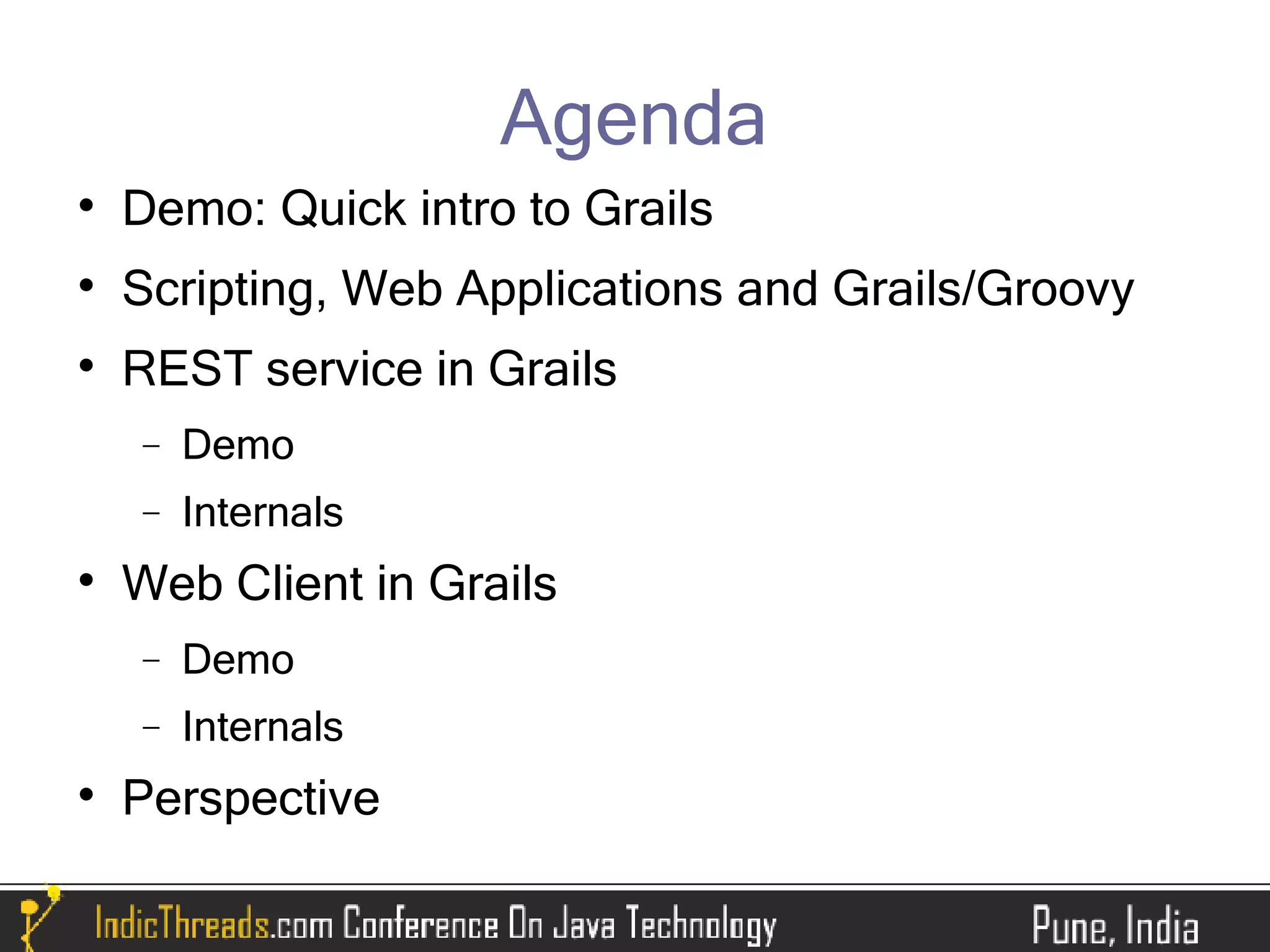
Agenda  Demo: Quick intro to Grails  Scripting, Web Applications and Grails/Groovy  REST service in Grails − Demo − Internals  Web Client in Grails − Demo − Internals  Perspective
Demo Quick Intro to Grails
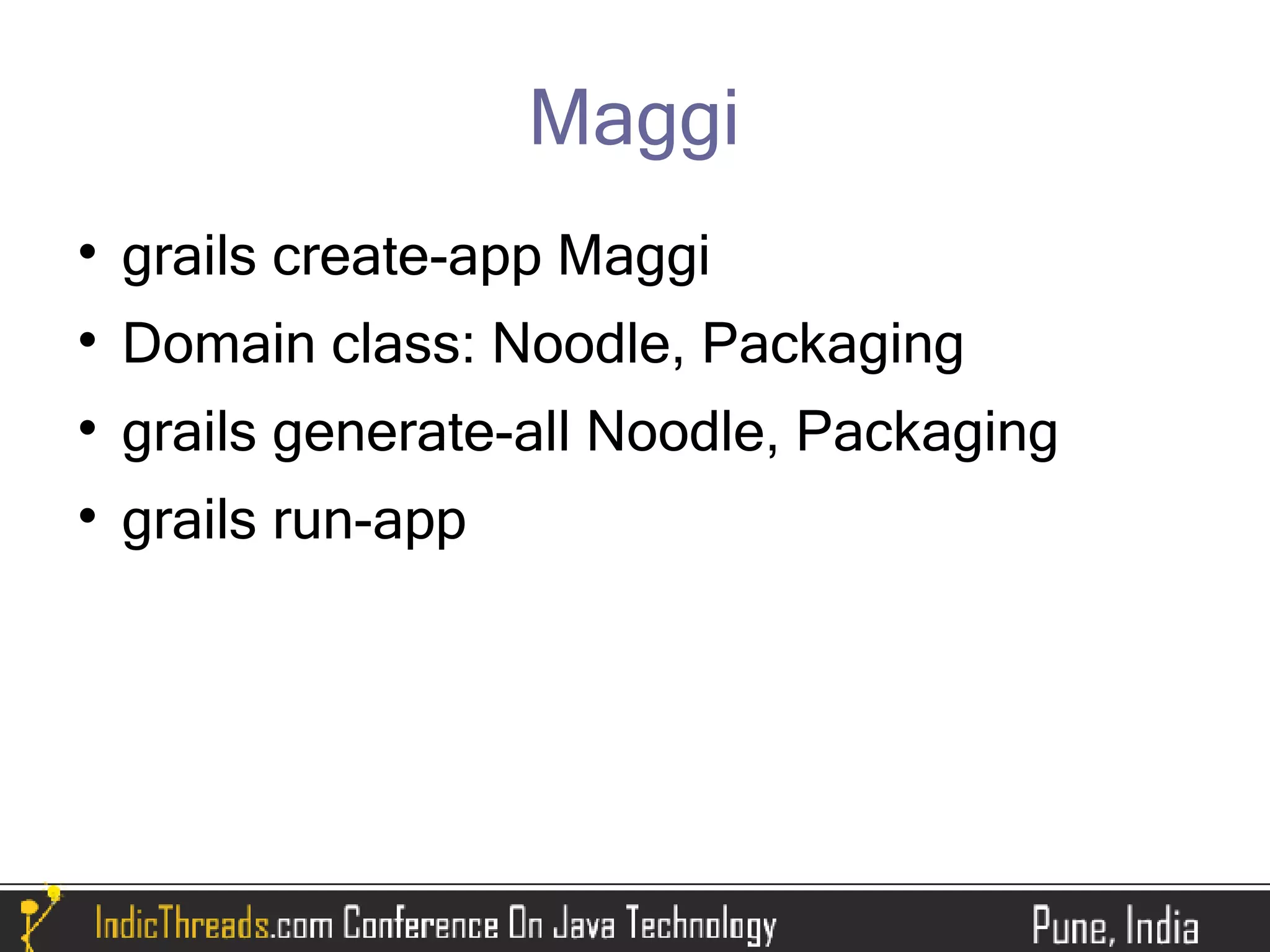
Maggi  grails create-app Maggi  Domain class: Noodle, Packaging  grails generate-all Noodle, Packaging  grails run-app
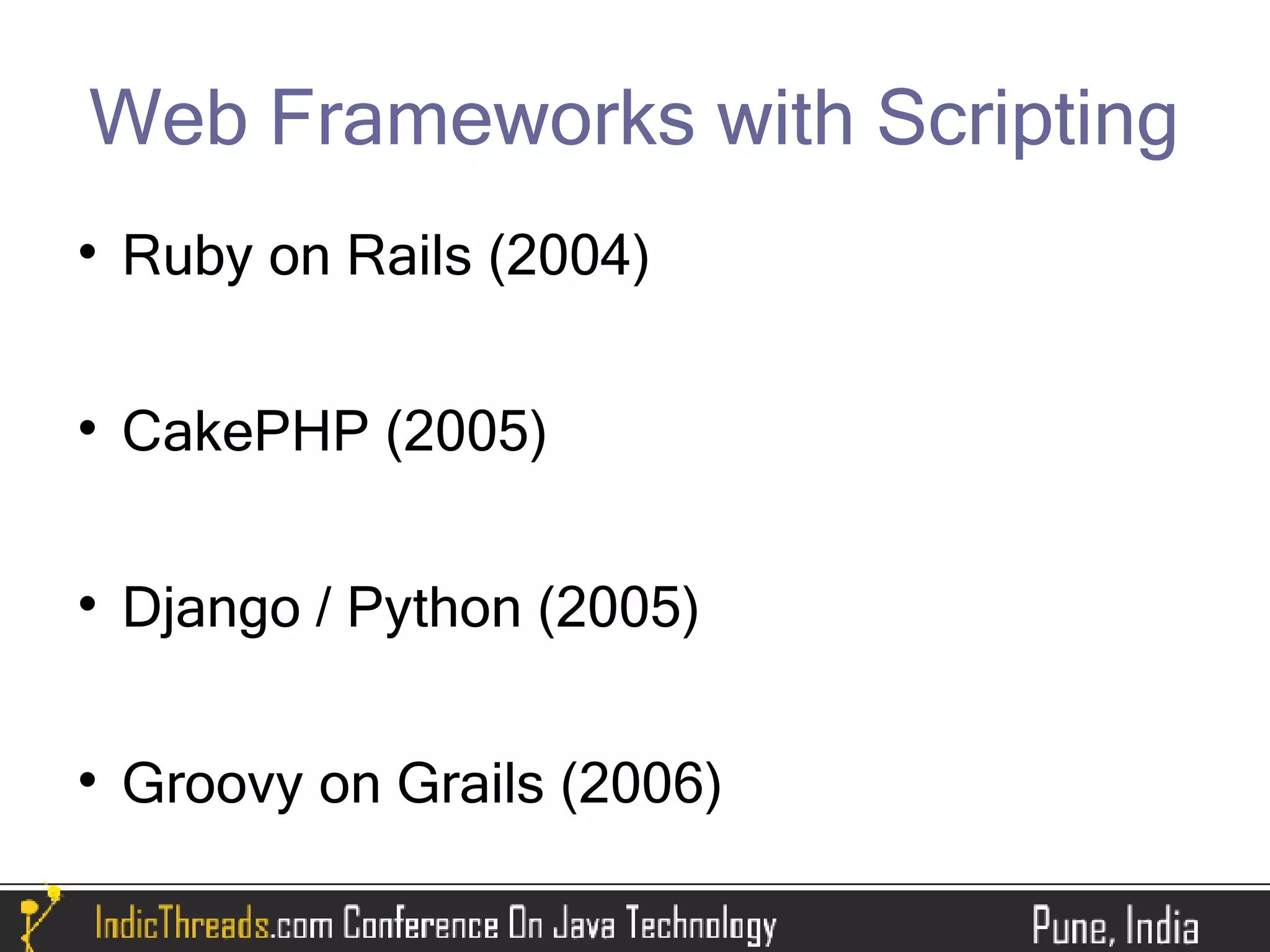
Web Frameworks with Scripting  Ruby on Rails (2004)  CakePHP (2005)  Django / Python (2005)  Groovy on Grails (2006)
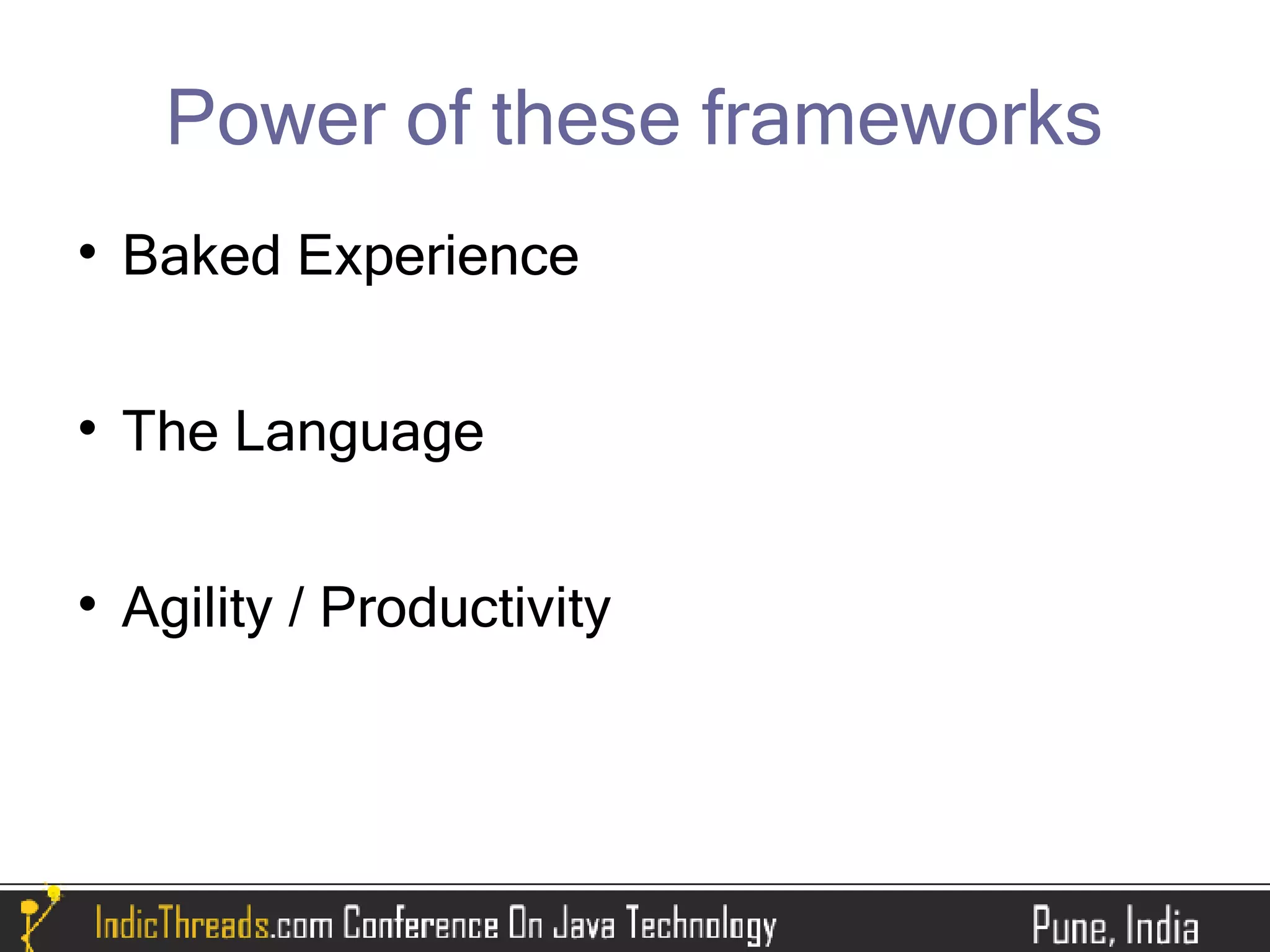
Power of these frameworks  Baked Experience  The Language  Agility / Productivity
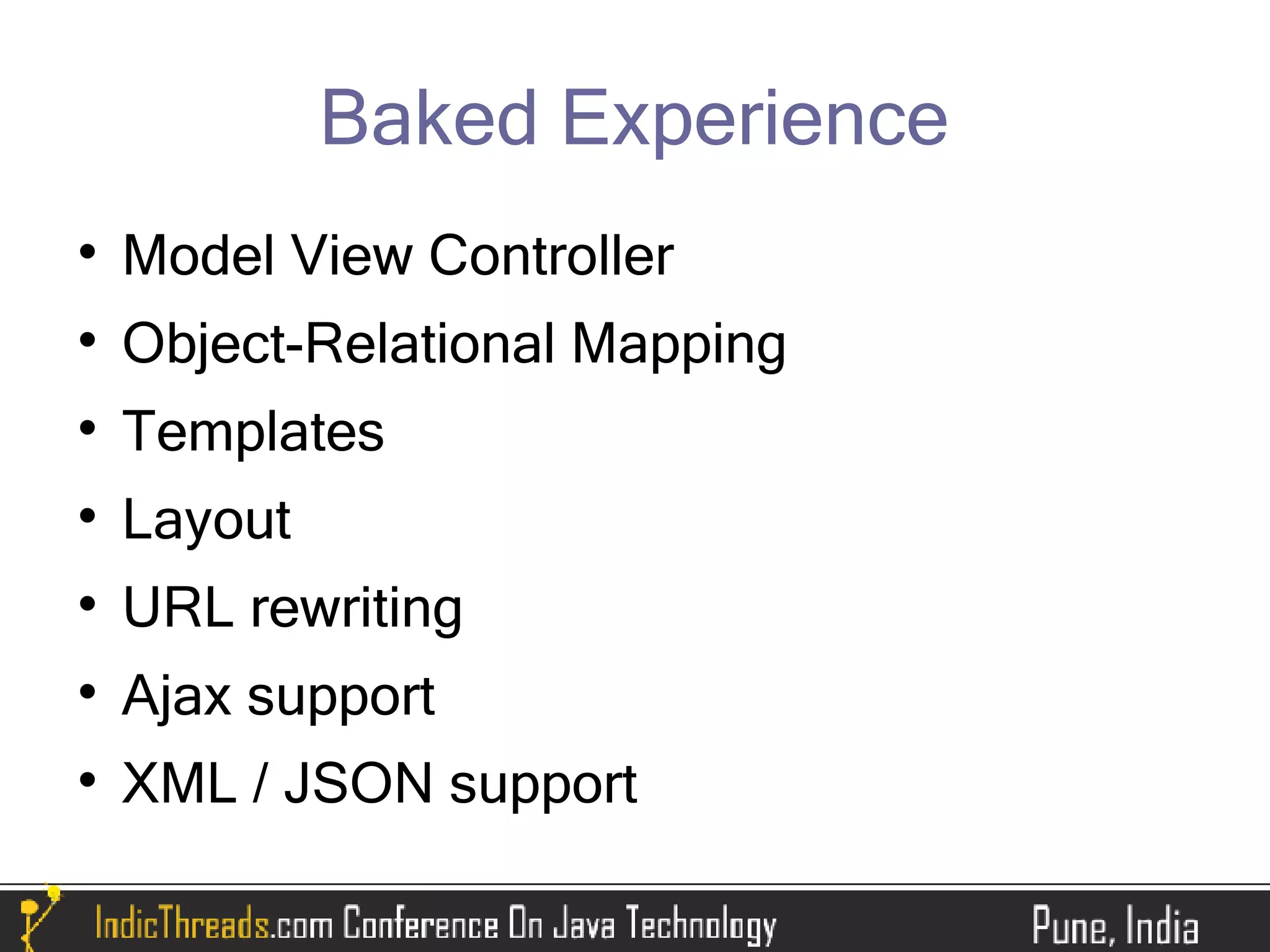
Baked Experience  Model View Controller  Object-Relational Mapping  Templates  Layout  URL rewriting  Ajax support  XML / JSON support
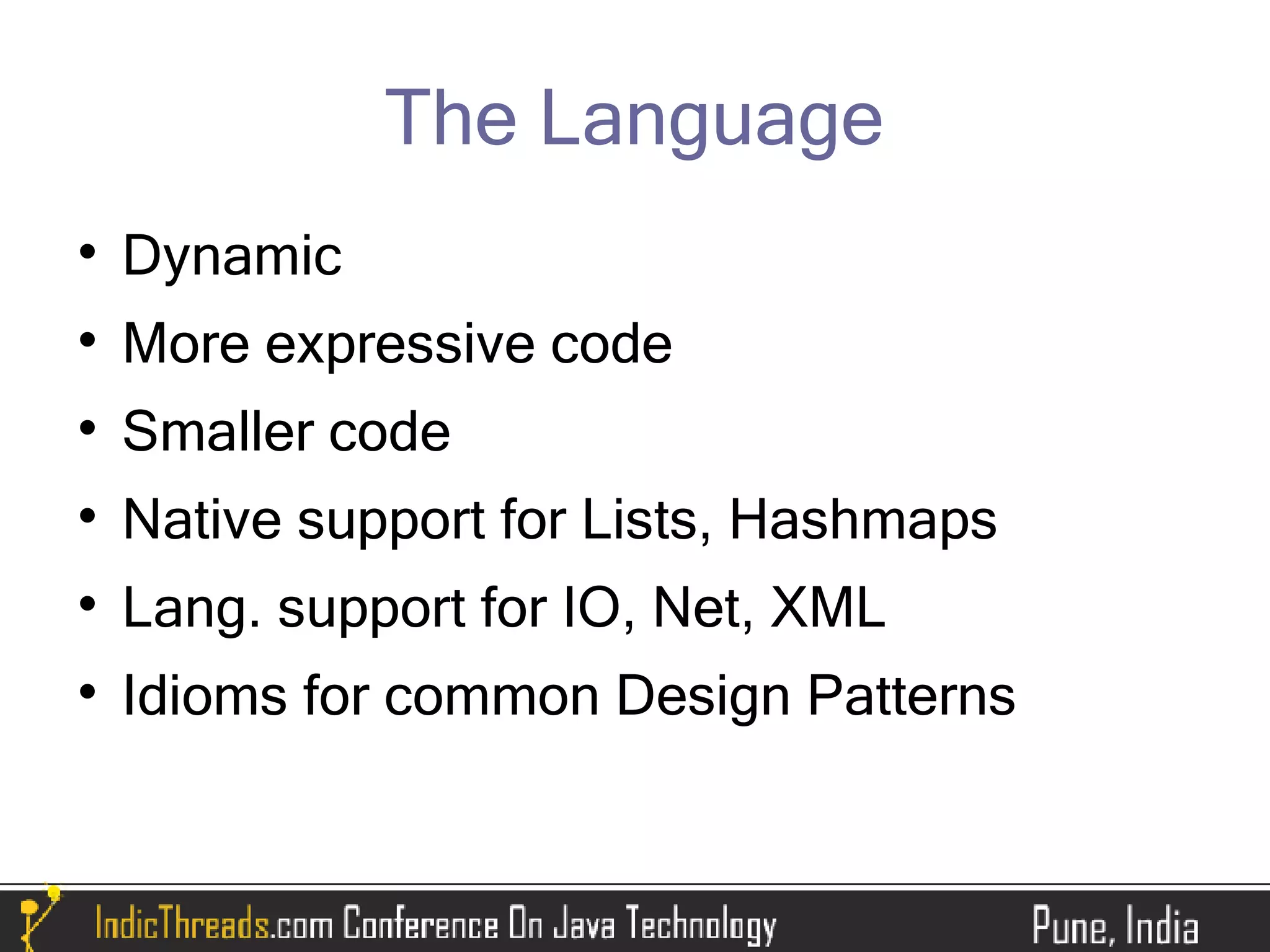
The Language  Dynamic  More expressive code  Smaller code  Native support for Lists, Hashmaps  Lang. support for IO, Net, XML  Idioms for common Design Patterns
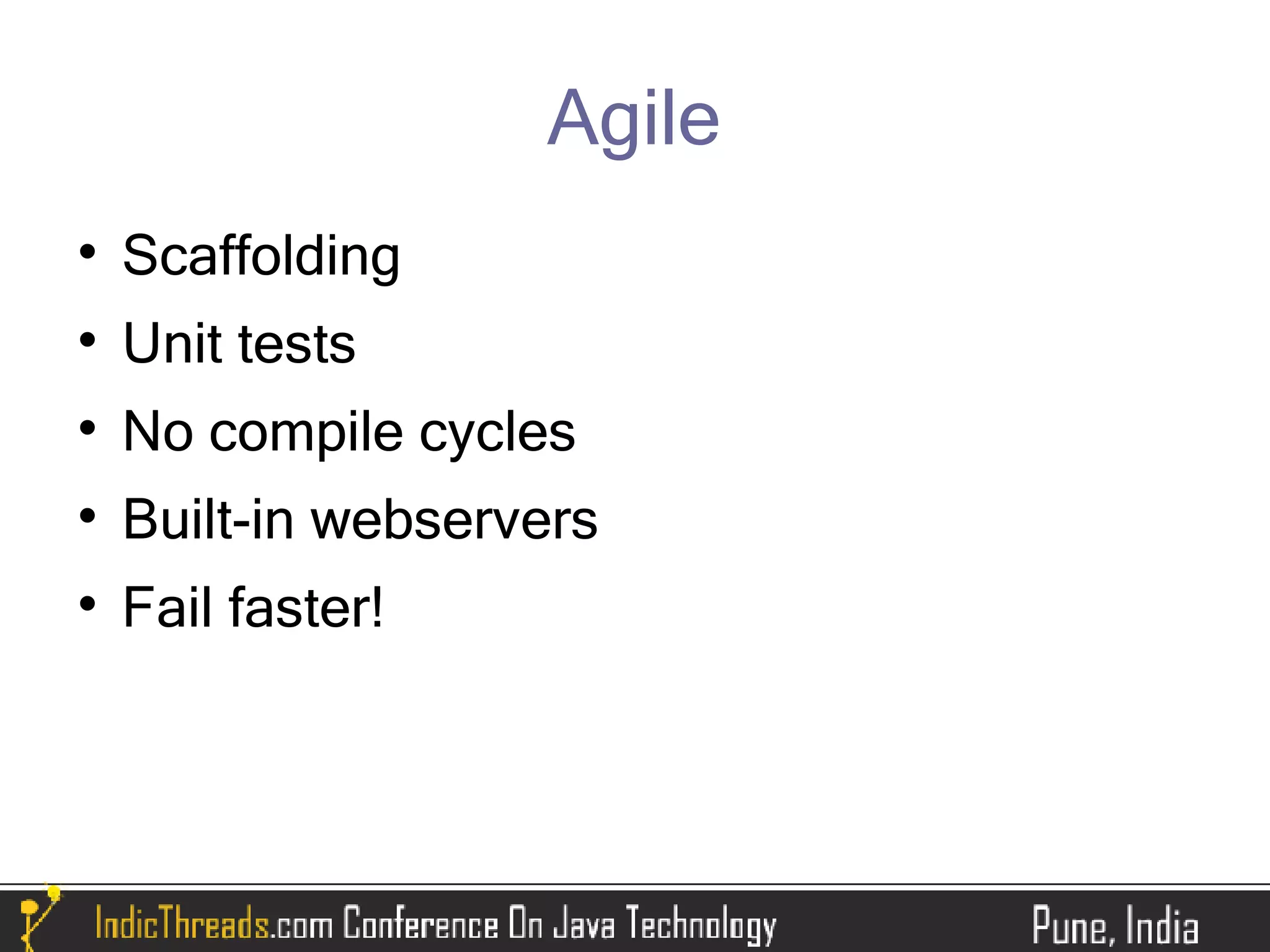
Agile  Scaffolding  Unit tests  No compile cycles  Built-in webservers  Fail faster!
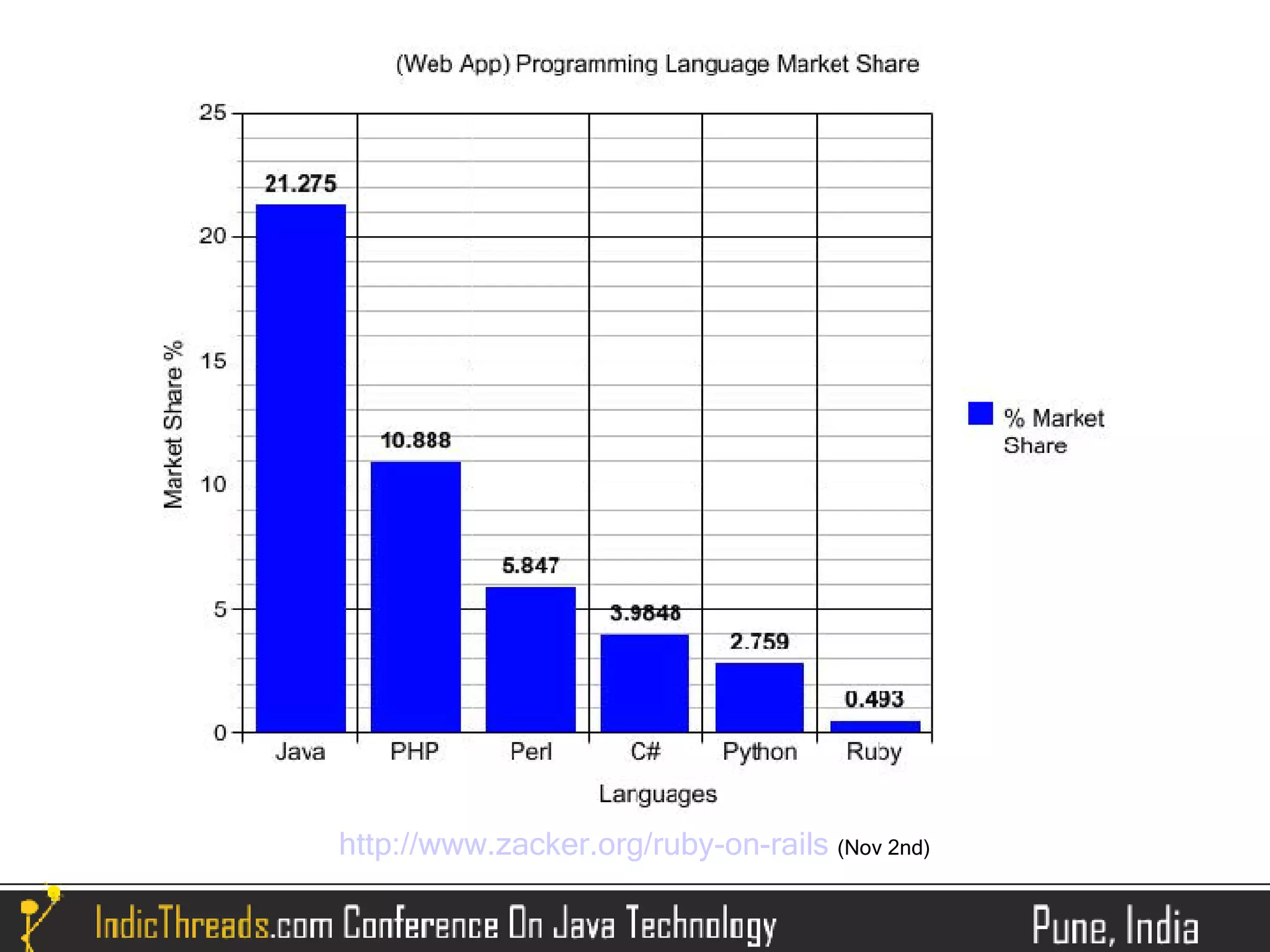
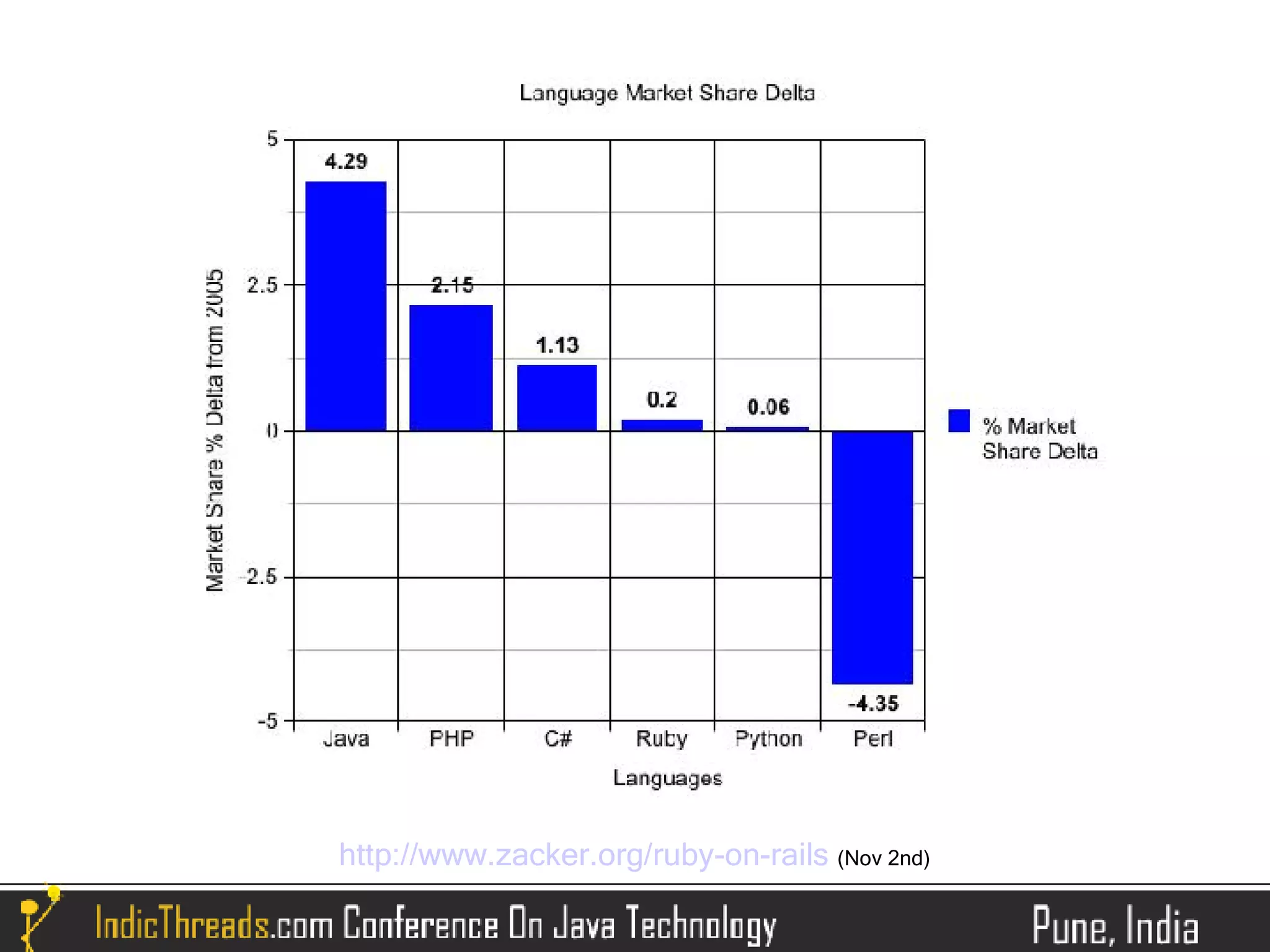
http://www.zacker.org/ruby-on-rails (Nov 2nd)
HelloWorld.java public class HelloWorld { String name; public void setName(String name) { this.name = name; } public String getName() { return name; } public String hello() { return “Hello “+ name; } public static void main(String args[]) { HelloWorld helloWorld = new HelloWorld(); helloWorld.setName(“Java”); System.out.println( helloWorld. hello() ); } }
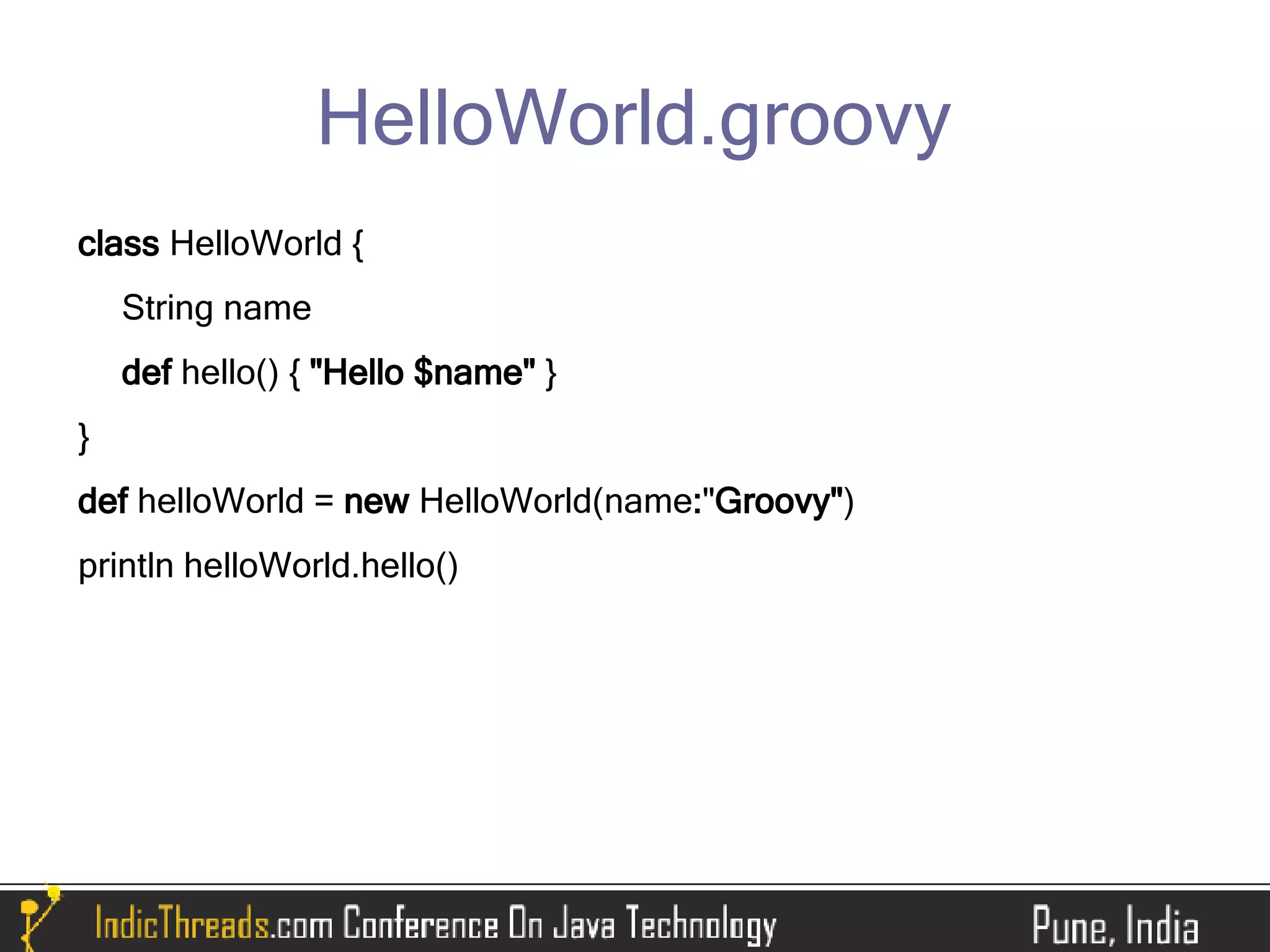
HelloWorld.groovy class HelloWorld { String name def hello() { "Hello $name" } } def helloWorld = new HelloWorld(name:"Groovy") println helloWorld.hello()
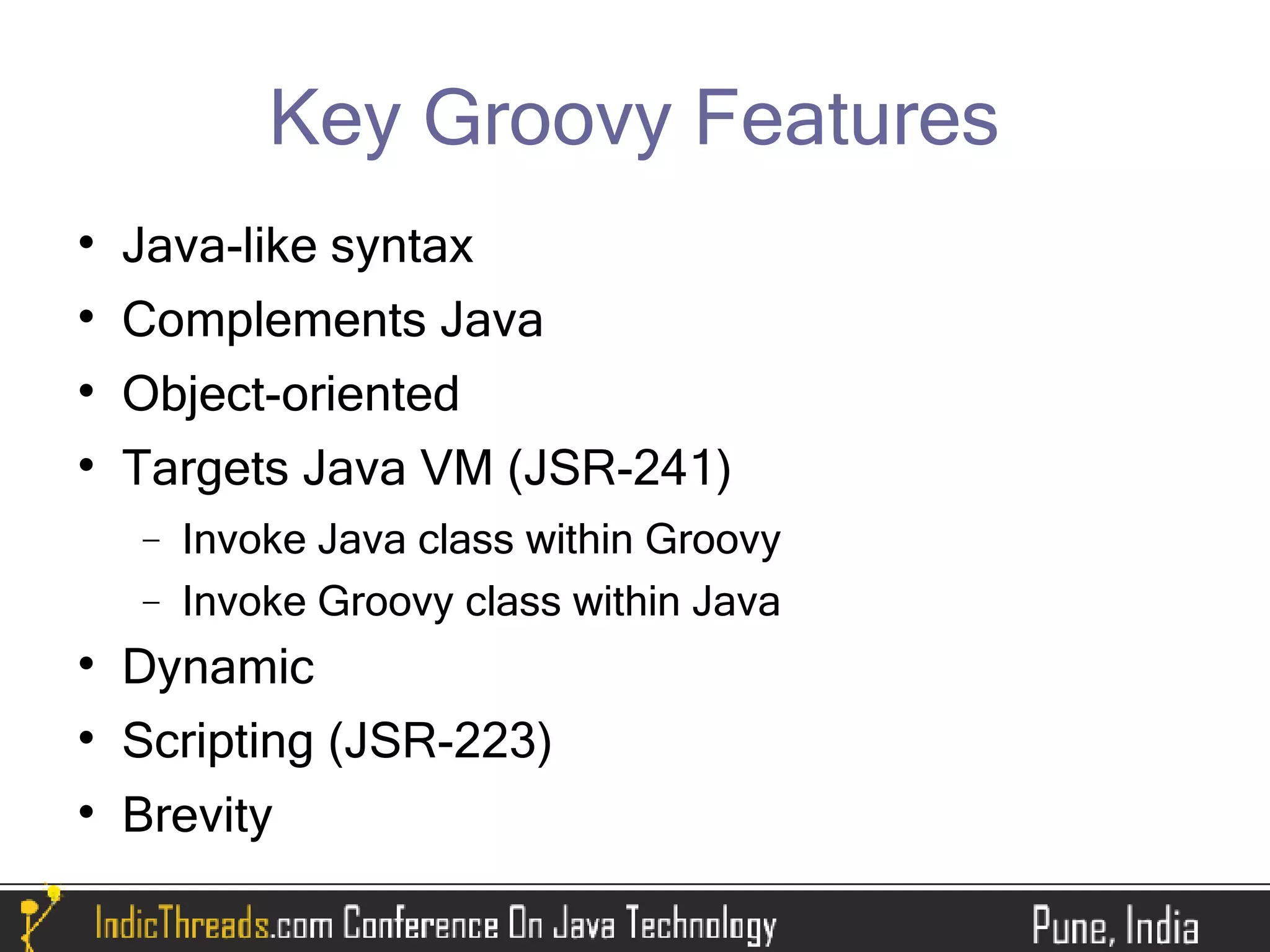
Key Groovy Features  Java-like syntax  Complements Java  Object-oriented  Targets Java VM (JSR-241) − Invoke Java class within Groovy − Invoke Groovy class within Java  Dynamic  Scripting (JSR-223)  Brevity
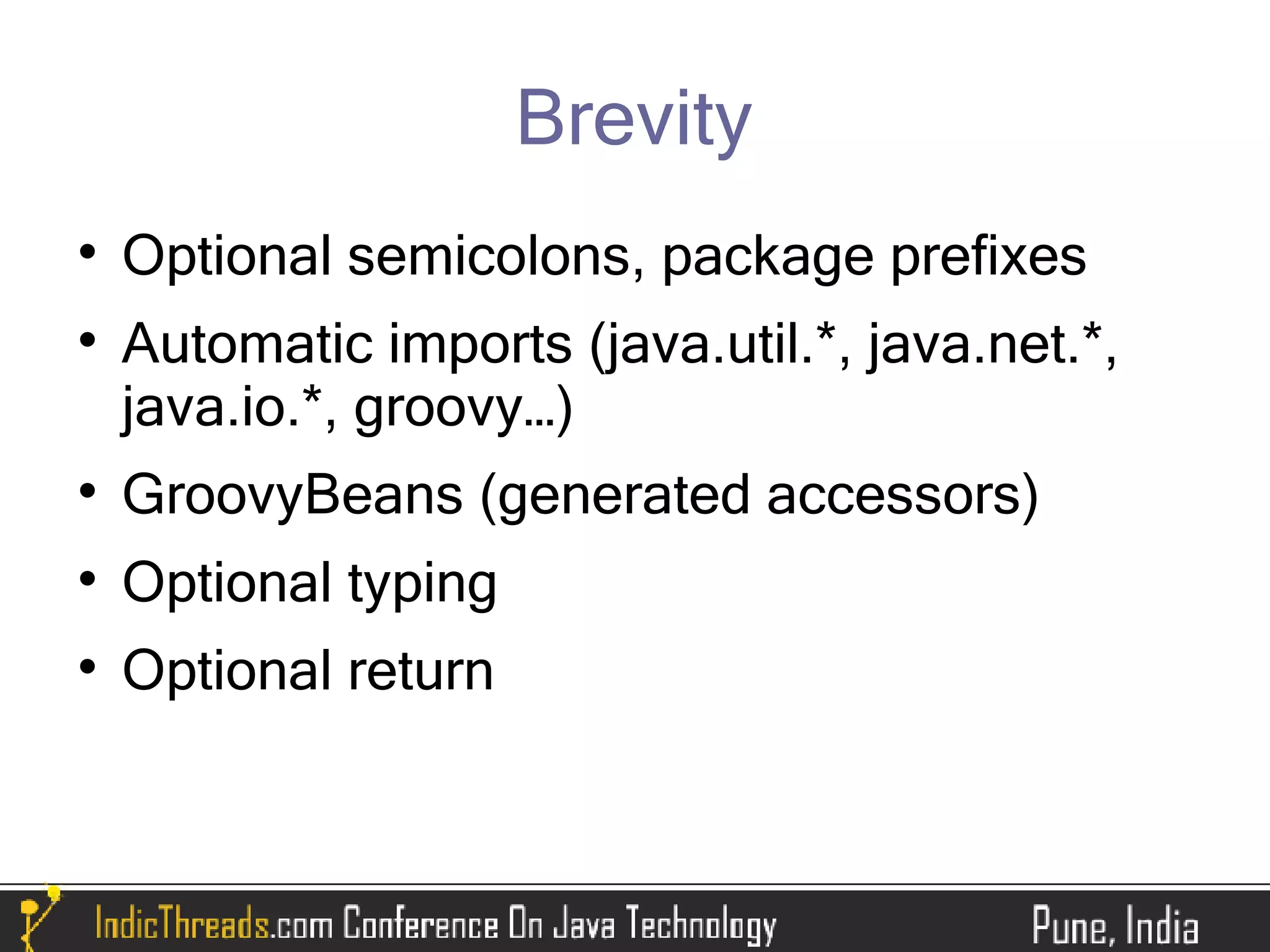
Brevity  Optional semicolons, package prefixes  Automatic imports (java.util.*, java.net.*, java.io.*, groovy…)  GroovyBeans (generated accessors)  Optional typing  Optional return
Groovy Gravy  GStrings: ”$book.title: $book.author (${book.reviewers.length})”  Regular expressions: assert ‘12345’ =~ /d+/  Only objects: primitives converted to Reference Types  Lists: def list = [1, 2, 'hello', new java.util.Date()]  Maps: def map = ['name':‘Indic Threads', 'location':‘Pune']  Closures [1,2,3].collect {it*2} ===> [2, 4, 6]  String literals – single, double, triple quotes
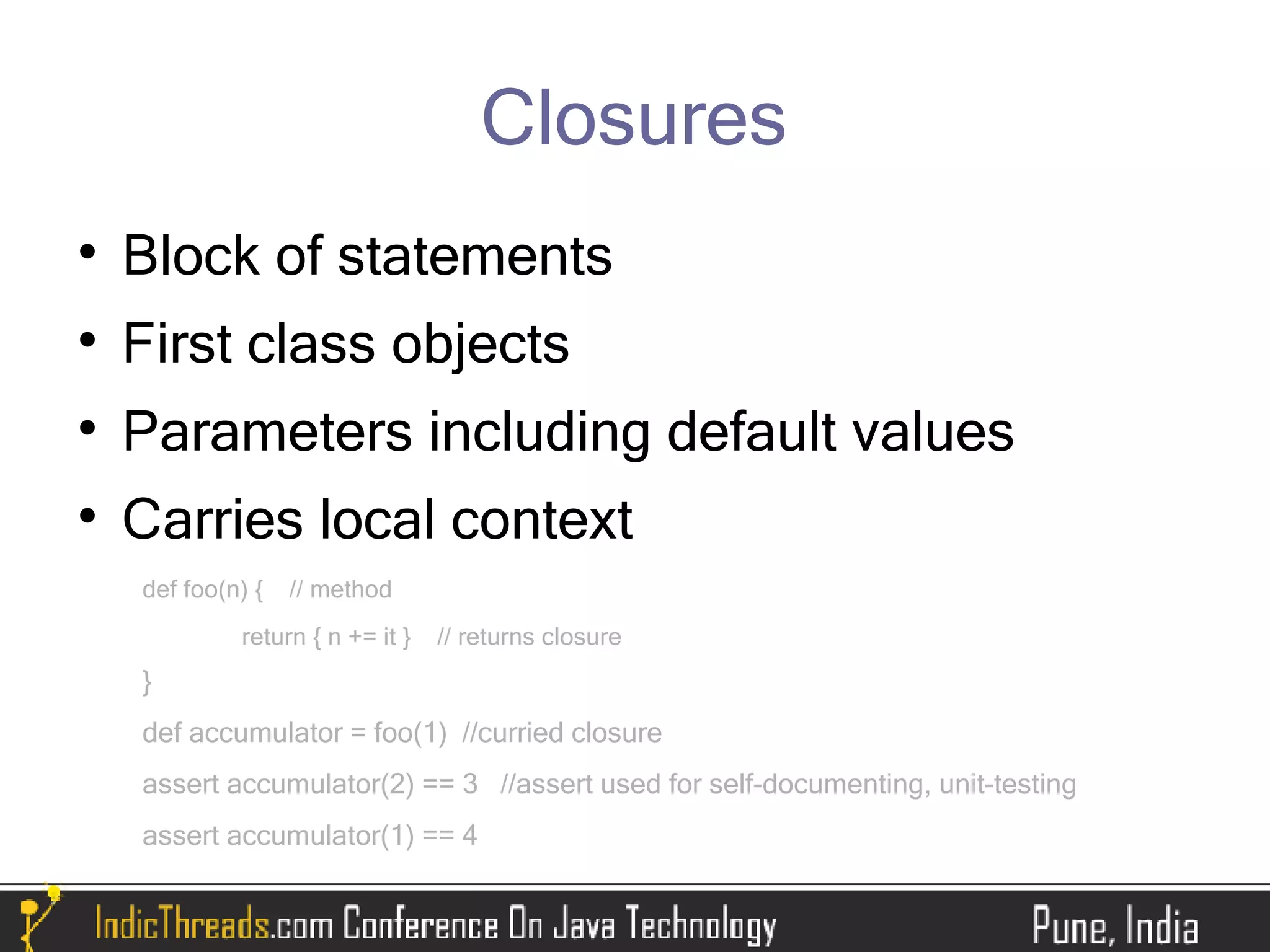
Closures  Block of statements  First class objects  Parameters including default values  Carries local context def foo(n) { // method return { n += it } // returns closure } def accumulator = foo(1) //curried closure assert accumulator(2) == 3 //assert used for self-documenting, unit-testing assert accumulator(1) == 4
Dynamic Programming  Add methods, properties to classes/objects at run-time  Mixins to inject behaviour  Can extend class field-access mechanism  Dynamic method invocation
Poolster  Online “football pools” application  Entities: Game, User  Game  Stake, Option, Ends  To join User chooses an Option  REST Webservice backend  Clients: iPhone, Grails, Android, Silverlight
Demo The Poolster Webservice
Grails – Philosophy  Convention over Configuration − Magic directories − Implicit table names, column names  Don’t Repeat Yourself − Database maps to domain − hasMany defines relationship & declares variable − Layout, form validations  Lightweight − Modify and F5  Strong shoulders − Spring (Grails MVC, DI, Transactions) − Hibernate (GORM) − Ant, JUnit, SiteMesh
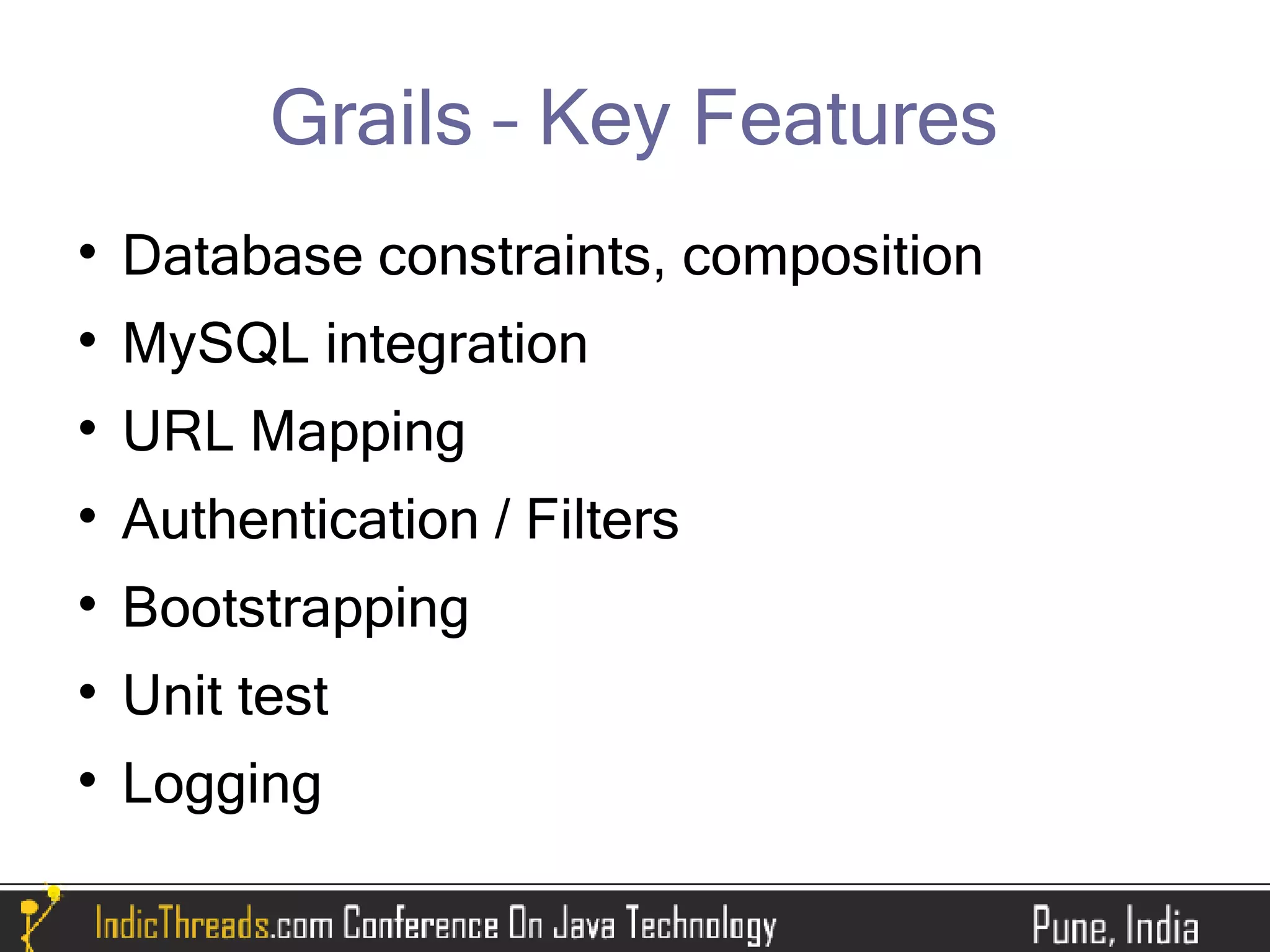
Grails – Key Features  Database constraints, composition  MySQL integration  URL Mapping  Authentication / Filters  Bootstrapping  Unit test  Logging
Demo Poolster Web Client
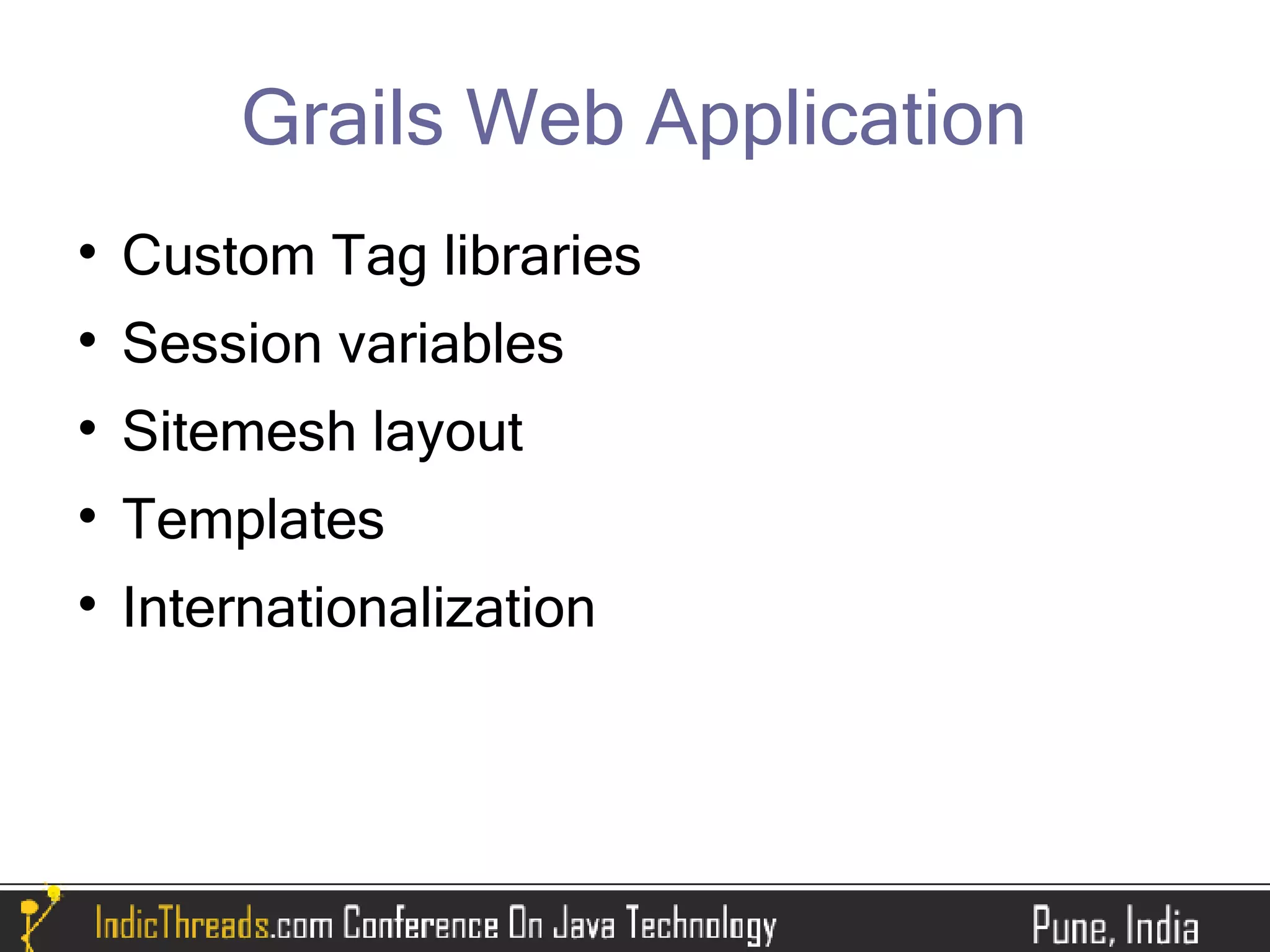
Grails Web Application  Custom Tag libraries  Session variables  Sitemesh layout  Templates  Internationalization
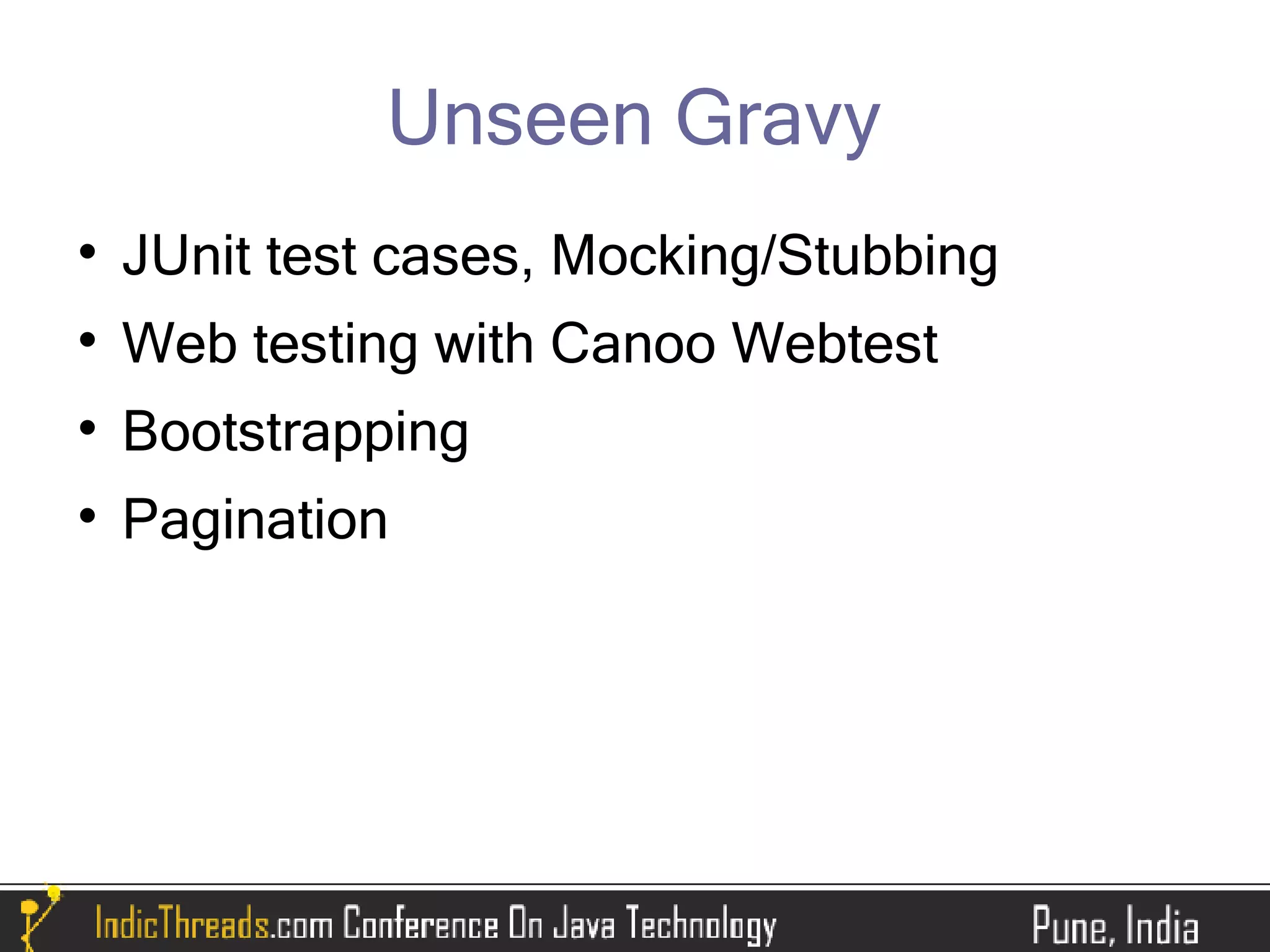
Unseen Gravy  JUnit test cases, Mocking/Stubbing  Web testing with Canoo Webtest  Bootstrapping  Pagination
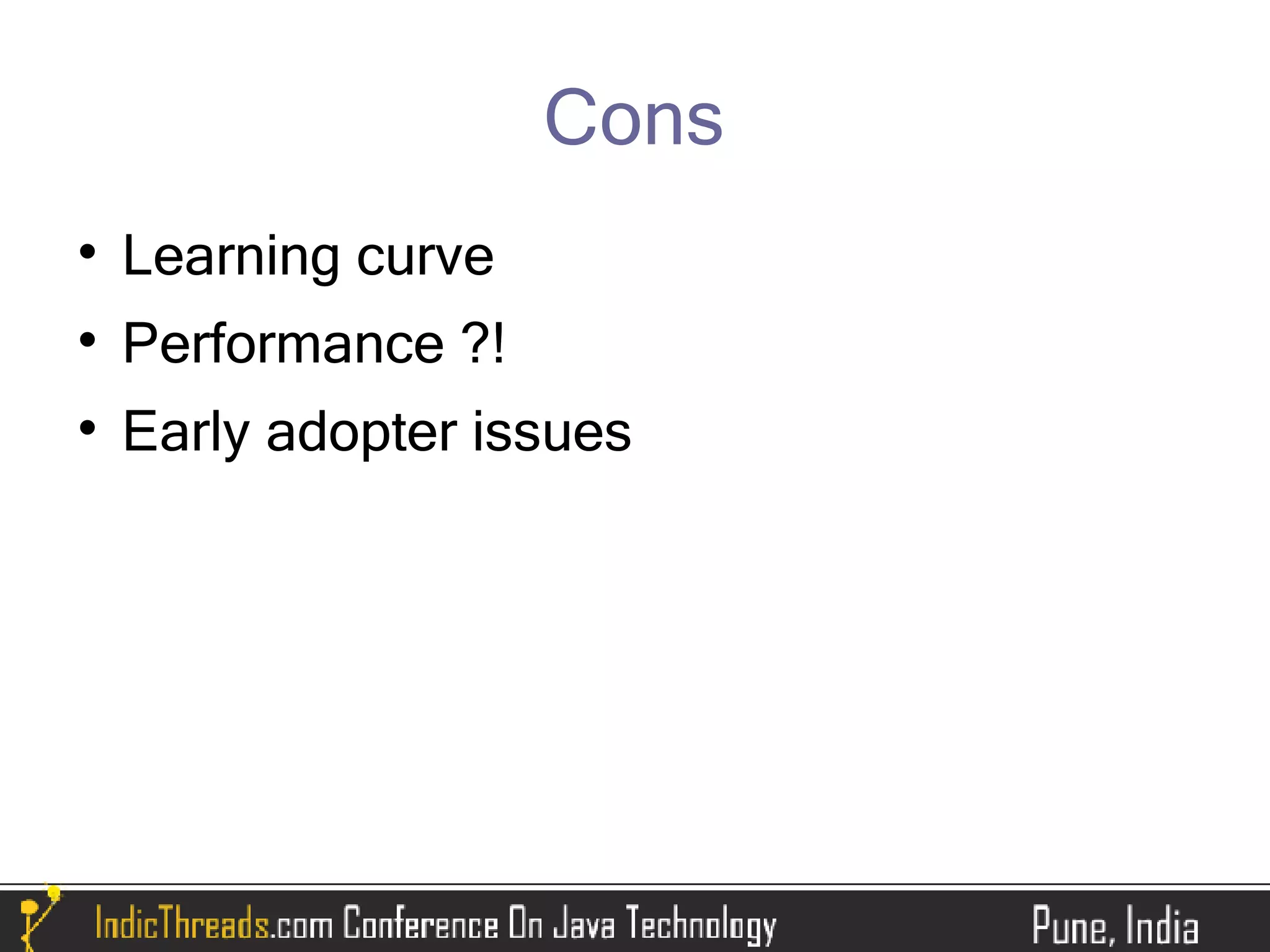
Cons  Learning curve  Performance ?!  Early adopter issues
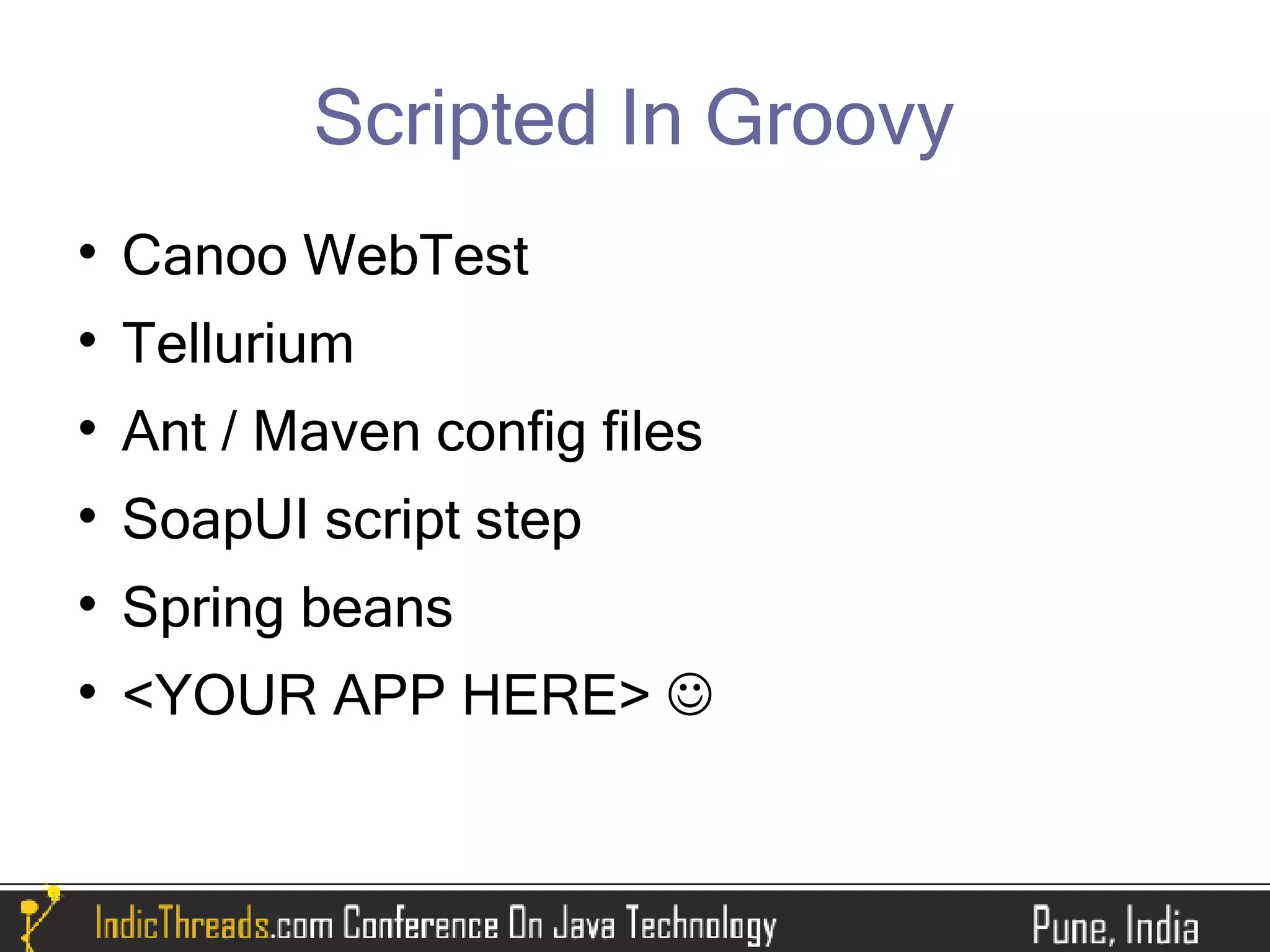
Scripted In Groovy  Canoo WebTest  Tellurium  Ant / Maven config files  SoapUI script step  Spring beans  <YOUR APP HERE> 
Invoking Groovy Scripts import java.io.File; import groovy.lang.Binding; import groovy.util.GroovyScriptEngine; public class ScriptEngineEmbedGroovy{ public static void main(String args[]) throws Throwable{ String[] paths = {"C:groovy"}; GroovyScriptEngine gse = new GroovyScriptEngine(paths); Binding binding = new Binding(); Object[] path = {"C:musicmp3"}; binding.setVariable("args",path); gse.run("Songs.groovy", binding); } }
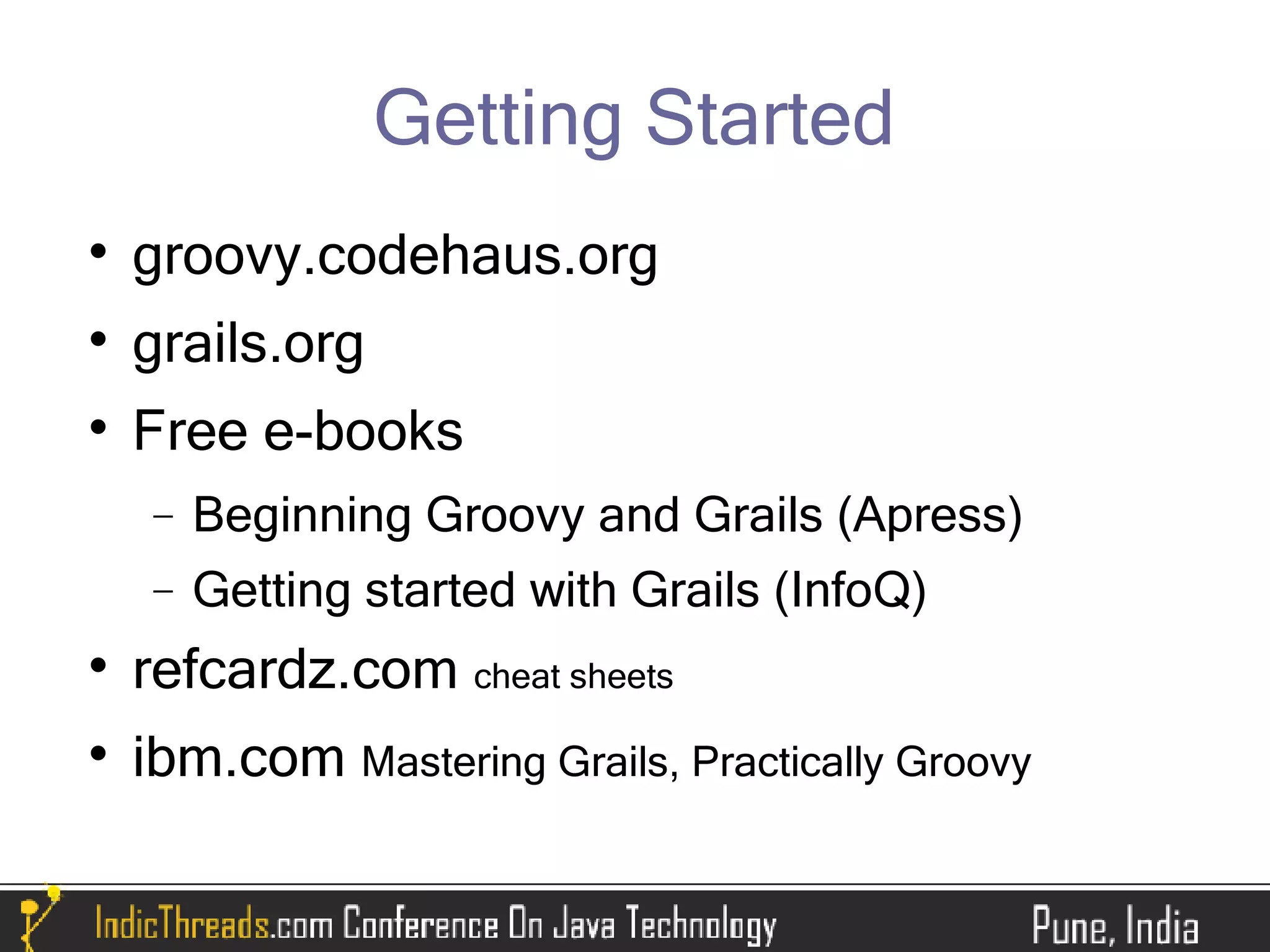
Getting Started  groovy.codehaus.org  grails.org  Free e-books − Beginning Groovy and Grails (Apress) − Getting started with Grails (InfoQ)  refcardz.com cheat sheets  ibm.com Mastering Grails, Practically Groovy
Thanks

Groovy - Grails as a modern scripting language for Web applications

  • 1.
    Groovy & Grails Scripting for Modern Web Applications Rohit Nayak Talentica Software
  • 2.
    Agenda  Demo: Quick intro to Grails  Scripting, Web Applications and Grails/Groovy  REST service in Grails − Demo − Internals  Web Client in Grails − Demo − Internals  Perspective
  • 3.
  • 4.
    Maggi  grails create-app Maggi  Domain class: Noodle, Packaging  grails generate-all Noodle, Packaging  grails run-app
  • 5.
    Web Frameworks withScripting  Ruby on Rails (2004)  CakePHP (2005)  Django / Python (2005)  Groovy on Grails (2006)
  • 6.
    Power of theseframeworks  Baked Experience  The Language  Agility / Productivity
  • 7.
    Baked Experience  Model View Controller  Object-Relational Mapping  Templates  Layout  URL rewriting  Ajax support  XML / JSON support
  • 8.
    The Language  Dynamic  More expressive code  Smaller code  Native support for Lists, Hashmaps  Lang. support for IO, Net, XML  Idioms for common Design Patterns
  • 9.
    Agile  Scaffolding  Unit tests  No compile cycles  Built-in webservers  Fail faster!
  • 10.
  • 11.
  • 12.
    HelloWorld.java public class HelloWorld{ String name; public void setName(String name) { this.name = name; } public String getName() { return name; } public String hello() { return “Hello “+ name; } public static void main(String args[]) { HelloWorld helloWorld = new HelloWorld(); helloWorld.setName(“Java”); System.out.println( helloWorld. hello() ); } }
  • 13.
    HelloWorld.groovy class HelloWorld { String name def hello() { "Hello $name" } } def helloWorld = new HelloWorld(name:"Groovy") println helloWorld.hello()
  • 14.
    Key Groovy Features  Java-like syntax  Complements Java  Object-oriented  Targets Java VM (JSR-241) − Invoke Java class within Groovy − Invoke Groovy class within Java  Dynamic  Scripting (JSR-223)  Brevity
  • 15.
    Brevity  Optional semicolons, package prefixes  Automatic imports (java.util.*, java.net.*, java.io.*, groovy…)  GroovyBeans (generated accessors)  Optional typing  Optional return
  • 16.
    Groovy Gravy  GStrings: ”$book.title: $book.author (${book.reviewers.length})”  Regular expressions: assert ‘12345’ =~ /d+/  Only objects: primitives converted to Reference Types  Lists: def list = [1, 2, 'hello', new java.util.Date()]  Maps: def map = ['name':‘Indic Threads', 'location':‘Pune']  Closures [1,2,3].collect {it*2} ===> [2, 4, 6]  String literals – single, double, triple quotes
  • 17.
    Closures  Block of statements  First class objects  Parameters including default values  Carries local context def foo(n) { // method return { n += it } // returns closure } def accumulator = foo(1) //curried closure assert accumulator(2) == 3 //assert used for self-documenting, unit-testing assert accumulator(1) == 4
  • 18.
    Dynamic Programming  Add methods, properties to classes/objects at run-time  Mixins to inject behaviour  Can extend class field-access mechanism  Dynamic method invocation
  • 19.
    Poolster  Online “football pools” application  Entities: Game, User  Game  Stake, Option, Ends  To join User chooses an Option  REST Webservice backend  Clients: iPhone, Grails, Android, Silverlight
  • 20.
  • 21.
    Grails – Philosophy  Convention over Configuration − Magic directories − Implicit table names, column names  Don’t Repeat Yourself − Database maps to domain − hasMany defines relationship & declares variable − Layout, form validations  Lightweight − Modify and F5  Strong shoulders − Spring (Grails MVC, DI, Transactions) − Hibernate (GORM) − Ant, JUnit, SiteMesh
  • 22.
    Grails – KeyFeatures  Database constraints, composition  MySQL integration  URL Mapping  Authentication / Filters  Bootstrapping  Unit test  Logging
  • 23.
  • 24.
    Grails Web Application  Custom Tag libraries  Session variables  Sitemesh layout  Templates  Internationalization
  • 25.
    Unseen Gravy  JUnit test cases, Mocking/Stubbing  Web testing with Canoo Webtest  Bootstrapping  Pagination
  • 26.
    Cons  Learning curve  Performance ?!  Early adopter issues
  • 27.
    Scripted In Groovy  Canoo WebTest  Tellurium  Ant / Maven config files  SoapUI script step  Spring beans  <YOUR APP HERE> 
  • 28.
    Invoking Groovy Scripts importjava.io.File; import groovy.lang.Binding; import groovy.util.GroovyScriptEngine; public class ScriptEngineEmbedGroovy{ public static void main(String args[]) throws Throwable{ String[] paths = {"C:groovy"}; GroovyScriptEngine gse = new GroovyScriptEngine(paths); Binding binding = new Binding(); Object[] path = {"C:musicmp3"}; binding.setVariable("args",path); gse.run("Songs.groovy", binding); } }
  • 29.
    Getting Started  groovy.codehaus.org  grails.org  Free e-books − Beginning Groovy and Grails (Apress) − Getting started with Grails (InfoQ)  refcardz.com cheat sheets  ibm.com Mastering Grails, Practically Groovy
  • 30.