Intro to CI/CD Michael Irwin - February 8, 2017
First... a history lesson!
The Pareto Principal (the 80/20 rule) 80% of bugs are found in 20% of code 90% of downtime comes from 10% of defects "80% of the errors and crashes in Windows and O ce were caused by 20% of the entire pool of bugs detected." --Microsoft's CEO, 2002 "Microsoft’s own research found that the average user of Word uses only 8% of the functionality." -- http://www.allaboutagile.com/agile-principle-8-enough-is-enough/
How do we reduce waste?
How would YOU de ne continuous integration?
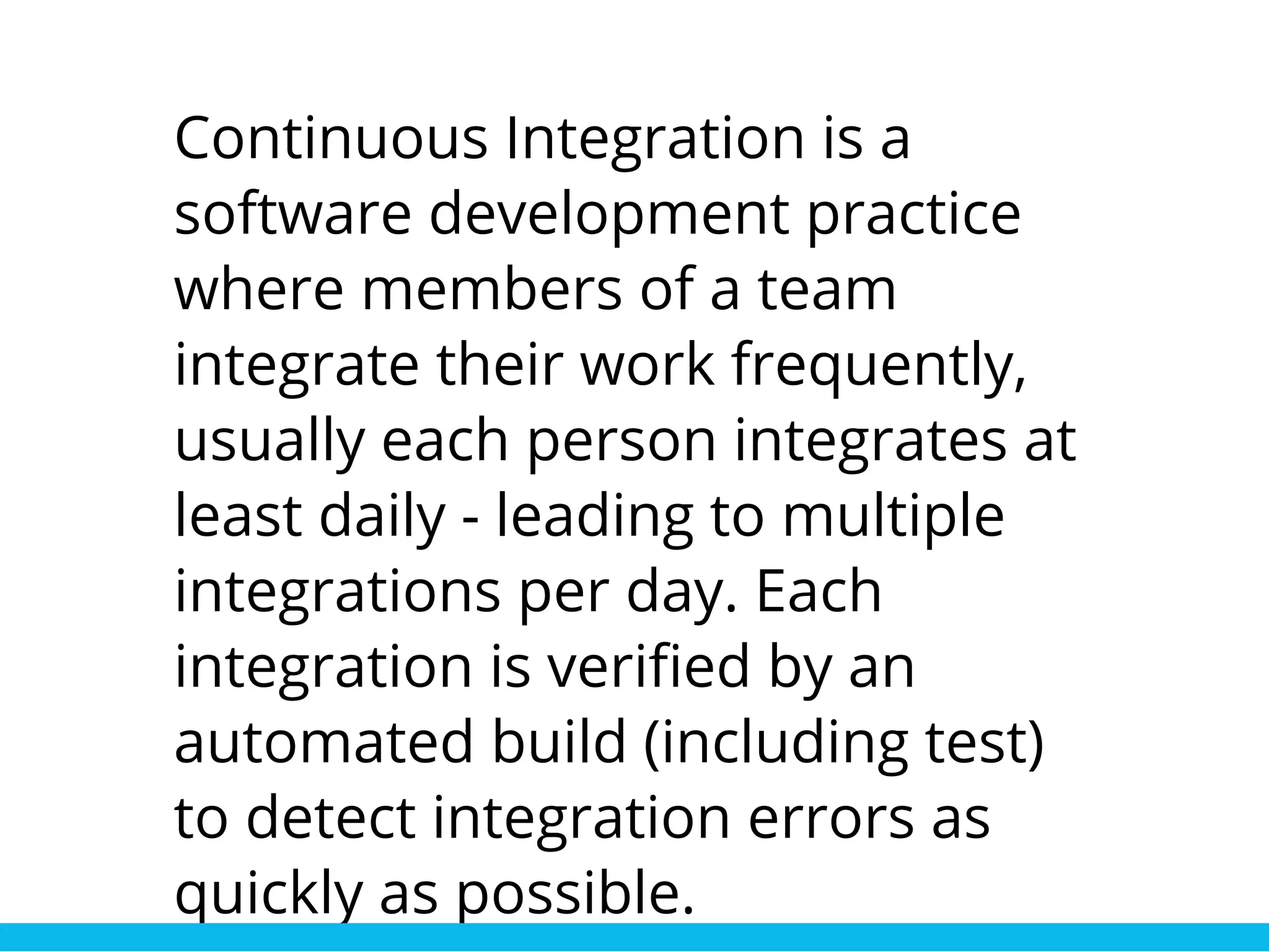
Continuous Integration is a software development practice where members of a team integrate their work frequently, usually each person integrates at least daily - leading to multiple integrations per day. Each integration is veri ed by an automated build (including test) to detect integration errors as quickly as possible.
How would YOU de ne continuous delivery?
Continuous Delivery is a software development discipline where you build software in such a way that the software can be released to production at any time. -- Martin Fowler
Recap Continuous... Integration - running automated builds to test integration of application Delivery - discipline to be able to release to production at any time Deployment - every change goes through the pipeline and straight to production
What's it look like? It really depends on your organization! A fairly typical pipeline... Developer commits code locally Pushes code to shared repository Build server sees change (either via webhook or polling) Build server performs build and runs tests Artifact is created and published Artifact rolled out to various tiers
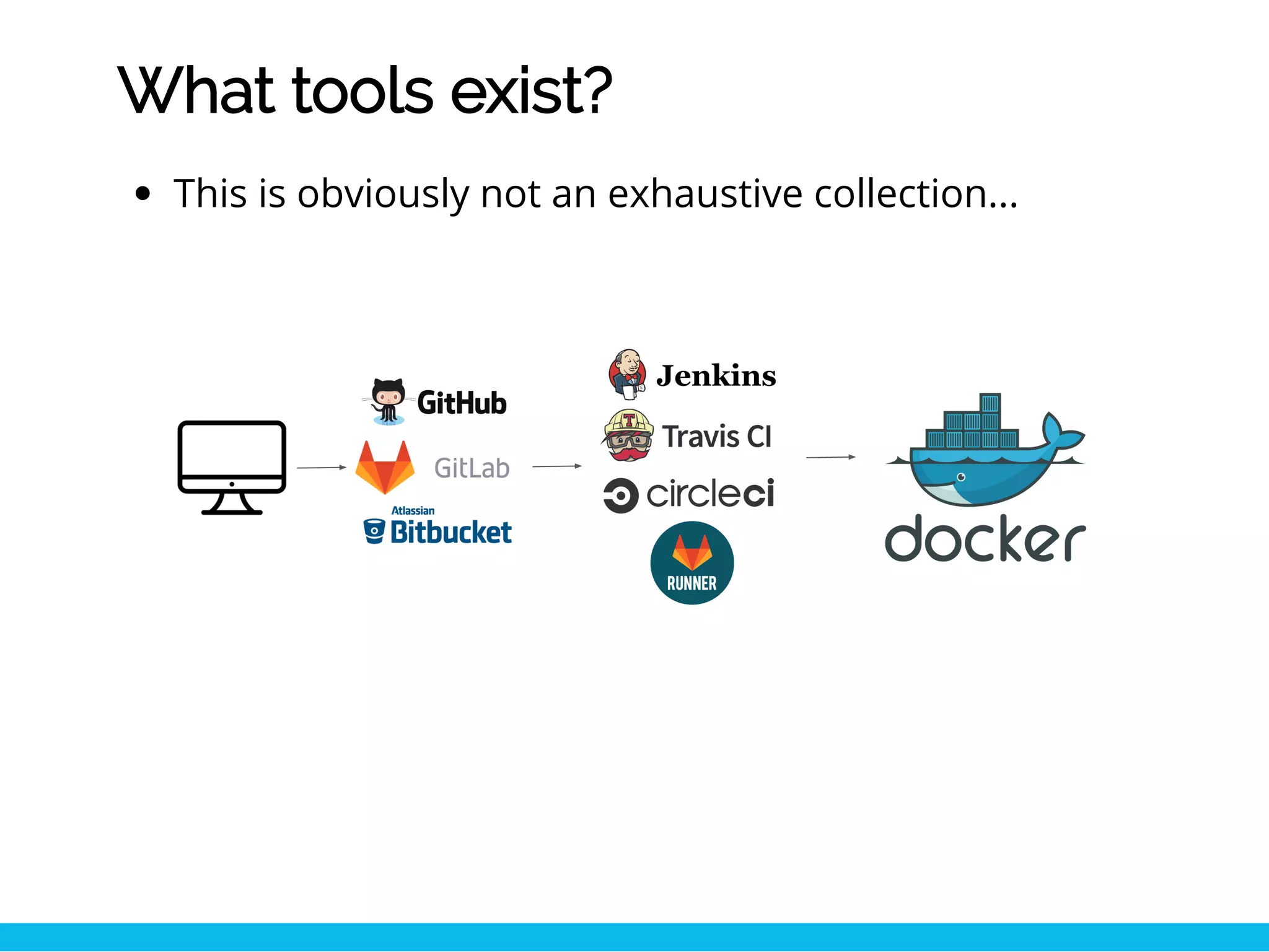
What tools exist? This is obviously not an exhaustive collection...
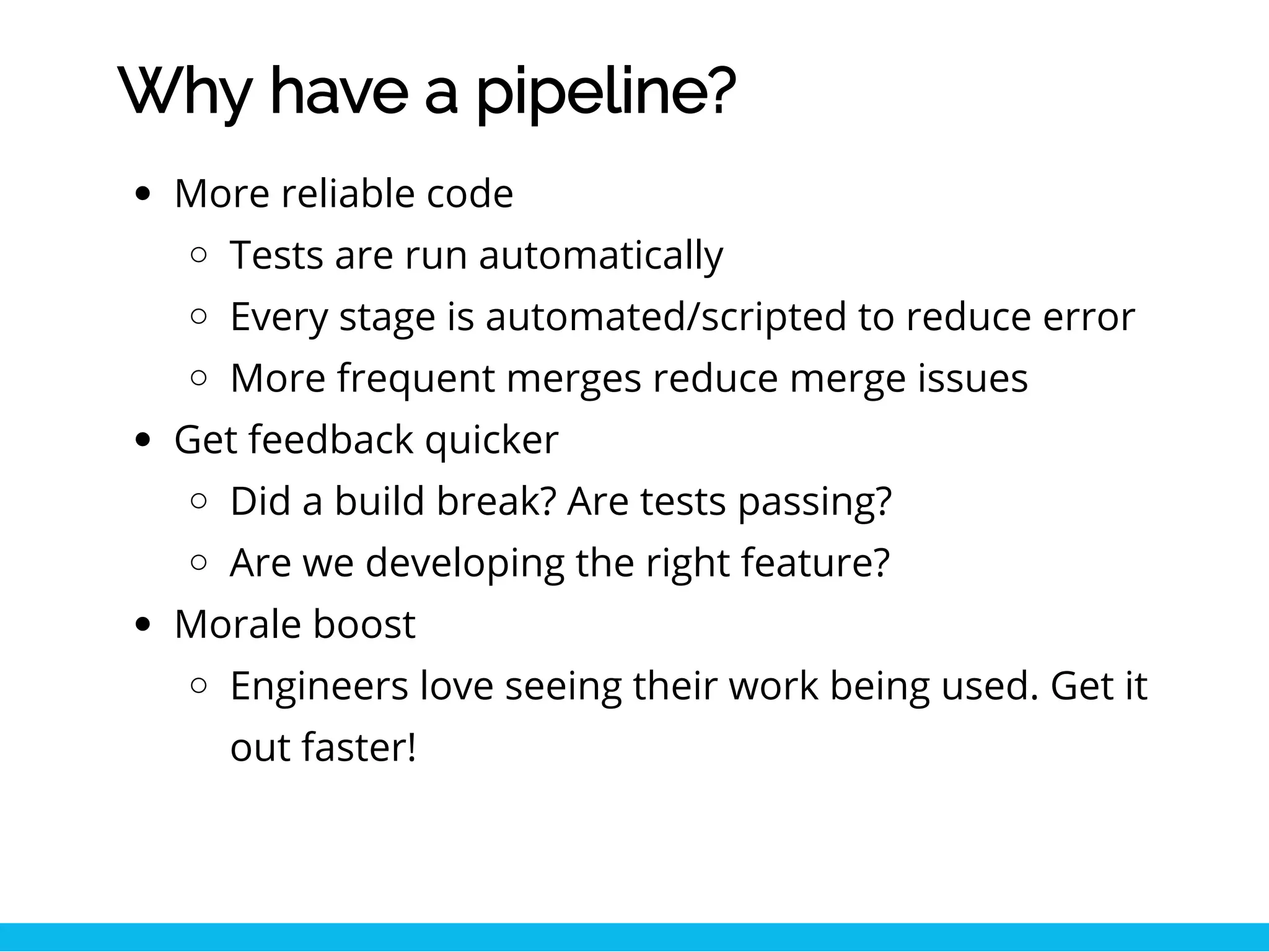
Why have a pipeline? More reliable code Tests are run automatically Every stage is automated/scripted to reduce error More frequent merges reduce merge issues Get feedback quicker Did a build break? Are tests passing? Are we developing the right feature? Morale boost Engineers love seeing their work being used. Get it out faster!
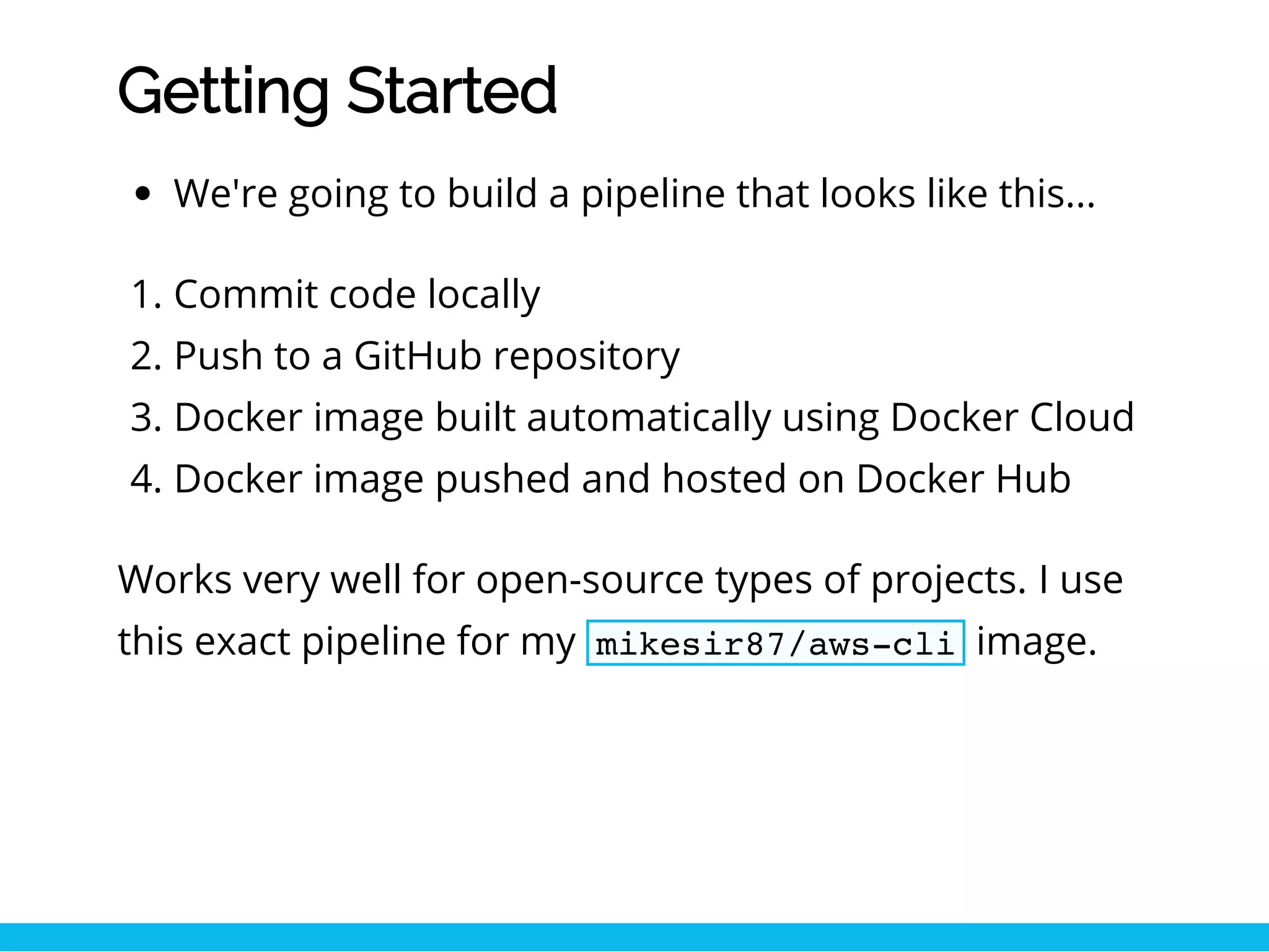
Getting Started We're going to build a pipeline that looks like this... 1. Commit code locally 2. Push to a GitHub repository 3. Docker image built automatically using Docker Cloud 4. Docker image pushed and hosted on Docker Hub Works very well for open-source types of projects. I use this exact pipeline for my mikesir87/aws-cli image.
Hands-on time https://github.com/mikesir87/ci-cd-intro-using-docker

Intro to CI/CD using Docker

  • 1.
    Intro to CI/CD MichaelIrwin - February 8, 2017
  • 2.
  • 3.
    The Pareto Principal(the 80/20 rule) 80% of bugs are found in 20% of code 90% of downtime comes from 10% of defects "80% of the errors and crashes in Windows and O ce were caused by 20% of the entire pool of bugs detected." --Microsoft's CEO, 2002 "Microsoft’s own research found that the average user of Word uses only 8% of the functionality." -- http://www.allaboutagile.com/agile-principle-8-enough-is-enough/
  • 4.
    How do wereduce waste?
  • 8.
    How would YOUde ne continuous integration?
  • 9.
    Continuous Integration isa software development practice where members of a team integrate their work frequently, usually each person integrates at least daily - leading to multiple integrations per day. Each integration is veri ed by an automated build (including test) to detect integration errors as quickly as possible.
  • 10.
    How would YOUde ne continuous delivery?
  • 11.
    Continuous Delivery isa software development discipline where you build software in such a way that the software can be released to production at any time. -- Martin Fowler
  • 12.
    Recap Continuous... Integration - runningautomated builds to test integration of application Delivery - discipline to be able to release to production at any time Deployment - every change goes through the pipeline and straight to production
  • 13.
    What's it looklike? It really depends on your organization! A fairly typical pipeline... Developer commits code locally Pushes code to shared repository Build server sees change (either via webhook or polling) Build server performs build and runs tests Artifact is created and published Artifact rolled out to various tiers
  • 14.
    What tools exist? Thisis obviously not an exhaustive collection...
  • 15.
    Why have apipeline? More reliable code Tests are run automatically Every stage is automated/scripted to reduce error More frequent merges reduce merge issues Get feedback quicker Did a build break? Are tests passing? Are we developing the right feature? Morale boost Engineers love seeing their work being used. Get it out faster!
  • 16.
    Getting Started We're goingto build a pipeline that looks like this... 1. Commit code locally 2. Push to a GitHub repository 3. Docker image built automatically using Docker Cloud 4. Docker image pushed and hosted on Docker Hub Works very well for open-source types of projects. I use this exact pipeline for my mikesir87/aws-cli image.
  • 17.