Java Full Stack Development Java is a versatile language that has been a cornerstone of full-stack web development for decades. From building robust server-side applications to crafting dynamic user interfaces, Java's strengths in object-orientation, scalability, and cross-platform compatibility make it an ideal choice for comprehensive full-stack solutions. by harshitha
Introduction to Java 1 Powerful Syntax Java's syntax is designed for readability and maintainability, making it an accessible language for beginners and experienced developers alike. 2 Platform Independence Java's "write once, run anywhere" philosophy allows developers to create applications that can run on various operating systems without modification. 3 Rich Ecosystem Java boasts an extensive collection of libraries, frameworks, and tools that simplify development and enhance productivity.
Java Runtime Environment (JRE) and Java Development Kit (JDK) JRE The Java Runtime Environment (JRE) is the software package that provides the necessary components to run Java applications on a computer. JDK The Java Development Kit (JDK) includes the JRE, as well as development tools such as the Java compiler, debugger, and other utilities required for building Java applications. Differences The JRE is for running Java programs, while the JDK is for developing and compiling Java applications.
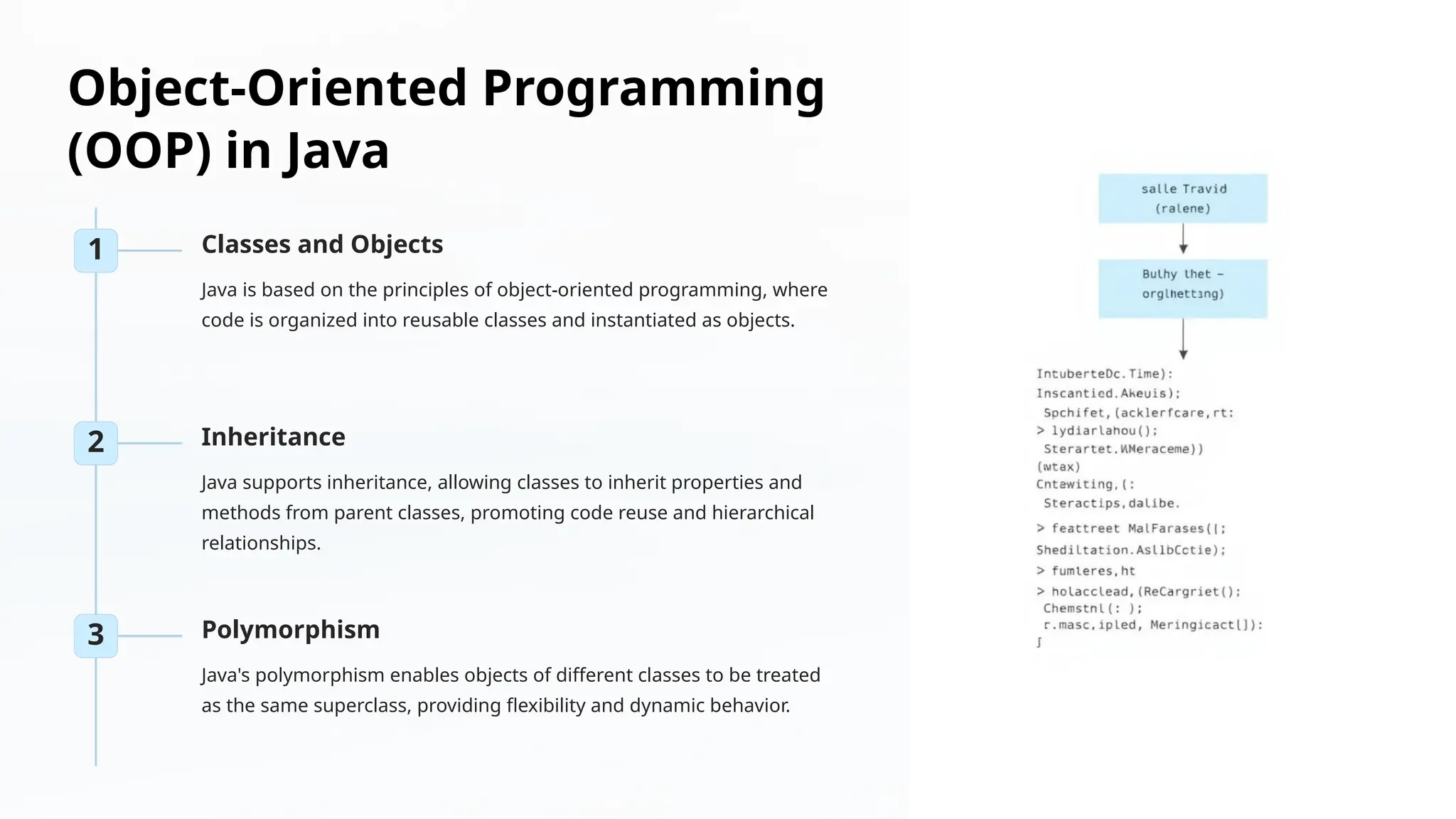
Object-Oriented Programming (OOP) in Java 1 Classes and Objects Java is based on the principles of object-oriented programming, where code is organized into reusable classes and instantiated as objects. 2 Inheritance Java supports inheritance, allowing classes to inherit properties and methods from parent classes, promoting code reuse and hierarchical relationships. 3 Polymorphism Java's polymorphism enables objects of different classes to be treated as the same superclass, providing flexibility and dynamic behavior.
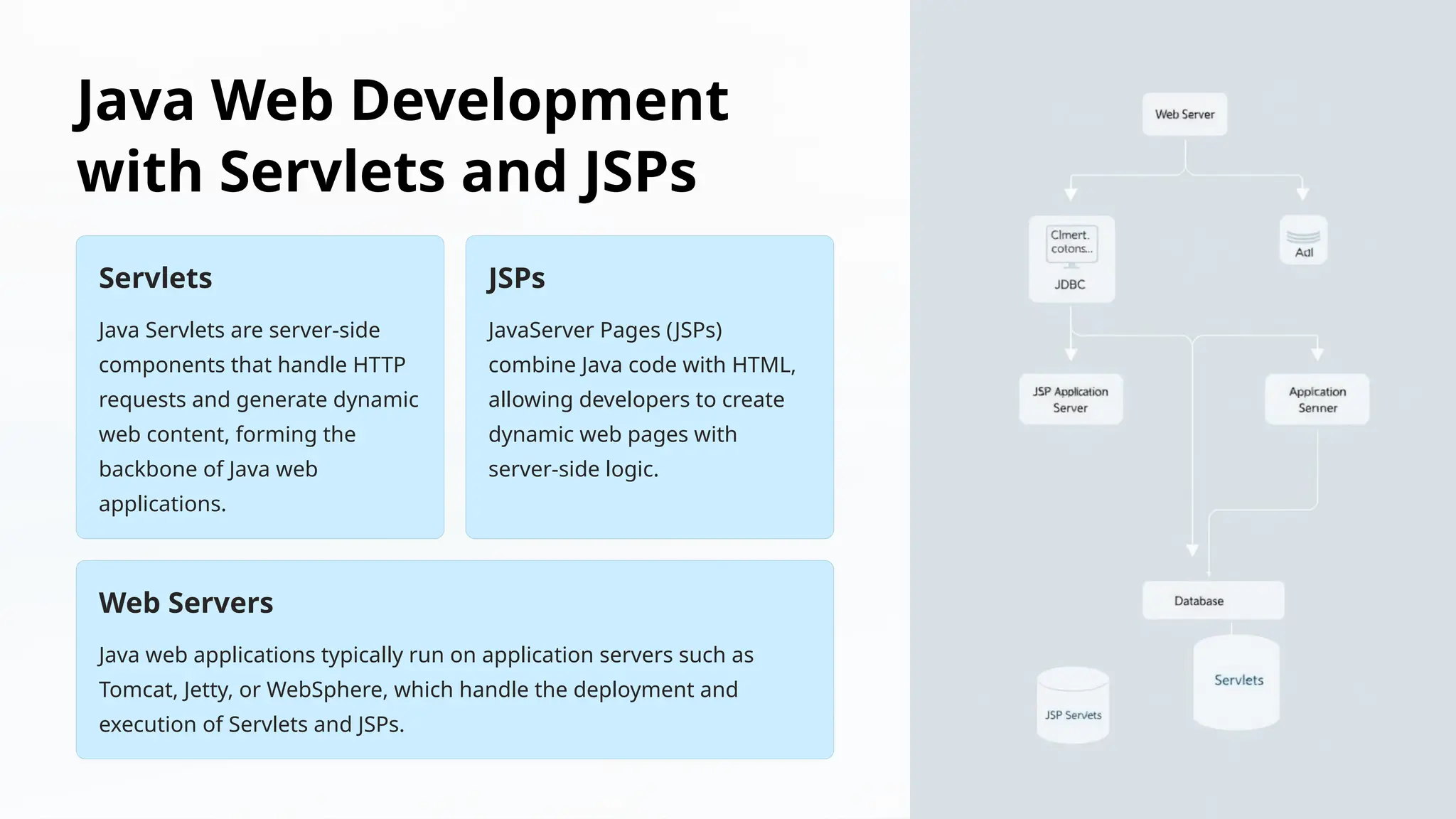
Java Web Development with Servlets and JSPs Servlets Java Servlets are server-side components that handle HTTP requests and generate dynamic web content, forming the backbone of Java web applications. JSPs JavaServer Pages (JSPs) combine Java code with HTML, allowing developers to create dynamic web pages with server-side logic. Web Servers Java web applications typically run on application servers such as Tomcat, Jetty, or WebSphere, which handle the deployment and execution of Servlets and JSPs.
Spring Framework for Java Web Applications Dependency Injection Spring's Inversion of Control (IoC) and Dependency Injection (DI) simplify application architecture and promote loose coupling. Data Access Spring provides comprehensive support for data access, including integration with popular databases and ORMs like Hibernate. Web MVC The Spring MVC framework enables developers to build robust, scalable, and flexible web applications with Java. Security Spring Security simplifies the implementation of authentication, authorization, and other security concerns in Java web apps.
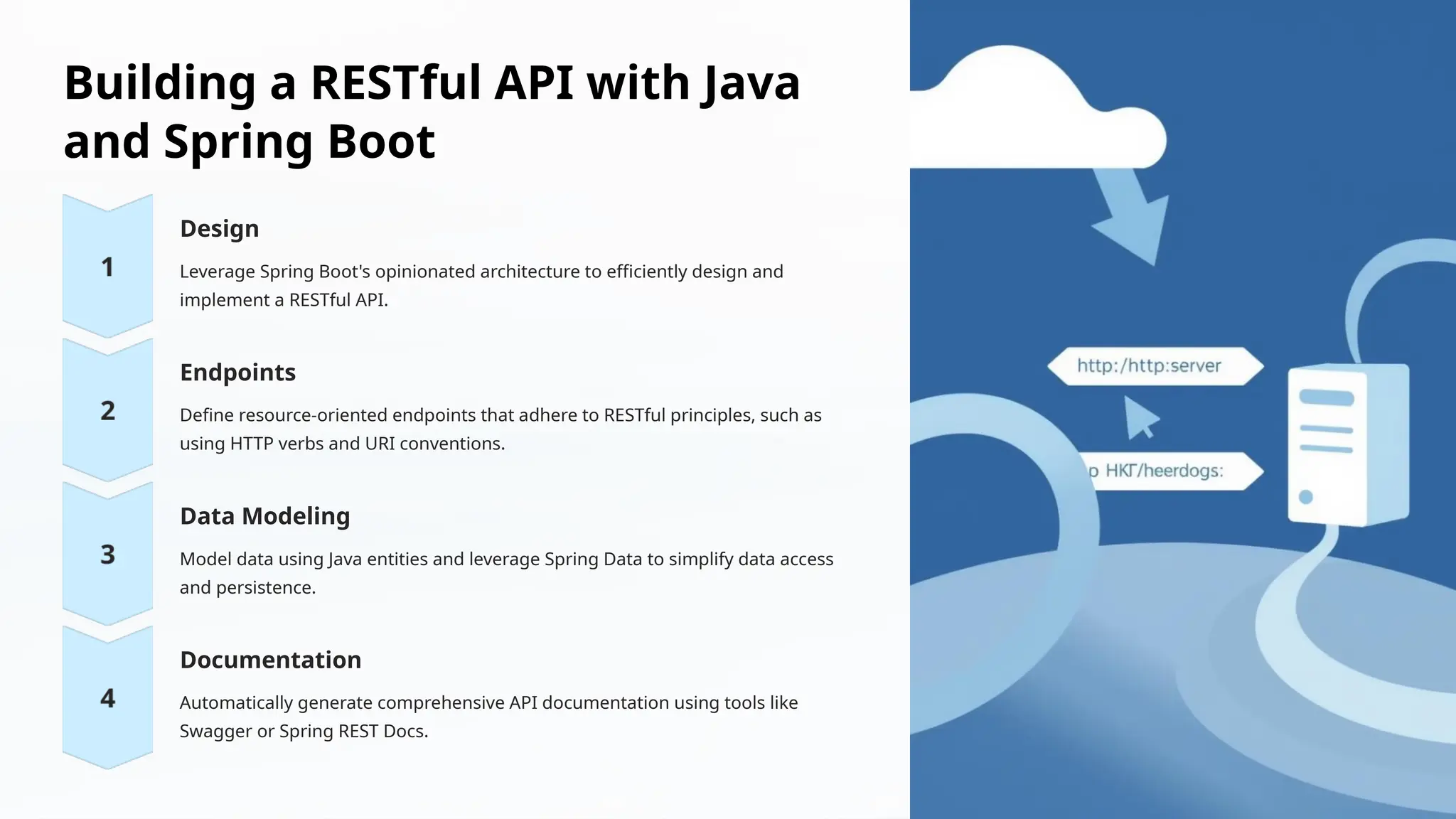
Building a RESTful API with Java and Spring Boot Design Leverage Spring Boot's opinionated architecture to efficiently design and implement a RESTful API. Endpoints Define resource-oriented endpoints that adhere to RESTful principles, such as using HTTP verbs and URI conventions. Data Modeling Model data using Java entities and leverage Spring Data to simplify data access and persistence. Documentation Automatically generate comprehensive API documentation using tools like Swagger or Spring REST Docs.
Deployment and Hosting of Java Web Applications Cloud Platforms Java applications can be deployed on cloud platforms like AWS, Azure, or Google Cloud, leveraging their scalability and management features. Application Servers Traditional Java web applications can be hosted on application servers like Apache Tomcat, JBoss, or WebSphere. Containerization Java applications can be packaged into Docker containers for consistent, portable, and scalable deployment across environments.
Future of Java in Full Stack Development 1 Microservices and Cloud Native Java's support for microservices architecture and cloud-native development will continue to drive its adoption in modern full-stack solutions. 2 Emerging Technologies Java's versatility allows it to integrate with cutting-edge technologies like big data, machine learning, and the Internet of Things. 3 Continued Innovation Java's active development community and new language features, such as Project Loom and Project Valhalla, will ensure its longevity in the full-stack landscape.

java full stack develpment course in banglore

  • 1.
    Java Full Stack Development Javais a versatile language that has been a cornerstone of full-stack web development for decades. From building robust server-side applications to crafting dynamic user interfaces, Java's strengths in object-orientation, scalability, and cross-platform compatibility make it an ideal choice for comprehensive full-stack solutions. by harshitha
  • 2.
    Introduction to Java 1Powerful Syntax Java's syntax is designed for readability and maintainability, making it an accessible language for beginners and experienced developers alike. 2 Platform Independence Java's "write once, run anywhere" philosophy allows developers to create applications that can run on various operating systems without modification. 3 Rich Ecosystem Java boasts an extensive collection of libraries, frameworks, and tools that simplify development and enhance productivity.
  • 3.
    Java Runtime Environment(JRE) and Java Development Kit (JDK) JRE The Java Runtime Environment (JRE) is the software package that provides the necessary components to run Java applications on a computer. JDK The Java Development Kit (JDK) includes the JRE, as well as development tools such as the Java compiler, debugger, and other utilities required for building Java applications. Differences The JRE is for running Java programs, while the JDK is for developing and compiling Java applications.
  • 4.
    Object-Oriented Programming (OOP) inJava 1 Classes and Objects Java is based on the principles of object-oriented programming, where code is organized into reusable classes and instantiated as objects. 2 Inheritance Java supports inheritance, allowing classes to inherit properties and methods from parent classes, promoting code reuse and hierarchical relationships. 3 Polymorphism Java's polymorphism enables objects of different classes to be treated as the same superclass, providing flexibility and dynamic behavior.
  • 5.
    Java Web Development withServlets and JSPs Servlets Java Servlets are server-side components that handle HTTP requests and generate dynamic web content, forming the backbone of Java web applications. JSPs JavaServer Pages (JSPs) combine Java code with HTML, allowing developers to create dynamic web pages with server-side logic. Web Servers Java web applications typically run on application servers such as Tomcat, Jetty, or WebSphere, which handle the deployment and execution of Servlets and JSPs.
  • 6.
    Spring Framework forJava Web Applications Dependency Injection Spring's Inversion of Control (IoC) and Dependency Injection (DI) simplify application architecture and promote loose coupling. Data Access Spring provides comprehensive support for data access, including integration with popular databases and ORMs like Hibernate. Web MVC The Spring MVC framework enables developers to build robust, scalable, and flexible web applications with Java. Security Spring Security simplifies the implementation of authentication, authorization, and other security concerns in Java web apps.
  • 7.
    Building a RESTfulAPI with Java and Spring Boot Design Leverage Spring Boot's opinionated architecture to efficiently design and implement a RESTful API. Endpoints Define resource-oriented endpoints that adhere to RESTful principles, such as using HTTP verbs and URI conventions. Data Modeling Model data using Java entities and leverage Spring Data to simplify data access and persistence. Documentation Automatically generate comprehensive API documentation using tools like Swagger or Spring REST Docs.
  • 8.
    Deployment and Hostingof Java Web Applications Cloud Platforms Java applications can be deployed on cloud platforms like AWS, Azure, or Google Cloud, leveraging their scalability and management features. Application Servers Traditional Java web applications can be hosted on application servers like Apache Tomcat, JBoss, or WebSphere. Containerization Java applications can be packaged into Docker containers for consistent, portable, and scalable deployment across environments.
  • 9.
    Future of Javain Full Stack Development 1 Microservices and Cloud Native Java's support for microservices architecture and cloud-native development will continue to drive its adoption in modern full-stack solutions. 2 Emerging Technologies Java's versatility allows it to integrate with cutting-edge technologies like big data, machine learning, and the Internet of Things. 3 Continued Innovation Java's active development community and new language features, such as Project Loom and Project Valhalla, will ensure its longevity in the full-stack landscape.