(Original PDF) C++ Programming From Problem Analysis to Program Design 8th
(Original PDF) C++ Programming From Problem Analysis to Program Design 8th (Original PDF) C++ Programming From Problem Analysis to Program Design 8th (Original PDF) C++ Programming From Problem Analysis to Program Design 8th
(Original PDF) C++ Programming From Problem Analysis to Program Design 8th
1.
(Original PDF) C++Programming From Problem Analysis to Program Design 8th pdf download https://ebooksecure.com/product/original-pdf-c-programming-from- problem-analysis-to-program-design-8th/ Download more ebook from https://ebooksecure.com
2.
We believe theseproducts will be a great fit for you. Click the link to download now, or visit ebooksecure.com to discover even more! (eBook PDF) C++ Programming: From Problem Analysis to Program Design 7th http://ebooksecure.com/product/ebook-pdf-c-programming-from- problem-analysis-to-program-design-7th/ C++ Programming: From Problem Analysis to Program Design 8th Edition Edition D.S. Malik - eBook PDF https://ebooksecure.com/download/c-programming-from-problem- analysis-to-program-design-ebook-pdf/ C++ Programming. Program Design including Data Structures 8th Edition D.S. Malik - eBook PDF https://ebooksecure.com/download/c-programming-program-design- including-data-structures-ebook-pdf/ (eBook PDF) Programming, Problem Solving and Abstraction with C http://ebooksecure.com/product/ebook-pdf-programming-problem- solving-and-abstraction-with-c/
3.
(eBook PDF) Java:An Introduction to Problem Solving and Programming 8th Edition http://ebooksecure.com/product/ebook-pdf-java-an-introduction-to- problem-solving-and-programming-8th-edition/ (eBook PDF) C How to Program, Global Edition 8th by Paul Deitel http://ebooksecure.com/product/ebook-pdf-c-how-to-program-global- edition-8th-by-paul-deitel/ C How to Program: With Case Studies in Applications and Systems Programming, Global Edition Paul Deitel - eBook PDF https://ebooksecure.com/download/c-how-to-program-with-case- studies-in-applications-and-systems-programming-global-edition- ebook-pdf/ Readings from Programming with C++ 1st Edition Kyla Mcmullen - eBook PDF https://ebooksecure.com/download/readings-from-programming-with- c-ebook-pdf-2/ Readings from Programming with C++ 1st Edition Kyla Mcmullen - eBook PDF https://ebooksecure.com/download/readings-from-programming-with- c-ebook-pdf/
4.
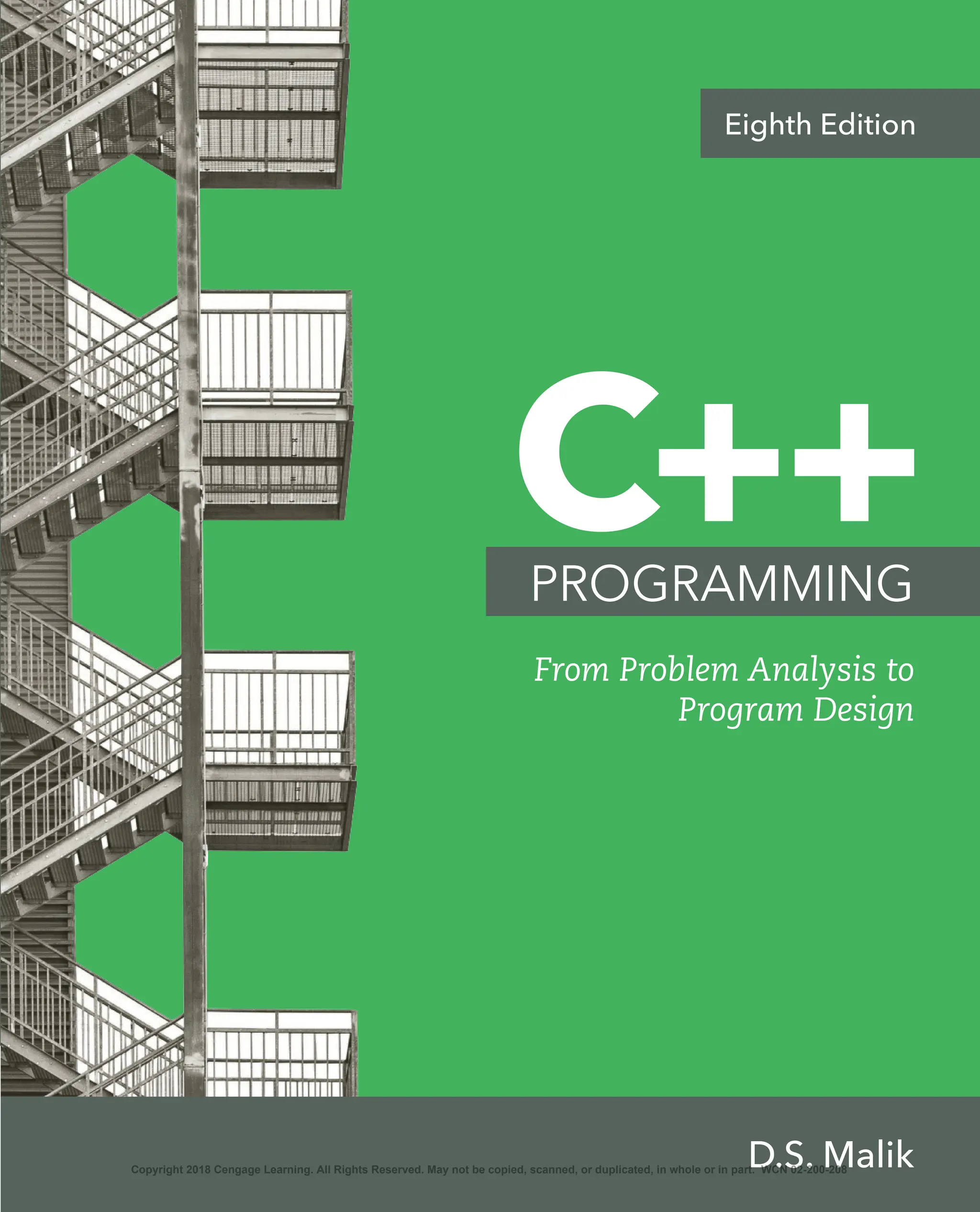
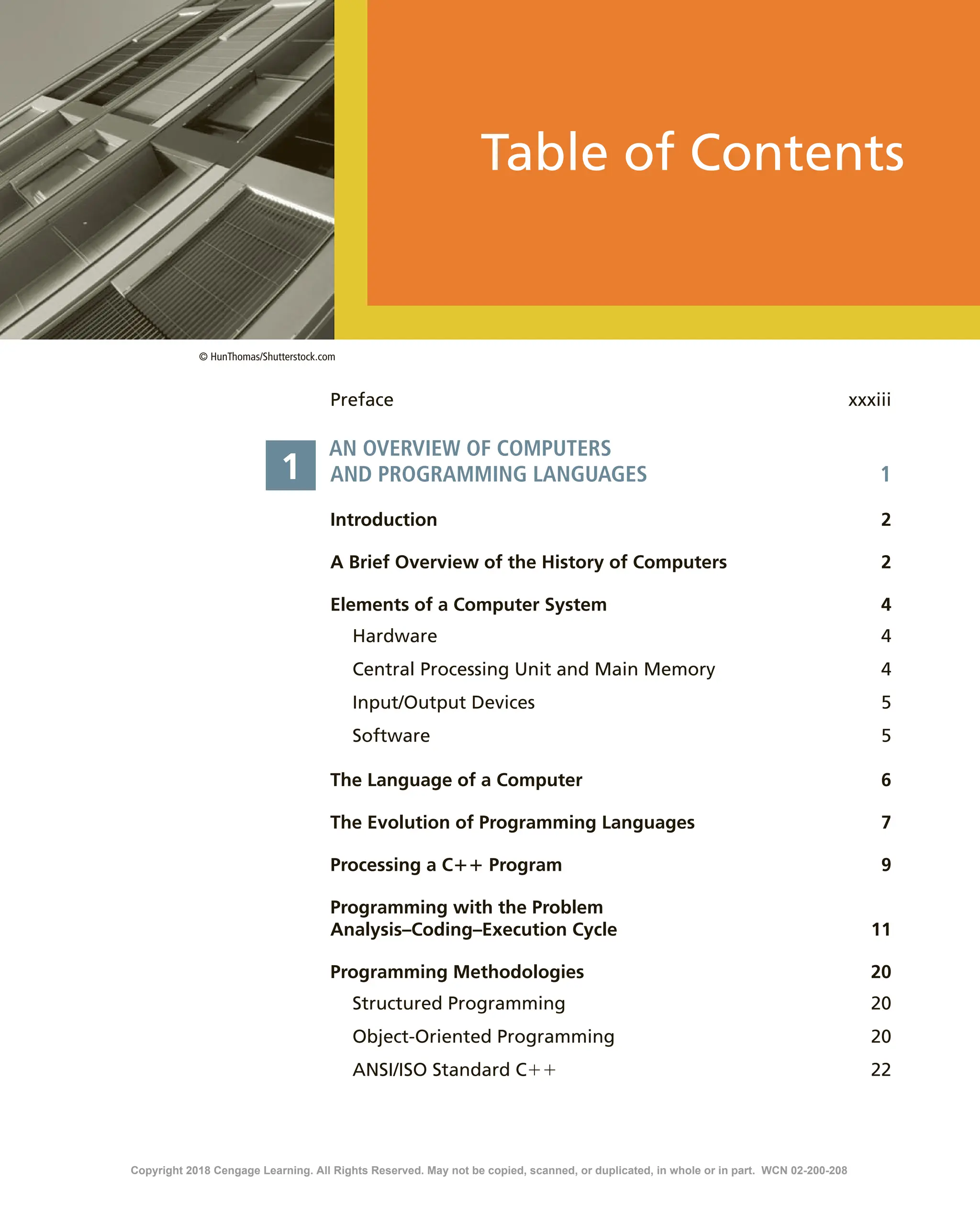
C++ From Problem Analysisto Program Design D.S. Malik PROGRAMMING Eighth Edition Eighth Edition D.S. Malik C++ PROGRAMMING From Problem Analysis to Program Design To register or access your online learning solution or purchase materials for your course, visit www.cengagebrain.com. Copyright 2018 Cengage Learning. All Rights Reserved. May not be copied, scanned, or duplicated, in whole or in part. WCN 02-200-208
5.
Copyright 2018 CengageLearning. All Rights Reserved. May not be copied, scanned, or duplicated, in whole or in part. WCN 02-200-208
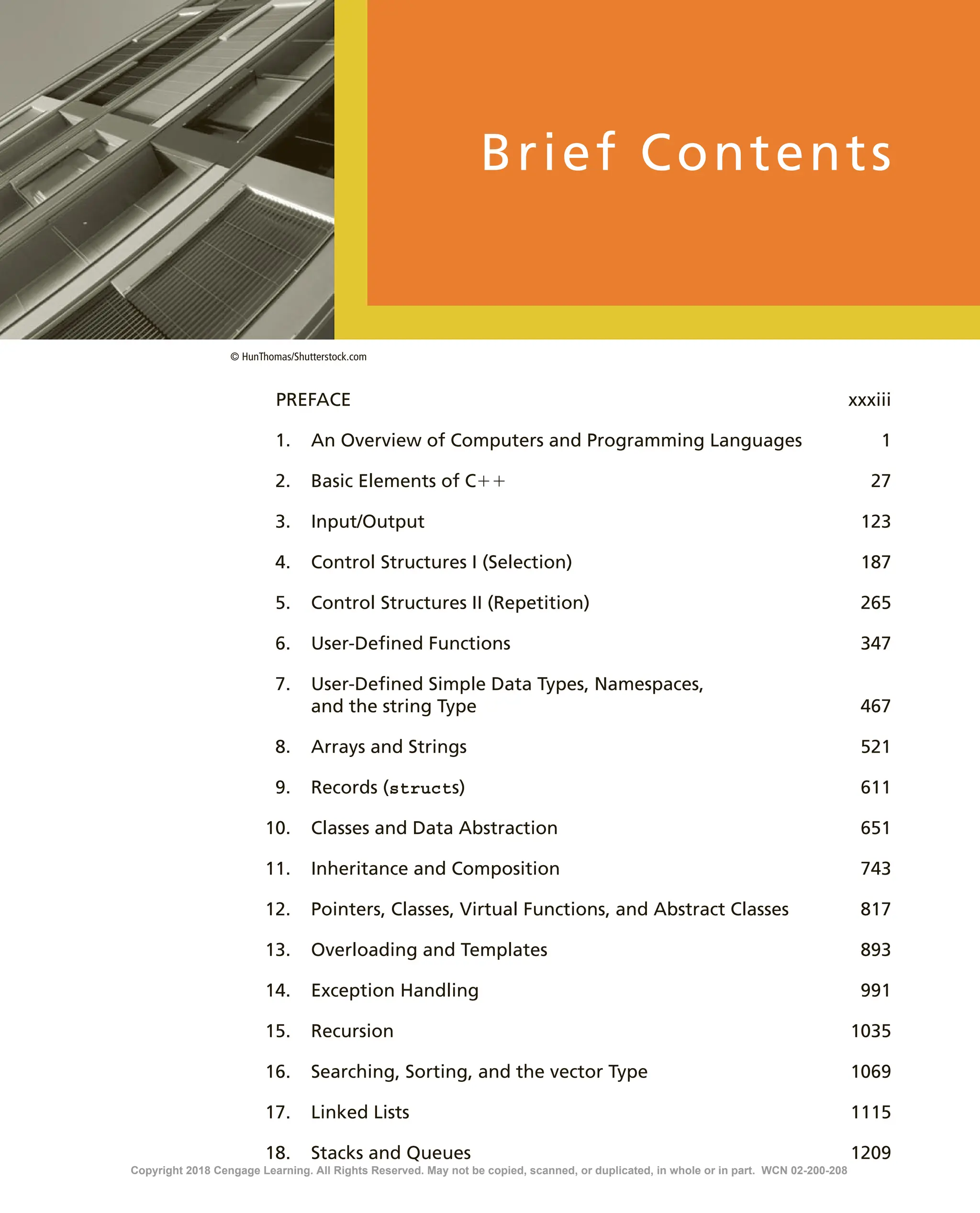
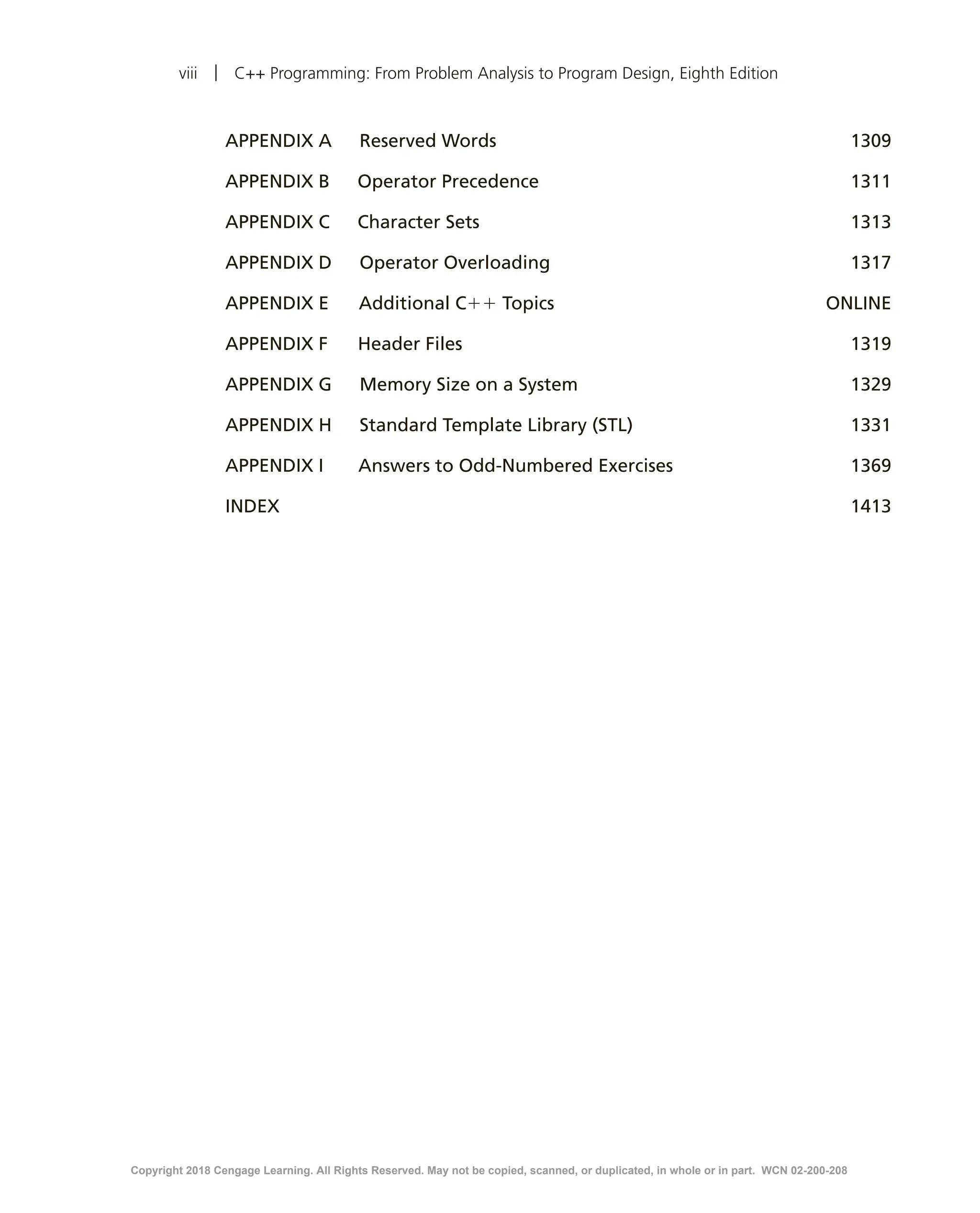
viii | C++Programming: From Problem Analysis to Program Design, Eighth Edition APPENDIX A Reserved Words 1309 APPENDIX B Operator Precedence 1311 APPENDIX C Character Sets 1313 APPENDIX D Operator Overloading 1317 APPENDIX E Additional C11 Topics ONLINE APPENDIX F Header Files 1319 APPENDIX G Memory Size on a System 1329 APPENDIX H Standard Template Library (STL) 1331 APPENDIX I Answers to Odd-Numbered Exercises 1369 INDEX 1413 Copyright 2018 Cengage Learning. All Rights Reserved. May not be copied, scanned, or duplicated, in whole or in part. WCN 02-200-208
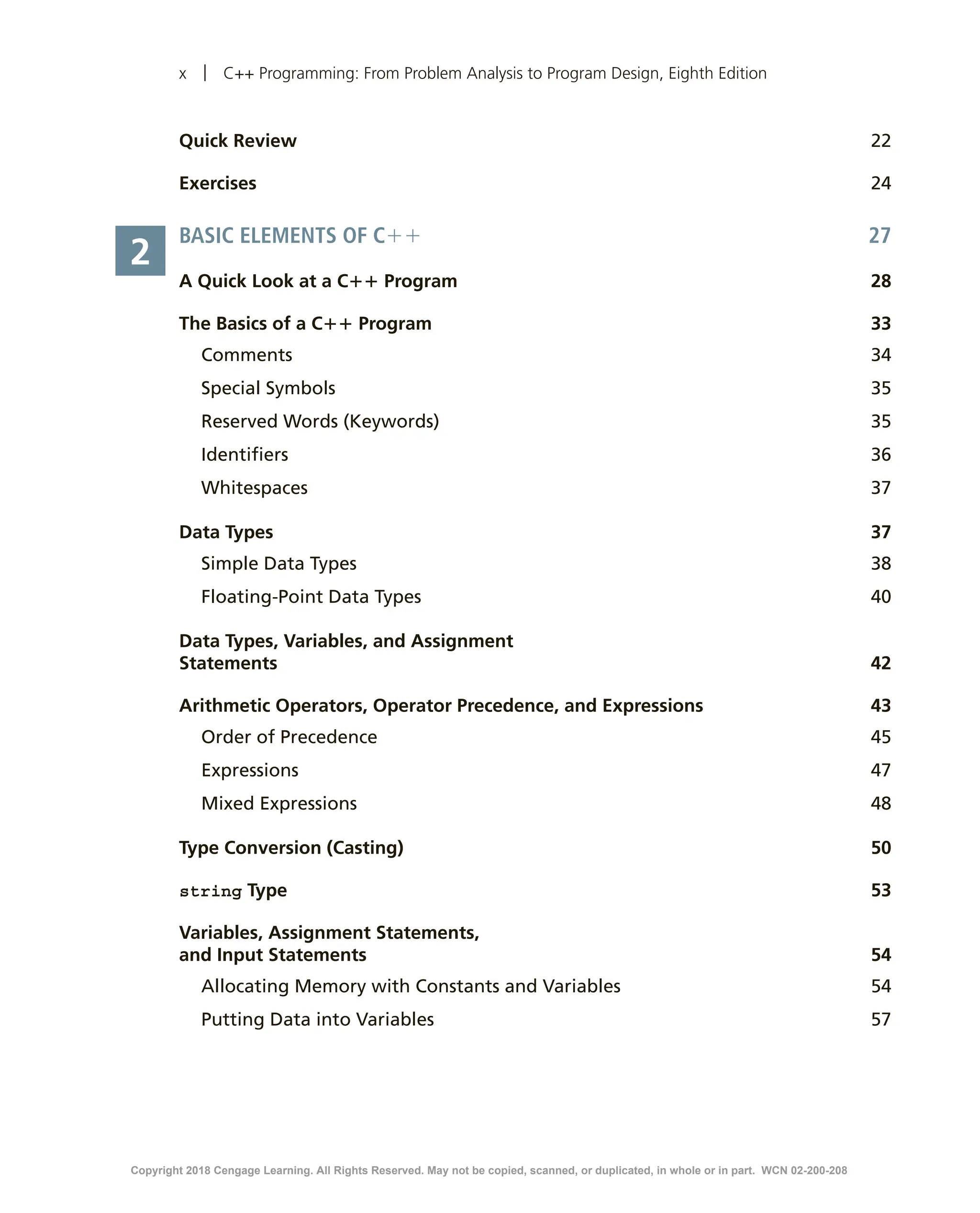
x | C++Programming: From Problem Analysis to Program Design, Eighth Edition Quick Review 22 Exercises 24 BASIC ELEMENTS OF C11 27 A Quick Look at a C11 Program 28 The Basics of a C11 Program 33 Comments34 Special Symbols 35 Reserved Words (Keywords) 35 Identifiers36 Whitespaces37 Data Types 37 Simple Data Types 38 Floating-Point Data Types 40 Data Types, Variables, and Assignment Statements42 Arithmetic Operators, Operator Precedence, and Expressions 43 Order of Precedence 45 Expressions47 Mixed Expressions 48 Type Conversion (Casting) 50 string Type 53 Variables, Assignment Statements, and Input Statements 54 Allocating Memory with Constants and Variables 54 Putting Data into Variables 57 2 Copyright 2018 Cengage Learning. All Rights Reserved. May not be copied, scanned, or duplicated, in whole or in part. WCN 02-200-208
10.
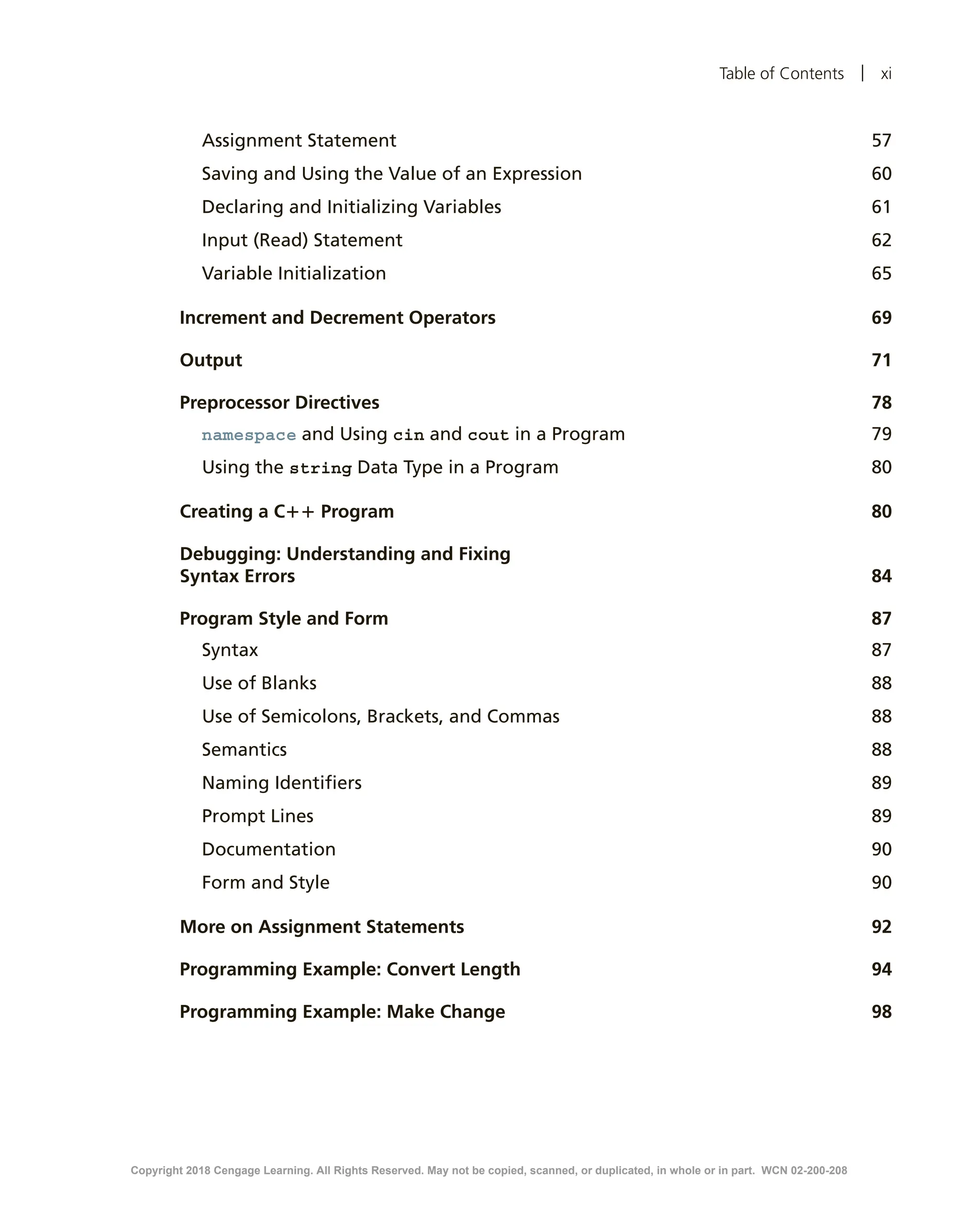
Table of Contents| xi Assignment Statement 57 Saving and Using the Value of an Expression 60 Declaring and Initializing Variables 61 Input (Read) Statement 62 Variable Initialization 65 Increment and Decrement Operators 69 Output71 Preprocessor Directives 78 namespace and Using cin and cout in a Program 79 Using the string Data Type in a Program 80 Creating a C11 Program 80 Debugging: Understanding and Fixing Syntax Errors 84 Program Style and Form 87 Syntax87 Use of Blanks 88 Use of Semicolons, Brackets, and Commas 88 Semantics88 Naming Identifiers 89 Prompt Lines 89 Documentation90 Form and Style 90 More on Assignment Statements 92 Programming Example: Convert Length 94 Programming Example: Make Change 98 Copyright 2018 Cengage Learning. All Rights Reserved. May not be copied, scanned, or duplicated, in whole or in part. WCN 02-200-208
11.
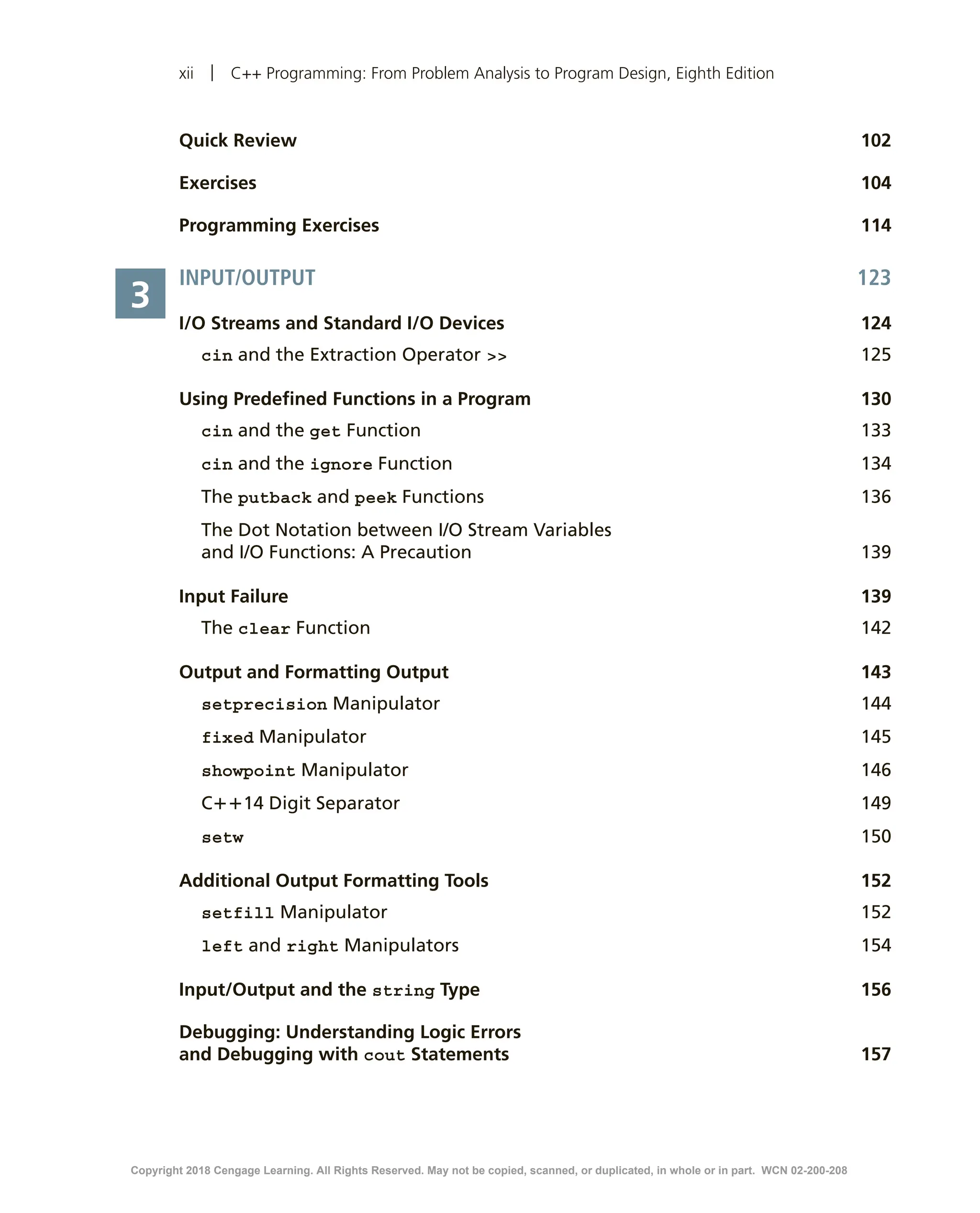
xii | C++Programming: From Problem Analysis to Program Design, Eighth Edition Quick Review 102 Exercises104 Programming Exercises 114 INPUT/OUTPUT123 I/O Streams and Standard I/O Devices 124 cin and the Extraction Operator 125 Using Predefined Functions in a Program 130 cin and the get Function 133 cin and the ignore Function 134 The putback and peek Functions 136 The Dot Notation between I/O Stream Variables and I/O Functions: A Precaution 139 Input Failure 139 The clear Function 142 Output and Formatting Output 143 setprecision Manipulator 144 fixed Manipulator 145 showpoint Manipulator 146 C1114 Digit Separator 149 setw 150 Additional Output Formatting Tools 152 setfill Manipulator 152 left and right Manipulators 154 Input/Output and the string Type 156 Debugging: Understanding Logic Errors and Debugging with cout Statements 157 3 Copyright 2018 Cengage Learning. All Rights Reserved. May not be copied, scanned, or duplicated, in whole or in part. WCN 02-200-208
12.
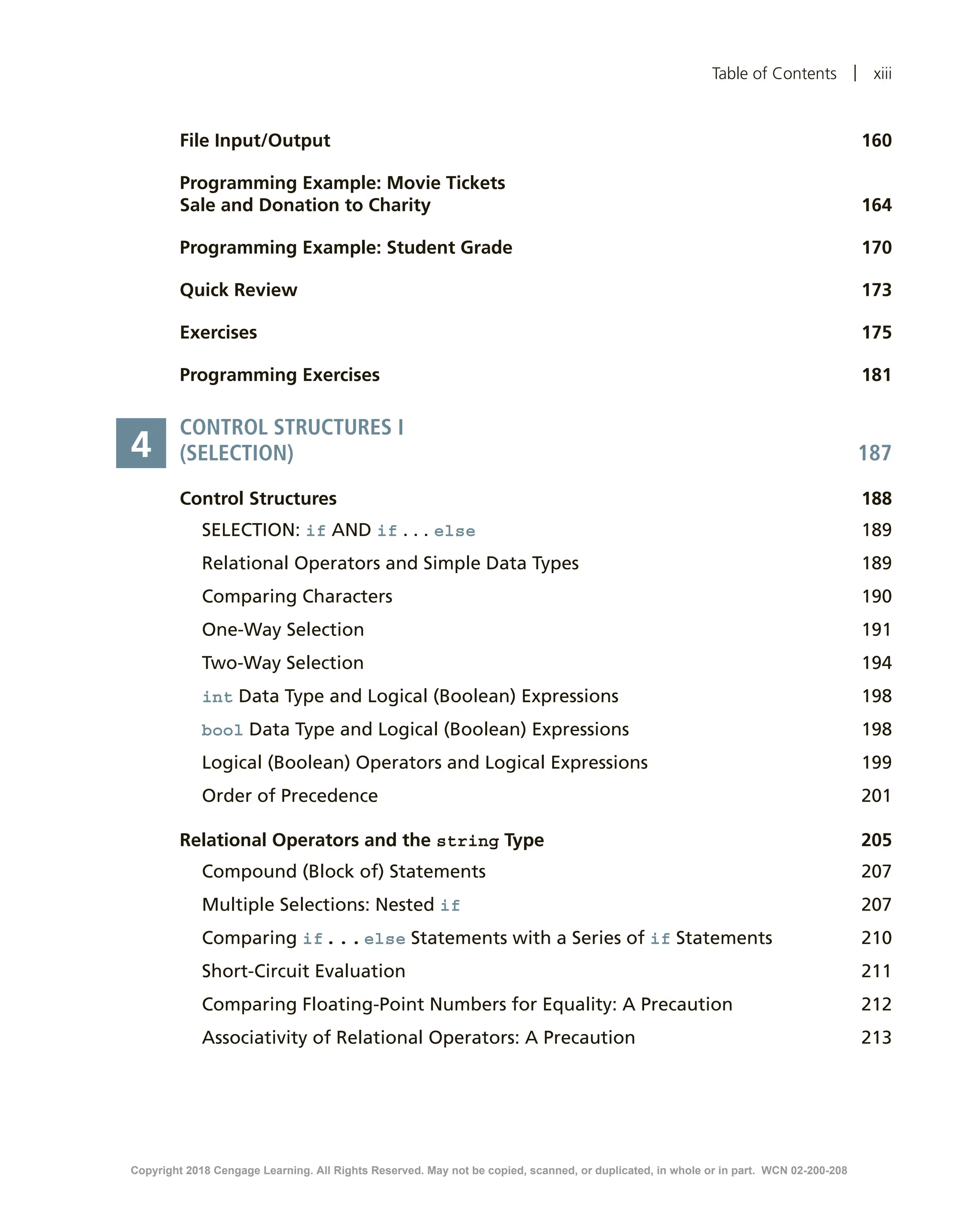
Table of Contents| xiii File Input/Output 160 Programming Example: Movie Tickets Sale and Donation to Charity 164 Programming Example: Student Grade 170 Quick Review 173 Exercises175 Programming Exercises 181 CONTROL STRUCTURES I (SELECTION)187 Control Structures 188 SELECTION: if AND if . . . else 189 Relational Operators and Simple Data Types 189 Comparing Characters 190 One-Way Selection 191 Two-Way Selection 194 int Data Type and Logical (Boolean) Expressions 198 bool Data Type and Logical (Boolean) Expressions 198 Logical (Boolean) Operators and Logical Expressions 199 Order of Precedence 201 Relational Operators and the string Type 205 Compound (Block of) Statements 207 Multiple Selections: Nested if 207 Comparing if...else Statements with a Series of if Statements 210 Short-Circuit Evaluation 211 Comparing Floating-Point Numbers for Equality: A Precaution 212 Associativity of Relational Operators: A Precaution 213 4 Copyright 2018 Cengage Learning. All Rights Reserved. May not be copied, scanned, or duplicated, in whole or in part. WCN 02-200-208
13.
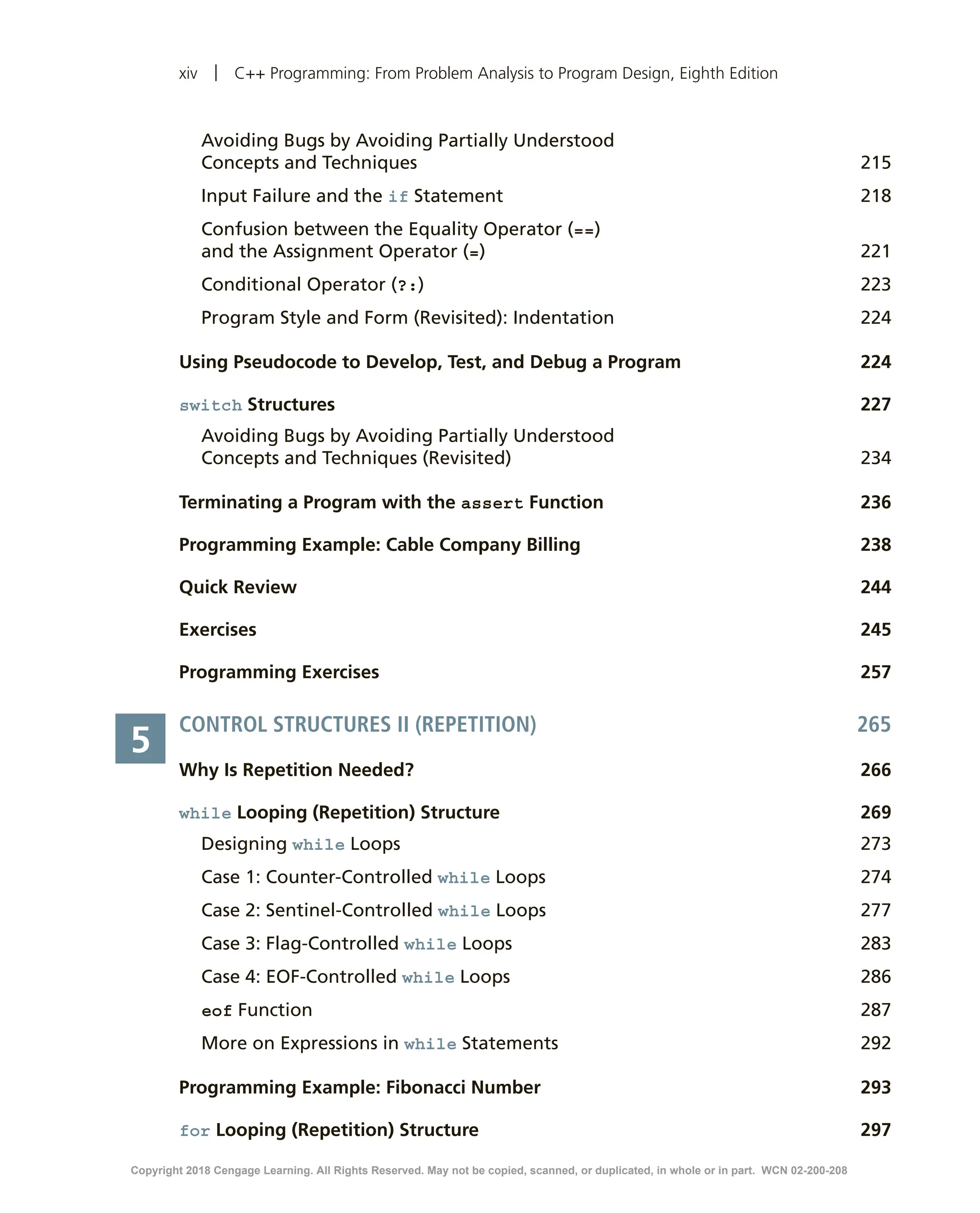
xiv | C++Programming: From Problem Analysis to Program Design, Eighth Edition Avoiding Bugs by Avoiding Partially Understood Concepts and Techniques 215 Input Failure and the if Statement 218 Confusion between the Equality Operator (==) and the Assignment Operator (=)221 Conditional Operator (?:)223 Program Style and Form (Revisited): Indentation 224 Using Pseudocode to Develop, Test, and Debug a Program 224 switch Structures 227 Avoiding Bugs by Avoiding Partially Understood Concepts and Techniques (Revisited) 234 Terminating a Program with the assert Function 236 Programming Example: Cable Company Billing 238 Quick Review 244 Exercises245 Programming Exercises 257 CONTROL STRUCTURES II (REPETITION) 265 Why Is Repetition Needed? 266 while Looping (Repetition) Structure 269 Designing while Loops 273 Case 1: Counter-Controlled while Loops 274 Case 2: Sentinel-Controlled while Loops 277 Case 3: Flag-Controlled while Loops 283 Case 4: EOF-Controlled while Loops 286 eof Function 287 More on Expressions in while Statements 292 Programming Example: Fibonacci Number 293 for Looping (Repetition) Structure 297 5 Copyright 2018 Cengage Learning. All Rights Reserved. May not be copied, scanned, or duplicated, in whole or in part. WCN 02-200-208
14.
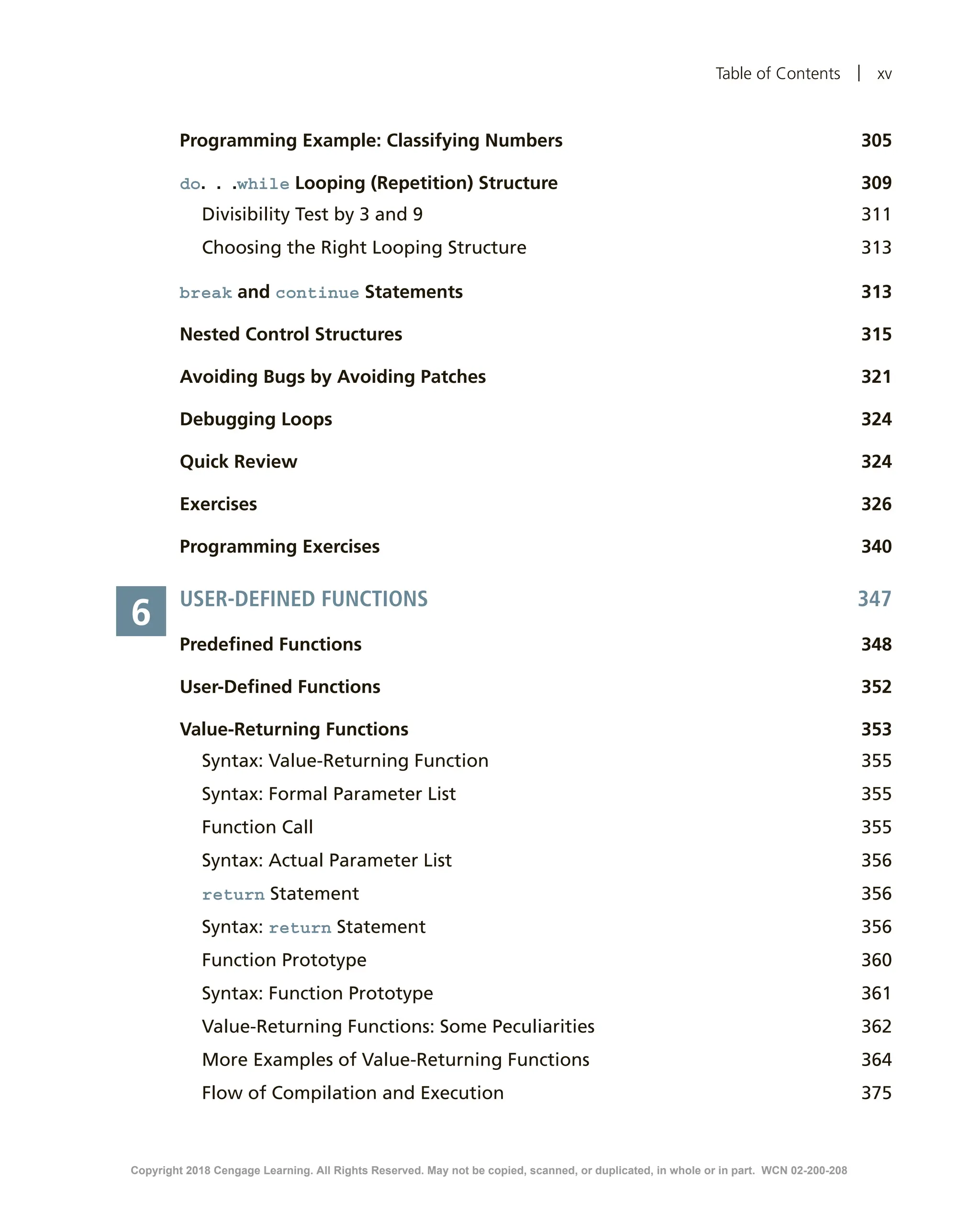
Table of Contents| xv Programming Example: Classifying Numbers 305 do. . .while Looping (Repetition) Structure 309 Divisibility Test by 3 and 9 311 Choosing the Right Looping Structure 313 break and continue Statements 313 Nested Control Structures 315 Avoiding Bugs by Avoiding Patches 321 Debugging Loops 324 Quick Review 324 Exercises326 Programming Exercises 340 USER-DEFINED FUNCTIONS 347 Predefined Functions 348 User-Defined Functions 352 Value-Returning Functions 353 Syntax: Value-Returning Function 355 Syntax: Formal Parameter List 355 Function Call 355 Syntax: Actual Parameter List 356 return Statement 356 Syntax: return Statement 356 Function Prototype 360 Syntax: Function Prototype 361 Value-Returning Functions: Some Peculiarities 362 More Examples of Value-Returning Functions 364 Flow of Compilation and Execution 375 6 Copyright 2018 Cengage Learning. All Rights Reserved. May not be copied, scanned, or duplicated, in whole or in part. WCN 02-200-208
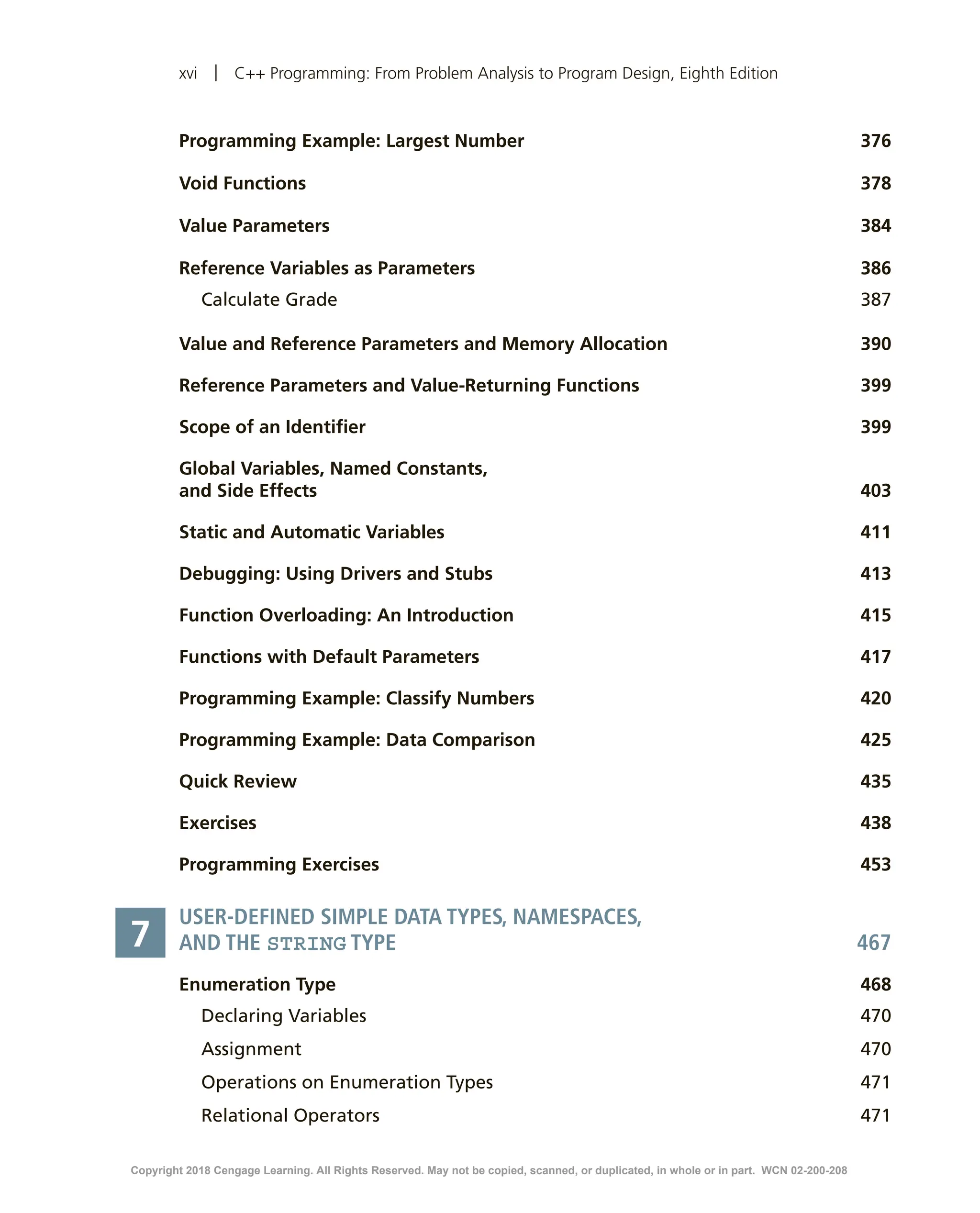
15.
xvi | C++Programming: From Problem Analysis to Program Design, Eighth Edition Programming Example: Largest Number 376 Void Functions 378 Value Parameters 384 Reference Variables as Parameters 386 Calculate Grade 387 Value and Reference Parameters and Memory Allocation 390 Reference Parameters and Value-Returning Functions 399 Scope of an Identifier 399 Global Variables, Named Constants, and Side Effects 403 Static and Automatic Variables 411 Debugging: Using Drivers and Stubs 413 Function Overloading: An Introduction 415 Functions with Default Parameters 417 Programming Example: Classify Numbers 420 Programming Example: Data Comparison 425 Quick Review 435 Exercises438 Programming Exercises 453 USER-DEFINED SIMPLE DATA TYPES, NAMESPACES, AND THE STRING TYPE 467 Enumeration Type 468 Declaring Variables 470 Assignment470 Operations on Enumeration Types 471 Relational Operators 471 7 Copyright 2018 Cengage Learning. All Rights Reserved. May not be copied, scanned, or duplicated, in whole or in part. WCN 02-200-208
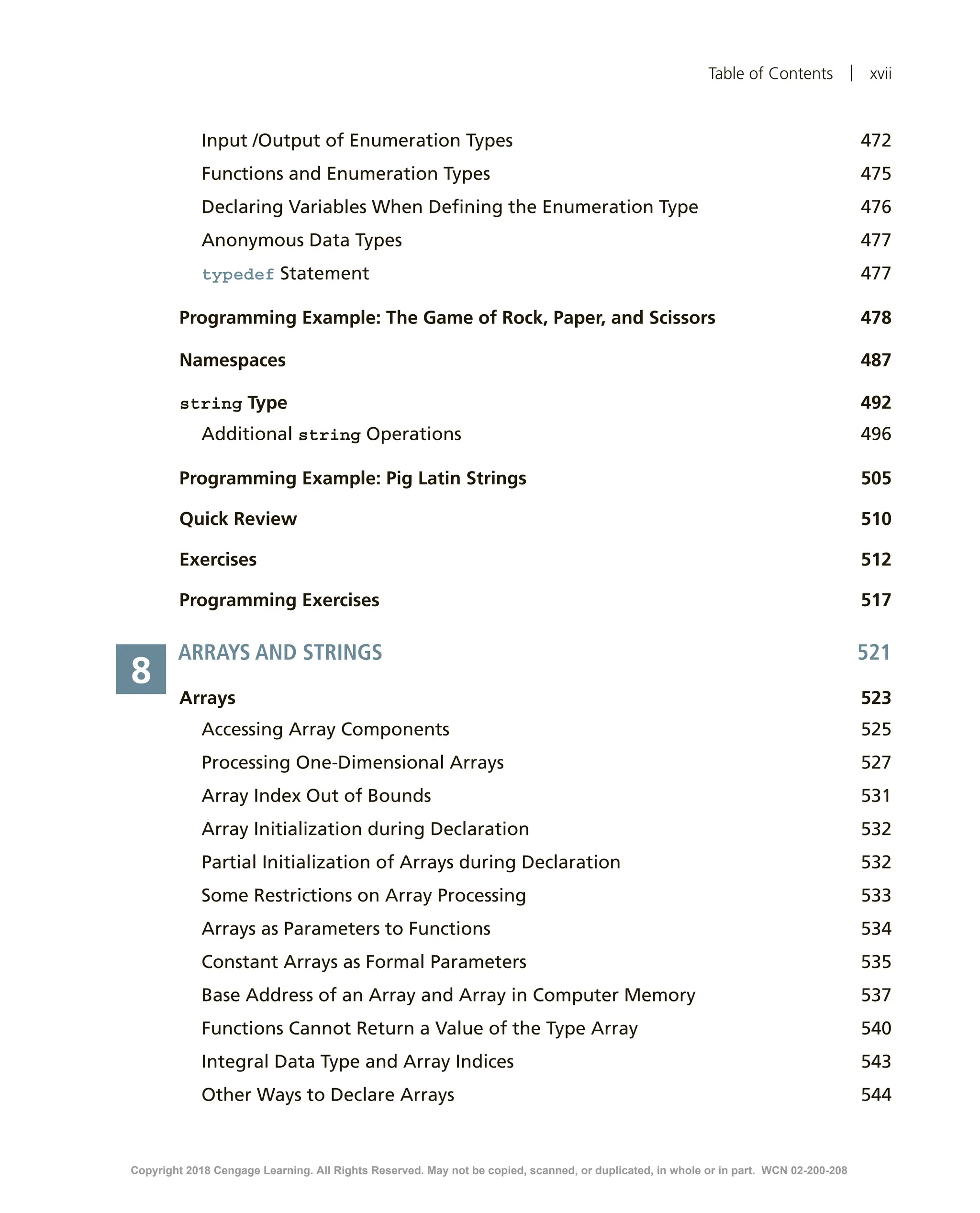
16.
Table of Contents| xvii Input /Output of Enumeration Types 472 Functions and Enumeration Types 475 Declaring Variables When Defining the Enumeration Type 476 Anonymous Data Types 477 typedef Statement 477 Programming Example: The Game of Rock, Paper, and Scissors 478 Namespaces487 string Type 492 Additional string Operations 496 Programming Example: Pig Latin Strings 505 Quick Review 510 Exercises512 Programming Exercises 517 ARRAYS AND STRINGS 521 Arrays523 Accessing Array Components 525 Processing One-Dimensional Arrays 527 Array Index Out of Bounds 531 Array Initialization during Declaration 532 Partial Initialization of Arrays during Declaration 532 Some Restrictions on Array Processing 533 Arrays as Parameters to Functions 534 Constant Arrays as Formal Parameters 535 Base Address of an Array and Array in Computer Memory 537 Functions Cannot Return a Value of the Type Array 540 Integral Data Type and Array Indices 543 Other Ways to Declare Arrays 544 8 Copyright 2018 Cengage Learning. All Rights Reserved. May not be copied, scanned, or duplicated, in whole or in part. WCN 02-200-208
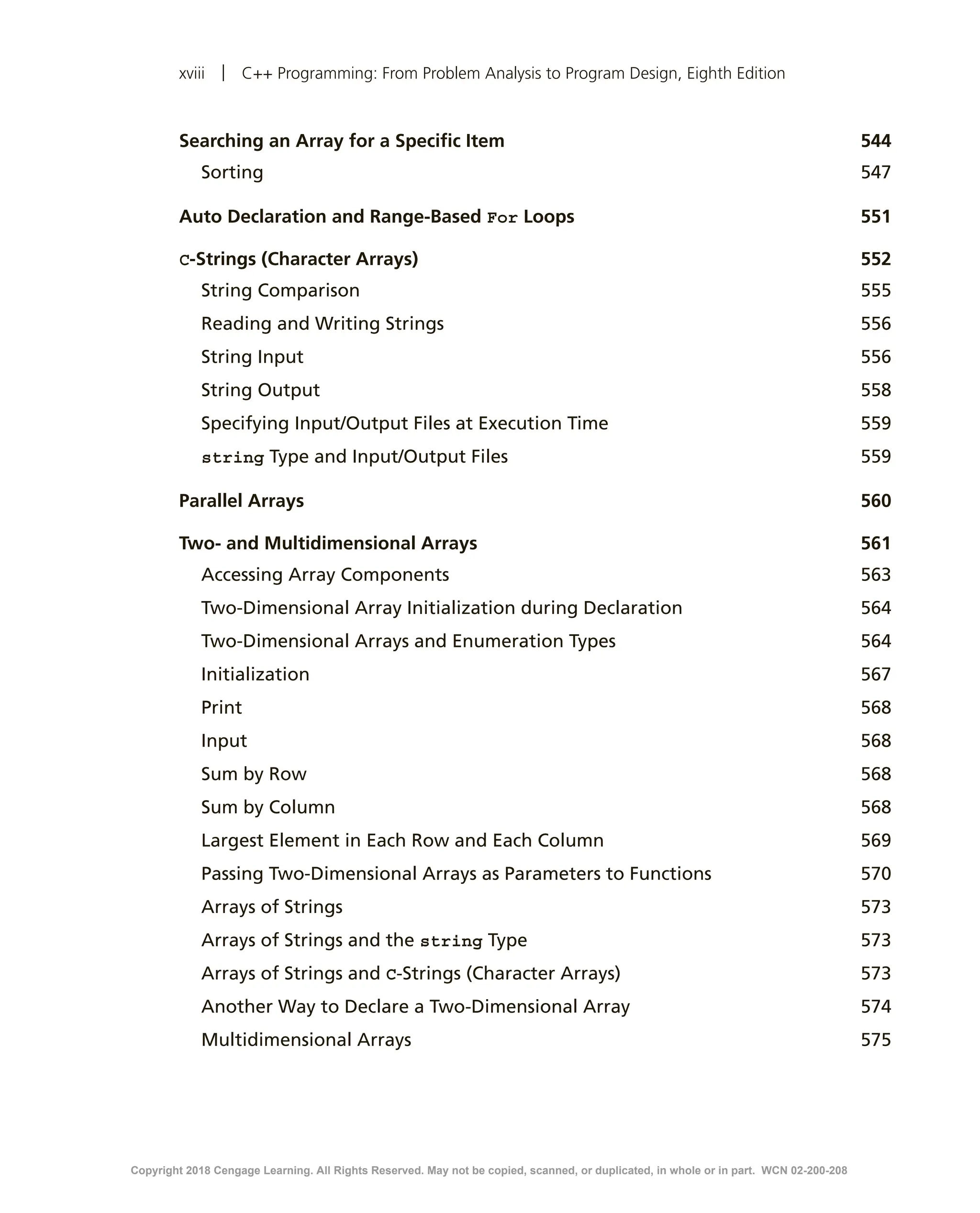
17.
xviii | C++Programming: From Problem Analysis to Program Design, Eighth Edition Searching an Array for a Specific Item 544 Sorting547 Auto Declaration and Range-Based For Loops 551 C-Strings (Character Arrays) 552 String Comparison 555 Reading and Writing Strings 556 String Input 556 String Output 558 Specifying Input/Output Files at Execution Time 559 string Type and Input/Output Files 559 Parallel Arrays 560 Two- and Multidimensional Arrays 561 Accessing Array Components 563 Two-Dimensional Array Initialization during Declaration 564 Two-Dimensional Arrays and Enumeration Types 564 Initialization567 Print568 Input568 Sum by Row 568 Sum by Column 568 Largest Element in Each Row and Each Column 569 Passing Two-Dimensional Arrays as Parameters to Functions 570 Arrays of Strings 573 Arrays of Strings and the string Type 573 Arrays of Strings and C-Strings (Character Arrays) 573 Another Way to Declare a Two-Dimensional Array 574 Multidimensional Arrays 575 Copyright 2018 Cengage Learning. All Rights Reserved. May not be copied, scanned, or duplicated, in whole or in part. WCN 02-200-208
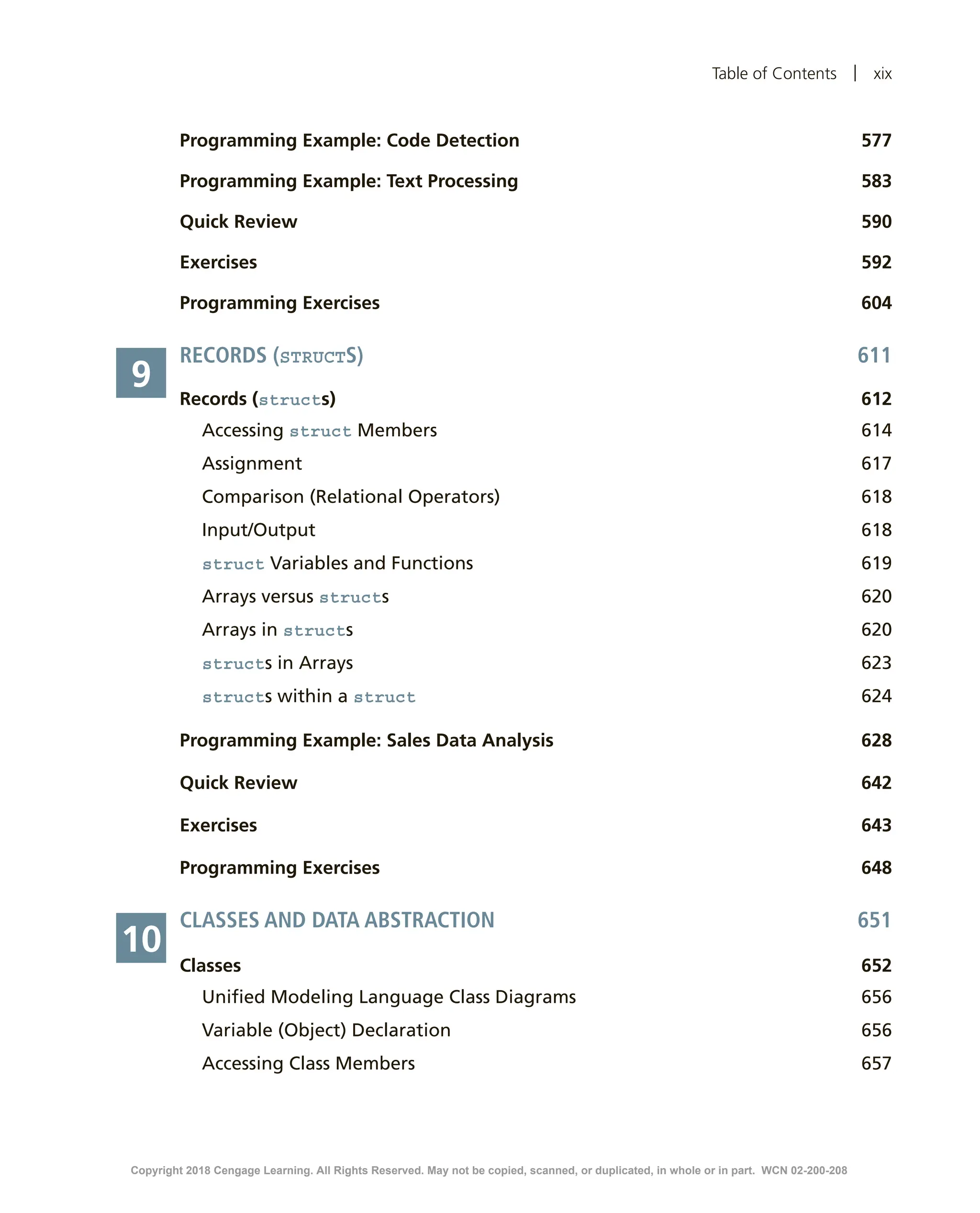
18.
Table of Contents| xix Programming Example: Code Detection 577 Programming Example: Text Processing 583 Quick Review 590 Exercises592 Programming Exercises 604 RECORDS (STRUCTS)611 Records (structs)612 Accessing struct Members 614 Assignment617 Comparison (Relational Operators) 618 Input/Output618 struct Variables and Functions 619 Arrays versus structs620 Arrays in structs620 structs in Arrays 623 structs within a struct 624 Programming Example: Sales Data Analysis 628 Quick Review 642 Exercises643 Programming Exercises 648 CLASSES AND DATA ABSTRACTION 651 Classes652 Unified Modeling Language Class Diagrams 656 Variable (Object) Declaration 656 Accessing Class Members 657 9 10 Copyright 2018 Cengage Learning. All Rights Reserved. May not be copied, scanned, or duplicated, in whole or in part. WCN 02-200-208
19.
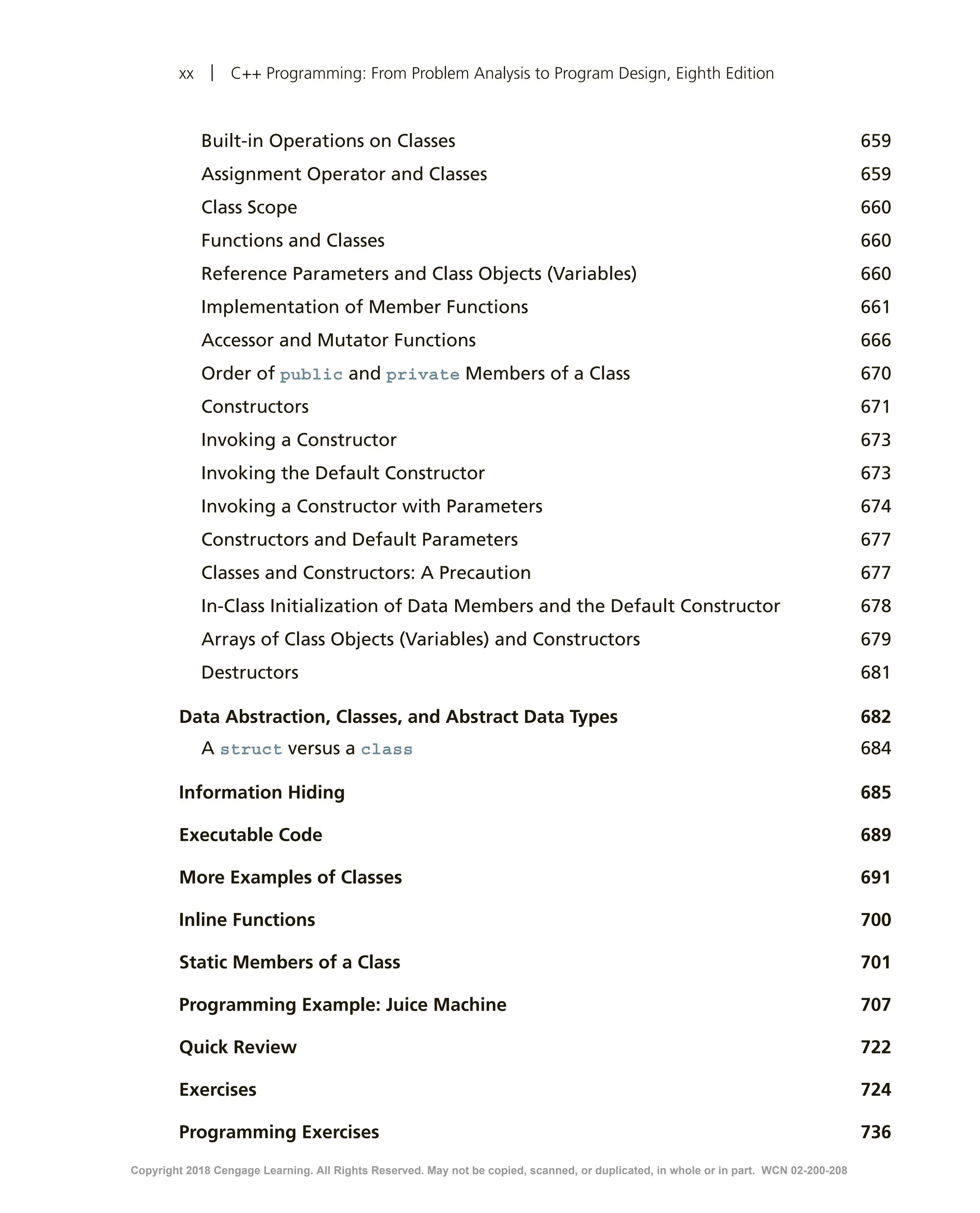
xx | C++Programming: From Problem Analysis to Program Design, Eighth Edition Built-in Operations on Classes 659 Assignment Operator and Classes 659 Class Scope 660 Functions and Classes 660 Reference Parameters and Class Objects (Variables) 660 Implementation of Member Functions 661 Accessor and Mutator Functions 666 Order of public and private Members of a Class 670 Constructors671 Invoking a Constructor 673 Invoking the Default Constructor 673 Invoking a Constructor with Parameters 674 Constructors and Default Parameters 677 Classes and Constructors: A Precaution 677 In-Class Initialization of Data Members and the Default Constructor 678 Arrays of Class Objects (Variables) and Constructors 679 Destructors681 Data Abstraction, Classes, and Abstract Data Types 682 A struct versus a class 684 Information Hiding 685 Executable Code 689 More Examples of Classes 691 Inline Functions 700 Static Members of a Class 701 Programming Example: Juice Machine 707 Quick Review 722 Exercises724 Programming Exercises 736 Copyright 2018 Cengage Learning. All Rights Reserved. May not be copied, scanned, or duplicated, in whole or in part. WCN 02-200-208
20.
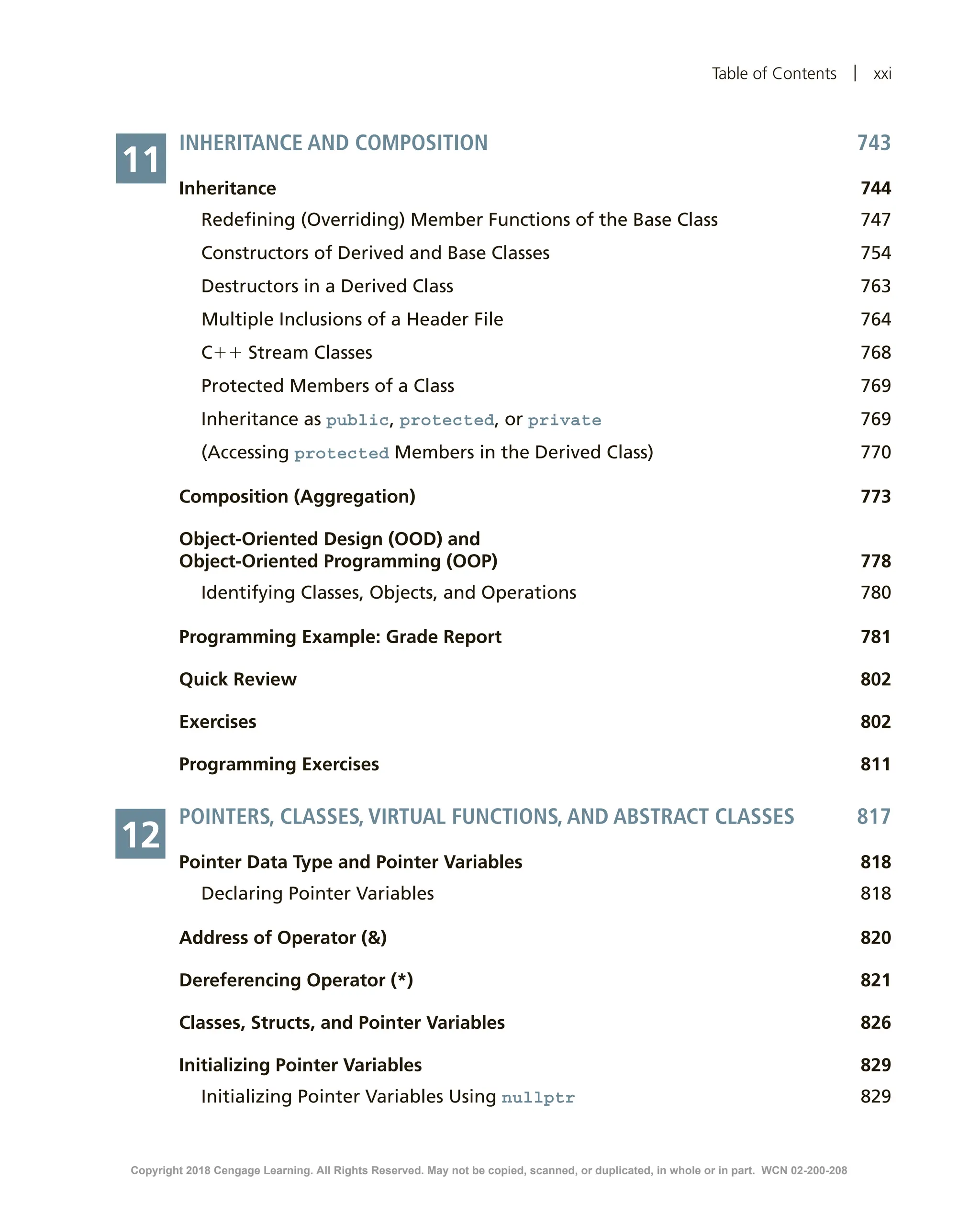
Table of Contents| xxi INHERITANCE AND COMPOSITION 743 Inheritance744 Redefining (Overriding) Member Functions of the Base Class 747 Constructors of Derived and Base Classes 754 Destructors in a Derived Class 763 Multiple Inclusions of a Header File 764 C11 Stream Classes 768 Protected Members of a Class 769 Inheritance as public, protected, or private 769 (Accessing protected Members in the Derived Class) 770 Composition (Aggregation) 773 Object-Oriented Design (OOD) and Object-Oriented Programming (OOP) 778 Identifying Classes, Objects, and Operations 780 Programming Example: Grade Report 781 Quick Review 802 Exercises802 Programming Exercises 811 POINTERS, CLASSES, VIRTUAL FUNCTIONS, AND ABSTRACT CLASSES 817 Pointer Data Type and Pointer Variables 818 Declaring Pointer Variables 818 Address of Operator () 820 Dereferencing Operator (*) 821 Classes, Structs, and Pointer Variables 826 Initializing Pointer Variables 829 Initializing Pointer Variables Using nullptr 829 11 12 Copyright 2018 Cengage Learning. All Rights Reserved. May not be copied, scanned, or duplicated, in whole or in part. WCN 02-200-208
21.
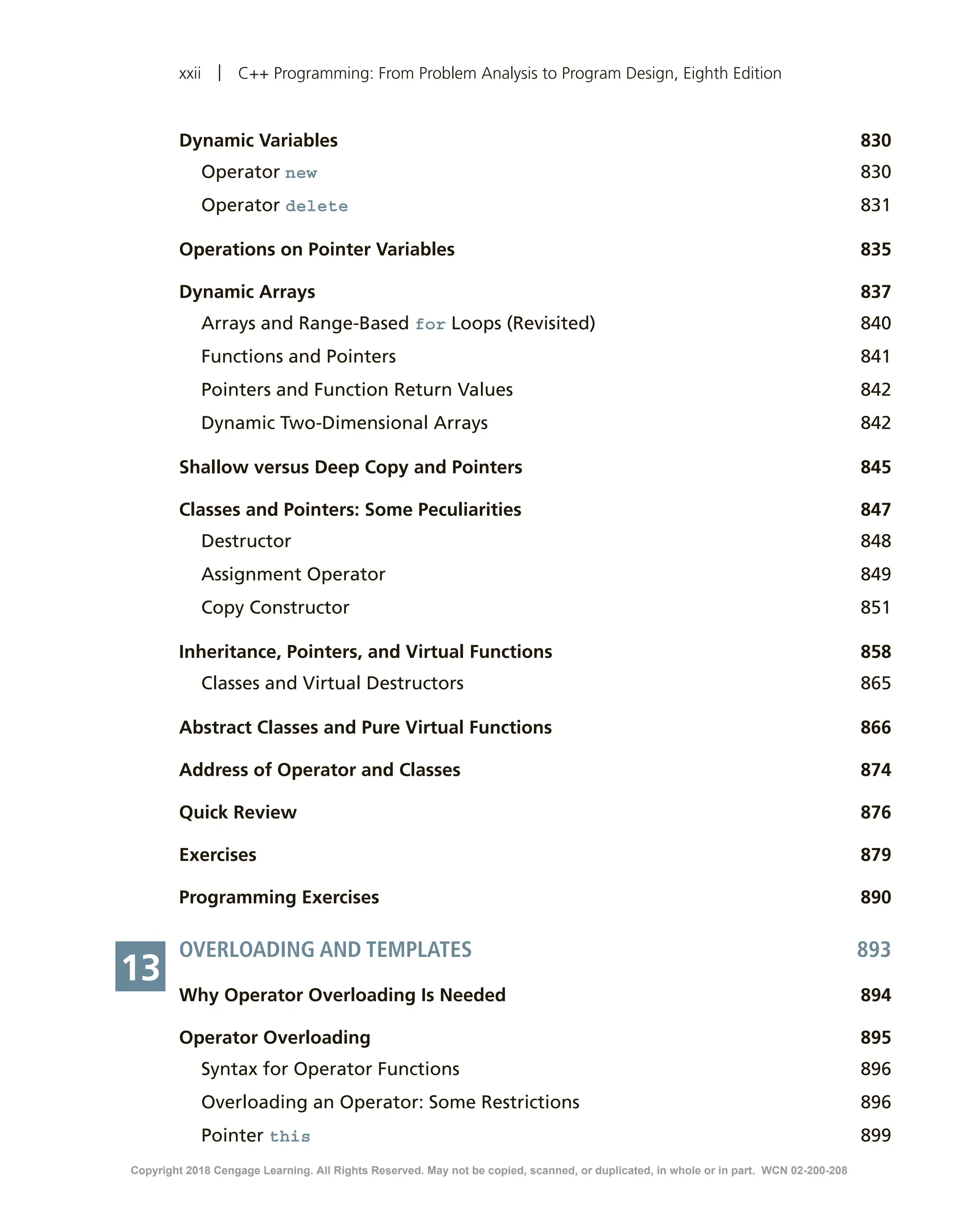
xxii | C++Programming: From Problem Analysis to Program Design, Eighth Edition Dynamic Variables 830 Operator new 830 Operator delete 831 Operations on Pointer Variables 835 Dynamic Arrays 837 Arrays and Range-Based for Loops (Revisited) 840 Functions and Pointers 841 Pointers and Function Return Values 842 Dynamic Two-Dimensional Arrays 842 Shallow versus Deep Copy and Pointers 845 Classes and Pointers: Some Peculiarities 847 Destructor848 Assignment Operator 849 Copy Constructor 851 Inheritance, Pointers, and Virtual Functions 858 Classes and Virtual Destructors 865 Abstract Classes and Pure Virtual Functions 866 Address of Operator and Classes 874 Quick Review 876 Exercises879 Programming Exercises 890 OVERLOADING AND TEMPLATES 893 Why Operator Overloading Is Needed 894 Operator Overloading 895 Syntax for Operator Functions 896 Overloading an Operator: Some Restrictions 896 Pointer this 899 13 Copyright 2018 Cengage Learning. All Rights Reserved. May not be copied, scanned, or duplicated, in whole or in part. WCN 02-200-208
22.
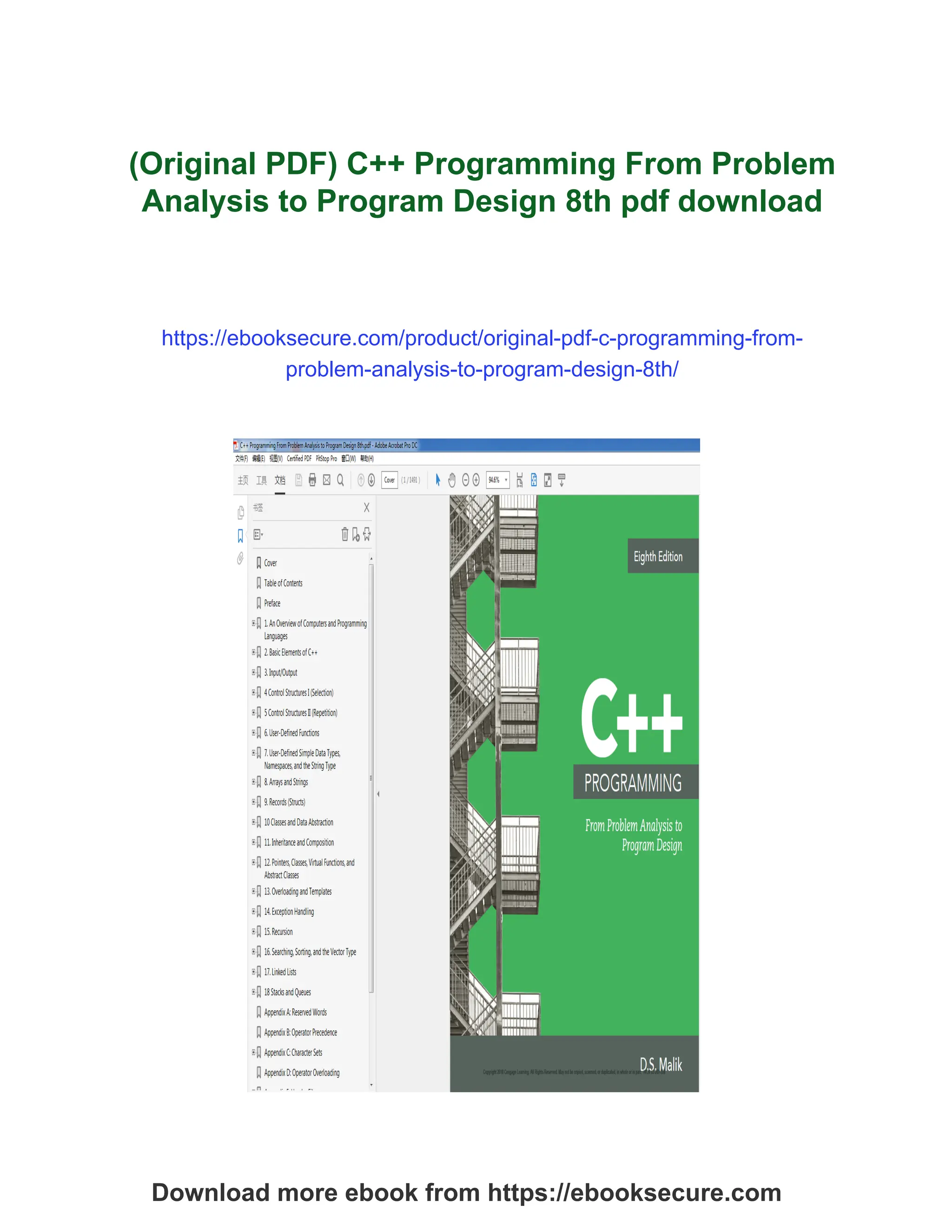
Table of Contents| xxiii Friend Functions of Classes 904 Operator Functions as Member Functions and Nonmember Functions 907 Overloading Binary Operators 910 Overloading the Stream Insertion () and Extraction () Operators 916 Overloading the Assignment Operator (=)921 Overloading Unary Operators 929 Operator Overloading: Member versus Nonmember 935 Classes and Pointer Member Variables (Revisited) 936 Operator Overloading: One Final Word 936 Programming Example: clockType936 Programming Example: Complex Numbers 945 Overloading the Array Index (Subscript) Operator ([]) 950 Programming Example: newString952 Function Overloading 959 Templates959 Function Templates 959 Class Templates 961 C1111 Random Number Generator 969 Quick Review 971 Exercises973 Programming Exercises 981 EXCEPTION HANDLING 991 Handling Exceptions within a Program 992 C11 Mechanisms of Exception Handling 996 try/catch Block 996 Using C11 Exception Classes 1003 14 Copyright 2018 Cengage Learning. All Rights Reserved. May not be copied, scanned, or duplicated, in whole or in part. WCN 02-200-208
in his hand,he draws it over to his side of the table, and takes from his hand the cards completing the combination of three cards, leaving them all face up. Even if he has cards enough in his hand to increase the combination to four or more cards, he should not show them. The cards drawn from the stock must never be taken into the hand. Let us suppose the pone holds these cards:—♡ J 7 6 4; ♠ 5 3 2; ♢ K 7 5; and that the ♡ 5 is the first card he draws. He can use this card in three ways: By making a run of three with the ♡ 4 and ♡ 6; or a run with the ♡ 6 and ♡ 7; or a triplet with the two other 5’s. In this case he would probably lay out the 6 and 7, and make the run of three. If he should draw the ♡ Q later on, he could use it by continuing the sequence with his Jack; or if the ♡ 3 appeared, he could use it with his ♡ 4. Passing. If he cannot use the card drawn, or does not wish to, he draws it from its position on the top of the stock and places it between himself and the dealer, still face up. The dealer then decides whether or not he wants it, and if he does not he “passes” it by turning it face down, and pushing it to his right. Cards once passed in this manner cannot again be seen by either player. The player who passes the card turns up the next one on the stock. If he does not want it, he places it on the table between himself and his adversary, and if his adversary does not want it either, he turns it down and passes it to the pile of deadwood, turning up the top card of the stock again. In this manner it will be seen that each player has to decide on two cards in succession; the one drawn but not used by his adversary, and the one he draws himself. This is continued until the stock is exhausted, which ends the game. Discarding. If a player uses any card drawn from the stock in this manner, it is obvious that he has too many cards, and in order to reduce his hand and show-downs to ten cards, he must discard something, unless he can show down everything remaining in his hand, in which case he would have eleven cards down, and win the game. In discarding, the card thrown out is placed at the disposal of
25.
the adversary, asif it were the card drawn from the stock, and if the adversary does not want it, he passes it and draws another. It should be observed that the player drawing the card from the stock always has the first refusal of it. This is sometimes very important, as both players often need the same card. In the foregoing example, the player’s best discard would be his ♢ K, which is too far removed from the others in the suit to make a run possible, and there is no mate to it with which to start a triplet. If the adversary could use this King, he would have to discard in his turn, and the card so thrown out would be at the disposal of the other player, just as if it had been drawn from the stock. Forcing. A player need not use any card drawn, but if he has upon the table any combination in which it can be used, his adversary may force him with it, even after it has been declined. For instance: A player has eight cards down, two sequences of four small cards each, and in his hand a pair of Kings. Another King will make him game; but if he has to depend on his sequences to put him out, he will have to get three more cards. Suppose he draws a card that will fit one of his sequences; it is to his advantage to pass it; but upon laying it on the table his adversary may take it up and force him with it, by placing it at the end of his sequence, at the same time saying: “Discard.” In the same manner a player holding one of the cards of his adversary’s show-down sequence or triplet may force after using a card, by placing his discard on his adversary’s sequence, instead of laying it on the table. If it is laid on the table, the adversary may pass it at once, by turning it down, and it is then too late to compel him to use it. Suppose you think your adversary holds two cards of an unplayed sequence, and has a triplet on the table. If you can use one of those sequence cards in his hand to advantage, and can force him by giving him the fourth card of his triplet, which is of no use to you, you should do so; but you must remember that you cannot force except after using a card yourself, because you are not allowed to discard under any other circumstances.
26.
If a playerlooks at any of the cards that have been passed and turned down, his adversary may take up and examine the remainder of the stock, but without disturbing the position of the cards therein, and without showing them. If a player looks at any of the cards in the stock except the one he draws, his adversary may look at all of them. If a player draws out of turn, his adversary simply claims the card. Showing. After the last card is drawn from the stock and passed, each player shows the remainder of his hand, and as neither can combine his cards so as to get eleven down, it is a tableau, and each puts a counter in the pool for the next hand. The deal passes from one player to the other in rotation as long as they continue to play. Suggestions for Good Play. Observation of the cards passed will usually show what the adversary is keeping, and what he has no chance for. Toward the end of the stock each player should know what the other holds in his hand by the cards which have not appeared in the drawing. If a player has not a good chance to get eleven down himself, he should play for a tableau, by using nothing that will compel him to discard cards which may put his adversary out. It should be remembered that a player cannot get eleven down in one suit, and careful observation of the cards passed will often show that his runs are blocked, the cards necessary to continue them having been turned down. One peculiar feature of the game is that a player cannot block his adversary and at the same time win the game, because so long as he holds up the card that his adversary wants he cannot get eleven down himself. His only chance is that he may be able to use the card that his adversary needs. For instance: He holds two 8’s, one of which will make his adversary eleven down by completing a sequence. If there is another 8 to come, the player with the pair may use both his 8’s, and win; but if there is no other 8 to come, it is impossible for the player with the two 8’s to win without first putting his adversary out.
27.
There are noText Books on Conquian, and this is the first complete description of it ever published. CALABRASELLA. This is a very popular game with the middle classes and the unoccupied clergy in Italy, and it is one of the very few good games of cards for three players. If the game were better known, the author is sure it would become a great favourite, especially with those who are fond of the whist family, because Calabrasella is an excellent training school for the use of cards of re-entry, long suits, and tenace positions in the end game. In the combination of two players against the third its tactics very closely resemble Skat, and many interesting and difficult positions occur in every game. Cards. Calabrasella is played with the Spanish pack, forty cards, the 10 9 and 8 of each suit being discarded. The cards rank: 3 2 A K Q J 7 6 5 4, the 3 being the highest, and the 4 the lowest, both in cutting and in play. There are no trumps. Markers. The game may be scored by paying and taking in counters, each player being provided with about fifty at the beginning of the game, which are purchased from a banker; but the better way is to keep account of the gains and losses of the single player in each deal, in the manner already described in connection with Skat, balancing the account at the end in the same way. Players. Calabrasella is played by three persons, two of whom are partners against the third in each hand. If four play, the dealer takes no cards, but shares the fortunes of those who are opposed to the single player, just as in Skat. The players on the right and left of the dealer are known as the pone and the eldest hand respectively. Cutting. The players cut for seats and deal, the lowest card having the first choice and dealing the first hand. A player exposing more than one card must cut again.
28.
Stakes. The gameis played for so much a point. The largest winning or loss for the single player is 140, but such an amount is almost impossible, and the average payments are 10 or 20. Dealing. The cards are presented to the pone to be cut, and at least four must be left in each packet. The dealer then distributes them to the players four at a time, until each has twelve, four remaining in the stock or talon, which is left upon the table face down. No trump is turned. The deal passes to the left. There are no misdeals. If the cards are not properly distributed, or four cards are not left in the talon, the same dealer must deal again, without penalty. Objects of the Game. The chief objects of the game are to win the last trick, and to secure counting cards in the other tricks in the course of play. There are 35 points to be played for in every deal. The six highest cards in each suit, 3 2 A K Q J, have a counting value, the Ace being worth 3, and the others 1 each. The last trick counts 3. Declaring. The eldest hand examines his cards and determines whether or not he will stand; that is, play single handed against the two others. If not, he says “pass,” and the next player decides. If all three pass, the deal is void, and passes to the next player on the left. If any player stands, he asks for the 3 of any suit he pleases, and if either adversary holds it, he must give it up. If it is in the stock, the player cannot ask for any other card. If he has all four 3’s in his hand he may ask for a 2, but for no lower card. The adversary giving the card asked for must receive a card in exchange from the hand of the single player, but this card must not be shown to the other adversary. Discarding. Having given a card in exchange for the 3 asked for, the single player must discard at least one more card, face downward on the table, and he may discard as many as four. The four cards remaining in the stock are then turned face up, and the single player may select from them as many cards as he has
29.
discarded; but heis not allowed to amend his discard in any way. The cards he does not take, if any, are turned down again, and are placed with his discards, forming a stock of four cards, which must not be seen or touched until the last card is played, when it becomes the property of the side that wins the last trick, and any counting cards it may contain are reckoned for that side. Playing. The discards settled, the eldest hand leads any card he pleases, and the others must follow suit if they can, but no one is obliged to win a trick if he has a smaller card of the suit led, and does not want the lead. The two adversaries of the single player do their best to get him between them, and combine their forces to prevent him from winning tricks that contain counting cards, especially Aces. Whatever tricks they win are placed together, and the counting cards contained in them reckon for their joint account. The tricks have no value as such, except the last. Showing. The winner of the last trick takes the stock, and each side then turns over its cards and counts the total value of the points won. The lower score is deducted from the higher, and the difference is the value of the game. If all 35 points are won by either side, they count double, 70. Scoring. If the single player loses, he loses to both adversaries, and if he wins he wins from both. His score is the only one put down, and the amount is preceded with a minus or plus sign according to the result. If he secures 23 points, he wins 11; if he takes in 16 only, he loses 3. If the amount is less than 18 it must be a loss; if it is 18 or more it must be a gain. The method of balancing the scores at the end will be found fully explained in connection with Skat. Irregularities. The penalty for a revoke is the loss of 9 points, which are taken from the score of the side in error at the end of the hand, and added to the side not in fault. If the final score is 24 to 11, for instance, in favour of the single player, and one of the partners has revoked, the score is 33 to 2, and the player wins 31 points. If any player turns over the stock before he has announced
30.
to stand andhas discarded at least one card, he loses 35 points to each adversary, and the deal is void. If an adversary of the single player turns over the stock before the player has discarded, there is no penalty, and the player may discard as he pleases. If an adversary of the single player leads or plays out of turn, the player may abandon the hand at that point, and claim the stock and last trick, the adversaries being entitled to count only the points they have won up to the time the error occurred. Suggestions for Good Play. The general tactics of the game are extremely like those employed in Whist and Skat. The player establishes his long suit as rapidly as possible, and preserves his tenaces and cards of re-entry. The adversaries of the player should lead short suits up to him, and long suits through him, and every opportunity should be taken advantage of to discard counting cards on partner’s tricks, Aces especially, which are not the best of the suit, but count the most. Both sides scheme to get their hands in shape for winning the last trick, which usually makes a difference of ten or twelve points in the score, owing to the high cards held back, and those found in the stock. Each side should keep mental count of its score, so as to know whether or not it must win the last trick to get to 18. The exposure of the stock, the number of cards discarded by the player, the suits which are led and avoided, will all prove useful guides in determining where the strength or weakness in each suit lies, and proper advantage should be taken of all such inferences. Some judgment is required in selecting the suit in which the 3 is to be asked for, and the single player must plan in advance for all his discards, one for the exchange, and those for the stock. The player’s position at the table makes quite a difference. The leader has an advantage with a good long suit; but with tenaces it is better to be third player, and very bad to be second hand. Some pretty positions arise in the end game through the refusal of players to win tricks which would put them in the lead, and so lose them the last trick and the stock. After the first few tricks,
31.
everything must bearranged with a view to securing that last trick, but the importance of getting home with Aces must never be overlooked. These count 12 points in every hand, and the side that can get in three out of the four has 6 points the best of it. The only Text Book on this game is the Pocket Guide, by “Cavendish”; there are some good articles in Vol. III. of the “Westminster Papers.” VINT. While this game is by some persons thought to be the forerunner of bridge, and might be classed as one of the whist family, it is at present so little known outside of Russia, where it is the national game, that the author has thought it best to group it with other games which are distinctly national in character. Vint has been variously described as bridge without a Dummy and as auction whist. It resembles bridge in the making of the trump, and whist in the manner of the play. Cards. Vint is played with the full pack of fifty-two cards, which rank from the A K Q down to the deuce. Two packs are generally used. Players. A table is complete with four players, and if there are more than four candidates for play the selection must be made by cutting. All the rules for formation of tables, cutting, ties, etc., are the same as at bridge. The lowest cut takes the deal. Partners sit opposite each other. Dealing. The dealer presents the pack to be cut, and then gives thirteen cards to each player, one at a time. No trump is turned. The deal passes to the left. All irregularities are governed by the same laws as bridge. Making the trump. Each player in turn, beginning with the dealer, bids to make a certain number of tricks, from seven to thirteen, with a suit of his own choosing, which he names when he
32.
makes his bid.The suits outrank one another in the order of hearts, diamonds, clubs, and spades, hearts being the best. No-trumps are higher than hearts. A bid of seven tricks is usually called “one” in hearts, or whatever the suit may be. A bid of “two” means to win eight tricks, or two over the book. Bidding. If a player wishes to go over the first offer made, he must either bid the same number of tricks in a better suit, or he must increase the number of tricks. No player can increase his own bid unless he is overbid in the interval, but there is no limit to the number of times that players may outbid one another. Observe that the dealer may bid or pass, and each player after him in turn may bid or pass. The highest bidder must abide by his announcement both as to the number of tricks and the suit. The Play. No matter who dealt the cards, the player to the left of the highest bidder always leads for the first trick. Each player in turn must follow suit if he can, and the highest card played, if of the suit led, wins the trick, trumps winning all other suits. The winner of one trick leads for the next, and so on. There is no Dummy hand as in bridge. Scoring. Although the bidding is for so many “odd” tricks, or tricks over the book, every trick taken is counted when it comes to the scoring; but it is the number of tricks bid, and not the rank of the suit, that determines the value. Every trick won by the same partners— In a bid of “one” is worth 10 In a bid of “two” is worth 20 In a bid of “three” is worth 30 In a bid of “four” is worth 40 In a bid of “five” is worth 50 In a bid of “six” is worth 60 In a bid of “seven” is worth 70
33.
Both sides score.If the highest bid was “two in diamonds,” and the bidder’s side won nine tricks, they would score 9 times 20, or 180; while their adversaries would score 4 times 20, or 80. As soon as either side reaches 500, they win the game, even if it is in the middle of a hand; but the hand must be played out in order to see how many points are won by each side. It should be observed that although the bidder’s side may make nine or ten tricks the adversaries can win the game if they get enough to count out before the bidder, by reaching 500 first. Tricks and Honours. The score for tricks and for honours must be kept separate, usually above and below the line, as at bridge. All trick points, which are the only ones that count toward game, are placed below the line; the honour points above. For winning a game, 1,000 points are added in the honour column. The side that first wins two games of 500 points each adds 2,000 rubber points in the honour column. Slams. If a little slam, 12 tricks, is made, but has not been bid, it is worth 1,000 points in honours. If a little slam, “six tricks,” has been bid and is made, it is worth 5,000 more for bidding it, or 6,000 altogether. If a grand slam, 13 tricks, is made but not bid, it is worth 2,000 honour points. If a little slam is bid and a grand slam made, it is worth 7,000 altogether. If a grand slam is bid and made, it is worth 12,000 altogether. Lost Games. If the bidder fails to make good, his adversaries score 100 times the value of the tricks as penalty, in the honour column; the scores for the tricks actually won standing at their regular value below the line. Suppose the bid to be three in diamonds, making the tricks worth 30 each, and that the bidder’s side get the odd trick only. Although the bidder has failed to make good, he scores below the line for the seven tricks he took, at 30 each, and the adversaries score for the six they took, also at 30 each. Then, as the bidder fell short by two tricks of making good, his
34.
adversaries score thesetwo tricks at 3,000 points each, penalty, in the honour column. Honours. The honours are the A K Q J 10 of trumps and the four Aces, the Aces being always honours; but when there is a no-trump declaration they are the only honours. This makes the Ace of trumps count double, when there is a trump suit; once as one of the five honours in trumps, and once as an Ace. Each honour is worth ten times as much as a trick. If the bid was three in clubs, the tricks would be worth 30 each and the honours 300 each. The side that has the majority of Aces and of honours scores for all they hold; not for the majority or difference. Suppose the bidder’s side has three honours in clubs and three Aces; the other side must have only two honours and one Ace; therefore the bidder scores for six honours, at 300 each. If the Aces and honours in trumps are so divided that each side has a majority of one or the other, they offset. Suppose the bidder to hold four Aces and two honours. The adversaries must have the majority of trump honours. Then the number of their trump honours, which is three, is deducted from the number of the bidder’s Aces, four, leaving the bidder’s side only one honour to the good. Three honours on one side and three Aces on the other would be a tie, and no honours to score. If the Aces are a tie, the side that wins the most tricks scores them. Suppose the bidder has three honours and two Aces. He scores five honours if he wins the odd trick; otherwise he scores one only, the Aces being a tie and he having only one more honour than his adversaries. In no-trump hands, the honours are worth 25 times the value of the tricks. If Aces are easy, neither side scores. If one has three Aces, they are all scored. Suppose the bid to have been “two at no- trumps,” then the Aces are worth 25 times 20, and three of them are worth 1,500 points.
35.
Coronets. A sequenceof three or more cards in any suit, trumps or plain, held by an individual player, is a coronet. Three or four Aces in one hand is also a coronet. When there is a trump suit, three Aces, or three of a plain suit in sequence, are worth 500 in the honour column. Each additional card is worth 500 points more. A sequence of K Q J 10 9 would be worth 1,500. In the trump suit, and in all the suits when there are no trumps, these coronets are worth double, and each additional card is therefore worth 1,000 more. Rubbers. As soon as one side wins two games, that ends the first rubber. The partners then change, without cutting, in such a manner that at the end of three rubbers each player shall have had each of the others for a partner. At the end of the third rubber, the losses and gains are ascertained for each individual, and settled for. Laws. The laws that govern the game are almost identical with those for Bridge. PREFERENCE. This is a simplified form of Vint, for three players, with a thirty- two-card pack. The cards rank: A K Q J 10 9 8 7, and the suits rank: Hearts, diamonds, clubs, and spades. Hearts are always preference. There are no hands played without a trump suit. If four persons play, the dealer takes no cards. The three active players make up a pool, each putting in an equal amount at first, and the bidder putting into it as many as he bids for the privilege of naming the trump suit. Any one may deal the first hand, after which the deal passes to the left. Three cards are given to each player the first round, then two are laid off for a widow, then four to each player, and then three to each. Beginning on the dealer’s left, each player in turn may name the trump if he thinks he can take at least six of the ten tricks to be played for. Bids outrank one another in the order of the suits,
36.
hearts being preferencealways. The number of tricks is not mentioned. In case there are no bids, each in turn has a second chance to bid for the widow. These bids are made in counters, to be put into the pool. The highest bidder takes the widow, lays out two cards, and then names the trump suit. The players agree upon a value for the tricks won, and payments are made from the pool accordingly. These payments may vary according to the rank of the trump suit.
37.
ODD GAMES. There arequite a number of odd games of cards, which come and go as favourites from time to time, and pass round the world from one country to another under many different names. The origin of most of these games is lost in the weedy undergrowth of variations, but the chief family trait in some of them can be traced back to the alpha of cards. Among the oldest of games was Ombre, immortalised by Pope, the only survivor of which is a variation played by the older Germans, under the name of Solo; a game which still faintly resists the exterminating influence of Skat. The ancient and honourable games of Comète, Hoc, and Nain Jaune survive to the present day in a large and prosperous family, ranging from Commit to Fan Tan, the latter being to-day quite a favourite among those who like simple and amusing games, free from mental effort. Fan Tan is unfortunately named, as many persons confuse it with the Chinese banking game, and it would be much better under its older name, Play or Pay. Among the many games of which everyone has heard, and which many thousands have been advised to play, is one which, strange to say, is not to be found described in any work on card games, and that is Old Maid. There was a time when the result of this game was supposed to be final and conclusive, and parties of young men have been known to substitute a Jack or King for the discarded Queen, in order to learn what the future had in store for them. Under such circumstances the game became Old Bachelor, of course. For those who believe in the verdict of the cards, there are other sources of information. Fortune telling, whether for the purpose of amusement or self-deception, has undoubtedly interested many persons in all stations of life ever since Eittella first explained the art,
38.
away back inthe sixteenth century. The meanings attached to the cards individually, and the manner of their arrangement, is all that can be given in a work of this kind. The qualifications for success in foretelling the future do not depend so much on the cards as on good judgment of human nature, unlimited assurance, a glib tongue, and a certain amount of ingenuity in making a connected story out of the disjointed sentences formed by the chance arrangement of certain cards, to which an arbitrary or fanciful meaning is attached. Speculation is considered by some persons an excellent training school for the commercial instincts of the younger members of a family, teaching them to form correct estimates as to the value of certain articles offered for sale in a fluctuating market. Authors is a very good game for the family circle, and does not require special cards, the ordinary pack being easily adapted to the distinctions of the game. Patience, or Solitaire, has probably claimed the attention of every card-player at some time or other, and one cannot fail to be impressed by the number and ingenuity of the patience games which have been invented. One of the most expensive works on cards ever published is devoted exclusively to Solitaire. Among all these odd games one should be able to find something to amuse all sorts and conditions of card-players. The only apparatus required in any of them is a pack of cards and a few counters, and for the latter corn or coffee-beans will form an excellent substitute. SOLO. Under the name of Solo, the Germans play a great many variations of card games, of which the following is the best known. Cards. Solo is played with a pack of thirty-two cards, which rank A K Q J 10 9 8 7. One suit is always first preference, or colour, and the suit usually selected is clubs. Any suit may be made the trump, but whatever the suit, the club Queen, Spadilla, is always the best
39.
trump; the Sevenof the trump suit, Manilla, is always the second- best trump; and the spade Queen, Basta, is always the third-best trump. Players. Solo is played by four persons, who throw round the cards for the first club turned up to deal eight cards to each player; 3-2-3 at a time. Objects. The object of the game is to secure the privilege of naming the trump suit, and of playing, either alone or with a partner, to make five tricks, solo, or eight tricks, tout. If a partner is required, he is selected by the player asking for a certain ace, but the holder of the ace remains unknown until the ace falls, although from the first he must assist the player who has asked for it. If a player asks for an ace while holding it himself, he of course plays without a partner, unknown to the others however, until he plays the ace asked for. Bidding. The players bid against one another for the privilege of naming the trump suit, eldest hand having the first say. When no one will bid any higher, the player who has made the best offer names the game he wishes to play, with or without a partner. Games. The rank of the various games, the amounts bid on them, and the payments made for them, are as follows:— Simple in suit, 2; in colour, 4. Forcée or Solo in suit, 4; in colour, 8. Tout in Suit, 16; in colour, 32. Simple Game is to play for five tricks with a partner holding a designated ace. If the trump is clubs, (in colour,) it is worth double, 4 counters. Solo is five tricks without a partner. With clubs trumps it pays double, 8 counters. Tout is eight tricks, with or without a partner. If alone, the single player wins or loses all; if with a partner he must share his gains or
40.
losses. Forcée is whenno bid is made, and any player holds both Spadilla and Basta. He must play a Solo, or call for an ace. If he calls, the player holding the ace names the trump suit; but the suit so named must not be the suit of the called ace. Forcée in clubs is worth double, 8 counters. Playing. The trump named, the eldest hand leads any card he pleases, and the others must follow suit if they can. The highest card played, if of the suit led, wins the trick, and trumps win all other suits. The hands are abandoned as soon as the bidder takes five tricks, if he is playing anything but a tout. If he goes on he must win all eight tricks, or lose the value of a tout. Payments. A solo player wins from or loses to each of his adversaries individually the amount of the game in counters. Two partners pay or receive each from one adversary. HEART SOLO is a game for three players, in which the pack is reduced to twenty-four cards by deleting the Eight of hearts, and all the diamonds but the Seven. Diamonds are always colour, and there are only three trumps in that suit; Spadilla, Manilla, and Basta. The only play is for the Solo, and if no one will make a bid, the hands are played in colour, and the winner of the last trick loses the value of a Solo. AUTHORS. This game was originally played with cards bearing the names of various authors, and other famous personages, arranged in groups, but the game is much simpler when played with an ordinary pack of fifty-two cards. Any number of persons can play. The cards are shuffled and spread, and the person drawing the lowest card deals the first hand. The ace is low. Each player then deposits a counter in the pool, and
41.
the cards aredistributed one at a time until the pack is exhausted. If some players have a card more than others it makes no difference. The object of the game is to secure tricks consisting of four cards of the same denomination; such as four 6’s or four K’s, and the player having the most tricks of this kind wins the pool. Ties divide it. The player on the left of the dealer begins by asking for a certain card, which must be of the same denomination as one already in his hand. For instance: He holds the spade Ten. He may ask any one at the table for either of the three other Tens; but he must designate the suit, and must ask a particular player for the card wanted. If the player asked has the card, he must immediately surrender it, and the player to whom it is given can then ask again—any player for any card, always provided that the asker has one of the same denomination in his own hand. If the person asked has not the card demanded, the privilege of asking is transferred to him, and he may ask any person at the table for any card of the same denomination as one already in his own hand. If he has just been asked for a Ten, for instance, and has a Ten, but not of the suit asked for, he might turn upon his questioner and get a Ten from him, if he could guess the right suit. As soon as any player gets together four cards of the same denomination, he lays them face down upon the table in front of him, and they form a trick. A good memory is necessary to play this game well, as it is very important to recall who has asked for certain cards, and which players were unable to supply them. It is a legitimate artifice in the game to ask for a card you already have in your own hand, although you know it will lose your guess, because it may be the only way to prevent another player from drawing several valuable cards from you. For instance: You hold the Fives of diamonds and spades, and have asked for and received the Five of clubs. If you ask for the heart Five, and miss it, the player with that card may draw all yours;
42.
but if youask for the spade Five, and he gets into the ask, he will at once betray the fact that he holds the fourth Five by asking you for the club Five; but he will never think of asking you for the spade Five, because you asked for it yourself. If you can get into the ask again you can immediately make a trick in Fives. SPECULATION. Any number of persons less than ten can play, each contributing an agreed number of counters to the pool, the dealer paying double. The full pack of fifty-two cards is used, and the cards rank from the A K Q down to the 2. In dealing, the cards are distributed from left to right, one at a time, until each player has received three. The next card on the top of the pack is turned up, and the suit to which it belongs is the trump, and forms the basis of speculation for that deal. If the turn- up card is an ace, the dealer takes the pool immediately, and the deal passes to the left. If the turn-up is a K Q or J, the dealer offers it for sale, before a card is looked at, and he may accept or refuse the amount offered. Whether the card is sold or not, all the cards that have been dealt out are turned face up, and the highest card of the turn-up suit wins the pool. If the card is not an honour, the dealer proceeds to sell it before any player is allowed to look at any of the cards dealt. If any one buys the dealer’s turn-up card, the purchaser places it on his own cards, leaving it face up. Whether it is sold or not, the elder hand proceeds to turn up the top card of his three. If this is not a trump, the next player on his left turns up his top card, and so on until a trump is turned that is better than the one already exposed. The player who possesses the original turn-up, does not expose any more of his cards until a better trump is shown. As soon as a better trump appears it is offered for sale, and after it is sold or refused, the cards are turned up again until a better trump appears, or all the cards have been exposed. The holder of the best trump at the end takes the pool.
43.
OLD MAID. Strange tosay, this oft-quoted and continually derided game is not mentioned in any work on cards, a singular omission which we hasten to supply. Any number of young ladies may play, and a pack of fifty-one cards is used, the Queen of hearts having been deleted. Any player can deal the cards, which are distributed one at a time until the pack is exhausted; if every player has not the same number it does not matter. Beginning with the eldest hand, each player sorts her cards into pairs of the same denomination; such as two Fives, two Jacks, etc., and all pairs so formed are laid upon the table face down, without showing them to the other players. All the cards laid out in this manner are left in front of the player, in order to discover errors, if any. Three of a kind cannot be discarded, but four of a kind may be considered as two pairs. The discarding of pairs complete, the dealer begins by spreading her remaining cards like a fan, and presenting them, face downward, to her left-hand neighbour, who must draw one card at random. The card so drawn is examined, and if it completes a pair, the two cards are discarded. Whether it forms a pair or not, the player’s cards are spread and presented to the next player on the left, to be drawn from in the same manner. This process of drawing, forming pairs, and discarding is continued until it is found that one player remains with one card. This card is of course the odd Queen, and the unfortunate holder of it is the Old Maid; but only for that deal. LIFT SMOKE. The number of players must be limited to six, each of whom deposits a counter in the pool. A full pack of fifty-two cards is used. The cards rank from the ace down to the deuce, as at Whist. If there
44.
are four players,six cards are dealt to each, one at a time; if five play, five cards to each, and if six play, four cards to each. The last card that falls to the dealer is turned up for the trump, and the remainder of the pack is placed in the centre of the table as a stock to draw from. The eldest hand leads for the first trick, and the others must follow suit if they can. The highest card played, if of the suit led, wins the trick, and trumps win all other suits. The winner of each trick draws the top card from the talon, and leads again. When any player’s cards are exhausted he withdraws from the game, and the others continue. The player who remains to the end, having a card when his adversary has none, wins the pool. If two players remain with a card each, the winner of the trick draws from the stock, and the card so drawn wins the game, his adversary having none. EARL OF COVENTRY. This game is sometimes called Snip Snap Snorem, by those who are not of a poetical turn of mind. Any number of persons may play, and a full pack of cards is dealt out, one at a time. If some players have a card more than others, it does not matter. The eldest hand lays upon the table any card he pleases, and each player in turn pairs or matches it, if he can, with another of the same denomination, accompanying the action with a rhyme. Suppose the first card played is a King; the person playing it would say: “There’s as good as King can be.” The first player to lay down another King would say: “There is one as good as he.” The player holding the third King would say: “There’s the best of all the three,” and the holder of the fourth would then triumphantly exclaim: “And there’s the Earl of Coventry.” The fortunate holder of the Earl of Coventry in each round has the privilege of leading a card for the next trick, and the first player to get rid of all his cards wins one counter from the others for every
45.
card they hold.The words, “Snip, Snap, Snorem,” may be substituted for the foregoing rhymes if time is short. Jig is a variation of Earl of Coventry in which the next higher in sequence and suit must be played, if the player has it, until four cards are shown. The one who lays down the last of the sequence of four cards starts a fresh sequence, and the winner is the one who can first get rid of all the cards originally dealt him. All the others then pay him a counter for each card they have left.

![Table of Contents | xxiii Friend Functions of Classes 904 Operator Functions as Member Functions and Nonmember Functions 907 Overloading Binary Operators 910 Overloading the Stream Insertion () and Extraction () Operators 916 Overloading the Assignment Operator (=)921 Overloading Unary Operators 929 Operator Overloading: Member versus Nonmember 935 Classes and Pointer Member Variables (Revisited) 936 Operator Overloading: One Final Word 936 Programming Example: clockType936 Programming Example: Complex Numbers 945 Overloading the Array Index (Subscript) Operator ([]) 950 Programming Example: newString952 Function Overloading 959 Templates959 Function Templates 959 Class Templates 961 C1111 Random Number Generator 969 Quick Review 971 Exercises973 Programming Exercises 981 EXCEPTION HANDLING 991 Handling Exceptions within a Program 992 C11 Mechanisms of Exception Handling 996 try/catch Block 996 Using C11 Exception Classes 1003 14 Copyright 2018 Cengage Learning. All Rights Reserved. May not be copied, scanned, or duplicated, in whole or in part. WCN 02-200-208](https://image.slidesharecdn.com/20475-250408190448-d604be77/75/Original-PDF-C-Programming-From-Problem-Analysis-to-Program-Design-8th-22-2048.jpg)