International Research Journal of Engineering and Technology (IRJET) e-ISSN: 2395-0056 Volume: 04 Issue: 07 | July -2017 www.irjet.net p-ISSN: 2395-0072 © 2017, IRJET | Impact Factor value: 5.181 | ISO 9001:2008 Certified Journal | Page 3364 Prediction Based Moving Object Tracking In Wireless Sensor Network Prajakta Joshi1, Akhila Joshi2 1,2 Student, Department of Electronics and Telecommunication, Vidyalankar Institute of Technology, Mumbai, India ---------------------------------------------------------------------***--------------------------------------------------------------------- Abstract - In recent years, Wireless sensor network is one of the rapidly growing area. It consists of thousands of tiny sensor nodes distributed inapplicationarea. Asensornode has ability of collecting, processing, storing and transferring the sensed data from one node toanother. Thesecapabilitiesmake sensor network to be used for many applications like environmental monitoring, intruderdetection, objecttracking and many more. Due to energy constraint reducing energy consumption is the aspect which has always been under research. Proposed system is designed to track the moving object in a clustered network. Prediction mechanism is used to predict next location of the object. Depending on predicted location only nodes closed to predicted location are activated while others remains in sleep mode to preserve the energy. Current location of the object is calculated by active clusterhead using Trilateration method. The proposed system is analyzed in Homogeneous and Heterogeneous network. Experiment is carried out using Network simulator-2 tool. Key Words: Wireless Sensor Networks, Tracking, Trilateration, Prediction 1. INTRODUCTION Wireless Sensor Networks (WSN) is group of small sensor nodes connected by wireless media. They are low cost, battery powered, placed randomly to form a sensor field. The sensors are spatially distributed to monitor physical or environmental conditions, such as temperature, sound, vibration, pressure, motion or pollutants. It has an ability to work cooperatively and pass their data throughthe network to the Base Station (BS) or a sink node. WSN has the ability to dynamically adapt to changing environments. Object tracking is one of the challenging application for Wireless Sensor Network in which network of wireless sensors are involved in the task of tracking a moving object. It consists of mainly two phase: 1) Detection of object 2) Monitoring and tracking of object. Object Tracking is widely used in many applications like military application, commercial applications, field of surveillance, intruder application and traffic applications. There are various metrics for analysing object tracking such as cluster formation, tracking accuracy, cluster head life time, miss rate, total energyconsumed,distancebetweenthe source and object, varying speed of the object, etc. The open issues in object tracking are detecting the moving object’s change in direction, varying speed of the object, object precision, prediction accuracy, fault tolerance and missing object recovery. In all tracking process, more energy is consumed for messages or data transmission between the sensor nodes or between the sensor and sink [7]. In traditional object tracking all the sensor node pass their sensed data to the one node (base station or a sink node) therefore computation burdenincreasesatthatnode, results in less accuracy and reduction in energy efficiency of that network and if number of sensor increases in the network, more number of messages are passed to Base station which consumes more bandwidth. Therefore, this approach lacks scalability. Also if that one node fails due to reduction in energy whole network collapse. It is called as centralized approach. In WSN, each node has very limited power and consequentlytraditional trackingmethodsbasedoncomplex signal processing algorithm are not applicable. In an object tracking application,thesensornodeswhichcan sense the object at a particular time are kept in active mode, while the remaining nodes are to be retained in inactive mode so as to conserve energy until the object approaches them. To continuously monitor mobile object, a group of sensors must be turned in active mode just before object reaches to them. The group of active sensor nodes varies depending on the velocity of moving object and theschedule by cluster head. The sensor nodes detect the moving object and transmit the information to the sink or the base station [6]. The object tracking algorithm should be designed in such a way that it results in good quality tracking with low energy consumption. The goodqualitytrackingextendsthe network lifetime and achieves a high accuracy. Because, even if a sensor node fails, other sensor node can take the responsibility and carry out the tracking process. In this paper we have proposed a system for prediction based object tracking in wireless sensor network. Using prediction mechanism object’snextlocationispredictedand only group of sensors which are in the vicinity of the predicted location will remain active. The rest of this paper is as follows: In section 2 we have an overview on some of the existing systemsfortargettracking.
International Research Journal of Engineering and Technology (IRJET) e-ISSN: 2395-0056 Volume: 04 Issue: 07 | July -2017 www.irjet.net p-ISSN: 2395-0072 © 2017, IRJET | Impact Factor value: 5.181 | ISO 9001:2008 Certified Journal | Page 3365 The proposed system will be presented in section 3. Then in section 4 we simulate proposed system and evaluate its performance, and in last section we conclude the paper. 2. RELATED WORK An adaptive sensor activation algorithmfortargettrackingin WSNs is presented in [8] where the authors used an auction mechanism forselecting the cluster head. In each iterationof the tracking operation, the cluster head tries to predict the region where that target may move to. Based on this predicted region, only nodes within this region are activated and the rest remain asleep. The presented algorithm has proven itself in terms of the network lifetime, energy efficiency and accuracy of tracking. Scope of proposed system, algorithm can be in co-operated in heterogeneous environment. An incremental clustering based object tracking in WSN is presented by [10] where authors proposed on-demand dynamic clustering in conjunction with static cluster based architecture. The problem they found in static clusteringisin static clustering global information sharing is refrained. Therefore when object moves to the boundary region it can be lost. They have implemented on demand clustering on boundary region when object’s trajectoryorpatterndoesnot belong to any of the cluster. Thus it ensures that object is tracked continuously. It requireshighenergyconsumptionto form extra clusters. Designing a prediction based clustering algorithm for target tracking in wireless sensor network presented in [7], the author presented energy efficient tracking scheme that is based on clustering architecture and object’s next location is predicted using speed and direction at current and previous time step. Thus just a few nodes in the vicinity of the predicted position of object get activated as tracker nodesby considering three parameters: distance, remaining energyof nodes while othersremaininpower-savingmode.Simulation results showed that the increase in a lifetime of network of proposed system in comparison with prediction based and cluster based approach. An Interactive multiple model (IMM) based target tracking for WSN is proposed in [9]. It used multiple models such as velocity and acceleration as well as multiple sensors to track the target continuously. It gives solution to missing of target due to non availability of target data at regular intervals. 3. PROPOSED SYSTEM Proposed system consists of three stages, I. Static cluster formation and selection of cluster head II. Object tracking III. Prediction. I. Clustering In this stage, all the sensors in the network are divided into different Zones. This implementation is performed using Cartesian coordinate system. Let the area taken for deployment is (X*Y) then network is divided into zone using equation (1) and (2) Xnew = X/sqrt n (1) Ynew = Y/sqrt n (2) Where n is number of zones. These zones are considered as static clusters in the sense that, sensor nodes are static and do not change position over the time. CHs are selected on the basis of either minimum distance from base station (distance based cluster head selection) or maximum residual energy that is sensor with the maximum remaining energy is selectedastheCH(energy based cluster head selection). II. Object tracking To track the current location of object, Trilateration algorithm is used. All the sensor nodes which can detect the object send distance information from it to respective CH. Distance is calculatedusingRSSI.CHselectsonlythreesensor nodes to track the object which has minimum distance from object.Afterreceivingdistanceinformationfromthreesensor nodes, CH calculates current location of object by solving equations form by relation (3). (Xi-Xt)2+(Yi-Yt)2= di 2 (i=1,2,3) (3) Where (Xi,Yi) are coordinatesof nodei,(Xt,Yt)arecoordinates of object and di is distance of node i from object. Figure 1. Trilateration III. Prediction Mechanism Prediction mechanism used in proposed system is linear prediction method. Given current location (Xi, Yi) and previous location ( Xi-1,Yi-1) of object this method estimates object’s speed and direction.
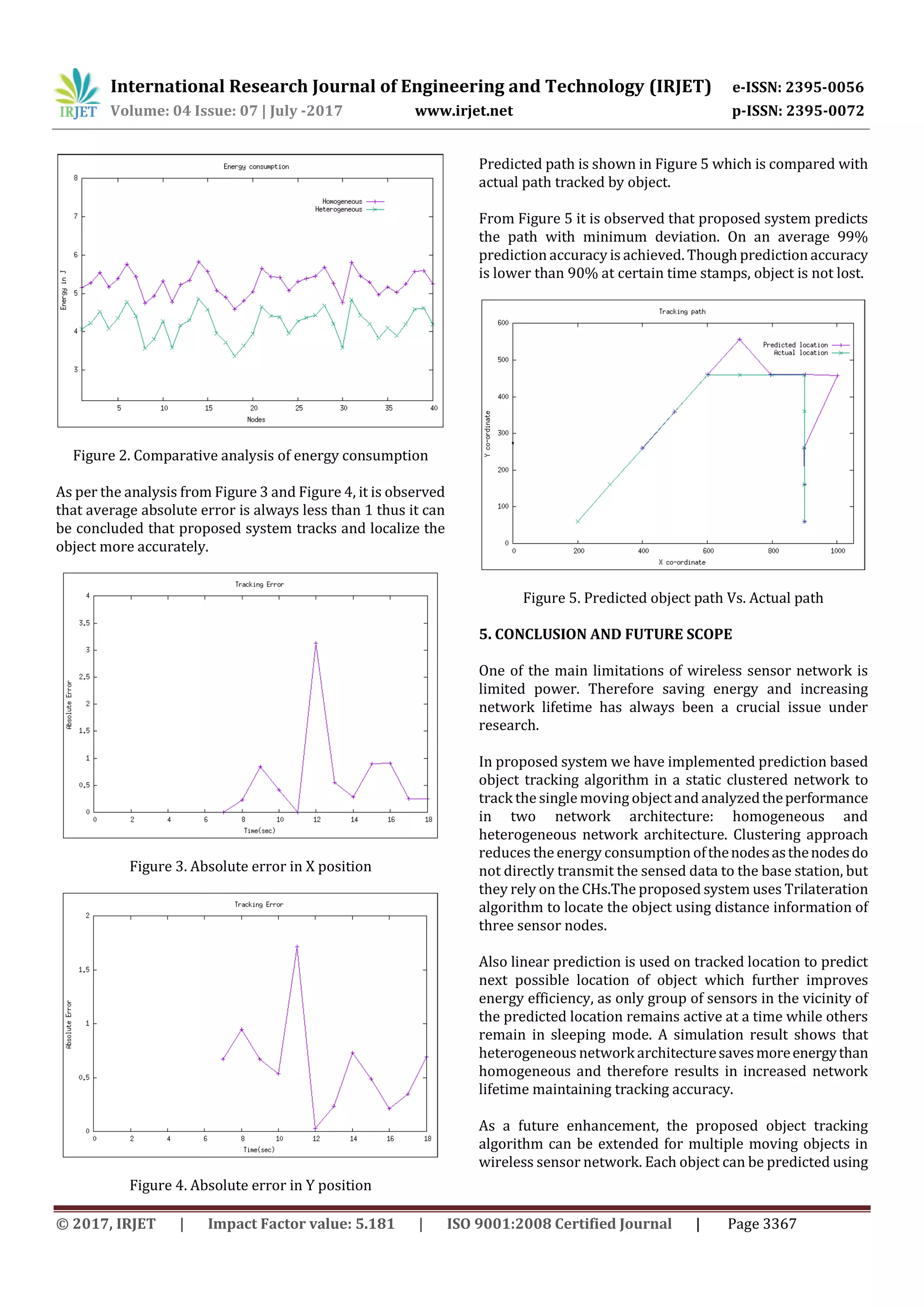
International Research Journal of Engineering and Technology (IRJET) e-ISSN: 2395-0056 Volume: 04 Issue: 07 | July -2017 www.irjet.net p-ISSN: 2395-0072 © 2017, IRJET | Impact Factor value: 5.181 | ISO 9001:2008 Certified Journal | Page 3366 While the direction is given by Based on the above information, the predicted location of object after a given time t is given by After calculating next possible location, if this location is present in current cluster, active CH selects three member nodes for tracking the object in the next interval time. If next location is out of current cluster then active CH sends message to CH of predicted location. 4. SIMULATION To evaluate the performance of implemented algorithm the simulation performed within 1000m X 1000m 2D square planner field. For simplicity 42 sensor nodes are uniformly distributed. Object velocity is 300m/s throughout the simulation. A. Simulation Parameters Table 1. Simulation Parameters Parameters Description Network size 1000m X 1000m Number of sensor nodes 42 MAC Protocol IEEE 802.11.4 Routing Protocol AODV Type of channel Wireless Transmission power 1.0 watt Receiving power 0.5 watt Initial energy 20J,30J Simulation time 20s Simulation Scenarios Proposed algorithm is analyzed in following scenarios. a) Moving object in homogeneous WSN In this network allsensor nodes has sameenergylevel.Initial energy of 20J is assigned to all the nodes. b) Moving Object in heterogeneous WSN In this network, two level heterogeneity is used. 20 % nodes are advanced nodes with 30J initial energy and 80% nodes are normal nodes with 20J initial energy. B. Performance parameters Performance evaluation and analysis is done on the basis of following parameters. i) Total consumption of energy Consume Energy[i] = Initial energy[i] – Final Energy[i] Where i is node id Total Energy Consumption is summingofConsumeEnergyof all nodes in the network as shown in following equation Total Energy Consumption = Total Energy Consumption + Consume Energy[i] ii) Average energy consumption Average Energy Consumption is nothing but average energy consumption of nodes throughout simulation. AverageEnergyConsumption=TotalEnergyConsumption/N iii) Absolute Tracking Error Absolute Tracking Error between Tracked and Actual location is calculated at every second. It is calculated separately for error in X location and error in Y location Absolute Tracking Error = |Actual location – Tracked location| iv) Prediction accuracy To check the predictionaccuracywehaveevaluatedAbsolute percentage deviation in X location and Y location separately. Absolute percentage deviation is a measure of prediction accuracy of a forecasting method in statisticsAbsolute % Deviation = (D / A * 100) Prediction Accuracy = 100 - (Absolute % Deviation) Where A is actual location of object. C. Results and analysis Figure2 shows energy consumptionofeachnodethroughout network lifetime. As per graph it is clearly seen that CH consumes more energy than others. As per analysis of Figure 2, Total energy consumption is less in case of heterogeneousnetworkcomparedtohomogeneous network. It is because in static clustering CHs are fixed once elected and serves for the entire network lifetime. In homogeneous network it is evident that CHs become overloaded with transmissiontobasestation.Itcarriesheavy burden from its cluster member and as a result of this CH consumes more energy than other nodes. Therefore total energy consumption is high and network lifetimeis reduced. In case of heterogeneousnetworkadvancenodesareselected as CH therefore energy is saved and results into increased network lifetime.
International Research Journal of Engineering and Technology (IRJET) e-ISSN: 2395-0056 Volume: 04 Issue: 07 | July -2017 www.irjet.net p-ISSN: 2395-0072 © 2017, IRJET | Impact Factor value: 5.181 | ISO 9001:2008 Certified Journal | Page 3367 Figure 2. Comparative analysis of energy consumption As per the analysis from Figure 3 and Figure 4, it is observed that average absolute error is always less than 1 thus it can be concluded that proposed system tracks and localize the object more accurately. Figure 3. Absolute error in X position Figure 4. Absolute error in Y position Predicted path is shown in Figure 5 which is compared with actual path tracked by object. From Figure 5 it is observed that proposed system predicts the path with minimum deviation. On an average 99% prediction accuracy is achieved. Though prediction accuracy is lower than 90% at certain time stamps, object is not lost. Figure 5. Predicted object path Vs. Actual path 5. CONCLUSION AND FUTURE SCOPE One of the main limitations of wireless sensor network is limited power. Therefore saving energy and increasing network lifetime has always been a crucial issue under research. In proposed system we have implemented prediction based object tracking algorithm in a static clustered network to track the single moving object and analyzedtheperformance in two network architecture: homogeneous and heterogeneous network architecture. Clustering approach reduces the energy consumption ofthenodesasthenodesdo not directly transmit the sensed data to the base station, but they rely on the CHs.The proposed system uses Trilateration algorithm to locate the object using distance information of three sensor nodes. Also linear prediction is used on tracked location to predict next possible location of object which further improves energy efficiency, as only group of sensors in the vicinity of the predicted location remains active at a time while others remain in sleeping mode. A simulation result shows that heterogeneous networkarchitecturesavesmoreenergythan homogeneous and therefore results in increased network lifetime maintaining tracking accuracy. As a future enhancement, the proposed object tracking algorithm can be extended for multiple moving objects in wireless sensor network. Each object can be predicted using
International Research Journal of Engineering and Technology (IRJET) e-ISSN: 2395-0056 Volume: 04 Issue: 07 | July -2017 www.irjet.net p-ISSN: 2395-0072 © 2017, IRJET | Impact Factor value: 5.181 | ISO 9001:2008 Certified Journal | Page 3368 various prediction technique and results of the same can be compared for the performance analysis. REFERENCES [1] K.Ramya, K. Praveen Kumar and Dr. V. Srinivas Rao “A Survey on Object Tracking Techniques in Wireless Sensor Network” 2012 International Journal Of Computer Science & Engineering Survey(IJCSES)Vol.3,No.4. [2] S. Bhatti and J. Xu, "Survey of Object Tracking Protocols Using Wireless Sensor Network," Wireless and Mobile Communications, 2009. ICWMC '09. Fifth International Conference on, Cannes, La Bocca, 2009, pp. 110-115. [3] R. Darman and N. Ithnin, "Object Tracking Methods in Wireless Sensor Network: Network Structure Classification," IT Convergence and Security (ICITCS), 2014 International Conferenceon,Beijing,2014,pp.1-3. [4] Mohsin Fayyaz, “Classification of Object Tracking Techniques in Wireless Sensor Networks,” Wireless Sensor Network,2011,3,121-124. [5] P. Mansur and S. Sreedharan, "Survey of prediction algorithms for object tracking in wireless sensor networks," 2014 IEEE International Conference on Computational Intelligence and Computing Research, Coimbatore, 2014, pp. 1-4. [6] P. K. Gangwar, Y. Singh and V. Mohindru, "An energy efficient zone-based clustering approach for object detection in wireless sensor networks," Recent Advances and Innovations in Engineering (ICRAIE), 2014, Jaipur, 2014, pp. 1-7. [7] F. Deldar and M. H. Yaghmaee, "Designing a prediction- based clustering algorithm for object tracking in wireless sensor networks," Computer Networks and Distributed Systems (CNDS), 2011 International Symposium on, Tehran, 2011, pp. 199-203. [8] Zhenga, J., M.Z.A. Bhuiyan, S. Liang, X. Xing and G. Wang, 2014. Auction-based adaptive sensor activation algorithm for target tracking in wireless sensor networks. Future Generat.Comput.Syst.,39:88-99.DOI: 10.1016/j.future.2013.12.014 [9] S. Vasuhi and V. Vaidehi, “Target tracking using interactive multiplemodel forwirelesssensornetwork,” Information Fusion, vol.27,pp.41-53, 2016 [10] M. Akter, M.O. Rahman, M. N. Islam, and M. A. Habib, ”Incremental clustering-based object tracking in wireless sensor networks,” in Proceeding of the International Conference on Networking Systems and Security (NSysS ‘15), pp. 1-5, January 2015. [11] Kevin Fall, Kannan Varadhan,“The ns Manual”,4 November 2011. [12] I.F. Akyildiz, W. Su, Y. Sankarasubramaniam, E. Cayirci, Wireless sensor networks: a survey, Computer Networks, Volume 38, Issue 4, 2002, Pages 393-422, ISSN 1389-1286 [13] J. Tang, Z. Wang, C. Du, Z. Zhou and Y. Sun, "Object tracking in wireless sensor networks usinganitinerary- based method," 9th International Conference on Communications and Networking in China, Maoming, 2014, pp. 38-43. [14] Kuei-Ping Shih, Sheng-Shih Wang, Pao-Hwa Yang and Chau-Chieh Chang, "CollECT: Collaborative Event deteCtion and Tracking in Wireless Heterogeneous Sensor Networks," 11th IEEESymposiumonComputers and Communications (ISCC'06), 2006, pp. 935-940. [15] Ms.Prajakta Joshi, Prof. Sachin Deshpande, “A survey on Object Tracking Techniques in Wireless Sensor Network”,International ResearchJournal ofEngineering and Technology, Vol.4,2017. [16] Snehal Andhare1, Sachin Deshpande ,“Object Tracking Using Wireless Sensor Network and Performance Evaluation of Dynamic and Static Sensor Node”,International Journal of Science and Research (IJSR),ISSN (Online),vol. 4, issue. 5,pp.1051-1053,May 2015. [17] Prof. Sachin Deshpande, Prof. Umesh Kulkarni, Mritunjay kumar Ojha, “Target Tracking In Wireless Sensor Network”, International Journal of Emerging Technology and Advanced Engineering, ISSN 2250- 2459, vol. 3, Issue 9,pp. 177-181, September 2013. [18] Dan Liu, Nihong Wang and Yi An, “Dynamic Cluster Based Object Tracking Algorithm in WSN”, 2010Second WRI Global Congress on Intelligent Systems, vol : 1 ,Pg:397-399, Dec 2010. [19] Mohammad-TaghiAbdizadeh, HadiJamali Rad and BahmanAbolhassani,“ANewAdaptivePrediction-Based Tracking Scheme for Wireless Sensor Networks”, 2009 Seventh Annual Communication Networks and Services Research Conference, Pg:335-341,May2009. [20] Olule, E., Guojun Wang, MinyiGuo and MianxiongDong,“ RARE: An Energy-Efficient Object Tracking Protocol for Wireless Sensor Networks”, 2007 International Conference on Parallel Processing Workshops (ICPPW 2007), September 2007. [21] Sam PhuManh Tran and T. Andrew Yang, “OCO: Optimized Communication & Organization for Object Tracking in Wireless Sensor Networks”, IEEE International conference on Sensor network, vol 1, Pg:428-435, June 2006.

Prediction Based Moving Object Tracking in Wireless Sensor Network

  • 1.
    International Research Journalof Engineering and Technology (IRJET) e-ISSN: 2395-0056 Volume: 04 Issue: 07 | July -2017 www.irjet.net p-ISSN: 2395-0072 © 2017, IRJET | Impact Factor value: 5.181 | ISO 9001:2008 Certified Journal | Page 3364 Prediction Based Moving Object Tracking In Wireless Sensor Network Prajakta Joshi1, Akhila Joshi2 1,2 Student, Department of Electronics and Telecommunication, Vidyalankar Institute of Technology, Mumbai, India ---------------------------------------------------------------------***--------------------------------------------------------------------- Abstract - In recent years, Wireless sensor network is one of the rapidly growing area. It consists of thousands of tiny sensor nodes distributed inapplicationarea. Asensornode has ability of collecting, processing, storing and transferring the sensed data from one node toanother. Thesecapabilitiesmake sensor network to be used for many applications like environmental monitoring, intruderdetection, objecttracking and many more. Due to energy constraint reducing energy consumption is the aspect which has always been under research. Proposed system is designed to track the moving object in a clustered network. Prediction mechanism is used to predict next location of the object. Depending on predicted location only nodes closed to predicted location are activated while others remains in sleep mode to preserve the energy. Current location of the object is calculated by active clusterhead using Trilateration method. The proposed system is analyzed in Homogeneous and Heterogeneous network. Experiment is carried out using Network simulator-2 tool. Key Words: Wireless Sensor Networks, Tracking, Trilateration, Prediction 1. INTRODUCTION Wireless Sensor Networks (WSN) is group of small sensor nodes connected by wireless media. They are low cost, battery powered, placed randomly to form a sensor field. The sensors are spatially distributed to monitor physical or environmental conditions, such as temperature, sound, vibration, pressure, motion or pollutants. It has an ability to work cooperatively and pass their data throughthe network to the Base Station (BS) or a sink node. WSN has the ability to dynamically adapt to changing environments. Object tracking is one of the challenging application for Wireless Sensor Network in which network of wireless sensors are involved in the task of tracking a moving object. It consists of mainly two phase: 1) Detection of object 2) Monitoring and tracking of object. Object Tracking is widely used in many applications like military application, commercial applications, field of surveillance, intruder application and traffic applications. There are various metrics for analysing object tracking such as cluster formation, tracking accuracy, cluster head life time, miss rate, total energyconsumed,distancebetweenthe source and object, varying speed of the object, etc. The open issues in object tracking are detecting the moving object’s change in direction, varying speed of the object, object precision, prediction accuracy, fault tolerance and missing object recovery. In all tracking process, more energy is consumed for messages or data transmission between the sensor nodes or between the sensor and sink [7]. In traditional object tracking all the sensor node pass their sensed data to the one node (base station or a sink node) therefore computation burdenincreasesatthatnode, results in less accuracy and reduction in energy efficiency of that network and if number of sensor increases in the network, more number of messages are passed to Base station which consumes more bandwidth. Therefore, this approach lacks scalability. Also if that one node fails due to reduction in energy whole network collapse. It is called as centralized approach. In WSN, each node has very limited power and consequentlytraditional trackingmethodsbasedoncomplex signal processing algorithm are not applicable. In an object tracking application,thesensornodeswhichcan sense the object at a particular time are kept in active mode, while the remaining nodes are to be retained in inactive mode so as to conserve energy until the object approaches them. To continuously monitor mobile object, a group of sensors must be turned in active mode just before object reaches to them. The group of active sensor nodes varies depending on the velocity of moving object and theschedule by cluster head. The sensor nodes detect the moving object and transmit the information to the sink or the base station [6]. The object tracking algorithm should be designed in such a way that it results in good quality tracking with low energy consumption. The goodqualitytrackingextendsthe network lifetime and achieves a high accuracy. Because, even if a sensor node fails, other sensor node can take the responsibility and carry out the tracking process. In this paper we have proposed a system for prediction based object tracking in wireless sensor network. Using prediction mechanism object’snextlocationispredictedand only group of sensors which are in the vicinity of the predicted location will remain active. The rest of this paper is as follows: In section 2 we have an overview on some of the existing systemsfortargettracking.
  • 2.
    International Research Journalof Engineering and Technology (IRJET) e-ISSN: 2395-0056 Volume: 04 Issue: 07 | July -2017 www.irjet.net p-ISSN: 2395-0072 © 2017, IRJET | Impact Factor value: 5.181 | ISO 9001:2008 Certified Journal | Page 3365 The proposed system will be presented in section 3. Then in section 4 we simulate proposed system and evaluate its performance, and in last section we conclude the paper. 2. RELATED WORK An adaptive sensor activation algorithmfortargettrackingin WSNs is presented in [8] where the authors used an auction mechanism forselecting the cluster head. In each iterationof the tracking operation, the cluster head tries to predict the region where that target may move to. Based on this predicted region, only nodes within this region are activated and the rest remain asleep. The presented algorithm has proven itself in terms of the network lifetime, energy efficiency and accuracy of tracking. Scope of proposed system, algorithm can be in co-operated in heterogeneous environment. An incremental clustering based object tracking in WSN is presented by [10] where authors proposed on-demand dynamic clustering in conjunction with static cluster based architecture. The problem they found in static clusteringisin static clustering global information sharing is refrained. Therefore when object moves to the boundary region it can be lost. They have implemented on demand clustering on boundary region when object’s trajectoryorpatterndoesnot belong to any of the cluster. Thus it ensures that object is tracked continuously. It requireshighenergyconsumptionto form extra clusters. Designing a prediction based clustering algorithm for target tracking in wireless sensor network presented in [7], the author presented energy efficient tracking scheme that is based on clustering architecture and object’s next location is predicted using speed and direction at current and previous time step. Thus just a few nodes in the vicinity of the predicted position of object get activated as tracker nodesby considering three parameters: distance, remaining energyof nodes while othersremaininpower-savingmode.Simulation results showed that the increase in a lifetime of network of proposed system in comparison with prediction based and cluster based approach. An Interactive multiple model (IMM) based target tracking for WSN is proposed in [9]. It used multiple models such as velocity and acceleration as well as multiple sensors to track the target continuously. It gives solution to missing of target due to non availability of target data at regular intervals. 3. PROPOSED SYSTEM Proposed system consists of three stages, I. Static cluster formation and selection of cluster head II. Object tracking III. Prediction. I. Clustering In this stage, all the sensors in the network are divided into different Zones. This implementation is performed using Cartesian coordinate system. Let the area taken for deployment is (X*Y) then network is divided into zone using equation (1) and (2) Xnew = X/sqrt n (1) Ynew = Y/sqrt n (2) Where n is number of zones. These zones are considered as static clusters in the sense that, sensor nodes are static and do not change position over the time. CHs are selected on the basis of either minimum distance from base station (distance based cluster head selection) or maximum residual energy that is sensor with the maximum remaining energy is selectedastheCH(energy based cluster head selection). II. Object tracking To track the current location of object, Trilateration algorithm is used. All the sensor nodes which can detect the object send distance information from it to respective CH. Distance is calculatedusingRSSI.CHselectsonlythreesensor nodes to track the object which has minimum distance from object.Afterreceivingdistanceinformationfromthreesensor nodes, CH calculates current location of object by solving equations form by relation (3). (Xi-Xt)2+(Yi-Yt)2= di 2 (i=1,2,3) (3) Where (Xi,Yi) are coordinatesof nodei,(Xt,Yt)arecoordinates of object and di is distance of node i from object. Figure 1. Trilateration III. Prediction Mechanism Prediction mechanism used in proposed system is linear prediction method. Given current location (Xi, Yi) and previous location ( Xi-1,Yi-1) of object this method estimates object’s speed and direction.
  • 3.
    International Research Journalof Engineering and Technology (IRJET) e-ISSN: 2395-0056 Volume: 04 Issue: 07 | July -2017 www.irjet.net p-ISSN: 2395-0072 © 2017, IRJET | Impact Factor value: 5.181 | ISO 9001:2008 Certified Journal | Page 3366 While the direction is given by Based on the above information, the predicted location of object after a given time t is given by After calculating next possible location, if this location is present in current cluster, active CH selects three member nodes for tracking the object in the next interval time. If next location is out of current cluster then active CH sends message to CH of predicted location. 4. SIMULATION To evaluate the performance of implemented algorithm the simulation performed within 1000m X 1000m 2D square planner field. For simplicity 42 sensor nodes are uniformly distributed. Object velocity is 300m/s throughout the simulation. A. Simulation Parameters Table 1. Simulation Parameters Parameters Description Network size 1000m X 1000m Number of sensor nodes 42 MAC Protocol IEEE 802.11.4 Routing Protocol AODV Type of channel Wireless Transmission power 1.0 watt Receiving power 0.5 watt Initial energy 20J,30J Simulation time 20s Simulation Scenarios Proposed algorithm is analyzed in following scenarios. a) Moving object in homogeneous WSN In this network allsensor nodes has sameenergylevel.Initial energy of 20J is assigned to all the nodes. b) Moving Object in heterogeneous WSN In this network, two level heterogeneity is used. 20 % nodes are advanced nodes with 30J initial energy and 80% nodes are normal nodes with 20J initial energy. B. Performance parameters Performance evaluation and analysis is done on the basis of following parameters. i) Total consumption of energy Consume Energy[i] = Initial energy[i] – Final Energy[i] Where i is node id Total Energy Consumption is summingofConsumeEnergyof all nodes in the network as shown in following equation Total Energy Consumption = Total Energy Consumption + Consume Energy[i] ii) Average energy consumption Average Energy Consumption is nothing but average energy consumption of nodes throughout simulation. AverageEnergyConsumption=TotalEnergyConsumption/N iii) Absolute Tracking Error Absolute Tracking Error between Tracked and Actual location is calculated at every second. It is calculated separately for error in X location and error in Y location Absolute Tracking Error = |Actual location – Tracked location| iv) Prediction accuracy To check the predictionaccuracywehaveevaluatedAbsolute percentage deviation in X location and Y location separately. Absolute percentage deviation is a measure of prediction accuracy of a forecasting method in statisticsAbsolute % Deviation = (D / A * 100) Prediction Accuracy = 100 - (Absolute % Deviation) Where A is actual location of object. C. Results and analysis Figure2 shows energy consumptionofeachnodethroughout network lifetime. As per graph it is clearly seen that CH consumes more energy than others. As per analysis of Figure 2, Total energy consumption is less in case of heterogeneousnetworkcomparedtohomogeneous network. It is because in static clustering CHs are fixed once elected and serves for the entire network lifetime. In homogeneous network it is evident that CHs become overloaded with transmissiontobasestation.Itcarriesheavy burden from its cluster member and as a result of this CH consumes more energy than other nodes. Therefore total energy consumption is high and network lifetimeis reduced. In case of heterogeneousnetworkadvancenodesareselected as CH therefore energy is saved and results into increased network lifetime.
  • 4.
    International Research Journalof Engineering and Technology (IRJET) e-ISSN: 2395-0056 Volume: 04 Issue: 07 | July -2017 www.irjet.net p-ISSN: 2395-0072 © 2017, IRJET | Impact Factor value: 5.181 | ISO 9001:2008 Certified Journal | Page 3367 Figure 2. Comparative analysis of energy consumption As per the analysis from Figure 3 and Figure 4, it is observed that average absolute error is always less than 1 thus it can be concluded that proposed system tracks and localize the object more accurately. Figure 3. Absolute error in X position Figure 4. Absolute error in Y position Predicted path is shown in Figure 5 which is compared with actual path tracked by object. From Figure 5 it is observed that proposed system predicts the path with minimum deviation. On an average 99% prediction accuracy is achieved. Though prediction accuracy is lower than 90% at certain time stamps, object is not lost. Figure 5. Predicted object path Vs. Actual path 5. CONCLUSION AND FUTURE SCOPE One of the main limitations of wireless sensor network is limited power. Therefore saving energy and increasing network lifetime has always been a crucial issue under research. In proposed system we have implemented prediction based object tracking algorithm in a static clustered network to track the single moving object and analyzedtheperformance in two network architecture: homogeneous and heterogeneous network architecture. Clustering approach reduces the energy consumption ofthenodesasthenodesdo not directly transmit the sensed data to the base station, but they rely on the CHs.The proposed system uses Trilateration algorithm to locate the object using distance information of three sensor nodes. Also linear prediction is used on tracked location to predict next possible location of object which further improves energy efficiency, as only group of sensors in the vicinity of the predicted location remains active at a time while others remain in sleeping mode. A simulation result shows that heterogeneous networkarchitecturesavesmoreenergythan homogeneous and therefore results in increased network lifetime maintaining tracking accuracy. As a future enhancement, the proposed object tracking algorithm can be extended for multiple moving objects in wireless sensor network. Each object can be predicted using
  • 5.
    International Research Journalof Engineering and Technology (IRJET) e-ISSN: 2395-0056 Volume: 04 Issue: 07 | July -2017 www.irjet.net p-ISSN: 2395-0072 © 2017, IRJET | Impact Factor value: 5.181 | ISO 9001:2008 Certified Journal | Page 3368 various prediction technique and results of the same can be compared for the performance analysis. REFERENCES [1] K.Ramya, K. Praveen Kumar and Dr. V. Srinivas Rao “A Survey on Object Tracking Techniques in Wireless Sensor Network” 2012 International Journal Of Computer Science & Engineering Survey(IJCSES)Vol.3,No.4. [2] S. Bhatti and J. Xu, "Survey of Object Tracking Protocols Using Wireless Sensor Network," Wireless and Mobile Communications, 2009. ICWMC '09. Fifth International Conference on, Cannes, La Bocca, 2009, pp. 110-115. [3] R. Darman and N. Ithnin, "Object Tracking Methods in Wireless Sensor Network: Network Structure Classification," IT Convergence and Security (ICITCS), 2014 International Conferenceon,Beijing,2014,pp.1-3. [4] Mohsin Fayyaz, “Classification of Object Tracking Techniques in Wireless Sensor Networks,” Wireless Sensor Network,2011,3,121-124. [5] P. Mansur and S. Sreedharan, "Survey of prediction algorithms for object tracking in wireless sensor networks," 2014 IEEE International Conference on Computational Intelligence and Computing Research, Coimbatore, 2014, pp. 1-4. [6] P. K. Gangwar, Y. Singh and V. Mohindru, "An energy efficient zone-based clustering approach for object detection in wireless sensor networks," Recent Advances and Innovations in Engineering (ICRAIE), 2014, Jaipur, 2014, pp. 1-7. [7] F. Deldar and M. H. Yaghmaee, "Designing a prediction- based clustering algorithm for object tracking in wireless sensor networks," Computer Networks and Distributed Systems (CNDS), 2011 International Symposium on, Tehran, 2011, pp. 199-203. [8] Zhenga, J., M.Z.A. Bhuiyan, S. Liang, X. Xing and G. Wang, 2014. Auction-based adaptive sensor activation algorithm for target tracking in wireless sensor networks. Future Generat.Comput.Syst.,39:88-99.DOI: 10.1016/j.future.2013.12.014 [9] S. Vasuhi and V. Vaidehi, “Target tracking using interactive multiplemodel forwirelesssensornetwork,” Information Fusion, vol.27,pp.41-53, 2016 [10] M. Akter, M.O. Rahman, M. N. Islam, and M. A. Habib, ”Incremental clustering-based object tracking in wireless sensor networks,” in Proceeding of the International Conference on Networking Systems and Security (NSysS ‘15), pp. 1-5, January 2015. [11] Kevin Fall, Kannan Varadhan,“The ns Manual”,4 November 2011. [12] I.F. Akyildiz, W. Su, Y. Sankarasubramaniam, E. Cayirci, Wireless sensor networks: a survey, Computer Networks, Volume 38, Issue 4, 2002, Pages 393-422, ISSN 1389-1286 [13] J. Tang, Z. Wang, C. Du, Z. Zhou and Y. Sun, "Object tracking in wireless sensor networks usinganitinerary- based method," 9th International Conference on Communications and Networking in China, Maoming, 2014, pp. 38-43. [14] Kuei-Ping Shih, Sheng-Shih Wang, Pao-Hwa Yang and Chau-Chieh Chang, "CollECT: Collaborative Event deteCtion and Tracking in Wireless Heterogeneous Sensor Networks," 11th IEEESymposiumonComputers and Communications (ISCC'06), 2006, pp. 935-940. [15] Ms.Prajakta Joshi, Prof. Sachin Deshpande, “A survey on Object Tracking Techniques in Wireless Sensor Network”,International ResearchJournal ofEngineering and Technology, Vol.4,2017. [16] Snehal Andhare1, Sachin Deshpande ,“Object Tracking Using Wireless Sensor Network and Performance Evaluation of Dynamic and Static Sensor Node”,International Journal of Science and Research (IJSR),ISSN (Online),vol. 4, issue. 5,pp.1051-1053,May 2015. [17] Prof. Sachin Deshpande, Prof. Umesh Kulkarni, Mritunjay kumar Ojha, “Target Tracking In Wireless Sensor Network”, International Journal of Emerging Technology and Advanced Engineering, ISSN 2250- 2459, vol. 3, Issue 9,pp. 177-181, September 2013. [18] Dan Liu, Nihong Wang and Yi An, “Dynamic Cluster Based Object Tracking Algorithm in WSN”, 2010Second WRI Global Congress on Intelligent Systems, vol : 1 ,Pg:397-399, Dec 2010. [19] Mohammad-TaghiAbdizadeh, HadiJamali Rad and BahmanAbolhassani,“ANewAdaptivePrediction-Based Tracking Scheme for Wireless Sensor Networks”, 2009 Seventh Annual Communication Networks and Services Research Conference, Pg:335-341,May2009. [20] Olule, E., Guojun Wang, MinyiGuo and MianxiongDong,“ RARE: An Energy-Efficient Object Tracking Protocol for Wireless Sensor Networks”, 2007 International Conference on Parallel Processing Workshops (ICPPW 2007), September 2007. [21] Sam PhuManh Tran and T. Andrew Yang, “OCO: Optimized Communication & Organization for Object Tracking in Wireless Sensor Networks”, IEEE International conference on Sensor network, vol 1, Pg:428-435, June 2006.