Computer Science Class XII ( As per CBSE Board) Chapter 1 Revision of the Basics of Python Visit : python.mykvs.in for regular updates New syllabus 2023-24
Introduction It is widely used general purpose,high level programming language.Developed by Guido van Rossum in 1991. It is used for: software development, web development (server-side), system scripting, Mathematics. Visit : python.mykvs.in for regular updates
Features of Python 1. Easy to use – Due to simple syntax rule 2. Interpreted language – Code execution & interpretation line by line 3. Cross-platform language – It can run on windows,linux,macinetosh etc. equally 4. Expressive language – Less code to be written as it itself express the purpose of the code. 5. Completeness – Support wide rage of library 6. Free & Open Source – Can be downloaded freely and source code can be modify for improvement Visit : python.mykvs.in for regular updates
Shortcomings of Python 1. Lesser libraries – as compared to other programming languages like c++,java,.net 2. Slow language – as it is interpreted languages,it executes the program slowly. 3. Weak on Type-binding – It not pin point on use of a single variable for different data type. Visit : python.mykvs.in for regular updates
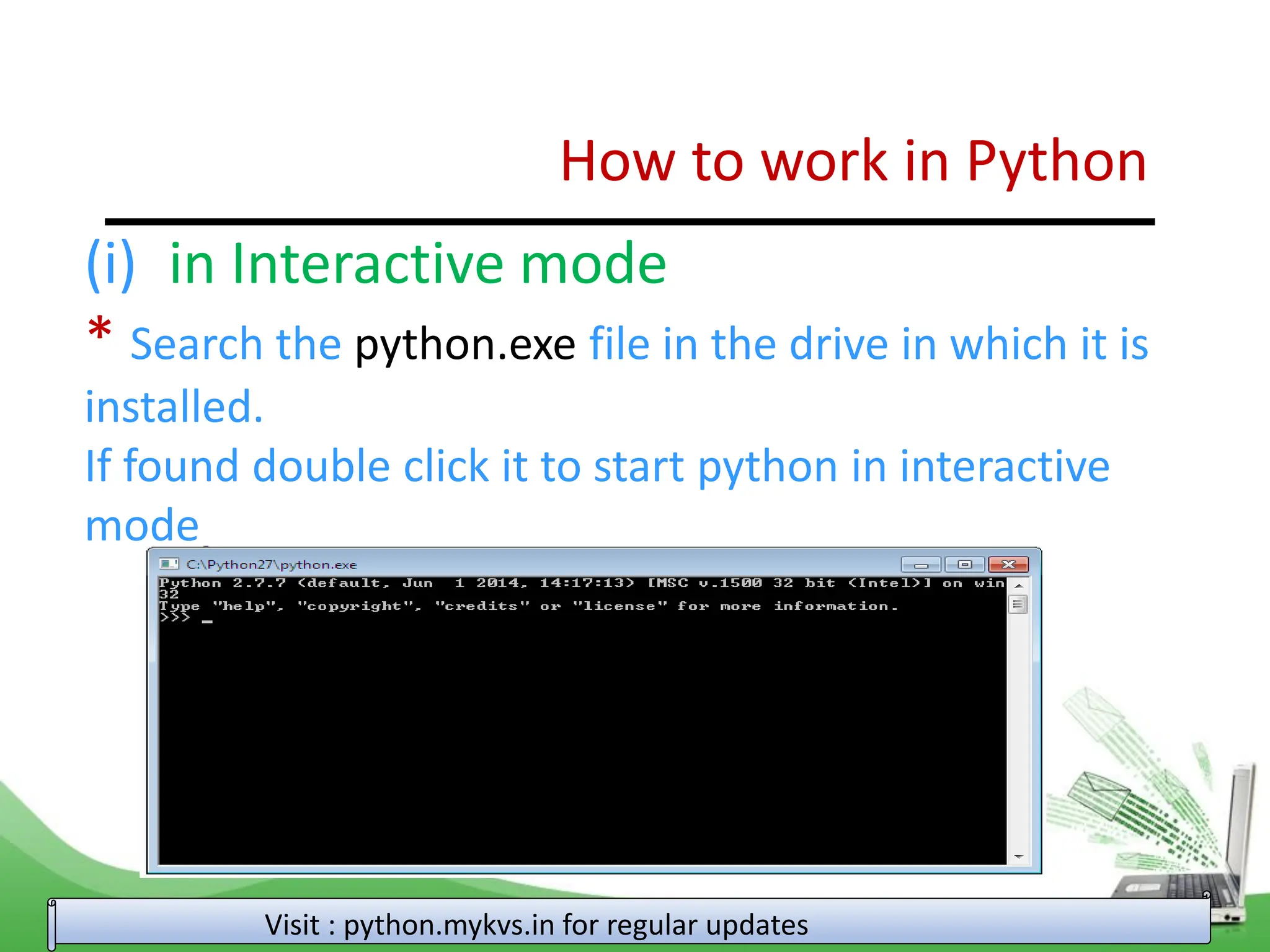
How to work in Python Visit : python.mykvs.in for regular updates (i) in Interactive mode * Search the python.exe file in the drive in which it is installed. If found double click it to start python in interactive mode
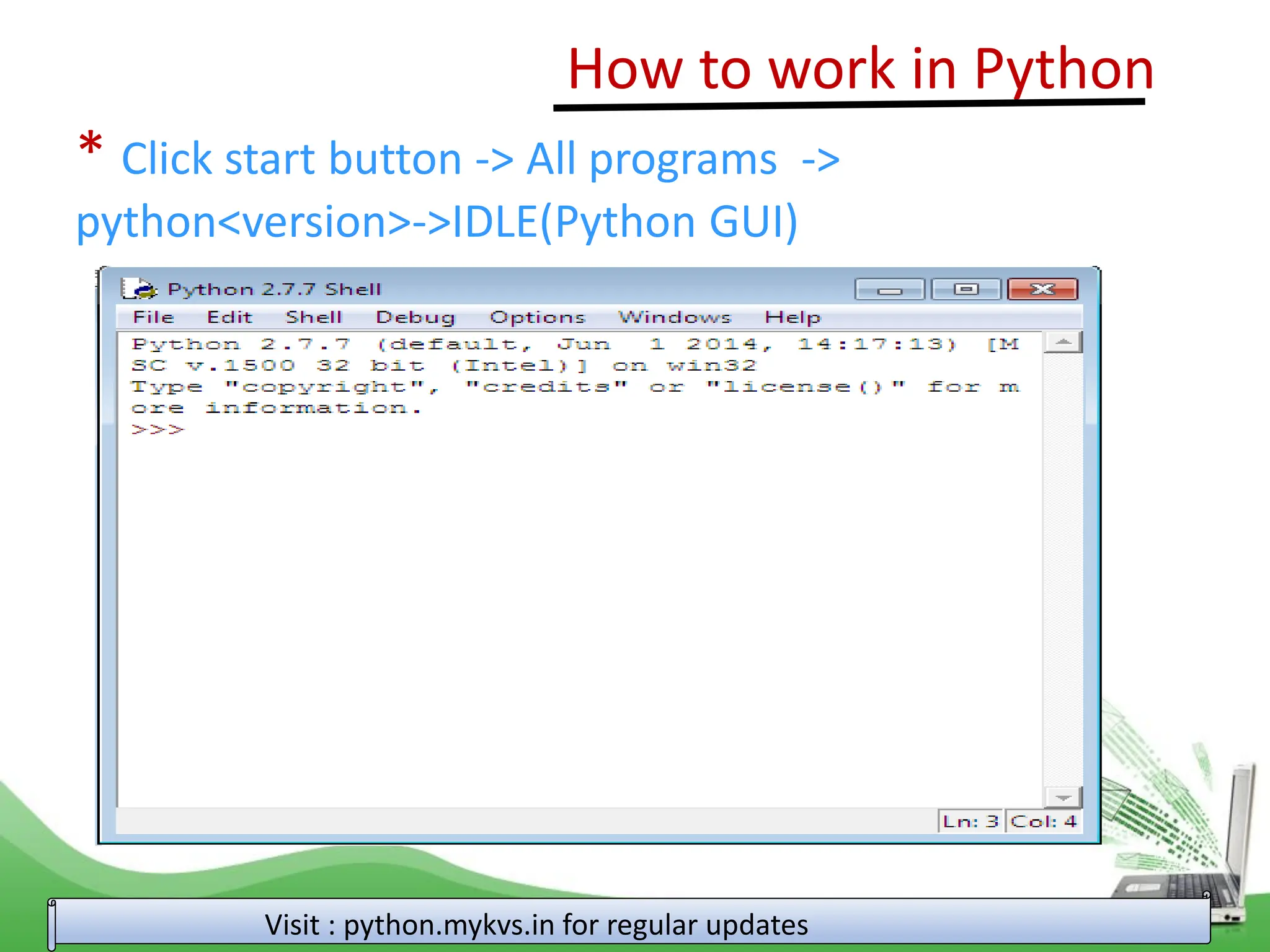
How to work in Python Visit : python.mykvs.in for regular updates * Click start button -> All programs -> python<version>->IDLE(Python GUI)
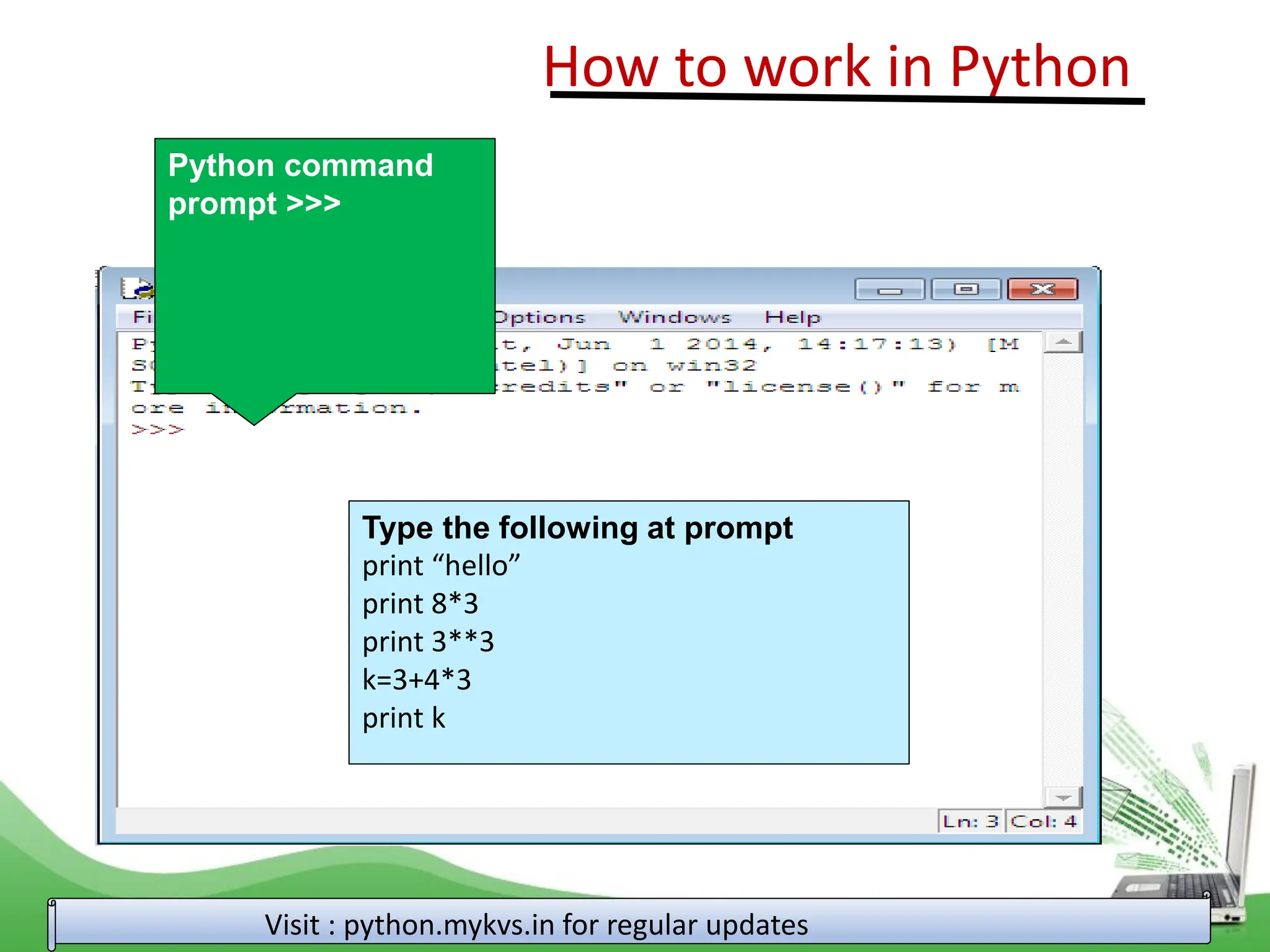
How to work in Python Visit : python.mykvs.in for regular updates Python command prompt >>> Type the following at prompt print “hello” print 8*3 print 3**3 k=3+4*3 print k
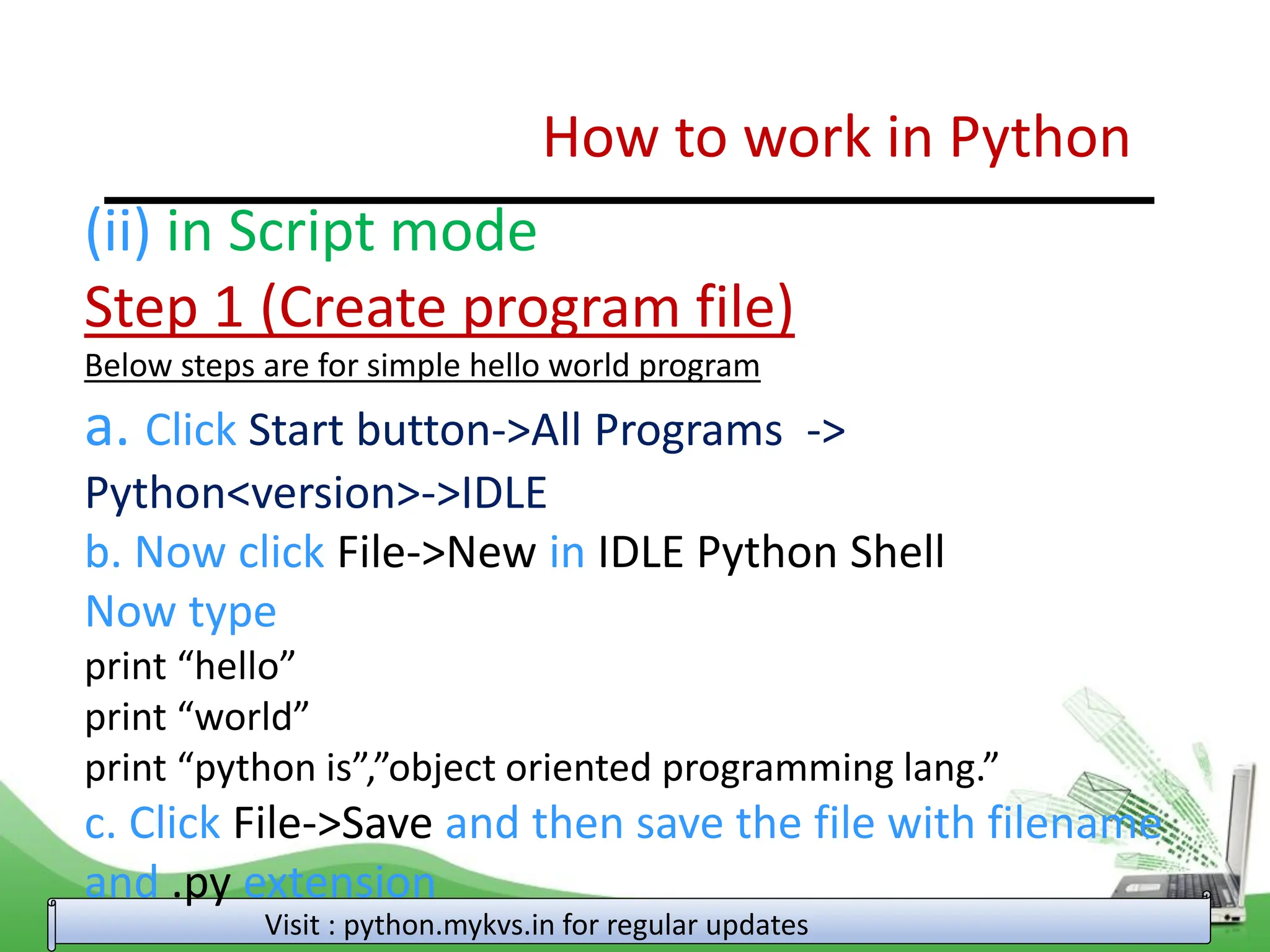
How to work in Python Visit : python.mykvs.in for regular updates (ii) in Script mode Step 1 (Create program file) Below steps are for simple hello world program a. Click Start button->All Programs -> Python<version>->IDLE b. Now click File->New in IDLE Python Shell Now type print “hello” print “world” print “python is”,”object oriented programming lang.” c. Click File->Save and then save the file with filename and .py extension
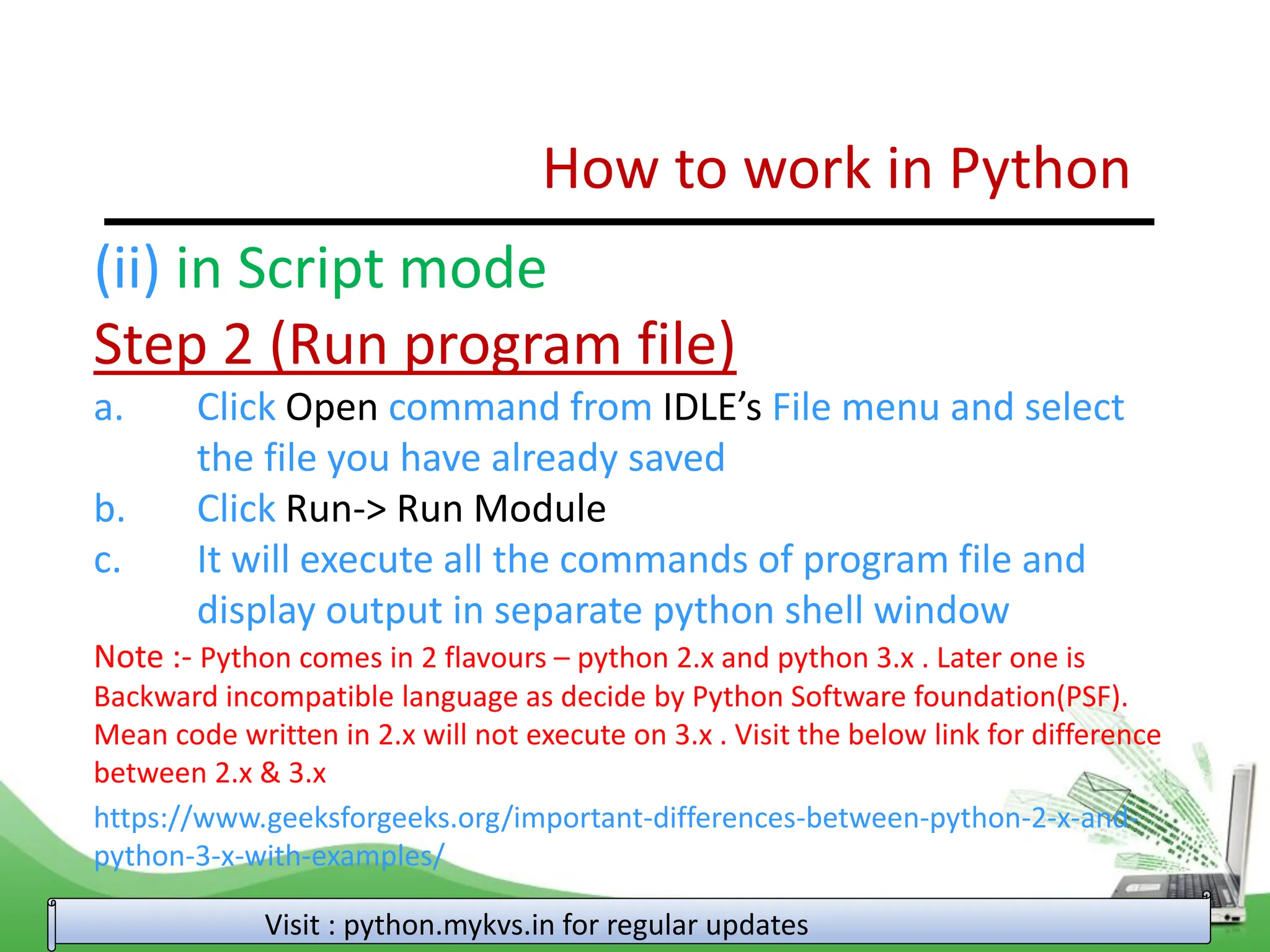
How to work in Python Visit : python.mykvs.in for regular updates (ii) in Script mode Step 2 (Run program file) a. Click Open command from IDLE’s File menu and select the file you have already saved b. Click Run-> Run Module c. It will execute all the commands of program file and display output in separate python shell window Note :- Python comes in 2 flavours – python 2.x and python 3.x . Later one is Backward incompatible language as decide by Python Software foundation(PSF). Mean code written in 2.x will not execute on 3.x . Visit the below link for difference between 2.x & 3.x https://www.geeksforgeeks.org/important-differences-between-python-2-x-and- python-3-x-with-examples/
Data Handling Most of the computer programming language support data type, variables,operator and expression like fundamentals.Python also support these. Data Types Data Type specifies which type of value a variable can store. type() function is used to determine a variable's type in Python. Visit : python.mykvs.in for regular updates
Data type continue Visit : python.mykvs.in for regular updates Data Types In Python 1. Number 2. String 3. Boolean 4. List 5. Tuple 6. Set 7. Dictionary
Data type continue Visit : python.mykvs.in for regular updates 1. Number In Python It is used to store numeric values Python has three numeric types: 1. Integers 2. Floating point numbers 3. Complex numbers.
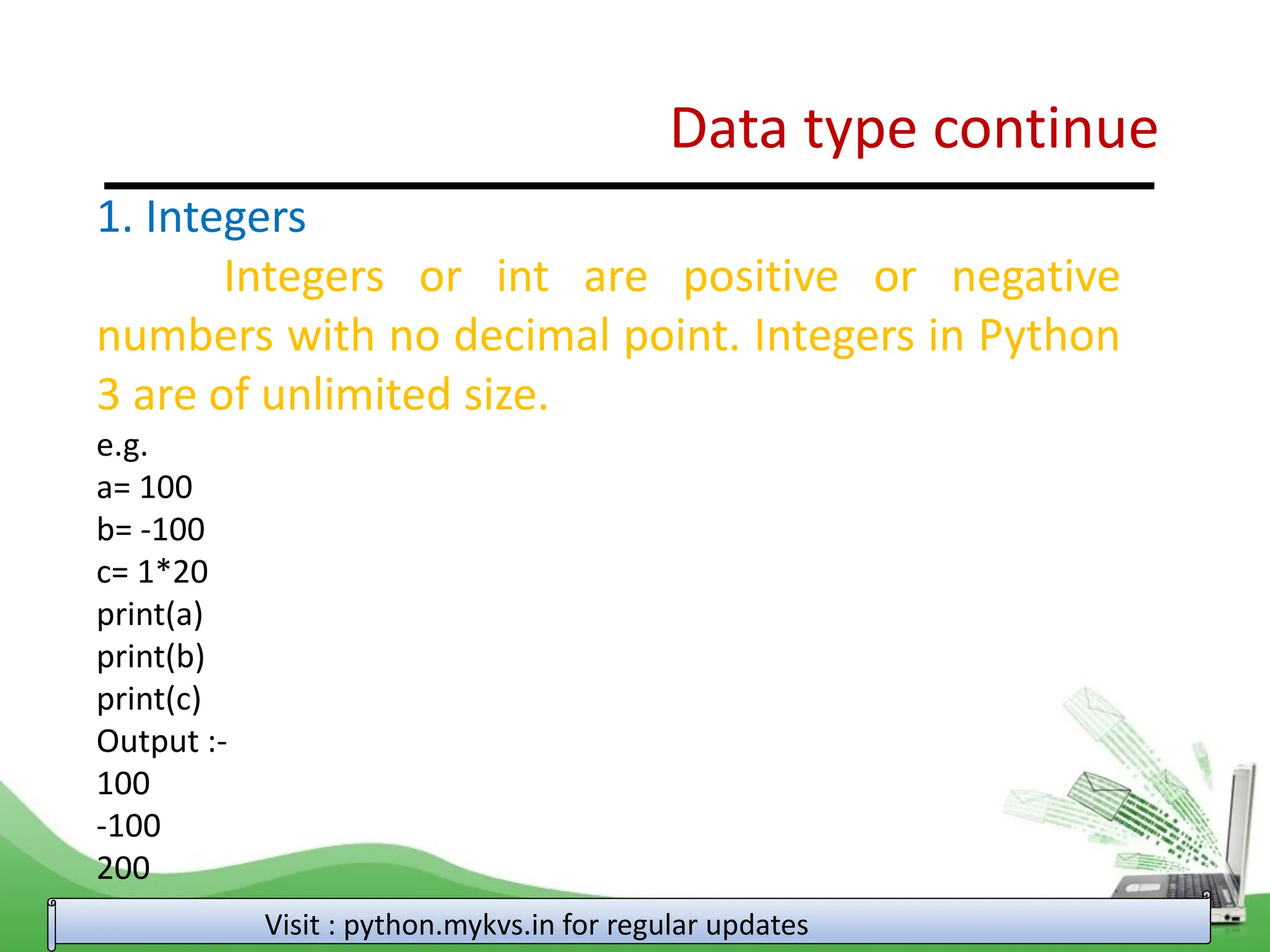
Data type continue Visit : python.mykvs.in for regular updates 1. Integers Integers or int are positive or negative numbers with no decimal point. Integers in Python 3 are of unlimited size. e.g. a= 100 b= -100 c= 1*20 print(a) print(b) print(c) Output :- 100 -100 200
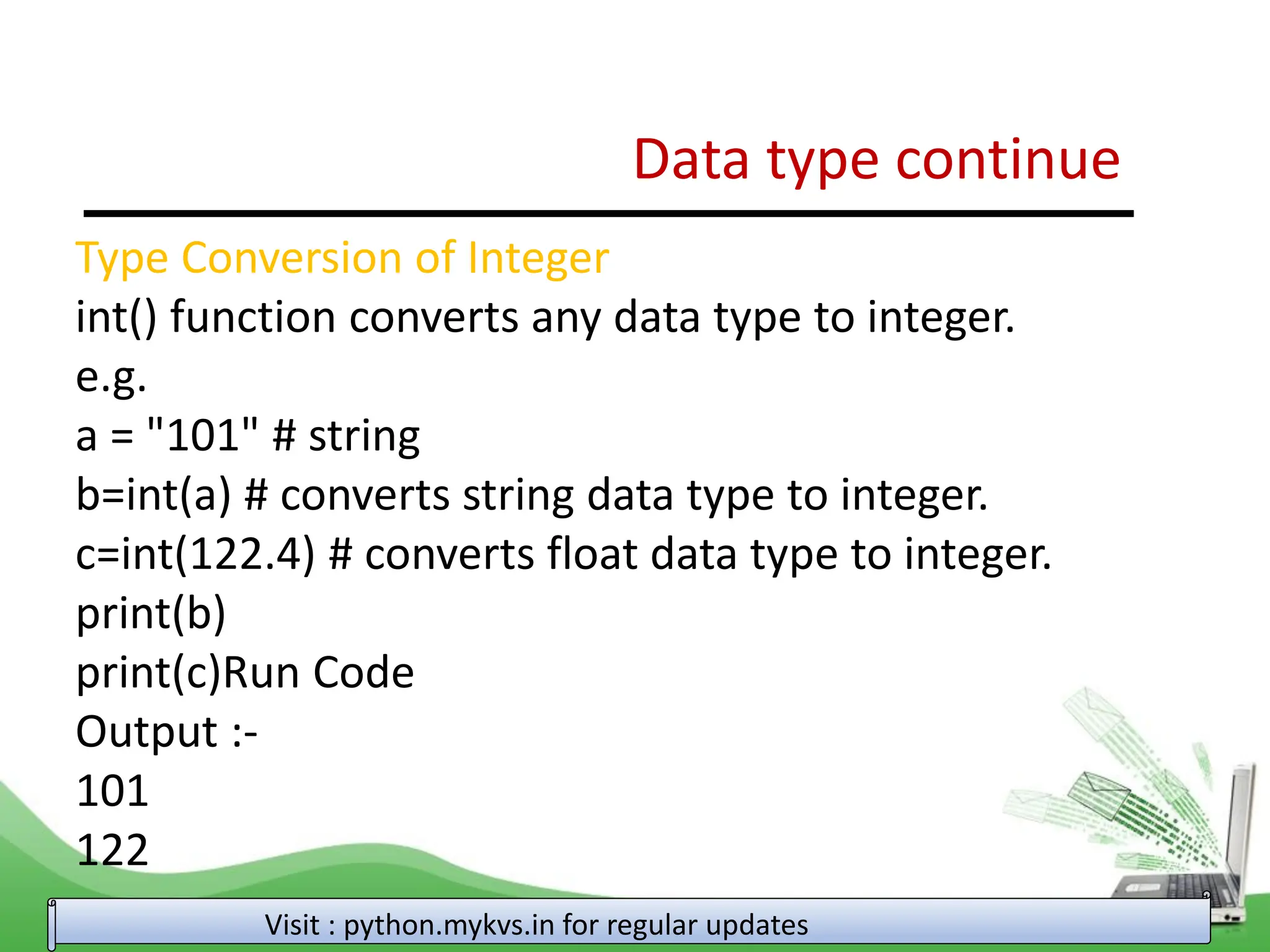
Data type continue Visit : python.mykvs.in for regular updates Type Conversion of Integer int() function converts any data type to integer. e.g. a = "101" # string b=int(a) # converts string data type to integer. c=int(122.4) # converts float data type to integer. print(b) print(c)Run Code Output :- 101 122
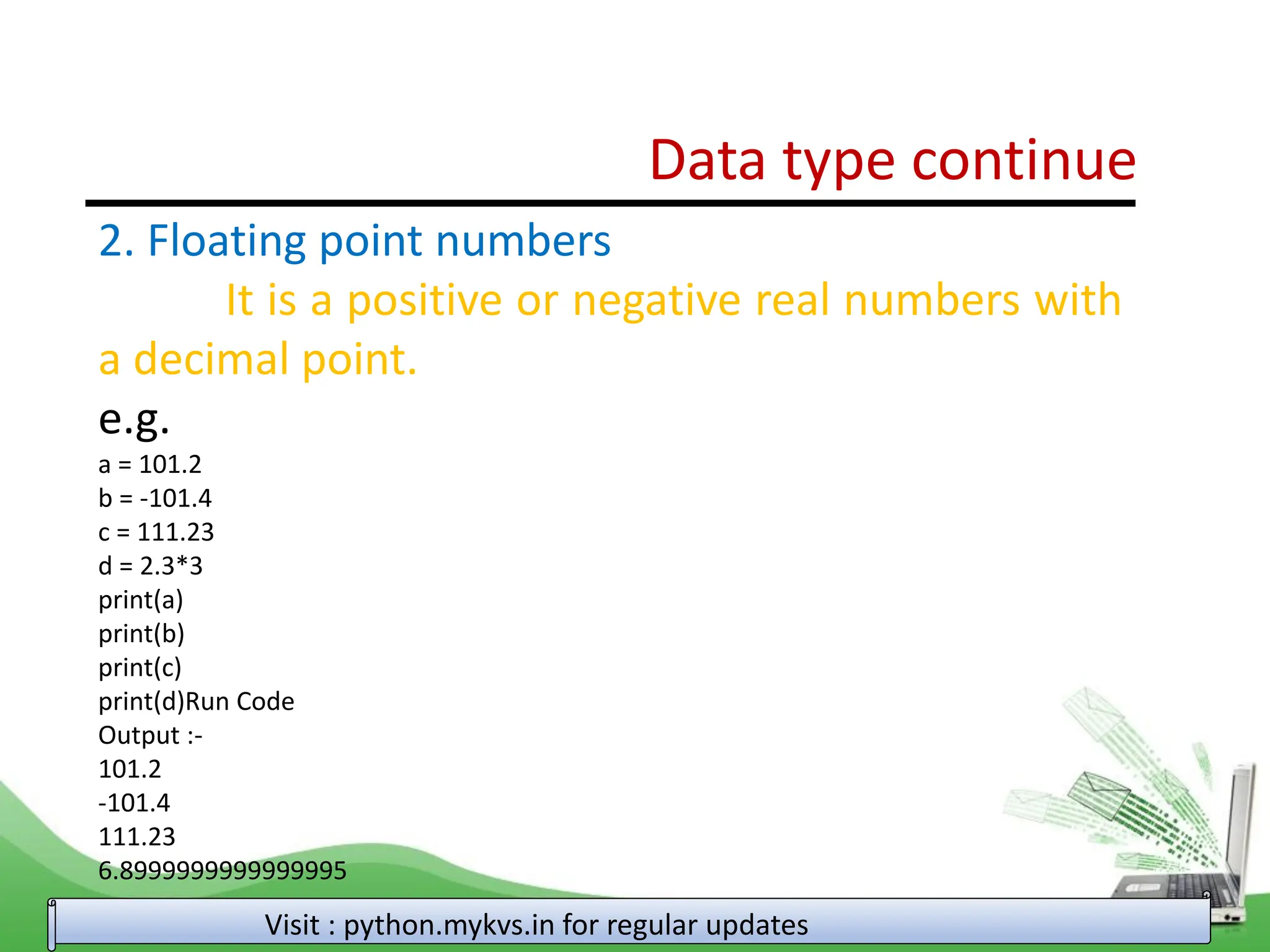
Data type continue Visit : python.mykvs.in for regular updates 2. Floating point numbers It is a positive or negative real numbers with a decimal point. e.g. a = 101.2 b = -101.4 c = 111.23 d = 2.3*3 print(a) print(b) print(c) print(d)Run Code Output :- 101.2 -101.4 111.23 6.8999999999999995
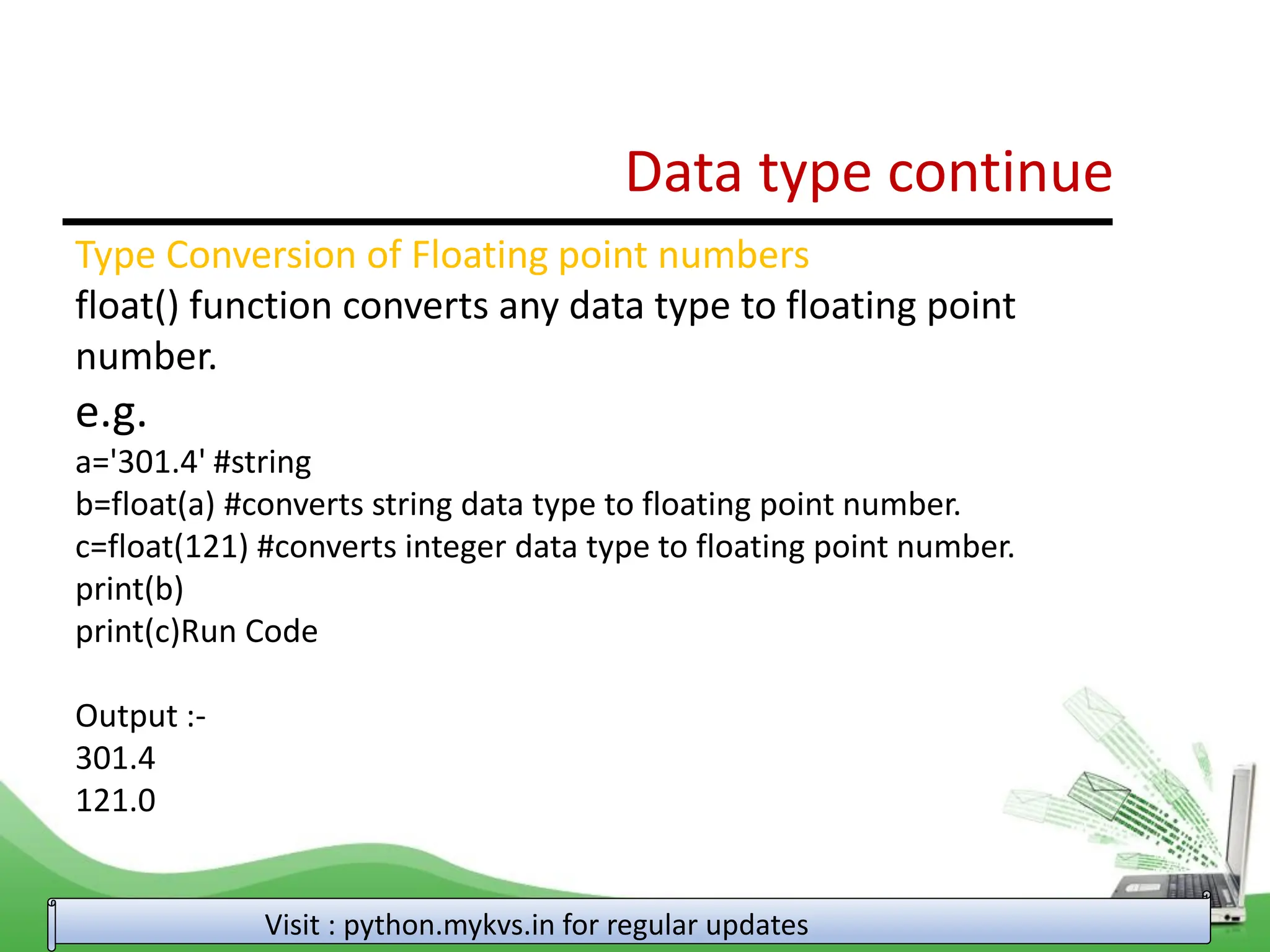
Data type continue Visit : python.mykvs.in for regular updates Type Conversion of Floating point numbers float() function converts any data type to floating point number. e.g. a='301.4' #string b=float(a) #converts string data type to floating point number. c=float(121) #converts integer data type to floating point number. print(b) print(c)Run Code Output :- 301.4 121.0
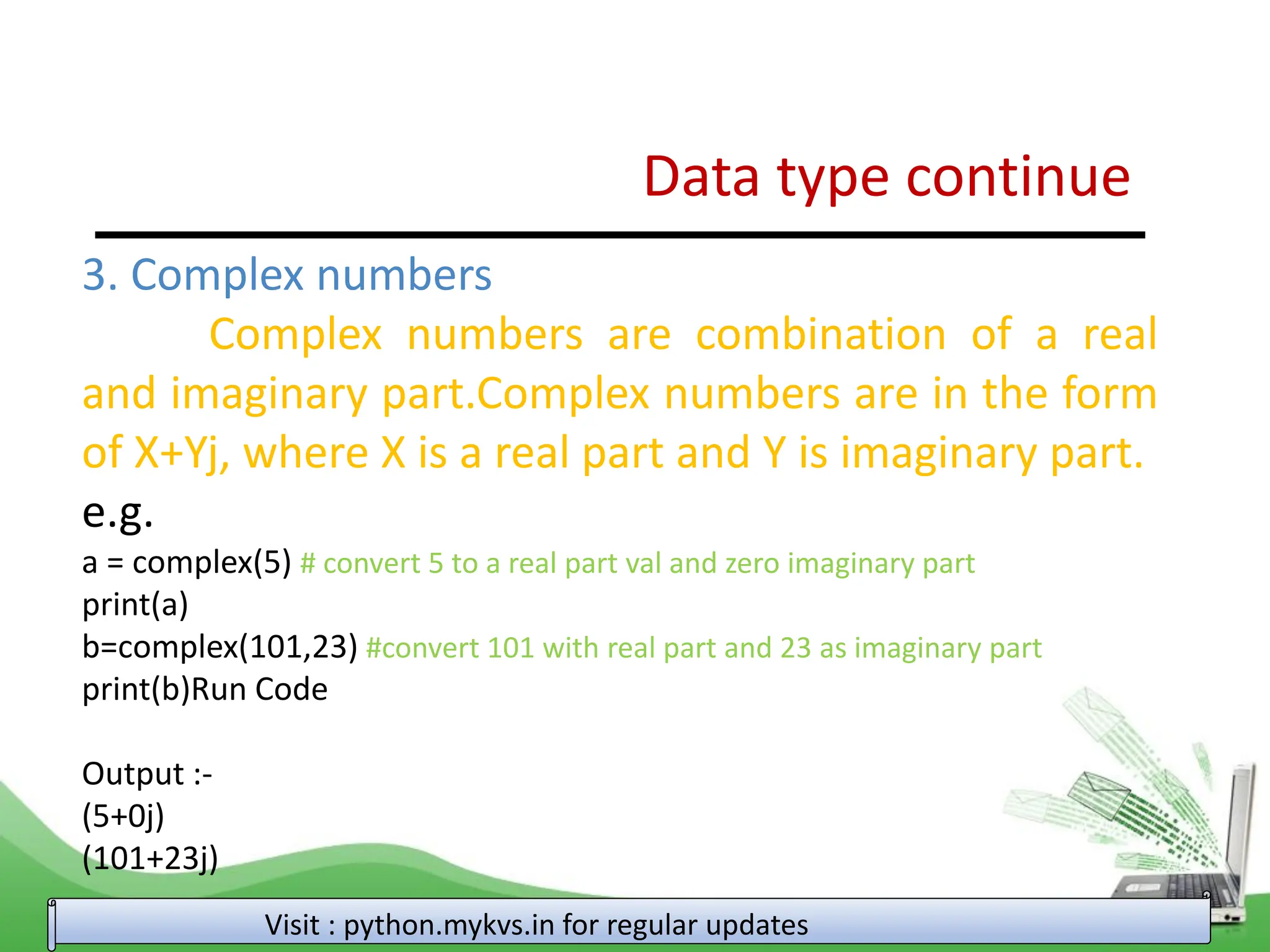
Data type continue Visit : python.mykvs.in for regular updates 3. Complex numbers Complex numbers are combination of a real and imaginary part.Complex numbers are in the form of X+Yj, where X is a real part and Y is imaginary part. e.g. a = complex(5) # convert 5 to a real part val and zero imaginary part print(a) b=complex(101,23) #convert 101 with real part and 23 as imaginary part print(b)Run Code Output :- (5+0j) (101+23j)
Data type continue Visit : python.mykvs.in for regular updates 2. String In Python A string is a sequence of characters. In python we can create string using single (' ') or double quotes (" ").Both are same in python. e.g. str='computer science' print('str-', str) # print string print('str[0]-', str[0]) # print first char 'h' print('str[1:3]-', str[1:3]) # print string from postion 1 to 3 'ell' print('str[3:]-', str[3:]) # print string staring from 3rd char 'llo world' print('str *2-', str *2 ) # print string two times print("str +'yes'-", str +'yes') # concatenated string Output str- computer science str[0]- c str[1:3]- om str[3:]- puter science str *2- computer sciencecomputer science str +'yes'- computer scienceyes
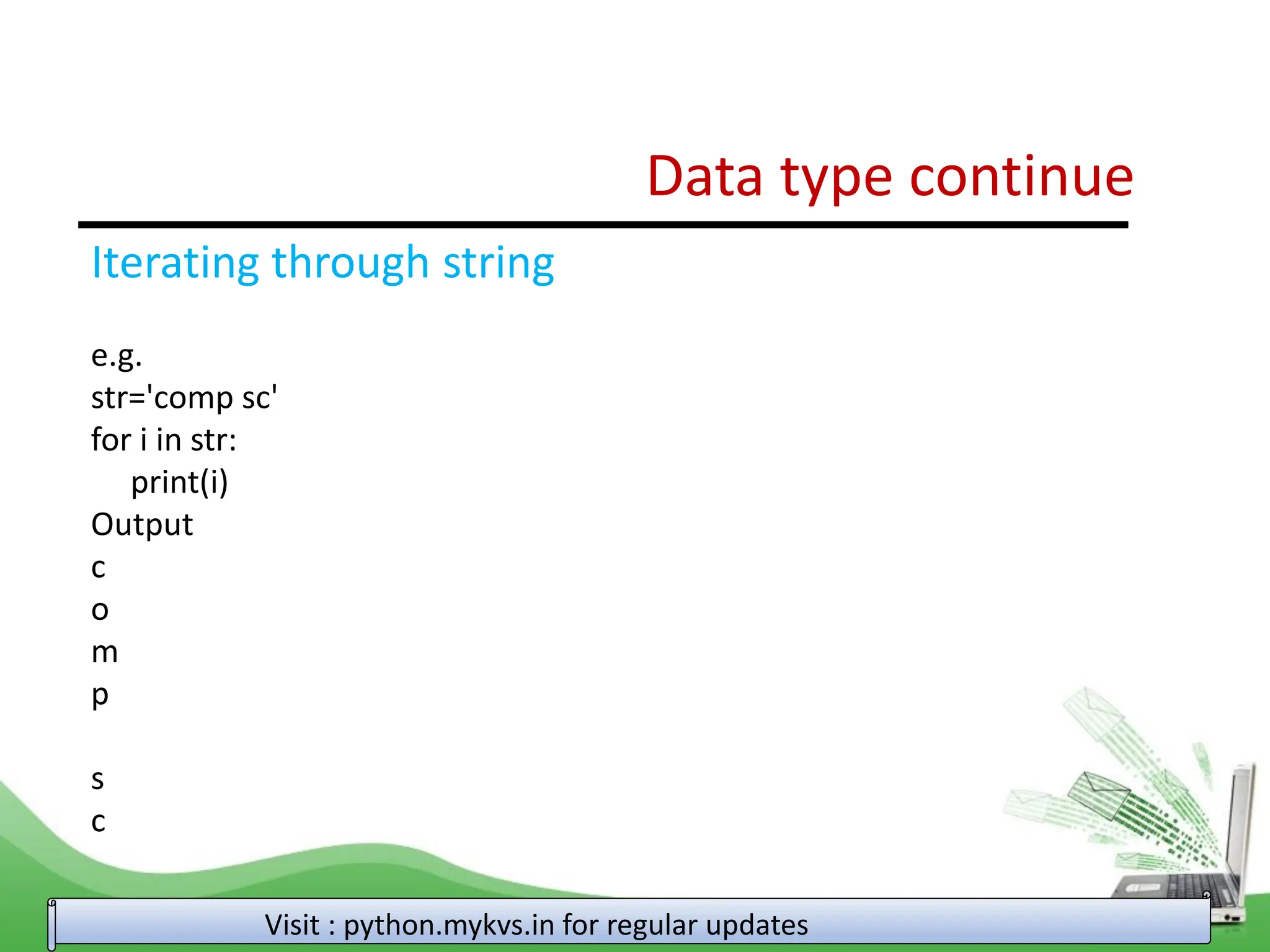
Data type continue Visit : python.mykvs.in for regular updates Iterating through string e.g. str='comp sc' for i in str: print(i) Output c o m p s c
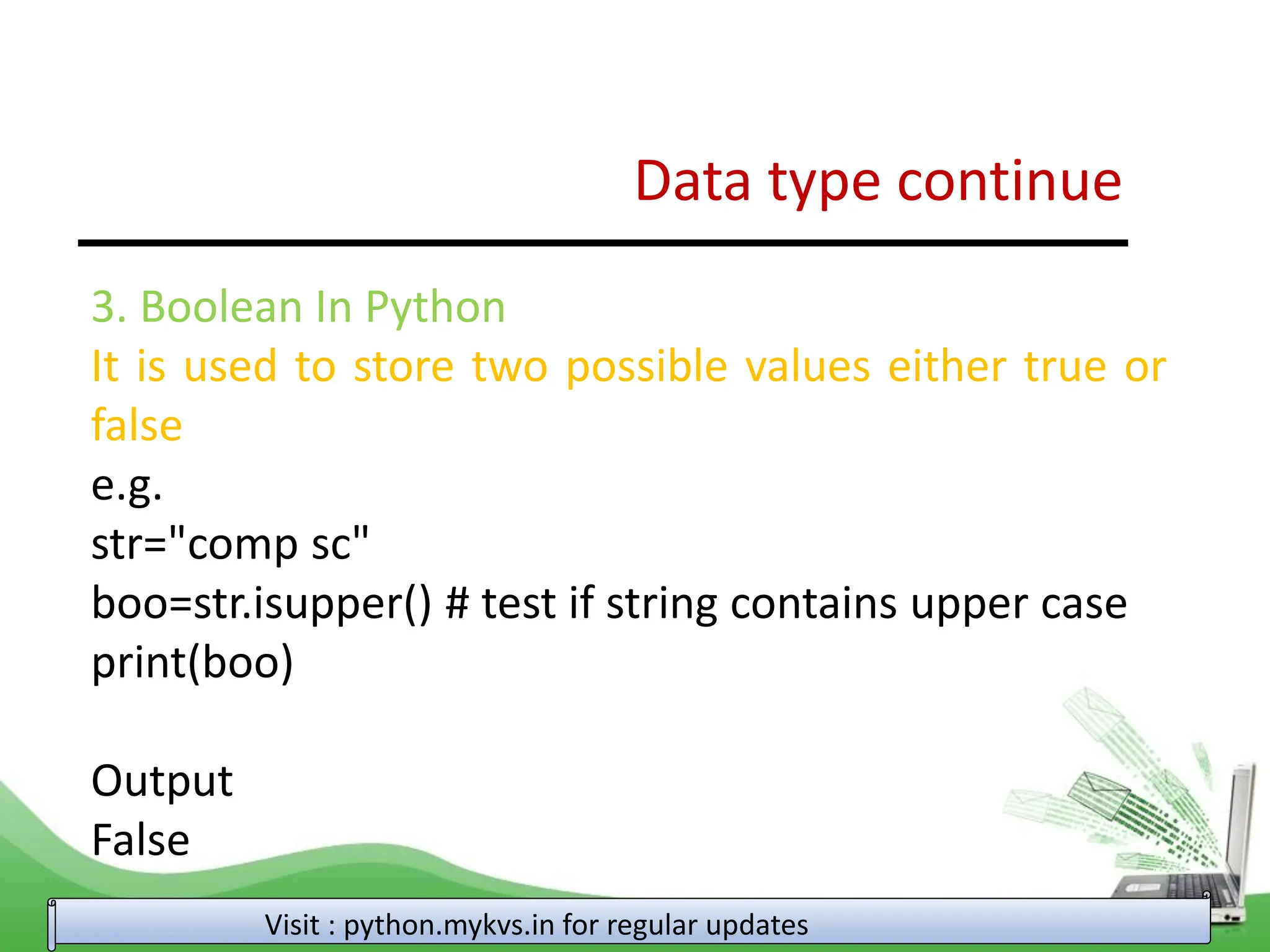
Data type continue Visit : python.mykvs.in for regular updates 3. Boolean In Python It is used to store two possible values either true or false e.g. str="comp sc" boo=str.isupper() # test if string contains upper case print(boo) Output False
Data type continue Visit : python.mykvs.in for regular updates 4.List In Python List are collections of items and each item has its own index value. 5. Tuple In Python List and tuple, both are same except ,a list is mutable python objects and tuple is immutable Python objects. Immutable Python objects mean you cannot modify the contents of a tuple once it is assigned. e.g. of list list =[6,9] list[0]=55 print(list[0]) print(list[1]) OUTPUT 55 9 e.g. of tuple tup=(66,99) Tup[0]=3 # error message will be displayed print(tup[0]) print(tup[1])
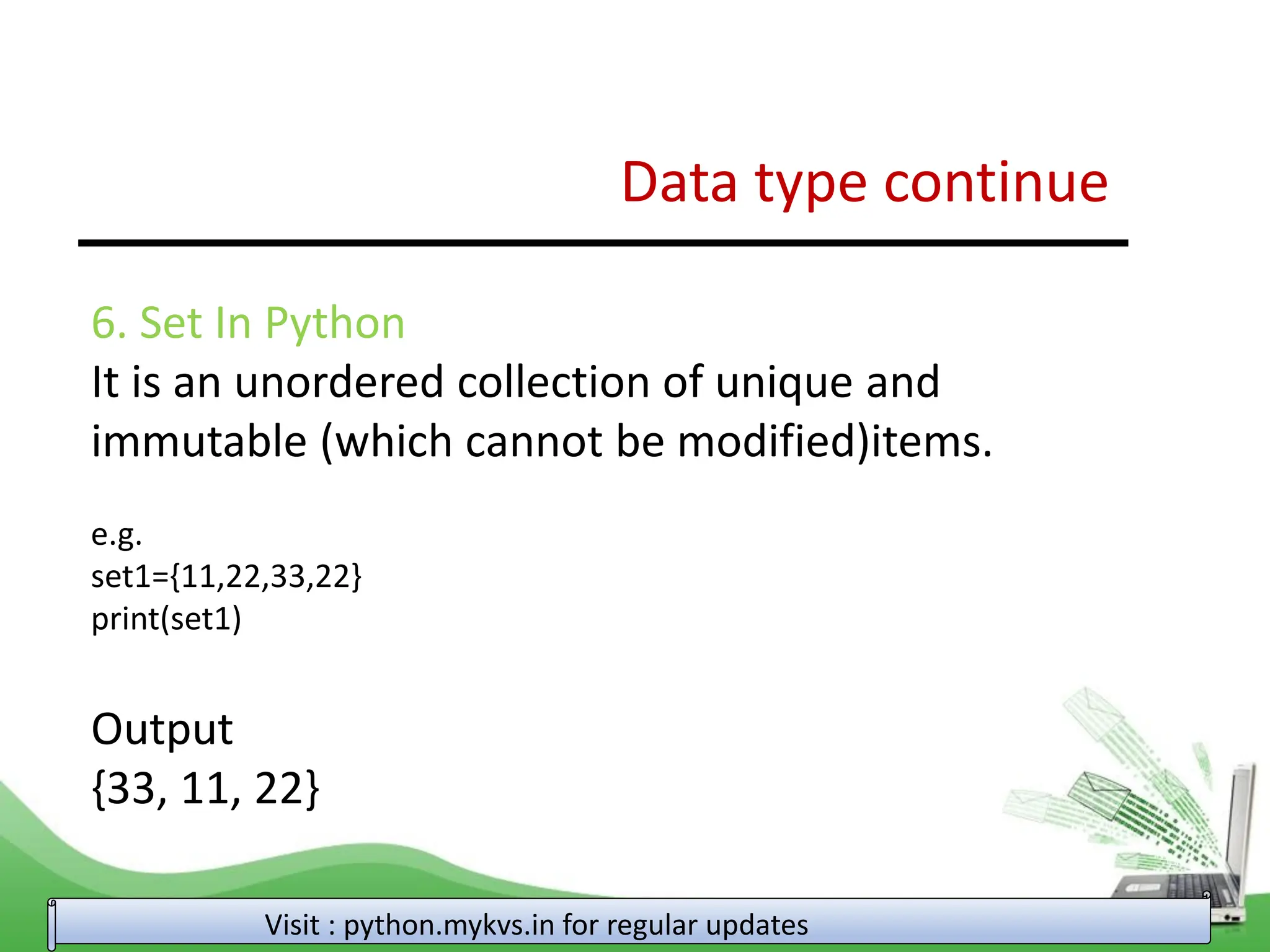
Data type continue Visit : python.mykvs.in for regular updates 6. Set In Python It is an unordered collection of unique and immutable (which cannot be modified)items. e.g. set1={11,22,33,22} print(set1) Output {33, 11, 22}
Data type continue Visit : python.mykvs.in for regular updates 7. Dictionary In Python It is an unordered collection of items and each item consist of a key and a value. e.g. dict = {'Subject': 'comp sc', 'class': '11'} print(dict) print ("Subject : ", dict['Subject']) print ("class : ", dict.get('class')) Output {'Subject': 'comp sc', 'class': '11'} Subject : comp sc class : 11
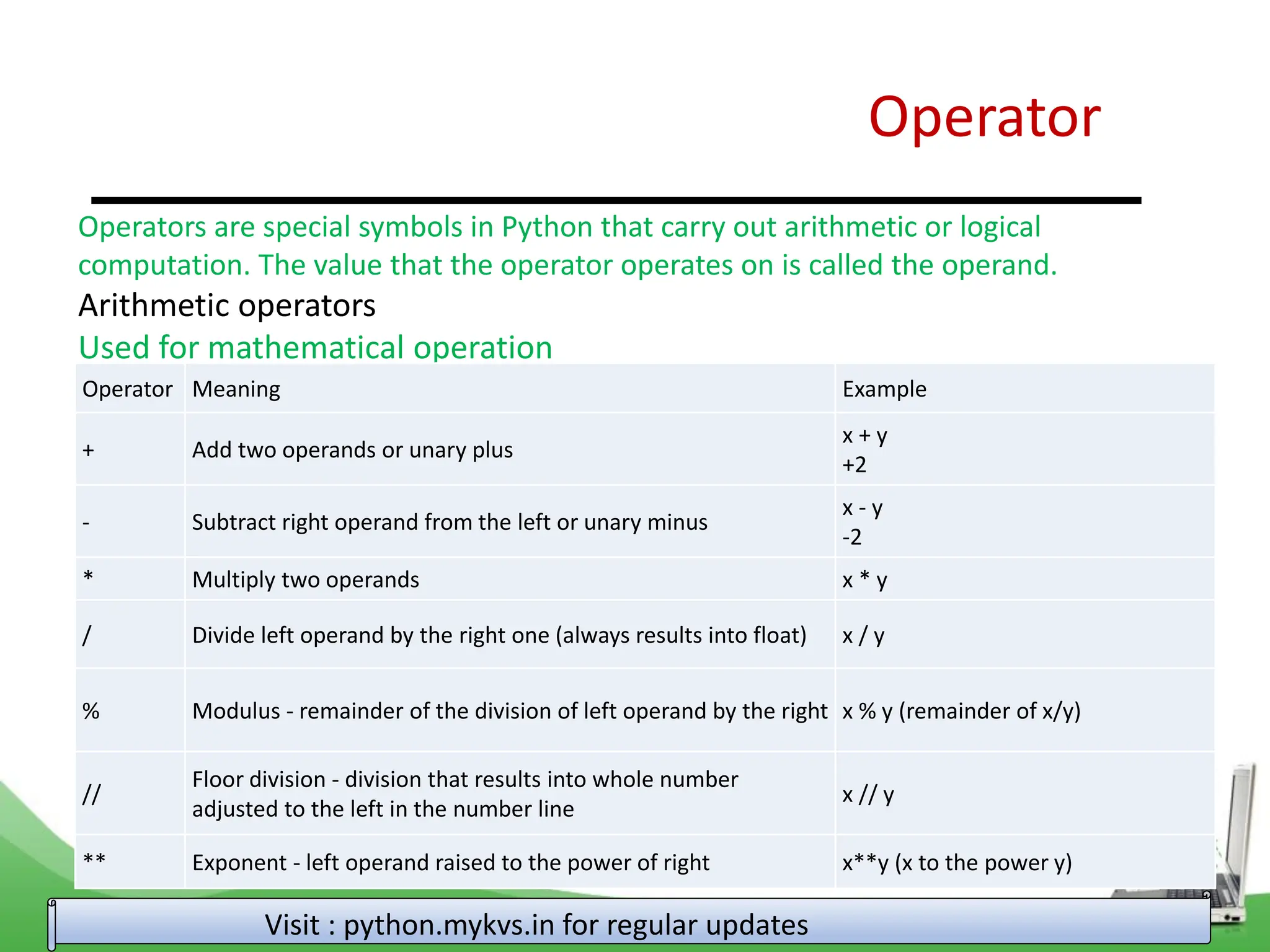
Operator Visit : python.mykvs.in for regular updates Operators are special symbols in Python that carry out arithmetic or logical computation. The value that the operator operates on is called the operand. Arithmetic operators Used for mathematical operation Operator Meaning Example + Add two operands or unary plus x + y +2 - Subtract right operand from the left or unary minus x - y -2 * Multiply two operands x * y / Divide left operand by the right one (always results into float) x / y % Modulus - remainder of the division of left operand by the right x % y (remainder of x/y) // Floor division - division that results into whole number adjusted to the left in the number line x // y ** Exponent - left operand raised to the power of right x**y (x to the power y)
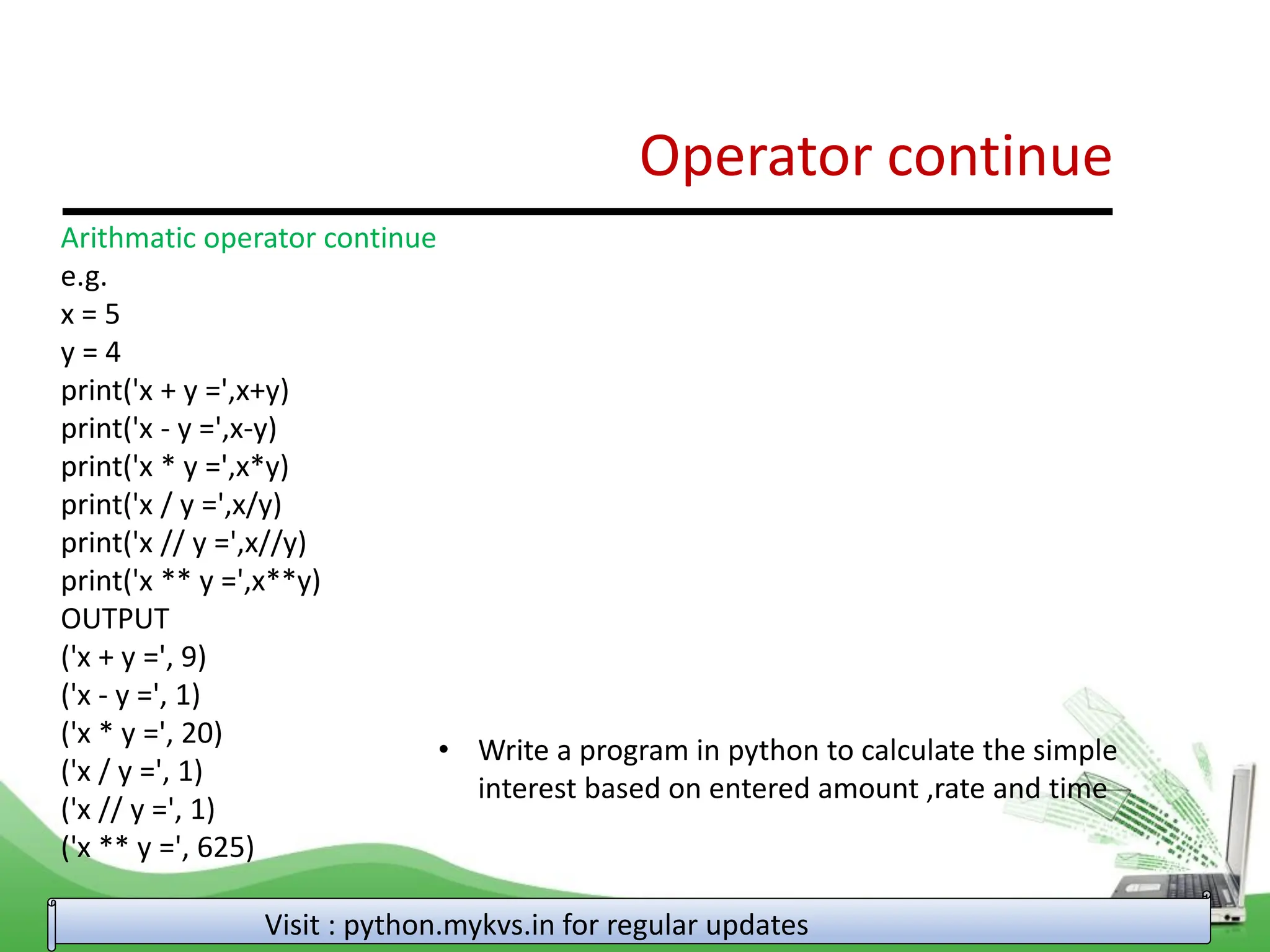
Operator continue Visit : python.mykvs.in for regular updates Arithmatic operator continue e.g. x = 5 y = 4 print('x + y =',x+y) print('x - y =',x-y) print('x * y =',x*y) print('x / y =',x/y) print('x // y =',x//y) print('x ** y =',x**y) OUTPUT ('x + y =', 9) ('x - y =', 1) ('x * y =', 20) ('x / y =', 1) ('x // y =', 1) ('x ** y =', 625) • Write a program in python to calculate the simple interest based on entered amount ,rate and time
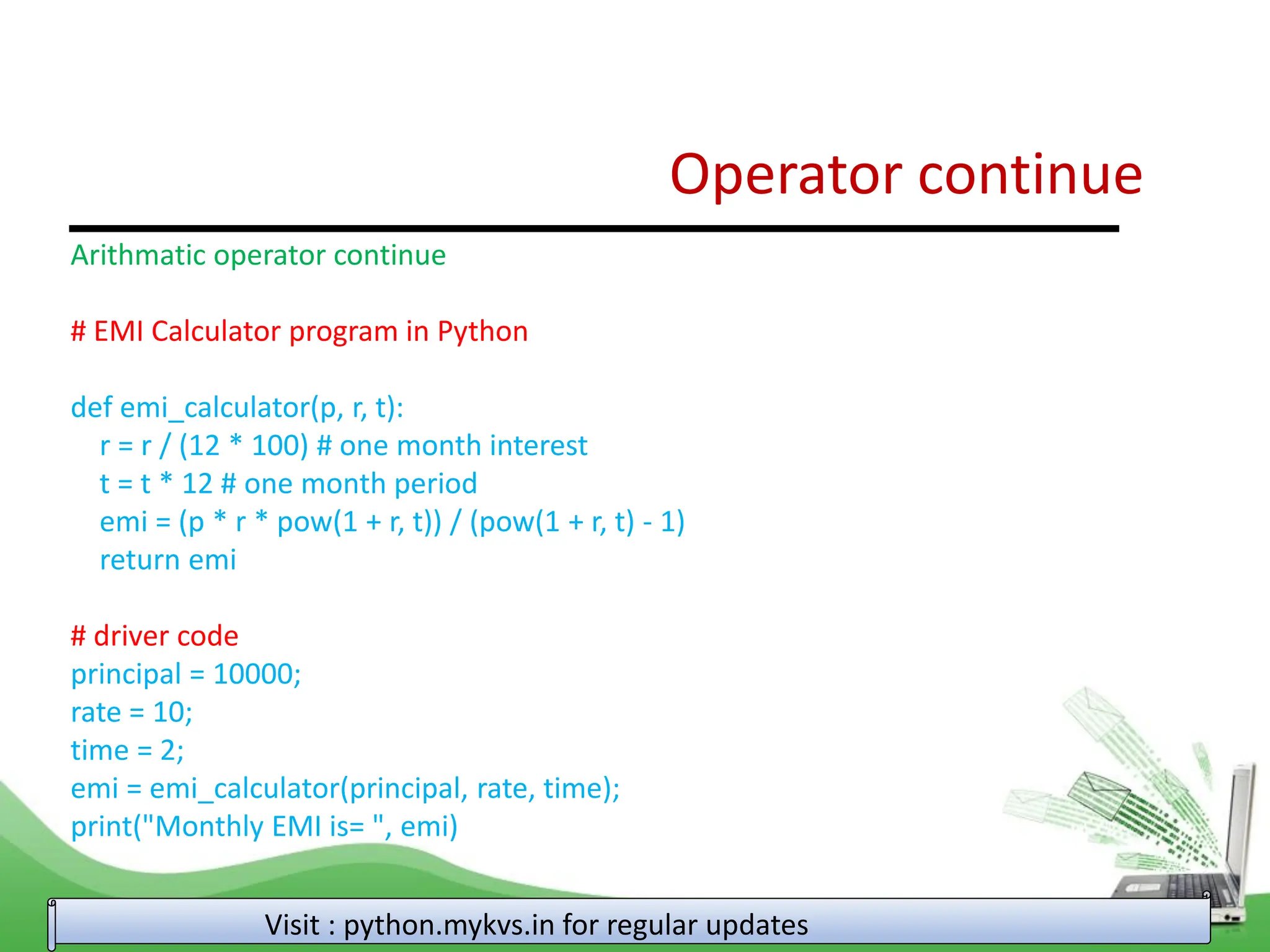
Operator continue Visit : python.mykvs.in for regular updates Arithmatic operator continue # EMI Calculator program in Python def emi_calculator(p, r, t): r = r / (12 * 100) # one month interest t = t * 12 # one month period emi = (p * r * pow(1 + r, t)) / (pow(1 + r, t) - 1) return emi # driver code principal = 10000; rate = 10; time = 2; emi = emi_calculator(principal, rate, time); print("Monthly EMI is= ", emi)
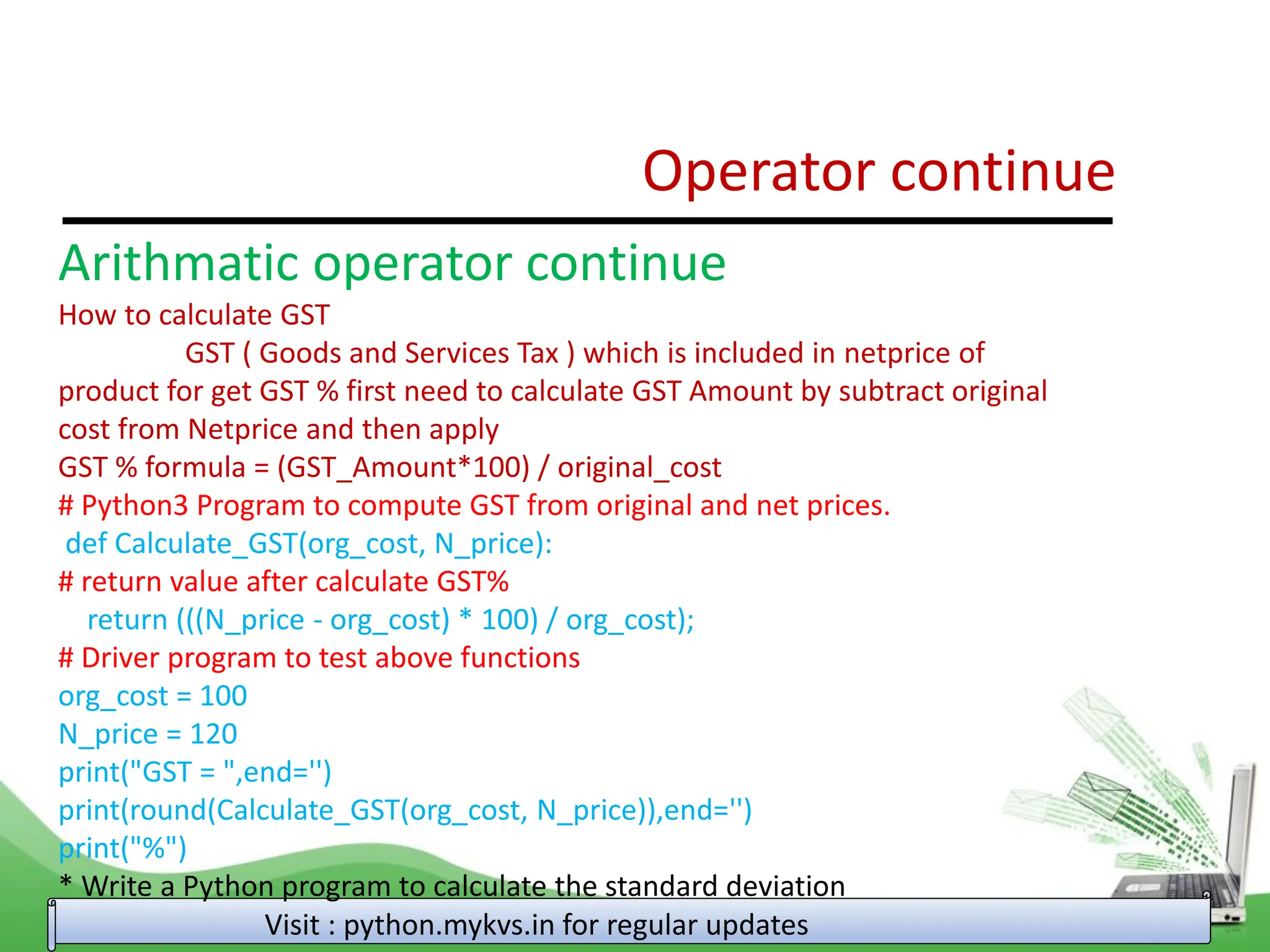
Operator continue Visit : python.mykvs.in for regular updates Arithmatic operator continue How to calculate GST GST ( Goods and Services Tax ) which is included in netprice of product for get GST % first need to calculate GST Amount by subtract original cost from Netprice and then apply GST % formula = (GST_Amount*100) / original_cost # Python3 Program to compute GST from original and net prices. def Calculate_GST(org_cost, N_price): # return value after calculate GST% return (((N_price - org_cost) * 100) / org_cost); # Driver program to test above functions org_cost = 100 N_price = 120 print("GST = ",end='') print(round(Calculate_GST(org_cost, N_price)),end='') print("%") * Write a Python program to calculate the standard deviation
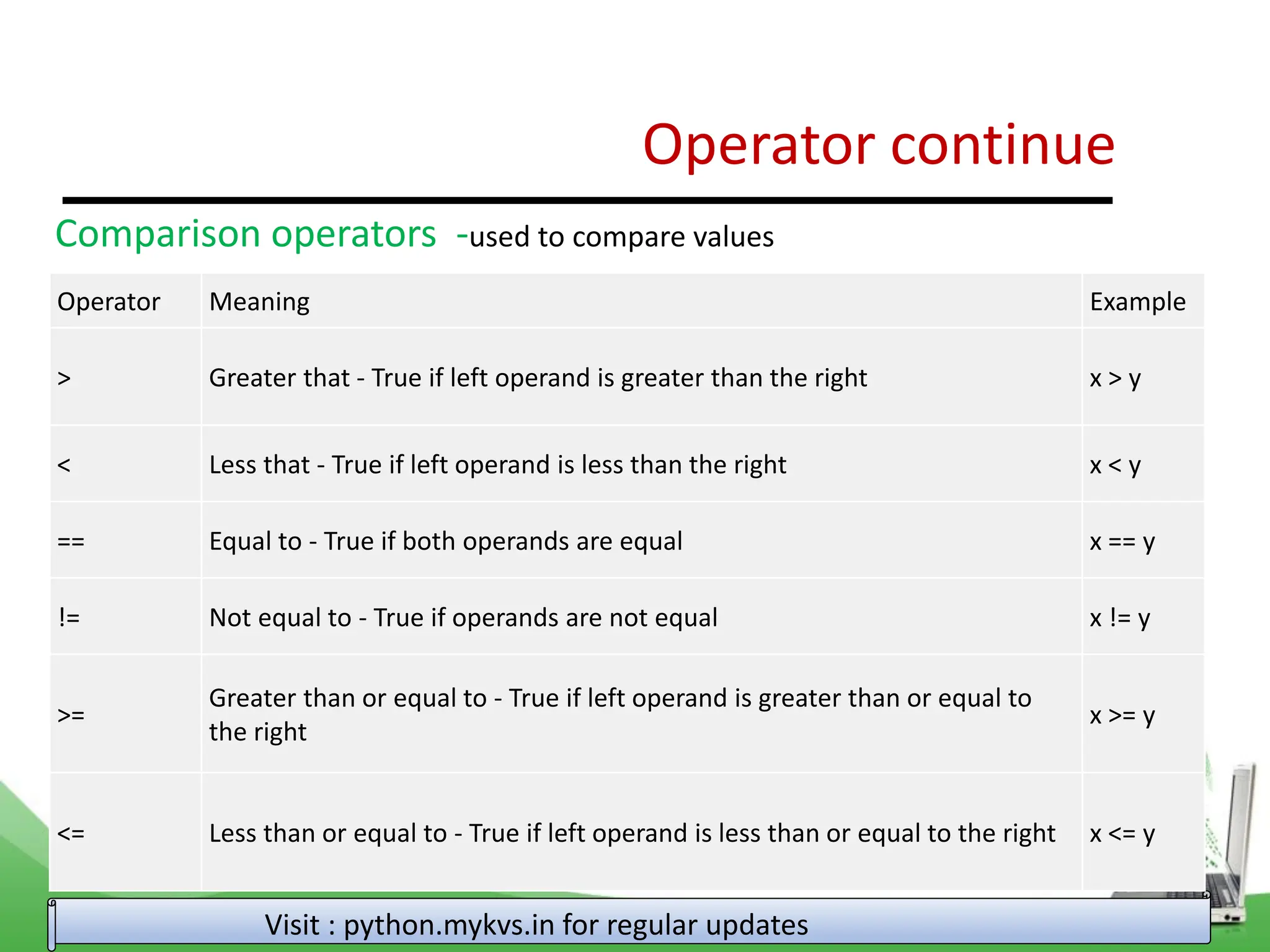
Operator continue Visit : python.mykvs.in for regular updates Comparison operators -used to compare values Operator Meaning Example > Greater that - True if left operand is greater than the right x > y < Less that - True if left operand is less than the right x < y == Equal to - True if both operands are equal x == y != Not equal to - True if operands are not equal x != y >= Greater than or equal to - True if left operand is greater than or equal to the right x >= y <= Less than or equal to - True if left operand is less than or equal to the right x <= y
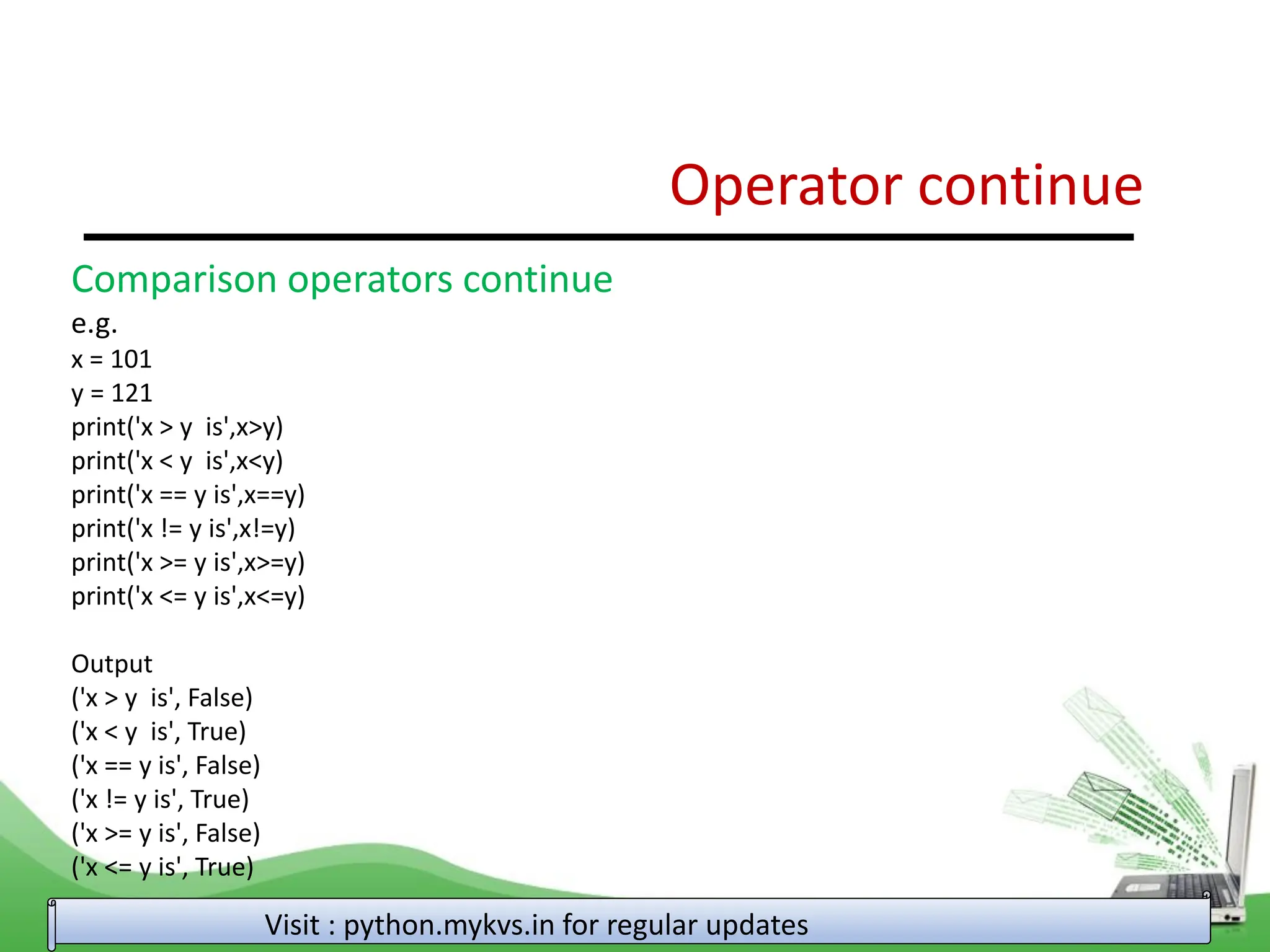
Operator continue Visit : python.mykvs.in for regular updates Comparison operators continue e.g. x = 101 y = 121 print('x > y is',x>y) print('x < y is',x<y) print('x == y is',x==y) print('x != y is',x!=y) print('x >= y is',x>=y) print('x <= y is',x<=y) Output ('x > y is', False) ('x < y is', True) ('x == y is', False) ('x != y is', True) ('x >= y is', False) ('x <= y is', True)
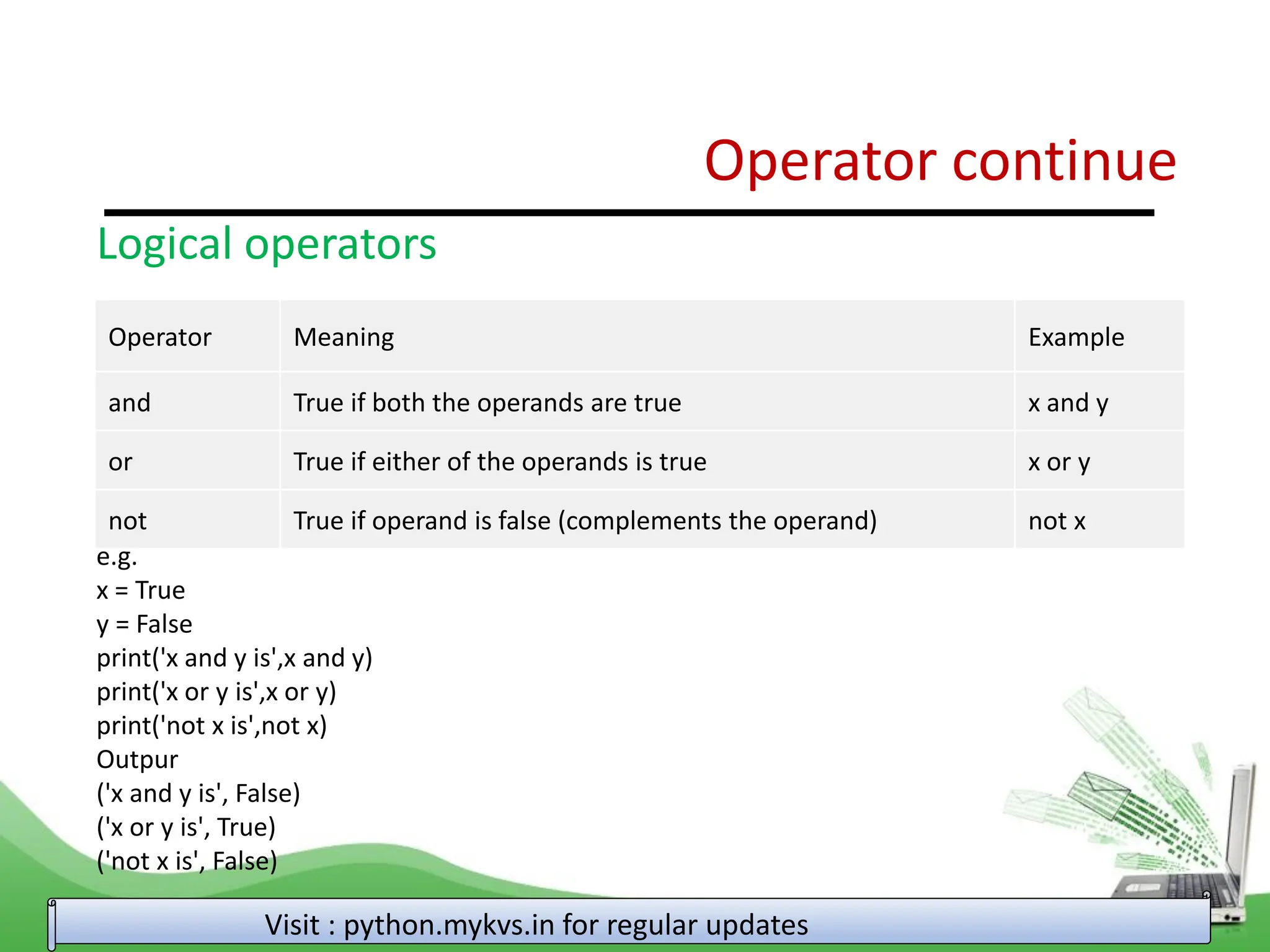
Operator continue Visit : python.mykvs.in for regular updates Logical operators e.g. x = True y = False print('x and y is',x and y) print('x or y is',x or y) print('not x is',not x) Outpur ('x and y is', False) ('x or y is', True) ('not x is', False) Operator Meaning Example and True if both the operands are true x and y or True if either of the operands is true x or y not True if operand is false (complements the operand) not x
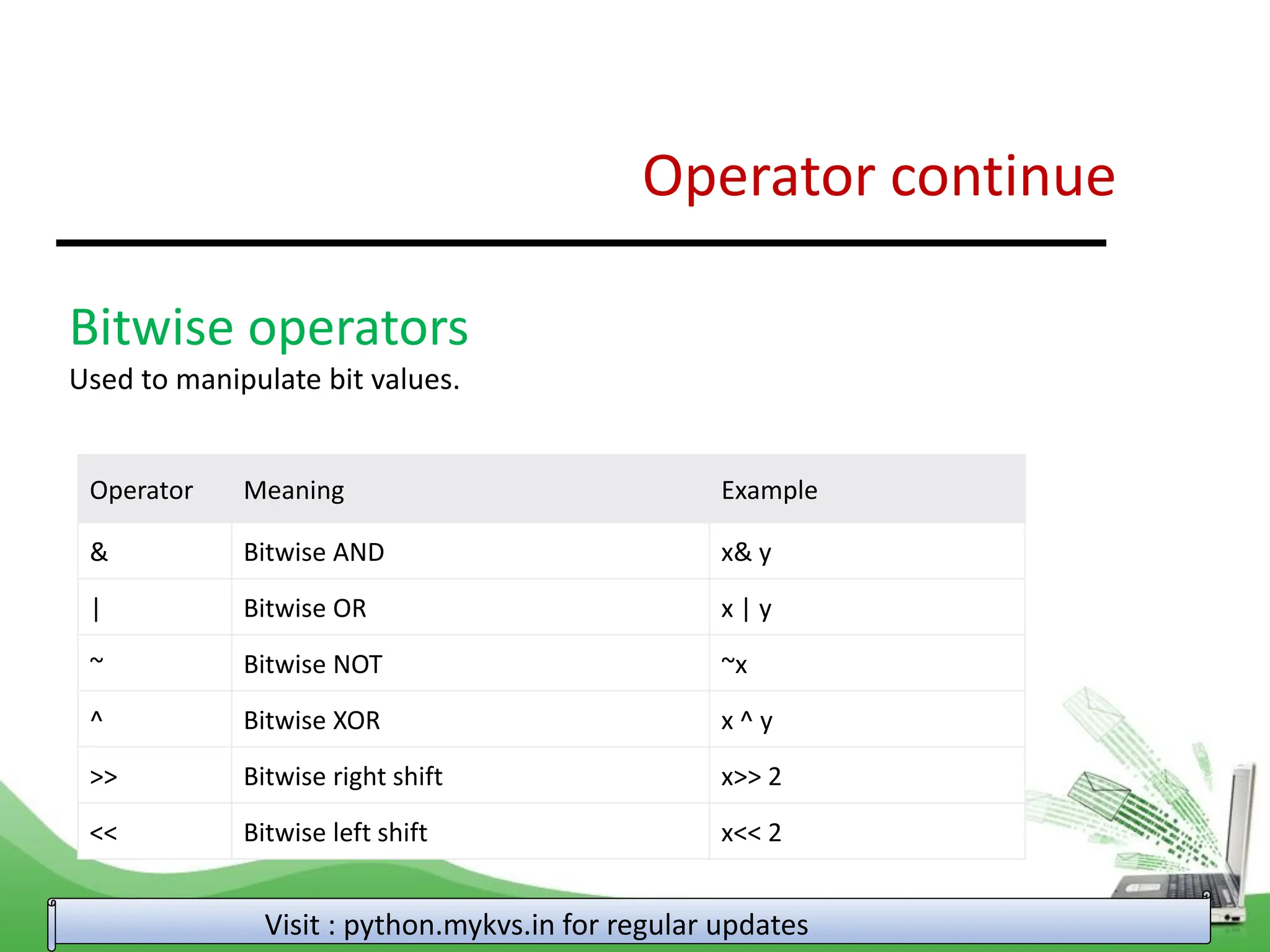
Operator continue Visit : python.mykvs.in for regular updates Bitwise operators Used to manipulate bit values. Operator Meaning Example & Bitwise AND x& y | Bitwise OR x | y ~ Bitwise NOT ~x ^ Bitwise XOR x ^ y >> Bitwise right shift x>> 2 << Bitwise left shift x<< 2
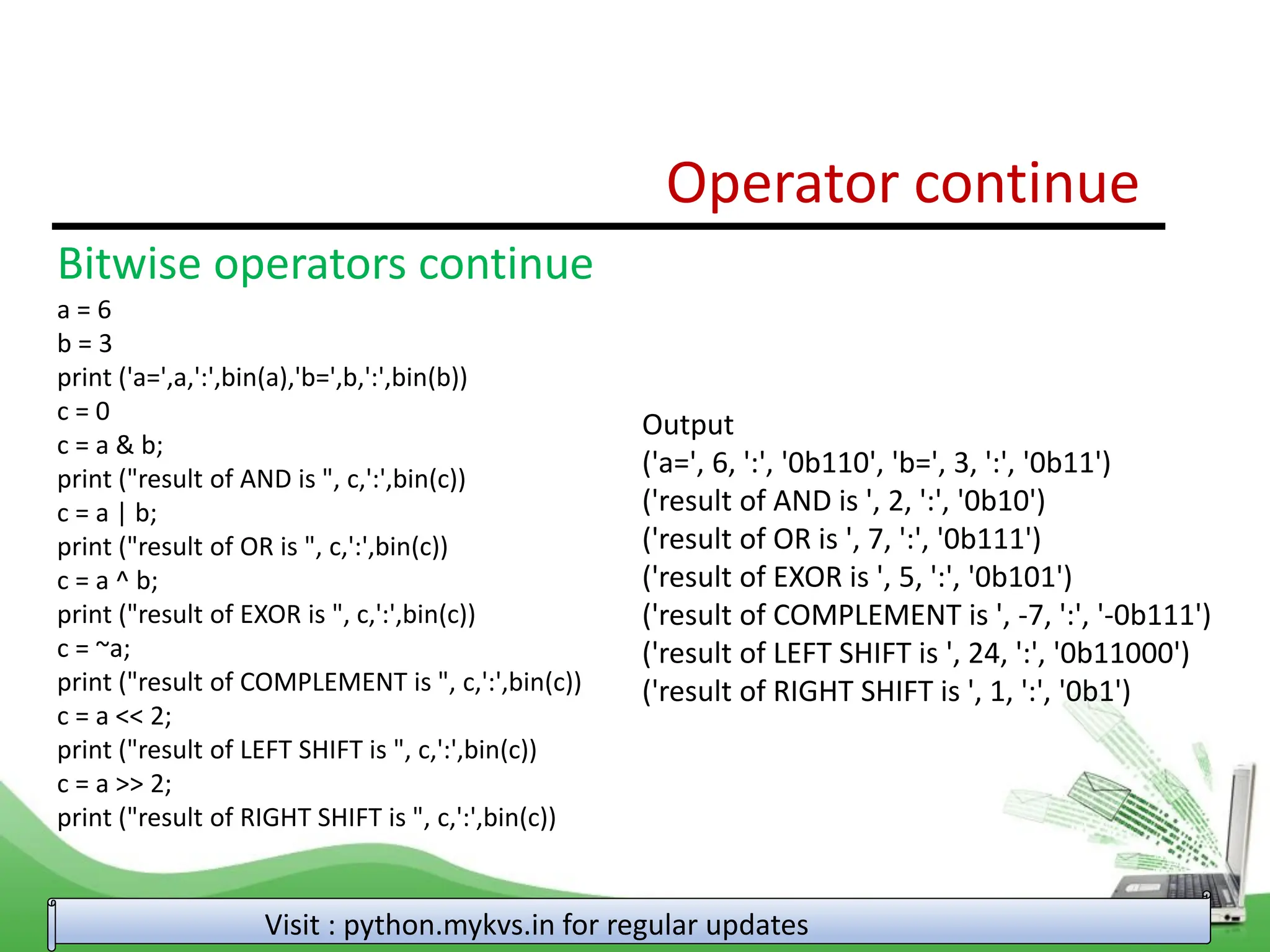
Operator continue Visit : python.mykvs.in for regular updates Bitwise operators continue a = 6 b = 3 print ('a=',a,':',bin(a),'b=',b,':',bin(b)) c = 0 c = a & b; print ("result of AND is ", c,':',bin(c)) c = a | b; print ("result of OR is ", c,':',bin(c)) c = a ^ b; print ("result of EXOR is ", c,':',bin(c)) c = ~a; print ("result of COMPLEMENT is ", c,':',bin(c)) c = a << 2; print ("result of LEFT SHIFT is ", c,':',bin(c)) c = a >> 2; print ("result of RIGHT SHIFT is ", c,':',bin(c)) Output ('a=', 6, ':', '0b110', 'b=', 3, ':', '0b11') ('result of AND is ', 2, ':', '0b10') ('result of OR is ', 7, ':', '0b111') ('result of EXOR is ', 5, ':', '0b101') ('result of COMPLEMENT is ', -7, ':', '-0b111') ('result of LEFT SHIFT is ', 24, ':', '0b11000') ('result of RIGHT SHIFT is ', 1, ':', '0b1')
Operator continue Visit : python.mykvs.in for regular updates Python Membership Operators Test for membership in a sequence e.g. a = 5 b = 10 list = [1, 2, 3, 4, 5 ] if ( a in list ): print ("Line 1 - a is available in the given list") else: print ("Line 1 - a is not available in the given list") if ( b not in list ): print ("Line 2 - b is not available in the given list") else: print ("Line 2 - b is available in the given list") Operator Description in Evaluates to true if it finds a variable in the specified sequence and false otherwise. not in Evaluates to true if it does not finds a variable in the specified sequence and false otherwise. output Line 1 - a is available in the given list Line 2 - b is not available in the given list
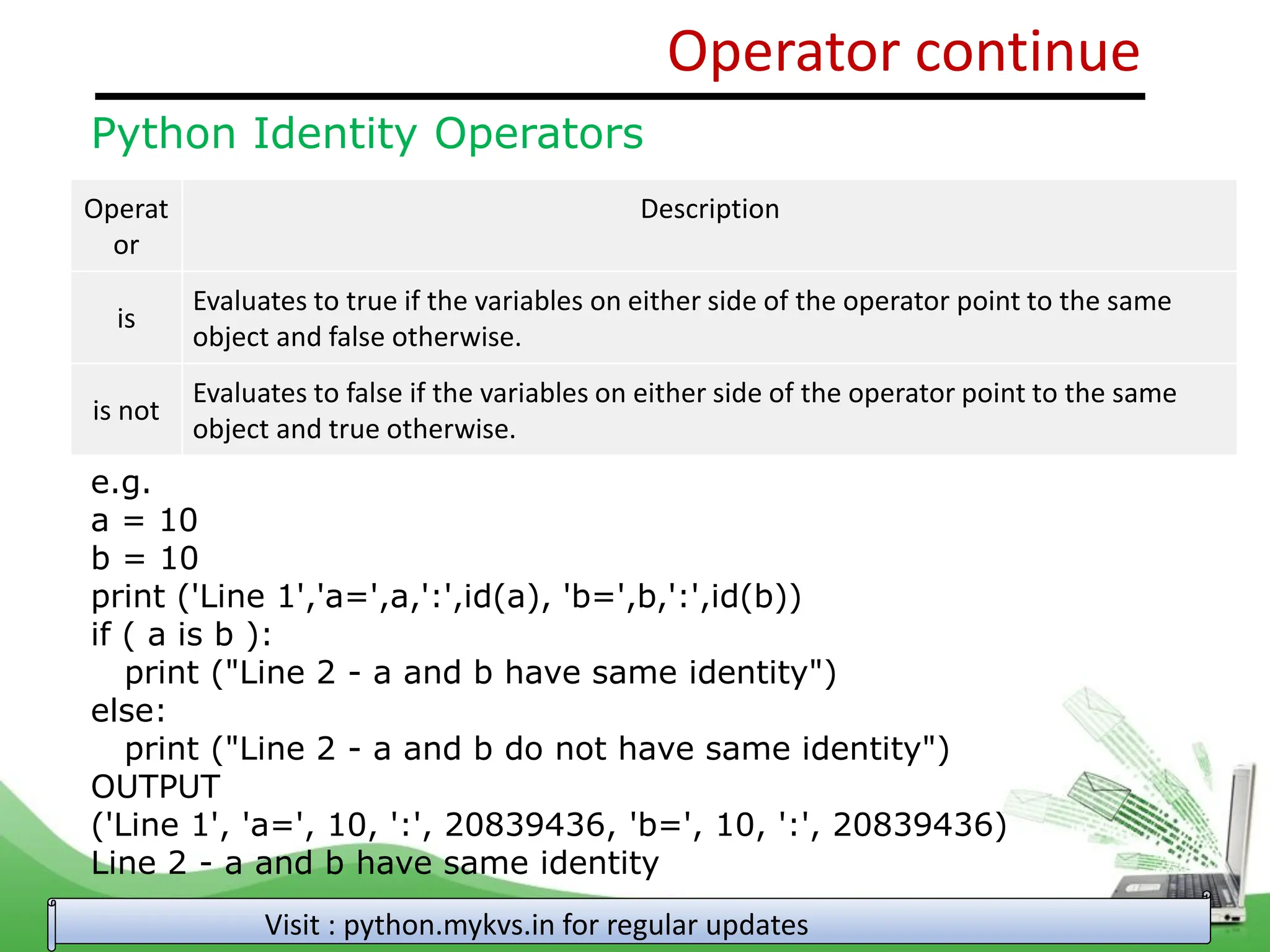
Operator continue Visit : python.mykvs.in for regular updates Python Identity Operators e.g. a = 10 b = 10 print ('Line 1','a=',a,':',id(a), 'b=',b,':',id(b)) if ( a is b ): print ("Line 2 - a and b have same identity") else: print ("Line 2 - a and b do not have same identity") OUTPUT ('Line 1', 'a=', 10, ':', 20839436, 'b=', 10, ':', 20839436) Line 2 - a and b have same identity Operat or Description is Evaluates to true if the variables on either side of the operator point to the same object and false otherwise. is not Evaluates to false if the variables on either side of the operator point to the same object and true otherwise.
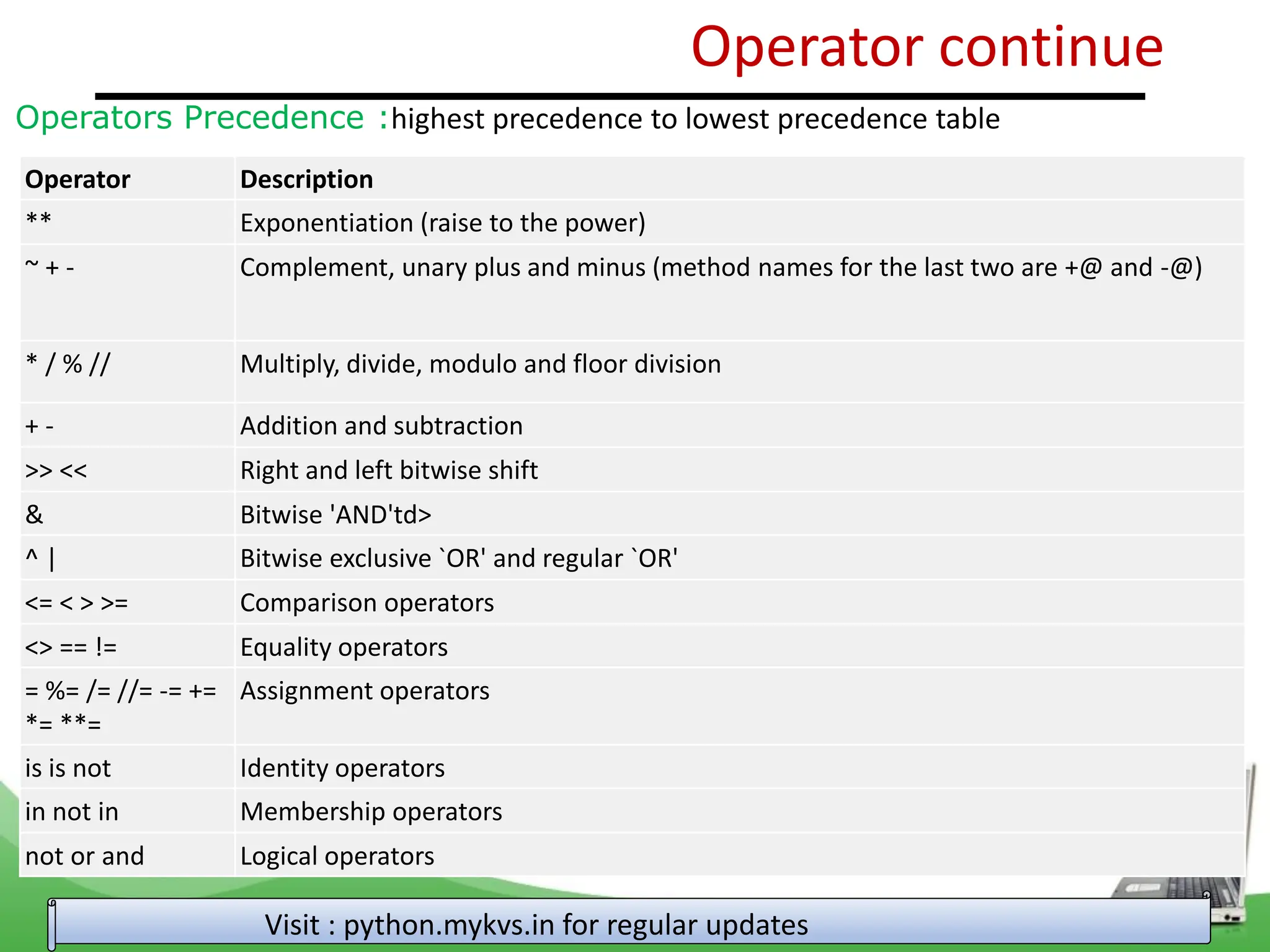
Operator continue Visit : python.mykvs.in for regular updates Operators Precedence :highest precedence to lowest precedence table Operator Description ** Exponentiation (raise to the power) ~ + - Complement, unary plus and minus (method names for the last two are +@ and -@) * / % // Multiply, divide, modulo and floor division + - Addition and subtraction >> << Right and left bitwise shift & Bitwise 'AND'td> ^ | Bitwise exclusive `OR' and regular `OR' <= < > >= Comparison operators <> == != Equality operators = %= /= //= -= += *= **= Assignment operators is is not Identity operators in not in Membership operators not or and Logical operators
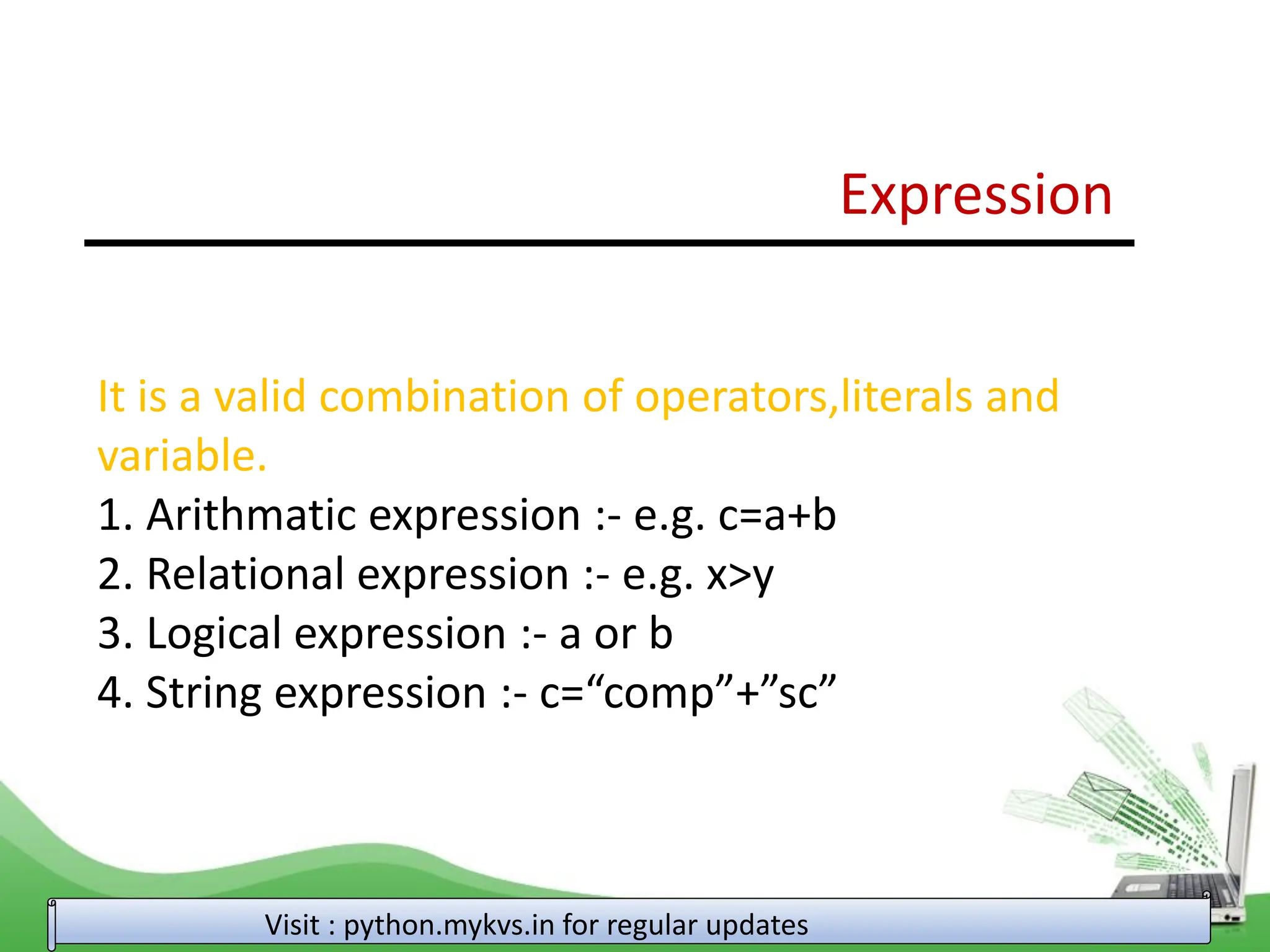
Expression Visit : python.mykvs.in for regular updates It is a valid combination of operators,literals and variable. 1. Arithmatic expression :- e.g. c=a+b 2. Relational expression :- e.g. x>y 3. Logical expression :- a or b 4. String expression :- c=“comp”+”sc”
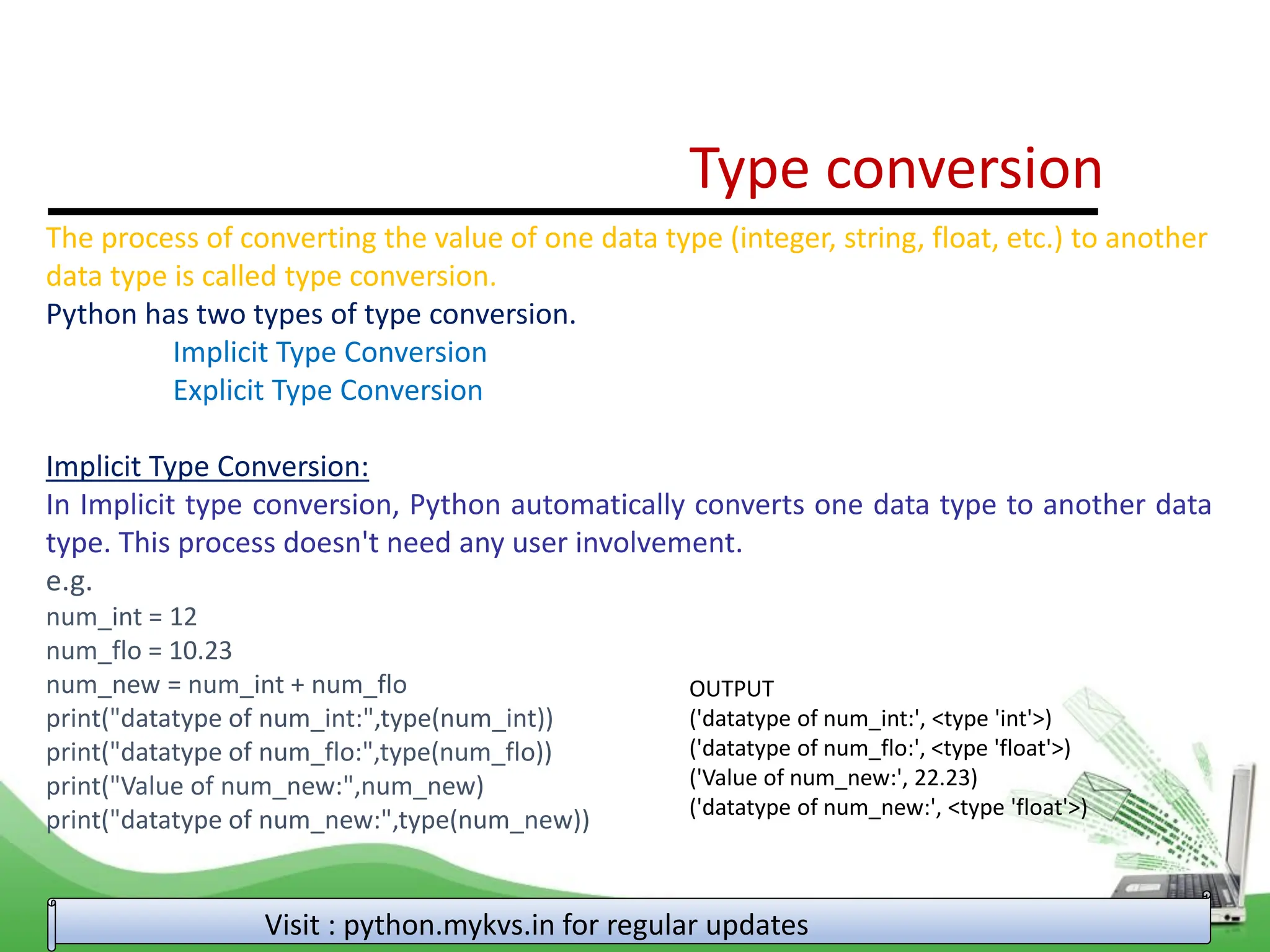
Type conversion Visit : python.mykvs.in for regular updates The process of converting the value of one data type (integer, string, float, etc.) to another data type is called type conversion. Python has two types of type conversion. Implicit Type Conversion Explicit Type Conversion Implicit Type Conversion: In Implicit type conversion, Python automatically converts one data type to another data type. This process doesn't need any user involvement. e.g. num_int = 12 num_flo = 10.23 num_new = num_int + num_flo print("datatype of num_int:",type(num_int)) print("datatype of num_flo:",type(num_flo)) print("Value of num_new:",num_new) print("datatype of num_new:",type(num_new)) OUTPUT ('datatype of num_int:', <type 'int'>) ('datatype of num_flo:', <type 'float'>) ('Value of num_new:', 22.23) ('datatype of num_new:', <type 'float'>)
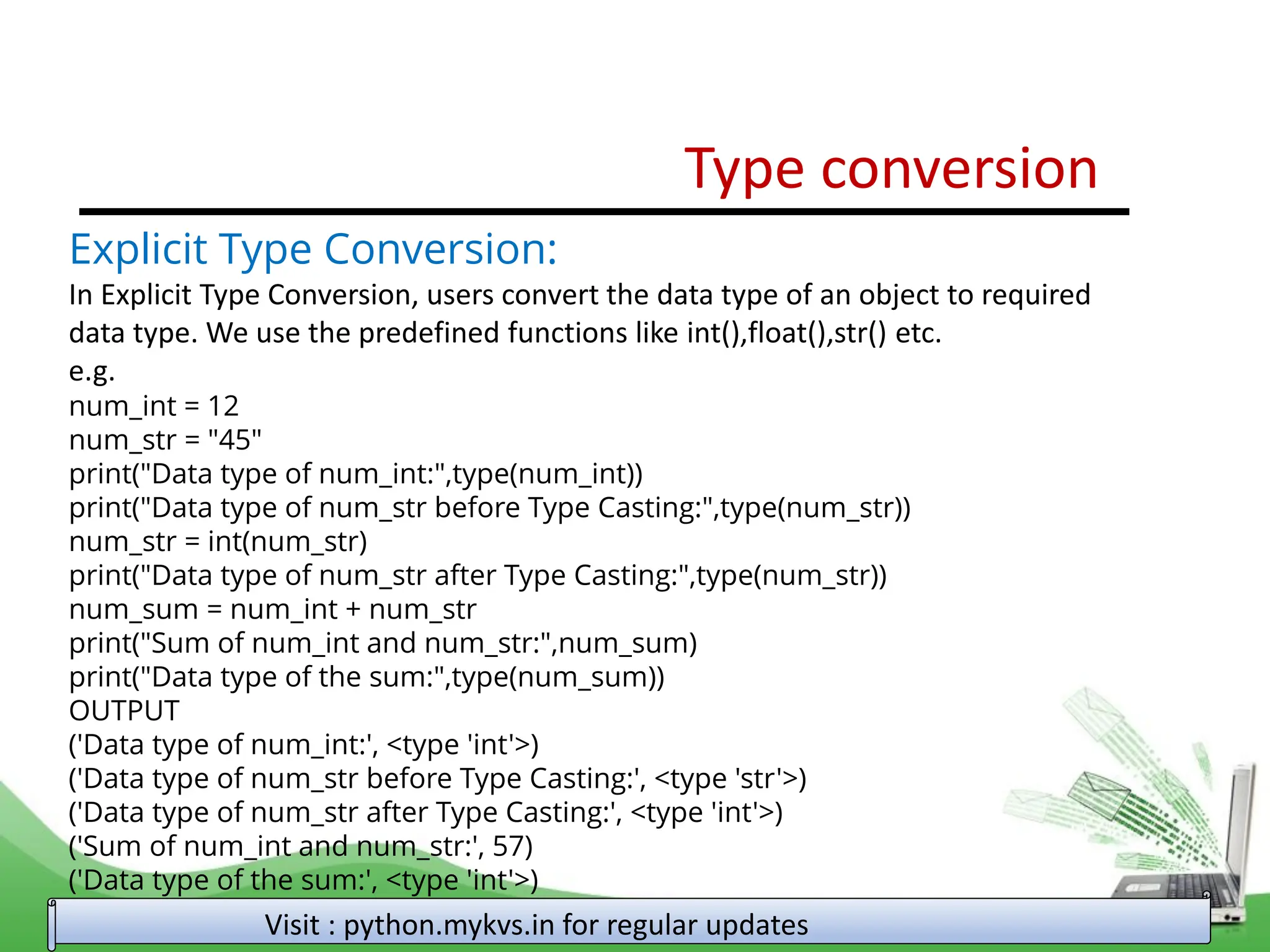
Type conversion Visit : python.mykvs.in for regular updates Explicit Type Conversion: In Explicit Type Conversion, users convert the data type of an object to required data type. We use the predefined functions like int(),float(),str() etc. e.g. num_int = 12 num_str = "45" print("Data type of num_int:",type(num_int)) print("Data type of num_str before Type Casting:",type(num_str)) num_str = int(num_str) print("Data type of num_str after Type Casting:",type(num_str)) num_sum = num_int + num_str print("Sum of num_int and num_str:",num_sum) print("Data type of the sum:",type(num_sum)) OUTPUT ('Data type of num_int:', <type 'int'>) ('Data type of num_str before Type Casting:', <type 'str'>) ('Data type of num_str after Type Casting:', <type 'int'>) ('Sum of num_int and num_str:', 57) ('Data type of the sum:', <type 'int'>)
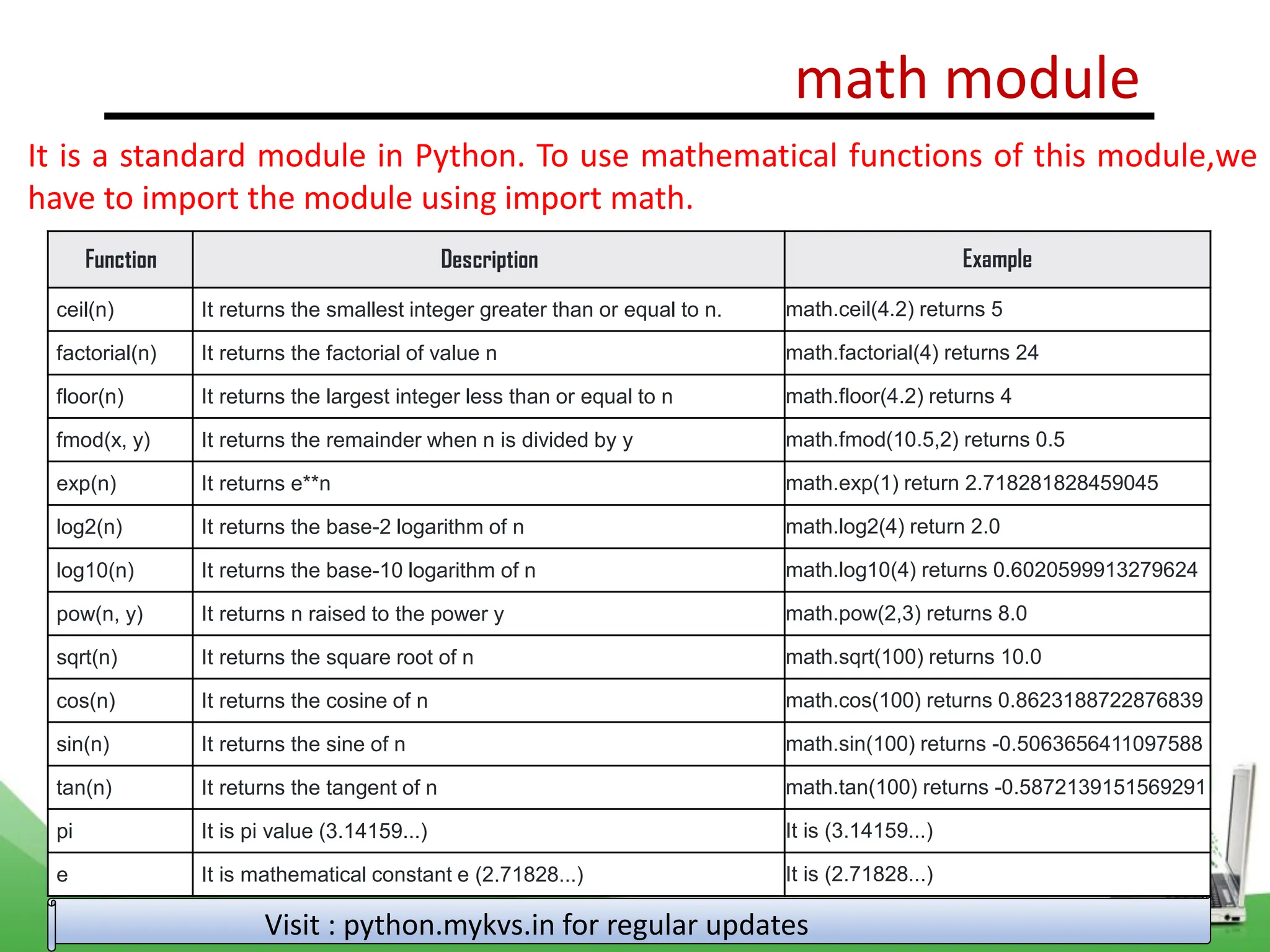
math module Visit : python.mykvs.in for regular updates It is a standard module in Python. To use mathematical functions of this module,we have to import the module using import math. Function Description Example ceil(n) It returns the smallest integer greater than or equal to n. math.ceil(4.2) returns 5 factorial(n) It returns the factorial of value n math.factorial(4) returns 24 floor(n) It returns the largest integer less than or equal to n math.floor(4.2) returns 4 fmod(x, y) It returns the remainder when n is divided by y math.fmod(10.5,2) returns 0.5 exp(n) It returns e**n math.exp(1) return 2.718281828459045 log2(n) It returns the base-2 logarithm of n math.log2(4) return 2.0 log10(n) It returns the base-10 logarithm of n math.log10(4) returns 0.6020599913279624 pow(n, y) It returns n raised to the power y math.pow(2,3) returns 8.0 sqrt(n) It returns the square root of n math.sqrt(100) returns 10.0 cos(n) It returns the cosine of n math.cos(100) returns 0.8623188722876839 sin(n) It returns the sine of n math.sin(100) returns -0.5063656411097588 tan(n) It returns the tangent of n math.tan(100) returns -0.5872139151569291 pi It is pi value (3.14159...) It is (3.14159...) e It is mathematical constant e (2.71828...) It is (2.71828...)
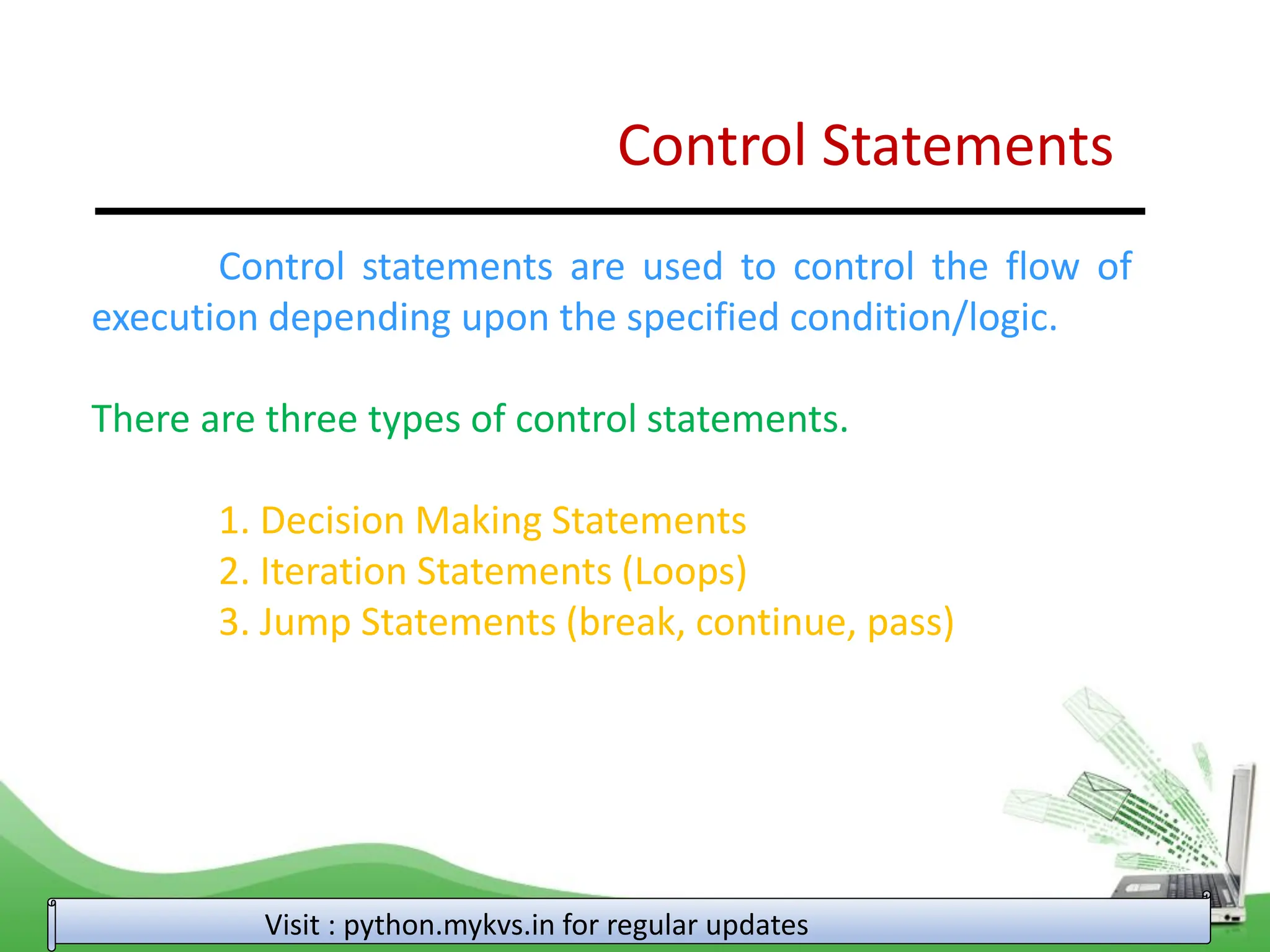
Control Statements Control statements are used to control the flow of execution depending upon the specified condition/logic. There are three types of control statements. 1. Decision Making Statements 2. Iteration Statements (Loops) 3. Jump Statements (break, continue, pass) Visit : python.mykvs.in for regular updates
Decision Making Statement Decision making statement used to control the flow of execution of program depending upon condition. There are three types of decision making statement. 1. if statements 2. if-else statements 3. Nested if-else statement Visit : python.mykvs.in for regular updates
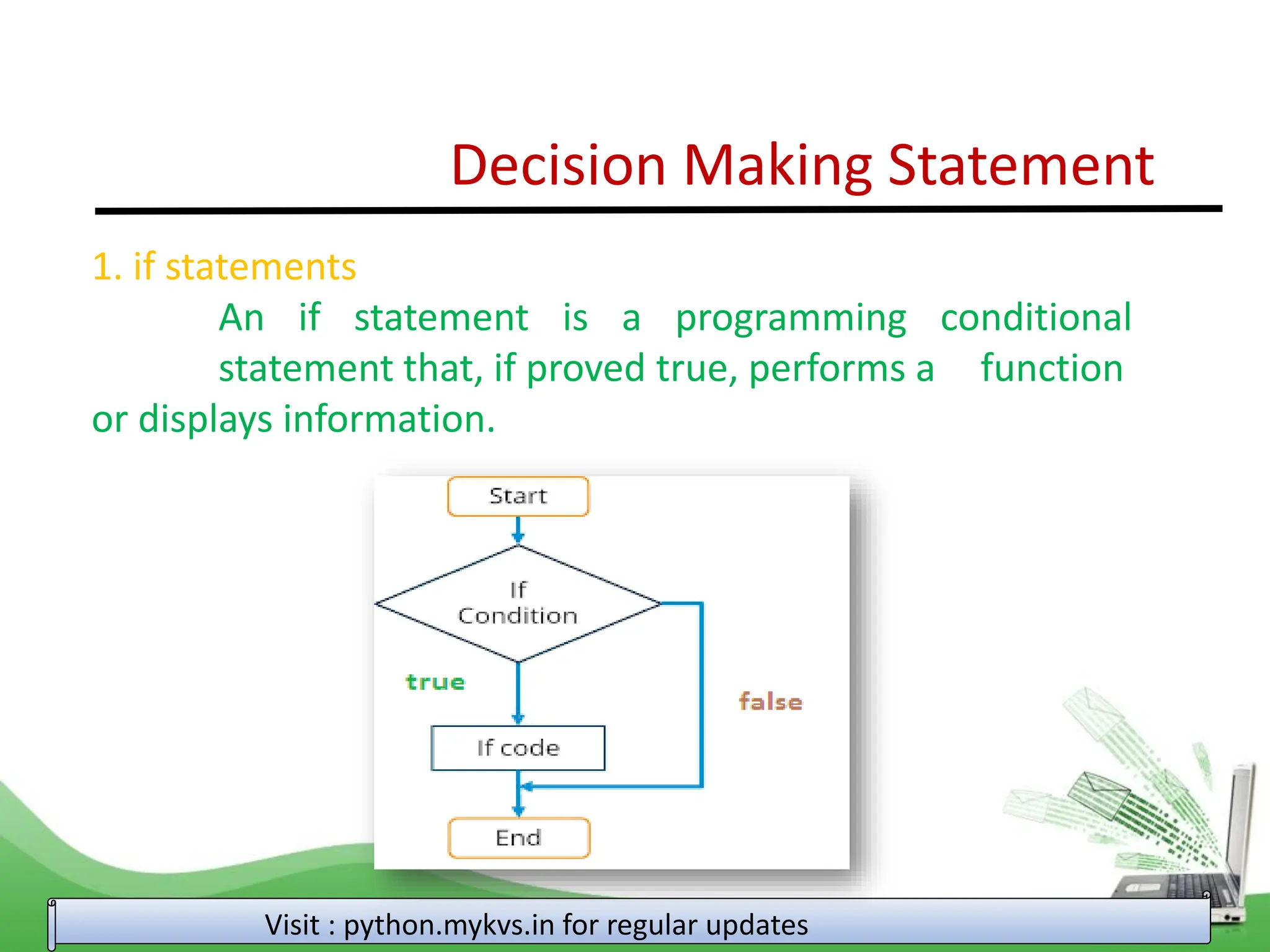
Decision Making Statement 1. if statements An if statement is a programming conditional statement that, if proved true, performs a function or displays information. Visit : python.mykvs.in for regular updates
Decision Making Statement 1. if statements Syntax: if(condition): statement [statements] e.g. noofbooks = 2 if (noofbooks == 2): print('You have ') print(‘two books’) print(‘outside of if statement’) Output You have two books Note:To indicate a block of code in Python, you must indent each line of the block by the same amount. In above e.g. both print statements are part of if condition because of both are at same level indented but not the third print statement. Visit : python.mykvs.in for regular updates
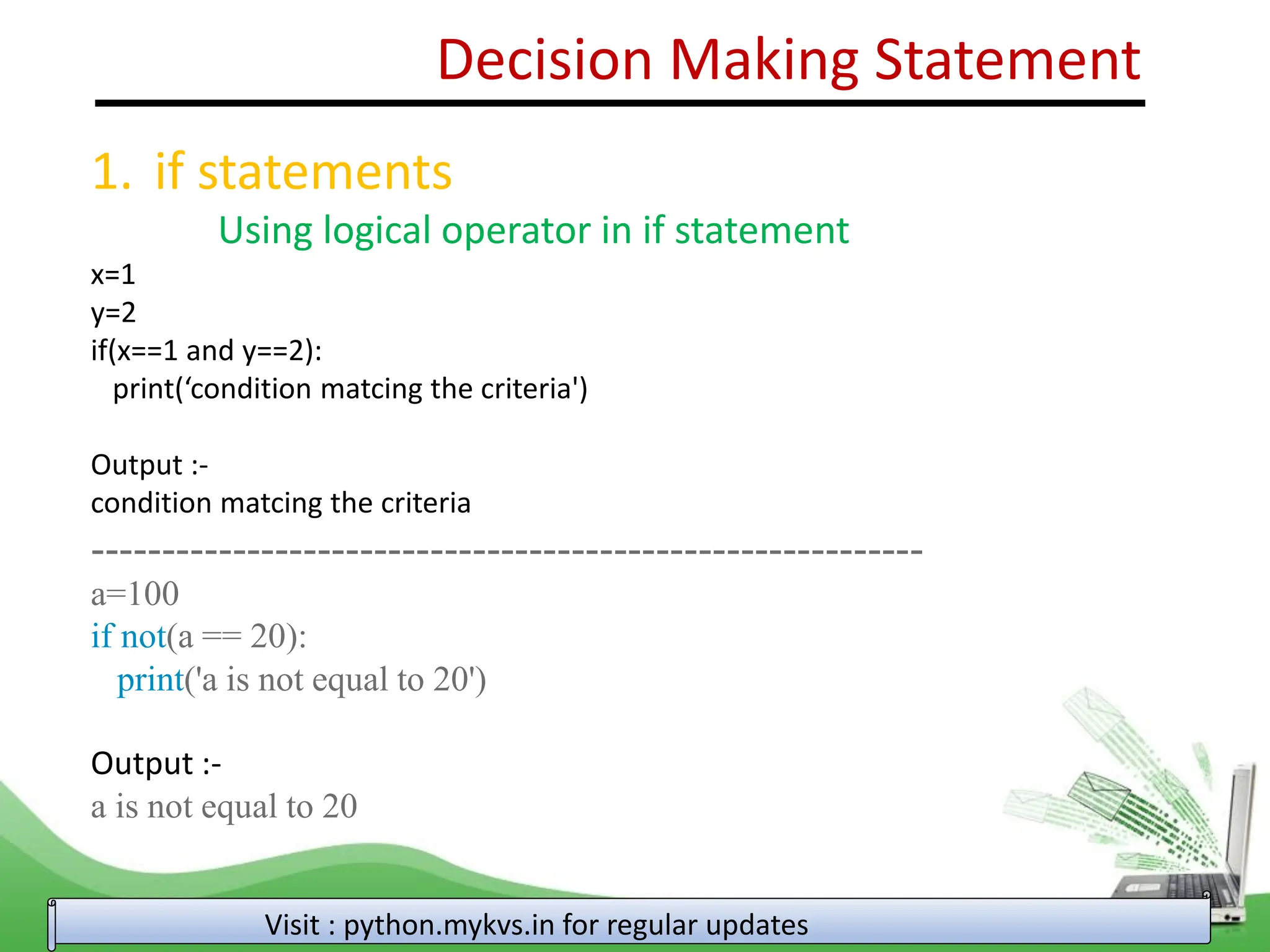
Decision Making Statement 1. if statements Using logical operator in if statement x=1 y=2 if(x==1 and y==2): print(‘condition matcing the criteria') Output :- condition matcing the criteria ----------------------------------------------------------- a=100 if not(a == 20): print('a is not equal to 20') Output :- a is not equal to 20 Visit : python.mykvs.in for regular updates
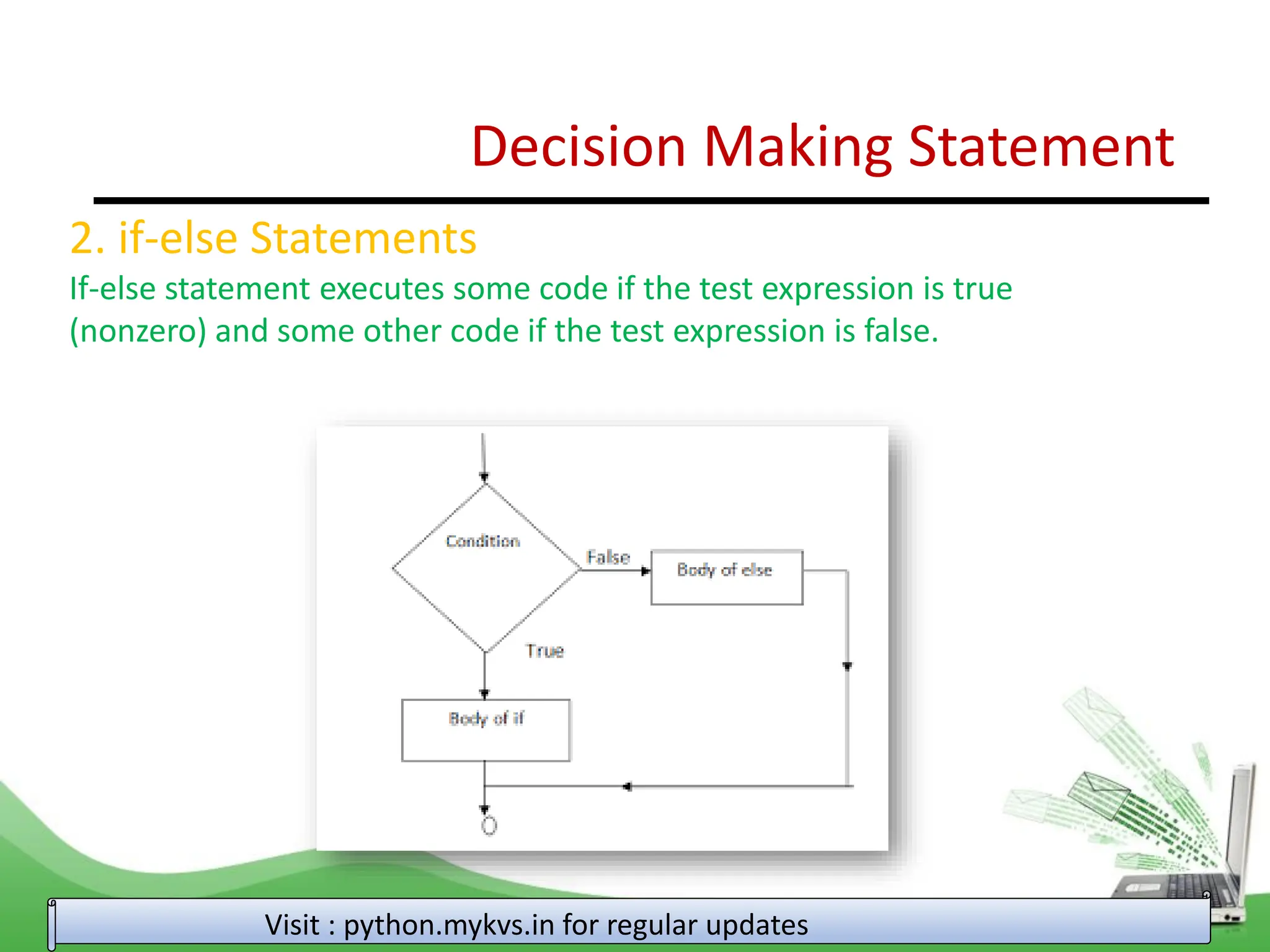
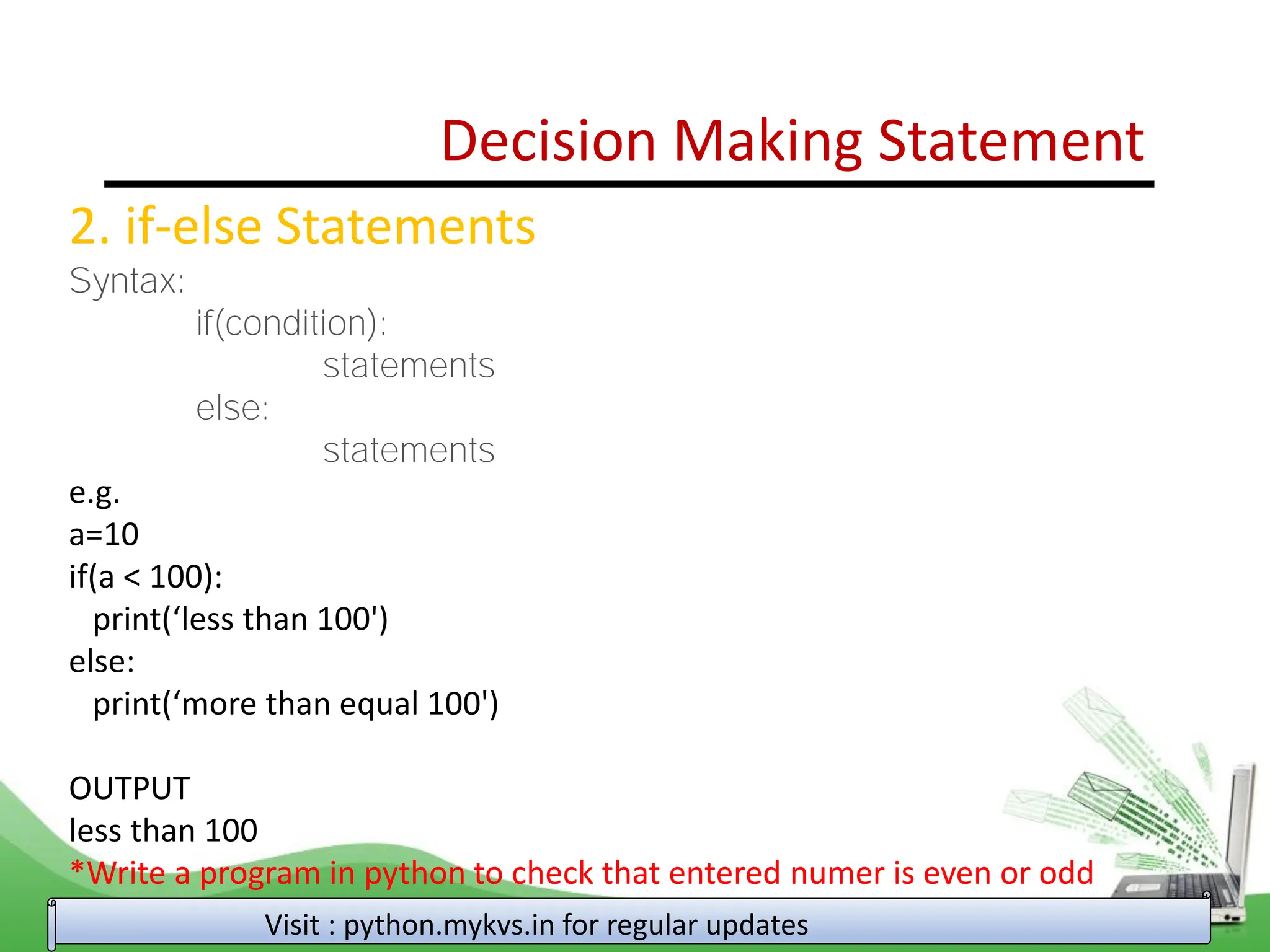
Decision Making Statement 2. if-else Statements If-else statement executes some code if the test expression is true (nonzero) and some other code if the test expression is false. Visit : python.mykvs.in for regular updates
Decision Making Statement 2. if-else Statements Syntax: if(condition): statements else: statements e.g. a=10 if(a < 100): print(‘less than 100') else: print(‘more than equal 100') OUTPUT less than 100 *Write a program in python to check that entered numer is even or odd Visit : python.mykvs.in for regular updates
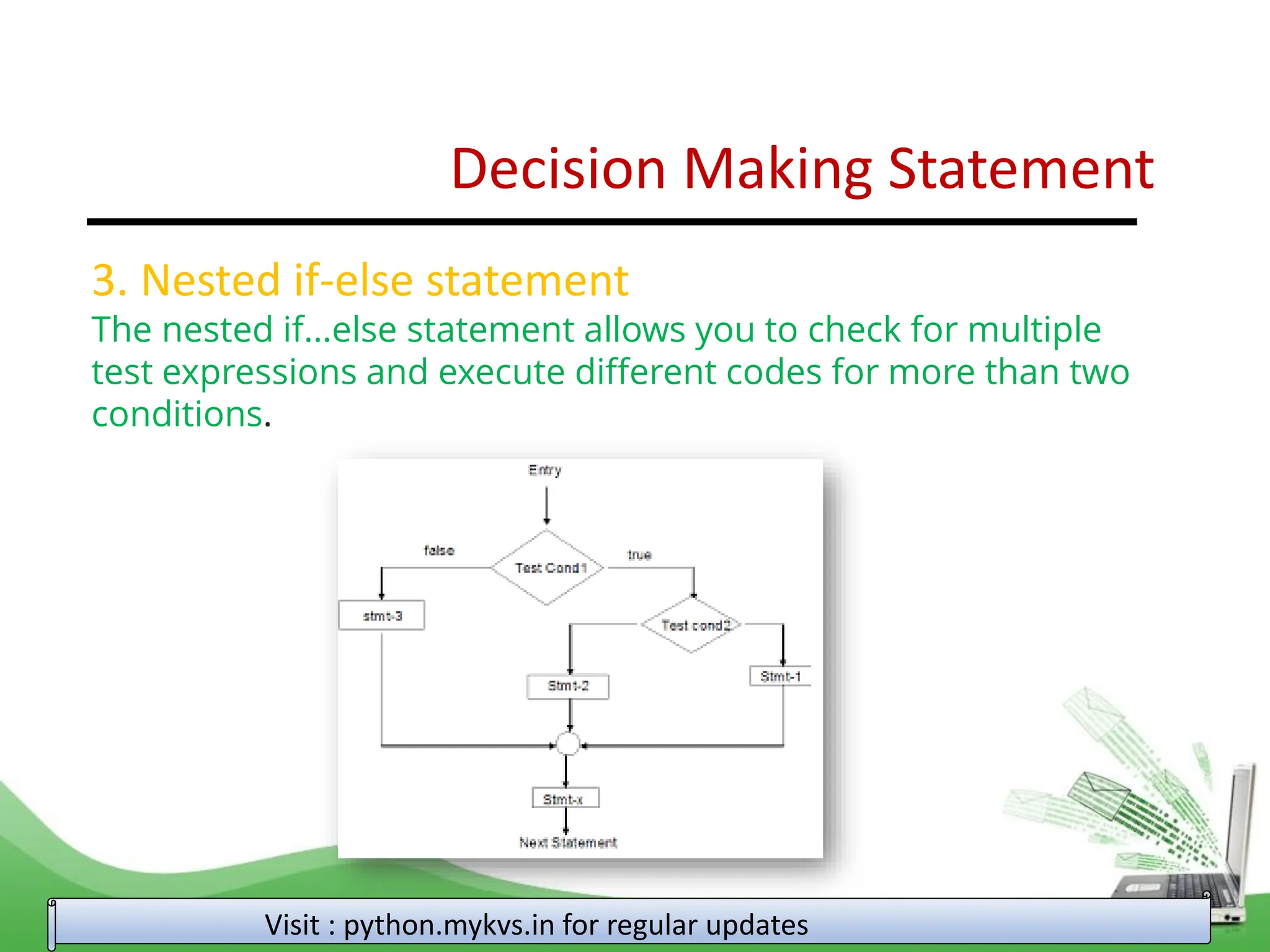
Decision Making Statement 3. Nested if-else statement The nested if...else statement allows you to check for multiple test expressions and execute different codes for more than two conditions. Visit : python.mykvs.in for regular updates
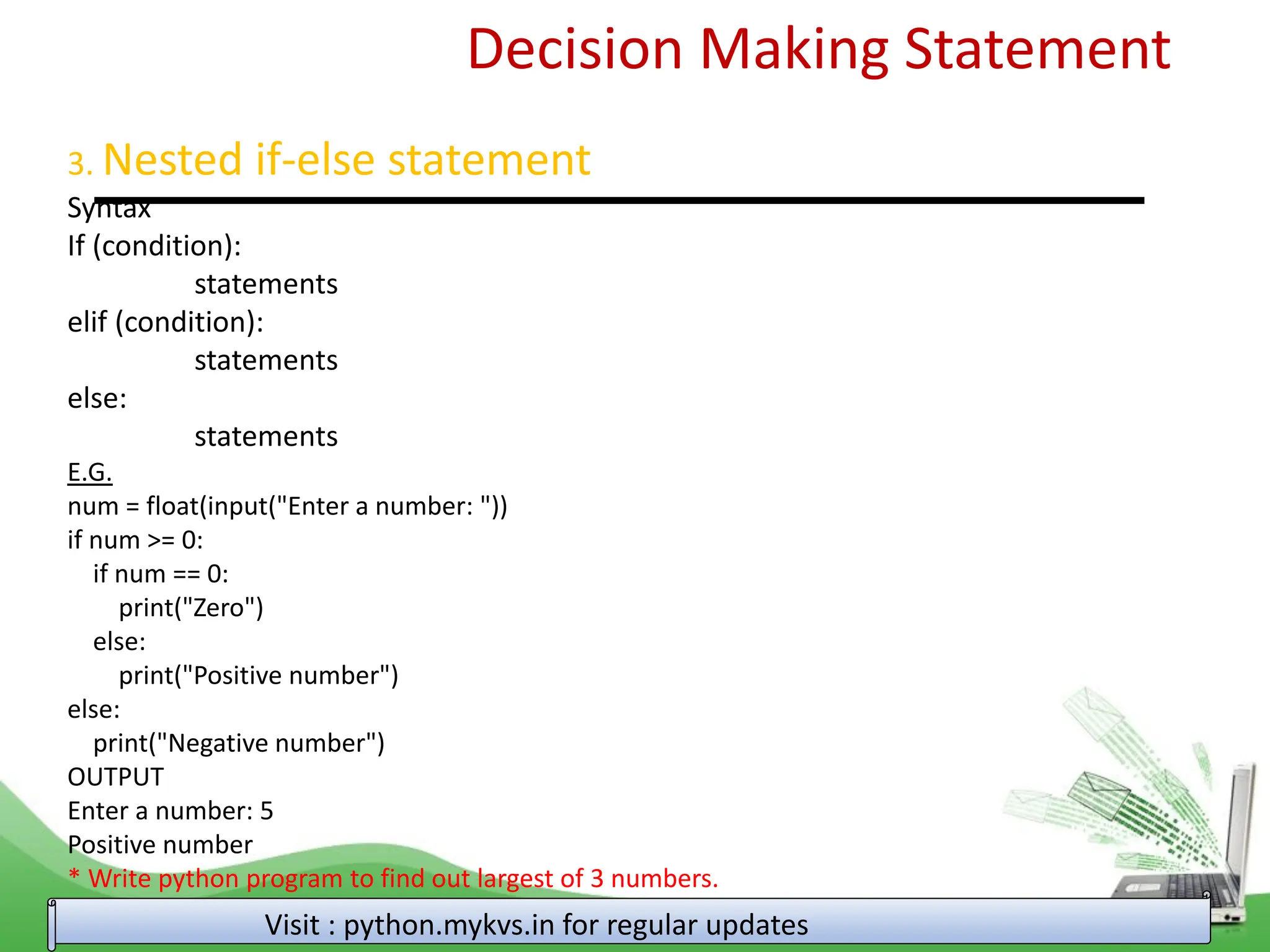
Decision Making Statement 3. Nested if-else statement Syntax If (condition): statements elif (condition): statements else: statements E.G. num = float(input("Enter a number: ")) if num >= 0: if num == 0: print("Zero") else: print("Positive number") else: print("Negative number") OUTPUT Enter a number: 5 Positive number * Write python program to find out largest of 3 numbers. Visit : python.mykvs.in for regular updates
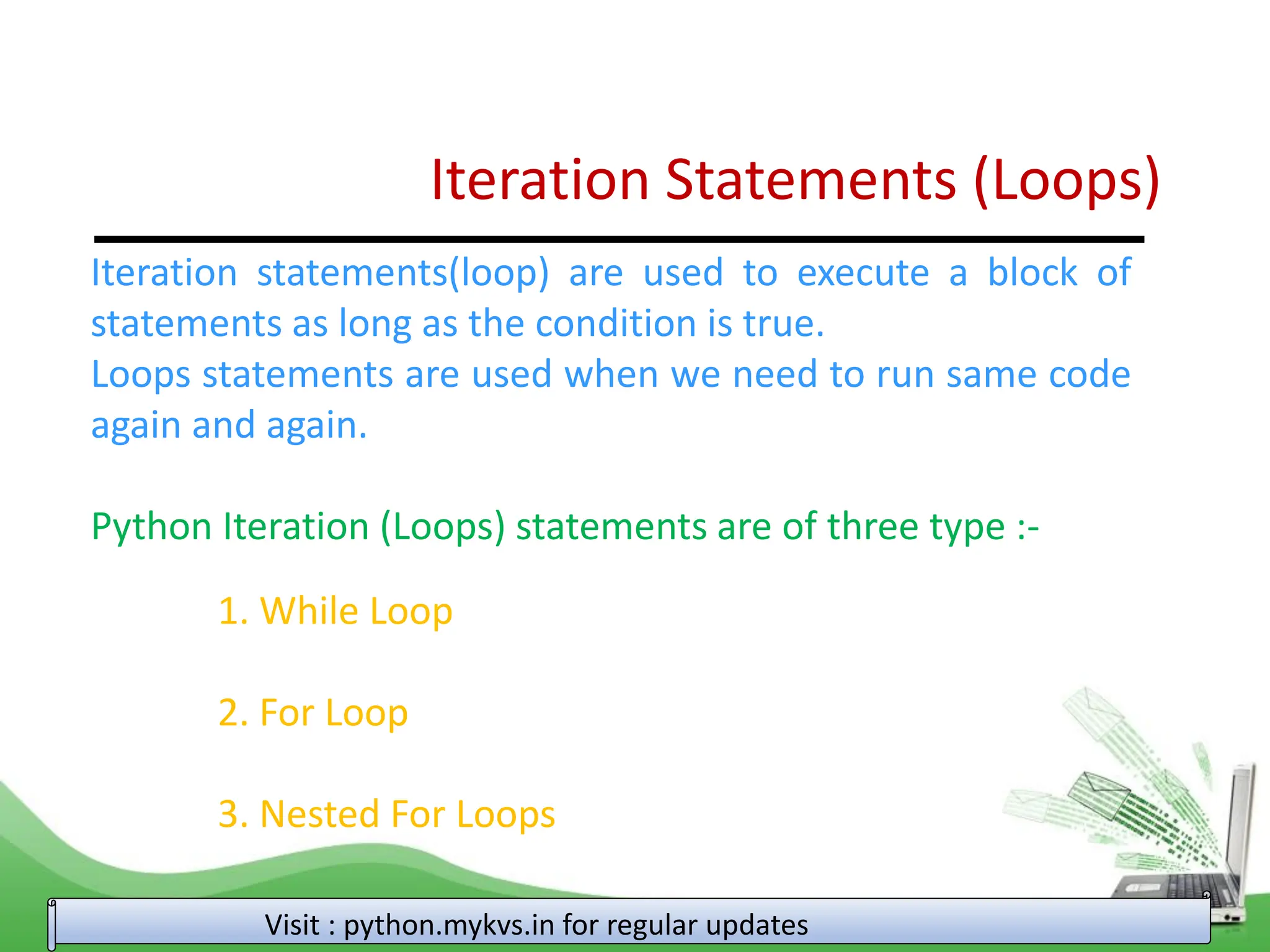
Iteration Statements (Loops) Iteration statements(loop) are used to execute a block of statements as long as the condition is true. Loops statements are used when we need to run same code again and again. Python Iteration (Loops) statements are of three type :- 1. While Loop 2. For Loop 3. Nested For Loops Visit : python.mykvs.in for regular updates
Iteration Statements (Loops) 1. While Loop It is used to execute a block of statement as long as a given condition is true. And when the condition become false, the control will come out of the loop. The condition is checked every time at the beginning of the loop. Syntax while (condition): statement [statements] e.g. x = 1 while (x <= 4): print(x) x = x + 1 Visit : python.mykvs.in for regular updates Output 1 2 3 4
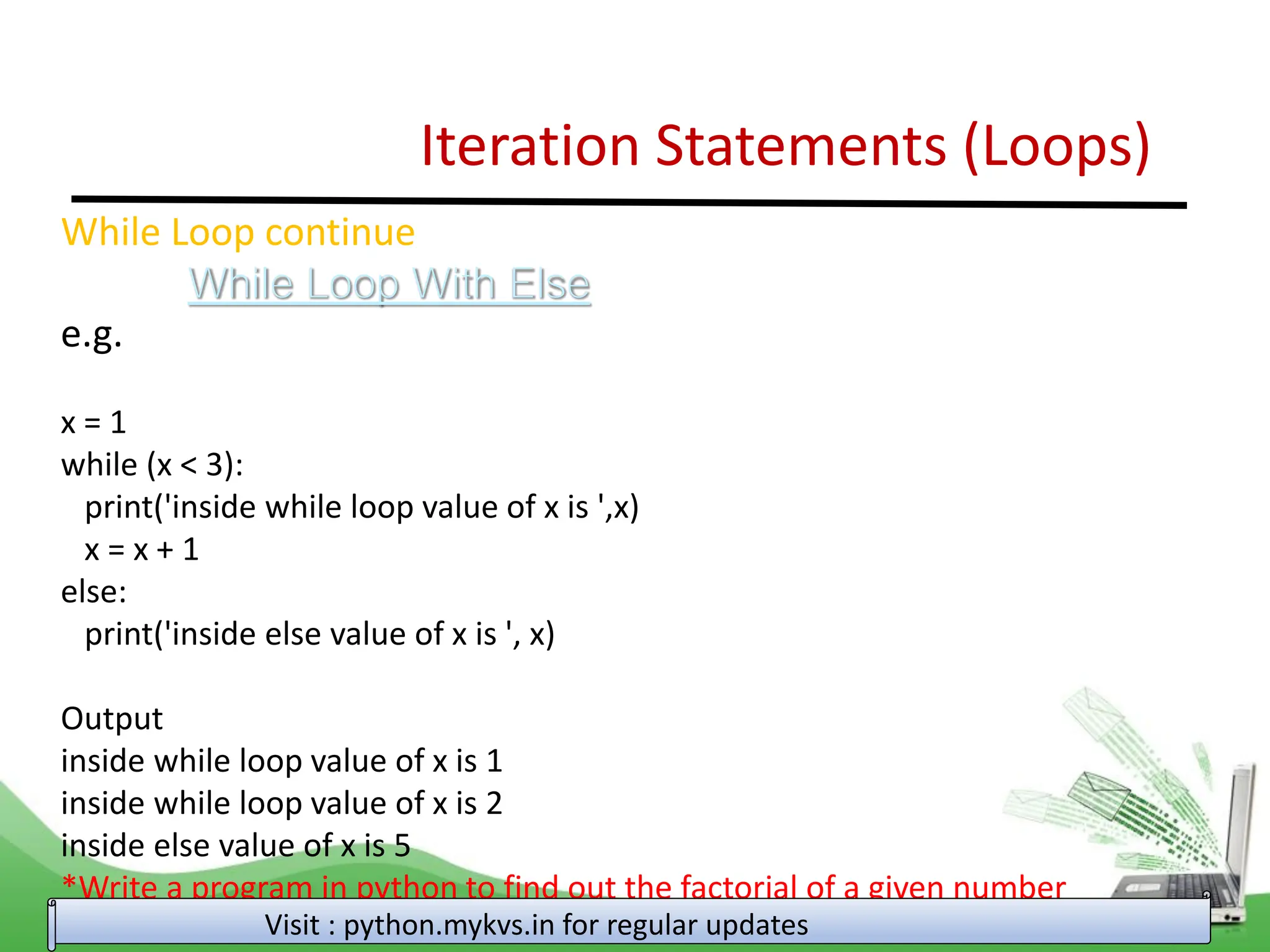
Iteration Statements (Loops) While Loop continue While Loop With Else e.g. x = 1 while (x < 3): print('inside while loop value of x is ',x) x = x + 1 else: print('inside else value of x is ', x) Output inside while loop value of x is 1 inside while loop value of x is 2 inside else value of x is 5 *Write a program in python to find out the factorial of a given number Visit : python.mykvs.in for regular updates
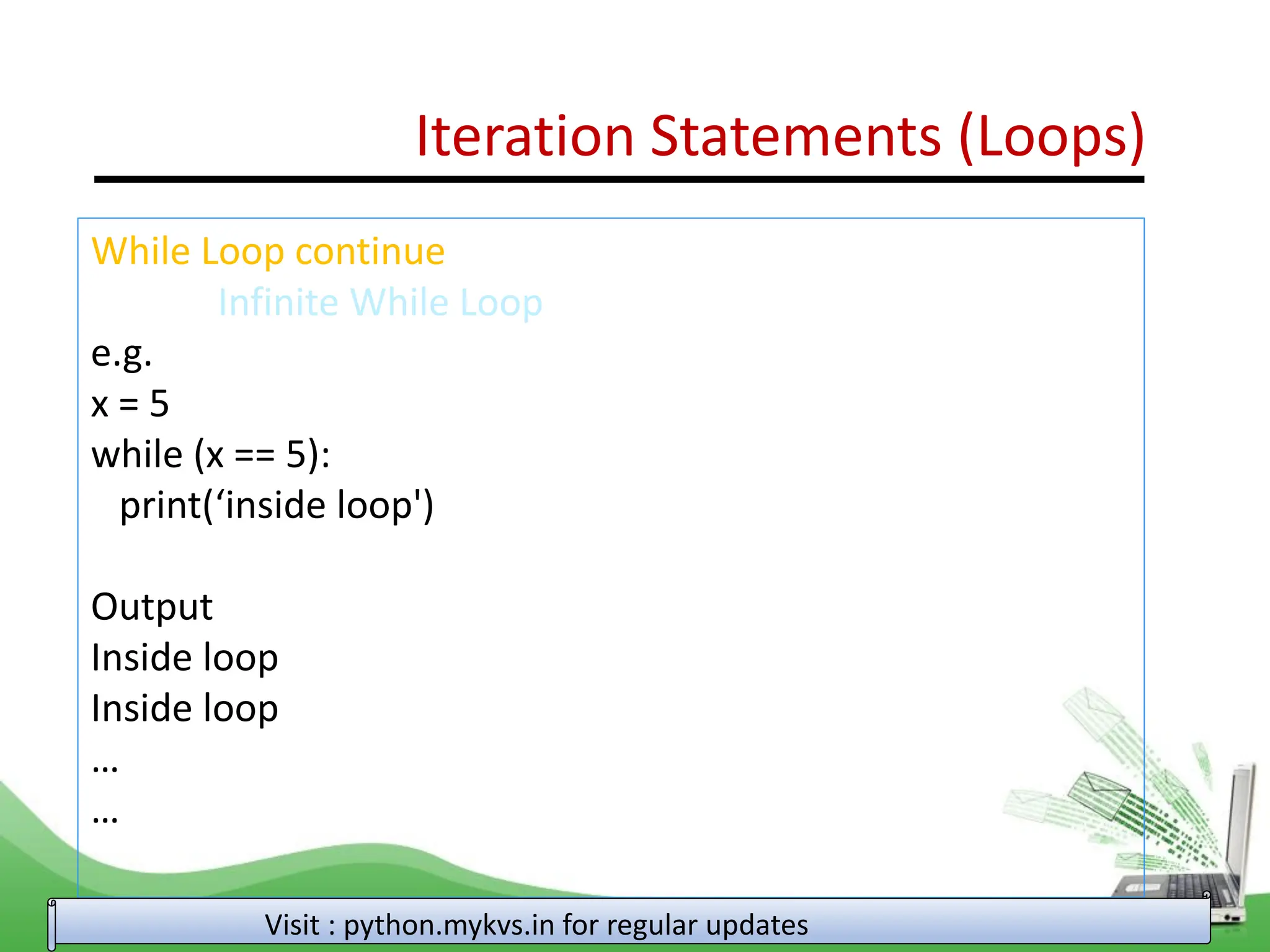
Iteration Statements (Loops) While Loop continue Infinite While Loop e.g. x = 5 while (x == 5): print(‘inside loop') Output Inside loop Inside loop … … Visit : python.mykvs.in for regular updates
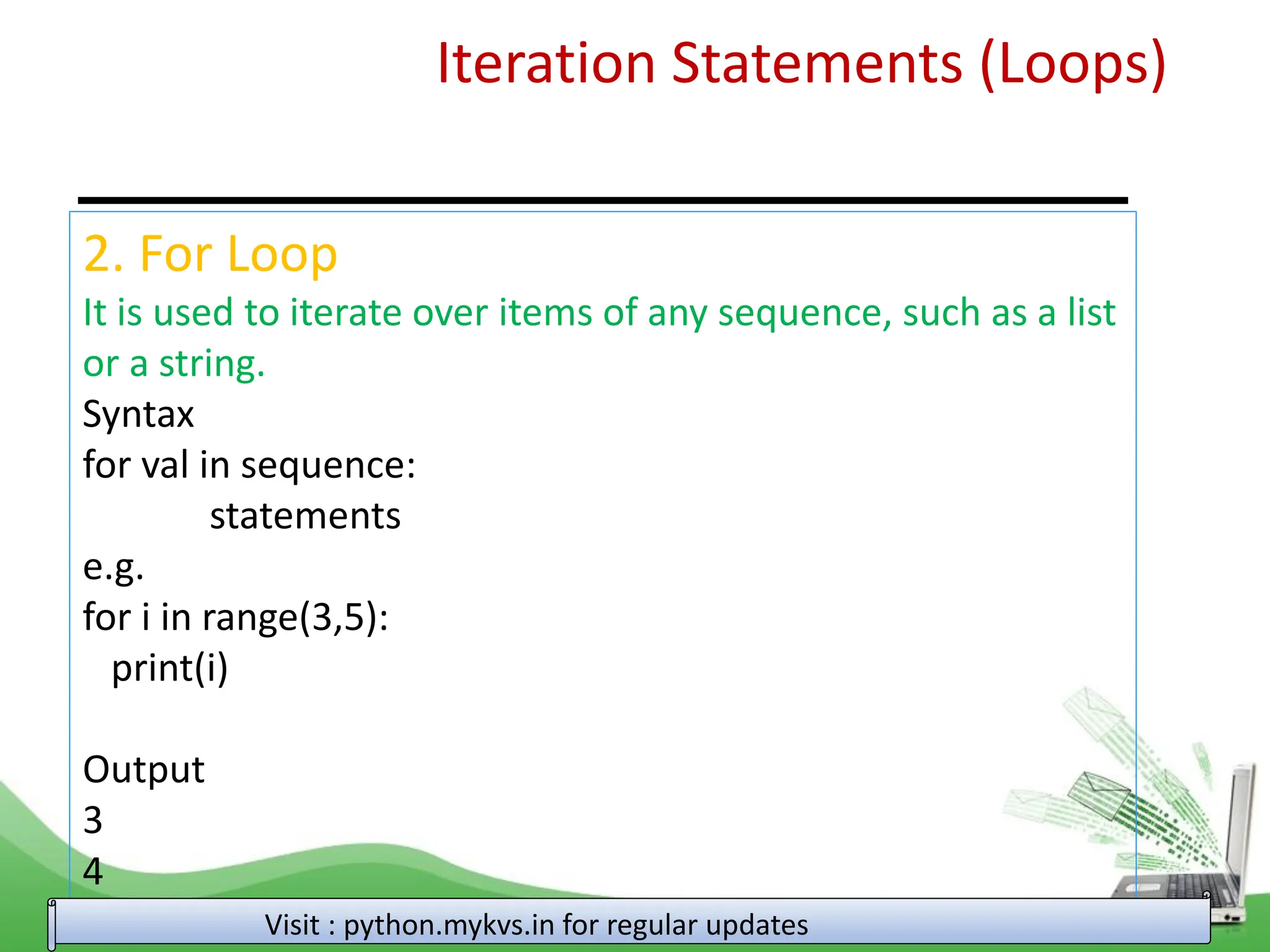
Iteration Statements (Loops) 2. For Loop It is used to iterate over items of any sequence, such as a list or a string. Syntax for val in sequence: statements e.g. for i in range(3,5): print(i) Output 3 4 Visit : python.mykvs.in for regular updates
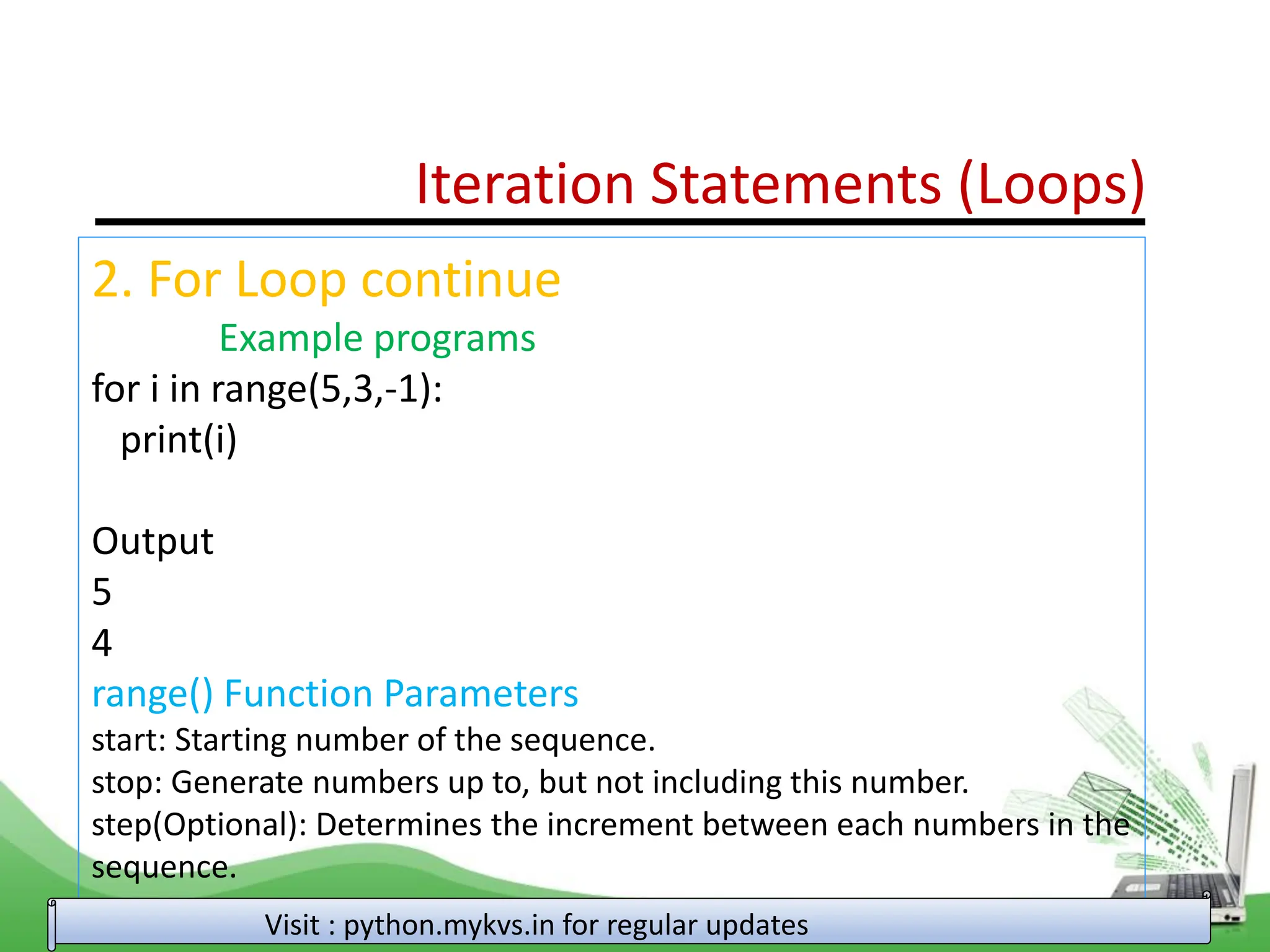
Iteration Statements (Loops) 2. For Loop continue Example programs for i in range(5,3,-1): print(i) Output 5 4 range() Function Parameters start: Starting number of the sequence. stop: Generate numbers up to, but not including this number. step(Optional): Determines the increment between each numbers in the sequence. Visit : python.mykvs.in for regular updates
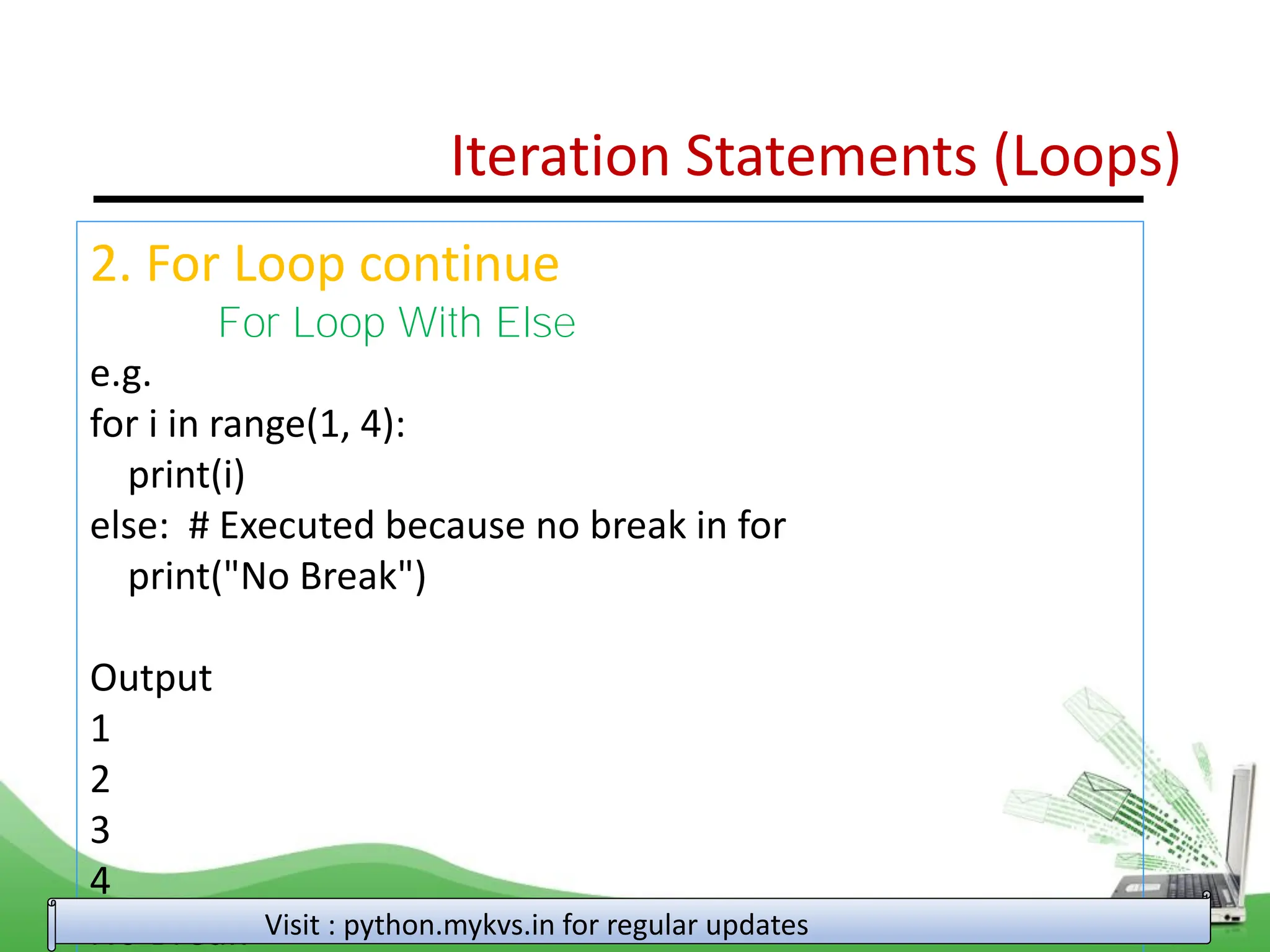
Iteration Statements (Loops) 2. For Loop continue For Loop With Else e.g. for i in range(1, 4): print(i) else: # Executed because no break in for print("No Break") Output 1 2 3 4 No Break Visit : python.mykvs.in for regular updates
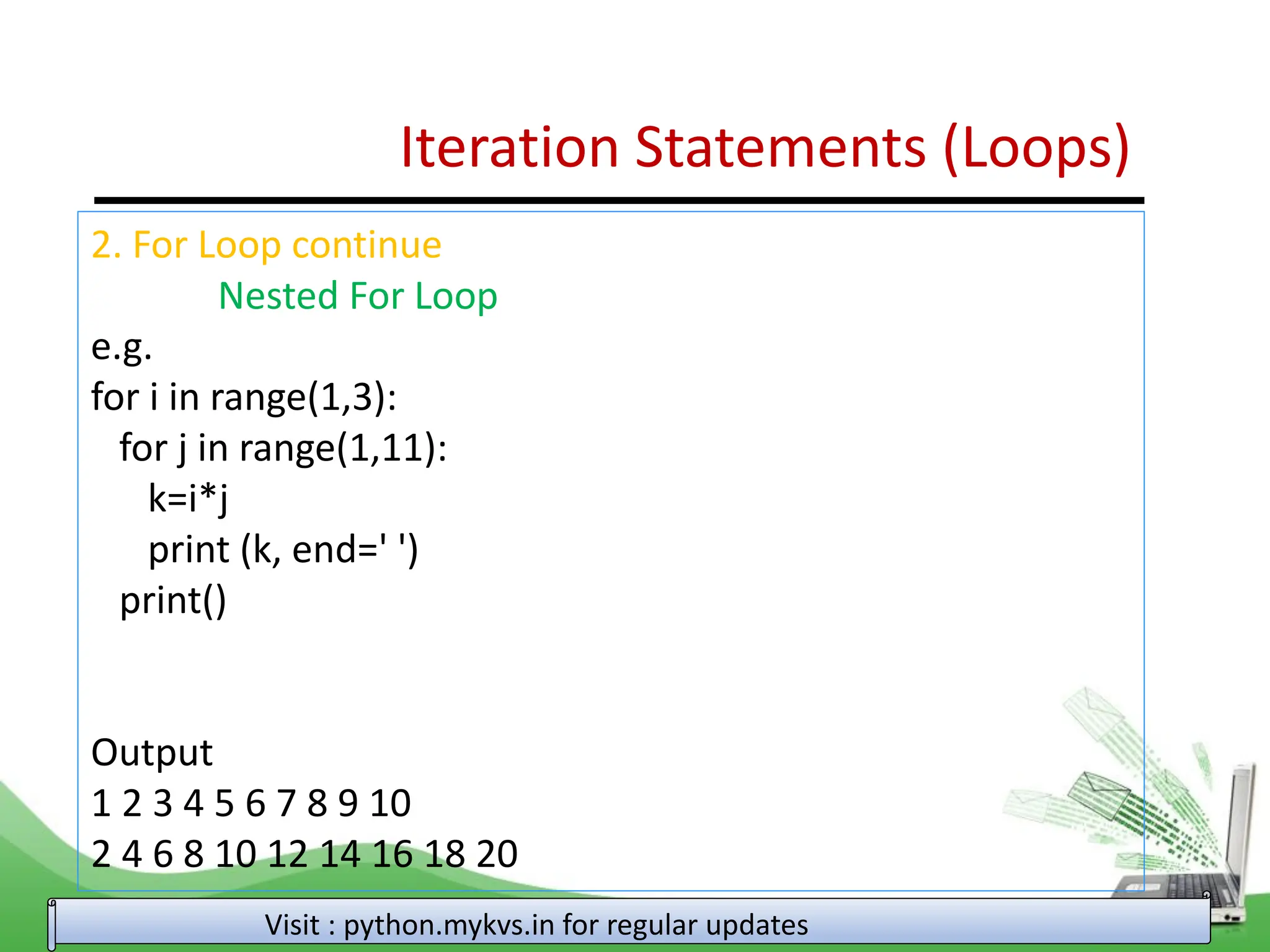
Iteration Statements (Loops) 2. For Loop continue Nested For Loop e.g. for i in range(1,3): for j in range(1,11): k=i*j print (k, end=' ') print() Output 1 2 3 4 5 6 7 8 9 10 2 4 6 8 10 12 14 16 18 20 Visit : python.mykvs.in for regular updates
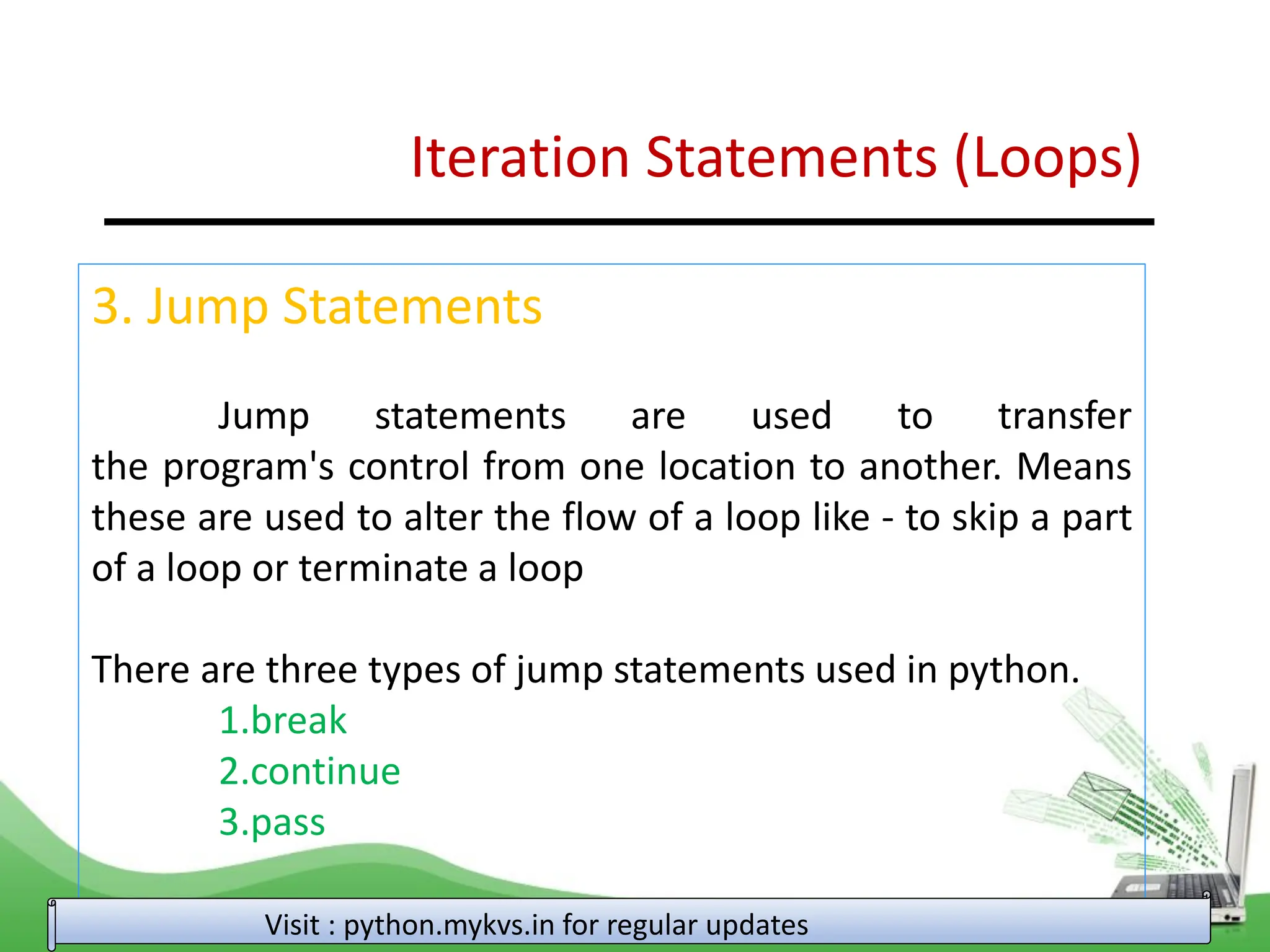
Iteration Statements (Loops) 3. Jump Statements Jump statements are used to transfer the program's control from one location to another. Means these are used to alter the flow of a loop like - to skip a part of a loop or terminate a loop There are three types of jump statements used in python. 1.break 2.continue 3.pass Visit : python.mykvs.in for regular updates
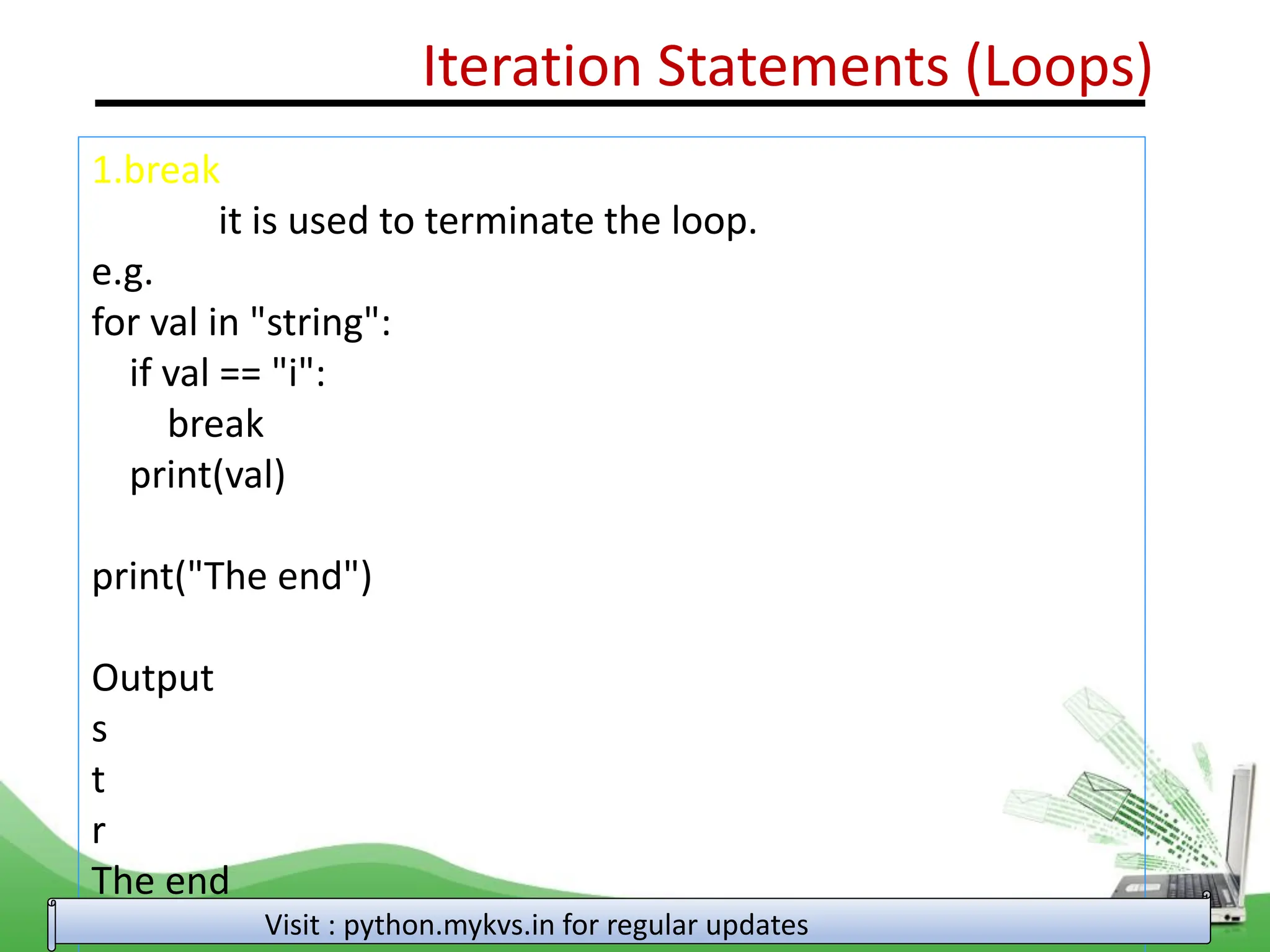
Iteration Statements (Loops) 1.break it is used to terminate the loop. e.g. for val in "string": if val == "i": break print(val) print("The end") Output s t r The end Visit : python.mykvs.in for regular updates
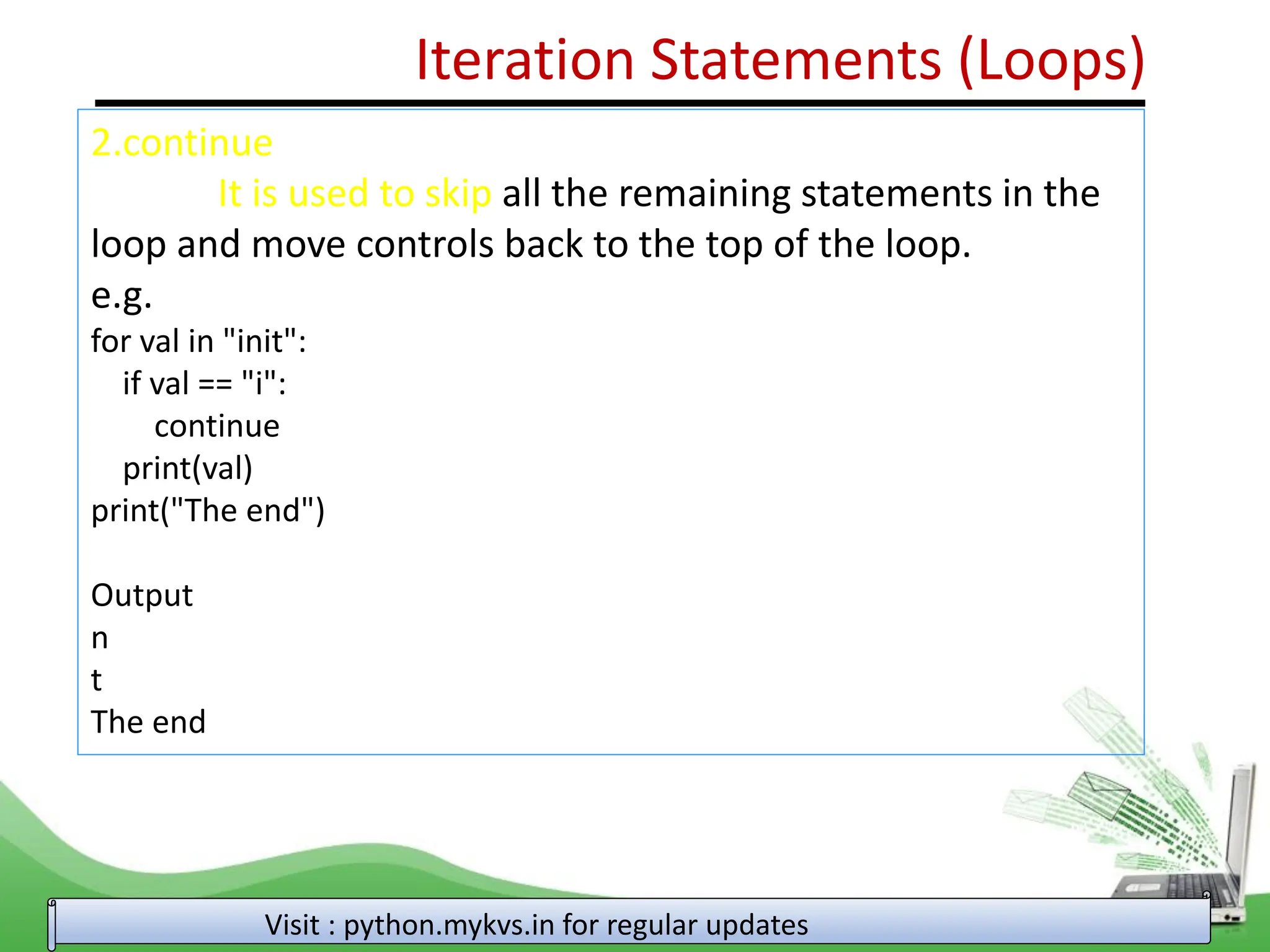
Iteration Statements (Loops) 2.continue It is used to skip all the remaining statements in the loop and move controls back to the top of the loop. e.g. for val in "init": if val == "i": continue print(val) print("The end") Output n t The end Visit : python.mykvs.in for regular updates
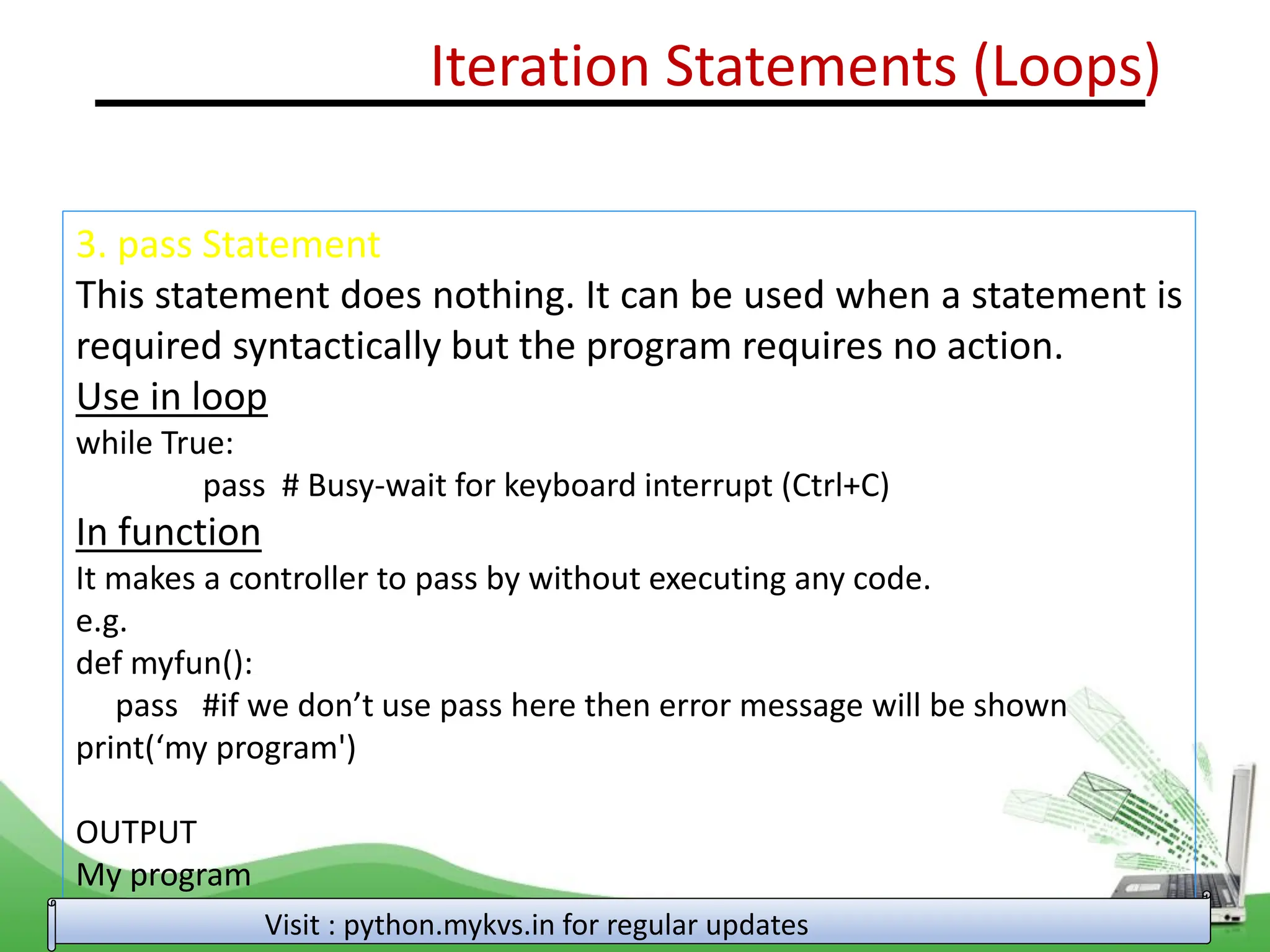
Iteration Statements (Loops) 3. pass Statement This statement does nothing. It can be used when a statement is required syntactically but the program requires no action. Use in loop while True: pass # Busy-wait for keyboard interrupt (Ctrl+C) In function It makes a controller to pass by without executing any code. e.g. def myfun(): pass #if we don’t use pass here then error message will be shown print(‘my program') OUTPUT My program Visit : python.mykvs.in for regular updates
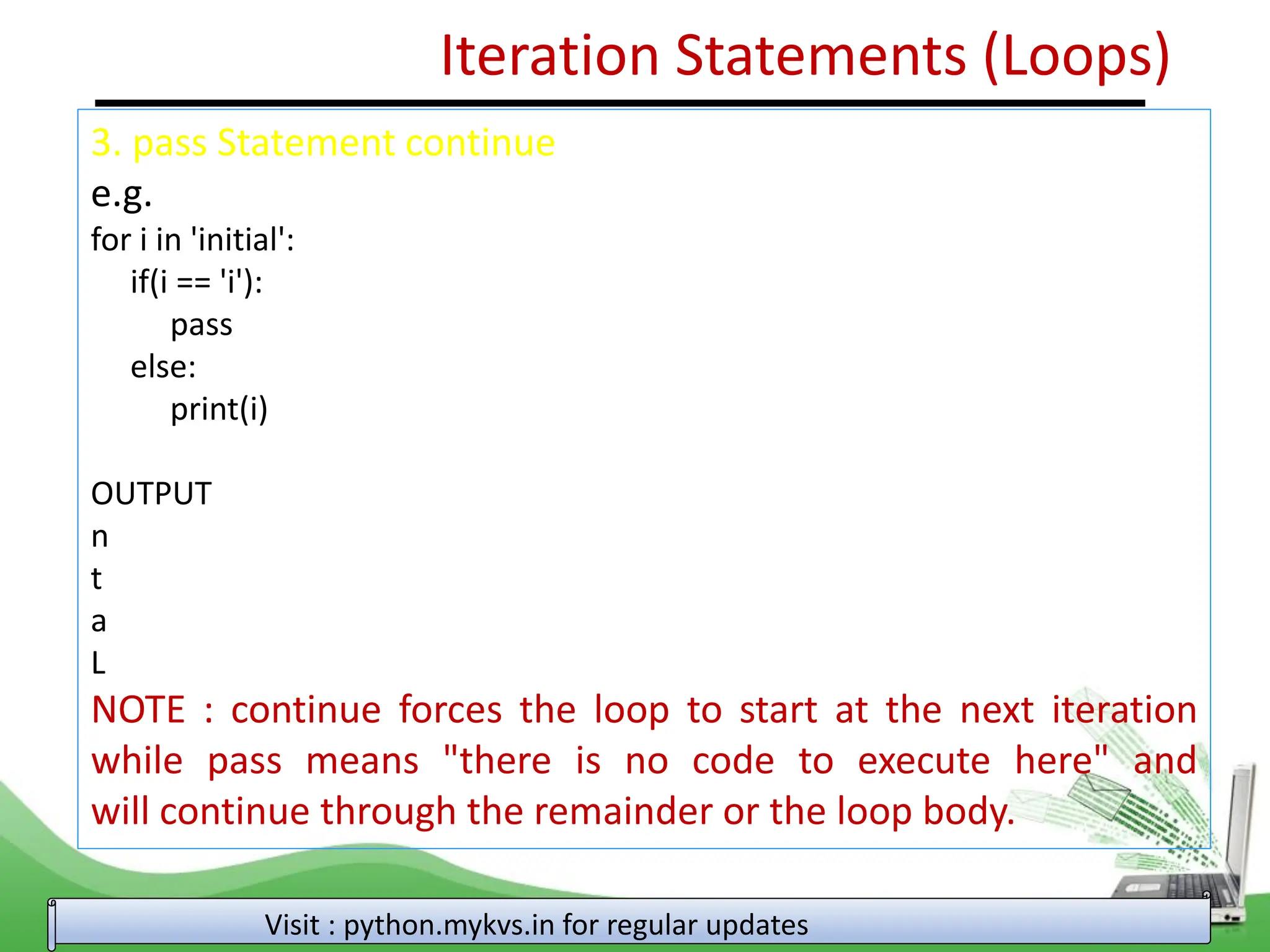
Iteration Statements (Loops) 3. pass Statement continue e.g. for i in 'initial': if(i == 'i'): pass else: print(i) OUTPUT n t a L NOTE : continue forces the loop to start at the next iteration while pass means "there is no code to execute here" and will continue through the remainder or the loop body. Visit : python.mykvs.in for regular updates

Revision of the basics of python1 (1).pdf

  • 1.
    Computer Science Class XII( As per CBSE Board) Chapter 1 Revision of the Basics of Python Visit : python.mykvs.in for regular updates New syllabus 2023-24
  • 2.
    Introduction It is widelyused general purpose,high level programming language.Developed by Guido van Rossum in 1991. It is used for: software development, web development (server-side), system scripting, Mathematics. Visit : python.mykvs.in for regular updates
  • 3.
    Features of Python 1.Easy to use – Due to simple syntax rule 2. Interpreted language – Code execution & interpretation line by line 3. Cross-platform language – It can run on windows,linux,macinetosh etc. equally 4. Expressive language – Less code to be written as it itself express the purpose of the code. 5. Completeness – Support wide rage of library 6. Free & Open Source – Can be downloaded freely and source code can be modify for improvement Visit : python.mykvs.in for regular updates
  • 4.
    Shortcomings of Python 1.Lesser libraries – as compared to other programming languages like c++,java,.net 2. Slow language – as it is interpreted languages,it executes the program slowly. 3. Weak on Type-binding – It not pin point on use of a single variable for different data type. Visit : python.mykvs.in for regular updates
  • 5.
    How to workin Python Visit : python.mykvs.in for regular updates (i) in Interactive mode * Search the python.exe file in the drive in which it is installed. If found double click it to start python in interactive mode
  • 6.
    How to workin Python Visit : python.mykvs.in for regular updates * Click start button -> All programs -> python<version>->IDLE(Python GUI)
  • 7.
    How to workin Python Visit : python.mykvs.in for regular updates Python command prompt >>> Type the following at prompt print “hello” print 8*3 print 3**3 k=3+4*3 print k
  • 8.
    How to workin Python Visit : python.mykvs.in for regular updates (ii) in Script mode Step 1 (Create program file) Below steps are for simple hello world program a. Click Start button->All Programs -> Python<version>->IDLE b. Now click File->New in IDLE Python Shell Now type print “hello” print “world” print “python is”,”object oriented programming lang.” c. Click File->Save and then save the file with filename and .py extension
  • 9.
    How to workin Python Visit : python.mykvs.in for regular updates (ii) in Script mode Step 2 (Run program file) a. Click Open command from IDLE’s File menu and select the file you have already saved b. Click Run-> Run Module c. It will execute all the commands of program file and display output in separate python shell window Note :- Python comes in 2 flavours – python 2.x and python 3.x . Later one is Backward incompatible language as decide by Python Software foundation(PSF). Mean code written in 2.x will not execute on 3.x . Visit the below link for difference between 2.x & 3.x https://www.geeksforgeeks.org/important-differences-between-python-2-x-and- python-3-x-with-examples/
  • 10.
    Data Handling Most ofthe computer programming language support data type, variables,operator and expression like fundamentals.Python also support these. Data Types Data Type specifies which type of value a variable can store. type() function is used to determine a variable's type in Python. Visit : python.mykvs.in for regular updates
  • 11.
    Data type continue Visit: python.mykvs.in for regular updates Data Types In Python 1. Number 2. String 3. Boolean 4. List 5. Tuple 6. Set 7. Dictionary
  • 12.
    Data type continue Visit: python.mykvs.in for regular updates 1. Number In Python It is used to store numeric values Python has three numeric types: 1. Integers 2. Floating point numbers 3. Complex numbers.
  • 13.
    Data type continue Visit: python.mykvs.in for regular updates 1. Integers Integers or int are positive or negative numbers with no decimal point. Integers in Python 3 are of unlimited size. e.g. a= 100 b= -100 c= 1*20 print(a) print(b) print(c) Output :- 100 -100 200
  • 14.
    Data type continue Visit: python.mykvs.in for regular updates Type Conversion of Integer int() function converts any data type to integer. e.g. a = "101" # string b=int(a) # converts string data type to integer. c=int(122.4) # converts float data type to integer. print(b) print(c)Run Code Output :- 101 122
  • 15.
    Data type continue Visit: python.mykvs.in for regular updates 2. Floating point numbers It is a positive or negative real numbers with a decimal point. e.g. a = 101.2 b = -101.4 c = 111.23 d = 2.3*3 print(a) print(b) print(c) print(d)Run Code Output :- 101.2 -101.4 111.23 6.8999999999999995
  • 16.
    Data type continue Visit: python.mykvs.in for regular updates Type Conversion of Floating point numbers float() function converts any data type to floating point number. e.g. a='301.4' #string b=float(a) #converts string data type to floating point number. c=float(121) #converts integer data type to floating point number. print(b) print(c)Run Code Output :- 301.4 121.0
  • 17.
    Data type continue Visit: python.mykvs.in for regular updates 3. Complex numbers Complex numbers are combination of a real and imaginary part.Complex numbers are in the form of X+Yj, where X is a real part and Y is imaginary part. e.g. a = complex(5) # convert 5 to a real part val and zero imaginary part print(a) b=complex(101,23) #convert 101 with real part and 23 as imaginary part print(b)Run Code Output :- (5+0j) (101+23j)
  • 18.
    Data type continue Visit: python.mykvs.in for regular updates 2. String In Python A string is a sequence of characters. In python we can create string using single (' ') or double quotes (" ").Both are same in python. e.g. str='computer science' print('str-', str) # print string print('str[0]-', str[0]) # print first char 'h' print('str[1:3]-', str[1:3]) # print string from postion 1 to 3 'ell' print('str[3:]-', str[3:]) # print string staring from 3rd char 'llo world' print('str *2-', str *2 ) # print string two times print("str +'yes'-", str +'yes') # concatenated string Output str- computer science str[0]- c str[1:3]- om str[3:]- puter science str *2- computer sciencecomputer science str +'yes'- computer scienceyes
  • 19.
    Data type continue Visit: python.mykvs.in for regular updates Iterating through string e.g. str='comp sc' for i in str: print(i) Output c o m p s c
  • 20.
    Data type continue Visit: python.mykvs.in for regular updates 3. Boolean In Python It is used to store two possible values either true or false e.g. str="comp sc" boo=str.isupper() # test if string contains upper case print(boo) Output False
  • 21.
    Data type continue Visit: python.mykvs.in for regular updates 4.List In Python List are collections of items and each item has its own index value. 5. Tuple In Python List and tuple, both are same except ,a list is mutable python objects and tuple is immutable Python objects. Immutable Python objects mean you cannot modify the contents of a tuple once it is assigned. e.g. of list list =[6,9] list[0]=55 print(list[0]) print(list[1]) OUTPUT 55 9 e.g. of tuple tup=(66,99) Tup[0]=3 # error message will be displayed print(tup[0]) print(tup[1])
  • 22.
    Data type continue Visit: python.mykvs.in for regular updates 6. Set In Python It is an unordered collection of unique and immutable (which cannot be modified)items. e.g. set1={11,22,33,22} print(set1) Output {33, 11, 22}
  • 23.
    Data type continue Visit: python.mykvs.in for regular updates 7. Dictionary In Python It is an unordered collection of items and each item consist of a key and a value. e.g. dict = {'Subject': 'comp sc', 'class': '11'} print(dict) print ("Subject : ", dict['Subject']) print ("class : ", dict.get('class')) Output {'Subject': 'comp sc', 'class': '11'} Subject : comp sc class : 11
  • 24.
    Operator Visit : python.mykvs.infor regular updates Operators are special symbols in Python that carry out arithmetic or logical computation. The value that the operator operates on is called the operand. Arithmetic operators Used for mathematical operation Operator Meaning Example + Add two operands or unary plus x + y +2 - Subtract right operand from the left or unary minus x - y -2 * Multiply two operands x * y / Divide left operand by the right one (always results into float) x / y % Modulus - remainder of the division of left operand by the right x % y (remainder of x/y) // Floor division - division that results into whole number adjusted to the left in the number line x // y ** Exponent - left operand raised to the power of right x**y (x to the power y)
  • 25.
    Operator continue Visit :python.mykvs.in for regular updates Arithmatic operator continue e.g. x = 5 y = 4 print('x + y =',x+y) print('x - y =',x-y) print('x * y =',x*y) print('x / y =',x/y) print('x // y =',x//y) print('x ** y =',x**y) OUTPUT ('x + y =', 9) ('x - y =', 1) ('x * y =', 20) ('x / y =', 1) ('x // y =', 1) ('x ** y =', 625) • Write a program in python to calculate the simple interest based on entered amount ,rate and time
  • 26.
    Operator continue Visit :python.mykvs.in for regular updates Arithmatic operator continue # EMI Calculator program in Python def emi_calculator(p, r, t): r = r / (12 * 100) # one month interest t = t * 12 # one month period emi = (p * r * pow(1 + r, t)) / (pow(1 + r, t) - 1) return emi # driver code principal = 10000; rate = 10; time = 2; emi = emi_calculator(principal, rate, time); print("Monthly EMI is= ", emi)
  • 27.
    Operator continue Visit :python.mykvs.in for regular updates Arithmatic operator continue How to calculate GST GST ( Goods and Services Tax ) which is included in netprice of product for get GST % first need to calculate GST Amount by subtract original cost from Netprice and then apply GST % formula = (GST_Amount*100) / original_cost # Python3 Program to compute GST from original and net prices. def Calculate_GST(org_cost, N_price): # return value after calculate GST% return (((N_price - org_cost) * 100) / org_cost); # Driver program to test above functions org_cost = 100 N_price = 120 print("GST = ",end='') print(round(Calculate_GST(org_cost, N_price)),end='') print("%") * Write a Python program to calculate the standard deviation
  • 28.
    Operator continue Visit :python.mykvs.in for regular updates Comparison operators -used to compare values Operator Meaning Example > Greater that - True if left operand is greater than the right x > y < Less that - True if left operand is less than the right x < y == Equal to - True if both operands are equal x == y != Not equal to - True if operands are not equal x != y >= Greater than or equal to - True if left operand is greater than or equal to the right x >= y <= Less than or equal to - True if left operand is less than or equal to the right x <= y
  • 29.
    Operator continue Visit :python.mykvs.in for regular updates Comparison operators continue e.g. x = 101 y = 121 print('x > y is',x>y) print('x < y is',x<y) print('x == y is',x==y) print('x != y is',x!=y) print('x >= y is',x>=y) print('x <= y is',x<=y) Output ('x > y is', False) ('x < y is', True) ('x == y is', False) ('x != y is', True) ('x >= y is', False) ('x <= y is', True)
  • 30.
    Operator continue Visit :python.mykvs.in for regular updates Logical operators e.g. x = True y = False print('x and y is',x and y) print('x or y is',x or y) print('not x is',not x) Outpur ('x and y is', False) ('x or y is', True) ('not x is', False) Operator Meaning Example and True if both the operands are true x and y or True if either of the operands is true x or y not True if operand is false (complements the operand) not x
  • 31.
    Operator continue Visit :python.mykvs.in for regular updates Bitwise operators Used to manipulate bit values. Operator Meaning Example & Bitwise AND x& y | Bitwise OR x | y ~ Bitwise NOT ~x ^ Bitwise XOR x ^ y >> Bitwise right shift x>> 2 << Bitwise left shift x<< 2
  • 32.
    Operator continue Visit :python.mykvs.in for regular updates Bitwise operators continue a = 6 b = 3 print ('a=',a,':',bin(a),'b=',b,':',bin(b)) c = 0 c = a & b; print ("result of AND is ", c,':',bin(c)) c = a | b; print ("result of OR is ", c,':',bin(c)) c = a ^ b; print ("result of EXOR is ", c,':',bin(c)) c = ~a; print ("result of COMPLEMENT is ", c,':',bin(c)) c = a << 2; print ("result of LEFT SHIFT is ", c,':',bin(c)) c = a >> 2; print ("result of RIGHT SHIFT is ", c,':',bin(c)) Output ('a=', 6, ':', '0b110', 'b=', 3, ':', '0b11') ('result of AND is ', 2, ':', '0b10') ('result of OR is ', 7, ':', '0b111') ('result of EXOR is ', 5, ':', '0b101') ('result of COMPLEMENT is ', -7, ':', '-0b111') ('result of LEFT SHIFT is ', 24, ':', '0b11000') ('result of RIGHT SHIFT is ', 1, ':', '0b1')
  • 33.
    Operator continue Visit :python.mykvs.in for regular updates Python Membership Operators Test for membership in a sequence e.g. a = 5 b = 10 list = [1, 2, 3, 4, 5 ] if ( a in list ): print ("Line 1 - a is available in the given list") else: print ("Line 1 - a is not available in the given list") if ( b not in list ): print ("Line 2 - b is not available in the given list") else: print ("Line 2 - b is available in the given list") Operator Description in Evaluates to true if it finds a variable in the specified sequence and false otherwise. not in Evaluates to true if it does not finds a variable in the specified sequence and false otherwise. output Line 1 - a is available in the given list Line 2 - b is not available in the given list
  • 34.
    Operator continue Visit :python.mykvs.in for regular updates Python Identity Operators e.g. a = 10 b = 10 print ('Line 1','a=',a,':',id(a), 'b=',b,':',id(b)) if ( a is b ): print ("Line 2 - a and b have same identity") else: print ("Line 2 - a and b do not have same identity") OUTPUT ('Line 1', 'a=', 10, ':', 20839436, 'b=', 10, ':', 20839436) Line 2 - a and b have same identity Operat or Description is Evaluates to true if the variables on either side of the operator point to the same object and false otherwise. is not Evaluates to false if the variables on either side of the operator point to the same object and true otherwise.
  • 35.
    Operator continue Visit :python.mykvs.in for regular updates Operators Precedence :highest precedence to lowest precedence table Operator Description ** Exponentiation (raise to the power) ~ + - Complement, unary plus and minus (method names for the last two are +@ and -@) * / % // Multiply, divide, modulo and floor division + - Addition and subtraction >> << Right and left bitwise shift & Bitwise 'AND'td> ^ | Bitwise exclusive `OR' and regular `OR' <= < > >= Comparison operators <> == != Equality operators = %= /= //= -= += *= **= Assignment operators is is not Identity operators in not in Membership operators not or and Logical operators
  • 36.
    Expression Visit : python.mykvs.infor regular updates It is a valid combination of operators,literals and variable. 1. Arithmatic expression :- e.g. c=a+b 2. Relational expression :- e.g. x>y 3. Logical expression :- a or b 4. String expression :- c=“comp”+”sc”
  • 37.
    Type conversion Visit :python.mykvs.in for regular updates The process of converting the value of one data type (integer, string, float, etc.) to another data type is called type conversion. Python has two types of type conversion. Implicit Type Conversion Explicit Type Conversion Implicit Type Conversion: In Implicit type conversion, Python automatically converts one data type to another data type. This process doesn't need any user involvement. e.g. num_int = 12 num_flo = 10.23 num_new = num_int + num_flo print("datatype of num_int:",type(num_int)) print("datatype of num_flo:",type(num_flo)) print("Value of num_new:",num_new) print("datatype of num_new:",type(num_new)) OUTPUT ('datatype of num_int:', <type 'int'>) ('datatype of num_flo:', <type 'float'>) ('Value of num_new:', 22.23) ('datatype of num_new:', <type 'float'>)
  • 38.
    Type conversion Visit :python.mykvs.in for regular updates Explicit Type Conversion: In Explicit Type Conversion, users convert the data type of an object to required data type. We use the predefined functions like int(),float(),str() etc. e.g. num_int = 12 num_str = "45" print("Data type of num_int:",type(num_int)) print("Data type of num_str before Type Casting:",type(num_str)) num_str = int(num_str) print("Data type of num_str after Type Casting:",type(num_str)) num_sum = num_int + num_str print("Sum of num_int and num_str:",num_sum) print("Data type of the sum:",type(num_sum)) OUTPUT ('Data type of num_int:', <type 'int'>) ('Data type of num_str before Type Casting:', <type 'str'>) ('Data type of num_str after Type Casting:', <type 'int'>) ('Sum of num_int and num_str:', 57) ('Data type of the sum:', <type 'int'>)
  • 39.
    math module Visit :python.mykvs.in for regular updates It is a standard module in Python. To use mathematical functions of this module,we have to import the module using import math. Function Description Example ceil(n) It returns the smallest integer greater than or equal to n. math.ceil(4.2) returns 5 factorial(n) It returns the factorial of value n math.factorial(4) returns 24 floor(n) It returns the largest integer less than or equal to n math.floor(4.2) returns 4 fmod(x, y) It returns the remainder when n is divided by y math.fmod(10.5,2) returns 0.5 exp(n) It returns e**n math.exp(1) return 2.718281828459045 log2(n) It returns the base-2 logarithm of n math.log2(4) return 2.0 log10(n) It returns the base-10 logarithm of n math.log10(4) returns 0.6020599913279624 pow(n, y) It returns n raised to the power y math.pow(2,3) returns 8.0 sqrt(n) It returns the square root of n math.sqrt(100) returns 10.0 cos(n) It returns the cosine of n math.cos(100) returns 0.8623188722876839 sin(n) It returns the sine of n math.sin(100) returns -0.5063656411097588 tan(n) It returns the tangent of n math.tan(100) returns -0.5872139151569291 pi It is pi value (3.14159...) It is (3.14159...) e It is mathematical constant e (2.71828...) It is (2.71828...)
  • 40.
    Control Statements Control statementsare used to control the flow of execution depending upon the specified condition/logic. There are three types of control statements. 1. Decision Making Statements 2. Iteration Statements (Loops) 3. Jump Statements (break, continue, pass) Visit : python.mykvs.in for regular updates
  • 41.
    Decision Making Statement Decisionmaking statement used to control the flow of execution of program depending upon condition. There are three types of decision making statement. 1. if statements 2. if-else statements 3. Nested if-else statement Visit : python.mykvs.in for regular updates
  • 42.
    Decision Making Statement 1.if statements An if statement is a programming conditional statement that, if proved true, performs a function or displays information. Visit : python.mykvs.in for regular updates
  • 43.
    Decision Making Statement 1.if statements Syntax: if(condition): statement [statements] e.g. noofbooks = 2 if (noofbooks == 2): print('You have ') print(‘two books’) print(‘outside of if statement’) Output You have two books Note:To indicate a block of code in Python, you must indent each line of the block by the same amount. In above e.g. both print statements are part of if condition because of both are at same level indented but not the third print statement. Visit : python.mykvs.in for regular updates
  • 44.
    Decision Making Statement 1.if statements Using logical operator in if statement x=1 y=2 if(x==1 and y==2): print(‘condition matcing the criteria') Output :- condition matcing the criteria ----------------------------------------------------------- a=100 if not(a == 20): print('a is not equal to 20') Output :- a is not equal to 20 Visit : python.mykvs.in for regular updates
  • 45.
    Decision Making Statement 2.if-else Statements If-else statement executes some code if the test expression is true (nonzero) and some other code if the test expression is false. Visit : python.mykvs.in for regular updates
  • 46.
    Decision Making Statement 2.if-else Statements Syntax: if(condition): statements else: statements e.g. a=10 if(a < 100): print(‘less than 100') else: print(‘more than equal 100') OUTPUT less than 100 *Write a program in python to check that entered numer is even or odd Visit : python.mykvs.in for regular updates
  • 47.
    Decision Making Statement 3.Nested if-else statement The nested if...else statement allows you to check for multiple test expressions and execute different codes for more than two conditions. Visit : python.mykvs.in for regular updates
  • 48.
    Decision Making Statement 3.Nested if-else statement Syntax If (condition): statements elif (condition): statements else: statements E.G. num = float(input("Enter a number: ")) if num >= 0: if num == 0: print("Zero") else: print("Positive number") else: print("Negative number") OUTPUT Enter a number: 5 Positive number * Write python program to find out largest of 3 numbers. Visit : python.mykvs.in for regular updates
  • 49.
    Iteration Statements (Loops) Iterationstatements(loop) are used to execute a block of statements as long as the condition is true. Loops statements are used when we need to run same code again and again. Python Iteration (Loops) statements are of three type :- 1. While Loop 2. For Loop 3. Nested For Loops Visit : python.mykvs.in for regular updates
  • 50.
    Iteration Statements (Loops) 1.While Loop It is used to execute a block of statement as long as a given condition is true. And when the condition become false, the control will come out of the loop. The condition is checked every time at the beginning of the loop. Syntax while (condition): statement [statements] e.g. x = 1 while (x <= 4): print(x) x = x + 1 Visit : python.mykvs.in for regular updates Output 1 2 3 4
  • 51.
    Iteration Statements (Loops) WhileLoop continue While Loop With Else e.g. x = 1 while (x < 3): print('inside while loop value of x is ',x) x = x + 1 else: print('inside else value of x is ', x) Output inside while loop value of x is 1 inside while loop value of x is 2 inside else value of x is 5 *Write a program in python to find out the factorial of a given number Visit : python.mykvs.in for regular updates
  • 52.
    Iteration Statements (Loops) WhileLoop continue Infinite While Loop e.g. x = 5 while (x == 5): print(‘inside loop') Output Inside loop Inside loop … … Visit : python.mykvs.in for regular updates
  • 53.
    Iteration Statements (Loops) 2.For Loop It is used to iterate over items of any sequence, such as a list or a string. Syntax for val in sequence: statements e.g. for i in range(3,5): print(i) Output 3 4 Visit : python.mykvs.in for regular updates
  • 54.
    Iteration Statements (Loops) 2.For Loop continue Example programs for i in range(5,3,-1): print(i) Output 5 4 range() Function Parameters start: Starting number of the sequence. stop: Generate numbers up to, but not including this number. step(Optional): Determines the increment between each numbers in the sequence. Visit : python.mykvs.in for regular updates
  • 55.
    Iteration Statements (Loops) 2.For Loop continue For Loop With Else e.g. for i in range(1, 4): print(i) else: # Executed because no break in for print("No Break") Output 1 2 3 4 No Break Visit : python.mykvs.in for regular updates
  • 56.
    Iteration Statements (Loops) 2.For Loop continue Nested For Loop e.g. for i in range(1,3): for j in range(1,11): k=i*j print (k, end=' ') print() Output 1 2 3 4 5 6 7 8 9 10 2 4 6 8 10 12 14 16 18 20 Visit : python.mykvs.in for regular updates
  • 57.
    Iteration Statements (Loops) 3.Jump Statements Jump statements are used to transfer the program's control from one location to another. Means these are used to alter the flow of a loop like - to skip a part of a loop or terminate a loop There are three types of jump statements used in python. 1.break 2.continue 3.pass Visit : python.mykvs.in for regular updates
  • 58.
    Iteration Statements (Loops) 1.break itis used to terminate the loop. e.g. for val in "string": if val == "i": break print(val) print("The end") Output s t r The end Visit : python.mykvs.in for regular updates
  • 59.
    Iteration Statements (Loops) 2.continue Itis used to skip all the remaining statements in the loop and move controls back to the top of the loop. e.g. for val in "init": if val == "i": continue print(val) print("The end") Output n t The end Visit : python.mykvs.in for regular updates
  • 60.
    Iteration Statements (Loops) 3.pass Statement This statement does nothing. It can be used when a statement is required syntactically but the program requires no action. Use in loop while True: pass # Busy-wait for keyboard interrupt (Ctrl+C) In function It makes a controller to pass by without executing any code. e.g. def myfun(): pass #if we don’t use pass here then error message will be shown print(‘my program') OUTPUT My program Visit : python.mykvs.in for regular updates
  • 61.
    Iteration Statements (Loops) 3.pass Statement continue e.g. for i in 'initial': if(i == 'i'): pass else: print(i) OUTPUT n t a L NOTE : continue forces the loop to start at the next iteration while pass means "there is no code to execute here" and will continue through the remainder or the loop body. Visit : python.mykvs.in for regular updates