IJSRD - International Journal for Scientific Research & Development| Vol. 1, Issue 5, 2013 | ISSN (online): 2321-0613 All rights reserved by www.ijsrd.com 1088 Abstract-- Basically, the idea behind this system is improvement in cybernetics, the biometric person identification technique based on the pattern of the human iris is well suited to be applied to access control. The human eye is sensitive to visible light. Security systems having realized the value of biometrics for two basic purposes: to verify or identify users. In this busy world, identification should be fast and efficient. In this paper I focus on an efficient methodology for identification and verification for iris detection using Haar transform and Minimum hamming distance. I use canny operator for the edge detection. This biological phenomenon contracts and dilates the two pupils synchronously when illuminating one of the eyes by visible light .I applied the Haar wavelet compressing the data. By comparing the quantized vectors using the Hamming Distance operator, we determine finally whether two irises are similar. The result shows that system is quite effective. Keywords: Iris recognition, Edge detection, Feature extraction, Haar transform, Biometrics iris recognition. I. INTRODUCTION The purpose of Jris Recognition', a biometrical based technology for personal identification and verification, is to recognize a person from his/her iris prints. In fact, iris patterns are characterized by high level of stability and distinctiveness. Each individual has a unique iris. I implemented Jris Recognition' using Matlab for its ease in image manipulation and wavelet applications. The first step of my project consists of images acquisition. Then, I changed the pictures' size and types are manipulated in order to be able subsequently to process them. Once the pre- processing step is achieved, it is necessary to localize the iris and unwrap it. At this stage, we can extract the texture of the iris using Haar Wavelets. Finally, we compare the coded image with the already coded iris in order to find a match or detect an imposter. A. ACQUISITION Image acquisition is considered the most critical step in my project since all subsequent stages depend highly on the image quality. I downloaded the iris images from internet. I set the resolution to 640x480, the type of the image to jpeg, and the mode to white and black for greater details. B. Image Manipulation In the pre-processing stage, we transformed the images from RGB to gray level and from eight-bit to double precision thus facilitating the manipulation of the images in subsequent steps. C. Location of the Iris Boundaries I implemented Jris Recognition' using Matlab for its ease in image manipulation and wavelet applications. The first step of my project consists of images acquisition. Then, I changed the pictures' size and types are manipulated in order to be able subsequently to process them. Once the preprocessing step is achieved, it is necessary to localize the iris and unwrap it. At this stage, we can extract the texture of the iris using Haar Wavelets. Finally, we compare the coded image with the already coded iris in order to find a match or detect an imposter. Before performing iris pattern matching, the boundaries of the iris should be located. So, we are supposed to detect the part of the image that extends from inside the limbus (the border between the sclera and the iris) to the outside of the pupil. I start by determining the outer edge by first down sampling the images by a factor of 4, to enable a faster processing delay, using a Gaussian Pyramid. Then I use the canny operator with the default threshold value given by Matlab, to obtain the gradient image. Next, I apply a circular summation which consists of summing the intensities over all circles, by using three nested loops to pass over all possible radiuses and Centre coordinates. The circle with the biggest radius and highest summation corresponds to the outer boundary. The Centre and radius of the iris in the original image are determined by rescaling the obtained results of localized iris shown in figure 1. Fig. 2: Localized Iris Secure System based on Dynamic Features of IRIS Recognition Shreyas A. Pathak1 1 Patel Institutes of Engineering and Science – RGPV University
Secure System based on Dynamic Features of IRIS Recognition (IJSRD/Vol. 1/Issue 5/2013/0013) All rights reserved by www.ijsrd.com 1089 After having located the outer edge, we next need to find the inner one which is difficult because it is not quite discernable by the canny operator especially for dark eyed people. Therefore, after detecting the outer boundary, we test the intensity of the pixels within the iris. Depending on this intensity, the threshold of the canny is chosen. If the iris is dark, a low threshold is used to enable the canny operator to mark out the inner circle separating the iris from the pupil. If the iris is light colored, such as blue or green, then a higher threshold is utilized. The pupil Centre is shifted by up to 15% from the center of the iris and its radius is not greater than 0.8 neither lowers than 0.1 of the radius of the iris. This means that processing time, dedicated to the search of the center of the pupil of this part is relatively small. Hence, instead of searching a down sample version of the iris, we searched the original one to gain maximum accuracy. D. Converting to the Stretched Polar coordinates System After determining the limits of the iris in the previous phase, the iris should be isolated and stored in a separate image. The factors that we should watch out for are the possibility of the pupil dilating and appearing of different size in different images. For this purpose, we begin by changing our coordinate system by un-wrapping the lower part of the iris (lower 180 degrees) and mapping all the points within the boundary of the iris into their polar equivalent. The size of the mapped image is fixed (100x402 pixels) which means that we are taking an equal amount of points at every angle. Therefore, if the pupil dilates the same points will be picked up and mapped again which makes our mapping process stretch invariant. When un-wrapping the image, I make use of the bilinear transformation to obtain the intensities of the points in the new image. The intensities at each pixel in the new image are the result of the interpolation of the gray scales in the old image. Fig. 2 Original Image E. Extracting the Iris code The picture of an eye is first processed by software that localizes the inner and outer boundaries of the iris, and the eyelid contours, in order to extract just the iris portion. Eyelashes and reflections that may cover parts of the iris are detected and discounted. Sophisticated mathematical software code for the texture sequence in the iris, similar to a DNA sequence code. Then it encodes the iris pattern by a process called Demodulation. This creates a phase process uses functions called 2-D wavelets that make a very compact yet complete description of the iris pattern, regardless of its size and pupil dilation, in just 512 bytes. The phase sequence is called an Iris code template, and it captures the unique features of an iris in a robust way that allows easy and very rapid comparisons against large databases of other templates. The Iris code template is immediately encrypted to eliminate the possibility of identity theft and to maximize security. Fig. 4: Coded Strip In an Iris code, each phasor angle shown fig above is quantized in to just the complex quadrant in which it lies for each local patch of the iris, and this operation is repeated all across the iris, at many different scales of analysis. Basically wavelet transforms allow the interpretation of signals (in this case an image) as a linear combination of a self-similar, though linearly independent, family of signals. These signals (or wavelets) can be chosen so that they respond best to important features in an image, in this case bringing out the details, which discriminate two different irises F. Image Analysis The features of the iris are then analyzed and digitized into a 512 byte (4096 bit) Iris Code record, half of which describes the features, half of which controls the comparison process. During enrolment, this Iris Code record is stored in the database for future comparison. During a recognition attempt, when an iris is presented at a recognition point, the same process is repeated; however the resulting Iris Code record is not stored, but is compared to ever y file in the database Fig. 5: J NIK illumination eye image
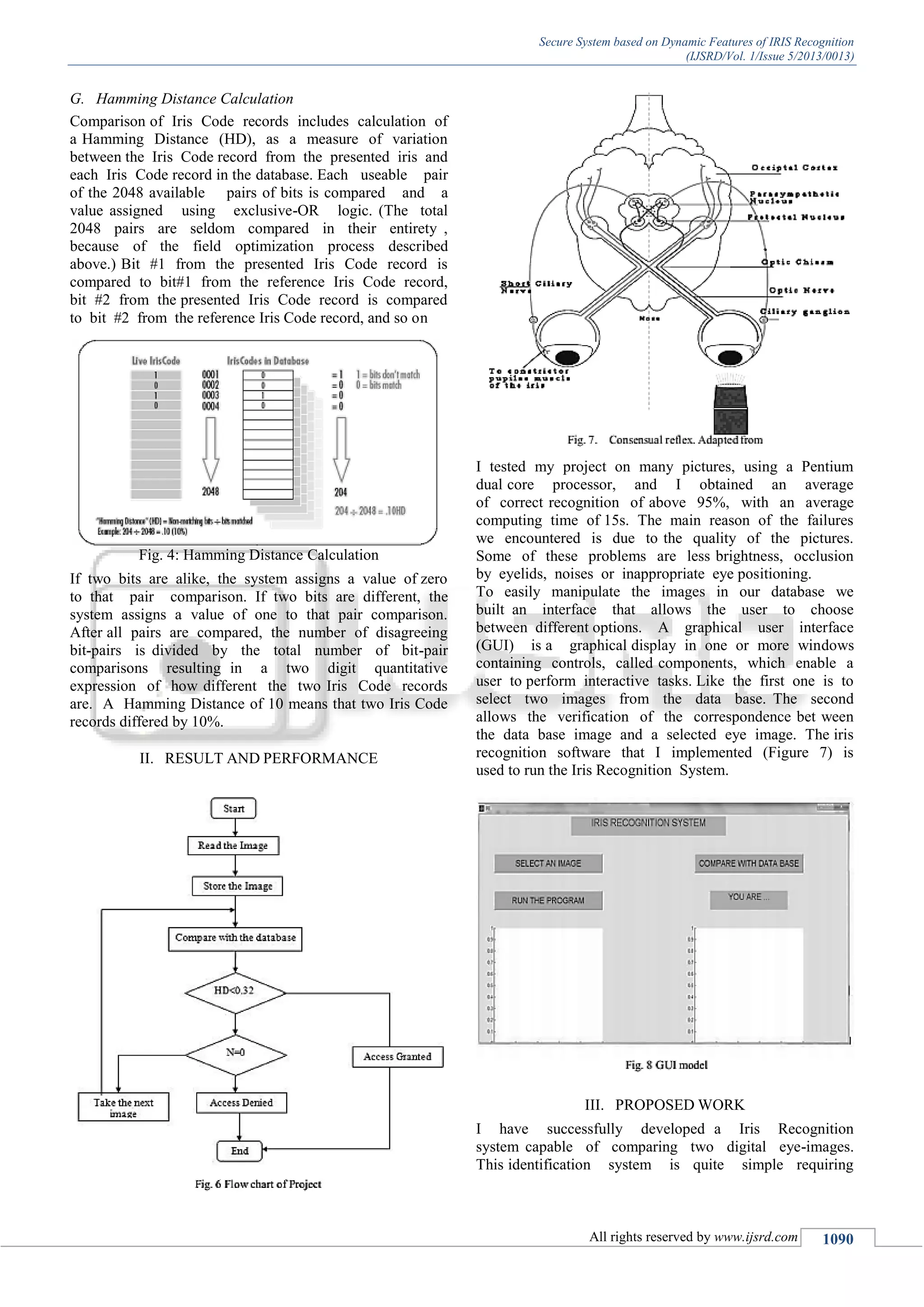
Secure System based on Dynamic Features of IRIS Recognition (IJSRD/Vol. 1/Issue 5/2013/0013) All rights reserved by www.ijsrd.com 1090 G. Hamming Distance Calculation Comparison of Iris Code records includes calculation of a Hamming Distance (HD), as a measure of variation between the Iris Code record from the presented iris and each Iris Code record in the database. Each useable pair of the 2048 available pairs of bits is compared and a value assigned using exclusive-OR logic. (The total 2048 pairs are seldom compared in their entirety , because of the field optimization process described above.) Bit #1 from the presented Iris Code record is compared to bit#1 from the reference Iris Code record, bit #2 from the presented Iris Code record is compared to bit #2 from the reference Iris Code record, and so on Fig. 4: Hamming Distance Calculation If two bits are alike, the system assigns a value of zero to that pair comparison. If two bits are different, the system assigns a value of one to that pair comparison. After all pairs are compared, the number of disagreeing bit-pairs is divided by the total number of bit-pair comparisons resulting in a two digit quantitative expression of how different the two Iris Code records are. A Hamming Distance of 10 means that two Iris Code records differed by 10%. II. RESULT AND PERFORMANCE I tested my project on many pictures, using a Pentium dual core processor, and I obtained an average of correct recognition of above 95%, with an average computing time of 15s. The main reason of the failures we encountered is due to the quality of the pictures. Some of these problems are less brightness, occlusion by eyelids, noises or inappropriate eye positioning. To easily manipulate the images in our database we built an interface that allows the user to choose between different options. A graphical user interface (GUI) is a graphical display in one or more windows containing controls, called components, which enable a user to perform interactive tasks. Like the first one is to select two images from the data base. The second allows the verification of the correspondence bet ween the data base image and a selected eye image. The iris recognition software that I implemented (Figure 7) is used to run the Iris Recognition System. III. PROPOSED WORK I have successfully developed a Iris Recognition system capable of comparing two digital eye-images. This identification system is quite simple requiring
Secure System based on Dynamic Features of IRIS Recognition (IJSRD/Vol. 1/Issue 5/2013/0013) All rights reserved by www.ijsrd.com 1091 few components and is effective enough to be integrated within security systems that require an identity check. IV. CONCLUSION I have successfully developed a Iris Recognition i capable of comparing two digital eye-images. Identification system is quite simple requiring few components and is effective enough to be integrated within security systems that require an identity check. I found that HD value must be 0.32. Judging by the clear distinctiveness of the iris patterns we can expect iris recognition systems to become the leading technology in identity verification. REFERENCES [1] Makram Nabti,Ahmed Bouridane, -An Effective Iris Recognition System Based On Wavelet Maxima and Gabor Filter Bank|| Institute of Electronics, Communications and Information Technology (ECIT) School of Electronics, Electrical Engineering and Computer Science, Queen's University Belfast, Belfast BT7 1NN. [2] Byung Jun Kang and Kang Ryoung Park, -Real Time Image restoration for Iris Recognition System! IEEE TRANSACTIONS ON SYSTEMS, MAN, AND CYBERNETICS—PART B: CYBERNETICS, VOL. 37, NO. 6, DECEMBER 2007 [3] Qichuan Tian and Zhengguang Liu -A Practical Iris Recognition Algorithm!, Proceedings of the 2006 IEEE International Conference on Robotics and Biomimetics December 17 - 20, 2006, Kunming, China [4] Md. Anwar Hussain, -Eigenspace Based Accurate Iris Recognition System!, #Department of ECE, NERIST (Deemed University) Arunachal Pradesh, India. 2010 Annual IEEE India Conference (INDICON) [5] M. Turk, and A. Pentland, -Eigen faces for Recognition,! Journal of Cognitive Neroscience, Vo. 3, no. 1, pages 71-86. [6] Juwei Lu, Kostantinos N. Plataniotis, and Anasios N. Venetsanopoulos, - Face Recognition Using LDA- Based Algorithms!, IEEE Trans. Neural Networks, vol.14, no.1, Jan 2003. [7] Chia Te CHU and Ching-Han CHEN - High Performance Iris Recognition Based on LDA and LPCC || Institute of Electrical Engineering,I-Shou University, Proceedings of the 17th IEEE International Conference on Tools with Artificial Intelligence (ICTAI'05) [8] Shashi Kumar D R1, K B Raja2, R. K Chhootaray3, Sabyasachi Pattnaik, -PCA based Iris Recognition using DWT ||, IJCTA | JULY-AUGUST 2011 [9] Kazuyuki Miyazawa, Koichi Ito, Takafumi Aoki, Koji Kobayashi, Atsushi Katsumata || AN IRIS RECOGNITION SYSTEM USING PHASE-BASED IMAGE MATCHING!, 1-4244-0481-9/06/ C2006 IEEE [10] Guangzhu Xu, Zaifeng Zhang , Yide Ma School of Information Science&Engineering -IMPROVING THE PERFORMANCE OF IRIS RECOGNITON SYSTEM USING EYELIDS AND EYELASHES DETECTION AND IRIS IMAGE ENHANCEMENT||,Proc 5th IEEE Int.Conf on cognitive Informatics(ICI/'06) [11] N. Popescu-Bodorin*, V.E. Balas, | Exploratory Simulation of an Intelligent Iris Verifier Distributed System!, 6th IEEE International Symposium on Applied Computational Intelligence and Informatics • May 19-21, 2011. [12] Inmaculada Tomeo-Reyes, Judith Liu-Jimenez, Ivan Rubio-Polo, Jorge Redondo-Justo, Raul Sanchez- Reillo,|| Input Images in Iris Recognition Systems: A Case Study!, 978-1-4244-9493-4/11/©2011 IEEE [13] Nitin Bhatia and Megha Chhabra, -Improved Hough Transform for Fast Iris Detection,! Second IEEE International Conference on Signal Processing systems, vol VI, pp. 172 - 176, 2010. [14] W Boles and Boashashash, -A Human Identification Technique Using Images of the Iris and Wavelet
Secure System based on Dynamic Features of IRIS Recognition (IJSRD/Vol. 1/Issue 5/2013/0013) All rights reserved by www.ijsrd.com 1092 Transform,! IEEE Transaction on Signal Processing, vol 46, pp. 1185¬1188, April 1998. [15] Yingzi Du, Emrah Arslanturk, Zhi Zhou, and Craig Belcher, -Video-Based Noncooperative Iris Image Segmentation! , IEEE TRANSACTIONS ON SYSTEMS, MAN, AND CYBERNETICS—PART B: CYBERNETICS, VOL. 41, NO. 1, FEBRUARY 2011 [16] Libor Masek, Peter Kovesi. MATLAB Source Code for a Biometric Identification System Based on Iris Patterns. The School of Computer Science and Software Engineering, The University of Western Australia. 2003.

Secure System based on Dynamic Features of IRIS Recognition

  • 1.
    IJSRD - InternationalJournal for Scientific Research & Development| Vol. 1, Issue 5, 2013 | ISSN (online): 2321-0613 All rights reserved by www.ijsrd.com 1088 Abstract-- Basically, the idea behind this system is improvement in cybernetics, the biometric person identification technique based on the pattern of the human iris is well suited to be applied to access control. The human eye is sensitive to visible light. Security systems having realized the value of biometrics for two basic purposes: to verify or identify users. In this busy world, identification should be fast and efficient. In this paper I focus on an efficient methodology for identification and verification for iris detection using Haar transform and Minimum hamming distance. I use canny operator for the edge detection. This biological phenomenon contracts and dilates the two pupils synchronously when illuminating one of the eyes by visible light .I applied the Haar wavelet compressing the data. By comparing the quantized vectors using the Hamming Distance operator, we determine finally whether two irises are similar. The result shows that system is quite effective. Keywords: Iris recognition, Edge detection, Feature extraction, Haar transform, Biometrics iris recognition. I. INTRODUCTION The purpose of Jris Recognition', a biometrical based technology for personal identification and verification, is to recognize a person from his/her iris prints. In fact, iris patterns are characterized by high level of stability and distinctiveness. Each individual has a unique iris. I implemented Jris Recognition' using Matlab for its ease in image manipulation and wavelet applications. The first step of my project consists of images acquisition. Then, I changed the pictures' size and types are manipulated in order to be able subsequently to process them. Once the pre- processing step is achieved, it is necessary to localize the iris and unwrap it. At this stage, we can extract the texture of the iris using Haar Wavelets. Finally, we compare the coded image with the already coded iris in order to find a match or detect an imposter. A. ACQUISITION Image acquisition is considered the most critical step in my project since all subsequent stages depend highly on the image quality. I downloaded the iris images from internet. I set the resolution to 640x480, the type of the image to jpeg, and the mode to white and black for greater details. B. Image Manipulation In the pre-processing stage, we transformed the images from RGB to gray level and from eight-bit to double precision thus facilitating the manipulation of the images in subsequent steps. C. Location of the Iris Boundaries I implemented Jris Recognition' using Matlab for its ease in image manipulation and wavelet applications. The first step of my project consists of images acquisition. Then, I changed the pictures' size and types are manipulated in order to be able subsequently to process them. Once the preprocessing step is achieved, it is necessary to localize the iris and unwrap it. At this stage, we can extract the texture of the iris using Haar Wavelets. Finally, we compare the coded image with the already coded iris in order to find a match or detect an imposter. Before performing iris pattern matching, the boundaries of the iris should be located. So, we are supposed to detect the part of the image that extends from inside the limbus (the border between the sclera and the iris) to the outside of the pupil. I start by determining the outer edge by first down sampling the images by a factor of 4, to enable a faster processing delay, using a Gaussian Pyramid. Then I use the canny operator with the default threshold value given by Matlab, to obtain the gradient image. Next, I apply a circular summation which consists of summing the intensities over all circles, by using three nested loops to pass over all possible radiuses and Centre coordinates. The circle with the biggest radius and highest summation corresponds to the outer boundary. The Centre and radius of the iris in the original image are determined by rescaling the obtained results of localized iris shown in figure 1. Fig. 2: Localized Iris Secure System based on Dynamic Features of IRIS Recognition Shreyas A. Pathak1 1 Patel Institutes of Engineering and Science – RGPV University
  • 2.
    Secure System basedon Dynamic Features of IRIS Recognition (IJSRD/Vol. 1/Issue 5/2013/0013) All rights reserved by www.ijsrd.com 1089 After having located the outer edge, we next need to find the inner one which is difficult because it is not quite discernable by the canny operator especially for dark eyed people. Therefore, after detecting the outer boundary, we test the intensity of the pixels within the iris. Depending on this intensity, the threshold of the canny is chosen. If the iris is dark, a low threshold is used to enable the canny operator to mark out the inner circle separating the iris from the pupil. If the iris is light colored, such as blue or green, then a higher threshold is utilized. The pupil Centre is shifted by up to 15% from the center of the iris and its radius is not greater than 0.8 neither lowers than 0.1 of the radius of the iris. This means that processing time, dedicated to the search of the center of the pupil of this part is relatively small. Hence, instead of searching a down sample version of the iris, we searched the original one to gain maximum accuracy. D. Converting to the Stretched Polar coordinates System After determining the limits of the iris in the previous phase, the iris should be isolated and stored in a separate image. The factors that we should watch out for are the possibility of the pupil dilating and appearing of different size in different images. For this purpose, we begin by changing our coordinate system by un-wrapping the lower part of the iris (lower 180 degrees) and mapping all the points within the boundary of the iris into their polar equivalent. The size of the mapped image is fixed (100x402 pixels) which means that we are taking an equal amount of points at every angle. Therefore, if the pupil dilates the same points will be picked up and mapped again which makes our mapping process stretch invariant. When un-wrapping the image, I make use of the bilinear transformation to obtain the intensities of the points in the new image. The intensities at each pixel in the new image are the result of the interpolation of the gray scales in the old image. Fig. 2 Original Image E. Extracting the Iris code The picture of an eye is first processed by software that localizes the inner and outer boundaries of the iris, and the eyelid contours, in order to extract just the iris portion. Eyelashes and reflections that may cover parts of the iris are detected and discounted. Sophisticated mathematical software code for the texture sequence in the iris, similar to a DNA sequence code. Then it encodes the iris pattern by a process called Demodulation. This creates a phase process uses functions called 2-D wavelets that make a very compact yet complete description of the iris pattern, regardless of its size and pupil dilation, in just 512 bytes. The phase sequence is called an Iris code template, and it captures the unique features of an iris in a robust way that allows easy and very rapid comparisons against large databases of other templates. The Iris code template is immediately encrypted to eliminate the possibility of identity theft and to maximize security. Fig. 4: Coded Strip In an Iris code, each phasor angle shown fig above is quantized in to just the complex quadrant in which it lies for each local patch of the iris, and this operation is repeated all across the iris, at many different scales of analysis. Basically wavelet transforms allow the interpretation of signals (in this case an image) as a linear combination of a self-similar, though linearly independent, family of signals. These signals (or wavelets) can be chosen so that they respond best to important features in an image, in this case bringing out the details, which discriminate two different irises F. Image Analysis The features of the iris are then analyzed and digitized into a 512 byte (4096 bit) Iris Code record, half of which describes the features, half of which controls the comparison process. During enrolment, this Iris Code record is stored in the database for future comparison. During a recognition attempt, when an iris is presented at a recognition point, the same process is repeated; however the resulting Iris Code record is not stored, but is compared to ever y file in the database Fig. 5: J NIK illumination eye image
  • 3.
    Secure System basedon Dynamic Features of IRIS Recognition (IJSRD/Vol. 1/Issue 5/2013/0013) All rights reserved by www.ijsrd.com 1090 G. Hamming Distance Calculation Comparison of Iris Code records includes calculation of a Hamming Distance (HD), as a measure of variation between the Iris Code record from the presented iris and each Iris Code record in the database. Each useable pair of the 2048 available pairs of bits is compared and a value assigned using exclusive-OR logic. (The total 2048 pairs are seldom compared in their entirety , because of the field optimization process described above.) Bit #1 from the presented Iris Code record is compared to bit#1 from the reference Iris Code record, bit #2 from the presented Iris Code record is compared to bit #2 from the reference Iris Code record, and so on Fig. 4: Hamming Distance Calculation If two bits are alike, the system assigns a value of zero to that pair comparison. If two bits are different, the system assigns a value of one to that pair comparison. After all pairs are compared, the number of disagreeing bit-pairs is divided by the total number of bit-pair comparisons resulting in a two digit quantitative expression of how different the two Iris Code records are. A Hamming Distance of 10 means that two Iris Code records differed by 10%. II. RESULT AND PERFORMANCE I tested my project on many pictures, using a Pentium dual core processor, and I obtained an average of correct recognition of above 95%, with an average computing time of 15s. The main reason of the failures we encountered is due to the quality of the pictures. Some of these problems are less brightness, occlusion by eyelids, noises or inappropriate eye positioning. To easily manipulate the images in our database we built an interface that allows the user to choose between different options. A graphical user interface (GUI) is a graphical display in one or more windows containing controls, called components, which enable a user to perform interactive tasks. Like the first one is to select two images from the data base. The second allows the verification of the correspondence bet ween the data base image and a selected eye image. The iris recognition software that I implemented (Figure 7) is used to run the Iris Recognition System. III. PROPOSED WORK I have successfully developed a Iris Recognition system capable of comparing two digital eye-images. This identification system is quite simple requiring
  • 4.
    Secure System basedon Dynamic Features of IRIS Recognition (IJSRD/Vol. 1/Issue 5/2013/0013) All rights reserved by www.ijsrd.com 1091 few components and is effective enough to be integrated within security systems that require an identity check. IV. CONCLUSION I have successfully developed a Iris Recognition i capable of comparing two digital eye-images. Identification system is quite simple requiring few components and is effective enough to be integrated within security systems that require an identity check. I found that HD value must be 0.32. Judging by the clear distinctiveness of the iris patterns we can expect iris recognition systems to become the leading technology in identity verification. REFERENCES [1] Makram Nabti,Ahmed Bouridane, -An Effective Iris Recognition System Based On Wavelet Maxima and Gabor Filter Bank|| Institute of Electronics, Communications and Information Technology (ECIT) School of Electronics, Electrical Engineering and Computer Science, Queen's University Belfast, Belfast BT7 1NN. [2] Byung Jun Kang and Kang Ryoung Park, -Real Time Image restoration for Iris Recognition System! IEEE TRANSACTIONS ON SYSTEMS, MAN, AND CYBERNETICS—PART B: CYBERNETICS, VOL. 37, NO. 6, DECEMBER 2007 [3] Qichuan Tian and Zhengguang Liu -A Practical Iris Recognition Algorithm!, Proceedings of the 2006 IEEE International Conference on Robotics and Biomimetics December 17 - 20, 2006, Kunming, China [4] Md. Anwar Hussain, -Eigenspace Based Accurate Iris Recognition System!, #Department of ECE, NERIST (Deemed University) Arunachal Pradesh, India. 2010 Annual IEEE India Conference (INDICON) [5] M. Turk, and A. Pentland, -Eigen faces for Recognition,! Journal of Cognitive Neroscience, Vo. 3, no. 1, pages 71-86. [6] Juwei Lu, Kostantinos N. Plataniotis, and Anasios N. Venetsanopoulos, - Face Recognition Using LDA- Based Algorithms!, IEEE Trans. Neural Networks, vol.14, no.1, Jan 2003. [7] Chia Te CHU and Ching-Han CHEN - High Performance Iris Recognition Based on LDA and LPCC || Institute of Electrical Engineering,I-Shou University, Proceedings of the 17th IEEE International Conference on Tools with Artificial Intelligence (ICTAI'05) [8] Shashi Kumar D R1, K B Raja2, R. K Chhootaray3, Sabyasachi Pattnaik, -PCA based Iris Recognition using DWT ||, IJCTA | JULY-AUGUST 2011 [9] Kazuyuki Miyazawa, Koichi Ito, Takafumi Aoki, Koji Kobayashi, Atsushi Katsumata || AN IRIS RECOGNITION SYSTEM USING PHASE-BASED IMAGE MATCHING!, 1-4244-0481-9/06/ C2006 IEEE [10] Guangzhu Xu, Zaifeng Zhang , Yide Ma School of Information Science&Engineering -IMPROVING THE PERFORMANCE OF IRIS RECOGNITON SYSTEM USING EYELIDS AND EYELASHES DETECTION AND IRIS IMAGE ENHANCEMENT||,Proc 5th IEEE Int.Conf on cognitive Informatics(ICI/'06) [11] N. Popescu-Bodorin*, V.E. Balas, | Exploratory Simulation of an Intelligent Iris Verifier Distributed System!, 6th IEEE International Symposium on Applied Computational Intelligence and Informatics • May 19-21, 2011. [12] Inmaculada Tomeo-Reyes, Judith Liu-Jimenez, Ivan Rubio-Polo, Jorge Redondo-Justo, Raul Sanchez- Reillo,|| Input Images in Iris Recognition Systems: A Case Study!, 978-1-4244-9493-4/11/©2011 IEEE [13] Nitin Bhatia and Megha Chhabra, -Improved Hough Transform for Fast Iris Detection,! Second IEEE International Conference on Signal Processing systems, vol VI, pp. 172 - 176, 2010. [14] W Boles and Boashashash, -A Human Identification Technique Using Images of the Iris and Wavelet
  • 5.
    Secure System basedon Dynamic Features of IRIS Recognition (IJSRD/Vol. 1/Issue 5/2013/0013) All rights reserved by www.ijsrd.com 1092 Transform,! IEEE Transaction on Signal Processing, vol 46, pp. 1185¬1188, April 1998. [15] Yingzi Du, Emrah Arslanturk, Zhi Zhou, and Craig Belcher, -Video-Based Noncooperative Iris Image Segmentation! , IEEE TRANSACTIONS ON SYSTEMS, MAN, AND CYBERNETICS—PART B: CYBERNETICS, VOL. 41, NO. 1, FEBRUARY 2011 [16] Libor Masek, Peter Kovesi. MATLAB Source Code for a Biometric Identification System Based on Iris Patterns. The School of Computer Science and Software Engineering, The University of Western Australia. 2003.