Smart Agriculture Using IOT A Project report submitted to UKA TARSADIA UNIVERSITY In partial fulfillment of the requirements for the degree of Bachelor of Technology In Electrical Engineering By Rupesh Kumar (201503100610058) Guided by Mr. Darshan Vora Mr. Ankur Rana Assistant Professor, Electrical Dept. Assistant Professor, Electrical Dept. C.G.P.I.T., UTU. C.G.P.I.T., UTU. Chhotubhai Gopalbhai Patel Institute of Technology Bardoli, Surat. MAY 2019
SMART AGRICULTURE USING IOT II CERTIFICATE This is to certify that work embodied in this project report entitled “Smart Agriculture Using IOT” was carried out by “Mr. Rupesh Kumar” (201503100610058), at Chhotubhai Gopalbhai Patel Institute of Technology for the partial fulfillment of B.Tech. degree to be awarded by UKA TARSADIA UNIVERSITY. This research work has been carried out under my supervision and is to our satisfaction. Date: Place: Mr. Darshan vora Mr. Ankur Rana Assistant Professor, Electrical Dept. Assistant Professor, Electrical Dept. C.G.P.I.T., UTU. C.G.P.I.T., UTU. Mrs. Krupa Dave External Examiner Head of Electrical/EC/ICT Department. C.G.P.I.T., UTU Dr. R.V. Patil Director, C.G.P.I.T UTU
SMART AGRICULTURE USING IOT III DECLARATION I hereby certify that I am the sole author of this report and that neither any part of this report nor the whole of the report has been submitted for a degree to any other University or Institution. I certify that, to the best of my knowledge, my report does not infringe upon anyone’s copyright nor violate any proprietary rights and that any ideas, techniques, quotations, or any other material from the work of other people include in my report, published or other material from the work of other people include in my report, published or otherwise, are fully acknowledged in accordance with the standard referencing practices. I declare that this is a true copy of my report, including any final revisions, as approved by my report review committee. Date: Signature and name of Students Place: Rupesh Kumar (201503100610058) Verified by Signature and Name of Supervisor Signature and Name of Supervisor Mr. Darshan vora Mr. Ankur Rana Assistant Professor, Electrical Dept. Assistant Professor, Electrical Dept. C.G.P.I.T., UTU. C.G.P.I.T., UTU.
SMART AGRICULTURE USING IOT IV ACKNOWLEDGMENT The undertaking of this project could not have been achieved without the contributions and encouragement from the following people. Their help has been much appreciated. We would like to express our deep sense of gratitude to our guide Mr. Darshan Vora and Mr. Ankur Rana for their valuable Guidance and motivation and for their extreme cooperation to complete our project work successfully. We would also like to thank all the teaching and non-teaching staff for cooperating with us and providing valuable advice which was instrumental in the completion of this project. Last but not the least we would like to thank our parents who have been a pillar of support throughout the last four years. Rupesh Kumar (201503100610058)
SMART AGRICULTURE USING IOT V ABSTRACT Internet of Things (IoT) technology has brought revolution to each and every field of common man’s life by making everything smart and intelligent. IoT refers to a network of things which make a self-configuring network. The development of Intelligent Smart Agriculture IoT based devices is day by day turning the face of agriculture production by not only enhancing it but also making it cost-effective and reducing wastage. The aim of this project work is to propose a Novel Smart IoT based Agriculture this assisting farmers in getting Live Data (Temperature, Soil Moisture, humidity and Rain status) for efficient environment monitoring which will enable them to do smart farming and increase their overall yield and quality of products. The Smart Agriculture being proposed via this project is integrated with Arduino Technology, Breadboard mixed with various sensors and live data feed can be obtained online from using android application and by SMS and also by e-mail. The project being proposed is tested on Live Agriculture Fields giving high accuracy over 98% in data feeds.
SMART AGRICULTURE USING IOT VI Contents CERTIFICATE ..........................................................................................................................................II DECLARATION ......................................................................................................................................III ACKNOWLEDGMENT............................................................................................................................IV ABSTRACT..............................................................................................................................................V LIST OF FIGURES..................................................................................................................................VII LIST OF TABLES...................................................................................................................................VIII Chapter .1 INTRODUCTION.............................................................................................................1 1.1 Present Scenario of Traditional Agriculture System .............................................................2 1.2 Need of Smart Agriculture Using IOT....................................................................................3 Chapter .2 LITERATURE SURVEY .....................................................................................................4 Chapter .3 INTERFACING OF SYSTEM..............................................................................................7 3.1 Arduino Controller ................................................................................................................7 3.2 Soil moisture sensor............................................................................................................10 3.2.1 Features.......................................................................................................................10 3.2.2 Specifications ..............................................................................................................11 3.2.3 Pin Details....................................................................................................................11 3.3 Temperature sensor............................................................................................................13 3.3.1 Working Principle of LM35..........................................................................................13 3.3.2 Features.......................................................................................................................14 3.3.3 Applications.................................................................................................................14 3.4 Rain Sensor..........................................................................................................................16 3.4.1 Specification of Rain sensor ........................................................................................16 3.5 Humidity Sensor..................................................................................................................17 3.5.1 Features of Humidity Sensor.......................................................................................17 3.6 LCD (Liquid Crystal Display).................................................................................................18 3.7 General Packet Radio Service (GPRS)..................................................................................20 Chapter .4 PROJECT HARDWARE ..................................................................................................21 Chapter .5 CONCLUSION...............................................................................................................24 Chapter .6 REFERENCES ................................................................................................................25
SMART AGRICULTURE USING IOT VII LIST OF FIGURES Figure 1 Block Diagram of Smart agriculture Using IOT...................................................................7 Figure 2 Arduino...................................................................................................................................8 Figure 3 Soil Moisture Sensor.............................................................................................................10 Figure 4 Output of soil moisture sensor Field.....................................................................................12 Figure 5 Output of soil moisture in field at wet..................................................................................12 Figure 6 LM 35 ...................................................................................................................................13 Figure 7 Output of Temperature sensor (LM35).................................................................................15 Figure 8 Rain Sensor...........................................................................................................................16 Figure 10 Humidity Sensor.................................................................................................................17 Figure 11 LCD(16x2) Pin Diagram ....................................................................................................18 Figure 12 GPRS Module.....................................................................................................................20 Figure 13 Project Hardware ................................................................................................................21 Figure 14 Hardware with Arduino, GPRS, Relay Board, Sensors and LCD......................................21 Figure 15 Results by SMS...................................................................................................................22 Figure 16 Results by Mobile Application ...........................................................................................23
SMART AGRICULTURE USING IOT VIII LIST OF TABLES Table 1 Arduino Pin Detail ...................................................................................................................9 Table 2 Sensor Specification...............................................................................................................11 Table 3 Sensor Pin Detail....................................................................................................................11 Table 4 Temperatue Sensor Pin Detail................................................................................................14 Table 5 LCD (16x2) Pin Description..................................................................................................19
SMART AGRICULTURE USING IOT 1 Chapter .1 INTRODUCTION Agriculture is the unquestionably the largest livelihood provider in India. With rising population, there is a need for increased agricultural production. In order to support greater Production in farms, the requirement of the amount of fresh water used in irrigation also rises. Currently, agriculture accounts 83% of the total water consumption in India. Unplanned use of water inadvertently results in wastage of water. This suggests that there is an urgent need to develop systems that prevent water wastage without imposing pressure on farmers. Over the past 15 years, farmers started using computers and software systems to organize their financial data and keep track of their transactions with third parties and also monitor their crops more effectively. In the Internet era, where information plays a key role in people's lives, agriculture is rapidly becoming a very data intensive industry where farmers need to collect and evaluate a huge amount of information from a diverse number of devices (eg., sensors, faming machinery etc.) in order to become more efficient in production and communicating appropriate information . With the advent of open source Arduino boards along with cheap moisture sensors, it is viable to create devices that can monitor the soil moisture content and accordingly irrigating the fields or the landscape as an when needed. [1] Agriculture is considered as the basis of life for us as it is the main source of food and other raw materials. It plays vital role in the growth of country’s economy. Growth in agricultural sector is necessary for the development of economic condition of the country. Unfortunately, many farmers still use the traditional methods of farming. In India most of the irrigation system are manually operated one’s. These outdated techniques are replaced with automated techniques. This project focuses primarily on reducing the wastage of water and minimizing the manual labor on field for irrigation. [2]
SMART AGRICULTURE USING IOT 2 As the world is trending into new technologies and implementations it is a necessary goal to trend up in agriculture also. Many researches are done in the field of agriculture. Most projects signify the use of wireless sensor network collect data from different sensors deployed at various nodes and send it through the wireless protocol. The collected data provide the information about the various environmental factors. Monitoring the environmental factors is not the complete solution to increase the yield of crops. There are number of other factors that decrease the productivity to a greater extent. Hence automation must be implemented in agriculture to overcome these problems. So, in order to provide solution to all such problems, it is necessary to develop an integrated system which will take care of all factors affecting the productivity in every stage. But complete automation in agriculture is not achieved due to various issues. Though it is implemented in the research level it is not given to the farmers as a product to get benefitted from the resources. Hence this project deals about developing smart agriculture using IoT and given to the farmers. [3] 1.1 Present Scenario of Traditional Agriculture System Growth in agricultural sector is necessary for the development of economic condition of the country. Unfortunately, many farmers still use the traditional methods of farming. With rising population, there is a need for increased agricultural production. In order to support greater production in farms, the requirement of the amount of fresh water used in irrigation also rises. Currently, agriculture accounts 83% of the total water consumption in India. Unplanned use of water inadvertently results in wastage of water. Today, India ranks second in the world in farm output 64% of cultivated land dependent on monsoons. Irrigation accounts for 55-75% of water usage in India. Nearly 60% of the water used in irrigation is wasted. [1]
SMART AGRICULTURE USING IOT 3 1.2 Need of Smart Agriculture Using IOT  Simple and easy to install and configure.  Saving energy and resources, so that it can be utilized in proper way and amount.  Farmers would be able to smear the right amount of water at the right time by automating farm or nursery irrigation.  Avoiding irrigation at the wrong time of day, reduce runoff from overwatering saturated soils which will improve crop performance.  Automated irrigation system uses valves to turn motor ON and OFF. Motors can be automated easily by using controllers and no need of labor to turn motor ON and OFF .  It is precise method for irrigation and a valuable tool for accurate soil moisture control in highly specialized greenhouse vegetable production.  It is time saving, the human error elimination in adjusting available soil moisture levels.
SMART AGRICULTURE USING IOT 4 Chapter .2 LITERATURE SURVEY [1] Srishti Rawal Department of Computer Science, VIT University “IOT based Smart Irrigation System” International Journal of Computer Applications (0975 – 8887) Volume 159 – No 8, February 2017. This paper present basic information regarding automation of farm activities can transform agricultural domain from being manual and static to intelligent and dynamic leading to higher production with lesser human supervision. This paper proposes an automated irrigation system which monitors and maintains the desired soil moisture content via automatic watering. Microcontroller ATMEGA328P on arduino uno platform is used to implement the control unit. The setup uses soil moisture sensors which measure the exact moisture level in soil. This value enables the system to use appropriate quantity of water which avoids over/under irrigation. IOT is used to keep the farmers updated about the status of sprinklers. Information from the sensors is regularly updated on a webpage using GSM- GPRS SIM900A modem through which a farmer can check whether the water sprinklers are ON/OFF at any given time. Also, the sensor readings are transmitted to a Thing speak channel to generate graphs for analysis. [2] Arif Gori 1, Manglesh Singh 2, Ojas Thanawala 3, Anupam Vishwakarma 4, Prof. Ashfaque Shaikh 5 Student, Computer Engineering, Rizvi College of Engineering, Mumbai, India1,2,3,4 Guide, Computer Engineering, Rizvi College of Engineering, Mumbai, India 5. “Smart Irrigation System using IOT” International Journal of Advanced Research in Computer and Communication Engineering ISO 3297:2007 Certified Vol. 6, Issue 9, September 2017. This paper presents information regarding as water supply is becoming scarce in today’s world there is an urgency of adopting smart ways of irrigation. The project describes how
SMART AGRICULTURE USING IOT 5 irrigation can be handled smartly using IOT. This project aims at saving time and avoiding problems like constant vigilance. It also helps in conserving water by automatically providing water to the plants/field depending on the water requirements. This system can also prove to be helpful in agriculture, parks and lawns. The objective of this system is to detect the moisture content of the soil and depending on it sprinkle water .This entire information will be sent to the user’s mobile phone. [3] 1 Dr.N.Suma,2 Sandra Rhea Samson, 3 S.Saranya , 4 G.Shanmugapriya, 5 R.Subhashri 1 Associate Professor, Department of ECE, SNS College of Engineering, Coimbatore, India. e-mail:sumasivaravi@gmail.com 2 Student, Department of ECE, SNS College of Engineering, Coimbatore, India e-mail: sandyr96@gmail.com 3 Student, Department of ECE, SNS College of Engineering, Coimbatore, India e-mail: saranyasubramaniyam14@gmail.com 4 Student, Department of ECE, SNS College of Engineering, Coimbatore, India e- mail:shanmuganasan@gmail.com 5 Student, Department of ECE, SNS College of Engineering, Coimbatore, India e- mail:subaranju0708@gmail.com “IOT Based Smart Agriculture Monitoring System” International Journal on Recent and Innovation Trends in Computing and Communication ISSN: 2321-8169 Volume: 5 Issue: 2 177 – 181 This paper presents information regarding study consists of Agriculture is the primary occupation in our country for ages. But now due to migration of people from rural to urban there is hindrance in agriculture. So to overcome this problem we go for smart agriculture techniques using IoT. This project includes various features like GPS based remote
SMART AGRICULTURE USING IOT 6 controlled monitoring, moisture & temperature sensing, intruders scaring, security, leaf wetness and proper irrigation facilities. It makes use of wireless sensor networks for noting the soil properties and environmental factors continuously. Various sensor nodes are deployed at different locations in the farm. Controlling these parameters are through any remote device or internet services and the operations are performed by interfacing sensors, Wi-Fi, camera with microcontroller. This concept is created as a product and given to the farmer’s welfare. [4] Karan Kansara1, Vishal Zaveri1, Shreyans Shah1, Sandip Delwadkar2, Kaushal Jani3 1PG Student, Babu Madhav Institute of Technology, Uka Tarsadia University, Bardoli, Gujarat, India 2Assistant Professor, Babu Madhav Institute of Information Technology, Bardoli, Gujarat, India 3Teaching Assistant, Babu Madhav Institute of Information Technology, Bardoli, Gujarat, India “Sensor based Automated Irrigation System with IOT: A Technical Review” (IJCSIT) International Journal of Computer Science and Information Technologies, Vol. 6 (6) , 2015, 5331-5333 This paper present information regarding IOT, Sensor based irrigation and GSM, GPRS based mobile system.
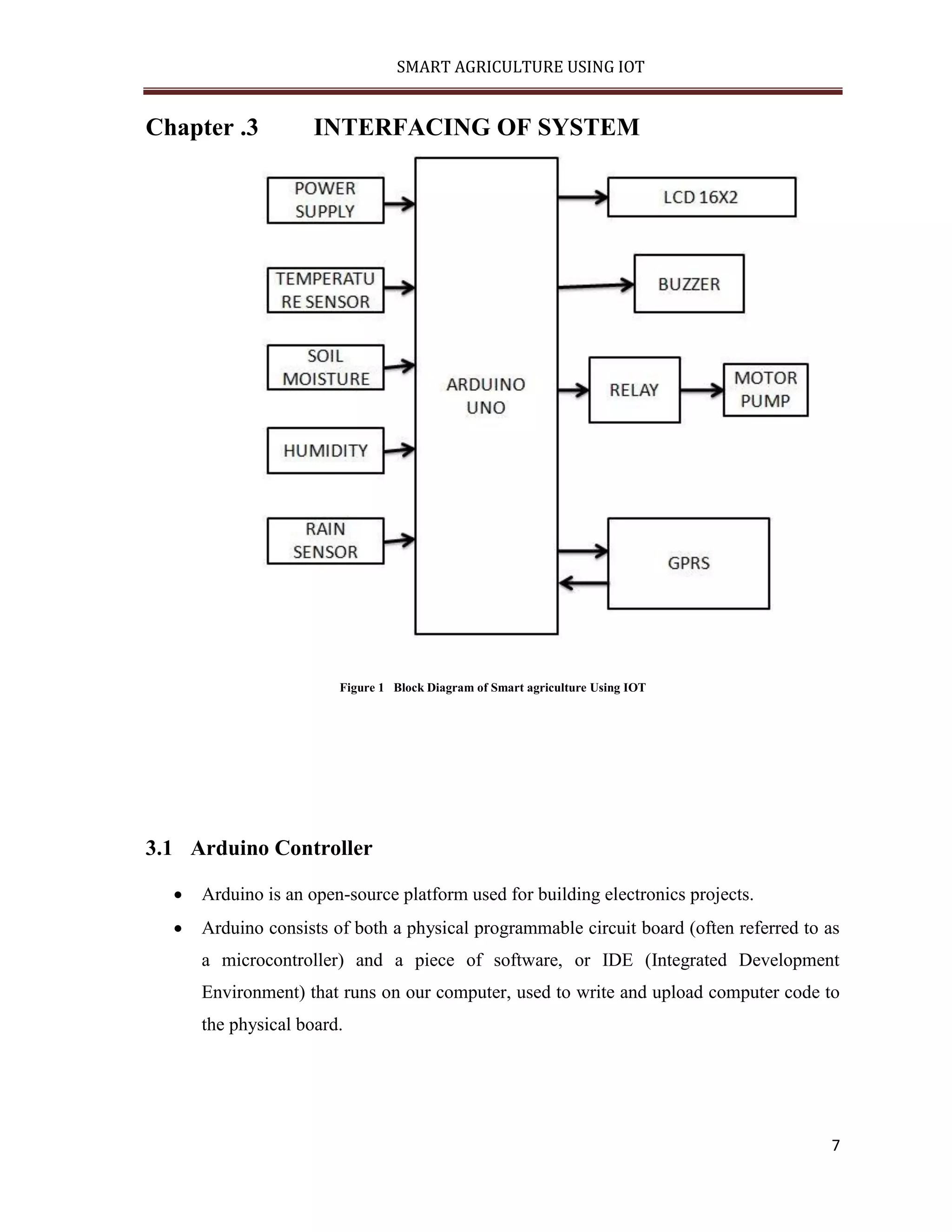
SMART AGRICULTURE USING IOT 7 Chapter .3 INTERFACING OF SYSTEM Figure 1 Block Diagram of Smart agriculture Using IOT 3.1 Arduino Controller  Arduino is an open-source platform used for building electronics projects.  Arduino consists of both a physical programmable circuit board (often referred to as a microcontroller) and a piece of software, or IDE (Integrated Development Environment) that runs on our computer, used to write and upload computer code to the physical board.
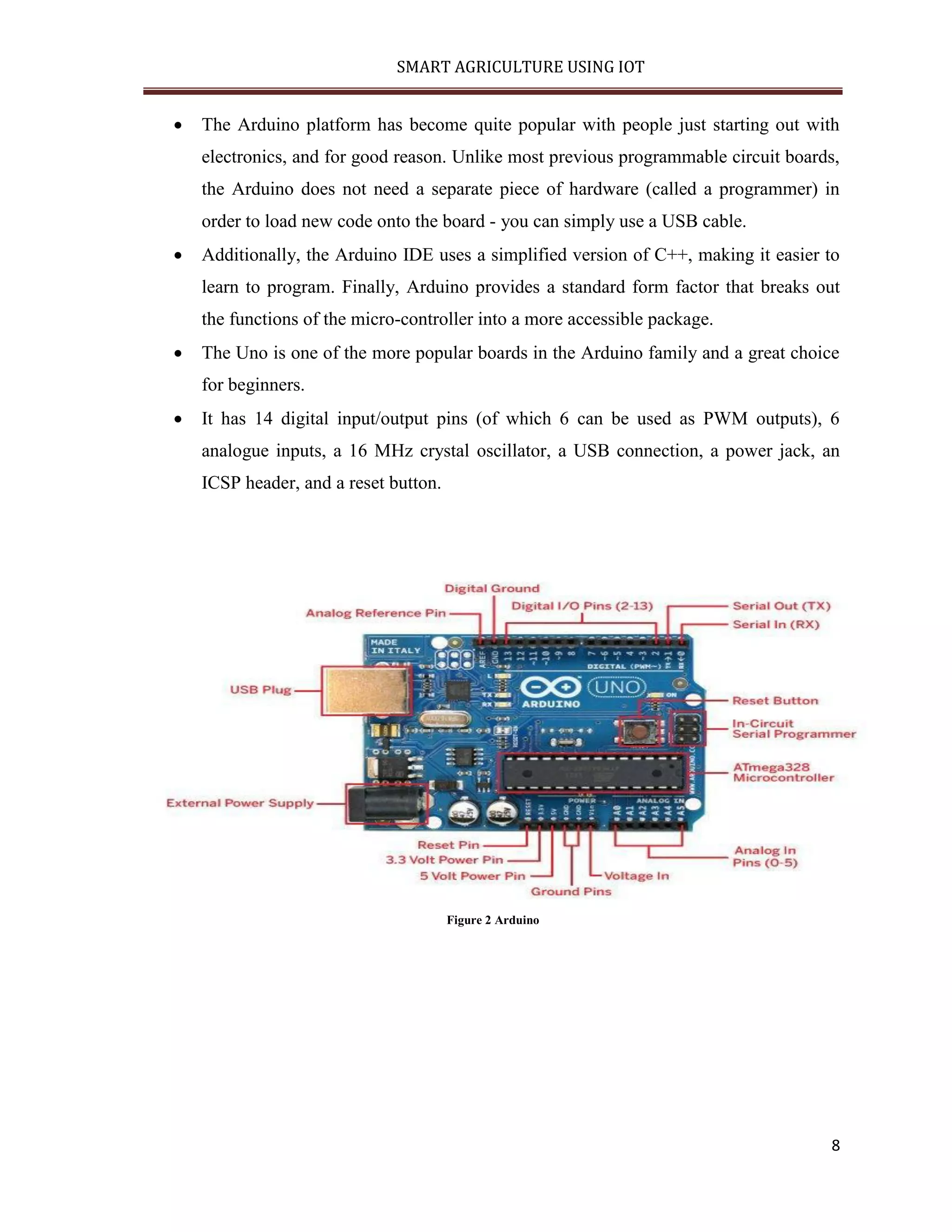
SMART AGRICULTURE USING IOT 8  The Arduino platform has become quite popular with people just starting out with electronics, and for good reason. Unlike most previous programmable circuit boards, the Arduino does not need a separate piece of hardware (called a programmer) in order to load new code onto the board - you can simply use a USB cable.  Additionally, the Arduino IDE uses a simplified version of C++, making it easier to learn to program. Finally, Arduino provides a standard form factor that breaks out the functions of the micro-controller into a more accessible package.  The Uno is one of the more popular boards in the Arduino family and a great choice for beginners.  It has 14 digital input/output pins (of which 6 can be used as PWM outputs), 6 analogue inputs, a 16 MHz crystal oscillator, a USB connection, a power jack, an ICSP header, and a reset button. Figure 2 Arduino
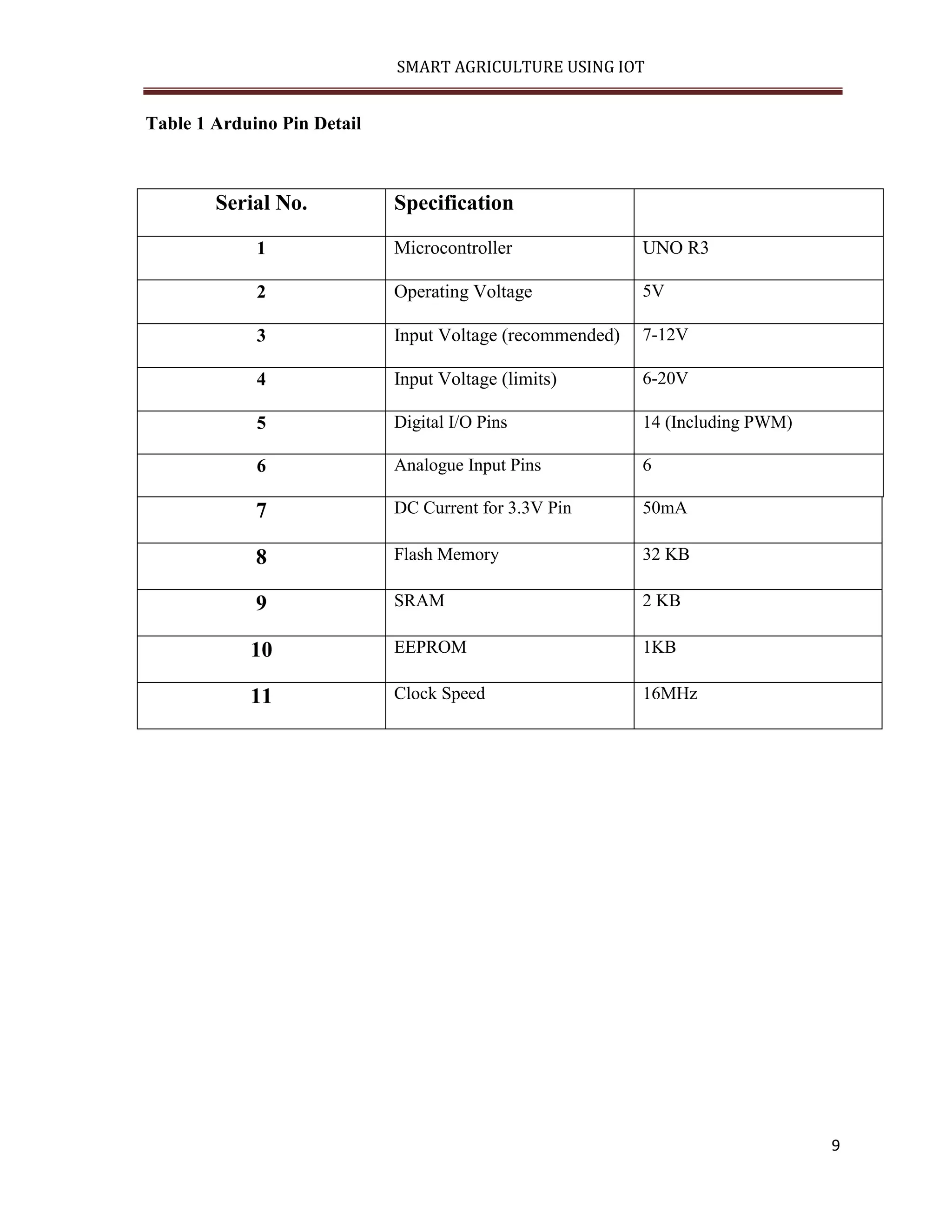
SMART AGRICULTURE USING IOT 9 Table 1 Arduino Pin Detail Serial No. Specification 1 Microcontroller UNO R3 2 Operating Voltage 5V 3 Input Voltage (recommended) 7-12V 4 Input Voltage (limits) 6-20V 5 Digital I/O Pins 14 (Including PWM) 6 Analogue Input Pins 6 7 DC Current for 3.3V Pin 50mA 8 Flash Memory 32 KB 9 SRAM 2 KB 10 EEPROM 1KB 11 Clock Speed 16MHz
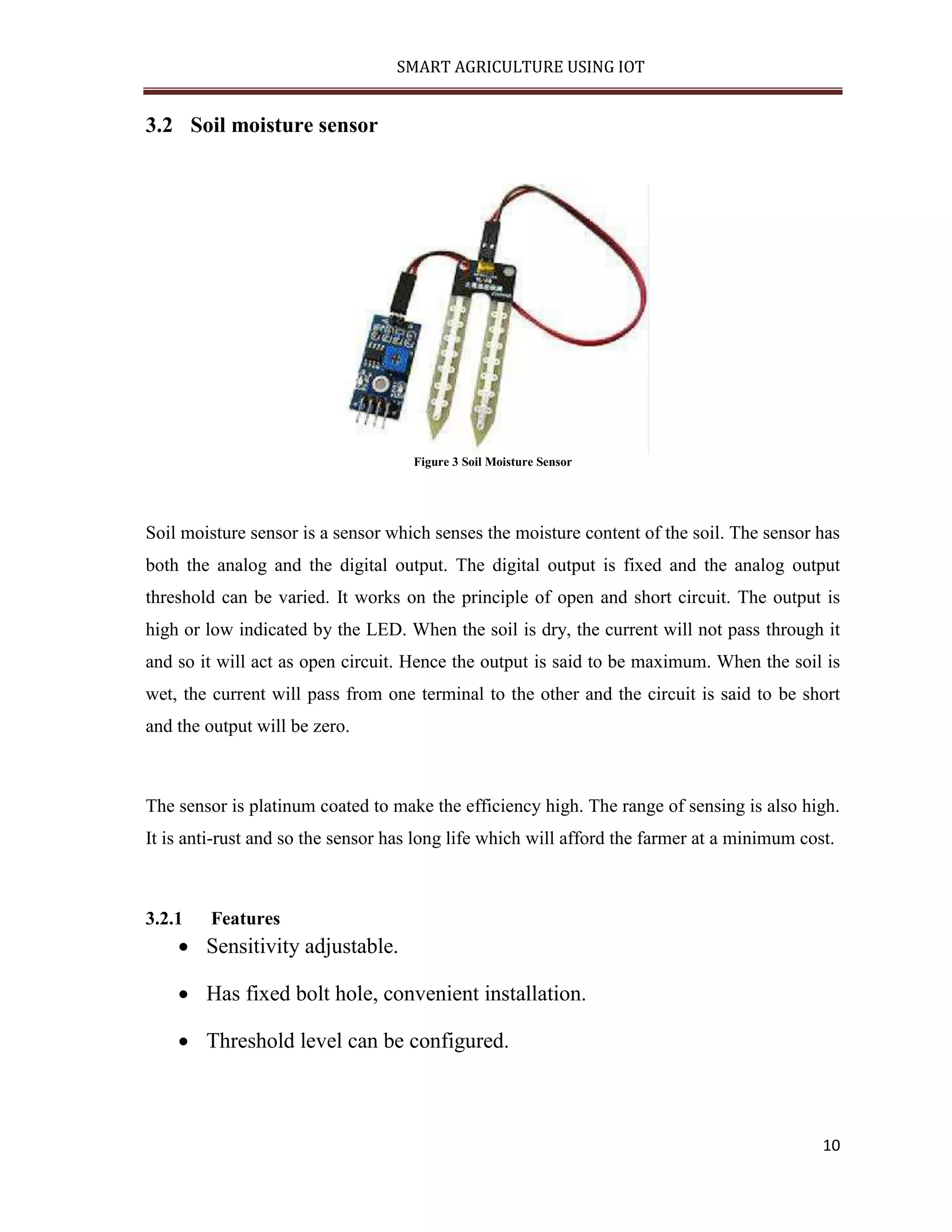
SMART AGRICULTURE USING IOT 10 3.2 Soil moisture sensor Figure 3 Soil Moisture Sensor Soil moisture sensor is a sensor which senses the moisture content of the soil. The sensor has both the analog and the digital output. The digital output is fixed and the analog output threshold can be varied. It works on the principle of open and short circuit. The output is high or low indicated by the LED. When the soil is dry, the current will not pass through it and so it will act as open circuit. Hence the output is said to be maximum. When the soil is wet, the current will pass from one terminal to the other and the circuit is said to be short and the output will be zero. The sensor is platinum coated to make the efficiency high. The range of sensing is also high. It is anti-rust and so the sensor has long life which will afford the farmer at a minimum cost. 3.2.1 Features  Sensitivity adjustable.  Has fixed bolt hole, convenient installation.  Threshold level can be configured.
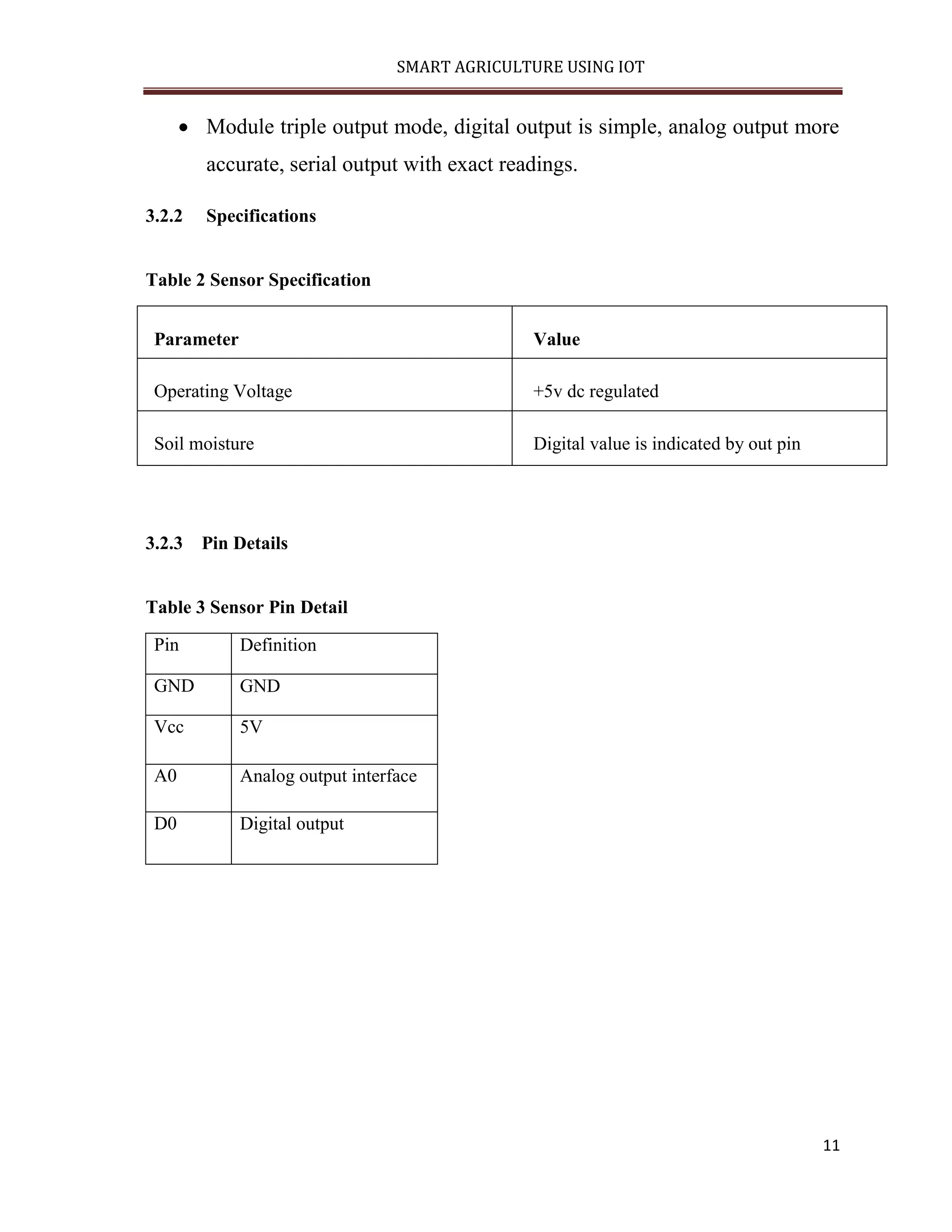
SMART AGRICULTURE USING IOT 11  Module triple output mode, digital output is simple, analog output more accurate, serial output with exact readings. 3.2.2 Specifications Table 2 Sensor Specification Parameter Value Operating Voltage +5v dc regulated Soil moisture Digital value is indicated by out pin 3.2.3 Pin Details Table 3 Sensor Pin Detail Pin Definition GND GND Vcc 5V A0 Analog output interface D0 Digital output
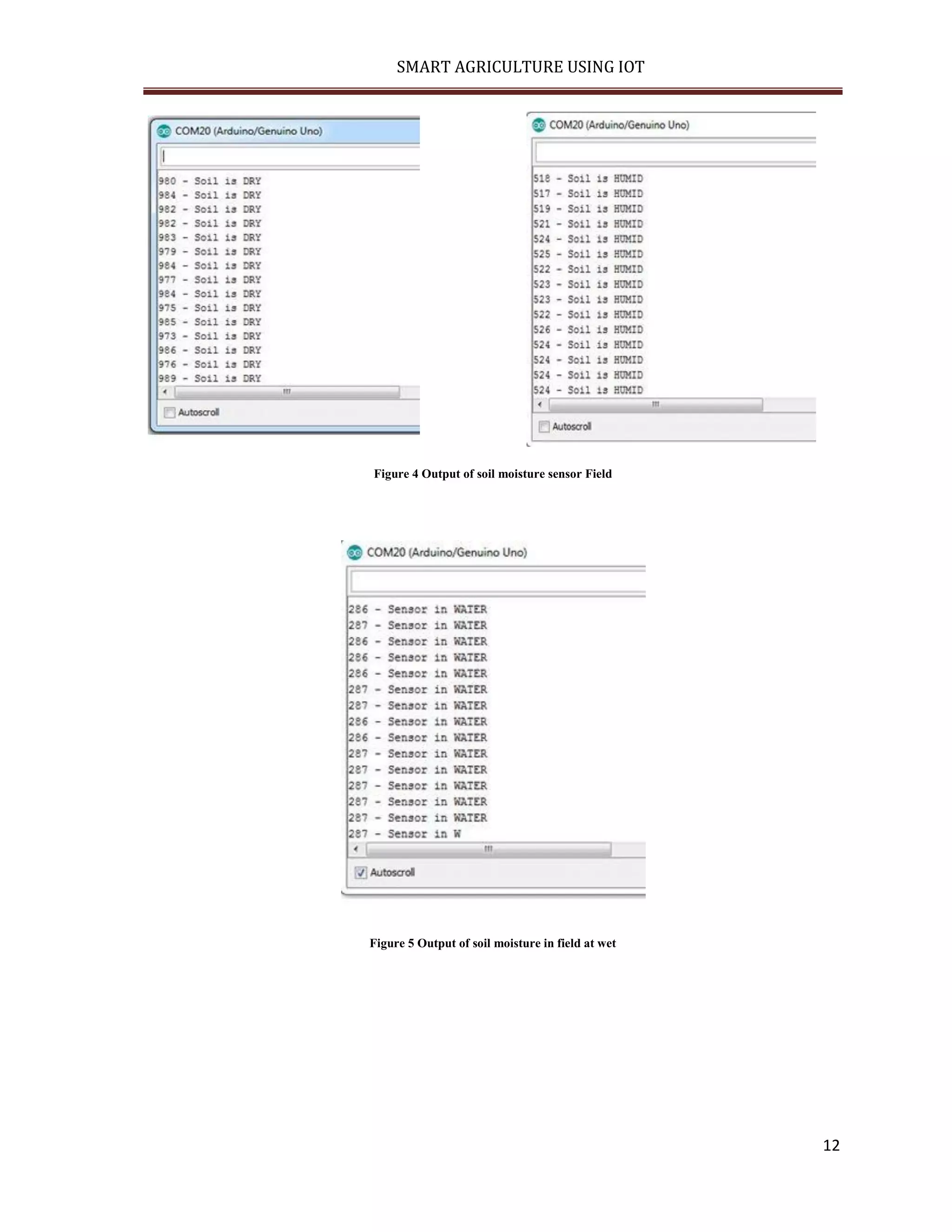
SMART AGRICULTURE USING IOT 12 Figure 4 Output of soil moisture sensor Field Figure 5 Output of soil moisture in field at wet
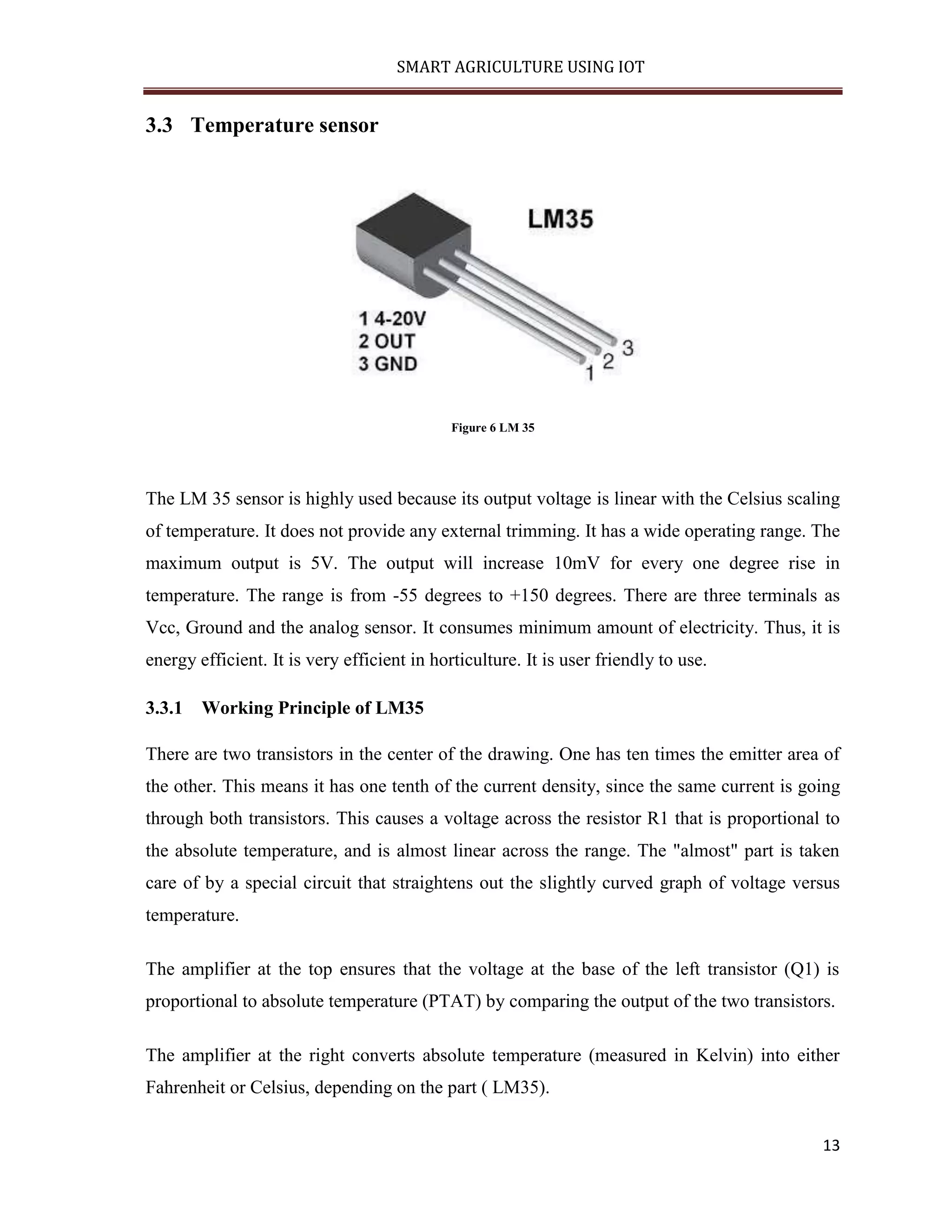
SMART AGRICULTURE USING IOT 13 3.3 Temperature sensor Figure 6 LM 35 The LM 35 sensor is highly used because its output voltage is linear with the Celsius scaling of temperature. It does not provide any external trimming. It has a wide operating range. The maximum output is 5V. The output will increase 10mV for every one degree rise in temperature. The range is from -55 degrees to +150 degrees. There are three terminals as Vcc, Ground and the analog sensor. It consumes minimum amount of electricity. Thus, it is energy efficient. It is very efficient in horticulture. It is user friendly to use. 3.3.1 Working Principle of LM35 There are two transistors in the center of the drawing. One has ten times the emitter area of the other. This means it has one tenth of the current density, since the same current is going through both transistors. This causes a voltage across the resistor R1 that is proportional to the absolute temperature, and is almost linear across the range. The "almost" part is taken care of by a special circuit that straightens out the slightly curved graph of voltage versus temperature. The amplifier at the top ensures that the voltage at the base of the left transistor (Q1) is proportional to absolute temperature (PTAT) by comparing the output of the two transistors. The amplifier at the right converts absolute temperature (measured in Kelvin) into either Fahrenheit or Celsius, depending on the part ( LM35).
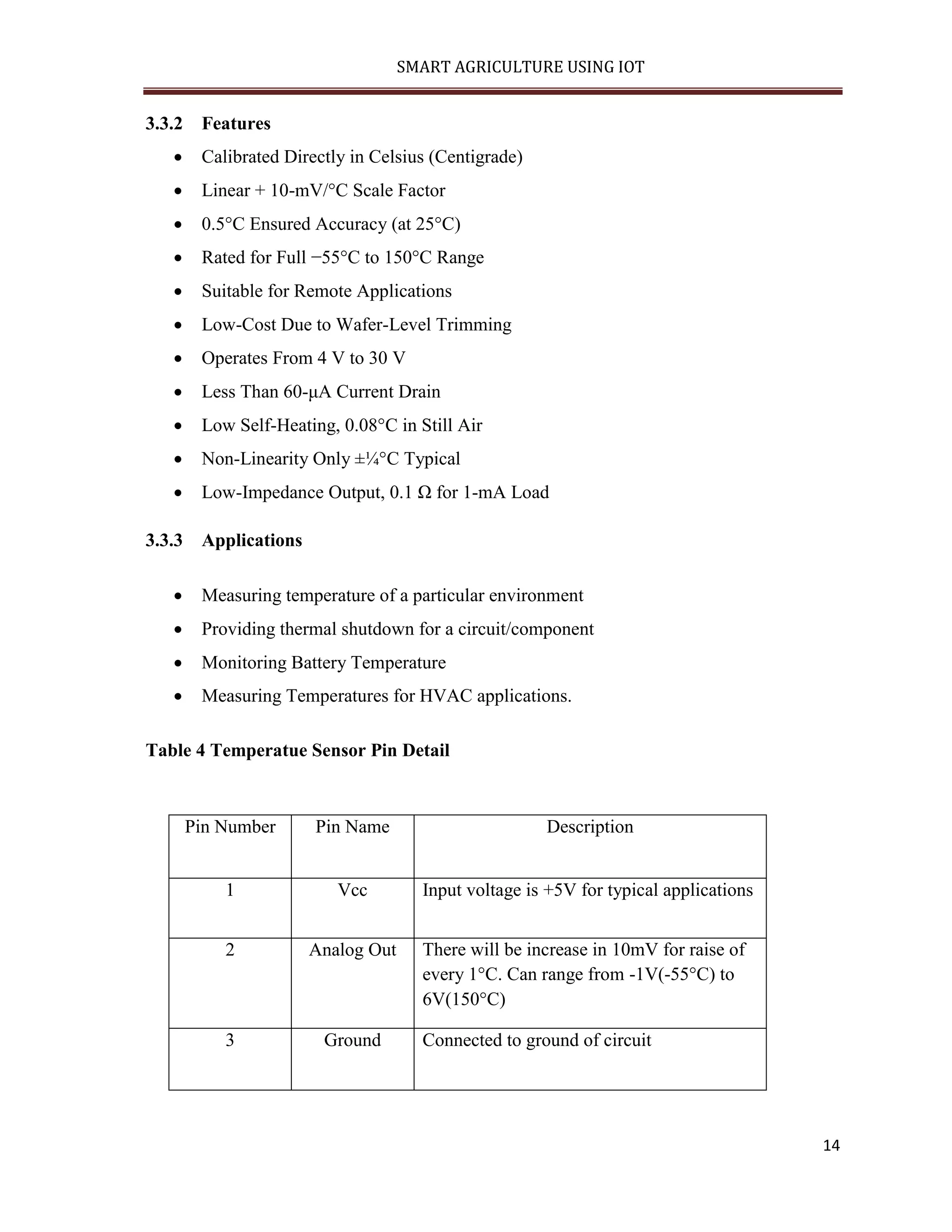
SMART AGRICULTURE USING IOT 14 3.3.2 Features  Calibrated Directly in Celsius (Centigrade)  Linear + 10-mV/°C Scale Factor  0.5°C Ensured Accuracy (at 25°C)  Rated for Full −55°C to 150°C Range  Suitable for Remote Applications  Low-Cost Due to Wafer-Level Trimming  Operates From 4 V to 30 V  Less Than 60-μA Current Drain  Low Self-Heating, 0.08°C in Still Air  Non-Linearity Only ±¼°C Typical  Low-Impedance Output, 0.1 Ω for 1-mA Load 3.3.3 Applications  Measuring temperature of a particular environment  Providing thermal shutdown for a circuit/component  Monitoring Battery Temperature  Measuring Temperatures for HVAC applications. Table 4 Temperatue Sensor Pin Detail Pin Number Pin Name Description 1 Vcc Input voltage is +5V for typical applications 2 Analog Out There will be increase in 10mV for raise of every 1°C. Can range from -1V(-55°C) to 6V(150°C) 3 Ground Connected to ground of circuit
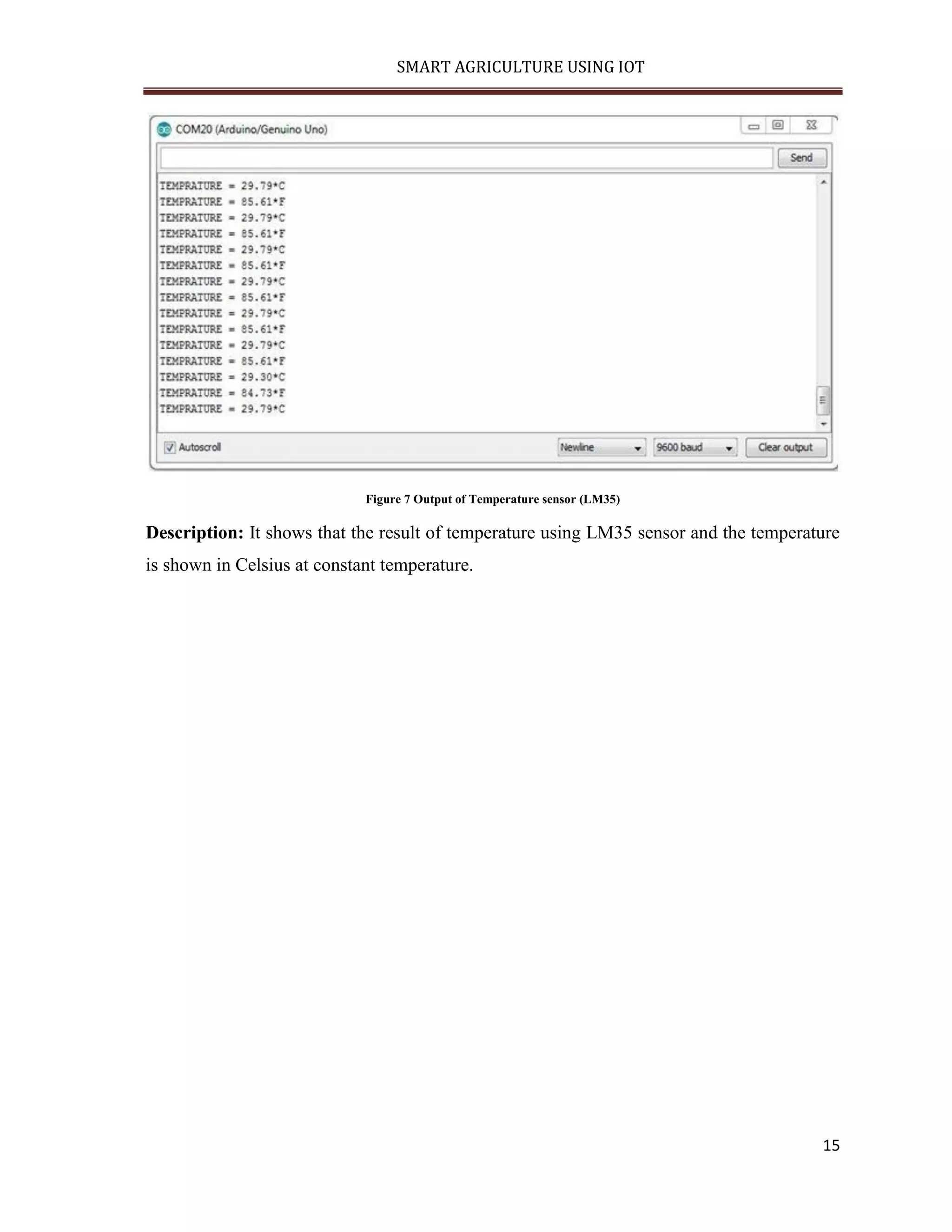
SMART AGRICULTURE USING IOT 15 Figure 7 Output of Temperature sensor (LM35) Description: It shows that the result of temperature using LM35 sensor and the temperature is shown in Celsius at constant temperature.
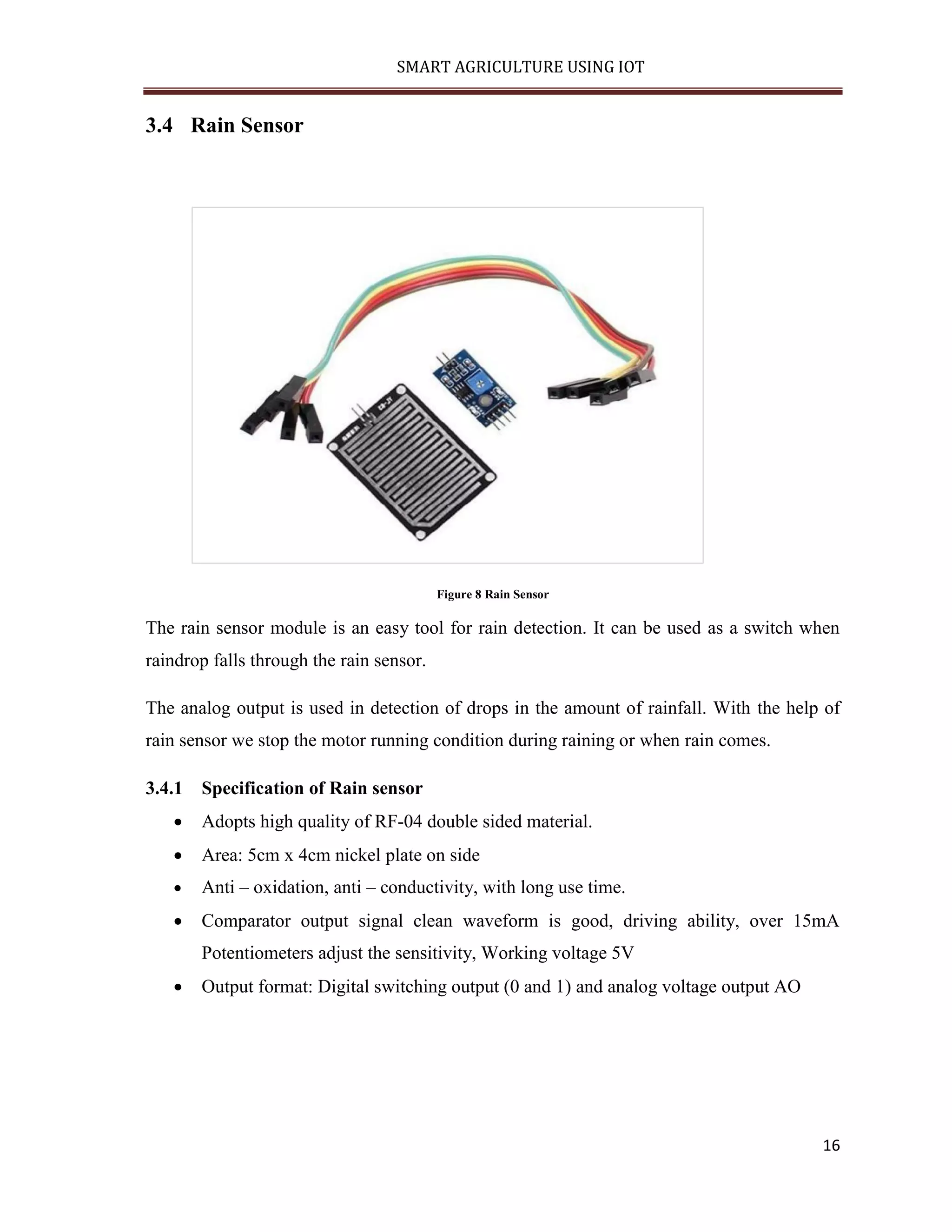
SMART AGRICULTURE USING IOT 16 3.4 Rain Sensor Figure 8 Rain Sensor The rain sensor module is an easy tool for rain detection. It can be used as a switch when raindrop falls through the rain sensor. The analog output is used in detection of drops in the amount of rainfall. With the help of rain sensor we stop the motor running condition during raining or when rain comes. 3.4.1 Specification of Rain sensor  Adopts high quality of RF-04 double sided material.  Area: 5cm x 4cm nickel plate on side  Anti – oxidation, anti – conductivity, with long use time.  Comparator output signal clean waveform is good, driving ability, over 15mA Potentiometers adjust the sensitivity, Working voltage 5V  Output format: Digital switching output (0 and 1) and analog voltage output AO
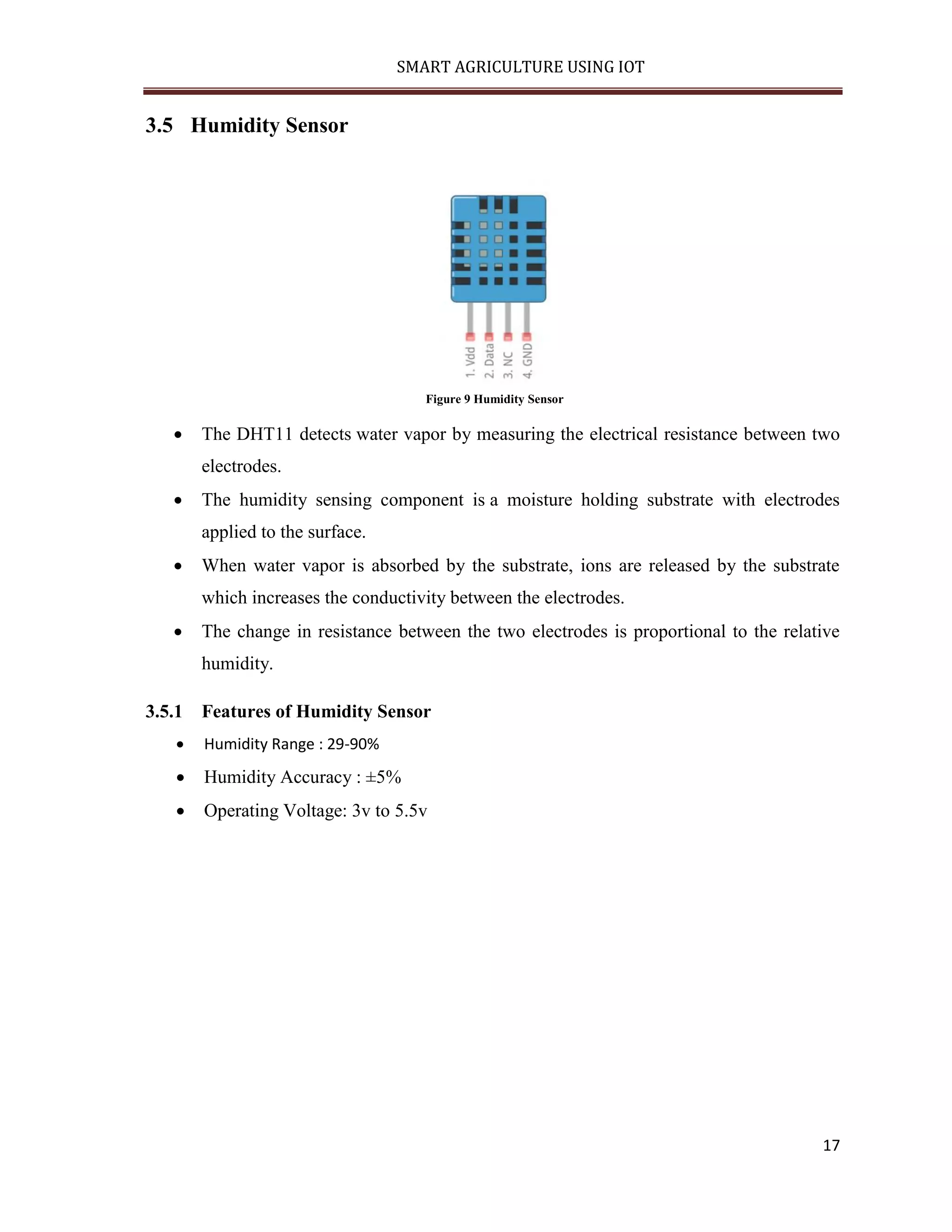
SMART AGRICULTURE USING IOT 17 3.5 Humidity Sensor Figure 9 Humidity Sensor  The DHT11 detects water vapor by measuring the electrical resistance between two electrodes.  The humidity sensing component is a moisture holding substrate with electrodes applied to the surface.  When water vapor is absorbed by the substrate, ions are released by the substrate which increases the conductivity between the electrodes.  The change in resistance between the two electrodes is proportional to the relative humidity. 3.5.1 Features of Humidity Sensor  Humidity Range : 29-90%  Humidity Accuracy : ±5%  Operating Voltage: 3v to 5.5v
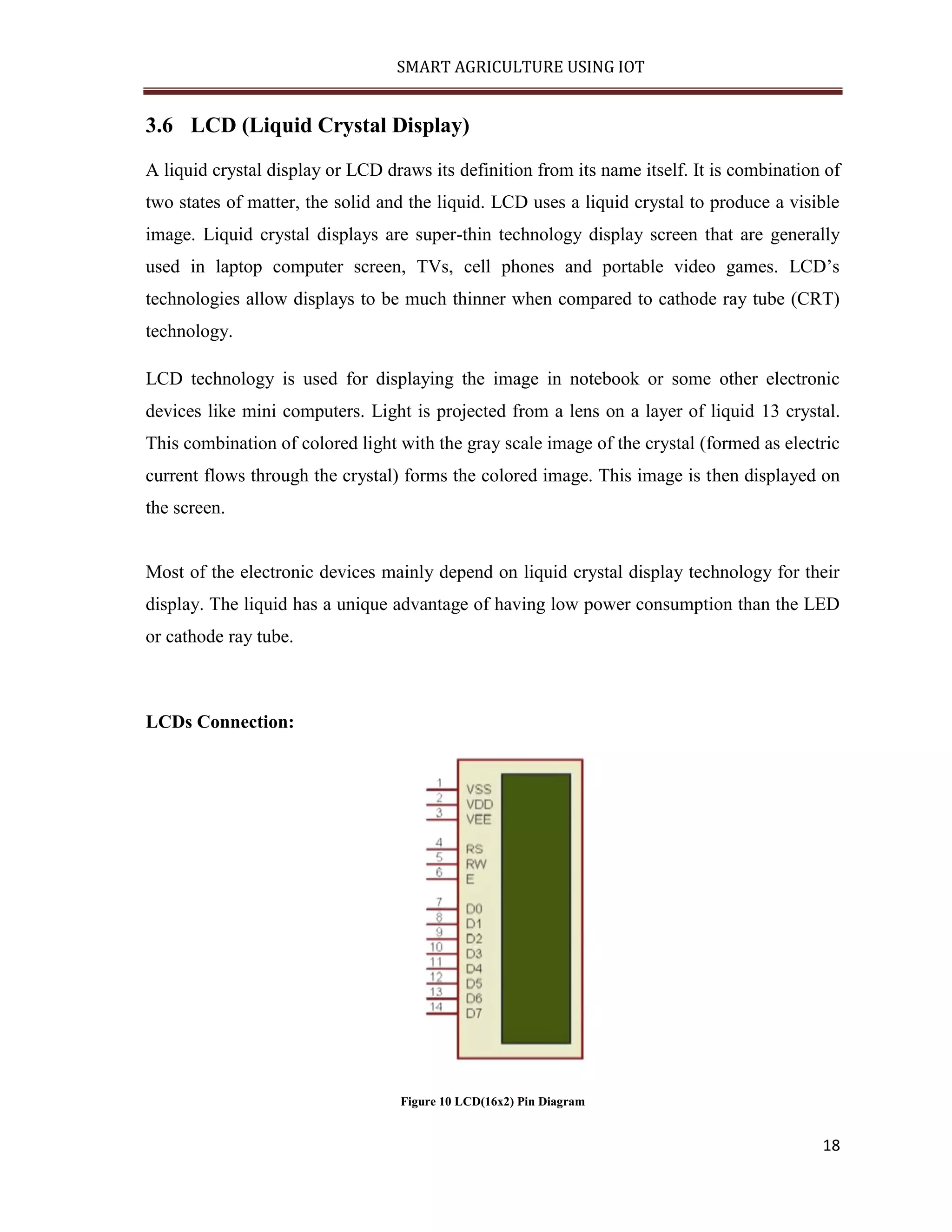
SMART AGRICULTURE USING IOT 18 3.6 LCD (Liquid Crystal Display) A liquid crystal display or LCD draws its definition from its name itself. It is combination of two states of matter, the solid and the liquid. LCD uses a liquid crystal to produce a visible image. Liquid crystal displays are super-thin technology display screen that are generally used in laptop computer screen, TVs, cell phones and portable video games. LCD’s technologies allow displays to be much thinner when compared to cathode ray tube (CRT) technology. LCD technology is used for displaying the image in notebook or some other electronic devices like mini computers. Light is projected from a lens on a layer of liquid 13 crystal. This combination of colored light with the gray scale image of the crystal (formed as electric current flows through the crystal) forms the colored image. This image is then displayed on the screen. Most of the electronic devices mainly depend on liquid crystal display technology for their display. The liquid has a unique advantage of having low power consumption than the LED or cathode ray tube. LCDs Connection: Figure 10 LCD(16x2) Pin Diagram
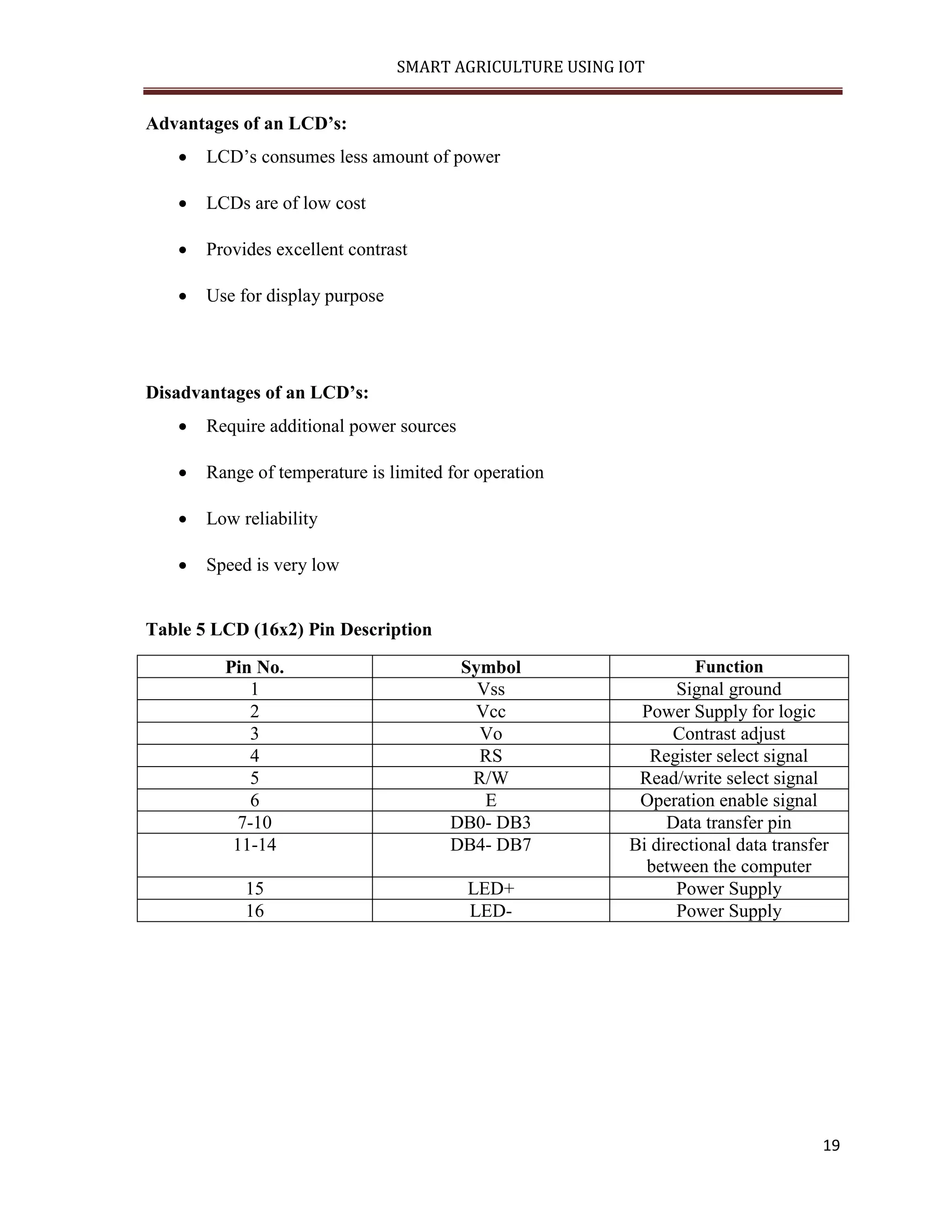
SMART AGRICULTURE USING IOT 19 Advantages of an LCD’s:  LCD’s consumes less amount of power  LCDs are of low cost  Provides excellent contrast  Use for display purpose Disadvantages of an LCD’s:  Require additional power sources  Range of temperature is limited for operation  Low reliability  Speed is very low Table 5 LCD (16x2) Pin Description Pin No. Symbol Function 1 Vss Signal ground 2 Vcc Power Supply for logic 3 Vo Contrast adjust 4 RS Register select signal 5 R/W Read/write select signal 6 E Operation enable signal 7-10 DB0- DB3 Data transfer pin 11-14 DB4- DB7 Bi directional data transfer between the computer 15 LED+ Power Supply 16 LED- Power Supply
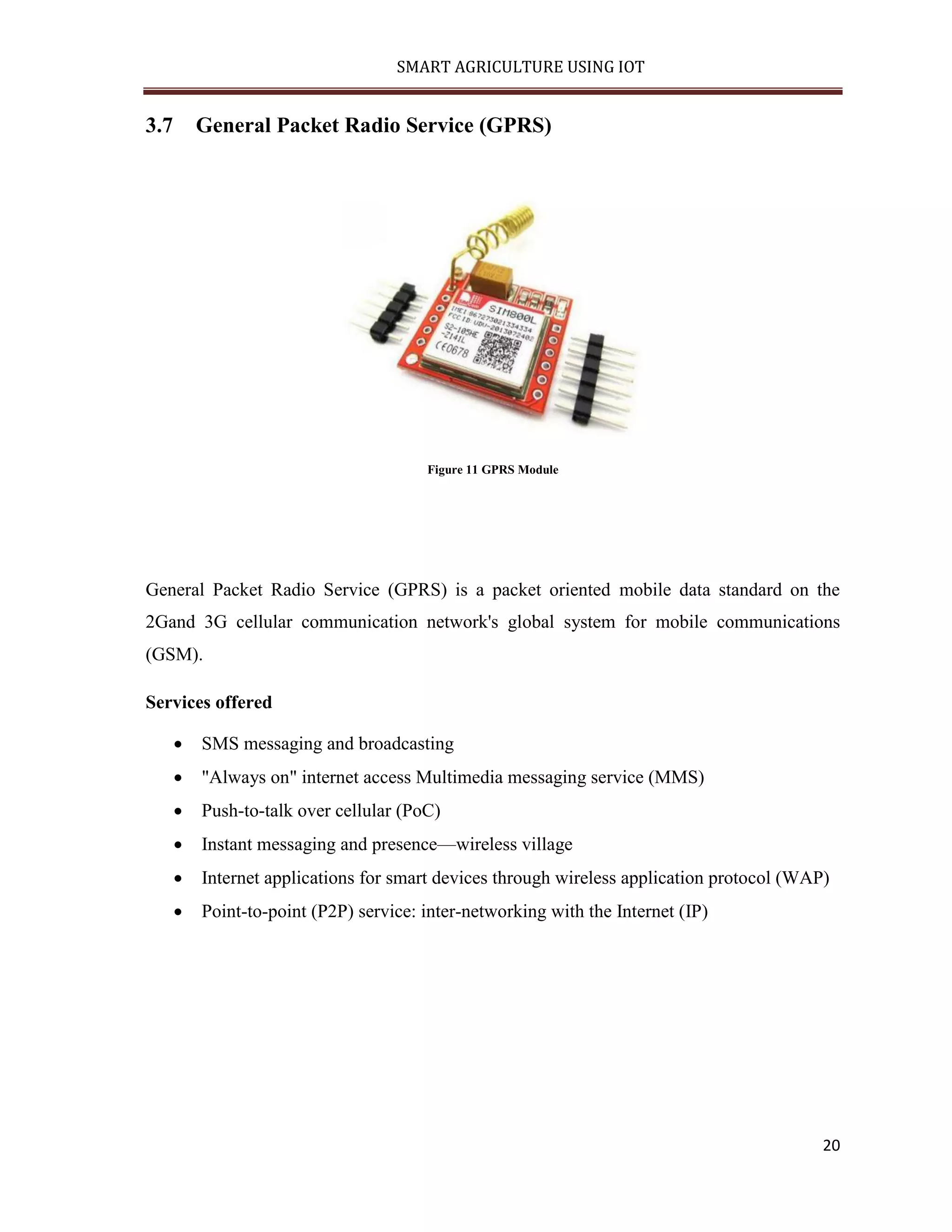
SMART AGRICULTURE USING IOT 20 3.7 General Packet Radio Service (GPRS) Figure 11 GPRS Module General Packet Radio Service (GPRS) is a packet oriented mobile data standard on the 2Gand 3G cellular communication network's global system for mobile communications (GSM). Services offered  SMS messaging and broadcasting  "Always on" internet access Multimedia messaging service (MMS)  Push-to-talk over cellular (PoC)  Instant messaging and presence—wireless village  Internet applications for smart devices through wireless application protocol (WAP)  Point-to-point (P2P) service: inter-networking with the Internet (IP)
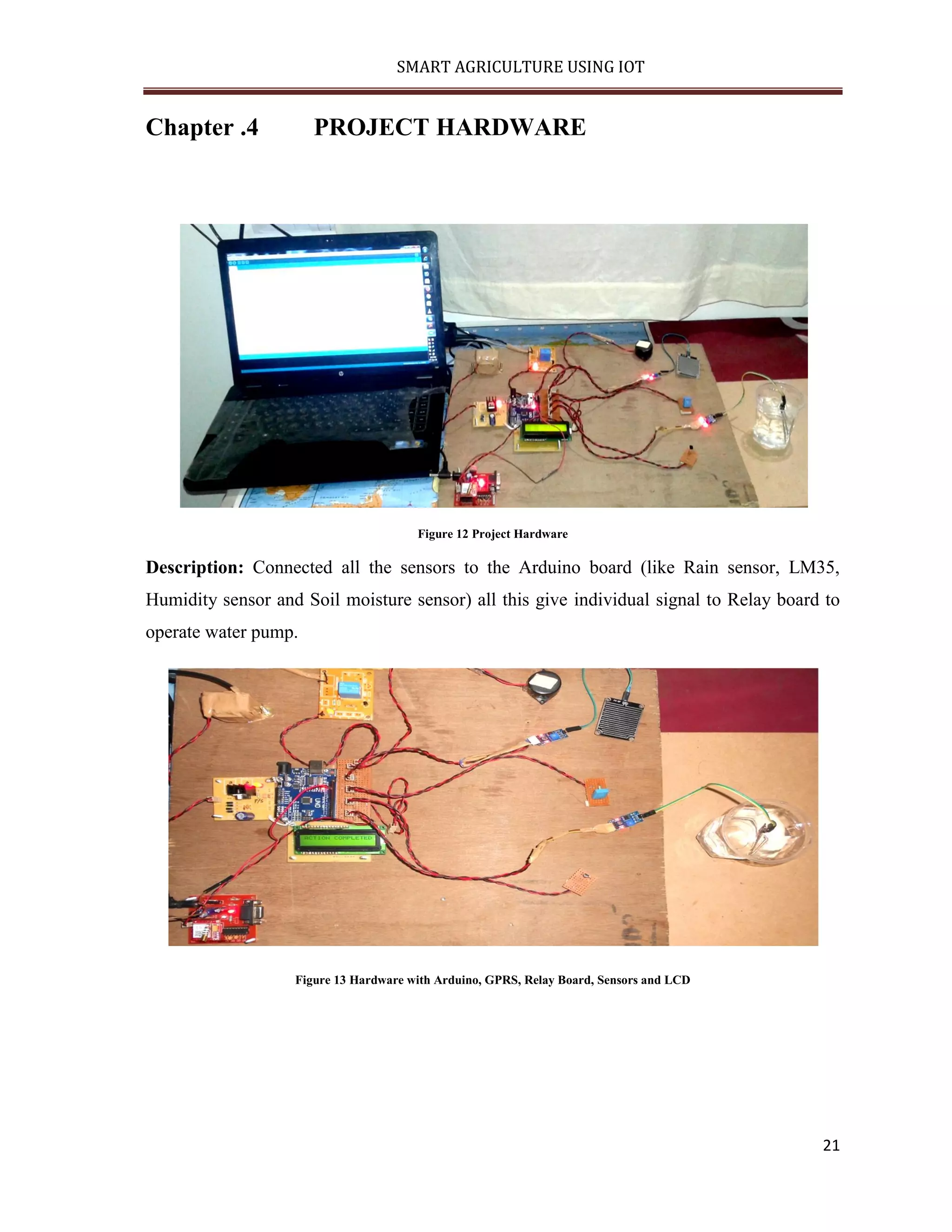
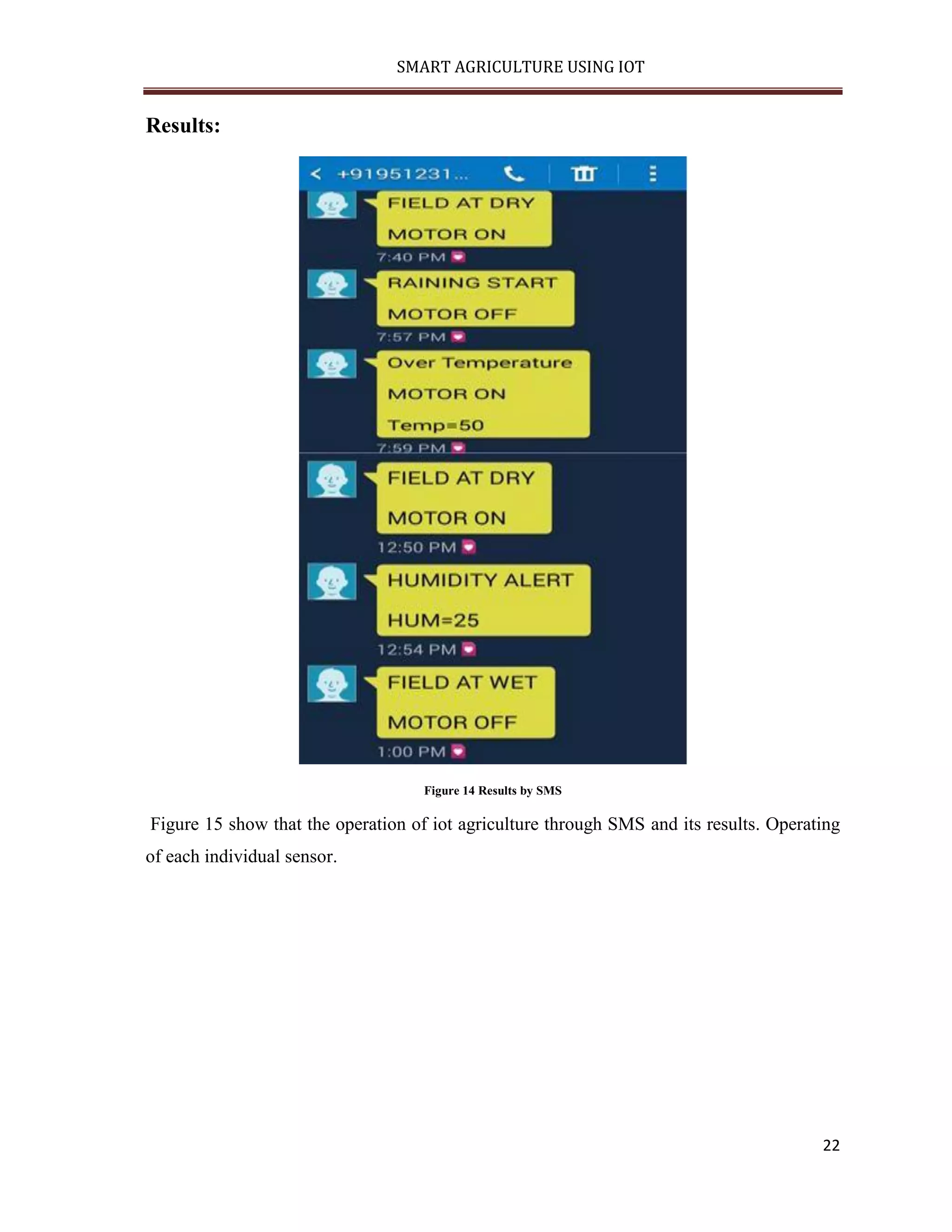
SMART AGRICULTURE USING IOT 21 Chapter .4 PROJECT HARDWARE Figure 12 Project Hardware Description: Connected all the sensors to the Arduino board (like Rain sensor, LM35, Humidity sensor and Soil moisture sensor) all this give individual signal to Relay board to operate water pump. Figure 13 Hardware with Arduino, GPRS, Relay Board, Sensors and LCD
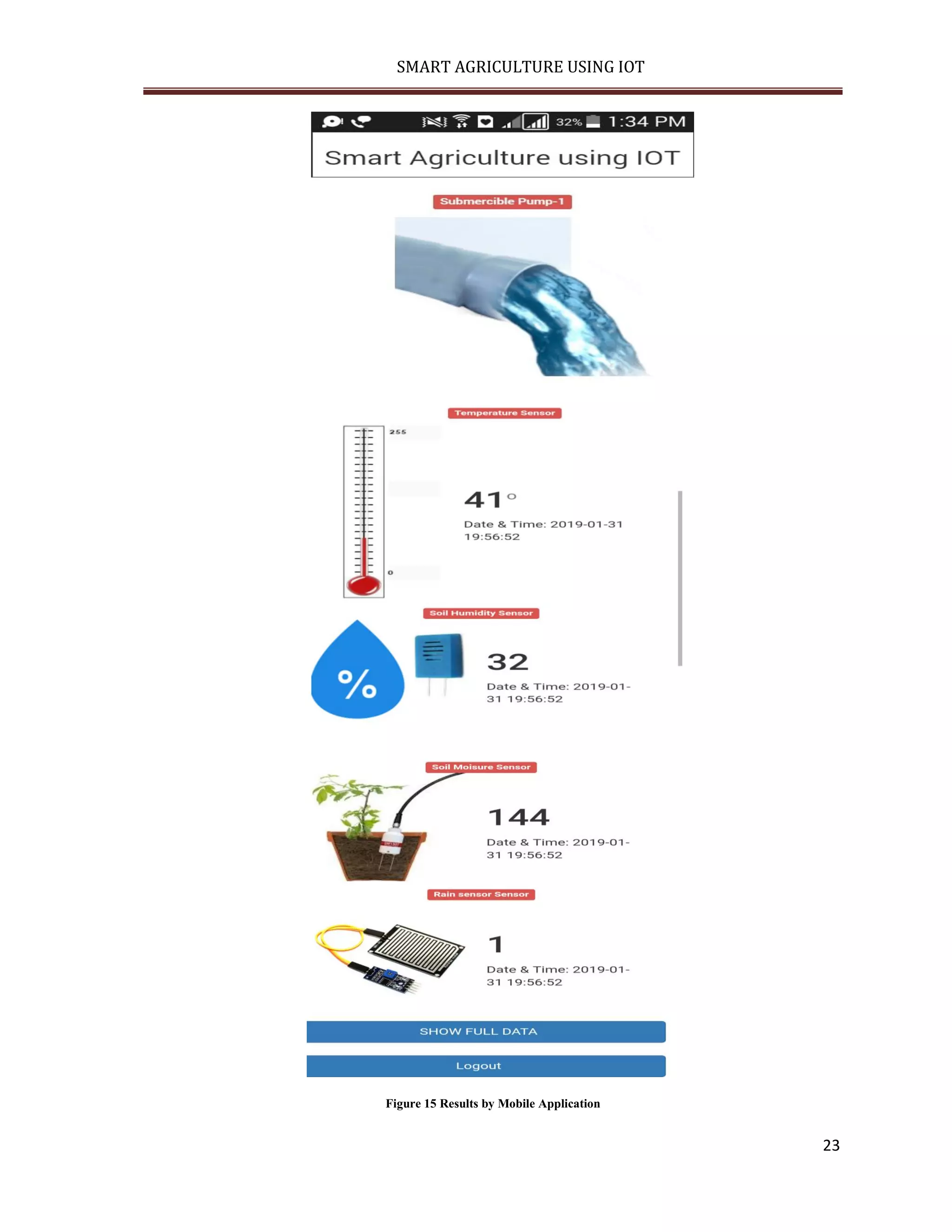
SMART AGRICULTURE USING IOT 22 Results: Figure 14 Results by SMS Figure 15 show that the operation of iot agriculture through SMS and its results. Operating of each individual sensor.
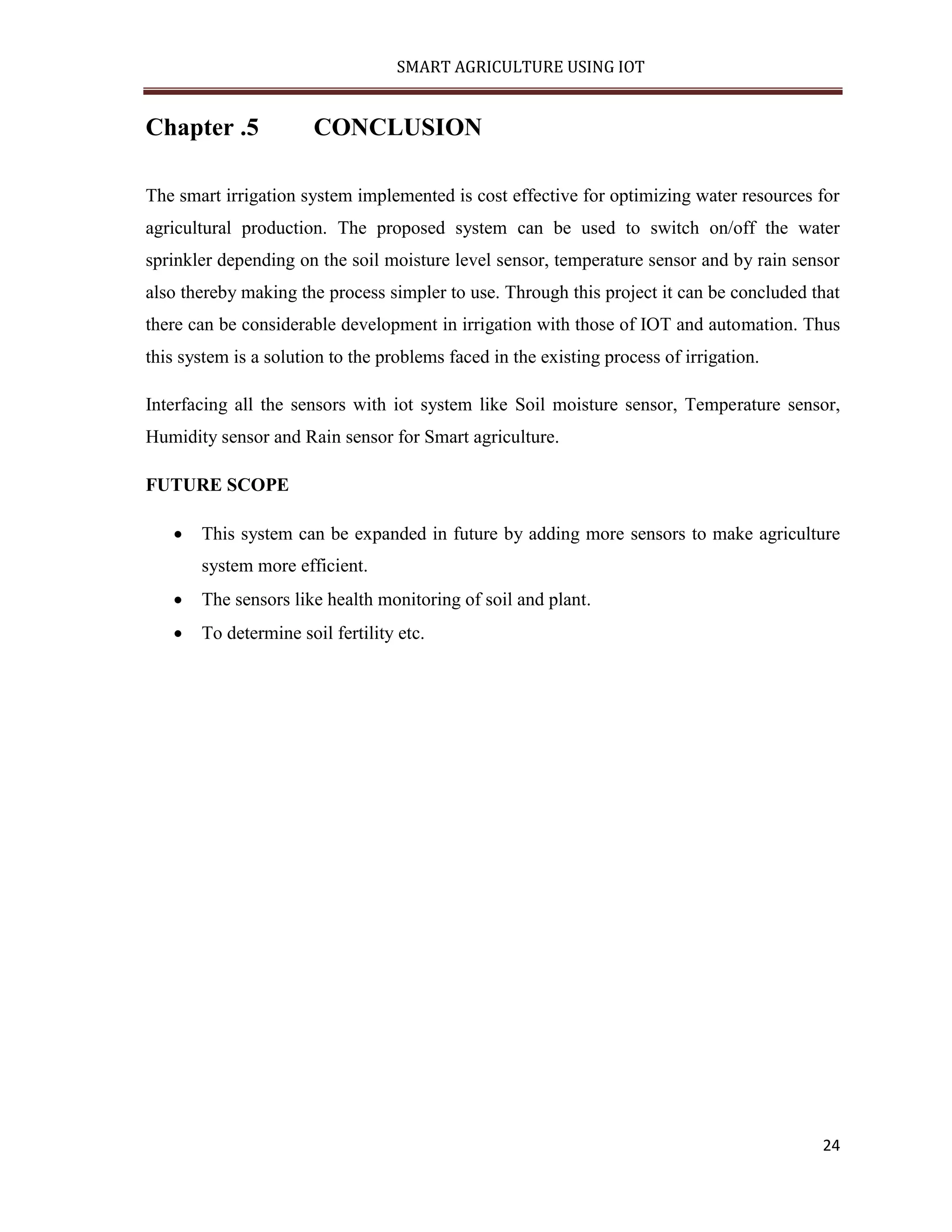
SMART AGRICULTURE USING IOT 23 Figure 15 Results by Mobile Application
SMART AGRICULTURE USING IOT 24 Chapter .5 CONCLUSION The smart irrigation system implemented is cost effective for optimizing water resources for agricultural production. The proposed system can be used to switch on/off the water sprinkler depending on the soil moisture level sensor, temperature sensor and by rain sensor also thereby making the process simpler to use. Through this project it can be concluded that there can be considerable development in irrigation with those of IOT and automation. Thus this system is a solution to the problems faced in the existing process of irrigation. Interfacing all the sensors with iot system like Soil moisture sensor, Temperature sensor, Humidity sensor and Rain sensor for Smart agriculture. FUTURE SCOPE  This system can be expanded in future by adding more sensors to make agriculture system more efficient.  The sensors like health monitoring of soil and plant.  To determine soil fertility etc.
SMART AGRICULTURE USING IOT 25 Chapter .6 REFERENCES [1] Srishti Rawal Department of Computer Science, VIT University “ IOT based Smart Irrigation System ” International Journal of Computer Applications (0975 – 8887) Volume 159 – No 8, February 2017. [2] Arif Gori 1, Manglesh Singh 2, Ojas Thanawala 3, Anupam Vishwakarma 4, Prof. Ashfaque Shaikh 5 Student, Computer Engineering, Rizvi College of Engineering, Mumbai, India1,2,3,4 Guide, Computer Engineering, Rizvi College of Engineering, Mumbai, India 5. “Smart Irrigation System using IOT” International Journal of Advanced Research in Computer and Communication Engineering ISO 3297:2007 Certified Vol. 6, Issue 9, September 2017. [3] 1 Dr.N.Suma,2 Sandra Rhea Samson, 3 S.Saranya , 4 G.Shanmugapriya, 5 R.Subhashri Associate Professor, Department of ECE, SNS College of Engineering, Coimbatore, India. e-mail:sumasivaravi@gmail.com [4] Karan Kansara1, Vishal Zaveri1, Shreyans Shah1, Sandip Delwadkar2, Kaushal Jani3 1PG Student, Babu Madhav Institute of Technology, Uka Tarsadia University, Bardoli, Gujarat, India 2Assistant Professor, Babu Madhav Institute of Information Technology, Bardoli, Gujarat, India 3Teaching Assistant, Babu Madhav Institute of Information Technology, Bardoli, Gujarat, India “Sensor based Automated Irrigation System with IOT: A Technical Review” (IJCSIT) International Journal of Computer Science and Information Technologies, Vol. 6 (6) , 2015, 5331-5333
SMART AGRICULTURE USING IOT 26 [5] R.Sindhuja1 and B.Krithiga2 1UG Student, Department of Electronics and Communication Engineering, IFET College of Engineering, Villupuram, Tamilnadu, India. 2Assistant Professor, Department of Electronics and Communication Engineering, IFET College of Engineering, Villupuram, Tamilnadu, India. [6] K. Jyostsna Vanaja1, Aala Suresh2, S. Srilatha3, K. Vijay Kumar4, M. Bharath5 1B. Tech IV Year, Department of ECE, Chalapathi Institute of Engineering &Technology, AP. 2Assistant Professor, Department of ECE, Chalapathi Institute of Engineering & Technology, AP. 3,4,5 B. Tech IV Year Department of ECE, Chalapathi Institute of Engineering & Technology, Guntur, AP. [7] IoT based Smart Irrigation Tank Monitoring System Sukriti, Sanyam Gupta, Indumathy KB. Tech, Department of Computer Science and Technology, Vellore Institute of Technology. [8] S.G.Manoj Guru 1, P.Naveen2 , R.Vinodh Raja3 , V.Srirenga Nachiyar* SMART IRRIGATION SYSTEM USING ARDUINO SSRG International Journal of Electronics and Communication Engineering - (ICRTECITA-2017) - Special Issue - March 2017 [9] R.Suresh, S.Gopinath, K.Govindaraju, T.Devika,N.SuthanthiraVanitha, “GSM based Automated Irrigation Control using Raingun Irrigation System”, International Journal of Advanced Research in Computer and Communication Engineering Vol. 3,Issue 2, February 2014. [10] Mahir Dursun and Semih Ozden, A wireless application of drip irrigation automation supported by soil moisture sensors, Scientific Research and Essays Vol. 6(7), pp. 1573- 1582, 4 April, 2011.

Smart agriculture using iot (fully smart) By using arduino

  • 1.
    Smart Agriculture UsingIOT A Project report submitted to UKA TARSADIA UNIVERSITY In partial fulfillment of the requirements for the degree of Bachelor of Technology In Electrical Engineering By Rupesh Kumar (201503100610058) Guided by Mr. Darshan Vora Mr. Ankur Rana Assistant Professor, Electrical Dept. Assistant Professor, Electrical Dept. C.G.P.I.T., UTU. C.G.P.I.T., UTU. Chhotubhai Gopalbhai Patel Institute of Technology Bardoli, Surat. MAY 2019
  • 2.
    SMART AGRICULTURE USINGIOT II CERTIFICATE This is to certify that work embodied in this project report entitled “Smart Agriculture Using IOT” was carried out by “Mr. Rupesh Kumar” (201503100610058), at Chhotubhai Gopalbhai Patel Institute of Technology for the partial fulfillment of B.Tech. degree to be awarded by UKA TARSADIA UNIVERSITY. This research work has been carried out under my supervision and is to our satisfaction. Date: Place: Mr. Darshan vora Mr. Ankur Rana Assistant Professor, Electrical Dept. Assistant Professor, Electrical Dept. C.G.P.I.T., UTU. C.G.P.I.T., UTU. Mrs. Krupa Dave External Examiner Head of Electrical/EC/ICT Department. C.G.P.I.T., UTU Dr. R.V. Patil Director, C.G.P.I.T UTU
  • 3.
    SMART AGRICULTURE USINGIOT III DECLARATION I hereby certify that I am the sole author of this report and that neither any part of this report nor the whole of the report has been submitted for a degree to any other University or Institution. I certify that, to the best of my knowledge, my report does not infringe upon anyone’s copyright nor violate any proprietary rights and that any ideas, techniques, quotations, or any other material from the work of other people include in my report, published or other material from the work of other people include in my report, published or otherwise, are fully acknowledged in accordance with the standard referencing practices. I declare that this is a true copy of my report, including any final revisions, as approved by my report review committee. Date: Signature and name of Students Place: Rupesh Kumar (201503100610058) Verified by Signature and Name of Supervisor Signature and Name of Supervisor Mr. Darshan vora Mr. Ankur Rana Assistant Professor, Electrical Dept. Assistant Professor, Electrical Dept. C.G.P.I.T., UTU. C.G.P.I.T., UTU.
  • 4.
    SMART AGRICULTURE USINGIOT IV ACKNOWLEDGMENT The undertaking of this project could not have been achieved without the contributions and encouragement from the following people. Their help has been much appreciated. We would like to express our deep sense of gratitude to our guide Mr. Darshan Vora and Mr. Ankur Rana for their valuable Guidance and motivation and for their extreme cooperation to complete our project work successfully. We would also like to thank all the teaching and non-teaching staff for cooperating with us and providing valuable advice which was instrumental in the completion of this project. Last but not the least we would like to thank our parents who have been a pillar of support throughout the last four years. Rupesh Kumar (201503100610058)
  • 5.
    SMART AGRICULTURE USINGIOT V ABSTRACT Internet of Things (IoT) technology has brought revolution to each and every field of common man’s life by making everything smart and intelligent. IoT refers to a network of things which make a self-configuring network. The development of Intelligent Smart Agriculture IoT based devices is day by day turning the face of agriculture production by not only enhancing it but also making it cost-effective and reducing wastage. The aim of this project work is to propose a Novel Smart IoT based Agriculture this assisting farmers in getting Live Data (Temperature, Soil Moisture, humidity and Rain status) for efficient environment monitoring which will enable them to do smart farming and increase their overall yield and quality of products. The Smart Agriculture being proposed via this project is integrated with Arduino Technology, Breadboard mixed with various sensors and live data feed can be obtained online from using android application and by SMS and also by e-mail. The project being proposed is tested on Live Agriculture Fields giving high accuracy over 98% in data feeds.
  • 6.
    SMART AGRICULTURE USINGIOT VI Contents CERTIFICATE ..........................................................................................................................................II DECLARATION ......................................................................................................................................III ACKNOWLEDGMENT............................................................................................................................IV ABSTRACT..............................................................................................................................................V LIST OF FIGURES..................................................................................................................................VII LIST OF TABLES...................................................................................................................................VIII Chapter .1 INTRODUCTION.............................................................................................................1 1.1 Present Scenario of Traditional Agriculture System .............................................................2 1.2 Need of Smart Agriculture Using IOT....................................................................................3 Chapter .2 LITERATURE SURVEY .....................................................................................................4 Chapter .3 INTERFACING OF SYSTEM..............................................................................................7 3.1 Arduino Controller ................................................................................................................7 3.2 Soil moisture sensor............................................................................................................10 3.2.1 Features.......................................................................................................................10 3.2.2 Specifications ..............................................................................................................11 3.2.3 Pin Details....................................................................................................................11 3.3 Temperature sensor............................................................................................................13 3.3.1 Working Principle of LM35..........................................................................................13 3.3.2 Features.......................................................................................................................14 3.3.3 Applications.................................................................................................................14 3.4 Rain Sensor..........................................................................................................................16 3.4.1 Specification of Rain sensor ........................................................................................16 3.5 Humidity Sensor..................................................................................................................17 3.5.1 Features of Humidity Sensor.......................................................................................17 3.6 LCD (Liquid Crystal Display).................................................................................................18 3.7 General Packet Radio Service (GPRS)..................................................................................20 Chapter .4 PROJECT HARDWARE ..................................................................................................21 Chapter .5 CONCLUSION...............................................................................................................24 Chapter .6 REFERENCES ................................................................................................................25
  • 7.
    SMART AGRICULTURE USINGIOT VII LIST OF FIGURES Figure 1 Block Diagram of Smart agriculture Using IOT...................................................................7 Figure 2 Arduino...................................................................................................................................8 Figure 3 Soil Moisture Sensor.............................................................................................................10 Figure 4 Output of soil moisture sensor Field.....................................................................................12 Figure 5 Output of soil moisture in field at wet..................................................................................12 Figure 6 LM 35 ...................................................................................................................................13 Figure 7 Output of Temperature sensor (LM35).................................................................................15 Figure 8 Rain Sensor...........................................................................................................................16 Figure 10 Humidity Sensor.................................................................................................................17 Figure 11 LCD(16x2) Pin Diagram ....................................................................................................18 Figure 12 GPRS Module.....................................................................................................................20 Figure 13 Project Hardware ................................................................................................................21 Figure 14 Hardware with Arduino, GPRS, Relay Board, Sensors and LCD......................................21 Figure 15 Results by SMS...................................................................................................................22 Figure 16 Results by Mobile Application ...........................................................................................23
  • 8.
    SMART AGRICULTURE USINGIOT VIII LIST OF TABLES Table 1 Arduino Pin Detail ...................................................................................................................9 Table 2 Sensor Specification...............................................................................................................11 Table 3 Sensor Pin Detail....................................................................................................................11 Table 4 Temperatue Sensor Pin Detail................................................................................................14 Table 5 LCD (16x2) Pin Description..................................................................................................19
  • 9.
    SMART AGRICULTURE USINGIOT 1 Chapter .1 INTRODUCTION Agriculture is the unquestionably the largest livelihood provider in India. With rising population, there is a need for increased agricultural production. In order to support greater Production in farms, the requirement of the amount of fresh water used in irrigation also rises. Currently, agriculture accounts 83% of the total water consumption in India. Unplanned use of water inadvertently results in wastage of water. This suggests that there is an urgent need to develop systems that prevent water wastage without imposing pressure on farmers. Over the past 15 years, farmers started using computers and software systems to organize their financial data and keep track of their transactions with third parties and also monitor their crops more effectively. In the Internet era, where information plays a key role in people's lives, agriculture is rapidly becoming a very data intensive industry where farmers need to collect and evaluate a huge amount of information from a diverse number of devices (eg., sensors, faming machinery etc.) in order to become more efficient in production and communicating appropriate information . With the advent of open source Arduino boards along with cheap moisture sensors, it is viable to create devices that can monitor the soil moisture content and accordingly irrigating the fields or the landscape as an when needed. [1] Agriculture is considered as the basis of life for us as it is the main source of food and other raw materials. It plays vital role in the growth of country’s economy. Growth in agricultural sector is necessary for the development of economic condition of the country. Unfortunately, many farmers still use the traditional methods of farming. In India most of the irrigation system are manually operated one’s. These outdated techniques are replaced with automated techniques. This project focuses primarily on reducing the wastage of water and minimizing the manual labor on field for irrigation. [2]
  • 10.
    SMART AGRICULTURE USINGIOT 2 As the world is trending into new technologies and implementations it is a necessary goal to trend up in agriculture also. Many researches are done in the field of agriculture. Most projects signify the use of wireless sensor network collect data from different sensors deployed at various nodes and send it through the wireless protocol. The collected data provide the information about the various environmental factors. Monitoring the environmental factors is not the complete solution to increase the yield of crops. There are number of other factors that decrease the productivity to a greater extent. Hence automation must be implemented in agriculture to overcome these problems. So, in order to provide solution to all such problems, it is necessary to develop an integrated system which will take care of all factors affecting the productivity in every stage. But complete automation in agriculture is not achieved due to various issues. Though it is implemented in the research level it is not given to the farmers as a product to get benefitted from the resources. Hence this project deals about developing smart agriculture using IoT and given to the farmers. [3] 1.1 Present Scenario of Traditional Agriculture System Growth in agricultural sector is necessary for the development of economic condition of the country. Unfortunately, many farmers still use the traditional methods of farming. With rising population, there is a need for increased agricultural production. In order to support greater production in farms, the requirement of the amount of fresh water used in irrigation also rises. Currently, agriculture accounts 83% of the total water consumption in India. Unplanned use of water inadvertently results in wastage of water. Today, India ranks second in the world in farm output 64% of cultivated land dependent on monsoons. Irrigation accounts for 55-75% of water usage in India. Nearly 60% of the water used in irrigation is wasted. [1]
  • 11.
    SMART AGRICULTURE USINGIOT 3 1.2 Need of Smart Agriculture Using IOT  Simple and easy to install and configure.  Saving energy and resources, so that it can be utilized in proper way and amount.  Farmers would be able to smear the right amount of water at the right time by automating farm or nursery irrigation.  Avoiding irrigation at the wrong time of day, reduce runoff from overwatering saturated soils which will improve crop performance.  Automated irrigation system uses valves to turn motor ON and OFF. Motors can be automated easily by using controllers and no need of labor to turn motor ON and OFF .  It is precise method for irrigation and a valuable tool for accurate soil moisture control in highly specialized greenhouse vegetable production.  It is time saving, the human error elimination in adjusting available soil moisture levels.
  • 12.
    SMART AGRICULTURE USINGIOT 4 Chapter .2 LITERATURE SURVEY [1] Srishti Rawal Department of Computer Science, VIT University “IOT based Smart Irrigation System” International Journal of Computer Applications (0975 – 8887) Volume 159 – No 8, February 2017. This paper present basic information regarding automation of farm activities can transform agricultural domain from being manual and static to intelligent and dynamic leading to higher production with lesser human supervision. This paper proposes an automated irrigation system which monitors and maintains the desired soil moisture content via automatic watering. Microcontroller ATMEGA328P on arduino uno platform is used to implement the control unit. The setup uses soil moisture sensors which measure the exact moisture level in soil. This value enables the system to use appropriate quantity of water which avoids over/under irrigation. IOT is used to keep the farmers updated about the status of sprinklers. Information from the sensors is regularly updated on a webpage using GSM- GPRS SIM900A modem through which a farmer can check whether the water sprinklers are ON/OFF at any given time. Also, the sensor readings are transmitted to a Thing speak channel to generate graphs for analysis. [2] Arif Gori 1, Manglesh Singh 2, Ojas Thanawala 3, Anupam Vishwakarma 4, Prof. Ashfaque Shaikh 5 Student, Computer Engineering, Rizvi College of Engineering, Mumbai, India1,2,3,4 Guide, Computer Engineering, Rizvi College of Engineering, Mumbai, India 5. “Smart Irrigation System using IOT” International Journal of Advanced Research in Computer and Communication Engineering ISO 3297:2007 Certified Vol. 6, Issue 9, September 2017. This paper presents information regarding as water supply is becoming scarce in today’s world there is an urgency of adopting smart ways of irrigation. The project describes how
  • 13.
    SMART AGRICULTURE USINGIOT 5 irrigation can be handled smartly using IOT. This project aims at saving time and avoiding problems like constant vigilance. It also helps in conserving water by automatically providing water to the plants/field depending on the water requirements. This system can also prove to be helpful in agriculture, parks and lawns. The objective of this system is to detect the moisture content of the soil and depending on it sprinkle water .This entire information will be sent to the user’s mobile phone. [3] 1 Dr.N.Suma,2 Sandra Rhea Samson, 3 S.Saranya , 4 G.Shanmugapriya, 5 R.Subhashri 1 Associate Professor, Department of ECE, SNS College of Engineering, Coimbatore, India. e-mail:sumasivaravi@gmail.com 2 Student, Department of ECE, SNS College of Engineering, Coimbatore, India e-mail: sandyr96@gmail.com 3 Student, Department of ECE, SNS College of Engineering, Coimbatore, India e-mail: saranyasubramaniyam14@gmail.com 4 Student, Department of ECE, SNS College of Engineering, Coimbatore, India e- mail:shanmuganasan@gmail.com 5 Student, Department of ECE, SNS College of Engineering, Coimbatore, India e- mail:subaranju0708@gmail.com “IOT Based Smart Agriculture Monitoring System” International Journal on Recent and Innovation Trends in Computing and Communication ISSN: 2321-8169 Volume: 5 Issue: 2 177 – 181 This paper presents information regarding study consists of Agriculture is the primary occupation in our country for ages. But now due to migration of people from rural to urban there is hindrance in agriculture. So to overcome this problem we go for smart agriculture techniques using IoT. This project includes various features like GPS based remote
  • 14.
    SMART AGRICULTURE USINGIOT 6 controlled monitoring, moisture & temperature sensing, intruders scaring, security, leaf wetness and proper irrigation facilities. It makes use of wireless sensor networks for noting the soil properties and environmental factors continuously. Various sensor nodes are deployed at different locations in the farm. Controlling these parameters are through any remote device or internet services and the operations are performed by interfacing sensors, Wi-Fi, camera with microcontroller. This concept is created as a product and given to the farmer’s welfare. [4] Karan Kansara1, Vishal Zaveri1, Shreyans Shah1, Sandip Delwadkar2, Kaushal Jani3 1PG Student, Babu Madhav Institute of Technology, Uka Tarsadia University, Bardoli, Gujarat, India 2Assistant Professor, Babu Madhav Institute of Information Technology, Bardoli, Gujarat, India 3Teaching Assistant, Babu Madhav Institute of Information Technology, Bardoli, Gujarat, India “Sensor based Automated Irrigation System with IOT: A Technical Review” (IJCSIT) International Journal of Computer Science and Information Technologies, Vol. 6 (6) , 2015, 5331-5333 This paper present information regarding IOT, Sensor based irrigation and GSM, GPRS based mobile system.
  • 15.
    SMART AGRICULTURE USINGIOT 7 Chapter .3 INTERFACING OF SYSTEM Figure 1 Block Diagram of Smart agriculture Using IOT 3.1 Arduino Controller  Arduino is an open-source platform used for building electronics projects.  Arduino consists of both a physical programmable circuit board (often referred to as a microcontroller) and a piece of software, or IDE (Integrated Development Environment) that runs on our computer, used to write and upload computer code to the physical board.
  • 16.
    SMART AGRICULTURE USINGIOT 8  The Arduino platform has become quite popular with people just starting out with electronics, and for good reason. Unlike most previous programmable circuit boards, the Arduino does not need a separate piece of hardware (called a programmer) in order to load new code onto the board - you can simply use a USB cable.  Additionally, the Arduino IDE uses a simplified version of C++, making it easier to learn to program. Finally, Arduino provides a standard form factor that breaks out the functions of the micro-controller into a more accessible package.  The Uno is one of the more popular boards in the Arduino family and a great choice for beginners.  It has 14 digital input/output pins (of which 6 can be used as PWM outputs), 6 analogue inputs, a 16 MHz crystal oscillator, a USB connection, a power jack, an ICSP header, and a reset button. Figure 2 Arduino
  • 17.
    SMART AGRICULTURE USINGIOT 9 Table 1 Arduino Pin Detail Serial No. Specification 1 Microcontroller UNO R3 2 Operating Voltage 5V 3 Input Voltage (recommended) 7-12V 4 Input Voltage (limits) 6-20V 5 Digital I/O Pins 14 (Including PWM) 6 Analogue Input Pins 6 7 DC Current for 3.3V Pin 50mA 8 Flash Memory 32 KB 9 SRAM 2 KB 10 EEPROM 1KB 11 Clock Speed 16MHz
  • 18.
    SMART AGRICULTURE USINGIOT 10 3.2 Soil moisture sensor Figure 3 Soil Moisture Sensor Soil moisture sensor is a sensor which senses the moisture content of the soil. The sensor has both the analog and the digital output. The digital output is fixed and the analog output threshold can be varied. It works on the principle of open and short circuit. The output is high or low indicated by the LED. When the soil is dry, the current will not pass through it and so it will act as open circuit. Hence the output is said to be maximum. When the soil is wet, the current will pass from one terminal to the other and the circuit is said to be short and the output will be zero. The sensor is platinum coated to make the efficiency high. The range of sensing is also high. It is anti-rust and so the sensor has long life which will afford the farmer at a minimum cost. 3.2.1 Features  Sensitivity adjustable.  Has fixed bolt hole, convenient installation.  Threshold level can be configured.
  • 19.
    SMART AGRICULTURE USINGIOT 11  Module triple output mode, digital output is simple, analog output more accurate, serial output with exact readings. 3.2.2 Specifications Table 2 Sensor Specification Parameter Value Operating Voltage +5v dc regulated Soil moisture Digital value is indicated by out pin 3.2.3 Pin Details Table 3 Sensor Pin Detail Pin Definition GND GND Vcc 5V A0 Analog output interface D0 Digital output
  • 20.
    SMART AGRICULTURE USINGIOT 12 Figure 4 Output of soil moisture sensor Field Figure 5 Output of soil moisture in field at wet
  • 21.
    SMART AGRICULTURE USINGIOT 13 3.3 Temperature sensor Figure 6 LM 35 The LM 35 sensor is highly used because its output voltage is linear with the Celsius scaling of temperature. It does not provide any external trimming. It has a wide operating range. The maximum output is 5V. The output will increase 10mV for every one degree rise in temperature. The range is from -55 degrees to +150 degrees. There are three terminals as Vcc, Ground and the analog sensor. It consumes minimum amount of electricity. Thus, it is energy efficient. It is very efficient in horticulture. It is user friendly to use. 3.3.1 Working Principle of LM35 There are two transistors in the center of the drawing. One has ten times the emitter area of the other. This means it has one tenth of the current density, since the same current is going through both transistors. This causes a voltage across the resistor R1 that is proportional to the absolute temperature, and is almost linear across the range. The "almost" part is taken care of by a special circuit that straightens out the slightly curved graph of voltage versus temperature. The amplifier at the top ensures that the voltage at the base of the left transistor (Q1) is proportional to absolute temperature (PTAT) by comparing the output of the two transistors. The amplifier at the right converts absolute temperature (measured in Kelvin) into either Fahrenheit or Celsius, depending on the part ( LM35).
  • 22.
    SMART AGRICULTURE USINGIOT 14 3.3.2 Features  Calibrated Directly in Celsius (Centigrade)  Linear + 10-mV/°C Scale Factor  0.5°C Ensured Accuracy (at 25°C)  Rated for Full −55°C to 150°C Range  Suitable for Remote Applications  Low-Cost Due to Wafer-Level Trimming  Operates From 4 V to 30 V  Less Than 60-μA Current Drain  Low Self-Heating, 0.08°C in Still Air  Non-Linearity Only ±¼°C Typical  Low-Impedance Output, 0.1 Ω for 1-mA Load 3.3.3 Applications  Measuring temperature of a particular environment  Providing thermal shutdown for a circuit/component  Monitoring Battery Temperature  Measuring Temperatures for HVAC applications. Table 4 Temperatue Sensor Pin Detail Pin Number Pin Name Description 1 Vcc Input voltage is +5V for typical applications 2 Analog Out There will be increase in 10mV for raise of every 1°C. Can range from -1V(-55°C) to 6V(150°C) 3 Ground Connected to ground of circuit
  • 23.
    SMART AGRICULTURE USINGIOT 15 Figure 7 Output of Temperature sensor (LM35) Description: It shows that the result of temperature using LM35 sensor and the temperature is shown in Celsius at constant temperature.
  • 24.
    SMART AGRICULTURE USINGIOT 16 3.4 Rain Sensor Figure 8 Rain Sensor The rain sensor module is an easy tool for rain detection. It can be used as a switch when raindrop falls through the rain sensor. The analog output is used in detection of drops in the amount of rainfall. With the help of rain sensor we stop the motor running condition during raining or when rain comes. 3.4.1 Specification of Rain sensor  Adopts high quality of RF-04 double sided material.  Area: 5cm x 4cm nickel plate on side  Anti – oxidation, anti – conductivity, with long use time.  Comparator output signal clean waveform is good, driving ability, over 15mA Potentiometers adjust the sensitivity, Working voltage 5V  Output format: Digital switching output (0 and 1) and analog voltage output AO
  • 25.
    SMART AGRICULTURE USINGIOT 17 3.5 Humidity Sensor Figure 9 Humidity Sensor  The DHT11 detects water vapor by measuring the electrical resistance between two electrodes.  The humidity sensing component is a moisture holding substrate with electrodes applied to the surface.  When water vapor is absorbed by the substrate, ions are released by the substrate which increases the conductivity between the electrodes.  The change in resistance between the two electrodes is proportional to the relative humidity. 3.5.1 Features of Humidity Sensor  Humidity Range : 29-90%  Humidity Accuracy : ±5%  Operating Voltage: 3v to 5.5v
  • 26.
    SMART AGRICULTURE USINGIOT 18 3.6 LCD (Liquid Crystal Display) A liquid crystal display or LCD draws its definition from its name itself. It is combination of two states of matter, the solid and the liquid. LCD uses a liquid crystal to produce a visible image. Liquid crystal displays are super-thin technology display screen that are generally used in laptop computer screen, TVs, cell phones and portable video games. LCD’s technologies allow displays to be much thinner when compared to cathode ray tube (CRT) technology. LCD technology is used for displaying the image in notebook or some other electronic devices like mini computers. Light is projected from a lens on a layer of liquid 13 crystal. This combination of colored light with the gray scale image of the crystal (formed as electric current flows through the crystal) forms the colored image. This image is then displayed on the screen. Most of the electronic devices mainly depend on liquid crystal display technology for their display. The liquid has a unique advantage of having low power consumption than the LED or cathode ray tube. LCDs Connection: Figure 10 LCD(16x2) Pin Diagram
  • 27.
    SMART AGRICULTURE USINGIOT 19 Advantages of an LCD’s:  LCD’s consumes less amount of power  LCDs are of low cost  Provides excellent contrast  Use for display purpose Disadvantages of an LCD’s:  Require additional power sources  Range of temperature is limited for operation  Low reliability  Speed is very low Table 5 LCD (16x2) Pin Description Pin No. Symbol Function 1 Vss Signal ground 2 Vcc Power Supply for logic 3 Vo Contrast adjust 4 RS Register select signal 5 R/W Read/write select signal 6 E Operation enable signal 7-10 DB0- DB3 Data transfer pin 11-14 DB4- DB7 Bi directional data transfer between the computer 15 LED+ Power Supply 16 LED- Power Supply
  • 28.
    SMART AGRICULTURE USINGIOT 20 3.7 General Packet Radio Service (GPRS) Figure 11 GPRS Module General Packet Radio Service (GPRS) is a packet oriented mobile data standard on the 2Gand 3G cellular communication network's global system for mobile communications (GSM). Services offered  SMS messaging and broadcasting  "Always on" internet access Multimedia messaging service (MMS)  Push-to-talk over cellular (PoC)  Instant messaging and presence—wireless village  Internet applications for smart devices through wireless application protocol (WAP)  Point-to-point (P2P) service: inter-networking with the Internet (IP)
  • 29.
    SMART AGRICULTURE USINGIOT 21 Chapter .4 PROJECT HARDWARE Figure 12 Project Hardware Description: Connected all the sensors to the Arduino board (like Rain sensor, LM35, Humidity sensor and Soil moisture sensor) all this give individual signal to Relay board to operate water pump. Figure 13 Hardware with Arduino, GPRS, Relay Board, Sensors and LCD
  • 30.
    SMART AGRICULTURE USINGIOT 22 Results: Figure 14 Results by SMS Figure 15 show that the operation of iot agriculture through SMS and its results. Operating of each individual sensor.
  • 31.
    SMART AGRICULTURE USINGIOT 23 Figure 15 Results by Mobile Application
  • 32.
    SMART AGRICULTURE USINGIOT 24 Chapter .5 CONCLUSION The smart irrigation system implemented is cost effective for optimizing water resources for agricultural production. The proposed system can be used to switch on/off the water sprinkler depending on the soil moisture level sensor, temperature sensor and by rain sensor also thereby making the process simpler to use. Through this project it can be concluded that there can be considerable development in irrigation with those of IOT and automation. Thus this system is a solution to the problems faced in the existing process of irrigation. Interfacing all the sensors with iot system like Soil moisture sensor, Temperature sensor, Humidity sensor and Rain sensor for Smart agriculture. FUTURE SCOPE  This system can be expanded in future by adding more sensors to make agriculture system more efficient.  The sensors like health monitoring of soil and plant.  To determine soil fertility etc.
  • 33.
    SMART AGRICULTURE USINGIOT 25 Chapter .6 REFERENCES [1] Srishti Rawal Department of Computer Science, VIT University “ IOT based Smart Irrigation System ” International Journal of Computer Applications (0975 – 8887) Volume 159 – No 8, February 2017. [2] Arif Gori 1, Manglesh Singh 2, Ojas Thanawala 3, Anupam Vishwakarma 4, Prof. Ashfaque Shaikh 5 Student, Computer Engineering, Rizvi College of Engineering, Mumbai, India1,2,3,4 Guide, Computer Engineering, Rizvi College of Engineering, Mumbai, India 5. “Smart Irrigation System using IOT” International Journal of Advanced Research in Computer and Communication Engineering ISO 3297:2007 Certified Vol. 6, Issue 9, September 2017. [3] 1 Dr.N.Suma,2 Sandra Rhea Samson, 3 S.Saranya , 4 G.Shanmugapriya, 5 R.Subhashri Associate Professor, Department of ECE, SNS College of Engineering, Coimbatore, India. e-mail:sumasivaravi@gmail.com [4] Karan Kansara1, Vishal Zaveri1, Shreyans Shah1, Sandip Delwadkar2, Kaushal Jani3 1PG Student, Babu Madhav Institute of Technology, Uka Tarsadia University, Bardoli, Gujarat, India 2Assistant Professor, Babu Madhav Institute of Information Technology, Bardoli, Gujarat, India 3Teaching Assistant, Babu Madhav Institute of Information Technology, Bardoli, Gujarat, India “Sensor based Automated Irrigation System with IOT: A Technical Review” (IJCSIT) International Journal of Computer Science and Information Technologies, Vol. 6 (6) , 2015, 5331-5333
  • 34.
    SMART AGRICULTURE USINGIOT 26 [5] R.Sindhuja1 and B.Krithiga2 1UG Student, Department of Electronics and Communication Engineering, IFET College of Engineering, Villupuram, Tamilnadu, India. 2Assistant Professor, Department of Electronics and Communication Engineering, IFET College of Engineering, Villupuram, Tamilnadu, India. [6] K. Jyostsna Vanaja1, Aala Suresh2, S. Srilatha3, K. Vijay Kumar4, M. Bharath5 1B. Tech IV Year, Department of ECE, Chalapathi Institute of Engineering &Technology, AP. 2Assistant Professor, Department of ECE, Chalapathi Institute of Engineering & Technology, AP. 3,4,5 B. Tech IV Year Department of ECE, Chalapathi Institute of Engineering & Technology, Guntur, AP. [7] IoT based Smart Irrigation Tank Monitoring System Sukriti, Sanyam Gupta, Indumathy KB. Tech, Department of Computer Science and Technology, Vellore Institute of Technology. [8] S.G.Manoj Guru 1, P.Naveen2 , R.Vinodh Raja3 , V.Srirenga Nachiyar* SMART IRRIGATION SYSTEM USING ARDUINO SSRG International Journal of Electronics and Communication Engineering - (ICRTECITA-2017) - Special Issue - March 2017 [9] R.Suresh, S.Gopinath, K.Govindaraju, T.Devika,N.SuthanthiraVanitha, “GSM based Automated Irrigation Control using Raingun Irrigation System”, International Journal of Advanced Research in Computer and Communication Engineering Vol. 3,Issue 2, February 2014. [10] Mahir Dursun and Semih Ozden, A wireless application of drip irrigation automation supported by soil moisture sensors, Scientific Research and Essays Vol. 6(7), pp. 1573- 1582, 4 April, 2011.