Showing posts with label spinning. Show all posts

Wednesday, April 03, 2024

Springtime Spinning and Winding Wool

It's sheep-shearing time here in the Bluegrass, and I am helping my friend Sarah to shear sheep, including our Shetlands, Lana and Nina.

Lana, Nina, and Liam at the hay rack,
late winter. Lana and Nina live with Liam
on my friend Sarah's farm and she took this photo.
The sheep in the background are her Soays. Liam is 
hers, too...and Lana and Liam are always together.

That put me into the wool spinning mood, so I've been using the old Eastern European supported spindle to spin more yarn for the years-long project to make blankets for the twins.

The Eastern European spindle,
which was hand-turned on a 
lathe who knows how long ago.

Given that to date the project has involved shearing the sheep, picking the fleece, scouring the fleece in warm soapy water, drum-carding the wool, and spinning the wool, I measure progress in years. A few years ago I sent several fleeces to two mills to be made into roving, so I could skip the cleaning process, but haven't spun more than a few yards of that.

Now I have several thousand yards, enough to weave a small blanket, and need that much again for the second one.

Here is the spindle-spun wool.

114 yards of hand-spun wool from the spindle

Here is a 185-yard skein spun on the Polish Kromski wheel. The wheel-spun wool is a little more consistent in feel, but not by much.

Comparison with my wheel-spun wool

Given that progress is in fits and starts, we have years ahead. :)


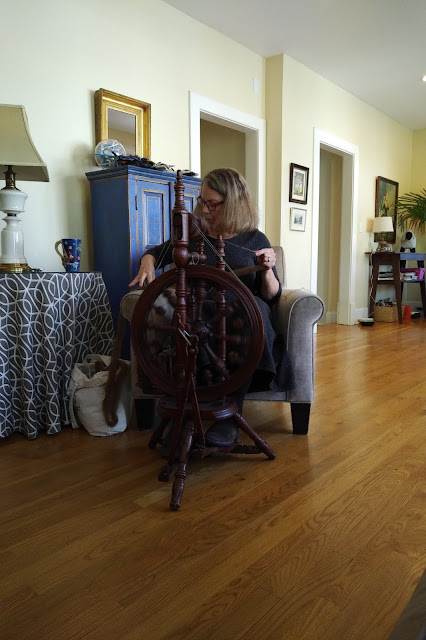
Here I am winding a spindle full of yarn onto the yarn swift my dad and I made years ago. One full revolution is 1 yard of yarn. 

Yarn swift from the top...

...and the side.

The swift comes apart into pieces to make storage easier.

Yarn swift in pieces.

Happy springtime, everyone!

I have a post about some transition stays almost ready...

Monday, January 06, 2020

Midwinter Spinning, Midwinter Sheep

Joining an end of yarn to fleece ready to be spun.
Every winter for getting on quite a few years the urge has come to sit and spin. In the Kentucky Bluegrass the days are faded, however blue the sky, or gray and so dim the streetlights sometimes come on, and we seem to orient ourselves towards the windows, or towards the lamps when the windows leak in only a moody, sometimes bitter light.

In that time for some reason handling wool is comforting. Spinning yarn requires attention and care, but the slow, thoughtful movements, the repetitive treadling of the wheel or the flicking of the supported spindle in the hand, and the drawing out of soft, washed fleece, watching as twist runs into the fibers and draws them into a springy, soft yarn, is soothing. It makes wan light, or wet light, or threatening light, or expectant light heavy with the thought of snow feel good and sweet, as illogical as that might seem.

I am wondering. Humans have spent so much of their lives spinning or twining fibers -- millenium after millennium -- to make ropes, strings, baskets, fabrics, those objects that help make life easier. Is the urge, once woken, still built in to our neural networks? Perhaps that's wishful thinking, but it sure does seem that way.

That's what I have been doing, after all the preparations, excitement, and stress of the end of the boys' fall school semester, and the Advent and Christmas seasons.


Pulling out a thin roving made of wool from our Shetland ewes, Lana and Nina.


Until 2018, I had prepared our ewes' fleeces for spinning by hand, by myself, as the boys are now too busy to interest themselves in the process. Even if the girls weigh under 75 pounds apiece, they still produce a great big humongous pile of fleece, two pillowcases stuffed to bursting. The pile would be knee-high if suddenly let out of the bags.

Black sheep, black sheep
Have you any wool?
Yes, sir, yes, sir, three bags full!

Oh, that's much too much --
Though it's very nice;
I'll take two instead
And spin it in a trice.*
In a trice? Erm, no...

(*My own weak doggerel, not part of the original rhyme.)

Each crimpy fragrant (if you like the smell of sheep, and I normally do) lock must be picked of its bits of straw, hay, seeds, and unmentionables. That's a pleasant thing to do outdoors, in the springtime, when it's breezy, because as you pull on the locks the moving airs will pull some of the vegetable matter -- VM -- and carry it away for you, gratis.

Then the fleece must be washed in small batches in several consecutive buckets of steaming hot soapy water, preferably outdoors, and rinsed in more buckets, and dried in creepy looking, drippy clumps in the basement, hung over a wooden rod above the old zinc washing sink. This is slow, wet, dirty work with a dash of danger as I haul boiling water in the teakettle outdoors to heat the bucketfuls of water.

I have a whole post about the process titled "Scouring and Teasing Shetland Fleece" from several years ago, when I first started working with wool. It might entertain you. It did me. I have so much fleece now that I'd never think to rescue such supremely dirty locks as I did then. Instead, I'd leave them out for birds and animals to make nests with.

This is from some years ago, when I first started working with wool. Boy, was that fleece a bit hard to work with...


Then the wool must be separated. This is an extra step, joyously extra, because our ewes give us a twofer. They are dual-coated, which means they are covered next to their skin with a fine, so-soft downy wool a couple of inches long that keeps them warm. Through and over that grow hairs, in spiral locks, up to about six inches long. These hairs remind me of very coarse human hair, and they direct rain and snow down their lengths and off the sheep, keeping the sheep warm and dry-ish.

Nina, will you model your coat for our readers, please? Thank you, sweet girl.

Nina, sporting her winter coat. See that spiral-locked outer coat? That's what makes her a dual-coated Shetland sheep,
an especially lovely and ancient type of Shetland.
Knowing how blustery the Shetland Islands are, a dual coat is Heaven-sent. It's an ancient sort of coat, and not all Shetlands sport it; thankfully there is enough genetic diversity in the breed that it keeps showing up, because it's luscious, or as I said, joyous.

Joyous, anyhow, until your hands ache after taking the umpteenth hundred lock in your hands and pulling each end to separate the long hairs from the down.

Try doing that on an entire ewe's worth of fleece. Now double it, to include Lana's wool. She's dual-coated, too.
Nina says, "I'm so sorry your hands are so sore. Do you have any crunchies? I can gum your fingers for them..." As of last year, she is fatter and bigger than her mother.
Lana -- that's her rump dead ahead, ignoring everyone because it's breakfast time.
She's next to her boyfriend Liam, also a Shetland, from whom she is not often
more than a few yards a way. He does not have a dual coat. That's a sweet Soay sheep, from
islands not too far from the Shetlands even more rugged than they are. My ewes live
with her and the rest of the flock at my friend Sarah's farm.
The hair from the separated wool is good for warp threads for weaving, or, mixed with the down wool, for tough outer garments, and I might try it for an add-in buckle for an 18th century hairdo.

We're not done, however. After separating the wool, there's carding the down coat to ready it for spinning. I have a hand-turned drum carder, so I don't have to use two hand carders and work lock by lock, thank heaven, but it's still a slow manual process to feed in each lock, and then run a full load through twice, and then offload the batt, tear it into three strips, and wind them into "nests" ready to spin.

So that's the process that I followed, and still follow, to some extent, because I actually enjoy some amount of hand-processing. It's hard, elemental work, and very satisfying. However, I found a wool processing mill that had the special equipment for separating fleeces, and now have a large amount of lovely, soft roving. It feels a little like cheating to spin so easily, without all the effort, but it's a nice change. Alas that the mill closed, and the only other one is in New England with a six months' wait! It may be back to hand processing.

I'll be back to finish up the 1890s posts in a bit. Right now, the wheel is in hypnotizing motion...

Tuesday, January 13, 2015

Hand-cleaned, handspun, handwoven Alpaca and wool scarf: measuring and chaining warp


Ladybug: "Where does this yarn go and
what happens if I pull on it with my teeth?"
[No picture available of disaster
averted.]
Weaving = math + mechanics + art + time x patience / more or less

If creating yarn is a multi-step process, weaving it is that times 5. Holy cats, what a lot of steps. They say that if you only like actual weaving you had better like measuring warp and "dressing" the loom with it, too, for many times you'll spend more time preparing the loom than weaving on it. 

Good thing that's true for me so far. I like winding, and rewinding, and pulling and coaxing string. Of course, I've only got as far as measuring out the warp and readying it to be put on the loom, and a multitude of steps await on the loom itself: getting all the warp on there and through the wee slots in the reed and the wee holes in the correct harnesses, and all tied up and tensioned evenly. Ai, yi! 

One of the slowing factors, aside from teaching myself, is that I am working on a shoestring (ahem) with ad hoc tools. It's good to learn  -- by tangles, slowness, failures, and banging up against physical impossibilities -- why tools designed in one of several ways are sensible. Besides, you get to fiddle around and invent, and that's just plain fun.

The loom is the little pine thing dwarfed by the big pine thing.
Yes, there is a tiny homemade Tinkertoy loom next to it.
That's toy the boys and I made. It works!
Because I am weaving on a Swedish Glimakra loom (the 1970s-vintage Pysslingen above), it seemed fitting to take The Big Book of Weaving, also from Sweden, as a guide. For those who may be curious, the ways the Scandinavians tend to dress their looms differ a bit from the way it's often done in America. There are assumptions that one is using string heddles, not metal ones, and that parts of the loom can be broken down and removed for easier setup. The simple but subtle mechanics of these looms are so beautifully worked out...

Oh, that large pine 19th century clothes press? Ultimate source unknown, but found it locally a few weeks back. It might not be American: so many things are imported and exported. It's rather beaten up: original button drawer knobs gone, cupboard handle gone, back of the cornice looks as if it's been left in the rain or chewed by mice, it's water-stained in front, and inside, boards are shrunken with time. No matter. It is happy and cozy and sturdy. It will hold all the toys as well as the television, doesn't mind if small basketballs and small children bump it, and will be a good foundation piece for one of the boys down the road. I love pine. Cherry is warm and handsome and very local to where I grew up and here in Kentucky, walnut is tough, poplar is useful, butternut and fruitwoods are rare lovelies, old mohogany is serious. Pine is softer than these, softer in color, softer in surface, but oh, so good.

Here are pictures, as much to document for my fuzzy brain as to entertain you, showing what is going on.

Measuring Out the Yarn

The warp, a commercial alpaca-wool blend. My handspun is not strong enough to be warp. It would break. It's in a skein measuring 110 yards -- all I will need for the scarf's longways warp threads -- tied at intervals with kitchen string to keep it in order.

First, last November, we measuring out the total yardage with a Tinkertoy skein holder Noah and I made and a skein winder Dad and I made of scrap lumber measuring exactly one yard per turn around the four arms.

Skein holder and 1-yard skein winder. Collapsible into pieces.
Yes, that's a different breakfront cupboardin the background.
That one has gone upstairs to the master bedroom,
and a new-to-us pine one is now downstairs. Both 19th century,
but only the cherry one from Kentucky.
Christopher and I did the measuring together.


Now that Christmastide is over and the new year begun, it's time to measure again and this time, get the warp in order.


 The skein ends are tied together with a visible knot so it's easy to find the ends.


The skein has to be unwound. It will be divided in half, and wound on two spools because the warping method I use measures out warp for the loom with two strings of yarn, called ends, at a time. It's easier to keep tension even with a pair of ends and saves time measuring.

Here is the skein on the big Tinkertoy skein holder. How to get it onto two spools? One at a time.


First, measure out half the yardage needed, on the skein winder. Cut the yarn, pull off the new skein carefully, then do it again with the second half.


Now to get the skeins onto spools since skeins tangle easily and don't unwind an even rate of tension -- as me how I know.

Wind, wind. Yawn, cramp. This is too slow. Egad. No go.

A bit of tinkering with Tinkertoys later, we have a weighted arm to hold the spool, and a handle taped onto the spool to speed winding. Push your finger against the handle and it turns, winding the spool, while your other hand guides the yarn so it winds evenly. An already wound spool waits on the table.


Measuring the Yarn for the Loom With Warping Pegs

If you have cash and space, you purchase a warping board, which looks like a square window frame with giant pegs stuck in it all around, or better, a warping mill, which is simply a reel made to stand and spin upright. I have neither, so it's warping pegs for me.

Each warp thread is measured out to the length it will be on the loom. The yarn goes from one peg, at the left, to the other end, around an intermediary peg in a figure-8 pattern called the lease cross. It's that crossing of yarns that keeps the warp in line.

You can only have a warp as long as your longest clampable surface -- the pegs have to be clamped in place to hold tension, so you generally can't weave a very long length.

The yarns have to stay perfectly evenly tensioned and one yarn cannot cross over another yarn except at the lease cross. That means that the spools should unwind below the pegs -- on the floor for me, because your fingers have to be able to pull the yarns evenly and also guide them over the pegs in the proper pattern. Ask me why I know this.

The warping pegs have to be in a straight line, or one side of the warp threads will be longer than the other. Um, yeah, I learned that, too.

Also I learned that it's easiest if you are going to measure out two ends at a time and they go there and back again to the end peg, that it's best to measure everything divisible by four for the whole warp part of the project. If you want clean measurements. Just saying :}


When you have measured out all your warp on the pegs, for goodness' sake please tie nice, tight bows with kitchen string around the end peg...

...the middle of the warp on both sides...


...and at the lease cross and both sides of it. See the cross in the picture?


Then I took the warp off the loom and "chained" it: formed it into a crocheted chain using my hands as the crochet hook. No picture because I had no hands available.  Also because it required a visit to a YouTube video to learn how (https://www.youtube.com/watch?v=VQ1qNeSYBxs). Desperately needed moving visuals :}

So there we are to date. Now I have to clean a rusty reed that guides the warp in the loom and also serves to beat the weft into position as it's woven. Then we can start actually dressing the loom. When, I wonder?

Next up, the last of November 1811's journal journey.

Friday, December 05, 2014

Weaving Handspun Yarn: Increasing Fascination, Research Extension

Measuring out 50 yards on the homemade skein winder.
Christopher and I spin together. Now we are weaving together. Months ago we made yarn from Tuesday the alpaca's so-soft-you-bury-your-face-in-it hair. Since his brother has a woolen scarf I knit for him, Christopher has been agitating for one too, and we've agreed to learn to weave it together.

Will it be finished by Christmas? Since we must learn to size the yarn with starch or a milk solution, measure out the warp threads on warping pegs, and then dress a harness loom with them -- a process with 20 pages worth of steps in my big Swedish weaving book -- weave the scarf, and then finish and full the resulting fabric, probably not. Maybe by Easter and lambing time? Who knows? Doesn't matter. It's experimenting with this most ancient and respected craft that is the point right now. Later Christopher can enjoy wearing the piece of heaven that is partly the work of his own 7-year-old self.

From Tuesday's back to Christopher's neck, our hands, using tools so ancient some of their sources are lost in time, will have touched each step. To this day I have never felt such happiness and satisfaction with anything I have ever sewn or produced. This is getting to the source of things.

Christopher unskeins the commercial wool/alpaca yarn from the homemade skein unwinder, while I continue
measuring out a total of 110 yards for the scarf warp (lengthwise) threads.

Here's the loom. It's a Swedish loom, a Glimåkra Pysslingen table loom on legs from the 1970s. Like most Swedish and Finnish looms, it's ingenious and to my eyes, handsome. You'll be seeing it on and off as time passes.

Glimåkra Pysslingen loom, up close, along with skeins of the fluffy, chunky handspun
alpaca Christopher and I have produced.
Little note: you might recall the trim loom. It's in use. It's got cotton warped on it now, and I am about a third of the way through making a petticoat tape. A nifty, handsome machine and good way to begin to understand weaving movements. Plus make trim. But when? Again, who knows. Whenever the path winds there.

You Know Why I Spin, But Why Weave, Not Knit?

First, my knitting is poor. Garter stitch is fine, purling okay, but any combination beyond knit and purl and it's all too easy to get confused. This brain has a hard time with numbers anyway. Dates, sums, prices, equations, they get turned around in my mind so easily, mixed up together in jumbles. Long experience has taught me that all number sequences and calculations must be written down, then checked to make sure they weren't garbled even during their writing. Knitting sequences? Germs of frustration.

Then, weaving has appealed since a high-school-era class in a sunny old room introduced me to the big harness looms and the amazing things they can accomplish. Now is the time to return to that magic, even though it involves hordes of potential calculations and our loom is by no means large. At least those can be written down in logical order. I can avoid patterns made by complicated harness sequences and keep to the simplest weave structures while turning to manual warp-by-warp inlay techniques for figures and patterns beyond stripes and checks.

At the last, like many costumers, trying to find modern equivalents to or substitutes for historical fabrics has led naturally to curiosity about them.
  • What were the fibers like when the original garments were made? 
  • Were the silk worms the same species as raised today? Who raised them? 
  • Who herded the sheep for the wool and what did the sheep look like, smell like, act like? 
  • Where did the fine Indian muslins sold in Europe and the Americas come from? What plants, animals, and minerals were developed into paints and dyes?
  • What tools and machines made the yarns and threads and fabric and who developed them and used them?
  • What is calendaring, and is it true that the "scroop" of late 19th century silk depended on treating the silk yarns to a bath in caustic soda? How is brocade made?
  • What linen thread counts are good for shifts? What weaves look nice in a wool petticoat?
  • How was reeled silk produced in the 18th century? What about the 19th? How about now?
  • If England made American colonists buy so much of their wool, how come spinning wheels from the era are common? Who used them and what for?
  • When was ninon silk invented and why was it apparently named after Ninon l'Enclos?
  • What happened to fabric after it was reduced to rags, and what's the difference between mungo and shoddy?
Questions like these have bedeviled me for years. The answers have a great deal to do with what fabrics and designs were popular and where, and how people constructed and wore clothing, and they impacted fashion designs more than we costumers tend to think about.

So, as I've learned to spin Americas-style with a handspindle and now to weave, bedtime reading matter has been mostly historical accounts of the dawn of sheepherding, of spinning, of weaving among the Egyptians, of the English wool industry, and of revent ideas about how Medieval spinning in Europe may have been accomplished. I've eaten up books about spinning on wheels and spindles, and have read and reread Learning to Weave, a bible among American weavers, and The Big Book of Weaving, another bible recently translated from Swedish and my favorite reference so far, probably because the Swedish and Finnish looms are such clever, elegant structures almost entirely constructed of wood and cord, and capable of producing amazingly fine fabrics.

Booky, bloggy, wiki knowledge hasn't been the only benefit of all the reading and experimentation. When I read letters like those from Anna Briggs' accounts of spinning, weavers, and fabric conservation in American Grit: A Woman's Letters from the Ohio Frontier, her descriptions and concerns have made much, much more visceral sense than they once did. Same for My Dearest Friend: Letters of Abigail and John Adams. Books like Rural Pennsylvania Clothing: Being a Study of the Wearing Apparel of the German and English Inhabitants, take on a different feel when I can begin to visualize some of the decisions the makers made when constructing clothing. Concepts become tangible and are tested, the sense of time shifts, resources are appreciated more, and the skills within bone and muscle and empathy in the mind and soul develop, even if just a little bit.

By the way, I am far from alone in this. There are historically minded spinners and weavers all over, in the United States associated with institutions like Colonial Williamsburg, tiny firms and larger companies like Thistle Hill Weavers or Devere Yarns or Pallia Mittelalter Hautnah in the U.K. Reenactor and SCA folks too, many of them in Europe and a number of them sharing their experiences on sites and blogs: Arachne's Blog and In deme jare Christi in Sweden, 15thcenturyspinning in Australia, Medieval Silkwork, in the Netherlands, and Hibernaatiopesäke in Finland, or Odette's Obsessions here in the States.

As Christopher and I make his scarf, and I consider a fun and modern rya-knot-woven pillow for the den, and perhaps a linsey-woolsey petticoat someday, it's good not only to enjoy the process, but to begin to feel and experience physical, mental and emotional movements made generation after generation after generation since people became people, and to begin to glimpse how the arts we are practicing are so closely meshed with with not just fashion, but with so much of the rest of life.

It is such fun getting down into the roots of it all.

Monday, September 08, 2014

Scouring and Teasing Shetland Fleece


The shetland fleece, outer side up.
It's an incandescent day, ueber-sunny, cool and pleasant, and the cicadas are singing. With Noah home from school with a fever, it's a good opportunity to scour more of Rosemary's shetland fleece. Edit: This post was written before we knew that both boys were going to be really sick for days: high fever, headache, stomach issues, congestion, the works. Little curled-up balls of woe, they were. Christopher is still mending.

Let's take a picture walk, and see how I prepare it for spinning.

The Raw Fleece
The first job was to skirt the fleece. That means taking the extra-dirty, hay and burr and dung-touched outer edges of the fleece. Since the edges are made up of the belly side of the sheep fleece, it's no wonder it's so dirty, because little Mr. has been running around a meadow all year.  In the first picture we see the fleece, outer side up. Notice how long the wool is. Shetlands grow beautifully long locks. Notice that the fleece almost looks like a sheepskin rug in need of a wash. That's how thick the sheared fleece is!

Here is Mr. Shetland himself, in a picture taken by Laura Lough of Square Peg Farm. The sheep may be part Soay, another rare and "unimproved", as they call it, breed. Unimproved my eye. How anyone can improve on an impressive set of colors and softness fit for baby clothes, I can't imagine.

Rosemary's Shetland, who might be a Shetland-Soay mix. He was shorn recently and its his fleece I'm working with.
He's a sweetie and appears to be looking up for a potential treat. Photo courtesy Square Peg Farm.

Shetland fleece, skin side up. Notice the gray undercoat on the back? The back is in the center of the fleece and is the cleanest, highest-quality part.
Here is the outside, close up. Shetlands have waves in their wool. Here I am pointing to the gray undercoat.


Picking the Locks
Here I have pulled off a lock of the wool near the section that was close to my sheepy boy's head. It has lots of "VM", vegetable matter in it.

In this big set of locks, I have spotted two fat burrs. They'll come out right away.


A lock of Shetland wool typically is triangular-shaped. That's because Shetlands are a very, very old breed. Like other early sheep, they have a long outer coat with guard hairs, and then a fine, very soft undercoat. The outer coat is thinner, the inner coat thicker, and so produce the characteristic triangle shape.


Here's another view.


There are lots of ways to get the VM out. One of the most common is to comb it with very sharp combs. I am using one here. Or I can use a smaller, blunt-tined comb.


Once the locks have the worst of the VM out, they are ready to be washed, called scouring. In the case of this morning's scouring, the locks were so clean that I am scouring them without doing anything other than removing burrs and big stuff.

Scouring the Locks
Wool is scoured to remove the lanolin and sheepy sweat, called suint, plus other assorted potential contaminants. Dawn dish soap is a popular and inexpensive scouring agent. Sure, I could purchase special stuff, and perhaps even save some money that way, but Dawn is available at the grocery and we use it daily, so it's sensible for us.

Water is heated to too-hot-to touch, in goes a big blorp of soap, and then the locks are laid in gently so as not to agitate them and accidentally start the wool fibers felting together. They sit and marinate for about 15 minutes. Then the now yellowy-brown water is emptied out, and then there's another hot bath, and then another if needed.

In go the locks! Noah is home with a fever and heavy congestion. He cools off in the morning air.


A final bath for a few minutes in hot water with a blorp of distilled vinegar to neutralize the alkaline action of the soap, and then the locks are set to dry for a few days, either in front of a dehumidifier or in the sun, or both.

Teasing the Locks
Once the locks are dry, then it's time to get the rest of the hay and bits of dust out, preparatory to combing the wool to prepare it for spinning worsted-style. Worsted yarn requires a particular combing of the yarn and a style of spinning that makes it lustrous, dense, and smooth. But back to teasing.

Here is a lock of washed but very dirty Shetland. Now, many spinners would throw this lock away as too much a of a pain to bother with. Not me. This fleece is valuable, and what I have most of is time, not money. It's worth it to me to rescue such locks, to comb and pick out all of the VM.

If you look closely, you see the long guard hairs, a creamy color, at the top, then the short full undercoat, with the gray in it, at the bottom. When I comb, I hold it from the bottom, quite tightly, and comb it with a blunt comb. Then if needed, I flick -- lightly hit and pull -- the lock with a flicker comb, which in my case is a sensitive-skin cat comb.


Here is a much cleaner lock, creamy white, with the barest deeper cream at the tops. So lush! It won't need much teasing, but just enough to remove any bits that are left. The higher on the back of the fleece you go, the cleaner the fleece and its locks are.


Here is a little video showing how I prepare locks. It shows combing, not flicking.


This is what a lock looks like when its done. Like a slice of heaven, no? Soooo soft, so gentle, so lustrous.


In a blog post or two, we'll look at the final combing -- managed much the same way since the Middle Ages -- that turns the locks into "top", the soft and aligned length of fibers ready for the spinning wheel or spindle.

Wednesday, August 20, 2014

Picking, Combing, Carding, Spinning...Weaving: That's What's Happening


Working with wool and alpaca fiber recently.
The subtitle of this blog reads "and, of Course, the Occasional Side Trip". What I've been doing these past months qualifies as more than a little excursion, at this point.

I am hand-spinning wool and alpaca and getting ready to re-learn the art of harness weaving -- you know, a loom that goes "whish swish, whump thump" as you throw the shuttle and pull back on the beater to secure the just-made fabric.

The spinning was necessary; last fall I signed on once again at church to teach children to card and spin a little at this summer's Vacation Bible School. The summer before we'd had fun together but the spinning was execrable. So over months this spring I learned to handle a drop spindle decently and fell in love with what Amos Alden calls an "ancient and honorable craft". So ancient, in fact, it's wound up with pre-civilization.

One of the crop of pinky-red, yellow and fuzzy (!) toadstools
sprouting in our lawn after all the rain and fog.
Here we are, towards summer's end, and there are alpaca and sheep fleeces in the basement, bags of it in the garage -- fodder for another volunteer project -- fleece awaiting picking in a bowl, spindles and spinning wheel in the hallway, and a loom in the family room. They multiplied like the toadstools in our lawn after this summer's weeks of rain and dimness.

Not an excursion, then. Costuming? I've got a pretty beaded reticule on the way and a chintz 1770s anglaise on hold. No then, costuming's not going away. It just has to share space in the calendar and in the brain with work and family, volunteering and with wool picking, scouring, carding, combing, dizzing -- that doesn't mean spinning around until you fall over -- spinning and weaving scarves and warm alpaca blankets, and maybe, a linsey-woolsey petticoat? Let's see what happens.

Meanwhile, the last months unroll below in pictures. One fleece is worth ten thousand threads.

First there was the spinning wheel, a present for my grumumppieth birthday. Built in 1887 somewhere in Scandinavia, it traveled to North Carolina with immigrants and was held on to by their descendants until they unaccountably decided to part with it. A sort of faded reddish color, it's decorated with banding and painted designs in black. Rather chic, I think.

Circa 1887 Scandinavian spinning wheel.

Chic it might be, but it sat. Then I cleaned it and got everything smoothly turning, but it still sat. It's still sitting. I haven't learned to keep up with it!

Then there was the drop spindle that turned up at an antique show. It's from Eastern Europe, and I didn't know until recently that you're supposed to rest it on a surface to support it as it turns. Taking a class from a local professional, it was on this spindle I learned to spin in preparation for Vacation Bible School.

The Eastern European spindle. It has no notch on the pointed
top: you half hitch your yarn to hold it on.

Obligatory cute kitty shot.
Spinning!
Alpaca fleece arrived, part of the VBS project. Had to have lots of fleece ready for children to spin, plus more cleaned and ready to for them to try to card into cute little tubes, called "rolags", a Scotch term. So I learned to clean alpaca: to flick locks to remove bits of dust and hay, to roll rolags...

Second cute kitty shot. Muffin's sitting on the completed
rolags in the box. Can't blame her, they're soft.
Wanting to have wool for the VBS children to handle and card and spin too, because it's easier to work than slippery alpaca hair is, I bought a pretty Shetland sheep fleece from a lovely girl in Ohio. Lothlorien's whole fleece arrived in a box, smelling pleasantly and not too strongly of sheepy lanolin, and imbued with her personality. Here she is.

Lothlorien, the creamy Shetland in back.
Spinning practice went apace. I turned back to alpaca not long after the first lesson, heaven knows why, probably because I had so much of it. Wool fibers have lots of scales, and they have waves and crimps that makes them stretchy, resilient, and fibers stick together and are easy to spin. Alpaca has fewer scales per fiber, often has little crimp or curl and isn't stretchy, and so is slippery-ish and a bit harder to spin. Whatever. It's what I really learned on and I love how deliciously sooooooft it is.

Here is a lock from Tuesday, the alpaca whose hair I've been spinning. See his cute stripe? He's ticked!


Christopher holds up two balls of spun alpaca. They're for a scarf for him at Christmas.


Here's one of the balls. See all the fluffs on the edges? That's before washing, too. It "blooms" after being washed and is even fluffier.


Here's the yarn, plied from two strands, or "singles". So much terminology. Just like sewing.


I washed the plied yarn. It bloomed, all right. Big, chunky, fluffy, soft like Muffin's kitten would be.


Well, our VBS coordinator gave me some wool that was even easier for children to handle, some curly, long-locked Blue-faced Leicester. Sheep breeds have funny names. Do you see any blue on the face of the sheep below? The skin under the white wool on his face does have a bluish tint.

Hexham Champion, 2008, from Middle Dukesfield, in England.

So I learned to comb out the 6"-10" wool, purchasing long wickedly sharp combs, true weapons capable of really injuring somebody, at the Bluegrass Sheep and Fiber Festival in May.

The boys wanted to learn, so they got spindles, too. They're still learning, a little, as the fit takes them.

Can you see the snowball, erm, fleeceball, rolling?

At Vacation Bible School the campers handled wool and alpaca, carded and combed and spun it and two children took big balls of wool home, with hopes to buy a drop spindle and continue learning. Everyone else got an alpaca puff to pet and scare their parents with, plus a length of what they had made. Here we are on the first day of camp, learning about wool and other animal fibers.


Next day we carded and used those wicked combs to actually comb some lovely locks into fluff ready for spinning on the morrow.


The children spin. First I'd demonstrate, then they'd try it and try it again.


Here's Jenni from Living with Jane. She helped children make jewelry, do glass mosaics, and felting.


The children actually span -- the obsolete past perfect tense of "spun"? -- quite a bit of yarn, not all of which was given away. We built a yarn winder from Tinkertoys to put it in a skein so it could be washed again to finish it.

The yarn winder. Spin the cross-shaped piece and it goes around.
Completed skein. The yarn thickness varies a lot. Children
just learning made it, and it has charm.
Well, we wanted to use it, and the boys and I were interested in how a loom works, so I read up in library books and online, and we built a rudimentary two-harness counterbalance loom, invented eons ago. Versions of this loom were used in India to make the incomparably fine muslins exported to Europe in the late 18th century, just in time for Classicism and the Regency. Versions called drawlooms made figured silks, and European weavers produced the luscious gold-and-silver thread enhanced, flower-bedecked brocades that we all sigh over.

Here's the Tinkertoy loom, with a red cotton warp on it, ready to be woven with the weft, made of the child-spun wool you saw above. That's a cardboard "stick" shuttle.

Yes, it works. Those two rectangular-shaped things decked with
strings (heddles) and hung from the top bar (castle) are called
harnesses.
At VBS the owner of Rosie's Ponies and Petting Zoo and I got to talking about the friendly llamas and sheep she had brought for the children to admire, pet, and feed, and she kindly offered the animal's fleeces when I asked if she might sell some, since she didn't use them. I got to thinking and in a spark of what I like to think is grace, it seemed that the fleeces could be turned into warm things for those in our area who need them. Thus was born the Big Fleece Project. It's still in infancy, but we hope to have felt and yarn from the fleeces to use.

One day recently the boys and I visited their farm, petted an affectionate (!) camel, a cozy-stand-next-to-you pony, admired llamas, petted rare Soay sheep, and packed up fleece after fleece that had been sheared. The back of the SUV was filled to the roof with fleeces stuffed into bags.


We brought them home, and that evening and the next morning, sorted them, skirted the sheep fleeces, a fancy term for taking off the edges, which are usually encrusted with matted, dungified, muddy, weedy bits. You see, a shearer cuts the fleece off sheep such that it's in once piece, ideally. He starts on the tummy one one hind leg and works round to the back and ends with the other hind leg. WikiHow explains.

Not all the fleeces were usable, but many were, and they were draped everywhere, drying out before being bagged.

Remember VBS? Here's the petting zoo day. Look at Mr. Llama and his buddy behind him, craning for affection and some treats. See if you can match his fleece in the piles below. I think I recognize some of the sheepy fleece, too.


Llama fleeces fall apart easily, so they're in bits: chocolate brown, cinnamon, latte, silver mist, cream, and agouti. They're my names. Must be hungry right now. Oh, so soft.

Llama, llama everywhere.
One Shetland fleece and lots of mystery short-staple (length of the wool) wool, a bit overpowering due to being damp. My mother was not terribly impressed on first contact with the project.

Sheep fleeces, entire, drying the only super-sunny, dry place I could think of,
the back of the truck.
"Black sheep, black sheep, have you any wool?" We ended with eleven bags full.

Soccer and fleece. They go together. Right?
In the last week or two I've almost completed spinning yarn for Christopher's scarf, and am starting to clean another Shetland fleece. In a post or two, how that's done. Oh, and the new loom, and not a Tinkertoy one.

Meantime, it'll be back to the Journal Journey!