14
$\begingroup$

I tried to find a non-trivial integer solution to the equation
$$2012^2=a^2+b^2+c^2+d^2+e^2$$ with Mathematica but the computation takes minutes; I might be doing something wrong.

FindInstance[2012^2 == a^2 + b^2 + c^2 + d^2 + e^2 && a > 0 && b > 0 && c > 0 && d > 0 && e > 0, {a, b, c, d, e}, Integers] 

But when I try

FindInstance[2012^1 == a^2 + b^2 + c^2 + d^2 + e^2 && a > 0 && b > 0 && c > 0 && d > 0 && e > 0, {a, b, c, d, e}, Integers] 

I get an immediate result.

$\endgroup$
1
  • $\begingroup$ @kguler the change was from 2012^2 to 2012^1, I think they are both meant to be from the Integers. $\endgroup$ Commented Mar 27, 2012 at 4:38

3 Answers 3

19
$\begingroup$

It does not seem surprising that a search space 2000 times larger results in a substantially longer computation time.

Here is a much more direct way to find a solution:

Sqrt @ IntegerPartitions[2012^2, {5}, Range[2012]^2, 1] 
{{2011, 63, 7, 2, 1}} 
$\endgroup$
3
  • 4
    $\begingroup$ +1 for the clean approach. Though all odd (small enough) powers of 2012 work fast. Try this FindInstance[2012^13 == a^2 + b^2 + c^2 + d^2 + e^2, {a, b, c, d, e}, Integers] On the other hand even powers work slow. I am not sure if it is exactly larger computational space issue. $\endgroup$ Commented Mar 27, 2012 at 6:01
  • $\begingroup$ @Vitaliy that's an interesting observation. I don't feel qualified to analyze the reason. $\endgroup$ Commented Mar 27, 2012 at 6:06
  • $\begingroup$ Mathematica seems to pick the wrong approach, i tried replacing 2012^n with other values and in most of them i ran out of memory, even if the number is very small like 864 $\endgroup$ Commented Mar 27, 2012 at 18:29
18
$\begingroup$

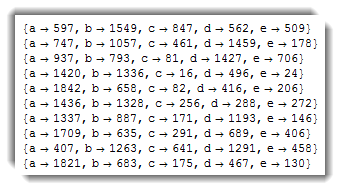
Here is a way to make FindInstance work and give you a a few random solutions quickly:

Flatten /@ ({a -> #, FindInstance[2012^2 == #^2 + b^2 + c^2 + d^2 + e^2, {b, c, d, e}, Integers]} & /@ RandomInteger[2011, 10]) // Column 

enter image description here

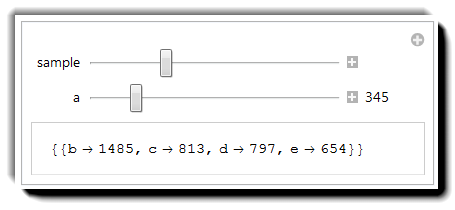
Your equation can be solved for any Abs[a] <= 2012. Here is an app that let's you browse random solutions for any such fixed a

Manipulate[FindInstance[2012^2 == a^2 + b^2 + c^2 + d^2 + e^2, {b, c, d, e}, Integers, RandomSeed -> s], {{s, 300, "sample"}, 1, 1000, 1}, {{a, 345}, 1, 2012, 1, Appearance -> "Labeled"}] 

enter image description here

$\endgroup$
1
  • 2
    $\begingroup$ @Mr.Wizard Do you mean higher even powers by "more general"? If yes, the above approach works with any even power. $\endgroup$ Commented Mar 27, 2012 at 6:24
8
$\begingroup$

As it happens, I wrote code for this sort of thing a couple of months ago. Am hoping to put it into Wolfram|Alpha some day.

sumOfPowers[n_, pow_, use_, exactly_: False] := sumOfPowers[n, pow, use, n + 1, exactly] sumOfPowers[n_, pow_, use_, min_, exactly_: False] := Catch[Module[ {n1 = min, nminus, res}, If[use == 1 && ! IntegerQ[n^(1/pow)], Throw[$Failed]]; If[n <= min && IntegerQ[n^(1/pow)] && (use == 1 || ! exactly), Throw[{n}]]; While[(n1 = Floor[n1^(1/pow)]^pow) > 0, nminus = n - n1; res = sumOfPowers[nminus, pow, use - 1, Min[nminus, n1] + 1, exactly]; If[res =!= $Failed, Throw[Prepend[res, n1]]]; n1--; ]; $Failed ]] 

Your example:

In[6]:= sumOfPowers[2012^2, 2, 4, True] // Timing Out[6]= {0.11, {4040100, 7396, 324, 324}} 

To find all such sums, perhaps best would be to use

PowersRepresentations[2012^2, 4, 2] 

This might be no faster than what you did, though.

$\endgroup$

Start asking to get answers

Find the answer to your question by asking.

Ask question

Explore related questions

See similar questions with these tags.