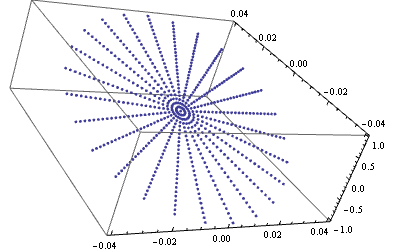
I want to solve a Laplace PDE in a polar coordinate system with finite difference method, but I have a problem with boundary conditions at r = 0.
Here is what I found on the Internet: http://homepages.see.leeds.ac.uk/~amt6xw/Distance%20Learning/CFD5030/node10.html
The formula for discretization is here: 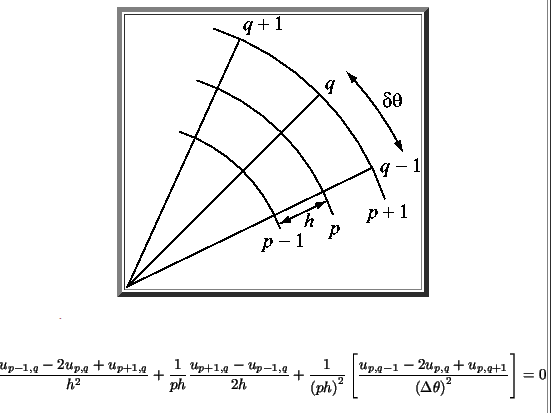
I started off from a Cartesian coordinate system, from a rectangle grid. I tried to transfrom it into polar coordinates, but I don't know how to add/define the boundary conditions at r = 0, but in r = R = 0.
R = 0.04; n = 10; m = 10; Δr = R/n; Δθ = R/m; ϕ[n, j_] = 0;(*???*) ϕ[i_, m] = 0;(*???*) vars = Flatten[Table[ϕ[i, j], {i, 1, n - 1}, {j, 1, m - 1}]]; eqns = Flatten[Table[1/Δr^2 (1 - 1/(2 m)) ϕ[i - 1, j] - 2 ϕ[i, j] + (1 - 1/(2 m)) ϕ[i + 1, j] + 1/(m Δθ)^2 (ϕ[i, j + 1] - 2 ϕ[i, j] + ϕ[i, j - 1]) == 0, {i, 1, n - 1}, {j, 1, m - 1}]]; sol = Solve[eqns, vars][[1]]; ϕsol = Interpolation[ Flatten[Table[{i Δr, j Δθ, ϕ[i, j]}, {i, 0, n}, {j, 0, m}] /. sol, 1]]; When I solve analitycal the result is here: 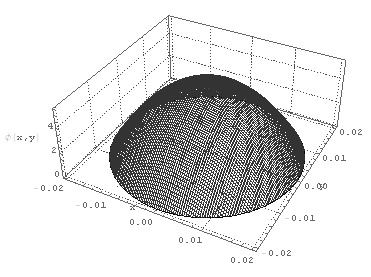
But I don't know how to solve numerically