43
\$\begingroup\$

This is my first challenge on ppcg!

Input

A string consisting of two different ascii characters. For example

ABAABBAAAAAABBAAABAABBAABA 

Challenge

The task is to decode this string following these rules:

  1. Skip the first two characters
  2. Split the rest of the string into groups of 8 characters
  3. In each group, replace each character with 0 if that character is the same as the first character of the original string, and with 1 otherwise
  4. Now each group represents a byte. Convert each group to character from byte char code
  5. Concatenate all characters

Example

Let's decode the above string.

 AB AABBAAAA AABBAAAB AABBAABA ^^ ^ ^ ^ | | | | | \---------|---------/ | | Skip Convert to binary 

Notice that A is the first character in the original string and B is the second. Therefore, replace each A with 0 and each B with 1. Now we obtain:

00110000 00110001 00110010 

which is [0x30, 0x31, 0x32] in binary. These values represent characters ["0", "1", "2"] respectively, so the final output should be 012.

Scoring

This is, of course, , which means make your code as short as possible. Score is measured in bytes.

Constraints and IO format

Standard rules apply. Here are some additional rules:

  • You can assume valid input
    • Input string consists of exactly two different characters
    • The first two characters are different
    • The minimal length of the input string is 2 characters
    • The length will always give 2 modulo 8
  • You can assume the string will always consist only of printable ASCII characters
    • Both in the input and in the decoded string
  • Leading and trailing whitespace are allowed in the output (everything that matches /\s*/)
\$\endgroup\$
5
  • 6
    \$\begingroup\$ Gotta say man, for a first challenge, this is one of the better formatted challenges I've ever seen. As an fyi, the community sandbox is a great place for feedback before posting so you don't get randomly rep bombed for a rule you didn't know. \$\endgroup\$ Commented Apr 23, 2018 at 0:16
  • \$\begingroup\$ @MagicOctopusUrn. Thank you! Didn't know about sandbox, I'll post there next time :) \$\endgroup\$ Commented Apr 23, 2018 at 0:18
  • 2
    \$\begingroup\$ I mostly use it so people can call me out on duplicate questions, very simple to follow rules, rather hard to know about dupes without memorizing meta :). I'd also recommend checking out the chatrooms, we have chats for almost every language you could hope to learn and questions are encouraged. \$\endgroup\$ Commented Apr 23, 2018 at 0:18
  • 1
    \$\begingroup\$ Great first challenge! Some more test cases would be neat. \$\endgroup\$ Commented Apr 23, 2018 at 16:33
  • \$\begingroup\$ Really nice first challenge. Had fun playing with this one. \$\endgroup\$ Commented Apr 23, 2018 at 19:18

44 Answers 44

14
\$\begingroup\$

brainfuck, 76 71 65 bytes

-6 bytes thanks to Nitrodon!

,>>,,[>>++++++++[-[->+<]<<<<[->+>-<<]>>[[-]>>+<<]>[->++<],>>]<.<] 

Try it online!

Feels weird beating Python...

\$\endgroup\$
3
  • 1
    \$\begingroup\$ Not if the 8 keywords in BF were as long as their Python counterpart. \$\endgroup\$ Commented Apr 23, 2018 at 4:47
  • \$\begingroup\$ It helps that BF automatically converts the unicode. \$\endgroup\$ Commented Apr 23, 2018 at 9:49
  • \$\begingroup\$ 65 bytes \$\endgroup\$ Commented Apr 23, 2018 at 17:35
9
\$\begingroup\$

Stax, 15 11 bytes

ó║¥U⌂½íèäöñ 

Run and debug it at staxlang.xyz!

Quick 'n' dirty approach. Working on improving it. Improved it!

Unpacked (13 bytes) and explanation

2:/8/{{[Im:bm 2:/ Split at index 2. Push head, then tail. 8/ Split into length-8 segments. { m Map block over each segment: { m Map block over each character: [ Copy first two elements (below) in-place. I Index of character in first two characters. :b Convert from binary. Implicit print as string. 
\$\endgroup\$
1
  • \$\begingroup\$ Ahhhh... I knew this would beat us. \$\endgroup\$ Commented Apr 23, 2018 at 0:29
7
\$\begingroup\$

05AB1E, 10 bytes

¦¦Sk8ôJCçJ 

Try it online!

-3 thanks to emigna.


Ù # Unique letters, in order they appear. v # For each... yN: # Push letter and index, replace in input. } # End loop. ¦¦ # Remove first x2. 8ô # Split into eighths. C # Convert to integer. ç # Convert to char. J # Join together entire result. 
\$\endgroup\$
2
  • 1
    \$\begingroup\$ You can use 01‡ instead of the loop. EDIT: or even better: ¦¦Sk8ôJCçJ \$\endgroup\$ Commented Apr 23, 2018 at 6:33
  • \$\begingroup\$ Ahhhh... I knew this would beat us. \$\endgroup\$ Commented Jul 29, 2019 at 15:50
6
\$\begingroup\$

JavaScript (Node.js), 67 bytes

s=>s.replace(/./g,x=(c,i)=>(x=x*2|c==s[1],Buffer(i<3|i&7^1?0:[x]))) 

Try it online!

How?

We use two different syntaxes of the Buffer constructor:

  • Buffer([n]) generates a buffer containing the sole byte n and is coerced to the corresponding ASCII character. Only the 8 least significant bits of n are considered.
  • Buffer(n) generates a buffer of n bytes. Therefore, Buffer(0) generates an empty buffer, which is coerced to an empty string.

Note: They both are deprecated in recent Node versions. Buffer.from([n]) and Buffer.alloc(n) should be used instead.

Commented

s => // given the input string s s.replace(/./g, x = // initialize x to a non-numeric value (will be coerced to 0) (c, i) => ( // for each character c at position i in s: x = x * 2 | // shift x to the left c == s[1], // and append the new bit, based on the comparison of c with s[1] Buffer( // invoke the constructor of Buffer (see above): i < 3 | // if i is less than 3 i & 7 ^ 1 ? // or i is not congruent to 1 modulo 8: 0 // replace c with an empty string : // else: [x] // replace c with the ASCII char. whose code is the LSB of x ) // end of Buffer constructor )) // end of replace(); return the new string 
\$\endgroup\$
6
\$\begingroup\$

bash, 59 58 52 bytes

tr -t "$1" 01 <<<$1|cut -c3-|fold -8|sed 'i2i aP'|dc 

Try it online!

Thanks to Cows quack for saving 6 bytes.

This challenge works remarkably well with a series of coreutils (and dc to do the conversion and output at the end). First, we use

tr -t "$1" 01 <<<$1 

to transliterate the two characters in the input to zeroes and ones. The -t flag truncates the first argument to the length of the second, so this reduces to transliterating the first two characters in the input to 0 and 1, which is what we want. Then,

cut -c3- 

removes the first two characters, and

fold -8 

outputs 8 of the characters per line. Finally, the sed command turns each line into a dc snippet that reads the number as binary and outputs that byte.

\$\endgroup\$
1
  • \$\begingroup\$ Always nice to see a bash answer :) You can use sed to simplify the dc calculations by converting each line to dc code that prints each character out and then eval'ing it in dc tio.run/##S0oszvj/… (and the space after cut -c can be removed) \$\endgroup\$ Commented Apr 23, 2018 at 12:49
6
\$\begingroup\$

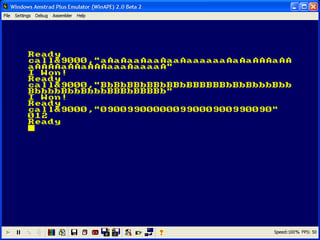
Z80 machine code on an Amstrad CPC, 32 31 30 bytes

000001 0000 (9000) ORG &9000 000002 9000 EB EX DE, HL 000003 9001 46 LD B, (HL) 000004 9002 23 INC HL 000005 9003 5E LD E, (HL) 000006 9004 23 INC HL 000007 9005 56 LD D, (HL) 000009 9006 1A LD A, (DE) 000010 9007 05 DEC B 000011 9008 13 INC DE 000012 9009 4F LD C, A 000014 900A Light 000015 900A 26 01 LD H, &01 000016 900C Last 000017 900C 13 INC DE 000018 900D 05 DEC B 000019 900E C8 RET Z 000021 900F Loop 000022 900F 1A LD A, (DE) 000023 9010 B9 CP C 000024 9011 28 01 JR Z, Lable 000025 9013 37 SCF 000026 9014 Lable 000027 9014 ED 6A ADC HL, HL 000028 9016 30 F4 JR NC, Last 000029 9018 7D LD A, L 000030 9019 CD 5A BB CALL &BB5A 000032 901C 18 EC JR Light 

The code takes the instruction replace each character with 0 if that character is the same as the first character of the original string, and with 1 otherwise literally and doesn't ever bother to check that a character matches the second character in the input string. It just checks for same-as-first-character and different-from-first-character.

I ran out of registers (the Z80 only has 7 easily usable 8-bit registers, the rest need longer instructions) so I put &01 in H, along with using L to build up the ASCII character (I just realised it's unnecessary to initialise L, saving one byte). When H overflows into the Carry flag, the character in L is ready to be output. Luckily, there is a 16-bit ADC (Add with Carry) that does the job of a left-shift instruction.

(DE) can only be read into A although (HL) can be read into any 8-bit register, so it was a compromise which one to use. I couldn't compare (DE) with C directly, so I had to load one into A first. The labels are just random words that start with L (a requirement of the assembler).

  • A the Accumulator - the only register that can do comparisons
  • B the counter register for the instruction DJNZ: Decrement (B) and Jump if Non Zero. By rearranging the code, I was able to do the job of DJNZ with one fewer byte
  • C the first character in the input string
  • D, E as DE the address of the current input character
  • H the carry trigger (every 8th loop)
  • L the output character being built up

enter image description here

\$\endgroup\$
5
\$\begingroup\$

J, 17 13 Bytes

u:_8#.\2}.1{= 

-4 thanks to FrownyFrog

Old version:

u:_8#.\2&({.i.}.) 

Explanation:

u:_8#.\2}.1{= = | Self classify, for each unique element x of y, compute x = y, element-wise 1{ | Second row 2}. | Drop 2 _8#.\ | Convert non-intersecting subarrays of length 8 from binary u: | Convert to characters 

Examples:

 = 'ABAABBAAAAAABBAAABAABBAABA' 1 0 1 1 0 0 1 1 1 1 1 1 0 0 1 1 1 0 1 1 0 0 1 1 0 1 0 1 0 0 1 1 0 0 0 0 0 0 1 1 0 0 0 1 0 0 1 1 0 0 1 0 2}.1{= 'ABAABBAAAAAABBAAABAABBAABA' 0 0 1 1 0 0 0 0 0 0 1 1 0 0 0 1 0 0 1 1 0 0 1 0 _8#.\2}.1{= 'ABAABBAAAAAABBAAABAABBAABA' 48 49 50 u:_8#.\2}.1{= 'ABAABBAAAAAABBAAABAABBAABA' 012 
\$\endgroup\$
3
  • 1
    \$\begingroup\$ 2}.1{= to save 4 bytes. \$\endgroup\$ Commented Apr 22, 2018 at 23:45
  • \$\begingroup\$ Oh my, tied... I can't find another byte. \$\endgroup\$ Commented Apr 23, 2018 at 0:13
  • 1
    \$\begingroup\$ @MagicOctopusUrn it's actually a snippet, it should have a [: at the start :) \$\endgroup\$ Commented Apr 23, 2018 at 2:48
5
\$\begingroup\$

Python 2, 77 bytes

lambda s:[chr(int(`map(s.find,s)`[i:i+24:3],2))for i in range(7,3*len(s),24)] 

Try it online!

\$\endgroup\$
5
\$\begingroup\$

R, 71 bytes

function(s)intToUtf8(2^(7:0)%*%matrix((y=utf8ToInt(s))[-1:-2]==y[2],8)) 

Try it online!

Surprisingly golfy!

First, converts the string to ascii code-points with utf8ToInt, saving it as y. Removing the first two characters with negative indexing is shorter than using tail.

The array y[-1:-2]==y[2] is equivalent to the bits when %*% (matrix multiplication) is applied, but first we reshape that array into a matrix with nrow=8, converting from a linear array to byte groupings. Fortuitously, we can then convert to the ascii code points using matrix multiplication with the appropriate powers of 2, 2^(7:0), and then we convert the code points back to a string with intToUtf8.

\$\endgroup\$
4
\$\begingroup\$

Python 3, 77 bytes

a,b,*r=input();x=i=0 for c in r:i*=2;i|=a!=c;x+=1;x%8or print(end=chr(i&255)) 

Try it online!

\$\endgroup\$
4
\$\begingroup\$

PHP, 73 71 bytes

while($s=substr($argn,-6+$i+=8,8))echo~chr(bindec(strtr($s,$argn,10))); 

Run as pipe with -nR or try it online.

golfings:

  • start index at -6 and pre-increment by 8
  • exploit that strtr ignores excessive chars in the longer parameter (no substr needed)
  • translating to 10 and then inverting needs no quotes -> -1 byte
  • invert character instead of ascii code --> ~ serves as word boundary -> -1 byte.
\$\endgroup\$
2
  • 3
    \$\begingroup\$ At least you should match brainfuck: for(;$s=substr($argn,2+8*$i++,8);)echo~chr(bindec(strtr($s,$argn,10))); \$\endgroup\$ Commented Apr 23, 2018 at 11:00
  • 2
    \$\begingroup\$ @Christoph I like how Brainfuck is suddenly a standard for reasonable answer length. \$\endgroup\$ Commented Apr 23, 2018 at 13:18
4
\$\begingroup\$

Pyth, 20 9 bytes

CittxLQQ2 

Saved 11 bytes thanks to FryAmTheEggman.

Try it here

Explanation

CittxLQQ2 xLQQ Find the index of each character in the string. tt Exclude the first 2. i 2 Convert from binary. C Get the characters. 
\$\endgroup\$
2
  • \$\begingroup\$ @FryAmTheEggman Thanks. Evidently I've still got a lot to learn about Pyth. \$\endgroup\$ Commented Apr 23, 2018 at 15:52
  • \$\begingroup\$ Haha, so do I! It's a very intricate golfing language. I hope you continue golfing in it :) \$\endgroup\$ Commented Apr 23, 2018 at 16:08
3
\$\begingroup\$

Ruby, 82 79 bytes

->s{s[2..-1].tr(s[0,2],'01').chars.each_slice(8).map{|s|s.join.to_i(2).chr}*''} 

Try it online!

\$\endgroup\$
1
  • 1
    \$\begingroup\$ Welcome to PPCG! I didn't see that there was already an answer in Ruby before i posted mine, but some typical golfing tricks apply to your approach too - e.g., the last .join can be replaced by *'', and s[0..1] by s[0,2]. \$\endgroup\$ Commented Apr 23, 2018 at 9:26
3
\$\begingroup\$

Japt, 11 bytes

¤£bXÃò8 ®Íd 

Try it


Explanation

¤ :Slice from the 3rd character £ Ã :Map over each X bX : Get the first 0-based index of X in the input ò8 :Split to an array of strings of length 8 ® :Map Í : Convert from base-2 string to base-10 integer d : Get the character at that codepoint 
\$\endgroup\$
1
  • \$\begingroup\$ Very clever use of the s2 shortcut, nice. \$\endgroup\$ Commented Apr 23, 2018 at 12:35
3
\$\begingroup\$

PHP + GNU Multiple Precision, 63 61

<?=gmp_export(gmp_init(substr(strtr($argn,$argn,"01"),2),2)); 

sadly the GMP extention is not default activated (but shipped).

Run like this:

echo "ABABABAAAAABABAAAAAABAABBAABAAAABBABAAABBB" | php -F a.php 
\$\endgroup\$
3
  • \$\begingroup\$ <?= saves 2 bytes and possibly the day. ;-) \$\endgroup\$ Commented Apr 23, 2018 at 12:46
  • \$\begingroup\$ @Titus yeah but sadly it doesn't work with -R (I tried). \$\endgroup\$ Commented Apr 23, 2018 at 13:22
  • 1
    \$\begingroup\$ try -F instead \$\endgroup\$ Commented Apr 23, 2018 at 13:27
3
\$\begingroup\$

Java 8, 143 142 141 bytes

s->{char i=47;for(;++i<50;)s=s.replace(s.charAt(i%2),i);for(i=2;i<s.length();)System.out.print((char)Long.parseLong(s.substring(i,i+=8),2));} 

-1 byte thanks to @OlivierGrégoire.

Try it online.

Explanation:

s->{ // Method with String parameter and no return-type char i=47; // Index character, starting at 47 for(;++i<50;) // Loop 2 times s.replace(s.charAt(i%2),i) // Replace first characters to 0, second characters to 1 for(i=2;i<s.length();) // Loop `i` from 2 upwards over the String-length System.out.print( // Print: (char) // As character: Long.parseLong( // Convert Binary-String to number s.substring(i,i+=8) // The substring in range [i,i+8), ,2));} 
\$\endgroup\$
1
  • \$\begingroup\$ 142 bytes \$\endgroup\$ Commented Apr 25, 2018 at 16:23
2
\$\begingroup\$

Python 3, 99 86 bytes

lambda s:[chr(int(str(list(map(s.find,s[i:i+8])))[1::3],2))for i in range(2,len(s),8)] 

Try it online!

Thanks to ASCII-only for basically the whole thing really

\$\endgroup\$
2
  • \$\begingroup\$ Nice, but it fails here. \$\endgroup\$ Commented Apr 23, 2018 at 0:16
  • \$\begingroup\$ 86, port of python 2 method. returns as list though but at least it works \$\endgroup\$ Commented Apr 23, 2018 at 0:34
2
\$\begingroup\$

APL+WIN, 30 bytes

Index origin 0. Prompts for input of string

⎕av[2⊥¨(+\0=8|⍳⍴b)⊂b←2↓s≠↑s←⎕] 

Explanation:

s≠↑s←⎕ prompts for string and creates binary vector not equal to first character b←2↓s drops first two elements of binary (+\0=8|⍳⍴b)⊂ splits binary into groups of 8 2⊥¨ converts each group to decimal ⎕av[...] displays decoded characters 
\$\endgroup\$
2
  • \$\begingroup\$ I assume Quad-AV is in-line with ASCII for APL+WIN? \$\endgroup\$ Commented Apr 24, 2018 at 22:23
  • \$\begingroup\$ @Zacharý Yes for the first 128 characters. The special APL characters replace some of the characters in the extended ASCII character set. \$\endgroup\$ Commented Apr 25, 2018 at 10:39
2
\$\begingroup\$

Red, 110 bytes

func[s][t: 0 i: 128 foreach c next next s[if c = s/2[t: t + i]i: i / 2 if i = 0[prin to-char t t: 0 i: 128]]] 

Try it online!

Explanation:

A simple straightforward solution, no builtins.

f: func [s] [ ; s is the argument (string) t: 0 ; total - initially 0 i: 128 ; powers of 2, initially 0 b: s/2 ; b is the second charachter foreach c next next s [ ; for each char in the input string after the 2nd one if c = b [t: t + i] ; if it's equal to b than add the power of 2 to t i: i / 2 ; previous power of 2 if i = 0 [ ; if it's 0 prin to-char t ; convert t to character and print it t: 0 ; set t to 0 i: 128 ; i to 128 ] ] ] 
\$\endgroup\$
2
\$\begingroup\$

Google Sheets, 123 bytes

=ArrayFormula(Join("",IfError(Char(Bin2Dec(Substitute(Substitute(Mid(A1,3+8*(Row(A:A)-1),8),Left(A1),0),Mid(A1,2,1),1))),"" 

Input is in cell A1. Google will automatically add ))) to the end of the formula.

Explanation:

  • Mid(A1,3+8*(Row(A:A)-1),8) grabs chunks of characters 8 at a time, starting with the third.
  • Substitute(Mid(~),Left(A1),0) replaces each instance of the first character with 0.
  • Substitute(Substitute(~),Mid(A1,2,1),1) replaces the second character with 1.
  • Char(Bin2Dec(Substitute(~))) converts the chunk to decimal and then to ASCII.
  • IfError(Char(~,"")) corrects all the errors that result from the fact that Row(A:A) returns far more values than we so Bin2Dec gives us a lot of zero values and Char errors out on zero.
  • ArrayFormula(Join("",IfError(~))) joins together all the Char results and ArrayFormula is what makes the Row(A:A) return an array of values instead of just the first value.
\$\endgroup\$
2
\$\begingroup\$

Haskell, 75 bytes

f[_,_]="" f(z:o:s)=toEnum(sum[2^b|(b,c)<-zip[7,6..0]s,c==o]):f(z:o:drop 8s) 

Try it online!

\$\endgroup\$
2
\$\begingroup\$

Ruby, 61 42 bytes

-19 bytes thanks to benj2240

->s{[s[2..-1].tr(s[0,2],"01")].pack("B*")} 

Try it online!

\$\endgroup\$
2
  • \$\begingroup\$ pack is an inspired choice, but right now you're sort of going the long way around. It can do even more of the work for you. \$\endgroup\$ Commented Apr 23, 2018 at 19:13
  • 1
    \$\begingroup\$ Yep, that was a total mind-block from my side... \$\endgroup\$ Commented Apr 23, 2018 at 20:53
2
\$\begingroup\$

Perl 5 -lp, 34 bytes

#!/usr/bin/perl -lp s%.%1-/^$&/%eg;$_=pack'B*',s/..//r 

Try it online!

\$\endgroup\$
2
\$\begingroup\$

REXX, 41 bytes

arg a+2 b say x2c(b2x(translate(b,01,a))) 

Try it online!

\$\endgroup\$
1
  • \$\begingroup\$ Very cool. Not played with REXX for a long time. \$\endgroup\$ Commented Apr 25, 2018 at 19:25
2
\$\begingroup\$

Python 2, 88 bytes

i=input() f=''.join('10'[x==i[0]]for x in i[2:]) while f:print chr(int(f[:8],2));f=f[8:] 

Try it online!

Not the shortest - just an alternative way.

Following version prints the output on one line for 98 bytes although the rules state that trailing whitespace is allowed.:

i=input();f=''.join('10'[x==i[0]]for x in i[2:]);o="" while f:o+=chr(int(f[:8],2));f=f[8:] print o 

Try it online!

\$\endgroup\$
4
  • \$\begingroup\$ Final output should be on one line, not three. \$\endgroup\$ Commented Apr 25, 2018 at 13:54
  • \$\begingroup\$ From OP: "Leading and trailing whitespace are allowed in the output (everything that matches /\s*/)". Newline matches /\s*/. \$\endgroup\$ Commented Apr 25, 2018 at 14:24
  • 1
    \$\begingroup\$ Sorry, I'm not well-enough versed in regex notation. :/ \$\endgroup\$ Commented Apr 25, 2018 at 14:36
  • \$\begingroup\$ Neither am I but i Googled it just to be sure ;-) \$\endgroup\$ Commented Apr 25, 2018 at 14:49
1
\$\begingroup\$

C# (Visual C# Compiler), 158 bytes

using System.Linq;a=>new string(a.Skip(2).Where((c,i)=>(i-2)%8==0).Select((c,i)=>(char)a.Skip(8*i+2).Take(8).Select((d,j)=>d!=a[0]?1<<7-j:0).Sum()).ToArray()) 

Try it online!

\$\endgroup\$
1
\$\begingroup\$

Perl 5 -p, 40 bytes

s/(.)(.)//;$_=pack'B*',eval"y/$1$2/01/r" 

Try it online!

\$\endgroup\$
1
\$\begingroup\$

Scala, 95 bytes

s.substring(2).replace(s(0),'0').replace(s(1),'1').grouped(8).map(Integer.parseInt(_,2).toChar) 

Try it online!

\$\endgroup\$
1
\$\begingroup\$

Haskell, 124 105 93 bytes

f(x:_:y)=fromEnum.(/=x)<$>y g[]=[] g s=(toEnum.sum.zipWith((*).(2^))[7,6..0])s:g(drop 8s) g.f 

Try it online!

f converts the string to a list of bits by comparing each character to the first one, turning the Bools into zeros and ones with fromEnum. g divides this list into groups of 8, converts them to decimal, and takes the value of the resulting number as an Enum, which Char is an instance of.

Changes:

  • -19 bytes thanks to @Laikoni (removing import, embedding map into function)
  • -12 bytes inspired by @Lynn's answer (getting rid of take by zipping with shorter list)
\$\endgroup\$
1
  • 2
    \$\begingroup\$ You can use toEnum instead of chr and drop the import. Also the map can be included into g. The space between 8 s can be removed. \$\endgroup\$ Commented Apr 23, 2018 at 11:02
1
\$\begingroup\$

Forth (gforth), 83 bytes

: f over c@ 0 rot 2 do 2* over i 4 pick + c@ <> - i 8 mod 1 = if emit 0 then loop ; 

Try it online!

Input is a standard Forth string (address and length) output is printed to stdout

Explanation

over c@ \ get the value of the first character in the string 0 rot \ add a starting "byte" value of 0 and put the length on top of the stack 2 do \ start a loop from 2 to length-1 2* \ multiply the current byte value by 2 (shift "bits" left one) over \ copy the reference char to the top of the stack i 4 pick + \ add the index and the starting address to get address of the current char c@ <> \ get the char at the address and check if not equal to the reference char - \ subtract the value from our bit count, -1 is default "true" value in forth i 8 mod 1 = \ check if we are at the last bit in a byte if \ if we are emit 0 \ print the character and start our new byte at 0 then \ and end the if statement loop \ end the loop 
\$\endgroup\$