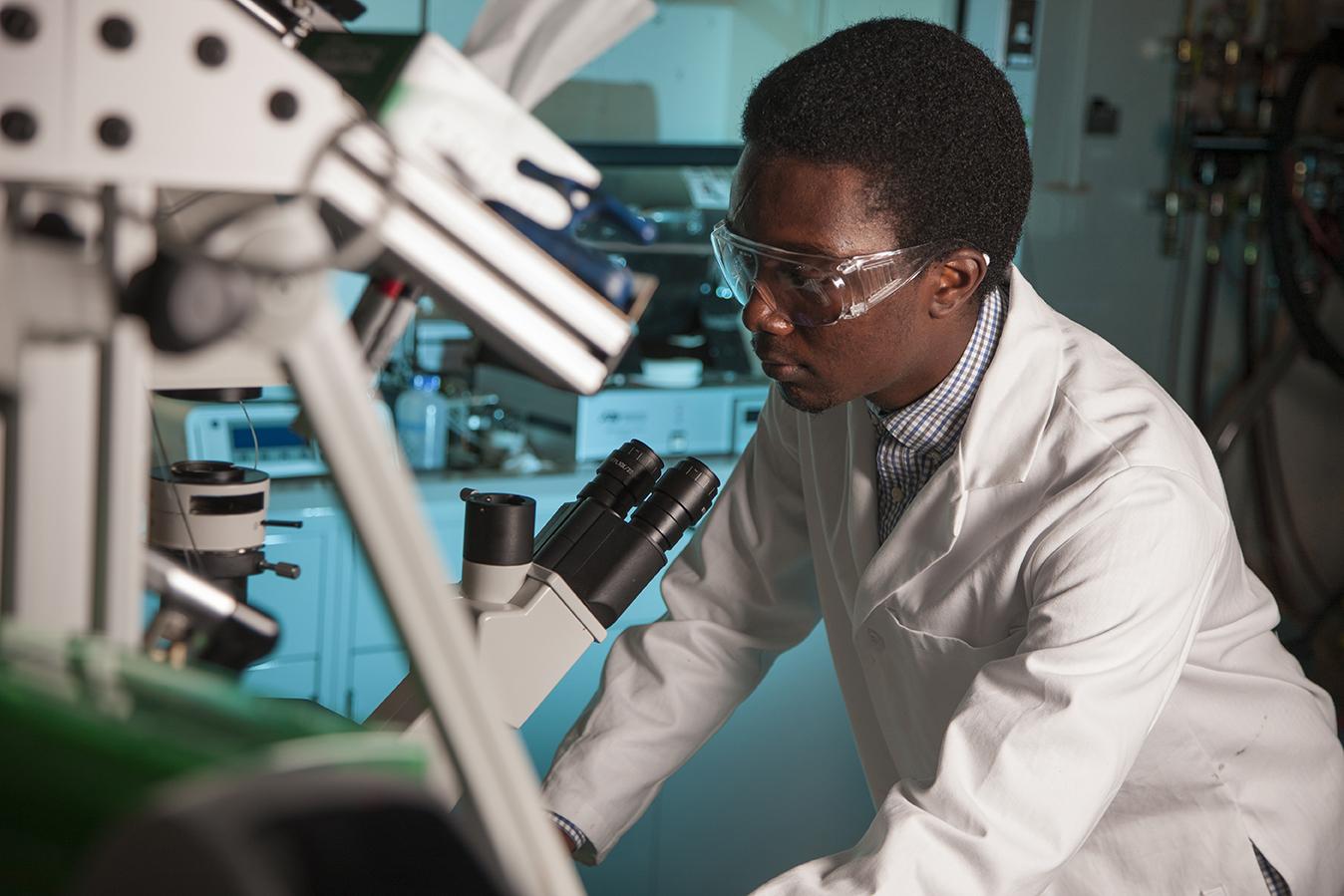
The Advanced Manufacturing Laboratory (AML) is part of the Livermore Valley Open Campus (LVOC)—a 110-acre open and unclassified innovation hub for stimulating collaborative projects with external partners in government, industry, and academia. LVOC is a joint initiative of the National Nuclear Security Administration, LLNL, and Sandia National Laboratories.
Current AML capabilities include:
- Designing high-performance materials, architected materials and structures, devices, components, and assemblies using HPC modeling and simulation
- Developing unique, custom, high-quality feedstocks and nanomaterials
- Inventing and maturing advanced manufacturing processes such as 3D printing

The Center for Bioengineering applies its tools and principles to complex biological systems. Our mission challenge is to enable transformational solutions to counter biological threats and increase national resilience.
Since we know that early biological threat analysis and assessment provide the best bio-engineered materials to provide national security, we have a long history of delivering bioengineering enabled solutions, from the 1980s’ high-speed cell sorter to rapid antibody design in the face of COVID-19.
Current Center for Bioengineering thematic foci include:
- Sensors and devices
- Human organ models
- Artificial intelligence and machine learning for precision medicine
- Biomaterials and biomanufacturing

The Center for Advanced Signal and Image Sciences (CASIS) establishes a forum for signal and image science experts to freely exchange cutting-edge research, methodologies, and technologies.
Signal and image science capabilities at LLNL include:
- Adaptive optics
- Computer vision and video analytics
- CT reconstruction and analysis
- Machine learning and artificial intelligence
- Novel sensing
- Quantum sensing and information processing
- Radiation detection
- Signal and image analysis at the National Ignition Facility (NIF)

The Center for Design and Optimization (CDO) pushes the boundaries of what is possible, leading the design and optimization of complex systems governed by the nonlinear, dynamic, multiphysics, or multiresolution phenomena afforded by LLNL’s advanced manufacturing technologies.
Our primary effort is developing the Livermore design optimization (LiDO) code, which engineers and designers use to optimize multifunctional systems to deliver high-quality design solutions for the nation's challenges. LiDO uses LLNL’s HPC libraries to solve problems with ~109 design variables.
Problems the CDO solves include:
- Shape and topology optimization
- Metamaterial design
Design for additive manufacturing - Reduced order modeling for shape optimization
- Transport optimization

The Center for Engineered Materials and Manufacturing (CEMM) spans multiple laboratories, innovating additive manufacturing (3D printing) techniques to create structural and functional materials with novel capabilities. The center also serves as an incubator, training future additive manufacturing talent.
CEMM capabilities include:
- Extrusion-based additive manufacturing
- Light-based additive manufacturing
- Energy-based additive manufacturing
- Field-based additive manufacturing
- Materials synthesis and processing
- Design and optimization
- Characterization and testing

The Center for Micro and Nanotechnology (CMNT) works with materials, devices, instruments, and systems that require microfabricated components, including microelectromechanical systems, electronics, photonics, micro- and nanostructures, bioimplantable devices, and micro- and nanoactuators. We supply novel national security infrastructure by customizing microelectronics and micro-sensor technologies for unique applications specific to LLNL and the Department of Energy.
Our unique facilities include class 100 cleanrooms, biosafety laboratories, and an accredited biomedical foundry, in addition to extensive supporting laboratory space to help transform ideas into technologies that shape the future.
Capabilities at CMNT include:
- Semiconductor device fabrication, characterization, and testing
- Precision metrology
- High-power electronics
- Bio-microsystems for sensors and medical devices
- Microelectromechanical systems
- Additive biomanufacturing
- RF-photonics
- Photonics spectroscopy
- Nanomaterials
- Quantum information science
- Precision multilayer thin-film optical coatings

The Energy Matter Interaction Tunnel (EMIT) facility houses a cold-flow, open-jet, blowdown wind tunnel to test materials in clean, high enthalpy, high-speed flight environments. Designed for high-throughput and small-scale material response to hypersonic flow, EMIT supports a range of programmatic, fundamental research, and external sponsor needs that require high resolution data for physics-based modeling and simulation.
EMIT capabilities include:
- 2" axisymmetric nozzle with flows up to Mach 5
- Wind tunnel run times extending to 60 seconds, with turnaround times of 30 minutes or less
- 4-way optical diagnostic access
- Diagnostics of both flow and material behavior

Nondestructive characterization aims to understand the internal physical properties of a material, component, or system without causing damage. The Nondestructive Characterization Institute (NCI) advances the fields of non-destructive evaluation and characterization through collaborative research and development applied to real-world national security problems.
NCI's state-of-the-art capabilities include:
- X-ray signatures of homemade explosives
- Evaluating systems to detect radiological and nuclear materials in cargo
- Advanced few-view reconstruction algorithms for tomography
- Acoustic emission and non-linear evaluation of additively manufactured (AM) parts
- Transducer ultrasonic testing
- Laser-based ultrasonics testing of AM parts

Interested in Partnering?
Opportunities for industrial, university, and agency partnerships
Explore what a collaboration with your organization might involve. Fill out the form below to get started.