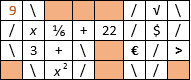
The grid reminds me a bit of ><>, an esoteric programming language where the program pointer moves around on a two-dimensional grid of characters.
In ><>, the two slashes / and \ are reflectors. Think of the program flow 'bouncing' off of them like hitting a wall. Assuming the same initial condition as ><> (starting in the upper-left corner headed right), and that none of the other characters modify the program flow, we get a flow like:
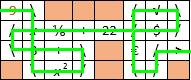
The sequence of 'instructions' we pass through is:
9 x 3 x^2 + 3 x 1/6 + 22 sqrt $ euro
I assume that the different color of the 9 is probably just to indicate that it is the starting point, and that the > indicates that the flow exits to the right.
Interpreting x as times, the first ten characters look like a mathematical expression written as a series of key to enter into a calculator:
$$ 9 \xrightarrow{\times 3} 27 \xrightarrow{x^2} 729 \xrightarrow{+3} 732 \xrightarrow{\times\frac{1}{6}} 122 \xrightarrow{+22} 144 \xrightarrow{\sqrt{x}} 12 $$
The two currency symbols, however, are still a mystery. Presumably they indicate some sort of exchange rate conversion. However, exchange rates are changing constantly and we lack a fixed time to determine a fixed exchange rate. Also, we need (according to Hanko) a five-digit number. Converting from USD to EUR is not a big change, so the integer part will remain two digits; and since both currencies are divided into exactly 100 subunits, that leaves us only two further decimal places, four total out of five.
Personally, If I were you, and believed that:
your life may depend on your completion of this problem
I'd probably just stop working there.



><>... (interpreting/and\as mirrors gives us the sequence9x3x^2+3x1/6+22sqrt$euro) $\endgroup$0-9if there are only five rows in each column? A picture of the punch card would be helpful. $\endgroup$