International Journal of Computer Engineering and Technology (IJCET), ISSN 0976- 6367(Print), ISSN 0976 – 6375(Online) Volume 4, Issue 2, March – April (2013), © IAEME 386 A COMPARISON OF MULTIPLE WAVELET ALGORITHMS FOR IRIS RECOGNITION Sayeesh1 , Dr. Nagaratna P. Hegde 2 1 Asst. Professor, Dept. of CS & E, Alva’s Institute of Engg. & Tech., Shobhavana Campus, Mijar, Moodbidri – 574 225, Karnataka State. 2 Professor, Dept. of CS & E, Vasavi College of Engg., Ibrahimbhag, Hyderabad – 31, Andhra Pradesh. ABSTRACT Personal identification has become the need of modern day life. The identification must be fast, automatic and foolproof. Biometrics has emerged as a strong alternative to identify a person compared to the traditional ways. Also biometric identification can be made fast, automatic and is already foolproof. Among other biometrics, Iris recognition has emerged as a strong way of identifying any person. Iris recognition is one of the newer biometric technologies used for personal identification. It is one of the most reliable and widely used biometric techniques available. In general, a typical iris recognition method includes capturing iris images, testing iris liveness, image segmentation, and image recognition using traditional and statistical methods. Each method has its own strengths and limitations. In this paper, we compare the performance of various wavelets for Iris recognition like complex wavelet transform, Gabor wavelet, and discrete wavelet transform. Keywords- Iris recognition, complex wavelets, Gabor wavelets, discrete wavelet transform. I. INTRODUCTION The demand for security systems is increasing day by day. Rigorous search for different verification and identification techniques is the need of the day. Most traditional methods of security require a person to possess some type of physical possession, such as a key, or to know certain information, such as a password. These techniques are not as secure as organizations may desire. In recent years, the increasing capabilities of computers have allowed more sophisticated and intelligent personal identification methods. Biometric INTERNATIONAL JOURNAL OF COMPUTER ENGINEERING & TECHNOLOGY (IJCET) ISSN 0976 – 6367(Print) ISSN 0976 – 6375(Online) Volume 4, Issue 2, March – April (2013), pp. 386-395 © IAEME: www.iaeme.com/ijcet.asp Journal Impact Factor (2013): 6.1302 (Calculated by GISI) www.jifactor.com IJCET © I A E M E
International Journal of Computer Engineering and Technology (IJCET), ISSN 0976- 6367(Print), ISSN 0976 – 6375(Online) Volume 4, Issue 2, March – April (2013), © IAEME 387 techniques, which use uniquely identifiable physical or behavioral characteristics to identify individuals, are one such method. Commonly used biometric features are the face, fingerprints, voice, DNA, retina, and the iris. Iris recognition is regarded as the most reliable and accurate biometric identification system available. Iris recognition is a biometric-based method of identification. This method has many advantages, such as unique, stability, can be collected, nonaggressive, etc. The iris recognition's error rate is the lowest in most biometric identification method. Now many research organizations at home and abroad spend a lot of time and energy to do research of iris recognition. The human iris is an annular part between the pupil (generally appearing black in image) and white sclera has an extraordinary structure. The iris begins to form in the third month of gestation and structures creating its pattern are largely complete by the eight months, although pigment accretion can continue in the first postnatal years. The word iris is generally used to denote the colored Portion of the eye. It is a complex structure comprising muscle, connective tissues and blood vessels. The image of a human iris thus constitutes a plausible biometric signature for establishing or confirming personal identity. Further properties of the iris that makes it superior to finger prints for automatic identification systems include, among others, the difficulty of surgically modifying its texture without risk, its inherent protection and isolation from the physical environment, and it's easily monitored physiological response to light. Additional technical advantages over fingerprints for automatic recognition systems include the ease of registering the iris optically without physical contact beside the fact that its intrinsic polar geometry does make the process of feature extraction easier. It involves using photographs of a person’s eye(s) to determine the identity of the individual. The iris contains unique features, such as stripes, freckles, coronas, etc., collectively referred to as the texture of the iris. This texture is analyzed and compared to a database of images to obtain a match. The probability of a false match is close to zero, which makes iris recognition a very reliable method of personal identification. This paper discusses performance of different wavelet based algorithm for iris image enhancement, noise reduction, feature extraction, and matching. II. RELATED LITERATURE A biometric system provides the automatic recognition of an individual based on some unique feature or characteristic possessed by the individual. This section describes the overview of the iris recognition system, theoretical background about wavelets, and principles of iris recognition. A. Overview of the Iris Recognition system Image processing techniques can be employed to extract the unique iris pattern from a digitized image of the eye and encode it into the biometric template, which can be stored in database. This biometric template contains an objective mathematical representation of the unique information stored in the iris, and allows the comparisons made between templates. When a person wishes to be identified by an iris recognition system, their eye is first photographed and then template is created for their iris region. This template is then compared with the template stored in a database, until either a matching template is found and a subject is identified, or no match is found and subject remains unidentified. Human iris recognition process is basically divided into four steps.
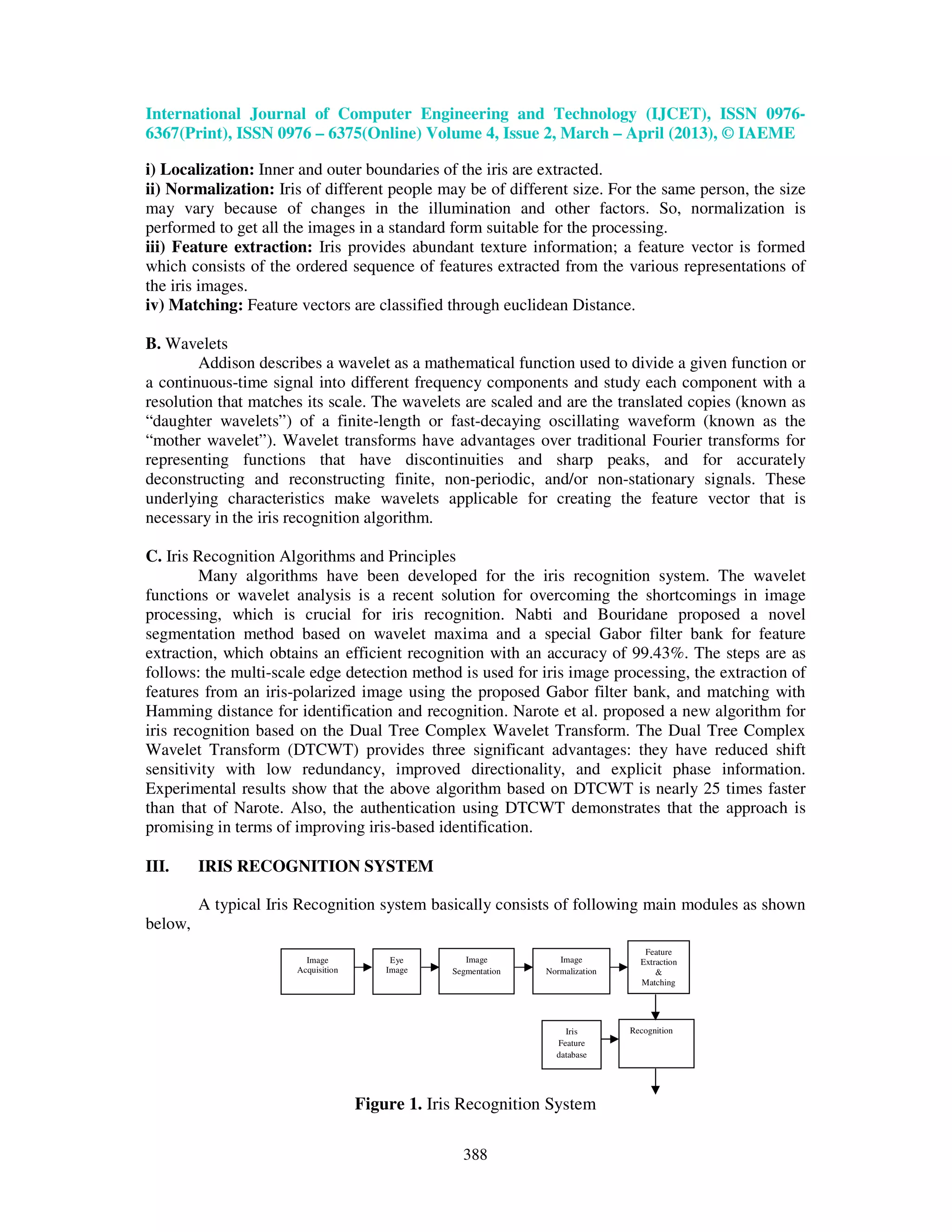
International Journal of Computer Engineering and Technology (IJCET), ISSN 0976- 6367(Print), ISSN 0976 – 6375(Online) Volume 4, Issue 2, March – April (2013), © IAEME 388 i) Localization: Inner and outer boundaries of the iris are extracted. ii) Normalization: Iris of different people may be of different size. For the same person, the size may vary because of changes in the illumination and other factors. So, normalization is performed to get all the images in a standard form suitable for the processing. iii) Feature extraction: Iris provides abundant texture information; a feature vector is formed which consists of the ordered sequence of features extracted from the various representations of the iris images. iv) Matching: Feature vectors are classified through euclidean Distance. B. Wavelets Addison describes a wavelet as a mathematical function used to divide a given function or a continuous-time signal into different frequency components and study each component with a resolution that matches its scale. The wavelets are scaled and are the translated copies (known as “daughter wavelets”) of a finite-length or fast-decaying oscillating waveform (known as the “mother wavelet”). Wavelet transforms have advantages over traditional Fourier transforms for representing functions that have discontinuities and sharp peaks, and for accurately deconstructing and reconstructing finite, non-periodic, and/or non-stationary signals. These underlying characteristics make wavelets applicable for creating the feature vector that is necessary in the iris recognition algorithm. C. Iris Recognition Algorithms and Principles Many algorithms have been developed for the iris recognition system. The wavelet functions or wavelet analysis is a recent solution for overcoming the shortcomings in image processing, which is crucial for iris recognition. Nabti and Bouridane proposed a novel segmentation method based on wavelet maxima and a special Gabor filter bank for feature extraction, which obtains an efficient recognition with an accuracy of 99.43%. The steps are as follows: the multi-scale edge detection method is used for iris image processing, the extraction of features from an iris-polarized image using the proposed Gabor filter bank, and matching with Hamming distance for identification and recognition. Narote et al. proposed a new algorithm for iris recognition based on the Dual Tree Complex Wavelet Transform. The Dual Tree Complex Wavelet Transform (DTCWT) provides three significant advantages: they have reduced shift sensitivity with low redundancy, improved directionality, and explicit phase information. Experimental results show that the above algorithm based on DTCWT is nearly 25 times faster than that of Narote. Also, the authentication using DTCWT demonstrates that the approach is promising in terms of improving iris-based identification. III. IRIS RECOGNITION SYSTEM A typical Iris Recognition system basically consists of following main modules as shown below, Figure 1. Iris Recognition System Image Acquisition Eye Image Image Segmentation Image Normalization Feature Extraction & Matching Iris Feature database Recognition
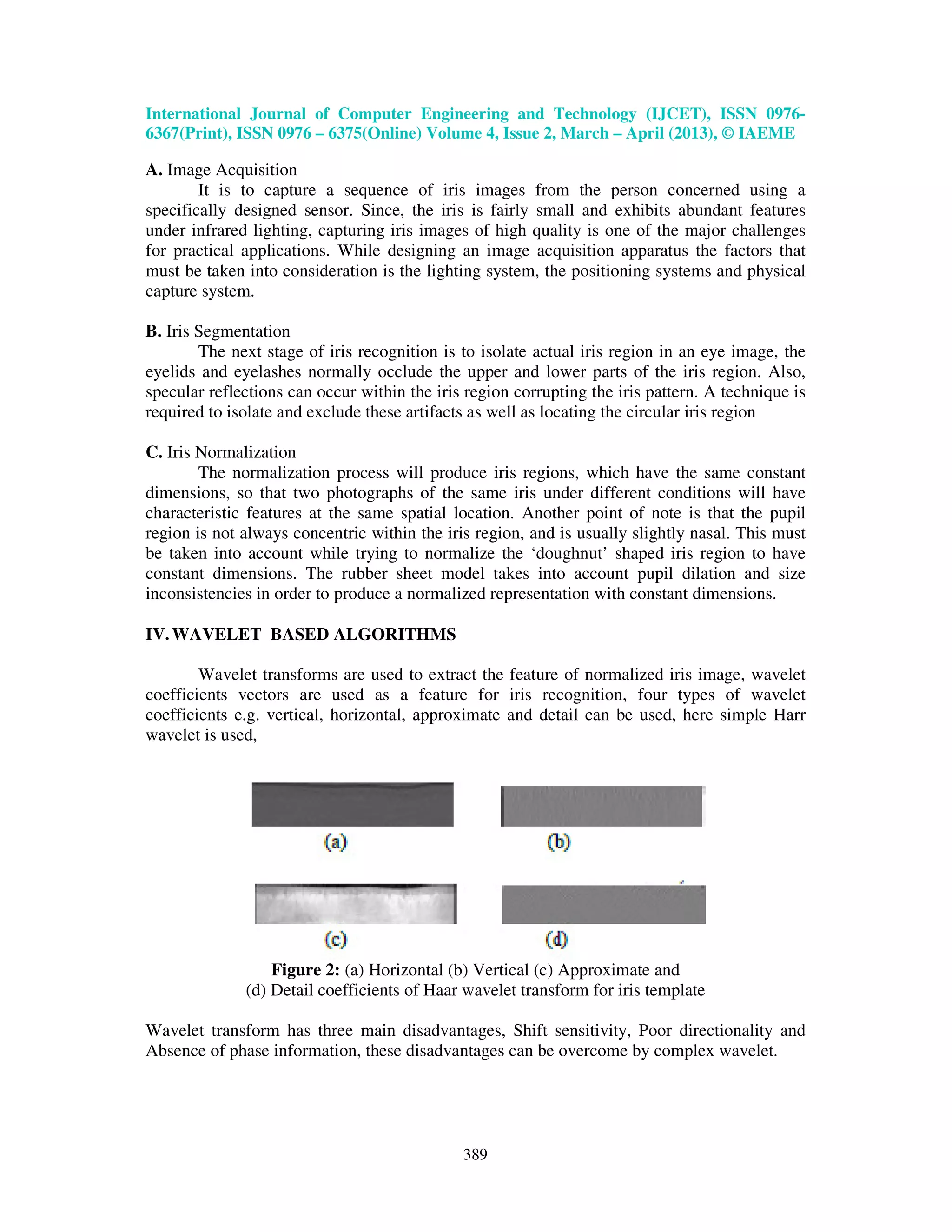
International Journal of Computer Engineering and Technology (IJCET), ISSN 0976- 6367(Print), ISSN 0976 – 6375(Online) Volume 4, Issue 2, March – April (2013), © IAEME 389 A. Image Acquisition It is to capture a sequence of iris images from the person concerned using a specifically designed sensor. Since, the iris is fairly small and exhibits abundant features under infrared lighting, capturing iris images of high quality is one of the major challenges for practical applications. While designing an image acquisition apparatus the factors that must be taken into consideration is the lighting system, the positioning systems and physical capture system. B. Iris Segmentation The next stage of iris recognition is to isolate actual iris region in an eye image, the eyelids and eyelashes normally occlude the upper and lower parts of the iris region. Also, specular reflections can occur within the iris region corrupting the iris pattern. A technique is required to isolate and exclude these artifacts as well as locating the circular iris region C. Iris Normalization The normalization process will produce iris regions, which have the same constant dimensions, so that two photographs of the same iris under different conditions will have characteristic features at the same spatial location. Another point of note is that the pupil region is not always concentric within the iris region, and is usually slightly nasal. This must be taken into account while trying to normalize the ‘doughnut’ shaped iris region to have constant dimensions. The rubber sheet model takes into account pupil dilation and size inconsistencies in order to produce a normalized representation with constant dimensions. IV.WAVELET BASED ALGORITHMS Wavelet transforms are used to extract the feature of normalized iris image, wavelet coefficients vectors are used as a feature for iris recognition, four types of wavelet coefficients e.g. vertical, horizontal, approximate and detail can be used, here simple Harr wavelet is used, Figure 2: (a) Horizontal (b) Vertical (c) Approximate and (d) Detail coefficients of Haar wavelet transform for iris template Wavelet transform has three main disadvantages, Shift sensitivity, Poor directionality and Absence of phase information, these disadvantages can be overcome by complex wavelet.
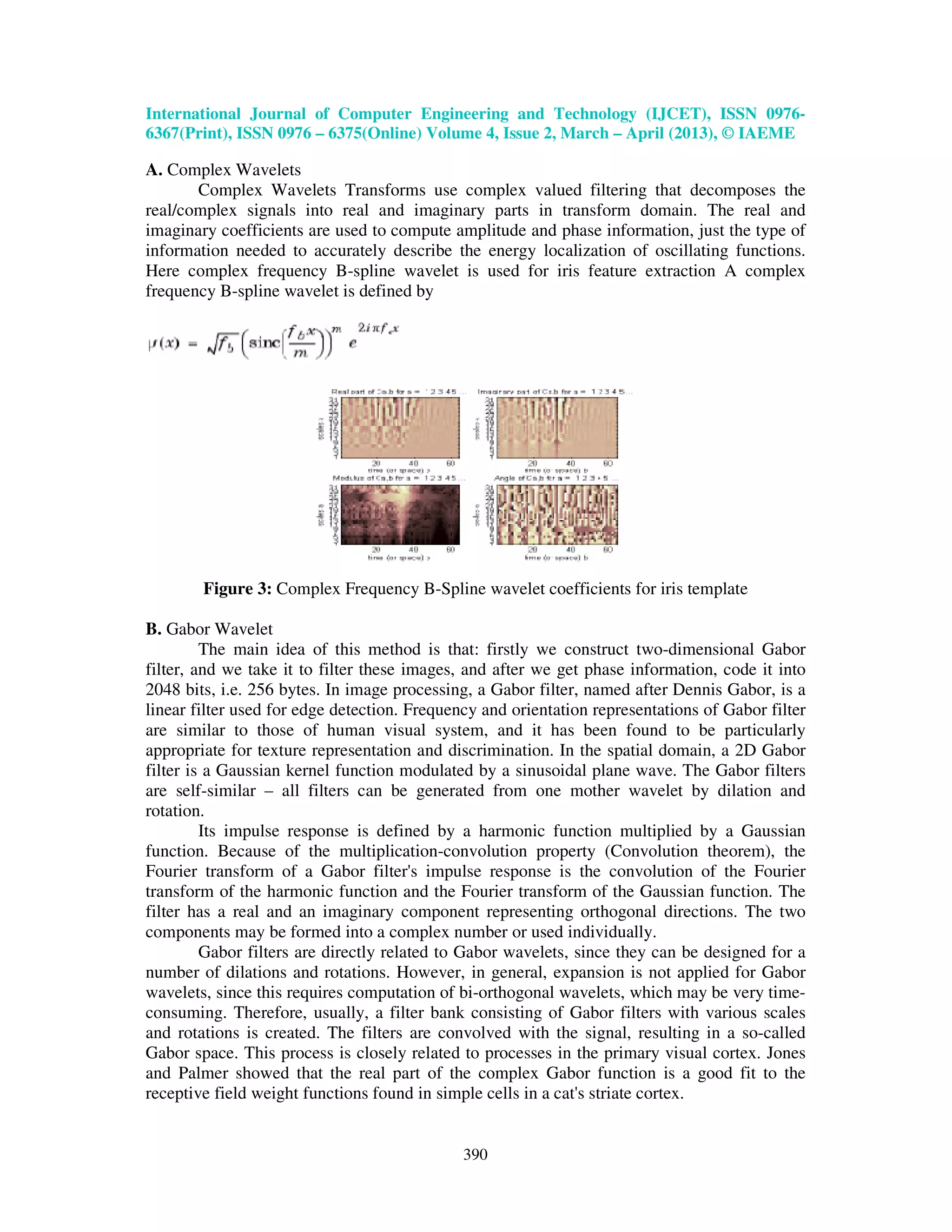
International Journal of Computer Engineering and Technology (IJCET), ISSN 0976- 6367(Print), ISSN 0976 – 6375(Online) Volume 4, Issue 2, March – April (2013), © IAEME 390 A. Complex Wavelets Complex Wavelets Transforms use complex valued filtering that decomposes the real/complex signals into real and imaginary parts in transform domain. The real and imaginary coefficients are used to compute amplitude and phase information, just the type of information needed to accurately describe the energy localization of oscillating functions. Here complex frequency B-spline wavelet is used for iris feature extraction A complex frequency B-spline wavelet is defined by Figure 3: Complex Frequency B-Spline wavelet coefficients for iris template B. Gabor Wavelet The main idea of this method is that: firstly we construct two-dimensional Gabor filter, and we take it to filter these images, and after we get phase information, code it into 2048 bits, i.e. 256 bytes. In image processing, a Gabor filter, named after Dennis Gabor, is a linear filter used for edge detection. Frequency and orientation representations of Gabor filter are similar to those of human visual system, and it has been found to be particularly appropriate for texture representation and discrimination. In the spatial domain, a 2D Gabor filter is a Gaussian kernel function modulated by a sinusoidal plane wave. The Gabor filters are self-similar – all filters can be generated from one mother wavelet by dilation and rotation. Its impulse response is defined by a harmonic function multiplied by a Gaussian function. Because of the multiplication-convolution property (Convolution theorem), the Fourier transform of a Gabor filter's impulse response is the convolution of the Fourier transform of the harmonic function and the Fourier transform of the Gaussian function. The filter has a real and an imaginary component representing orthogonal directions. The two components may be formed into a complex number or used individually. Gabor filters are directly related to Gabor wavelets, since they can be designed for a number of dilations and rotations. However, in general, expansion is not applied for Gabor wavelets, since this requires computation of bi-orthogonal wavelets, which may be very time- consuming. Therefore, usually, a filter bank consisting of Gabor filters with various scales and rotations is created. The filters are convolved with the signal, resulting in a so-called Gabor space. This process is closely related to processes in the primary visual cortex. Jones and Palmer showed that the real part of the complex Gabor function is a good fit to the receptive field weight functions found in simple cells in a cat's striate cortex.
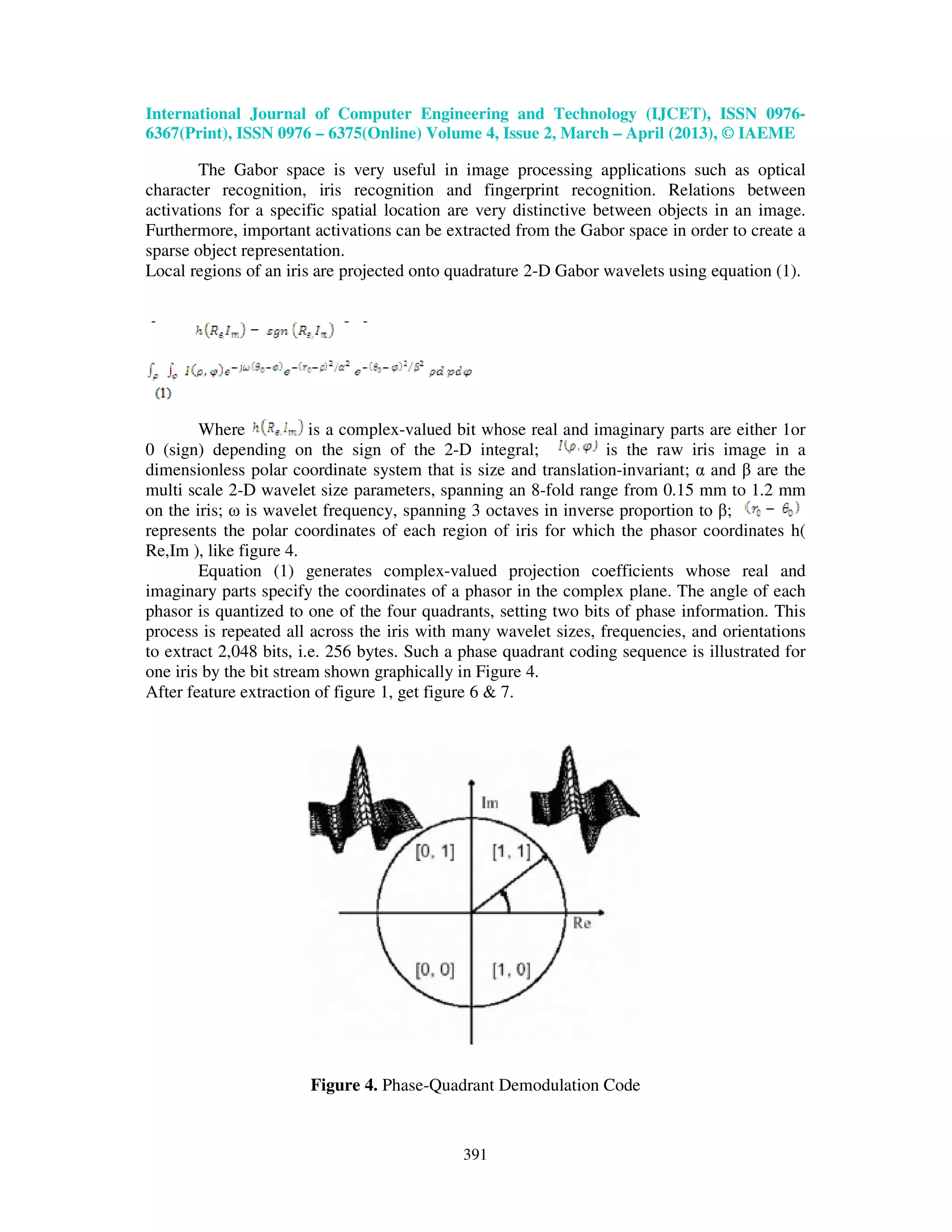
International Journal of Computer Engineering and Technology (IJCET), ISSN 0976- 6367(Print), ISSN 0976 – 6375(Online) Volume 4, Issue 2, March – April (2013), © IAEME 391 The Gabor space is very useful in image processing applications such as optical character recognition, iris recognition and fingerprint recognition. Relations between activations for a specific spatial location are very distinctive between objects in an image. Furthermore, important activations can be extracted from the Gabor space in order to create a sparse object representation. Local regions of an iris are projected onto quadrature 2-D Gabor wavelets using equation (1). Where is a complex-valued bit whose real and imaginary parts are either 1or 0 (sign) depending on the sign of the 2-D integral; is the raw iris image in a dimensionless polar coordinate system that is size and translation-invariant; α and β are the multi scale 2-D wavelet size parameters, spanning an 8-fold range from 0.15 mm to 1.2 mm on the iris; ω is wavelet frequency, spanning 3 octaves in inverse proportion to β; represents the polar coordinates of each region of iris for which the phasor coordinates h( Re,Im ), like figure 4. Equation (1) generates complex-valued projection coefficients whose real and imaginary parts specify the coordinates of a phasor in the complex plane. The angle of each phasor is quantized to one of the four quadrants, setting two bits of phase information. This process is repeated all across the iris with many wavelet sizes, frequencies, and orientations to extract 2,048 bits, i.e. 256 bytes. Such a phase quadrant coding sequence is illustrated for one iris by the bit stream shown graphically in Figure 4. After feature extraction of figure 1, get figure 6 & 7. Figure 4. Phase-Quadrant Demodulation Code
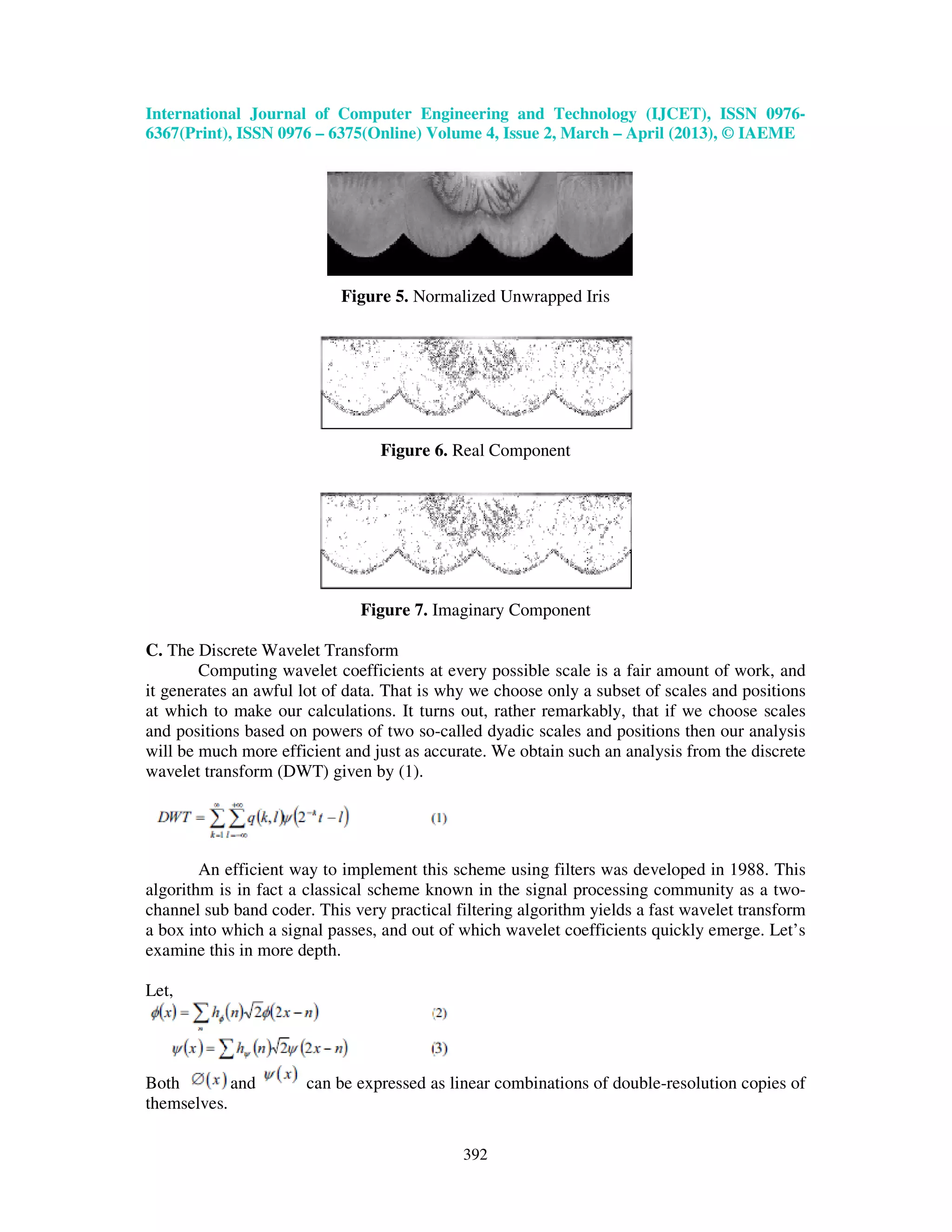
International Journal of Computer Engineering and Technology (IJCET), ISSN 0976- 6367(Print), ISSN 0976 – 6375(Online) Volume 4, Issue 2, March – April (2013), © IAEME 392 Figure 5. Normalized Unwrapped Iris Figure 6. Real Component Figure 7. Imaginary Component C. The Discrete Wavelet Transform Computing wavelet coefficients at every possible scale is a fair amount of work, and it generates an awful lot of data. That is why we choose only a subset of scales and positions at which to make our calculations. It turns out, rather remarkably, that if we choose scales and positions based on powers of two so-called dyadic scales and positions then our analysis will be much more efficient and just as accurate. We obtain such an analysis from the discrete wavelet transform (DWT) given by (1). An efficient way to implement this scheme using filters was developed in 1988. This algorithm is in fact a classical scheme known in the signal processing community as a two- channel sub band coder. This very practical filtering algorithm yields a fast wavelet transform a box into which a signal passes, and out of which wavelet coefficients quickly emerge. Let’s examine this in more depth. Let, Both and can be expressed as linear combinations of double-resolution copies of themselves.
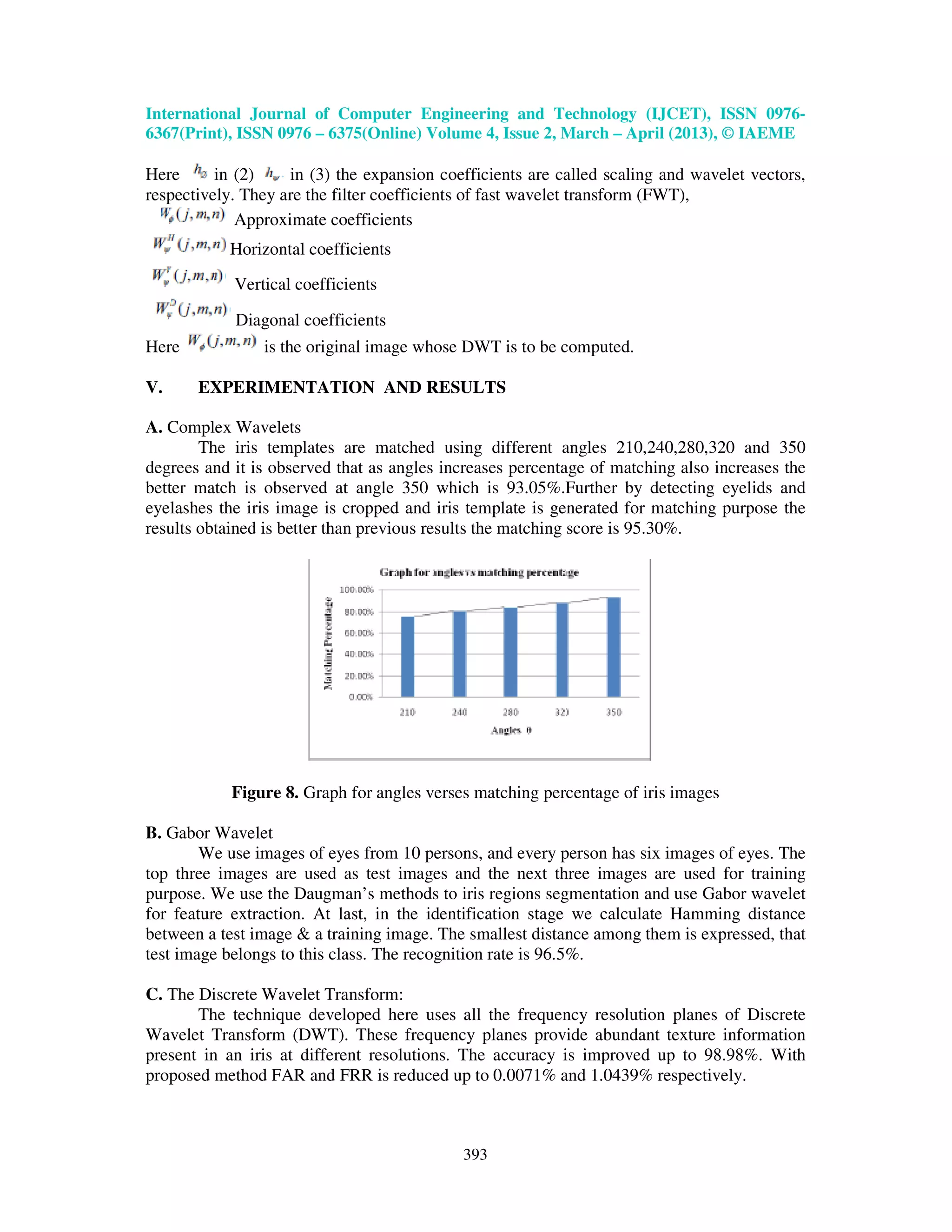
International Journal of Computer Engineering and Technology (IJCET), ISSN 0976- 6367(Print), ISSN 0976 – 6375(Online) Volume 4, Issue 2, March – April (2013), © IAEME 393 Here in (2) in (3) the expansion coefficients are called scaling and wavelet vectors, respectively. They are the filter coefficients of fast wavelet transform (FWT), Approximate coefficients Horizontal coefficients Vertical coefficients Diagonal coefficients Here is the original image whose DWT is to be computed. V. EXPERIMENTATION AND RESULTS A. Complex Wavelets The iris templates are matched using different angles 210,240,280,320 and 350 degrees and it is observed that as angles increases percentage of matching also increases the better match is observed at angle 350 which is 93.05%.Further by detecting eyelids and eyelashes the iris image is cropped and iris template is generated for matching purpose the results obtained is better than previous results the matching score is 95.30%. Figure 8. Graph for angles verses matching percentage of iris images B. Gabor Wavelet We use images of eyes from 10 persons, and every person has six images of eyes. The top three images are used as test images and the next three images are used for training purpose. We use the Daugman’s methods to iris regions segmentation and use Gabor wavelet for feature extraction. At last, in the identification stage we calculate Hamming distance between a test image & a training image. The smallest distance among them is expressed, that test image belongs to this class. The recognition rate is 96.5%. C. The Discrete Wavelet Transform: The technique developed here uses all the frequency resolution planes of Discrete Wavelet Transform (DWT). These frequency planes provide abundant texture information present in an iris at different resolutions. The accuracy is improved up to 98.98%. With proposed method FAR and FRR is reduced up to 0.0071% and 1.0439% respectively.
International Journal of Computer Engineering and Technology (IJCET), ISSN 0976- 6367(Print), ISSN 0976 – 6375(Online) Volume 4, Issue 2, March – April (2013), © IAEME 394 VI. CONCLUSION In this paper, we compare the performance of various wavelets for Iris recognition like complex wavelet transform, Gabor wavelet, and discrete wavelet transform. Using complex wavelet, different coefficient vectors are calculated. Minimum distance classifier was used for final matching. The smaller the distance the more the images matched. It is observed that for the complex wavelets the results obtain are good than the simple wavelet because in complex wavelet we get both phase and angle also real and imaginary coefficients, so we can compare all these parameters for iris matching purpose.2D Gabor wavelets have the highest recognition rate. Because iris is rotator, and 2D Gabor wavelets have rotation invariance, it has the highest recognition rate. But 2D Gabor wavelets have high computational complexity, and need more time. Discrete wavelet transform used for iris signature formation gives better and reliable results. REFERENCES [1] Biometrics: Personal Identification in a Networked Society, A. Jain, R. Bolle and S. Pankanti, eds. Kluwer, 1999. [2] D. Zhang, Automated Biometrics: Technologies and Systems. Kluwer, 2000 [3] Anil Jain. Introduction to Biometrics. Michigan State University, East Lansing, MI. [4] L. Ma, T, Yunhong Wang, and D. Zhang. Personal identification based on iris texture analysis. IEEE Transactions on Pattern Analysis and Machine Intelligence, vol.25, no.12, 2003 [5] John Daugman. Recognizing persons by their iris patterns. Cambridge University, Cambridge, UK. [6] J. Daugman, “Demodulation by Complex-Valued Wavelets for Stochastic Pattern Recognition,” Int’l J. Wavelets, Multiresolution and Information Processing, vol. 1, no. 1, pp. 1-17, 2003 [7] W. Boles and B. Boashash, “A Human Identification Technique Using Images of the Iris and Wavelet Transform,” IEEE Trans. Signal Processing, vol. 46, no. 4, pp. 1185- 1188, 1998 [8] R. Wildes, J. Asmuth, G. Green, S. Hsu, R. Kolczynski, J. Matey, and S. McBride, “A Machine-Vision System for Iris Recognition,” Machine Vision and Applications, vol. 9, pp. 1-8, 1996 [9] S. Lim, K. Lee, O. Byeon, and T. Kim, “Efficient Iris Recognition through Improvement of Feature Vector and Classifier,” ETRI J., vol. 23, no. 2, pp. 61-70, 2001 [10] L. Ma, Y. Wang, and T. Tan, “Iris Recognition Based on Multichannel Gabor Filtering,” Proc. Fifth Asian Conf. Computer Vision, vol. I, pp. 279-283, 2002 [11] C. Tisse, L. Martin, L. Torres, and M. Robert, “Person Identification Technique Using Human Iris Recognition” Proc. Vision Interface, pp. 294-299, 2002 [12] J. Daugman, “How Iris Recognition Works,” IEEE Transaction on Circuits and System for Video Technology, vol. 14, no. 1,pp. 21–30, 2004. [13] J. Daugman,” High Confidence Visual Recognition of Persons by a Test of Statistical Independence,” IEEE Transactions on Pattern Analysis and Machine Intelligence, vol. 15, no. 11, pp. 1148–1161, 1993.
International Journal of Computer Engineering and Technology (IJCET), ISSN 0976- 6367(Print), ISSN 0976 – 6375(Online) Volume 4, Issue 2, March – April (2013), © IAEME 395 [14] L.Ma, T. Tan, Y. Wang and D. Zhang,” Efficient Iris Recognition by Characterizing Key Local Variations,” IEEE Transactions on Image Processing, vol. 13, no. 6, pp. 739–750, 2004. [15] K. Miyazawa, K. Ito, T. Aoki, K. Kobayashi, and H. Nakajima, “An efficient iris recognition algorithm using phase-based image matching,” Proc. Int. IEEE Conf. on Image Processing, Vol. II, pp. 49–52, Sept. 2005. [16] Panchamkumar D Shukla,”Complex Wavelet Transforms and their applications” an M.Phil Thesis, University of Stratchlyde, Signal Processing Division, 2003. [17] S. Lim, K. Lee, O. Byeon, and T. Kim, “Efficient Iris Recognition through Improvement of Feature Vector and Classifier”, ETRI Journal, Vol.23, No.2, June, 2001. [18] J. Daugman, “High Confidence Visual Recognition of Persons by a Test of Statistical Independence”. IEEE Transl. on Pattern Analysis and Machine Intelligence, Vol.15, issue 11, 1993. [19] Makram Nabti and Bouridane, “An effective iris recognition system based on wavelet maxima and Gabor filter bank”, IEEE trans. on iris recognition, 2007. [20] Narote et al. “An iris recognition based on dual tree complex wavelet transform”. IEEE trans. on iris recognition, 2007. [21] Institute of Automation Chinese Academy of Sciences. Database of CASIA iris image [EB/OL] [22] L. Masek, “Recognition of Human Iris Patterns for Biometric Identification”, The University of Western California, 2003. [23] N. G. Kingsbury, “Image processing with complex wavelets,” Philos.Trans. R. Soc. London A, Math. Phys. Sci, vol. 357, no. 3, pp. 2543–2560, 1999. [24] Vijay M.Mane, GauravV. Chalkikar and Milind E. Rane, “Multiscale Iris Recognition System”, International journal of Electronics and Communication Engineering & Technology (IJECET), Volume 3, Issue 1, 2012, pp. 317 - 324, ISSN Print: 0976- 6464, ISSN Online: 0976 –6472. [25] Darshana Mistry and Asim Banerjee, “Discrete Wavelet Transform using Matlab”, International journal of Computer Engineering & Technology (IJCET), Volume 4, Issue 2, 2012, pp. 252 - 259, ISSN Print: 0976 – 6367, ISSN Online: 0976 – 6375.

A comparison of multiple wavelet algorithms for iris recognition 2

  • 1.
    International Journal ofComputer Engineering and Technology (IJCET), ISSN 0976- 6367(Print), ISSN 0976 – 6375(Online) Volume 4, Issue 2, March – April (2013), © IAEME 386 A COMPARISON OF MULTIPLE WAVELET ALGORITHMS FOR IRIS RECOGNITION Sayeesh1 , Dr. Nagaratna P. Hegde 2 1 Asst. Professor, Dept. of CS & E, Alva’s Institute of Engg. & Tech., Shobhavana Campus, Mijar, Moodbidri – 574 225, Karnataka State. 2 Professor, Dept. of CS & E, Vasavi College of Engg., Ibrahimbhag, Hyderabad – 31, Andhra Pradesh. ABSTRACT Personal identification has become the need of modern day life. The identification must be fast, automatic and foolproof. Biometrics has emerged as a strong alternative to identify a person compared to the traditional ways. Also biometric identification can be made fast, automatic and is already foolproof. Among other biometrics, Iris recognition has emerged as a strong way of identifying any person. Iris recognition is one of the newer biometric technologies used for personal identification. It is one of the most reliable and widely used biometric techniques available. In general, a typical iris recognition method includes capturing iris images, testing iris liveness, image segmentation, and image recognition using traditional and statistical methods. Each method has its own strengths and limitations. In this paper, we compare the performance of various wavelets for Iris recognition like complex wavelet transform, Gabor wavelet, and discrete wavelet transform. Keywords- Iris recognition, complex wavelets, Gabor wavelets, discrete wavelet transform. I. INTRODUCTION The demand for security systems is increasing day by day. Rigorous search for different verification and identification techniques is the need of the day. Most traditional methods of security require a person to possess some type of physical possession, such as a key, or to know certain information, such as a password. These techniques are not as secure as organizations may desire. In recent years, the increasing capabilities of computers have allowed more sophisticated and intelligent personal identification methods. Biometric INTERNATIONAL JOURNAL OF COMPUTER ENGINEERING & TECHNOLOGY (IJCET) ISSN 0976 – 6367(Print) ISSN 0976 – 6375(Online) Volume 4, Issue 2, March – April (2013), pp. 386-395 © IAEME: www.iaeme.com/ijcet.asp Journal Impact Factor (2013): 6.1302 (Calculated by GISI) www.jifactor.com IJCET © I A E M E
  • 2.
    International Journal ofComputer Engineering and Technology (IJCET), ISSN 0976- 6367(Print), ISSN 0976 – 6375(Online) Volume 4, Issue 2, March – April (2013), © IAEME 387 techniques, which use uniquely identifiable physical or behavioral characteristics to identify individuals, are one such method. Commonly used biometric features are the face, fingerprints, voice, DNA, retina, and the iris. Iris recognition is regarded as the most reliable and accurate biometric identification system available. Iris recognition is a biometric-based method of identification. This method has many advantages, such as unique, stability, can be collected, nonaggressive, etc. The iris recognition's error rate is the lowest in most biometric identification method. Now many research organizations at home and abroad spend a lot of time and energy to do research of iris recognition. The human iris is an annular part between the pupil (generally appearing black in image) and white sclera has an extraordinary structure. The iris begins to form in the third month of gestation and structures creating its pattern are largely complete by the eight months, although pigment accretion can continue in the first postnatal years. The word iris is generally used to denote the colored Portion of the eye. It is a complex structure comprising muscle, connective tissues and blood vessels. The image of a human iris thus constitutes a plausible biometric signature for establishing or confirming personal identity. Further properties of the iris that makes it superior to finger prints for automatic identification systems include, among others, the difficulty of surgically modifying its texture without risk, its inherent protection and isolation from the physical environment, and it's easily monitored physiological response to light. Additional technical advantages over fingerprints for automatic recognition systems include the ease of registering the iris optically without physical contact beside the fact that its intrinsic polar geometry does make the process of feature extraction easier. It involves using photographs of a person’s eye(s) to determine the identity of the individual. The iris contains unique features, such as stripes, freckles, coronas, etc., collectively referred to as the texture of the iris. This texture is analyzed and compared to a database of images to obtain a match. The probability of a false match is close to zero, which makes iris recognition a very reliable method of personal identification. This paper discusses performance of different wavelet based algorithm for iris image enhancement, noise reduction, feature extraction, and matching. II. RELATED LITERATURE A biometric system provides the automatic recognition of an individual based on some unique feature or characteristic possessed by the individual. This section describes the overview of the iris recognition system, theoretical background about wavelets, and principles of iris recognition. A. Overview of the Iris Recognition system Image processing techniques can be employed to extract the unique iris pattern from a digitized image of the eye and encode it into the biometric template, which can be stored in database. This biometric template contains an objective mathematical representation of the unique information stored in the iris, and allows the comparisons made between templates. When a person wishes to be identified by an iris recognition system, their eye is first photographed and then template is created for their iris region. This template is then compared with the template stored in a database, until either a matching template is found and a subject is identified, or no match is found and subject remains unidentified. Human iris recognition process is basically divided into four steps.
  • 3.
    International Journal ofComputer Engineering and Technology (IJCET), ISSN 0976- 6367(Print), ISSN 0976 – 6375(Online) Volume 4, Issue 2, March – April (2013), © IAEME 388 i) Localization: Inner and outer boundaries of the iris are extracted. ii) Normalization: Iris of different people may be of different size. For the same person, the size may vary because of changes in the illumination and other factors. So, normalization is performed to get all the images in a standard form suitable for the processing. iii) Feature extraction: Iris provides abundant texture information; a feature vector is formed which consists of the ordered sequence of features extracted from the various representations of the iris images. iv) Matching: Feature vectors are classified through euclidean Distance. B. Wavelets Addison describes a wavelet as a mathematical function used to divide a given function or a continuous-time signal into different frequency components and study each component with a resolution that matches its scale. The wavelets are scaled and are the translated copies (known as “daughter wavelets”) of a finite-length or fast-decaying oscillating waveform (known as the “mother wavelet”). Wavelet transforms have advantages over traditional Fourier transforms for representing functions that have discontinuities and sharp peaks, and for accurately deconstructing and reconstructing finite, non-periodic, and/or non-stationary signals. These underlying characteristics make wavelets applicable for creating the feature vector that is necessary in the iris recognition algorithm. C. Iris Recognition Algorithms and Principles Many algorithms have been developed for the iris recognition system. The wavelet functions or wavelet analysis is a recent solution for overcoming the shortcomings in image processing, which is crucial for iris recognition. Nabti and Bouridane proposed a novel segmentation method based on wavelet maxima and a special Gabor filter bank for feature extraction, which obtains an efficient recognition with an accuracy of 99.43%. The steps are as follows: the multi-scale edge detection method is used for iris image processing, the extraction of features from an iris-polarized image using the proposed Gabor filter bank, and matching with Hamming distance for identification and recognition. Narote et al. proposed a new algorithm for iris recognition based on the Dual Tree Complex Wavelet Transform. The Dual Tree Complex Wavelet Transform (DTCWT) provides three significant advantages: they have reduced shift sensitivity with low redundancy, improved directionality, and explicit phase information. Experimental results show that the above algorithm based on DTCWT is nearly 25 times faster than that of Narote. Also, the authentication using DTCWT demonstrates that the approach is promising in terms of improving iris-based identification. III. IRIS RECOGNITION SYSTEM A typical Iris Recognition system basically consists of following main modules as shown below, Figure 1. Iris Recognition System Image Acquisition Eye Image Image Segmentation Image Normalization Feature Extraction & Matching Iris Feature database Recognition
  • 4.
    International Journal ofComputer Engineering and Technology (IJCET), ISSN 0976- 6367(Print), ISSN 0976 – 6375(Online) Volume 4, Issue 2, March – April (2013), © IAEME 389 A. Image Acquisition It is to capture a sequence of iris images from the person concerned using a specifically designed sensor. Since, the iris is fairly small and exhibits abundant features under infrared lighting, capturing iris images of high quality is one of the major challenges for practical applications. While designing an image acquisition apparatus the factors that must be taken into consideration is the lighting system, the positioning systems and physical capture system. B. Iris Segmentation The next stage of iris recognition is to isolate actual iris region in an eye image, the eyelids and eyelashes normally occlude the upper and lower parts of the iris region. Also, specular reflections can occur within the iris region corrupting the iris pattern. A technique is required to isolate and exclude these artifacts as well as locating the circular iris region C. Iris Normalization The normalization process will produce iris regions, which have the same constant dimensions, so that two photographs of the same iris under different conditions will have characteristic features at the same spatial location. Another point of note is that the pupil region is not always concentric within the iris region, and is usually slightly nasal. This must be taken into account while trying to normalize the ‘doughnut’ shaped iris region to have constant dimensions. The rubber sheet model takes into account pupil dilation and size inconsistencies in order to produce a normalized representation with constant dimensions. IV.WAVELET BASED ALGORITHMS Wavelet transforms are used to extract the feature of normalized iris image, wavelet coefficients vectors are used as a feature for iris recognition, four types of wavelet coefficients e.g. vertical, horizontal, approximate and detail can be used, here simple Harr wavelet is used, Figure 2: (a) Horizontal (b) Vertical (c) Approximate and (d) Detail coefficients of Haar wavelet transform for iris template Wavelet transform has three main disadvantages, Shift sensitivity, Poor directionality and Absence of phase information, these disadvantages can be overcome by complex wavelet.
  • 5.
    International Journal ofComputer Engineering and Technology (IJCET), ISSN 0976- 6367(Print), ISSN 0976 – 6375(Online) Volume 4, Issue 2, March – April (2013), © IAEME 390 A. Complex Wavelets Complex Wavelets Transforms use complex valued filtering that decomposes the real/complex signals into real and imaginary parts in transform domain. The real and imaginary coefficients are used to compute amplitude and phase information, just the type of information needed to accurately describe the energy localization of oscillating functions. Here complex frequency B-spline wavelet is used for iris feature extraction A complex frequency B-spline wavelet is defined by Figure 3: Complex Frequency B-Spline wavelet coefficients for iris template B. Gabor Wavelet The main idea of this method is that: firstly we construct two-dimensional Gabor filter, and we take it to filter these images, and after we get phase information, code it into 2048 bits, i.e. 256 bytes. In image processing, a Gabor filter, named after Dennis Gabor, is a linear filter used for edge detection. Frequency and orientation representations of Gabor filter are similar to those of human visual system, and it has been found to be particularly appropriate for texture representation and discrimination. In the spatial domain, a 2D Gabor filter is a Gaussian kernel function modulated by a sinusoidal plane wave. The Gabor filters are self-similar – all filters can be generated from one mother wavelet by dilation and rotation. Its impulse response is defined by a harmonic function multiplied by a Gaussian function. Because of the multiplication-convolution property (Convolution theorem), the Fourier transform of a Gabor filter's impulse response is the convolution of the Fourier transform of the harmonic function and the Fourier transform of the Gaussian function. The filter has a real and an imaginary component representing orthogonal directions. The two components may be formed into a complex number or used individually. Gabor filters are directly related to Gabor wavelets, since they can be designed for a number of dilations and rotations. However, in general, expansion is not applied for Gabor wavelets, since this requires computation of bi-orthogonal wavelets, which may be very time- consuming. Therefore, usually, a filter bank consisting of Gabor filters with various scales and rotations is created. The filters are convolved with the signal, resulting in a so-called Gabor space. This process is closely related to processes in the primary visual cortex. Jones and Palmer showed that the real part of the complex Gabor function is a good fit to the receptive field weight functions found in simple cells in a cat's striate cortex.
  • 6.
    International Journal ofComputer Engineering and Technology (IJCET), ISSN 0976- 6367(Print), ISSN 0976 – 6375(Online) Volume 4, Issue 2, March – April (2013), © IAEME 391 The Gabor space is very useful in image processing applications such as optical character recognition, iris recognition and fingerprint recognition. Relations between activations for a specific spatial location are very distinctive between objects in an image. Furthermore, important activations can be extracted from the Gabor space in order to create a sparse object representation. Local regions of an iris are projected onto quadrature 2-D Gabor wavelets using equation (1). Where is a complex-valued bit whose real and imaginary parts are either 1or 0 (sign) depending on the sign of the 2-D integral; is the raw iris image in a dimensionless polar coordinate system that is size and translation-invariant; α and β are the multi scale 2-D wavelet size parameters, spanning an 8-fold range from 0.15 mm to 1.2 mm on the iris; ω is wavelet frequency, spanning 3 octaves in inverse proportion to β; represents the polar coordinates of each region of iris for which the phasor coordinates h( Re,Im ), like figure 4. Equation (1) generates complex-valued projection coefficients whose real and imaginary parts specify the coordinates of a phasor in the complex plane. The angle of each phasor is quantized to one of the four quadrants, setting two bits of phase information. This process is repeated all across the iris with many wavelet sizes, frequencies, and orientations to extract 2,048 bits, i.e. 256 bytes. Such a phase quadrant coding sequence is illustrated for one iris by the bit stream shown graphically in Figure 4. After feature extraction of figure 1, get figure 6 & 7. Figure 4. Phase-Quadrant Demodulation Code
  • 7.
    International Journal ofComputer Engineering and Technology (IJCET), ISSN 0976- 6367(Print), ISSN 0976 – 6375(Online) Volume 4, Issue 2, March – April (2013), © IAEME 392 Figure 5. Normalized Unwrapped Iris Figure 6. Real Component Figure 7. Imaginary Component C. The Discrete Wavelet Transform Computing wavelet coefficients at every possible scale is a fair amount of work, and it generates an awful lot of data. That is why we choose only a subset of scales and positions at which to make our calculations. It turns out, rather remarkably, that if we choose scales and positions based on powers of two so-called dyadic scales and positions then our analysis will be much more efficient and just as accurate. We obtain such an analysis from the discrete wavelet transform (DWT) given by (1). An efficient way to implement this scheme using filters was developed in 1988. This algorithm is in fact a classical scheme known in the signal processing community as a two- channel sub band coder. This very practical filtering algorithm yields a fast wavelet transform a box into which a signal passes, and out of which wavelet coefficients quickly emerge. Let’s examine this in more depth. Let, Both and can be expressed as linear combinations of double-resolution copies of themselves.
  • 8.
    International Journal ofComputer Engineering and Technology (IJCET), ISSN 0976- 6367(Print), ISSN 0976 – 6375(Online) Volume 4, Issue 2, March – April (2013), © IAEME 393 Here in (2) in (3) the expansion coefficients are called scaling and wavelet vectors, respectively. They are the filter coefficients of fast wavelet transform (FWT), Approximate coefficients Horizontal coefficients Vertical coefficients Diagonal coefficients Here is the original image whose DWT is to be computed. V. EXPERIMENTATION AND RESULTS A. Complex Wavelets The iris templates are matched using different angles 210,240,280,320 and 350 degrees and it is observed that as angles increases percentage of matching also increases the better match is observed at angle 350 which is 93.05%.Further by detecting eyelids and eyelashes the iris image is cropped and iris template is generated for matching purpose the results obtained is better than previous results the matching score is 95.30%. Figure 8. Graph for angles verses matching percentage of iris images B. Gabor Wavelet We use images of eyes from 10 persons, and every person has six images of eyes. The top three images are used as test images and the next three images are used for training purpose. We use the Daugman’s methods to iris regions segmentation and use Gabor wavelet for feature extraction. At last, in the identification stage we calculate Hamming distance between a test image & a training image. The smallest distance among them is expressed, that test image belongs to this class. The recognition rate is 96.5%. C. The Discrete Wavelet Transform: The technique developed here uses all the frequency resolution planes of Discrete Wavelet Transform (DWT). These frequency planes provide abundant texture information present in an iris at different resolutions. The accuracy is improved up to 98.98%. With proposed method FAR and FRR is reduced up to 0.0071% and 1.0439% respectively.
  • 9.
    International Journal ofComputer Engineering and Technology (IJCET), ISSN 0976- 6367(Print), ISSN 0976 – 6375(Online) Volume 4, Issue 2, March – April (2013), © IAEME 394 VI. CONCLUSION In this paper, we compare the performance of various wavelets for Iris recognition like complex wavelet transform, Gabor wavelet, and discrete wavelet transform. Using complex wavelet, different coefficient vectors are calculated. Minimum distance classifier was used for final matching. The smaller the distance the more the images matched. It is observed that for the complex wavelets the results obtain are good than the simple wavelet because in complex wavelet we get both phase and angle also real and imaginary coefficients, so we can compare all these parameters for iris matching purpose.2D Gabor wavelets have the highest recognition rate. Because iris is rotator, and 2D Gabor wavelets have rotation invariance, it has the highest recognition rate. But 2D Gabor wavelets have high computational complexity, and need more time. Discrete wavelet transform used for iris signature formation gives better and reliable results. REFERENCES [1] Biometrics: Personal Identification in a Networked Society, A. Jain, R. Bolle and S. Pankanti, eds. Kluwer, 1999. [2] D. Zhang, Automated Biometrics: Technologies and Systems. Kluwer, 2000 [3] Anil Jain. Introduction to Biometrics. Michigan State University, East Lansing, MI. [4] L. Ma, T, Yunhong Wang, and D. Zhang. Personal identification based on iris texture analysis. IEEE Transactions on Pattern Analysis and Machine Intelligence, vol.25, no.12, 2003 [5] John Daugman. Recognizing persons by their iris patterns. Cambridge University, Cambridge, UK. [6] J. Daugman, “Demodulation by Complex-Valued Wavelets for Stochastic Pattern Recognition,” Int’l J. Wavelets, Multiresolution and Information Processing, vol. 1, no. 1, pp. 1-17, 2003 [7] W. Boles and B. Boashash, “A Human Identification Technique Using Images of the Iris and Wavelet Transform,” IEEE Trans. Signal Processing, vol. 46, no. 4, pp. 1185- 1188, 1998 [8] R. Wildes, J. Asmuth, G. Green, S. Hsu, R. Kolczynski, J. Matey, and S. McBride, “A Machine-Vision System for Iris Recognition,” Machine Vision and Applications, vol. 9, pp. 1-8, 1996 [9] S. Lim, K. Lee, O. Byeon, and T. Kim, “Efficient Iris Recognition through Improvement of Feature Vector and Classifier,” ETRI J., vol. 23, no. 2, pp. 61-70, 2001 [10] L. Ma, Y. Wang, and T. Tan, “Iris Recognition Based on Multichannel Gabor Filtering,” Proc. Fifth Asian Conf. Computer Vision, vol. I, pp. 279-283, 2002 [11] C. Tisse, L. Martin, L. Torres, and M. Robert, “Person Identification Technique Using Human Iris Recognition” Proc. Vision Interface, pp. 294-299, 2002 [12] J. Daugman, “How Iris Recognition Works,” IEEE Transaction on Circuits and System for Video Technology, vol. 14, no. 1,pp. 21–30, 2004. [13] J. Daugman,” High Confidence Visual Recognition of Persons by a Test of Statistical Independence,” IEEE Transactions on Pattern Analysis and Machine Intelligence, vol. 15, no. 11, pp. 1148–1161, 1993.
  • 10.
    International Journal ofComputer Engineering and Technology (IJCET), ISSN 0976- 6367(Print), ISSN 0976 – 6375(Online) Volume 4, Issue 2, March – April (2013), © IAEME 395 [14] L.Ma, T. Tan, Y. Wang and D. Zhang,” Efficient Iris Recognition by Characterizing Key Local Variations,” IEEE Transactions on Image Processing, vol. 13, no. 6, pp. 739–750, 2004. [15] K. Miyazawa, K. Ito, T. Aoki, K. Kobayashi, and H. Nakajima, “An efficient iris recognition algorithm using phase-based image matching,” Proc. Int. IEEE Conf. on Image Processing, Vol. II, pp. 49–52, Sept. 2005. [16] Panchamkumar D Shukla,”Complex Wavelet Transforms and their applications” an M.Phil Thesis, University of Stratchlyde, Signal Processing Division, 2003. [17] S. Lim, K. Lee, O. Byeon, and T. Kim, “Efficient Iris Recognition through Improvement of Feature Vector and Classifier”, ETRI Journal, Vol.23, No.2, June, 2001. [18] J. Daugman, “High Confidence Visual Recognition of Persons by a Test of Statistical Independence”. IEEE Transl. on Pattern Analysis and Machine Intelligence, Vol.15, issue 11, 1993. [19] Makram Nabti and Bouridane, “An effective iris recognition system based on wavelet maxima and Gabor filter bank”, IEEE trans. on iris recognition, 2007. [20] Narote et al. “An iris recognition based on dual tree complex wavelet transform”. IEEE trans. on iris recognition, 2007. [21] Institute of Automation Chinese Academy of Sciences. Database of CASIA iris image [EB/OL] [22] L. Masek, “Recognition of Human Iris Patterns for Biometric Identification”, The University of Western California, 2003. [23] N. G. Kingsbury, “Image processing with complex wavelets,” Philos.Trans. R. Soc. London A, Math. Phys. Sci, vol. 357, no. 3, pp. 2543–2560, 1999. [24] Vijay M.Mane, GauravV. Chalkikar and Milind E. Rane, “Multiscale Iris Recognition System”, International journal of Electronics and Communication Engineering & Technology (IJECET), Volume 3, Issue 1, 2012, pp. 317 - 324, ISSN Print: 0976- 6464, ISSN Online: 0976 –6472. [25] Darshana Mistry and Asim Banerjee, “Discrete Wavelet Transform using Matlab”, International journal of Computer Engineering & Technology (IJCET), Volume 4, Issue 2, 2012, pp. 252 - 259, ISSN Print: 0976 – 6367, ISSN Online: 0976 – 6375.