Arduino Programming
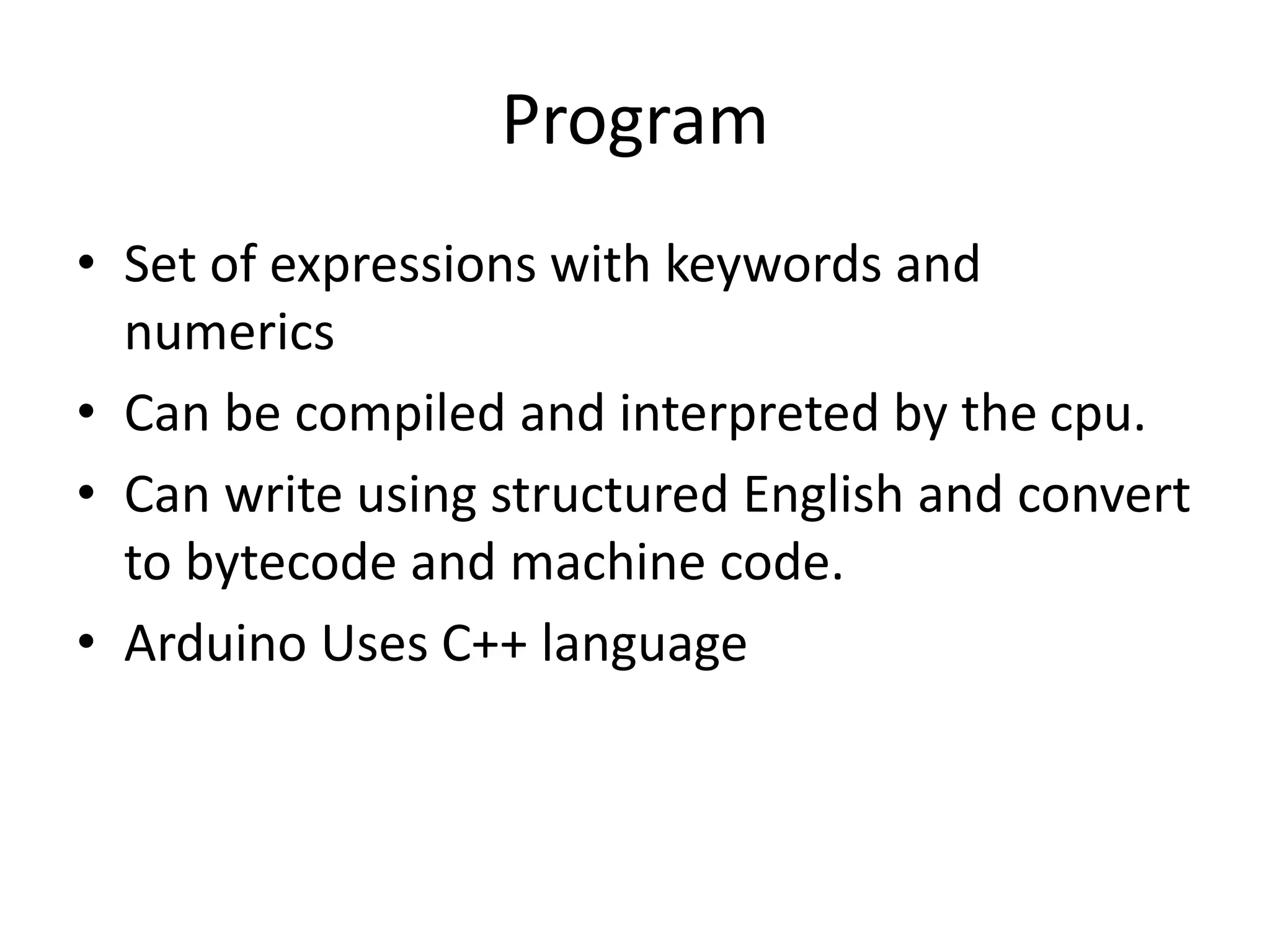
Program • Set of expressions with keywords and numerics • Can be compiled and interpreted by the cpu. • Can write using structured English and convert to bytecode and machine code. • Arduino Uses C++ language
Structure of a program • Variables / constants / Arrays – Use to store value(s) used by our program temporary or permanently – Has a type of data to store (int, bool, char, String) – Global / local • Conditions / Arguments – Used to evaluate a value against a value or condition – IF Else , Switch case • Repetitions – Looping or repeating a set of instructions /code until a given condition is met. – While, Do While, For • Functions – Sub modules of a programme to perform a specific task by calling in the main program. We can feed values to be used by a function. – Void or return (has a data type)
Variables / constants / Arrays • Declaration, Assign, Use, Modify • Ex: int a=100; • Ex: Const int =100; • Ex: int Arr[]={1,2,3,4,5};
Operators • Arethmatic = + , - , * , / • Boolian = True, false (1,0) • Comparison >=, <=, == • Assignment = • Logical = &&, ||, != (and, or, not)
Conditions / Arguments • IF(Condition) { //what to perform if condition is met } Else { // What to perform if condition is not met }
Conditions / Arguments • Switch(variable) { case label1: // statements break; case label2: // statements break; case default: // statements break; }
Repetitions • While(condition is true) { //Statements ; } • Do { } While(condition is true); • For(Condition) { //Statements ; }
Functions • Void func_name(Parameter1, parameter2) { Statements } int func_name(Parameter1, parameter2) { Statements return 0; }

Arduino Programming.pptx

  • 1.
  • 2.
    Program • Set ofexpressions with keywords and numerics • Can be compiled and interpreted by the cpu. • Can write using structured English and convert to bytecode and machine code. • Arduino Uses C++ language
  • 3.
    Structure of aprogram • Variables / constants / Arrays – Use to store value(s) used by our program temporary or permanently – Has a type of data to store (int, bool, char, String) – Global / local • Conditions / Arguments – Used to evaluate a value against a value or condition – IF Else , Switch case • Repetitions – Looping or repeating a set of instructions /code until a given condition is met. – While, Do While, For • Functions – Sub modules of a programme to perform a specific task by calling in the main program. We can feed values to be used by a function. – Void or return (has a data type)
  • 4.
    Variables / constants/ Arrays • Declaration, Assign, Use, Modify • Ex: int a=100; • Ex: Const int =100; • Ex: int Arr[]={1,2,3,4,5};
  • 5.
    Operators • Arethmatic =+ , - , * , / • Boolian = True, false (1,0) • Comparison >=, <=, == • Assignment = • Logical = &&, ||, != (and, or, not)
  • 6.
    Conditions / Arguments •IF(Condition) { //what to perform if condition is met } Else { // What to perform if condition is not met }
  • 7.
    Conditions / Arguments •Switch(variable) { case label1: // statements break; case label2: // statements break; case default: // statements break; }
  • 8.
    Repetitions • While(condition istrue) { //Statements ; } • Do { } While(condition is true); • For(Condition) { //Statements ; }
  • 9.
    Functions • Void func_name(Parameter1,parameter2) { Statements } int func_name(Parameter1, parameter2) { Statements return 0; }