Detection and recognition of face using neural network Supervised By: Submitted By: Dr. Nitin Malik Smriti Tikoo 14-ECP-015 Mtech 4th Sem(ECE)
Agenda • Face detection • Face detection algorithms • Viola Jones algorithm • Flowchart • Faces and features detected • Face Recognition and its need. • Back Propagation • Sigmoidal Function • Flowchart • Solution Methodology • Binary Image • Histogram • Neural Network • Results • Conclusion • References • Publications
Face Detection • Face detection is a computer technology being used in a variety of applications that identifies human faces in digital images. • It refers to the psychological process by which humans locate and attend to faces in a visual scene. • Face-detection algorithms focus on the detection of frontal human faces. • It is analogous to image detection in which the image of a person is matched bit by bit. • Some facial algorithms identify by doing facial feature extraction , or by analyzing relative position , size and or shape of eyes , cheekbones etc • These features are then used to search images with matching features. Any facial feature changes in the database will invalidate the matching process.
Face Detection Algorithm • The Viola–Jones object detection framework is the first object detection framework to provide competitive object detection rates in real-time proposed in 2001 by Paul Viola and Michael Jones. • Although it can be trained to detect a variety of object classes, it was motivated primarily by the problem of face detection. • This algorithm is implemented in OpenCV as cvHaarDetectObjects().k
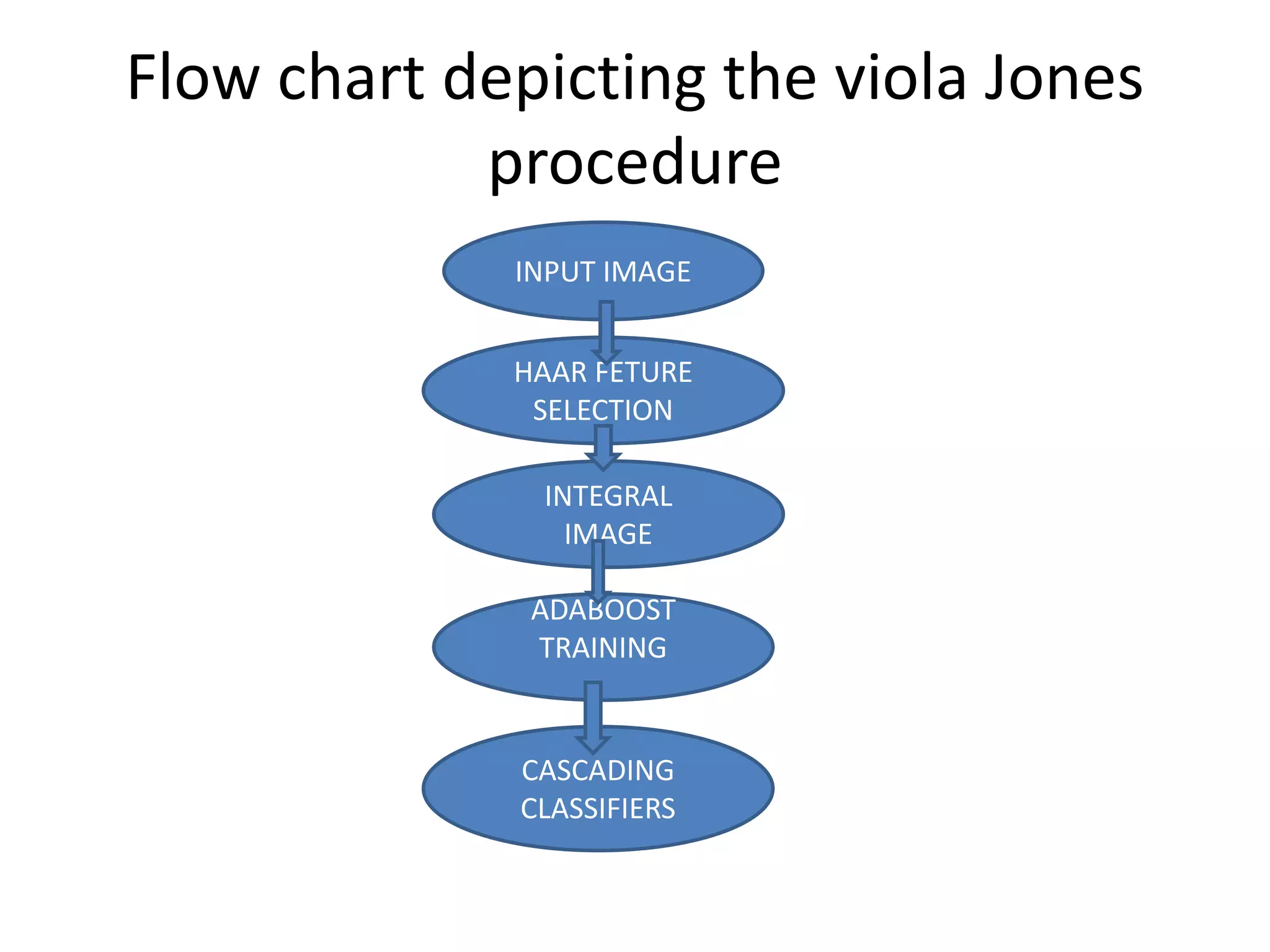
Viola Jones Algorithm • The characteristics of Viola–Jones algorithm which make it a good detection algorithm are: • Robust – very high detection rate . • Real time – For practical applications • Face detection only (not recognition) - The goal is to distinguish faces from non-faces (detection is the first step in the recognition process). • The algorithm has four stages: • Haar Feature Selection • Creating an Integral Image • Ada boost Training • Cascading Classifiers
Flow chart depicting the viola Jones procedure INPUT IMAGE HAAR FETURE SELECTION INTEGRAL IMAGE ADABOOST TRAINING CASCADING CLASSIFIERS
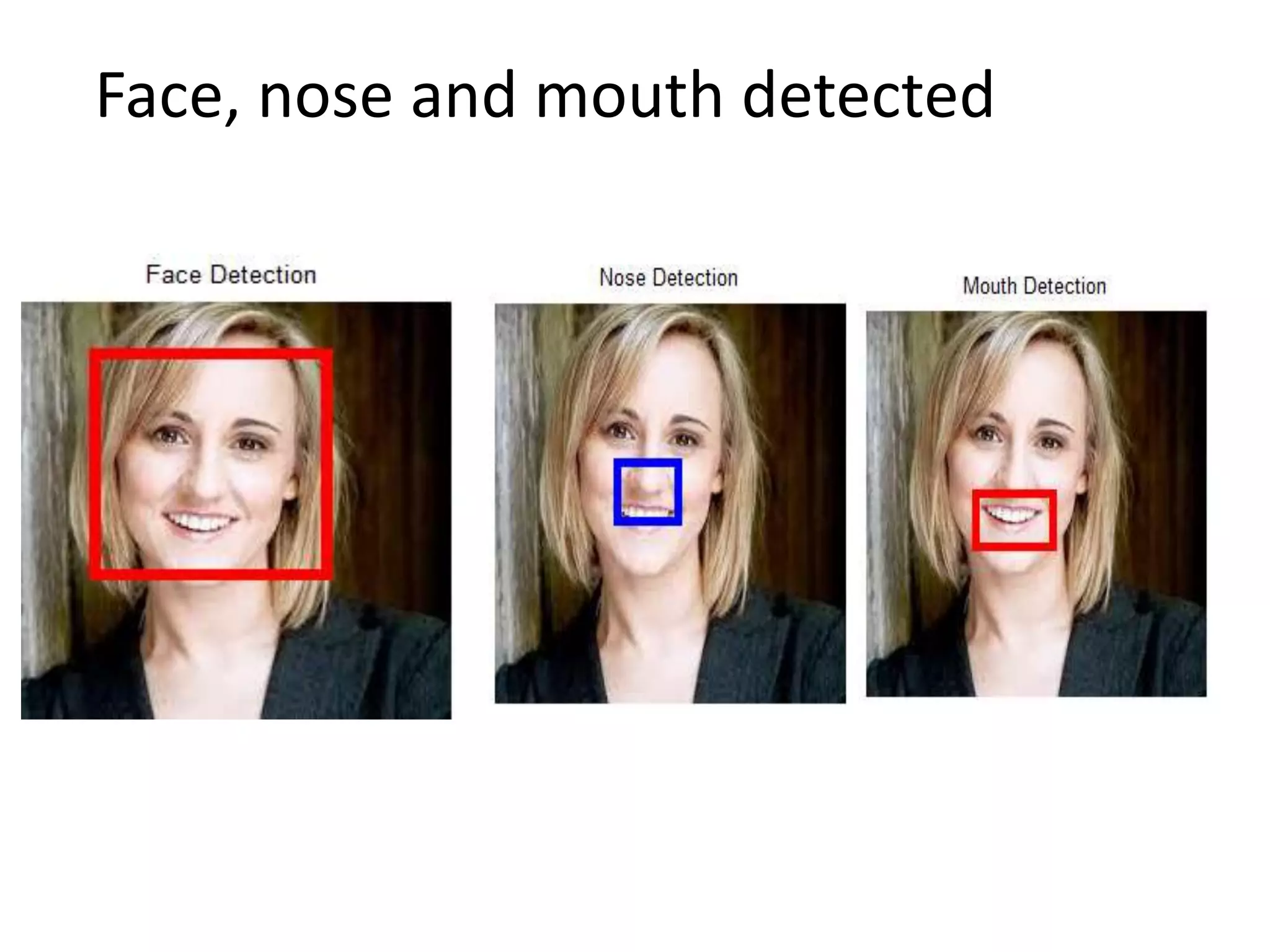
Face, nose and mouth detected
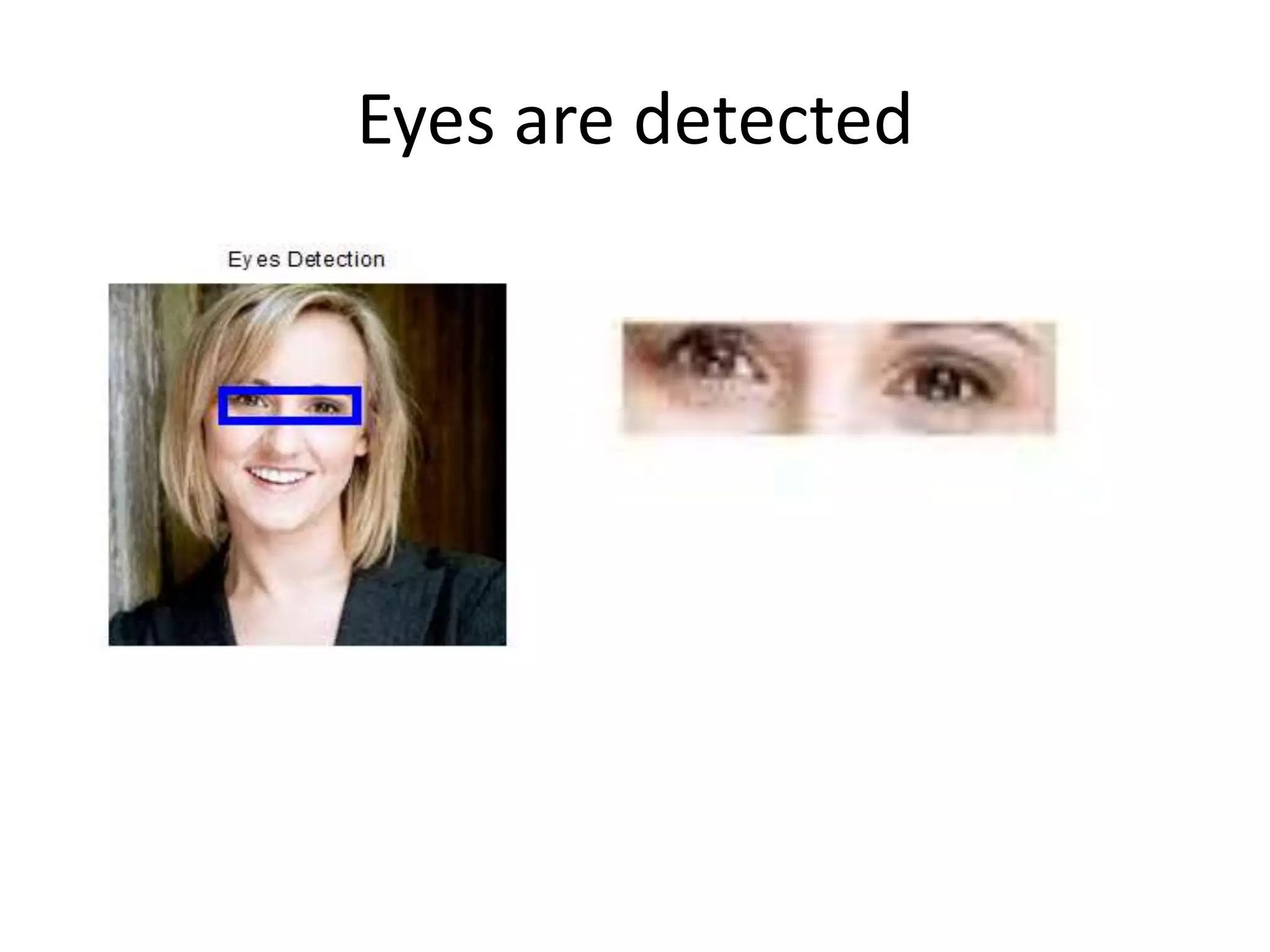
Eyes are detected
Face Recognition and its need • Plays an integral part in human computer interaction. • It is typically used in security systems and can be compared to other biometrics such as fingerprint or eye iris recognition systems. • Recently, it has also become popular as a commercial identification and marketing tool. • Some facial recognition algo’s identify by doing facial feature detection &extraction , or by analyzing relative position , size and or shape of eyes , cheekbones etc • The skill to identify a face is quite robust despite of large variations in visual stimulus due to changing condition, aging and distractions such as beard , glasses or changes in hairstyle. • Trivial for brain extremely difficult to imitate artificially.
Back Propagation • Backward Propagation of Errors • Most common & popular- for training NN. • Requires known, desired o/p for each i/p in order to calculate the loss function gradient. • Considered supervised learning method. • BP algo consists of 2 propagation: • Forward Propagation : Input is fed through the network to generate propagation's output activations. • Backward propagation: Backward propagation of the propagation's output activations through the neural network using the training pattern target in order to generate the deltas (the difference between the targeted and actual output values) of all output and hidden neurons.
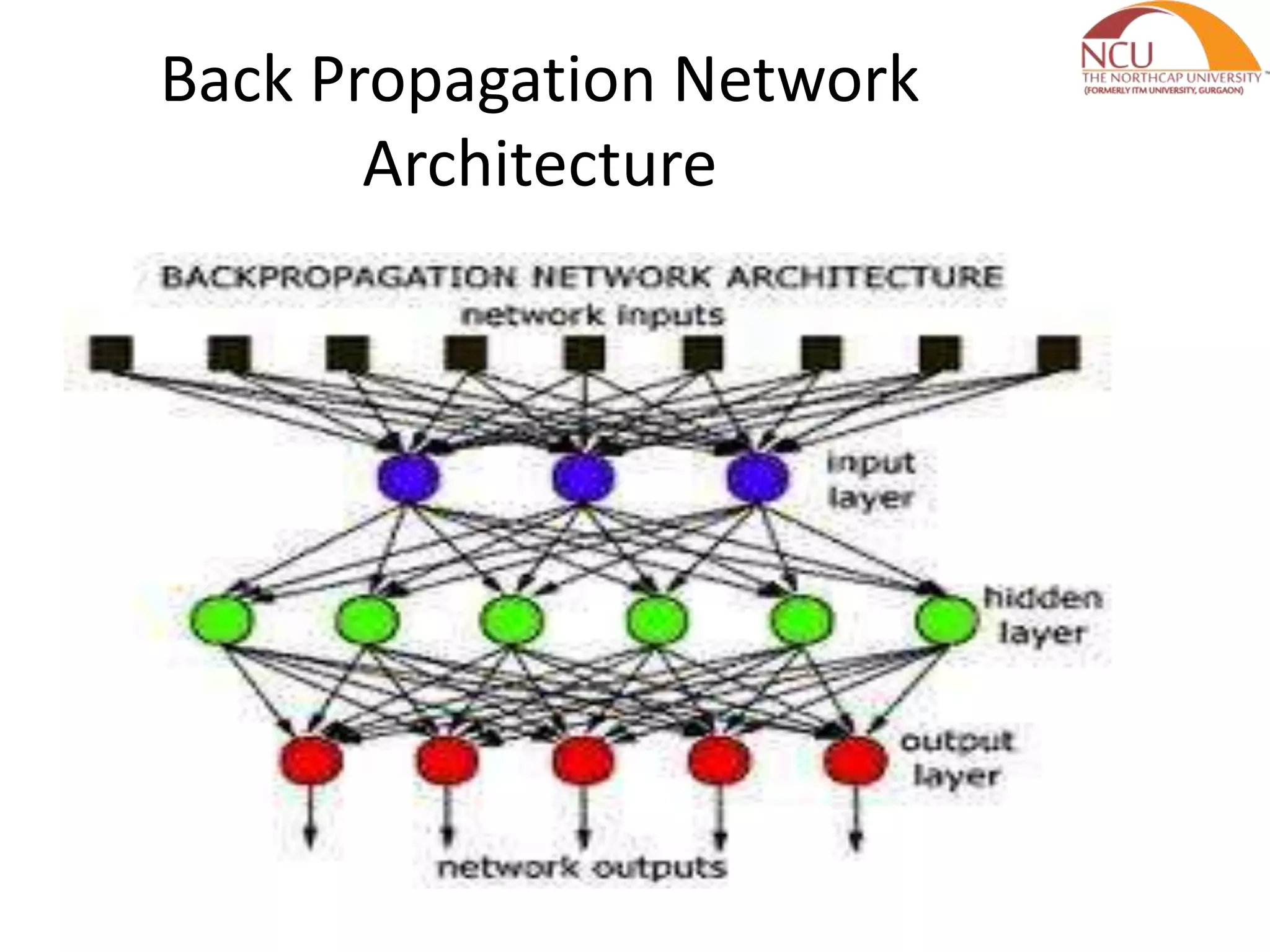
Back Propagation Network Architecture
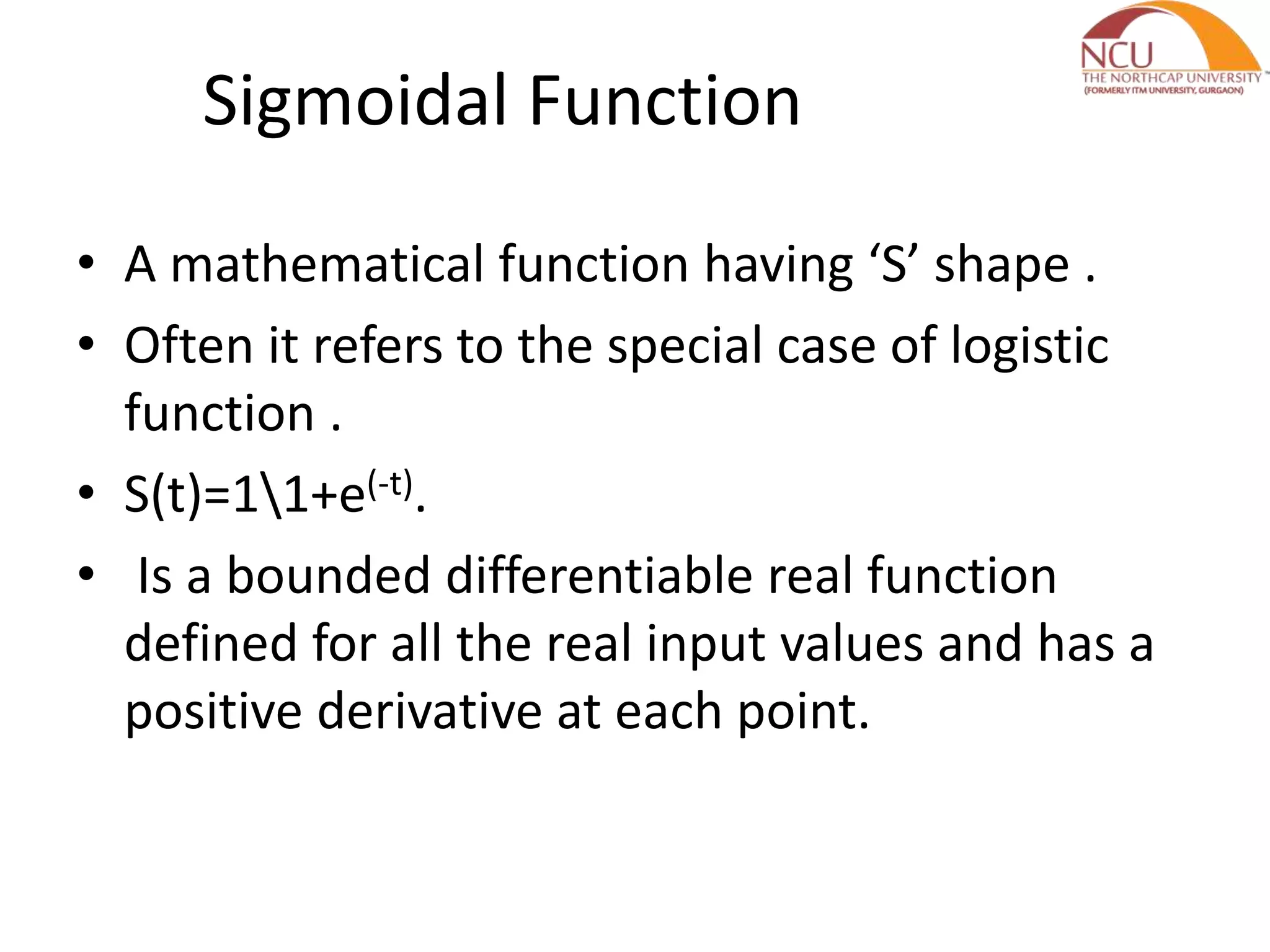
Continued….. • Gives insights into how changing the weights and biases changes the overall network behavior. • Has a high rate of convergence . • The design of back propagation architecture lies entirely on the type of activation function selected. • The activation function used in this case is sigmoidal activation function.
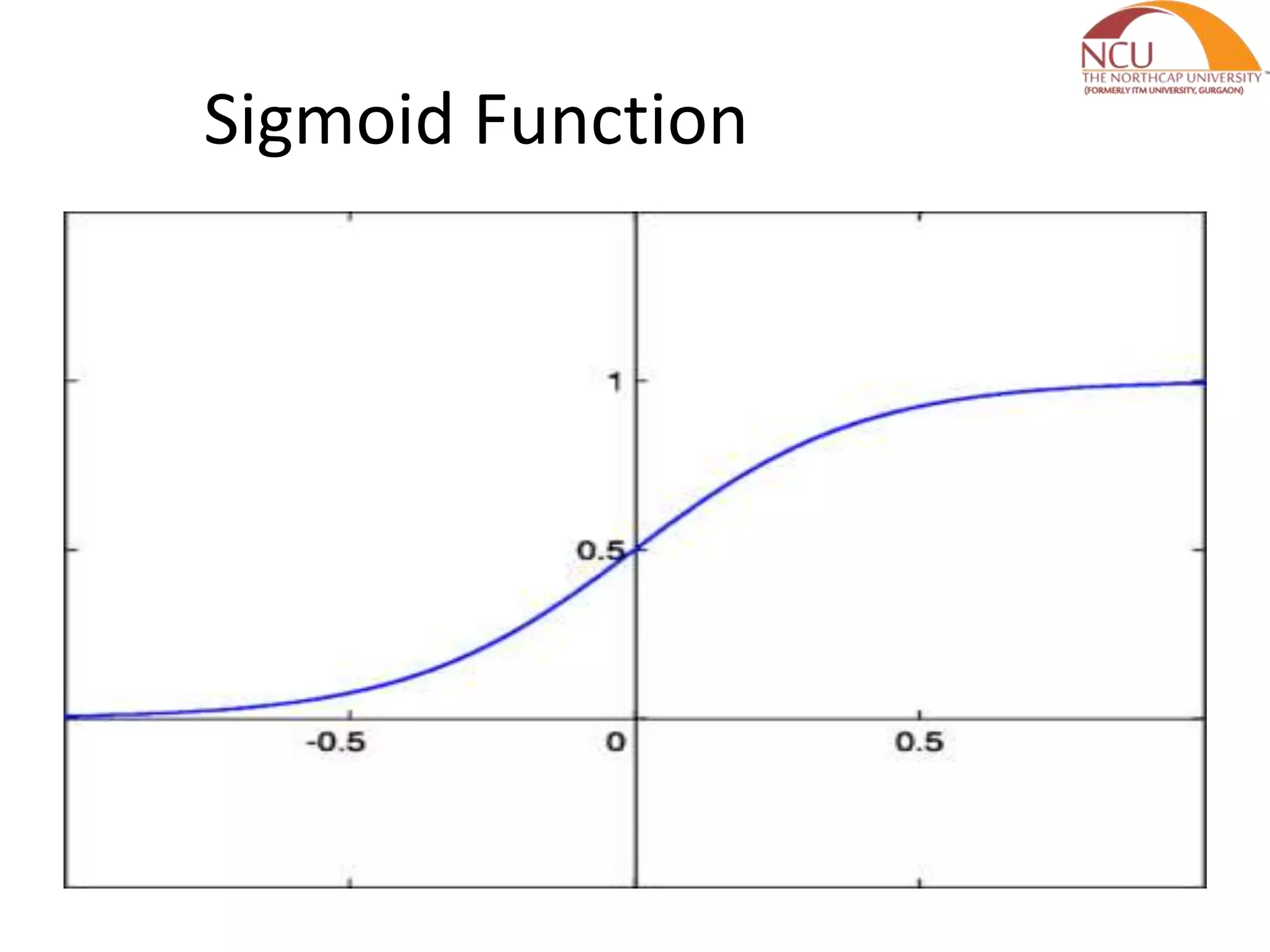
Sigmoidal Function • A mathematical function having ‘S’ shape . • Often it refers to the special case of logistic function . • S(t)=11+e(-t). • Is a bounded differentiable real function defined for all the real input values and has a positive derivative at each point.
Sigmoid Function
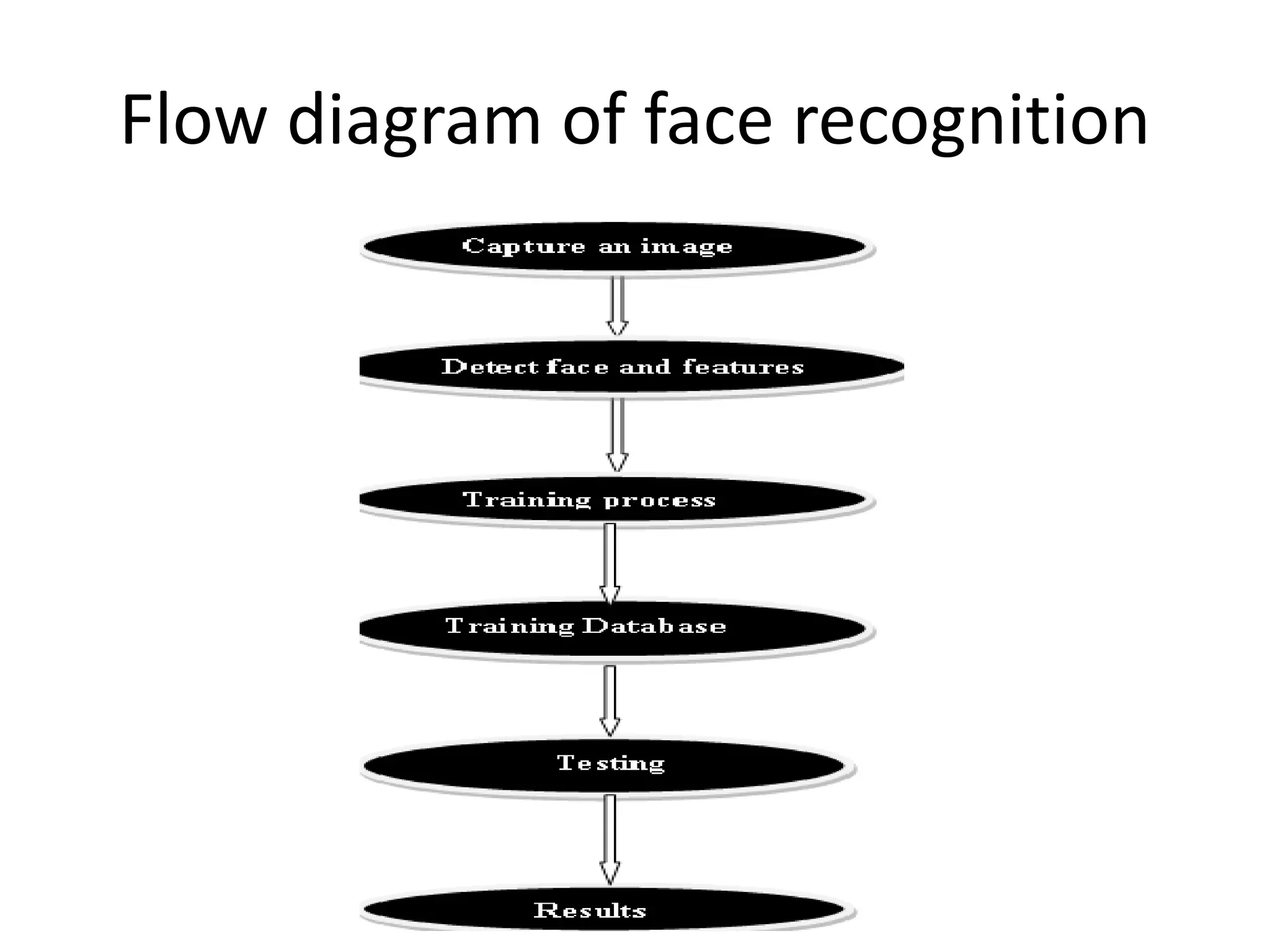
Flow diagram of face recognition
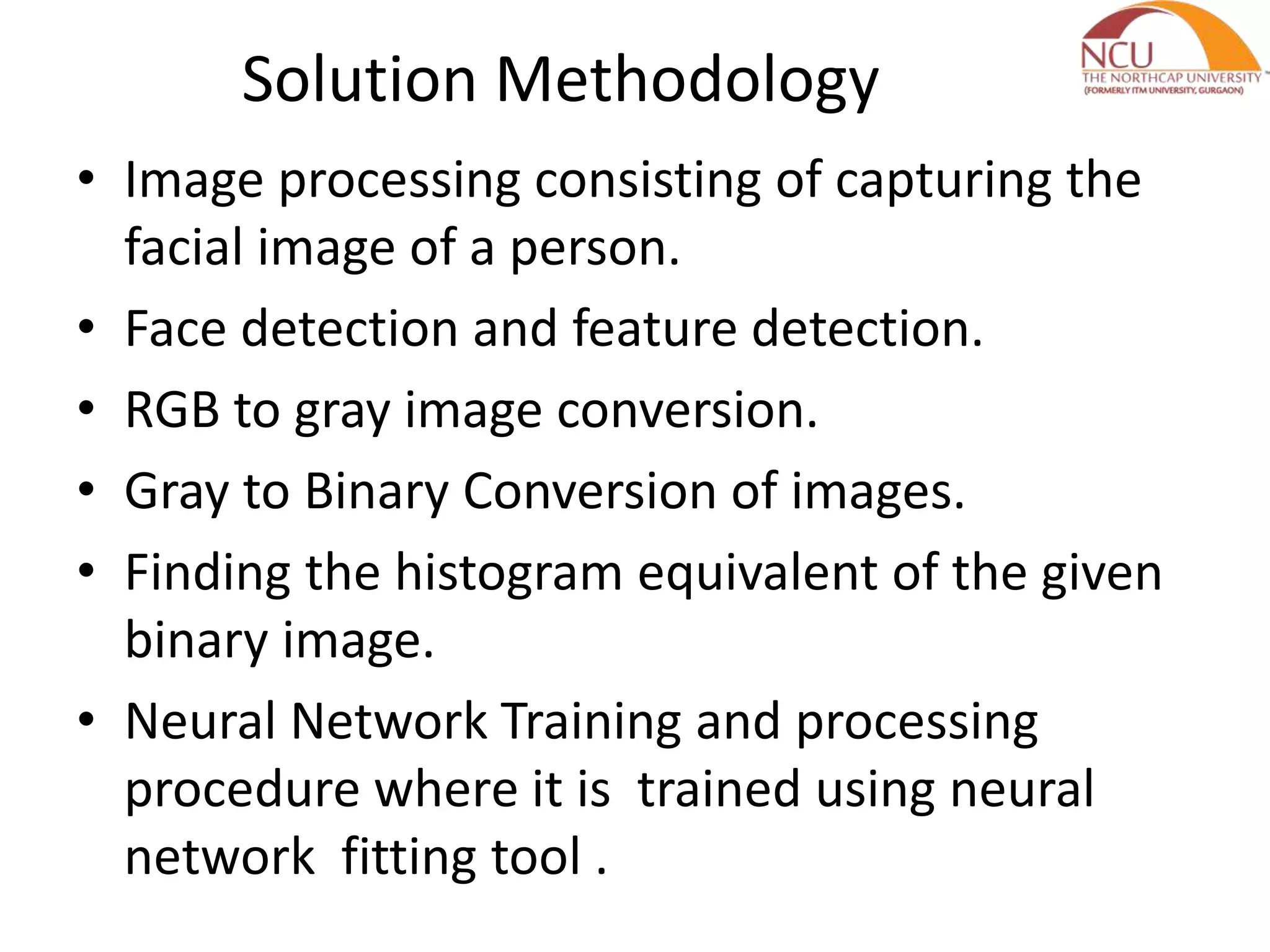
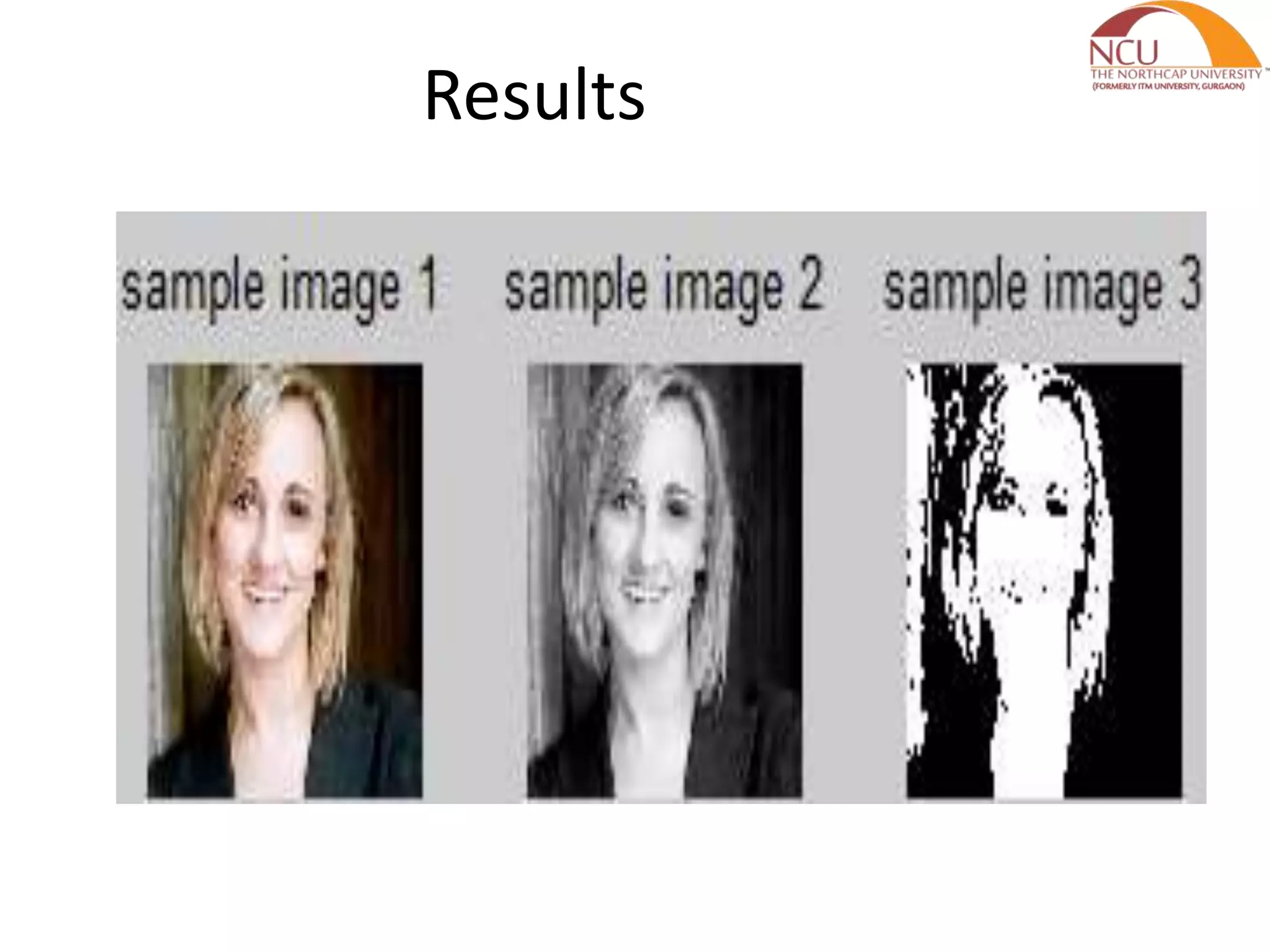
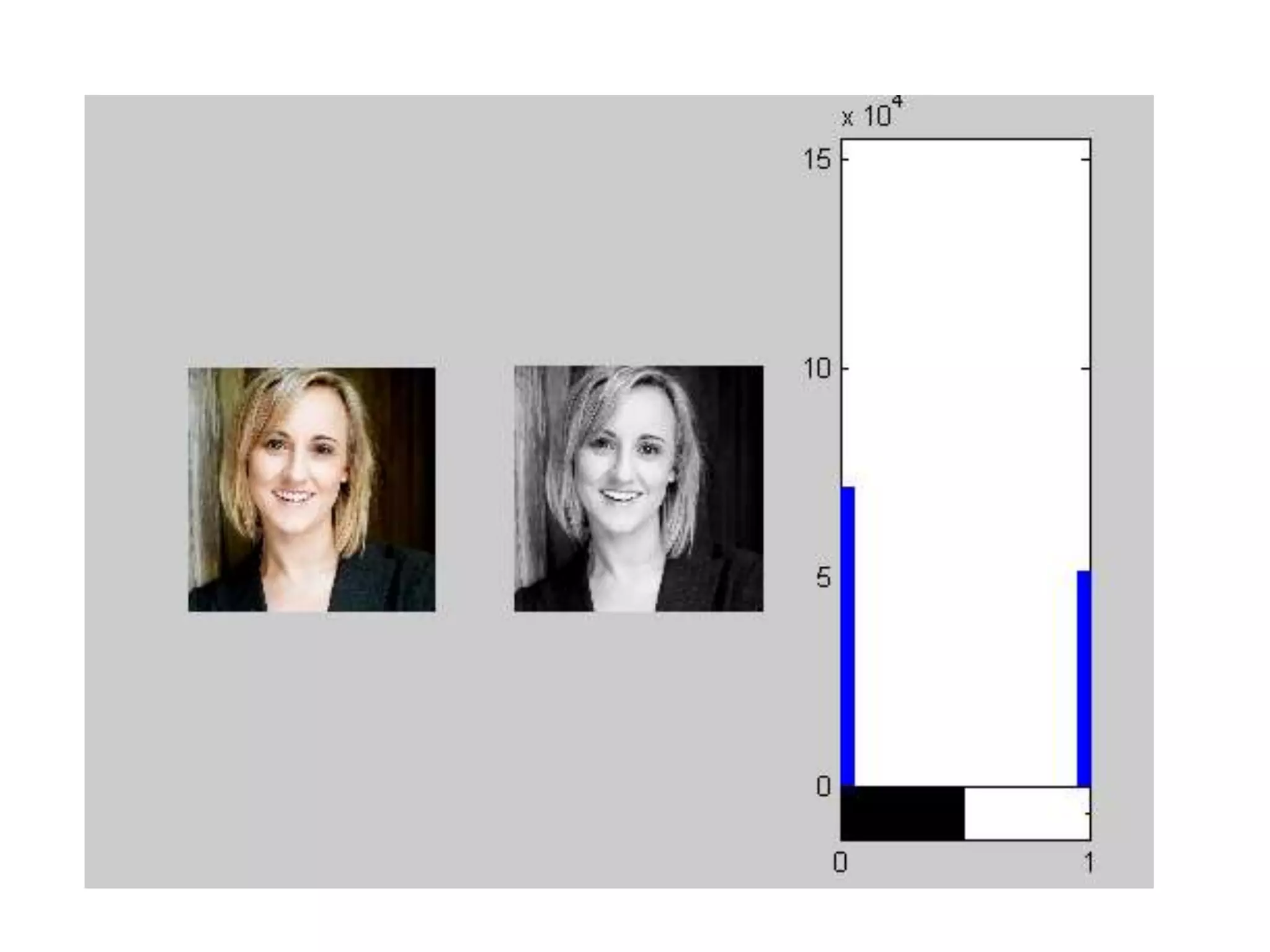
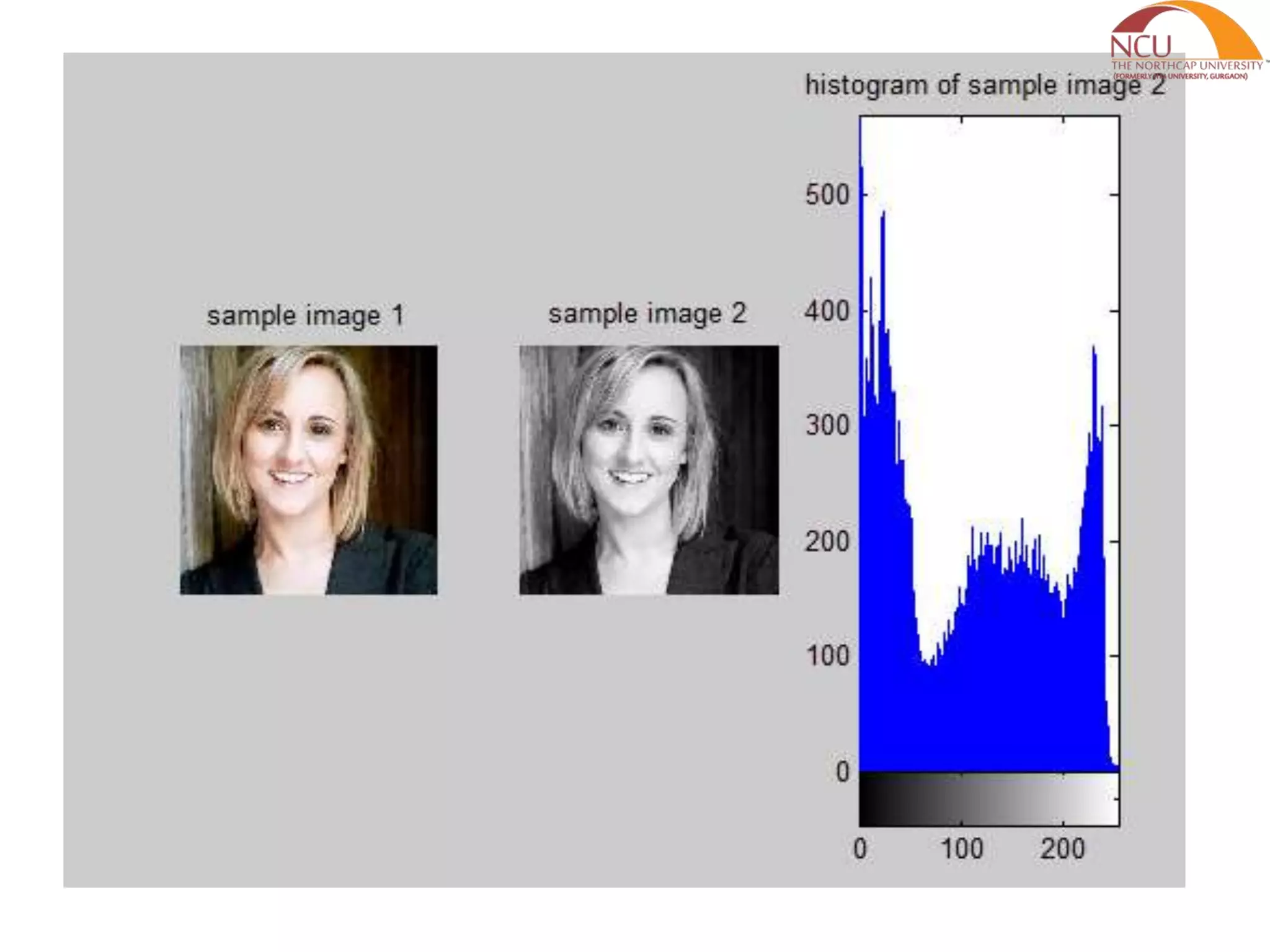
Solution Methodology • Image processing consisting of capturing the facial image of a person. • Face detection and feature detection. • RGB to gray image conversion. • Gray to Binary Conversion of images. • Finding the histogram equivalent of the given binary image. • Neural Network Training and processing procedure where it is trained using neural network fitting tool .
Binary Image • Is a digital image that has only two possible value for each pixel. • Typically the two colors used for a binary image are black and white though any two colors can used . • The color used for the object in the image is the foreground color while the rest of the image is background color. • In the scanning industry it is often referred as bitonal. • Uses im2bw keyword to convert an image to binary.
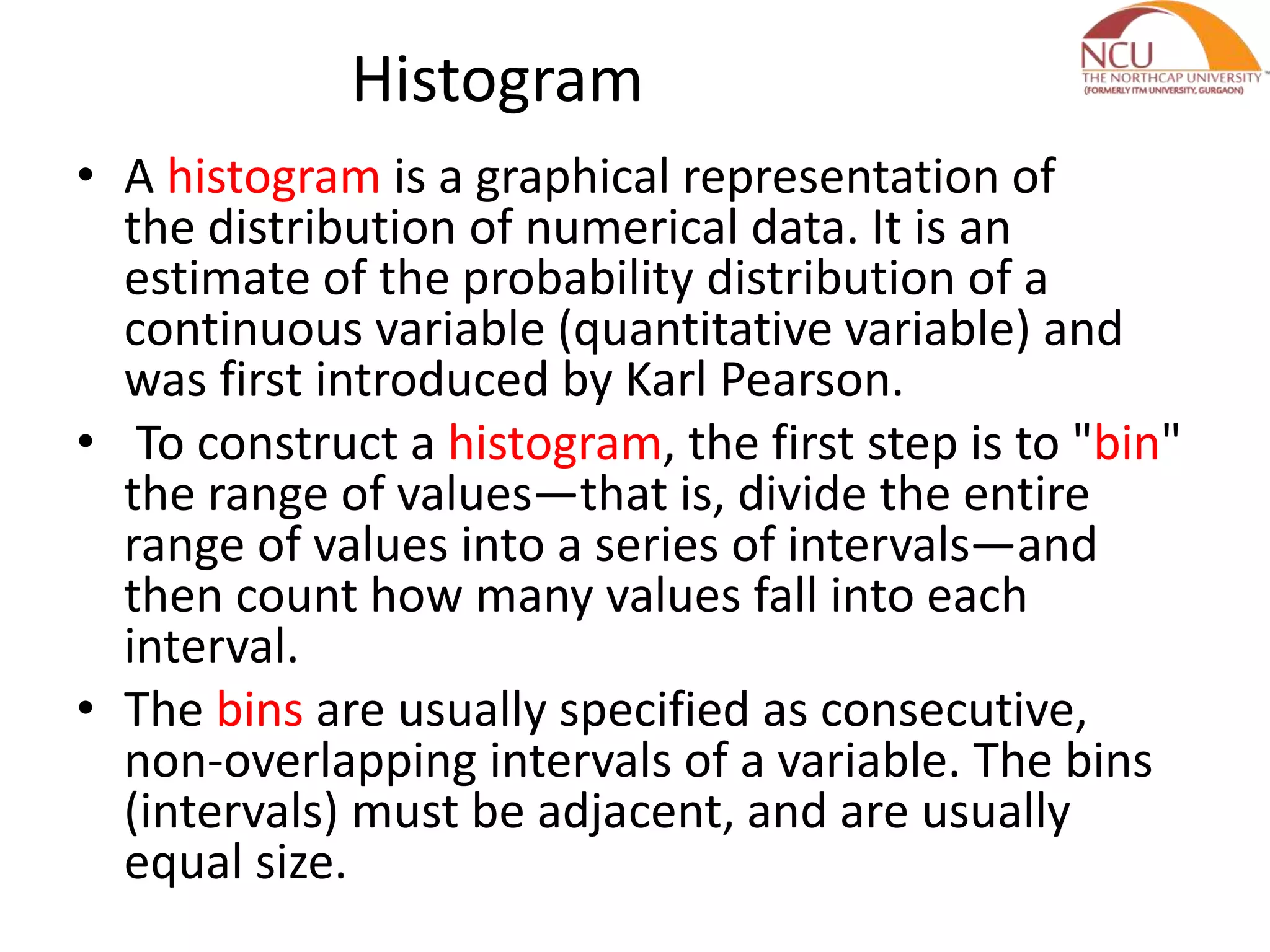
Histogram • A histogram is a graphical representation of the distribution of numerical data. It is an estimate of the probability distribution of a continuous variable (quantitative variable) and was first introduced by Karl Pearson. • To construct a histogram, the first step is to "bin" the range of values—that is, divide the entire range of values into a series of intervals—and then count how many values fall into each interval. • The bins are usually specified as consecutive, non-overlapping intervals of a variable. The bins (intervals) must be adjacent, and are usually equal size.
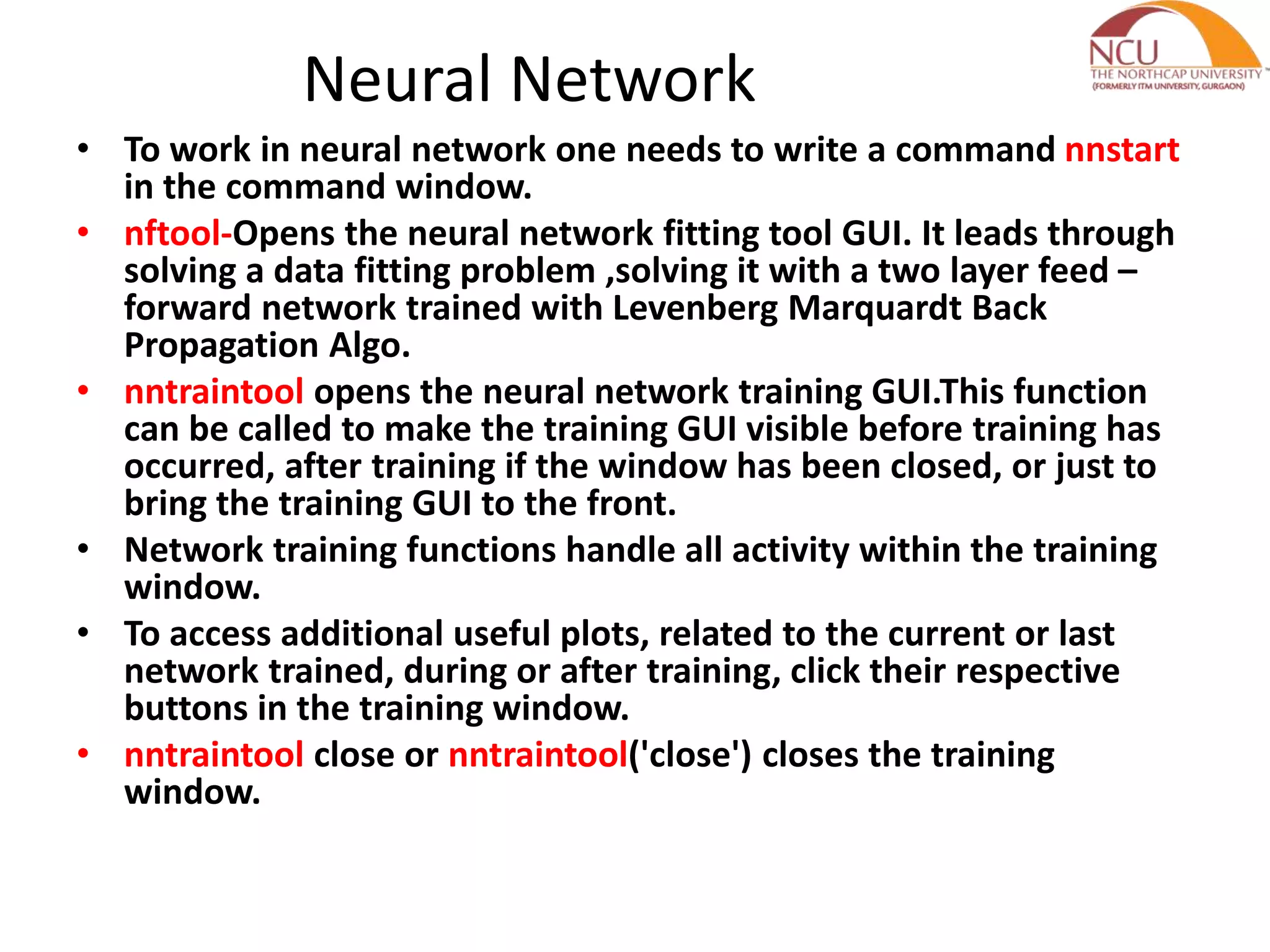
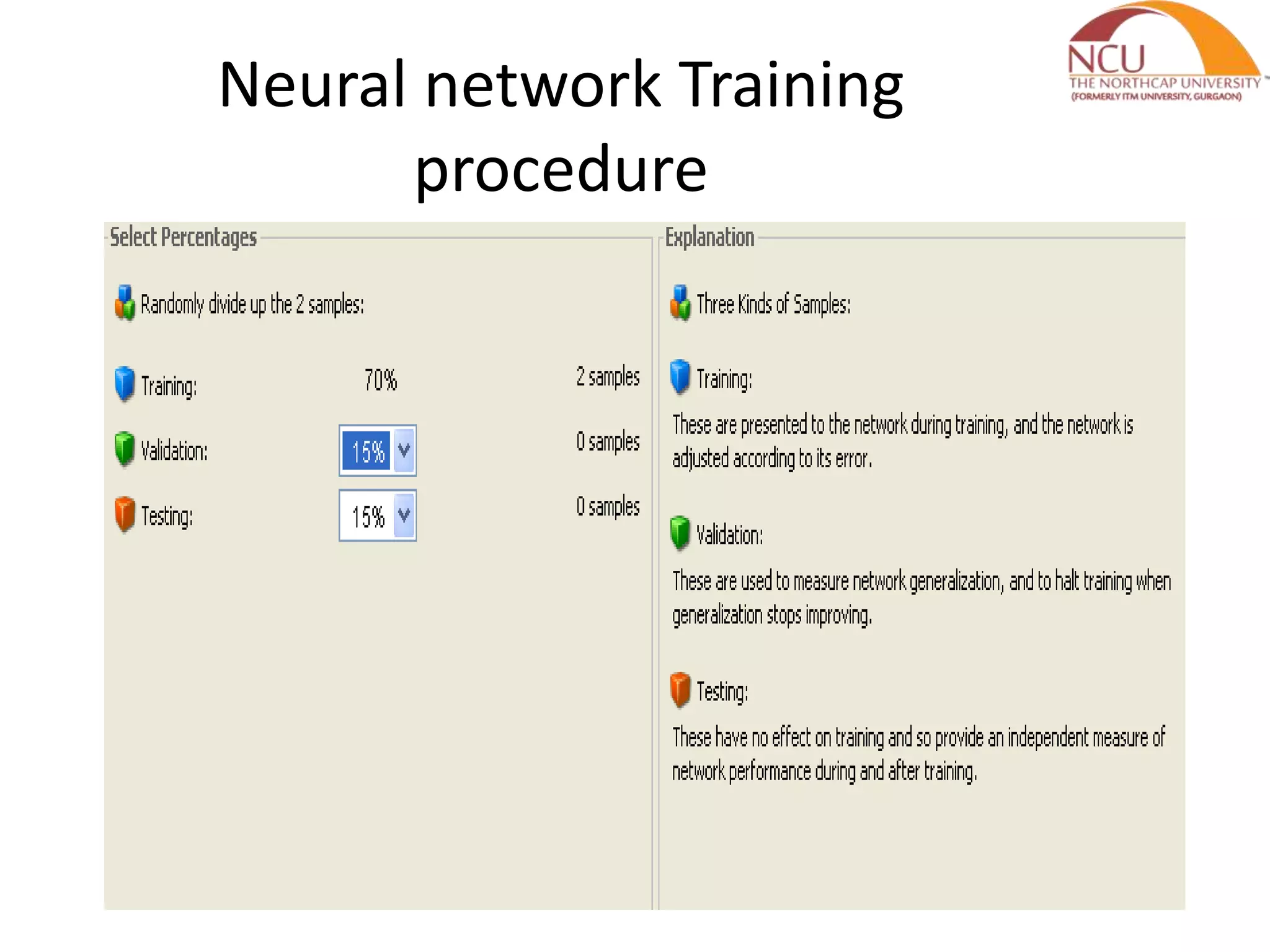
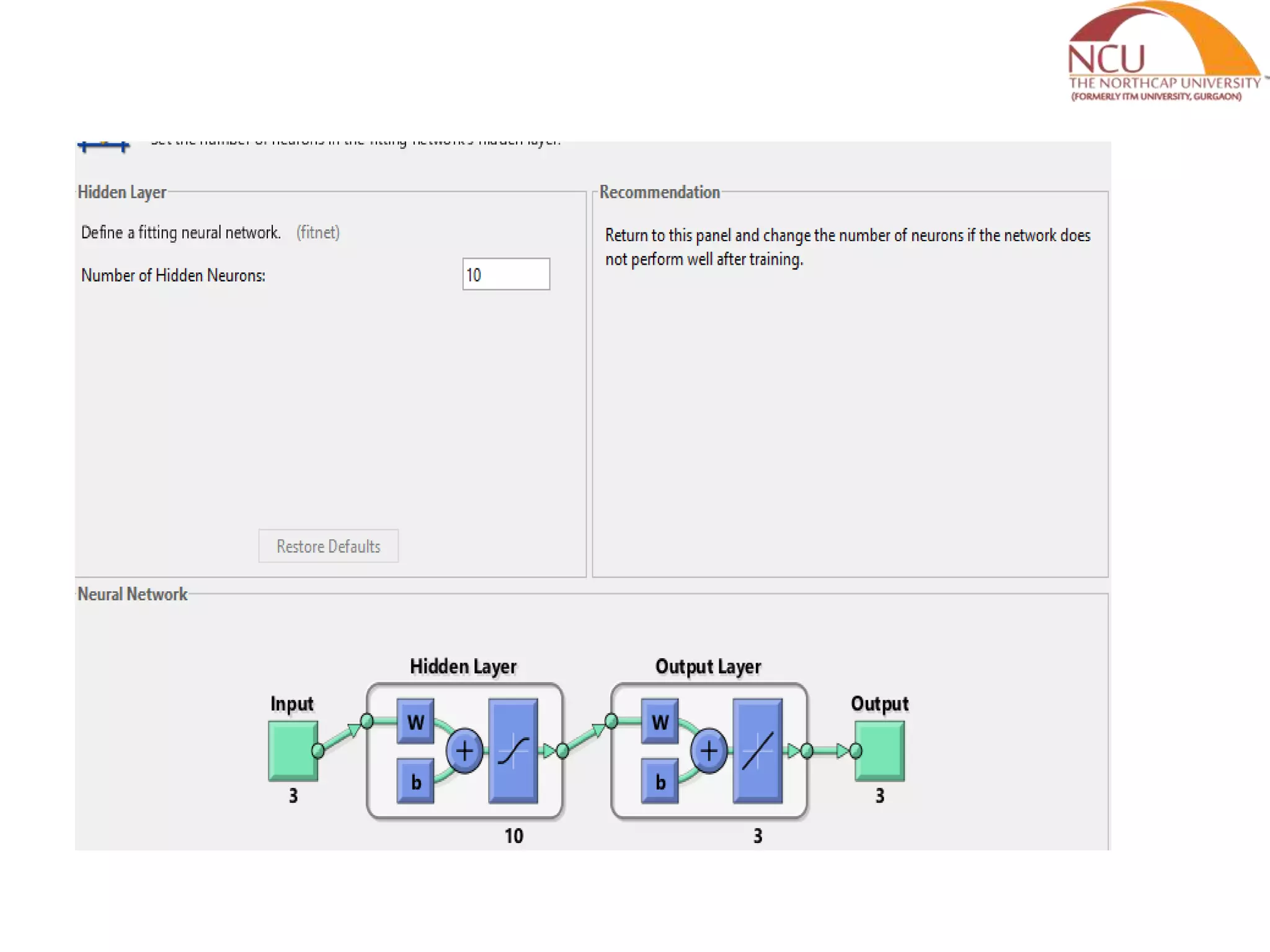
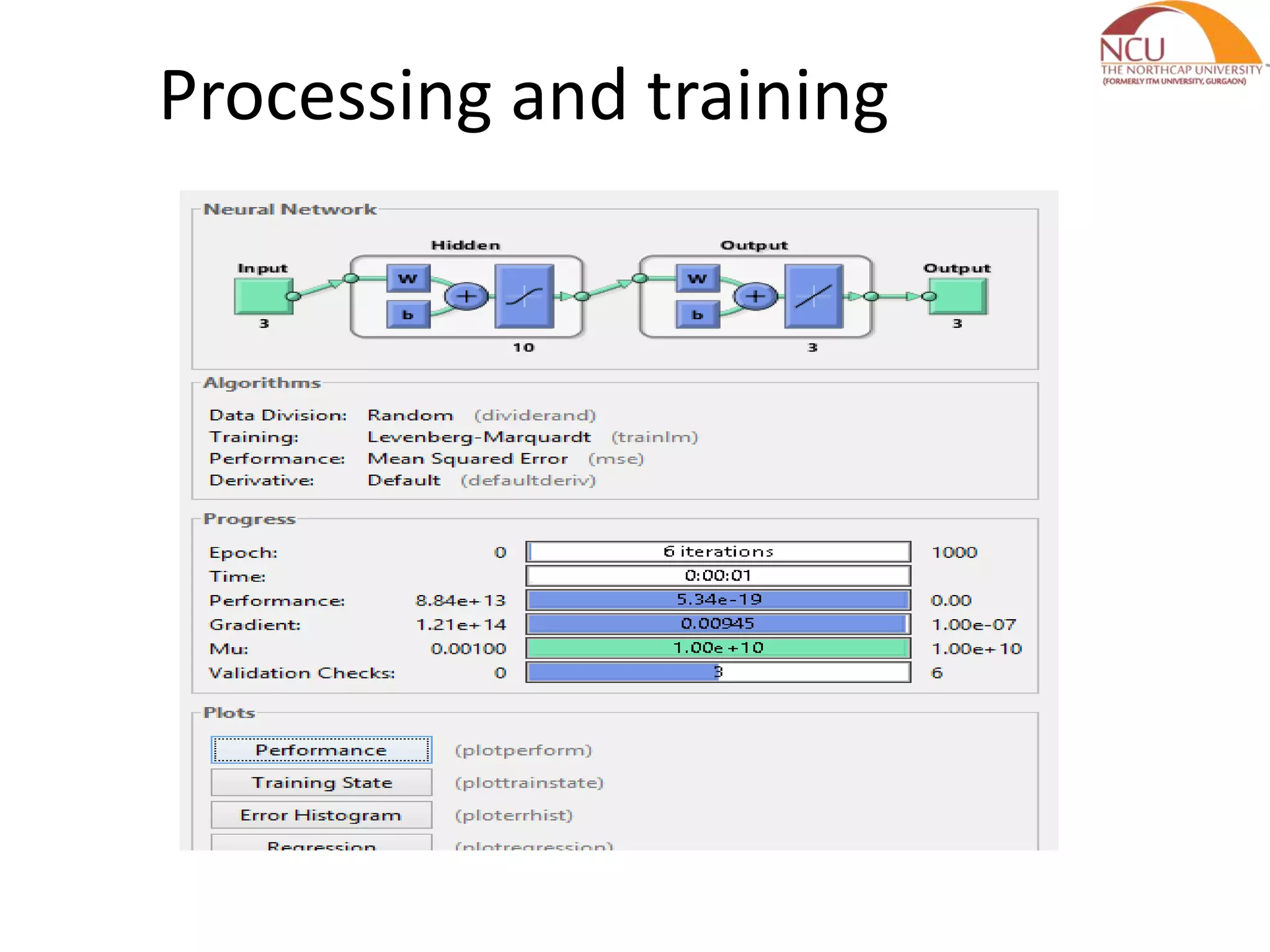
Neural Network • To work in neural network one needs to write a command nnstart in the command window. • nftool-Opens the neural network fitting tool GUI. It leads through solving a data fitting problem ,solving it with a two layer feed – forward network trained with Levenberg Marquardt Back Propagation Algo. • nntraintool opens the neural network training GUI.This function can be called to make the training GUI visible before training has occurred, after training if the window has been closed, or just to bring the training GUI to the front. • Network training functions handle all activity within the training window. • To access additional useful plots, related to the current or last network trained, during or after training, click their respective buttons in the training window. • nntraintool close or nntraintool('close') closes the training window.
Results
Neural network Training procedure
Processing and training
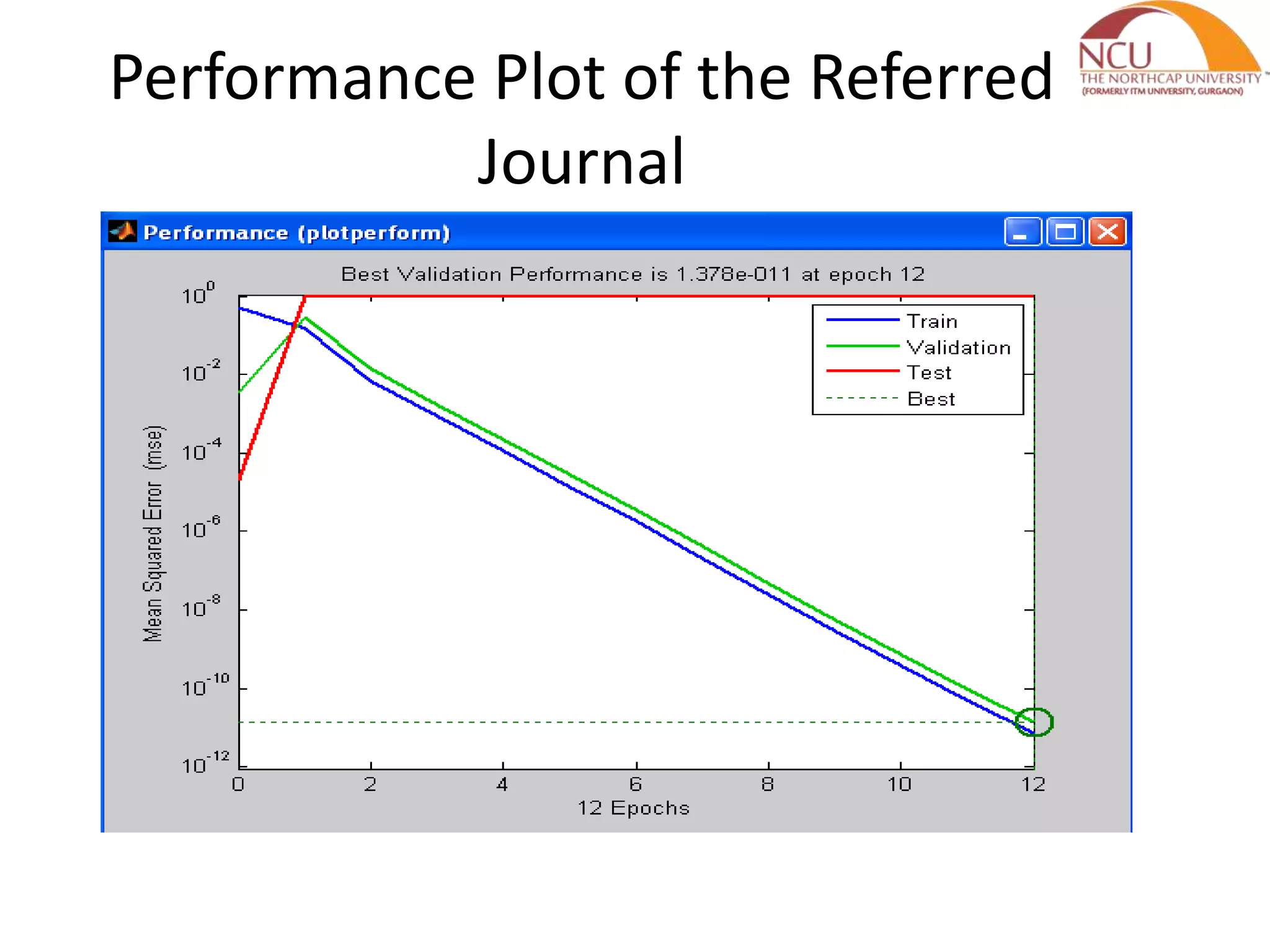
Performance Plot of the Referred Journal
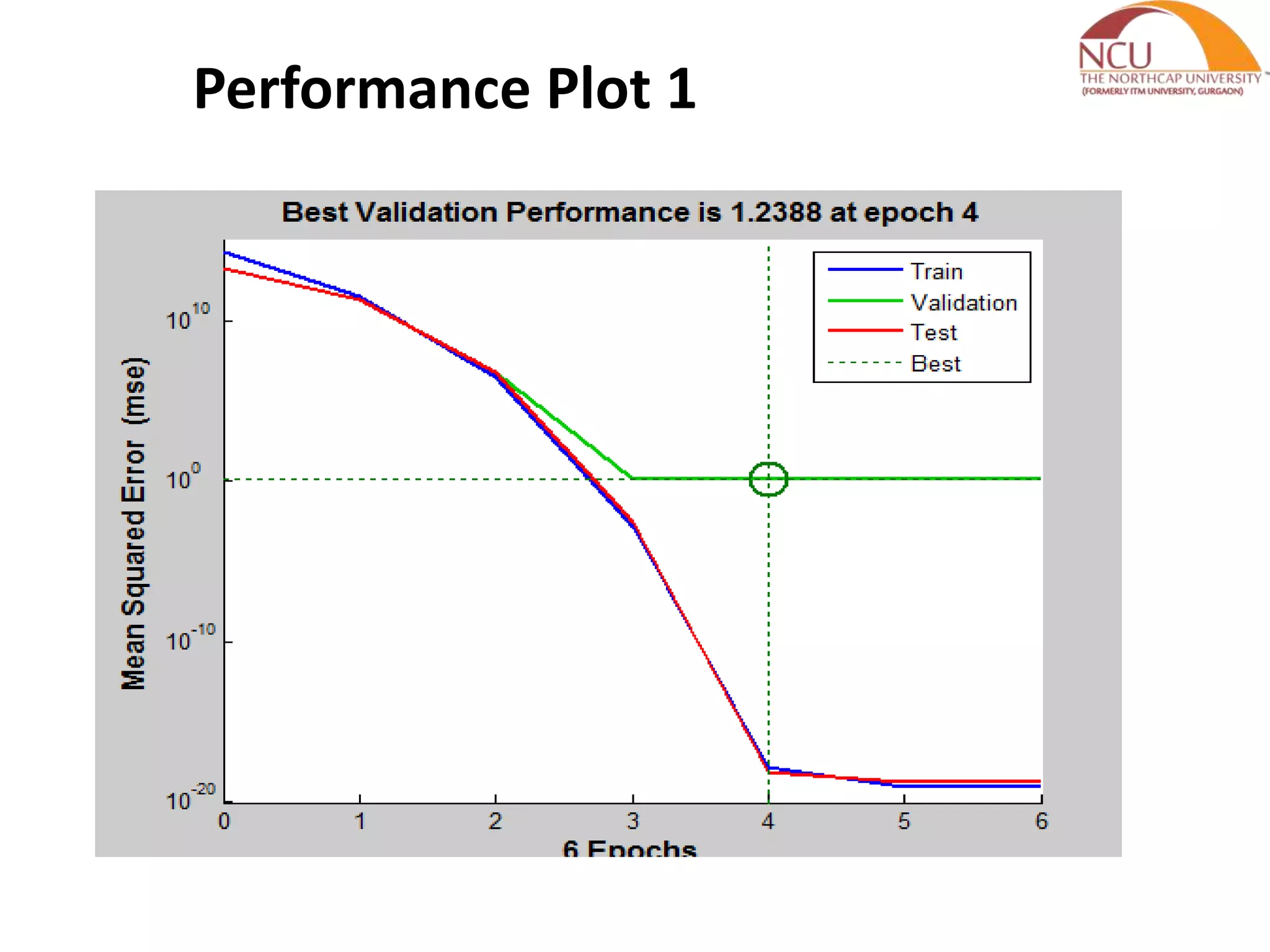
Performance Plot 1
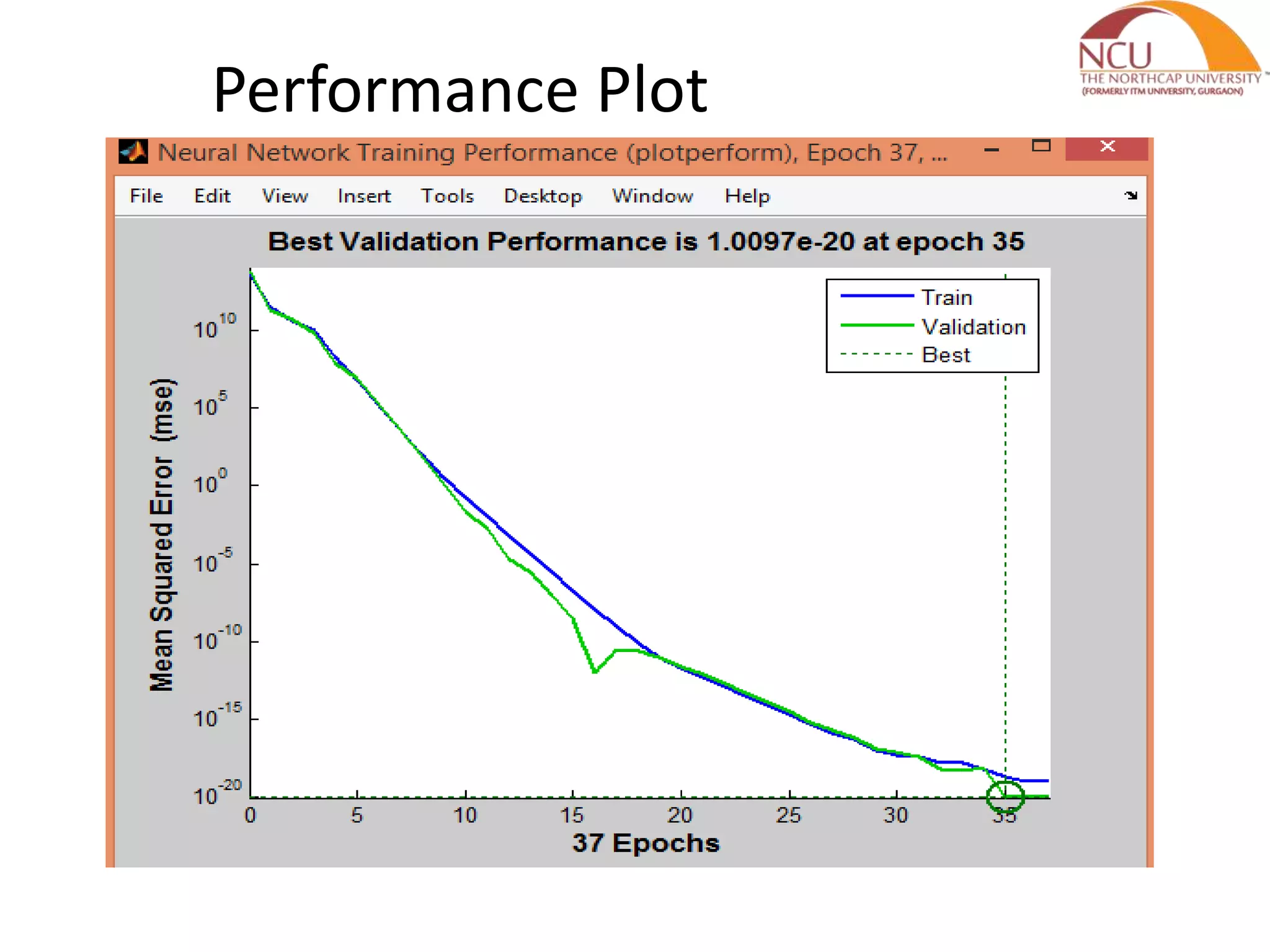
Performance Plot
Conclusion • In this work it has been shown that if a facial image of a person is given then the network can be able to recognize the face of the person. The whole work is completed through the following steps : • Facial detection is influenced by clarity of the image , colored or black and white image . • It can only support frontal detection of images. • The training does takes a lot of time in order to separate a negative face from a positive face. • Using Adaptive boost algorithm and cascading helps in faster detection. • Facial image without dividing into parts has been applied in the network. • Feed Forward Back Propagation neural network have been used to train, test and validate the network for each part of the image using MATLAB. • Training of each sample is performed up to 8 to 10 times to minimize the mean square error.
References • [1] H.A. Rowley, S. Baluja, and T. Kanade, “Neural network - based face detection,” IEEE Trans. Pattern Analysis and Machine Intelligence, vol. 20, no. 1, pp. 23–38, Jan. 1998. • [2] H.A.Rowley, S. Baluja, and T. Kanade, “Rotation invariant neural net-work based face detection,” Proc. IEEE Int’l Conf. Computer Vision and Pattern Recognition, pp. 38–44, 1998. • [3] K.K Sung and T. Poggio, “Example-based learning for view-based human face detection,” IEEE Trans. Pattern Analysis and Machine Intelli-gence, vol. 20, no. 1, pp. 39–51, Jan. 1998. • [4] H. Schneiderman and T. Kanade, “A statistical method for 3D object detection applied to faces and cars,” Proc. IEEE Int’l Conf. Computer Vision and Pattern Recognition, pp. 746–751, June 2000. • [5] K.C. Yow and R. Cipolla, “Feature-based human face detection,” Image and Vision Computing, vol. 25, no. 9, pp. 713–735, Sept. 1997. • [6] D. Maio and D. Maltoni, “Real-time face location on gray-scale static images,” Pattern Recognition, vol. 33, no. 9, pp. 1525–1539, Sept. 2000. • [7] M.S. Lew and N. Huijsmans, “Information theory and face detection,” Proc.IEEE Int’l Conf. Pattern Recognition, pp. 601- 605, Aug. 1996. • [8] S.C. Dass and A.K. Jain, “Markov face models,” Proc. IEEE Int’l Conf.Computer Vision, pp. 680–687, July 2001. • [9] A.J. Colmenarez and T.S. Huang, “Face detection with information based maximum discrimination,” Proc. IEEE Int’l Conf. Computer Vision and Pattern Recognition, pp. 782–787, June 1997. • [10] D. DeCarlo and D. Metaxas, “Optical flow constraints on deformable models with applications to face tracking,” International Journal Computer Vision, vol. 38, no. 2, pp. 99–127, July 2000.
• [11] V. Bakic and G. Stockman, “Menu selection by facial aspect,” Proc. Vision Interface, Canada, pp. 203–209, May 1999. • [12] A. Colmenarez, B. Frey, and T. Huang, “Detection and tracking of faces and facial features,” Proc. IEEE Int’l Conf. Image Processing, pp. 657–661, Oct. 1999. • [13] R. F´eraud, O.J. Bernier, J.-E. Viallet, and M. Collobert, “A fast and accurate face detection based on neural network,” IEEE Trans. Pattern Analysis and Machine Intelligence, vol. 23. • [14] W.Zhao, R.Chellappa, P.J..Phillips and A. Rosennfeld, “Face Reconi-tion: A literature Survey”. ACM Comput.Surv., 35(4): 399-458, 2003. • [15] M.A.Turk and A.P. Pentaland, “Face Recognition Using Eigenfaces”, IEEE conf. on Computer Vision and Pattern Recognition, pp. 586-591, 1991. • [16] Ling-Zhi Liao, Si-Wei Luo, and Mei Tian “”Whitenedfaces” Recogni-tion With PCA and ICA” IEEE Signal Processing Letters, Vol. 14, No. 12, pp1008-1011, Dec. 2007. • [17] G. Jarillo, W.Pedrycz , M. Reformat “Aggregation of classifiers based on image transformations in biometric face recognition” Machine Vision and Applications (2008) Vol . 19,pp. 125-140, Springer-Verlag 2007. • [18] Tej Pal Singh, “Face Recognition by using Feed Forward Back Propagation Neural Network”, International Journal of Innovative Research in Technology & Science, vol.1, no.1. • [19] N.Revathy, T.Guhan, “Face recognition system using back propagation artificial neural networks”, International Journal of Advanced Engineering Technology, vol.3, no. 1, 2012. • [20] Kwan-Ho Lin, Kin-Man Lam, and Wan-Chi Siu. “A New Approach using ModiGied Hausdorff Distances with Eigen Face for Human Face Recognition” IEEE Seventh international Conference on Control, Automation, Robotics and Vision , Singapore, 2-5 Dec, ,pp 980-984, 2002
• [21] Zdravko Liposcak, , Sven Loncaric, “Face Recognition From Profiles Using Morphological Operations”, IEEE Conference on Recognition, Analysis, and Tracking of Faces and Gestures in Real-Time Systems, 1999. • [22] Simone Ceolin , William A.P Smith, Edwin Hancock, “Facial Shape Spaces from Surface Normals and Geodesic Distance”, Digital Image Computing Techniques and Applications, 9th Biennial Conference of Australian Pattern Recognition Society IEEE 3-5 Dec., Glenelg, pp- 416-423, 2007 • [23] Ki-Chung Chung , Seok Cheol Kee ,and Sang Ryong Kim, “Face Recognition using Principal Component Analysis of Gabor Filter Responses” ,Recognition, Analysis, and Tracking of Faces and Gestures in Real-Time Systems, 1999,Proceedings. International Workshop IEEE 26-27 September, Corfu,pp-53-57, 1999, • [24] Ms. Varsha Gupta, Mr. Dipesh Sharma, “A Study of Various Face Detection Methods”, International Journal of Advanced Research in Computer and Communication Engineering), vol.3, no. 5, May 2014. • [25] Irene Kotsia, Iaonnis Pitas, “Facial expression recognition in image sequences using geometric deformation features and support vector machines”, IEEE transaction paper on image processing, vol. 16, no.1, pp-172-187, January 2007. [24] Ms. Varsha Gupta, Mr. Dipesh Sharma, “A Study of Various Face Detection Methods”, International Journal of Advanced Research in Computer and Communication Engineering), vol.3, no. 5, May 2014. • [25] Irene Kotsia, Iaonnis Pitas, “Facial expression recognition in image sequences using geometric deformation features and support vector machines”, IEEE transaction paper on image processing, vol. 16, no.1, pp-172-187, January 2007. • [26] R.Rojas,”The back propagation algorithm”,Springer-Verlag, Neural networks, pp 149-182 ,1996.
• [27] Hosseien Lari-Najaffi , Mohammad Naseerudin and Tariq Samad,”Effects of initial weights on back propagation and its variations”, Systems, Man and Cybernetics ,Conference Proceedings, IEEE International Conference, 14-17 Nov ,Cambridge, pp-218- 219,1989. • [28] M.H Ahmad Fadzil. , H.Abu Bakar., “Human face recognition using neural networks”, Image processing, 1994, Proceedings ICIP-94, IEEE International Conference ,13-16 November, Austin ,pp-936-939,1994. • [29] N.K Sinha , M.M Gupta and D.H Rao, “Dynamic Neural Networks -an overview”, Industrial Technology 2000,Proceedings of IEEE International Conference,19-22 Jan, , pp- 491-496, 2000 • [30] Prachi Agarwal, Naveen Prakash, “An Efficient Back Propagation NeuralNetwork Based Face Recognition System Using Haar Wavelet Transform and PCA” International Journal of Computer Science and Mobile Computing, vol.2, no.5,pg.386 – 395,May 2013. • [31]Dibber, 4 Jan 2005, “Backpropagation”, https://en.wikipedia.org/wiki/Backpropagation, 20 September 2015 • [32] “Artificial Neural Networks”, https://en.wikipedia.org/wiki/Artificial_neural_network, accessed online 2 October 2001. • [33]MichaelNielsen,Jan, “Neural networks and deep learning”, http://neuralnetworksanddeeplearning.com/chap2.html,2016 • [34]Tyrell turing, 7 April, “Feed forward neural network”, https://en.wikipedia.org/wiki/Feedforward_neural_network,2005.
Publications Journal Publications • Smriti Tikoo, Nitin Malik, “Detection of face using Viola Jones algorithm and recognition using Backpropagation neural network”, International Journal of Computer science and Mobile Computing, vol 5, issue no. 5, pg.288-295, May 2016. • Communicated: “Detection, segmentation and recognition of face and its features using neural networks”, International Journal of Advanced Research in Computer and Communication Engineering.
THANK YOU

Detection and recognition of face using neural network

  • 1.
    Detection and recognition offace using neural network Supervised By: Submitted By: Dr. Nitin Malik Smriti Tikoo 14-ECP-015 Mtech 4th Sem(ECE)
  • 2.
    Agenda • Face detection •Face detection algorithms • Viola Jones algorithm • Flowchart • Faces and features detected • Face Recognition and its need. • Back Propagation • Sigmoidal Function • Flowchart • Solution Methodology • Binary Image • Histogram • Neural Network • Results • Conclusion • References • Publications
  • 3.
    Face Detection • Facedetection is a computer technology being used in a variety of applications that identifies human faces in digital images. • It refers to the psychological process by which humans locate and attend to faces in a visual scene. • Face-detection algorithms focus on the detection of frontal human faces. • It is analogous to image detection in which the image of a person is matched bit by bit. • Some facial algorithms identify by doing facial feature extraction , or by analyzing relative position , size and or shape of eyes , cheekbones etc • These features are then used to search images with matching features. Any facial feature changes in the database will invalidate the matching process.
  • 4.
    Face Detection Algorithm •The Viola–Jones object detection framework is the first object detection framework to provide competitive object detection rates in real-time proposed in 2001 by Paul Viola and Michael Jones. • Although it can be trained to detect a variety of object classes, it was motivated primarily by the problem of face detection. • This algorithm is implemented in OpenCV as cvHaarDetectObjects().k
  • 5.
    Viola Jones Algorithm •The characteristics of Viola–Jones algorithm which make it a good detection algorithm are: • Robust – very high detection rate . • Real time – For practical applications • Face detection only (not recognition) - The goal is to distinguish faces from non-faces (detection is the first step in the recognition process). • The algorithm has four stages: • Haar Feature Selection • Creating an Integral Image • Ada boost Training • Cascading Classifiers
  • 6.
    Flow chart depictingthe viola Jones procedure INPUT IMAGE HAAR FETURE SELECTION INTEGRAL IMAGE ADABOOST TRAINING CASCADING CLASSIFIERS
  • 7.
    Face, nose andmouth detected
  • 8.
  • 9.
    Face Recognition andits need • Plays an integral part in human computer interaction. • It is typically used in security systems and can be compared to other biometrics such as fingerprint or eye iris recognition systems. • Recently, it has also become popular as a commercial identification and marketing tool. • Some facial recognition algo’s identify by doing facial feature detection &extraction , or by analyzing relative position , size and or shape of eyes , cheekbones etc • The skill to identify a face is quite robust despite of large variations in visual stimulus due to changing condition, aging and distractions such as beard , glasses or changes in hairstyle. • Trivial for brain extremely difficult to imitate artificially.
  • 10.
    Back Propagation • BackwardPropagation of Errors • Most common & popular- for training NN. • Requires known, desired o/p for each i/p in order to calculate the loss function gradient. • Considered supervised learning method. • BP algo consists of 2 propagation: • Forward Propagation : Input is fed through the network to generate propagation's output activations. • Backward propagation: Backward propagation of the propagation's output activations through the neural network using the training pattern target in order to generate the deltas (the difference between the targeted and actual output values) of all output and hidden neurons.
  • 11.
  • 12.
    Continued….. • Gives insightsinto how changing the weights and biases changes the overall network behavior. • Has a high rate of convergence . • The design of back propagation architecture lies entirely on the type of activation function selected. • The activation function used in this case is sigmoidal activation function.
  • 13.
    Sigmoidal Function • Amathematical function having ‘S’ shape . • Often it refers to the special case of logistic function . • S(t)=11+e(-t). • Is a bounded differentiable real function defined for all the real input values and has a positive derivative at each point.
  • 14.
  • 15.
    Flow diagram offace recognition
  • 16.
    Solution Methodology • Imageprocessing consisting of capturing the facial image of a person. • Face detection and feature detection. • RGB to gray image conversion. • Gray to Binary Conversion of images. • Finding the histogram equivalent of the given binary image. • Neural Network Training and processing procedure where it is trained using neural network fitting tool .
  • 17.
    Binary Image • Isa digital image that has only two possible value for each pixel. • Typically the two colors used for a binary image are black and white though any two colors can used . • The color used for the object in the image is the foreground color while the rest of the image is background color. • In the scanning industry it is often referred as bitonal. • Uses im2bw keyword to convert an image to binary.
  • 18.
    Histogram • A histogramis a graphical representation of the distribution of numerical data. It is an estimate of the probability distribution of a continuous variable (quantitative variable) and was first introduced by Karl Pearson. • To construct a histogram, the first step is to "bin" the range of values—that is, divide the entire range of values into a series of intervals—and then count how many values fall into each interval. • The bins are usually specified as consecutive, non-overlapping intervals of a variable. The bins (intervals) must be adjacent, and are usually equal size.
  • 19.
    Neural Network • Towork in neural network one needs to write a command nnstart in the command window. • nftool-Opens the neural network fitting tool GUI. It leads through solving a data fitting problem ,solving it with a two layer feed – forward network trained with Levenberg Marquardt Back Propagation Algo. • nntraintool opens the neural network training GUI.This function can be called to make the training GUI visible before training has occurred, after training if the window has been closed, or just to bring the training GUI to the front. • Network training functions handle all activity within the training window. • To access additional useful plots, related to the current or last network trained, during or after training, click their respective buttons in the training window. • nntraintool close or nntraintool('close') closes the training window.
  • 20.
  • 23.
  • 25.
  • 26.
    Performance Plot ofthe Referred Journal
  • 27.
  • 28.
  • 29.
    Conclusion • In thiswork it has been shown that if a facial image of a person is given then the network can be able to recognize the face of the person. The whole work is completed through the following steps : • Facial detection is influenced by clarity of the image , colored or black and white image . • It can only support frontal detection of images. • The training does takes a lot of time in order to separate a negative face from a positive face. • Using Adaptive boost algorithm and cascading helps in faster detection. • Facial image without dividing into parts has been applied in the network. • Feed Forward Back Propagation neural network have been used to train, test and validate the network for each part of the image using MATLAB. • Training of each sample is performed up to 8 to 10 times to minimize the mean square error.
  • 30.
    References • [1] H.A.Rowley, S. Baluja, and T. Kanade, “Neural network - based face detection,” IEEE Trans. Pattern Analysis and Machine Intelligence, vol. 20, no. 1, pp. 23–38, Jan. 1998. • [2] H.A.Rowley, S. Baluja, and T. Kanade, “Rotation invariant neural net-work based face detection,” Proc. IEEE Int’l Conf. Computer Vision and Pattern Recognition, pp. 38–44, 1998. • [3] K.K Sung and T. Poggio, “Example-based learning for view-based human face detection,” IEEE Trans. Pattern Analysis and Machine Intelli-gence, vol. 20, no. 1, pp. 39–51, Jan. 1998. • [4] H. Schneiderman and T. Kanade, “A statistical method for 3D object detection applied to faces and cars,” Proc. IEEE Int’l Conf. Computer Vision and Pattern Recognition, pp. 746–751, June 2000. • [5] K.C. Yow and R. Cipolla, “Feature-based human face detection,” Image and Vision Computing, vol. 25, no. 9, pp. 713–735, Sept. 1997. • [6] D. Maio and D. Maltoni, “Real-time face location on gray-scale static images,” Pattern Recognition, vol. 33, no. 9, pp. 1525–1539, Sept. 2000. • [7] M.S. Lew and N. Huijsmans, “Information theory and face detection,” Proc.IEEE Int’l Conf. Pattern Recognition, pp. 601- 605, Aug. 1996. • [8] S.C. Dass and A.K. Jain, “Markov face models,” Proc. IEEE Int’l Conf.Computer Vision, pp. 680–687, July 2001. • [9] A.J. Colmenarez and T.S. Huang, “Face detection with information based maximum discrimination,” Proc. IEEE Int’l Conf. Computer Vision and Pattern Recognition, pp. 782–787, June 1997. • [10] D. DeCarlo and D. Metaxas, “Optical flow constraints on deformable models with applications to face tracking,” International Journal Computer Vision, vol. 38, no. 2, pp. 99–127, July 2000.
  • 31.
    • [11] V.Bakic and G. Stockman, “Menu selection by facial aspect,” Proc. Vision Interface, Canada, pp. 203–209, May 1999. • [12] A. Colmenarez, B. Frey, and T. Huang, “Detection and tracking of faces and facial features,” Proc. IEEE Int’l Conf. Image Processing, pp. 657–661, Oct. 1999. • [13] R. F´eraud, O.J. Bernier, J.-E. Viallet, and M. Collobert, “A fast and accurate face detection based on neural network,” IEEE Trans. Pattern Analysis and Machine Intelligence, vol. 23. • [14] W.Zhao, R.Chellappa, P.J..Phillips and A. Rosennfeld, “Face Reconi-tion: A literature Survey”. ACM Comput.Surv., 35(4): 399-458, 2003. • [15] M.A.Turk and A.P. Pentaland, “Face Recognition Using Eigenfaces”, IEEE conf. on Computer Vision and Pattern Recognition, pp. 586-591, 1991. • [16] Ling-Zhi Liao, Si-Wei Luo, and Mei Tian “”Whitenedfaces” Recogni-tion With PCA and ICA” IEEE Signal Processing Letters, Vol. 14, No. 12, pp1008-1011, Dec. 2007. • [17] G. Jarillo, W.Pedrycz , M. Reformat “Aggregation of classifiers based on image transformations in biometric face recognition” Machine Vision and Applications (2008) Vol . 19,pp. 125-140, Springer-Verlag 2007. • [18] Tej Pal Singh, “Face Recognition by using Feed Forward Back Propagation Neural Network”, International Journal of Innovative Research in Technology & Science, vol.1, no.1. • [19] N.Revathy, T.Guhan, “Face recognition system using back propagation artificial neural networks”, International Journal of Advanced Engineering Technology, vol.3, no. 1, 2012. • [20] Kwan-Ho Lin, Kin-Man Lam, and Wan-Chi Siu. “A New Approach using ModiGied Hausdorff Distances with Eigen Face for Human Face Recognition” IEEE Seventh international Conference on Control, Automation, Robotics and Vision , Singapore, 2-5 Dec, ,pp 980-984, 2002
  • 32.
    • [21] ZdravkoLiposcak, , Sven Loncaric, “Face Recognition From Profiles Using Morphological Operations”, IEEE Conference on Recognition, Analysis, and Tracking of Faces and Gestures in Real-Time Systems, 1999. • [22] Simone Ceolin , William A.P Smith, Edwin Hancock, “Facial Shape Spaces from Surface Normals and Geodesic Distance”, Digital Image Computing Techniques and Applications, 9th Biennial Conference of Australian Pattern Recognition Society IEEE 3-5 Dec., Glenelg, pp- 416-423, 2007 • [23] Ki-Chung Chung , Seok Cheol Kee ,and Sang Ryong Kim, “Face Recognition using Principal Component Analysis of Gabor Filter Responses” ,Recognition, Analysis, and Tracking of Faces and Gestures in Real-Time Systems, 1999,Proceedings. International Workshop IEEE 26-27 September, Corfu,pp-53-57, 1999, • [24] Ms. Varsha Gupta, Mr. Dipesh Sharma, “A Study of Various Face Detection Methods”, International Journal of Advanced Research in Computer and Communication Engineering), vol.3, no. 5, May 2014. • [25] Irene Kotsia, Iaonnis Pitas, “Facial expression recognition in image sequences using geometric deformation features and support vector machines”, IEEE transaction paper on image processing, vol. 16, no.1, pp-172-187, January 2007. [24] Ms. Varsha Gupta, Mr. Dipesh Sharma, “A Study of Various Face Detection Methods”, International Journal of Advanced Research in Computer and Communication Engineering), vol.3, no. 5, May 2014. • [25] Irene Kotsia, Iaonnis Pitas, “Facial expression recognition in image sequences using geometric deformation features and support vector machines”, IEEE transaction paper on image processing, vol. 16, no.1, pp-172-187, January 2007. • [26] R.Rojas,”The back propagation algorithm”,Springer-Verlag, Neural networks, pp 149-182 ,1996.
  • 33.
    • [27] HosseienLari-Najaffi , Mohammad Naseerudin and Tariq Samad,”Effects of initial weights on back propagation and its variations”, Systems, Man and Cybernetics ,Conference Proceedings, IEEE International Conference, 14-17 Nov ,Cambridge, pp-218- 219,1989. • [28] M.H Ahmad Fadzil. , H.Abu Bakar., “Human face recognition using neural networks”, Image processing, 1994, Proceedings ICIP-94, IEEE International Conference ,13-16 November, Austin ,pp-936-939,1994. • [29] N.K Sinha , M.M Gupta and D.H Rao, “Dynamic Neural Networks -an overview”, Industrial Technology 2000,Proceedings of IEEE International Conference,19-22 Jan, , pp- 491-496, 2000 • [30] Prachi Agarwal, Naveen Prakash, “An Efficient Back Propagation NeuralNetwork Based Face Recognition System Using Haar Wavelet Transform and PCA” International Journal of Computer Science and Mobile Computing, vol.2, no.5,pg.386 – 395,May 2013. • [31]Dibber, 4 Jan 2005, “Backpropagation”, https://en.wikipedia.org/wiki/Backpropagation, 20 September 2015 • [32] “Artificial Neural Networks”, https://en.wikipedia.org/wiki/Artificial_neural_network, accessed online 2 October 2001. • [33]MichaelNielsen,Jan, “Neural networks and deep learning”, http://neuralnetworksanddeeplearning.com/chap2.html,2016 • [34]Tyrell turing, 7 April, “Feed forward neural network”, https://en.wikipedia.org/wiki/Feedforward_neural_network,2005.
  • 34.
    Publications Journal Publications • SmritiTikoo, Nitin Malik, “Detection of face using Viola Jones algorithm and recognition using Backpropagation neural network”, International Journal of Computer science and Mobile Computing, vol 5, issue no. 5, pg.288-295, May 2016. • Communicated: “Detection, segmentation and recognition of face and its features using neural networks”, International Journal of Advanced Research in Computer and Communication Engineering.
  • 35.