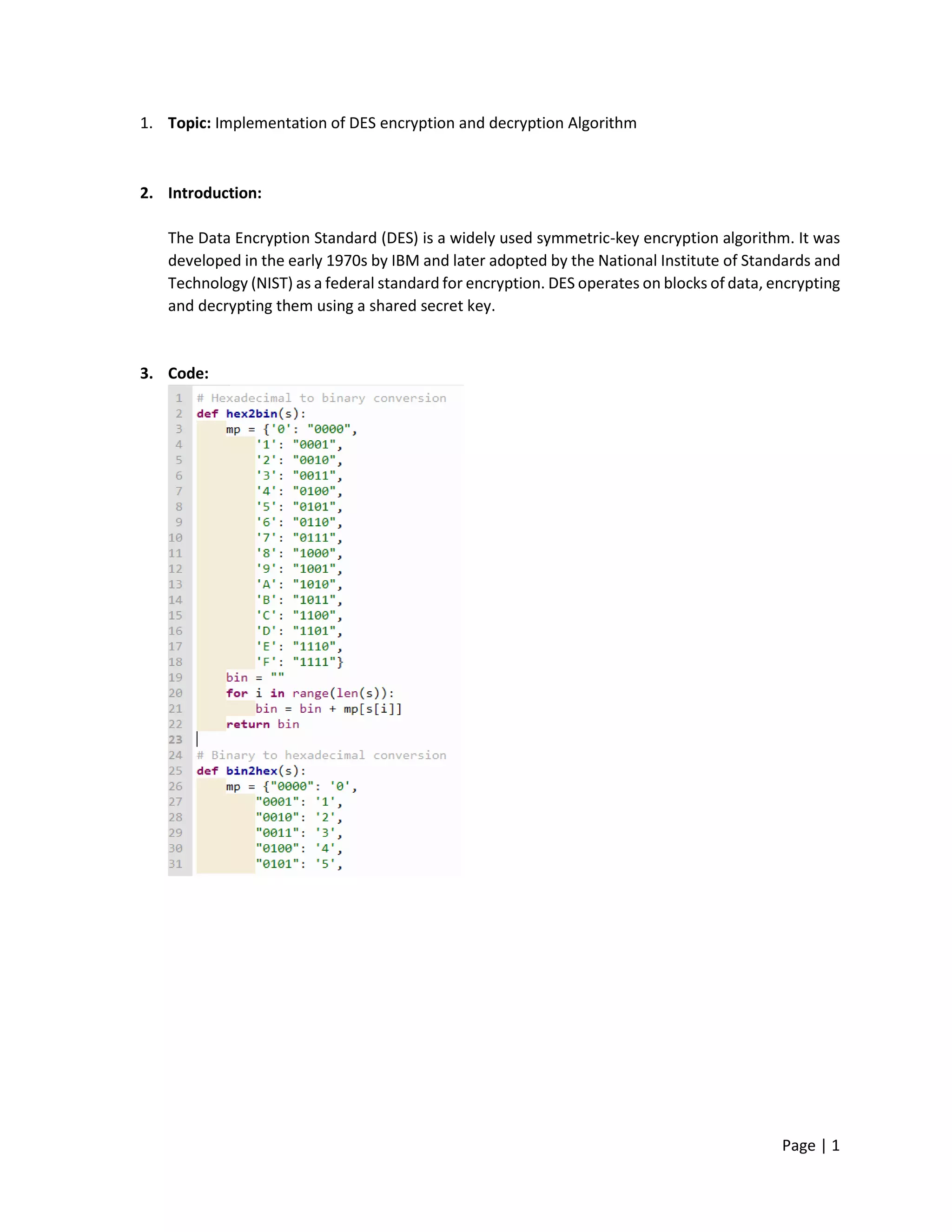
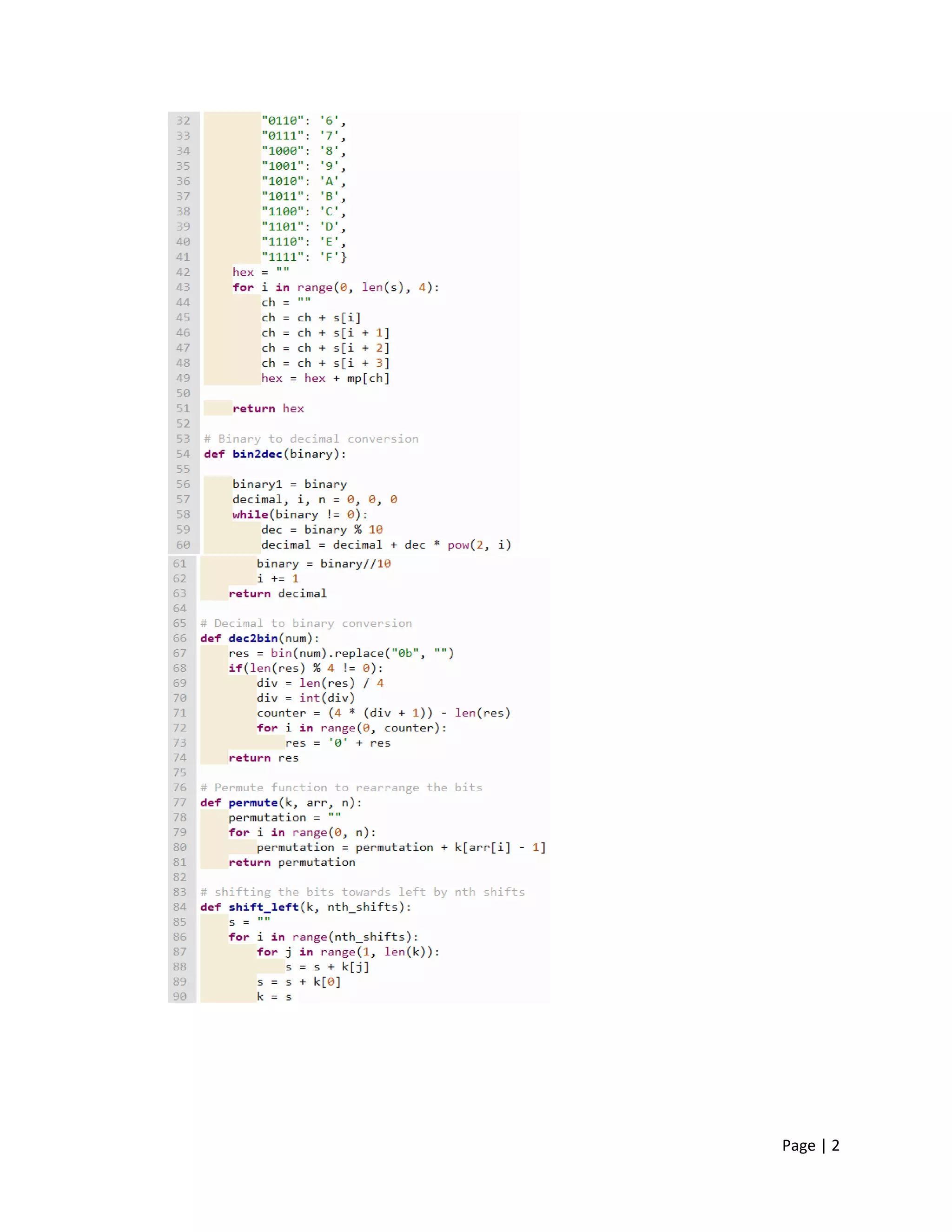
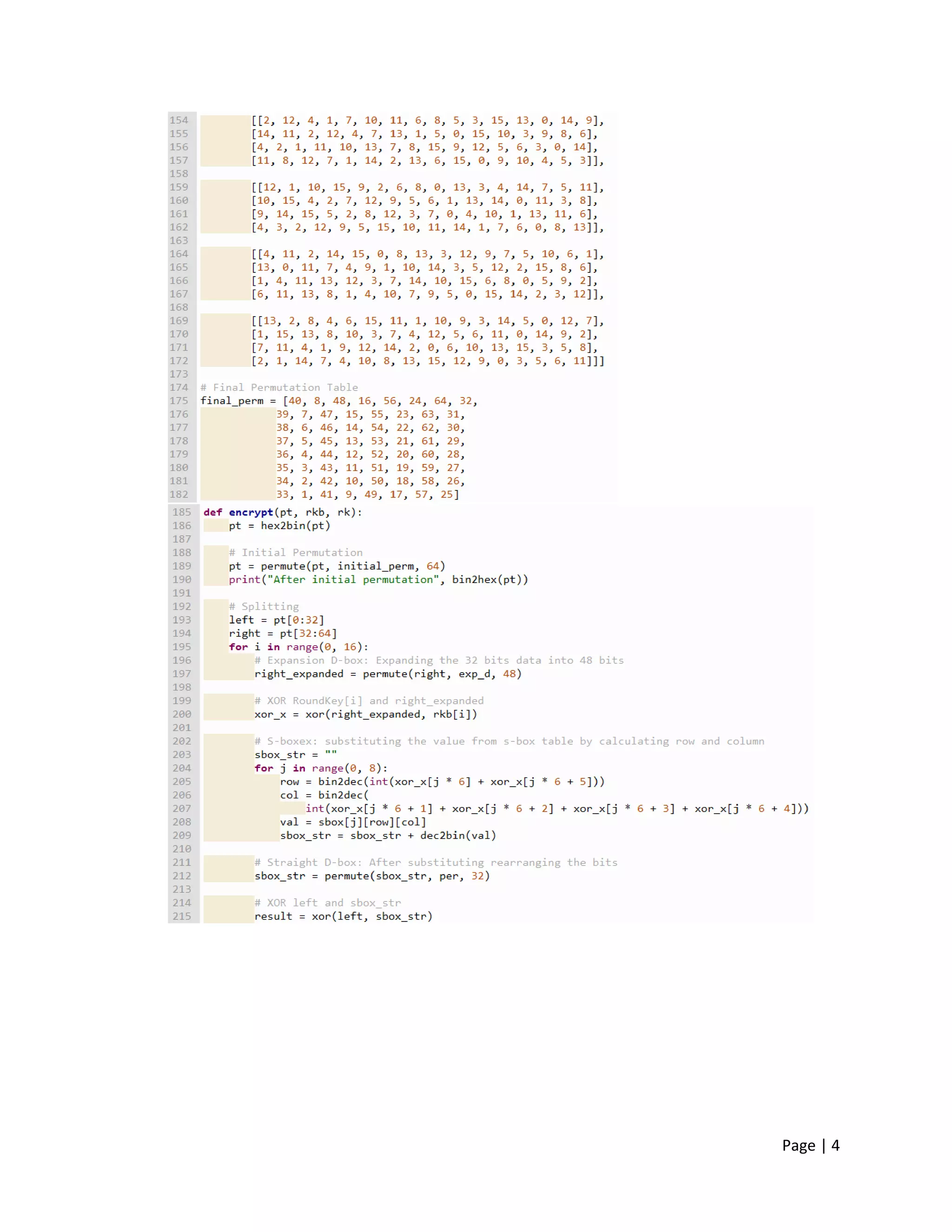
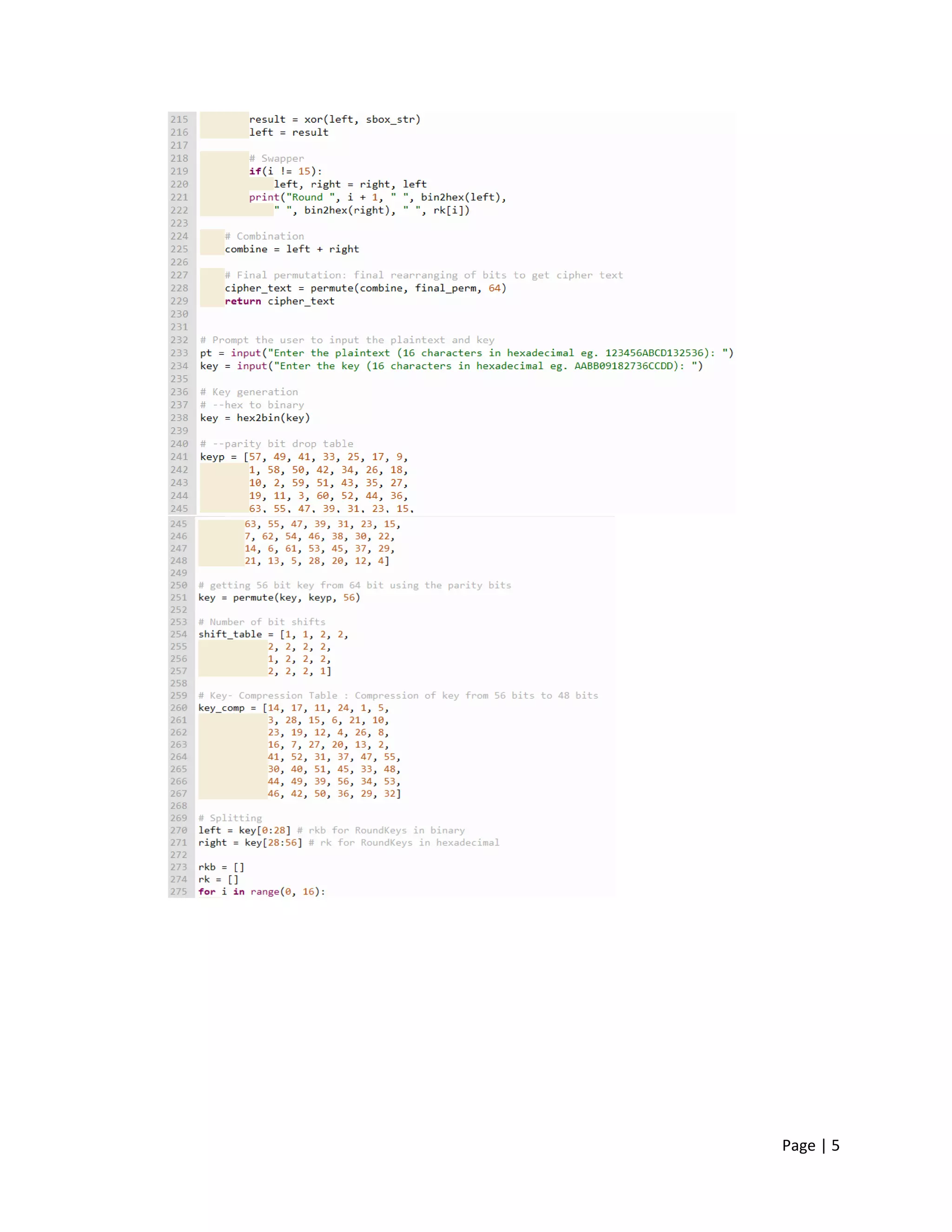
Page | 1 1. Topic: Implementation of DES encryption and decryption Algorithm 2. Introduction: The Data Encryption Standard (DES) is a widely used symmetric-key encryption algorithm. It was developed in the early 1970s by IBM and later adopted by the National Institute of Standards and Technology (NIST) as a federal standard for encryption. DES operates on blocks of data, encrypting and decrypting them using a shared secret key. 3. Code:
Page | 2
Page | 3
Page | 4
Page | 5
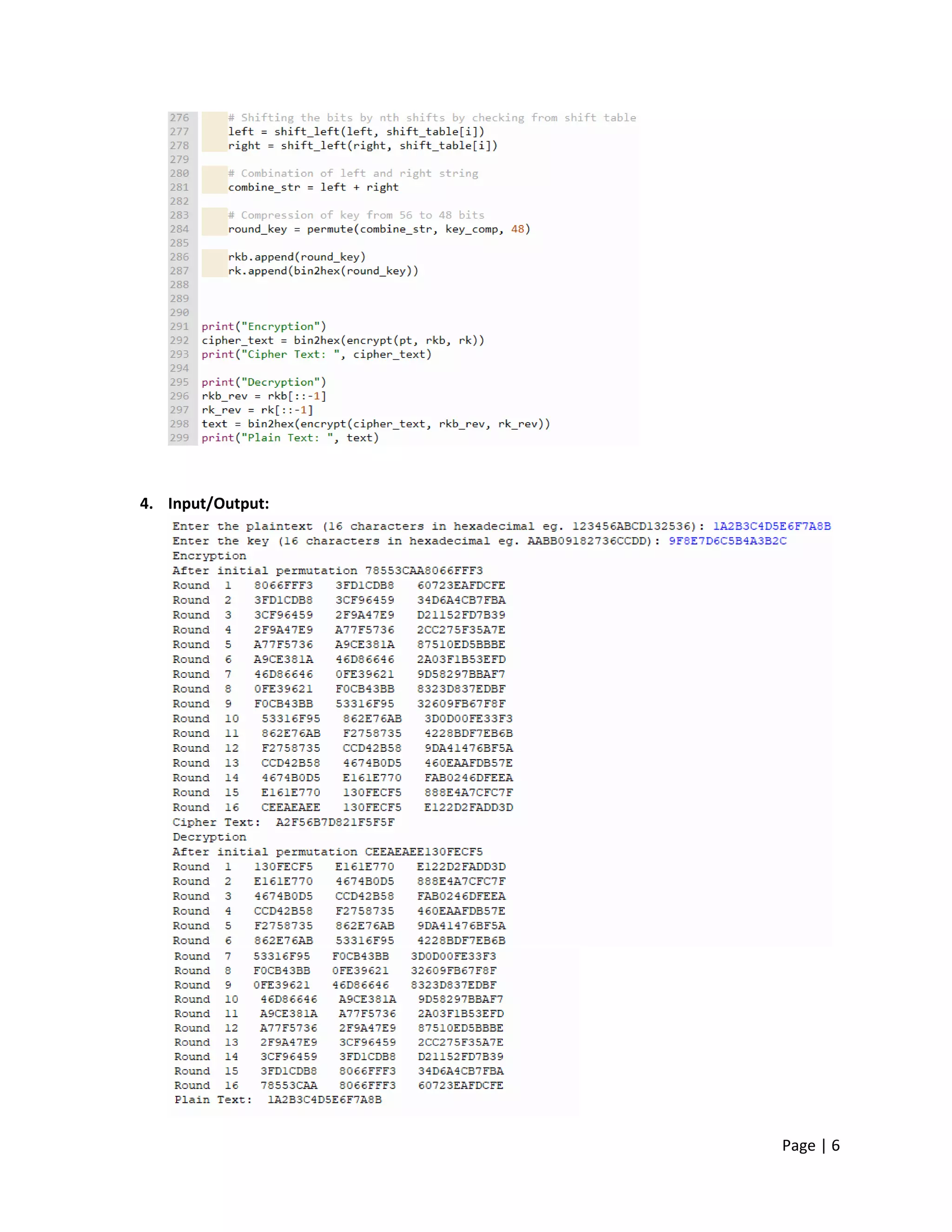
Page | 6 4. Input/Output:
Page | 7 5. Conclusion: In this lab report, we explored the DES (Data Encryption Standard) encryption and decryption algorithm. DES is a symmetric key block cipher that operates on 64-bit blocks of data. It employs both permutation and substitution techniques to achieve its encryption and decryption processes. During our investigation, we implemented the DES algorithm using Python and observed its functionality. The algorithm involves several key components, including key generation, initial permutation, Feistel network, round function, and final permutation. By understanding these components, we were able to encrypt and decrypt plaintext messages. Through our experimentation, we found that DES provides a strong level of security for data encryption. Its key strength of 56 bits ensures a large keyspace, making it computationally infeasible to brute-force attack. DES also exhibits resistance against known cryptographic attacks, such as differential and linear cryptanalysis. However, it's important to note that DES has become less secure over time due to advances in computational power. The 56-bit key size is now considered vulnerable to brute-force attacks. As a result, the use of DES is discouraged in modern cryptographic applications, and it has been replaced by more secure algorithms like AES (Advanced Encryption Standard). In conclusion, DES is a historically significant encryption algorithm that has played a crucial role in the field of cryptography. It laid the foundation for modern block ciphers and contributed to the development of stronger encryption standards. While DES itself is no longer recommended for practical use, studying its principles and mechanisms helps in understanding the evolution of cryptographic algorithms and their vulnerabilities.

Implementation of DES encryption and decryption Algorithm

  • 1.
    Page | 1 1.Topic: Implementation of DES encryption and decryption Algorithm 2. Introduction: The Data Encryption Standard (DES) is a widely used symmetric-key encryption algorithm. It was developed in the early 1970s by IBM and later adopted by the National Institute of Standards and Technology (NIST) as a federal standard for encryption. DES operates on blocks of data, encrypting and decrypting them using a shared secret key. 3. Code:
  • 2.
  • 3.
  • 4.
  • 5.
  • 6.
    Page | 6 4.Input/Output:
  • 7.
    Page | 7 5.Conclusion: In this lab report, we explored the DES (Data Encryption Standard) encryption and decryption algorithm. DES is a symmetric key block cipher that operates on 64-bit blocks of data. It employs both permutation and substitution techniques to achieve its encryption and decryption processes. During our investigation, we implemented the DES algorithm using Python and observed its functionality. The algorithm involves several key components, including key generation, initial permutation, Feistel network, round function, and final permutation. By understanding these components, we were able to encrypt and decrypt plaintext messages. Through our experimentation, we found that DES provides a strong level of security for data encryption. Its key strength of 56 bits ensures a large keyspace, making it computationally infeasible to brute-force attack. DES also exhibits resistance against known cryptographic attacks, such as differential and linear cryptanalysis. However, it's important to note that DES has become less secure over time due to advances in computational power. The 56-bit key size is now considered vulnerable to brute-force attacks. As a result, the use of DES is discouraged in modern cryptographic applications, and it has been replaced by more secure algorithms like AES (Advanced Encryption Standard). In conclusion, DES is a historically significant encryption algorithm that has played a crucial role in the field of cryptography. It laid the foundation for modern block ciphers and contributed to the development of stronger encryption standards. While DES itself is no longer recommended for practical use, studying its principles and mechanisms helps in understanding the evolution of cryptographic algorithms and their vulnerabilities.