TELKOMNIKA Telecommunication, Computing, Electronics and Control Vol. 18, No. 6, December 2020, pp. 3357~3364 ISSN: 1693-6930, accredited First Grade by Kemenristekdikti, Decree No: 21/E/KPT/2018 DOI: 10.12928/TELKOMNIKA.v18i6.16335  3357 Journal homepage: http://journal.uad.ac.id/index.php/TELKOMNIKA Improving face recognition by artificial neural network using principal component analysis Shatha A. Baker1 , Hesham Hashim Mohammed2 , Hanan A. Aldabagh3 1,2 Department of Electrical and Computer Engineering, Northern Technical University, Iraq 3 The General Directorate of Education in Nineveh Governorate, Iraq Article Info ABSTRACT Article history: Received Apr 13, 2020 Revised Apr 29, 2020 Accepted Jun 25, 2020 The face-recognition system is among the most effective pattern recognition and image analysis techniques. This technique has met great attention from academic and industrial fields because of its extensive use in detecting the identity of individuals for monitoring systems, security and many other practical fields. In this paper, an effective method of face recognition was proposed. Ten person's faces images were selected from ORL dataset, for each person (42) image with total of (420) images as dataset. Features are extracted using principle component analysis PCA to reduce the dimensionality of the face images. Four models where created, the first one was trained using feed forward back propagation learning (FFBBL) with 40 features, the second was trained using 50 features with FFBBL, the third and fourth models were trained using the same features but using Elman neural network. For each person (24) image used as training set for the neural networks, while the remaining images used as testing set. The results showed that the proposed method was effective and highly accurate. FFBBL give accuracy of (98.33, 98.80) with (40, 50) features respectively, while Elman gives (98.33, 95.14) for with (40, 50) features respectively. Keywords: Artificial neural network Pattern recognition Principle component analysis This is an open access article under the CC BY-SA license. Corresponding Author: Hesham Hashim Mohammed, Electronic Computer Center, Northern Technical University, University High Way Street, Mosul, Iraq. Email: hhmss888@gmail.com 1. INTRODUCTION The technique of pattern recognition is one of the most successful techniques in the field of image processing. Recently, this technology has been used for security purposes, and has become compatible with security systems based on other biometrics such as fingerprints and iris [1, 2]. The neural network-based tree [3], neural networks, artificial neural networks [4] and key component analysis [5] are the common methods used for face recognition. Principle component analysis (PCA) is a statistical measurement method that reduces the large dimensions of the image in the data space to smaller dimensions. The new spaces are often feature spaces, this helps to reduce the calculations of the image database in a controlled way to obtain higher recognition and best accuracy [6-8]. PCA can be used for extracting the features from a human face intensity image. The basic face database is defined as all training patterns of the same size and configuration. In this work we utilized facial recognition from the ORL database. Neural networks gave high efficiency in computational techniques to pattern recognition and image processing, which led to their widely use in this field [9, 10]. In this research, two types of neural networks were used: a feedback network and the current frequency network (Elman), both networks gave high accuracy.
 ISSN: 1693-6930 TELKOMNIKA Telecommun Comput El Control, Vol. 18, No. 6, December 2020: 3357 - 3364 3358 2. RELATED WORKS The researchers introduce a reliable and automated system that depend on using multi-algorithms for face recognition and it's applied on students faces, the system propose using both principal component analysis (PCA) as well as histogram of oriented gradient (HOG) for feature extraction and artificial neural network (ANN) for recognition, coupled with help vector machine (SVM). The accuracy of system recognition was 96.8% [11]. The researchers in [12] presents a Face recognition system in which principal component analysis (PCA) and back propagation neural networks (BPNN) is performed where used for face identification and verification while they implement face recognition system is done by using neural network, Its acceptance ratio was greater than 90% for the proposed matching methods. In [13], the researchers introduce a face recognition system which use PCA for dimensionality reduction and feature extraction, with SVM were used as classifier. The system accuracy was 96.8%. In 2013, other researchers proposed face recognition paper using wavelet transform and PCA with neural network back propagation. Wavelet transformations were used to calculate the level of image decomposition. Using three levels the image was disassembled. The study showed the third level is the best level of disassembly [14]. In the other work [15], a descriptor is obtained by projecting a face as an input on a eigenface space, then the descriptor is fed as an input to each object's pre-trained network. They determine and report the maximum output if it passes the threshold previously established for the recognition system. 3. RESEARCH METHOD Some particular methodologies need to be followed in order to implement the proposed algorithm dealing with the face recognition system. For this process, certain steps need to be taken. The proposed algorithm included major steps are as follows, shown in Figure 1. a. Preprocessing: In this step, the face detection process checks if the image is a face image or not. The face cropping only from the entire image using the Viola-Jones algorithm [16]. Transform the image of the face cropped to size (50×60), as shown in Figure 2. b. Finding the Eigen Data Matrix to be used in subsequent steps to extract feature [17], Figure 3 represents the flowchart for the finding of the Eigen matrix. c. Extracting the features of the faces using the Eigen vectors of the faces "calculated by step 2", Figure 4 represent the flowchart of the extraction features process. d. Training and testing of two artificial neural networks. One of them is of type FFBBL and the other is Elman Neural network. Figure 1. Block diagram of the system Figure 2. steps of Preprocessing
TELKOMNIKA Telecommun Comput El Control  Improving face recognition by artificial neural network using… (Shatha A. Baker) 3359 Figure 3. System flowchart of calculating Eigen matrix Figure 4. System flowchart for finding face features using Eigen matrix 3.1. Back propagation network BBN has proved successful in identifying and recognition patterns [18, 19]. It is a kind of supervised learning network. The basis of its work depends on the gradual regression method used to update the weight values to find the lowest mean square error between the output values of the network and the target values. Therefore,
 ISSN: 1693-6930 TELKOMNIKA Telecommun Comput El Control, Vol. 18, No. 6, December 2020: 3357 - 3364 3360 the updated weights are used in each layer of the network to begin with the output layer and end with the input layer, so it is called the back propagation [20], and Figure 5 illustrates the architecture of this network. The training of the back Propagation network goes through two phases [21]:  Feed forward stage: The input from the input layer moves to the hidden layer(s) according to their number, ending with the output layer, and then comparing the actual output values with the desired output values to calculate the difference between them, which represents the error value.  Feedback phase: At this stage, the weights of the grid are adjusted depending on the error value. This process continues until the true output value becomes as close as possible to the desired output value. Figure 5. Architecture of FFBBL 3.2. Elman network The Elman network is a special kind of back propagation networks. It is one of the most famous iterative networks. It has been used in the fields of recognition and classification to contain a dynamic memory that can be used to retrieve the hidden layer to the input layer, thus speeding up the network. The Elman network consists of the input and output layers in addition to the hidden layer. It has processing units equal to the number of processing units in the hidden layer. These units serve as memory to store the previous state [22, 23]. At the beginning of the training, the processing units are given zero values and the corresponding weights are single values then adjust during training. The previous values are stored for the hidden layer to be re-entered by the input layer after the weights have been adjusted. The insertion of the hidden layer is the result of the input values multiplied by the weight after adding bias values. Using the back-propagation frequency of the error, the weights are adjusted and the network is given the ability to recognition patterns through different iterative phases and Figure 6 illustrates the architecture of Elman network [24]. The proposed algorithm used two sets of features 40 and 50 respectivly. These features are extracted using the eigenface algorithm illustrated in Figure 2. Each set of features are used to Train two types of artificial neural networks feed forward back probagation learning and Elman neural network. These networks was trained using the Levenberg-Marquardt Back propagation algorithm for back probagation learning [25]. Figure 6. Architecture of Elman network
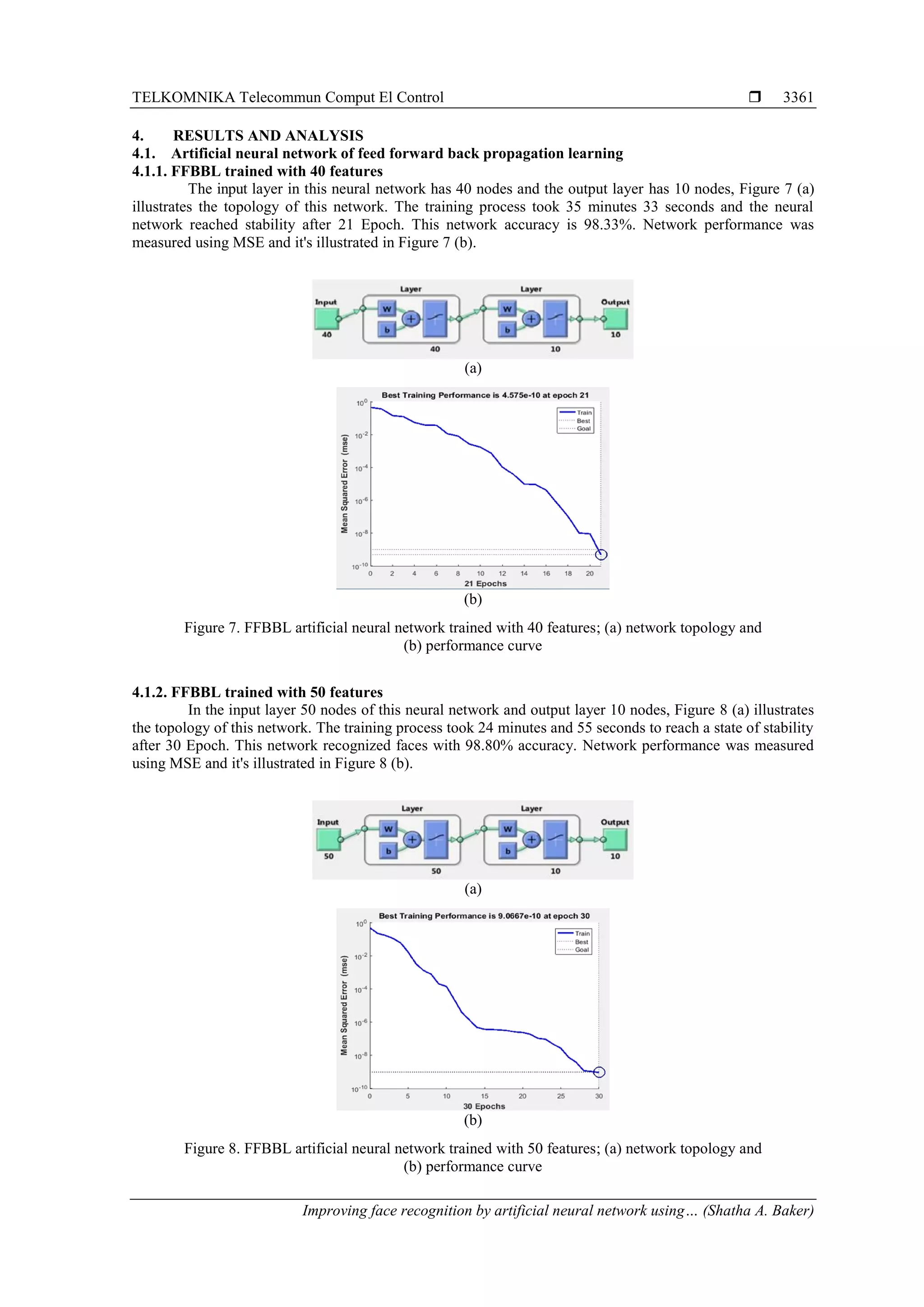
TELKOMNIKA Telecommun Comput El Control  Improving face recognition by artificial neural network using… (Shatha A. Baker) 3361 4. RESULTS AND ANALYSIS 4.1. Artificial neural network of feed forward back propagation learning 4.1.1. FFBBL trained with 40 features The input layer in this neural network has 40 nodes and the output layer has 10 nodes, Figure 7 (a) illustrates the topology of this network. The training process took 35 minutes 33 seconds and the neural network reached stability after 21 Epoch. This network accuracy is 98.33%. Network performance was measured using MSE and it's illustrated in Figure 7 (b). (a) (b) Figure 7. FFBBL artificial neural network trained with 40 features; (a) network topology and (b) performance curve 4.1.2. FFBBL trained with 50 features In the input layer 50 nodes of this neural network and output layer 10 nodes, Figure 8 (a) illustrates the topology of this network. The training process took 24 minutes and 55 seconds to reach a state of stability after 30 Epoch. This network recognized faces with 98.80% accuracy. Network performance was measured using MSE and it's illustrated in Figure 8 (b). (a) (b) Figure 8. FFBBL artificial neural network trained with 50 features; (a) network topology and (b) performance curve
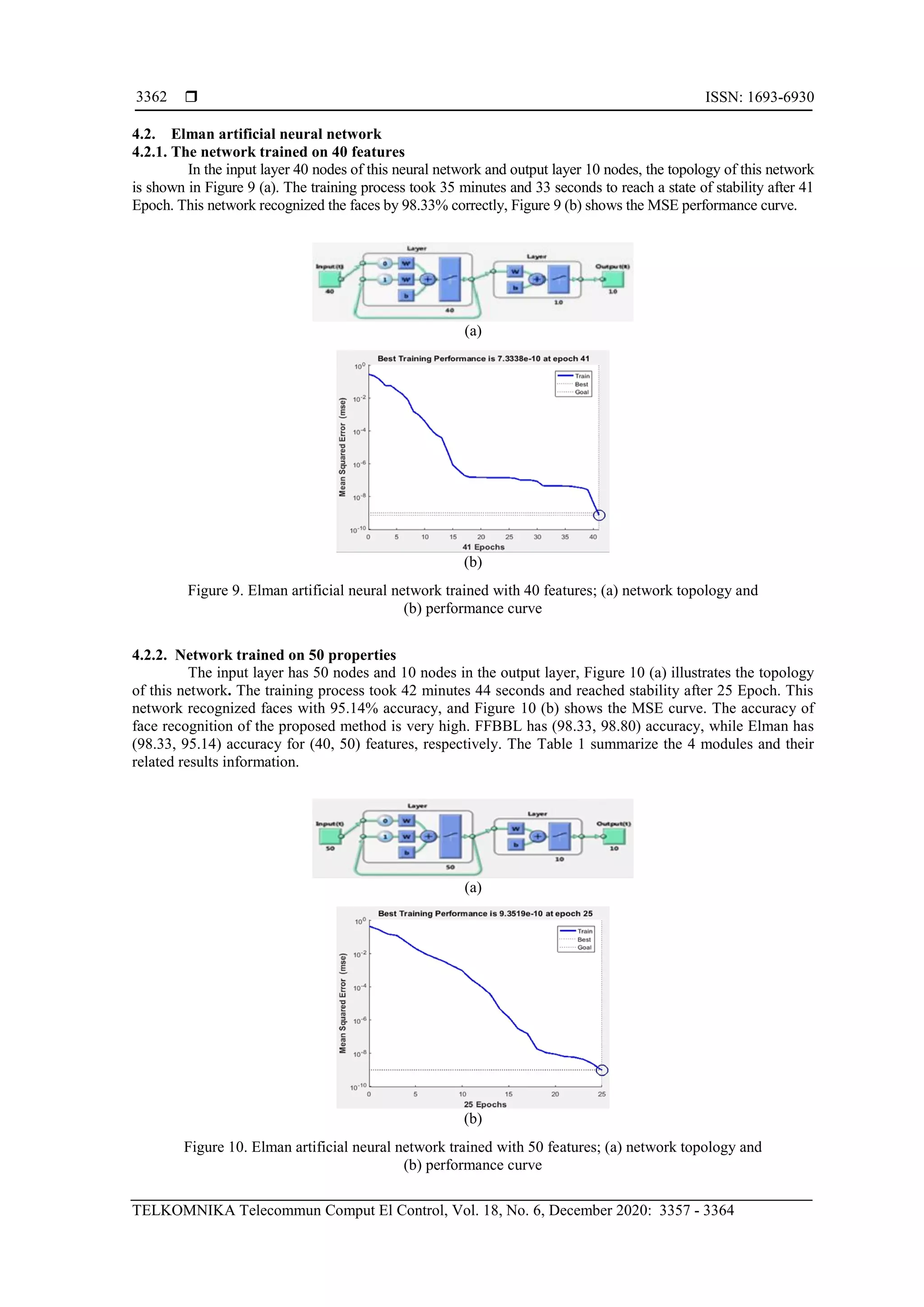
 ISSN: 1693-6930 TELKOMNIKA Telecommun Comput El Control, Vol. 18, No. 6, December 2020: 3357 - 3364 3362 4.2. Elman artificial neural network 4.2.1. The network trained on 40 features In the input layer 40 nodes of this neural network and output layer 10 nodes, the topology of this network is shown in Figure 9 (a). The training process took 35 minutes and 33 seconds to reach a state of stability after 41 Epoch. This network recognized the faces by 98.33% correctly, Figure 9 (b) shows the MSE performance curve. (a) (b) Figure 9. Elman artificial neural network trained with 40 features; (a) network topology and (b) performance curve 4.2.2. Network trained on 50 properties The input layer has 50 nodes and 10 nodes in the output layer, Figure 10 (a) illustrates the topology of this network. The training process took 42 minutes 44 seconds and reached stability after 25 Epoch. This network recognized faces with 95.14% accuracy, and Figure 10 (b) shows the MSE curve. The accuracy of face recognition of the proposed method is very high. FFBBL has (98.33, 98.80) accuracy, while Elman has (98.33, 95.14) accuracy for (40, 50) features, respectively. The Table 1 summarize the 4 modules and their related results information. (a) (b) Figure 10. Elman artificial neural network trained with 50 features; (a) network topology and (b) performance curve
TELKOMNIKA Telecommun Comput El Control  Improving face recognition by artificial neural network using… (Shatha A. Baker) 3363 Table 1. Final results summary Network type Number of features Number of epochs Training time Min: Sec Accuracy FFBBL 40 21 35:33 98.33% 50 30 24:55 98.80% Elman 40 41 35:33 98.33% 50 25 42:44 95.14% 5. CONCLOSION Face recognition is among the most common applications in many areas which can be used as a replacement to a password or for identification of criminals. In this work a proposed method for Face recognition by ANN Using PCA was presented. We can infer from the result that there is an inverse relation between both the number of features extracted and the number of Epochs that is when the features increase the Epochs number decrease. In either case the recognition accuracy is high. In FFBBL with 50 features, the recognition accuracy is high comparing with Elman with the same number of features, also the training time increases from 24:55 to 42:44. REFERENCES [1] Prajoy Podder, A. H. M Shahariar Parvez, Md. Mizanur Rahman, Tanvir Zaman Khan, “Ramifications and Diminution of Image Noise in Iris Recognition System,” Conference: 2018 IEEE International Conference on Current Trends towards Converging TechnologiesAt: India, pp. 205-211, 2018. [2] A. George and A. Routray, “A score level fusion method for eye movement biometrics,” Pattern Recognit. Lett., vol. 82, pp. 207-215, 2016. doi: 10.1016/j.patrec.2015.11.020. [3] M. Zhang and J. Fulcher, “Face perspective understanding using artificial neural network group-based tree,” IEEE Int. Conf. Image Process., vol. 3, pp. 475-478, 1996. doi: 10.1109/icip.1996.560534. [4] M. M. Kasar, D. Bhattacharyya, and T. H. Kim, “Face recognition using neural network: A review,” Int. J. Secur. its Appl., vol. 10, no. 3, pp. 81-100, 2016. doi: 10.14257/ijsia.2016.10.3.08. [5] T. F. Karim, M. S. H. Lipu, M. L. Rahman, and F. Sultana, “Face recognition using PCA-based method,” ICAMS 2010 - Proc. 2010 IEEE Int. Conf. Adv. Manag. Sci., vol. 3, pp. 158-162, 2010. doi: 10.1109/ICAMS.2010.5553266. [6] A. Mandhare and S. Kadam, "Performance Analysis of Trust-Based," Springer Singapore, 2019. [7] O. Jericho, M. Kevin, R. Spencer, I. Kris, and B.-C. Magdalena, “Unsupervised Learning Methods in X-ray Spectral Imaging Material Segmentation,” arXiv:1904.03701 [physics.med-ph], 2019. doi: 10.1088/1748-0221/14/06/P06022. [8] H. Xie, J. Li, Q. Zhang, and Y. Wang, “Comparison among dimensionality reduction techniques based on Random Projection for cancer classification,” Comput. Biol. Chem., vol. 65, pp. 165-172, 2016. [9] N. Chhillar, N. Yadav, and N. Jaiswal, “Enhanced Efficiency Using Pattern Recognition System,” International Journal of Technology Enhancements and Emerging Engineering Research, vol. 1, no. 4, pp. 119-122, 2014. [10] D. Beaini, S. Achiche, and M. Raison, “Improving Convolutional Neural Networks Via Conservative Field Regularisation and Integration,” arXiv:2003.05182 [cs.CV], pp. 1-11, 2020, [Online]. Available: http://arxiv.org/abs/2003. [11] Kehinde Sotonwa, Oluwashina Oyeniran, “Facial Recognition System: A Shift In Students Attendance Management,” Anale Seria Informatica, vol. XVII, fasc. 1, 2019. [12] S. Rastogi and S. Choudhary, “Face recognition by using neural network,” Acta Inform. Malaysia, vol. 3, no. 2, pp. 7-9, 2019. [13] S. Zhang, Z. Y. Li, Y. C. Liu, “Research on Face Recognition Technology Based on PCA and SVM,” in Proceedings of the 11th International Conference on Modelling, Identification and Control (ICMIC2019), pp. 75-85, 2020. [14] M. P. Satone and G. K. Kharate, "Face recognition based on PCA on wavelet subband," 2012 IEEE Students' Conference on Electrical, Electronics and Computer Science, Bhopal, pp. 1-4, 2012. [15] M. A. Al-Abaji and M. M. Salih, “The using of PCA, wavelet and GLCM in face recognition system, a comparative study,” J. Univ. Babylon Pure Appl. Sci., vol. 26, no. 10, pp. 131-139, 2018. [16] N. T. Deshpande and S. Ravishankar, “Face Detection and Recognition using Viola-Jones algorithm and fusion of LDA and ANN,” IOSR J. Comput. Eng., vol. 18, no. 6, pp. 1-6, 2016. doi: 10.9790/0661-1806020106. [17] G. M. Zafaruddin and H. S. Fadewar, “Face recognition using eigenfaces,” in Computing, Communication and Signal Processing, Springer, pp. 855-864, 2019. [18] P. Melin and D. Sánchez, “Multi-objective optimization for modular granular neural networks applied to pattern recognition,” Inf. Sci. (Ny)., vol. 460-461, pp. 594-610, 2018. doi: 10.1016/j.ins.2017.09.031. [19] M. M. Hussein, A. H. Mutlag, and H. Shareef, “Developed artificial neural network based on human face recognition,” Indones. J. Electr. Eng. Comput. Sci., vol. 16, no. 3, pp. 1279-1285, 2019, doi: 10.11591/ijeecs.v16.i3.pp1279-1285. [20] T. Ahmad, A. Jameel, and B. Ahmad, “Pattern recognition using statistical and neural techniques,” in International Conference on Computer Networks and Information Technology, pp. 87-91, 2011. [21] I. Jung and G. Wang, “Pattern Classification of Back-Propagation Algorithm Using Exclusive Connecting Network,” World Acad. Sci. Eng. Technol., vol. 36, pp. 189-193, 2007. [22] A. S. Abdullah, M. A. Abed, and I. Al-Barazanchi, “Improving face recognition by elman neural network using curvelet transform and HSI color space,” Period. Eng. Nat. Sci., vol. 7, no. 2, pp. 430-437, 2019. [23] S. Q. Alhashmi, K. H. Thanoon, and O. I. Alsaif, “A Proposed Face Recognition based on Hybrid Algorithm for Features Extraction,” Proc. 6th Int. Eng. Conf. Sustainable Technol. Dev. IEC 2020, pp. 232-236, 2020.
 ISSN: 1693-6930 TELKOMNIKA Telecommun Comput El Control, Vol. 18, No. 6, December 2020: 3357 - 3364 3364 [24] Y. Shi and D. Feng, “Face Recognition Based on Block PCA algorithm and Elman neural network,” IOP Conf. Ser. Mater. Sci. Eng., vol. 382, no. 5, 2018. [25] S. Sapna, “Backpropagation Learning Algorithm Based on Levenberg Marquardt Algorithm,” in Conference: The Fourth International Workshop on Computer Networks & Communications pp. 393-398, 2012. BIOGRAPHIES OF AUTHORS Mr. Hesham Hashim, received his BSc and MSc degree from University of Mosul-Iraq, College of computer science and mathematics, Computer Science department, at 2010, 2013 respectively. He worked as assistant lecturer in computer science department, college of computer science and mathematics, mosul, Iraq for the period 2013 to the end of 2016. Since 2017 he worked as assistant lecturer in Northern Technical University (NTU), Mosul, Iraq. He is now a Ph. D student at the computer science and mathematics college. His interested research area includes AI applications, digital image processing and bioinformatics. Mrs. Shatha obtained a BSc in Computer Science from the University of Mosul in 1997, and in 2013, she earned an MSc in Computer Science from the same University. She worked as a lecturer in Northern Technical University (NTU), Mosul, Iraq. Her interested research area includes Mobile programming, Information Security and Multimedia communications and Artificial intelligence. She is now a Ph. D student at the computer science and mathematics college. Ms. Hanan, in 2008 received her BSc in Computer Science from the University of Mosul, and in 2014 she earned an MSc in Computer Science from the same University. She works as an employee The General Directorate of Education in Nineveh Governorate, Iraq. Her interested research area includes wireless network, Information Security and Multimedia communications and Artificial intelligence. She is now a Ph. D student at the computer science and mathematics college.

Improving face recognition by artificial neural network using principal component analysis

  • 1.
    TELKOMNIKA Telecommunication, Computing,Electronics and Control Vol. 18, No. 6, December 2020, pp. 3357~3364 ISSN: 1693-6930, accredited First Grade by Kemenristekdikti, Decree No: 21/E/KPT/2018 DOI: 10.12928/TELKOMNIKA.v18i6.16335  3357 Journal homepage: http://journal.uad.ac.id/index.php/TELKOMNIKA Improving face recognition by artificial neural network using principal component analysis Shatha A. Baker1 , Hesham Hashim Mohammed2 , Hanan A. Aldabagh3 1,2 Department of Electrical and Computer Engineering, Northern Technical University, Iraq 3 The General Directorate of Education in Nineveh Governorate, Iraq Article Info ABSTRACT Article history: Received Apr 13, 2020 Revised Apr 29, 2020 Accepted Jun 25, 2020 The face-recognition system is among the most effective pattern recognition and image analysis techniques. This technique has met great attention from academic and industrial fields because of its extensive use in detecting the identity of individuals for monitoring systems, security and many other practical fields. In this paper, an effective method of face recognition was proposed. Ten person's faces images were selected from ORL dataset, for each person (42) image with total of (420) images as dataset. Features are extracted using principle component analysis PCA to reduce the dimensionality of the face images. Four models where created, the first one was trained using feed forward back propagation learning (FFBBL) with 40 features, the second was trained using 50 features with FFBBL, the third and fourth models were trained using the same features but using Elman neural network. For each person (24) image used as training set for the neural networks, while the remaining images used as testing set. The results showed that the proposed method was effective and highly accurate. FFBBL give accuracy of (98.33, 98.80) with (40, 50) features respectively, while Elman gives (98.33, 95.14) for with (40, 50) features respectively. Keywords: Artificial neural network Pattern recognition Principle component analysis This is an open access article under the CC BY-SA license. Corresponding Author: Hesham Hashim Mohammed, Electronic Computer Center, Northern Technical University, University High Way Street, Mosul, Iraq. Email: hhmss888@gmail.com 1. INTRODUCTION The technique of pattern recognition is one of the most successful techniques in the field of image processing. Recently, this technology has been used for security purposes, and has become compatible with security systems based on other biometrics such as fingerprints and iris [1, 2]. The neural network-based tree [3], neural networks, artificial neural networks [4] and key component analysis [5] are the common methods used for face recognition. Principle component analysis (PCA) is a statistical measurement method that reduces the large dimensions of the image in the data space to smaller dimensions. The new spaces are often feature spaces, this helps to reduce the calculations of the image database in a controlled way to obtain higher recognition and best accuracy [6-8]. PCA can be used for extracting the features from a human face intensity image. The basic face database is defined as all training patterns of the same size and configuration. In this work we utilized facial recognition from the ORL database. Neural networks gave high efficiency in computational techniques to pattern recognition and image processing, which led to their widely use in this field [9, 10]. In this research, two types of neural networks were used: a feedback network and the current frequency network (Elman), both networks gave high accuracy.
  • 2.
     ISSN: 1693-6930 TELKOMNIKATelecommun Comput El Control, Vol. 18, No. 6, December 2020: 3357 - 3364 3358 2. RELATED WORKS The researchers introduce a reliable and automated system that depend on using multi-algorithms for face recognition and it's applied on students faces, the system propose using both principal component analysis (PCA) as well as histogram of oriented gradient (HOG) for feature extraction and artificial neural network (ANN) for recognition, coupled with help vector machine (SVM). The accuracy of system recognition was 96.8% [11]. The researchers in [12] presents a Face recognition system in which principal component analysis (PCA) and back propagation neural networks (BPNN) is performed where used for face identification and verification while they implement face recognition system is done by using neural network, Its acceptance ratio was greater than 90% for the proposed matching methods. In [13], the researchers introduce a face recognition system which use PCA for dimensionality reduction and feature extraction, with SVM were used as classifier. The system accuracy was 96.8%. In 2013, other researchers proposed face recognition paper using wavelet transform and PCA with neural network back propagation. Wavelet transformations were used to calculate the level of image decomposition. Using three levels the image was disassembled. The study showed the third level is the best level of disassembly [14]. In the other work [15], a descriptor is obtained by projecting a face as an input on a eigenface space, then the descriptor is fed as an input to each object's pre-trained network. They determine and report the maximum output if it passes the threshold previously established for the recognition system. 3. RESEARCH METHOD Some particular methodologies need to be followed in order to implement the proposed algorithm dealing with the face recognition system. For this process, certain steps need to be taken. The proposed algorithm included major steps are as follows, shown in Figure 1. a. Preprocessing: In this step, the face detection process checks if the image is a face image or not. The face cropping only from the entire image using the Viola-Jones algorithm [16]. Transform the image of the face cropped to size (50×60), as shown in Figure 2. b. Finding the Eigen Data Matrix to be used in subsequent steps to extract feature [17], Figure 3 represents the flowchart for the finding of the Eigen matrix. c. Extracting the features of the faces using the Eigen vectors of the faces "calculated by step 2", Figure 4 represent the flowchart of the extraction features process. d. Training and testing of two artificial neural networks. One of them is of type FFBBL and the other is Elman Neural network. Figure 1. Block diagram of the system Figure 2. steps of Preprocessing
  • 3.
    TELKOMNIKA Telecommun ComputEl Control  Improving face recognition by artificial neural network using… (Shatha A. Baker) 3359 Figure 3. System flowchart of calculating Eigen matrix Figure 4. System flowchart for finding face features using Eigen matrix 3.1. Back propagation network BBN has proved successful in identifying and recognition patterns [18, 19]. It is a kind of supervised learning network. The basis of its work depends on the gradual regression method used to update the weight values to find the lowest mean square error between the output values of the network and the target values. Therefore,
  • 4.
     ISSN: 1693-6930 TELKOMNIKATelecommun Comput El Control, Vol. 18, No. 6, December 2020: 3357 - 3364 3360 the updated weights are used in each layer of the network to begin with the output layer and end with the input layer, so it is called the back propagation [20], and Figure 5 illustrates the architecture of this network. The training of the back Propagation network goes through two phases [21]:  Feed forward stage: The input from the input layer moves to the hidden layer(s) according to their number, ending with the output layer, and then comparing the actual output values with the desired output values to calculate the difference between them, which represents the error value.  Feedback phase: At this stage, the weights of the grid are adjusted depending on the error value. This process continues until the true output value becomes as close as possible to the desired output value. Figure 5. Architecture of FFBBL 3.2. Elman network The Elman network is a special kind of back propagation networks. It is one of the most famous iterative networks. It has been used in the fields of recognition and classification to contain a dynamic memory that can be used to retrieve the hidden layer to the input layer, thus speeding up the network. The Elman network consists of the input and output layers in addition to the hidden layer. It has processing units equal to the number of processing units in the hidden layer. These units serve as memory to store the previous state [22, 23]. At the beginning of the training, the processing units are given zero values and the corresponding weights are single values then adjust during training. The previous values are stored for the hidden layer to be re-entered by the input layer after the weights have been adjusted. The insertion of the hidden layer is the result of the input values multiplied by the weight after adding bias values. Using the back-propagation frequency of the error, the weights are adjusted and the network is given the ability to recognition patterns through different iterative phases and Figure 6 illustrates the architecture of Elman network [24]. The proposed algorithm used two sets of features 40 and 50 respectivly. These features are extracted using the eigenface algorithm illustrated in Figure 2. Each set of features are used to Train two types of artificial neural networks feed forward back probagation learning and Elman neural network. These networks was trained using the Levenberg-Marquardt Back propagation algorithm for back probagation learning [25]. Figure 6. Architecture of Elman network
  • 5.
    TELKOMNIKA Telecommun ComputEl Control  Improving face recognition by artificial neural network using… (Shatha A. Baker) 3361 4. RESULTS AND ANALYSIS 4.1. Artificial neural network of feed forward back propagation learning 4.1.1. FFBBL trained with 40 features The input layer in this neural network has 40 nodes and the output layer has 10 nodes, Figure 7 (a) illustrates the topology of this network. The training process took 35 minutes 33 seconds and the neural network reached stability after 21 Epoch. This network accuracy is 98.33%. Network performance was measured using MSE and it's illustrated in Figure 7 (b). (a) (b) Figure 7. FFBBL artificial neural network trained with 40 features; (a) network topology and (b) performance curve 4.1.2. FFBBL trained with 50 features In the input layer 50 nodes of this neural network and output layer 10 nodes, Figure 8 (a) illustrates the topology of this network. The training process took 24 minutes and 55 seconds to reach a state of stability after 30 Epoch. This network recognized faces with 98.80% accuracy. Network performance was measured using MSE and it's illustrated in Figure 8 (b). (a) (b) Figure 8. FFBBL artificial neural network trained with 50 features; (a) network topology and (b) performance curve
  • 6.
     ISSN: 1693-6930 TELKOMNIKATelecommun Comput El Control, Vol. 18, No. 6, December 2020: 3357 - 3364 3362 4.2. Elman artificial neural network 4.2.1. The network trained on 40 features In the input layer 40 nodes of this neural network and output layer 10 nodes, the topology of this network is shown in Figure 9 (a). The training process took 35 minutes and 33 seconds to reach a state of stability after 41 Epoch. This network recognized the faces by 98.33% correctly, Figure 9 (b) shows the MSE performance curve. (a) (b) Figure 9. Elman artificial neural network trained with 40 features; (a) network topology and (b) performance curve 4.2.2. Network trained on 50 properties The input layer has 50 nodes and 10 nodes in the output layer, Figure 10 (a) illustrates the topology of this network. The training process took 42 minutes 44 seconds and reached stability after 25 Epoch. This network recognized faces with 95.14% accuracy, and Figure 10 (b) shows the MSE curve. The accuracy of face recognition of the proposed method is very high. FFBBL has (98.33, 98.80) accuracy, while Elman has (98.33, 95.14) accuracy for (40, 50) features, respectively. The Table 1 summarize the 4 modules and their related results information. (a) (b) Figure 10. Elman artificial neural network trained with 50 features; (a) network topology and (b) performance curve
  • 7.
    TELKOMNIKA Telecommun ComputEl Control  Improving face recognition by artificial neural network using… (Shatha A. Baker) 3363 Table 1. Final results summary Network type Number of features Number of epochs Training time Min: Sec Accuracy FFBBL 40 21 35:33 98.33% 50 30 24:55 98.80% Elman 40 41 35:33 98.33% 50 25 42:44 95.14% 5. CONCLOSION Face recognition is among the most common applications in many areas which can be used as a replacement to a password or for identification of criminals. In this work a proposed method for Face recognition by ANN Using PCA was presented. We can infer from the result that there is an inverse relation between both the number of features extracted and the number of Epochs that is when the features increase the Epochs number decrease. In either case the recognition accuracy is high. In FFBBL with 50 features, the recognition accuracy is high comparing with Elman with the same number of features, also the training time increases from 24:55 to 42:44. REFERENCES [1] Prajoy Podder, A. H. M Shahariar Parvez, Md. Mizanur Rahman, Tanvir Zaman Khan, “Ramifications and Diminution of Image Noise in Iris Recognition System,” Conference: 2018 IEEE International Conference on Current Trends towards Converging TechnologiesAt: India, pp. 205-211, 2018. [2] A. George and A. Routray, “A score level fusion method for eye movement biometrics,” Pattern Recognit. Lett., vol. 82, pp. 207-215, 2016. doi: 10.1016/j.patrec.2015.11.020. [3] M. Zhang and J. Fulcher, “Face perspective understanding using artificial neural network group-based tree,” IEEE Int. Conf. Image Process., vol. 3, pp. 475-478, 1996. doi: 10.1109/icip.1996.560534. [4] M. M. Kasar, D. Bhattacharyya, and T. H. Kim, “Face recognition using neural network: A review,” Int. J. Secur. its Appl., vol. 10, no. 3, pp. 81-100, 2016. doi: 10.14257/ijsia.2016.10.3.08. [5] T. F. Karim, M. S. H. Lipu, M. L. Rahman, and F. Sultana, “Face recognition using PCA-based method,” ICAMS 2010 - Proc. 2010 IEEE Int. Conf. Adv. Manag. Sci., vol. 3, pp. 158-162, 2010. doi: 10.1109/ICAMS.2010.5553266. [6] A. Mandhare and S. Kadam, "Performance Analysis of Trust-Based," Springer Singapore, 2019. [7] O. Jericho, M. Kevin, R. Spencer, I. Kris, and B.-C. Magdalena, “Unsupervised Learning Methods in X-ray Spectral Imaging Material Segmentation,” arXiv:1904.03701 [physics.med-ph], 2019. doi: 10.1088/1748-0221/14/06/P06022. [8] H. Xie, J. Li, Q. Zhang, and Y. Wang, “Comparison among dimensionality reduction techniques based on Random Projection for cancer classification,” Comput. Biol. Chem., vol. 65, pp. 165-172, 2016. [9] N. Chhillar, N. Yadav, and N. Jaiswal, “Enhanced Efficiency Using Pattern Recognition System,” International Journal of Technology Enhancements and Emerging Engineering Research, vol. 1, no. 4, pp. 119-122, 2014. [10] D. Beaini, S. Achiche, and M. Raison, “Improving Convolutional Neural Networks Via Conservative Field Regularisation and Integration,” arXiv:2003.05182 [cs.CV], pp. 1-11, 2020, [Online]. Available: http://arxiv.org/abs/2003. [11] Kehinde Sotonwa, Oluwashina Oyeniran, “Facial Recognition System: A Shift In Students Attendance Management,” Anale Seria Informatica, vol. XVII, fasc. 1, 2019. [12] S. Rastogi and S. Choudhary, “Face recognition by using neural network,” Acta Inform. Malaysia, vol. 3, no. 2, pp. 7-9, 2019. [13] S. Zhang, Z. Y. Li, Y. C. Liu, “Research on Face Recognition Technology Based on PCA and SVM,” in Proceedings of the 11th International Conference on Modelling, Identification and Control (ICMIC2019), pp. 75-85, 2020. [14] M. P. Satone and G. K. Kharate, "Face recognition based on PCA on wavelet subband," 2012 IEEE Students' Conference on Electrical, Electronics and Computer Science, Bhopal, pp. 1-4, 2012. [15] M. A. Al-Abaji and M. M. Salih, “The using of PCA, wavelet and GLCM in face recognition system, a comparative study,” J. Univ. Babylon Pure Appl. Sci., vol. 26, no. 10, pp. 131-139, 2018. [16] N. T. Deshpande and S. Ravishankar, “Face Detection and Recognition using Viola-Jones algorithm and fusion of LDA and ANN,” IOSR J. Comput. Eng., vol. 18, no. 6, pp. 1-6, 2016. doi: 10.9790/0661-1806020106. [17] G. M. Zafaruddin and H. S. Fadewar, “Face recognition using eigenfaces,” in Computing, Communication and Signal Processing, Springer, pp. 855-864, 2019. [18] P. Melin and D. Sánchez, “Multi-objective optimization for modular granular neural networks applied to pattern recognition,” Inf. Sci. (Ny)., vol. 460-461, pp. 594-610, 2018. doi: 10.1016/j.ins.2017.09.031. [19] M. M. Hussein, A. H. Mutlag, and H. Shareef, “Developed artificial neural network based on human face recognition,” Indones. J. Electr. Eng. Comput. Sci., vol. 16, no. 3, pp. 1279-1285, 2019, doi: 10.11591/ijeecs.v16.i3.pp1279-1285. [20] T. Ahmad, A. Jameel, and B. Ahmad, “Pattern recognition using statistical and neural techniques,” in International Conference on Computer Networks and Information Technology, pp. 87-91, 2011. [21] I. Jung and G. Wang, “Pattern Classification of Back-Propagation Algorithm Using Exclusive Connecting Network,” World Acad. Sci. Eng. Technol., vol. 36, pp. 189-193, 2007. [22] A. S. Abdullah, M. A. Abed, and I. Al-Barazanchi, “Improving face recognition by elman neural network using curvelet transform and HSI color space,” Period. Eng. Nat. Sci., vol. 7, no. 2, pp. 430-437, 2019. [23] S. Q. Alhashmi, K. H. Thanoon, and O. I. Alsaif, “A Proposed Face Recognition based on Hybrid Algorithm for Features Extraction,” Proc. 6th Int. Eng. Conf. Sustainable Technol. Dev. IEC 2020, pp. 232-236, 2020.
  • 8.
     ISSN: 1693-6930 TELKOMNIKATelecommun Comput El Control, Vol. 18, No. 6, December 2020: 3357 - 3364 3364 [24] Y. Shi and D. Feng, “Face Recognition Based on Block PCA algorithm and Elman neural network,” IOP Conf. Ser. Mater. Sci. Eng., vol. 382, no. 5, 2018. [25] S. Sapna, “Backpropagation Learning Algorithm Based on Levenberg Marquardt Algorithm,” in Conference: The Fourth International Workshop on Computer Networks & Communications pp. 393-398, 2012. BIOGRAPHIES OF AUTHORS Mr. Hesham Hashim, received his BSc and MSc degree from University of Mosul-Iraq, College of computer science and mathematics, Computer Science department, at 2010, 2013 respectively. He worked as assistant lecturer in computer science department, college of computer science and mathematics, mosul, Iraq for the period 2013 to the end of 2016. Since 2017 he worked as assistant lecturer in Northern Technical University (NTU), Mosul, Iraq. He is now a Ph. D student at the computer science and mathematics college. His interested research area includes AI applications, digital image processing and bioinformatics. Mrs. Shatha obtained a BSc in Computer Science from the University of Mosul in 1997, and in 2013, she earned an MSc in Computer Science from the same University. She worked as a lecturer in Northern Technical University (NTU), Mosul, Iraq. Her interested research area includes Mobile programming, Information Security and Multimedia communications and Artificial intelligence. She is now a Ph. D student at the computer science and mathematics college. Ms. Hanan, in 2008 received her BSc in Computer Science from the University of Mosul, and in 2014 she earned an MSc in Computer Science from the same University. She works as an employee The General Directorate of Education in Nineveh Governorate, Iraq. Her interested research area includes wireless network, Information Security and Multimedia communications and Artificial intelligence. She is now a Ph. D student at the computer science and mathematics college.