Introduction to Quality of Service By: Hemanth Kumar MP
So what is it? • Quality of service is the ability to provide different priority to different applications, users, or data flows, or to guarantee a certain level of performance to a data flow
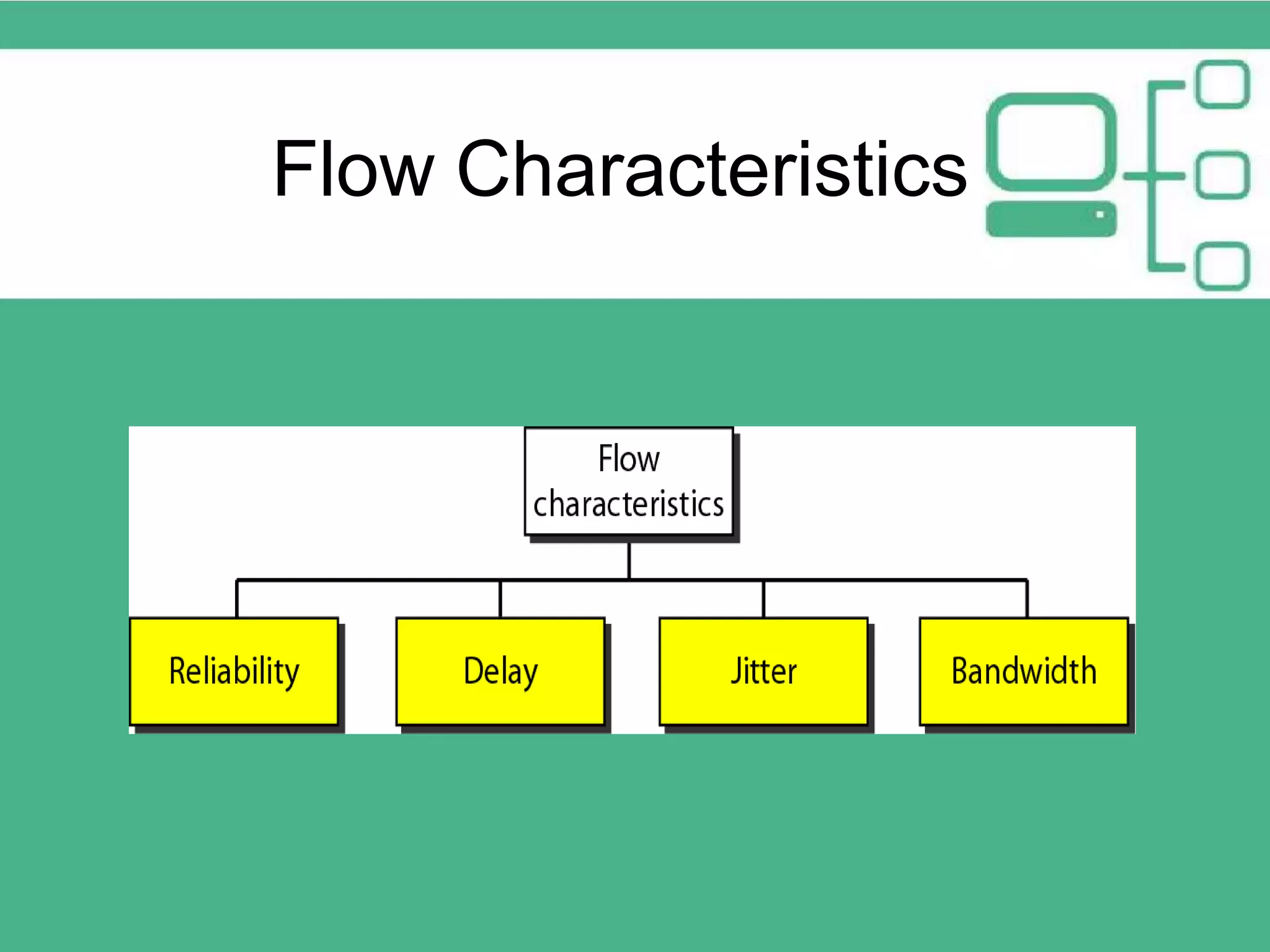
Flow Characteristics
• Reliability : Lack of Reliability means losing a packet or ack. • Delay : Different applications can tolerate delay in different degrees. • Jitter : jitter is the variation in packets belonging to same flow. • Bandwidth : different application need different b/w.
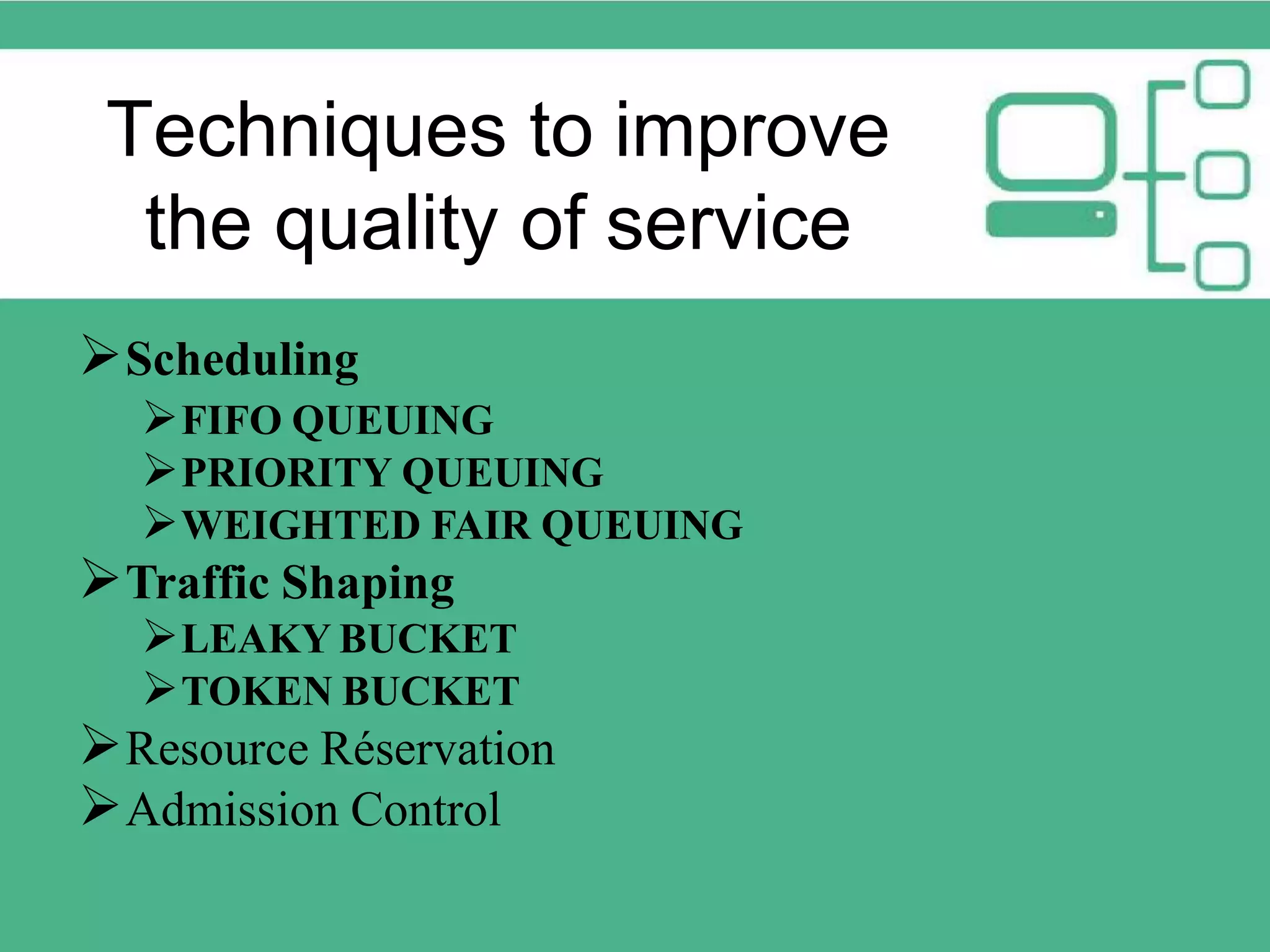
Techniques to improve the quality of service. Scheduling FIFO QUEUING PRIORITY QUEUING WEIGHTED FAIR QUEUING Traffic Shaping LEAKY BUCKET TOKEN BUCKET Resource Réservation Admission Control
Scheduling • Packets from different flow arrive at switch or router for processing • A good scheduling technique treats the different flow in a fair and appropriate manner
• FIFO QUEUING
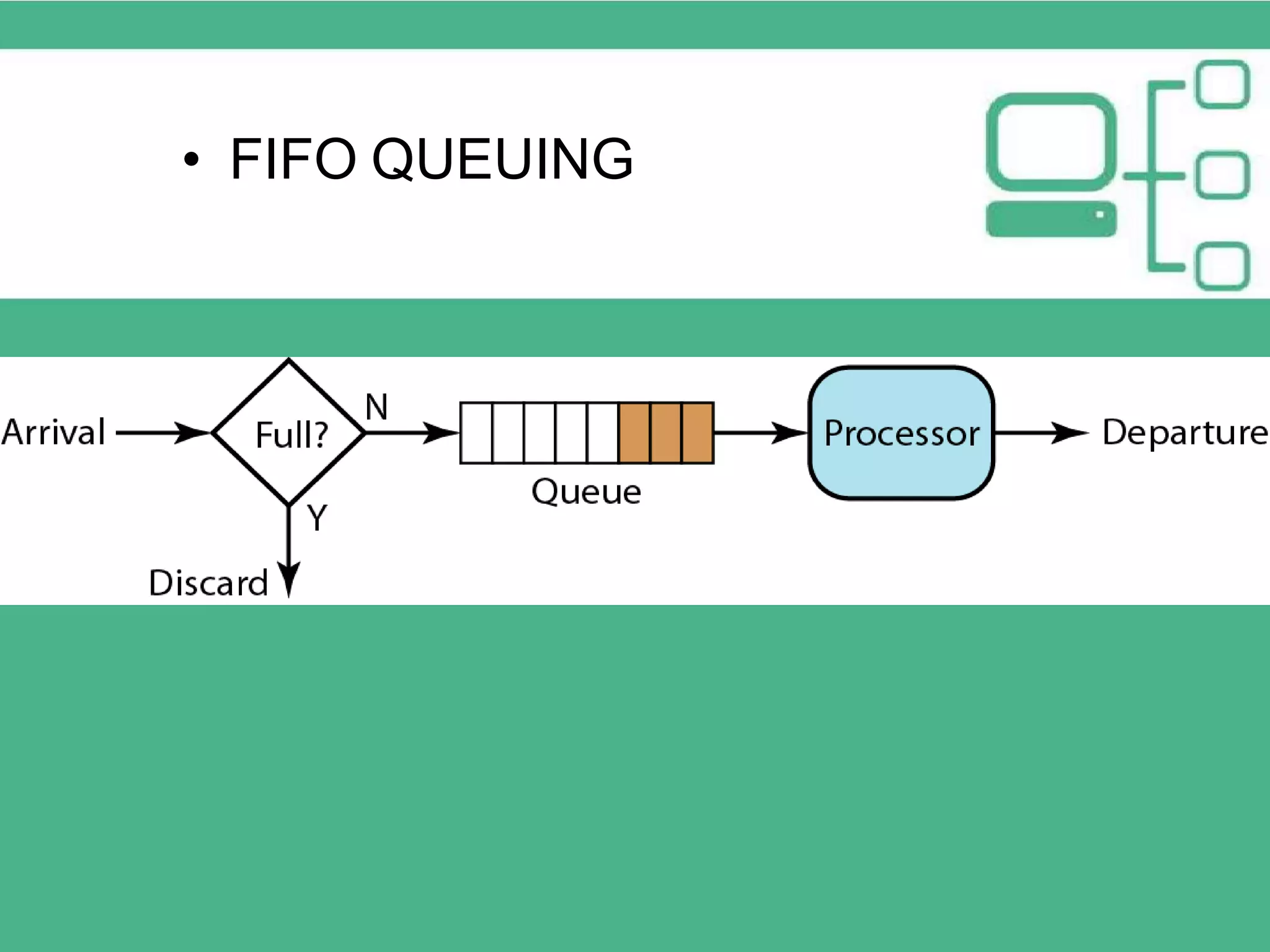
• FIFO QUEUING • Packets wait in a buffer (queue) until the node is ready to process them. • If avg. arrival rate>avg. processing rate =>new packets will be discarded.
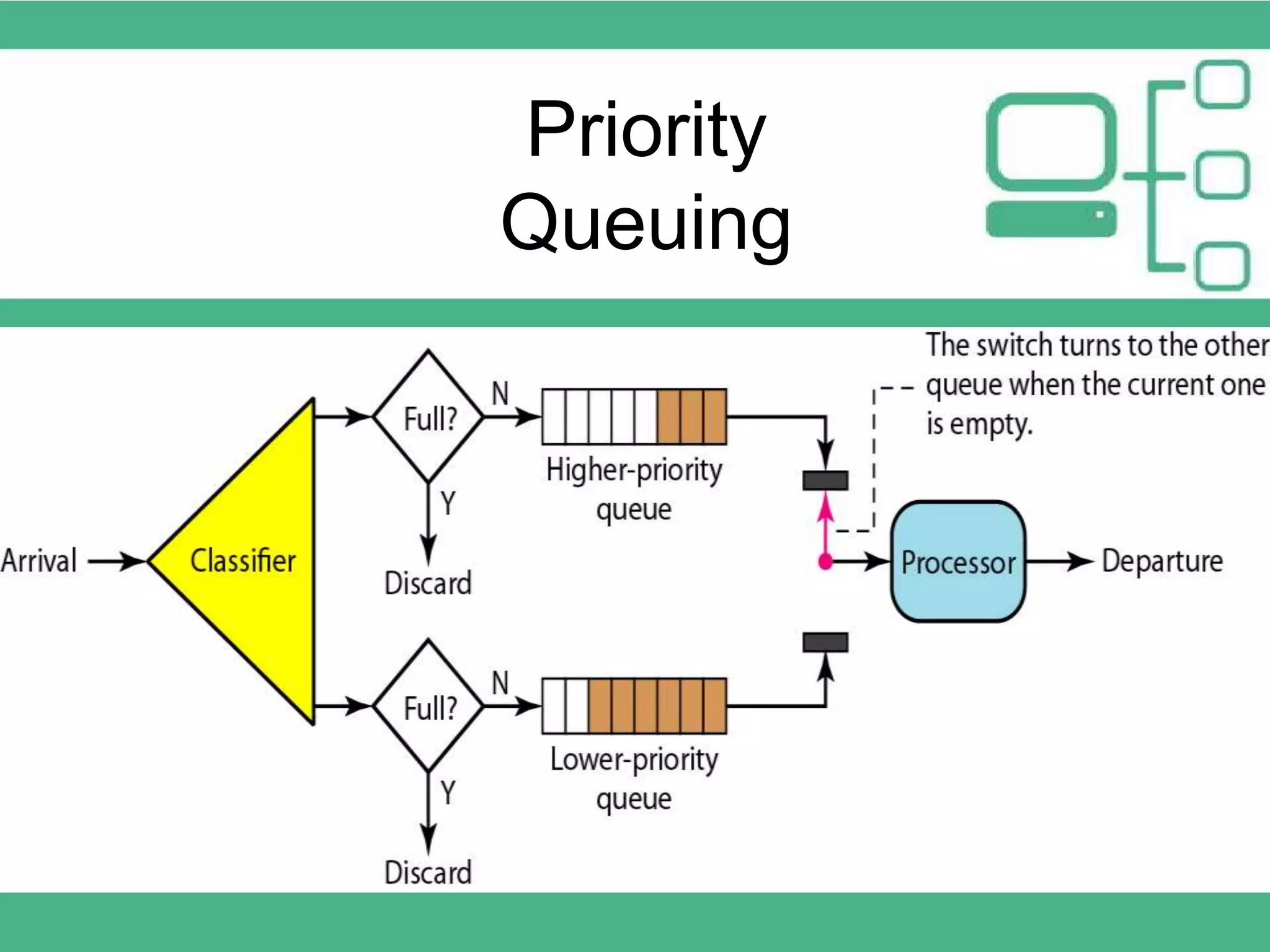
Priority Queuing
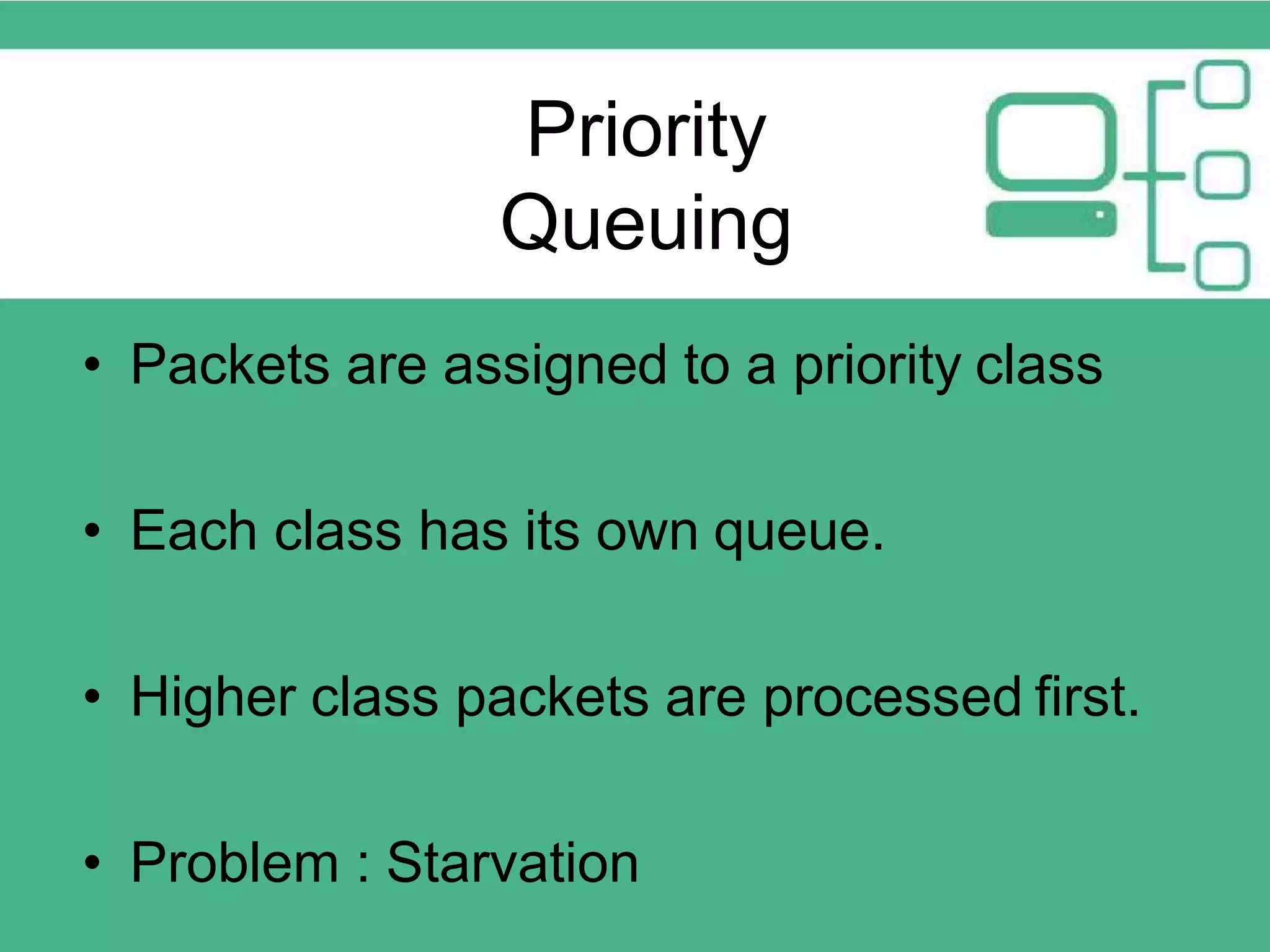
• Packets are assigned to a priority class • Each class has its own queue. • Higher class packets are processed first. • Problem : Starvation Priority Queuing
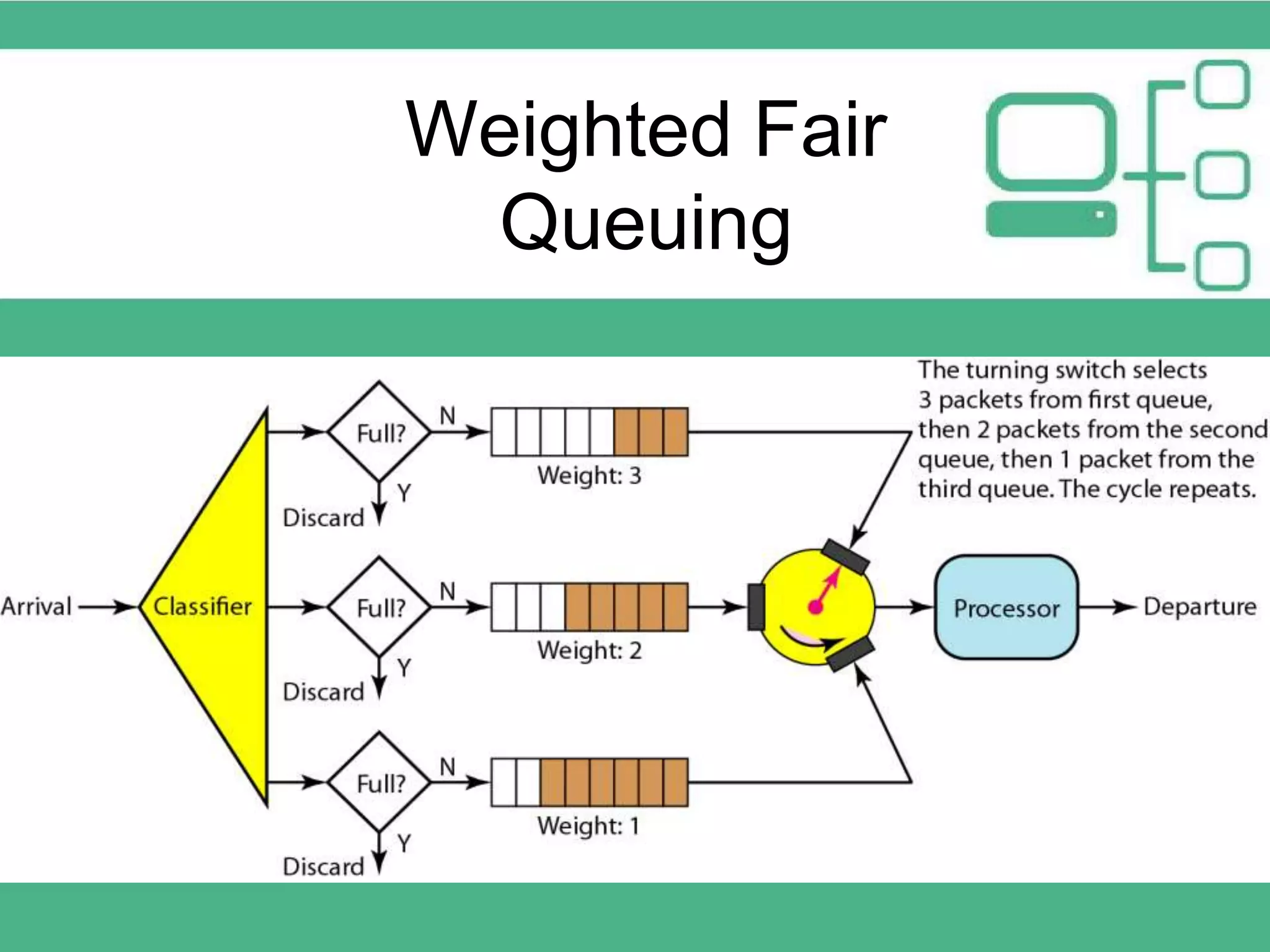
Weighted Fair Queuing
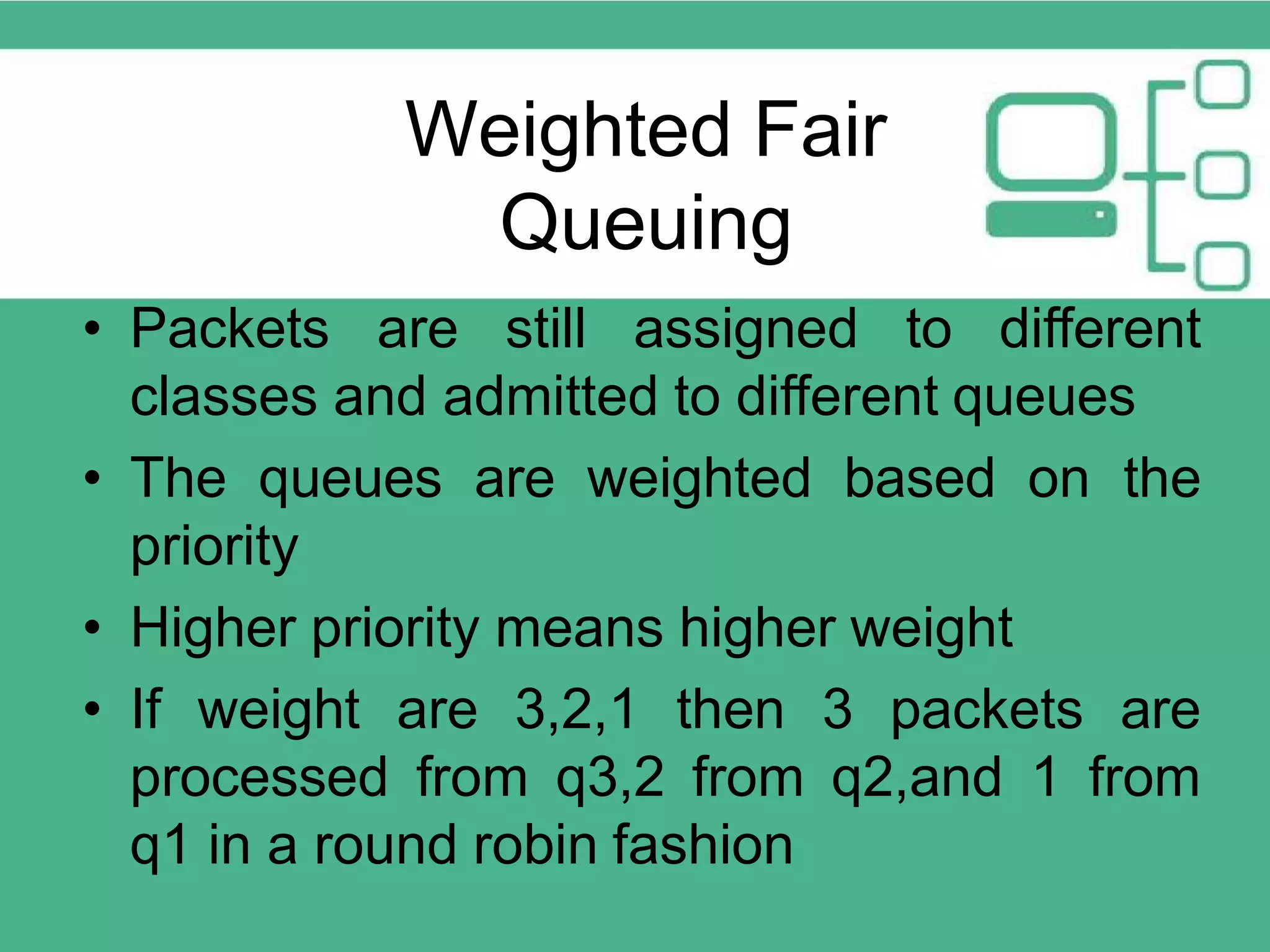
• Packets are still assigned to different classes and admitted to different queues • The queues are weighted based on the priority • Higher priority means higher weight • If weight are 3,2,1 then 3 packets are processed from q3,2 from q2,and 1 from q1 in a round robin fashion Weighted Fair Queuing
Traffic Shaping Is the mechanism to control the amount and the rate of the traffic sent to the network
Techniques to improve the quality of service Scheduling FIFO QUEUING PRIORITY QUEUING WEIGHTED FAIR QUEUING Traffic Shaping LEAKY BUCKET TOKEN BUCKET Resource Réservation Admission Control
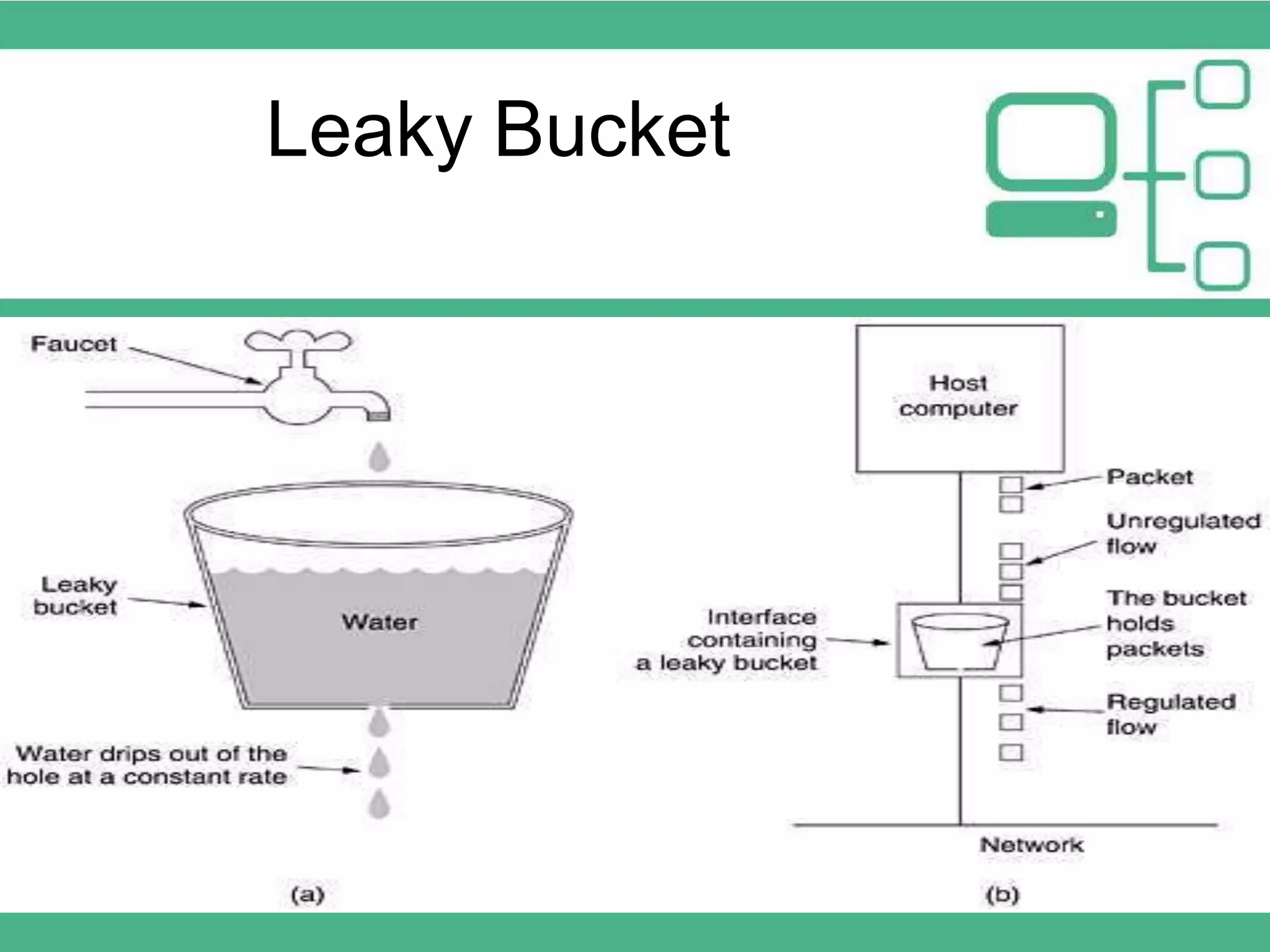
Leaky Bucket
The rate at which water leaks from a bucket does not depend on the rate at which the water is input to the bucket The input rate varies but the o/p remains constant ,similarly ,network can smooth out bursty traffic Leaky Bucket
Token Bucket
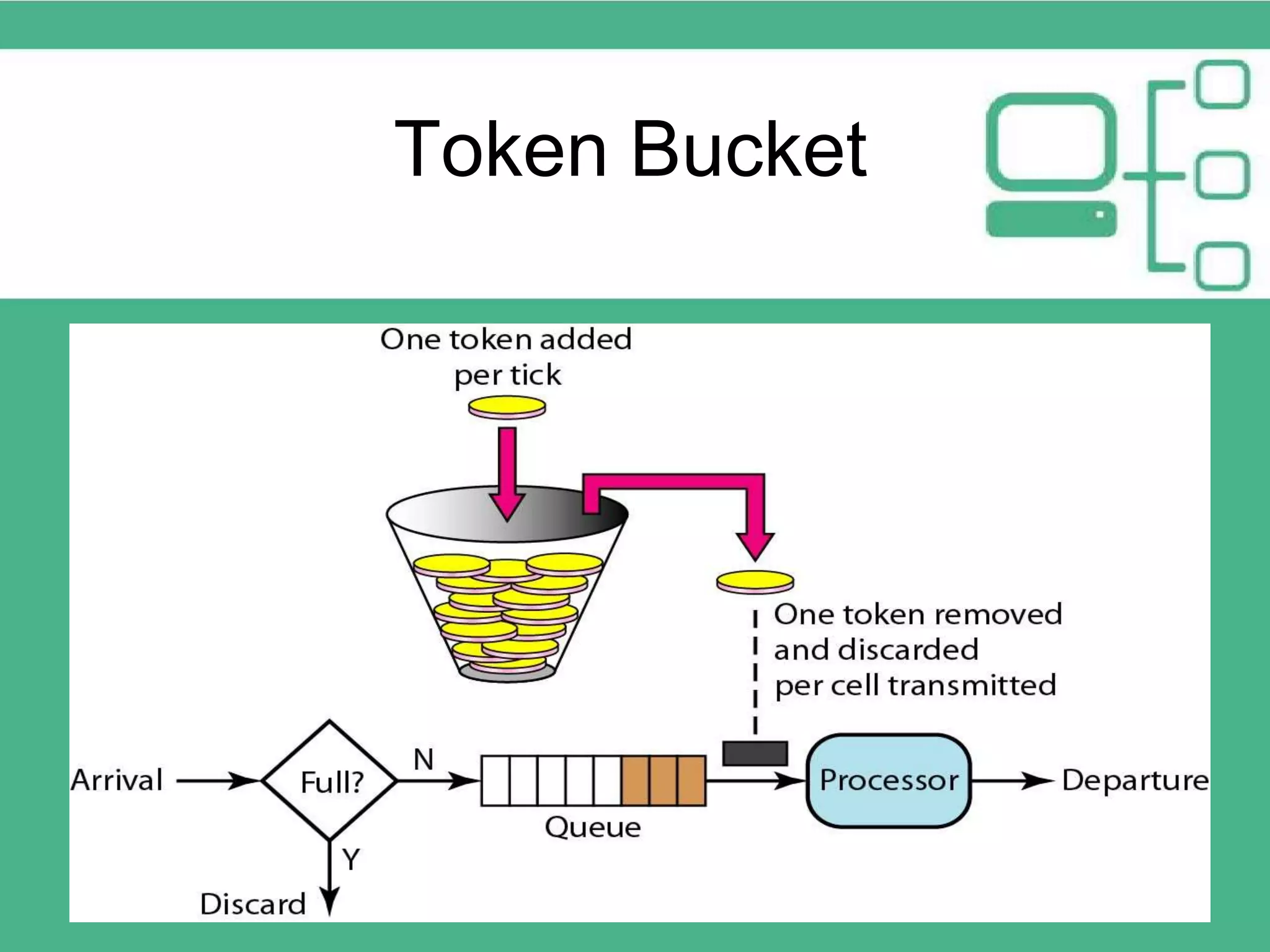
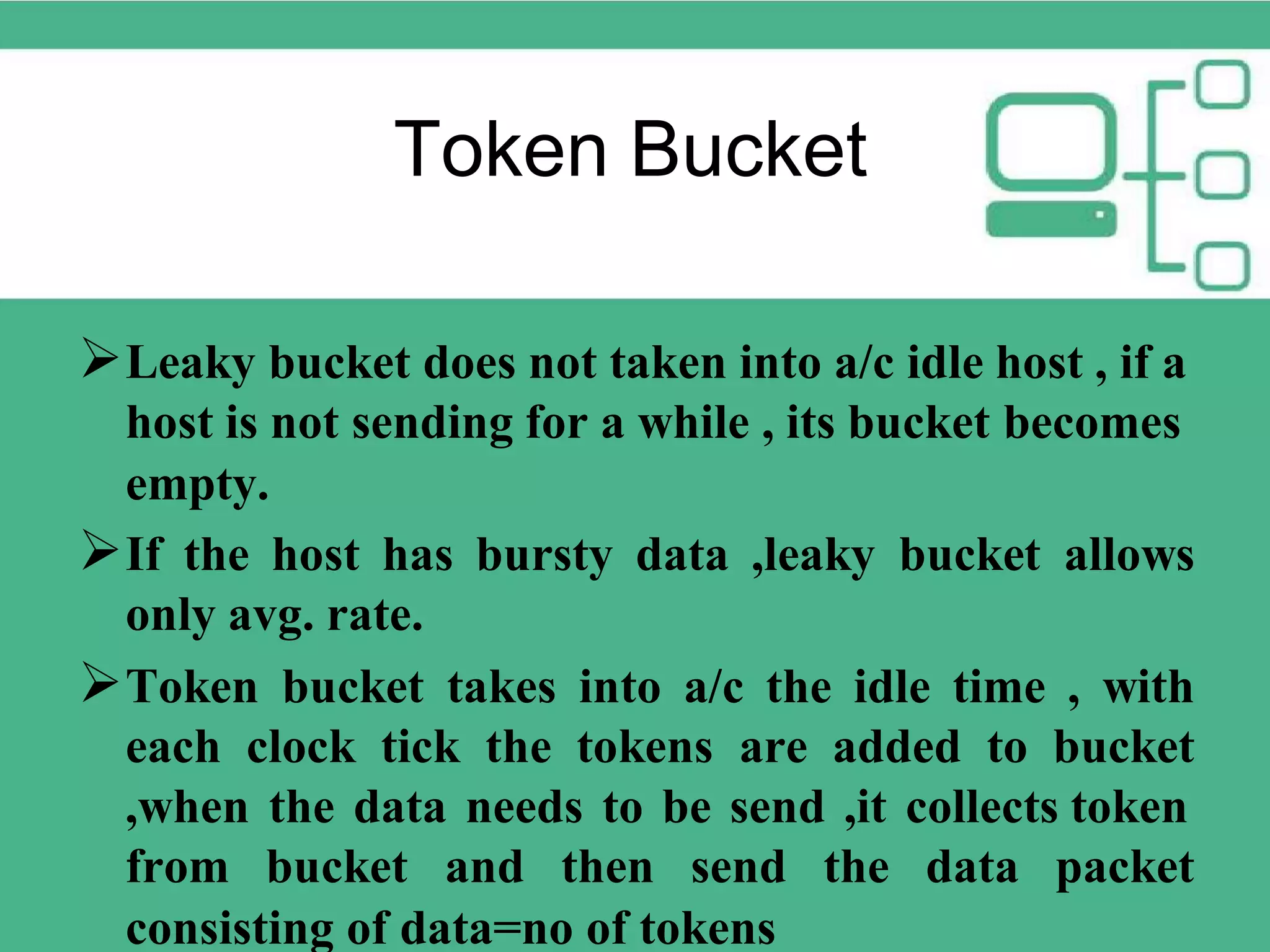
Token Bucket Leaky bucket does not taken into a/c idle host , if a host is not sending for a while , its bucket becomes empty. If the host has bursty data ,leaky bucket allows only avg. rate. Token bucket takes into a/c the idle time , with each clock tick the tokens are added to bucket ,when the data needs to be send ,it collects token from bucket and then send the data packet consisting of data=no of tokens
Techniques to improve the quality of service Scheduling FIFO QUEUING PRIORITY QUEUING WEIGHTED FAIR QUEUING Traffic Shaping LEAKY BUCKET TOKEN BUCKET Resource Réservation Admission Control
Resource Reservation • A flow of data needs resources such as buffer, bandwidth, CPU time, and so on . • QoS can be improved if these resources are reserved beforehand.
Techniques to improve the quality of service Scheduling FIFO QUEUING PRIORITY QUEUING WEIGHTED FAIR QUEUING Traffic Shaping LEAKY BUCKET TOKEN BUCKET Resource Réservation Admission Control
Admission Control • Routers or switches puts restrictions on the admission of packets from host. • Before a router accepts the flow , it checks the flow for specifications in terms of bandwidth , buffer size ,cpu speed etc.
Conclusion:  Flow characteristics  Scheduling  FIFO QUEUING  PRIORITY QUEUING  WEIGHTED FAIR QUEUING  Traffic Shaping  LEAKY BUCKET  TOKEN BUCKET  Resource Réservation  Admission Control
Any Questions?
Thank You

Introduction to Quality Of Service - Networking

  • 1.
  • 2.
    So what isit? • Quality of service is the ability to provide different priority to different applications, users, or data flows, or to guarantee a certain level of performance to a data flow
  • 3.
  • 4.
    • Reliability :Lack of Reliability means losing a packet or ack. • Delay : Different applications can tolerate delay in different degrees. • Jitter : jitter is the variation in packets belonging to same flow. • Bandwidth : different application need different b/w.
  • 5.
    Techniques to improve thequality of service. Scheduling FIFO QUEUING PRIORITY QUEUING WEIGHTED FAIR QUEUING Traffic Shaping LEAKY BUCKET TOKEN BUCKET Resource Réservation Admission Control
  • 6.
    Scheduling • Packets fromdifferent flow arrive at switch or router for processing • A good scheduling technique treats the different flow in a fair and appropriate manner
  • 7.
  • 8.
    • FIFO QUEUING •Packets wait in a buffer (queue) until the node is ready to process them. • If avg. arrival rate>avg. processing rate =>new packets will be discarded.
  • 9.
  • 10.
    • Packets areassigned to a priority class • Each class has its own queue. • Higher class packets are processed first. • Problem : Starvation Priority Queuing
  • 11.
  • 12.
    • Packets arestill assigned to different classes and admitted to different queues • The queues are weighted based on the priority • Higher priority means higher weight • If weight are 3,2,1 then 3 packets are processed from q3,2 from q2,and 1 from q1 in a round robin fashion Weighted Fair Queuing
  • 13.
    Traffic Shaping Is themechanism to control the amount and the rate of the traffic sent to the network
  • 14.
    Techniques to improve thequality of service Scheduling FIFO QUEUING PRIORITY QUEUING WEIGHTED FAIR QUEUING Traffic Shaping LEAKY BUCKET TOKEN BUCKET Resource Réservation Admission Control
  • 15.
  • 16.
    The rate atwhich water leaks from a bucket does not depend on the rate at which the water is input to the bucket The input rate varies but the o/p remains constant ,similarly ,network can smooth out bursty traffic Leaky Bucket
  • 17.
  • 18.
    Token Bucket Leaky bucketdoes not taken into a/c idle host , if a host is not sending for a while , its bucket becomes empty. If the host has bursty data ,leaky bucket allows only avg. rate. Token bucket takes into a/c the idle time , with each clock tick the tokens are added to bucket ,when the data needs to be send ,it collects token from bucket and then send the data packet consisting of data=no of tokens
  • 19.
    Techniques to improve thequality of service Scheduling FIFO QUEUING PRIORITY QUEUING WEIGHTED FAIR QUEUING Traffic Shaping LEAKY BUCKET TOKEN BUCKET Resource Réservation Admission Control
  • 20.
    Resource Reservation • Aflow of data needs resources such as buffer, bandwidth, CPU time, and so on . • QoS can be improved if these resources are reserved beforehand.
  • 21.
    Techniques to improve thequality of service Scheduling FIFO QUEUING PRIORITY QUEUING WEIGHTED FAIR QUEUING Traffic Shaping LEAKY BUCKET TOKEN BUCKET Resource Réservation Admission Control
  • 22.
    Admission Control • Routersor switches puts restrictions on the admission of packets from host. • Before a router accepts the flow , it checks the flow for specifications in terms of bandwidth , buffer size ,cpu speed etc.
  • 23.
    Conclusion:  Flow characteristics Scheduling  FIFO QUEUING  PRIORITY QUEUING  WEIGHTED FAIR QUEUING  Traffic Shaping  LEAKY BUCKET  TOKEN BUCKET  Resource Réservation  Admission Control
  • 24.
  • 25.