1 Introduction to Automata Theory Reading: Chapter 1
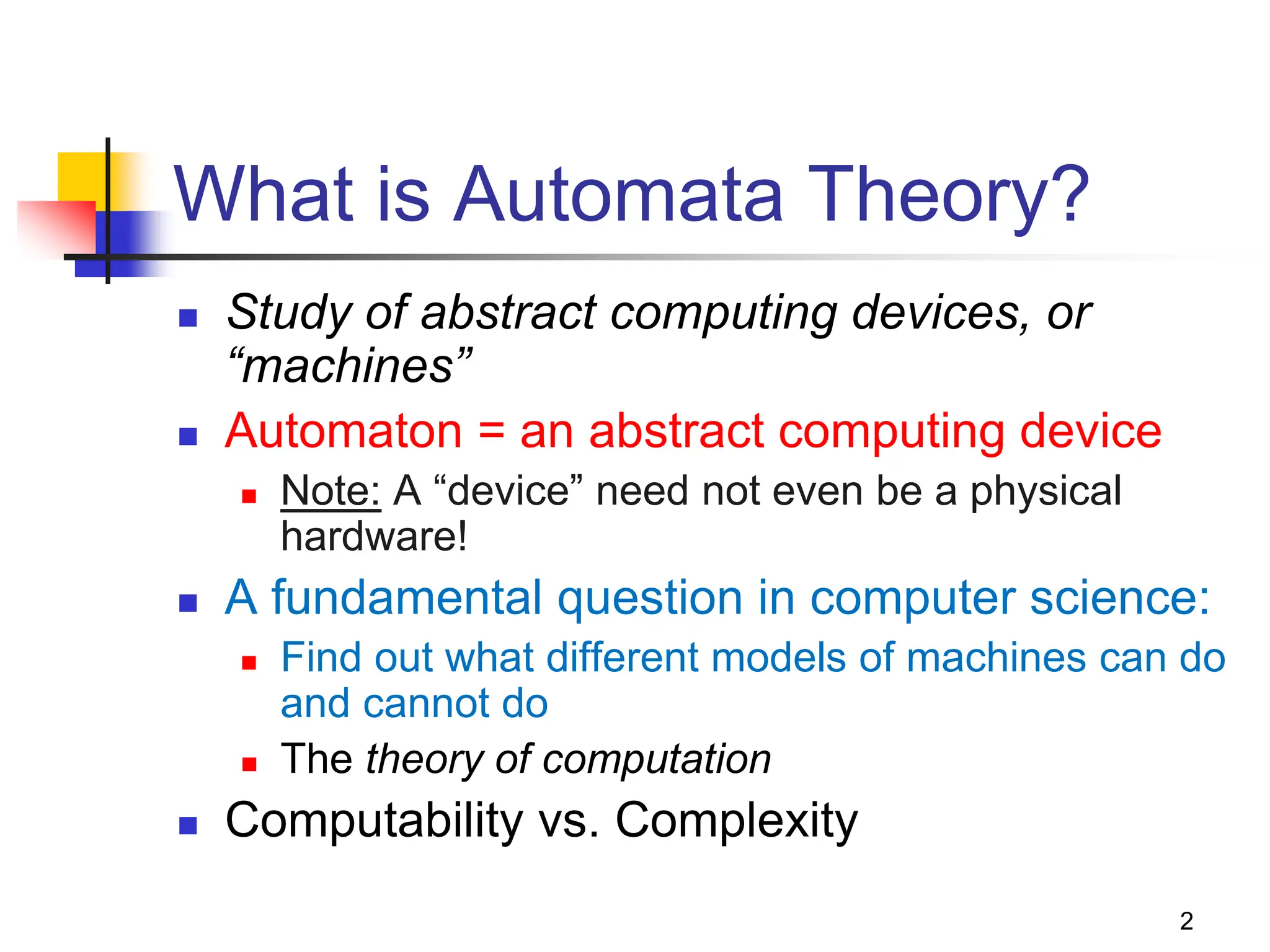
2 What is Automata Theory?  Study of abstract computing devices, or “machines”  Automaton = an abstract computing device  Note: A “device” need not even be a physical hardware!  A fundamental question in computer science:  Find out what different models of machines can do and cannot do  The theory of computation  Computability vs. Complexity
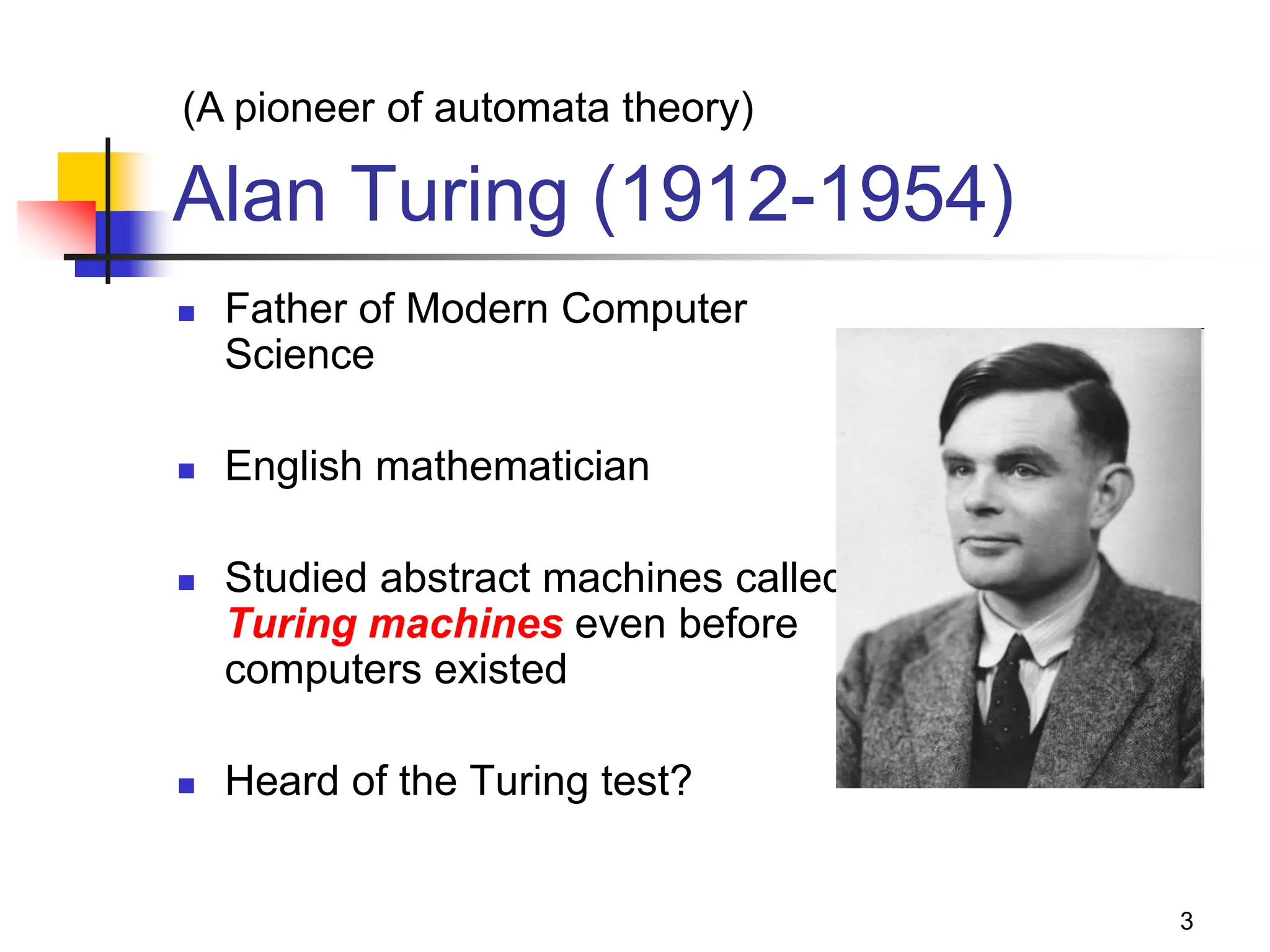
3 Alan Turing (1912-1954)  Father of Modern Computer Science  English mathematician  Studied abstract machines called Turing machines even before computers existed  Heard of the Turing test? (A pioneer of automata theory)
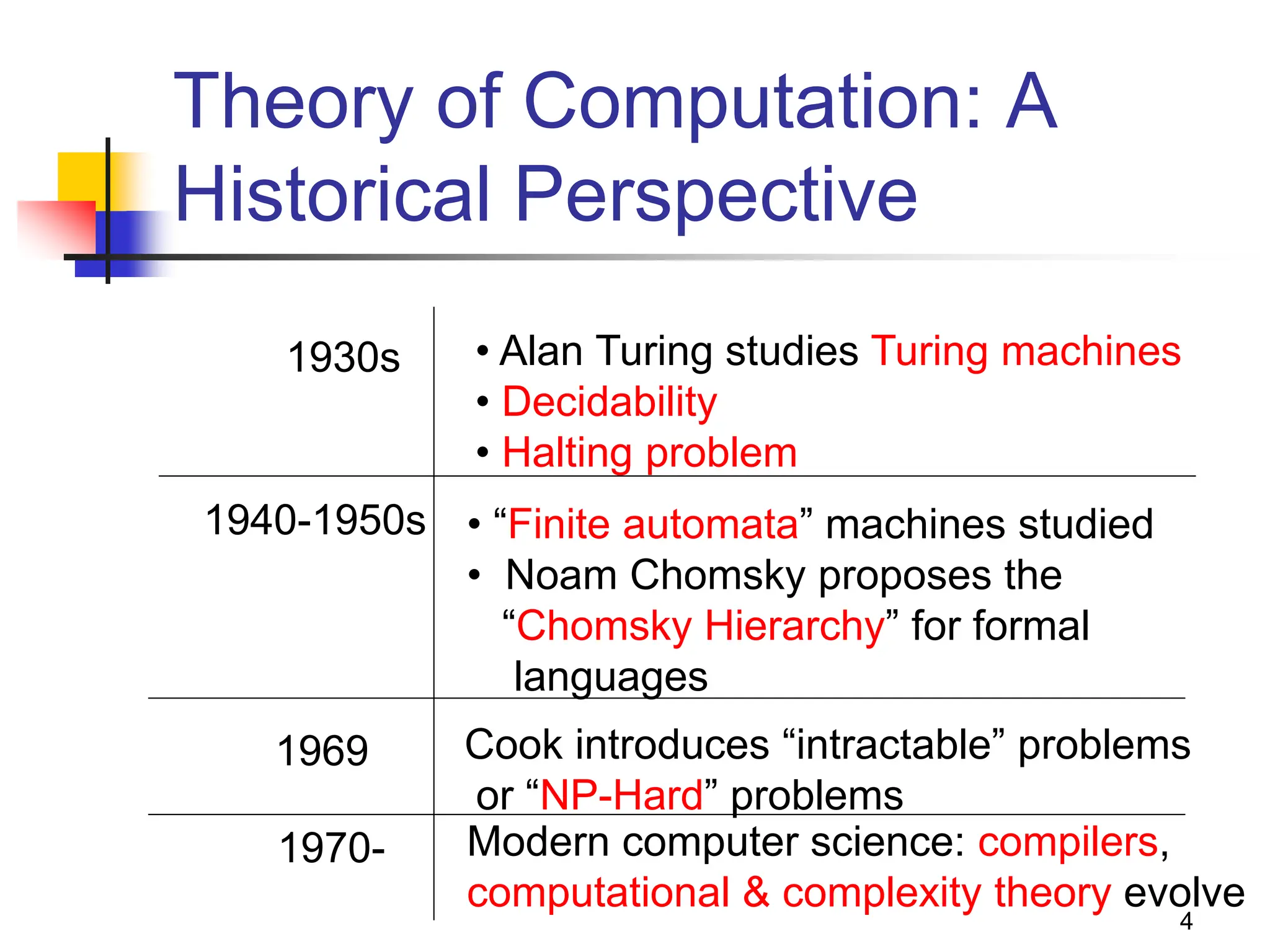
4 Theory of Computation: A Historical Perspective 1930s • Alan Turing studies Turing machines • Decidability • Halting problem 1940-1950s • “Finite automata” machines studied • Noam Chomsky proposes the “Chomsky Hierarchy” for formal languages 1969 Cook introduces “intractable” problems or “NP-Hard” problems 1970- Modern computer science: compilers, computational & complexity theory evolve
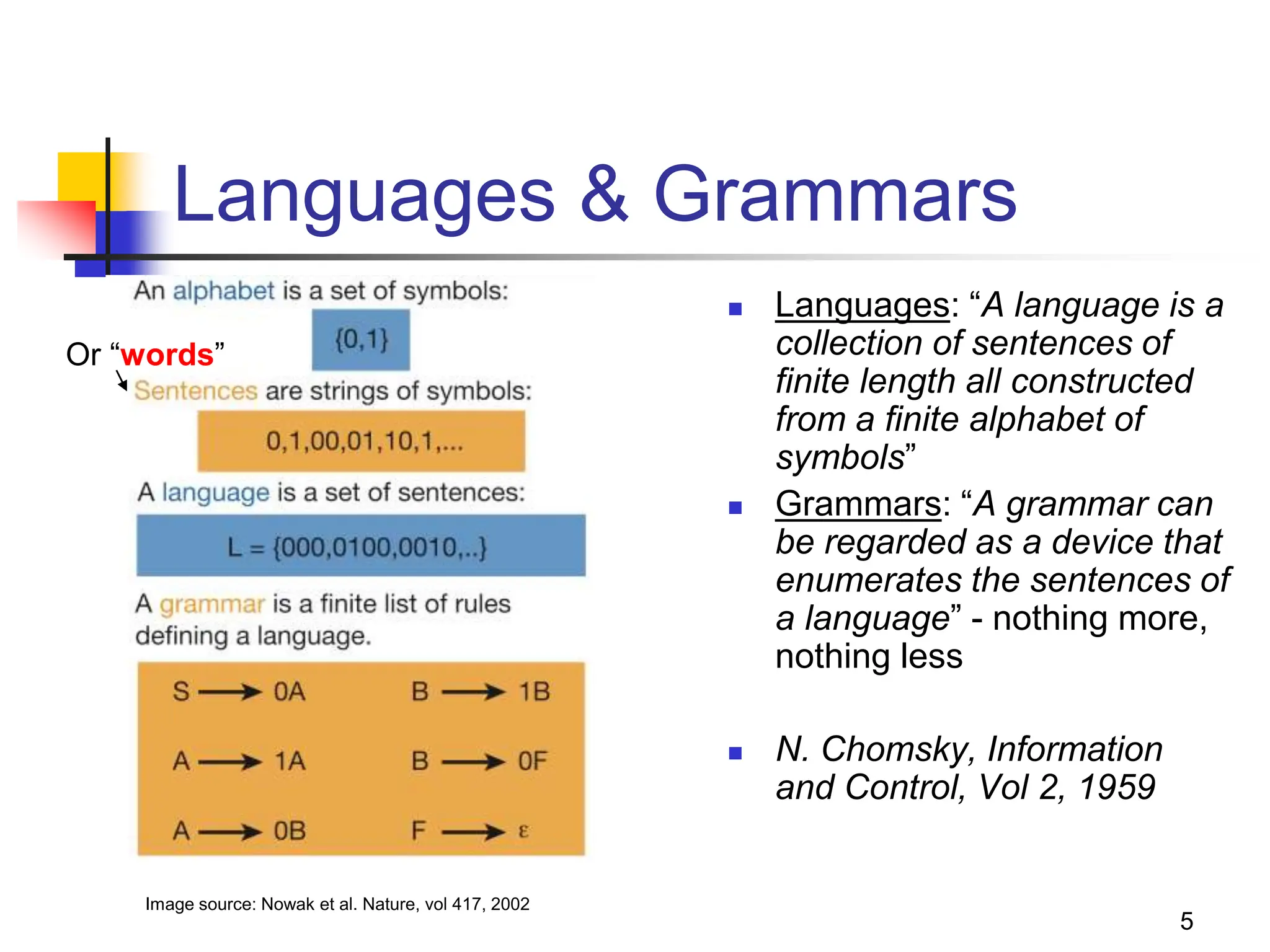
5 Languages & Grammars Or “words” Image source: Nowak et al. Nature, vol 417, 2002  Languages: “A language is a collection of sentences of finite length all constructed from a finite alphabet of symbols”  Grammars: “A grammar can be regarded as a device that enumerates the sentences of a language” - nothing more, nothing less  N. Chomsky, Information and Control, Vol 2, 1959
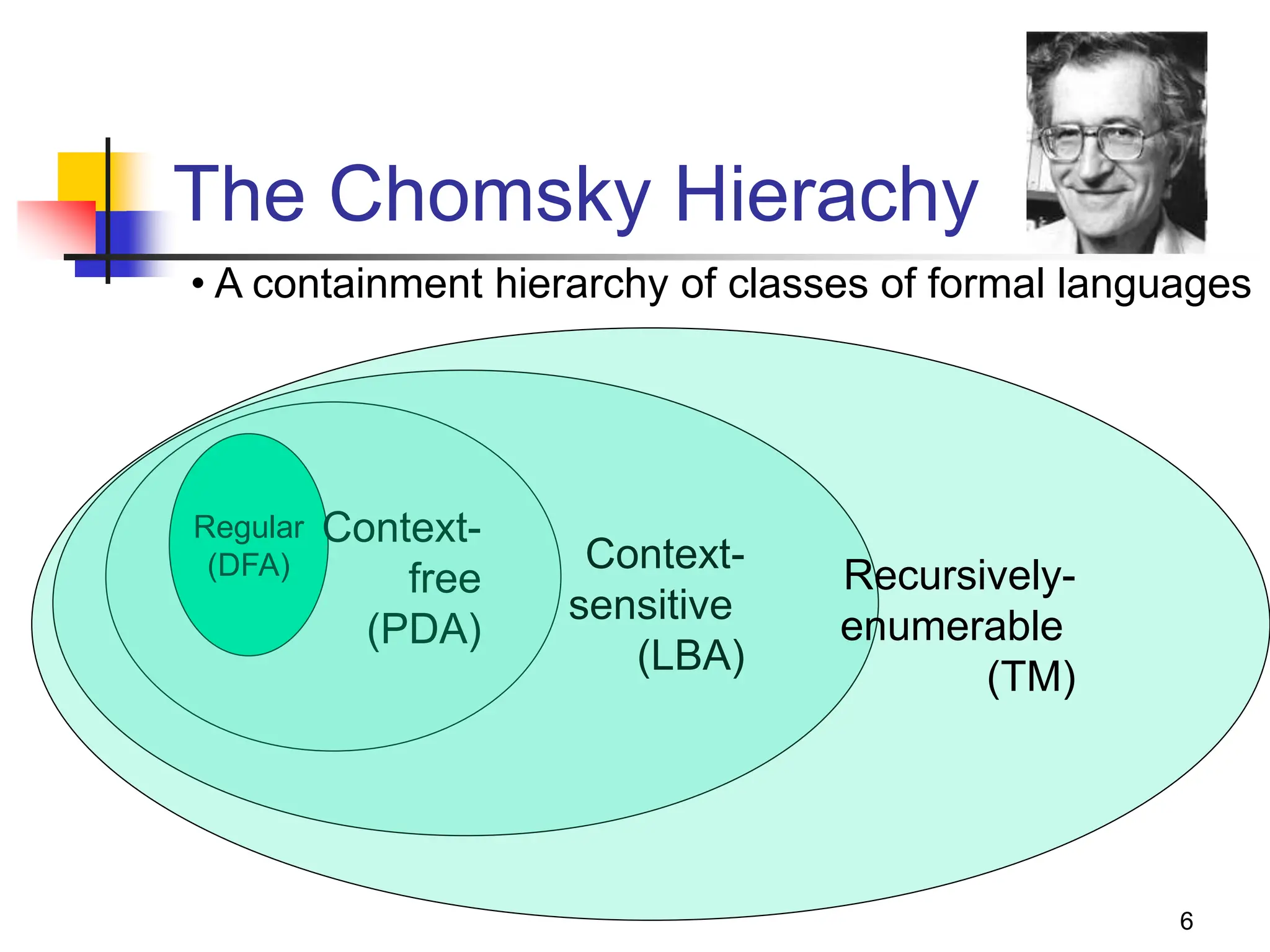
6 The Chomsky Hierachy Regular (DFA) Context- free (PDA) Context- sensitive (LBA) Recursively- enumerable (TM) • A containment hierarchy of classes of formal languages
7 The Central Concepts of Automata Theory
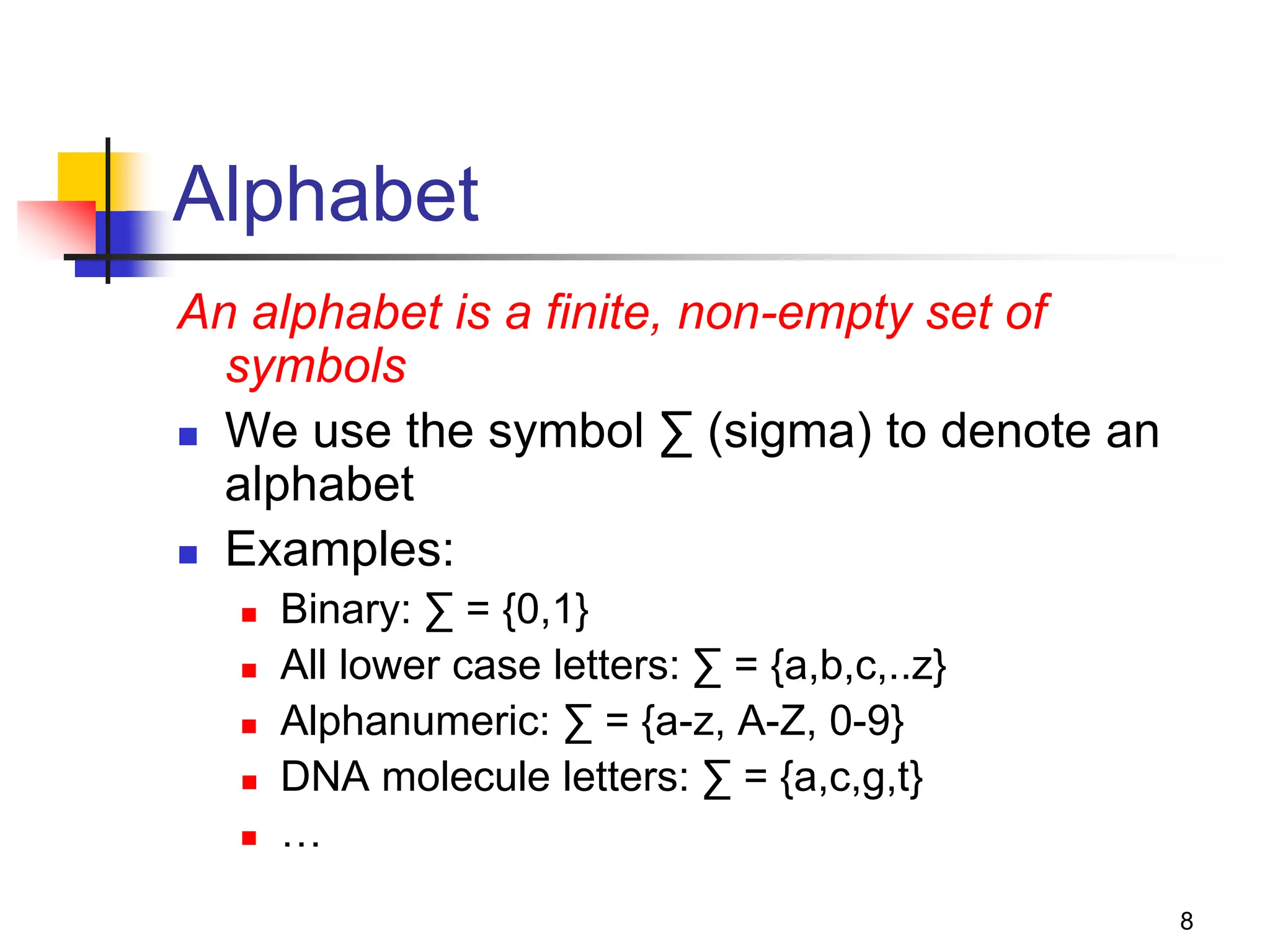
8 Alphabet An alphabet is a finite, non-empty set of symbols  We use the symbol ∑ (sigma) to denote an alphabet  Examples:  Binary: ∑ = {0,1}  All lower case letters: ∑ = {a,b,c,..z}  Alphanumeric: ∑ = {a-z, A-Z, 0-9}  DNA molecule letters: ∑ = {a,c,g,t}  …
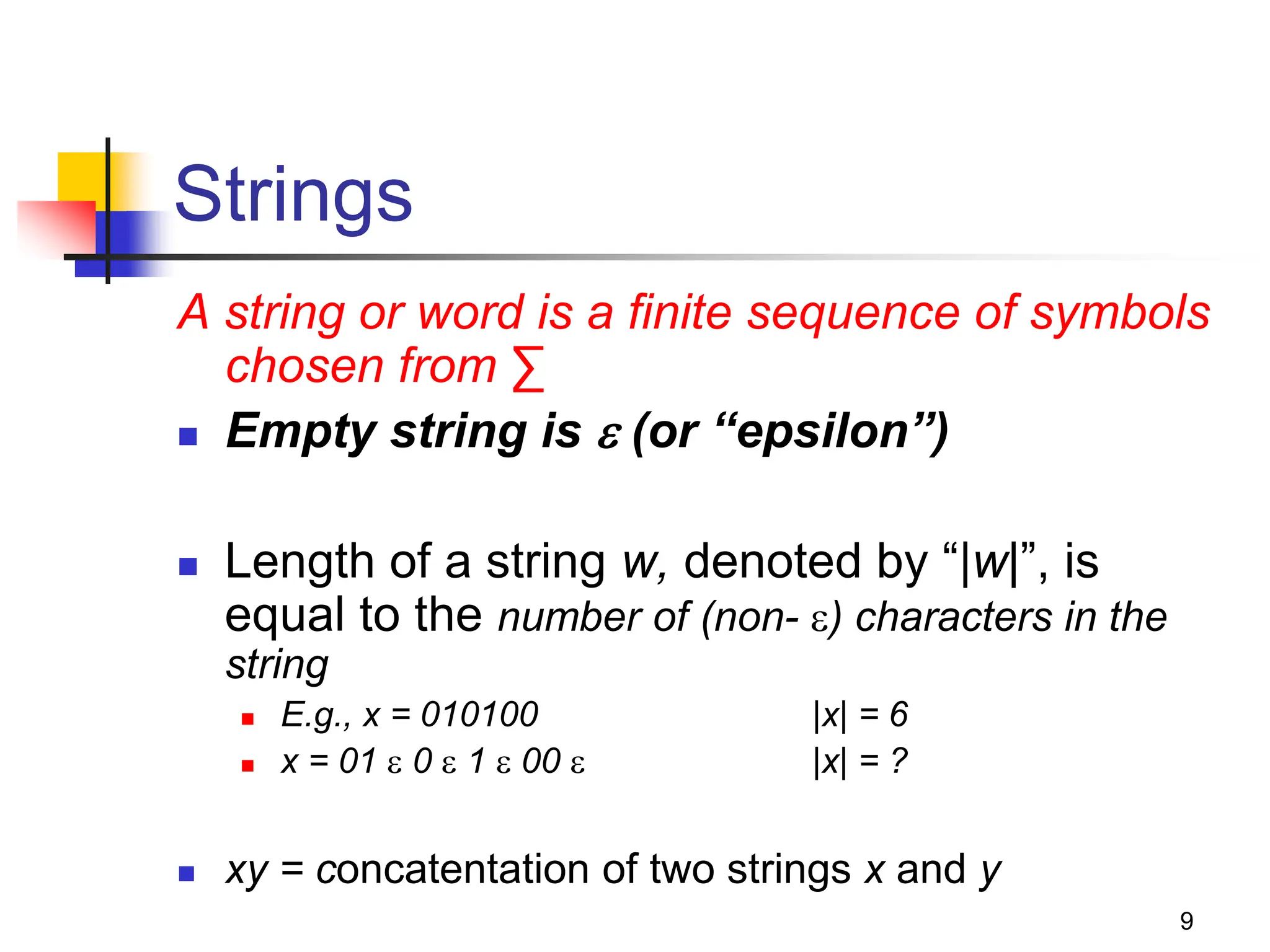
9 Strings A string or word is a finite sequence of symbols chosen from ∑  Empty string is  (or “epsilon”)  Length of a string w, denoted by “|w|”, is equal to the number of (non- ) characters in the string  E.g., x = 010100 |x| = 6  x = 01  0  1  00  |x| = ?  xy = concatentation of two strings x and y
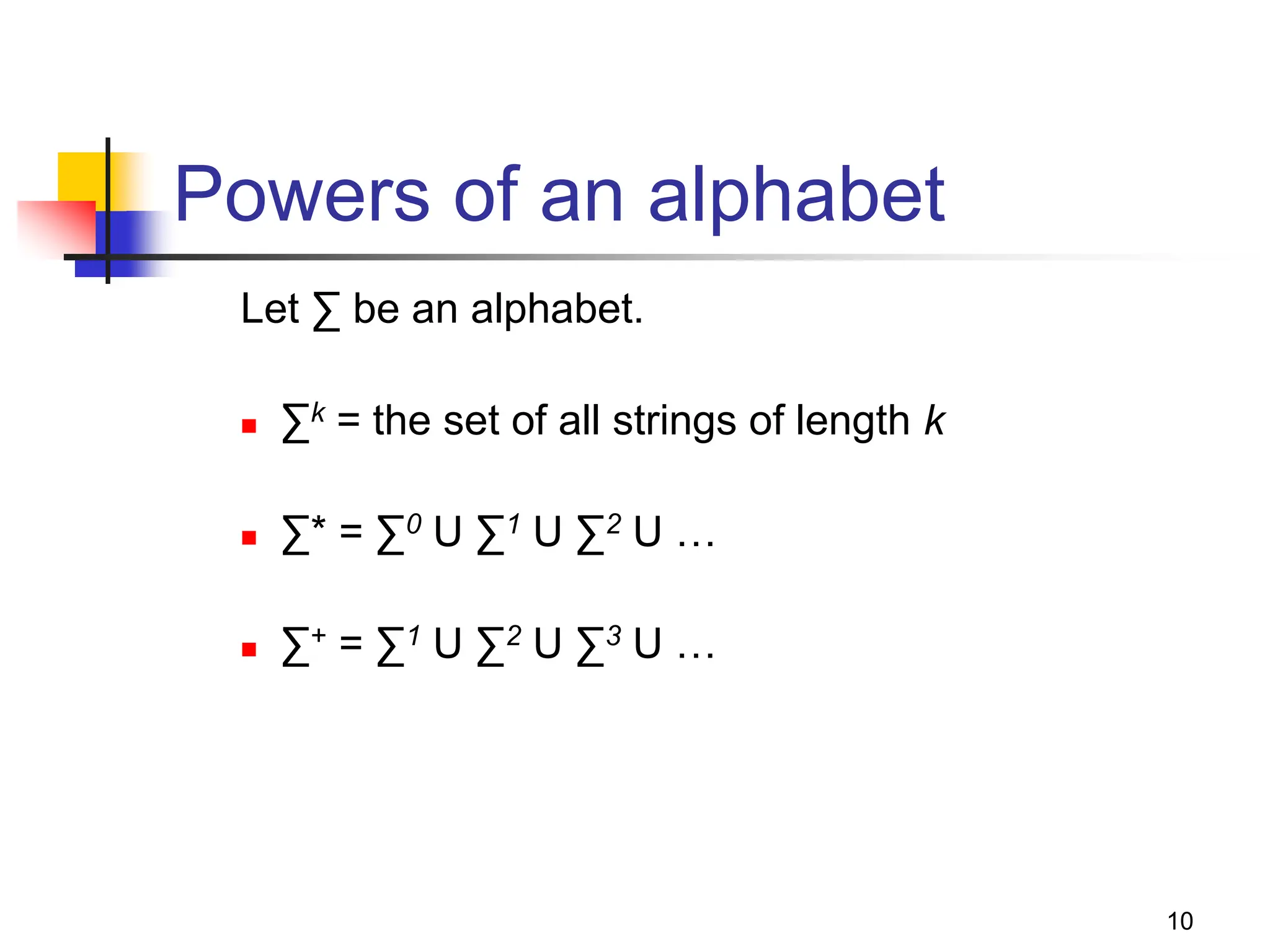
10 Powers of an alphabet Let ∑ be an alphabet.  ∑k = the set of all strings of length k  ∑* = ∑0 U ∑1 U ∑2 U …  ∑+ = ∑1 U ∑2 U ∑3 U …
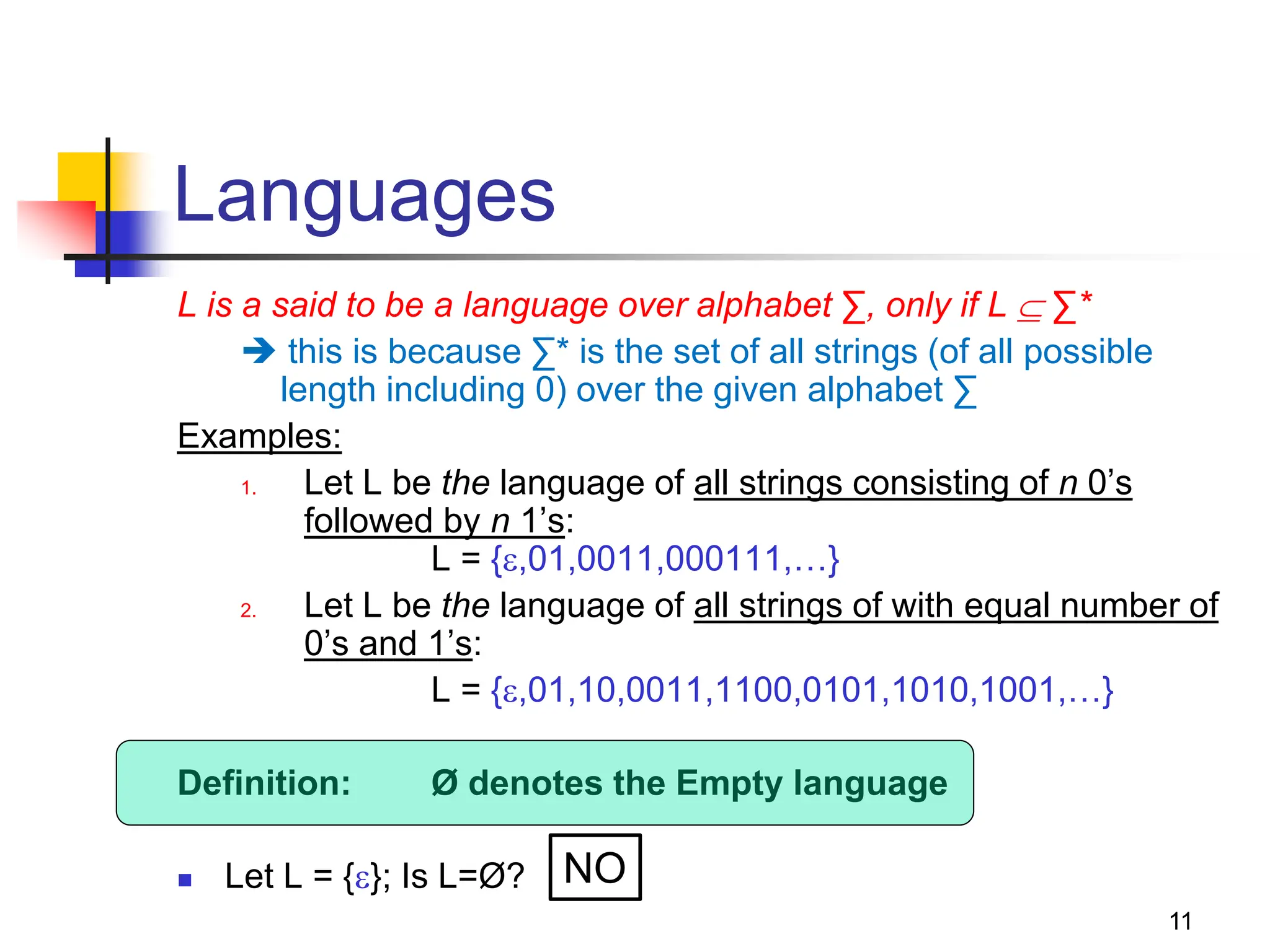
11 Languages L is a said to be a language over alphabet ∑, only if L  ∑*  this is because ∑* is the set of all strings (of all possible length including 0) over the given alphabet ∑ Examples: 1. Let L be the language of all strings consisting of n 0’s followed by n 1’s: L = {,01,0011,000111,…} 2. Let L be the language of all strings of with equal number of 0’s and 1’s: L = {,01,10,0011,1100,0101,1010,1001,…} Definition: Ø denotes the Empty language  Let L = {}; Is L=Ø? NO
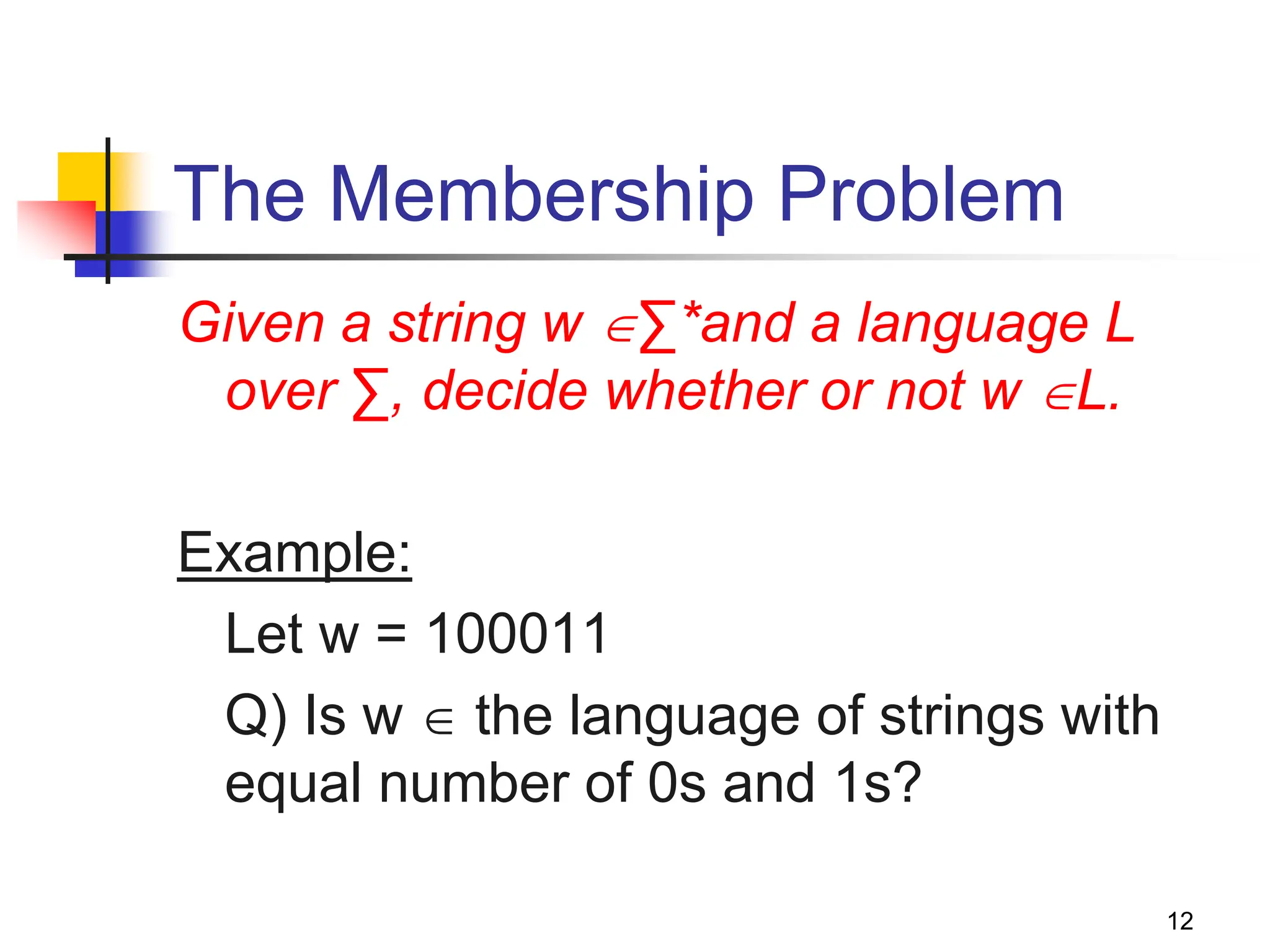
12 The Membership Problem Given a string w ∑*and a language L over ∑, decide whether or not w L. Example: Let w = 100011 Q) Is w  the language of strings with equal number of 0s and 1s?
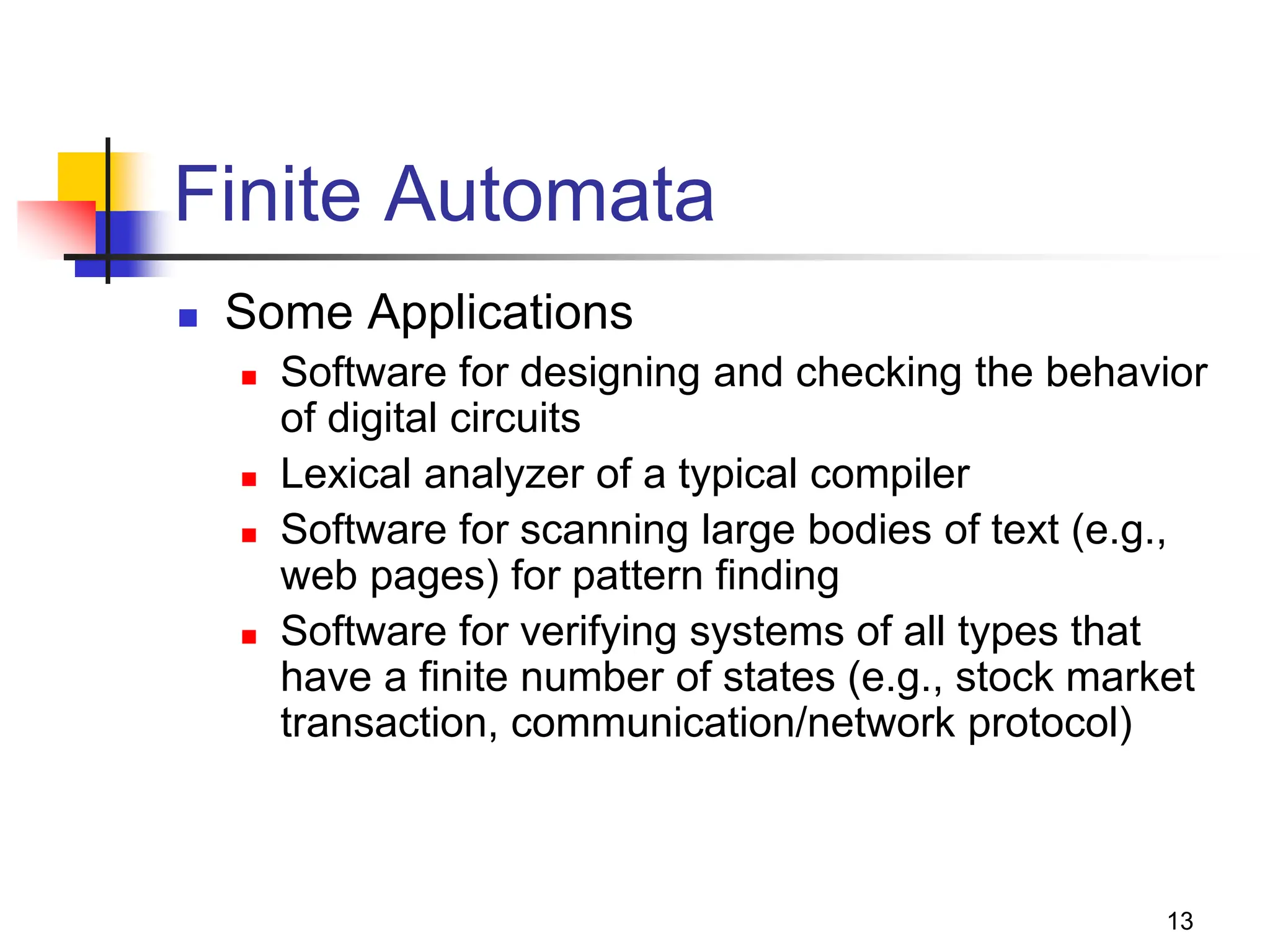
13 Finite Automata  Some Applications  Software for designing and checking the behavior of digital circuits  Lexical analyzer of a typical compiler  Software for scanning large bodies of text (e.g., web pages) for pattern finding  Software for verifying systems of all types that have a finite number of states (e.g., stock market transaction, communication/network protocol)
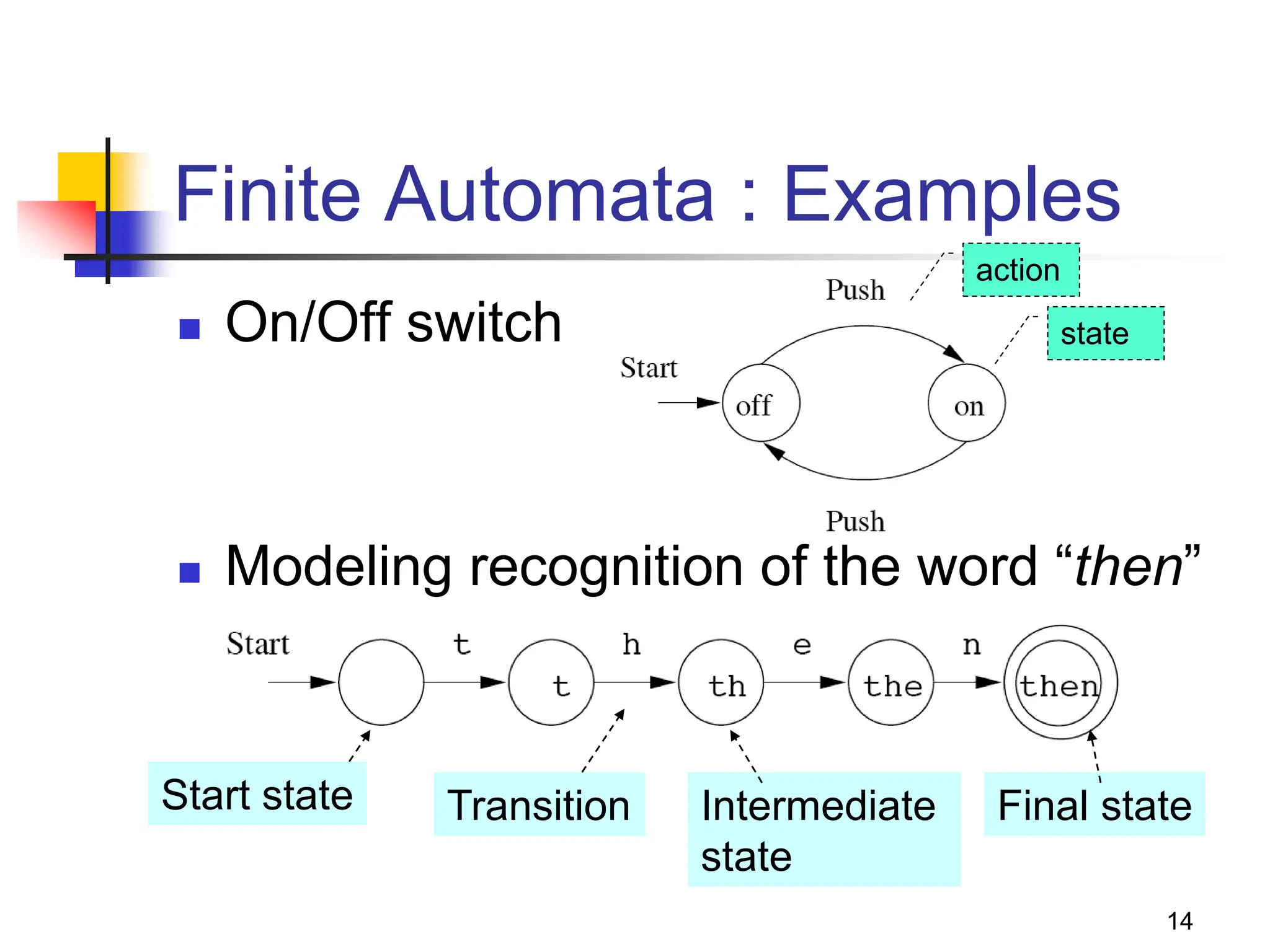
14 Finite Automata : Examples  On/Off switch  Modeling recognition of the word “then” Start state Final state Transition Intermediate state action state
15 Structural expressions  Grammars  Regular expressions  E.g., unix style to capture city names such as “Palo Alto CA”:  [A-Z][a-z]*([ ][A-Z][a-z]*)*[ ][A-Z][A-Z] Start with a letter A string of other letters (possibly empty) Other space delimited words (part of city name) Should end w/ 2-letter state code
16 Formal Proofs
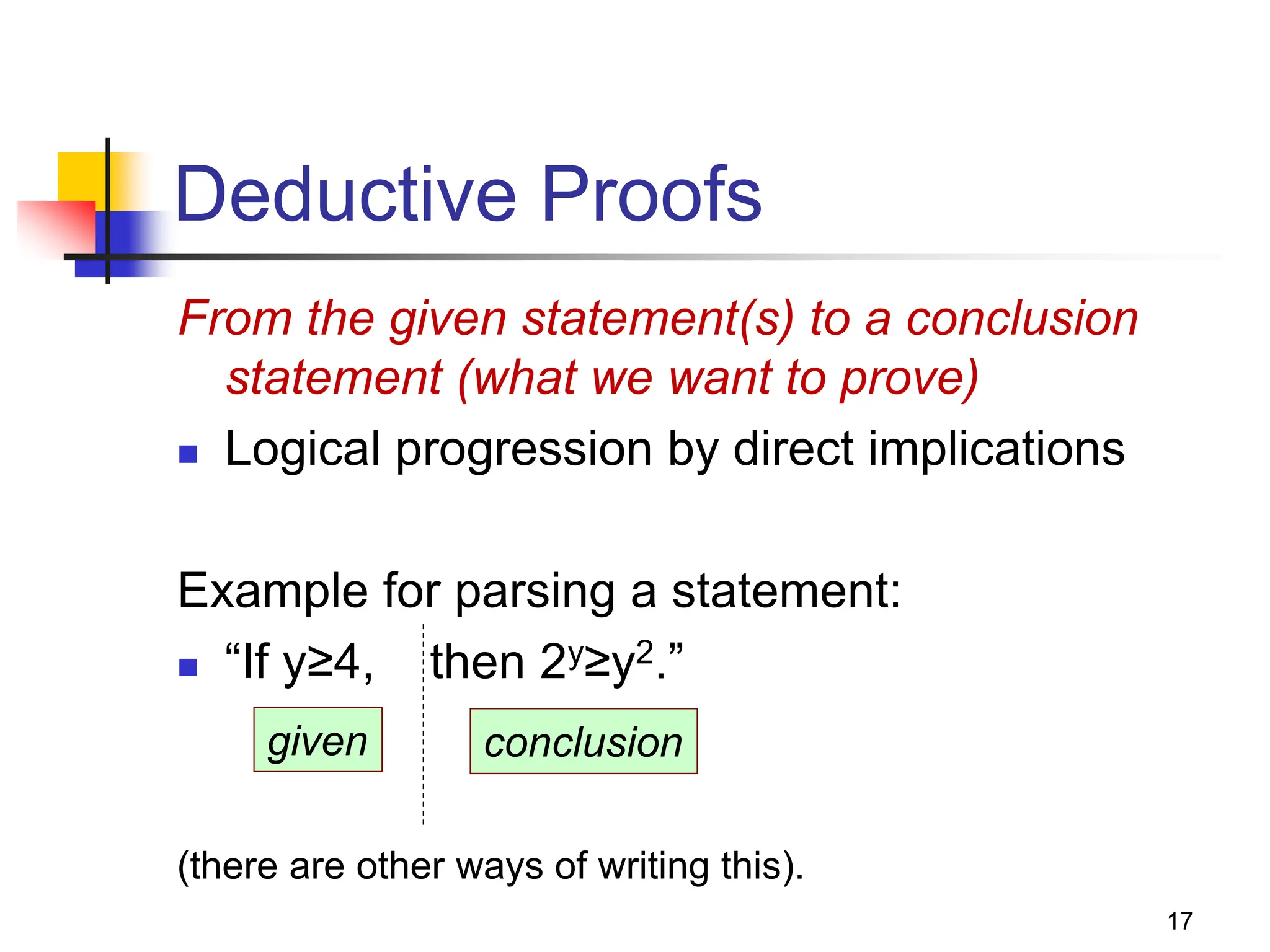
17 Deductive Proofs From the given statement(s) to a conclusion statement (what we want to prove)  Logical progression by direct implications Example for parsing a statement:  “If y≥4, then 2y≥y2.” (there are other ways of writing this). given conclusion
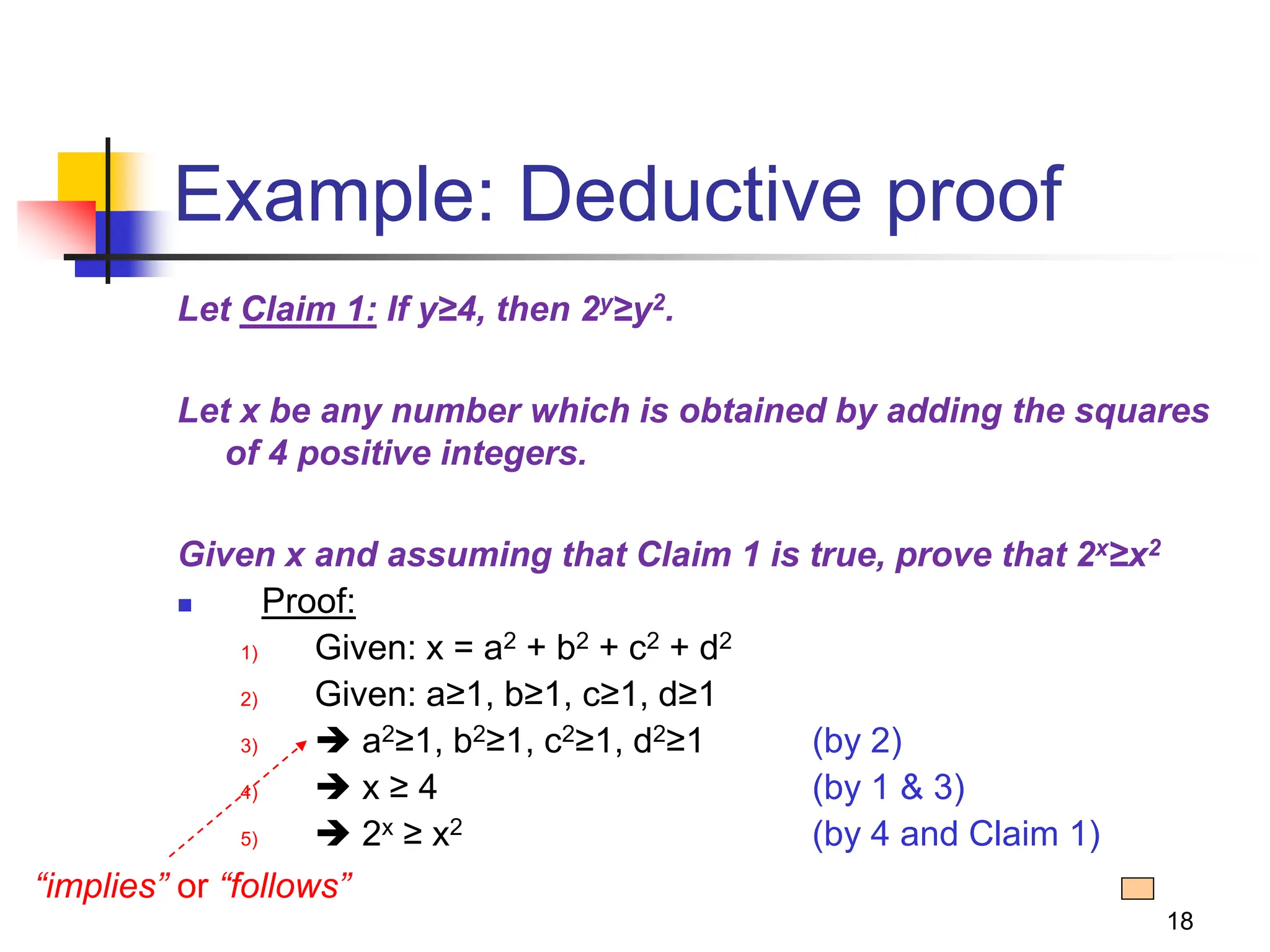
18 Example: Deductive proof Let Claim 1: If y≥4, then 2y≥y2. Let x be any number which is obtained by adding the squares of 4 positive integers. Given x and assuming that Claim 1 is true, prove that 2x≥x2  Proof: 1) Given: x = a2 + b2 + c2 + d2 2) Given: a≥1, b≥1, c≥1, d≥1 3)  a2≥1, b2≥1, c2≥1, d2≥1 (by 2) 4)  x ≥ 4 (by 1 & 3) 5)  2x ≥ x2 (by 4 and Claim 1) “implies” or “follows”
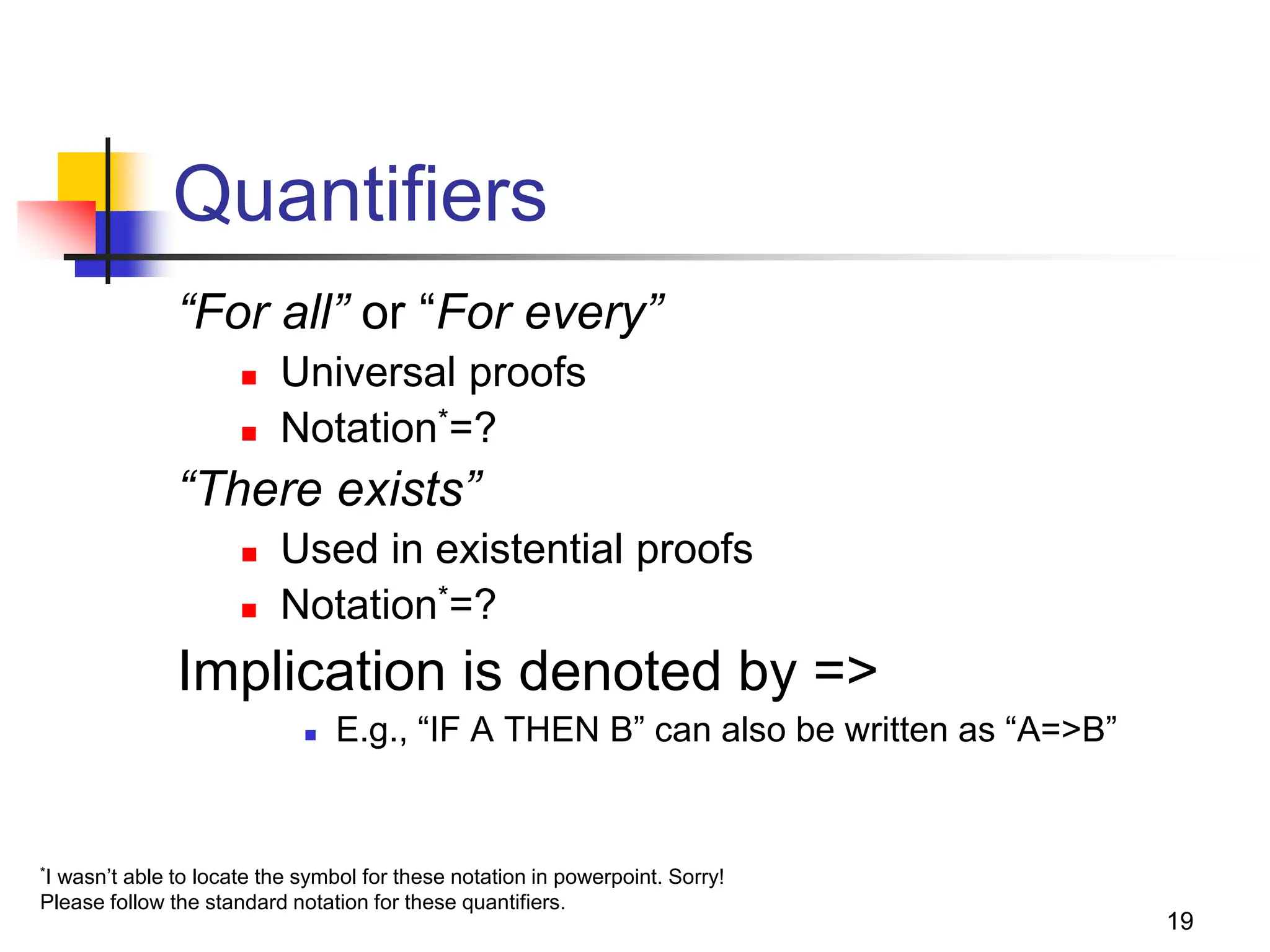
19 Quantifiers “For all” or “For every”  Universal proofs  Notation*=? “There exists”  Used in existential proofs  Notation*=? Implication is denoted by =>  E.g., “IF A THEN B” can also be written as “A=>B” *I wasn’t able to locate the symbol for these notation in powerpoint. Sorry! Please follow the standard notation for these quantifiers.
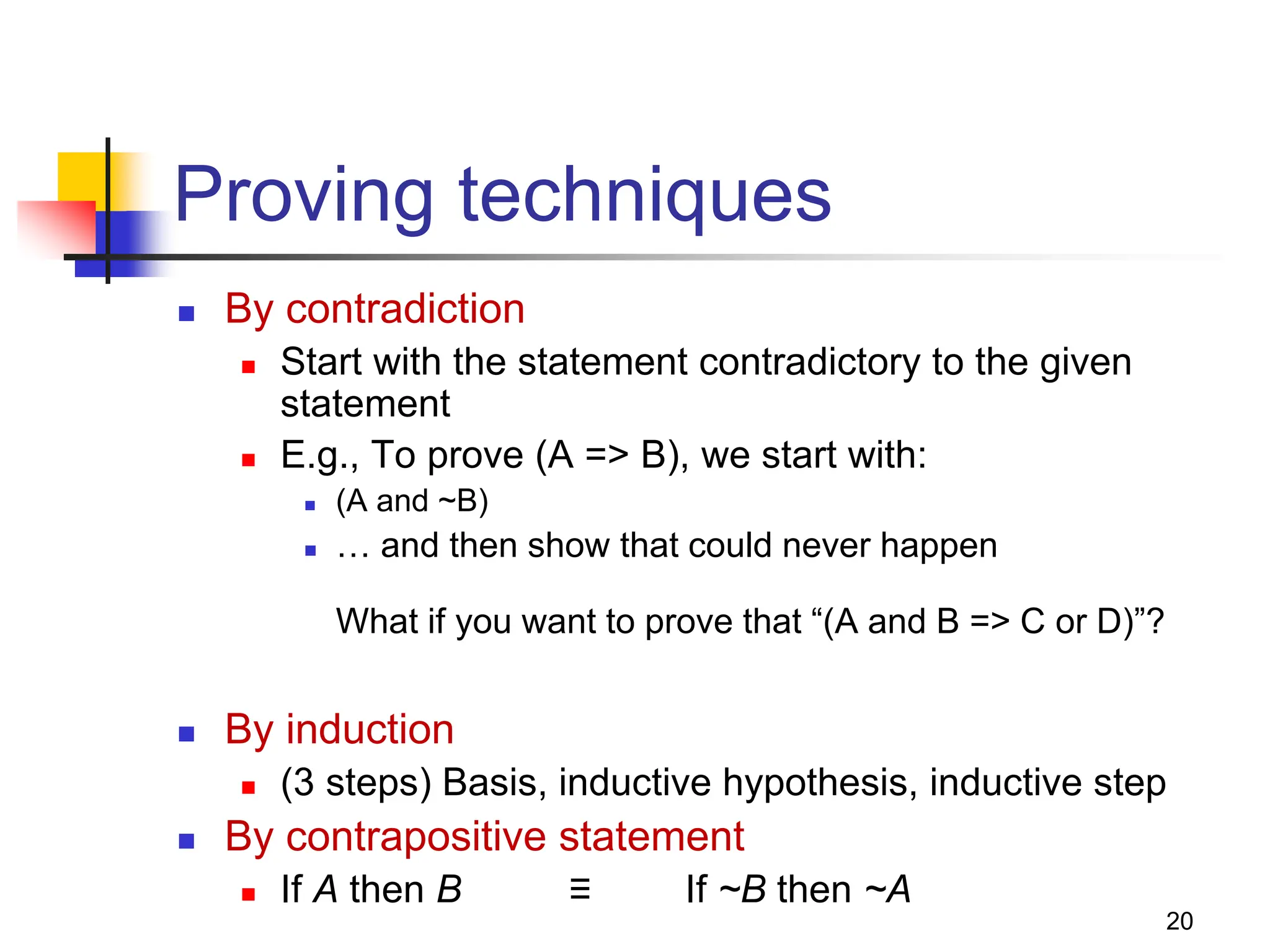
20 Proving techniques  By contradiction  Start with the statement contradictory to the given statement  E.g., To prove (A => B), we start with:  (A and ~B)  … and then show that could never happen What if you want to prove that “(A and B => C or D)”?  By induction  (3 steps) Basis, inductive hypothesis, inductive step  By contrapositive statement  If A then B ≡ If ~B then ~A
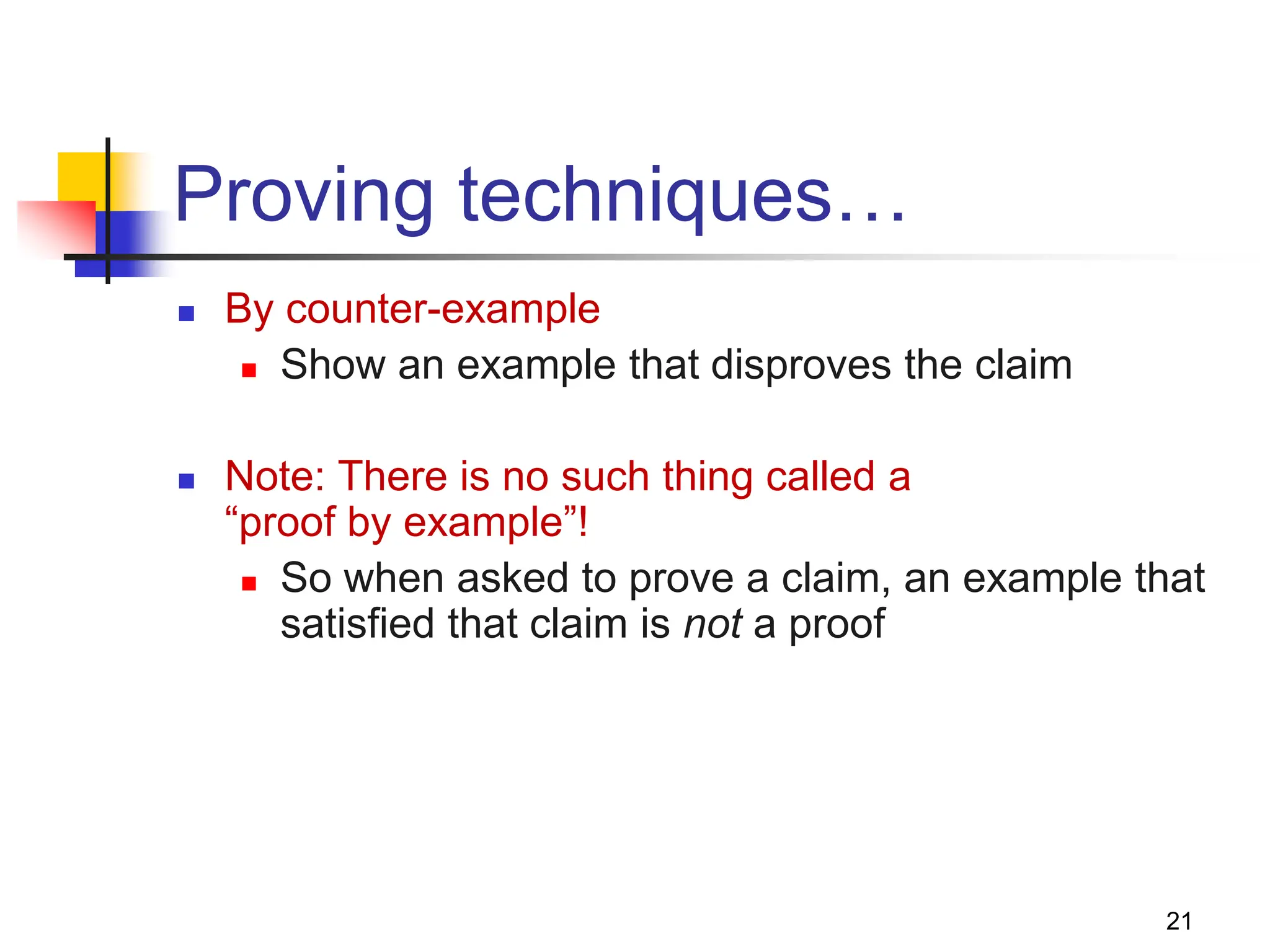
21 Proving techniques…  By counter-example  Show an example that disproves the claim  Note: There is no such thing called a “proof by example”!  So when asked to prove a claim, an example that satisfied that claim is not a proof
22 Different ways of saying the same thing  “If H then C”: i. H implies C ii. H => C iii. C if H iv. H only if C v. Whenever H holds, C follows
23 “If-and-Only-If” statements  “A if and only if B” (A <==> B)  (if part) if B then A ( <= )  (only if part) A only if B ( => ) (same as “if A then B”)  “If and only if” is abbreviated as “iff”  i.e., “A iff B”  Example:  Theorem: Let x be a real number. Then floor of x = ceiling of x if and only if x is an integer.  Proofs for iff have two parts  One for the “if part” & another for the “only if part”
24 Summary  Automata theory & a historical perspective  Chomsky hierarchy  Finite automata  Alphabets, strings/words/sentences, languages  Membership problem  Proofs:  Deductive, induction, contrapositive, contradiction, counterexample  If and only if  Read chapter 1 for more examples and exercises  Gradiance homework 1

Introduction to the computing theory in automata

  • 1.
  • 2.
    2 What is AutomataTheory?  Study of abstract computing devices, or “machines”  Automaton = an abstract computing device  Note: A “device” need not even be a physical hardware!  A fundamental question in computer science:  Find out what different models of machines can do and cannot do  The theory of computation  Computability vs. Complexity
  • 3.
    3 Alan Turing (1912-1954) Father of Modern Computer Science  English mathematician  Studied abstract machines called Turing machines even before computers existed  Heard of the Turing test? (A pioneer of automata theory)
  • 4.
    4 Theory of Computation:A Historical Perspective 1930s • Alan Turing studies Turing machines • Decidability • Halting problem 1940-1950s • “Finite automata” machines studied • Noam Chomsky proposes the “Chomsky Hierarchy” for formal languages 1969 Cook introduces “intractable” problems or “NP-Hard” problems 1970- Modern computer science: compilers, computational & complexity theory evolve
  • 5.
    5 Languages & Grammars Or“words” Image source: Nowak et al. Nature, vol 417, 2002  Languages: “A language is a collection of sentences of finite length all constructed from a finite alphabet of symbols”  Grammars: “A grammar can be regarded as a device that enumerates the sentences of a language” - nothing more, nothing less  N. Chomsky, Information and Control, Vol 2, 1959
  • 6.
  • 7.
    7 The Central Conceptsof Automata Theory
  • 8.
    8 Alphabet An alphabet isa finite, non-empty set of symbols  We use the symbol ∑ (sigma) to denote an alphabet  Examples:  Binary: ∑ = {0,1}  All lower case letters: ∑ = {a,b,c,..z}  Alphanumeric: ∑ = {a-z, A-Z, 0-9}  DNA molecule letters: ∑ = {a,c,g,t}  …
  • 9.
    9 Strings A string orword is a finite sequence of symbols chosen from ∑  Empty string is  (or “epsilon”)  Length of a string w, denoted by “|w|”, is equal to the number of (non- ) characters in the string  E.g., x = 010100 |x| = 6  x = 01  0  1  00  |x| = ?  xy = concatentation of two strings x and y
  • 10.
    10 Powers of analphabet Let ∑ be an alphabet.  ∑k = the set of all strings of length k  ∑* = ∑0 U ∑1 U ∑2 U …  ∑+ = ∑1 U ∑2 U ∑3 U …
  • 11.
    11 Languages L is asaid to be a language over alphabet ∑, only if L  ∑*  this is because ∑* is the set of all strings (of all possible length including 0) over the given alphabet ∑ Examples: 1. Let L be the language of all strings consisting of n 0’s followed by n 1’s: L = {,01,0011,000111,…} 2. Let L be the language of all strings of with equal number of 0’s and 1’s: L = {,01,10,0011,1100,0101,1010,1001,…} Definition: Ø denotes the Empty language  Let L = {}; Is L=Ø? NO
  • 12.
    12 The Membership Problem Givena string w ∑*and a language L over ∑, decide whether or not w L. Example: Let w = 100011 Q) Is w  the language of strings with equal number of 0s and 1s?
  • 13.
    13 Finite Automata  SomeApplications  Software for designing and checking the behavior of digital circuits  Lexical analyzer of a typical compiler  Software for scanning large bodies of text (e.g., web pages) for pattern finding  Software for verifying systems of all types that have a finite number of states (e.g., stock market transaction, communication/network protocol)
  • 14.
    14 Finite Automata :Examples  On/Off switch  Modeling recognition of the word “then” Start state Final state Transition Intermediate state action state
  • 15.
    15 Structural expressions  Grammars Regular expressions  E.g., unix style to capture city names such as “Palo Alto CA”:  [A-Z][a-z]*([ ][A-Z][a-z]*)*[ ][A-Z][A-Z] Start with a letter A string of other letters (possibly empty) Other space delimited words (part of city name) Should end w/ 2-letter state code
  • 16.
  • 17.
    17 Deductive Proofs From thegiven statement(s) to a conclusion statement (what we want to prove)  Logical progression by direct implications Example for parsing a statement:  “If y≥4, then 2y≥y2.” (there are other ways of writing this). given conclusion
  • 18.
    18 Example: Deductive proof LetClaim 1: If y≥4, then 2y≥y2. Let x be any number which is obtained by adding the squares of 4 positive integers. Given x and assuming that Claim 1 is true, prove that 2x≥x2  Proof: 1) Given: x = a2 + b2 + c2 + d2 2) Given: a≥1, b≥1, c≥1, d≥1 3)  a2≥1, b2≥1, c2≥1, d2≥1 (by 2) 4)  x ≥ 4 (by 1 & 3) 5)  2x ≥ x2 (by 4 and Claim 1) “implies” or “follows”
  • 19.
    19 Quantifiers “For all” or“For every”  Universal proofs  Notation*=? “There exists”  Used in existential proofs  Notation*=? Implication is denoted by =>  E.g., “IF A THEN B” can also be written as “A=>B” *I wasn’t able to locate the symbol for these notation in powerpoint. Sorry! Please follow the standard notation for these quantifiers.
  • 20.
    20 Proving techniques  Bycontradiction  Start with the statement contradictory to the given statement  E.g., To prove (A => B), we start with:  (A and ~B)  … and then show that could never happen What if you want to prove that “(A and B => C or D)”?  By induction  (3 steps) Basis, inductive hypothesis, inductive step  By contrapositive statement  If A then B ≡ If ~B then ~A
  • 21.
    21 Proving techniques…  Bycounter-example  Show an example that disproves the claim  Note: There is no such thing called a “proof by example”!  So when asked to prove a claim, an example that satisfied that claim is not a proof
  • 22.
    22 Different ways ofsaying the same thing  “If H then C”: i. H implies C ii. H => C iii. C if H iv. H only if C v. Whenever H holds, C follows
  • 23.
    23 “If-and-Only-If” statements  “Aif and only if B” (A <==> B)  (if part) if B then A ( <= )  (only if part) A only if B ( => ) (same as “if A then B”)  “If and only if” is abbreviated as “iff”  i.e., “A iff B”  Example:  Theorem: Let x be a real number. Then floor of x = ceiling of x if and only if x is an integer.  Proofs for iff have two parts  One for the “if part” & another for the “only if part”
  • 24.
    24 Summary  Automata theory& a historical perspective  Chomsky hierarchy  Finite automata  Alphabets, strings/words/sentences, languages  Membership problem  Proofs:  Deductive, induction, contrapositive, contradiction, counterexample  If and only if  Read chapter 1 for more examples and exercises  Gradiance homework 1

Editor's Notes

  • #2 School of EECS, WSU
  • #3 School of EECS, WSU
  • #4 School of EECS, WSU
  • #5 School of EECS, WSU
  • #6 School of EECS, WSU
  • #7 School of EECS, WSU
  • #8 School of EECS, WSU
  • #9 School of EECS, WSU
  • #10 School of EECS, WSU
  • #11 School of EECS, WSU
  • #12 School of EECS, WSU
  • #13 School of EECS, WSU
  • #14 School of EECS, WSU
  • #15 School of EECS, WSU
  • #16 School of EECS, WSU
  • #17 School of EECS, WSU
  • #18 School of EECS, WSU
  • #19 School of EECS, WSU
  • #20 School of EECS, WSU
  • #21 School of EECS, WSU
  • #22 School of EECS, WSU
  • #23 School of EECS, WSU
  • #24 School of EECS, WSU
  • #25 School of EECS, WSU