Downloaded 148 times


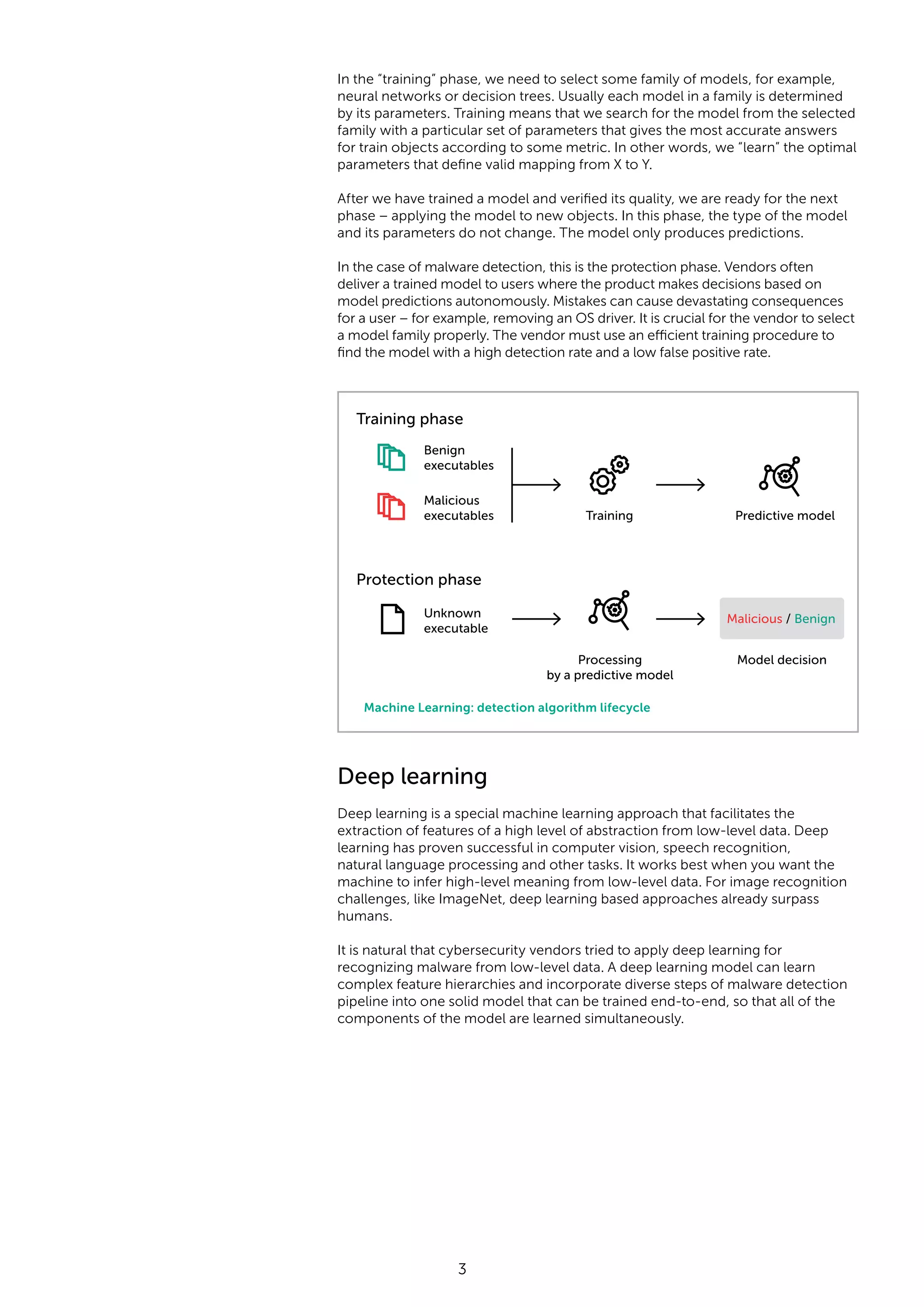
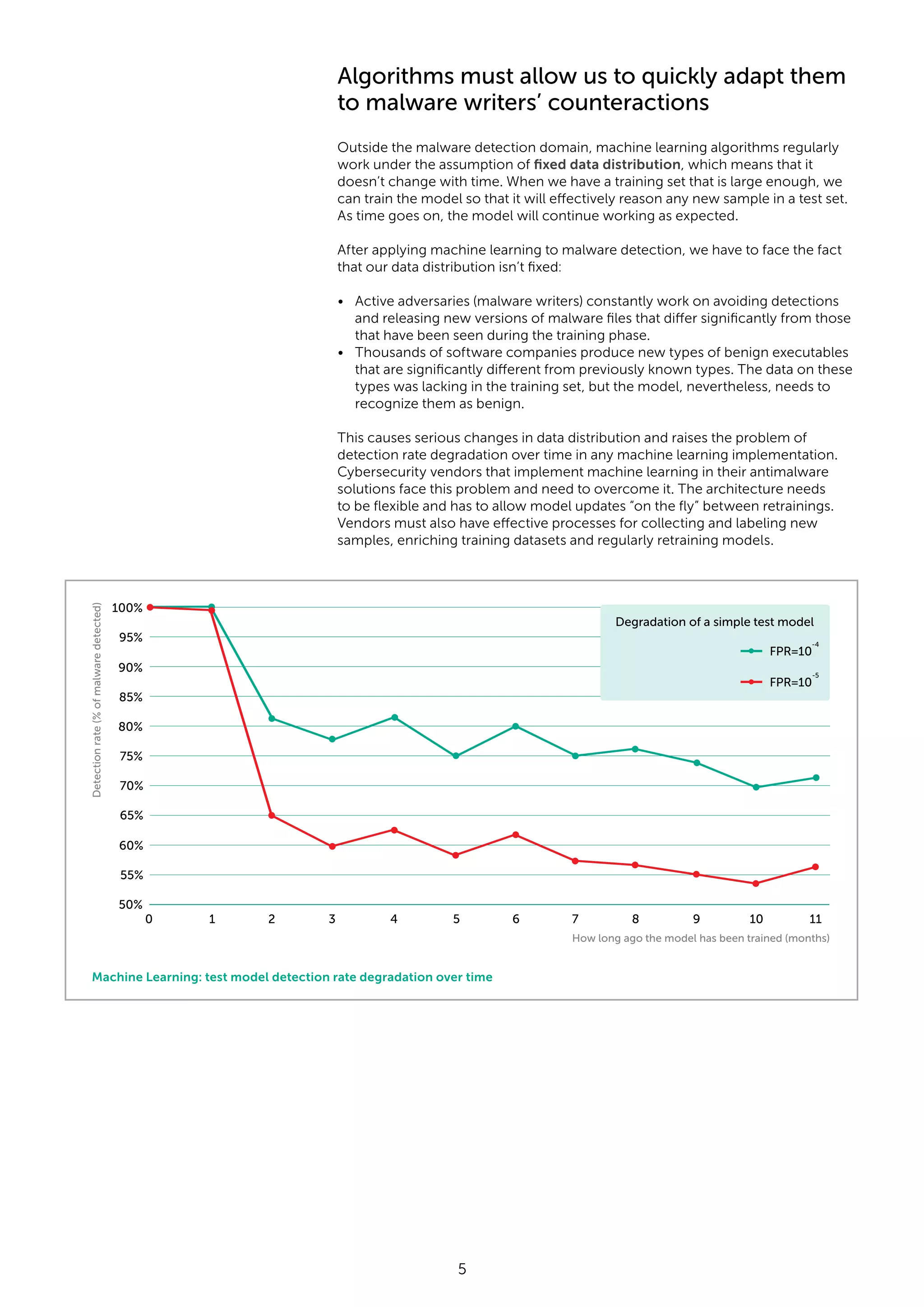
![7 Very similar files Similar files Non-similar files Cryptographic hash (hash values) Locality sensitive hash (hash values) But we went further. The LSH calculation was unsupervised. It didn’t take into account our additional knowledge of each sample being malware or benign. Having a dataset of similar and non-similar objects, we enhanced this approach by introducing a training phase. We implemented a similarity hashing approach. It’s similar to LSH, but it is supervised and capable of utilizing information about pairs of similar and non-similar objects. In this case: • Our training data X would be pairs of file feature representations [X1, X2] • Y would be the label that would tell us whether the objects were actually semantically similar or not. • During training, the algorithm fits parameters of hash mapping h(X) to maximize the number of pairs from the training set, for which h(X1) and h(X2) are identical for similar objects and different otherwise. This algorithm that is being applied to executable file features provides specific similarity hash mapping with useful detection capabilities. In fact, we train several versions of this mapping that differ in their sensitivity to local perturbations of different sets of features. For example, one version of similarity hash mapping could be more focused on capturing the executable file structure, while paying less attention to the actual content. The other one could be more focused on capturing the ASCII-strings of the file. This captures the idea that different subsets of features could be more or less discriminative to different kinds of malware files. For one of them, file content statistics could reveal the presence of an unknown malicious packer. For the others, the most important piece of information regarding potential behavior is concentrated in strings representing used OS API, created file names, accessed URLs or other feature subsets. For more precise detection in products, the results of a similarity hashing algorithm are combined with other machine learning-based detection methods. Machine Learning: locality sensitive hashing](https://image.slidesharecdn.com/kaspersky-lab-whitepaper-machine-learning-171229095509/75/Machine-Learning-in-Malware-Detection-9-2048.jpg)
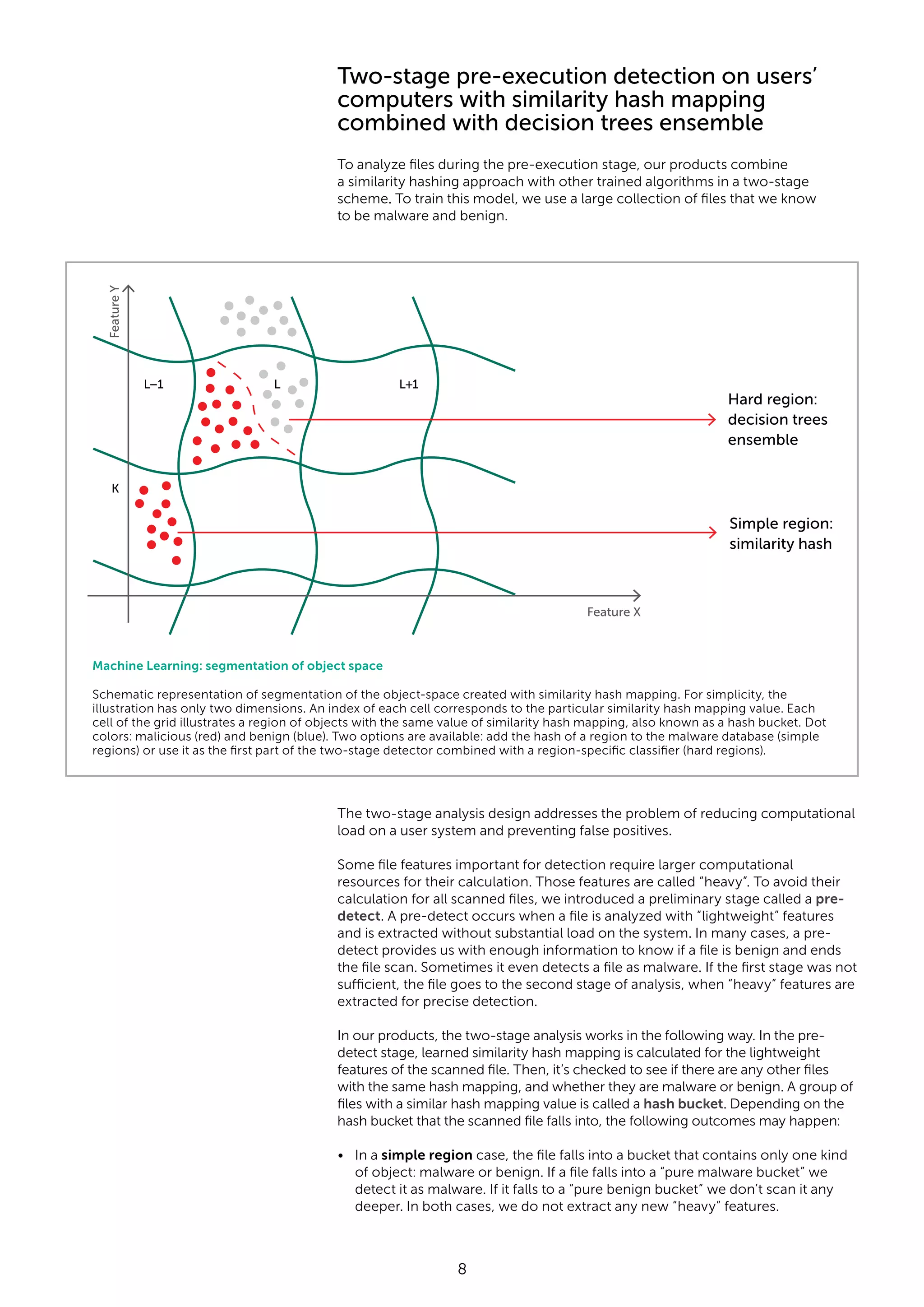
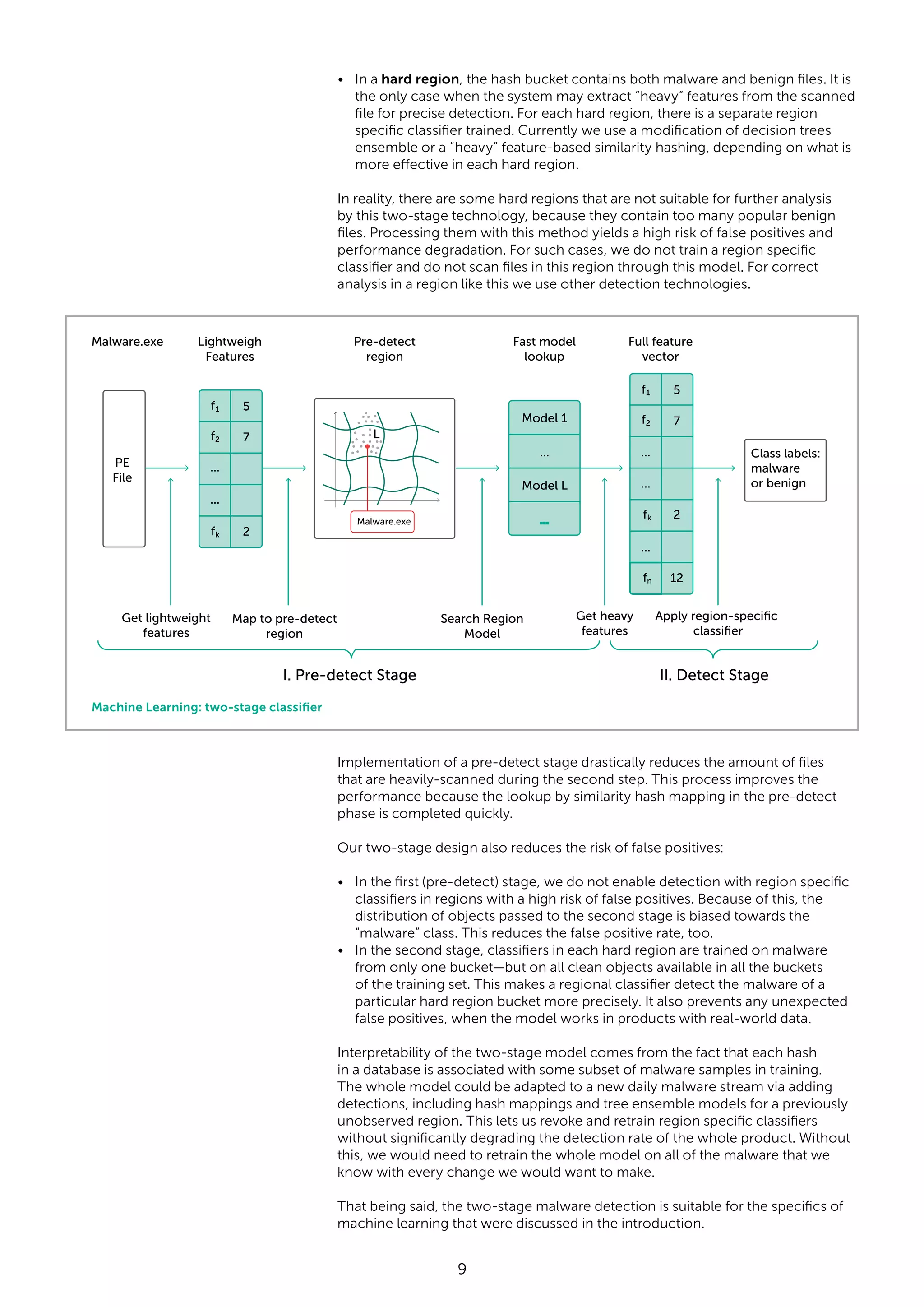
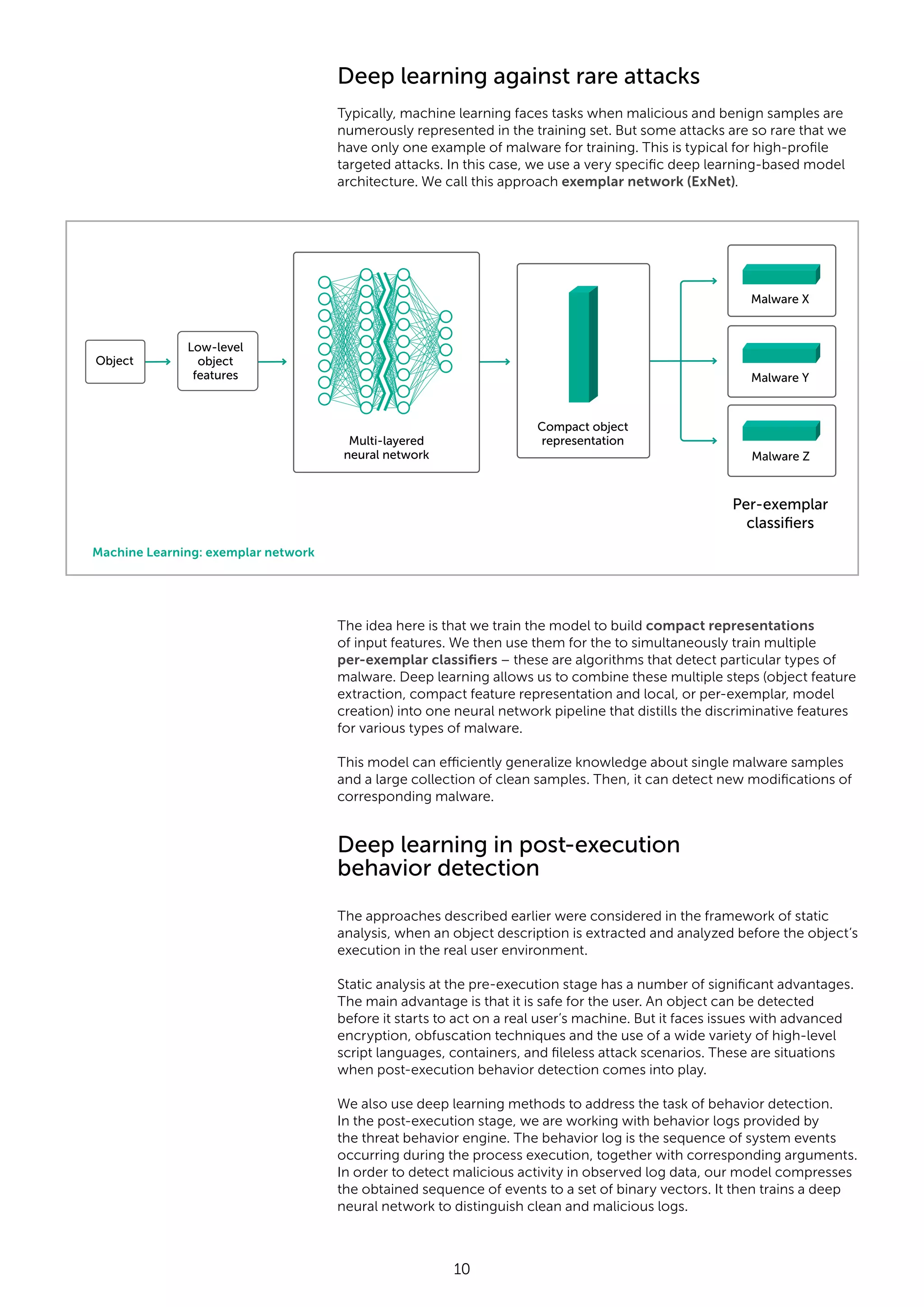
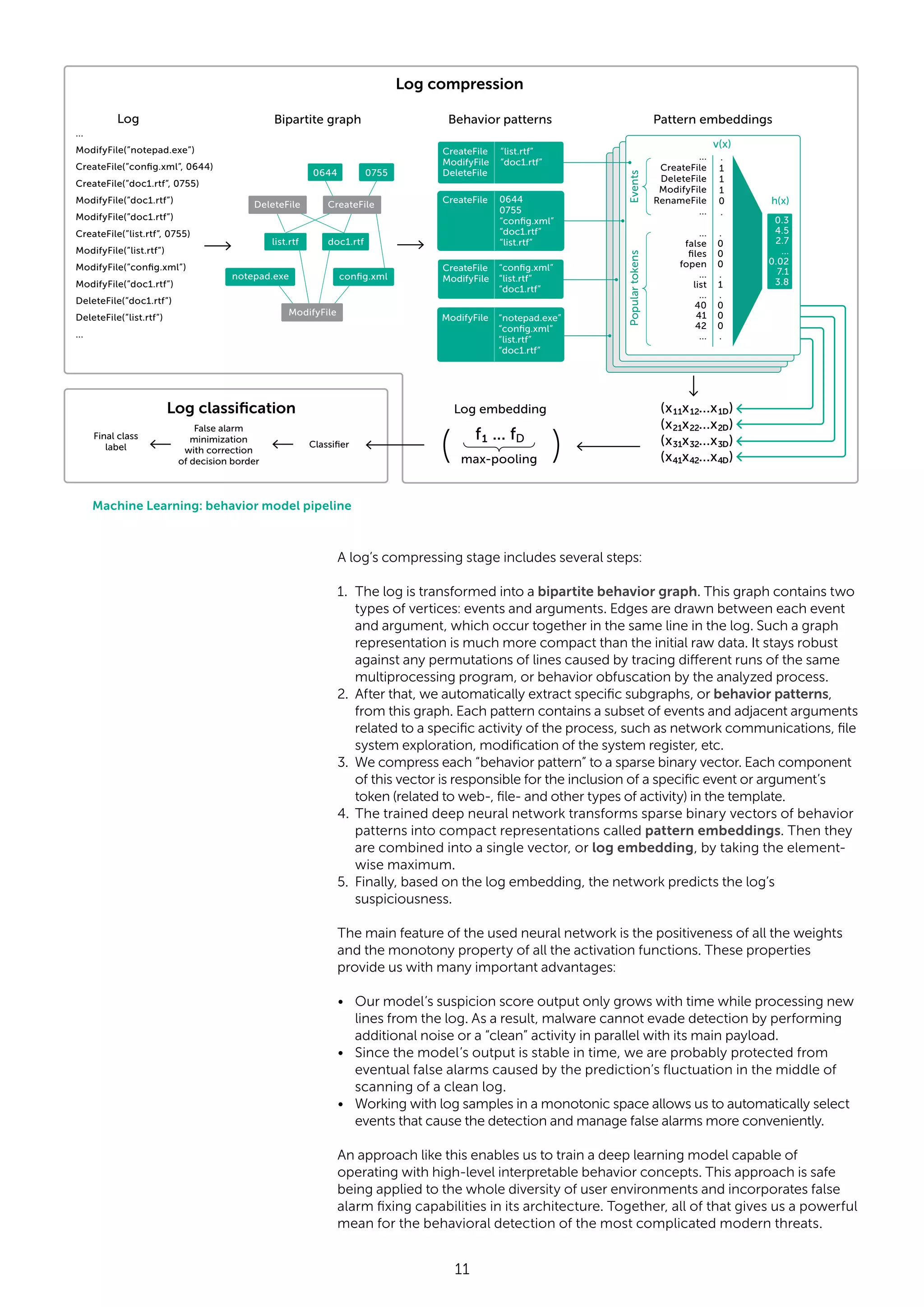
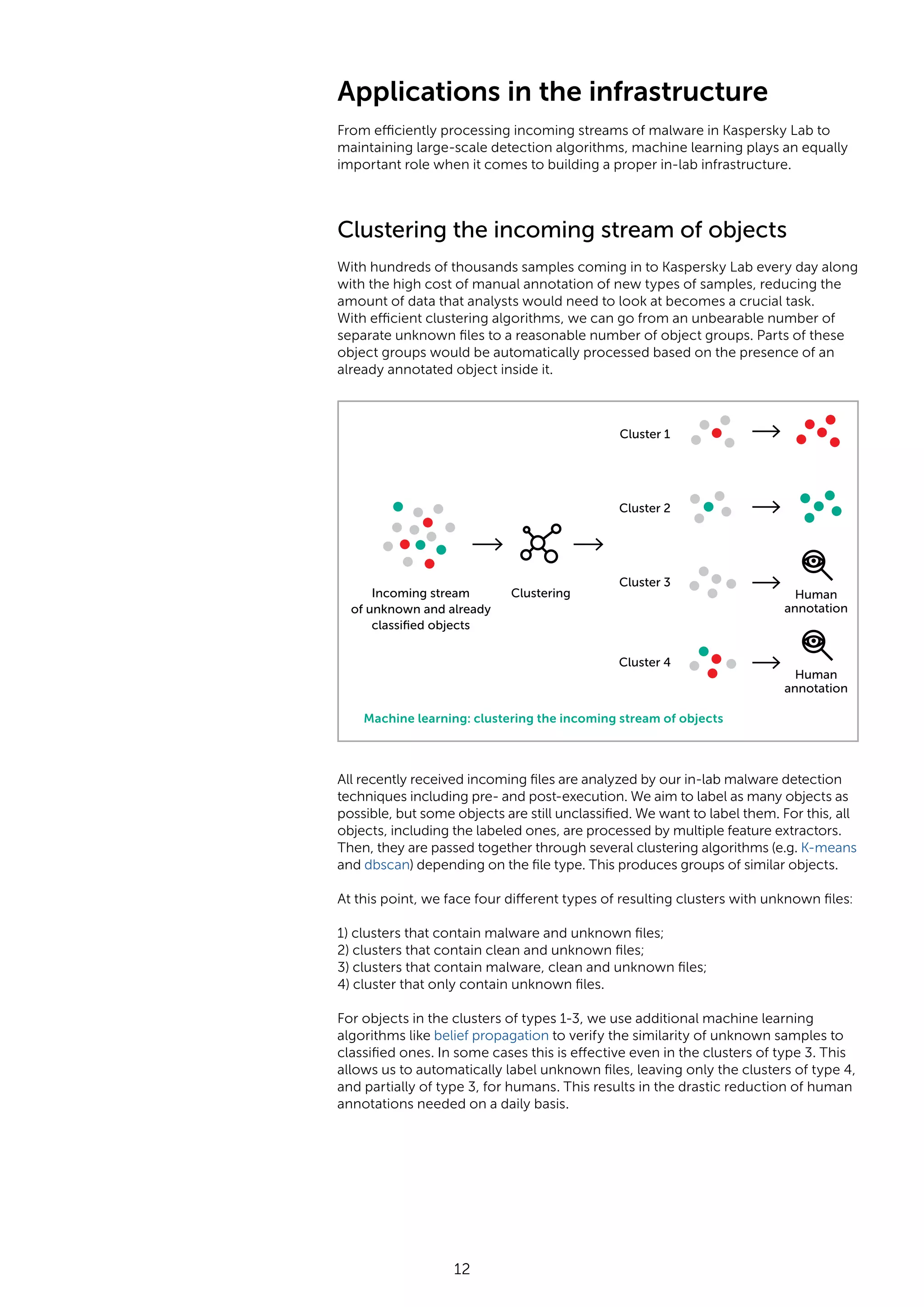
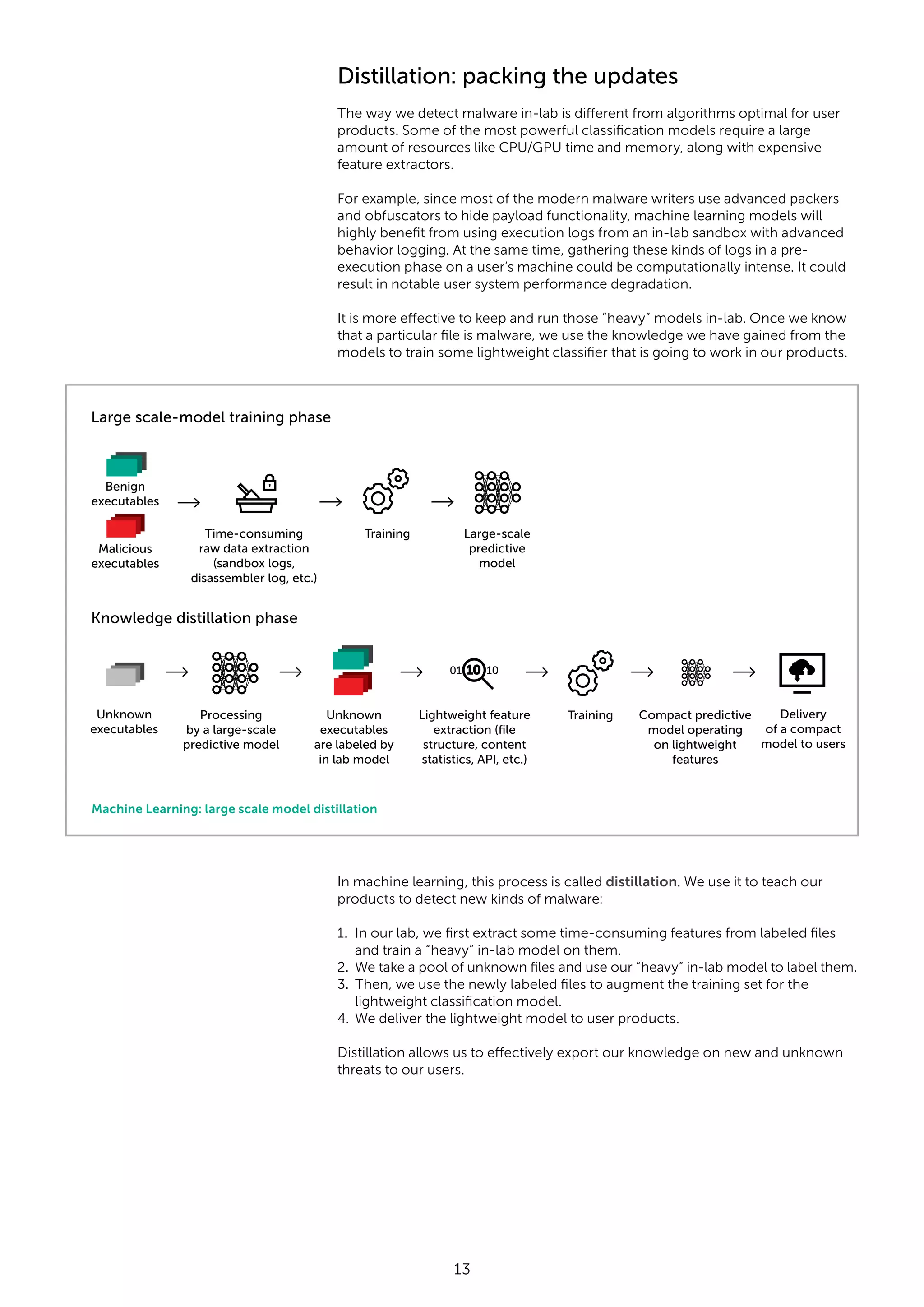

The document discusses Kaspersky's implementation of machine learning in malware detection, detailing concepts such as supervised and unsupervised learning as well as deep learning techniques. It emphasizes the importance of large representative datasets, low false positive rates, and model interpretability in ensuring effective cybersecurity. Furthermore, it outlines Kaspersky's two-stage detection approach that combines similarity hashing with decision trees to efficiently identify malware with reduced computational load.