@crichardson Managing data consistency in a microservice architecture using Sagas Chris Richardson Founder of Eventuate.io Founder of the original CloudFoundry.com Author of Microservices Patterns and POJOs in Action @crichardson chris@chrisrichardson.net http://learn.microservices.io Copyright © 2019. Chris Richardson Consulting, Inc. All rights reserved
@crichardson Presentation goal ACID transactions within services Sagas between services
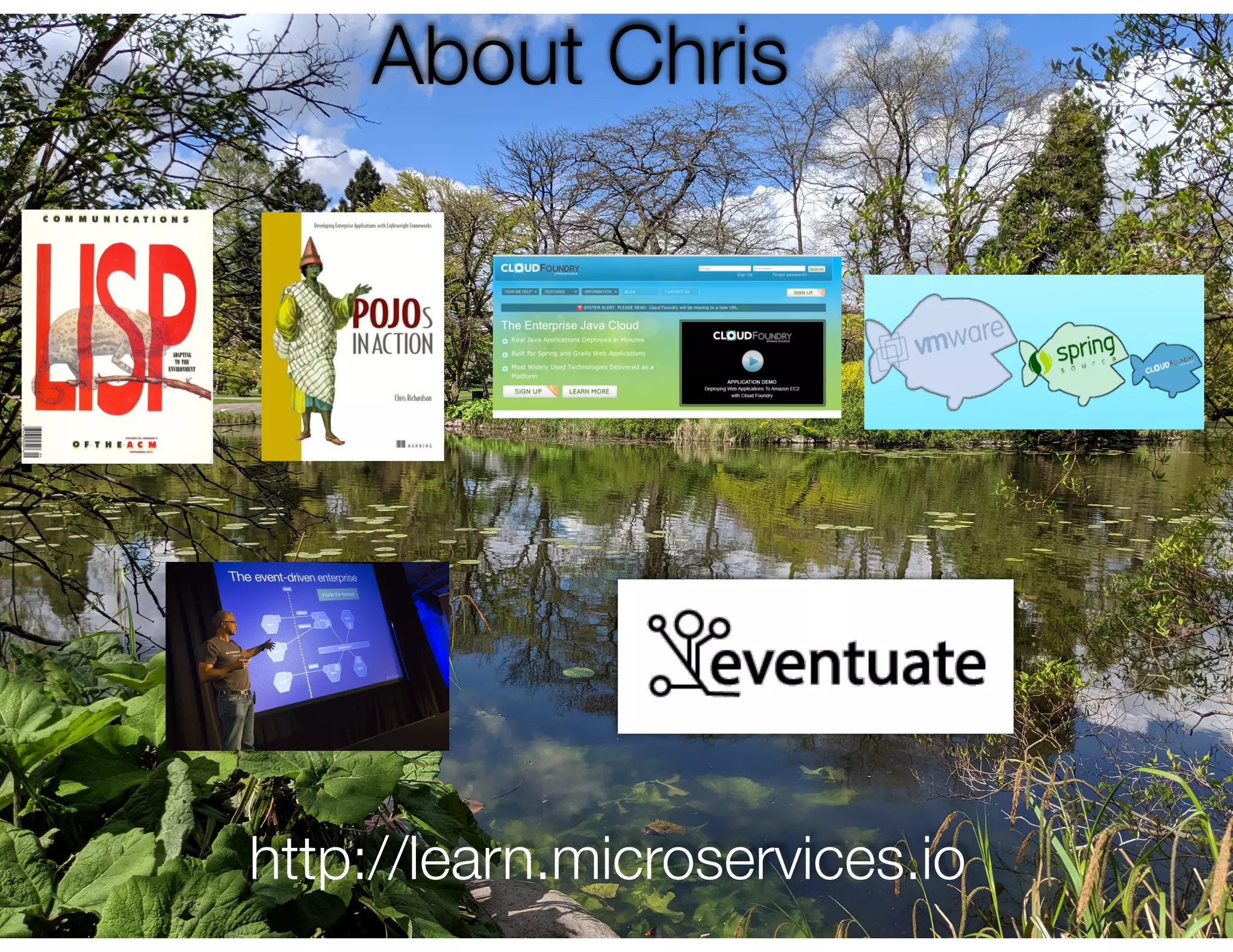
@crichardson About Chris http://learn.microservices.io
@crichardson About Chris https://microservices.io/book 40% discount with code ctwmicrocph19
@crichardson Agenda ACID is not an option Overview of sagas Coordinating sagas
The microservice architecture structures an application as a set of loosely coupled services
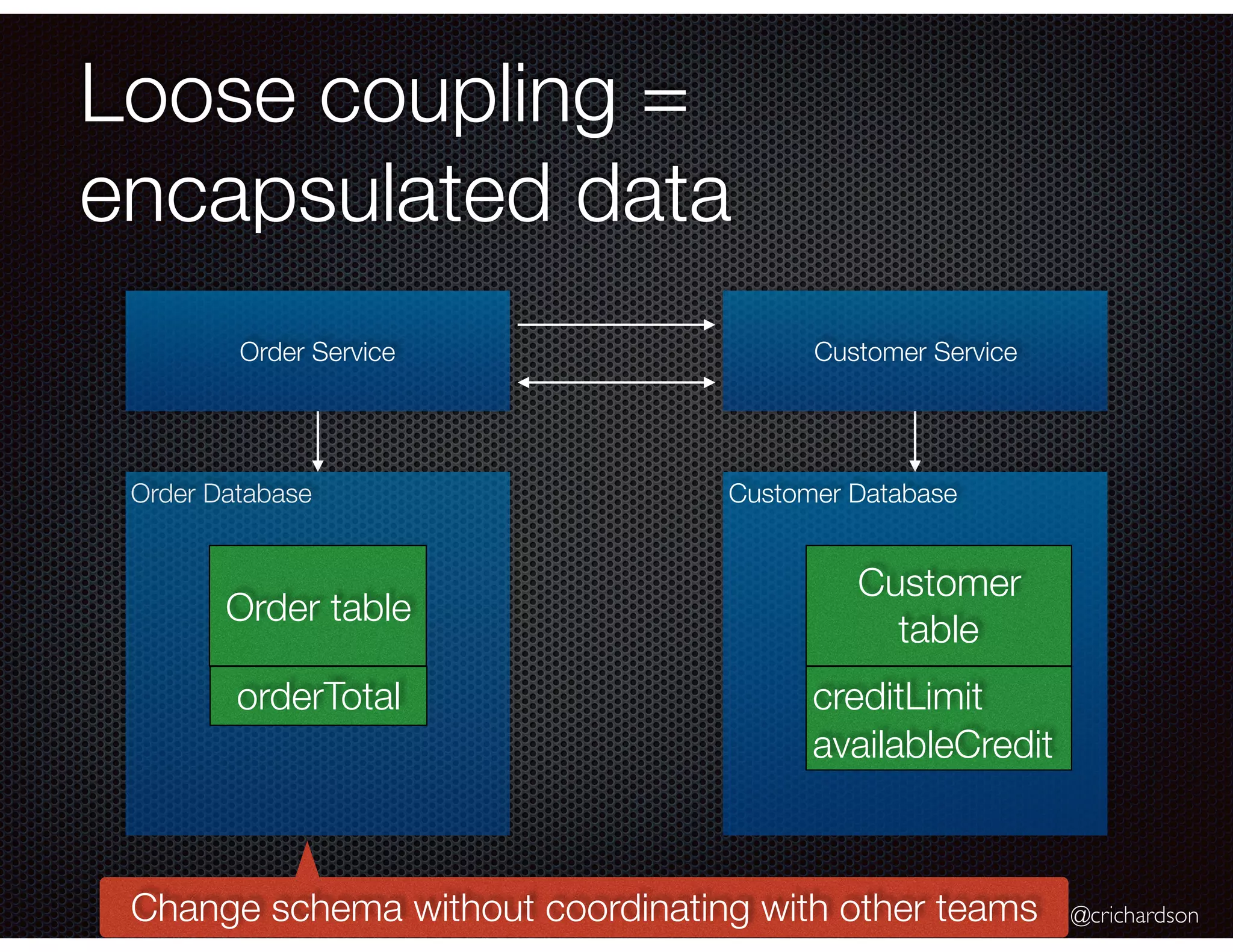
@crichardson Loose coupling = encapsulated data Order Service Customer Service Order Database Customer Database Order table Customer table orderTotal creditLimit availableCredit Change schema without coordinating with other teams
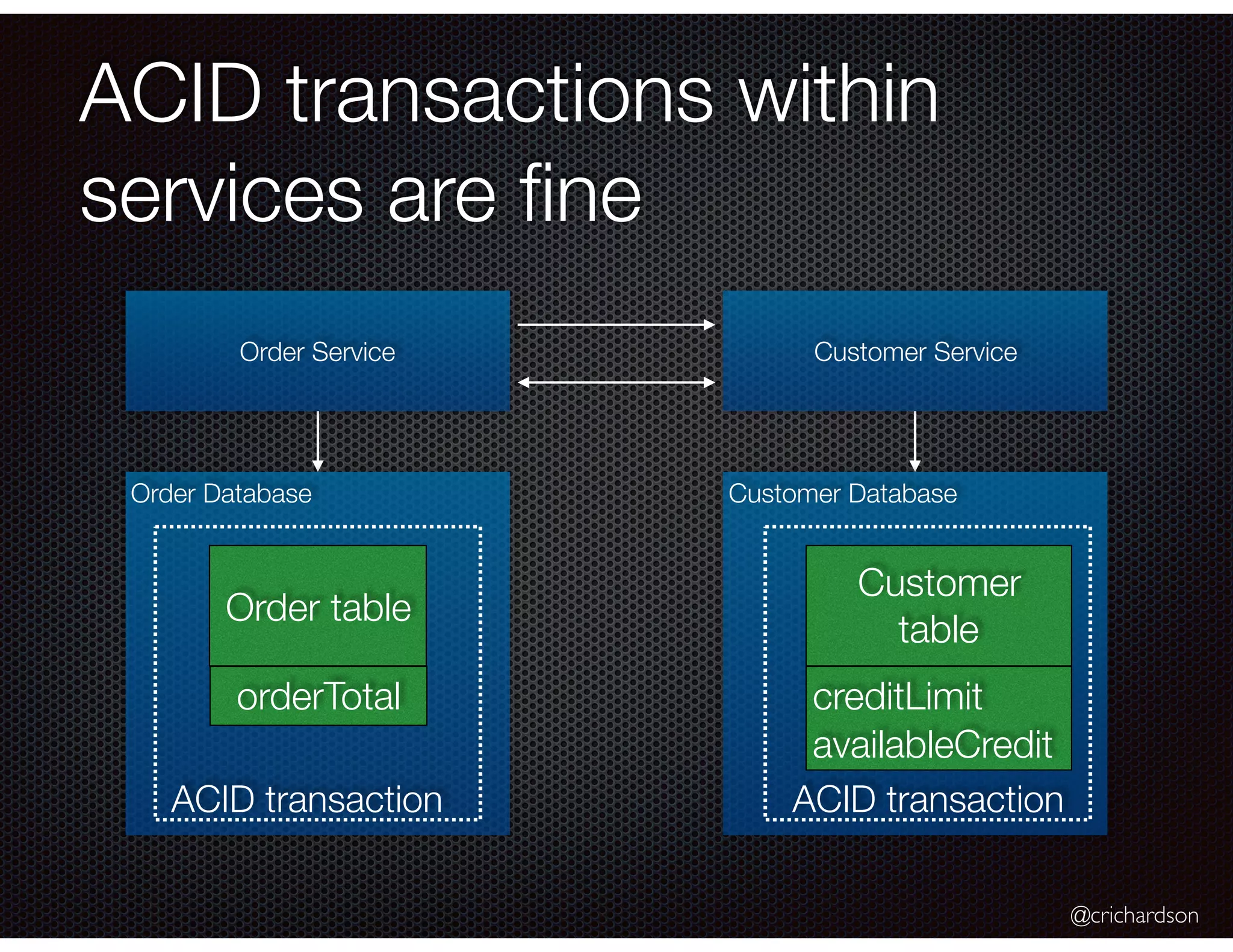
@crichardson ACID transactions within services are fine Order Service Customer Service Order Database Customer Database Order table Customer table orderTotal creditLimit availableCredit ACID transaction ACID transaction
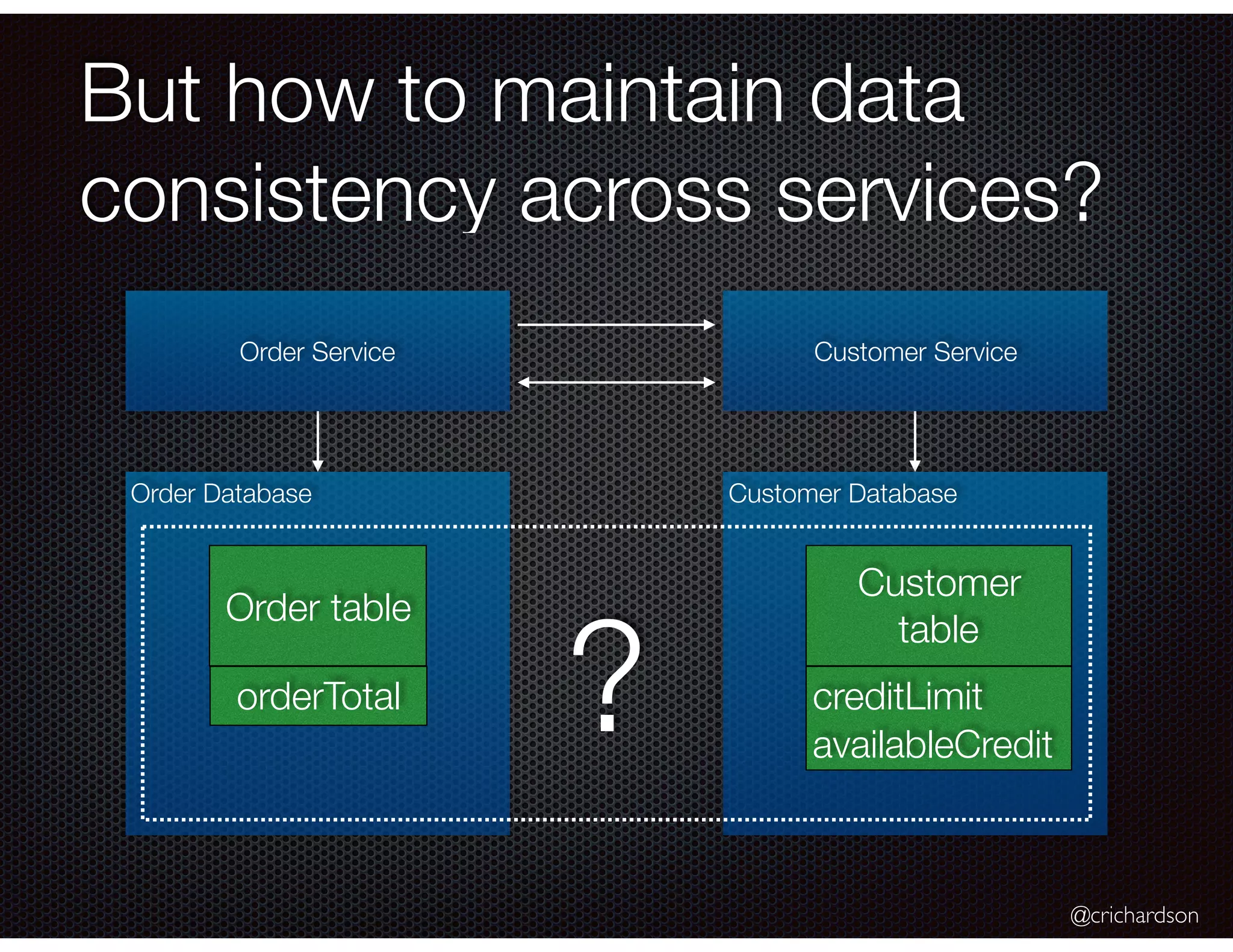
@crichardson But how to maintain data consistency across services? Order Service Customer Service Order Database Customer Database Order table Customer table orderTotal creditLimit availableCredit ?
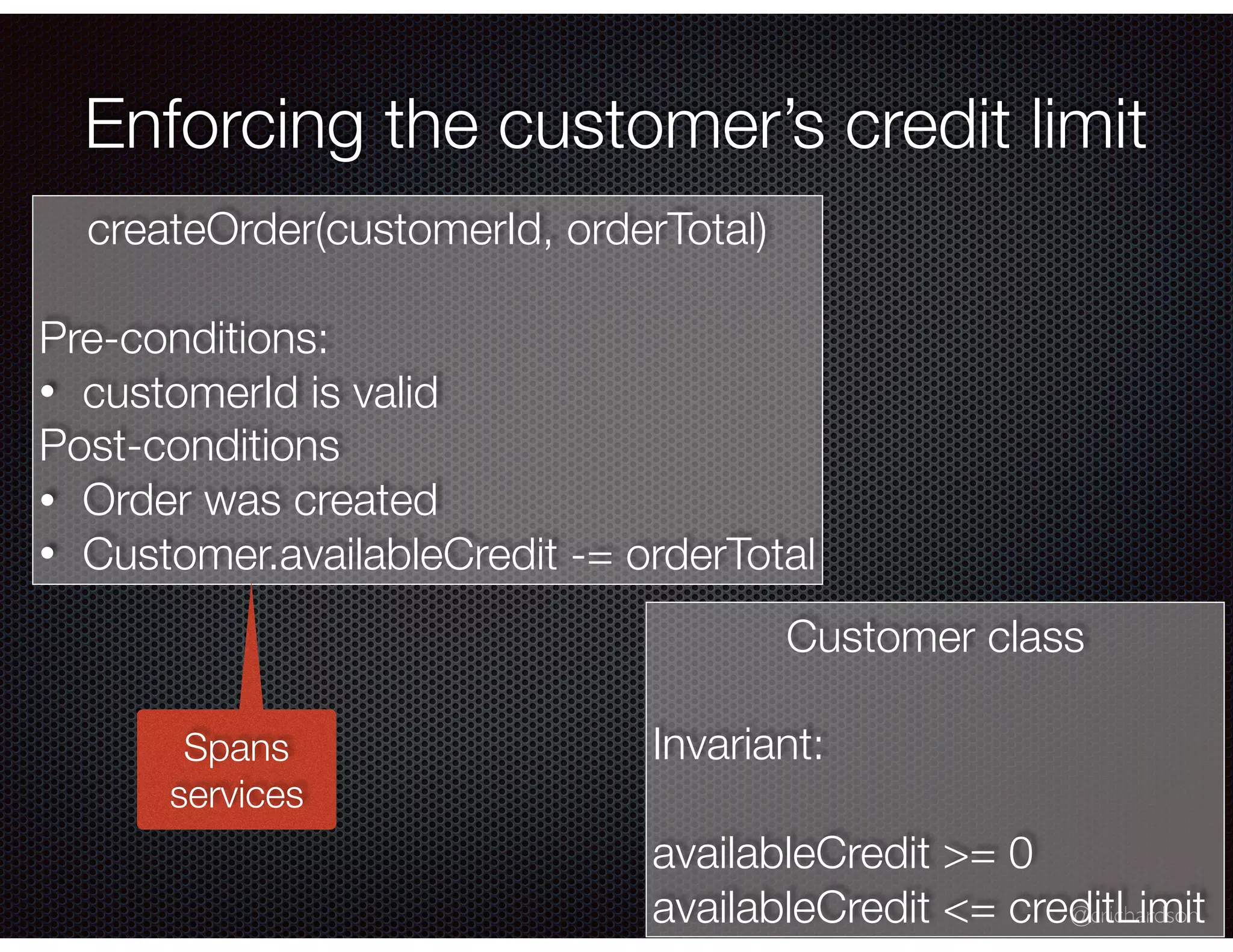
@crichardson Enforcing the customer’s credit limit createOrder(customerId, orderTotal) Pre-conditions: • customerId is valid Post-conditions • Order was created • Customer.availableCredit -= orderTotal Customer class Invariant: availableCredit >= 0 availableCredit <= creditLimit Spans services
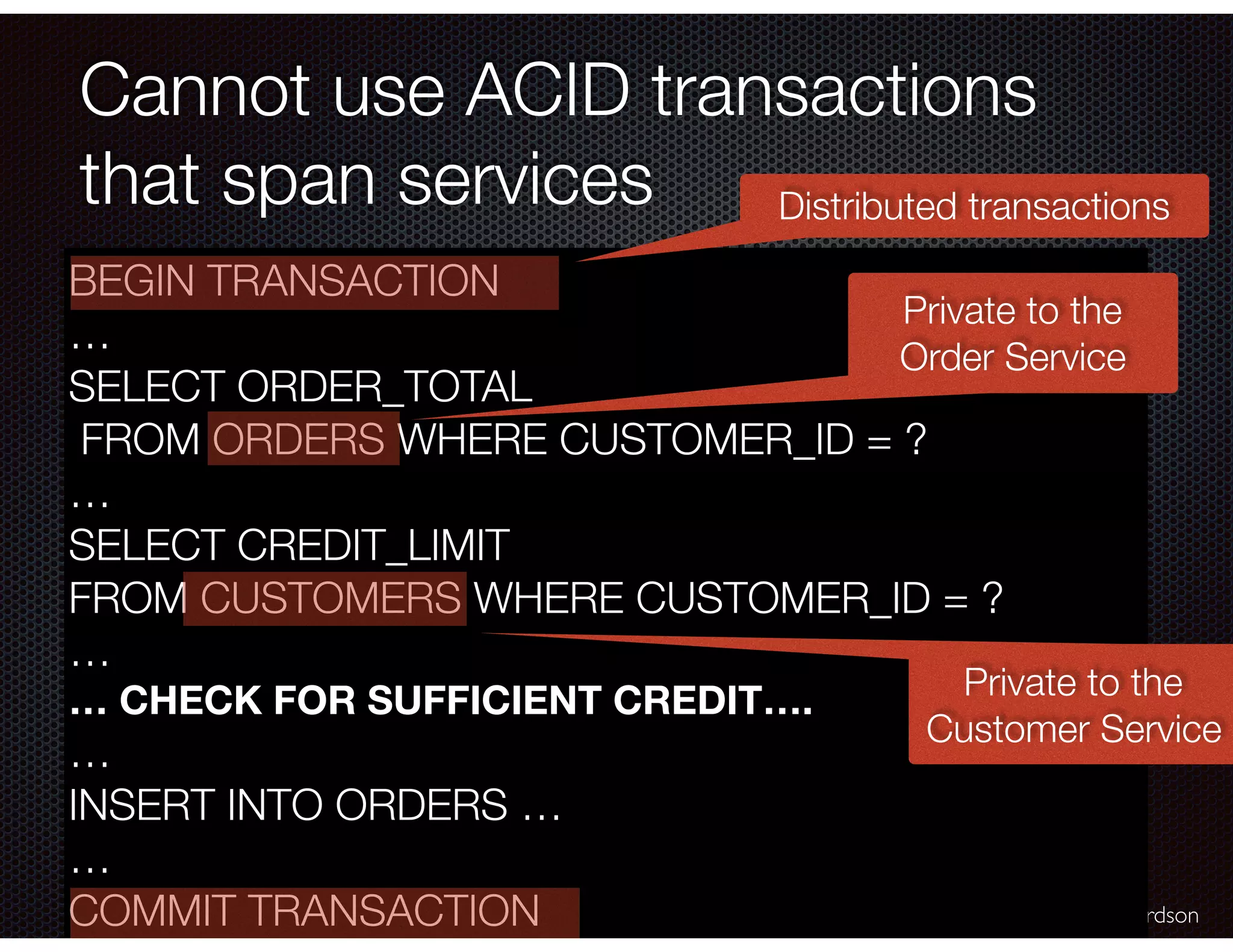
@crichardson Cannot use ACID transactions that span services BEGIN TRANSACTION … SELECT ORDER_TOTAL FROM ORDERS WHERE CUSTOMER_ID = ? … SELECT CREDIT_LIMIT FROM CUSTOMERS WHERE CUSTOMER_ID = ? … … CHECK FOR SUFFICIENT CREDIT…. … INSERT INTO ORDERS … … COMMIT TRANSACTION Private to the Order Service Private to the Customer Service Distributed transactions
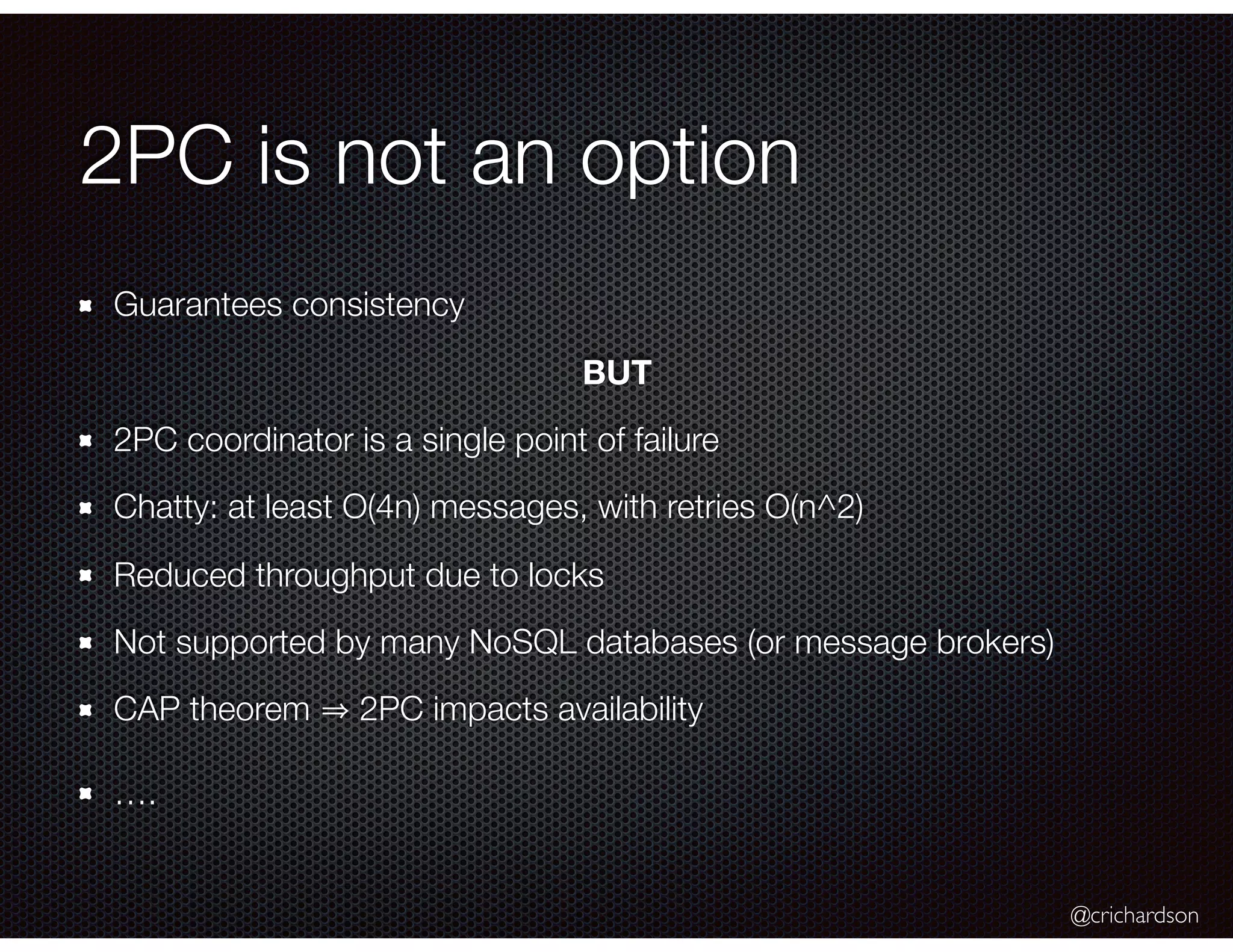
@crichardson 2PC is not an option Guarantees consistency BUT 2PC coordinator is a single point of failure Chatty: at least O(4n) messages, with retries O(n^2) Reduced throughput due to locks Not supported by many NoSQL databases (or message brokers) CAP theorem 2PC impacts availability ….
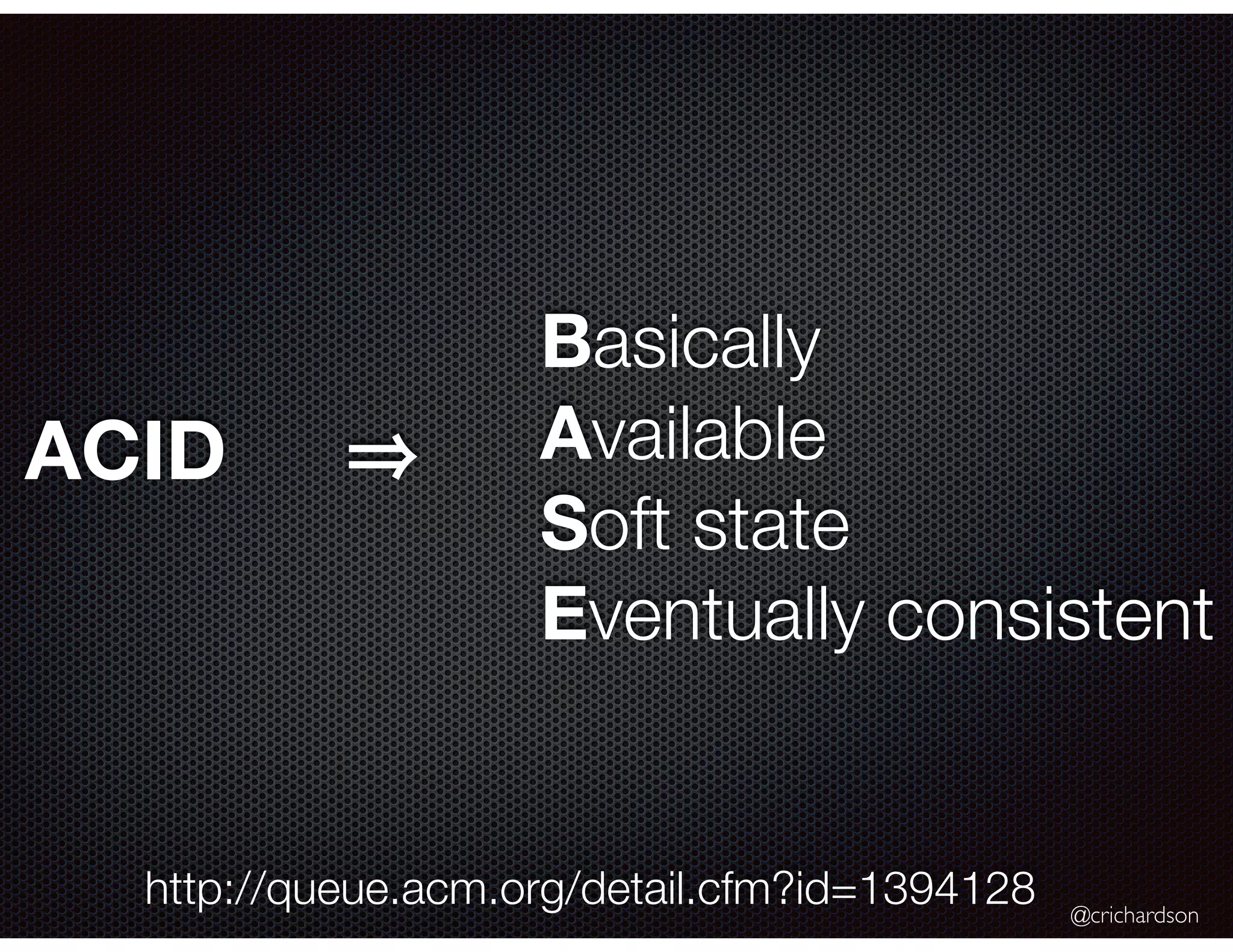
@crichardson Basically Available Soft state Eventually consistent http://queue.acm.org/detail.cfm?id=1394128 ACID
@crichardson Agenda ACID is not an option Overview of sagas Coordinating sagas
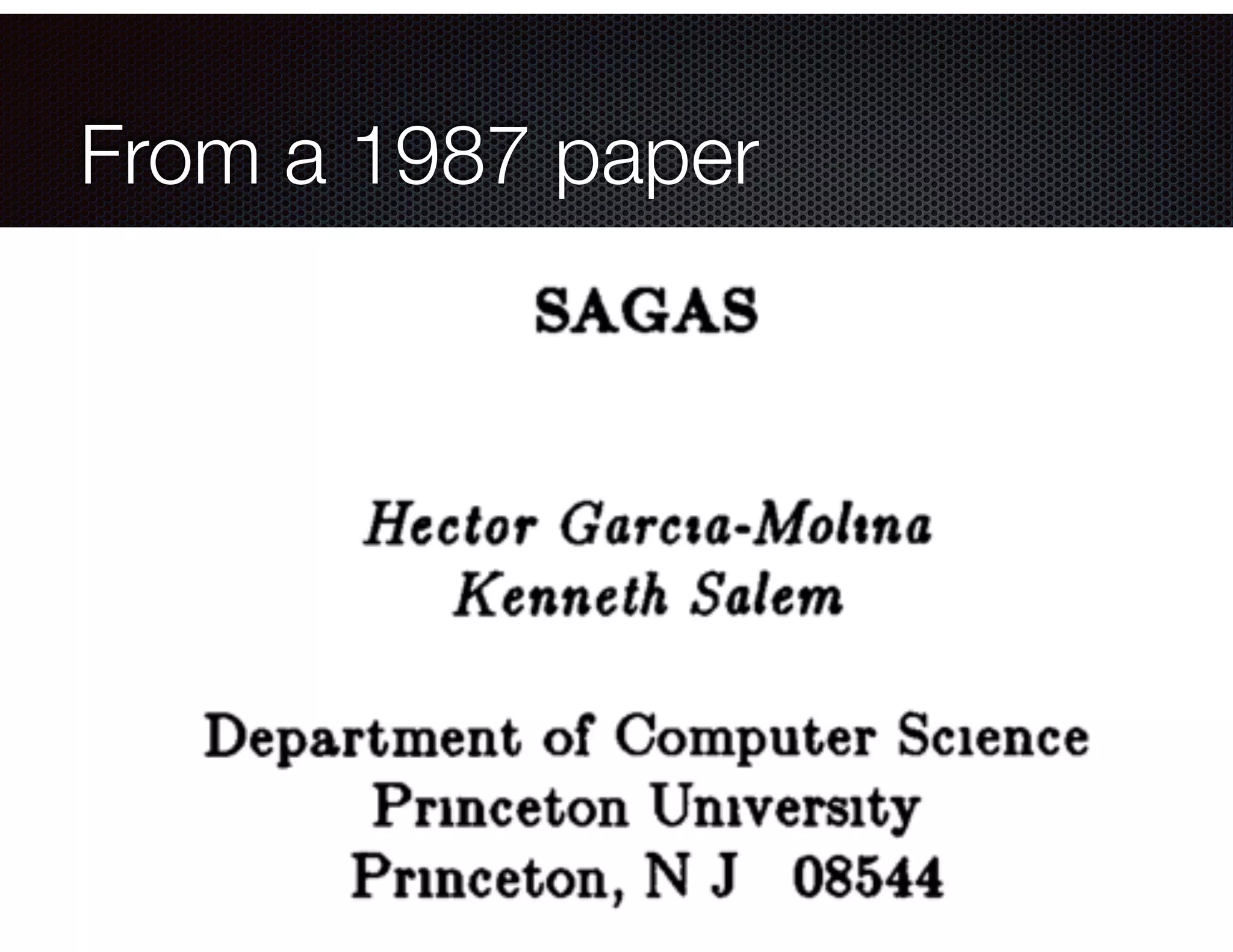
@crichardson From a 1987 paper
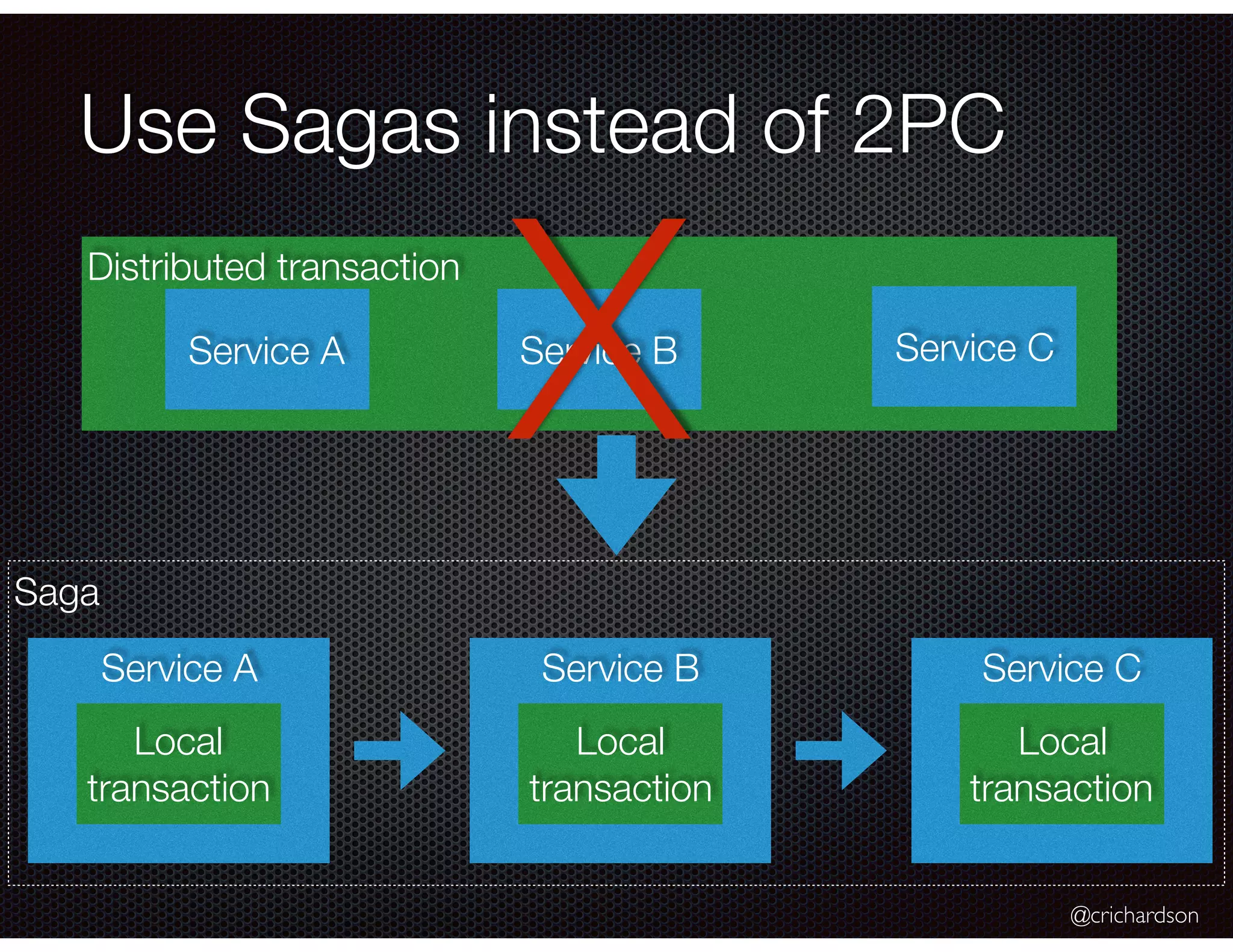
@crichardson Saga Use Sagas instead of 2PC Distributed transaction Service A Service B Service A Local transaction Service B Local transaction Service C Local transaction X Service C
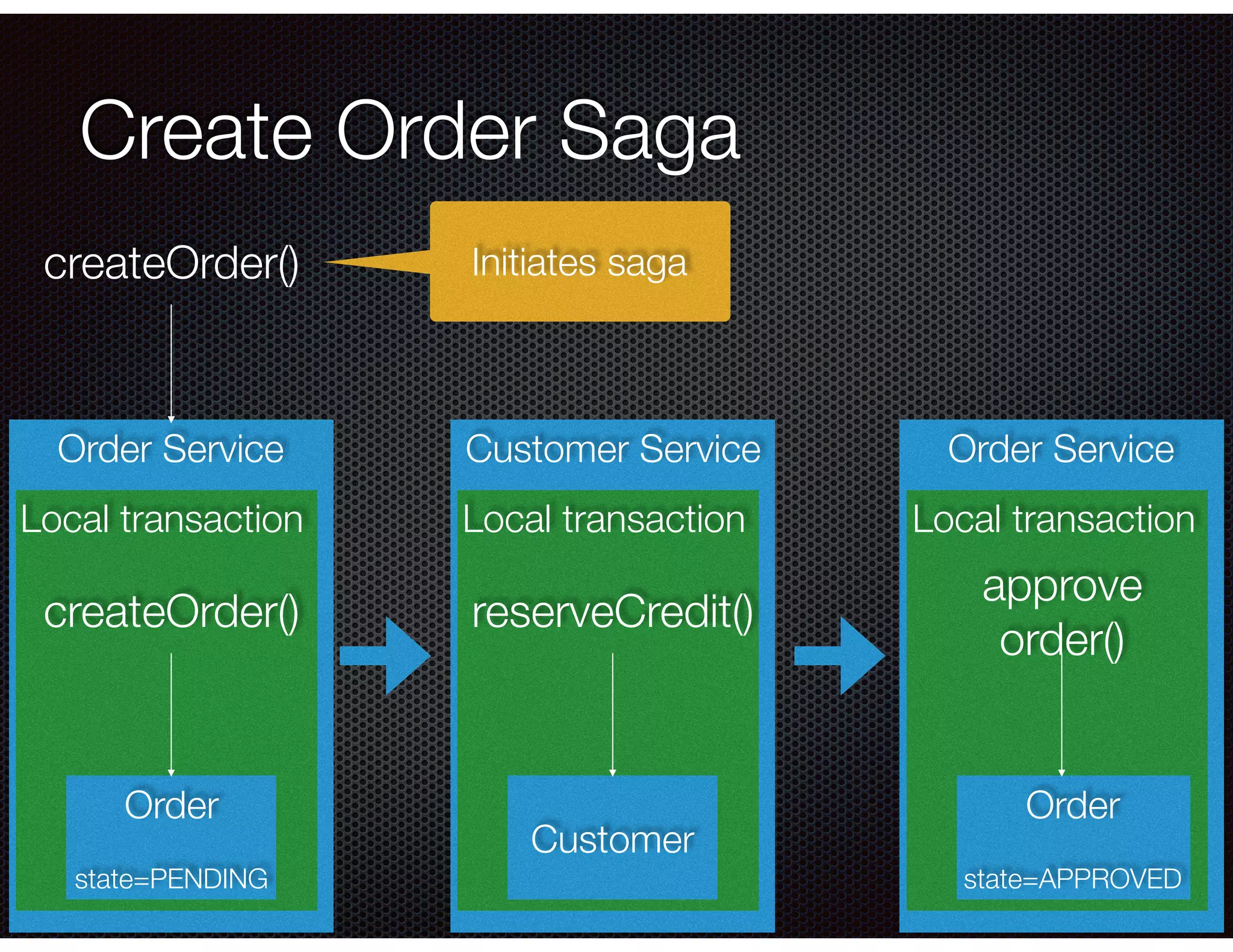
@crichardson Order Service Create Order Saga Local transaction Order state=PENDING createOrder() Customer Service Local transaction Customer reserveCredit() Order Service Local transaction Order state=APPROVED approve order() createOrder() Initiates saga
@crichardson Seems simple but …
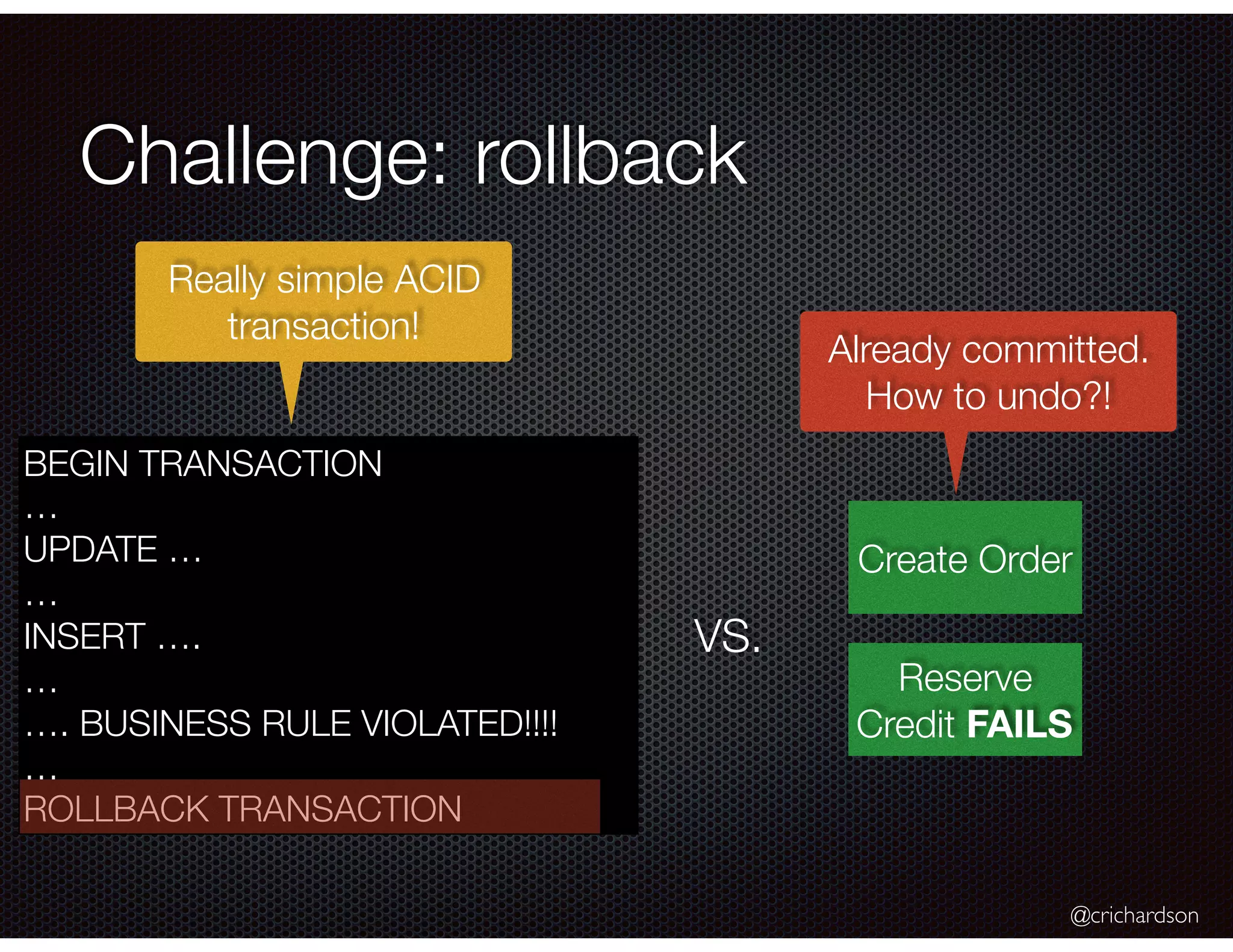
@crichardson Challenge: rollback BEGIN TRANSACTION … UPDATE … … INSERT …. … …. BUSINESS RULE VIOLATED!!!! … ROLLBACK TRANSACTION Really simple ACID transaction! Create Order Reserve Credit FAILS Already committed. How to undo?! VS.
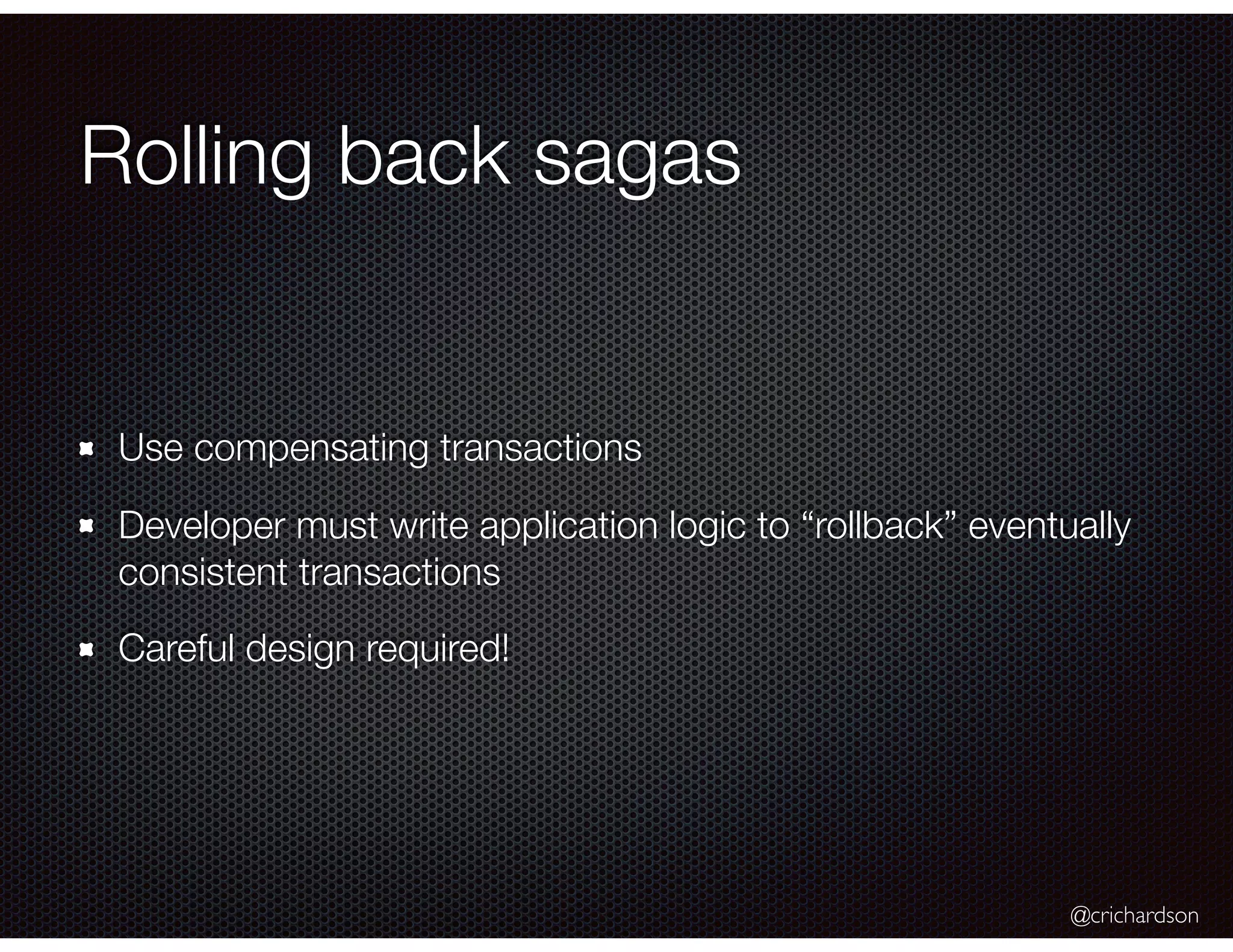
@crichardson Rolling back sagas Use compensating transactions Developer must write application logic to “rollback” eventually consistent transactions Careful design required!
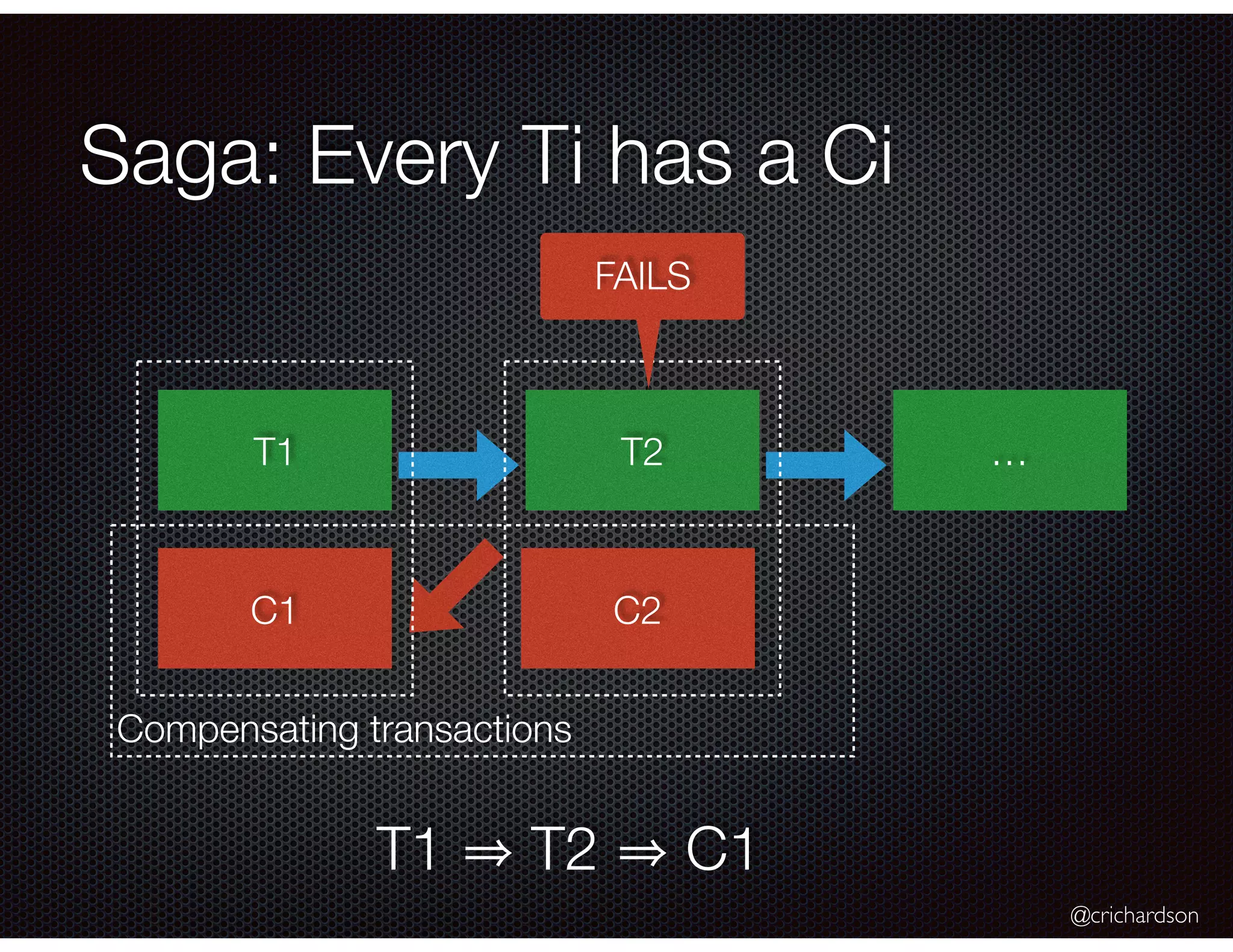
@crichardson Saga: Every Ti has a Ci T1 T2 … C1 C2 Compensating transactions T1 T2 C1 FAILS
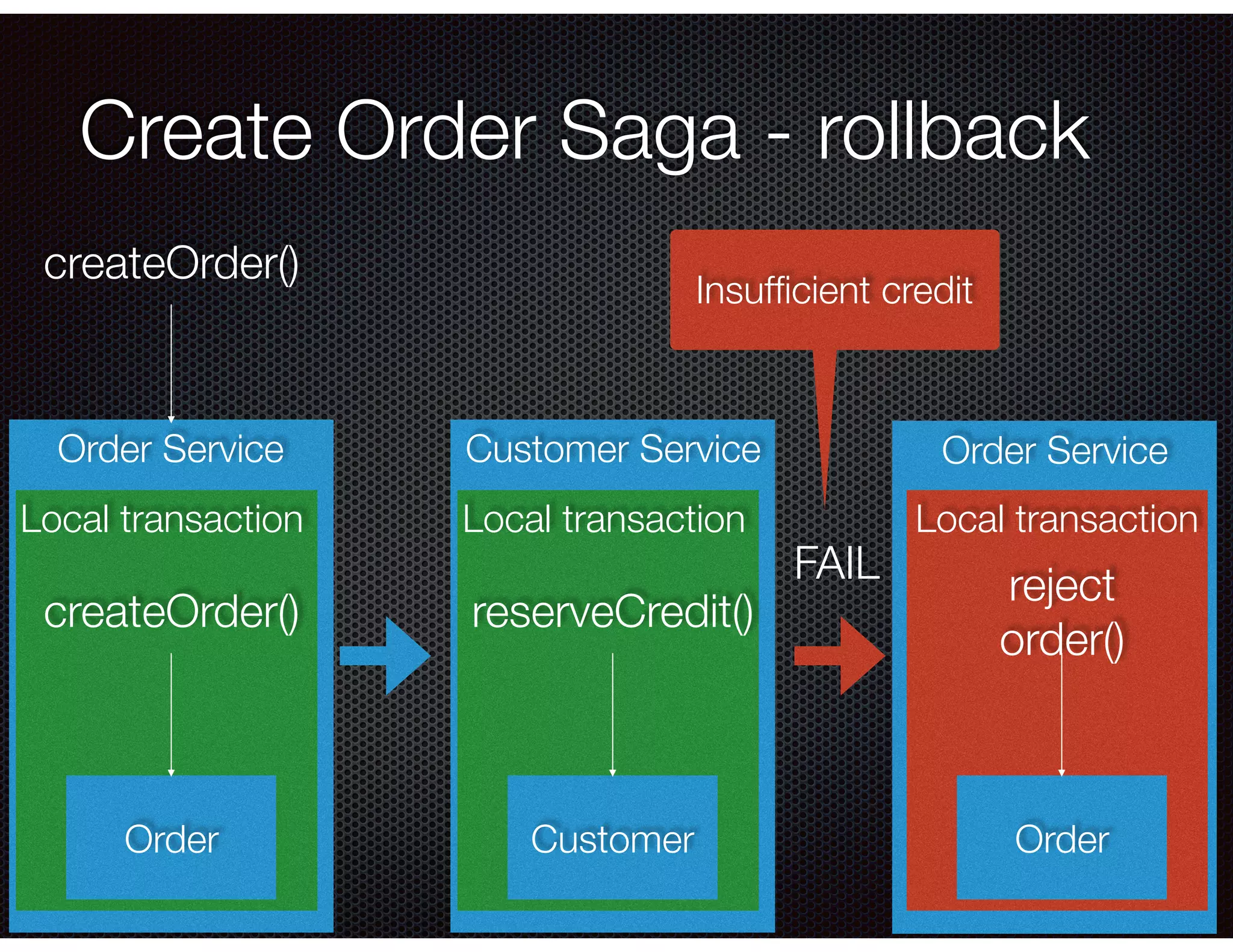
@crichardson Order Service Create Order Saga - rollback Local transaction Order createOrder() Customer Service Local transaction Customer reserveCredit() Order Service Local transaction Order reject order() createOrder() FAIL Insufficient credit
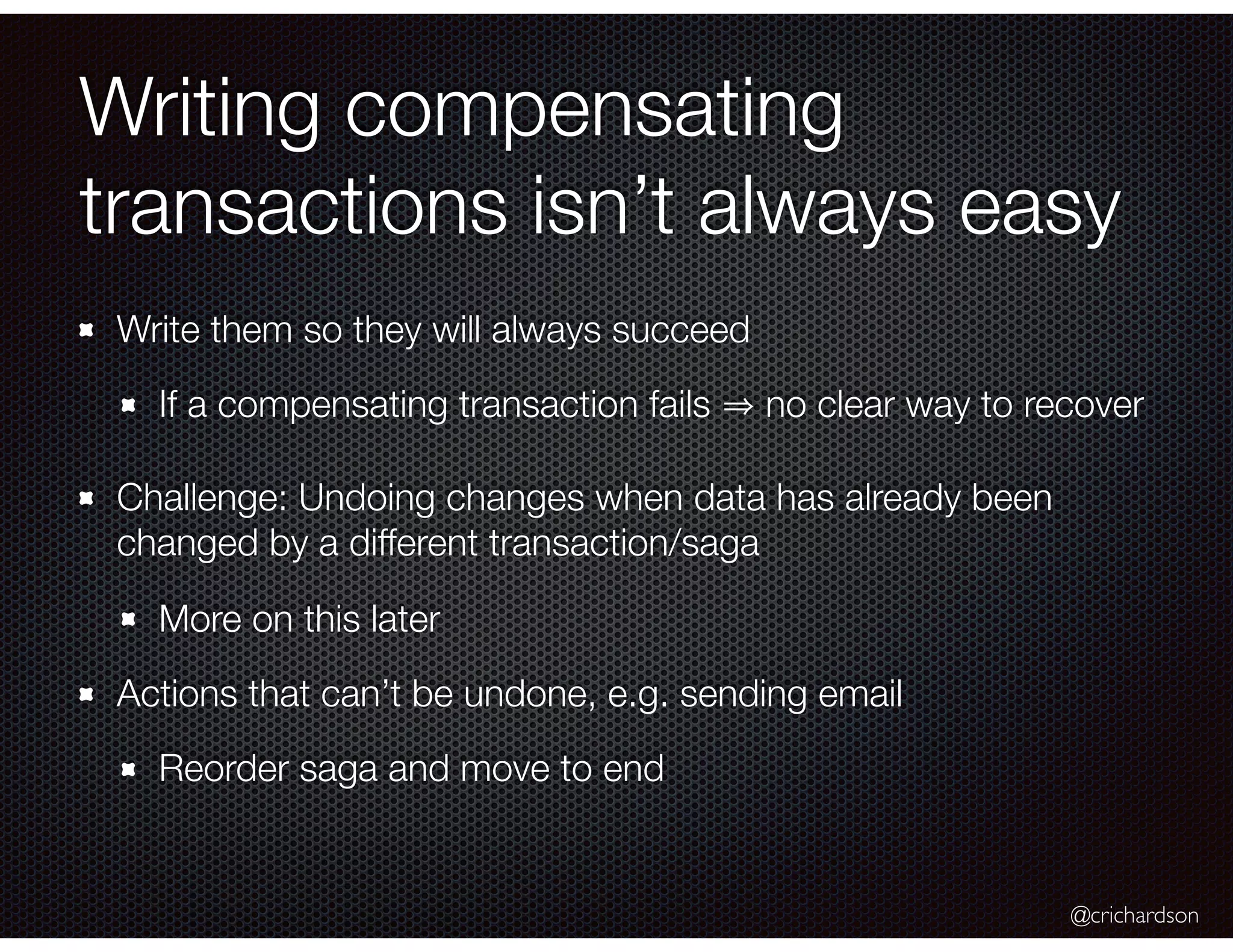
@crichardson Writing compensating transactions isn’t always easy Write them so they will always succeed If a compensating transaction fails no clear way to recover Challenge: Undoing changes when data has already been changed by a different transaction/saga More on this later Actions that can’t be undone, e.g. sending email Reorder saga and move to end
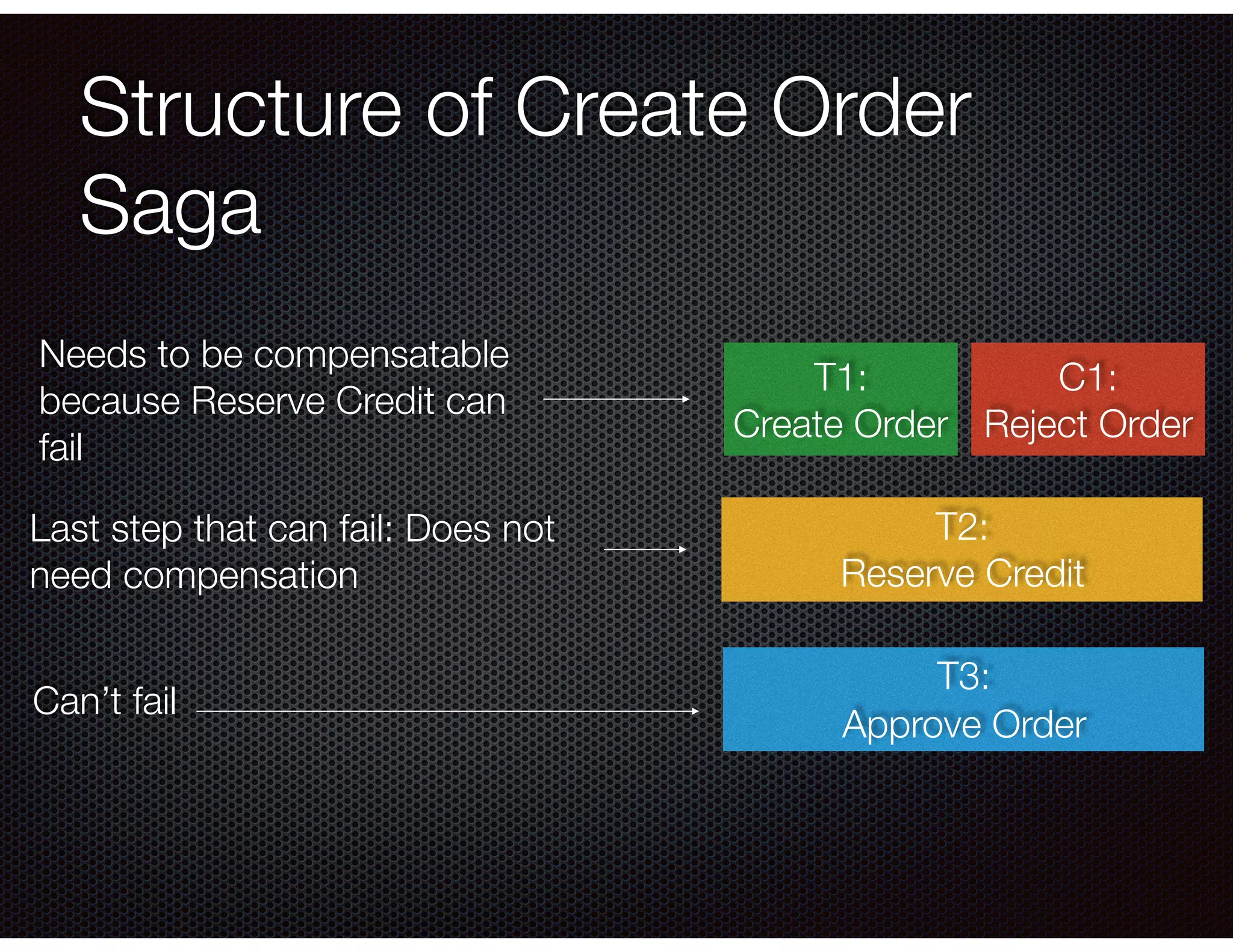
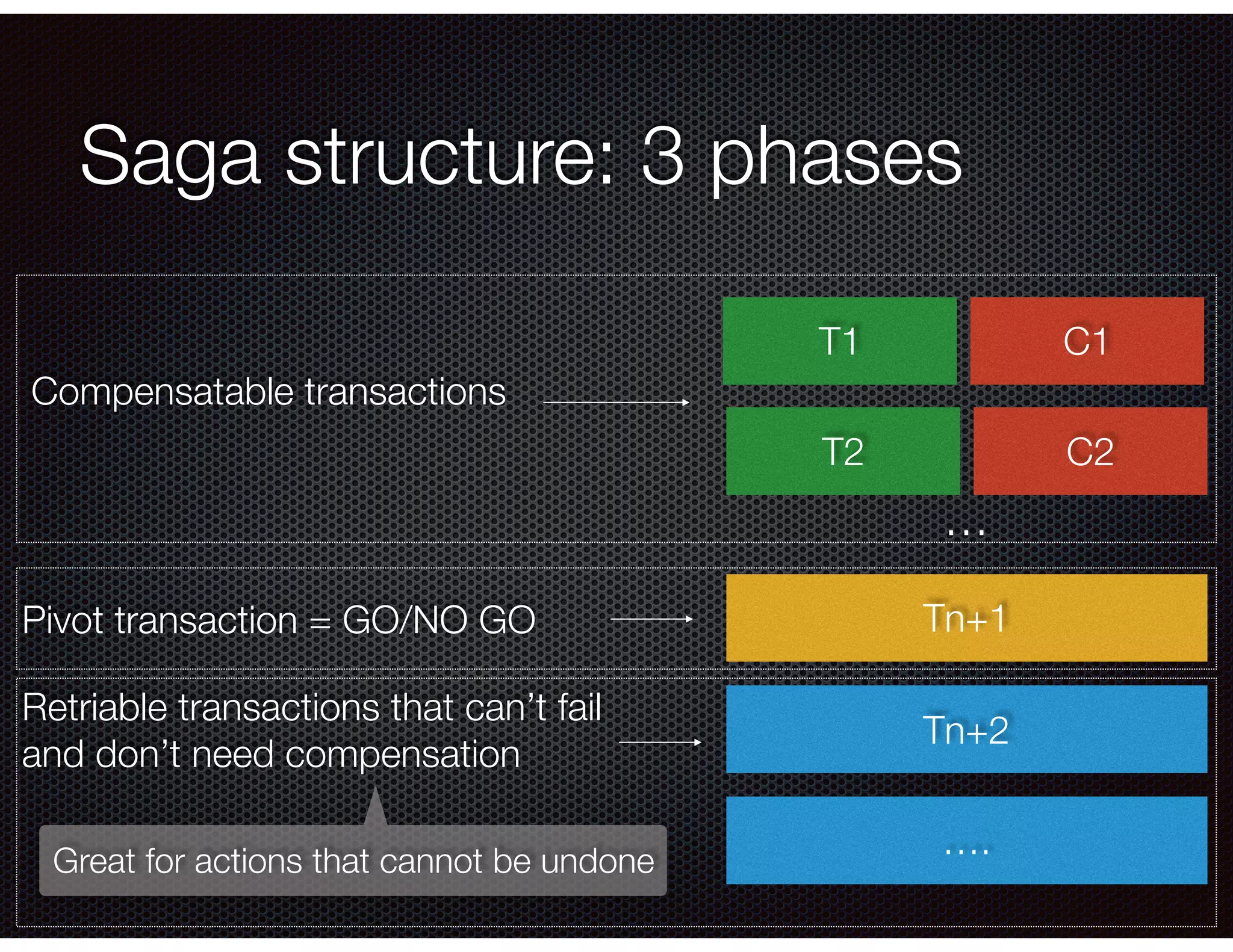
Structure of Create Order Saga T1: Create Order C1: Reject Order T2: Reserve Credit T3: Approve Order Needs to be compensatable because Reserve Credit can fail Last step that can fail: Does not need compensation Can’t fail
Saga structure: 3 phases T1 C1 … T2 C2 Tn+1 Tn+2 …. Compensatable transactions Pivot transaction = GO/NO GO Retriable transactions that can’t fail and don’t need compensation Great for actions that cannot be undone
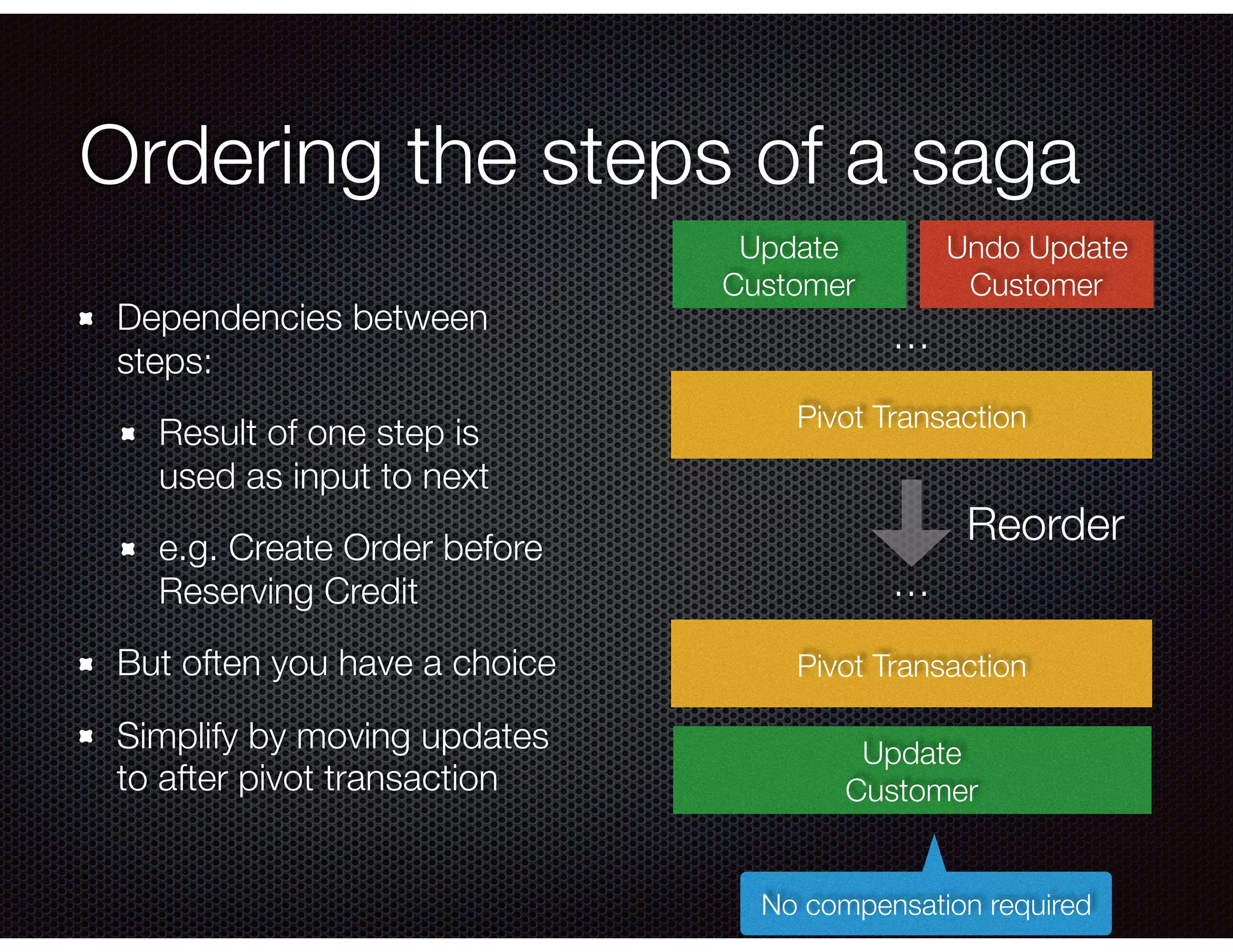
Ordering the steps of a saga Dependencies between steps: Result of one step is used as input to next e.g. Create Order before Reserving Credit But often you have a choice Simplify by moving updates to after pivot transaction Update Customer Undo Update Customer … Pivot Transaction Update Customer … Pivot Transaction No compensation required Reorder
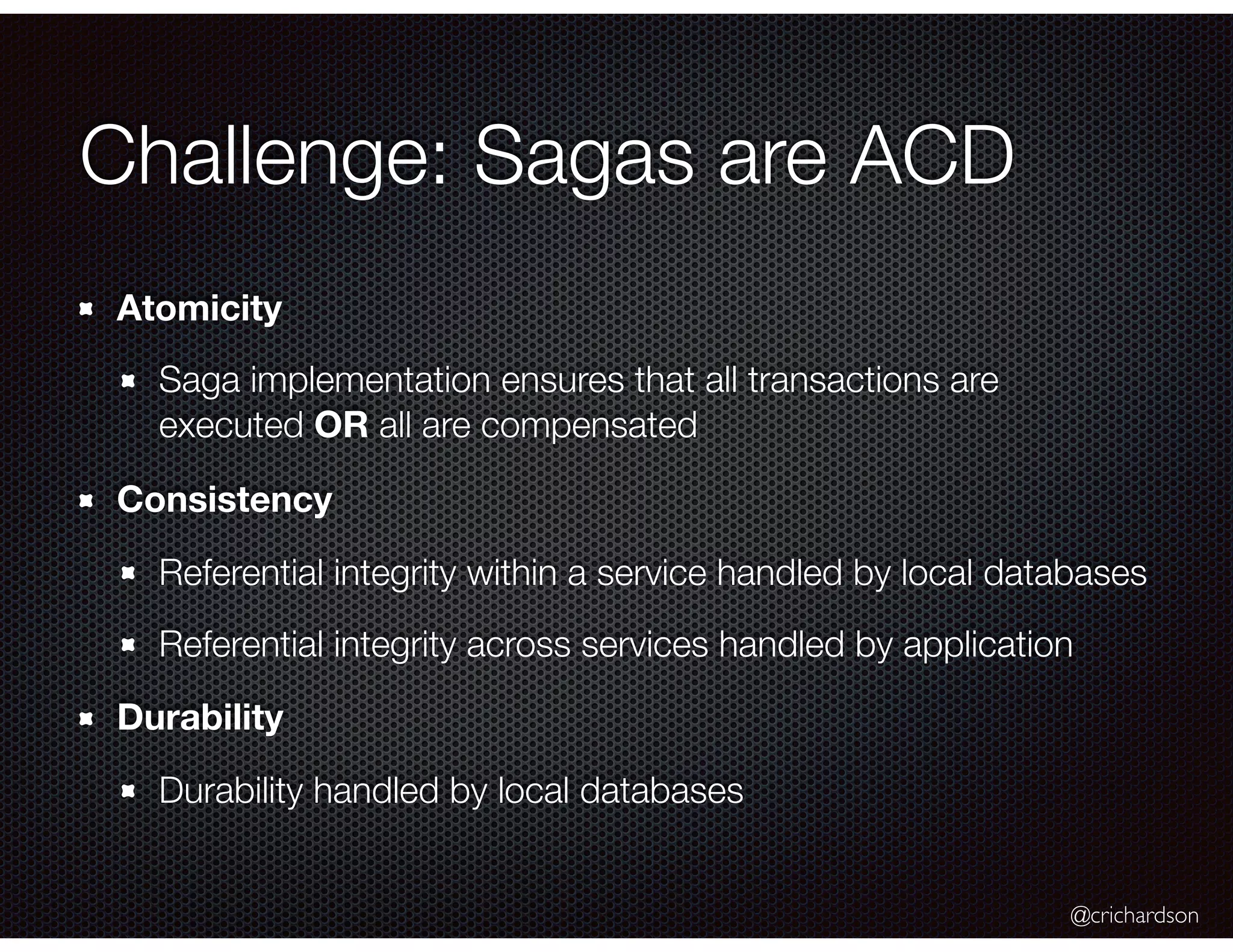
@crichardson Challenge: Sagas are ACD Atomicity Saga implementation ensures that all transactions are executed OR all are compensated Consistency Referential integrity within a service handled by local databases Referential integrity across services handled by application Durability Durability handled by local databases
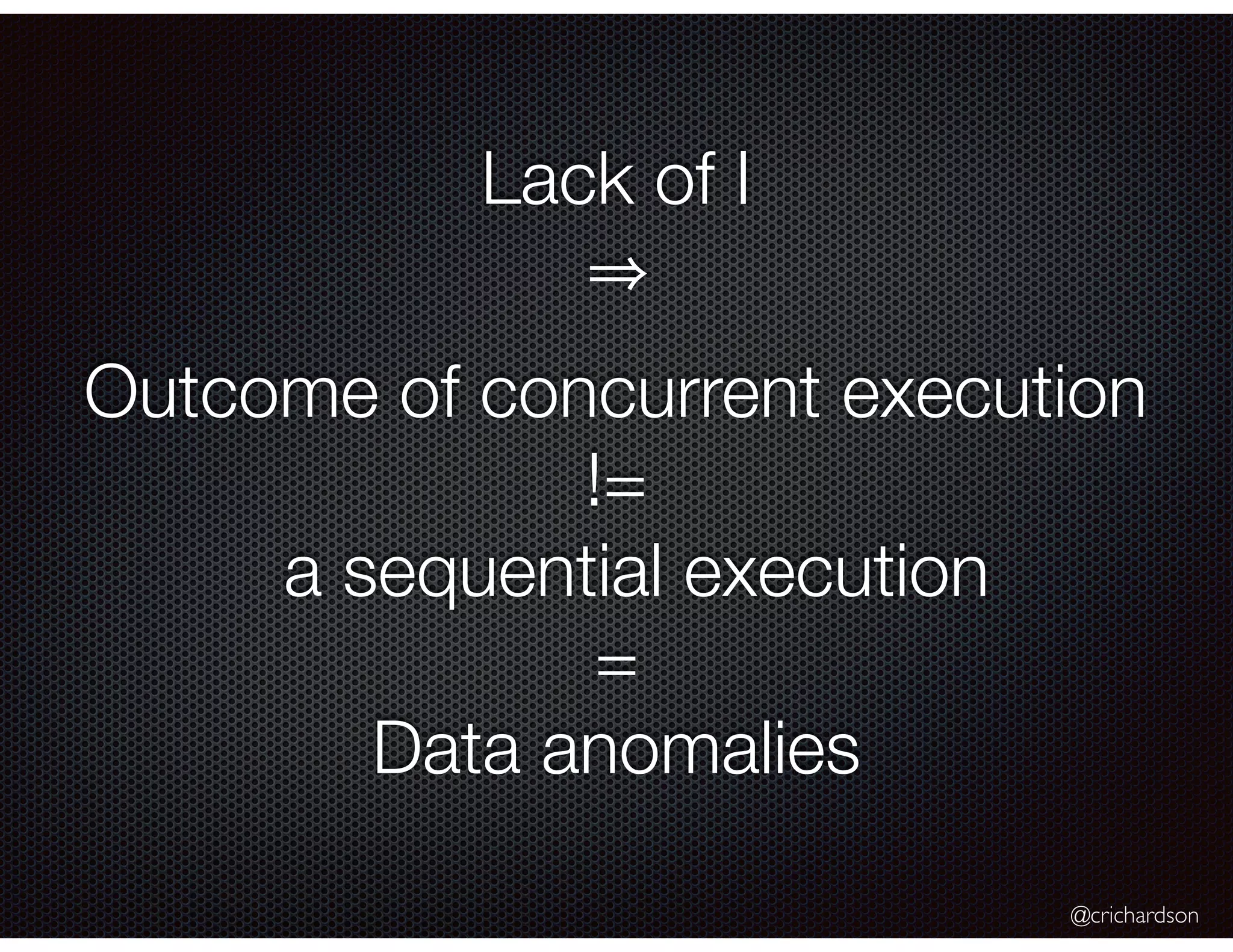
@crichardson Lack of I Outcome of concurrent execution != a sequential execution = Data anomalies
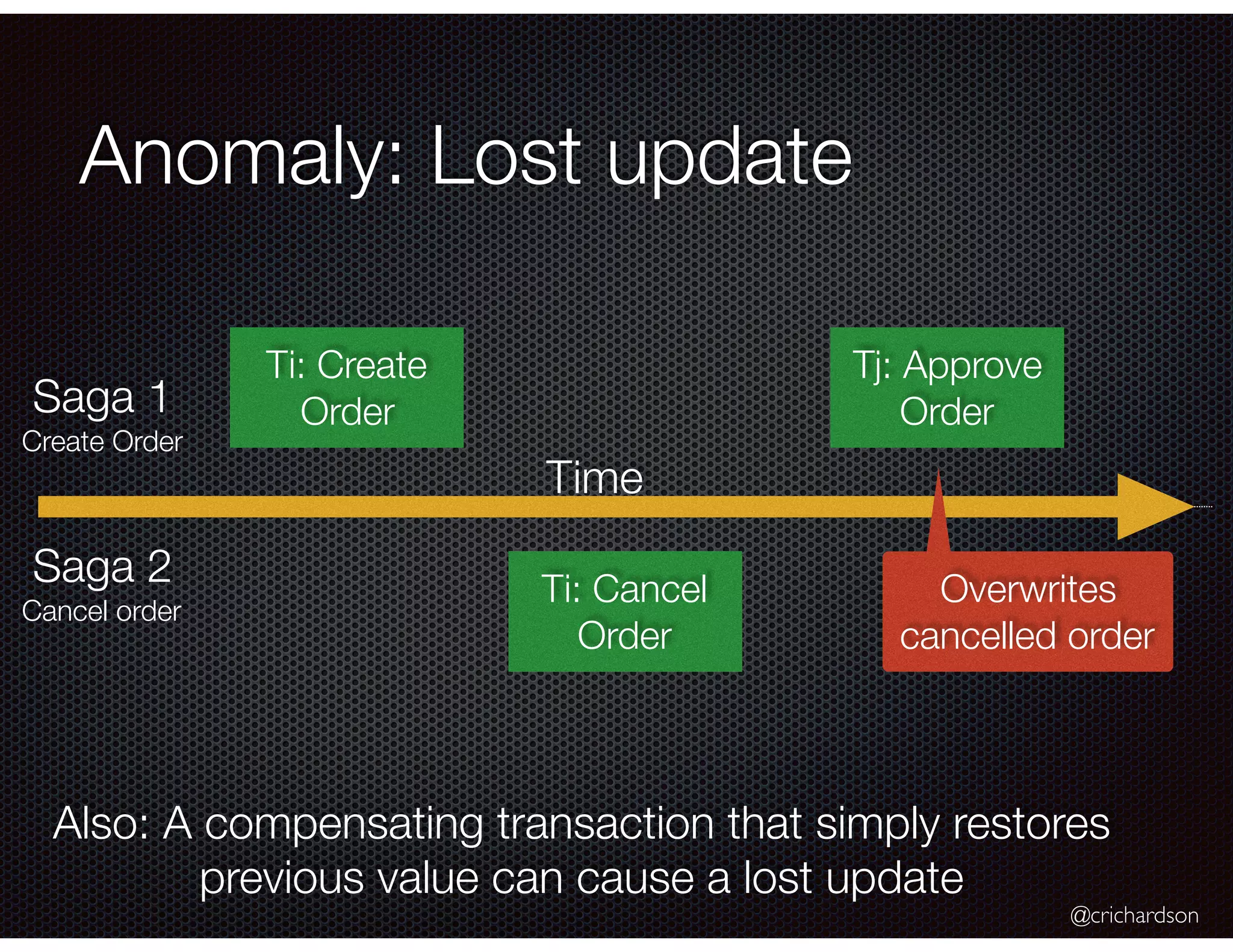
@crichardson Anomaly: Lost update Ti: Create Order Tj: Approve Order Ti: Cancel Order Saga 1 Create Order Saga 2 Cancel order Time Overwrites cancelled order Also: A compensating transaction that simply restores previous value can cause a lost update
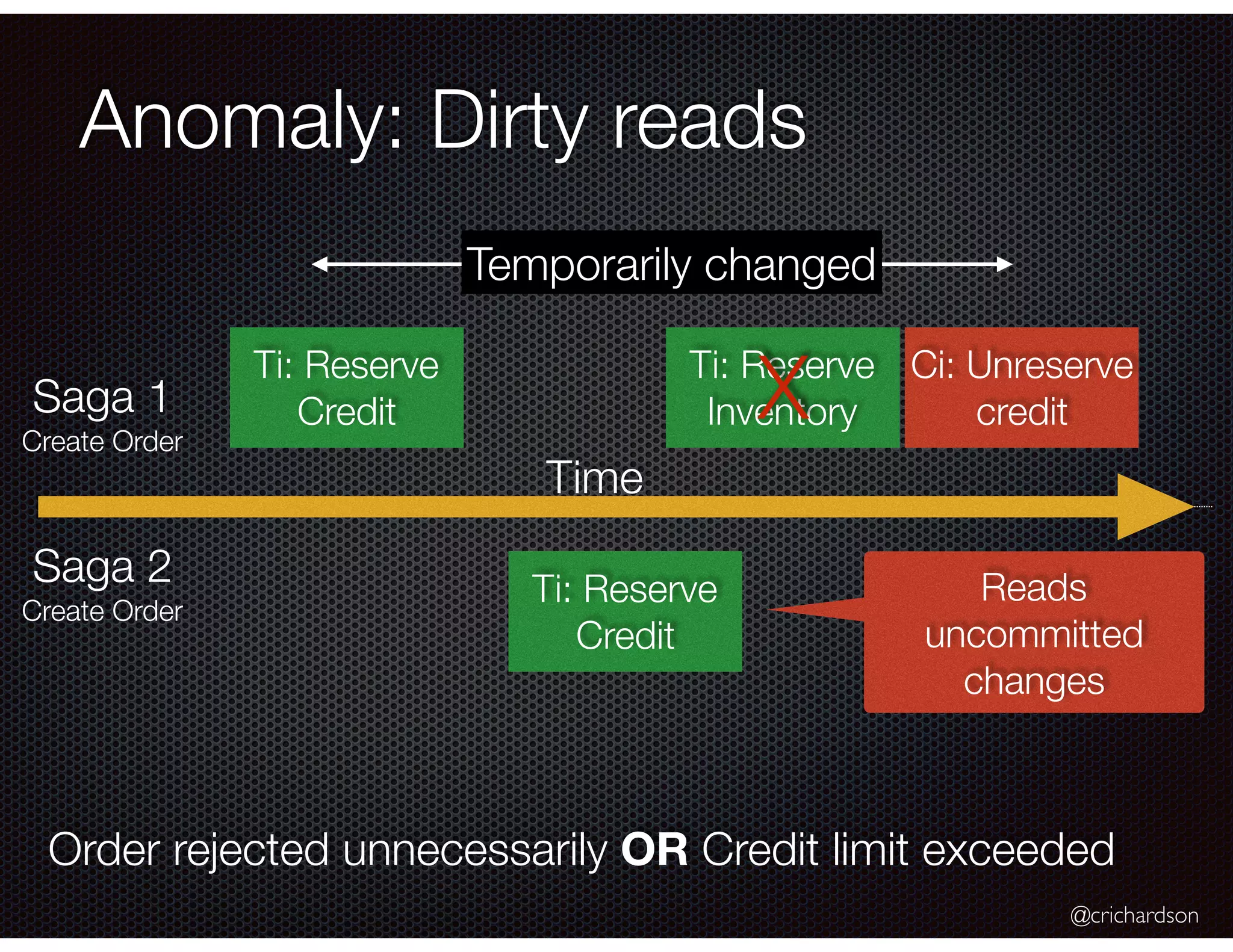
@crichardson Anomaly: Dirty reads Ti: Reserve Credit Ci: Unreserve credit Ti: Reserve Credit Reads uncommitted changes Order rejected unnecessarily OR Credit limit exceeded Time Saga 1 Create Order Saga 2 Create Order Ti: Reserve InventoryX Temporarily changed
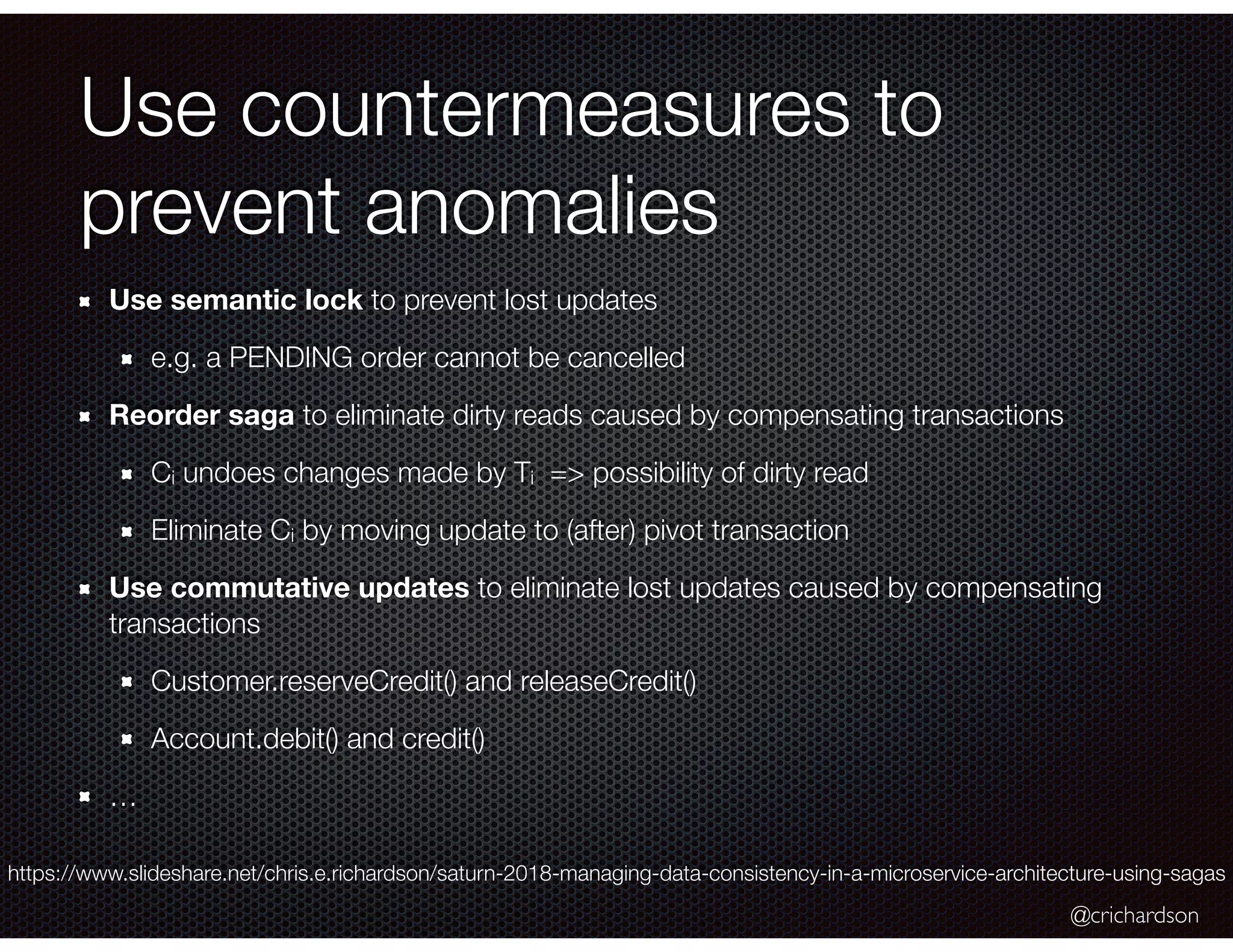
@crichardson Use countermeasures to prevent anomalies Use semantic lock to prevent lost updates e.g. a PENDING order cannot be cancelled Reorder saga to eliminate dirty reads caused by compensating transactions Ci undoes changes made by Ti => possibility of dirty read Eliminate Ci by moving update to (after) pivot transaction Use commutative updates to eliminate lost updates caused by compensating transactions Customer.reserveCredit() and releaseCredit() Account.debit() and credit() … https://www.slideshare.net/chris.e.richardson/saturn-2018-managing-data-consistency-in-a-microservice-architecture-using-sagas
@crichardson Agenda ACID is not an option Overview of sagas Coordinating sagas
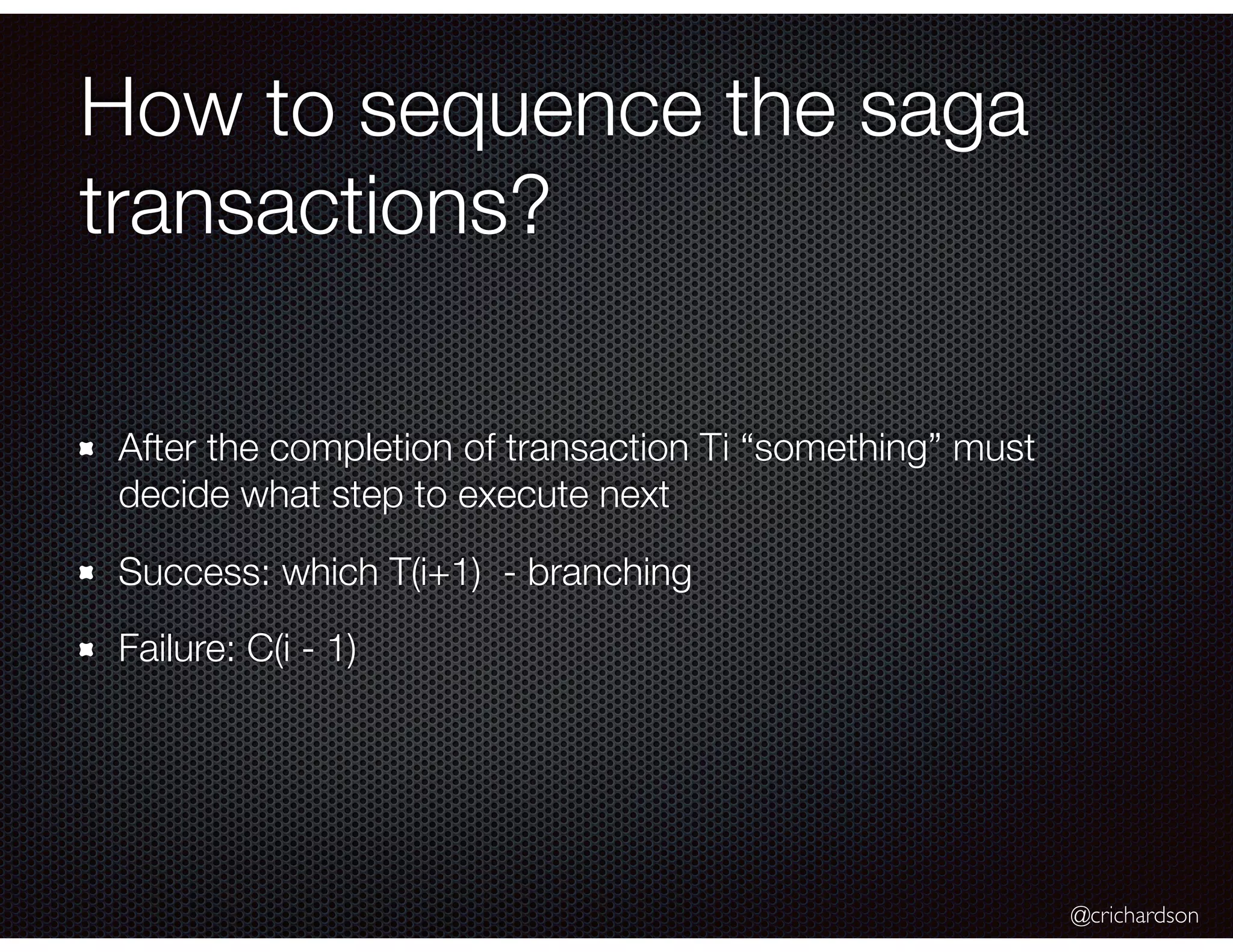
@crichardson How to sequence the saga transactions? After the completion of transaction Ti “something” must decide what step to execute next Success: which T(i+1) - branching Failure: C(i - 1)
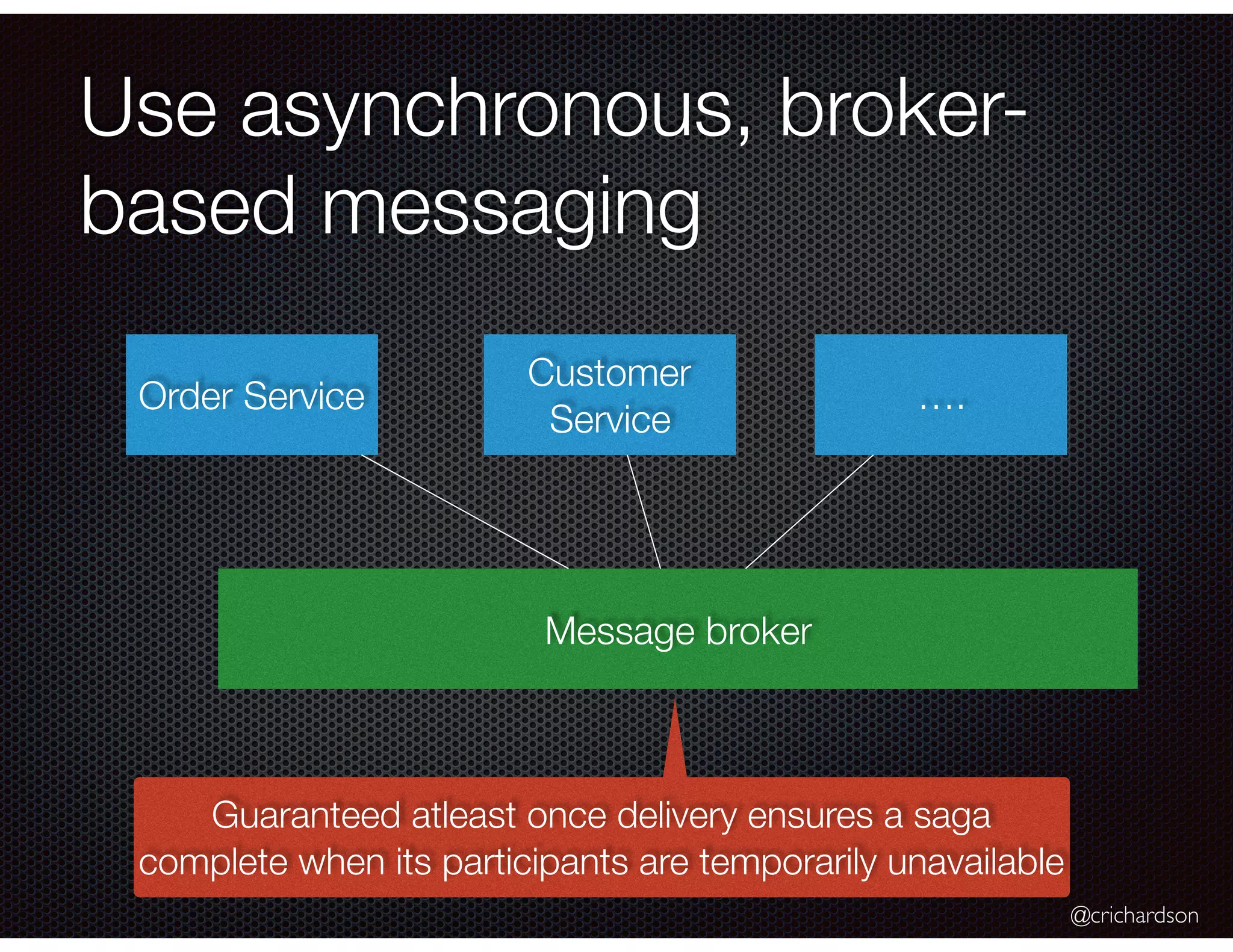
@crichardson Use asynchronous, broker- based messaging Order Service Customer Service …. Message broker Guaranteed atleast once delivery ensures a saga complete when its participants are temporarily unavailable
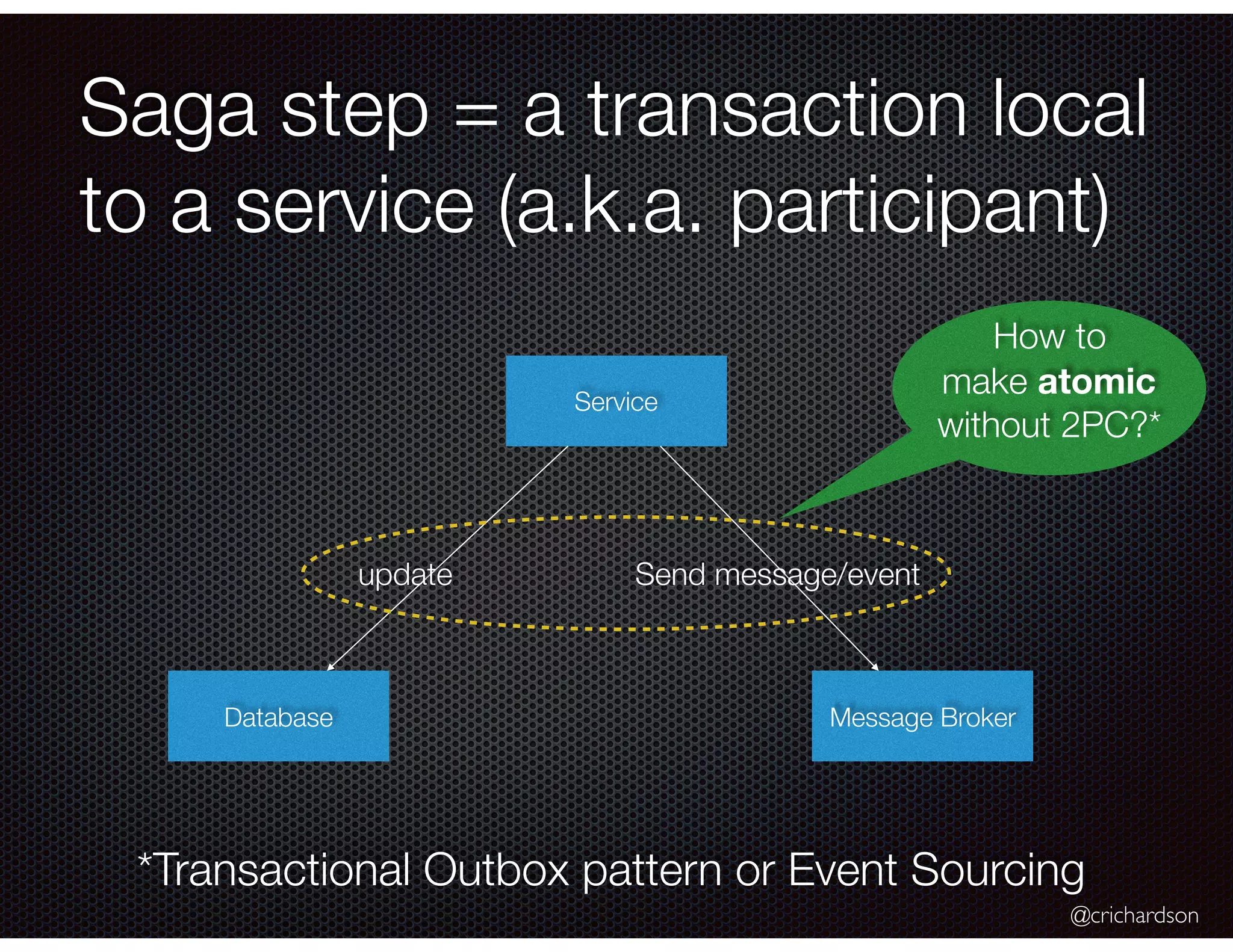
@crichardson Saga step = a transaction local to a service (a.k.a. participant) Service Database Message Broker update Send message/event How to make atomic without 2PC?* *Transactional Outbox pattern or Event Sourcing
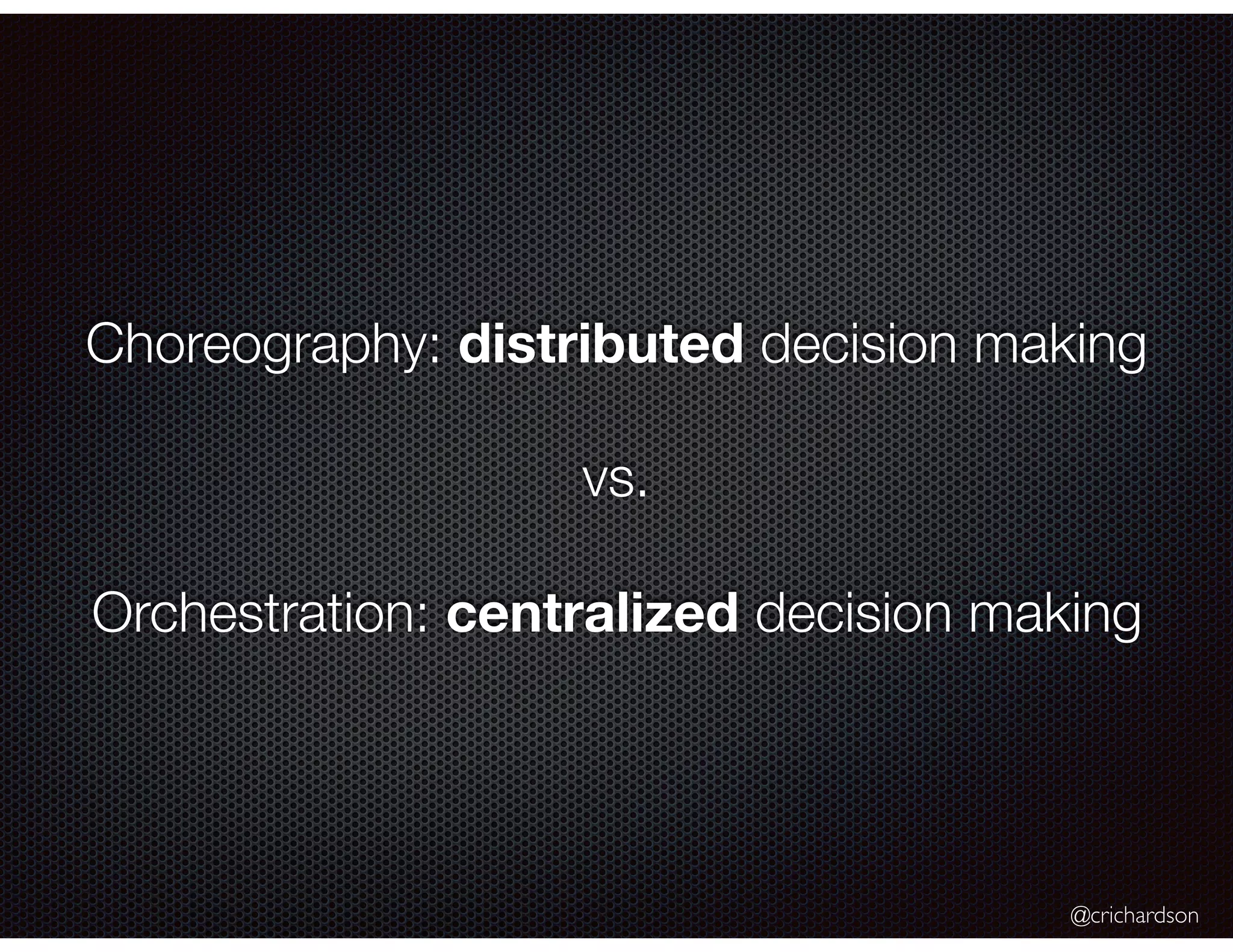
@crichardson Choreography: distributed decision making vs. Orchestration: centralized decision making
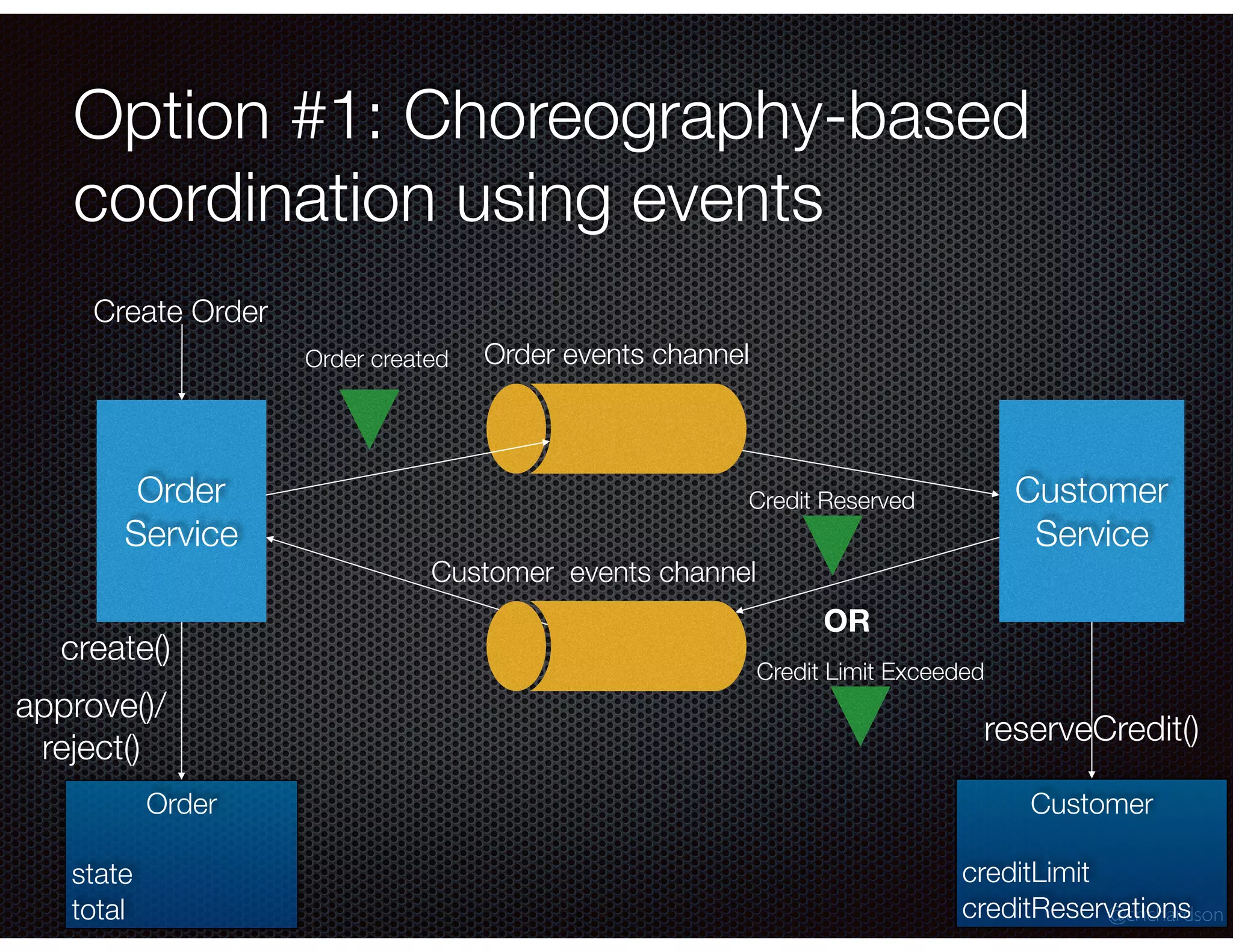
@crichardson Option #1: Choreography-based coordination using events Order Service Customer Service Order created Credit Reserved Credit Limit Exceeded Create Order OR Customer creditLimit creditReservations Order state total create() reserveCredit() approve()/ reject() Order events channel Customer events channel
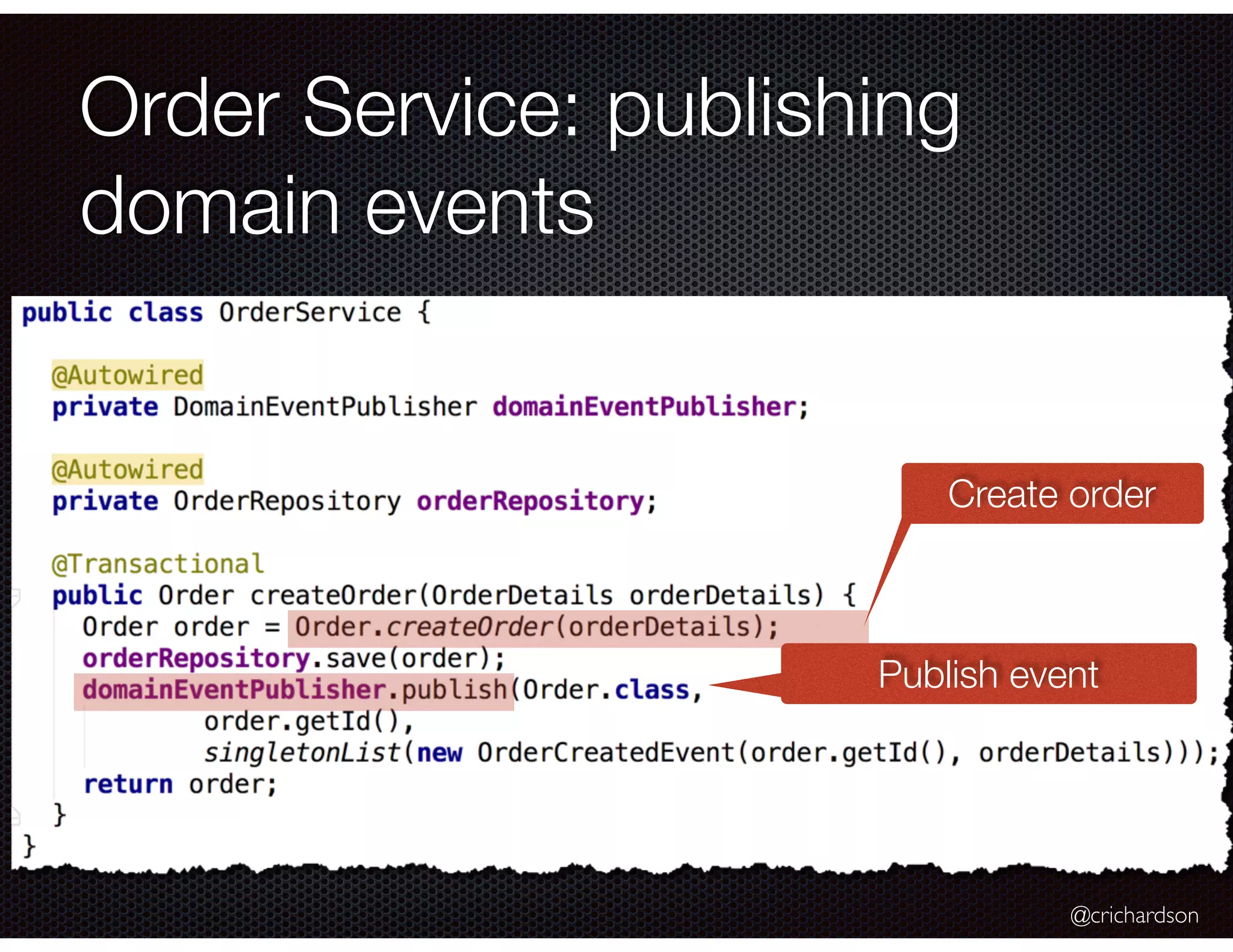
@crichardson Order Service: publishing domain events Publish event Create order
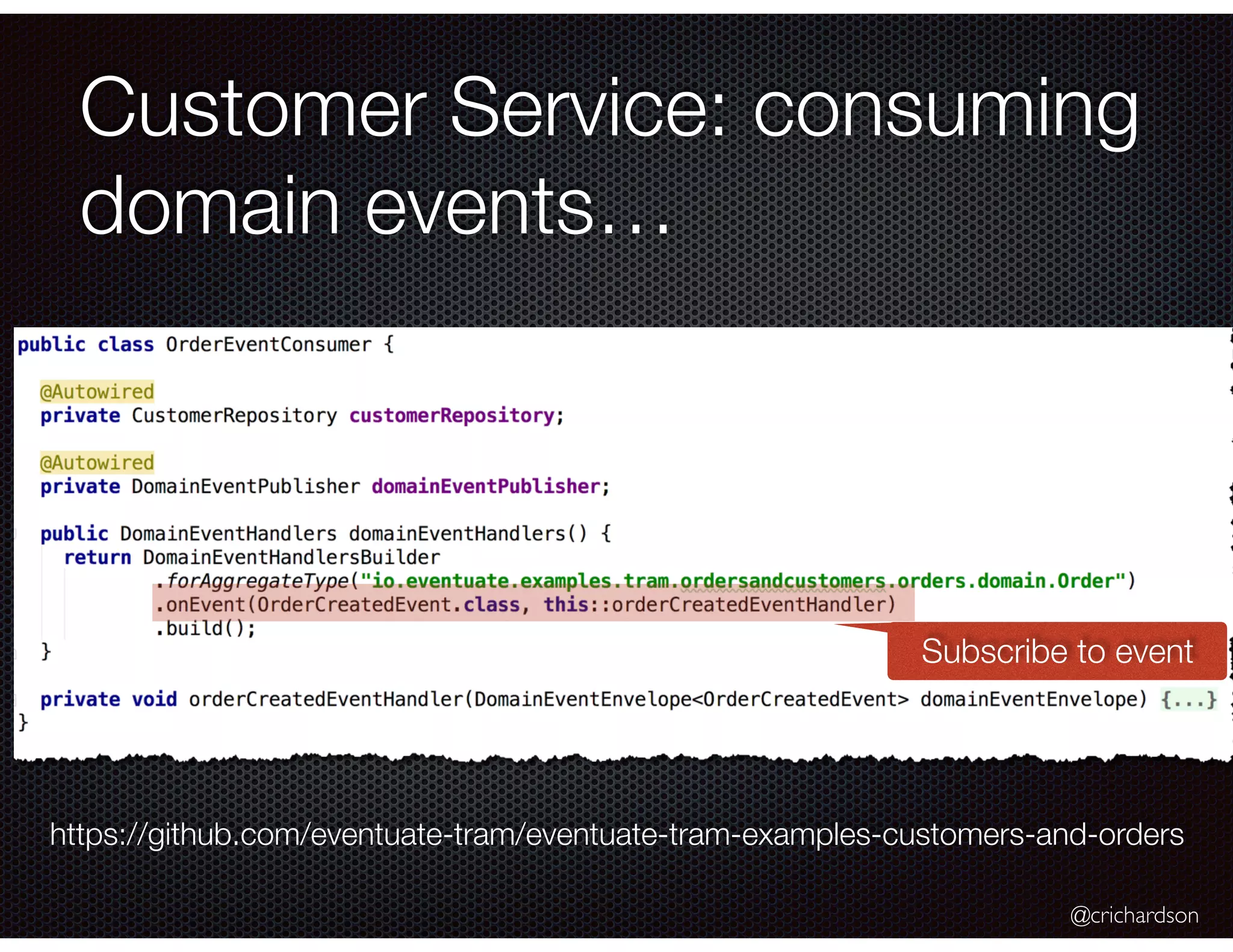
@crichardson Customer Service: consuming domain events… https://github.com/eventuate-tram/eventuate-tram-examples-customers-and-orders Subscribe to event
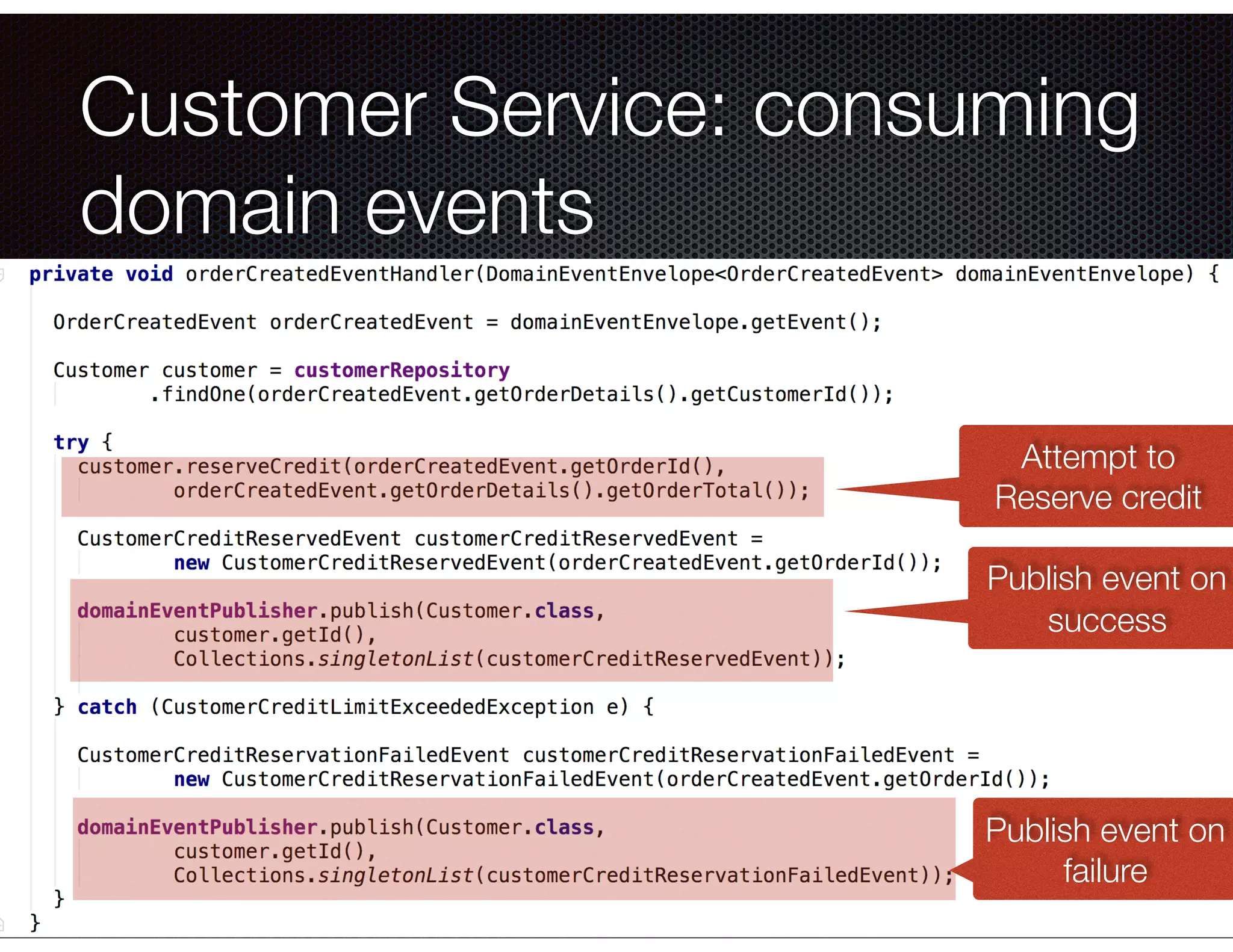
@crichardson Customer Service: consuming domain events Attempt to Reserve credit Publish event on success Publish event on failure
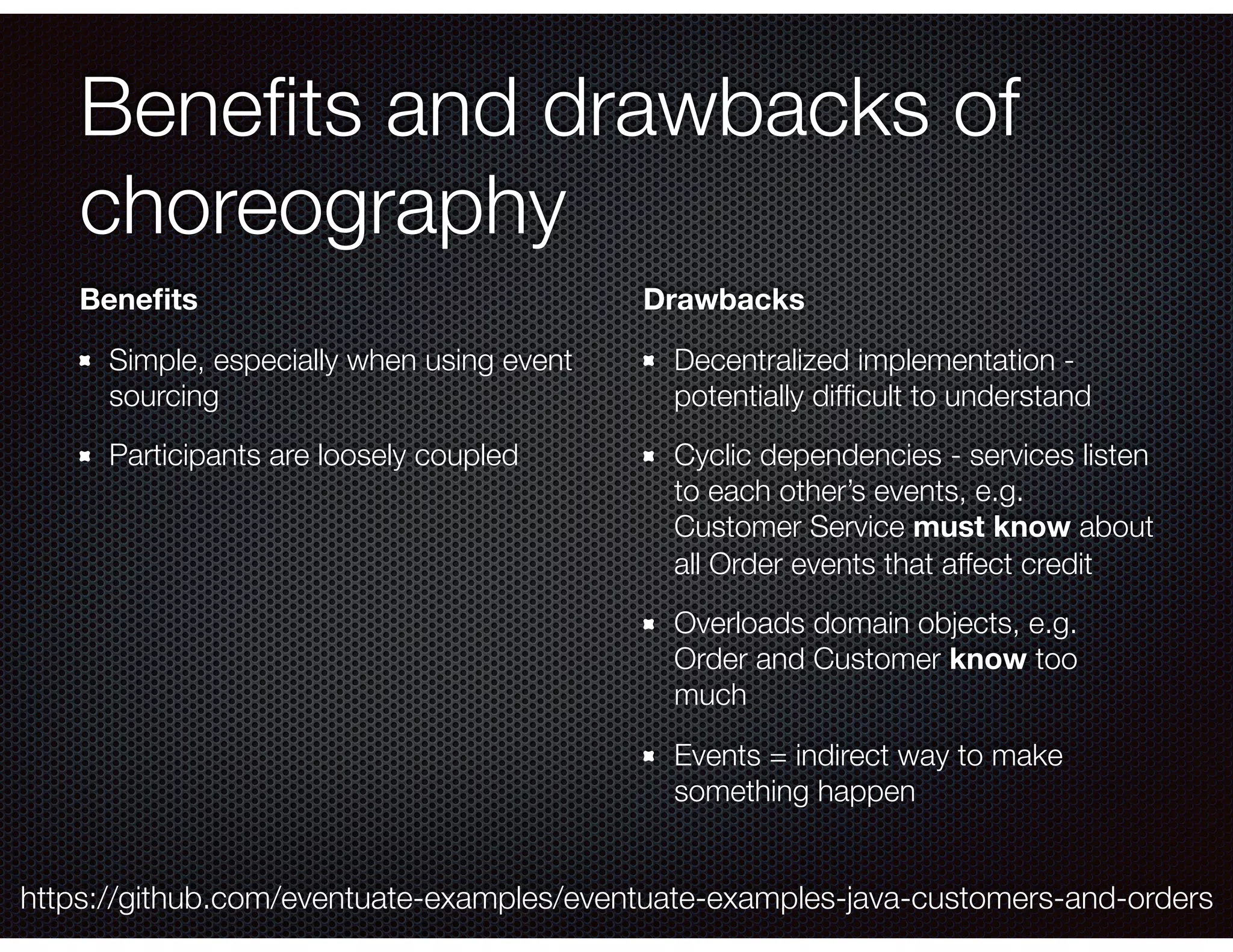
Benefits and drawbacks of choreography Benefits Simple, especially when using event sourcing Participants are loosely coupled Drawbacks Decentralized implementation - potentially difficult to understand Cyclic dependencies - services listen to each other’s events, e.g. Customer Service must know about all Order events that affect credit Overloads domain objects, e.g. Order and Customer know too much Events = indirect way to make something happen https://github.com/eventuate-examples/eventuate-examples-java-customers-and-orders
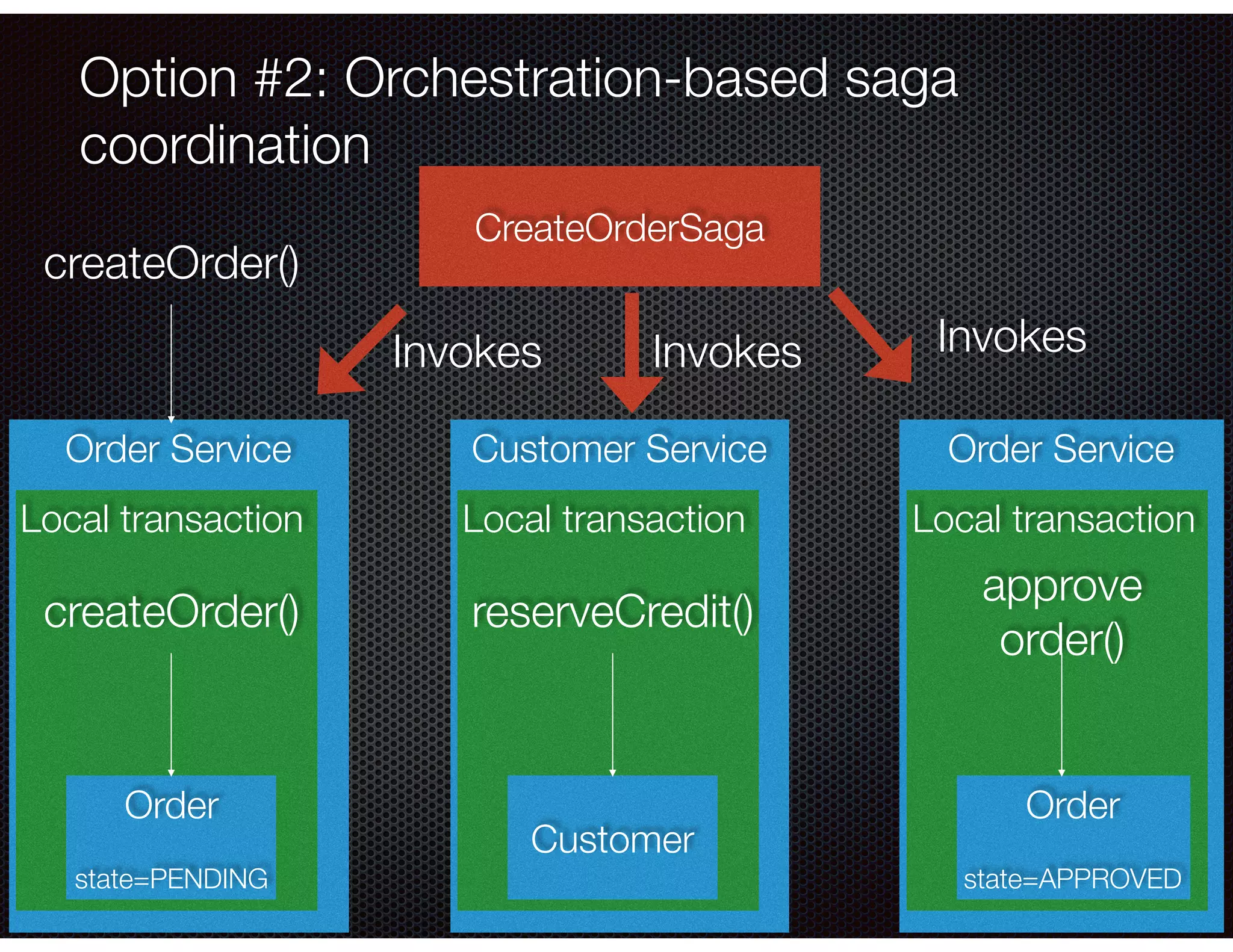
@crichardson Order Service Option #2: Orchestration-based saga coordination Local transaction Order state=PENDING createOrder() Customer Service Local transaction Customer reserveCredit() Order Service Local transaction Order state=APPROVED approve order() createOrder() CreateOrderSaga InvokesInvokesInvokes
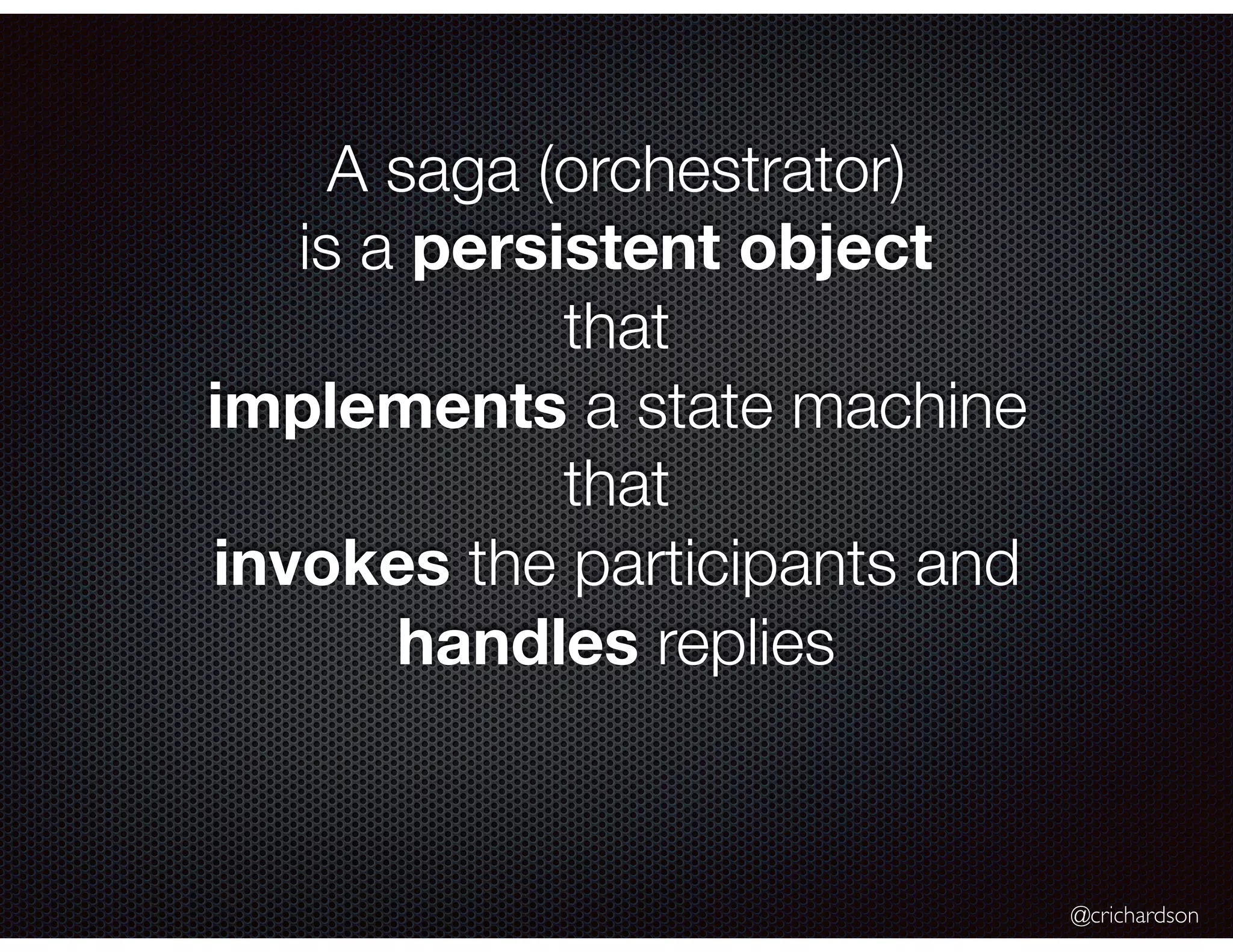
@crichardson A saga (orchestrator) is a persistent object that implements a state machine that invokes the participants and handles replies
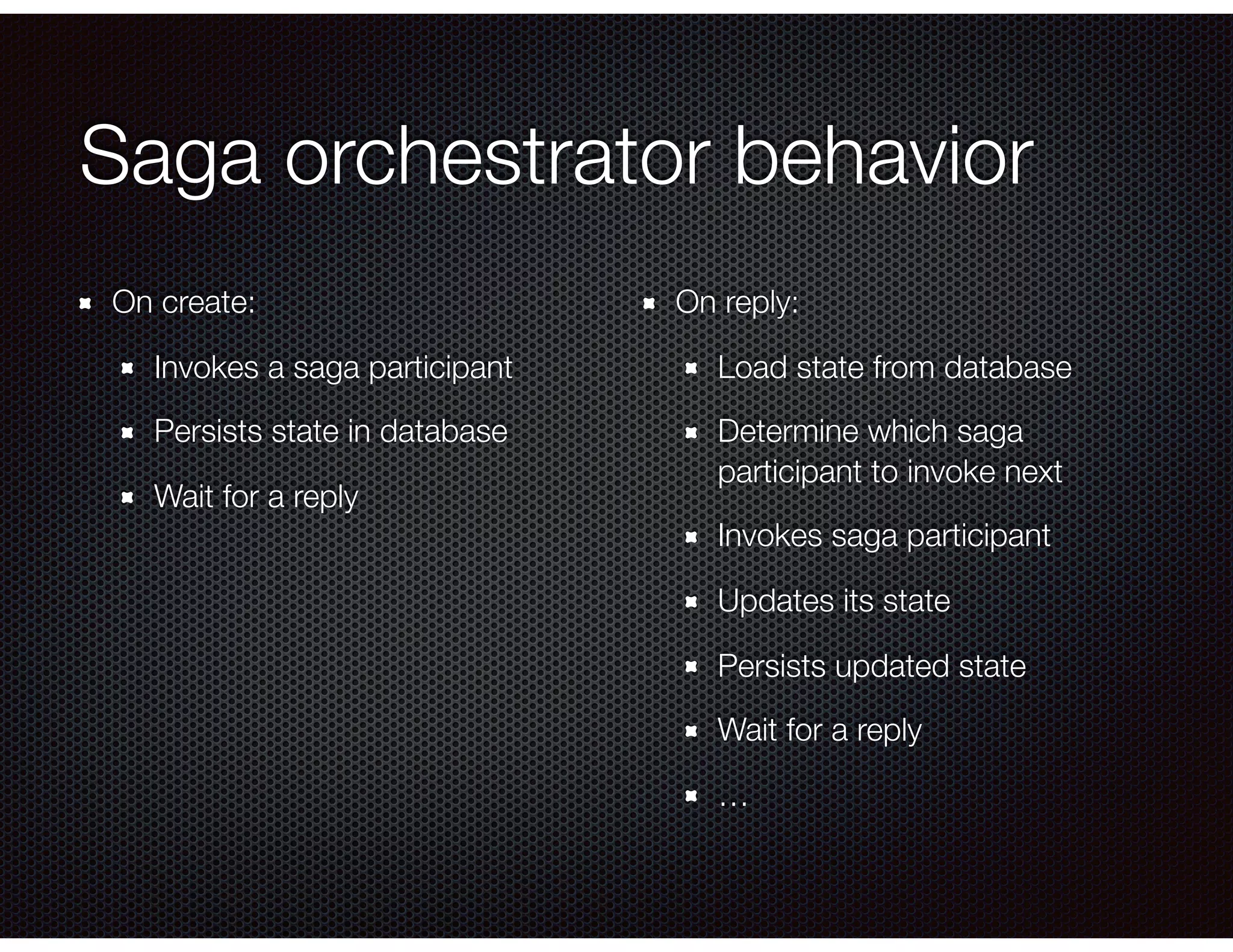
Saga orchestrator behavior On create: Invokes a saga participant Persists state in database Wait for a reply On reply: Load state from database Determine which saga participant to invoke next Invokes saga participant Updates its state Persists updated state Wait for a reply …
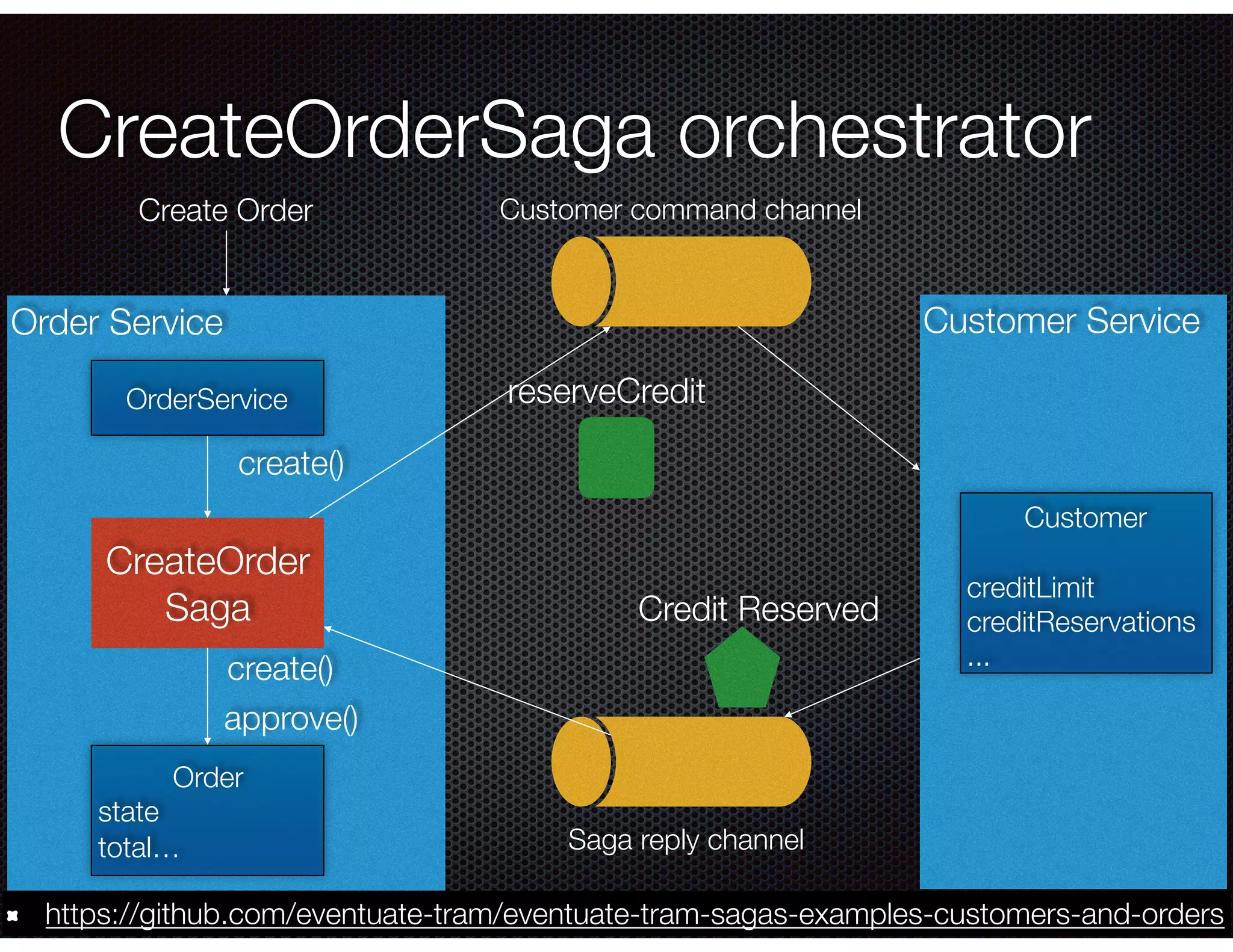
@crichardson Order Service CreateOrderSaga orchestrator Customer Service Create Order Customer creditLimit creditReservations ... Order state total… reserveCredit CreateOrder Saga OrderService create() create() approve() Credit Reserved Customer command channel Saga reply channel https://github.com/eventuate-tram/eventuate-tram-sagas-examples-customers-and-orders
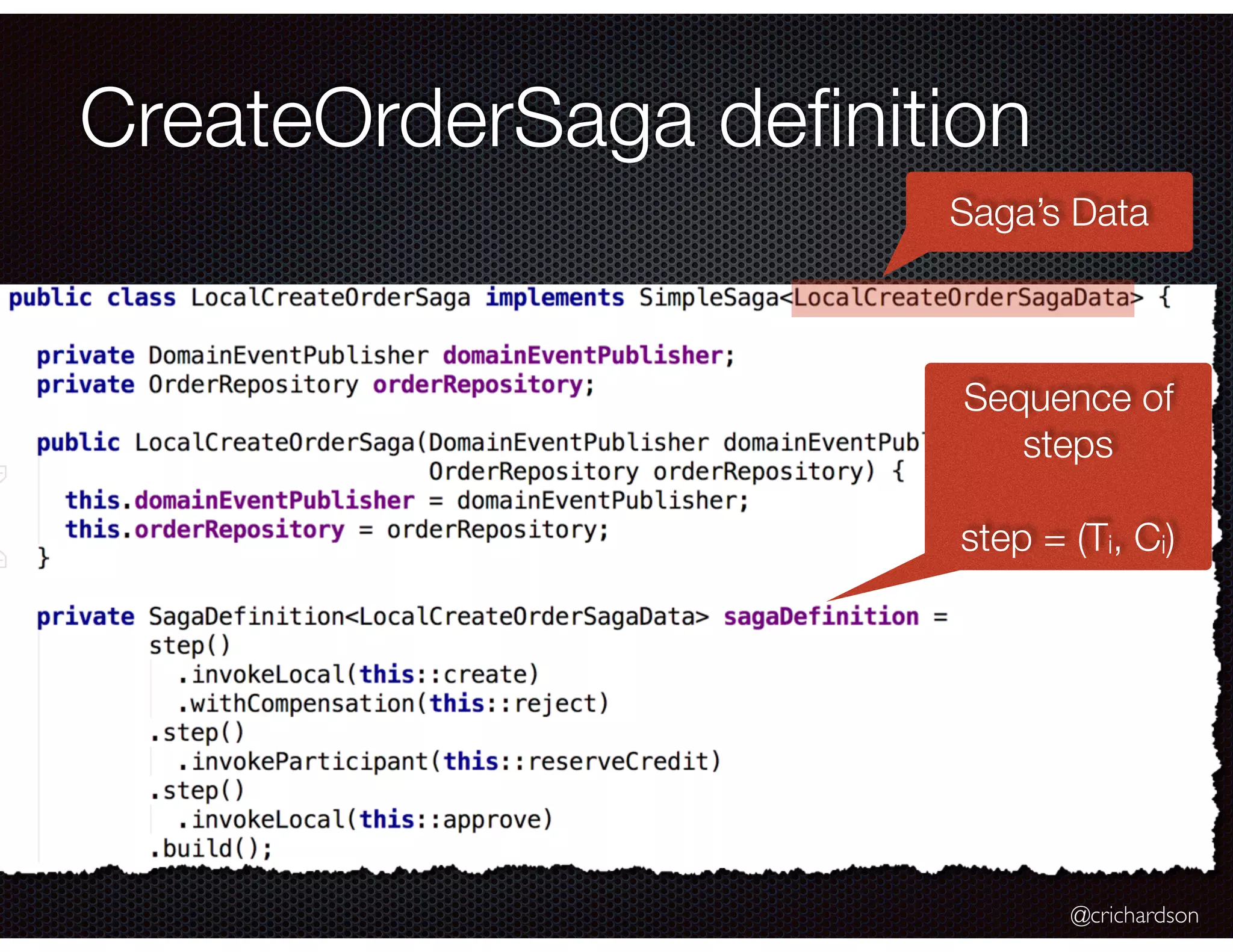
@crichardson CreateOrderSaga definition Sequence of steps step = (Ti, Ci) Saga’s Data
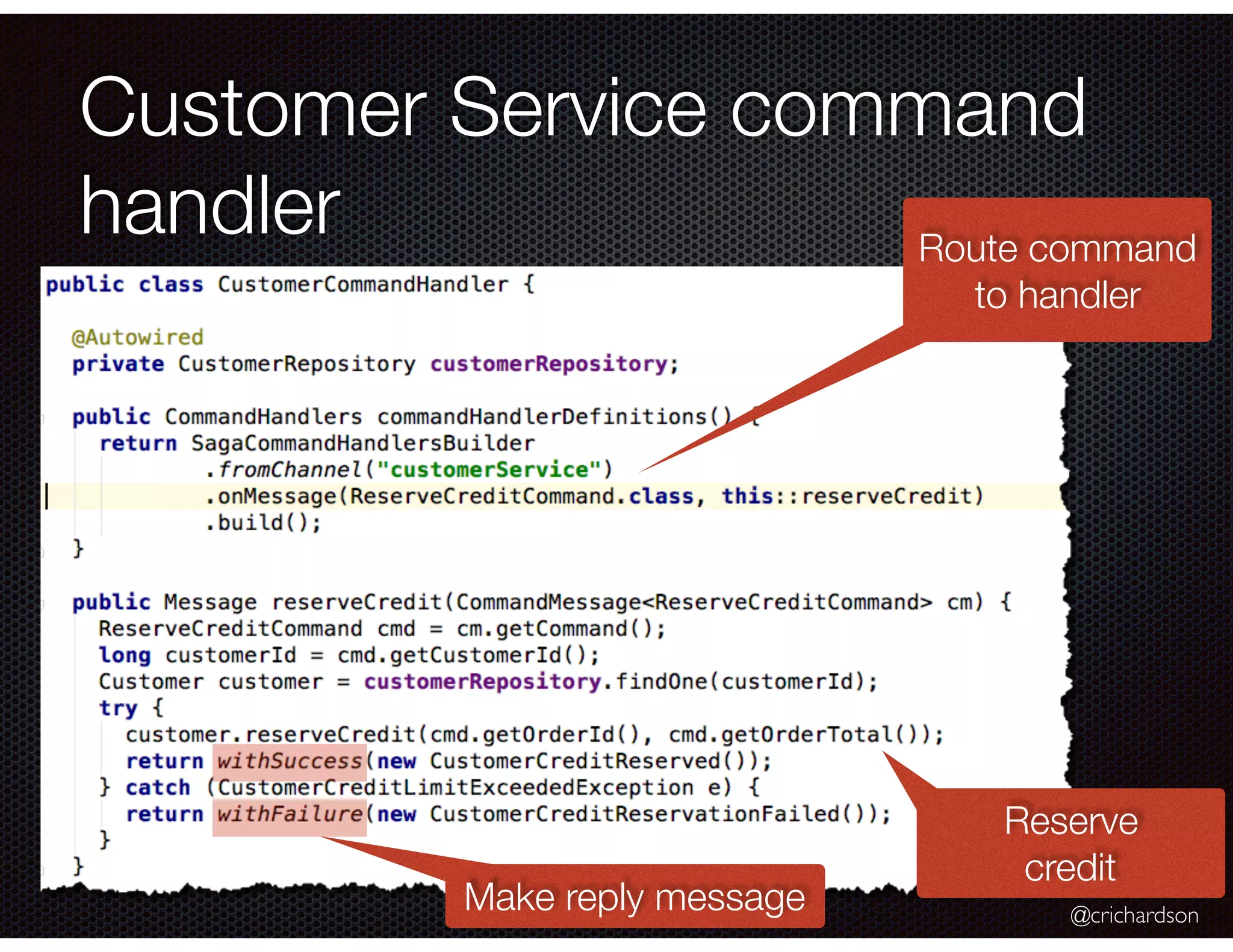
@crichardson Customer Service command handler Route command to handler Reserve credit Make reply message
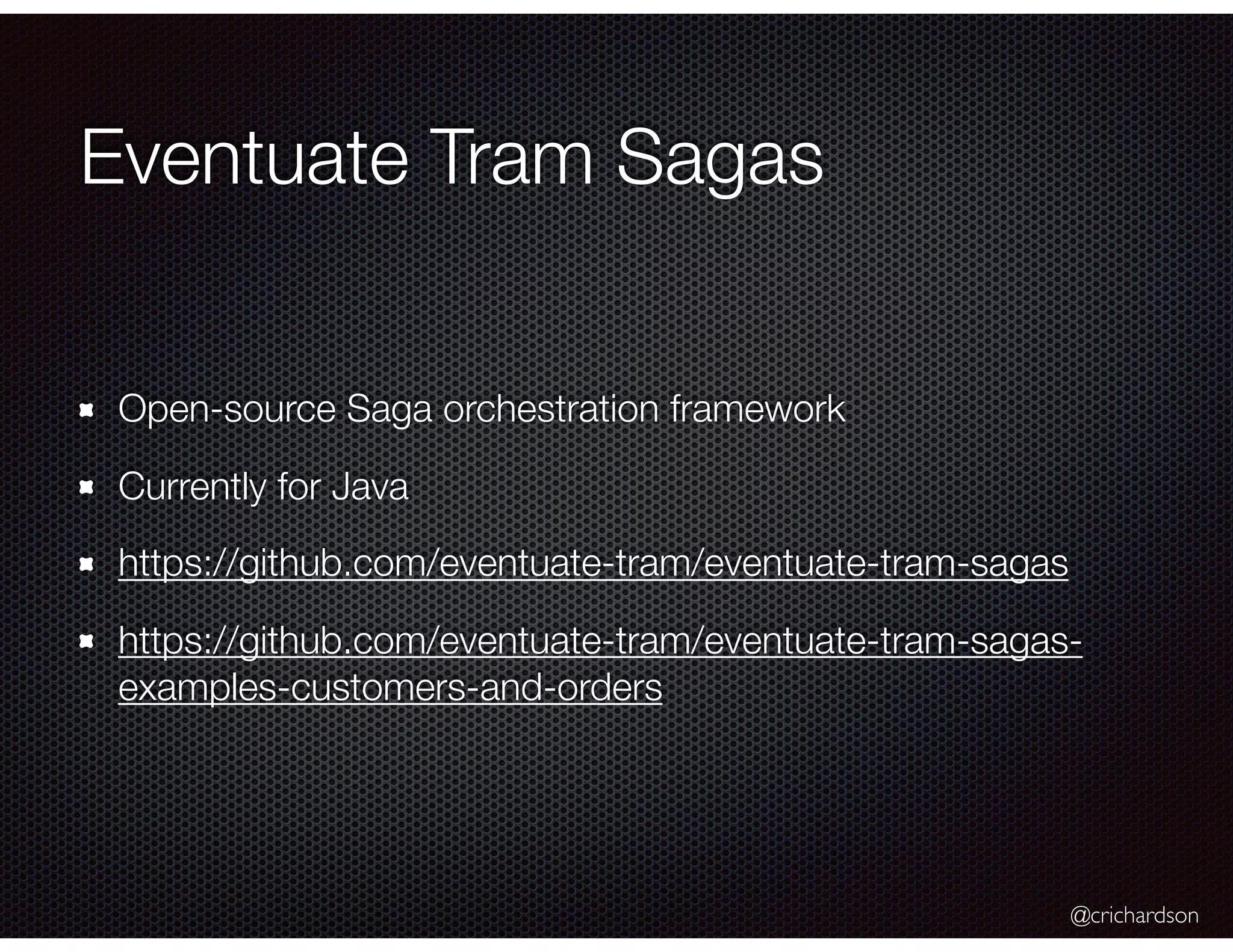
@crichardson Eventuate Tram Sagas Open-source Saga orchestration framework Currently for Java https://github.com/eventuate-tram/eventuate-tram-sagas https://github.com/eventuate-tram/eventuate-tram-sagas- examples-customers-and-orders
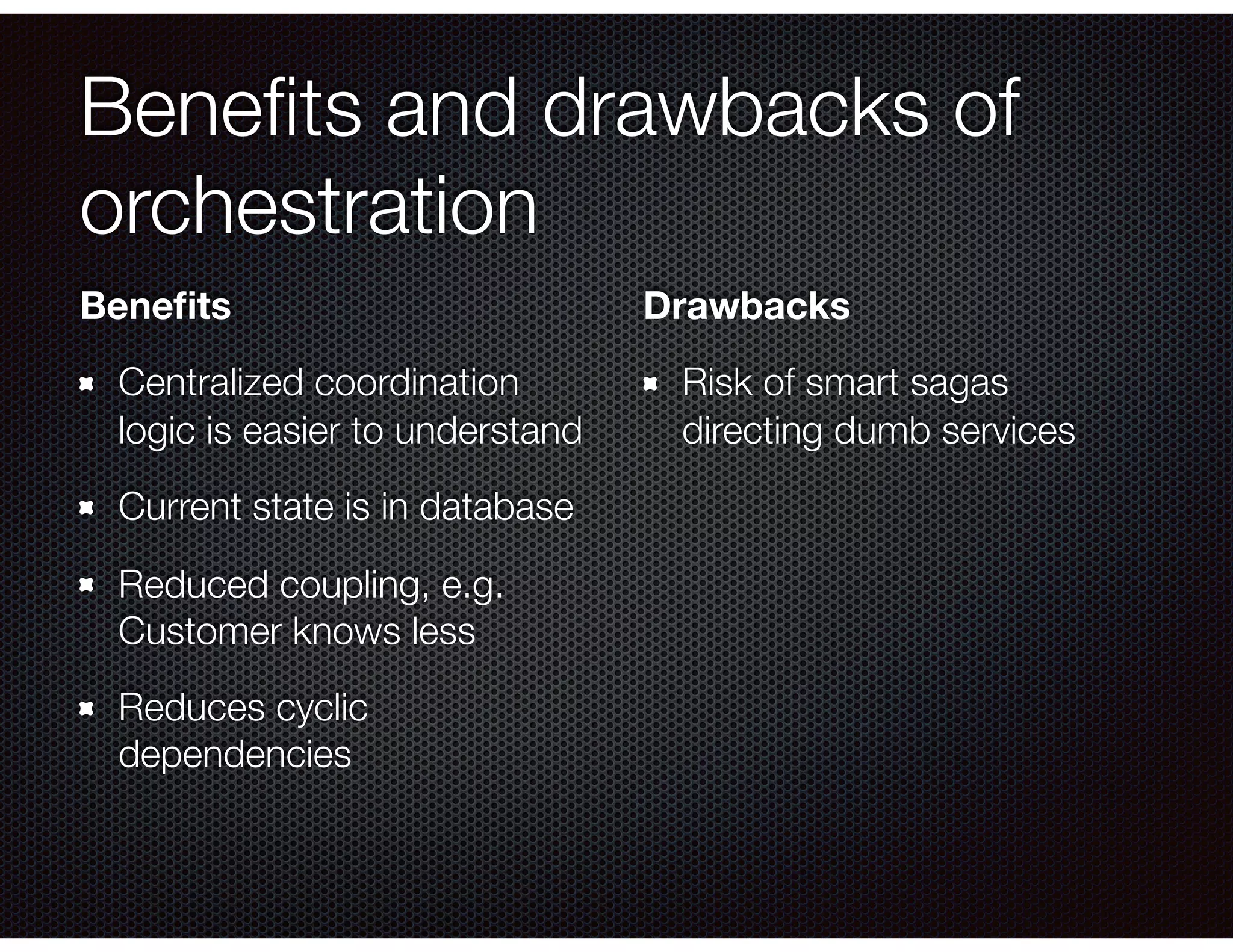
Benefits and drawbacks of orchestration Benefits Centralized coordination logic is easier to understand Current state is in database Reduced coupling, e.g. Customer knows less Reduces cyclic dependencies Drawbacks Risk of smart sagas directing dumb services
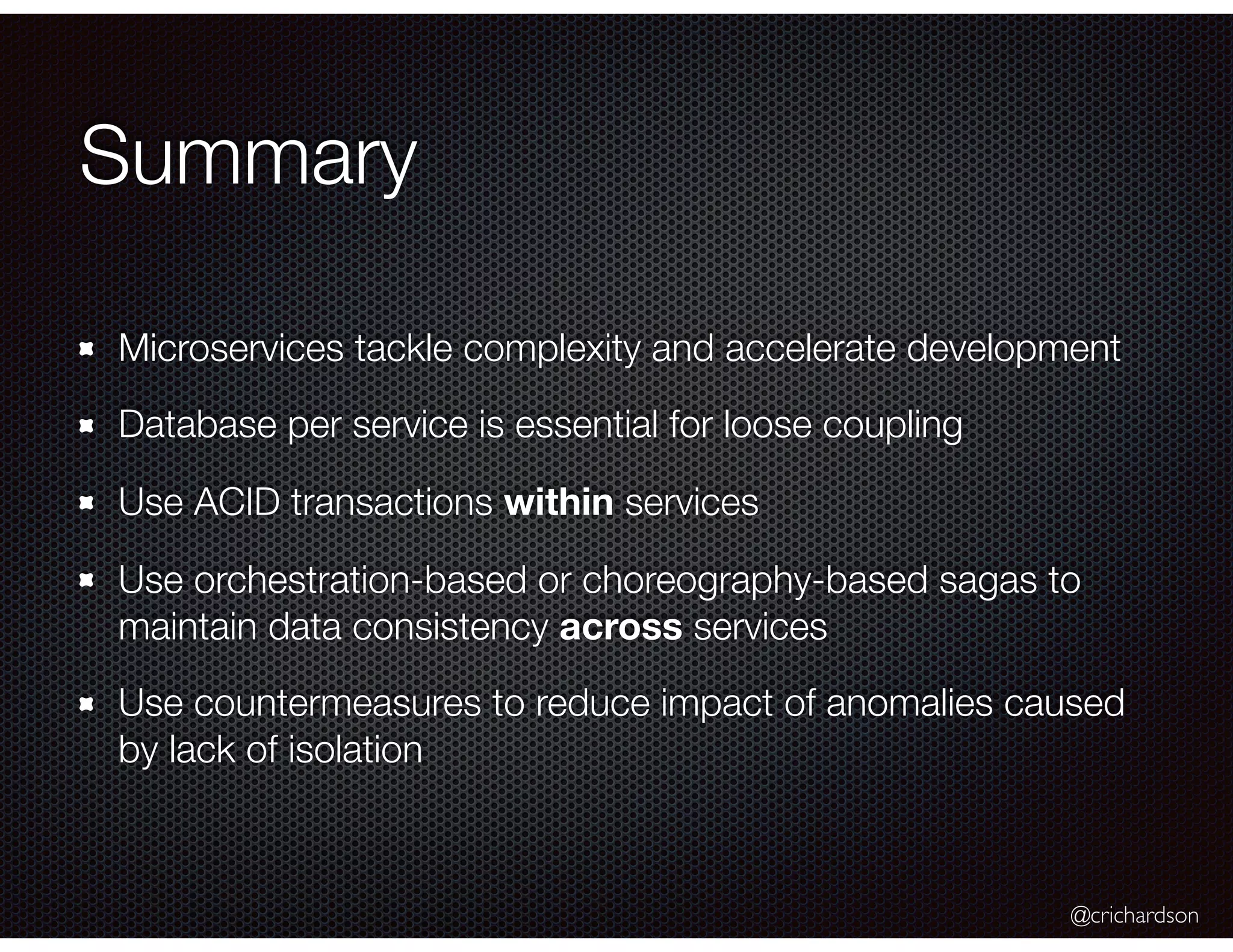
@crichardson Summary Microservices tackle complexity and accelerate development Database per service is essential for loose coupling Use ACID transactions within services Use orchestration-based or choreography-based sagas to maintain data consistency across services Use countermeasures to reduce impact of anomalies caused by lack of isolation
@crichardson @crichardson chris@chrisrichardson.net http://learn.microservices.io Questions? 40% discount with code ctwmicrocph19

MicroCPH - Managing data consistency in a microservice architecture using Sagas

  • 1.
    @crichardson Managing data consistencyin a microservice architecture using Sagas Chris Richardson Founder of Eventuate.io Founder of the original CloudFoundry.com Author of Microservices Patterns and POJOs in Action @crichardson chris@chrisrichardson.net http://learn.microservices.io Copyright © 2019. Chris Richardson Consulting, Inc. All rights reserved
  • 2.
  • 3.
  • 4.
  • 5.
    @crichardson Agenda ACID is notan option Overview of sagas Coordinating sagas
  • 6.
    The microservice architecture structures anapplication as a set of loosely coupled services
  • 7.
    @crichardson Loose coupling = encapsulateddata Order Service Customer Service Order Database Customer Database Order table Customer table orderTotal creditLimit availableCredit Change schema without coordinating with other teams
  • 8.
    @crichardson ACID transactions within servicesare fine Order Service Customer Service Order Database Customer Database Order table Customer table orderTotal creditLimit availableCredit ACID transaction ACID transaction
  • 9.
    @crichardson But how tomaintain data consistency across services? Order Service Customer Service Order Database Customer Database Order table Customer table orderTotal creditLimit availableCredit ?
  • 10.
    @crichardson Enforcing the customer’scredit limit createOrder(customerId, orderTotal) Pre-conditions: • customerId is valid Post-conditions • Order was created • Customer.availableCredit -= orderTotal Customer class Invariant: availableCredit >= 0 availableCredit <= creditLimit Spans services
  • 11.
    @crichardson Cannot use ACIDtransactions that span services BEGIN TRANSACTION … SELECT ORDER_TOTAL FROM ORDERS WHERE CUSTOMER_ID = ? … SELECT CREDIT_LIMIT FROM CUSTOMERS WHERE CUSTOMER_ID = ? … … CHECK FOR SUFFICIENT CREDIT…. … INSERT INTO ORDERS … … COMMIT TRANSACTION Private to the Order Service Private to the Customer Service Distributed transactions
  • 12.
    @crichardson 2PC is notan option Guarantees consistency BUT 2PC coordinator is a single point of failure Chatty: at least O(4n) messages, with retries O(n^2) Reduced throughput due to locks Not supported by many NoSQL databases (or message brokers) CAP theorem 2PC impacts availability ….
  • 13.
  • 14.
    @crichardson Agenda ACID is notan option Overview of sagas Coordinating sagas
  • 15.
  • 16.
    @crichardson Saga Use Sagas insteadof 2PC Distributed transaction Service A Service B Service A Local transaction Service B Local transaction Service C Local transaction X Service C
  • 17.
    @crichardson Order Service Create OrderSaga Local transaction Order state=PENDING createOrder() Customer Service Local transaction Customer reserveCredit() Order Service Local transaction Order state=APPROVED approve order() createOrder() Initiates saga
  • 18.
  • 19.
    @crichardson Challenge: rollback BEGIN TRANSACTION … UPDATE… … INSERT …. … …. BUSINESS RULE VIOLATED!!!! … ROLLBACK TRANSACTION Really simple ACID transaction! Create Order Reserve Credit FAILS Already committed. How to undo?! VS.
  • 20.
    @crichardson Rolling back sagas Usecompensating transactions Developer must write application logic to “rollback” eventually consistent transactions Careful design required!
  • 21.
    @crichardson Saga: Every Tihas a Ci T1 T2 … C1 C2 Compensating transactions T1 T2 C1 FAILS
  • 22.
    @crichardson Order Service Create OrderSaga - rollback Local transaction Order createOrder() Customer Service Local transaction Customer reserveCredit() Order Service Local transaction Order reject order() createOrder() FAIL Insufficient credit
  • 23.
    @crichardson Writing compensating transactions isn’talways easy Write them so they will always succeed If a compensating transaction fails no clear way to recover Challenge: Undoing changes when data has already been changed by a different transaction/saga More on this later Actions that can’t be undone, e.g. sending email Reorder saga and move to end
  • 24.
    Structure of CreateOrder Saga T1: Create Order C1: Reject Order T2: Reserve Credit T3: Approve Order Needs to be compensatable because Reserve Credit can fail Last step that can fail: Does not need compensation Can’t fail
  • 25.
    Saga structure: 3phases T1 C1 … T2 C2 Tn+1 Tn+2 …. Compensatable transactions Pivot transaction = GO/NO GO Retriable transactions that can’t fail and don’t need compensation Great for actions that cannot be undone
  • 26.
    Ordering the stepsof a saga Dependencies between steps: Result of one step is used as input to next e.g. Create Order before Reserving Credit But often you have a choice Simplify by moving updates to after pivot transaction Update Customer Undo Update Customer … Pivot Transaction Update Customer … Pivot Transaction No compensation required Reorder
  • 27.
    @crichardson Challenge: Sagas areACD Atomicity Saga implementation ensures that all transactions are executed OR all are compensated Consistency Referential integrity within a service handled by local databases Referential integrity across services handled by application Durability Durability handled by local databases
  • 28.
    @crichardson Lack of I Outcomeof concurrent execution != a sequential execution = Data anomalies
  • 29.
    @crichardson Anomaly: Lost update Ti:Create Order Tj: Approve Order Ti: Cancel Order Saga 1 Create Order Saga 2 Cancel order Time Overwrites cancelled order Also: A compensating transaction that simply restores previous value can cause a lost update
  • 30.
    @crichardson Anomaly: Dirty reads Ti:Reserve Credit Ci: Unreserve credit Ti: Reserve Credit Reads uncommitted changes Order rejected unnecessarily OR Credit limit exceeded Time Saga 1 Create Order Saga 2 Create Order Ti: Reserve InventoryX Temporarily changed
  • 31.
    @crichardson Use countermeasures to preventanomalies Use semantic lock to prevent lost updates e.g. a PENDING order cannot be cancelled Reorder saga to eliminate dirty reads caused by compensating transactions Ci undoes changes made by Ti => possibility of dirty read Eliminate Ci by moving update to (after) pivot transaction Use commutative updates to eliminate lost updates caused by compensating transactions Customer.reserveCredit() and releaseCredit() Account.debit() and credit() … https://www.slideshare.net/chris.e.richardson/saturn-2018-managing-data-consistency-in-a-microservice-architecture-using-sagas
  • 32.
    @crichardson Agenda ACID is notan option Overview of sagas Coordinating sagas
  • 33.
    @crichardson How to sequencethe saga transactions? After the completion of transaction Ti “something” must decide what step to execute next Success: which T(i+1) - branching Failure: C(i - 1)
  • 34.
    @crichardson Use asynchronous, broker- basedmessaging Order Service Customer Service …. Message broker Guaranteed atleast once delivery ensures a saga complete when its participants are temporarily unavailable
  • 35.
    @crichardson Saga step =a transaction local to a service (a.k.a. participant) Service Database Message Broker update Send message/event How to make atomic without 2PC?* *Transactional Outbox pattern or Event Sourcing
  • 36.
    @crichardson Choreography: distributed decisionmaking vs. Orchestration: centralized decision making
  • 37.
    @crichardson Option #1: Choreography-based coordinationusing events Order Service Customer Service Order created Credit Reserved Credit Limit Exceeded Create Order OR Customer creditLimit creditReservations Order state total create() reserveCredit() approve()/ reject() Order events channel Customer events channel
  • 38.
    @crichardson Order Service: publishing domainevents Publish event Create order
  • 39.
    @crichardson Customer Service: consuming domainevents… https://github.com/eventuate-tram/eventuate-tram-examples-customers-and-orders Subscribe to event
  • 40.
    @crichardson Customer Service: consuming domainevents Attempt to Reserve credit Publish event on success Publish event on failure
  • 41.
    Benefits and drawbacksof choreography Benefits Simple, especially when using event sourcing Participants are loosely coupled Drawbacks Decentralized implementation - potentially difficult to understand Cyclic dependencies - services listen to each other’s events, e.g. Customer Service must know about all Order events that affect credit Overloads domain objects, e.g. Order and Customer know too much Events = indirect way to make something happen https://github.com/eventuate-examples/eventuate-examples-java-customers-and-orders
  • 42.
    @crichardson Order Service Option #2:Orchestration-based saga coordination Local transaction Order state=PENDING createOrder() Customer Service Local transaction Customer reserveCredit() Order Service Local transaction Order state=APPROVED approve order() createOrder() CreateOrderSaga InvokesInvokesInvokes
  • 43.
    @crichardson A saga (orchestrator) isa persistent object that implements a state machine that invokes the participants and handles replies
  • 44.
    Saga orchestrator behavior Oncreate: Invokes a saga participant Persists state in database Wait for a reply On reply: Load state from database Determine which saga participant to invoke next Invokes saga participant Updates its state Persists updated state Wait for a reply …
  • 45.
    @crichardson Order Service CreateOrderSaga orchestrator CustomerService Create Order Customer creditLimit creditReservations ... Order state total… reserveCredit CreateOrder Saga OrderService create() create() approve() Credit Reserved Customer command channel Saga reply channel https://github.com/eventuate-tram/eventuate-tram-sagas-examples-customers-and-orders
  • 46.
  • 47.
    @crichardson Customer Service command handlerRoute command to handler Reserve credit Make reply message
  • 48.
    @crichardson Eventuate Tram Sagas Open-sourceSaga orchestration framework Currently for Java https://github.com/eventuate-tram/eventuate-tram-sagas https://github.com/eventuate-tram/eventuate-tram-sagas- examples-customers-and-orders
  • 49.
    Benefits and drawbacksof orchestration Benefits Centralized coordination logic is easier to understand Current state is in database Reduced coupling, e.g. Customer knows less Reduces cyclic dependencies Drawbacks Risk of smart sagas directing dumb services
  • 50.
    @crichardson Summary Microservices tackle complexityand accelerate development Database per service is essential for loose coupling Use ACID transactions within services Use orchestration-based or choreography-based sagas to maintain data consistency across services Use countermeasures to reduce impact of anomalies caused by lack of isolation
  • 51.