Microsoft, Linux, Open Source, Cloud + DevOps Jessica Deen Cloud Developer Advocate
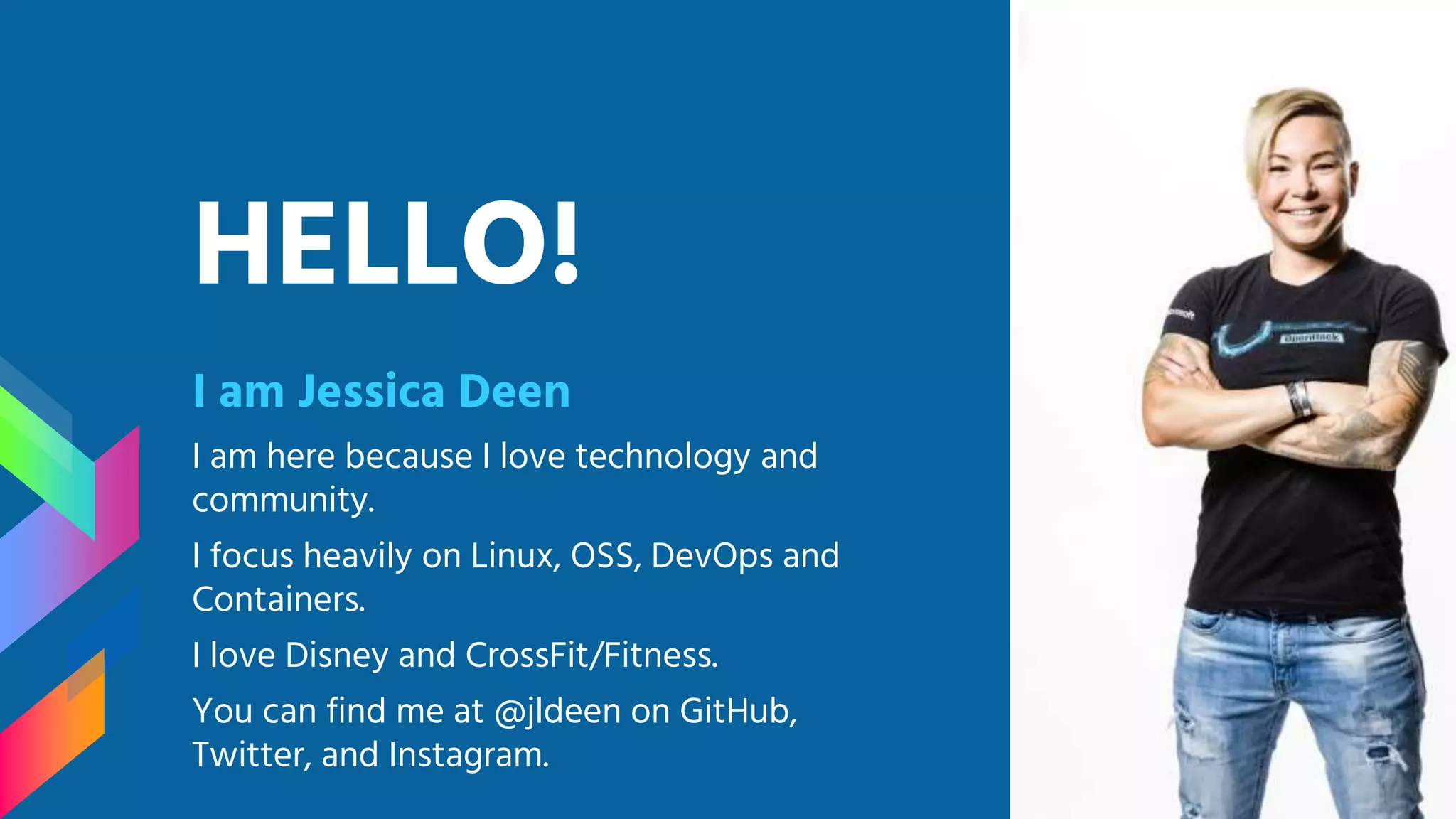
HELLO! I am Jessica Deen I am here because I love technology and community. I focus heavily on Linux, OSS, DevOps and Containers. I love Disney and CrossFit/Fitness. You can find me at @jldeen on GitHub, Twitter, and Instagram.
Disclaimer The next 45 minutes will NOT make you an expert, but it will: - Get you thinking - Show you what’s possible - Give you some sample code for you to get started on your own time
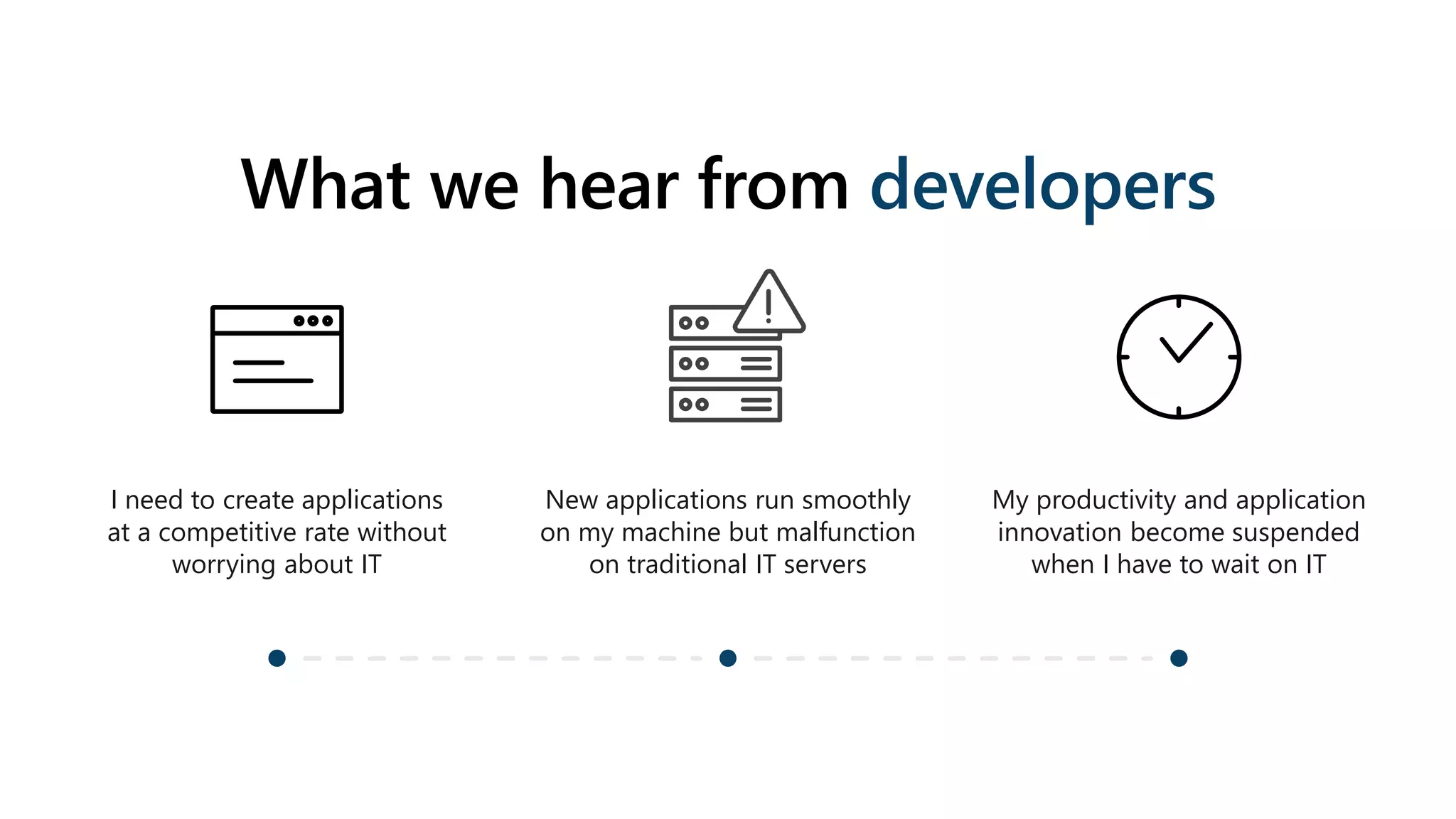
developers I need to create applications at a competitive rate without worrying about IT New applications run smoothly on my machine but malfunction on traditional IT servers My productivity and application innovation become suspended when I have to wait on IT
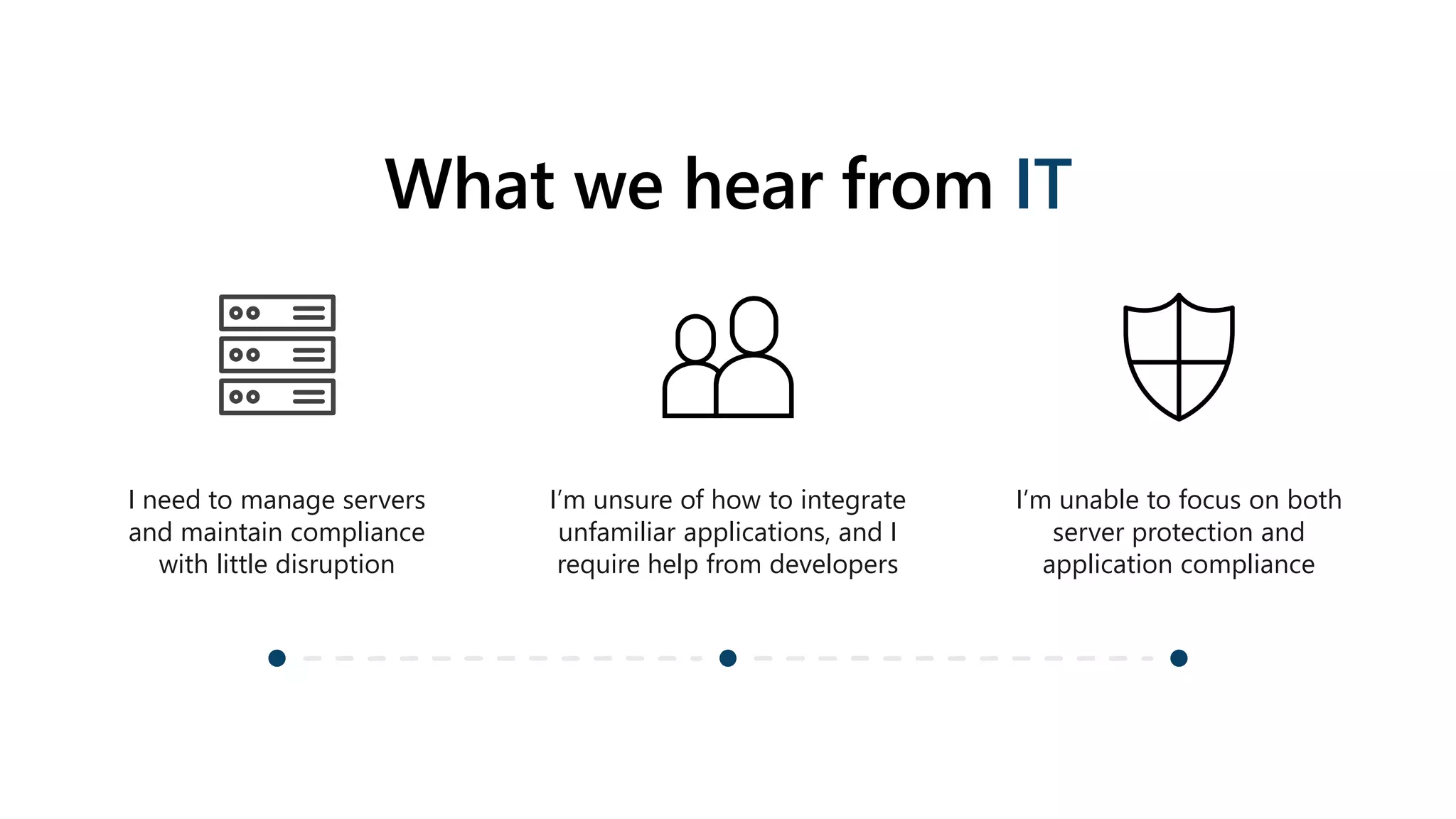
IT I need to manage servers and maintain compliance with little disruption I’m unsure of how to integrate unfamiliar applications, and I require help from developers I’m unable to focus on both server protection and application compliance
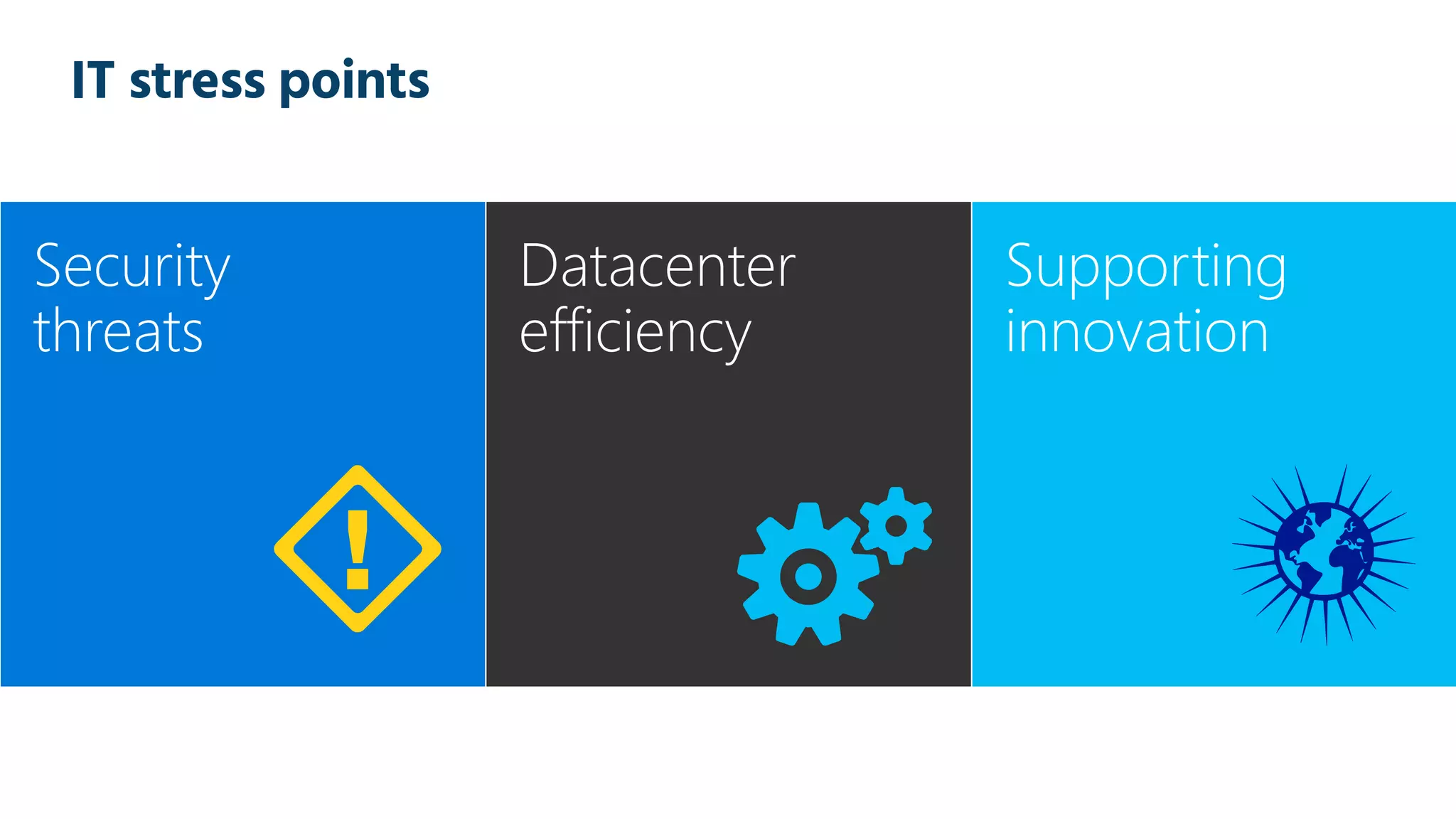
IT stress points Security threats Datacenter efficiency Supporting innovation
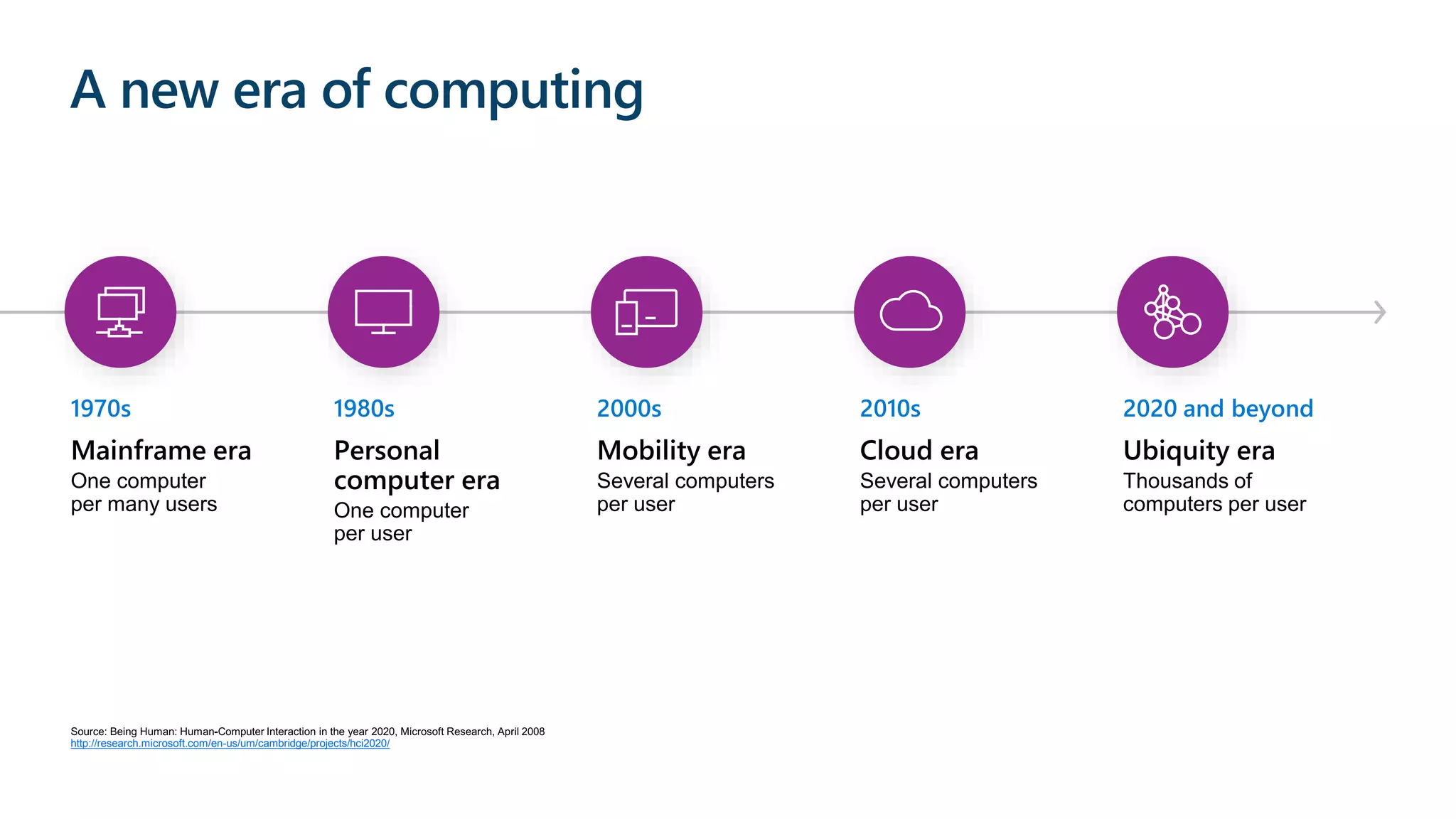
http://research.microsoft.com/en-us/um/cambridge/projects/hci2020/ A new era of computing
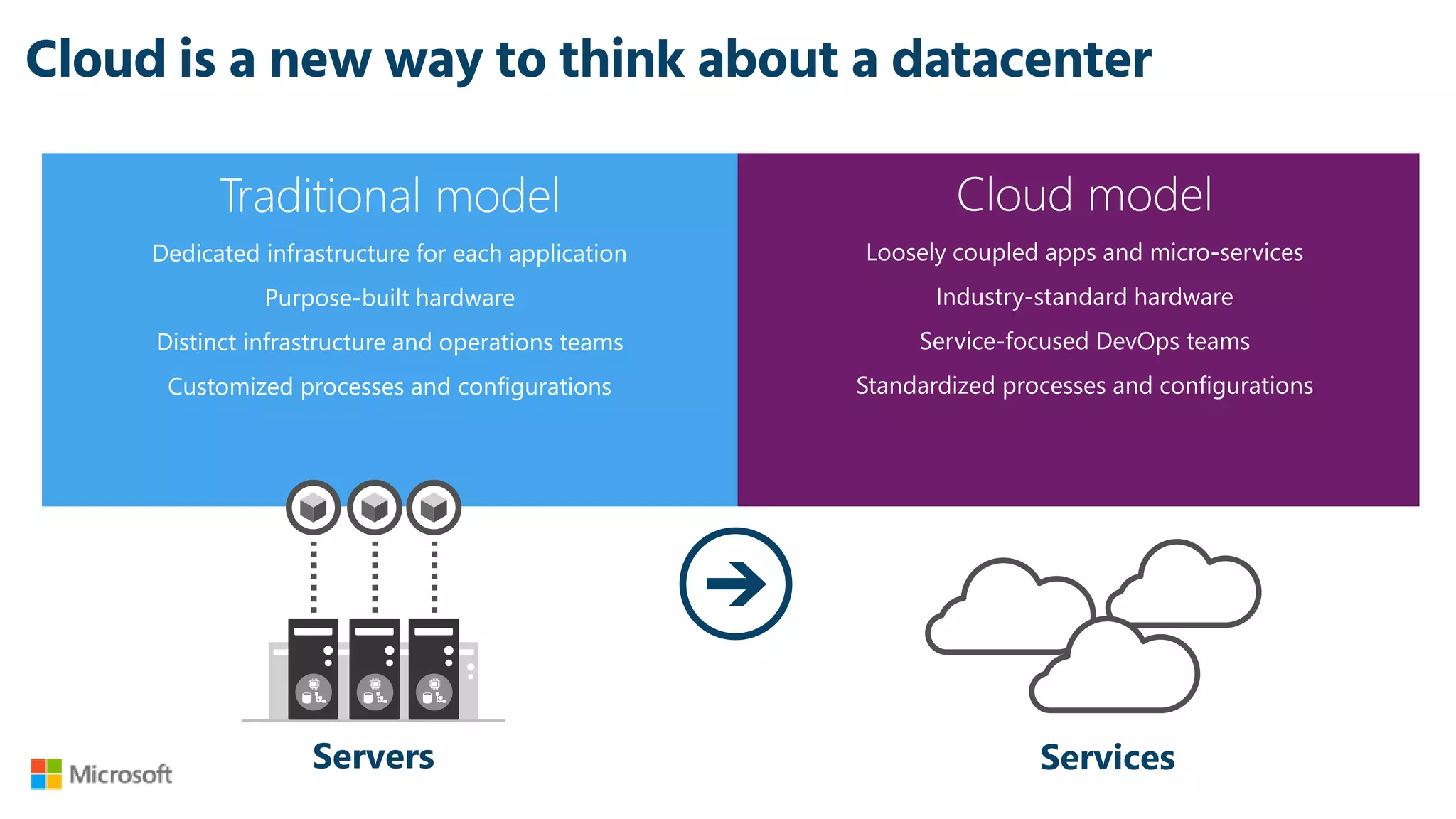
Servers Services Cloud is a new way to think about a datacenter
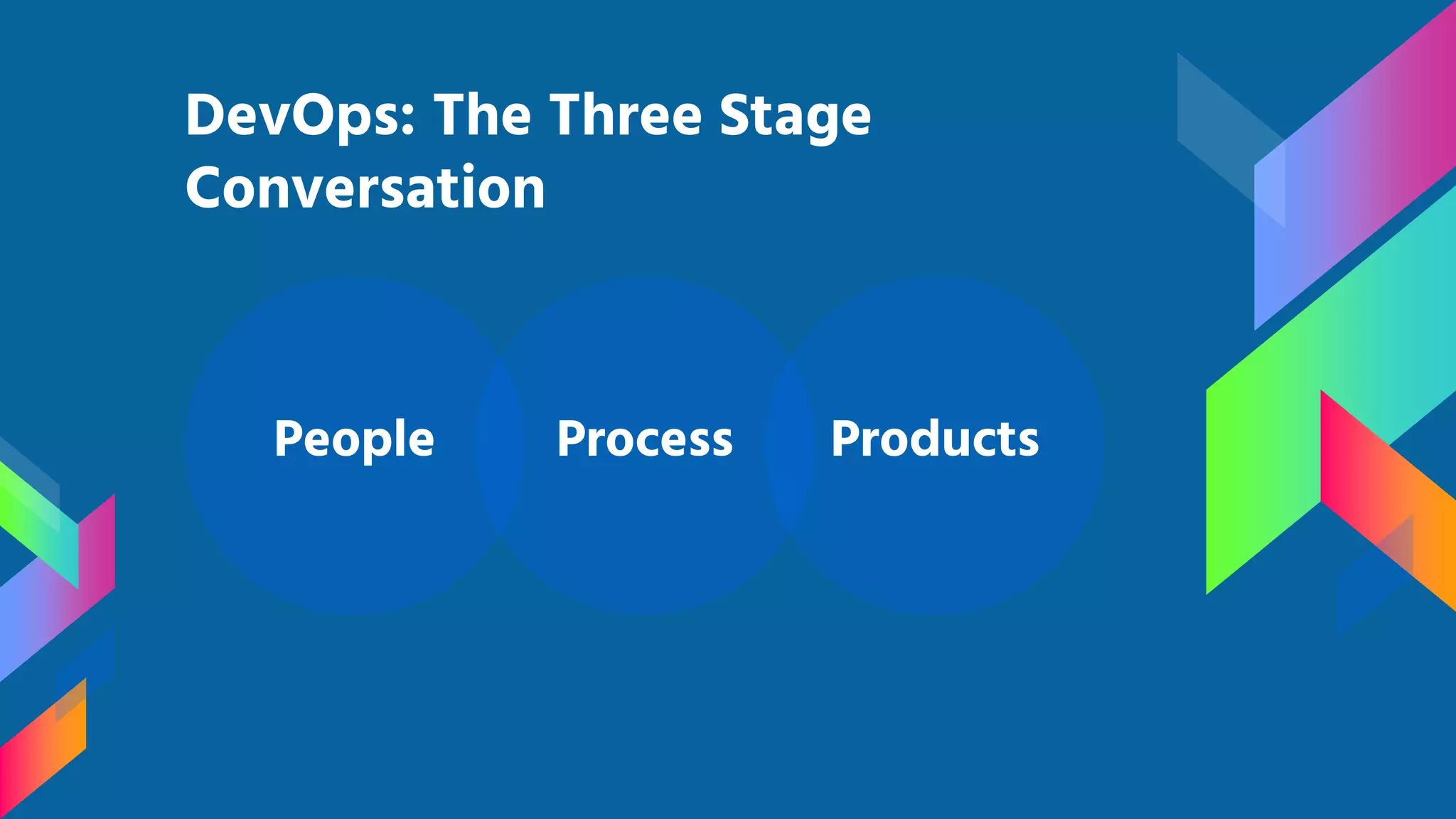
DevOps: The Three Stage Conversation ProcessPeople Products
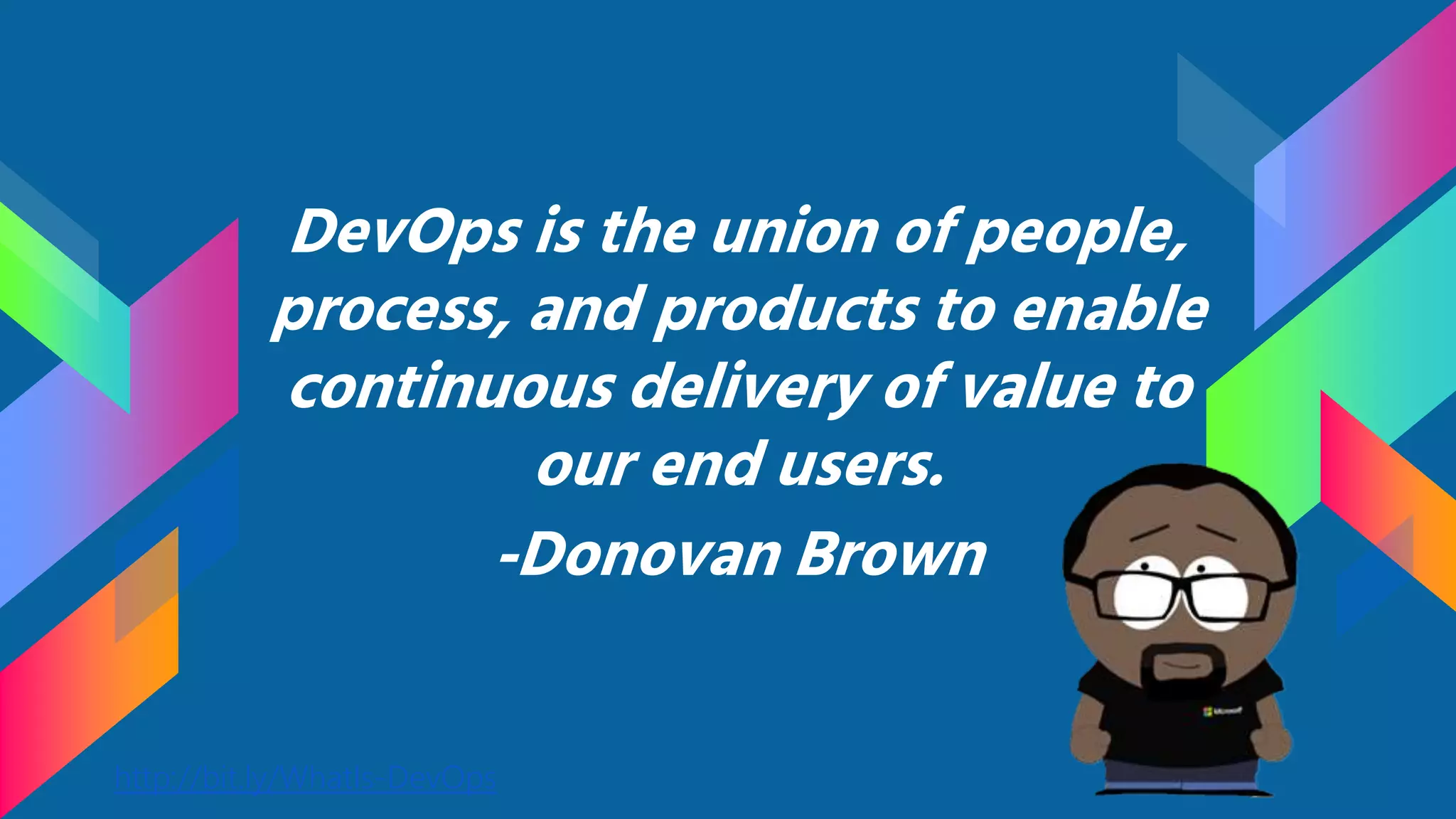
DevOps is the union of people, process, and products to enable continuous delivery of value to our end users. -Donovan Brown http://bit.ly/WhatIs-DevOps
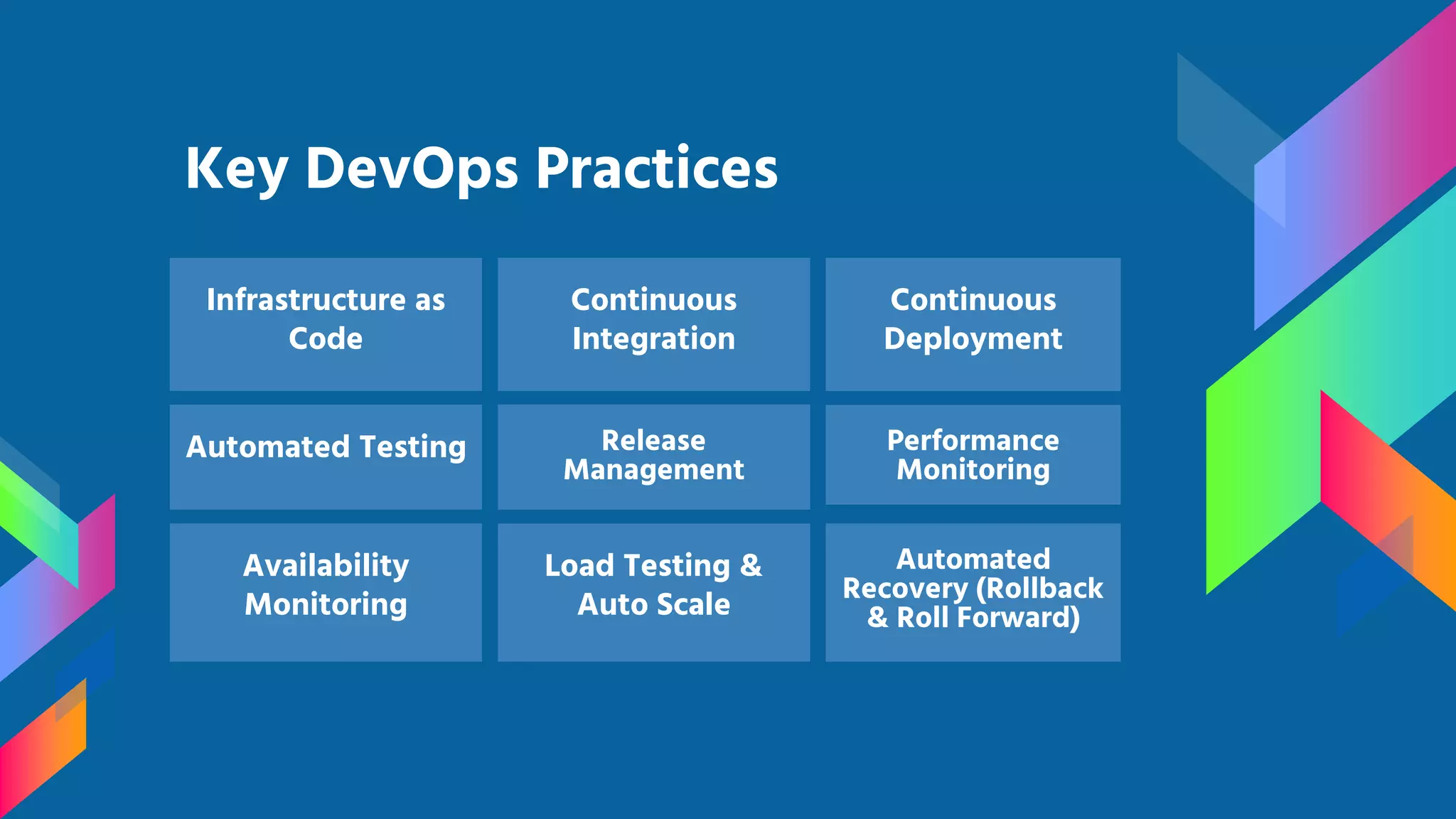
Key DevOps Practices Infrastructure as Code Continuous Integration Continuous Deployment Automated Testing Release Management Performance Monitoring Availability Monitoring Load Testing & Auto Scale Automated Recovery (Rollback & Roll Forward)
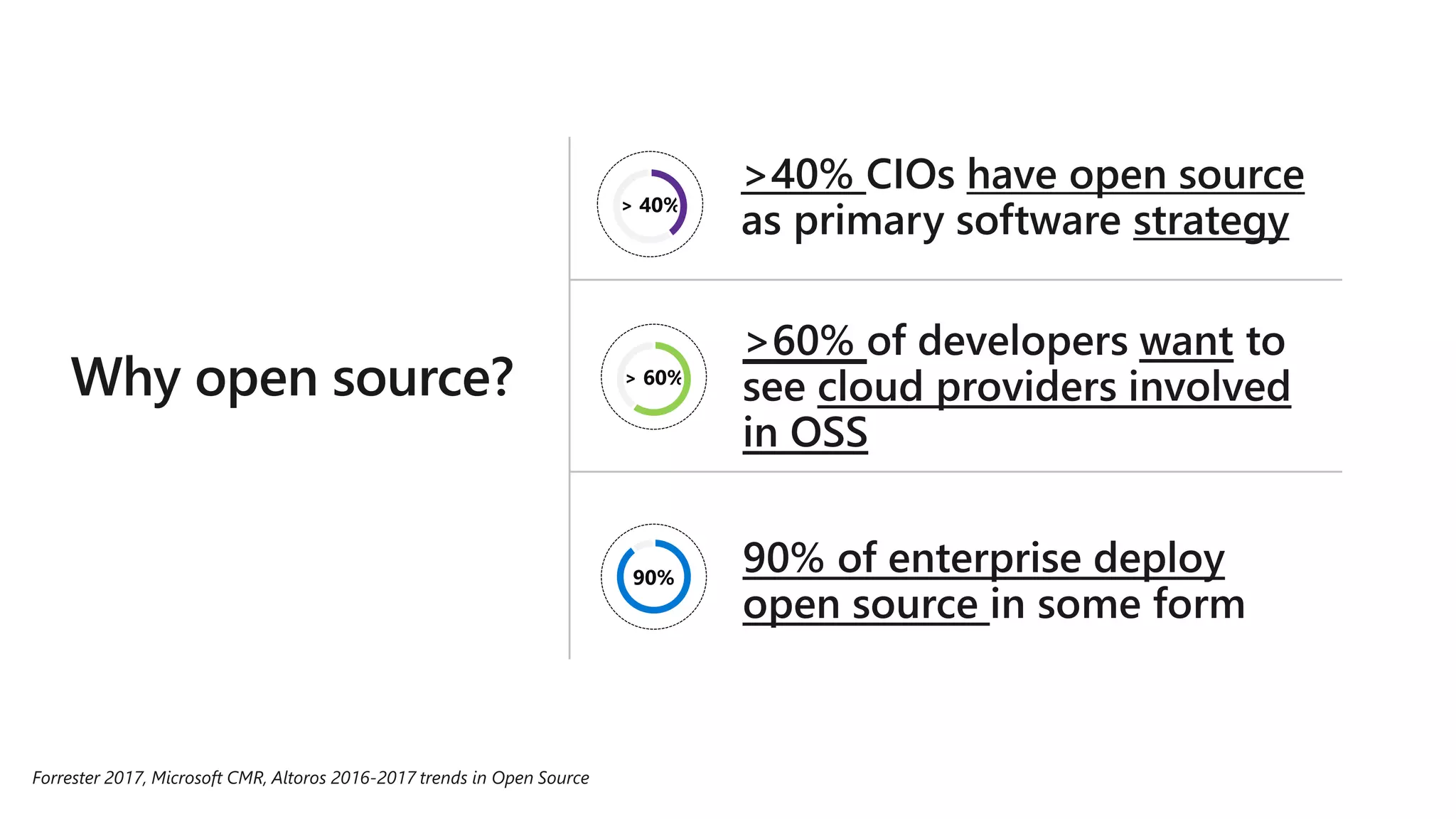
> 60% > 40% 90%
Demo – VS Code in Action
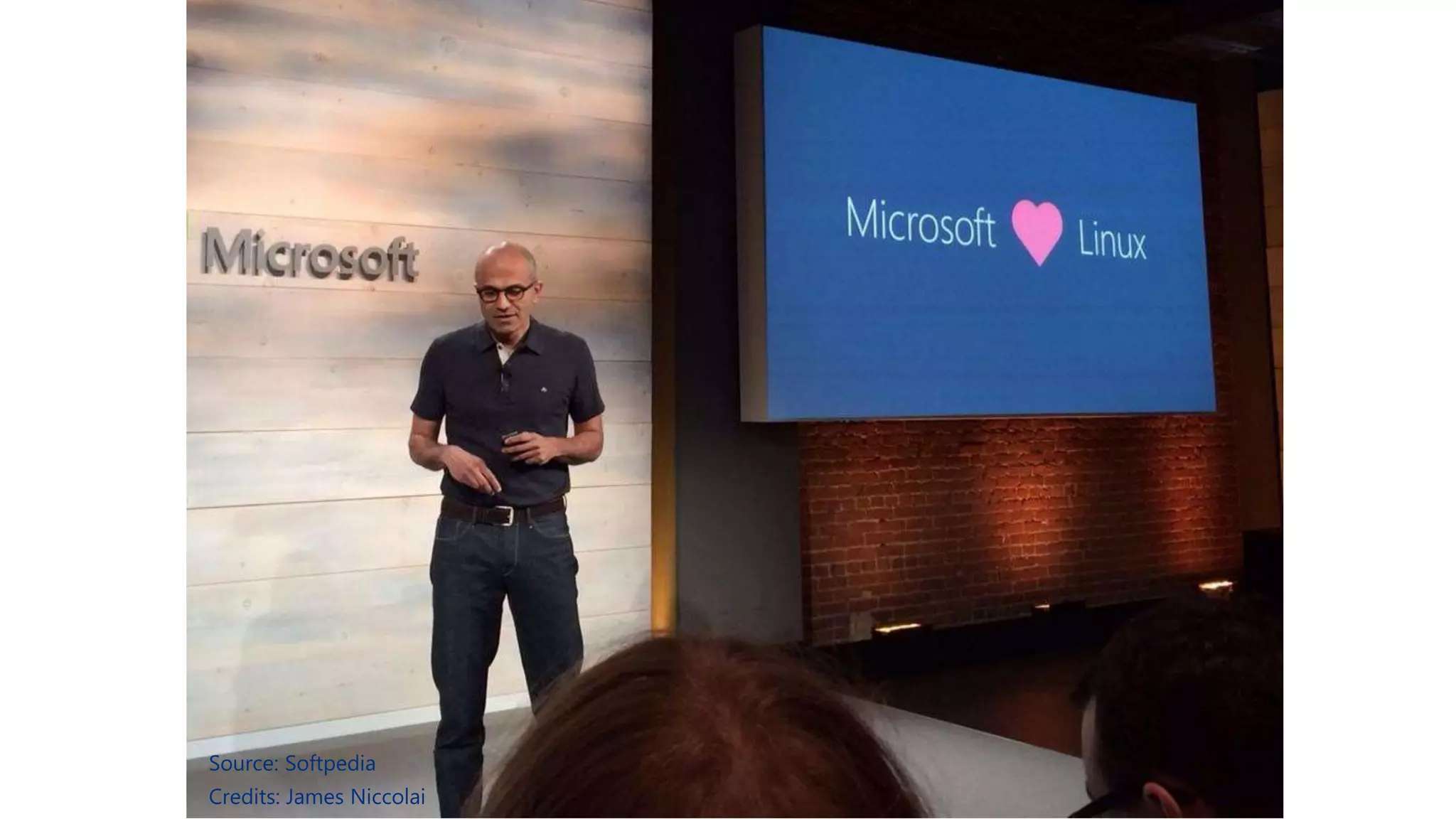
Source: Softpedia Credits: James Niccolai
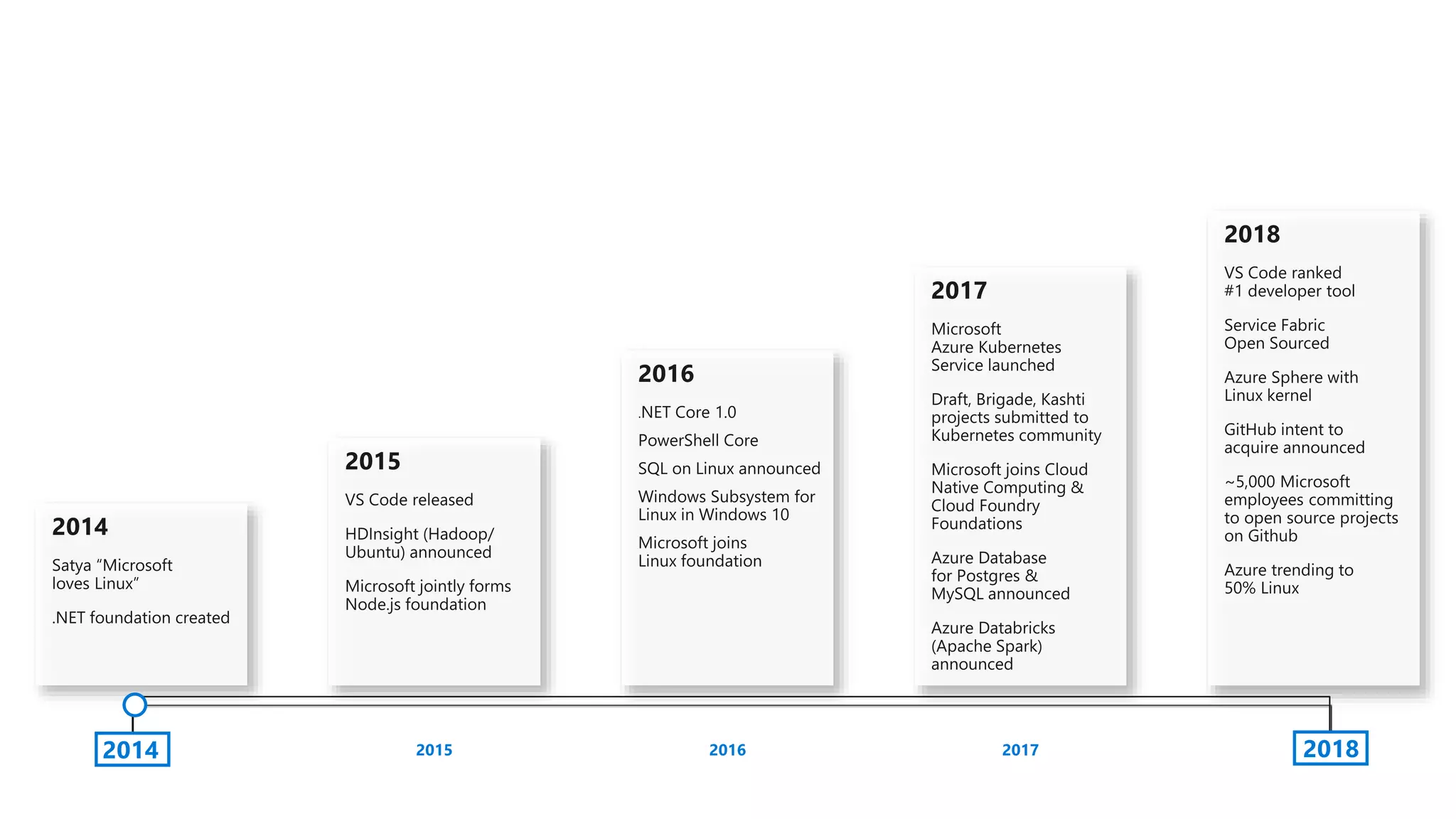
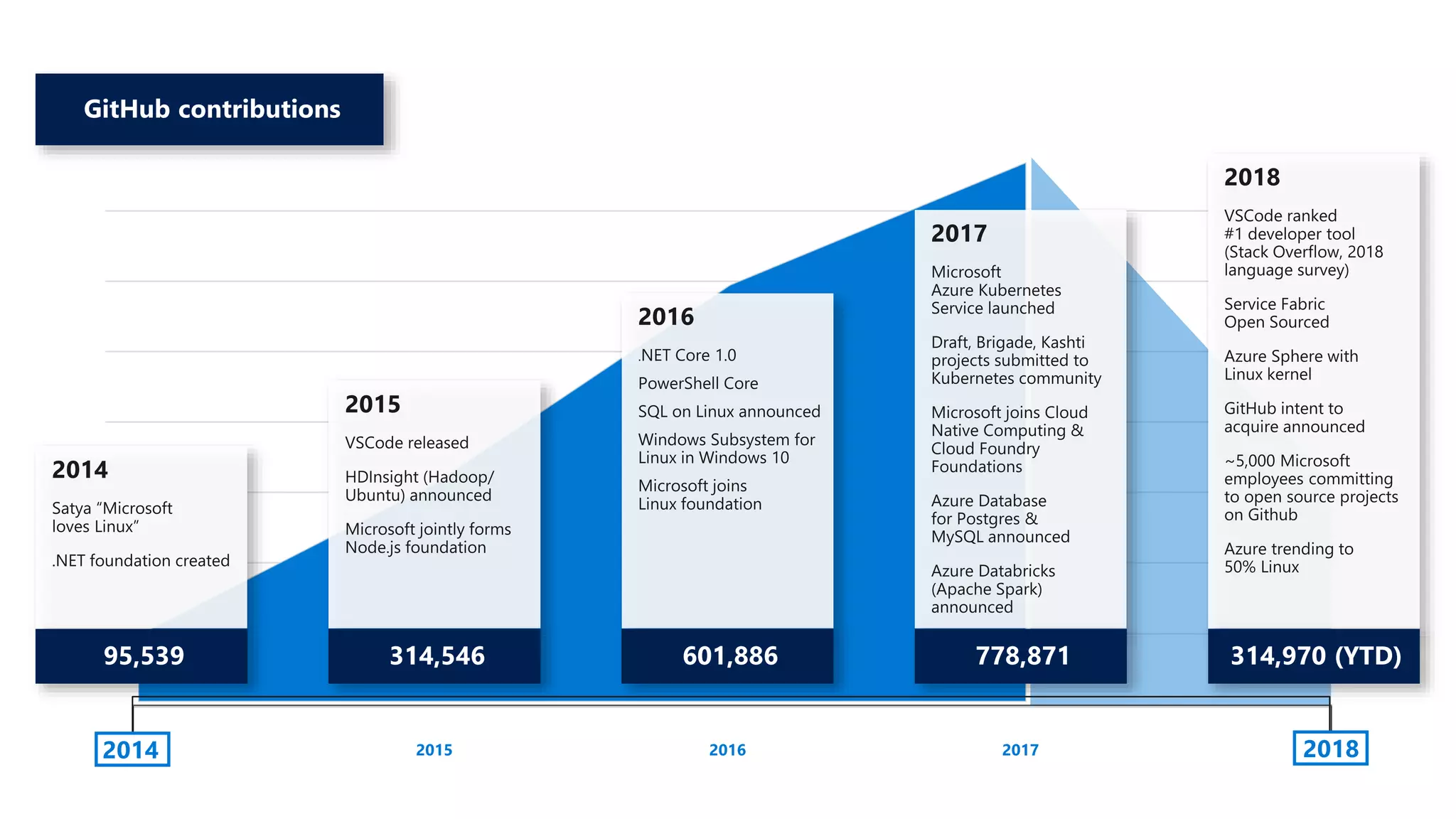
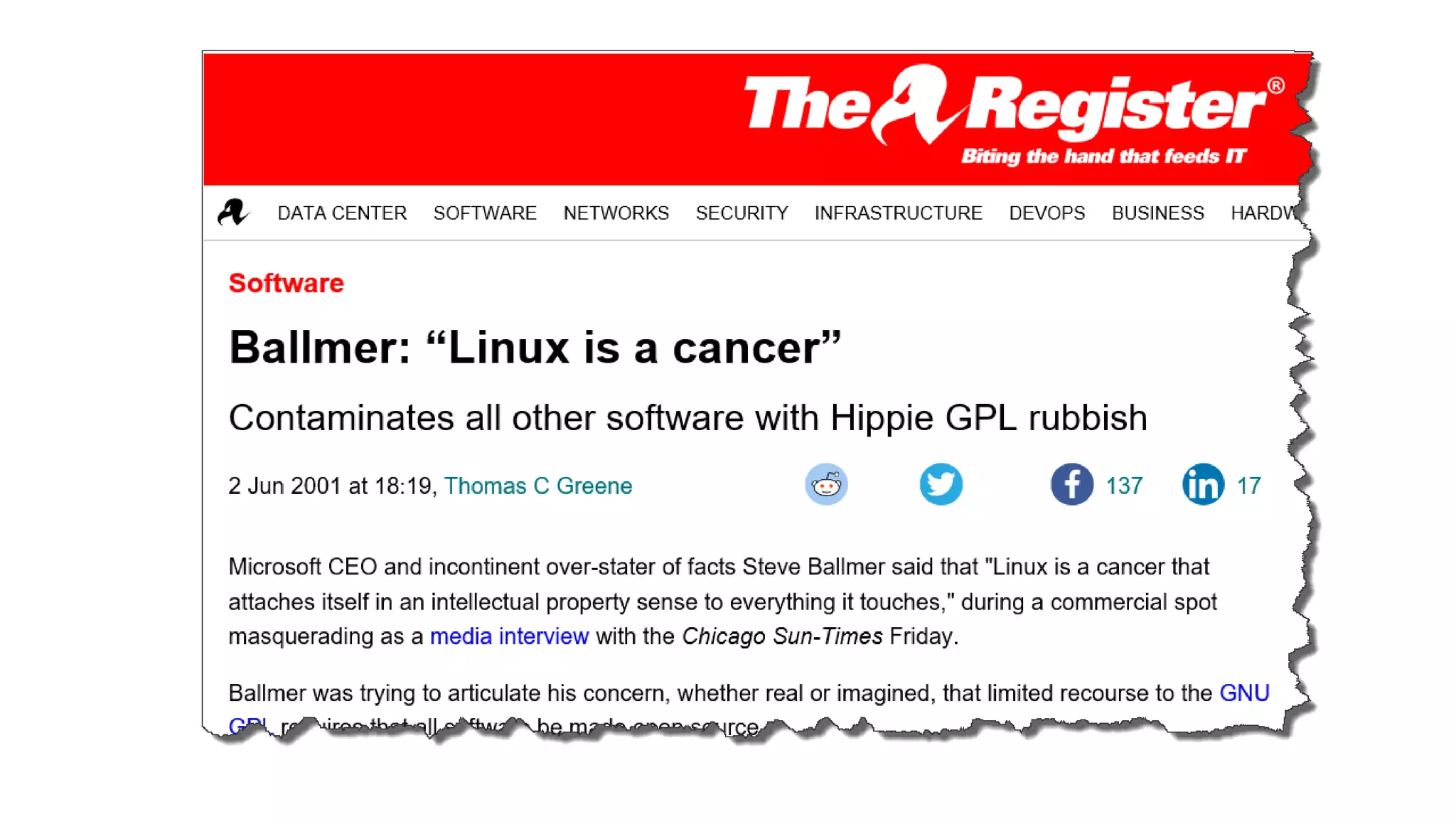
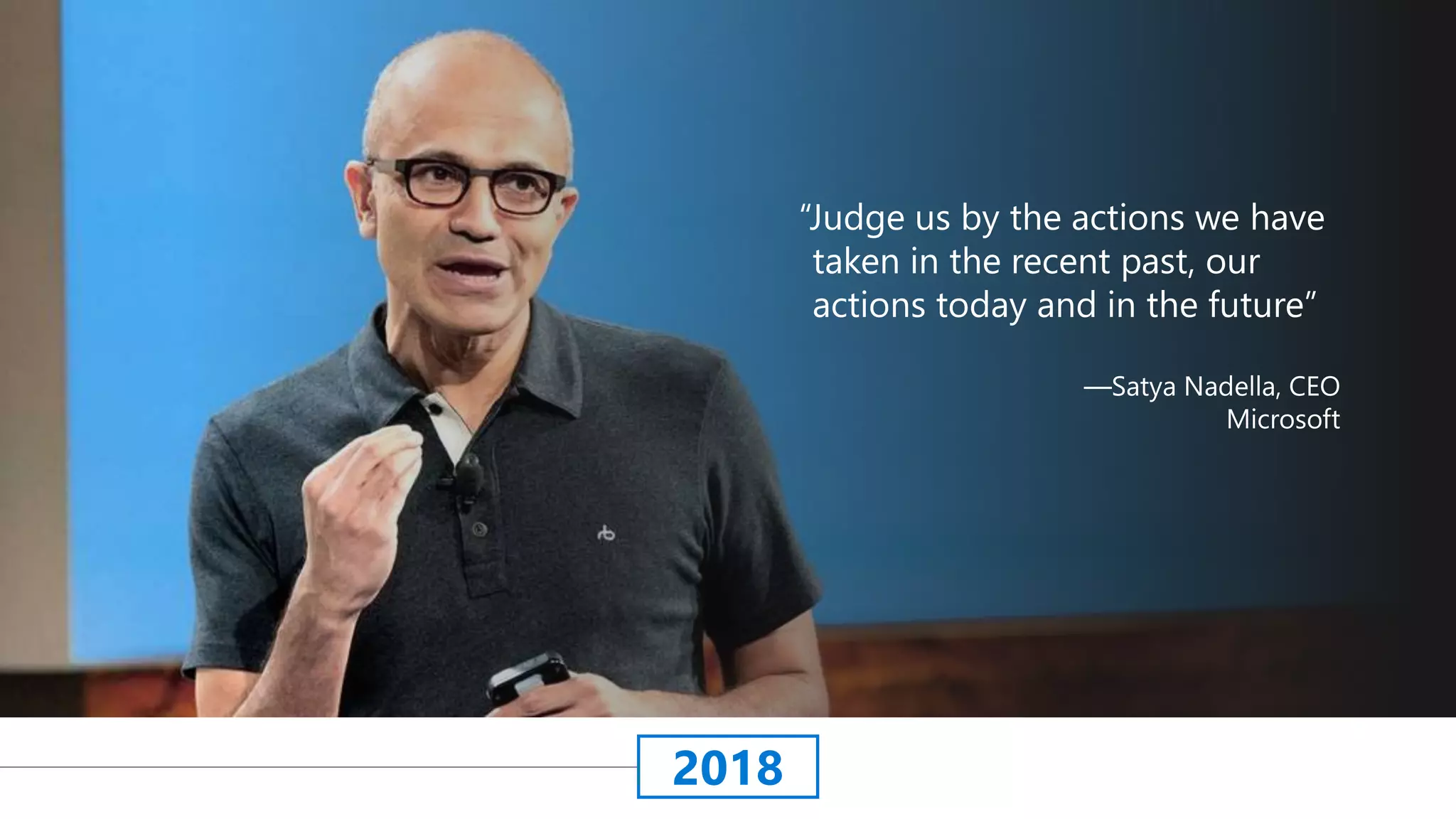
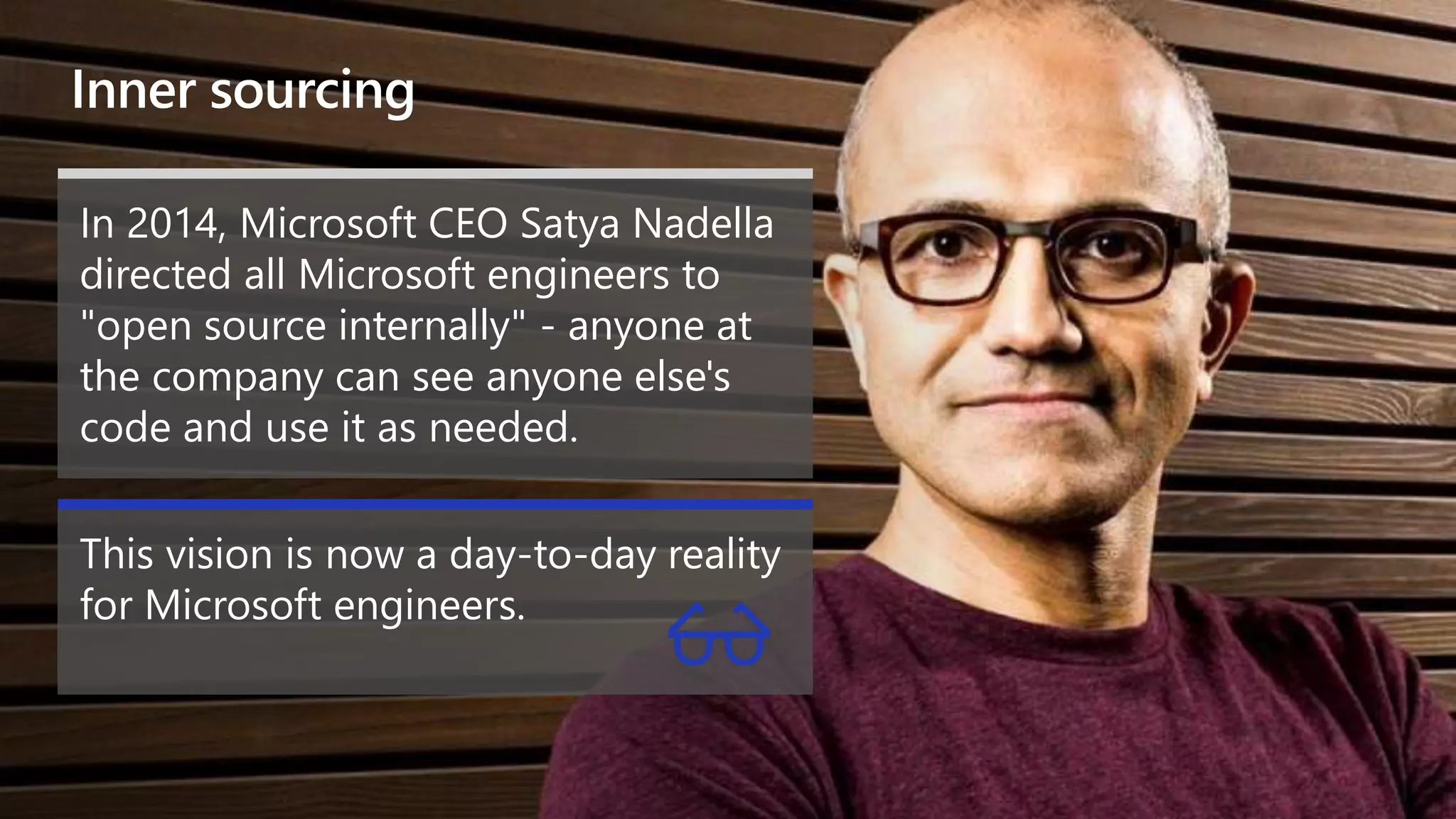
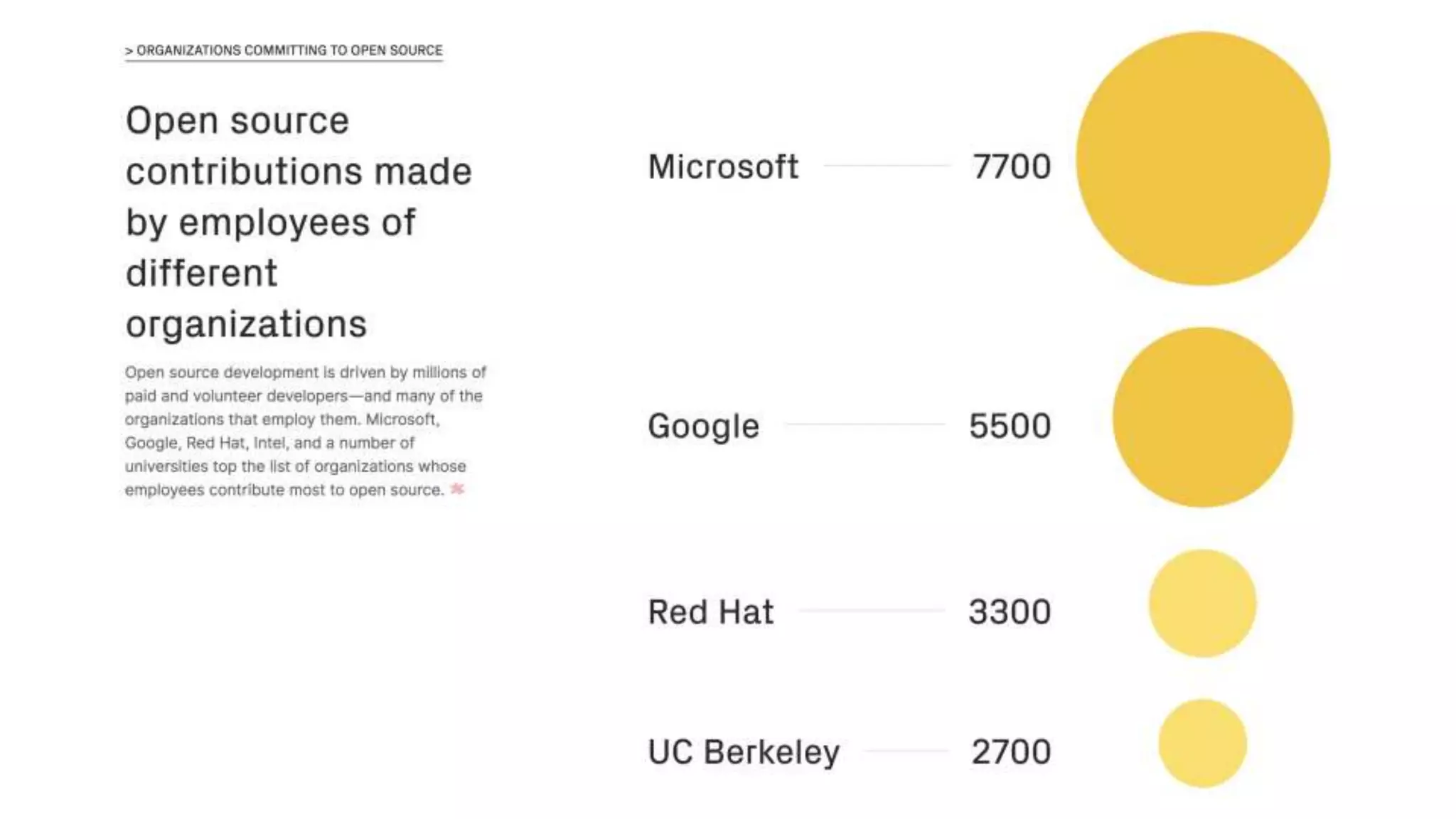
In 2014, Microsoft CEO Satya Nadella directed all Microsoft engineers to "open source internally" - anyone at the company can see anyone else's code and use it as needed. This vision is now a day-to-day reality for Microsoft engineers.
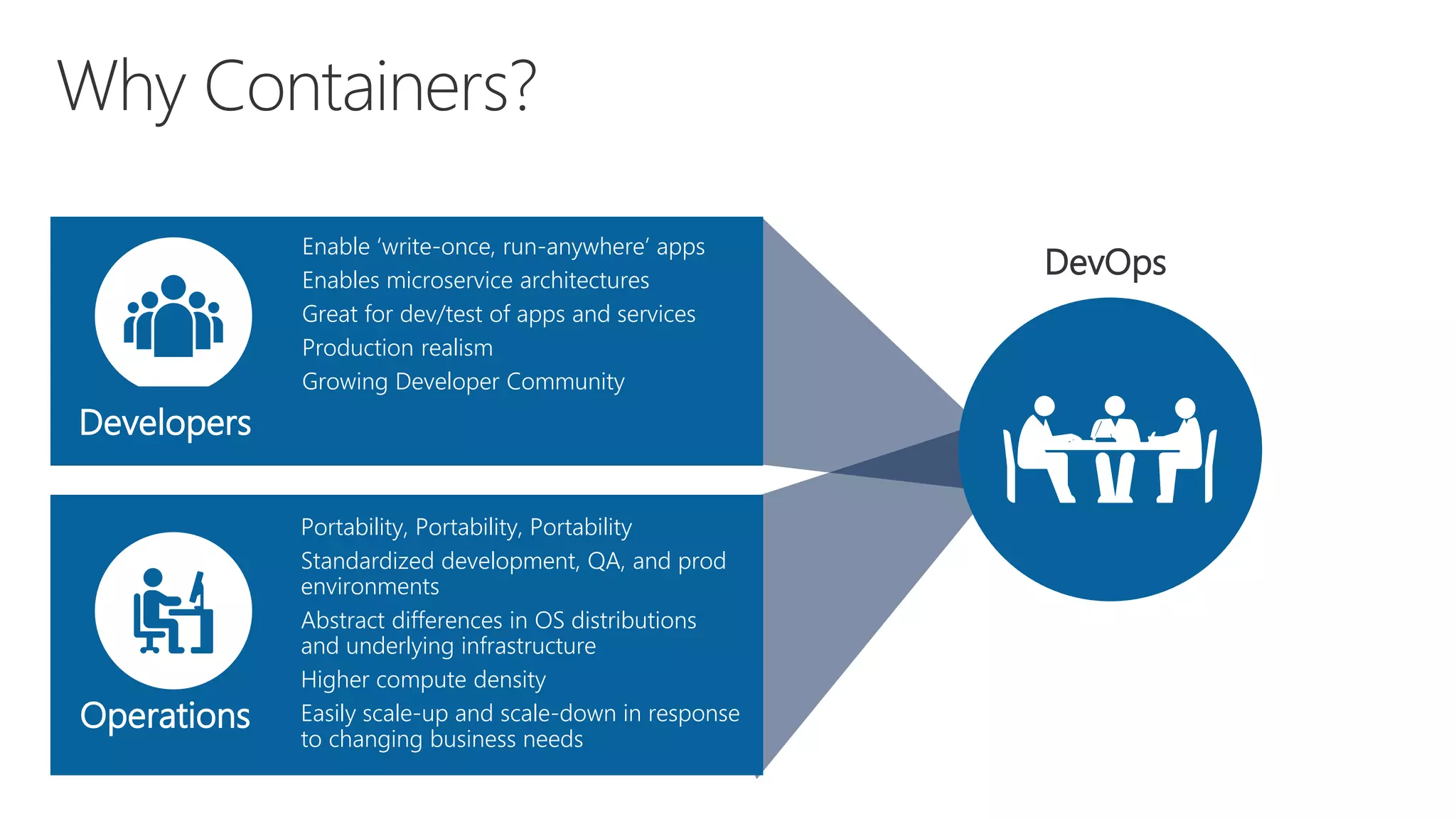
Developers Enable ‘write-once, run-anywhere’ apps Enables microservice architectures Great for dev/test of apps and services Production realism Growing Developer Community Operations Portability, Portability, Portability Standardized development, QA, and prod environments Abstract differences in OS distributions and underlying infrastructure Higher compute density Easily scale-up and scale-down in response to changing business needs DevOps
Container Orchestration: Kubernetes
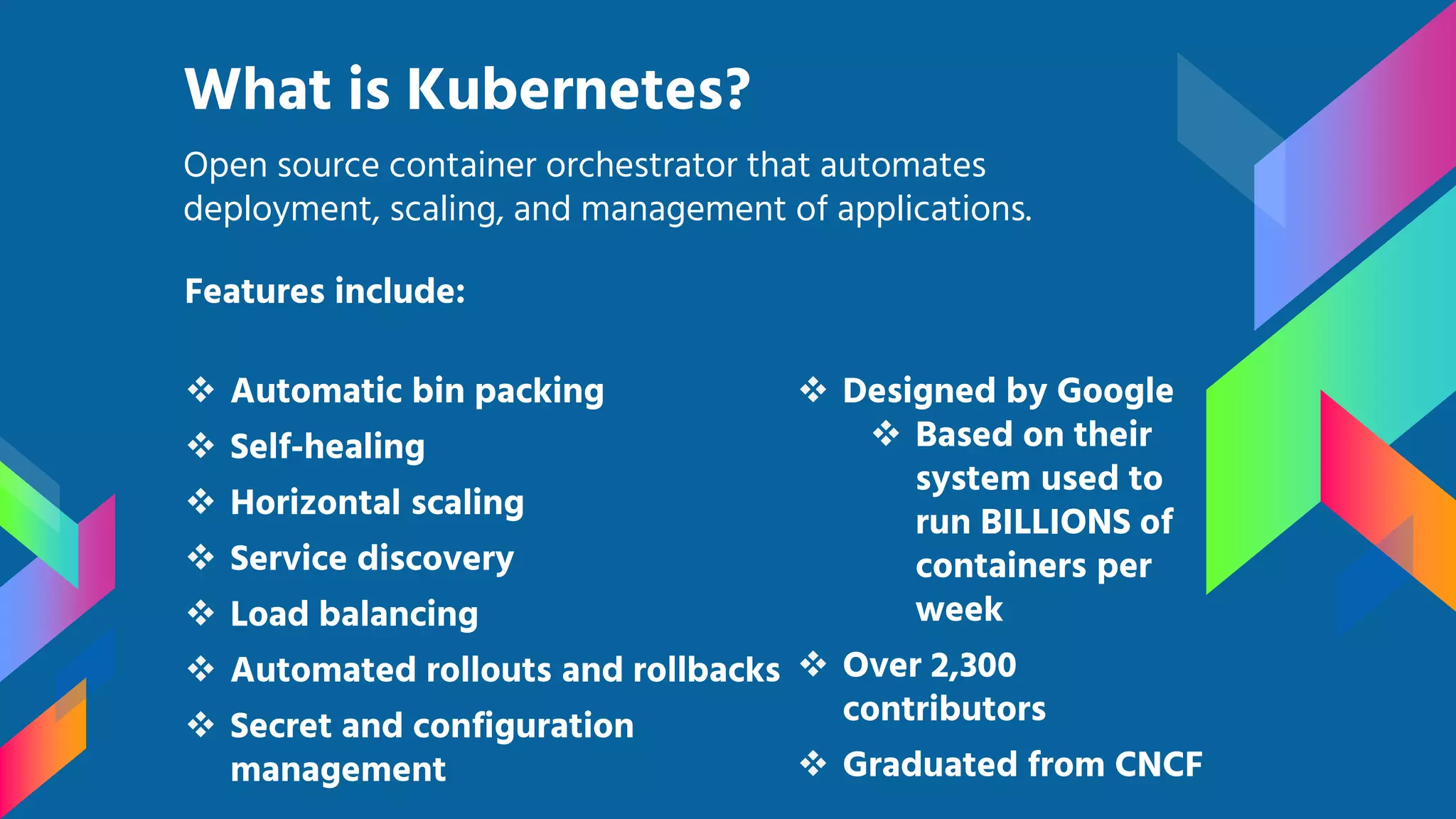
Features include:  Automatic bin packing  Self-healing  Horizontal scaling  Service discovery  Load balancing  Automated rollouts and rollbacks  Secret and configuration management What is Kubernetes? Open source container orchestrator that automates deployment, scaling, and management of applications.  Designed by Google  Based on their system used to run BILLIONS of containers per week  Over 2,300 contributors  Graduated from CNCF
Open Source Tooling: Kubernetes
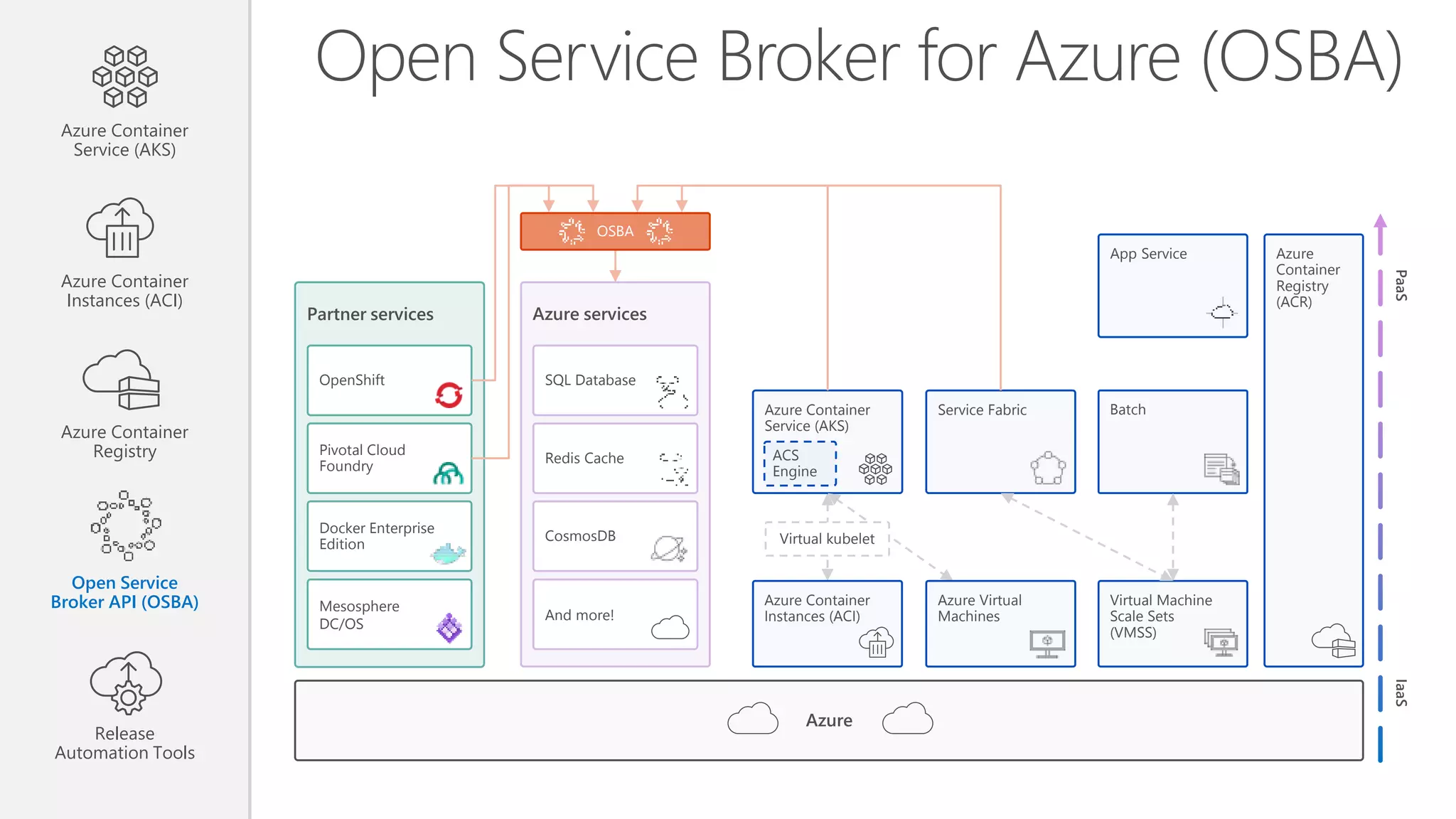
Open Service Broker for Azure (OSBA) Azure Container Service (AKS) Azure Container Instances (ACI) Azure Container Registry Open Service Broker API (OSBA) Release Automation Tools IaaSPaaS Azure services SQL Database Redis Cache CosmosDB And more! Partner services OpenShift Pivotal Cloud Foundry Docker Enterprise Edition Mesosphere DC/OS Azure Azure Container Registry (ACR) Azure Container Service (AKS) ACS Engine Batch Azure Container Instances (ACI) Azure Virtual Machines Virtual Machine Scale Sets (VMSS) Service Fabric Virtual kubelet App Service OSBA
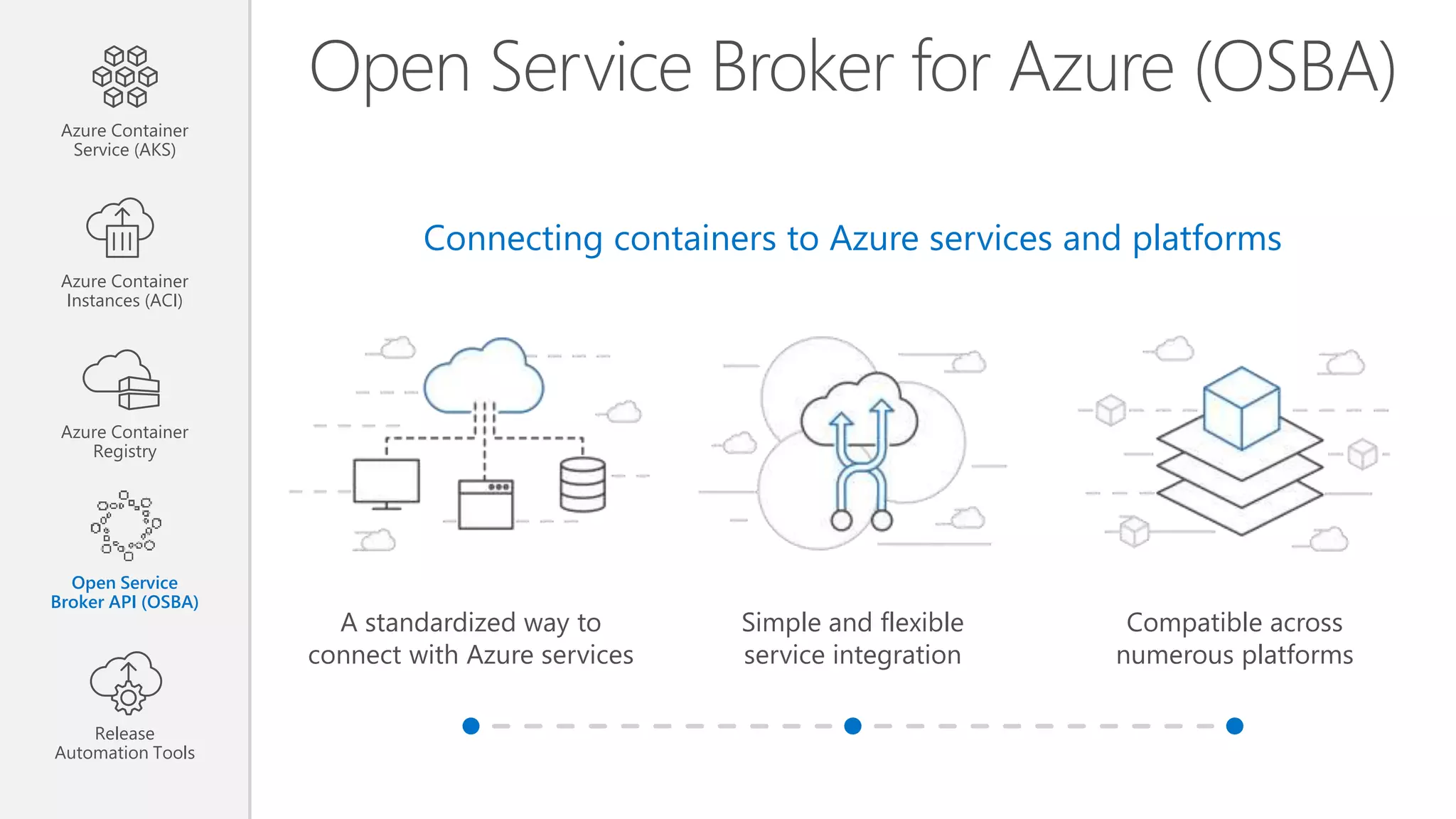
Open Service Broker for Azure (OSBA) Connecting containers to Azure services and platforms Simple and flexible service integration Compatible across numerous platforms A standardized way to connect with Azure services Azure Container Service (AKS) Azure Container Instances (ACI) Azure Container Registry Open Service Broker API (OSBA) Release Automation Tools
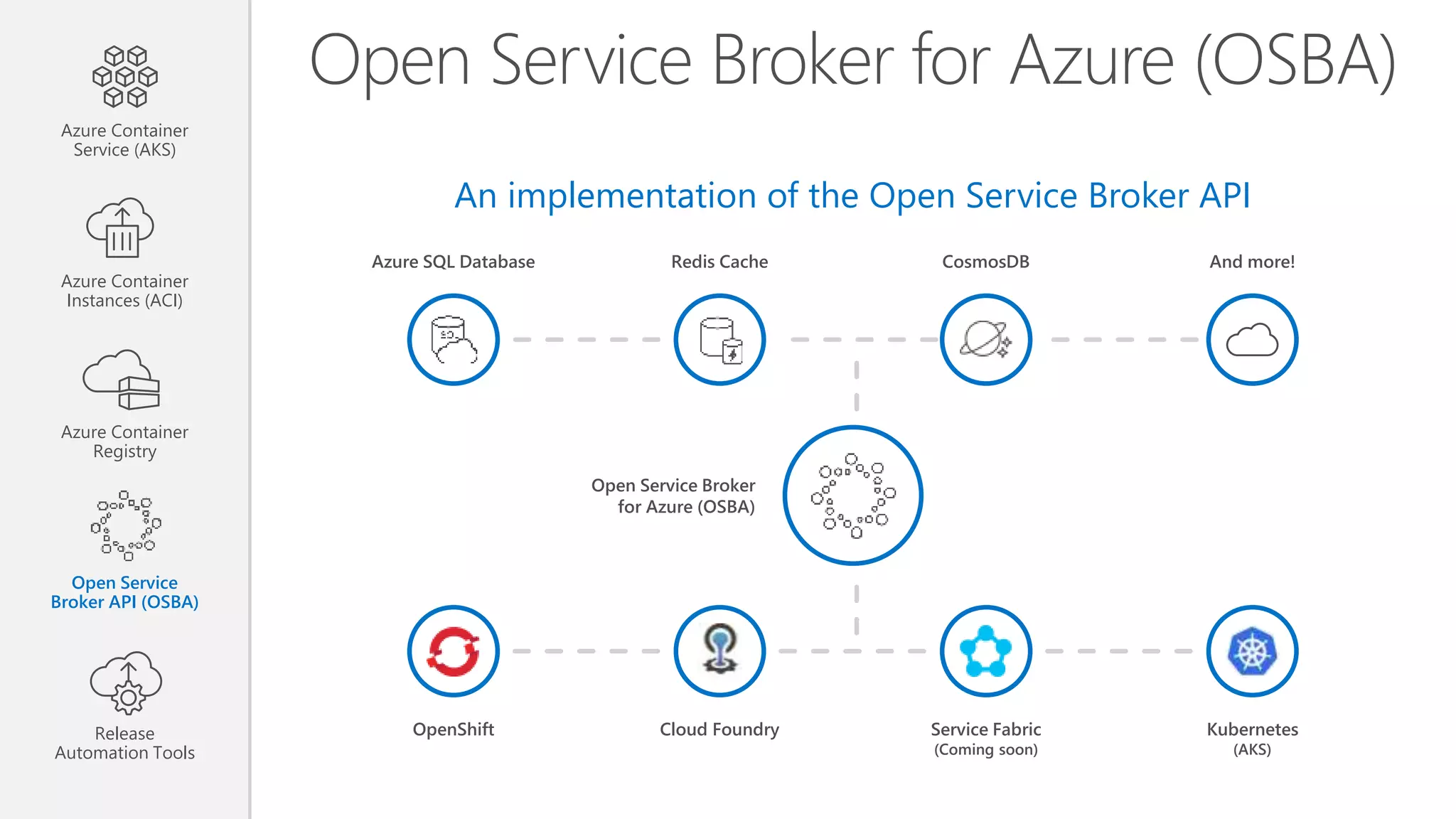
Open Service Broker for Azure (OSBA) An implementation of the Open Service Broker API OpenShift Cloud Foundry Service Fabric (Coming soon) Kubernetes (AKS) Azure SQL Database Redis Cache CosmosDB And more! Open Service Broker for Azure (OSBA) Azure Container Service (AKS) Azure Container Instances (ACI) Azure Container Registry Open Service Broker API (OSBA) Release Automation Tools
Open Service Broker for Azure (OSBA) OSBA in action Azure Container Service (AKS) Azure Container Instances (ACI) Azure Container Registry Open Service Broker API (OSBA) Release Automation Tools
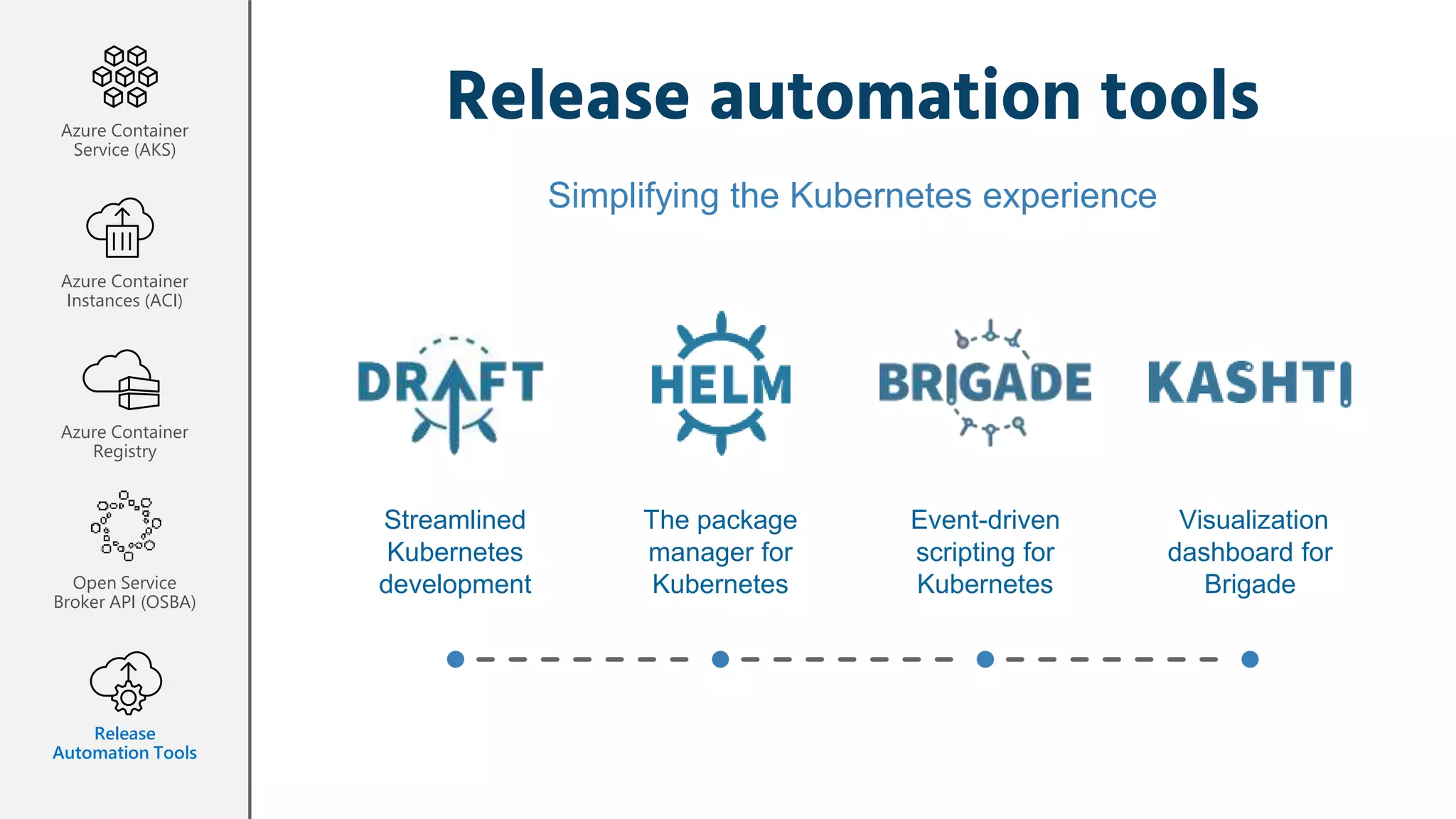
Release automation tools Simplifying the Kubernetes experience Streamlined Kubernetes development The package manager for Kubernetes Event-driven scripting for Kubernetes Visualization dashboard for Brigade Azure Container Service (AKS) Azure Container Instances (ACI) Azure Container Registry Open Service Broker API (OSBA) Release Automation Tools
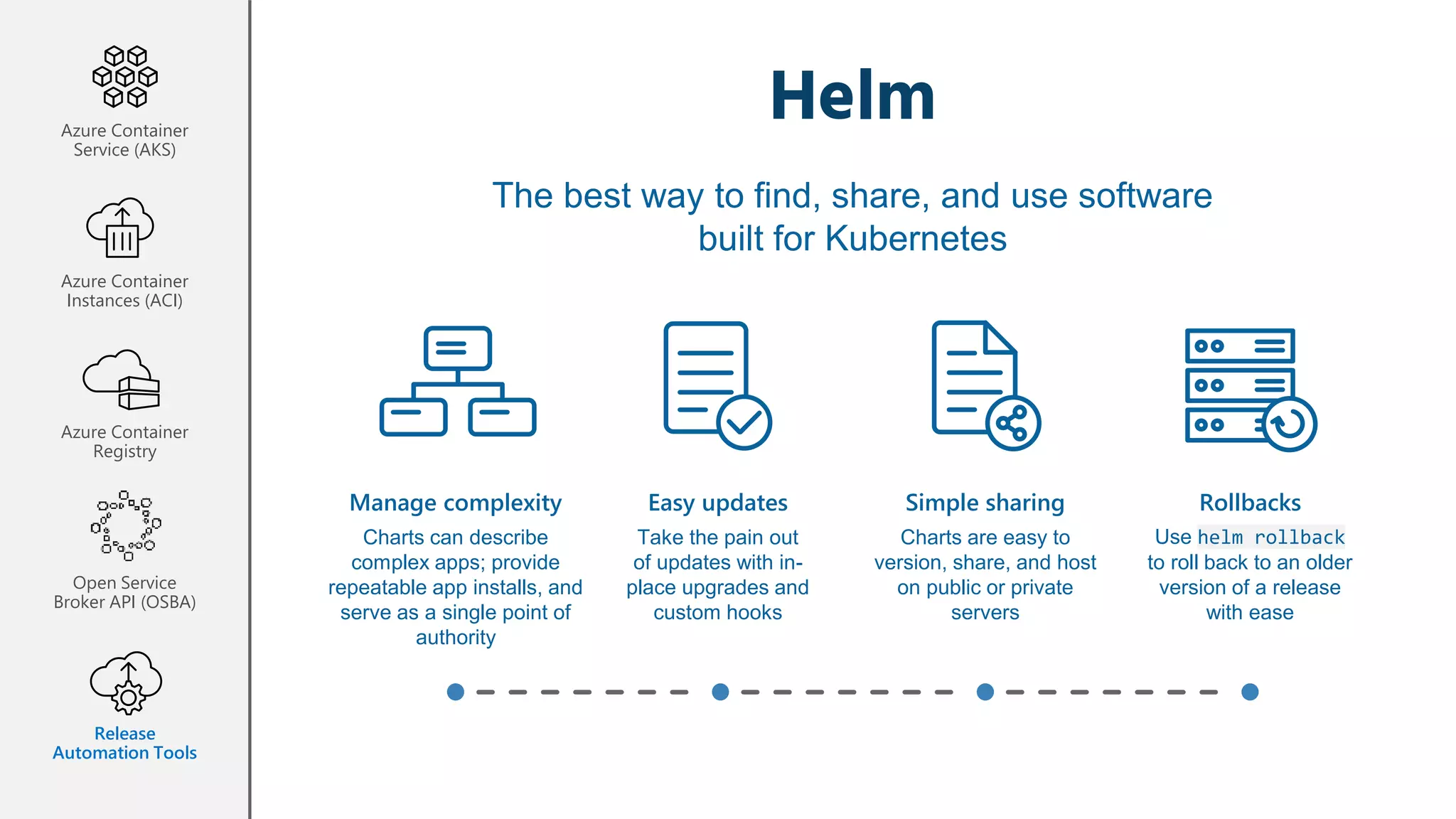
Helm The best way to find, share, and use software built for Kubernetes Manage complexity Charts can describe complex apps; provide repeatable app installs, and serve as a single point of authority Easy updates Take the pain out of updates with in- place upgrades and custom hooks Simple sharing Charts are easy to version, share, and host on public or private servers Rollbacks Use helm rollback to roll back to an older version of a release with ease Azure Container Service (AKS) Azure Container Instances (ACI) Azure Container Registry Open Service Broker API (OSBA) Release Automation Tools
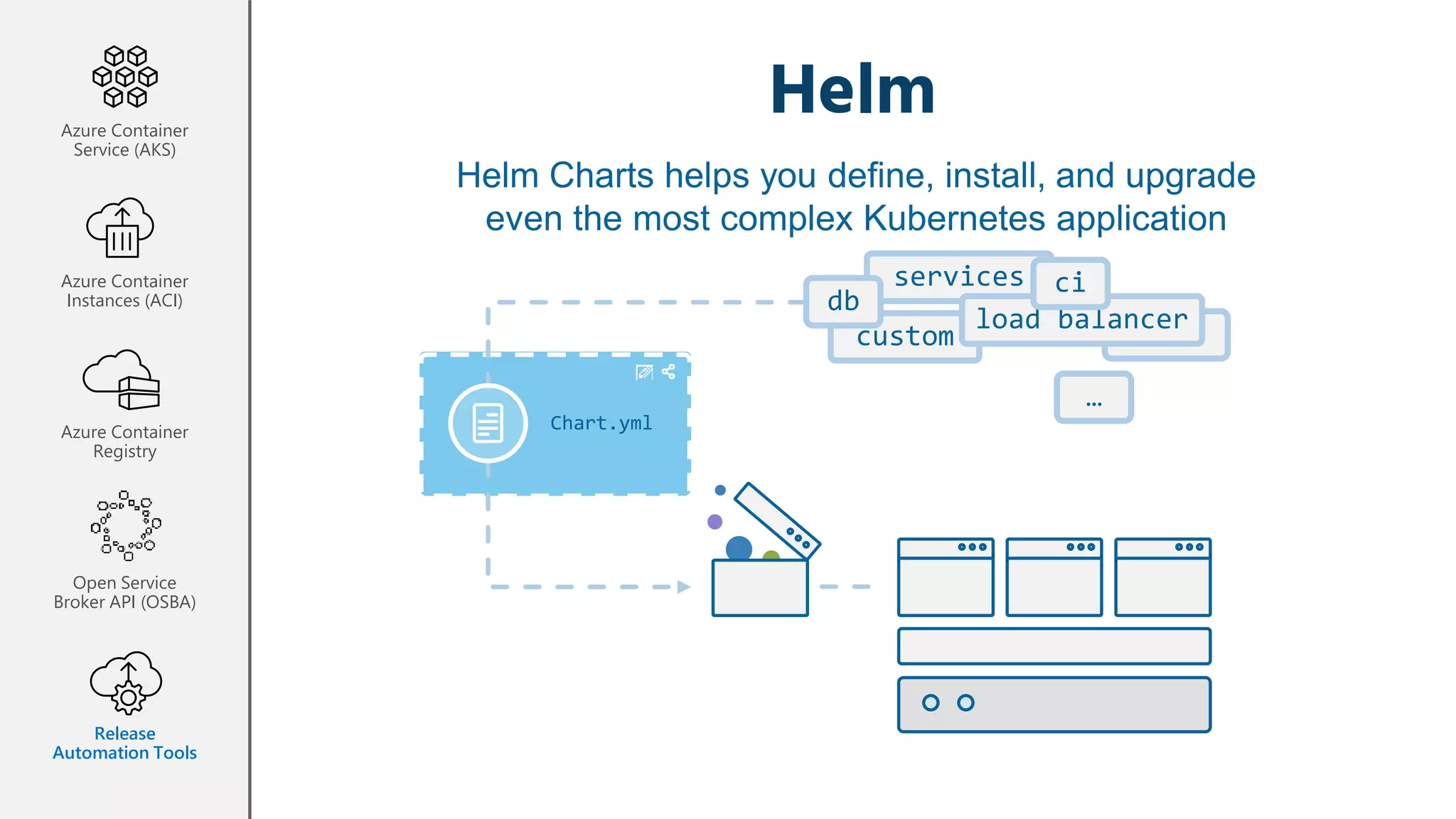
Helm Helm Charts helps you define, install, and upgrade even the most complex Kubernetes application custom services Chart.yml db load balancer ci … Azure Container Service (AKS) Azure Container Instances (ACI) Azure Container Registry Open Service Broker API (OSBA) Release Automation Tools
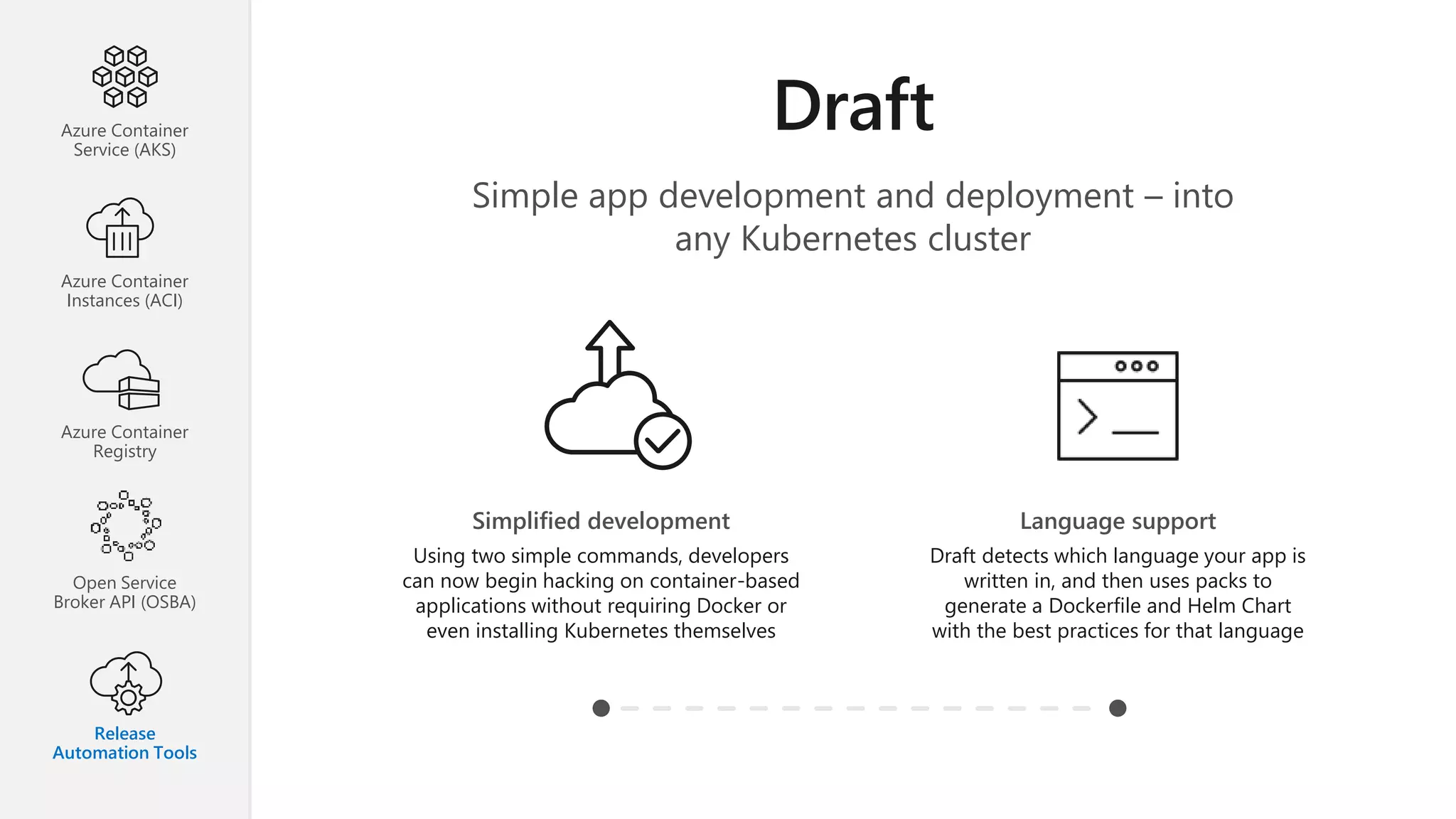
Simple app development and deployment – into any Kubernetes cluster Simplified development Using two simple commands, developers can now begin hacking on container-based applications without requiring Docker or even installing Kubernetes themselves Language support Draft detects which language your app is written in, and then uses packs to generate a Dockerfile and Helm Chart with the best practices for that language Azure Container Service (AKS) Azure Container Instances (ACI) Azure Container Registry Open Service Broker API (OSBA) Release Automation Tools
Demo
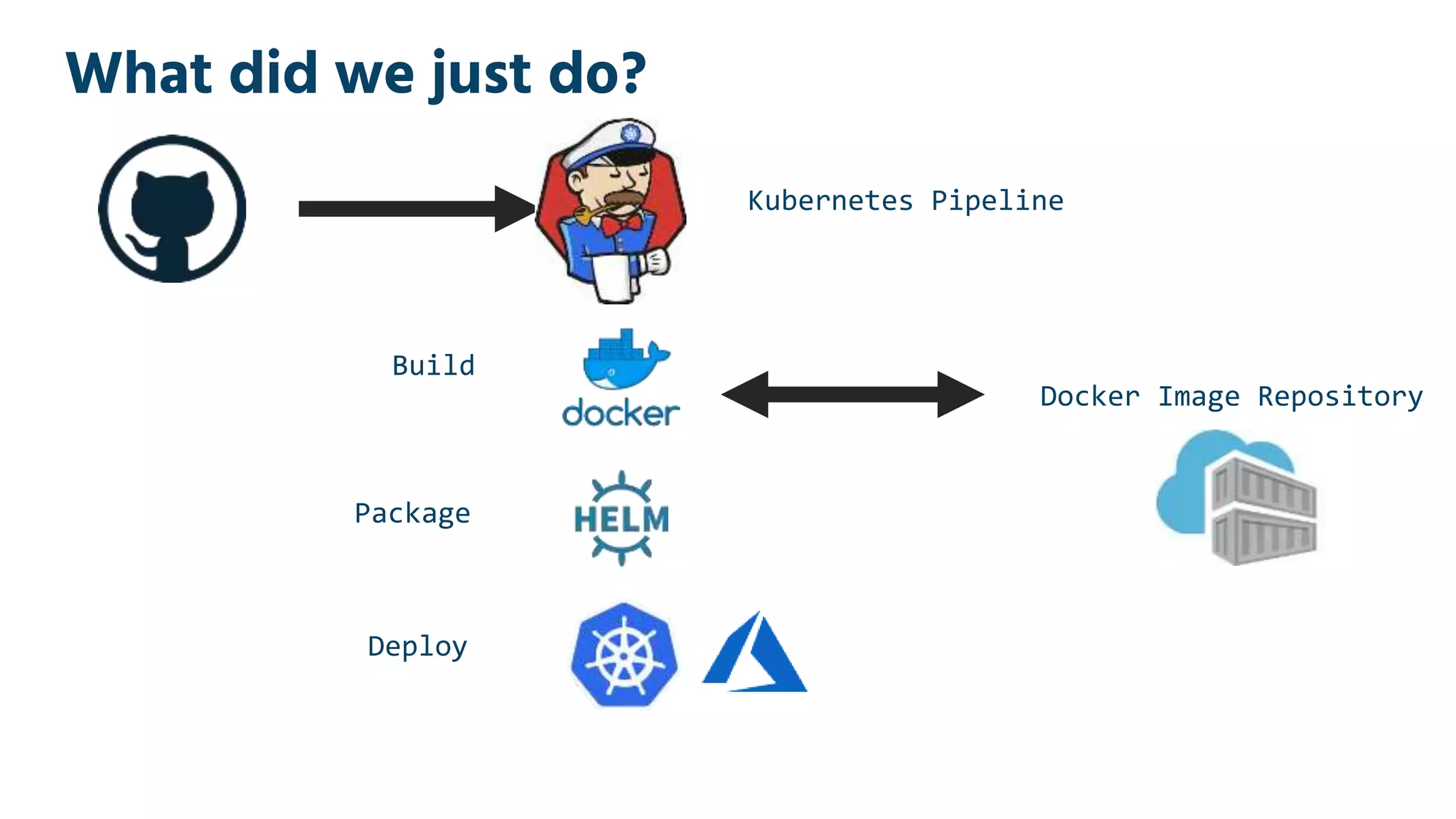
What did we just do? Build Package Deploy Kubernetes Pipeline Docker Image Repository
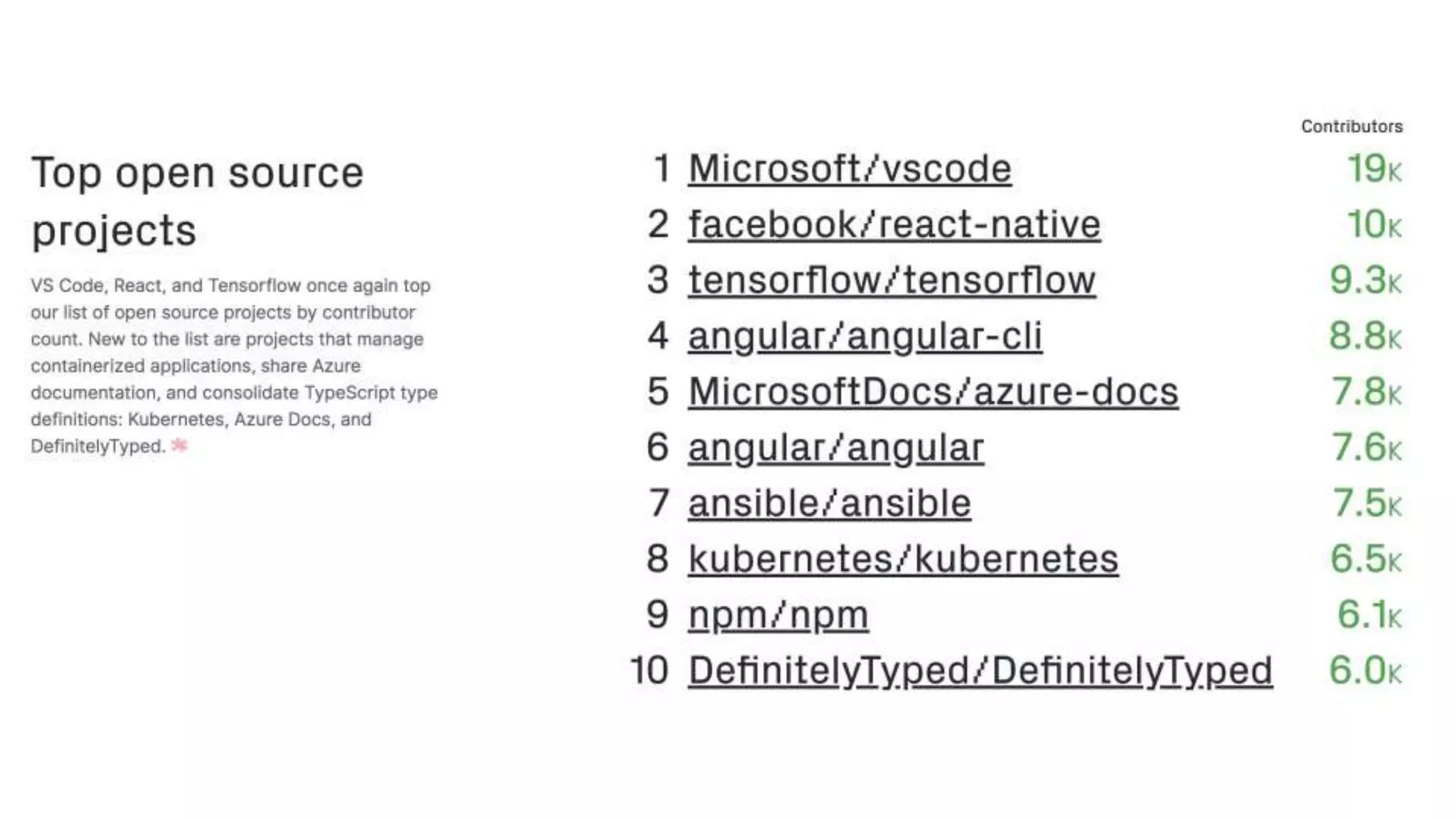
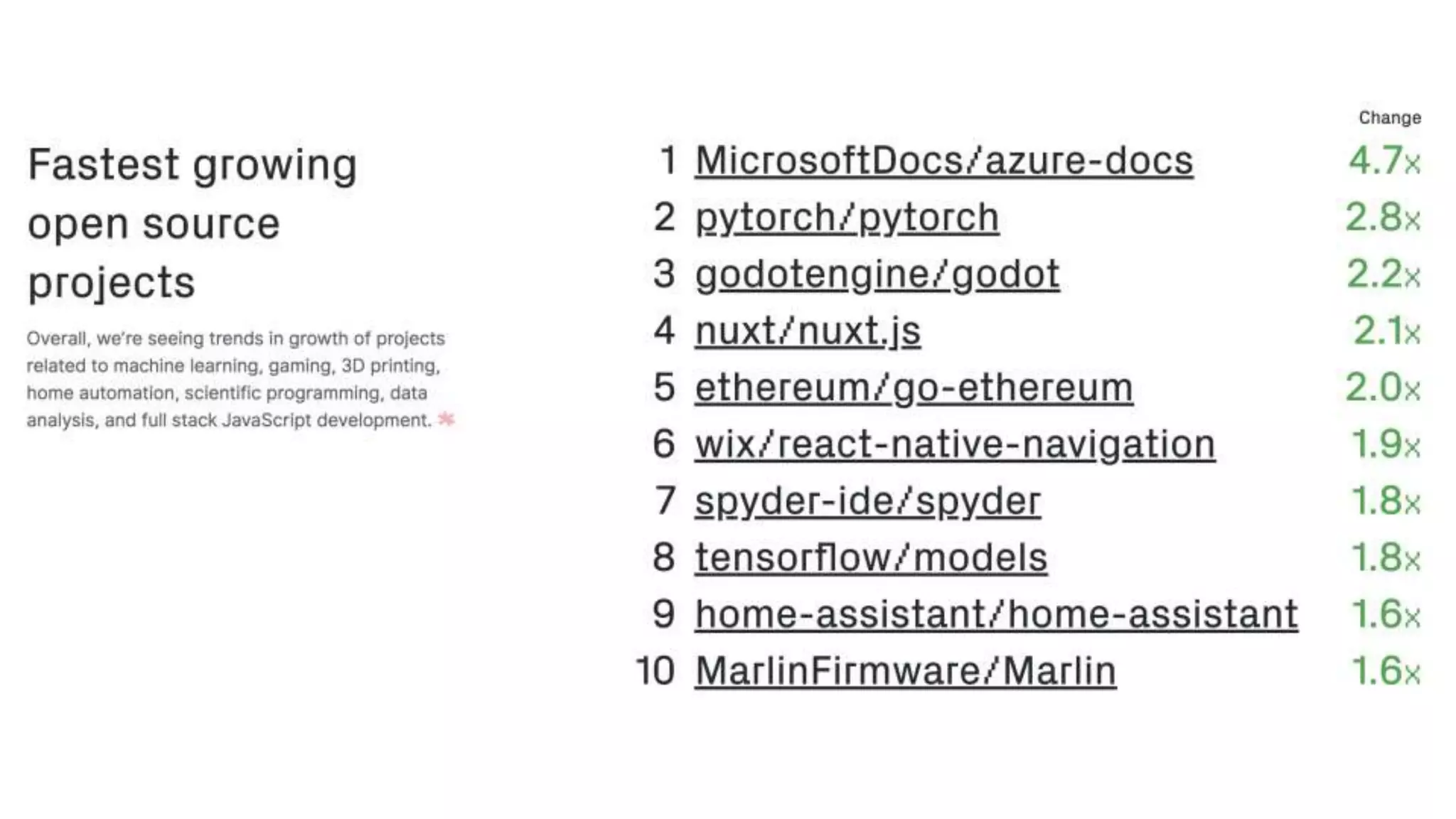
Octoverse Report
THANKS! Resources aka.ms/devops/jenkinsworldEU2018 Any questions? You can find me at: @jldeen · jessica.deen@microsoft.com

Microsoft, Linux, Open Source, DevOps

  • 1.
    Microsoft, Linux, Open Source, Cloud+ DevOps Jessica Deen Cloud Developer Advocate
  • 2.
    HELLO! I am JessicaDeen I am here because I love technology and community. I focus heavily on Linux, OSS, DevOps and Containers. I love Disney and CrossFit/Fitness. You can find me at @jldeen on GitHub, Twitter, and Instagram.
  • 3.
    Disclaimer The next 45minutes will NOT make you an expert, but it will: - Get you thinking - Show you what’s possible - Give you some sample code for you to get started on your own time
  • 5.
    developers I need tocreate applications at a competitive rate without worrying about IT New applications run smoothly on my machine but malfunction on traditional IT servers My productivity and application innovation become suspended when I have to wait on IT
  • 6.
    IT I need tomanage servers and maintain compliance with little disruption I’m unsure of how to integrate unfamiliar applications, and I require help from developers I’m unable to focus on both server protection and application compliance
  • 7.
  • 8.
  • 9.
    Servers Services Cloud isa new way to think about a datacenter
  • 10.
    DevOps: The ThreeStage Conversation ProcessPeople Products
  • 11.
    DevOps is theunion of people, process, and products to enable continuous delivery of value to our end users. -Donovan Brown http://bit.ly/WhatIs-DevOps
  • 12.
    Key DevOps Practices Infrastructureas Code Continuous Integration Continuous Deployment Automated Testing Release Management Performance Monitoring Availability Monitoring Load Testing & Auto Scale Automated Recovery (Rollback & Roll Forward)
  • 13.
  • 16.
    Demo – VSCode in Action
  • 18.
  • 20.
    In 2014, MicrosoftCEO Satya Nadella directed all Microsoft engineers to "open source internally" - anyone at the company can see anyone else's code and use it as needed. This vision is now a day-to-day reality for Microsoft engineers.
  • 21.
    Developers Enable ‘write-once, run-anywhere’apps Enables microservice architectures Great for dev/test of apps and services Production realism Growing Developer Community Operations Portability, Portability, Portability Standardized development, QA, and prod environments Abstract differences in OS distributions and underlying infrastructure Higher compute density Easily scale-up and scale-down in response to changing business needs DevOps
  • 22.
  • 23.
    Features include:  Automaticbin packing  Self-healing  Horizontal scaling  Service discovery  Load balancing  Automated rollouts and rollbacks  Secret and configuration management What is Kubernetes? Open source container orchestrator that automates deployment, scaling, and management of applications.  Designed by Google  Based on their system used to run BILLIONS of containers per week  Over 2,300 contributors  Graduated from CNCF
  • 24.
  • 25.
    Open Service Brokerfor Azure (OSBA) Azure Container Service (AKS) Azure Container Instances (ACI) Azure Container Registry Open Service Broker API (OSBA) Release Automation Tools IaaSPaaS Azure services SQL Database Redis Cache CosmosDB And more! Partner services OpenShift Pivotal Cloud Foundry Docker Enterprise Edition Mesosphere DC/OS Azure Azure Container Registry (ACR) Azure Container Service (AKS) ACS Engine Batch Azure Container Instances (ACI) Azure Virtual Machines Virtual Machine Scale Sets (VMSS) Service Fabric Virtual kubelet App Service OSBA
  • 26.
    Open Service Brokerfor Azure (OSBA) Connecting containers to Azure services and platforms Simple and flexible service integration Compatible across numerous platforms A standardized way to connect with Azure services Azure Container Service (AKS) Azure Container Instances (ACI) Azure Container Registry Open Service Broker API (OSBA) Release Automation Tools
  • 27.
    Open Service Brokerfor Azure (OSBA) An implementation of the Open Service Broker API OpenShift Cloud Foundry Service Fabric (Coming soon) Kubernetes (AKS) Azure SQL Database Redis Cache CosmosDB And more! Open Service Broker for Azure (OSBA) Azure Container Service (AKS) Azure Container Instances (ACI) Azure Container Registry Open Service Broker API (OSBA) Release Automation Tools
  • 28.
    Open Service Brokerfor Azure (OSBA) OSBA in action Azure Container Service (AKS) Azure Container Instances (ACI) Azure Container Registry Open Service Broker API (OSBA) Release Automation Tools
  • 29.
    Release automation tools Simplifyingthe Kubernetes experience Streamlined Kubernetes development The package manager for Kubernetes Event-driven scripting for Kubernetes Visualization dashboard for Brigade Azure Container Service (AKS) Azure Container Instances (ACI) Azure Container Registry Open Service Broker API (OSBA) Release Automation Tools
  • 30.
    Helm The best wayto find, share, and use software built for Kubernetes Manage complexity Charts can describe complex apps; provide repeatable app installs, and serve as a single point of authority Easy updates Take the pain out of updates with in- place upgrades and custom hooks Simple sharing Charts are easy to version, share, and host on public or private servers Rollbacks Use helm rollback to roll back to an older version of a release with ease Azure Container Service (AKS) Azure Container Instances (ACI) Azure Container Registry Open Service Broker API (OSBA) Release Automation Tools
  • 31.
    Helm Helm Charts helpsyou define, install, and upgrade even the most complex Kubernetes application custom services Chart.yml db load balancer ci … Azure Container Service (AKS) Azure Container Instances (ACI) Azure Container Registry Open Service Broker API (OSBA) Release Automation Tools
  • 32.
    Simple app developmentand deployment – into any Kubernetes cluster Simplified development Using two simple commands, developers can now begin hacking on container-based applications without requiring Docker or even installing Kubernetes themselves Language support Draft detects which language your app is written in, and then uses packs to generate a Dockerfile and Helm Chart with the best practices for that language Azure Container Service (AKS) Azure Container Instances (ACI) Azure Container Registry Open Service Broker API (OSBA) Release Automation Tools
  • 33.
  • 34.
    What did wejust do? Build Package Deploy Kubernetes Pipeline Docker Image Repository
  • 35.
  • 39.
    THANKS! Resources aka.ms/devops/jenkinsworldEU2018 Any questions? You canfind me at: @jldeen · jessica.deen@microsoft.com

Editor's Notes

  • #5  Not just Microsoft… IBM, Google, … all technology vendors Our typical Customer base and how they fit What is Digital Transformation -> AE/PSS/SSP conversations Cloud > Azure… Value for customers = Apps and Data So our Digital Transformation stories tend to center around… Blockbuster at it’s Peak: $37B assets, 84K employees, >9K locations  Part of Dish and < half a dozen stores
  • #6 Here’s what we hear from dev Want to be able to move fast Things to run smooth on their machine and production – dev / prod parity Don’t want to be blocked on IT / ops team
  • #7 IT - wants to minimize risk don’t really understand applications or what it takes to be a dev Unable to do both infrastructure stuff and handle the application operations
  • #9 There have been various computer-driven revolutions in the past: the widespread introduction of the personal computer (PC) was one, the invention of the graphical browser was another, and the Internet yet another. There have also been computer eras where one type of computer has dominated, having straightforward implications for whether the computers were shared or personal, and for whether they were specialized commodities or not (see diagram below). But the ways computers have altered our lives, all aspects of our lives, is more comprehensive than, at first blush, recollections of these technological revolutions or eras might suggest. Computers affect how we undertake the most prosaic of activities – from buying food to paying our bills – and they do so in ways we might not have imagined when the first personal computers arrived on our desks. They have also created wholly new experiences, for example, allowing us to inhabit virtual worlds with people from many different parts of the globe. In between these extremes, from the prosaic to the wholly new, computers have taken over from older technologies in ways that looked merely like substitution at first but which have ended up creating radical change. Computers have played a massive role in changing the way we live over the last couple of decades. They are no longer possessions of the privileged but are rapidly becoming inexpensive, everyday commodities. They have evolved from being isolated machines to globally interconnected devices. Not only has access to computers vastly increased, but the ways we interact with them and materials used for computer devices have changed too. All of this means that computers can now be interwoven with almost every aspect of our lives. As we move towards 2020, so the extent of these changes will increase. By 2020, it may not be possible to realize all of our goals, ambitions and aspirations without using a computer or computing in one way or another. This binding of computing to our daily activities will in turn affect our values, goals and aspirations.
  • #10 Traditional model - Empathize, land the case for change based on change in business context Take empathizing tone (don’t want to make this sound negative). We want them to realize that what customers have done may have worked in the past but they need to recognize the need for change as the business is changing rapidly. Most companies are running custom apps that are stitched together, they have purpose-built hardware to think about, and have specialized teams, and everything has been carefully customized (over many years in some cases!). Now as an enterprise, you did all this for all the right reasons, but you might consider that it might be holding our customers (and their business) back in many ways given that the business context has changed fundamentally. In this new age of apps, the old way of doing this is causing friction because IT isn’t moving as fast as business wants it to. This is manifested in developers not getting the speed and freedom they need to create the best end-user experiences. That leads to lost productivity on their side, which results in ‘Shadow IT’. In 2015, 42% of the technology budget resides outside IT; this will grow to 50% by 2020 (Gartner). So this is real.   And we all know that while Shadow IT behaviors provide immediate gratification, it comes with risk. Slide 8: Cloud model (Mark) – Empathize, ask customers to be change agents, land cloud principles. Now let’s look at the cloud. Everyone knows that the cloud offers agility and innovation. It’s proving itself to be the way forward for the modern enterprise and we’ll talk more about that in a bit. But for some of our IT customers, the cloud might seem a little daunting. They might be asking, “Is this something I want to lead the charge on? How does it help my career?” The tension some of them experience is because you’re not sure if things are consistent with what you’re doing on-premises and it seems like it will be hard to manage. There’s also a tension between developers who want speed and freedom (represented by business demands), and the IT folks who have to worry about things like security and compliance.   Bridge to our POV while bringing them along. Implore them to be change agents in their orgs. But make no mistake about it – the cloud is the natural way forward for the rapidly evolving enterprise. Let’s all embrace it. In this context, we’re already seeing some leading indicators around “bi-modal“ IT among you: 45% of CIOs have a second, fast, mode of service delivery that complements their rock solid operations” (Gartner Symposium, Oct 2014). So there’s already some great progress that a lot of you seem to be driving. This is do-able. And we want our customers to be change agents in driving cloud adoption in your orgs.   Our POV We believe that cloud is a model/architecture, not a location. (Cloud-first principles as in the slide) Turns out that Microsoft has been on its own cloud-first journey for many years and we have fully operationalized cloud-first in our hyper-scale datacenters. We’d like to share some of that next to help customers shortcut their journey.
  • #16 229% increase in just 4 years
  • #17 Setup Jenkins Server with one command? – Jenkins Values File Codefresh Demo Don’t forget VSTS Mac, Linux, Windows Demo
  • #21 Context, motivation and vision come from the top, but there are still barriers to overcome all the way down. Another example: in a recent company meeting, Satya said that improving our engineering systems is more important than adding new features. (Can we get the exact quote?)
  • #34 Setup Jenkins Server with one command? – Jenkins Values File Codefresh Demo Don’t forget VSTS Mac, Linux, Windows Demo
  • #36 Setup Jenkins Server with one command? – Jenkins Values File Codefresh Demo Don’t forget VSTS Mac, Linux, Windows Demo