Why Kubernetes as a container orchestrator is a right choice for running spark clusters on cloud? Rachit Arora rachitar@in.ibm.com IBM, India Software Labs
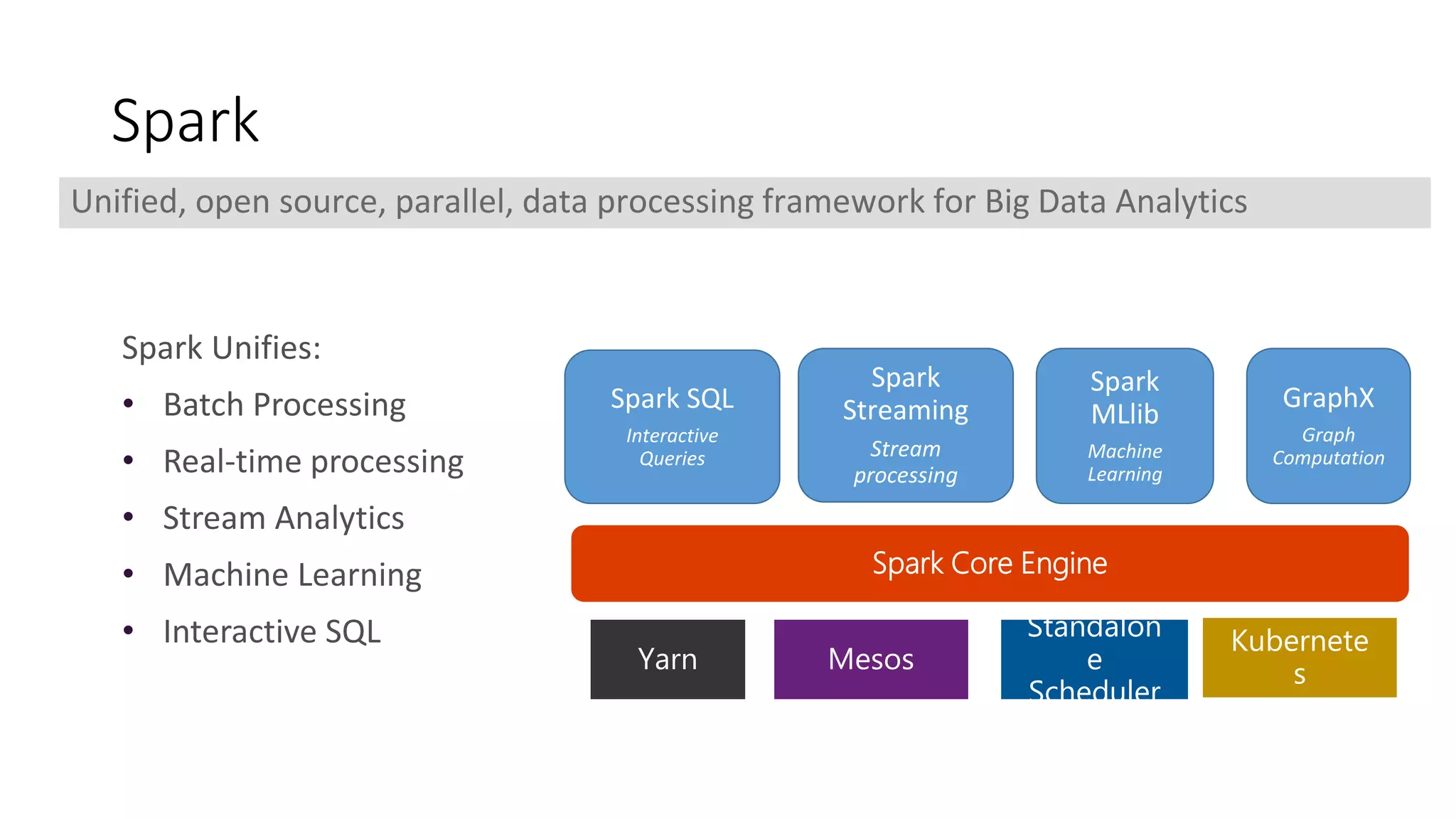
Spark Unified, open source, parallel, data processing framework for Big Data Analytics Spark Core Engine Yarn Mesos Standalon e Scheduler Kubernete s Spark SQL Interactive Queries Spark Streaming Stream processing Spark MLlib Machine Learning GraphX Graph Computation
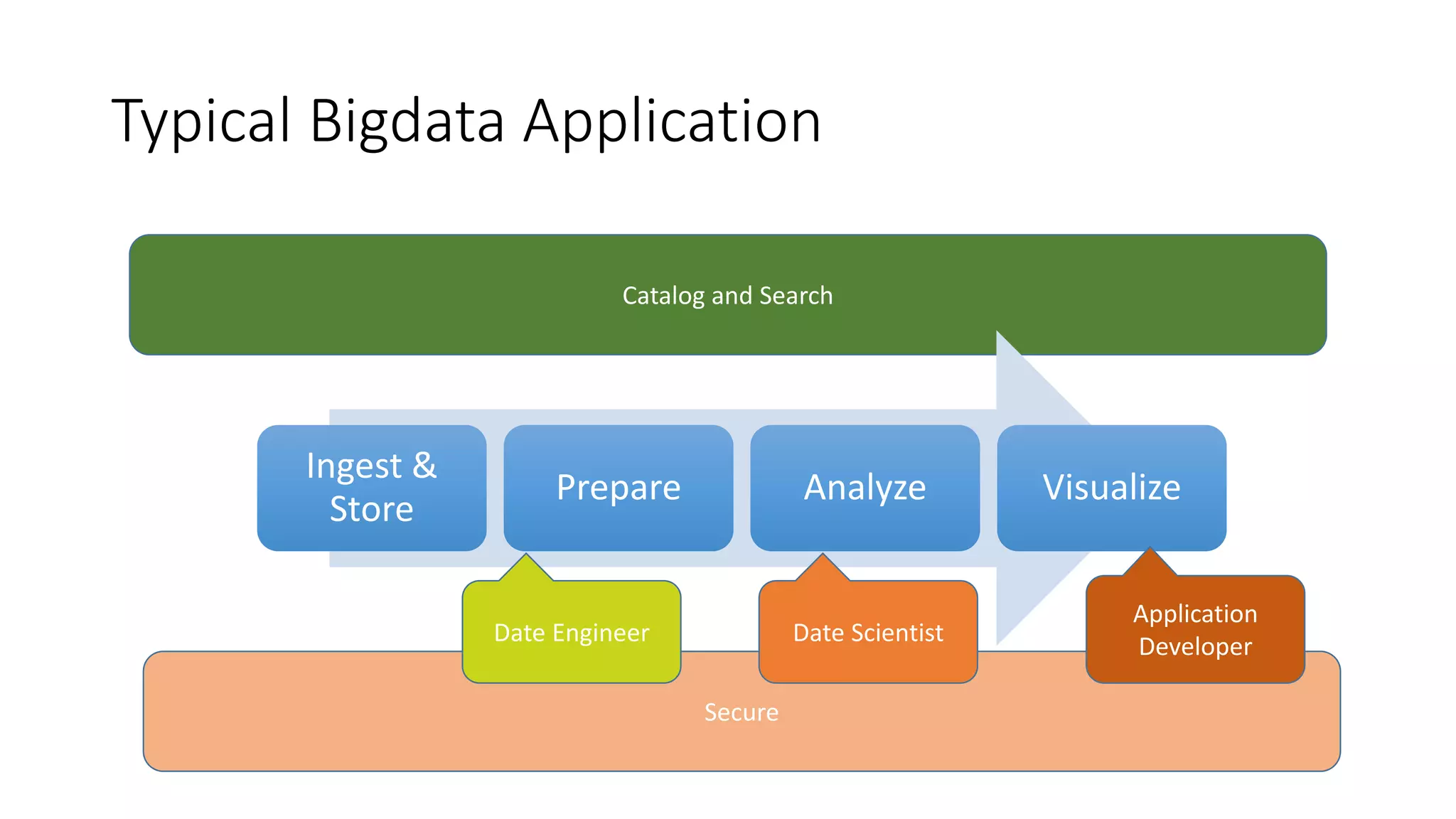
Typical Bigdata Application Secure Catalog and Search Ingest & Store Prepare Analyze Visualize Date Engineer Date Scientist Application Developer
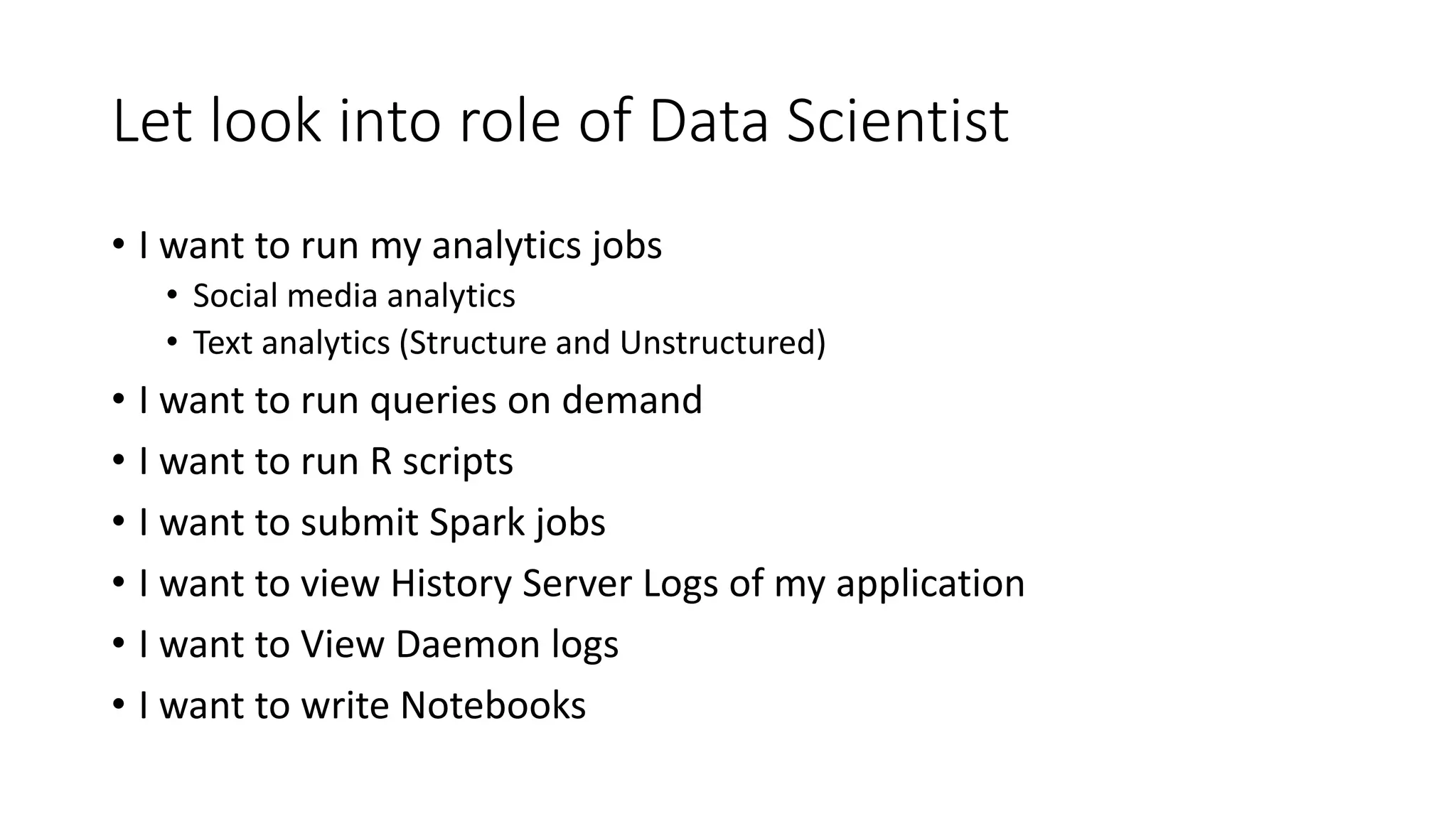
Let look into role of Data Scientist • I want to run my analytics jobs • Social media analytics • Text analytics (Structure and Unstructured) • I want to run queries on demand • I want to run R scripts • I want to submit Spark jobs • I want to view History Server Logs of my application • I want to View Daemon logs • I want to write Notebooks
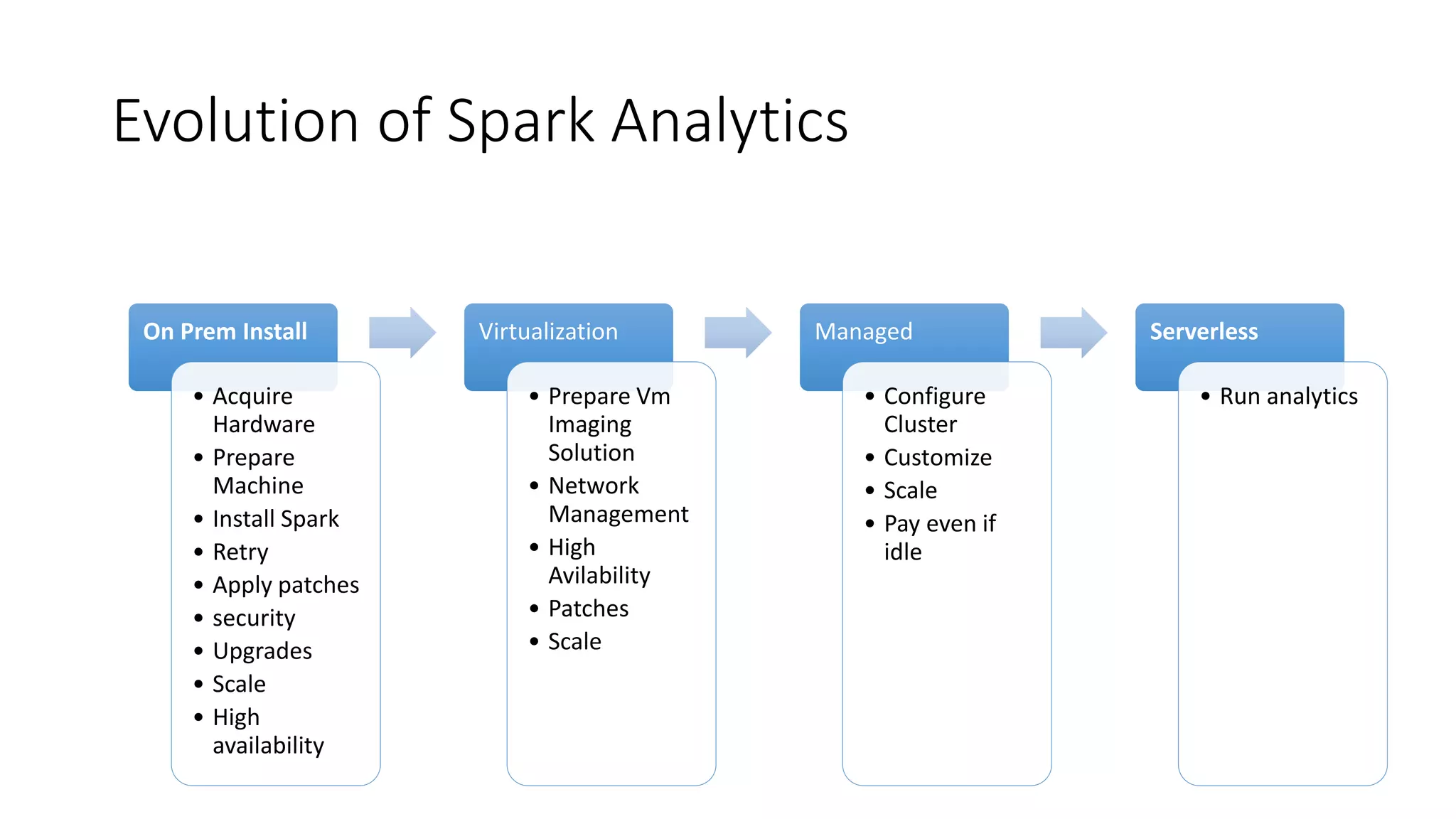
Evolution of Spark Analytics On Prem Install • Acquire Hardware • Prepare Machine • Install Spark • Retry • Apply patches • security • Upgrades • Scale • High availability Virtualization • Prepare Vm Imaging Solution • Network Management • High Avilability • Patches • Scale Managed • Configure Cluster • Customize • Scale • Pay even if idle Serverless • Run analytics
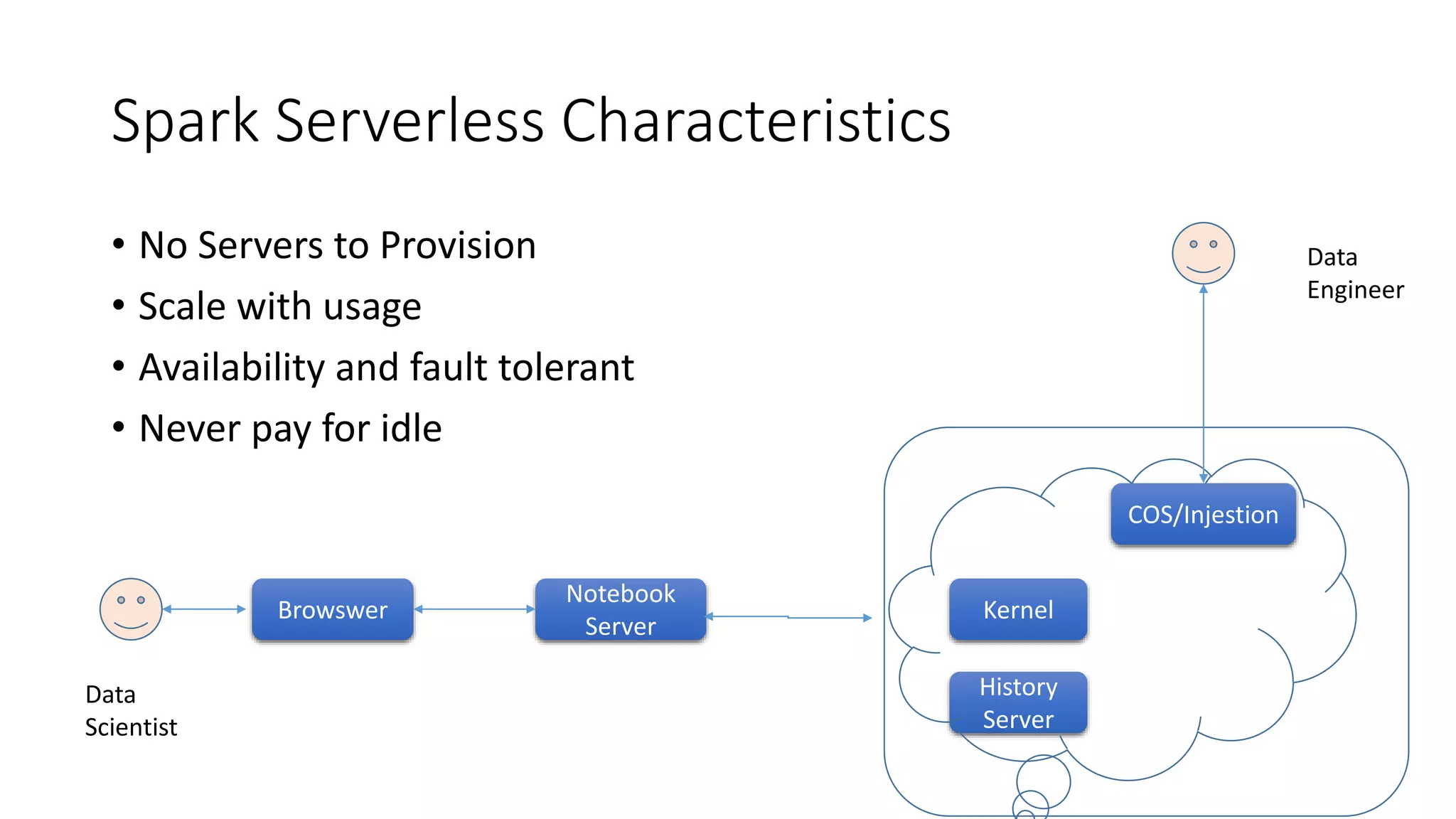
Spark Serverless Characteristics • No Servers to Provision • Scale with usage • Availability and fault tolerant • Never pay for idle Kernel History Server Notebook Server Browswer Data Scientist COS/Injestion Data Engineer
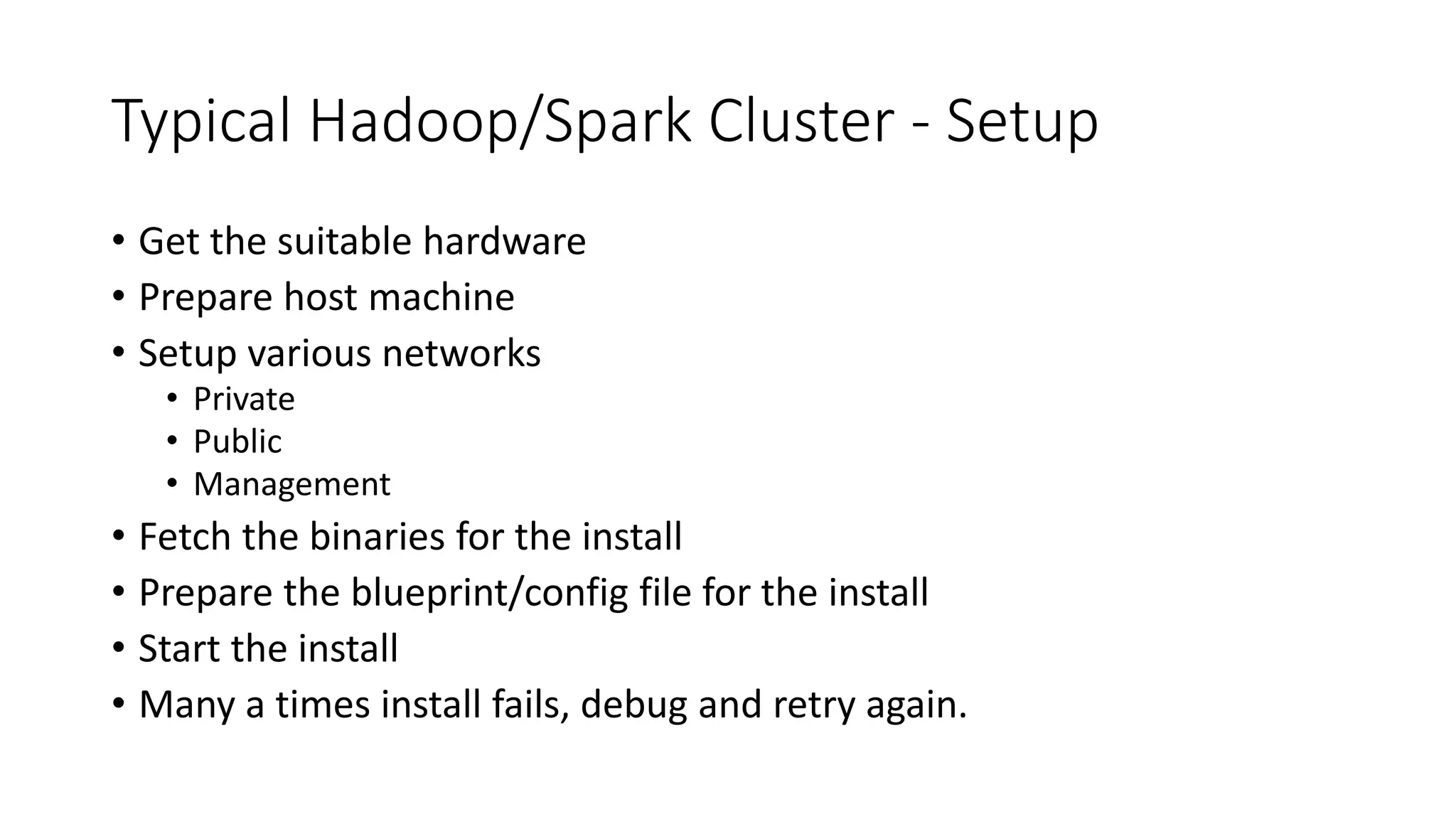
Typical Hadoop/Spark Cluster - Setup • Get the suitable hardware • Prepare host machine • Setup various networks • Private • Public • Management • Fetch the binaries for the install • Prepare the blueprint/config file for the install • Start the install • Many a times install fails, debug and retry again.
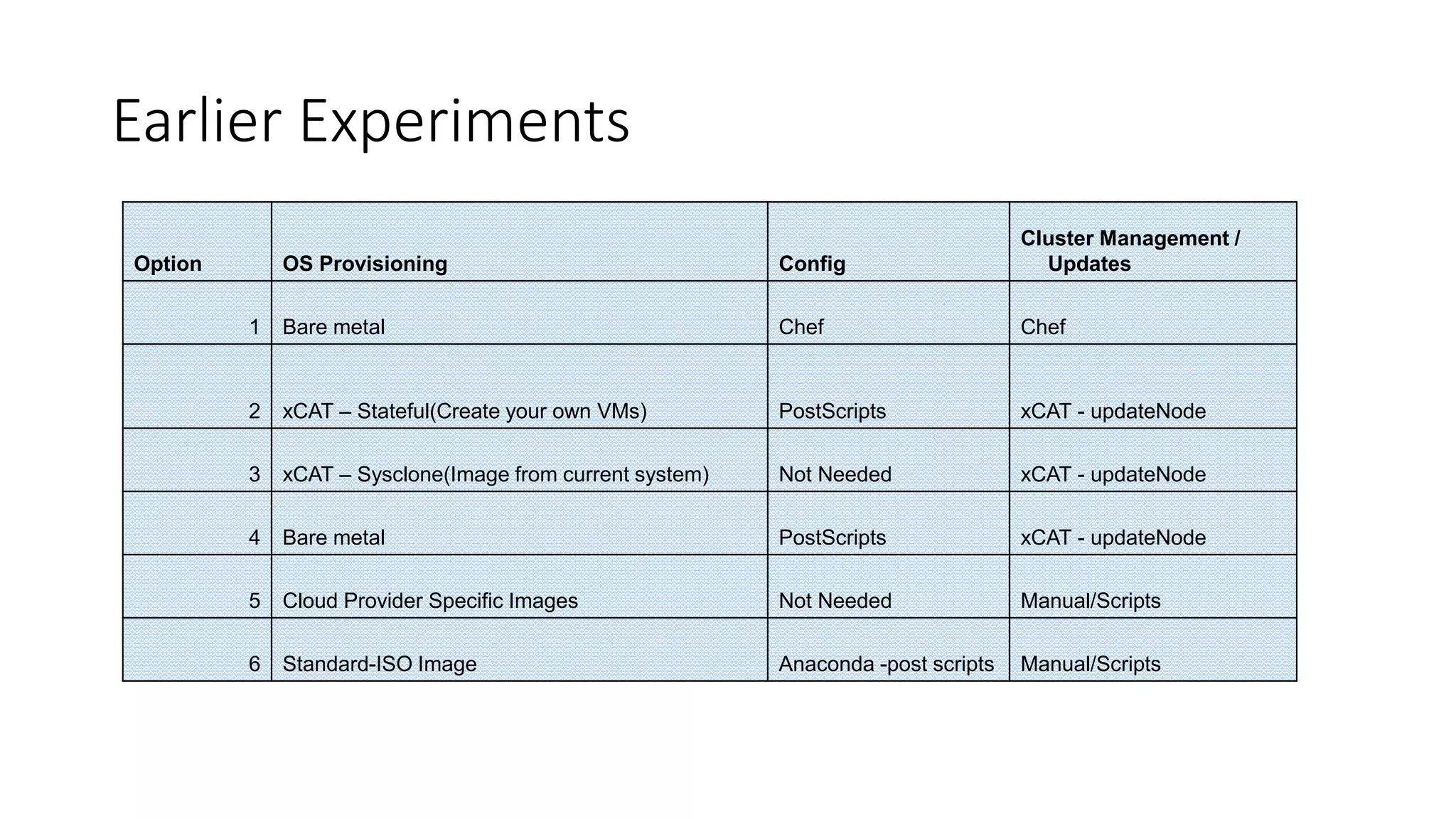
Earlier Experiments Option OS Provisioning Config Cluster Management / Updates 1 Bare metal Chef Chef 2 xCAT – Stateful(Create your own VMs) PostScripts xCAT - updateNode 3 xCAT – Sysclone(Image from current system) Not Needed xCAT - updateNode 4 Bare metal PostScripts xCAT - updateNode 5 Cloud Provider Specific Images Not Needed Manual/Scripts 6 Standard-ISO Image Anaconda -post scripts Manual/Scripts
How do I build Serverless Spark • Option 1: Vanilla Containers – If I need to build with Kubernetes • Repeatable • Application Portability • Faster Development Cycle • Reduced dev-ops load • Improved Infrastructure Utilization
Guiding Principles • Virtualization helps repeatability, lesser failures & speed • Maintenance • Performance(Equivalent to Bare metal) • Use open source from an active community • Cloud-agnostic
Think Containers!!
Containers: Thinking as VMs ? (mistake)
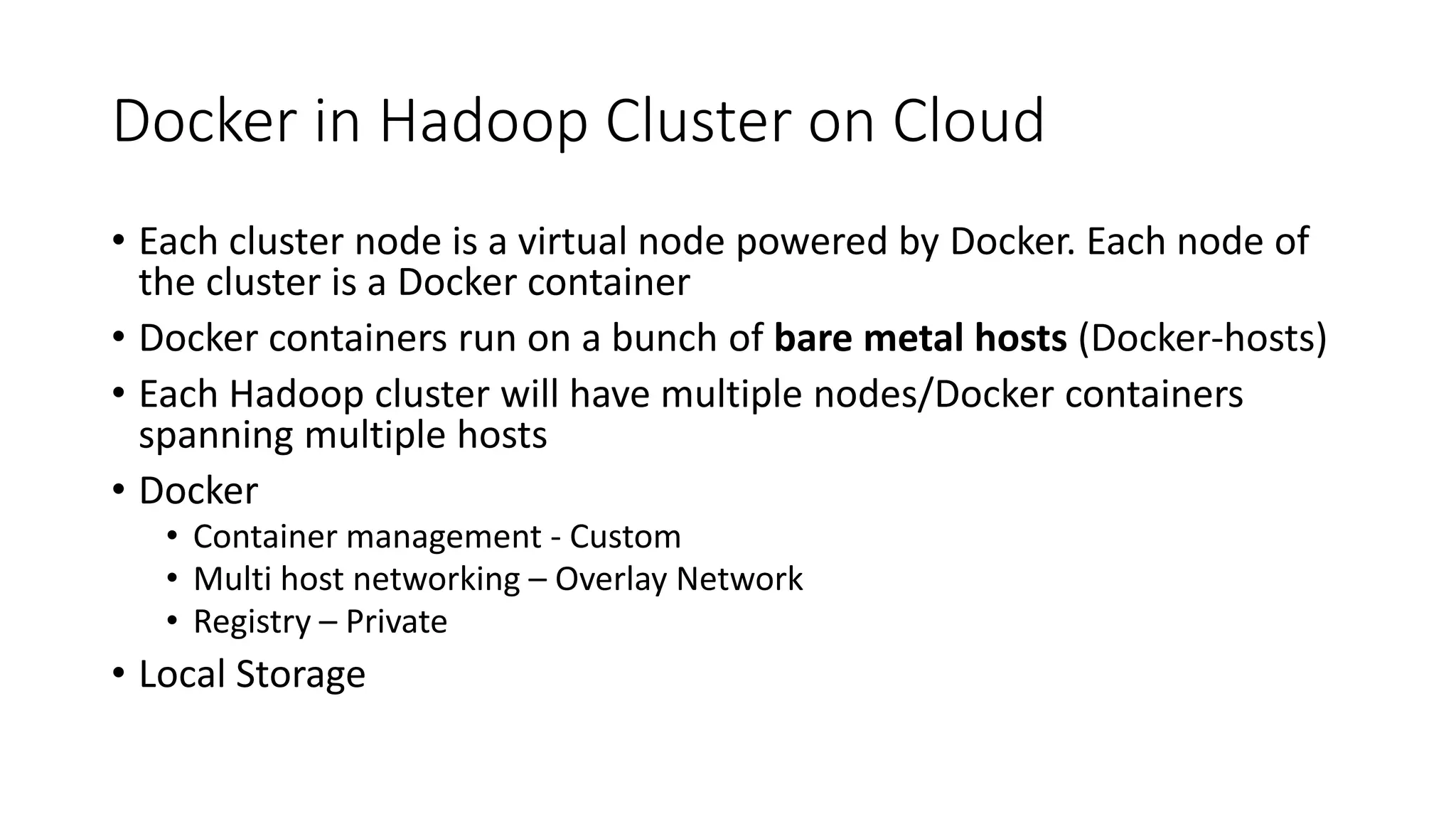
Docker in Hadoop Cluster on Cloud • Each cluster node is a virtual node powered by Docker. Each node of the cluster is a Docker container • Docker containers run on a bunch of bare metal hosts (Docker-hosts) • Each Hadoop cluster will have multiple nodes/Docker containers spanning multiple hosts • Docker • Container management - Custom • Multi host networking – Overlay Network • Registry – Private • Local Storage
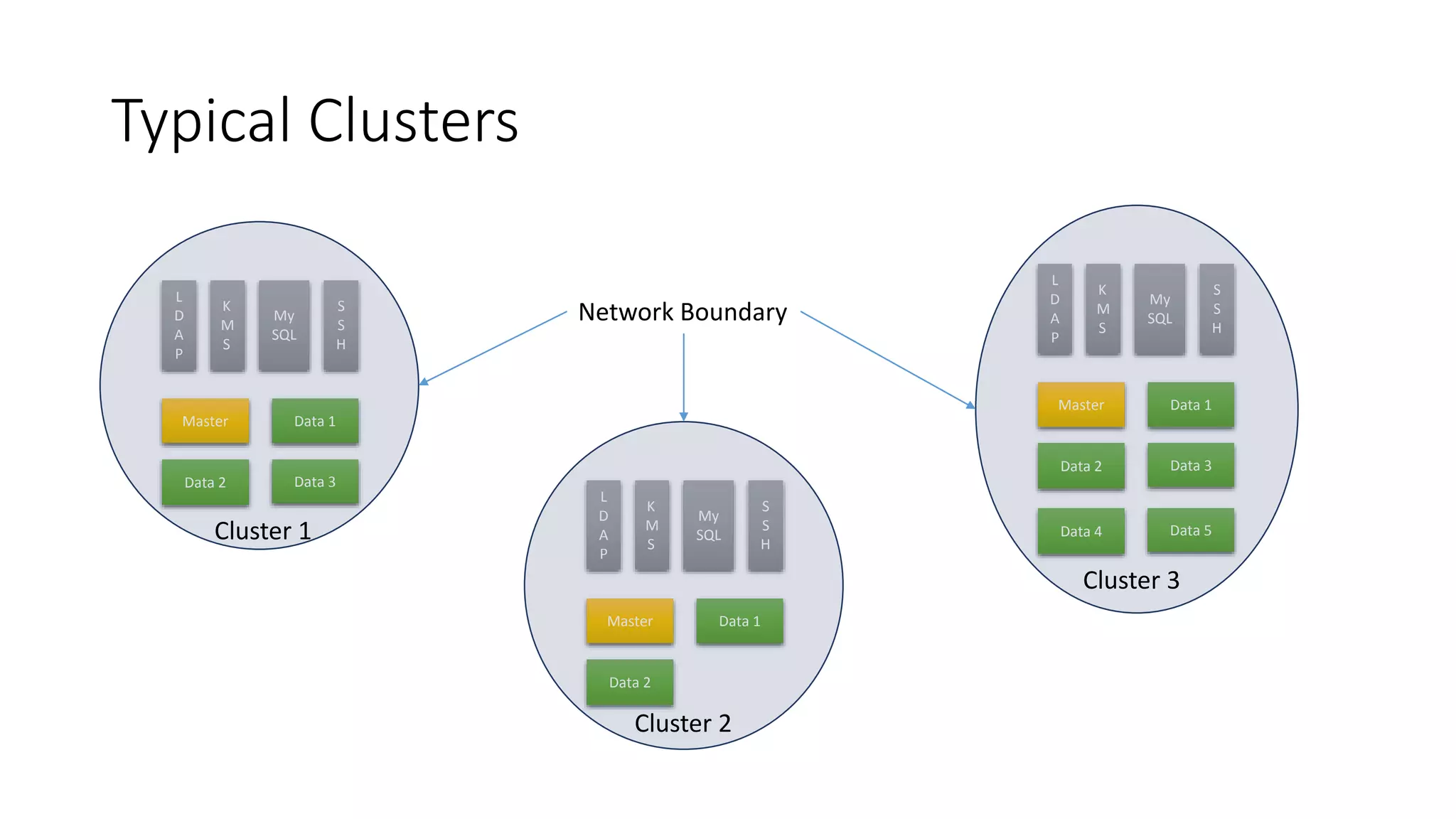
Typical Clusters L D A P K M S My SQL S S H Master Data 1 Data 2 Data 3 L D A P K M S My SQL S S H Master Data 1 Data 2 L D A P K M S My SQL S S H Master Data 1 Data 2 Data 3 Data 4 Data 5Cluster 1 Cluster 2 Cluster 3 Network Boundary
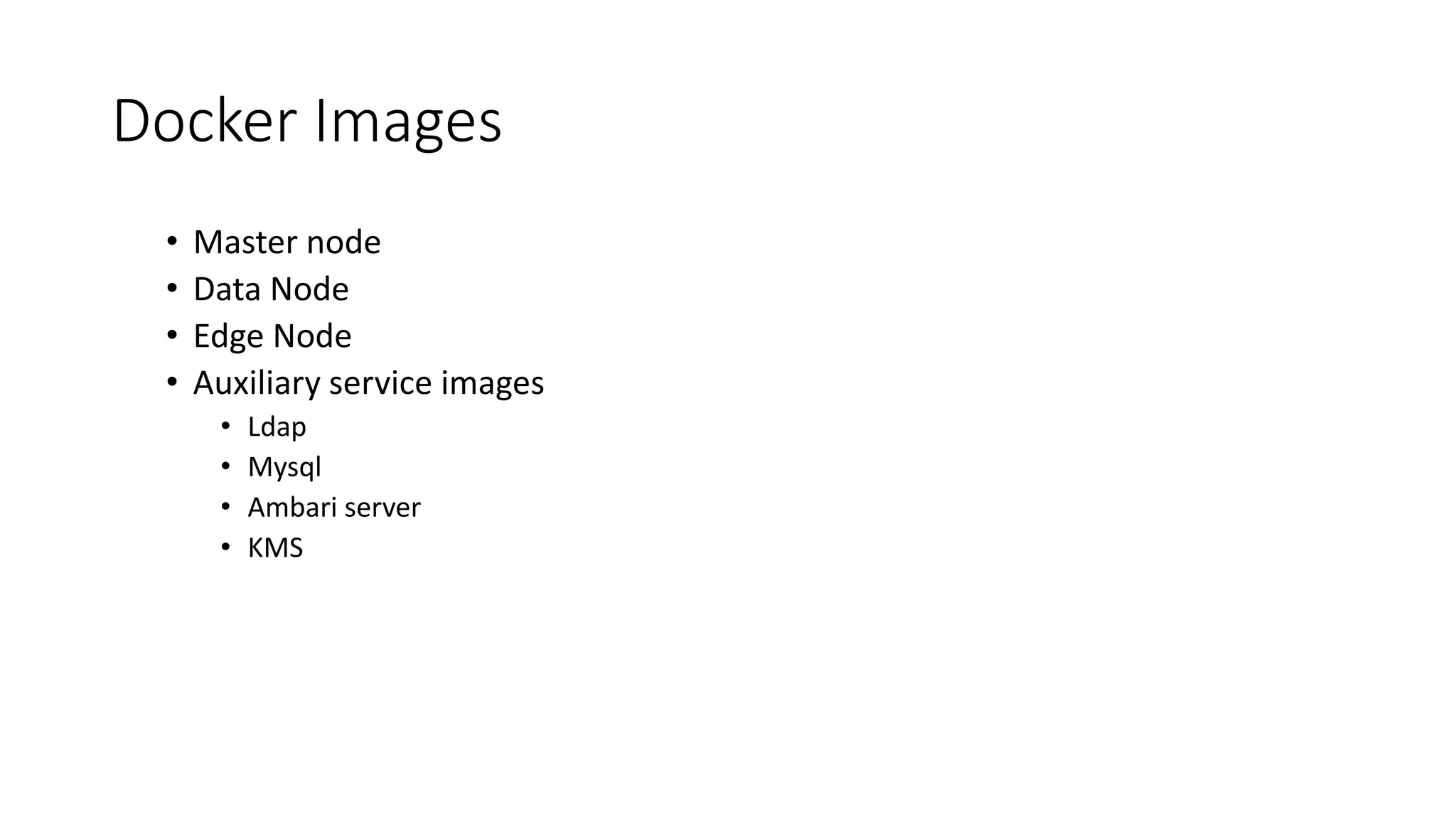
Docker Images • Master node • Data Node • Edge Node • Auxiliary service images • Ldap • Mysql • Ambari server • KMS
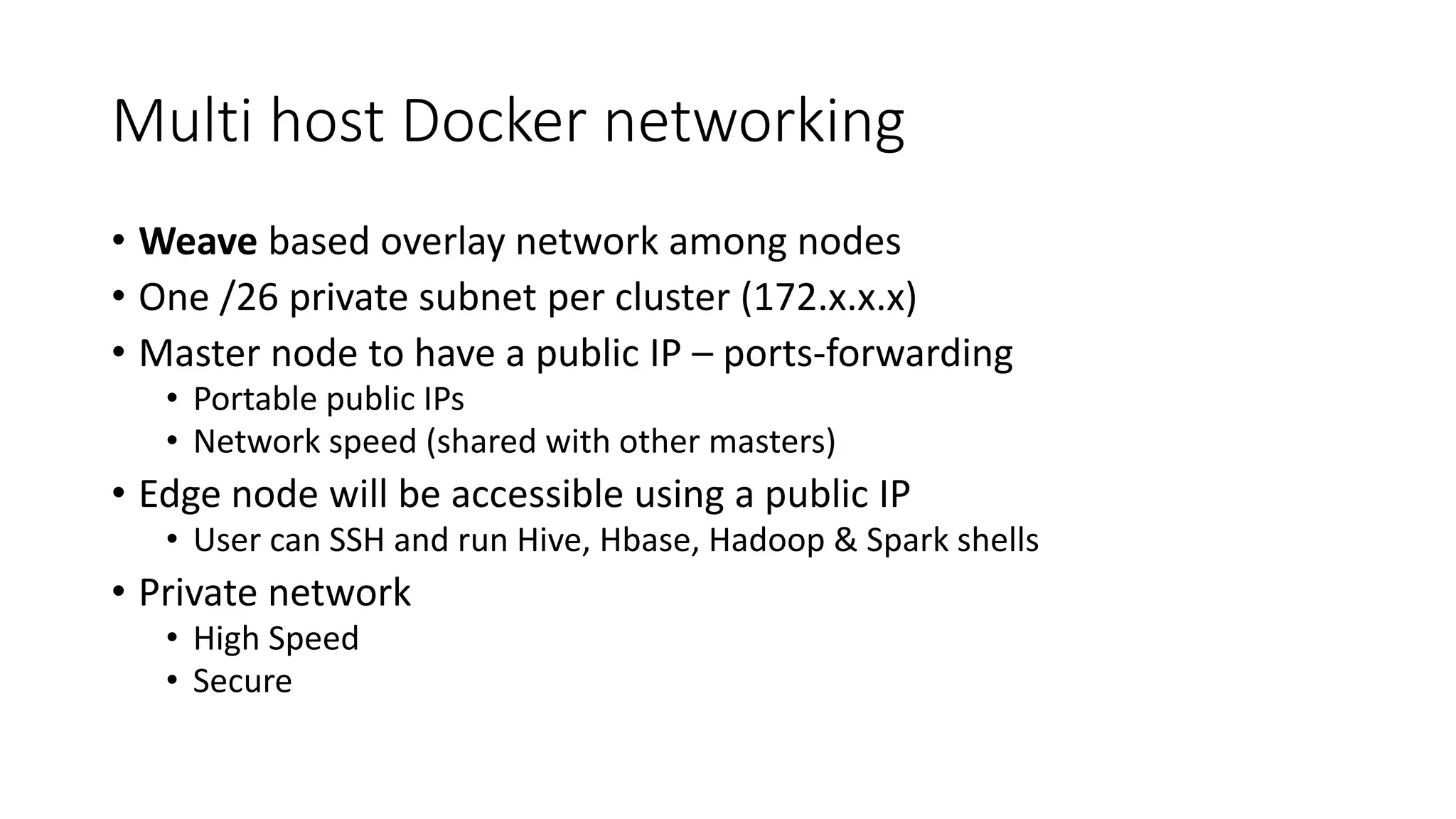
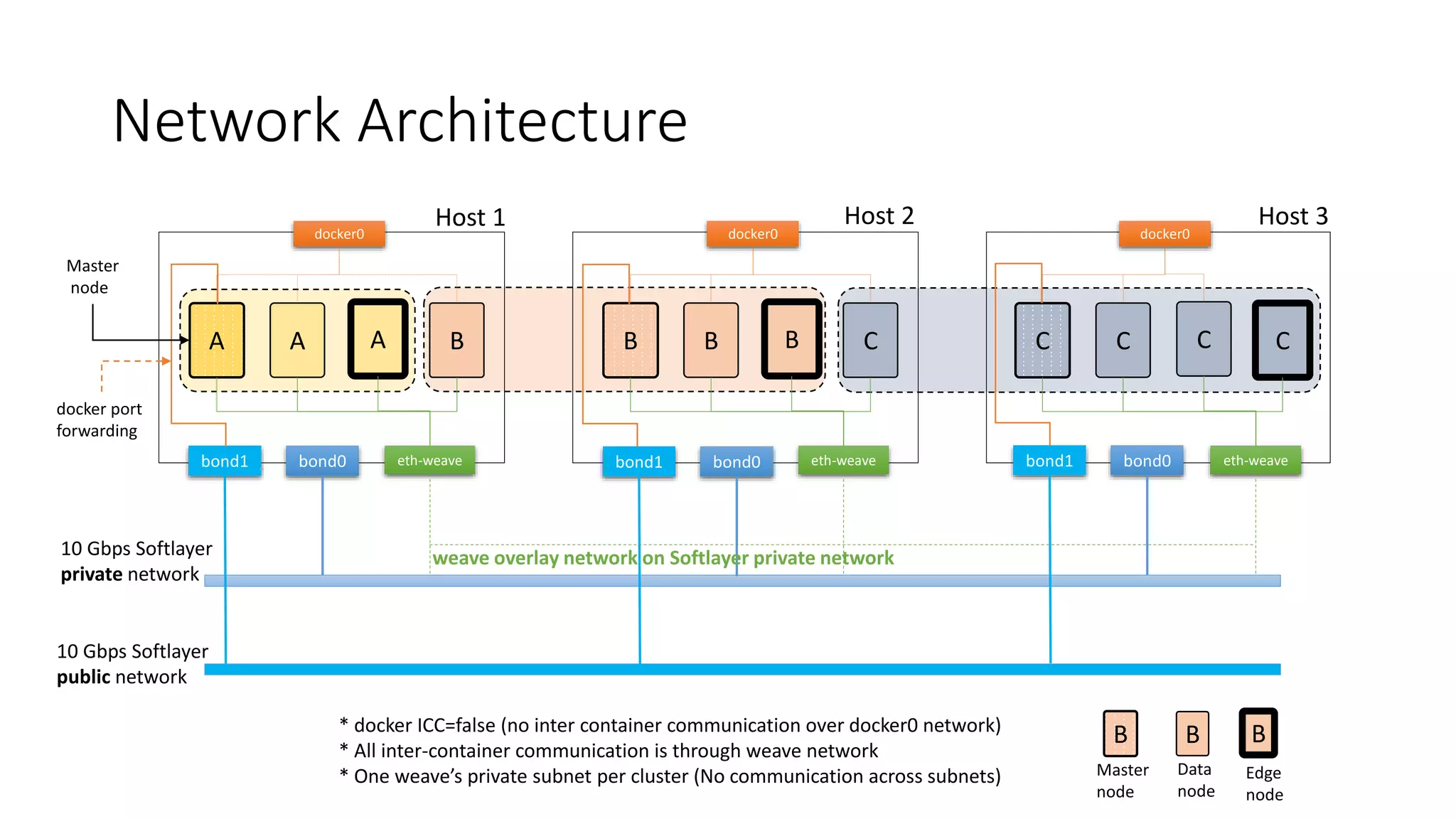
Multi host Docker networking • Weave based overlay network among nodes • One /26 private subnet per cluster (172.x.x.x) • Master node to have a public IP – ports-forwarding • Portable public IPs • Network speed (shared with other masters) • Edge node will be accessible using a public IP • User can SSH and run Hive, Hbase, Hadoop & Spark shells • Private network • High Speed • Secure
Network Architecture A A A B bond1 bond0 eth-weave docker0 10 Gbps Softlayer private network 10 Gbps Softlayer public network B B B C eth-weave docker0 C C C C eth-weave docker0 bond1 bond0 bond1 bond0 docker port forwarding * docker ICC=false (no inter container communication over docker0 network) * All inter-container communication is through weave network * One weave’s private subnet per cluster (No communication across subnets) weave overlay network on Softlayer private network Host 1 Host 2 Host 3 Master node B BB Master node Edge node Data node
Cluster Provisioning
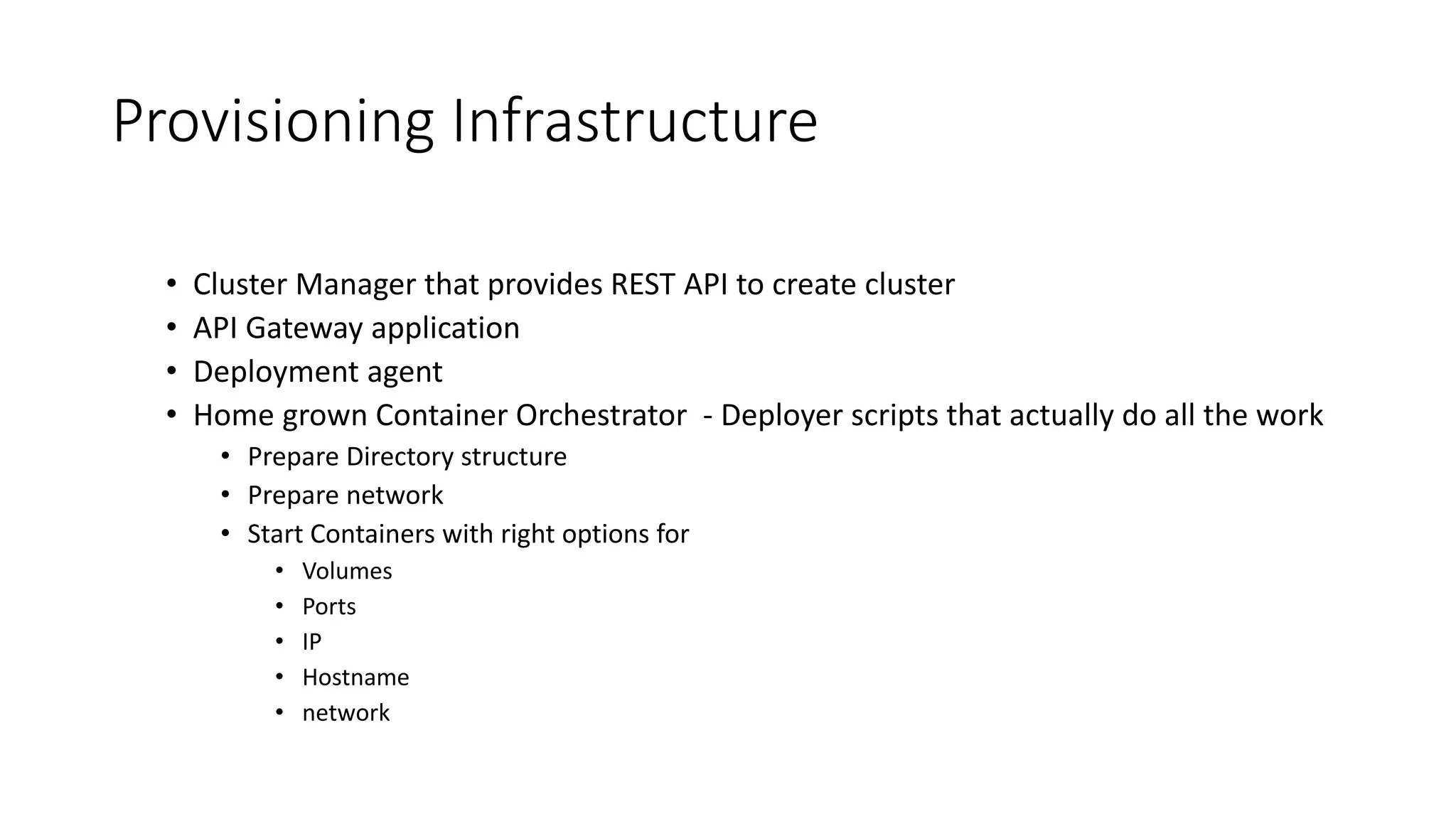
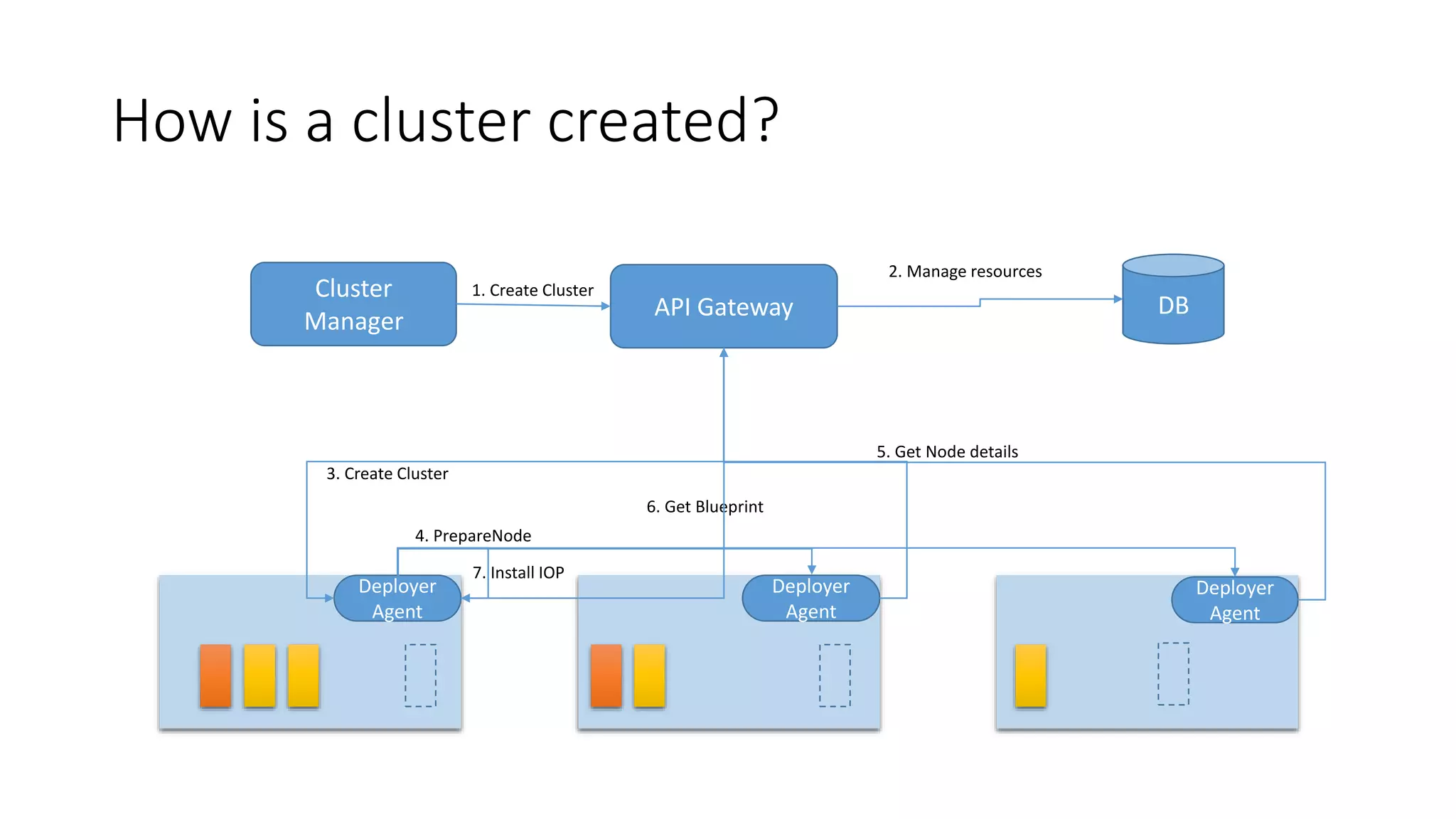
Provisioning Infrastructure • Cluster Manager that provides REST API to create cluster • API Gateway application • Deployment agent • Home grown Container Orchestrator - Deployer scripts that actually do all the work • Prepare Directory structure • Prepare network • Start Containers with right options for • Volumes • Ports • IP • Hostname • network
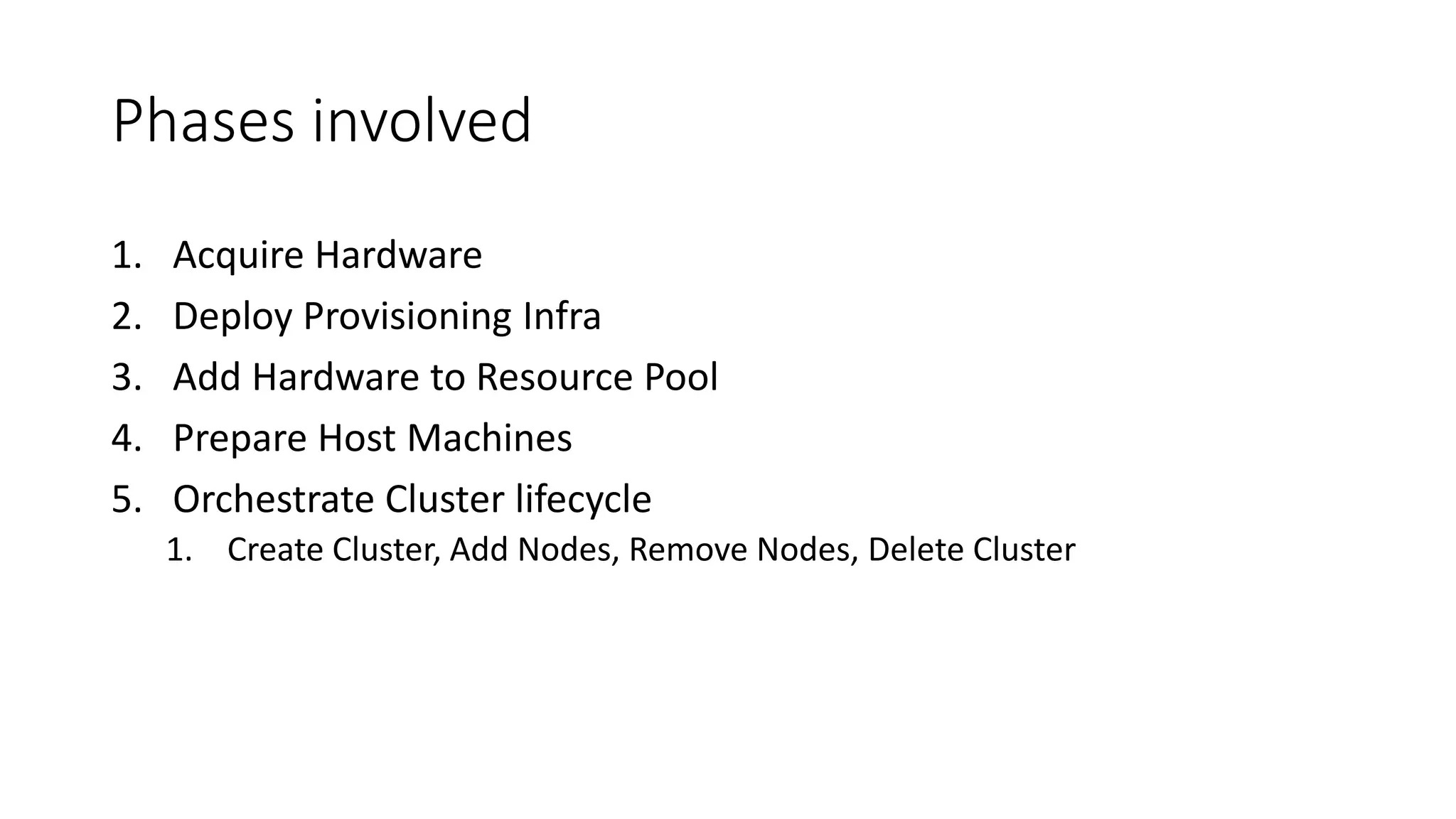
Phases involved 1. Acquire Hardware 2. Deploy Provisioning Infra 3. Add Hardware to Resource Pool 4. Prepare Host Machines 5. Orchestrate Cluster lifecycle 1. Create Cluster, Add Nodes, Remove Nodes, Delete Cluster
How is a cluster created? Cluster Manager DBAPI Gateway 2. Manage resources 1. Create Cluster Deployer Agent Deployer Agent Deployer Agent 3. Create Cluster 4. PrepareNode 7. Install IOP 5. Get Node details 6. Get Blueprint
How do I build Serverless Spark • Option 2 : Function as a service • Single Node Cluster – Or No Cluster at all • Spark local mode • all in one Image • Resource Limitations • Design Limitations
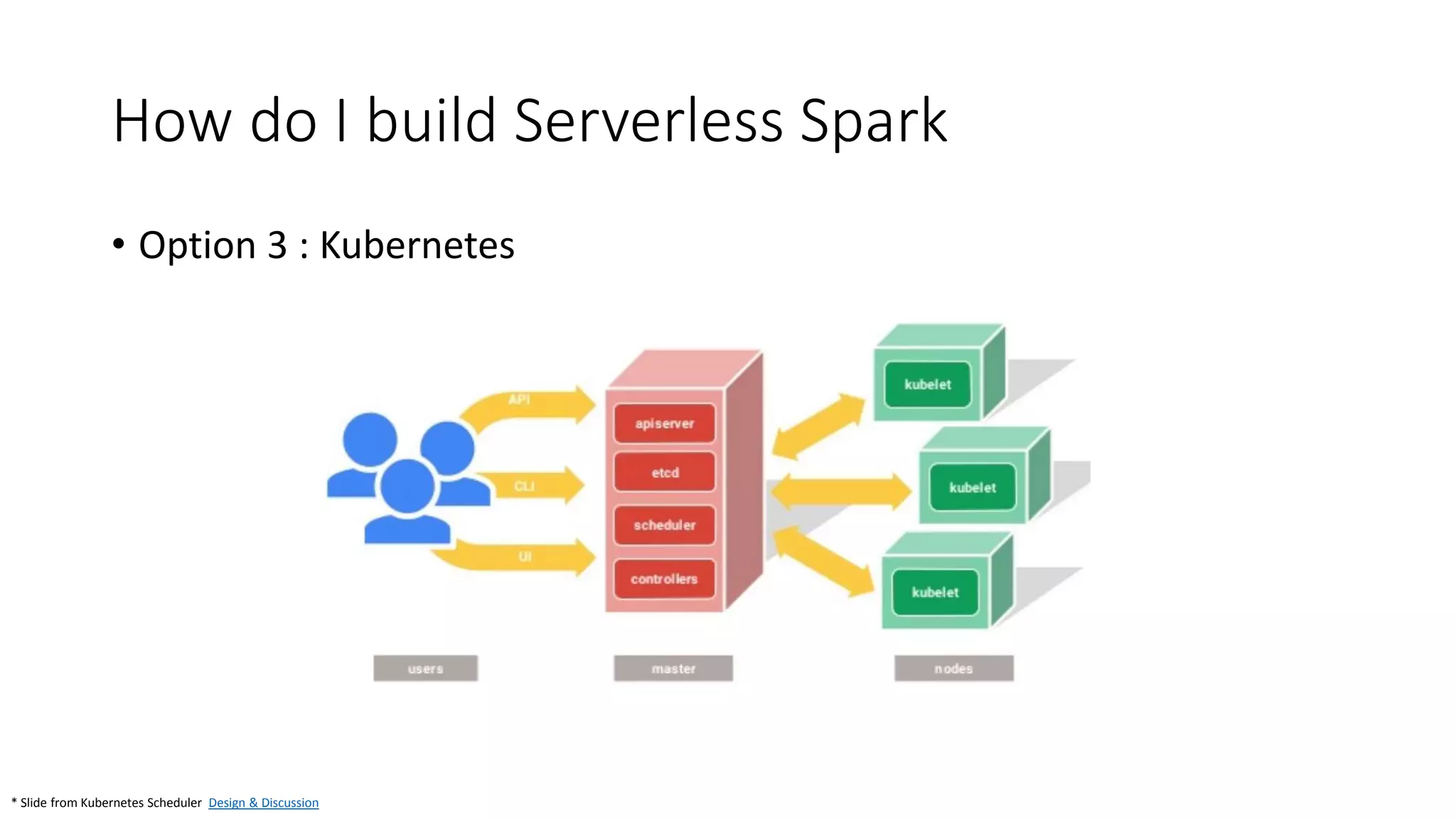
How do I build Serverless Spark • Option 3 : Kubernetes * Slide from Kubernetes Scheduler Design & Discussion
What Kubernetes Bring in? • Kubernetes is an open-source system for automating deployment, scaling, and management of containerized applications. • It Manages Containers for me • It Manages High availability • It Provides me flexibility to choose resource I WANT and Persistence I want • Kubernetes – Lots of addon services: third-party logging, monitoring, and security tools • Reduced operational costs • Improved infrastructure utilization
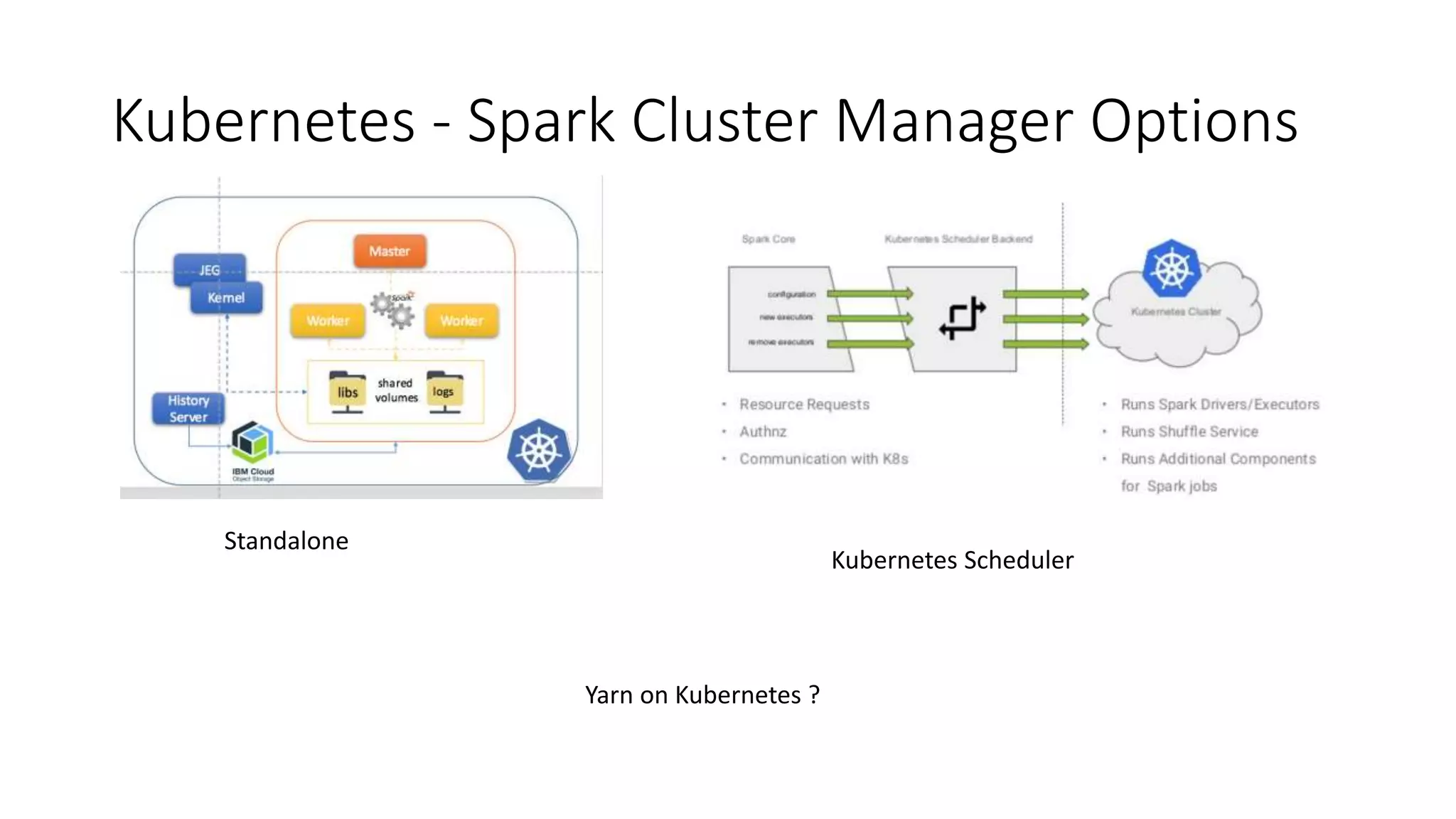
Kubernetes - Spark Cluster Manager Options Kubernetes Scheduler Standalone Yarn on Kubernetes ?
Conclusion • Spark Serverless - need for Data Scientist • Kuberenetes enables • Spark Clusters in Background and Kernel Up and Running in seconds • High Availability • Auto scaling with Spark monitoring and Kubernetes deployment features • No Extra Money for idle time
References • IBM Watson Studio https://datascience.ibm.com • IBM Watson https://www.ibm.com/analytics/us/en/watson-data-platform/tutorial/ • Analytics Engine https://www.ibm.com/cloud/analytics-engine • Apache Spark • Kubernetes Scheduler Design & Discussion • Kuberenetes Clusters on IBM Cloud Rachit Arora rachitar@in.ibm.com @rachit1arora
Thank you Rachit Arora rachitar@in.ibm.com @rachit1arora

Why Kubernetes as a container orchestrator is a right choice for running spark clusters on cloud?

  • 1.
    Why Kubernetes asa container orchestrator is a right choice for running spark clusters on cloud? Rachit Arora rachitar@in.ibm.com IBM, India Software Labs
  • 2.
    Spark Unified, open source,parallel, data processing framework for Big Data Analytics Spark Core Engine Yarn Mesos Standalon e Scheduler Kubernete s Spark SQL Interactive Queries Spark Streaming Stream processing Spark MLlib Machine Learning GraphX Graph Computation
  • 3.
    Typical Bigdata Application Secure Catalogand Search Ingest & Store Prepare Analyze Visualize Date Engineer Date Scientist Application Developer
  • 4.
    Let look intorole of Data Scientist • I want to run my analytics jobs • Social media analytics • Text analytics (Structure and Unstructured) • I want to run queries on demand • I want to run R scripts • I want to submit Spark jobs • I want to view History Server Logs of my application • I want to View Daemon logs • I want to write Notebooks
  • 5.
    Evolution of SparkAnalytics On Prem Install • Acquire Hardware • Prepare Machine • Install Spark • Retry • Apply patches • security • Upgrades • Scale • High availability Virtualization • Prepare Vm Imaging Solution • Network Management • High Avilability • Patches • Scale Managed • Configure Cluster • Customize • Scale • Pay even if idle Serverless • Run analytics
  • 6.
    Spark Serverless Characteristics •No Servers to Provision • Scale with usage • Availability and fault tolerant • Never pay for idle Kernel History Server Notebook Server Browswer Data Scientist COS/Injestion Data Engineer
  • 7.
    Typical Hadoop/Spark Cluster- Setup • Get the suitable hardware • Prepare host machine • Setup various networks • Private • Public • Management • Fetch the binaries for the install • Prepare the blueprint/config file for the install • Start the install • Many a times install fails, debug and retry again.
  • 8.
    Earlier Experiments Option OSProvisioning Config Cluster Management / Updates 1 Bare metal Chef Chef 2 xCAT – Stateful(Create your own VMs) PostScripts xCAT - updateNode 3 xCAT – Sysclone(Image from current system) Not Needed xCAT - updateNode 4 Bare metal PostScripts xCAT - updateNode 5 Cloud Provider Specific Images Not Needed Manual/Scripts 6 Standard-ISO Image Anaconda -post scripts Manual/Scripts
  • 9.
    How do Ibuild Serverless Spark • Option 1: Vanilla Containers – If I need to build with Kubernetes • Repeatable • Application Portability • Faster Development Cycle • Reduced dev-ops load • Improved Infrastructure Utilization
  • 10.
    Guiding Principles • Virtualizationhelps repeatability, lesser failures & speed • Maintenance • Performance(Equivalent to Bare metal) • Use open source from an active community • Cloud-agnostic
  • 11.
  • 12.
    Containers: Thinking asVMs ? (mistake)
  • 13.
    Docker in HadoopCluster on Cloud • Each cluster node is a virtual node powered by Docker. Each node of the cluster is a Docker container • Docker containers run on a bunch of bare metal hosts (Docker-hosts) • Each Hadoop cluster will have multiple nodes/Docker containers spanning multiple hosts • Docker • Container management - Custom • Multi host networking – Overlay Network • Registry – Private • Local Storage
  • 14.
    Typical Clusters L D A P K M S My SQL S S H Master Data1 Data 2 Data 3 L D A P K M S My SQL S S H Master Data 1 Data 2 L D A P K M S My SQL S S H Master Data 1 Data 2 Data 3 Data 4 Data 5Cluster 1 Cluster 2 Cluster 3 Network Boundary
  • 15.
    Docker Images • Masternode • Data Node • Edge Node • Auxiliary service images • Ldap • Mysql • Ambari server • KMS
  • 16.
    Multi host Dockernetworking • Weave based overlay network among nodes • One /26 private subnet per cluster (172.x.x.x) • Master node to have a public IP – ports-forwarding • Portable public IPs • Network speed (shared with other masters) • Edge node will be accessible using a public IP • User can SSH and run Hive, Hbase, Hadoop & Spark shells • Private network • High Speed • Secure
  • 17.
    Network Architecture A AA B bond1 bond0 eth-weave docker0 10 Gbps Softlayer private network 10 Gbps Softlayer public network B B B C eth-weave docker0 C C C C eth-weave docker0 bond1 bond0 bond1 bond0 docker port forwarding * docker ICC=false (no inter container communication over docker0 network) * All inter-container communication is through weave network * One weave’s private subnet per cluster (No communication across subnets) weave overlay network on Softlayer private network Host 1 Host 2 Host 3 Master node B BB Master node Edge node Data node
  • 18.
  • 19.
    Provisioning Infrastructure • ClusterManager that provides REST API to create cluster • API Gateway application • Deployment agent • Home grown Container Orchestrator - Deployer scripts that actually do all the work • Prepare Directory structure • Prepare network • Start Containers with right options for • Volumes • Ports • IP • Hostname • network
  • 20.
    Phases involved 1. AcquireHardware 2. Deploy Provisioning Infra 3. Add Hardware to Resource Pool 4. Prepare Host Machines 5. Orchestrate Cluster lifecycle 1. Create Cluster, Add Nodes, Remove Nodes, Delete Cluster
  • 21.
    How is acluster created? Cluster Manager DBAPI Gateway 2. Manage resources 1. Create Cluster Deployer Agent Deployer Agent Deployer Agent 3. Create Cluster 4. PrepareNode 7. Install IOP 5. Get Node details 6. Get Blueprint
  • 22.
    How do Ibuild Serverless Spark • Option 2 : Function as a service • Single Node Cluster – Or No Cluster at all • Spark local mode • all in one Image • Resource Limitations • Design Limitations
  • 23.
    How do Ibuild Serverless Spark • Option 3 : Kubernetes * Slide from Kubernetes Scheduler Design & Discussion
  • 24.
    What Kubernetes Bringin? • Kubernetes is an open-source system for automating deployment, scaling, and management of containerized applications. • It Manages Containers for me • It Manages High availability • It Provides me flexibility to choose resource I WANT and Persistence I want • Kubernetes – Lots of addon services: third-party logging, monitoring, and security tools • Reduced operational costs • Improved infrastructure utilization
  • 25.
    Kubernetes - SparkCluster Manager Options Kubernetes Scheduler Standalone Yarn on Kubernetes ?
  • 26.
    Conclusion • Spark Serverless- need for Data Scientist • Kuberenetes enables • Spark Clusters in Background and Kernel Up and Running in seconds • High Availability • Auto scaling with Spark monitoring and Kubernetes deployment features • No Extra Money for idle time
  • 27.
    References • IBM WatsonStudio https://datascience.ibm.com • IBM Watson https://www.ibm.com/analytics/us/en/watson-data-platform/tutorial/ • Analytics Engine https://www.ibm.com/cloud/analytics-engine • Apache Spark • Kubernetes Scheduler Design & Discussion • Kuberenetes Clusters on IBM Cloud Rachit Arora rachitar@in.ibm.com @rachit1arora
  • 28.

Editor's Notes

  • #3 Spark is an open source, scalable, massively parallel, in-memory execution engine for analytics applications. Think of it as an in-memory layer that sits above multiple data stores, where data can be loaded into memory and analyzed in parallel across a cluster. Spark Core: The foundation of Spark that lot of libraires for scheduling and basic I/O Spark offers over 100s of high-level operators that make it easy to build parallel apps. Spark also includes prebuilt machine-learning algorithms and graph analysis algorithms that are especially written to execute in parallel and in memory. It also supports interactive SQL processing of queries and real-time streaming analytics. As a result, you can write analytics applications in programming languages such as Java, Python, R and Scala. You can run Spark using its standalone cluster mode, on Cloud, on Hadoop YARN, on Apache Mesos, or on Kubernetes. Access data in HDFS, Cassandra, HBase, Hive, Object Store, and any Hadoop data source.
  • #4 Prepare Even though you have the right data, it may not be in the right format or structure for analysis. That’s where data preparation comes in. Data engineers need to bring raw data into one interface from wherever it lives – on premises, in the cloud or on your desktop – where it can then be shaped, transformed, explored, and prepared for analysis. Data scientist: Primarily responsible for building predictive analytic models and building insights. He will analyze data that’s been cataloged and prepared by the data engineer using machine learning tools like Watson Machine Learning. He will build applications using Jupyter Notebooks, RStudio After the data scientist shares his Analytical outputs , Application developer can build APPs like a cognitive chatbot. As the chatbot engages with customers, it will continuously improve its knowledge and help uncover new insights.
  • #6 As a data scientist what I was required to do On Prem to Virtuliation as demand increased in my organization for the sevrice I decided to move to virtualized VM to handle many request on demand but there still pain was more Then I decided to try services being offereed on cloud like EMR and IBM Analytics Engine or Microsoft Insights etce but there I need to order cluster sand configure them to suit my work loads Keep them running even when I do not want to use them Cover what is takes to install a hadoop/spark cluster
  • #7 Wit Spalr and Hadoop  serveless is whole new game   “Function as aservice “  - History , Logs , Performance as if i am doing stuff on prem Lets take case of Data Scentient  Note book - kernel , log , History Server expectation from spark server less Data Engineer and Scientist sending request to Serverless Spark 
  • #8 Setup is hard 6.8 to 6.7 example Optimal seetings for work loads We do have such offering , its deployed in bluemix
  • #9 xCAT is Extreme Cluster/Cloud Administration Toolkit, xCAT offers complete management for clusters, Grids, Clouds, Datacenters, and many other things. It is agile, extensible, and based on years of system administration best practices and experience. It enables you to: Provision Operating Systems on physical or virtual machines: RHEL, CentOS, Fedora, SLES, Ubuntu, AIX, Windows, VMWare, KVM, PowerVM, PowerKVM, zVM. Provision using scripted install, stateless, statelite, iSCSI, or cloning
  • #10 What problems we faced - Managing Hardware as a service – complex Build solutions for Container orchestration Container Security and OS Patch PROBLEM : INSTALLATION AND CUSTOMIZATION Data Persistence
  • #12 - First we tried for imaging solution and when I dd docker run command . That was just magic
  • #13 “How do I backup a container?” How do I handle restart of host machine ? “What’s my patch management strategy for my running containers?” How do I network them ? Where is my data going to be ? How do I manage them ?
  • #14 500 baremetal We spin conatiners we are not using orch as of now , will talk why Our own registry Local storage
  • #15 Monolthic application being breaked down . We plan to still do it further to service break downs
  • #16 Strech on benfits of separating out / like I can change ldap tp IPA , Mysql to other db , KMS verssion change . Separate metrics for these conatiners
  • #17 Stress on security Stress on extensible to adopt newer networking solutions Mentions it its not recommened to have ssh / Talk about ip forwarding and multiple networks we have and need for those networks in the cluster
  • #18 Explain here about the cpu allocation and the schduleings strategies and how we wanted to schedule them and reason behind it for the taking advanteage of the hadoop’s build in retundancy and replicatioon to have less failure chances T
  • #20 Talk here about orchestration needs , CPU SET and Local disks . how many of the current orchestrators not fitting in . Talk about the montioring aspects of the conatiners and logging aspects of the conatiners
  • #22 Resource manager , layout maker Deployer can be any of machines will work no master deployer here Wait for nodes to prepare Once up start the install which is config driven . Yum install hadoop ! Oh I have it , set up db , Oh I have it .
  • #23 AWS Lambda , IBM Apache OpenWisk , Microsoft functions. No Cluster just executors Not The experience I am used too. History Server Logs, Monitoring tools? Inability to communicate directly: Spark using DAG execution framework spawns jobs with multiple stages. For inter-stage communication, Spark requires data transfer across executors. Many Fiunction as a service does not allow communication between two Lambda functions. This poses a challenge for running executors in this environment. Extremely limited runtime resources: Many Function invocations are currently limited to a maximum execution duration of 5 minutes, 1536 MB memory and 512 MB disk space. Spark loves memory, can have a large disk footprint and can spawn long running tasks. This makes Functions a difficult environment to run Spark on.
  • #24 Introduction to Kubernetes Kubernetes is an open-source system for automating deployment, scaling, and management of containerized applications. It Manages Containers for me It Manages High avilabilty It Provides me flexibilty to choose resource I WANT and Persistence I want Kubernetes – Lots of addon services: third-party logging, monitoring, and security tools – Reduced operational costs – Improved infrastructure utilization
  • #26 No or very less latency
  • #28 IBM Watson brings together data management, data policies, data preparation, and analysis capabilities into a common framework. You can index, discover, control, and share data with Watson Knowledge Catalog, refine and prepare the data with Data Refinery, then organize resources to analyze the same data with Watson Studio. The IBM Watson apps are fully integrated to use the same user interface and framework. You can pick whichever apps and tools you need for your organization. Watson Studio (Watson Studio) provides you with the environment and tools to solve your business problems by collaboratively analyzing data What is Analytics Engine? You can use AE to Build and deploy clusters within minutes with simplified user experience, scalability, and reliability. You Custom configure the environment and Scale on demand.