TRINITY INSTITUTE OF PROFESSIONAL STUDIES Sector – 9, Dwarka Institutional Area, New Delhi-75 Affiliated G.G.S.IP.U, Delhi BCA, FEDT VB .NET,20205 Priyanka Rattan Assistant Professor(IT)
TRINITY INSTITUTE OF PROFESSIONAL STUDIES Sector – 9, Dwarka Institutional Area, New Delhi-75 Topic Object Oriented Programming Concepts –Object Oriented Programming –Objects vs. Structures –Methods, Events, and Properties –Overloading –Interfaces and Inheritance
TRINITY INSTITUTE OF PROFESSIONAL STUDIES Sector – 9, Dwarka Institutional Area, New Delhi-75 Object Oriented Programming • Objects • Abstraction • Encapsulation • Polymorphism • Inheritance
TRINITY INSTITUTE OF PROFESSIONAL STUDIES Sector – 9, Dwarka Institutional Area, New Delhi-75 Object Components The Object • Data – Members – Properties • Behavior – Methods – Events
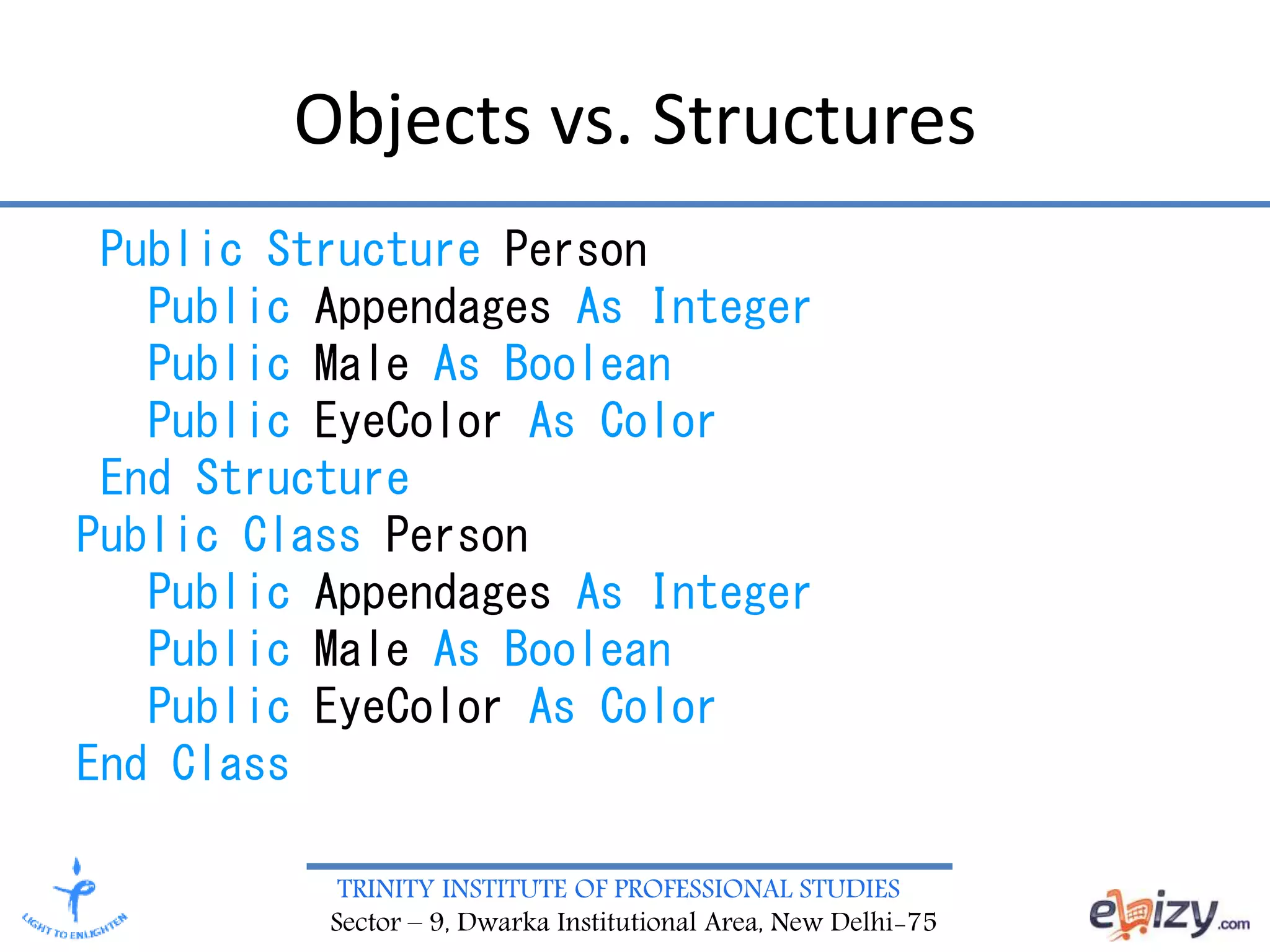
TRINITY INSTITUTE OF PROFESSIONAL STUDIES Sector – 9, Dwarka Institutional Area, New Delhi-75 Objects vs. Structures Public Structure Person Public Appendages As Integer Public Male As Boolean Public EyeColor As Color End Structure Public Class Person Public Appendages As Integer Public Male As Boolean Public EyeColor As Color End Class
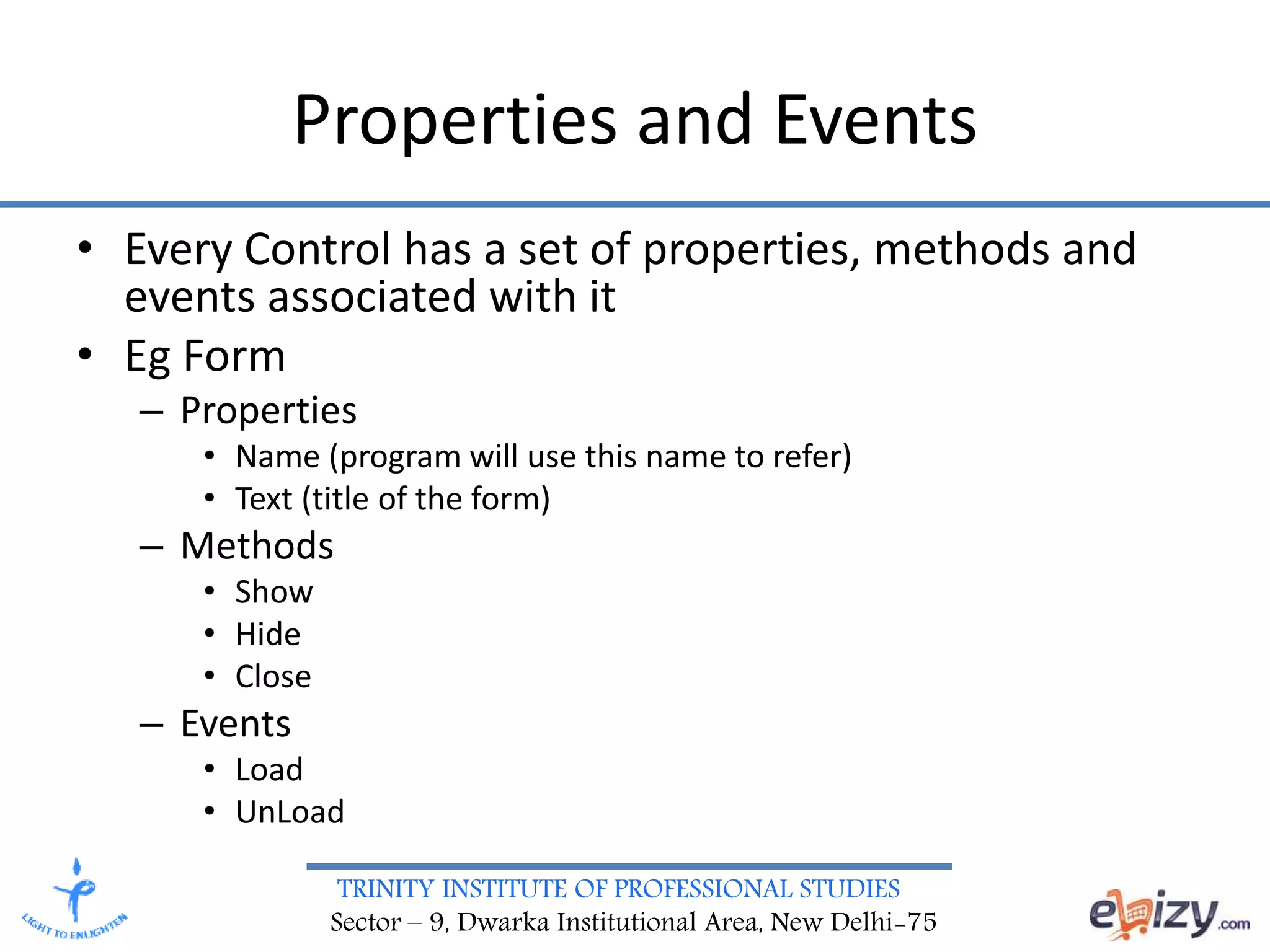
TRINITY INSTITUTE OF PROFESSIONAL STUDIES Sector – 9, Dwarka Institutional Area, New Delhi-75 Properties and Events • Every Control has a set of properties, methods and events associated with it • Eg Form – Properties • Name (program will use this name to refer) • Text (title of the form) – Methods • Show • Hide • Close – Events • Load • UnLoad
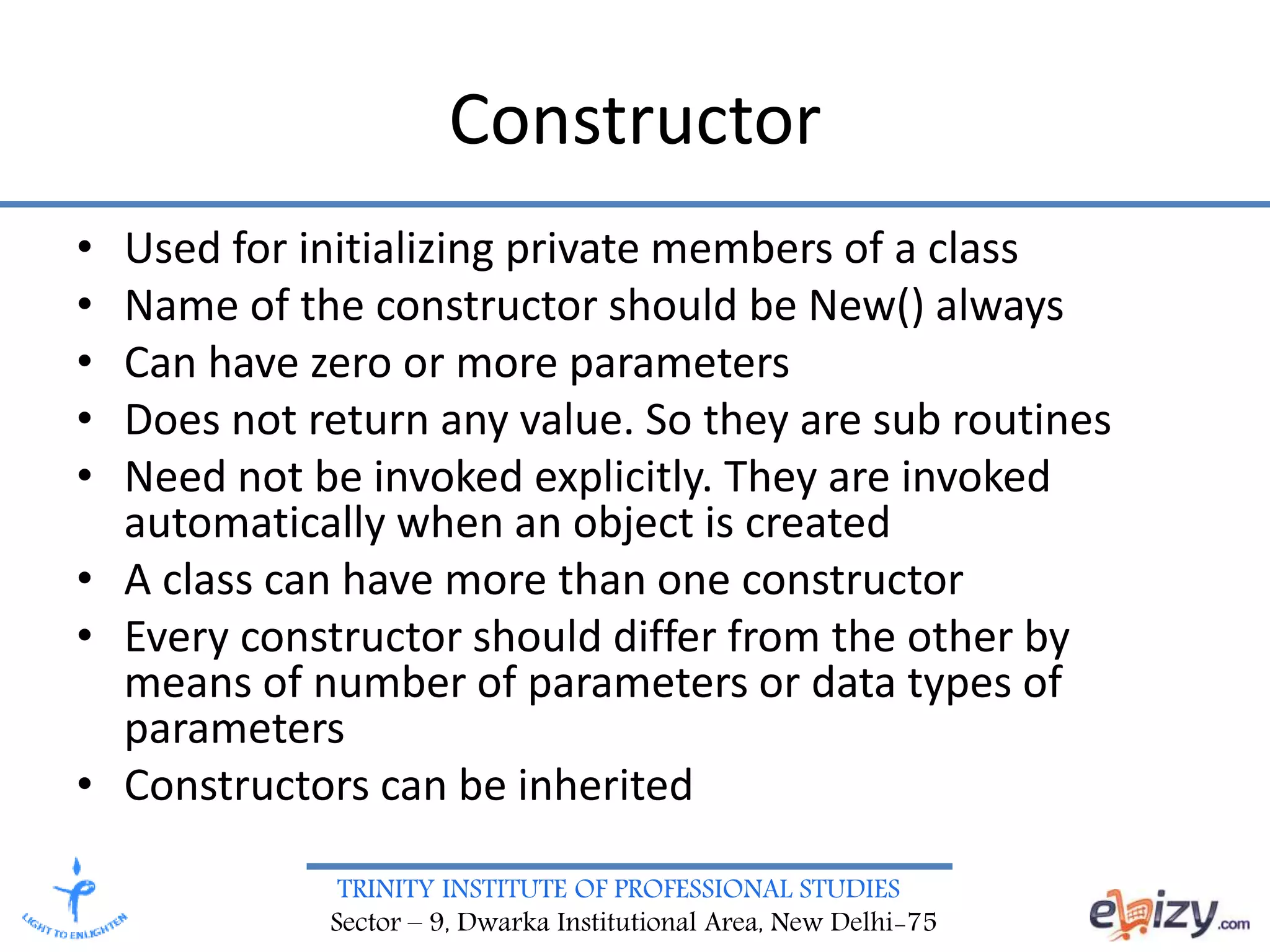
TRINITY INSTITUTE OF PROFESSIONAL STUDIES Sector – 9, Dwarka Institutional Area, New Delhi-75 Constructor • Used for initializing private members of a class • Name of the constructor should be New() always • Can have zero or more parameters • Does not return any value. So they are sub routines • Need not be invoked explicitly. They are invoked automatically when an object is created • A class can have more than one constructor • Every constructor should differ from the other by means of number of parameters or data types of parameters • Constructors can be inherited
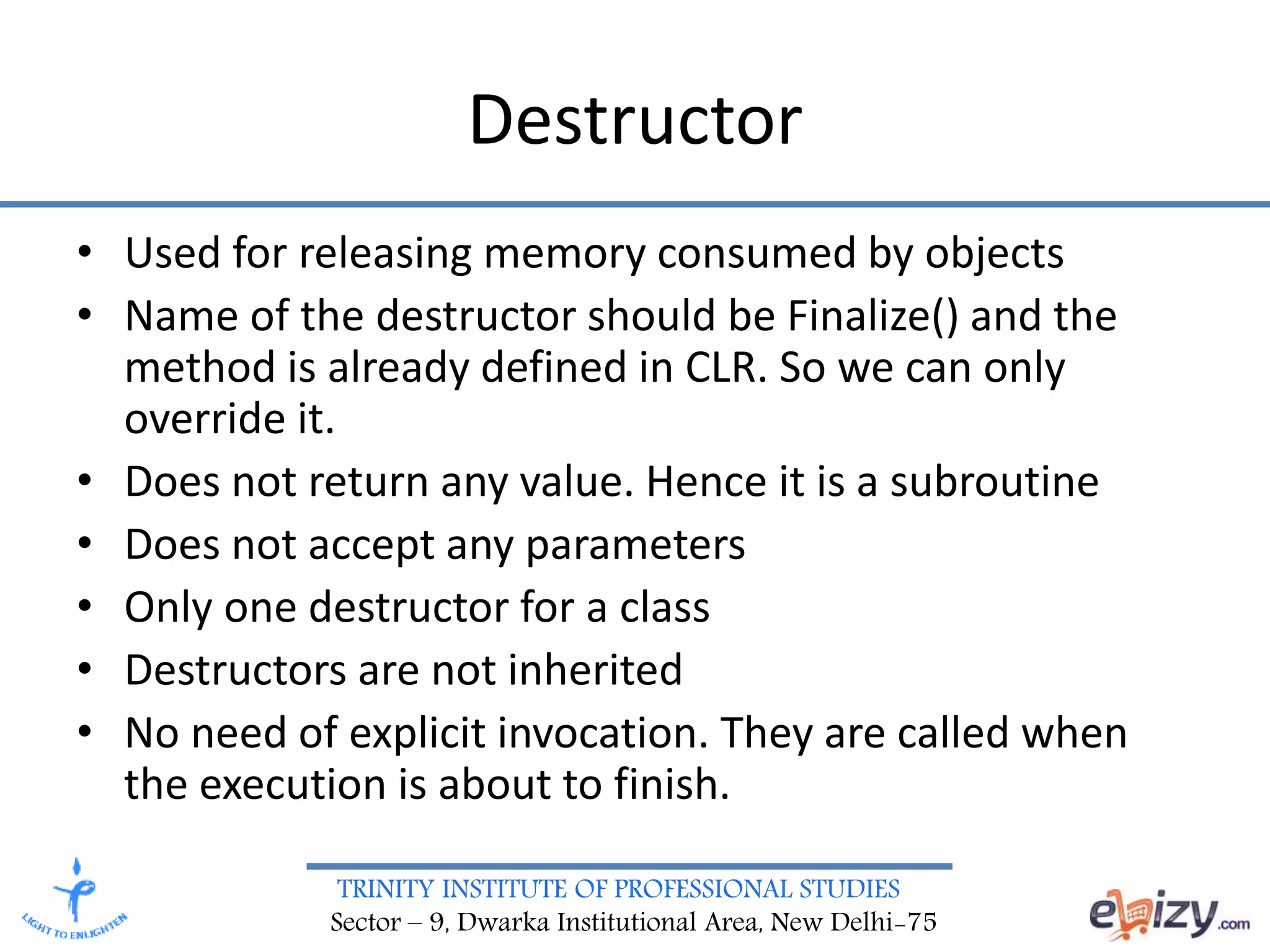
TRINITY INSTITUTE OF PROFESSIONAL STUDIES Sector – 9, Dwarka Institutional Area, New Delhi-75 Destructor • Used for releasing memory consumed by objects • Name of the destructor should be Finalize() and the method is already defined in CLR. So we can only override it. • Does not return any value. Hence it is a subroutine • Does not accept any parameters • Only one destructor for a class • Destructors are not inherited • No need of explicit invocation. They are called when the execution is about to finish.
TRINITY INSTITUTE OF PROFESSIONAL STUDIES Sector – 9, Dwarka Institutional Area, New Delhi-75 Array List • Array List is a dynamic array • Its size grows with the addition of element • Searching is based on the index • Sequential search is performed on elements • Hence it is slow • Occupies less space
TRINITY INSTITUTE OF PROFESSIONAL STUDIES Sector – 9, Dwarka Institutional Area, New Delhi-75 Forms and other controls • Form is a container for other controls • We can place the following in a form – Label – Text Box – Check Box – Radio Button – Button – Date Picker – And more…
TRINITY INSTITUTE OF PROFESSIONAL STUDIES Sector – 9, Dwarka Institutional Area, New Delhi-75 Exception Handling • Exception is Run time error • It is not known at the compile time • Examples of exceptions – Divide by zero – Accessing non existing portion of memory – Memory overflow due to looping • In VB .Net, exception is handled via Try Catch Mechanism
TRINITY INSTITUTE OF PROFESSIONAL STUDIES Sector – 9, Dwarka Institutional Area, New Delhi-75 Try Catch Finally Try Suspicious code that may throw an exception to be written here Catch ex As Exception What to be done if exception occurs to be written here Finally Optional portion which will be executed irrespective of the happening of exception to be written here. Can contain code for releasing unnecessary space

Object Oriented Programming Concepts

  • 1.
    TRINITY INSTITUTE OFPROFESSIONAL STUDIES Sector – 9, Dwarka Institutional Area, New Delhi-75 Affiliated G.G.S.IP.U, Delhi BCA, FEDT VB .NET,20205 Priyanka Rattan Assistant Professor(IT)
  • 2.
    TRINITY INSTITUTE OFPROFESSIONAL STUDIES Sector – 9, Dwarka Institutional Area, New Delhi-75 Topic Object Oriented Programming Concepts –Object Oriented Programming –Objects vs. Structures –Methods, Events, and Properties –Overloading –Interfaces and Inheritance
  • 3.
    TRINITY INSTITUTE OFPROFESSIONAL STUDIES Sector – 9, Dwarka Institutional Area, New Delhi-75 Object Oriented Programming • Objects • Abstraction • Encapsulation • Polymorphism • Inheritance
  • 4.
    TRINITY INSTITUTE OFPROFESSIONAL STUDIES Sector – 9, Dwarka Institutional Area, New Delhi-75 Object Components The Object • Data – Members – Properties • Behavior – Methods – Events
  • 5.
    TRINITY INSTITUTE OFPROFESSIONAL STUDIES Sector – 9, Dwarka Institutional Area, New Delhi-75 Objects vs. Structures Public Structure Person Public Appendages As Integer Public Male As Boolean Public EyeColor As Color End Structure Public Class Person Public Appendages As Integer Public Male As Boolean Public EyeColor As Color End Class
  • 6.
    TRINITY INSTITUTE OFPROFESSIONAL STUDIES Sector – 9, Dwarka Institutional Area, New Delhi-75 Properties and Events • Every Control has a set of properties, methods and events associated with it • Eg Form – Properties • Name (program will use this name to refer) • Text (title of the form) – Methods • Show • Hide • Close – Events • Load • UnLoad
  • 7.
    TRINITY INSTITUTE OFPROFESSIONAL STUDIES Sector – 9, Dwarka Institutional Area, New Delhi-75 Constructor • Used for initializing private members of a class • Name of the constructor should be New() always • Can have zero or more parameters • Does not return any value. So they are sub routines • Need not be invoked explicitly. They are invoked automatically when an object is created • A class can have more than one constructor • Every constructor should differ from the other by means of number of parameters or data types of parameters • Constructors can be inherited
  • 8.
    TRINITY INSTITUTE OFPROFESSIONAL STUDIES Sector – 9, Dwarka Institutional Area, New Delhi-75 Destructor • Used for releasing memory consumed by objects • Name of the destructor should be Finalize() and the method is already defined in CLR. So we can only override it. • Does not return any value. Hence it is a subroutine • Does not accept any parameters • Only one destructor for a class • Destructors are not inherited • No need of explicit invocation. They are called when the execution is about to finish.
  • 9.
    TRINITY INSTITUTE OFPROFESSIONAL STUDIES Sector – 9, Dwarka Institutional Area, New Delhi-75 Array List • Array List is a dynamic array • Its size grows with the addition of element • Searching is based on the index • Sequential search is performed on elements • Hence it is slow • Occupies less space
  • 10.
    TRINITY INSTITUTE OFPROFESSIONAL STUDIES Sector – 9, Dwarka Institutional Area, New Delhi-75 Forms and other controls • Form is a container for other controls • We can place the following in a form – Label – Text Box – Check Box – Radio Button – Button – Date Picker – And more…
  • 11.
    TRINITY INSTITUTE OFPROFESSIONAL STUDIES Sector – 9, Dwarka Institutional Area, New Delhi-75 Exception Handling • Exception is Run time error • It is not known at the compile time • Examples of exceptions – Divide by zero – Accessing non existing portion of memory – Memory overflow due to looping • In VB .Net, exception is handled via Try Catch Mechanism
  • 12.
    TRINITY INSTITUTE OFPROFESSIONAL STUDIES Sector – 9, Dwarka Institutional Area, New Delhi-75 Try Catch Finally Try Suspicious code that may throw an exception to be written here Catch ex As Exception What to be done if exception occurs to be written here Finally Optional portion which will be executed irrespective of the happening of exception to be written here. Can contain code for releasing unnecessary space