
By Sukanya Sen Sharma and Shaishavi Kashikar MBICT College
 Introduction  1.Why Web Designing?  2.What And Why?  3.Web Standards  HTML  XML  Comparison
Web design is the practice of creating presentations of content (usually hypertext or hypermedia) that are delivered to an end-user through the Worldwide Web,using a Web browser or other Web-enabled software. The intent of web design is to create a website²a collection of electronic documents and applications that reside on a Webserver/servers. The website may include text, images, soundsand other content, and may be interactive.
 Why  Web designing – 1. First impression counts 3 important element 2. Professionalism 1. Colour and tone of 3. Competition website 2. Use of graphics 3. Quality of contents  What is the use of web designing 1. Marketing 2. Advertisement
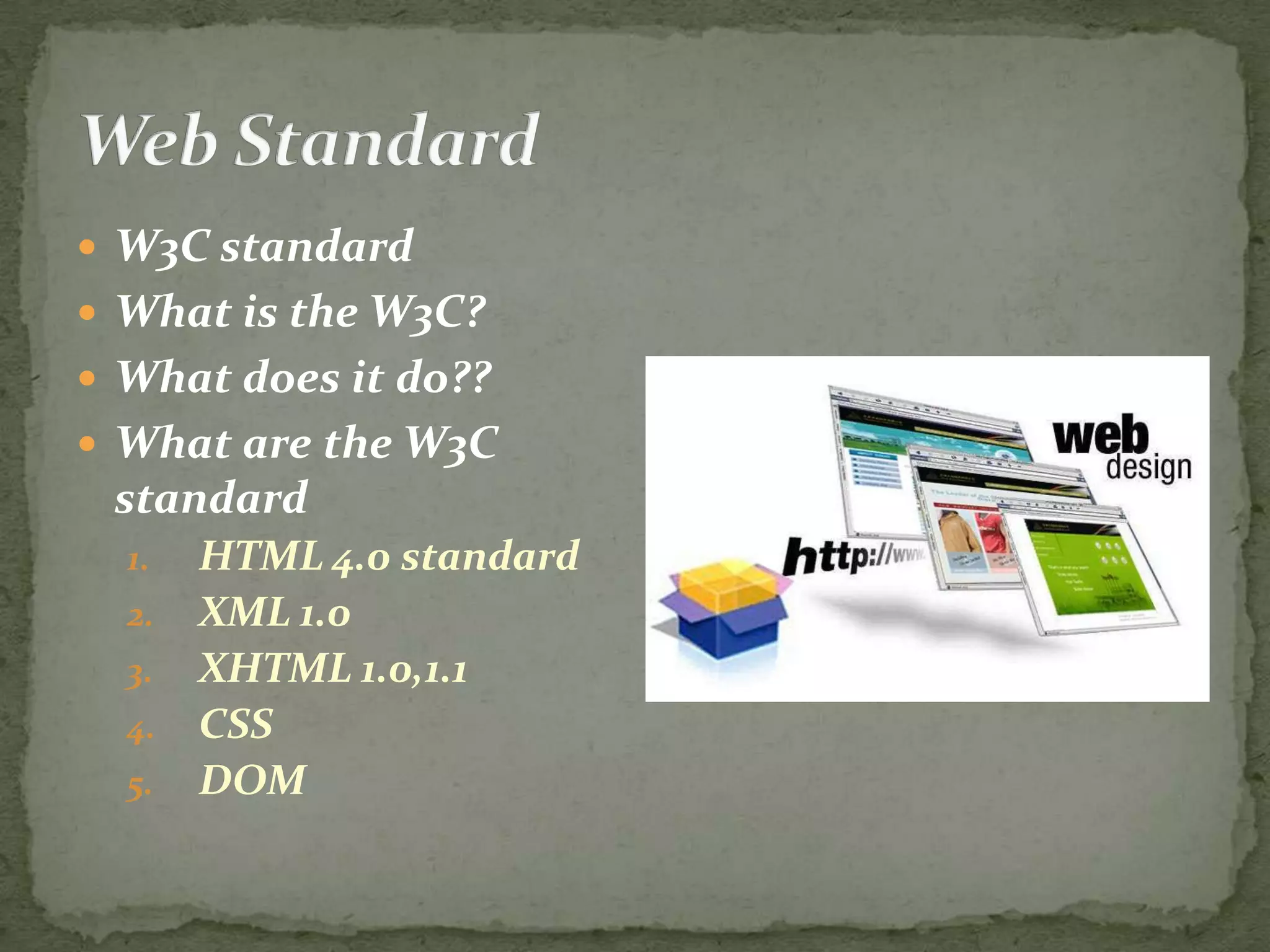
 W3C standard  What is the W3C?  What does it do??  What are the W3C standard 1. HTML 4.0 standard 2. XML 1.0 3. XHTML 1.0,1.1 4. CSS 5. DOM
 An Webpage is best thought as a set of VIRTUAL ELEMENTS (paragraphs,titles,tables,list,ima ges).  HTML(Hyper type Markup Language ) defines the structure and layout of elements of a Web page with a variety of TAGS.  Each tag may have a set of attributes that modify the appearance and layout of the virtual elements contained by the tag.
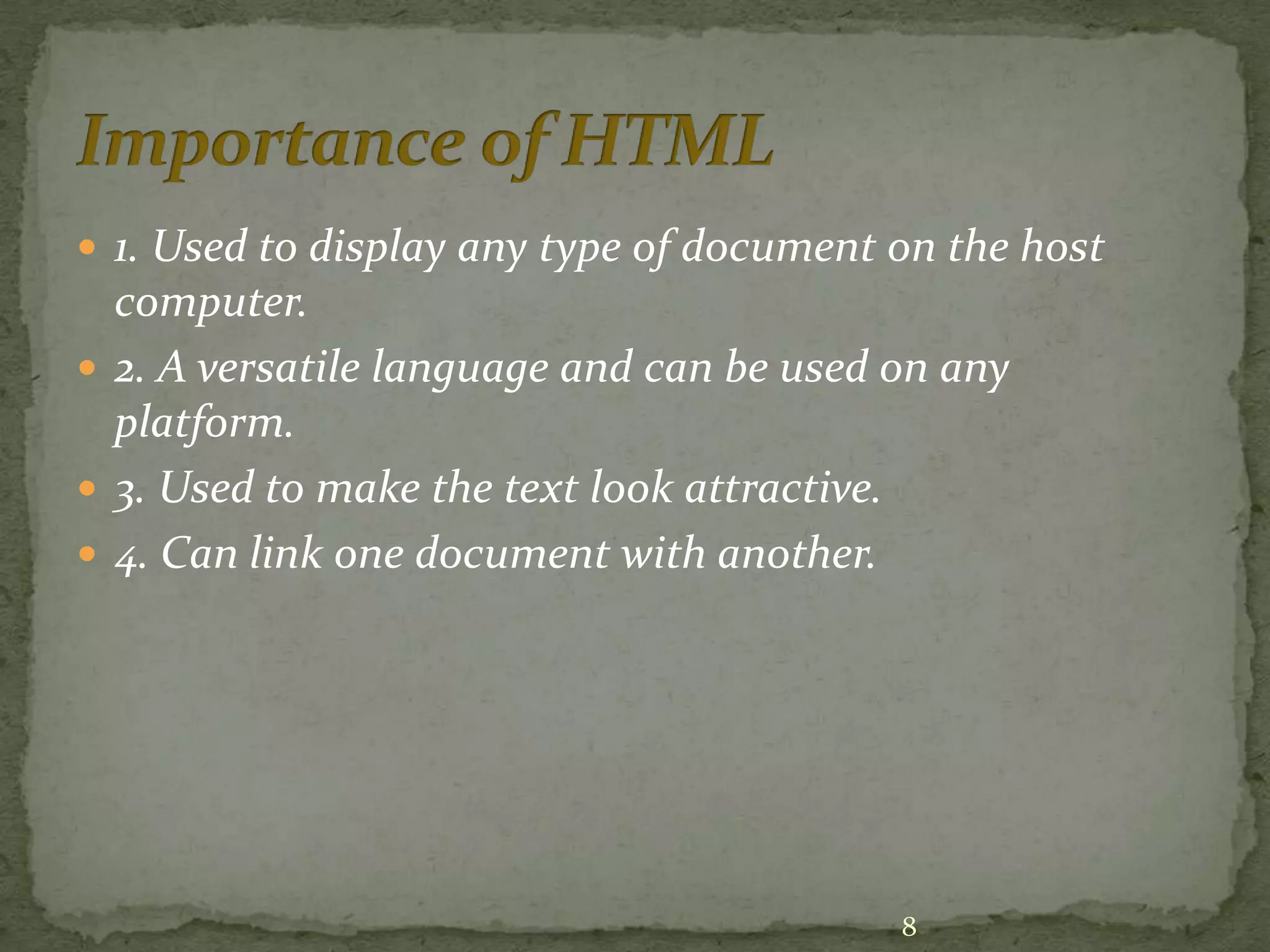
 BASIC STRUCTURE <!DOCTYPE html> <html> <body> <h1> My first Heading </h1> <p> My first paragraph </p> </body> </html>
 1. Used to display any type of document on the host computer.  2. A versatile language and can be used on any platform.  3. Used to make the text look attractive.  4. Can link one document with another. 8
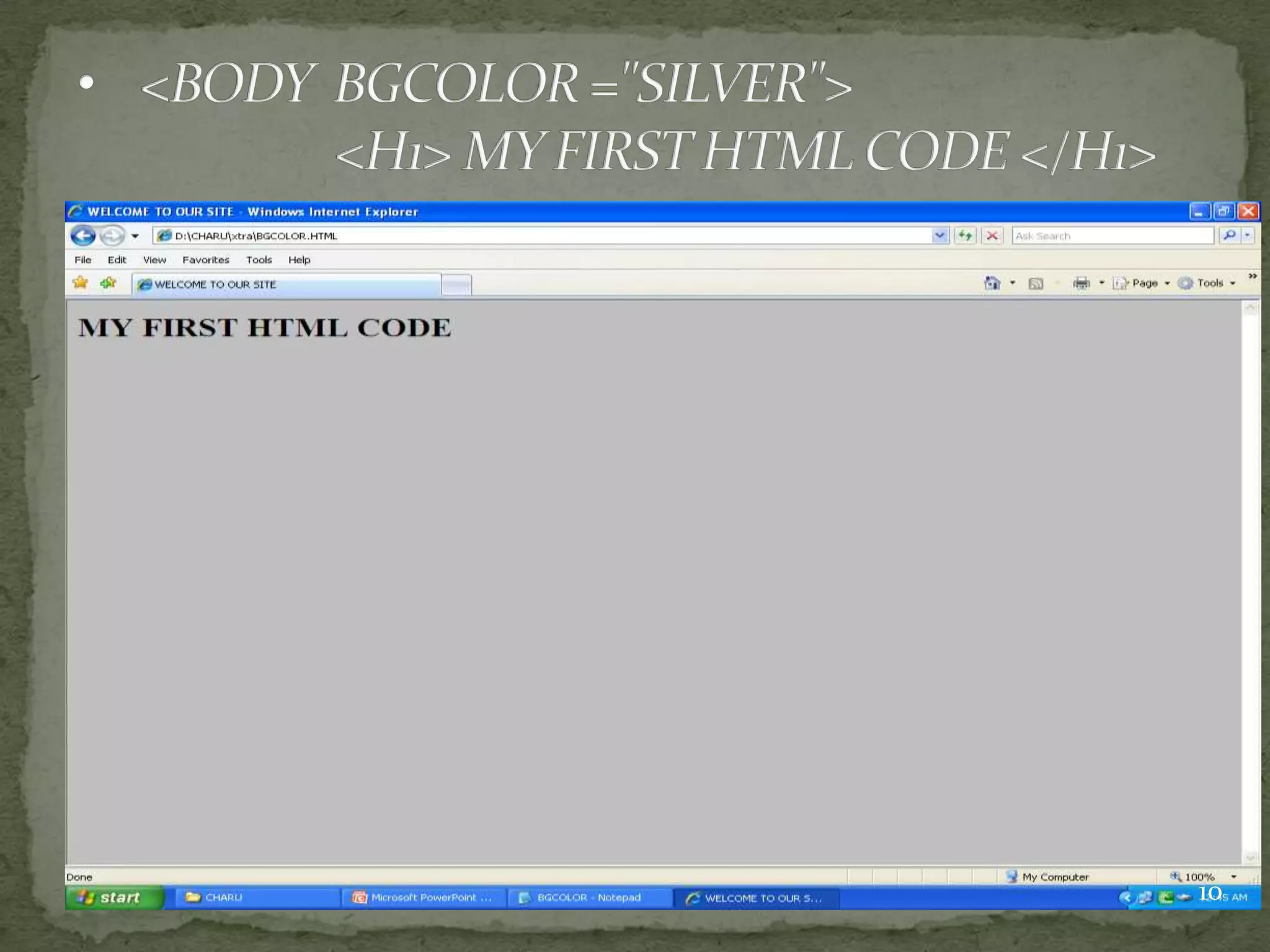
~ Background ~Bgcolor ~size ~font ~color ~Left margin ~Top margin….etc The above mentioned attributes are explained in the next section. 9
10
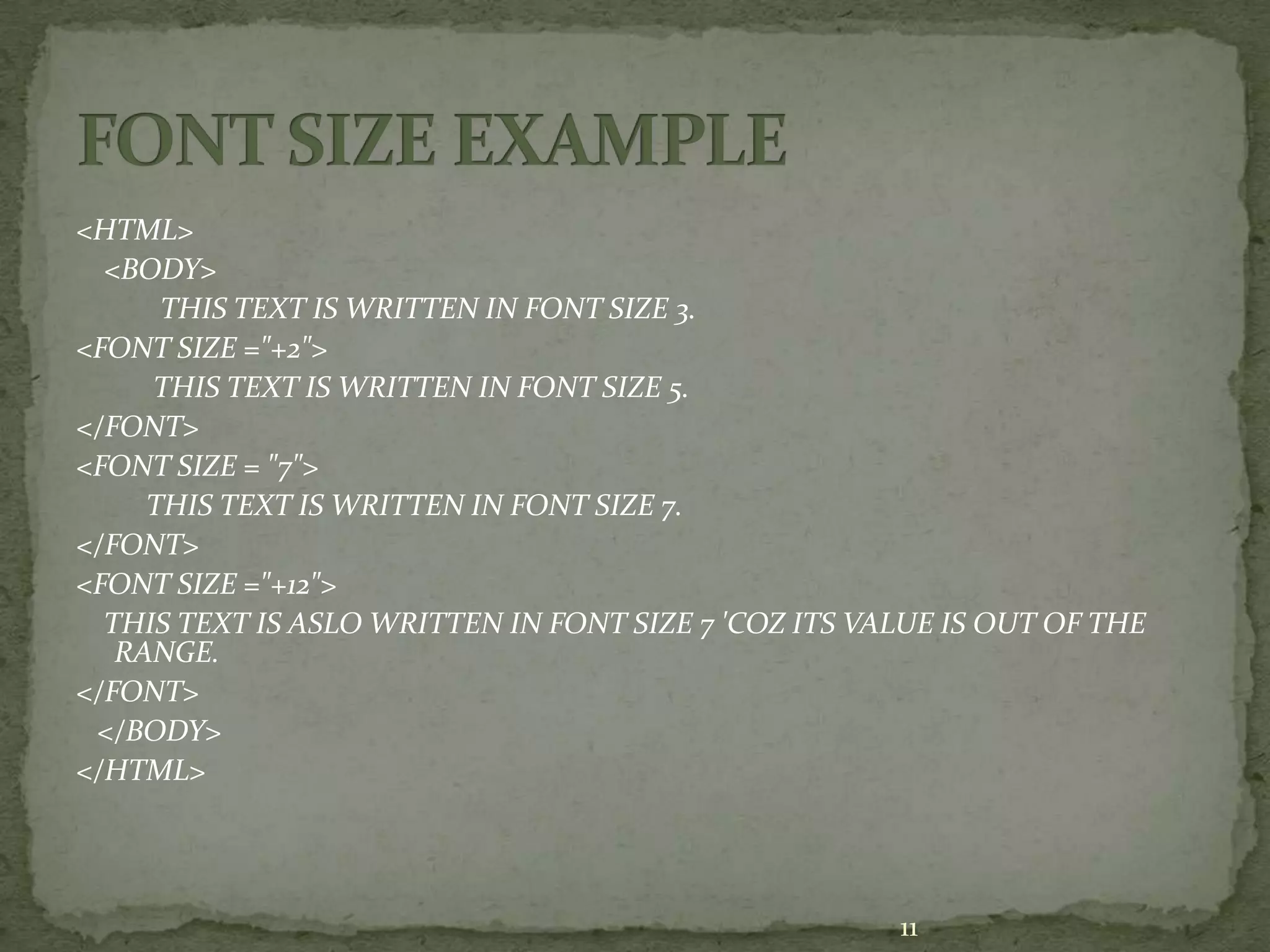
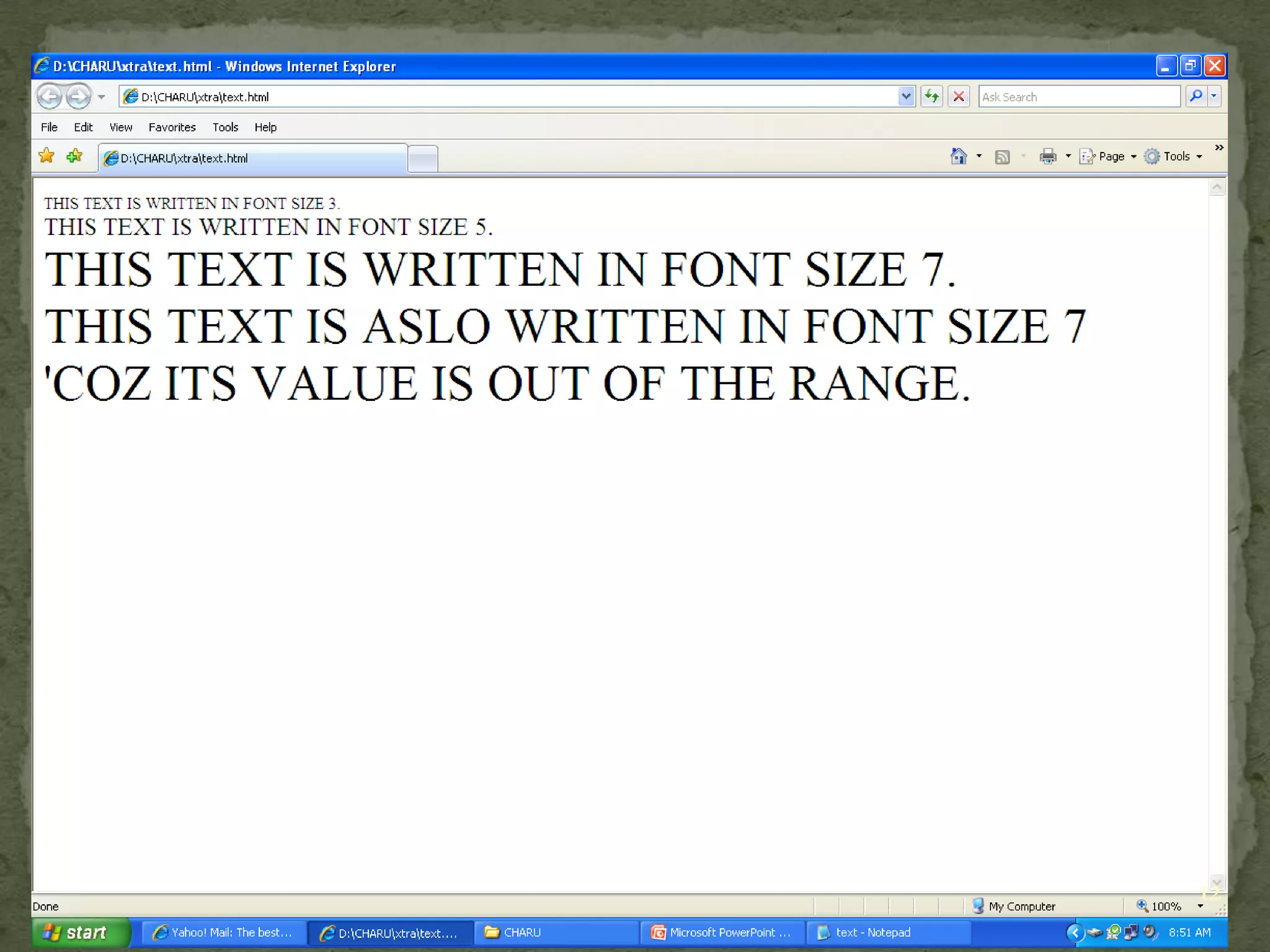
<HTML> <BODY> THIS TEXT IS WRITTEN IN FONT SIZE 3. <FONT SIZE ="+2"> THIS TEXT IS WRITTEN IN FONT SIZE 5. </FONT> <FONT SIZE = "7"> THIS TEXT IS WRITTEN IN FONT SIZE 7. </FONT> <FONT SIZE ="+12"> THIS TEXT IS ASLO WRITTEN IN FONT SIZE 7 'COZ ITS VALUE IS OUT OF THE RANGE. </FONT> </BODY> </HTML> 11
12
13
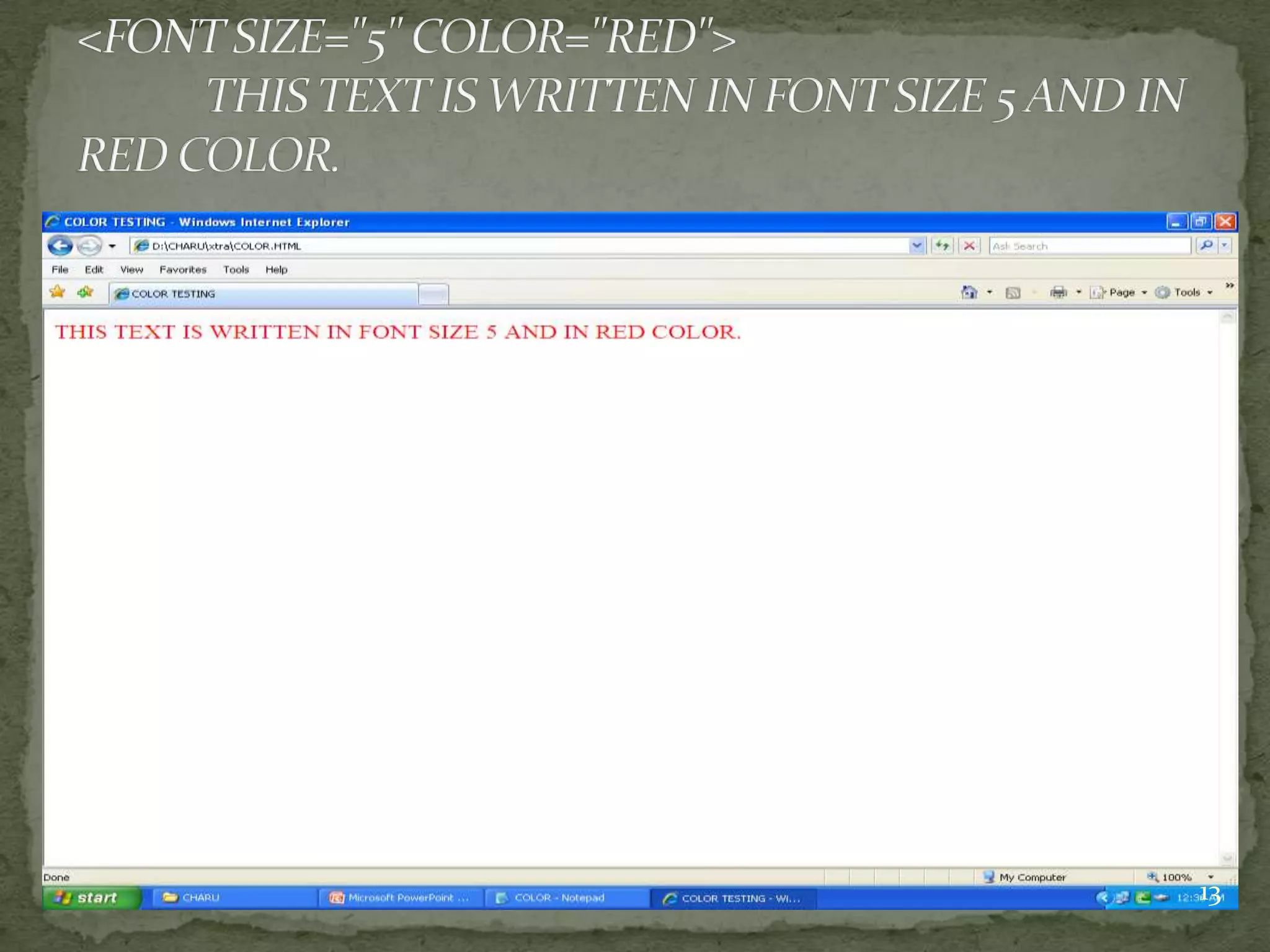
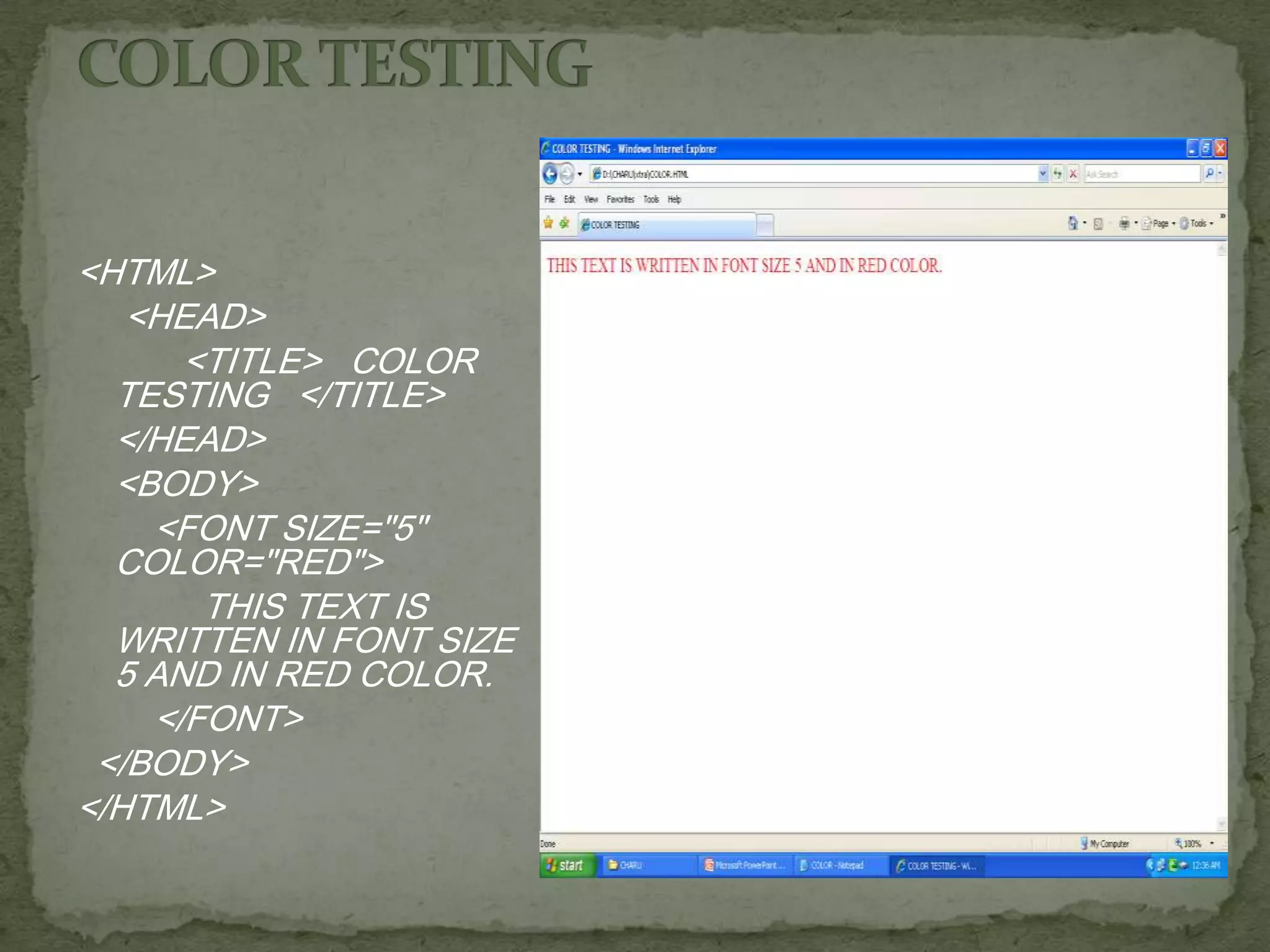
<HTML> <HEAD> <TITLE> COLOR TESTING </TITLE> </HEAD> <BODY> <FONT SIZE="5" COLOR="RED"> THIS TEXT IS WRITTEN IN FONT SIZE 5 AND IN RED COLOR. </FONT> </BODY> </HTML>
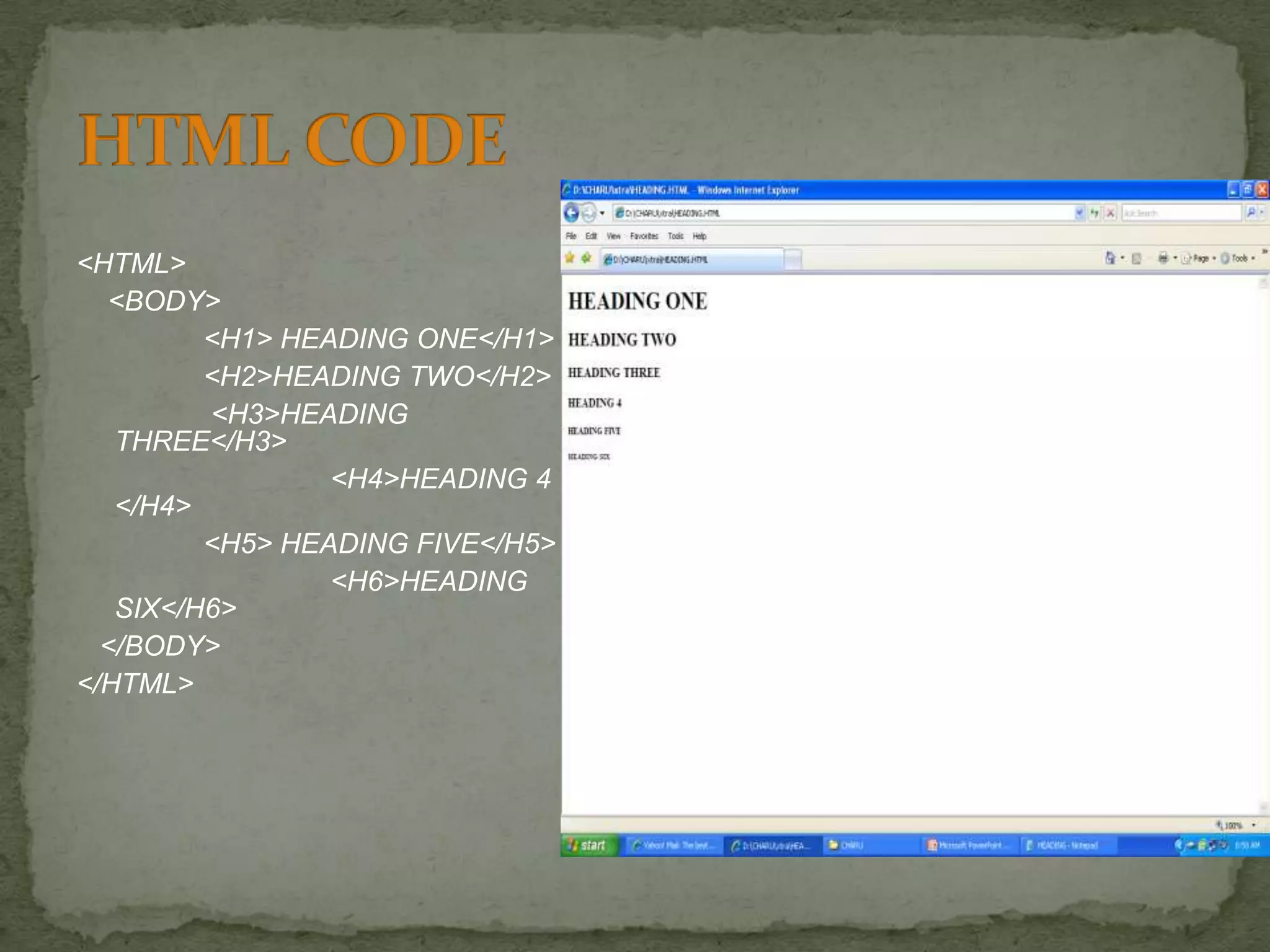
HTML defines six levels of heading. The heading element is written as: <Hn>………………………</Hn> Where n - level of heading and can take values from 1 to 6. H1 -- most prominent heading ,while H6 --least prominent heading. Headings are usually displayed in bolder and larger font than the normal text. NOTE: (From the example next)- An extra line is generally inserted above and below the heading.
<HTML> <BODY> <H1> HEADING ONE</H1> <H2>HEADING TWO</H2> <H3>HEADING THREE</H3> <H4>HEADING 4 </H4> <H5> HEADING FIVE</H5> <H6>HEADING SIX</H6> </BODY> </HTML>
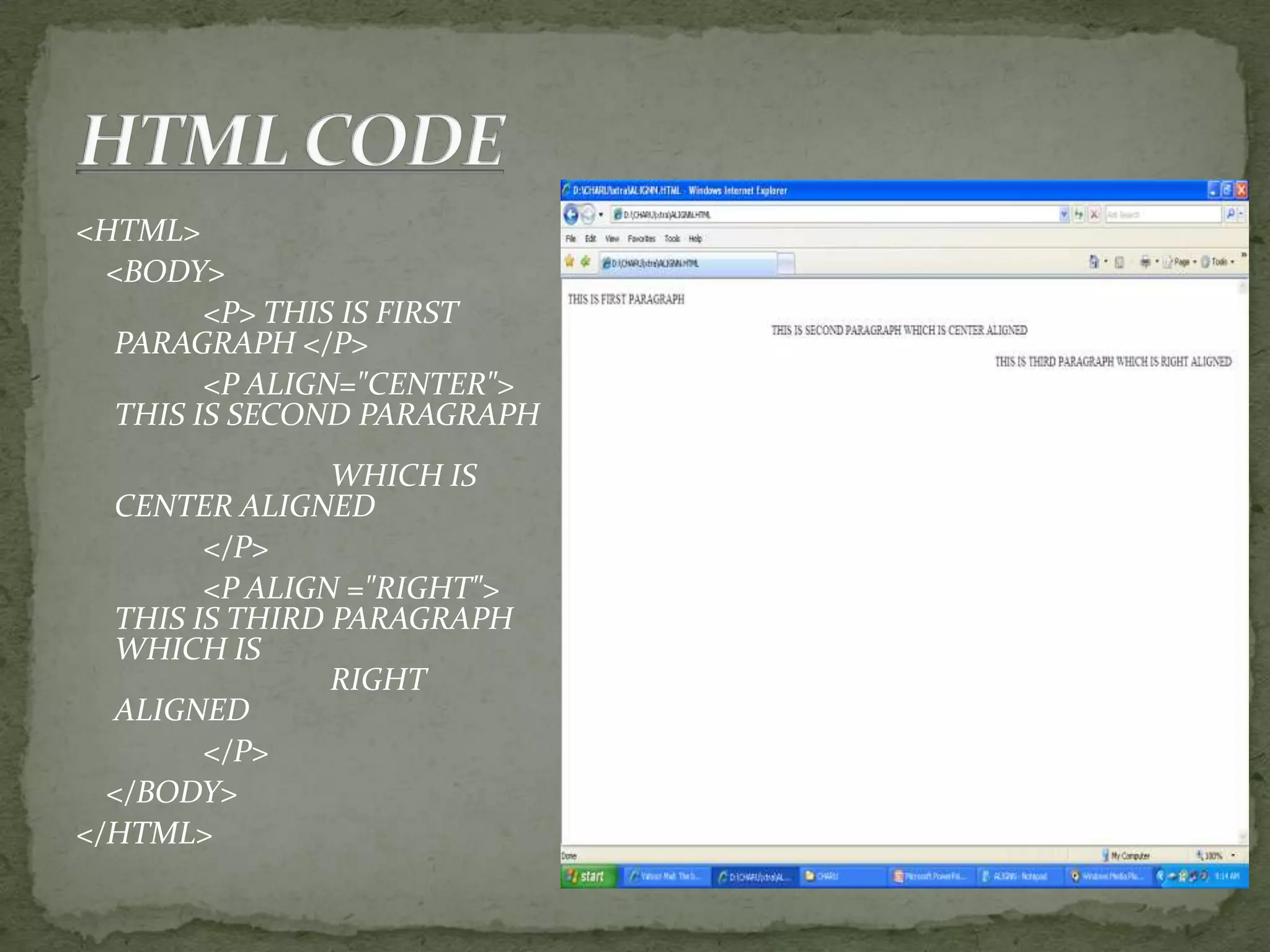
 The PARAGRAPH Element <P> indicates a paragraph.  The paragraph can be aligned by using the ALIGN attribute.  The ALIGN = LEFT/CENTER/RIGHT attribute can be added to the <H1> through to <H6> elements.  SYNTAX: <P> ……………………………..</P> <br>This element is used to insert a line break with extra space in the beginning.
<HTML> <BODY> <P> THIS IS FIRST PARAGRAPH </P> <P ALIGN="CENTER"> THIS IS SECOND PARAGRAPH WHICH IS CENTER ALIGNED </P> <P ALIGN ="RIGHT"> THIS IS THIRD PARAGRAPH WHICH IS RIGHT ALIGNED </P> </BODY> </HTML>
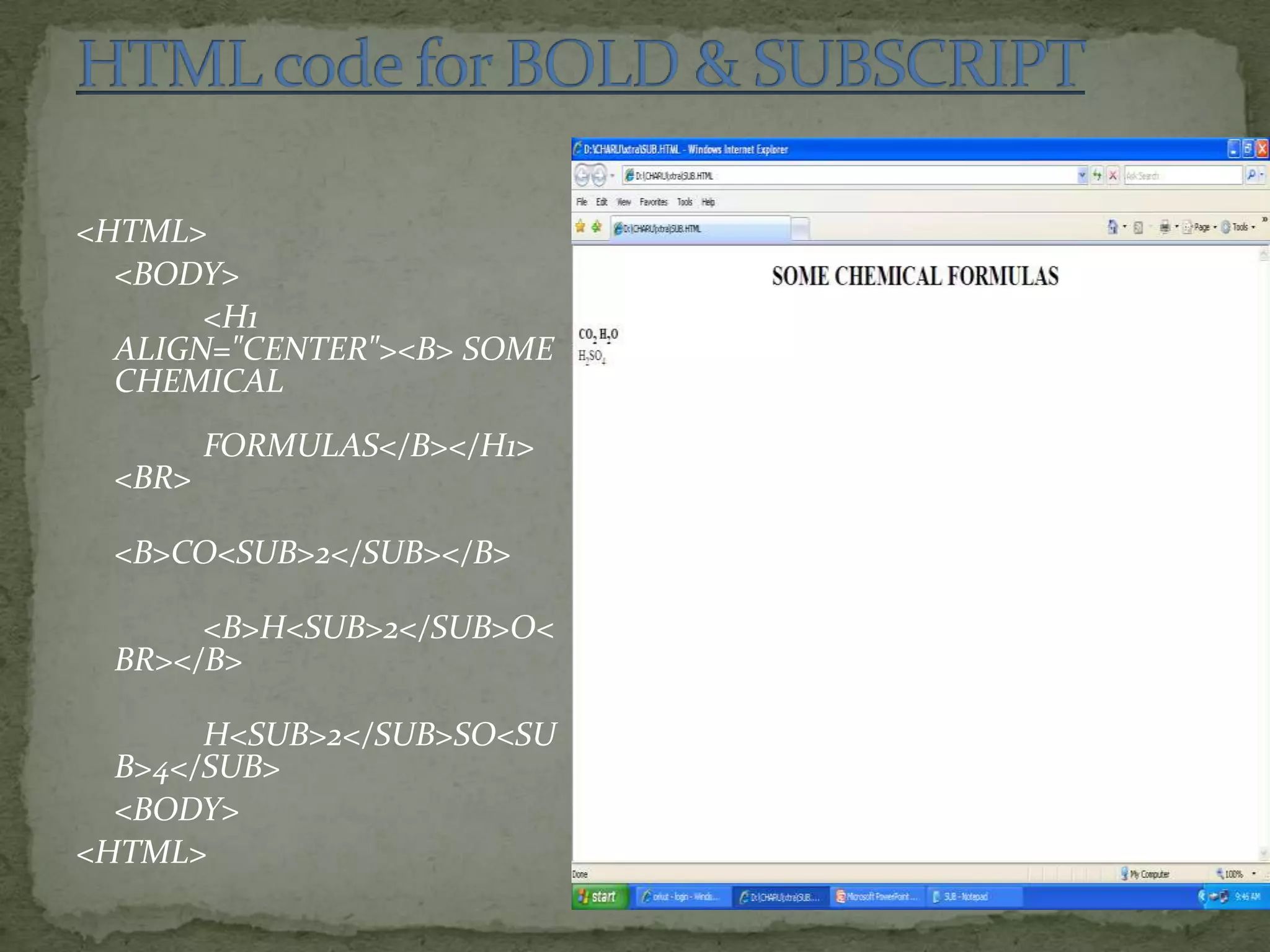
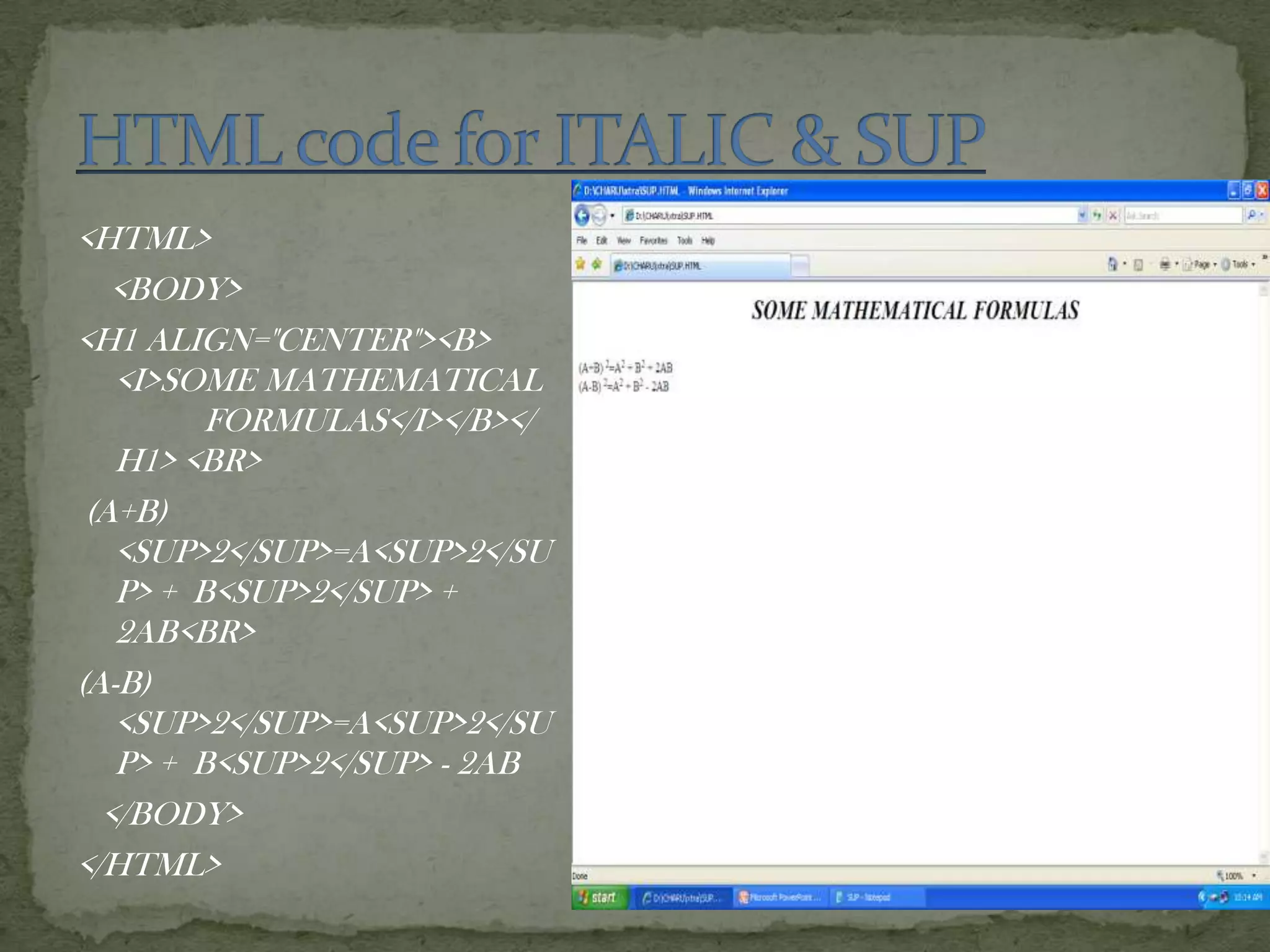
1. B (BOLD) Syntax: <B> ---------- </B> 2. I (ITALIC) Syntax: <I> ----------- </I> 3. SUB (Subscript) Syntax: <SUB> ---------- </SUB> 4. SUP (Super script) Syntax: <SUP> ---------- </SUP>
<HTML> <BODY> <H1 ALIGN="CENTER"><B> SOME CHEMICAL FORMULAS</B></H1> <BR> <B>CO<SUB>2</SUB></B> <B>H<SUB>2</SUB>O< BR></B> H<SUB>2</SUB>SO<SU B>4</SUB> <BODY> <HTML>
<HTML> <BODY> <H1 ALIGN="CENTER"><B> <I>SOME MATHEMATICAL FORMULAS</I></B></ H1> <BR> (A+B) <SUP>2</SUP>=A<SUP>2</SU P> + B<SUP>2</SUP> + 2AB<BR> (A-B) <SUP>2</SUP>=A<SUP>2</SU P> + B<SUP>2</SUP> - 2AB </BODY> </HTML>
 eXtensible Markup Language  Markup language for documents containing structured information  Defined by four specifications:  XML, the Extensible Markup Language  XLL, the Extensible Linking Language  XSL, the Extensible Style Language  XUA, the XML User Agent
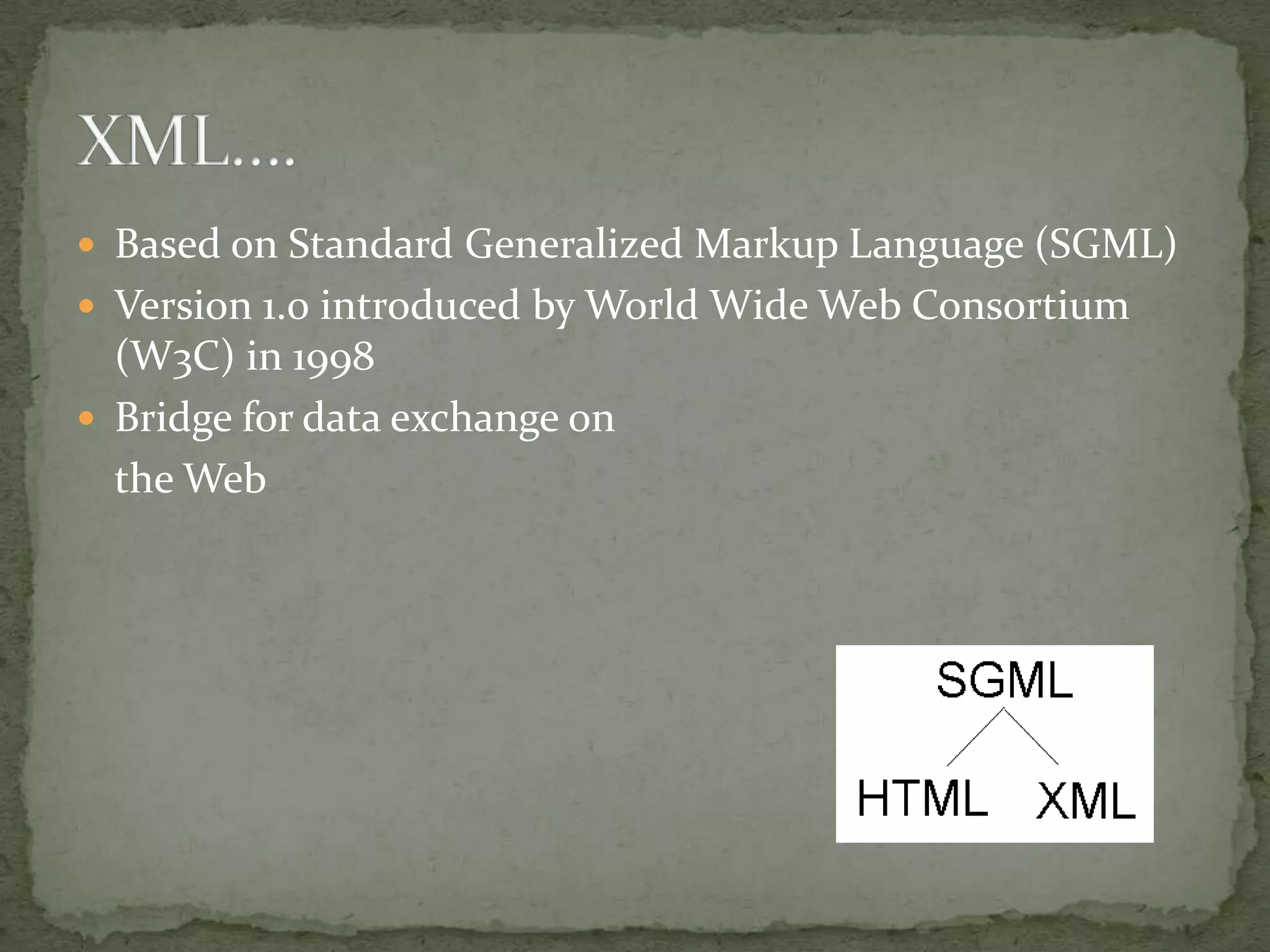
 Based on Standard Generalized Markup Language (SGML)  Version 1.0 introduced by World Wide Web Consortium (W3C) in 1998  Bridge for data exchange on the Web
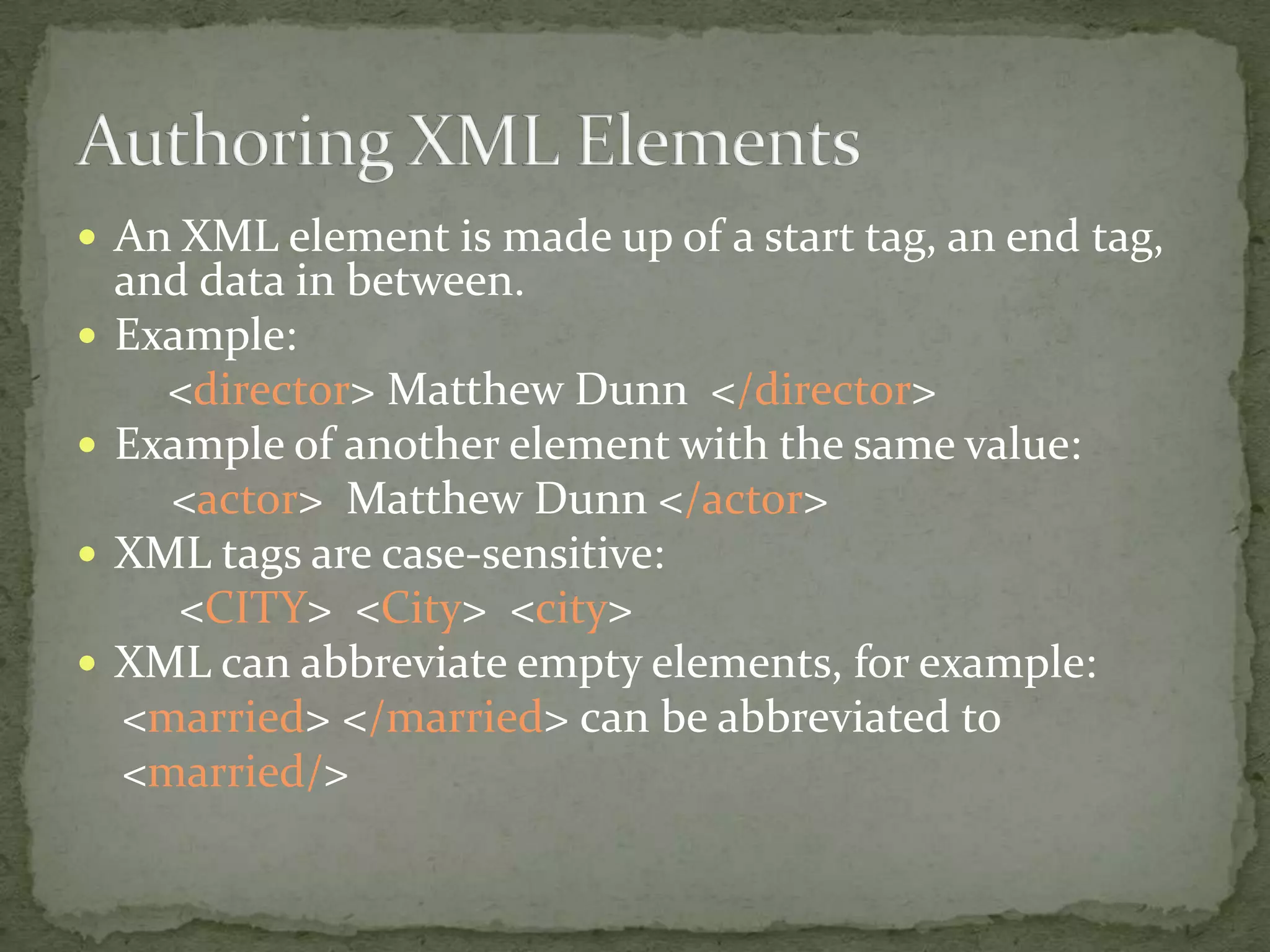
 An XML element is made up of a start tag, an end tag, and data in between.  Example: <director> Matthew Dunn </director>  Example of another element with the same value: <actor> Matthew Dunn </actor>  XML tags are case-sensitive: <CITY> <City> <city>  XML can abbreviate empty elements, for example: <married> </married> can be abbreviated to <married/>
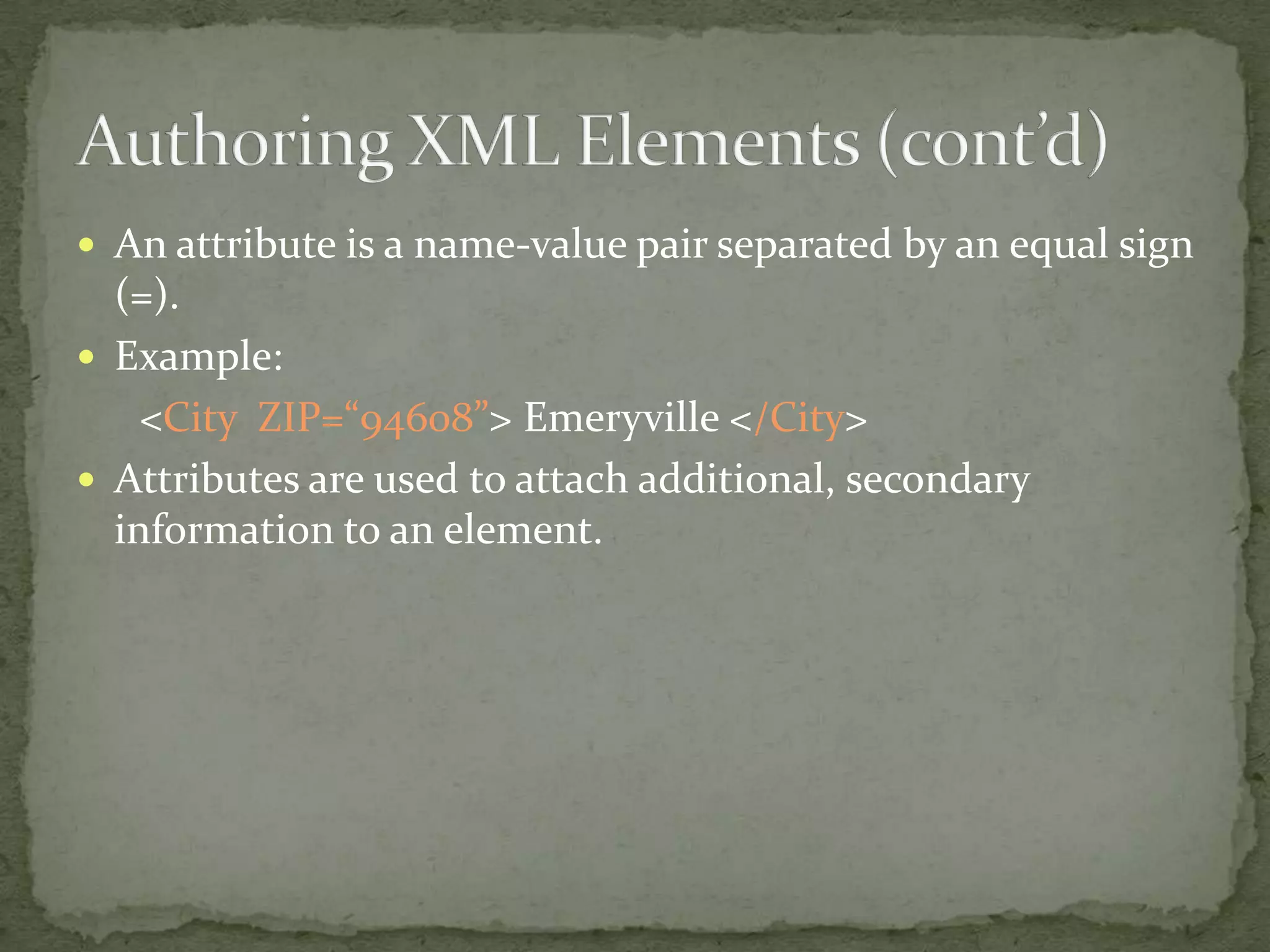
 An attribute is a name-value pair separated by an equal sign (=).  Example: <City ZIP=“94608”> Emeryville </City>  Attributes are used to attach additional, secondary information to an element.
 A basic XML document is an XML element that can, but might not, include nested XML elements.  Example: <books> <book isbn=“123”> <title> Second Chance </title> <author> Matthew Dunn </author> </book> </books>
 Authoring guidelines:  All elements must have an end tag.  All elements must be cleanly nested (overlapping elements are not allowed).  All attribute values must be enclosed in quotation marks.  Each document must have a unique first element, the root node.
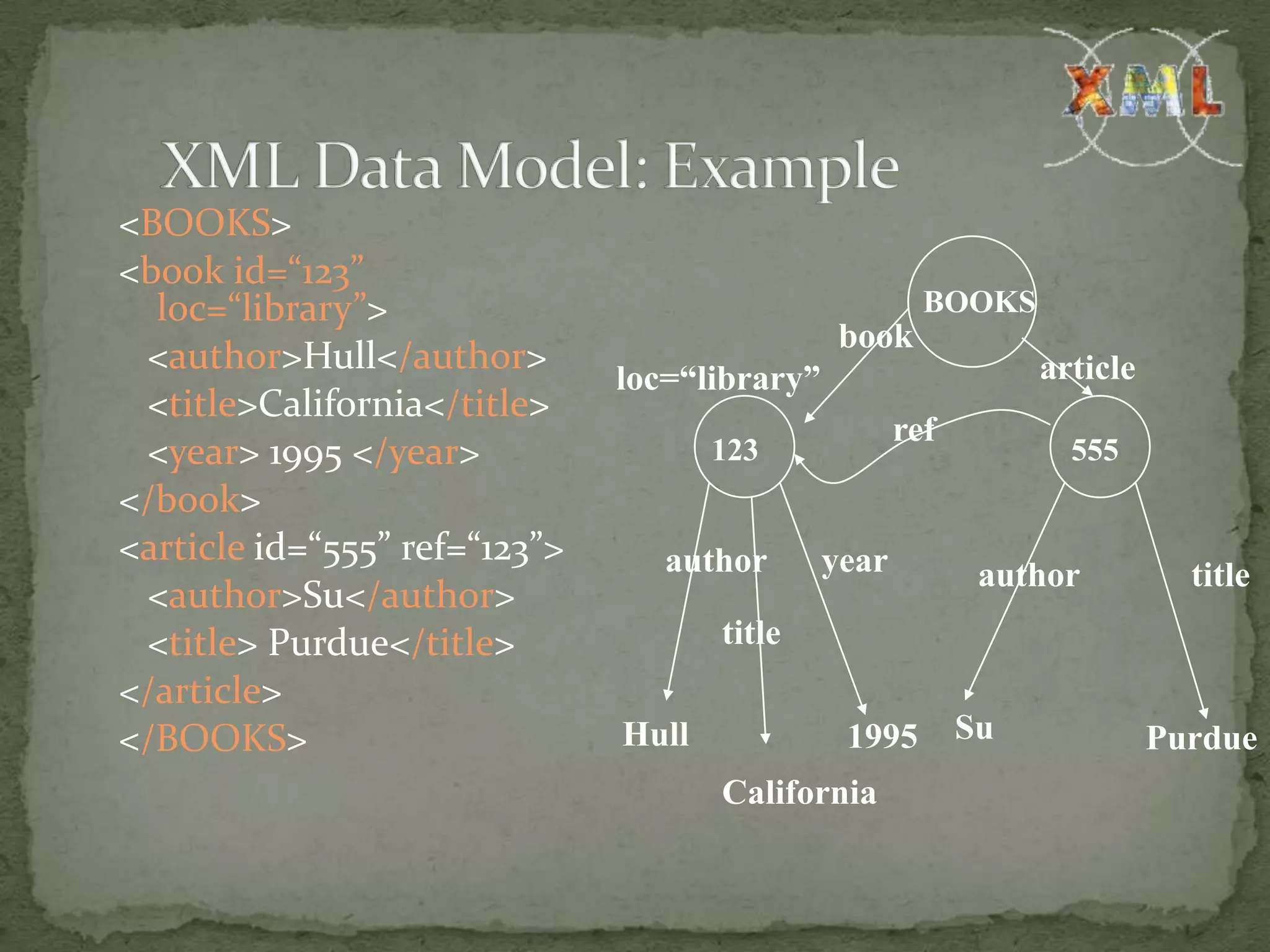
<BOOKS> <book id=“123” loc=“library”> BOOKS book <author>Hull</author> article loc=“library” <title>California</title> ref <year> 1995 </year> 123 555 </book> <article id=“555” ref=“123”> author year author title <author>Su</author> <title> Purdue</title> title </article> </BOOKS> Hull 1995 Su Purdue California
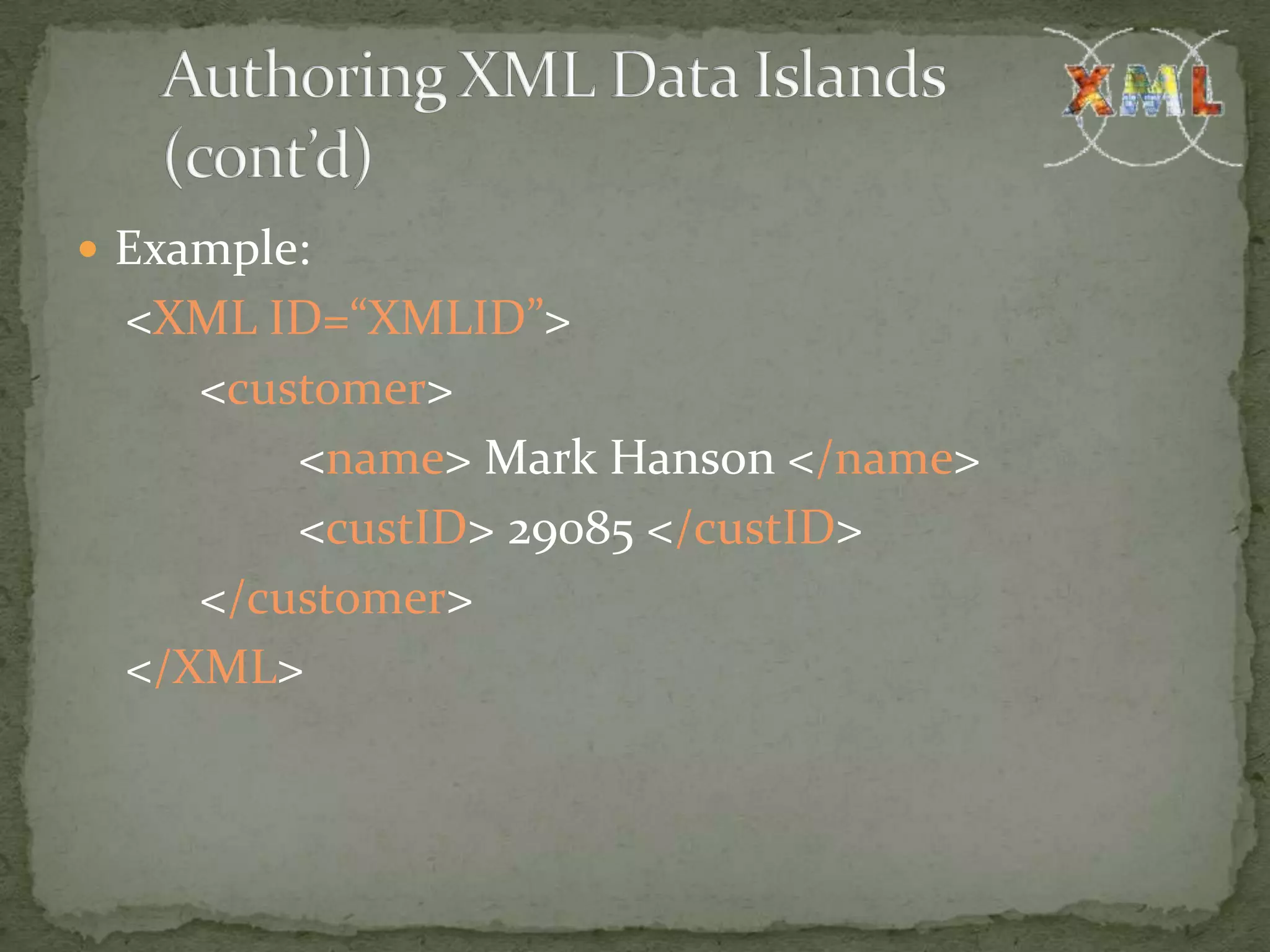
 A data island is an XML document that exists within an HTML page.  The <XML> element marks the beginning of the data island, and its ID attribute provides a name that you can use to reference the data island.
 Example: <XML ID=“XMLID”> <customer> <name> Mark Hanson </name> <custID> 29085 </custID> </customer> </XML>
 The first XML query languages  LOREL (Stanford)  XQL  Several other query languages have been developed (e.g. UNQL, XPath)  XML-QL considered by W3C for standardization  Currently W3C is considering and working on a new query language: XQuery
Developed at AT&T labs To extract data from the input XML data Has variables to which data is bound and templates which show how the output XML data is to be constructed Uses the XML syntax Based on a where/construct syntax  Where combines from and where parts of SQL  Construct corresponds to SQL’s select
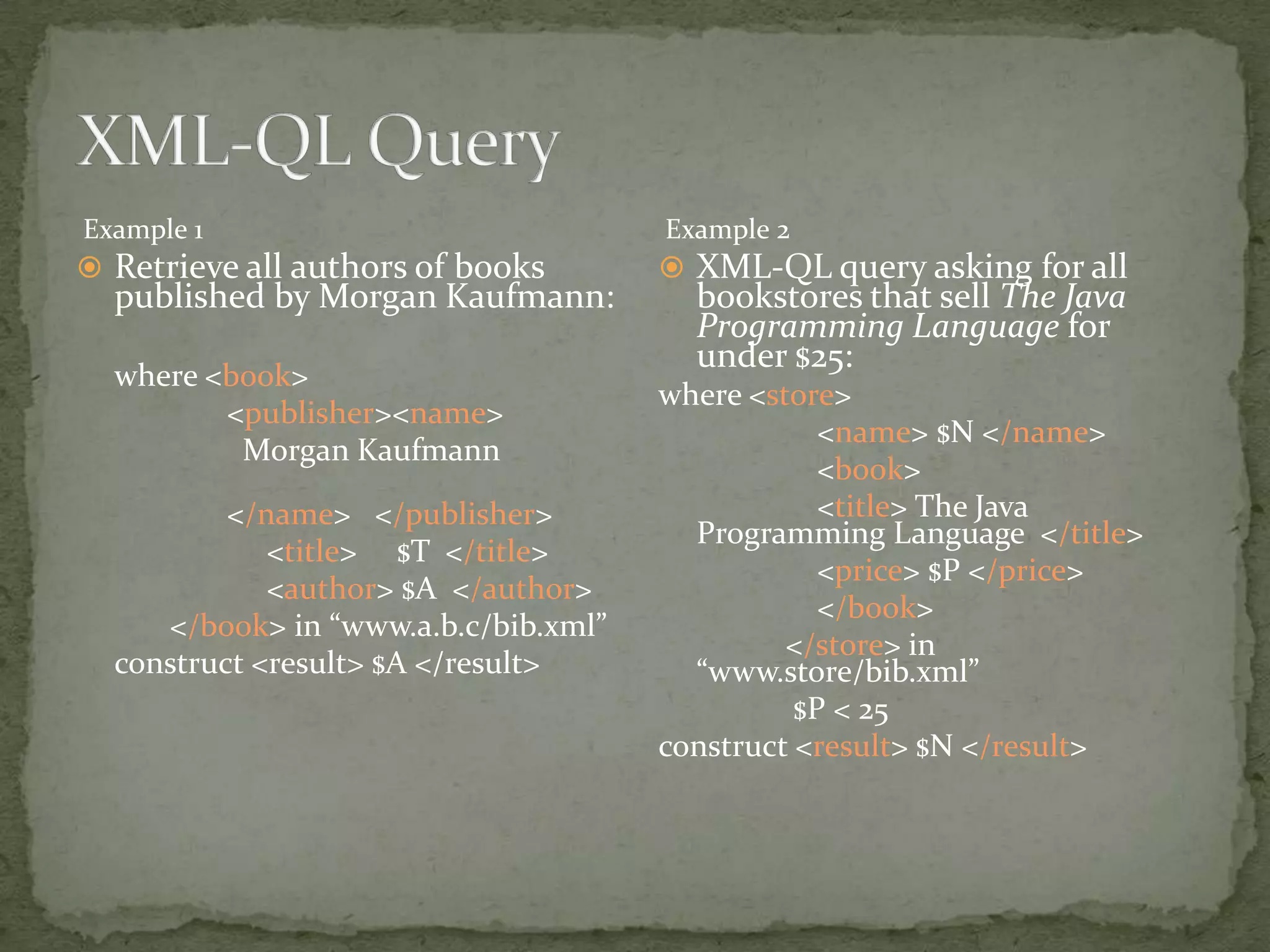
Example 1 Example 2  Retrieve all authors of books  XML-QL query asking for all published by Morgan Kaufmann: bookstores that sell The Java Programming Language for under $25: where <book> where <store> <publisher><name> <name> $N </name> Morgan Kaufmann <book> </name> </publisher> <title> The Java Programming Language </title> <title> $T </title> <price> $P </price> <author> $A </author> </book> </book> in “www.a.b.c/bib.xml” </store> in construct <result> $A </result> “www.store/bib.xml” $P < 25 construct <result> $N </result>
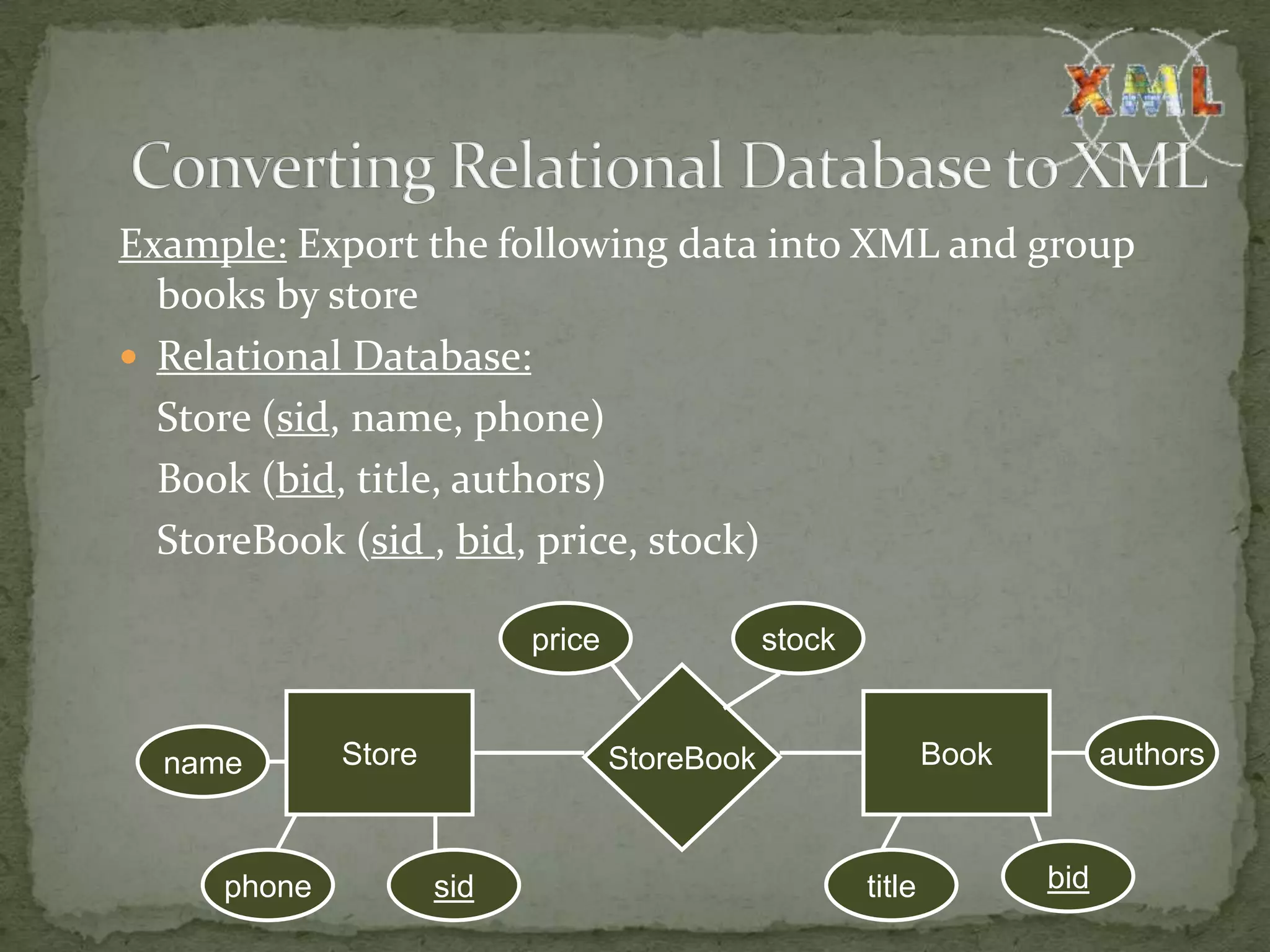
 Semi structured data is often encountered in data exchange and integration  At the sources the data may be structured (e.g. from relational databases)  A mediator is complex software component that integrates and transforms data from one or several sources using a declarative specification  Two main contexts:  Data conversion: converts data between two different models  e.g. by translating data from a relational database into XML  Data integration: integrates data from different sources into a common view
Example: Export the following data into XML and group books by store  Relational Database: Store (sid, name, phone) Book (bid, title, authors) StoreBook (sid , bid, price, stock) price stock name Store StoreBook Book authors phone sid title bid
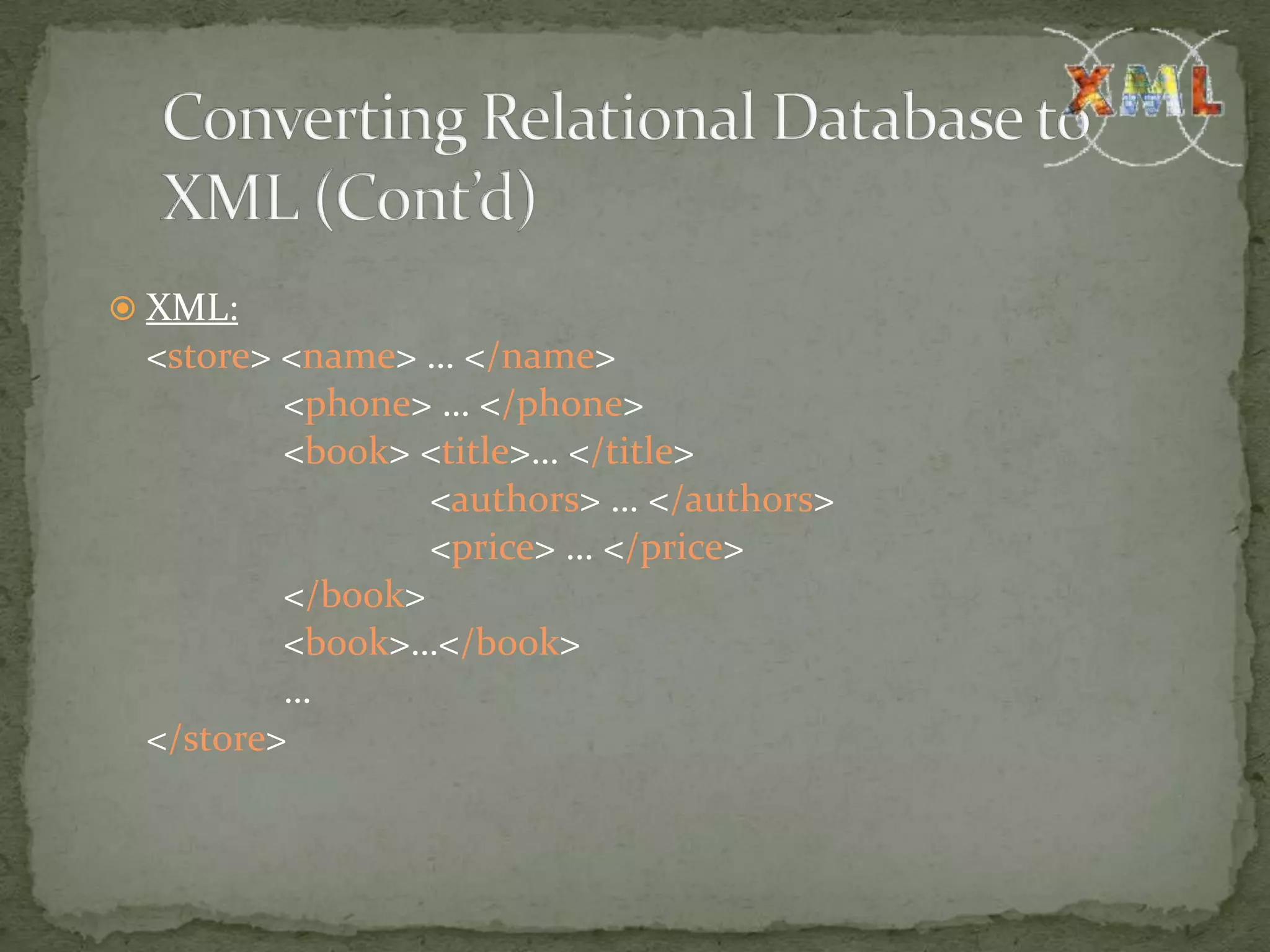
 XML: <store> <name> … </name> <phone> … </phone> <book> <title>… </title> <authors> … </authors> <price> … </price> </book> <book>…</book> … </store>
 Integration of data sharing  Security
XML HTML  XML fundamentally  HTML specifies separates contents (data presentation. and informati0n) from presentation.  XML allows tags and  HTML explicitly defines grammars to be used. a set of legal tags as well as grammar.
 BROWSER COMPATIBILITY  NAMING CONVENSIONS  QUALITY OF CONTENT  GRAPHICS AND IMAGES
Web page concept Basic

Web page concept Basic

  • 1.
    By Sukanya SenSharma and Shaishavi Kashikar MBICT College
  • 2.
     Introduction  1.Why Web Designing?  2.What And Why?  3.Web Standards  HTML  XML  Comparison
  • 3.
    Web design isthe practice of creating presentations of content (usually hypertext or hypermedia) that are delivered to an end-user through the Worldwide Web,using a Web browser or other Web-enabled software. The intent of web design is to create a website²a collection of electronic documents and applications that reside on a Webserver/servers. The website may include text, images, soundsand other content, and may be interactive.
  • 4.
     Why  Web designing – 1. First impression counts 3 important element 2. Professionalism 1. Colour and tone of 3. Competition website 2. Use of graphics 3. Quality of contents  What is the use of web designing 1. Marketing 2. Advertisement
  • 5.
     W3C standard What is the W3C?  What does it do??  What are the W3C standard 1. HTML 4.0 standard 2. XML 1.0 3. XHTML 1.0,1.1 4. CSS 5. DOM
  • 6.
     An Webpageis best thought as a set of VIRTUAL ELEMENTS (paragraphs,titles,tables,list,ima ges).  HTML(Hyper type Markup Language ) defines the structure and layout of elements of a Web page with a variety of TAGS.  Each tag may have a set of attributes that modify the appearance and layout of the virtual elements contained by the tag.
  • 7.
     BASIC STRUCTURE <!DOCTYPE html> <html> <body> <h1> My first Heading </h1> <p> My first paragraph </p> </body> </html>
  • 8.
     1. Usedto display any type of document on the host computer.  2. A versatile language and can be used on any platform.  3. Used to make the text look attractive.  4. Can link one document with another. 8
  • 9.
    ~ Background ~Bgcolor ~size ~font ~color ~Left margin ~Topmargin….etc The above mentioned attributes are explained in the next section. 9
  • 10.
  • 11.
    <HTML> <BODY> THIS TEXT IS WRITTEN IN FONT SIZE 3. <FONT SIZE ="+2"> THIS TEXT IS WRITTEN IN FONT SIZE 5. </FONT> <FONT SIZE = "7"> THIS TEXT IS WRITTEN IN FONT SIZE 7. </FONT> <FONT SIZE ="+12"> THIS TEXT IS ASLO WRITTEN IN FONT SIZE 7 'COZ ITS VALUE IS OUT OF THE RANGE. </FONT> </BODY> </HTML> 11
  • 12.
  • 13.
  • 14.
    <HTML> <HEAD> <TITLE> COLOR TESTING </TITLE> </HEAD> <BODY> <FONT SIZE="5" COLOR="RED"> THIS TEXT IS WRITTEN IN FONT SIZE 5 AND IN RED COLOR. </FONT> </BODY> </HTML>
  • 15.
    HTML defines sixlevels of heading. The heading element is written as: <Hn>………………………</Hn> Where n - level of heading and can take values from 1 to 6. H1 -- most prominent heading ,while H6 --least prominent heading. Headings are usually displayed in bolder and larger font than the normal text. NOTE: (From the example next)- An extra line is generally inserted above and below the heading.
  • 16.
    <HTML> <BODY> <H1> HEADING ONE</H1> <H2>HEADING TWO</H2> <H3>HEADING THREE</H3> <H4>HEADING 4 </H4> <H5> HEADING FIVE</H5> <H6>HEADING SIX</H6> </BODY> </HTML>
  • 17.
     The PARAGRAPHElement <P> indicates a paragraph.  The paragraph can be aligned by using the ALIGN attribute.  The ALIGN = LEFT/CENTER/RIGHT attribute can be added to the <H1> through to <H6> elements.  SYNTAX: <P> ……………………………..</P> <br>This element is used to insert a line break with extra space in the beginning.
  • 18.
    <HTML> <BODY> <P> THIS IS FIRST PARAGRAPH </P> <P ALIGN="CENTER"> THIS IS SECOND PARAGRAPH WHICH IS CENTER ALIGNED </P> <P ALIGN ="RIGHT"> THIS IS THIRD PARAGRAPH WHICH IS RIGHT ALIGNED </P> </BODY> </HTML>
  • 19.
    1. B(BOLD) Syntax: <B> ---------- </B> 2. I (ITALIC) Syntax: <I> ----------- </I> 3. SUB (Subscript) Syntax: <SUB> ---------- </SUB> 4. SUP (Super script) Syntax: <SUP> ---------- </SUP>
  • 20.
    <HTML> <BODY> <H1 ALIGN="CENTER"><B> SOME CHEMICAL FORMULAS</B></H1> <BR> <B>CO<SUB>2</SUB></B> <B>H<SUB>2</SUB>O< BR></B> H<SUB>2</SUB>SO<SU B>4</SUB> <BODY> <HTML>
  • 21.
    <HTML> <BODY> <H1 ALIGN="CENTER"><B> <I>SOME MATHEMATICAL FORMULAS</I></B></ H1> <BR> (A+B) <SUP>2</SUP>=A<SUP>2</SU P> + B<SUP>2</SUP> + 2AB<BR> (A-B) <SUP>2</SUP>=A<SUP>2</SU P> + B<SUP>2</SUP> - 2AB </BODY> </HTML>
  • 22.
     eXtensible MarkupLanguage  Markup language for documents containing structured information  Defined by four specifications:  XML, the Extensible Markup Language  XLL, the Extensible Linking Language  XSL, the Extensible Style Language  XUA, the XML User Agent
  • 23.
     Based onStandard Generalized Markup Language (SGML)  Version 1.0 introduced by World Wide Web Consortium (W3C) in 1998  Bridge for data exchange on the Web
  • 24.
     An XMLelement is made up of a start tag, an end tag, and data in between.  Example: <director> Matthew Dunn </director>  Example of another element with the same value: <actor> Matthew Dunn </actor>  XML tags are case-sensitive: <CITY> <City> <city>  XML can abbreviate empty elements, for example: <married> </married> can be abbreviated to <married/>
  • 25.
     An attributeis a name-value pair separated by an equal sign (=).  Example: <City ZIP=“94608”> Emeryville </City>  Attributes are used to attach additional, secondary information to an element.
  • 26.
     A basicXML document is an XML element that can, but might not, include nested XML elements.  Example: <books> <book isbn=“123”> <title> Second Chance </title> <author> Matthew Dunn </author> </book> </books>
  • 27.
     Authoring guidelines:  All elements must have an end tag.  All elements must be cleanly nested (overlapping elements are not allowed).  All attribute values must be enclosed in quotation marks.  Each document must have a unique first element, the root node.
  • 28.
    <BOOKS> <book id=“123” loc=“library”> BOOKS book <author>Hull</author> article loc=“library” <title>California</title> ref <year> 1995 </year> 123 555 </book> <article id=“555” ref=“123”> author year author title <author>Su</author> <title> Purdue</title> title </article> </BOOKS> Hull 1995 Su Purdue California
  • 29.
     A dataisland is an XML document that exists within an HTML page.  The <XML> element marks the beginning of the data island, and its ID attribute provides a name that you can use to reference the data island.
  • 30.
     Example: <XML ID=“XMLID”> <customer> <name> Mark Hanson </name> <custID> 29085 </custID> </customer> </XML>
  • 31.
     The firstXML query languages  LOREL (Stanford)  XQL  Several other query languages have been developed (e.g. UNQL, XPath)  XML-QL considered by W3C for standardization  Currently W3C is considering and working on a new query language: XQuery
  • 32.
    Developed at AT&Tlabs To extract data from the input XML data Has variables to which data is bound and templates which show how the output XML data is to be constructed Uses the XML syntax Based on a where/construct syntax  Where combines from and where parts of SQL  Construct corresponds to SQL’s select
  • 33.
    Example 1 Example 2  Retrieve all authors of books  XML-QL query asking for all published by Morgan Kaufmann: bookstores that sell The Java Programming Language for under $25: where <book> where <store> <publisher><name> <name> $N </name> Morgan Kaufmann <book> </name> </publisher> <title> The Java Programming Language </title> <title> $T </title> <price> $P </price> <author> $A </author> </book> </book> in “www.a.b.c/bib.xml” </store> in construct <result> $A </result> “www.store/bib.xml” $P < 25 construct <result> $N </result>
  • 34.
     Semi structureddata is often encountered in data exchange and integration  At the sources the data may be structured (e.g. from relational databases)  A mediator is complex software component that integrates and transforms data from one or several sources using a declarative specification  Two main contexts:  Data conversion: converts data between two different models  e.g. by translating data from a relational database into XML  Data integration: integrates data from different sources into a common view
  • 35.
    Example: Export thefollowing data into XML and group books by store  Relational Database: Store (sid, name, phone) Book (bid, title, authors) StoreBook (sid , bid, price, stock) price stock name Store StoreBook Book authors phone sid title bid
  • 36.
     XML: <store><name> … </name> <phone> … </phone> <book> <title>… </title> <authors> … </authors> <price> … </price> </book> <book>…</book> … </store>
  • 37.
     Integration ofdata sharing  Security
  • 38.
    XML HTML  XML fundamentally  HTML specifies separates contents (data presentation. and informati0n) from presentation.  XML allows tags and  HTML explicitly defines grammars to be used. a set of legal tags as well as grammar.
  • 39.
     BROWSER COMPATIBILITY NAMING CONVENSIONS  QUALITY OF CONTENT  GRAPHICS AND IMAGES